

Introduction
The presence of scandium in epidote-supergroup minerals is very poorly documented in the scientific literature. In routine petrological studies these minerals are not usually tested for the presence of this element. Frei et al. (Reference Frei, Liebscher, Franz, Dulski, Liebscher and Franz2004) reviewed the available data and concluded that although epidote-supergroup minerals seem to be enriched in Sc compared to their host rocks, there is no compelling evidence that natural Sc-rich epidotes exist. To the best of our knowledge, the only reports on epidote-supergroup minerals with significant contents of Sc concern allanite-group minerals, i.e. dissakisite-(Ce) with up to 1.0 wt.% Sc2O3 from a pegmatite at Impilakhti, Finland (Meyer, Reference Meyer1911) and allanite-(Ce) with up to 0.5 wt.% Sc2O3 from the Crystal Mountains, Montana, USA (Foord et al., Reference Foord, Birmingham, Demartin, Pilati, Gramaccioli and Lichte1993), 2–5 wt.% Sc2O3 from the Heftetjern pegmatite, Norway (Raade and Kristiansen, Reference Raade and Kristiansen2000; Kristiansen, Reference Kristiansen2009), and up to 3.26 wt.% Sc2O3 from the Kracovice pegmatite, Moldanubian Zone, Czech Republic (Čopjaková et al., Reference Čopjaková, Škoda, Vašinová Galiová, Novák and Cempírek2015). Recently, during a systematic investigation of Sc mineralisation in a serpentinite-hosted granitic pegmatite at Jordanów Śląski, Lower Silesia, Poland, Sc-enriched epidote-supergroup minerals containing up to 9.54 wt.% Sc2O3 were discovered. In the Jordanów Śląski pegmatite, crystals with the highest Sc contents represent a Sc-analogue of clinozoisite and epidote, which has been approved by the Commission on New Minerals, Nomenclature and Classification of the International Mineralogical Association under the name heflikite (mineral symbol – Hfk), the first Sc-dominant member of the epidote supergroup (IMA2022-139, Pieczka et al., Reference Pieczka, Kristiansen, Stachowicz, Dumańska-Słowik, Gołębiowska, Sęk, Nejbert, Kotowski, Marciniak-Maliszewska, Szuszkiewicz, Szełęg and Woźniak2023). Crystals with Sc2O3 contents lower than ~4.5–5.0 wt.% represent Sc-rich allanite-(Ce) or Sc-rich clinozoisite. Similar mineralisation, with Sc-bearing members of the epidote–allanite-(Ce) solid-solution series locally evolving to heflikite, is known from the Heftetjern pegmatite, Telemark, Norway (samples of Roy Kristiansen) that is a cotype locality for the mineral (Raade and Kristiansen, Reference Raade and Kristiansen2000; Kristiansen, Reference Kristiansen2009). The purpose of this paper is to report the characteristics of the new mineral heflikite.
Heflikite is isostructural with monoclinic epidote-supergroup minerals and is related to clinozoisite, Ca2(M1AlM2AlM3Al)(Si2O7)(SiO4)O(OH), and epidote, Ca2(M1AlM2AlM3Fe3+)(Si2O7)(SiO4)O(OH), by isovalent substitutions M3Sc3+ → M3Al and M3Sc3+ → M3Fe3+, respectively. In the classification of Strunz and Nickel (Reference Strunz and Nickel2001), the mineral belongs to subgroup 9.BG. Sorosilicates with mixed SiO4 and Si2O7 groups; cations in octahedral and greater coordination. In the classification of Dana (Gaines et al., Reference Gaines, Skinner, Foord, Mason and Rosenzweig1997), it belongs to class 52.2.1a Nesosilicates: Insular, mixed, single, and larger tetrahedral groups with cations in [6] and higher coordination; single and double groups (n = 1, 2). The name of the mineral honours Wiesław Heflik (born in 1932), an Emeritus Professor at the Faculty of Geology, Geophysics, and Environmental Protection, AGH University in Kraków, Poland, for his significant contribution to Polish mineralogy, gemology and petrology. He is one of the founding members of the Mineralogical Society of Poland and the Polish Gemological Society. Wiesław Heflik was also the first researcher to study in detail mineral parageneses of the Jordanów Śląski leucocratic rocks.
Holotype heflikite (specimen J11 from Jordanów Śląski) is deposited in the Mineralogical Museum at the University of Wrocław, with the catalogue number MMUWr IV8120. The postal address of the museum is as follows: University of Wrocław, Faculty of Earth Science and Environmental Management, Institute of Geological Sciences, Mineralogical Museum, Cybulskiego 30, 50-205 Wrocław, Poland. The cotype specimen (specimen N5, Heftetjern pegmatite, Tørdal, Telemark, Norway) is deposited in the Natural History Museum, University of Oslo, Norway, with the catalogue number KNR 44407.
Occurrence
Heflikite was discovered in a granitic pegmatite from a serpentinite quarry situated ~1 km west of the Jordanów Śląski village, ~30 km south of Wrocław, Lower Silesia, SW Poland (50.87111°N, 16.83833°E). The quarry is located in the eastern part of the Gogołów-Jordanów Serpentinite Massif, an ultramafic member of the Variscan Ślęża Ophiolite, at the northeastern periphery of the Bohemian Massif in the European Variscides. The Ślęża Ophiolite is a part of the ~400 Ma assemblage of Central Sudetic ophiolites formed in a supra-subduction setting during the amalgamation of Pangea (e.g. Pin et al., Reference Pin, Majerowicz and Wojciechowska1988; Dubińska et al., Reference Dubińska, Bylina, Kozłowski, Dörr, Nejbert, Schastok and Kulicki2004; Kryza and Pin, Reference Kryza and Pin2010; Awdankiewicz et al., Reference Awdankiewicz, Kryza, Turniak, Ovtcharova and Schaltegger2021; Wojtulek et al., Reference Wojtulek, Schulz, Klemd, Gil, Dajek and Delura2021). Together with the mafic members of the Ślęża Ophiolite exposed to the north and north-west, the serpentinites were subjected to regional greenschist- to lower amphibolite-facies metamorphism.
Small-sized dykes of plagiogranitic appearance and bodies of rodingite-like calc-silicate rocks are distributed randomly in the Gogołów–Jordanów Serpentinite Massif. The latter occur usually as tectonic inclusions in sheared and sometimes also brecciated serpentinites and represent two genetic groups, i.e. boninitic and plagiogranitic rodingites (Dubińska, Reference Dubińska1995, Reference Dubińska1997). In the Jordanów Śląski quarry, the serpentinites, built mostly of antigorite with minor chrysotile (Dubińska and Szafranek, Reference Dubińska and Szafranek1990; Gil et al., Reference Gil, Barnes, Boschi, Gunia, Szakmány, Bendő, Raczynski and Péterdi2015, Reference Gil, Bagiński, Gunia, Madej, Sachanbiński, Jokubauskas and Belka2020, and references therein), host two roughly NE–SW trending steeply dipping bodies of calc-silicate rocks: one ~20–25 m, the other ~5 m wide, traditionally called ‘leucocratic zones’. These rocks show diverse mineralogy dominated by grossular-rich garnet, zoisite and/or clinozoisite, epidote, prehnite and diopside, among others, and are believed to have formed from plagiogranitic-type protolith (e.g. Heflik, Reference Heflik1967, Reference Heflik1982; Majerowicz, Reference Majerowicz1984; Dubińska and Szafranek, Reference Dubińska and Szafranek1990; Dubińska, Reference Dubińska1995, Reference Dubińska1997). Both rodingitic bodies are surrounded by discontinuous and tectonically disrupted ‘blackwall schists’, from a few cm to ~1 m thick, containing mostly chlorite, vermiculite, tremolite, and locally also talc (Dubińska and Wiewióra, Reference Dubińska and Wiewióra1988; Dubińska and Szafranek, Reference Dubińska and Szafranek1990). In places, the blackwall schists grade into nephritic rocks composed of antigorite, tremolite and chlorite, with minor actinolite and diopside (Gil, Reference Gil2013; Gil et al., Reference Gil, Barnes, Boschi, Gunia, Szakmány, Bendő, Raczynski and Péterdi2015, Reference Gil, Bagiński, Gunia, Madej, Sachanbiński, Jokubauskas and Belka2020). The rodingitic bodies also host strongly metasomatised leucogranite dated at ~340 Ma (Kryza, Reference Kryza2011) and subordinate aplite–pegmatite of an unknown age. The leucogranite is built predominantly of quartz, albite and K-feldspar, with broadly varying minor contents of grossular-rich garnet, actinolite, chlorite, zoisite and/or clinozoisite, diopside and accessory apatite (Kryza, Reference Kryza2011). The pegmatite occurs within fine-grained aplitic rocks as irregular segregations and veins, typically from several centimetres to a little more than 10 cm thick (Waleńczak, Reference Waleńczak1969; Lis and Sylwestrzak, Reference Lis and Sylwestrzak1981). The relation of the aplite–pegmatite to the leucogranite remains ambiguous. Lis and Sylwestrzak (Reference Lis and Sylwestrzak1981) described the pegmatite as composed mostly of quartz, feldspars and muscovite, with minor to accessory beryl, almandine–spessartine garnet, tourmaline, unspecified columbite-group minerals, and gahnite. The emplacement of the leucogranite and aplite–pegmatite resulted in both thermal and metasomatic alterations of the surrounding rodingites and serpentinites (Dubińska, Reference Dubińska1995; Kryza, Reference Kryza2011). Locally, all the rocks building the ‘leucocratic zones’ as well as the adjacent serpentinites were mylonitised or brecciated, or both, and cemented by hydrothermal quartz (Dubińska, Reference Dubińska1995).
Because the quarry has not been operating for the last 50 years the present state of the exposure is poor and the pegmatite is no longer observed in the quarry walls. Therefore, our investigations have been carried out on samples collected in the 1990s by A.P. Pegmatitic fragments at our disposal are represented by an undeformed and coarse-grained rock, locally with quartz–feldspar graphic texture and weak to moderate overprint of Ca-metasomatic alteration. The pegmatite consists mainly of quartz, sodic plagioclase and K-feldspar, with accessory pale green beryl, dark green dravite, and randomly scattered aggregates of greenish yellow clinochlore. Detailed investigations also revealed the presence of biotite, muscovite, spessartine, titanite, zircon, cassiterite, columbite-(Mn), fersmite, euxenite-(Y), monazite-(Ce), xenotime-(Y), allanite-(Ce), epidote, clinozoisite, rhabdophane-(La), rhabdophane-(Ce), rhabdophane-(Nd), pyrochlore- and microlite-group minerals, phenakite, bavenite, bertrandite, milarite, tremolite, diopside, uraninite, aikinite, galena, Sc-rich ixiolite and a few Sc-bearing silicates, including cascandite, Sc-rich actinolite (Pieczka et al., Reference Pieczka, Stachowicz, Zelek-Pogudz, Gołębiowska, Sęk, Nejbert, Kotowski, Marciniak-Maliszewska, Szuszkiewicz, Szełęg, Stadnicka and Woźniak2024a), scandio-winchite (Pieczka et al., Reference Pieczka, Stachowicz, Zelek-Pogudz, Gołębiowska, Sęk, Nejbert, Kotowski, Marciniak-Maliszewska, Szuszkiewicz, Szełęg, Stadnicka and Woźniak2024b), kristiansenite, bazzite and heflikite (Pieczka et al., Reference Pieczka, Kristiansen, Stachowicz, Dumańska-Słowik, Gołębiowska, Sęk, Nejbert, Kotowski, Marciniak-Maliszewska, Szuszkiewicz, Szełęg and Woźniak2023).
The sample with cotype heflikite (provided by R.K.) comes from the Heftetjern pegmatite, Tørdal region, Telemark, Norway, the locality widely known for Sc mineralisation hosted in a granitic pegmatite of the Late-Proterozoic Sveconorwegian Pegmatite Province. The Sveconorwegian orogen (1.1–0.9 G.a.) hosts one of the largest pegmatitic provinces in the world, with more than 5000 pegmatite bodies divided into several pegmatite fields (Rosing-Schow et al., Reference Rosing-Schow, Müller, Romer and Friis2019). Pegmatites of the Tørdal area in Telemark are situated within the Nissedal volcano-sedimentary outlier. Both the outlier (1.3–1.2 G.a.) and the older basement (1.52–1.50 G.a.) are intruded by the Tørdal granite (960–850 M.a.), regarded as the source of the pegmatite-forming melts (Bergstøl and Juve, Reference Bergstøl and Juve1988). The Tørdal area pegmatites differ geochemically from pegmatites of other districts in southern Norway by having relatively high concentrations of Sn, Sc, Be and Li. On the basis of trace-element analyses of different rock types, it has been suggested that some Sn and a major part of Sc in the Tørdal pegmatites probably had their source in the volcanogenic rocks of the Nissedal outlier, which were penetrated by the F-bearing pegmatitic fluids (Bergstøl and Juve, Reference Bergstøl and Juve1988).
The Heftetjern pegmatites were exposed for the first time by small-scale blasting performed by the land-owner in the early 1970s. This mining activity was mainly aimed at prospecting for good-quality amazonite, which had been quarried by him since the early 1940s in the amazonite–lepidolite pegmatite in the nearby Høydalen quarry. The Heftetjern cleavelandite–amazonite pegmatite is situated in a marshy land between Høydalen and Skarsfjell in Tørdal, southern Norway (59.18223°N, 8.74668°E), ~4.8 km northwest of the small parish of Tørdal. The mineralogy of this pegmatite and the general geology of the area were first described by Bergstøl and Juve (Reference Bergstøl and Juve1988), who reported on an unusual occurrence of Sc-rich ixiolite, Sc-rich members of the pyrochlore and microlite groups, and Cs-rich bazzite. The Heftetjern pegmatite is a dyke, ~300 m long and 5 to 40 m thick, hosting a zone, less than 10 m long, 3–4 m wide and less than 2 m deep, extremely enriched in Sc and Be minerals (Kristiansen, Reference Kristiansen2009). The pegmatite is weakly zoned and consists dominantly of amazonitic microcline, albite (including the cleavelandite variety) with minor oligoclase, quartz (partly smoky), and a variety of dark and white micas. The main accessory minerals are beryl, spessartine, allanite-(Ce), uedaite-(Ce), gadolinite-(Y), cassiterite, Sc-rich ixiolite, zircon, monazite-(Ce), Sc-bearing pyrochlore-supergroup minerals, milarite and phenakite. A late-stage mineral assemblage, present mainly in vugs and fractures, comprises agakhanovite-(Y), bazzite, bertrandite, bohseite, cascandite, Ce–La–Sc-enriched epidote–allanite minerals, Y-rich fluorite, heftetjernite, Mn-bearing hellandite-(Y), Sc-rich helvine, triclinic Ca-hingganite-(Y), Sc-rich garnet, oftedalite, rynersonite, scandiobabingtonite, thortveitite, triclinic titanite and the unnamed new species of OH-dominant analogue of gadolinite-(Y), (Y,Ca)2(Fe,□)Be2Si2O8(OH,O)2 (Raade and Erambert, Reference Raade and Erambert1999; Raade and Bernhard, Reference Raade and Bernhard2003; Raade and Kristiansen, Reference Raade and Kristiansen2003; Raade et al., Reference Raade, Ferraris, Gula, Ivaldi and Berhard2002, Reference Raade, Bernhard and Ottolini2004; Cooper et al., Reference Cooper, Hawthorne, Ball, Černý and Kristiansen2006, Reference Cooper, Hawthorne, Miyawaki and Kristiansen2019; Lussier et al., Reference Lussier, Cooper, Hawthorne and Kristiansen2009; Kolitsch et al., Reference Kolitsch, Kristiansen, Raade and Tillmanns2010; Hawthorne et al., Reference Hawthorne, Abdu, Ball, Černý and Kristiansen2014; Miyawaki et al., Reference Miyawaki, Momma, Yokoyama, Shigeoka, Matsubara, Ito, Nakai and Kristiansen2015; Chukanov et al., Reference Chukanov, Aksenov, Rastsvetaeva, Kristiansen, Pekov, Belakovskiy, Van, Bychkova and Britvin2017; Raade, Reference Raade2020; Steffenssen et al., Reference Steffenssen, Müller, Munnik, Friis, Erambert, Kristoffersen and Rosing-Schow2020). Heflikite is a part of this late-stage mineral assemblage. The occurrence of well-formed epidote–allanite crystals enriched in Sc (from 2 to 5 wt.% Sc2O3) was first documented by reconnaissance scanning electron microscopy (SEM) using energy dispersive spectroscopy (EDS) analyses carried out in 1999. Subsequent detailed electron probe micro-analyses (EPMA) showed that the crystals are chemically zoned with considerable variation in Sc content, locally exceeding 8 wt.% Sc2O3 (pers. comm. to R.K. from Dr M. Nagashima, Yamaguchi University, 2017; Kristiansen, Reference Kristiansen2018).
Appearance and physical properties
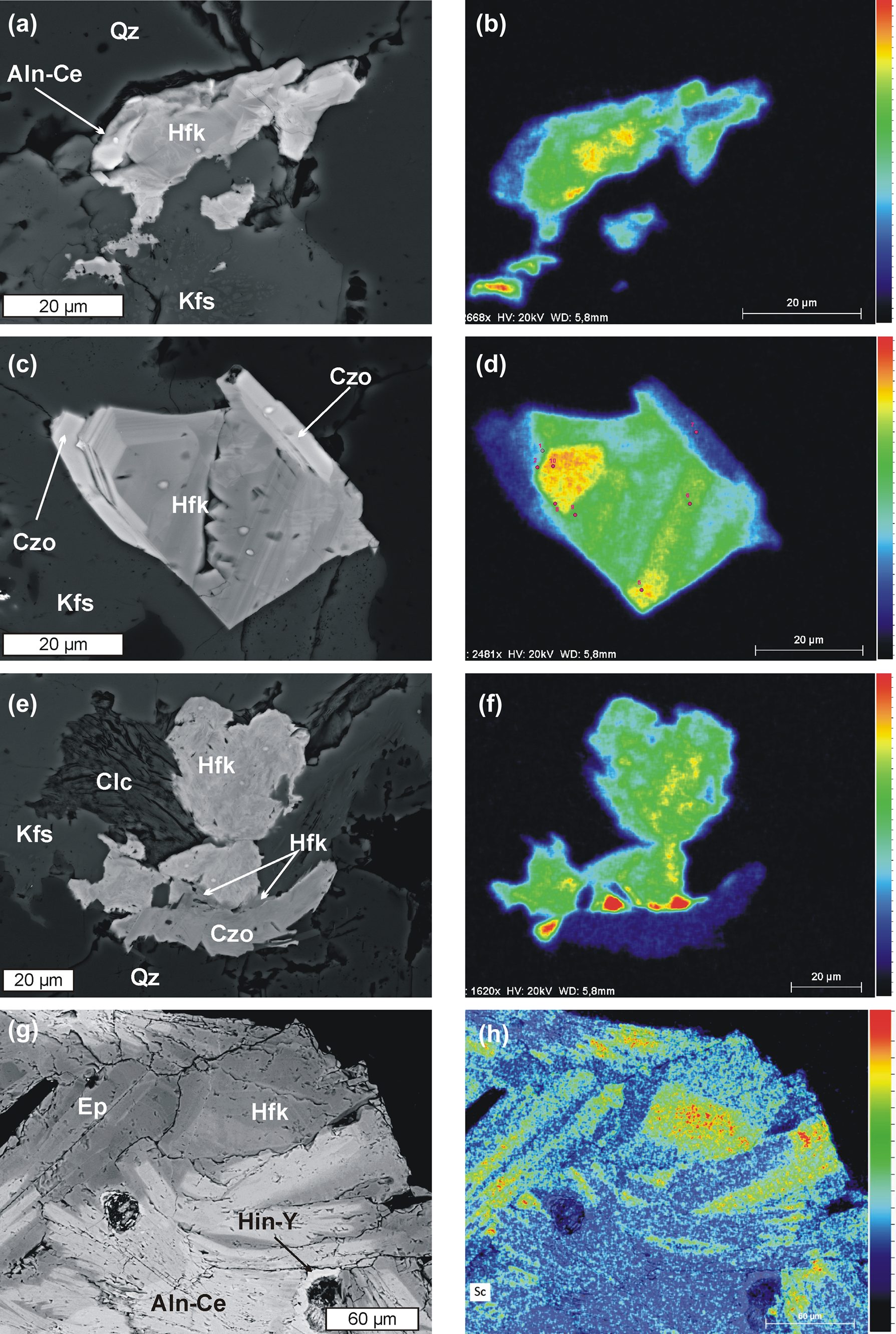
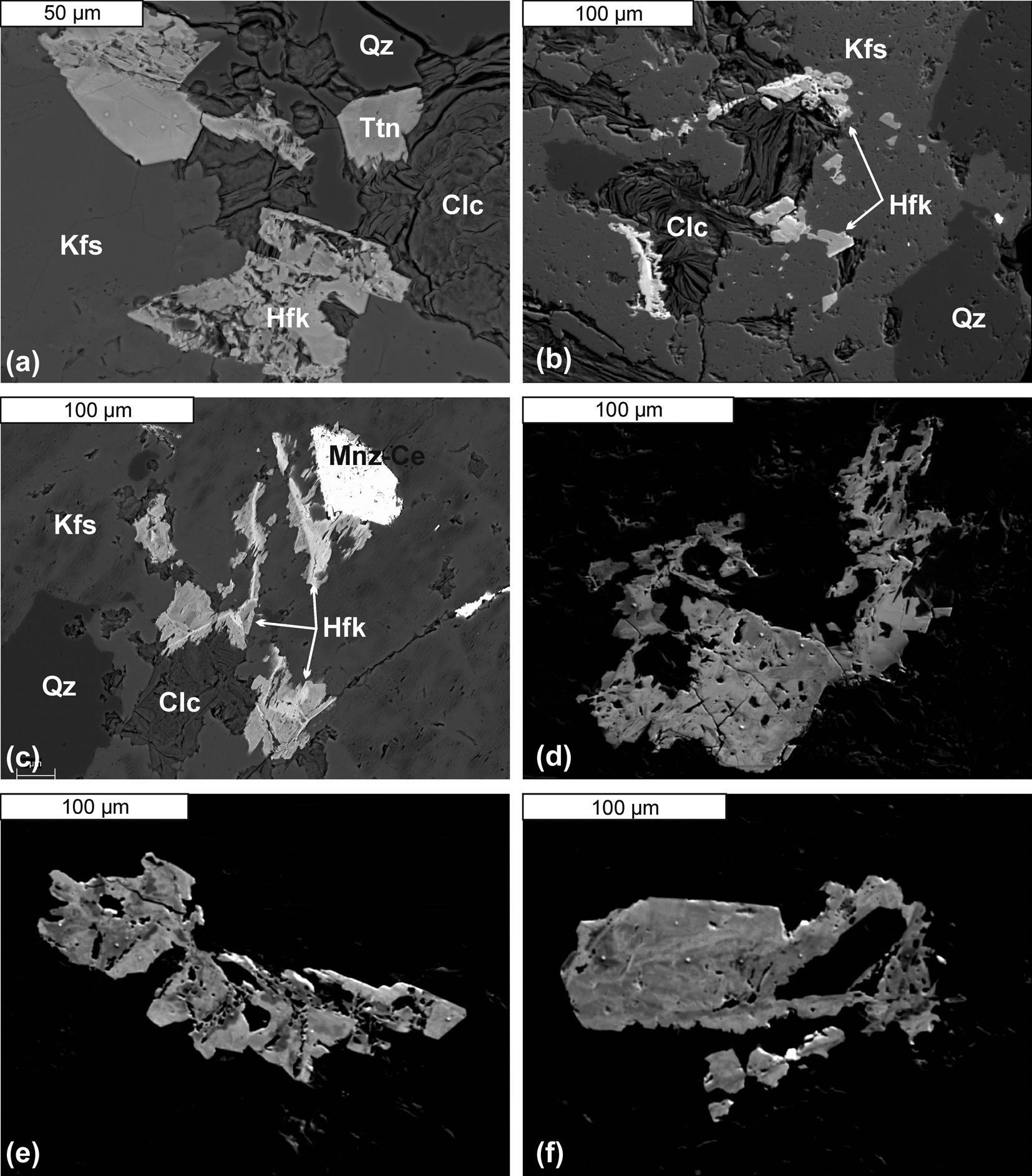
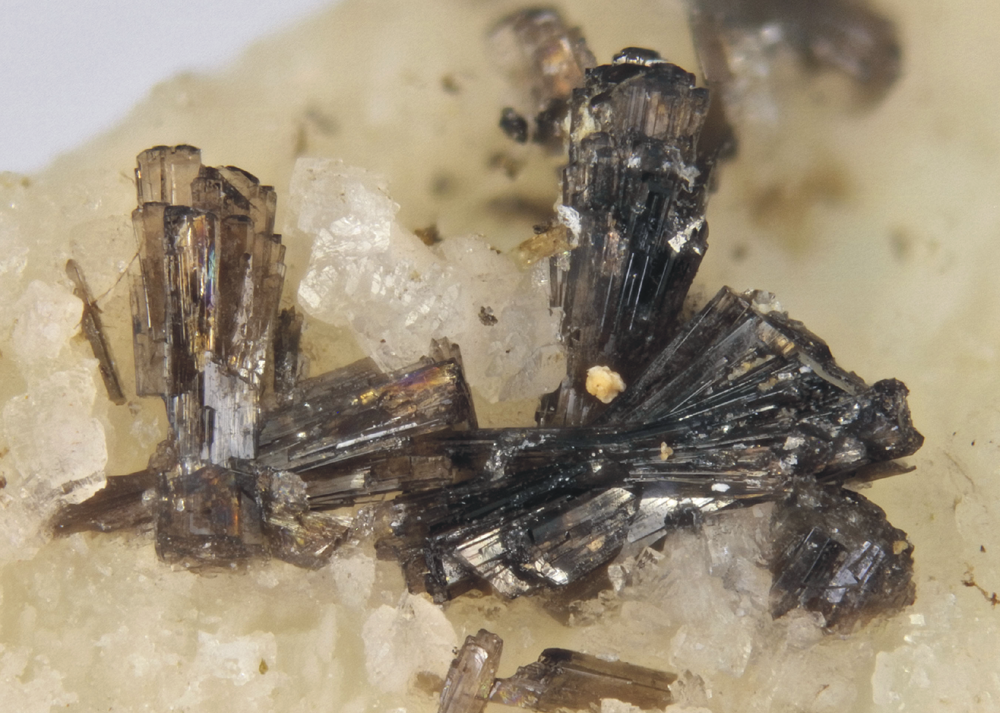
At Jordanów Śląski, heflikite was found in the form of a few compositionally zoned euhedral to subhedral separate crystals and intergrowths with REE-bearing clinozoisite and allanite-(Ce), reaching a maximum of 100 μm in size (Figs 1, 2). Textural observations indicate that the crystallisation sequence starts with heflikite (core or inner zone of the aggregates), progresses to Sc-rich allanite-(Ce), Sc-rich clinozoisite and finally to clinozoisite. In the Heftetjern pegmatite, heflikite occurs as a late-stage crystallisation phase in vugs and miarolitic cavities within feldspar and quartz, and is associated with Sc-rich allanite-(Ce), rarely with allanite-(La) and hingganite-(Y). The epidote-supergroup minerals from the locality form grey, green and brown well-developed transparent crystals and fan- or sheaf-like polycrystalline aggregates up to 10 mm large (Fig. 3). Although appearing homogeneous to the naked eye, all crystals examined show complex compositional zoning under SEM-EDS examination, reaching the heflikite composition only in some small domains (Fig. 1g,h).
Back-scattered electron (BSE) images and Sc distribution maps of heflikite crystals in the holotype (J11) and cotype (N5) specimens: (a,b) the studied holotype crystal J11a; (c,d) heflikite J11c evolving to Sc-rich clinozoisite; (e,f) heflikite J11b intergrown with Sc-poor clinozoisite; (g,h) an aggregate of allanite-(Ce) from the Heftetjern pegmatite with domains of heflikite (N5). Abbreviations: Aln-Ce – allanite-(Ce), Clc – clinochlore, Czo – clinozoisite, Ep – epidote, Hin-Y – hingganite-(Y), Kfs – K-feldspar, Qz – quartz (Warr, Reference Warr2021), Hfk – heflikite.
BSE images of other heflikite–allanite-(Ce) aggregates in specimens J15, J18, J19b (a–c) and J20c (d–f) from Jordanów. Abbreviations: Mnz-Ce – monazite-(Ce), Ttn – titanite, others as in Fig. 1. Darker zones in Figs 2d–f correspond to heflikite and lighter ones to Sc-rich allanite-(Ce) or Sc-rich REE-bearing clinozoisite.
Crystals of allanite-(Ce)–heflikite solid solution from the Heftetjern pegmatite (Field of view: ~5 × 3 mm). Photo used with permission, copyright Mr. O.T. Ljøstad.
Heflikite has a white streak, vitreous lustre and a Mohs hardness of ~6 by analogy with other epidote-supergroup minerals. Cleavage, parting, tenacity, fracture and magnetic properties were not observed. Density was not measured owing to the extremely small amount of the mineral. The density calculated from the empirical formula and refined unit-cell volume of the holotype is 3.537 g⋅cm–3. The optical properties were not measured owing to the scarcity of the type material. Heflikite is biaxial, with a mean refractive index close to 1.727, the value calculated from the Gladstone–Dale relation (Mandarino Reference Mandarino1979, Reference Mandarino1981) using the empirical EPMA-derived formula and calculated density of the holotype crystal.
Chemical composition
Crystals of heflikite were analysed at the Inter-Institute Analytical Complex for Minerals and Synthetic Substances at the University of Warsaw, Poland, using a Cameca SX 100 electron microprobe operating in wavelength-dispersive X-ray spectrometry mode (WDS) with an accelerating voltage of 15 kV, a beam current of 20 nA, peak count-time of 20 s, background time of 10 s, and a beam diameter of 2 μm. The microprobe is equipped with five spectrometers with the following diffracting crystals: TAP (thallium acid phthalate), PET (pentaerythritol), LIF (lithium fluoride), LPET (pentaerythritol – large crystal), LLIF (lithium fluoride – large crystal), and PC0 (W/Si multilayer crystal). Four analyses have been made on the holotype and three on the cotype. Reference materials, diffracting crystals, analytical lines and mean detection limits (element, wt.%) were as follows: F (fluorophlogopite, PC0, Kα, 0.12), Mg (diopside, TAP, Kα, 0.02), Al (orthoclase, TAP, Kα, 0.02), Si (diopside, TAP, Kα, 0.02), Ca (diopside, PET, Kα, 0.03), Sc (pure Sc, Kα, PET, 0.02), Ti (rutile, Kα, PET, 0.03), V (V2O5, Kα, LIF, 0.07), Cr (chromite, Kα, LIF, 0.07), Mn (rhodonite, Kα, LIF, 0.06), Fe (hematite, Kα, LIF, 0.06), Zn (sphalerite, Kα, LIF, 0.08), Sr (celestine, Lα, TAP, 0.06), Y (YPO4, Lα, TAP, 0.04), Sn (cassiterite, PET, Lα, 0.07), La (LaPO4, Lα, PET, 0.08), Ce (CePO4, Lα, PET, 0.07), Pr (Pr glass, Lβ, LIF, 0.14), Nd (NdGaO3, Lβ, LLIF, 0.12), Sm (SmPO4, Lβ, LLIF, 0.13), Eu (EuPO4, Lα, LLIF, 0.05), Gd (GdPO4, Lα, LLIF, 0.06), Tb (TbPO4, Lα, LLIF, 0.08), Dy (DyPO4, Lα, LLIF, 0.07), Er (ErPO4, Lα, LLIF, 0.08), Ho (HoPO4, Lβ, LLIF, 0.18), Tm (TmPO4, Lα, LLIF, 0.07), Yb (YbPO4, Lα, LLIF, 0.09), Lu (LuPO4, Lβ, LLIF, 0.16), Pb (crocoite, Mα, PET, 0.15), Th (ThO2, Mα, PET, 0.15) and U (UO2, Mβ, PET, 0.15). The raw data were reduced with the ‘PAP' routine of Pouchou and Pichoir (Reference Pouchou, Pichoir, Heinrich and Newbury1991). The problem of the analytical-line interferences for lanthanides has been addressed following the recommendations of Reed and Buckley (Reference Reed and Buckley1998). The content of H2O was not measured owing to the scarcity of the material. It was calculated from the empirical formula, assuming 1 OH anion per formula unit on the basis of the generalised formula of the epidote-supergroup minerals. The empirical formula was normalised to 12 O atoms + 1 (OH) group, with a Fe3+/Fetotal ratio matched in such a way to obtain the total content of all cations equal to 8 per formula unit. Compositional data of the holotype and cotype crystals are given in Table 1. On the basis of the general formula of the epidote-supergroup minerals, A2M3[T2O7][TO4](O,F)(OH,O), and suggested assignments of cations to different structural sites (Armbruster et al., Reference Armbruster, Bonazzi, Akasaka, Bermanec, Ch, Gieré, Heuss-Assbichler, Liebscher, Menchetti, Pan and Pasero2006), the averaged compositions correspond to the following empirical formula for the holotype heflikite from Jordanów Śląski (J11a crystal, Fig. 1a,b):
A1CaA2(Ca0.729Ce0.125La0.048Nd0.046Gd0.016Sm0.012Pr0.010Y0.005Eu2+0.003)Σ0.994
M1AlM2AlM3[(Sc0.449Al0.182Fe3+0.070V3+0.005)Σ0.706(Fe2+0.251Mg0.020Mn0.010)Σ0.281
Ti0.014]Σ1.001(Si3.006O11)O(OH),
and for the cotype heflikite from the Heftetjern pegmatite (Sc-rich domain in N5 specimen, Fig. 1g,h):
A1CaA2(Ca0.644Ce0.235La0.082Nd0.021Gd0.018Pr0.015Eu2+0.004)Σ1.019
M1(Al0.958Ti0.029)Σ0.987M2AlM3[(Sc0.362Fe3+0.128)Σ0.490(Fe2+0.434Mn0.009)Σ0.443
Sn0.029]Σ0.962(Si3.033O11)O(OH).
Compositions of heflikite from Jordanów Śląski, Poland, and Heftetjern, Norway (in wt.%, rounded to the second decimal place).
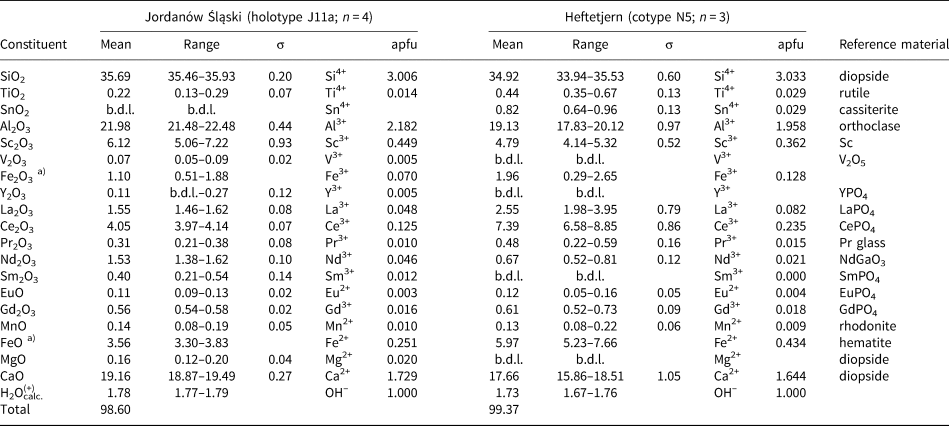
Notes: n – number of spot analyses; σ – standard deviation; b.d.l. – below detection limit; a) total Fe measured as FeO in the Jordanów Śląski heflikite was equal to 4.55 wt.% (range: 3.76–5.32 wt.%; σ: 0.77 wt.%) and 7.73 wt.% in the Heftetjern heflikite (range: 7.44–7.93 wt.%; σ: 0.22 wt.%). The Fe2O3 and FeO contents were calculated on the basis of the stoichiometry of the epidote-supergroup minerals. Terbium, Dy, Ho, Er, Tm, Yb, Lu, Th, U, Cr, Sr, Zn, Pb and F were below the respective detection limits (b.d.l.); H2Ocalc. – calculated on the basis of OH = 1 anion pfu.
The empirical formula of the holotype corresponds to the simplified heflikite formula Ca(Ca,Ce)Al2(Sc,Al,Fe3+,Fe2+)(Si2O7)(SiO4)O(OH), and the ideal formula Ca2(Al2Sc)(Si2O7)(SiO4)O(OH), which requires (in wt.%) SiO2 38.16, Al2O3 21.59, Sc2O3 14.60, CaO 23.74, and H2O 1.91; Total 100. The crystal from the Heftetjern pegmatite represents an intermediate member in a solid solution with allanite-type species. It shows a small prevalence of the heflikite end-member over allanite, but this is strongly dependent on the position of Ti4+ in the structure (M1 or M3 site). Supplementary material (S1), deposited with the Principal Editors of Mineralogical Magazine, presents the chemical compositions of the most Sc-rich heflikite domains in other heflikite – clinozoisite – Sc-rich allanite-(Ce) intergrowths from the Jordanów Śląski pegmatite (Figs 1 and 2).
Crystallography
Single-crystal X-ray diffraction and structure refinement
Two single crystals, the holotype J11a and the cotype N5, (0.033 × 0.015 × 0.004 mm and 0.068 × 0.037 × 0.023 mm, respectively), were extracted in the Laboratory of Transmission Electron Microscopy, Academic Centre for Materials and Nanotechnology (AGH University of Krakow), using a Quanta 3D 200i (Thermo Fisher Scientific) scanning electron microscope equipped with a Ga+ ion gun, Pt precursor gas injection systems (GIS) and Omniprobe micromanipulator for in situ lift-out. An ion beam accelerating voltage of 30 kV and ion currents in the range of 60 nA to 1 nA were applied. The sample was transferred via a micromanipulator to standard TEM copper half-ring grids. A FIB deposition process (from Pt precursor) was used to attach the manipulator probe to the sample and the foil to the grid. Afterwards, the crystal was transferred to a suitable microloop and placed on the goniometer base. The holotype crystal was attached to a non-diffracting Mitegen micromount support. The cotype crystal was attached to a carbon fibre that was attached to a metal pin.
Single-crystal X-ray diffraction (XRD) measurements were carried out with a four-circle diffractometer SuperNova, equipped with a HyPix (Rigaku Oxford Diffraction) Hybrid Pixel Array Detector. The detector-to-crystal distance was 55.0 mm. We used CuKα radiation (λ = 1.54184 Å) at 50.00 kV and 0.80 mA. A frame width of 1° in ω scans and frame times of 7, 30 and 50 s for holotype (2, 8 and 20 s for cotype) were used in the data collection strategy. Reflection intensities were corrected for Lorentz, polarisation, and absorption effects and converted to structure factors using the CrysAlisPro 1.171.42.36a software (Rigaku Oxford Diffraction, 2021). The holotype and cotype samples, although forming aggregates, enabled the separation of their components and facilitated single crystal processing.
The anisotropic structure refinement was performed in the space group P21/m using Shelxl (Sheldrick, Reference Sheldrick2015), within the Olex2 (Dolomanov et al., Reference Dolomanov, Bourhis, Gildea, Howard and Puschmann2009) graphical interface, starting from the atomic coordinates of Dollase (Reference Dollase1969). Correct element-assignment for cations and anions was based upon compositional data obtained by EPMA and crystal-chemical reasoning following the suggestions by Armbruster et al. (Reference Armbruster, Bonazzi, Akasaka, Bermanec, Ch, Gieré, Heuss-Assbichler, Liebscher, Menchetti, Pan and Pasero2006), comprising site-scattering, coordination and bond-lengths. The hydrogen atom position was found from the difference-Fourier maps of residual electron density. Final positions of H atoms were determined from the least-squares refinement with a restraint of bond length equal to 0.97(1) Å. This value is determined from a neutron diffraction experiment, which more accurately determines the H atom position (Gatta et al., Reference Gatta, Meven and Bromiley2010).
The structure was refined with the least-squares minimisation to R 1 = 8.62% (holotype) and 6.37% (cotype). Elevated values of R 1 indices are caused by compositional heterogeneity and moderate crystallinity of the extracted crystals (see Fig. 1a,b and g,h). Where more than one element occupied the same position in the asymmetric unit, constraints for equal atom coordinates and equal anisotropic displacement parameters for these groups of atoms within each unique site were applied.
Compositions of the refined crystals and initial refinements indicated that the A1 site is occupied solely by Ca, the M1 site (in holotype) and M2 site by Al, and the T1–T3 sites by Si. Therefore, the corresponding site occupancies were fixed as the respective full atom in the final refinement. Regarding the cotype heflikite, the M1 site occupancy was set free for refinement with the Al scattering factor. The occupancies of M3 and A2 sites were constrained to 1 and refined as M3(Sc vs Al) for holotype, M3(Sc vs Fe) for cotype, and A2(Ca vs Ce) for both crystals. Details of the measurements and structure solutions are presented in Table 2. Refined atom positions, equivalent isotropic and anisotropic displacement parameters, and occupancy for structural sites are given in Table 3, selected bond-lengths are collected in Table 4, and assigned site-populations are shown in Table 5. Bond-valences calculated on the basis of the parameters given by Gagné and Hawthorne (Reference Gagné and Hawthorne2015) are shown in Table 6. A comparison of the epidote-group minerals, including heflikite, is presented in Table 7. The crystallographic information file has been deposited with the Principal Editor of Mineralogical Magazine and is available as Supplementary material (S2).
Details on data collection and structure refinement of heflikite.

*R int = Σ|F o2–F o2(mean)|/Σ[F o2]. GooF = S = {Σ[w(F o2–F c2)2]/(n–p+r)}1/2. R 1 = Σ||F o|–|F c||/Σ|F o|. wR 2 = {Σ[w(F o2–F c2)2]/Σ[w(F o2)2]}1/2; w = 1/[Σ2(F o2) + (aP)2 + bP], where a is 0.103j11a, 0.0991N5 b is 4.1644j11a, 2.5299N5 and P is [2F c2 + F o2)]/3.
Atomic coordinates, occupancy, equivalent/isotropic and anisotropic displacement parameters (Å2) for non-hydrogen atoms for heflikite.
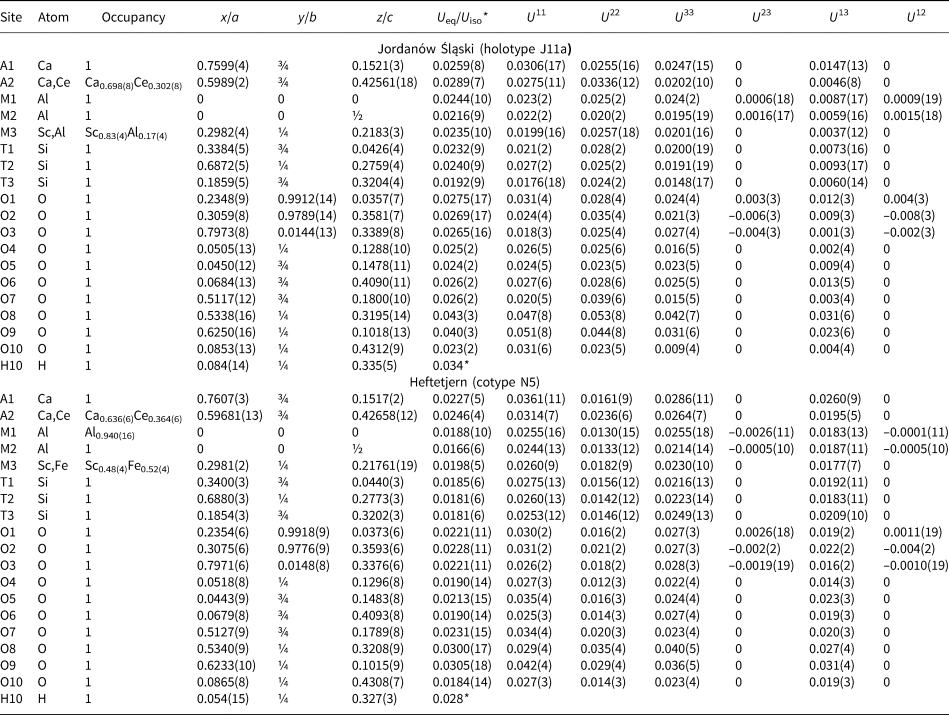
* U iso (isotropic displacement parameters).
Selected bond-lengths (Å) and hydrogen bond angle (°) for heflikite.

Notes: Quadratic elongation, <λ> and bond variance, σ2 (degree2) for octahedra and tetrahedra coordination are as defined by Robinson et al. (Reference Robinson, Gibbs and Ribbe1971).
Assigned site-occupancies, site-scattering, and mean bond lengths for heflikite.

Notes: ‘fix’ – a fixed value by the fixed site occupancy. Mean bond lengths were calculated on the basis of the empirical formulae and respective cation radii and O2– anion radius by Shannon (Reference Shannon1976).
Bond-valence analysis (in valence units) for heflikite.*
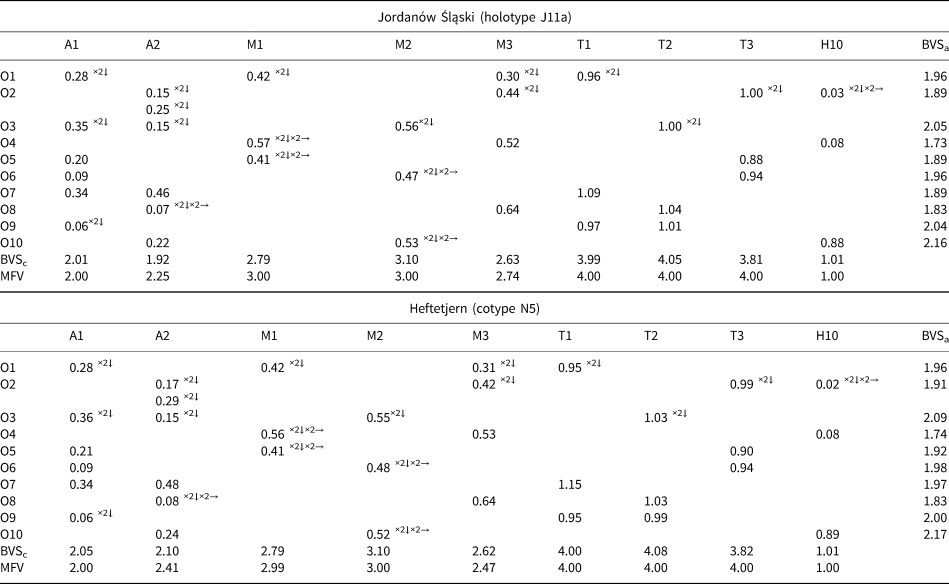
* Notes: Bond valences were calculated using the equation S = exp[(R0–R)/B], where R0 and B are bond-valence parameters by Gagné and Hawthorne (Reference Gagné and Hawthorne2015), and R is the refined bond length; BVSa, BVSc – bond-valence sums over anions and cations; MFV – mean formal valence.
Structural comparison of the epidote-group minerals.
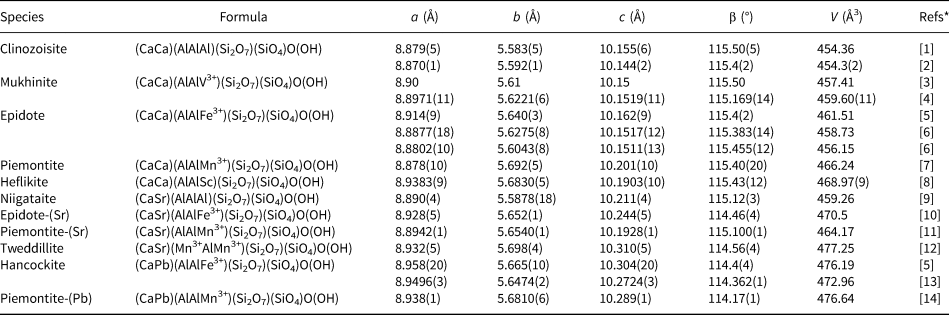
*References: [1] Dollase (Reference Dollase1968); [2] Comodi and Zanazzi (Reference Comodi and Zanazzi1997); [3] Shepel and Karpenko (Reference Shepel and Karpenko1969); [4] Korinevsky et al. (Reference Korinevsky, Chukanov, Aksenov, Korinevsky, Kotlyarov, Zamyatin, Ryanskaya, Kolisnichenko, Lebedeva and Ermolaeva2022); [5] Dollase (Reference Dollase1971); [6] Gabe et al. (Reference Gabe, Portheine and Whitlow1973); [7] Dollase (Reference Dollase1969); [8] this paper; [9] Miyajima et al. (Reference Miyajima, Matsubara, Miyawaki and Hirokawa2003); [10] Minakawa et al. (Reference Minakawa, Fukushima, Nishio-Hamane and Miura2008); [11] Bonazzi et al. (Reference Bonazzi, Menchetti and Palenzona1990); [12] Armbruster et al. (Reference Armbruster, Gnos, Dixon, Gutzmer, Hejny, Dobelin and Medenbach2002); [13] Perchiazzi et al. (Reference Perchiazzi, Mauro, Vignola, Zaccarini and Eldjarn2022); [14] Chukanov et al. (Reference Chukanov, Varlamov, Nestola, Belakovskiy, Goettlicher, Britvin, Lanza and Jancev2012).
Crystal structure
Heflikite crystallises in the monoclinic system (P21/m space-group symmetry), with unit-cell parameters (for holotype): a = 8.9383(9) Å, b = 5.6830(5) Å, c = 10.1903(10) Å, β = 115.43(12)°, V = 468.97(9) Å3; Z = 2. The a : b : c ratio calculated from the unit-cell parameters is 1.5728 : 1 : 1.7931.
The crystal structure of the epidote-supergroup minerals, including heflikite, is composed of T2O7 (Si2O7) and TO4 (SiO4) units linked to two kinds of chains built by edge-sharing MO6 octahedra arranged parallel to the b axis (Dollase, Reference Dollase1968, Reference Dollase1969, Reference Dollase1971; Shepel and Karpenko, Reference Shepel and Karpenko1969; Bonazzi et al., Reference Bonazzi, Menchetti and Palenzona1990; Miyajima et al., Reference Miyajima, Matsubara, Miyawaki and Hirokawa2003; Minakawa et al., Reference Minakawa, Fukushima, Nishio-Hamane and Miura2008; Armbruster et al., Reference Armbruster, Gnos, Dixon, Gutzmer, Hejny, Dobelin and Medenbach2002, Reference Armbruster, Bonazzi, Akasaka, Bermanec, Ch, Gieré, Heuss-Assbichler, Liebscher, Menchetti, Pan and Pasero2006; Chukanov et al., Reference Chukanov, Varlamov, Nestola, Belakovskiy, Goettlicher, Britvin, Lanza and Jancev2012). In heflikite, one chain consists of M2AlO5(OH) octahedra, while the other is formed by M1AlO6 octahedra with M3O6 octahedra attached on alternate sides along its length (Fig. 4). The M3O6 octahedra are occupied dominantly by trivalent cations (Sc, Al, Fe3+ and traces of V3+), from which Sc3+ prevails in the holotype. Divalent cations (Fe2+, Mn2+ and Mg) are always less abundant in crystals from Jordanów Śląski (Tables 1 and S1) owing to subordinate substitution A2REE3+ + M3(Fe,Mn,Mg)2+ ↔ A2Ca2+ + M3(Sc,Al,Fe)3+. Traces of Ti4+ were assigned to the M3O6 octahedron because the M1 site is fully occupied by Al3+ in the Jordanów Śląski crystal. In the Heftetjern heflikite, Ti4+ was assigned to the M1 site to compensate for Al deficiency [as suggested by Armbruster et al. (Reference Armbruster, Bonazzi, Akasaka, Bermanec, Ch, Gieré, Heuss-Assbichler, Liebscher, Menchetti, Pan and Pasero2006)], while the relatively large Sn4+ ion was assigned to the M3 site. The hydroxyl group is bonded to the M2 cation, and the O4 oxygen is not substituted by F.
Crystal structure of heflikite, view along b. Thin orange dashed lines denote hydrogen bonds O10–H⋅⋅⋅O2 and O10–H⋅⋅⋅O4. Figure prepared with VESTA Version 3 (Momma and Izumi, Reference Momma and Izumi2011).
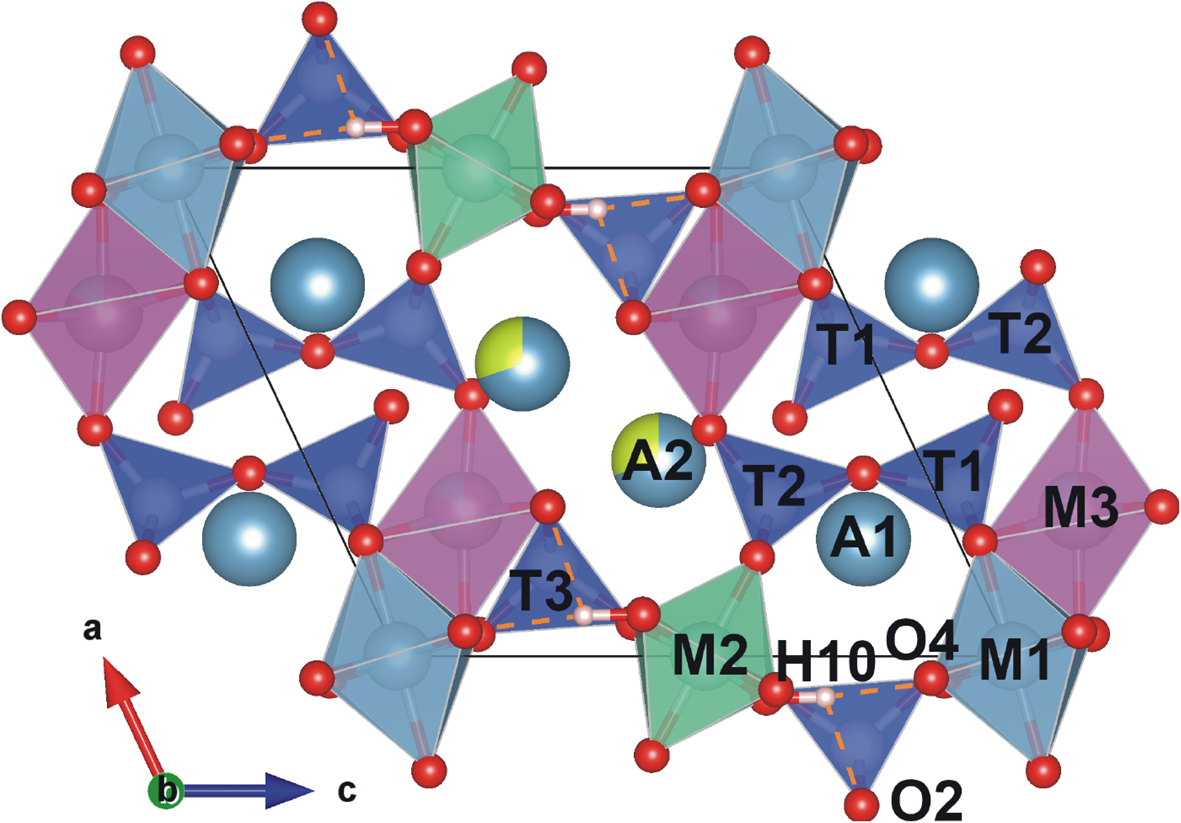
The EPMA-derived compositions and refined crystal-structure models of the holotype and cotype indicate that tetrahedral T1–T3 sites are fully occupied by Si, corresponding to the typical epidote structure. The two A sites (A1 and A2) in epidote-supergroup minerals can be occupied by Ca and Mn2+ at A1, and Ca, Sr, Pb and REE3+ with possible subordinate U4+, Th4+, K+ and Ba2+ at A2 (Armbruster et al., Reference Armbruster, Bonazzi, Akasaka, Bermanec, Ch, Gieré, Heuss-Assbichler, Liebscher, Menchetti, Pan and Pasero2006). In heflikite, however, Ca contents over 1.5 atoms per formula unit (apfu) suggest that Ca is a dominant occupant also at the A2 site, while REE from La to Gd are subordinate (Tables 1 and S1). The A1(Ca,Mn) is nine-fold coordinated with (Ca,Mn)–O bond lengths ranging from 2.327(5)–2.335(7) Å to 3.044(5)–3.047(3) Å, with <A1(Ca,Mn)–O> mean distances of 2.603(8) Å and 2.597(5) Å in the holotype and cotype crystals, respectively. The occupation of the A1 site is corroborated by the calculated bond-valence sum (BVS) of 2.01 and 2.05 valence units (vu) in both crystals (Table 6), which closely corresponds to the 2+ valence of Ca and Mn.
The A2 site occupancy was refined as Ca0.698(8)Ce0.302(8) in the holotype and Ca0.636(6)Ce0.364(6) in the cotype (Table 3). The occupancies suggest an A2 site population with 31.6(3) e – and 33.8(2) e –, respectively, the values conforming to the numbers of electrons at the site of both refined crystals derived from their empirical formulae, i.e. 30.0(6) e – and 34.7(2.9) e –. Considering the moderate quality of the single-crystal XRD data, the final A2 site populations were assigned to those indicated by the empirical EPMA-derived formulae (Table 5). The A2 site occupants are coordinated by 9 oxygen atoms and a hydroxyl from the O10 site, with bond lengths ranging from 2.285(9)–2.302(7) Å to 3.002(3)–3.004(4) Å, and the refined <A2Ca–O> of 2.688(7) Å and 2.683(5) Å. Both in the holotype and cotype, <A1Ca–O> and <A2–O> are slightly larger than 2.59–2.63 Å derived from the empirical compositions on the basis of the effective nine-fold-coordinated Ca2+ and ten-fold-coordinated Ca2+, La3+,Ce3+,Pr3+,Nd3+,Sm3+,Eu2+,Gd3+ radii, and tetrahedrally-coordinated O2– radius tabulated by Shannon (Reference Shannon1976). The calculated BVS for the A2 site occupants, 1.92 vu and 2.10 vu, are slightly lower than the mean formal valence of cations occupying the site (2.25 vu and 2.41 vu in the holotype and cotype, respectively), most probably owing to enlarged A2–O8 bonds (Tables 4 and 6).
Among the three types of octahedral M sites, the M2 site is occupied solely by Al. Therefore, the M1 and M3 site populations are critical for the classification of epidote-supergroup minerals. In both refined crystals the edge-sharing M2O6 octahedra are very regular [quadratic elongation <λ> (Robinson et al., Reference Robinson, Gibbs and Ribbe1971) is equal to 1.0054 and 1.0051, respectively], with M2–O bond lengths ranging from 1.862(7)–1.866(5) Å to 1.924(4)–1.932(6) Å, and <M2–O> of 1.892(4–6) Å, typical for VIAl3+–O bond (Table 4). The BVS of 3.10 vu calculated for Al as the M2 site occupant corroborates this site assignment (Table 6).
The occupancy of the M1 site was fixed as Al1.00 for the holotype and refined as Al0.940(16) for the cotype crystal (Table 3). Thus, for the holotype it may be considered that the M1 site is filled only by Al3+. For the cotype the refined M1 site-occupancy suggests a small deficit, which can be partly compensated by Ti4+ according to the suggestion of Armbruster et al. (Reference Armbruster, Bonazzi, Akasaka, Bermanec, Ch, Gieré, Heuss-Assbichler, Liebscher, Menchetti, Pan and Pasero2006). However, the analysis of the refined M1–O bond lengths indicates distinctly enlarged M1–O1 and M1–O5 bonds compared to the M1–O4 bond, 1.971(5)–1.984(7) Å vs 1.855(6)–1.857(5) Å, and distinctly increased refined <M1–O> up to 1.937 Å for both crystals (quadratic elongation <λ> = 1.0057 and 1.0058, Table 4). In consequence, the calculated BVS for the site occupant(s) are lowered to 2.79 vu, although the virtual valence of the M1 site occupant (Al or Al + Ti) is ~3+ (Table 6).
The M3O6 octahedron is attached to the M1O6-octahedra chain by two O1–O4 common edges. The M3 site occupancy was refined as Sc0.83(4)Al0.17(4) for the holotype and Sc0.48(4)Fe0.52(4) for the cotype (Table 3). These occupancies indicate the M3 site population with 19.6(3) e – in the holotype and 23.6(2) e – in the cotype (Table 5). Considering accuracies of the EPMA, these values correspond well to the numbers of electrons at the site, respectively 21.0 e – and 24.5 e –, derived from the empirical formulae. The M3O6 octahedron shows the strongest deformation (<λ> = 1.0309 in both crystals) with M3–O distances ranging from 1.913(13)–1.914(8) Å to 2.248(8)–2.225(5) Å. The refined <M3–O>, 2.095(9) Å for holotype and 2.089(6) Å for cotype, correspond well to the values of 2.077 Å and 2.088 Å derived from the empirical formulae using the respective cation radii and O2– radius from Shannon (Reference Shannon1976) (Table 6). Similarly to the M1 site, a slightly decreased BVS of 2.62–2.63 vu versus 2.73 and 2.47 vu means formal valence of the M3 cation may result from the enlargement of the M3–O bonds. Heflikite, with the largest trivalent M3 site occupant, has the highest unit-cell volume of all the epidote-group species with A1CaA2Ca and M1AlM2Al, except the species containing Sr2+ or Pb2+ at the A2 site (Table 7).
Calculated powder XRD data
Powder XRD data could not be collected owing to the scarcity and heterogeneity of the heflikite crystals. Therefore, the powder pattern was calculated from the refined single-crystal structure of holotype heflikite using the PowderCell 2.4 software (Nolze and Kraus, Reference Nolze and Kraus1998). The seven strongest reflections [d in Å (I) hkl] are as follows: 3.513 (41.0) $\bar{2}$ 11; 2.913 (100) $\bar{1}$
 13; 2.842 (40.8) 020; 2.706 (31.0) 013; 2.681 (22.6) 120; 2.617 (46.1) $\bar{3}$
 11; 2.412 (21.9) $\bar{3}$
 13. The complete calculated powder XRD data has been deposited with the Principal Editors of Mineralogical Magazine and is available as Supplementary material (S3).
Raman spectroscopy
The Raman spectrum of heflikite was recorded from the core of the compositionally-zoned crystal J11c in the holotype sample (Fig. 1c,d) in back-scattered geometry with a Horiba Labram HR spectrometer integrated with an Olympus BX 41 confocal microscope. The domain of this crystal is highly enriched in Sc and has the following composition (Table S1):
A1CaA2(Ca0.756Ce0.122La0.046Nd0.043Gd0.014Pr0.011Sm0.010Eu0.003Y0.001)Σ1.006
M1Al0.990M2AlM3[(Sc0.526Al0.179V3+0.009Fe3+0.005)Σ0.719(Fe2+0.248Mg0.011Mn0.005)Σ0.264Ti0.017]Σ1.000(Si3.006O11)O(OH).
The system was calibrated using the Rayleigh line. The spectrum was recorded on a random section of the crystal hosted in a pegmatitic matrix mounted in epoxy resin in the range of 50–4000 cm–1 using the 532 nm line of a solid-state Nd–YAG laser (10 mW) and 1800 grating. The Raman measurements were carried out using two accumulated scans per spectrum, each scan with an acquisition time of 600 s, an objective with 100× magnification, the minimum lateral and depth resolution of ~1 μm, and an estimated analytical spot size of ~3–5 μm. The deconvolution of the spectrum was done with the FITYK-1.3.1 software (Wojdyr, Reference Wojdyr2010) in the ranges of 50–1200 cm–1 and 3000–4000 cm–1. To remove the effect of luminescence, the linear background was removed in the first spectral range while in the second range the spectrum was processed without the background removal. Component bands have been added to the fitting model using the auto-add peak mode in such a way to minimise the difference between the empirical spectrum and the theoretical spectrum. Spectral position and intensities of the component bands were anticipated on the basis of the shape of the empirical spectrum (peaks maxima, asymmetry of the peaks and inflections on the peaks shoulders). The input model was fitted with Voigt function applying the Levenberg–Marquardt fitting method (Levenberg, Reference Levenberg1944; Marquardt, Reference Marquardt1963).
Compared to the RRUFF database (Lafuente et al., Reference Lafuente, Downs, Yang, Stone, Armbruster and Danisi2015), the Raman spectrum of heflikite corresponds well to the spectra of clinozoisite (R040085) and epidote (R050202) and is significantly different from that of allanite-(Ce) (R080044) (Fig. 5a). The deconvolution revealed 25 component bands in the Raman shift range of 50–1200 cm–1 centred at (s – strong, m – moderate, w – weak): (s) 101, 452, 568, 682 and 975 cm–1; (m) 128, 281, 385, 425, 489, 514, 605, 875, 912, 963 and 1061 cm–1; (w) 147, 240, 306, 326, 361, 632, 689, 832 and 1021 cm–1 (Fig. 5b).
Raman spectrum of heflikite (black): (a) compared with the spectra of clinozoisite R040085 (green), epidote R050202 (yellow) and allanite-(Ce) R080044 (brown) from the RRUFF database; (b) deconvolution of the spectrum in the lattice vibration region 50–1200 cm–1. Line colours: black – recorded spectrum, green – component bands, magenta – fitted spectrum; (c) deconvolution of the spectrum in the OH stretching vibration region 3000–4000 cm–1. Line colours: black – recorded spectrum, magenta – fitted spectrum, yellow – luminescence bands, blue – OH bands related to M3Sc. Parameters of the component bands: first number – band position, second number – full width at half maximum, numbers in parentheses indicate standard errors.
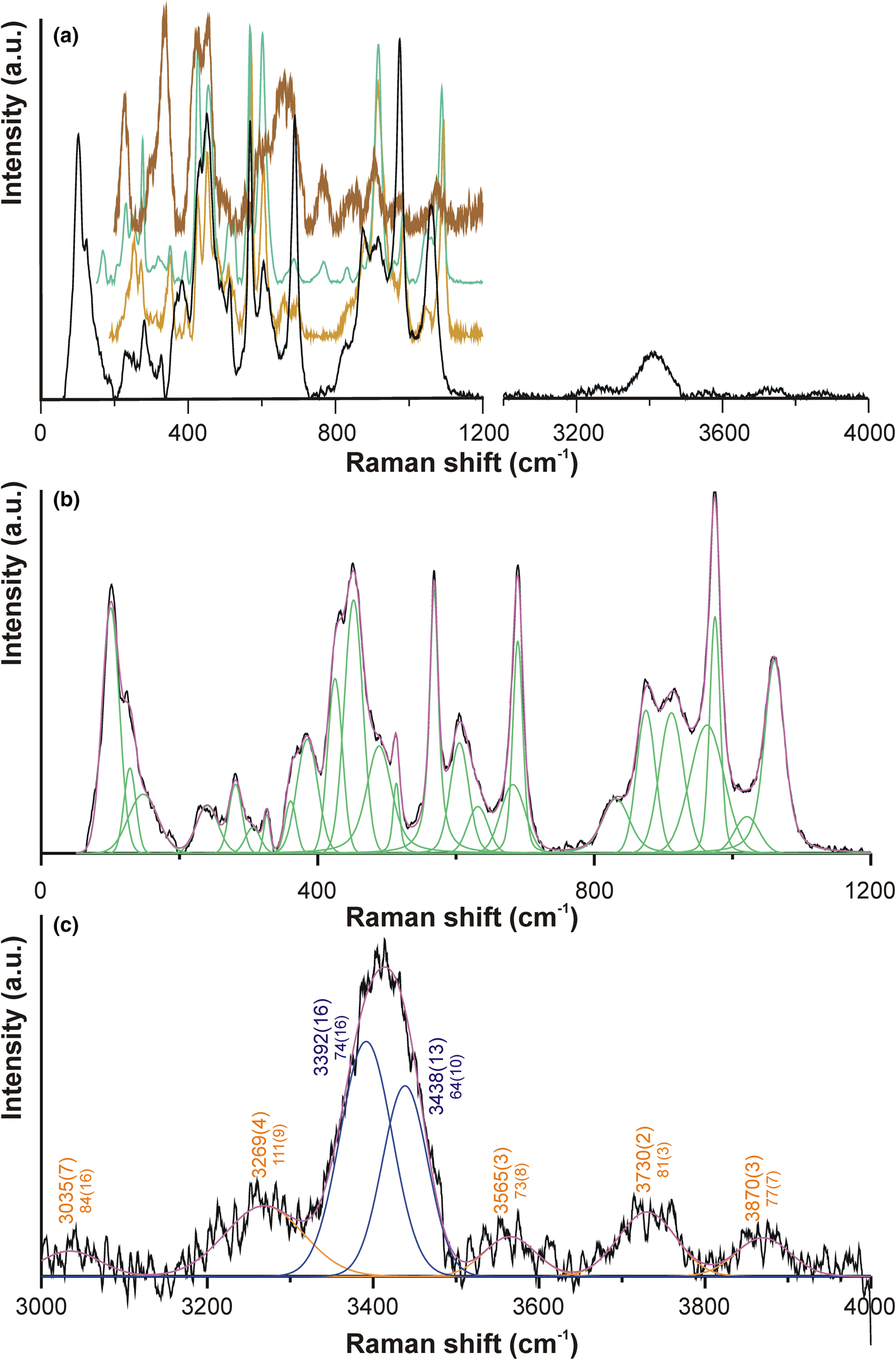
In general, Raman spectra of the epidote-supergroup minerals remain poorly understood. Nagashima et al. (Reference Nagashima, Armbruster, Nishio-Hamane and Mihailova2021) observed that substitutions at the M sites of the epidote structure can significantly influence the geometry of SiO4 and Si2O7 units. Therefore, unambiguous interpretation of the spectral range below 1250 cm–1 is difficult owing to the presence of multiple overlapping bands. For the same reason, precise assignment of Raman bands is also difficult in the case of heflikite. Some Raman bands correspond closely to the bands observed in the spectra of clinozoisite and epidote (e.g. Liebscher, Reference Liebscher, Liebscher and Franz2004; Limonta et al., Reference Limonta, Andò, Bersani and Garzanti2022; Nagashima and Mihailova, Reference Nagashima and Mihailova2023, and references therein) but most of them occur at slightly different wavenumbers owing to differences in the site occupancies among these minerals. According to Nagashima et al. (Reference Nagashima, Armbruster, Nishio-Hamane and Mihailova2021), the most intense Raman band at 975 cm–1 in the spectrum of heflikite can be assigned to the Si–O stretching mode, the band at 568 cm–1 to the Si–O–Si bending mode, and the features in the regions around 100 cm–1 and 240 cm–1 are most probably connected to heavy-cation vibrations and external silicate modes. Varlamov et al. (Reference Varlamov, Ermolaeva, Chukanov, Jančev, Vigasina and Plechov2019) assigned bands from the range 300–600 cm–1 collectively to the M–O stretching vibrations and bending vibrations of silicate anions. In their studies on various epidote-supergroup minerals, Varlamov et al. (Reference Varlamov, Ermolaeva, Chukanov, Jančev, Vigasina and Plechov2019) assigned the band in the range of 1020–1200 cm–1 to stretching vibrations of the Si–O–Si bridges. They also agreed with the suggestion of Chukanov (Reference Chukanov2014) that its exact spectral position depends on the Si–O–Si angle in such a way that a higher value of the angle is reflected by a higher frequency of the corresponding vibration. In the Raman spectrum of heflikite, the band is centred at 1061 cm–1. This falls between the ranges of 1074–1078 cm–1 and 1024–1056 cm–1, which were identified by Varlamov et al. (Reference Varlamov, Ermolaeva, Chukanov, Jančev, Vigasina and Plechov2019) as typical for REE-free and REE-bearing epidote-supergroup minerals, respectively. This spectral position correlates well with the refined T1Si–O9–T2Si angle of 151.4(9)° in heflikite, the value intermediate between those found in the structures of ferriallanite-(La), 143.61° (Kolitsch et al., Reference Kolitsch, Mills, Miyawaki and Blass2012) and epidote, 154.59° (Gatta et al., Reference Gatta, Meven and Bromiley2010) and 155.45(8)° (Gatta et al., Reference Gatta, Alvaro and Bromiley2012), and also agrees with a subordinate content of the allanite component in the holotype heflikite.
Previous studies of the O–H stretching region using infrared and Raman spectroscopy revealed that O–H bond stretching signals in epidote-group minerals are complex, comprising overlapping, strongly pleochroic bands. The exact position of the band is dependent on the amount of trivalent cations, such as Fe3+, Mn3+, Cr3+ and V3+, substituting for Al at the octahedral sites. The positive relationship between the concentration of Fe in the clinozoisite–epidote solid-solution series and the wavenumber of the bands' maxima has been firmly established (e.g. Langer and Raith, Reference Langer and Raith1974; Della Ventura et al., Reference Della Ventura, Mottana, Parodi and Griffin1996; Liebscher, Reference Liebscher, Liebscher and Franz2004; Gatta et al., Reference Gatta, Alvaro and Bromiley2012; Nagashima et al., Reference Nagashima, Armbruster, Nishio-Hamane and Mihailova2021; Limonta et al., Reference Limonta, Andò, Bersani and Garzanti2022; Nagashima and Mihailova, Reference Nagashima and Mihailova2023). In the Raman spectra of clinozoisite–epidote minerals, the position of the O–H stretching peak typically varies from ~3340 cm–1 in Fe-poor crystals to ~3390 cm–1 in Fe-rich species (e.g. Limonta et al., Reference Limonta, Andò, Bersani and Garzanti2022; Nagashima and Mihailova, Reference Nagashima and Mihailova2023). Aside from this shift, a split of the O–H stretching band in piemontite is observed, caused by the Jahn–Teller effect related to the presence of Mn3+ (Della Ventura et al., Reference Della Ventura, Mottana, Parodi and Griffin1996; Liebscher, Reference Liebscher, Liebscher and Franz2004). The O–H stretching region in the Raman spectrum of the heflikite holotype contains a broad and slightly asymmetric band of moderate intensity, centred at ~3412 cm–1 (Fig. 5c). The spectral position of the band can be modelled at 3411.2(8) with FWHM = 92(2) cm–1. However, the J11c crystal is poor in Fe3+ (with almost no Fe3+ in the core), and on the basis of its M1–M3 site populations, it is evident that the high wavenumber of the OH stretching band is due to the presence of a significant amount of Sc3+ at the M3 site.
Possible M3 site occupants exhibit significant differences in their cation radii as rAl3+ = 0.535 Å, rFe3+ = 0.645 Å, and rSc3+ = 0.745 Å (according to Shannon, Reference Shannon1976). The replacement of elements at the M3 site not only affect the M3–O bond lengths and respective bond valences, but also other bond lengths and bond valences in which oxygen atoms coordinated by the M3 cations participate, such as the M1–O4 bond, and the H+ of the O10O–H hydroxyl. The hydrogen atom, which is bonded to the O10 oxygen (acting as a donor), is involved in two hydrogen bonds. These are with the O4 and the O2 atoms acting as acceptors. In a Fourier-transform infrared spectrum of epidote (Gatta et al., Reference Gatta, Alvaro and Bromiley2012) and a Raman spectrum of synthetic clinozoisite (Nagashima et al., Reference Nagashima, Armbruster, Nishio-Hamane and Mihailova2021), the hydrogen bond O10–H⋅⋅⋅O4 was stronger than O10–H⋅⋅⋅O2, and the O10–H bond stretching mode appeared at lower wavenumbers for O10–H⋅⋅⋅O4 (~3350–3385 cm−1) than for O10–H⋅⋅⋅O2 (~3400 cm−1). This is because the M3–O2 and M3–O4 distances increase more rapidly than M2–O10, proportionally with the replacement of M3Al in clinozoisite by Fe3+ in epidote (and especially Sc3+ in heflikite) due to the increasing mean radius of the M3 site occupant. The deconvolution of the OH stretching range 3000–4000 cm–1 in heflikite (Fig. 5c) reveals the presence of several component bands, including two with still acceptable statistical parameters related to hydrogen bonds O10–H⋅⋅⋅O2 and O10–H⋅⋅⋅O4. The strength of the O10–H⋅⋅⋅O4 bond was found to be greater compared to the O10–H⋅⋅⋅O2 bond (0.08 vu versus 0.02–0.03 vu), as indicated by the configuration of both types of hydrogen bonds (Table 6). In consequence, the O10–H⋅⋅⋅O4 stretching mode, which corresponds to the M1,2Al2–O10–H⋅⋅⋅O4–M1,2Al2M3(Sc,Al) arrangement, appears at a lower wavenumber [3392(16) cm–1] compared to the O10–H⋅⋅⋅O2 stretching mode corresponding to the M1,2Al2–O10–H⋅⋅⋅O2–M1,2Al2M3(Sc,Al) arrangement [3438(13) cm–1]. When comparing the results for heflikite with those obtained by Gatta et al. (Reference Gatta, Alvaro and Bromiley2012) for epidote and by Nagashima et al. (Reference Nagashima, Armbruster, Nishio-Hamane and Mihailova2021) for synthetic clinozoisite, it becomes apparent that replacing M3Al3+ with Fe3+ and Sc3+ results in an increase of the <M3–O> distance, leading to a gradual weakening of both types of hydrogen bonds. Relatively strong bonds in M1,2Al2–O10–H⋅⋅⋅O4–M1,2Al2M3Al and M1,2Al2–O10–H⋅⋅⋅O2–M1,2Al2M3Al arrangements weaken within M1,2Al2–O10–H⋅⋅⋅O4–M1,2Al2M3Fe3+ and M1,2Al2–O10–H⋅⋅⋅O2–M1,2Al2M3Fe3+ configurations, and diminish further in M1,2Al2–O10–H⋅⋅⋅O4–M1,2Al2M3Sc and M1,2Al2–O10–H⋅⋅⋅O2–1,2Al2M3Sc. At the same time, the strength of the corresponding O10–H bond increases. The changes in the occupancy of the M3 site result in a splitting of the O–H stretching bands and a shift of the component bands towards higher wavenumbers.
Other very weak bands in the OH stretching vibration region of the Raman spectrum of heflikite cannot be interpreted unambiguously. They most probably represent luminescence [3035(7), 3269(4), 3565(3), 3730(2) and 3870(3) cm–1]. A slightly enhanced band at 3269(4) cm–1 could also be related to OH vibrations coupled to lattice vibrations as suggested by Gatta et al. (Reference Gatta, Alvaro and Bromiley2012), while bands in the range of 3500–4000 cm–1 can be assigned to OH groups participating in allanite-type arrangements with divalent octahedral occupants at the M3 site, mainly Fe2+ (Limonta et al., Reference Limonta, Andò, Bersani and Garzanti2022; fig. 4).
Genetic implications
Scandium mineralisation is currently of great interest to industry and technology due to the rapidly growing demand from manufacturers of high-tech aluminium alloys, solid oxide fuel cells, solid-state lasers, and other applications. REE-poor epidote-supergroup minerals have not previously been considered as a possible source of Sc. Reports on specimens with significant Sc enrichment are rare and limited to REE-enriched species (Meyer, Reference Meyer1911; Foord et al. Reference Foord, Birmingham, Demartin, Pilati, Gramaccioli and Lichte1993; Raade and Kristiansen, Reference Raade and Kristiansen2000; Kristiansen, Reference Kristiansen2009; Čopjaková et al., Reference Čopjaková, Škoda, Vašinová Galiová, Novák and Cempírek2015). Here, we report the discovery of heflikite, Ca2(Al2Sc)(Si2O7)(SiO4)O(OH), a new and the only Sc-rich epidote-supergroup mineral. Heflikite is closely related to clinozoisite and epidote, both widespread in various geological environments, through isovalent substitutions M3Sc3+ → M3Al and M3Sc3+ → M3Fe3+, respectively. The mode of occurrence and textural position of the holotype and cotype heflikite indicate its formation from hydrothermal fluids at low to moderate temperatures and pressures. In the Heftetjern pegmatite, it is a part of a diverse assemblage of late-stage hydrothermal Sc minerals, including bazzite, cascandite, heftetjernite, kristiansenite, oftedalite, scandiobabingtonite and thortveitite (Raade et al., Reference Raade, Ferraris, Gula, Ivaldi and Berhard2002; Kristiansen, Reference Kristiansen2009; Chukanov et al., Reference Chukanov, Aksenov, Rastsvetaeva, Kristiansen, Pekov, Belakovskiy, Van, Bychkova and Britvin2017; Steffenssen et al., Reference Steffenssen, Müller, Munnik, Friis, Erambert, Kristoffersen and Rosing-Schow2020). The granitic pegmatite at Jordanów Śląski also hosts Sc-rich minerals, such as Sc-rich ixiolite, cascandite, kristiansenite, bazzite, Sc-rich actinolite (Pieczka et al., Reference Pieczka, Stachowicz, Zelek-Pogudz, Gołębiowska, Sęk, Nejbert, Kotowski, Marciniak-Maliszewska, Szuszkiewicz, Szełęg, Stadnicka and Woźniak2024a), and scandio-winchite (Pieczka et al., Reference Pieczka, Stachowicz, Zelek-Pogudz, Gołębiowska, Sęk, Nejbert, Kotowski, Marciniak-Maliszewska, Szuszkiewicz, Szełęg, Stadnicka and Woźniak2024b). They formed from metasomatic fluids that infiltrated a contact between the granitic pegmatite and the surrounding rodingite-type calc-silicate rocks and serpentinites, introducing Sc into the pegmatite. The fluids could have either been hydrothermal or related to low-grade regional metamorphism that postdated the formation of the pegmatite. The stability field of heflikite and extents of its solid solution with other epidote-group minerals require further examination. Nonetheless, although heflikite has only been discovered in a few small crystals, it still demonstrates that the epidote-group minerals can act as effective collectors for scandium.
Acknowledgements
The authors thank Peter Leverett and two anonymous reviewers for their very helpful comments and suggestions, which greatly improved the manuscript. We also thank Mr. O.T. Ljøstad, Elverum, Norway, for permission to use his photograph of allanite-(Ce) – Sc-rich epidote crystals from Heftetjern. This study was supported by the National Science Centre (Poland) grant 2019/33/B/ST10/00120 to A.P.
Supplementary material
The supplementary material for this article can be found at https://doi.org/10.1180/mgm.2023.98.
Competing interests
The authors declare none.


 Open access

