


The images of the gods were numerous in Nahuatl-speaking Central Mexico. The bodies of the divinities were covered with ornaments arranged according to a complex code, the deciphering of which has occupied successive generations of researchers, starting with the early work of Eduard Seler more than a century ago. But generally speaking, and especially over the last fifty years, it has been considered that these representations were purely symbolic and that we should not look for the presence of glottograms, that is, signs that encode linguistic units pronounced in the Nahuatl language. It is true that, for reasons that go back to the history of the image in Europe (Schmitt Reference Schmitt2023), our society makes a clear distinction between images and writing, and it is hard to imagine that glottograms could nestle in an image, or even join together to form an image. And yet, over the course of time, a number of specialists have noted that the names of gods could find a place within their representations. Without claiming to be exhaustive, we should mention Seler (Reference Seler1963:vol. I, p. 80), who wrote that the name of Chalchiuhtlicue, Water Goddess, “was expressed in her clothing”; Sullivan (Reference Sullivan and Benson1982:11–12), who noted that the name of Tlazolteotl, Goddess of Filth, was written as a glyph on her face in the Codex Borbonicus; Mikulska (Reference Mikulska2017, Reference Mikulska and Mikulska2020), who posed the problem of the inscription of the names of gods in codices; and I myself have spoken of theonym in relation to the names of Chalchiuhtlicue engraved in her image (Dehouve Reference Dehouve2020 [Reference Dehouve2018]:23–26). This article intends to continue in this vein and demonstrate that we must reject the image/writing dichotomy in this context. In order to understand the identity of the Nahua gods, it is necessary to combine symbolic deciphering, which many of us are doing, with a reading of the divine names embedded in their bodies and ornaments.
Iconography and glottography in Nahuatl-speaking Central Mexico
In order to address these questions, which have been debated at length within the international community of specialists, it is necessary to specify the words that will be used and their definitions, even if these are merely conventions that can sometimes be overturned by analysis. I will therefore start with the definition of “writing in the strict sense” established by the Egyptologist Vernus.
“In the strong sense, writing designates a system of graphic symbols capable of theoretically encoding any linguistic statement, and therefore of transposing its phonic materiality into visual materiality” (Vernus Reference Vernus2020:2, my translation). This implies “a defined linguistic statement made up of sequences of sounds, transposed into a defined text made up of sequences of graphic signs.” These necessarily include “phonograms, i.e., signs with phonetic value, by recourse to the principle of rebus,” which are “limited in number” (Vernus Reference Vernus2020:2–3, my translation).
Mesoamerica is one of the world’s centers for the discovery of writing, and several systems corresponding to different linguistic families were invented there over the centuries. Mayan writing is undoubtedly the most elaborate, with 10,000 texts inscribed on stone, shells, wood, and paper, produced between 400 b.c. and a.d. 1600 and comprising a total of 700 signs, over 60 percent of which have been deciphered (Houston Reference Houston2023:40–41). But a dozen other systems are currently the subject of research by several teams (in Helmke and Nielsen Reference Helmke and Nielsen2024:26).
If we look at the best-known scripts (Maya, Mixtec, Nahuatl), what they have in common is that they are figurative, meaning that they possess a high level of iconicity that makes them suitable for comparison with Egyptian hieroglyphic writing. Following the publication of the seminal book by Beaux, Pottier, and Grimal (Reference Beaux, Pottier and Grimal2009), the comparison between the figurative character of the scripts of Ancient Egypt and Mesoamerica was pursued, notably in Houston and Stauder (Reference Houston and Stauder2020).
All these scripts are also logo-phonetic, that is, composed mainly of logograms (writing signs that refer to whole words, i.e., both their meaning and their pronunciation) and phonograms (which refer to one or more sounds used in the manner of a rebus). Finally, we can apply Vernus’s (Reference Vernus2016:111) observation to them: a script can be fully fledged and have building blocks that make it potentially capable of encoding the infinite number of utterances of a language, while limiting its use to title utterances, as happened with the Egyptian hieroglyphic system between 3100 and 2750 b.c. With the exception of Mayan writing, which produced a large number of diverse texts, many other Mesoamerican systems seem to have focused on the registering of titles and names of places and people.
While these scripts have characteristics in common, they also have differences. For example, in the Maya script, the graphic characters read as glottograms are generally distinguished from their pictorial environment: for the most part they adopt a quadrangular shape and are arranged on the monuments in columns and lines, which makes them comparable to the Egyptian hieroglyphic system (Houston and Stauder Reference Houston and Stauder2020:28). However, this is not the case in the writings of central Mexico, where these signs are inserted into images, making them difficult to isolate. In the Teotihuacan script, for example, script information is embedded in the headdress and clothes of the figures, as well as in the representation of landscapes (Berlo Reference Berlo and Berlo1983).
The possibility of differentiating between the image and the writing, which I said was difficult to achieve in central Mexico, has a special history in the Nahuatl-speaking regions, due to the existence of two specific types of document. On the one hand, there are the lists of names drawn up after the Conquest by the Indian scribes who preserved their tradition—such as the Codex Mendoza (Berdan and Anawalt Reference Berdan and Anawalt1997) and the Matrícula of Huexotzinco (n.d.)—which were very often accompanied by a transcription in Latin characters for use by the Spaniards. This script has been recognized as such since Joseph-Marius-Alexis Aubin (Reference Hamy1885 [Reference Hamy1849]), who drew up the first list of “characters transcribing syllables.” Later, Nicholson (Reference Nicholson and Elizabeth1973) presented a summary of the research highlighting phonograms in the lists of names. The research has continued uninterrupted ever since. To cite just a few examples, some studies have focused on specific manuscripts (e.g., Berdan and Anawalt Reference Berdan and Anawalt1997 for the Codex Mendoza), while others have provided overviews (e.g., Prem Reference Prem and Bricker1992; Prem and Riese Reference Prem, Riese, Coulmas and Ehlich1983). Finally, from 2008 onwards, some students have sought to develop new repertories of the scriptural procedures in use (in chronological order, Lacadena Reference Lacadena García-Gallo2008; Zender Reference Zender2008; Whittaker Reference Whittaker2009; Thouvenot Reference Thouvenot, Beaux, Pottier and Grimal2009a, Reference Thouvenot, Beaux, Pottier and Grimal2009b; Velásquez García Reference Velásquez García2019; Davletshin Reference Davletshin2021; Whittaker Reference Whittaker2021; Davletshin and Velásquez García Reference Davletshin and Velásquez García2024). It should be mentioned that, since 2020, there has been a Visual Lexicon of Aztec Hieroglyphs, a free, online, searchable database of Nahuatl hieroglyphs (Wood Reference Wood2020—present).
In addition, specialists have access to many mantic books and murals containing numerous representations of the gods, as well as effigies. These books and representations have been cataloged under several terms compiled by Nicholson (Reference Nicholson and Elizabeth1973:2)—figurative, descriptive-representational, ikological, symbolic, elliptical, ideographic—but today, “iconography” is the most frequently used (Whittaker Reference Whittaker2021), with “pictographic language” (Escalante Gonzalbo Reference Escalante Gonzalbo2010) and “narrative pictography” (Prem and Riese Reference Prem, Riese, Coulmas and Ehlich1983; Velásquez García Reference Velásquez García2019).
Boone (Reference Boone, Boone and Urton2011) is known for having proposed the term “semasiography,” defined as follows: “Semasiographic systems convey meaning through the structure of their own system, without requiring a reference to speech sounds, and thus can be read and variously voiced by people who speak different languages” (Boone Reference Boone, Boone and Urton2011:384). For this scholar these documents have a symbolic and non-glottic nature. More unexpectedly, we find the same kind of assessment among some experts in writing. For example, Velásquez García (Reference Velásquez García2019:61, my translation) says: “[This kind of highly codified iconography] constitutes a pictorial tradition of conceptual style, which by its metalinguistic nature was not invented to represent a verbal language” (emphasis added).
This has led to a divorce between two types of research: that based on lists of signs considered as writing and that devoted to the many other documents, which are considered as images. This dichotomy is currently hampering deciphering, and it is to be hoped that it will soon be overcome. This article aims to contribute to this. To make things clear, it is first necessary to specify what is writing and what is an image.
To analyze the representations of the gods, it is first necessary to decipher their symbolism (according to a term commonly used by anthropologists; see Turner Reference Turner1967) or to consider them as a semiotic system (according to the term used by semioticians; see Hébert Reference Hébert2018 and Reference Hébert2019). This absolutely necessary step highlights the meanings that the Nahua culture attributed to minerals (precious stones such as jade, turquoise, coral, etc.), animals (big predators, birds, snakes, etc.) and colors. We should also consider the semiotics of the shapes given to the ornaments (round, pointed, bifid, etc.) and those of the parts of the body (skull, face, torso, etc.). Given its complexity, this kind of codified language has given rise to an enormous amount of work that is impossible to cite here. It follows that the objects that made up the gods were saturated with meanings, which at the same time structured the rituals. For example, jade beads not only characterized the attire of Chalchiuhtlicue, the Water Goddess, but were also given to her as a gift. The mixture of chalk and white feathers not only formed part of the warrior’s attire before his sacrifice, but was also offered to the kings of an opposing city when a ceremonial declaration of war was made (Dehouve et al. Reference Dehouve, Mikulska and Vauzelle2025). This code takes its place in what Lotman (Reference Lotman1996) has called the “semiosphere,” defined as the set of references of a given culture, necessary for the establishment of the semiotic systems of which it is composed. In other words, it permeated the whole of society in all its aspects, and not just images. However, it was fully expressed in divinatory books, constituting their first layer of meaning.
This does not mean that the mantic books were devoid of writing “in the strict sense.” The aim of this article is to clarify the method used to bring to light the existence of glottograms in representations of deities. These relate above all to the names under which they were invoked. Each of the gods had a main name and several secondary names, as recorded by chroniclers in the sixteenth century. A particularly interesting source comes from the Franciscan friar Sahagún, who collected from his informants several pre-Columbian prayers that contain a large number of these invocations (Sahagún Reference Sahagún1950–Reference Sahagún1982:bk. 6, ch. 1–6 and 9) (See Dehouve Reference Dehouve2017).
These names appear as glottograms in the images of the gods. I have entitled this article “embedded glottograms,” to use the term coined by Berlo (Reference Berlo and Berlo1983) who spoke of “embedded texts” in relation to the writing of Teotihuacan. This expression is currently used by specialists of this culture (Domenici Reference Domenici, Clemmensen and Helmke2022; Helmke and Nielsen Reference Helmke and Nielsen2021) and it is the one I have chosen here because it is already part of the conceptual apparatus of some researchers. In this way, I hope to make it easier to accept the idea of the presence of glottograms in what is usually called “iconography.” I will provide several examples.
The sources I will be relying on are the so-called manuscripts of the Aztec tradition (Boone Reference Boone2007:210–213 and 239–240), which were produced in the Center of Mexico shortly after the Conquest at the request of the Spaniards and essentially comprise the Codex Borbonicus (n.d.), the Codex Telleriano-Remensis (n.d.), the Codex Tudela (n.d.), the Codex Vaticanus A or Ríos (n.d.), the Tonalamatl Aubin (n.d. and Reference Aubin1900), and the Primeros Memoriales (Sahagún Reference Sahagún1997). As their origin suggests, they were undoubtedly created by speakers of Nahuatl. To show that glottograms were widely used in central Mexico at the time of the Spanish Conquest, I will draw on three of these sources. This does not mean that the inscription of the names of gods in their representations originated in the colonial period. Recognizable phonograms exist in the pre-Hispanic Codex Borgia (see Dehouve Reference Dehouve2025). I have chosen to analyze manuscripts of the Aztec tradition here because of the richness and variety of the techniques they use in the representation of gods.
Nahuatl writing mechanisms
In the rest of this article I intend to demonstrate the presence of embedded Nahuatl words in the representation of the gods in divinatory manuscripts. To demonstrate this, I need to define the scriptural procedures used in the lists of names and show that they are found in the images of the gods. As I said, several scholars have been working on this question since 2008. As my article does not deal with this specific subject, I will not go into detail about the differences in appreciation between them, which can be found, for example, in Velásquez García (Reference Velásquez García2019:74) and Whittaker (Reference Whittaker2021:126–135). Based on the work of Whittaker (Reference Whittaker2021) and Davletshin (Reference Davletshin2021), I will specify below which analytical terms I will use, in what sense, and according to which conventions I will note them.
To write words in Nahuatl I will adopt the standardized spelling (Karttunen Reference Karttunen1983; Launey Reference Launey1980), with the glottal stops printed as -h-. It should be noted that in Nahuatl, the glottograms are formed on the stem of the word, after removing the “absolutive suffix” whose forms are tl-, tli-, li, and in-; for example, in the nouns teo(tl), tlan(tli), ol(li), zol(in) the glottograms will retain only the root teo, tlan, ol, and zol. It is also necessary to note a few phonetic peculiarities. Firstly, the Nahuatl language uses glottal stops and long vowels, but these are apparently not noted in the writing. “Given [their] importance to the language, [they] must therefore have been supplied by the knowledgable reader” (Zender Reference Zender2008:24). On the other hand, vowel nasalization is not stable in Nahuatl. Regarding -tlan, “place of,” Karttunen (Reference Karttunen1983:283) mentions the “tendency to lose final nasal consonants.” This means that “TLAN is often indistinguishable from TLAH, ‘place where there is an abundance of something’”. Carochi (Reference Carochi and León-Portilla1983 [Reference Carochi and León-Portilla1645]:401) also points out that -n isn’t pronounced before -z (zance, “just one” is pronounced zazce), or before -x (matiquinxox is pronounced matiquixxox). Finally, phonetic changes are allowed between the phonemes -z-, -tz-, and -ch- in certain grammatical cases. Thus, verbs ending in -tza, -tzi, -ti form an applicative in chilia, for example: notza gives nochilia, tlaza gives tlaxilia (Launey Reference Launey1980:vol. I, p. 193) and ahci gives ahxilia (Carochi Reference Carochi and León-Portilla1983 [Reference Carochi and León-Portilla1645]:467). Therefore, when we encounter this type of phonetic transformation later on, it should not be considered a “phonetic approximation,” a term reserved for the transcription of foreign words into Nahuatl (see Whittaker Reference Whittaker2021:194–206), but simply the result of linguistic usage.
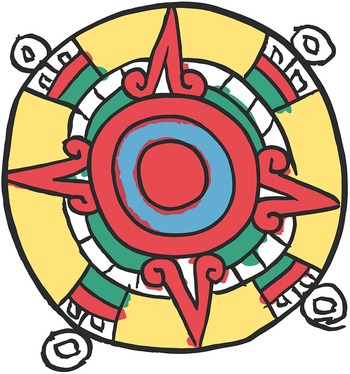
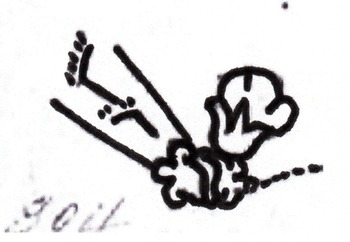
The logogram is a sign used for referring to an entire word, which means that it is linked simultaneously to both a meaning and a pronunciation (Polis Reference Polis2022b:44). According to Whittaker (Reference Whittaker2021:13), a logogram is “a semantic sign standing for a word or morpheme” and for Davletshin (Reference Davletshin2021:85), “a word sign.” In Nahuatl, logograms can be nominal (representing the root of a substantive, after deletion of the noun suffixes -tl, -tli, -li, -in) or verbal (representing the bases of the preterite). According to the commonly accepted convention, logograms are presented in large capitals and bold characters: for example the image of the sun will be read TONATIUH (Figure 1).
The sun as the nominal logogram TONATIUH in the toponym Tonatiuhco, “Place of the Sun God” (Codex Mendoza, Berdan and Anawalt Reference Berdan and Anawalt1997:f. 34r) (Drawing by Nicolas Latsanopoulos).

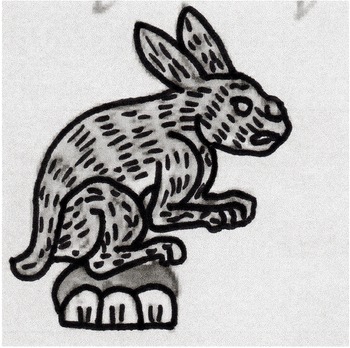
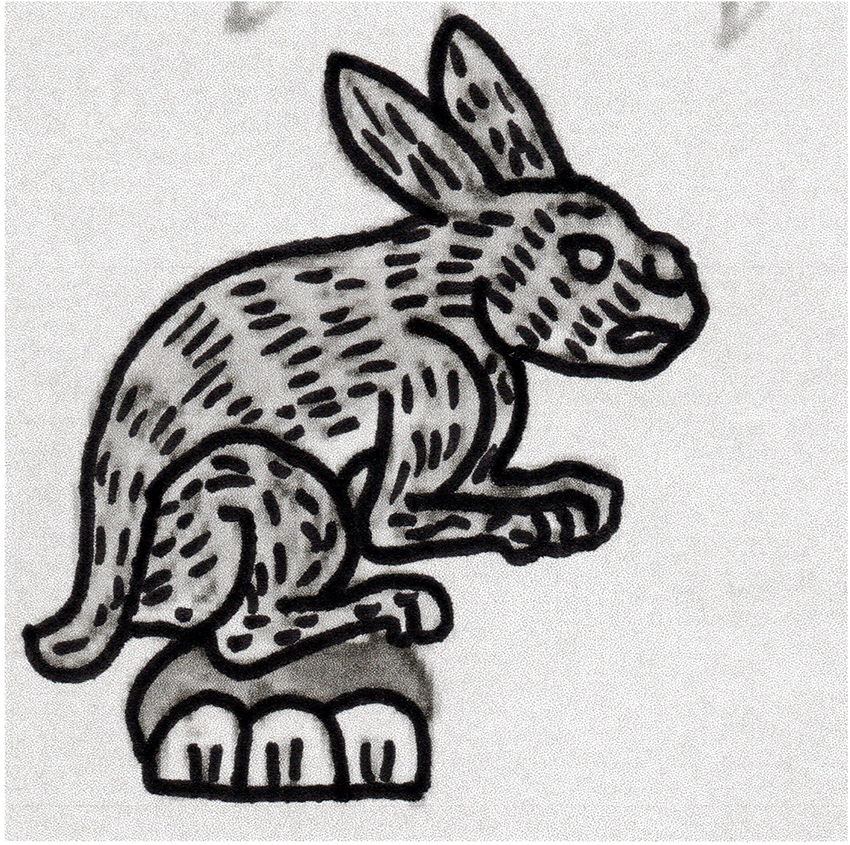
The phonogram is made up of elements with two values—graphic and phonic—but ignores the meaning (Pottier Reference Pottier, Beaux, Pottier and Grimal2009:392). This procedure was named “phoneticism” by Nicholson (Reference Nicholson and Elizabeth1973). In Egyptian hieroglyphs, phonograms are writing signs that refer to one or more sounds (Polis Reference Polis2022a:302–303). The technique, which aims to retain only the graphic and phonic values of a sign, is common in Nahuatl. For example, in the toponym Tochtlan (Figure 2) (“By or Among the Rabbits” (Whittaker Reference Whittaker2021:100, Figures 3–22d), the locative -tlan (“by”) is expressed as a phonogram by three teeth that are pronounced tlan(tli) in Nahuatl. By convention, this phonogram is written in bold lower case letters: tlan. The toponym Tochtlan, composed of the logogram toch(tli), “rabbit,” and the phonogram tlan, would therefore be written TOCH-tlan.
The toponym Tochtlan, “By or Among the Rabbits” (TOCH-tlan, written with the logogram TOCH, “rabbit” and the phonogram tlan, “teeth” for “among”) (Codex Mendoza, Berdan and Anawalt Reference Berdan and Anawalt1997:f. 50r) (Whittaker Reference Whittaker2021:100, Figures 3–22d) (Drawing by Danièle Dehouve).
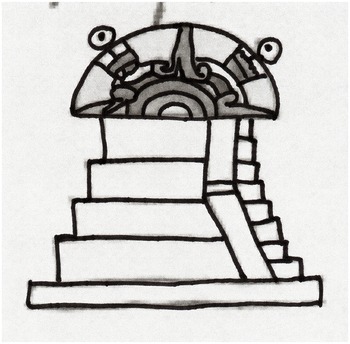
An indicator (teo-TEOPAN). Repetition of the syllable teo in Teopantlan, “By the Temple” (Codex Mendoza, Berdan and Anawalt Reference Berdan and Anawalt1997:f. 42r) (after Whittaker Reference Whittaker2021:79) (Drawing by Danièle Dehouve).
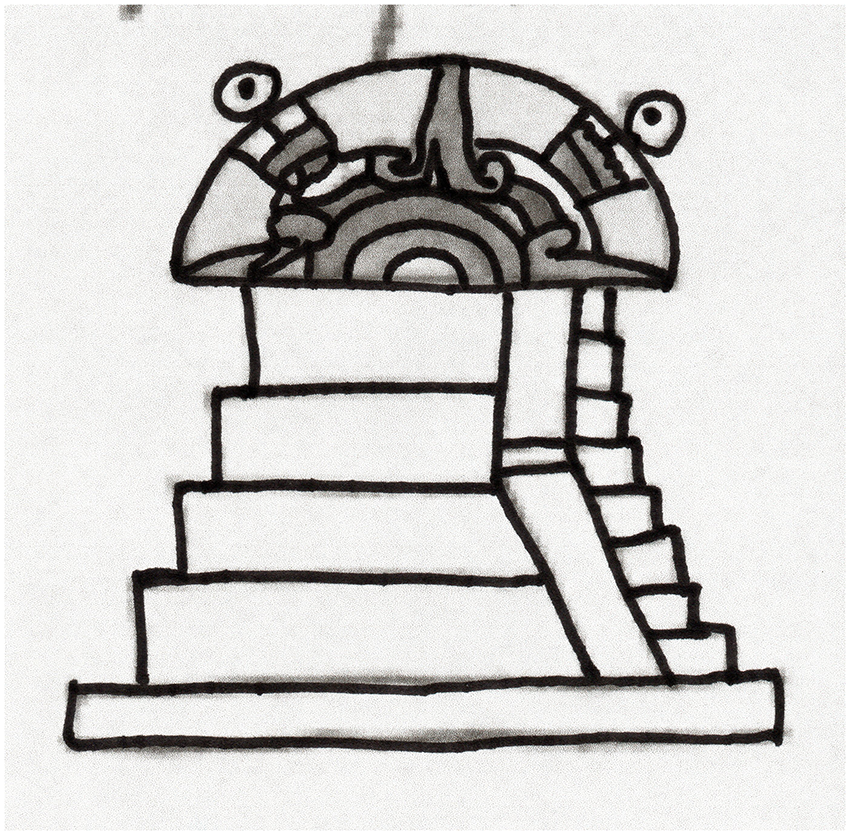
The phonetic indicator is a sign that repeats the pronunciation of a syllable to aid reading and reduce the possibility of misunderstanding. Egyptologists call it a “phonetic complement” (Polis Reference Polis2022a:300), and for Nahuatl script Davletshin (Reference Davletshin2021:77) uses the same term. Nicholson (Reference Nicholson and Elizabeth1973) preferred “redundant phonetic indicators” and so does Whittaker (Reference Whittaker2021:14). This is also the term that I will use. The latter author presents the indicator (Whittaker Reference Whittaker2021:79) written as superscript. For example, the place name teo-TEOPAN (“Temple”) will be transcribed in this way because the phonetic indicator (teo), from teo(tl) (“god”) drawn as a half-sun helps to read the first syllable of the logogram teopan (“temple”) (TEOPAN) (Figure 3).
The silent determinative is “a writing sign that is not pronounced, but specifies the semantic category or referent of the word it classifies” (Polis Reference Polis2022a:300). It therefore has two values—graphic and semantic—but no phonics. Whittaker (Reference Whittaker2021:74–78) calls this device the “classifier-semantic complement” and provides a list that includes the signs for mountain, man, woman, etc. I will not need to use it in my analysis of the names of the gods.
The abbreviated or truncated reading (Davletshin Reference Davletshin2021:71 and 82; Whittaker Reference Whittaker2021:15) is defined as follows: “resource consisting in the use of the phonetic value of a word sign in a partial way, according to its first sounds” (Davletshin Reference Davletshin2021:82). This is also known as acronym. For example, the toponym Chalco, “Place of the Hollow” (first recognized by Nicholson Reference Nicholson and Elizabeth1973:5) is expressed by means of the first syllable of chalchihu(i)(tl), “jade,” used as a phonogram to transcribe “hollow.” Tovar (Reference Tovar1944:18, 22, my translation) found the toponym Chalco to be a derivative of challi, “a hollowed-out cavity like a mouth.” The word could stem from the verb chaloa, “to open,” as in “to open one’s mouth,” by extension meaning “to pierce” (see Dehouve Reference Dehouve, Rosado and Barrio2018:17). As the word is truncated, I will write it according to the convention chosen by Whittaker (Reference Whittaker2021:15) as “points represented by the full stops”: chal. (Figure 4).
The toponym Chalco, “Place of the Hollow,” expressed using the truncated reading of the phonogram chal. from chal(chihui)(tl), “jade” and the abbreviated writing of Chal(co) (Codex Mendoza, Berdan and Anawalt Reference Berdan and Anawalt1997:f. 3v) (Drawing by Nicolas Latsanopoulos).

The abbreviated writing (or spelling) means that in a name in Nahuatl, only part of it is transcribed. For example, in Chalco, “Place of the Hollow,” only the syllable chal. is written, but not the locative -co. I will indicate this procedure using brackets: Chal(co) (Figure 4).
The system is easier to decipher when there is a Spanish transliteration, as found in many of the lists of names that were compiled after the Conquest and used to read the toponyms I have taken as examples in the previous figures. Indeed, with regard to figurative writing, Pottier (Reference Pottier, Beaux, Pottier and Grimal2009:402, my translation) states: “A sign can have several meanings (polysemy), spellings (polygraphy) or sounds (polyphony). Conversely, several meanings (homosemia), spellings (homography) or sounds (homophony) may occur under the same sign.” He thus points to a series of difficulties that can be found in particular in the deciphering of Nahuatl writing. For example, Whittaker (Reference Whittaker2021:55) shows that the leg sign can give rise to ten different readings (polyphony). Davletshin (Reference Davletshin2021:57) describes these signs as “multi-purpose,” “those with more than one reading value.”
Another difficulty concerns a characteristic that the Egyptian and Nahuatl scripts fully share: the multifunctionality of signs as logograms, phonograms, determinatives, and indicators. According to Polis (Reference Polis2022b:48), “It must be strongly emphasized that the functions just mentioned are not properties of signs, but values they take on in context.” And for Whittaker (Reference Whittaker2021:128), “the function is paramount. A sign can only be properly called a logogram when it is used as a logogram. It does not retain this status when its function changes, since status is ruled by context and usage. The rebus use of a logogram changes the latter into a phonogram.”
These difficulties are particularly pronounced when analyzing an image of a god that is not accompanied by a Spanish transliteration made in the sixteenth century. Only when a sufficient number of signs have been deciphered will it be possible to assign a definite meaning to each one. However, for now, the priority is to prove that the representations of gods, usually considered to be purely a “conceptual style of a metalinguistic nature,” as I have said above, actually contain glottograms in Nahuatl.
Logograms and phonograms in the names of gods
In my analysis of the names of the gods, I will look for the mechanisms that have been briefly defined, as well as their multifunctional implementation. Before taking complex examples, in which logograms, phonograms, and indicators are freely associated, I will begin by giving simple examples of logograms and phonograms constituting the names of gods.
Logogram
The referent of a logogram is a whole word and, in this case, the name of a god. The example below is simple and obvious. The name of the goddess Xochiquetzal is made up of xochi(tl), “flower” and quetzal(li), “quetzal bird” or quetzal feather. I indicate the absolutive suffix of the noun (tl, li) in parentheses because it can be removed to leave only the root of the substantive: xochi-, quetzal-.
In Nahuatl, the word quetzal has two meanings: on the one hand, it refers to the Pharomacrus mocinno bird, with its intense green plumage and metallic highlights, which today lives in the tropical rainforests of Mexico and Guatemala. On the other, the word refers to the feathers called quetzalli which came from the male quetzal. These were the upper covering feathers of the tail and could measure from 70 to 105 cm in length (Aguilera Reference Aguilera and Torres2001:222).
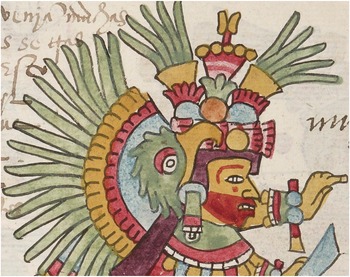
In the Codex Telleriano-Remensis, a colonial manuscript describing the divine governing forces for the 20 trecenas (groups of 13 days) of the divinatory calendar called tonalpohualli by the ancient Nahuas, the name of the goddess Xochiquetzal is inscribed on her head and neck (Figure 5). A flower, xochi(tl), rises vertically from the top of her head, representing the logogram XOCHI. Two plumes of quetzal feathers surround it and express the logogram QUETZAL. This name is repeated in the head of a quetzal bird and its large feathers, which are placed on the back of her neck.
Xochiquetzal, XOCHI-QUETZAL, “Flower-Quetzal” (Codex Telleriano-Remensis n.d.:f. 22v) (Courtesy of the National Library of France).

Phonogram
The names of divinities could also be expressed by means of a phonogram, i.e., a word chosen for its sound, disregarding its meaning. We shall see that this process is much more complex, as it opens the way to many plays of words that in turn refer to various symbolic dimensions.
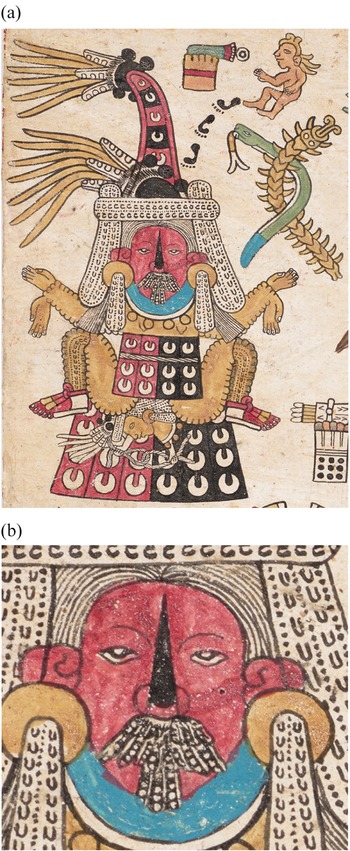
Tlazolteotl was called “Goddess of Filth” because she provoked—and purified—sexual transgressions. In the Codex Borbonicus, another manuscript produced shortly after the Conquest, which, among other things, describes divine influences on the trecenas, the word “filth,” tla(h)zol(li), appears as a phonogram before her mouth (Figure 6a–b). The sign is in fact composed of the body of a quail, zol(in) in Nahuatl, replacing her teeth, tla(n)(tli), which forms the phonogram tla-zol (“teeth-quail”), the sound of which is close to that of tlahzol-, “filth,” because, as said above, the glottal stop marked here (h) is not taken into account in the spelling, nor is the nasalization marked (n).
Tlazolteotl, “Goddess of Filth”: (a) general view of the goddess; (b) close-up of the phonogram of the beginning of her name: tla-zol, “teeth-quail” (Codex Borbonicus n.d.:f. 13) (Courtesy of the Bibliothèque de l’Assemblée Nationale ©).

The interpretation of this phonogram is not new, having been put forward by Sullivan (Reference Sullivan and Benson1982:11–12), but unfortunately scholars have not drawn any theoretical conclusions from it about the presence of phonograms in divine bodies. It has to be said that this association was perfectly understandable from a simple symbolic point of view. The teeth evoked the ingestion of food and the quail was the emblematic bird of the group of earthly goddesses, of which Tlazolteotl was a member. These birds were decapitated in large numbers, their blood offered to the Sun and their bodies thrown onto the surface of the Earth, who was supposed to eat them. During certain rituals, the personifiers of the deities associated with maize held quails between their teeth (Sahagún Reference Sahagún1950–Reference Sahagún1982:bk. 2, p. 202–216; bk. 9, f. 38. See also Mikulska Reference Mikulska2021:37). The presence of a quail devoured by the goddess was therefore hardly surprising.
Having taken these two cases illustrating the logogram and the phonogram, I will analyze the names of several gods, whose representations combine glottograms of different values in a more complex way.
Tlachitonatiuh, the Setting Sun
As a first example of the complex interweaving of several glottograms and symbolic meanings, I will comment on the image of a god in the sixteenth trecena, according to the Codex Borbonicus. This manuscript dates from the very beginning of the Spanish Conquest and is not influenced by the Latin alphabet. According to it, two deities exerted their influence over this period of 13 days: Xolotl, the twin of Quetzalcoatl in the form of a dog, and a god called Tlachitonatiuh, representing the Setting Sun when it is transformed into the Black Night Sun. Two other colonial manuscripts explain this in a commentary:
Tlachitonatio [erased] properly between light and darkness, and so the sun is painted on the shoulders and death under the feet as it appears here, saying that this is the warming or heat that the sun gives to the earth; they say that when the sun sets it will give light to the dead. (Codex Telleriano-Remensis n.d.:f. 20r, my translation from Spanish)
This means between light and darkness, what we call twilight, and so they paint this figure of the roundness of the earth as a man who has the sun on his shoulders, and under his feet night and death, implying that when the sun is going to die, it will warm and illuminate the dead. (Codex Vaticanus A n.d.:f. 29r, translation from Italian to Spanish by Anders and Jansen Reference Anders and Jansen1996:175, my translation from Spanish)
The name of this sun is Tlachitonatio (Codex Telleriano-Remensis n.d.:f. 20r), which we write Tlachitonatiuh, from tlachi-tonatiuh. The name of the Sun God is Tonatiuh, as we have already seen above, and here it is preceded by the word tlachi- which should be spelled tlalchi-. According to Wimmer (Reference Wimmer2014: tlalchi), this adverb is composed of the suffix -chi, “towards, in the direction of,” which is only used with the radical tlal(li), “earth,” in the form tlalchi. Carochi (Reference Carochi and León-Portilla1983 [Reference Carochi and León-Portilla1645]:498) translates it as “on or towards the ground” (e.g., “I look toward the ground,” my translation from Spanish). The descriptions of rituals collected by Sahagún in Nahuatl use it, for example, to describe the descent of men from the top of the pyramids to the ground.
The term tlalchi was also used to refer to one of the two leaders of the pre-Hispanic city of Cholula. The city was ruled by Aquiach and Tlalchiach, whose names can be translated as “The older brother of above, and the younger brother of below the ground” (Muñoz Camargo Reference Muñoz Camargo1998:207, §310, my translation). It should be noted that the same dual power existed in Cacaxtla (Testard Reference Testard2023:90). In other words, the first ruler represented the daytime sun and the second the night-time sun.
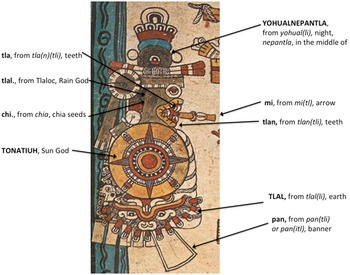
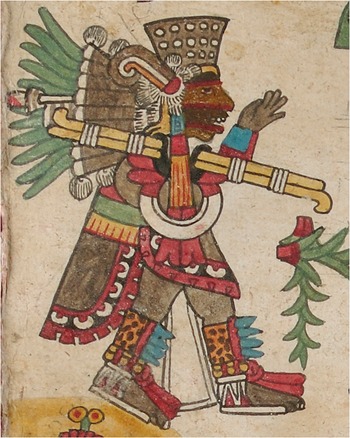
Two Aztec manuscripts, the Codex Borbonicus (n.d.) and the Tonalamatl Aubin (n.d.), draw the name Tlachitonatiuh in an interesting way. In Codex Borbonicus (n.d.:f. 16) (Figure 7), Tlachitonatiuh is represented as a mortuary bundle (tlaquimilolli) wrapped in a black cloth with skull and bone designs and tied with white ropes. The presence of this mortuary bundle is symbolically appropriate to represent the setting sun, which is about to join the world of the dead during the night, before being reborn at dawn. Furthermore, according to Hermann Lejarazu (Reference Lejarazu and Manuel2008), mortuary bundles bore external signs that allowed them to be recognized as representing a particular deity. Here the bundle bears the phonogram of the name Tlachitonatiuh, detailed on the left-hand side of Figure 7. It is surmounted by a mask whose wide-open mouth is filled with fangs: tla, from tla(n)(tli), “teeth.” It should be specified that in Nahuatl the word tlan(tli) (“teeth”) was commonly used to refer to animal fangs—see, for example, the terms tlancoliuhqui: “curved fangs” (Wimmer Reference Wimmer2014: tlancoliuhqui) or cocoatlantia: “to adorn someone with snake hooks” (Wimmer Reference Wimmer2014: cocoatlantia).
Tlachitonatiuh, Setting Sun: YOHUALNEPANTLA mi-tlan TLAL-pan tlal.-tla-chi.-TONATIUH, “Toward the middle of the night, toward the Place of Dead People, toward the Earth, Tonatiuh moving toward the Earth” (Codex Borbonicus n.d.:f. 16) (Courtesy of the Bibliothèque de l’Assemblée Nationale ©).

On the cheek of the mask is a circle decorated with small dots representing chia seeds (a word with several variants: chia, chian, chie, chiya, according to Wimmer Reference Wimmer2014: chia). Chia seeds (Salvia hispanica), of which there is a black variety (tliltic chian), are usually an ornament of the Rain God, Tlaloc, who wears white cakes on his cheek sprinkled with black seeds representing rain (Dupey García Reference Dupey García2010:vol. I, p. 319, and Reference Dupey García2010:vol. II, Figure175–176). In the case of Tlachitonatiuh, as the mask on the mortuary bundle is black, the chia seeds are black on a black background. The sign of the chia seeds is here a phonogram, with the value chi. used as an abbreviated reading of chia. As for the mask, it could be that of the god Tlaloc, as it also has his large eyes and characteristic curved fangs, which suggests that the name Tlaloc spells the phonogram tlal. in abbreviated reading . Finally, an enormous sun is placed on the mortuary bundle: it represents the logogram TONATIUH. Therefore the name of the god may be transcribed: tlal.-tla-chi.-TONATIUH. One of the two phonograms tlal. or tla can serve as a phonetic indicator.
But that’s not all, and I have detailed on the right-hand side of Figure 7 the other glottograms that appear in the image of the Setting Sun and can be read from top to bottom as follows. The middle of the night, yohualnepantla, from yohual(li), “night”-nepantla, “in the middle of,” was a particularly important moment in nocturnal rituals (Dehouve Reference Dehouve2014:281–283). The usual sign to represent it was a ball of hay surrounding a nocturnal eye (Mikulska Reference Mikulska2015:468–469; Seler Reference Seler1963:vol. II, p. 161). It can therefore be read as the logogram: YOHUALNEPANTLA.
Below, an arrow, mi from mi(tl), “arrow,” enters the mouth bearing “fangs,” tlan, from tlan(tli). The two words transcribe the phonogram: Mictlan, “Place of the Dead People.” Finally, still below, the Tonatiuh sun penetrates between the jaws of the Earth Monster, Tlaltecuhtli, which can be read as the logogram TLAL. Beneath the Earth Monster, a banner, pan(tli) or pan(itl), writes the phonogram pan. The two glottograms form the word Tlalpan, “Place of the Earth.” Taking into account the movement indicated by the suffix chi in Tlachitonatiuh, we can translate Mictlan as “Toward the Place of the Dead People” and Tlalpan as “Toward the Earth.”
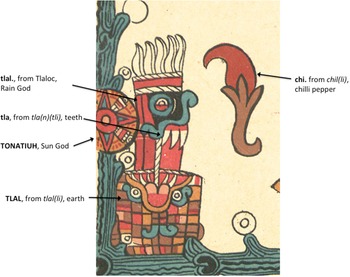
A similar image of Tlachitonatiuh can be found in another manuscript of Aztec tradition, the Tonalamatl Aubin (Reference Aubin1900:f. 16) (Figure 8). It is interesting because the god’s name is written using several other phonograms. Here, the mortuary bundle bears clearly the mask of the god Tlaloc, whose phonogram is tlal. in abbreviated reading. As Tlaloc’s mask, it is fitted with large teeth, tla(n) (see above); we can assume that these form a phonogram that helps to read the first phonogram, tla. Furthermore, the mortuary bundle is swallowed by the Earth, identifiable in this manuscript by its jaws and multi-colored body, whose logogram is TLAL, from tlal(li). The sound tlal is thus repeated in three different ways. Finally, opposite Tlaloc’s mask is a large chili pepper, chil(li), which gives the phonogram chi. in abbreviated reading, and the mortuary bundle carries on his back the Sun God whose logogram is TONATIUH.
Tlachitonatiuh, Setting Sun: tlal.-tla-TLAL-chi.-TONATIUH, “Tonatiuh moving toward the Earth” (Tonalamatl Aubin Reference Aubin1900:f. 16) (Image in the public domain).

This makes it possible to decipher tla.-TLAL-tlal-chi-TONATIUH. Of the three ways of repeating the sound tlal, one should be considered the main one and the other two as phonetic indicators.
Each of these glottograms is perfectly in line with the symbolism of the god of the Setting Sun, Tlalchitonatiuh, and the commentaries in the Codex Telleriano-Remensis (n.d.:f. 20r) and Codex Vaticanus A (n.d.:f. 29r), cited above. The presence of the Rain God Tlaloc can certainly be explained by his ability to render the phonogram tlal. Furthermore, Tlaloc is a “god full of earth” according to the etymology proposed by Sullivan (Reference Sullivan1974:213–219), so it is appropriate to refer to him when describing the Sun as it approaches the Earth, which it is about to enter. This is an example of how writing and the symbolic layer of meaning were interwoven in the bodies of the gods.
Xipe Anahuatlitec, flayer god
Xipe Totec was the Flayer or Flayed God and presided over a sacrificial ritual performed during the annual Tlacaxipehualizti festival. His name is generally interpreted as “Our Lord Flayed,” from totec, /to-tekw/ (“our lord”) and xipe (“flayed”). Xipe is a possessive noun that breaks down into xip-eh, from -eh, “who has, who possesses” and xip-, an unattested nominal stem but perhaps admissible from the verb xipehua (“to flay”) (Launey Reference Launey1987:vol. II, p. 1120). Representations of the god Xipe Totec are easily recognizable thanks to the human skin and mask with which he is clothed in the various manuscripts (see Vié-Wohrer Reference Vié-Wohrer1999:I,90–91) and which encode the xipe part of his name. However, research is still needed to understand how the totec part was represented.
It is therefore particularly interesting to look at an image accompanied by a name, spelled in Latin characters, in the Primeros Memoriales collected by the Franciscan Sahagún (Reference Sahagún1997:f. 263r) (Figure 9). This name is xippe anavatlitec, which will be written in standardized spelling: Xipe Anahuatlitec. According to the translation by Sullivan, Xipe means “Flayed One” and Anahuatlitec, “Lord of the Coastland” (literally “Coastland its Lord,” from anahua(tl)-itec, because the latter word is the third-person singular possessive of tecuhtli, “Lord”).
Xipe was particularly associated with Yopi/Tlappanec of the Guerrero-Oaxaca border region and the neighbouring Zapotec of the Oaxacan Pacific littoral. In the Florentine Codex [Sahagún Reference Sahagún1950–Reference Sahagún1982:vol. I, f. 39], Xipe was called Anaoatl iteouh: tzapoteca in vel inteuh catca: “The god of the Coastland, the proper god of the Zapoteca.” (Sullivan, in Sahagún Reference Sahagún1997:102)
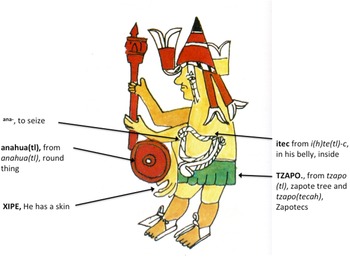
Xipe Totec, Flayer God: Xipe Anahuatlitec, Tzapoitec: XIPE ana-anahua(tl)-itec TZAPO.-itec, “He has a skin, Coast Lord [a round thing in the belly], Lord [a round thing in the belly] of the Zapotecs” (Sahagún Reference Sahagún1997:f. 263r). (Drawing by Antoine Pacé. In Vié-Wohrer Reference Vié-Wohrer1999:II,A61. Courtesy of the Centro de Estudios Mexicanos y Centroamericanos, CEMCA).

In fact, the word anahuatl referred to land close to water and could derive from the locative: a(tl)-nahuac, “Near Water.” The term Anahuac related to “any region where water surrounded a land, which included islands, coasts, and by extension the world as a whole, which was conceived by the Mexicas as a round land surrounded by water” (Vauzelle Reference Vauzelle2018:743, my translation from French). It could therefore refer to cities in the Valley of Mexico surrounded by lake water, as well as to coastal populations. This is why Sahagún said of Xipe Totec: “This god was honored by those who lived by the seashore, and its origin was in Tzapotlan, a town of Xalisco” (Sahagún Reference Sahagún1956:bk. 1, ch. 18, f. 45, my translation from Spanish).
The script of the name of the god Xipe Anahuatlitec in the image of Primeros Memoriales (Sahagún Reference Sahagún1997; Figure 9) is complex and begins with the word Xipe, “He has a skin.” The skin is expressed by one of its parts, the hand hanging over the figure’s stomach. It is therefore a logogram that can be written XIPE.
The rest of his name is based on the polysemy of the word anahuatl, which not only means “By the Water” or “Coastland,” but also designates a round thing: anahuayoh means “which has circles or a pattern formed of circles” and anahuacayoh, “which has concentric circles” (Wimmer Reference Wimmer2014: anahuayoh, anahuacayoh, my translation from French). As such, anahuatl (“coastal region”) can be represented by the phonogram anahua(tl) (“round thing”) expressed by the round shield, bearing several circles.
The second part of the god’s name, itec, means “its Lord” (“Anahuatl its Lord,” i.e., “Lord of Anahuatl,” from the possessive form i- applied to the substantive tecuhtli to give i-tec). It is represented by the phonogram itec, from ihtec [i(h)te(tl)-c], “in his belly or inside,” for as I said above, the glottal stop here noted (h) is not transcribed. The phonogram “in his belly” is drawn by a white rope that describes a loop on the figure’s belly.
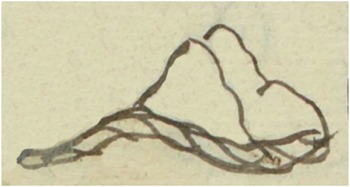
Finally, perhaps this white rope is likely to form the phonogram ana, from ana, “to catch, to seize.” This reading has not yet been highlighted in the lists of names; however, several anthroponyms from the Matrícula of Huexotzinco (n.d. In Wood Reference Wood2020—present) deciphered as huilana, “to grasp, to drag,” are represented by a rope (mecatl) encircling an object to be pulled: a stone, Tehuilan, from te(tl), “stone” and huilan(a), “to drag” (Matrícula of Huexotzinco n.d.:f. 570v; Wood Reference Wood2020—present:https://aztecglyphs.wired-humanities.org/content/tehuilan-mh570v); a mountain, Tepehuilan, from tepe(tl), “mountain” and huilana, “to drag” (Matrícula of Huexotzinco n.d.:f. 497v; Wood Reference Wood2020—present:https://aztecglyphs.wired-humanities.org/content/tepehuilan-mh497v) (Figure 10); something represented as a lumber, Tlahuilan, from tla, “something” and huilana, “to drag” (Matrícula of Huexotzinco n.d.:f. 513r; Wood Reference Wood2020—present:https://aztecglyphs.wired-humanities.org/content/tlahuilan-mh513r). It is therefore possible to hypothesize that the rope (mecatl) could also form the verb ana, “to catch,” a hypothesis to be confirmed later. If this is correct, ana would function here as the phonetic indicator for anahuatl.
The toponym Tepehuilan, “Dragged Mountain,” as a man’s name (Matrícula of Huexotzinco n.d.:f. 497v; Wood Reference Wood2020—present:https://aztecglyphs.wired-humanities.org/content/tepehuilan-mh497v).

But that is not all. Sahagún (Reference Sahagún1997:102) specified that the god’s full title was: Anaoatl iteouh: tzapoteca in vel inteuh catca: “He was the god of the Coastland, the proper god of the Zapotecs.” It remains to comment on the presence of the Zapotecs. It is found in the expression tzapotecah itec: “Lord of the Zapotecs,” expressed by the phonogram tzapo., from tzapo(tl) or tzapo(tecah), represented by the skirt made of zapote leaves that characterizes the god’s clothing and is called tzapocue(itl) (Vié-Wohrer Reference Vié-Wohrer1999:I, 91). The itec part is represented by the same white rope that forms the phonogram itec, from ihtec [ihte(tl)-c], “in his belly, inside,” which gives TZAPO-itec.
The phonograms (Figure 9) can therefore be read: XIPE ana-anahua(tl)-itec TZAPO.-itec, from ana, “to seize,” anahua(tl), “round thing,” i(h)tec, “in the belly,” tzapo(tecah), “Zapotecs,” i(h)tec, “in the belly.”
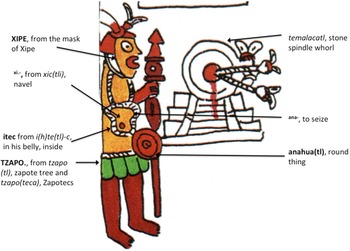
This interpretation is supported, but also enriched, by another illustration from the Primeros Memoriales (Sahagún Reference Sahagún1997:f. 269r) (Figure 11) which shows a god more or less similar to the one I have just analyzed. This god is represented by his impersonator or ixiptla, who is destined for sacrifice. The Xipe part (“He has a skin”) can be deduced from the Xipe mask worn by the impersonator. The rest of his name reads: Anahuatl itec, Zapotecah itec: “Lord of Anahuac, Lord of the Zapotecs,” as in the previous case.
A variant of Xipe Totec, Flayer God: Xipe Anahuatlitec, Tzapoitec: xi.-XIPE ana-anahua(tl)-itec TZAPO.-itec, “[navel], He has a skin, Coast Lord [a round thing in the belly], Lord [a round thing in the belly] of the Zapotecs” (Sahagún Reference Sahagún1997:f. 269r). (Drawing by Antoine Pacé. In Vié-Wohrer Reference Vié-Wohrer1999:II,A61. Courtesy of the Centro de Estudios Mexicanos y Centroamericanos, CEMCA).

The interesting thing about this representation is the variation in the representation of Xipe’s belly. This has a clearly distinguishable navel in the center. The round, red navel resembles the central point of the shield decorated with concentric circles. It is repeated again as a red, bloodstained circle in the center of the sacrificial stone, known as temalacatl (“stone spindle whorl”), where the impersonators of Xipe wearing the god’s attributes died. Figure 11 therefore clearly expresses the existence of a homology between Xipe’s belly, his shield with concentric circles, and the round sacrificial stone where warriors died in his honor.
Now, in Nahuatl, the navel is called xic(tli) (I would like to thank Julia Madajczak for establishing this connection and sharing it with me, personal communication, December 2024; the following analysis and any errors therein are my sole responsibility). The navel is located in the center of Xipe’s belly, which suggests that its sign plays the role of the phonetic indicator xi.-, i.e., the first syllable of xic(tli) without the -c-, for the logogram XIPE: xi.-XIPE.
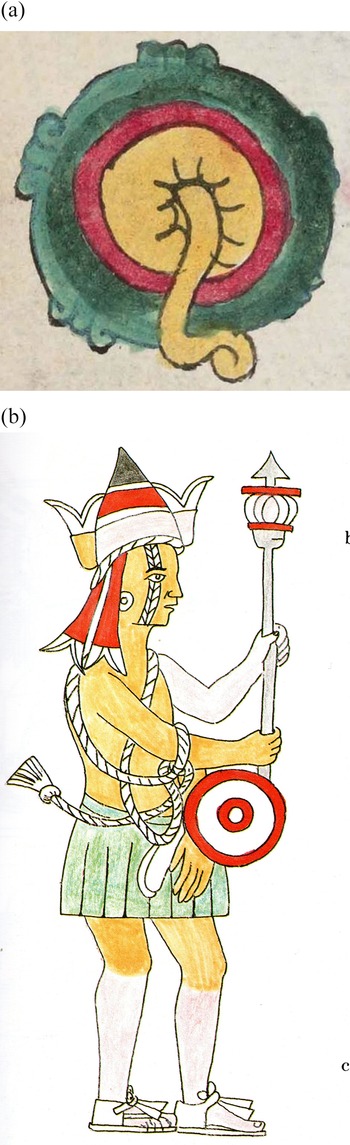
The word xic(tli) also designates the umbilical cord (Wimmer Reference Wimmer2014: xictli). This is represented in the toponym Xicco, “Place of the Umbilical Cord,” from xic(tli)-co (Figure 12a). This meaning opens up a new set of symbolic connotations that prove that the umbilical cord does indeed play a key role in the images and glottograms of Xipe. It demonstrates that the white rope on Xipe’s stomach is indeed the umbilical cord (Figures 9 and 11).This rope can be compared to the “rope of subsistence” called tonacamecatl, which tied the captive to the round sacrificial stone, and was made from white heron feathers (aztatl), which usually adorned the sacrificed captives. Now, It is clear that the umbilical cord is truly a “rope of subsistence” through which the fetus can feed and grow. It is therefore understandable that in Sahagún (Reference Sahagún1575–Reference Sahagún1577:vol. I, f. 12; Figure 12b), Xipe’s impersonator does not wear the white cord around his belly, but wrapped around his body: its main purpose here is to reinforce the homology between the umbilical cord and the rope of the sacrificial stone.
Representations of xic(tli), “navel and umbilical cord”: (a) Xicco, “Place of the Navel or Umbilical Cord,” from xic(tli)-co (Codex Mendoza n.d.:f. 20v; Wood Reference Wood2020—present:https://aztecglyphs.wired-humanities.org/content/xictli-mdz20v). (b) Xipe (Sahagún Reference Sahagún1575–1577:vol. I, f. 12). (Drawing by Antoine Pacé. In Vié-Wohrer Reference Vié-Wohrer1999:II,A61. Courtesy of the Centro de Estudios Mexicanos y Centroamericanos, CEMCA).

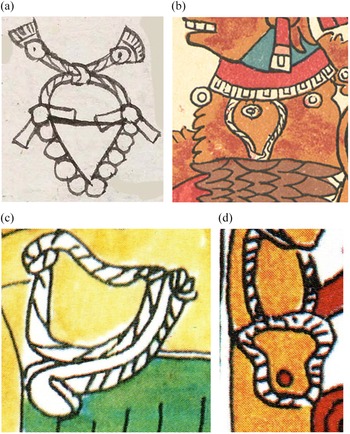
However, in Figures 9 and 11, the rope appears to hang from a necklace that falls down over the belly of Xipe’s impersonator and forms a circle. We find the reason for this in another toponym derived from the same root, Toxicco, “Place of Our Umbilical Cord,” from to-xic(tli)-co, where the umbilical cord is drawn as a white rope worn as a necklace (Figure 13a). Wood (Reference Wood2020—present:https://aztecglyphs.wired-humanities.org/content/toxicco-mdz12r) offers the following analysis: “Interestingly, the umbilical cord appears to have been made into a necklace. Male warriors carried the umbilical cords of boys into battle and left them on the battlefield; perhaps they wore them as necklaces into battle.”
Representations of xic(tli), “navel and umbilical cord” as a necklace. (a) Toxicco, “Place of Our Navel or Umbilical Cord,” from to-xic(tli)-co (Codex Mendoza n.d.:f. 12r; Wood Reference Wood2020—present:https://aztecglyphs.wired-humanities.org/content/toxicco-mdz12r); (b) The necklace of Xipe (Tonalamatl Aubin Reference Aubin1900:f. 14, in the public domain). (c) The necklace of Xipe (from Figure 9, Sahagún Reference Sahagún1997:f. 269r). (Drawing by y Antoine Pacé. In Vié-Wohrer Reference Vié-Wohrer1999:II,A61. Courtesy of the Centro de Estudios Mexicanos y Centroamericanos, CEMCA). (d) The necklace of Xipe (from Figure 11, Sahagún Reference Sahagún1997:f. 269r). (Drawing by Antoine Pacé. In Vié-Wohrer Reference Vié-Wohrer1999:II,A61. Courtesy of the Centro de Estudios Mexicanos y Centroamericanos. CEMCA).

These pieces of evidence support the fact that the rope hanging from Xipe’s neck in the Tonalamatl Aubin (n.d.:f. 14) (Figure 13b) and Sahagún (see Figures 9, 11 and 13c–d) was read as xic(tli), “navel and umbilical cord,” with the value of a phonogram serving as the phonetic indicator xi.-. Indirectly, they also confirm the reading of the phonogram i(h)tec, “in the belly,” since the navel is in the center of the belly.
Brylak (Reference Brylak2025) analyzes a warrior ritual involving the navel: before engaging in combat, warriors would pinch their enemies’ navels to provoke them. This was considered an insult, as the navel was used as a depreciative term (Wimmer Reference Wimmer2014: xictia). This observation therefore reinforces the idea that the navel/umbilical cord was closely linked to the god Xipe Totec.
Finally, it should be noted that the above analysis does not exhaust the symbolic connotations of the objects belonging to Xipe. Thus, Mikulska (Reference Mikulska2021) has pointed out that the concentric circles on the god’s shield, which I have linked here to Anahuatl and the navel, also represent the image of the sun. This hypothesis is confirmed by one of the capes represented in the Codex Magliabechiano (n.d.:f. 8r) made of concentric circles in similar colors, and named by the gloss in the manuscript as the “cape of the sun” (Mikulska Reference Mikulska2021). The roundness produces several kinds of analogy, including places in space (Anahuac), the sun and the navel (anahuatl).
Thus it becomes clear that the glottograms incorporated into images of gods were not only intended to spell out their names. Their main purpose was to reinforce the ritual efficacy of the representation by proving that the symbolism of the divine attributes was confirmed by the pronunciation of their names. The search for these glottograms cannot therefore be based solely on lists of phonograms that exist elsewhere, but must take into account the ritual and symbolic dimensions of Aztec society.
Tlazolteotl, “Goddess of Filth,” Teteo Innan, “Mother of the Gods” and Ixcuina, a Huaxtec goddess
The representation of Tlazoteotl in the Codex Borbonicus (n.d.:f. 13) is very well known and often reproduced. It has captured the imagination and been the subject of several analyses (Baena Ramírez Reference Baena Ramírez2010; Gajewska Reference Gajewska2015; Mikulska Reference Mikulska2001; Olivier Reference Olivier2014–Reference Olivier2015; Sullivan Reference Sullivan and Benson1982; and others). According to Sullivan (Reference Sullivan and Benson1982), author of a remarkable synthesis, the goddess had several main names, including Tlazolteotl (“Goddess of Filth”), Ixcuina (a word of Huastec origin meaning “Lady Cotton” in that language), Teteo Innan, “Mother of the Gods,” Toci, “Our Grandmother,” and others. It was noted above that, according to Sullivan, the representation of the goddess in the Codex Borbonicus (n.d.:f. 13) (Figure 6b) includes the phonogram tla-zol, expressing the first part of her name Tlazolteotl by means of the sign “teeth-quail.” In my opinion, the representation of the goddess in the Codex Borbonicus is even more complex and lends itself to a joint reading of her different names.
In the Codex Borbonicus, it is not unusual for several names of the same god to be combined in a single representation. I refer to Tezcatlipoca, ruler of the sixth trecena (Codex Borbonicus n.d.:f. 6) (Figure 14). His main name, Tezcatlipoca, “Smoking Mirror,” appears in the usual form of a mirror from which a scroll of smoke escapes, forming the logogram TEZCATLIPOCA. The same swirl represents the logogram EHECATL, “Wind,” when associated with the star-covered headdress that expresses the logogram YOHUALLI, “Night.” Together, they form the pair Yohualli Ehecatl, “Night Wind,” which was one of the god’s names. Finally, the slave yoke called cuauhcozcatl worn by the god on his shoulder expresses his name Titlacahuan, “He to whom we are slaves” (for further explanations, refer to Dehouve Reference Dehouve2017, Reference Dehouve2025, and Dehouve et al. Reference Dehouve, Mikulska and Vauzelle2025). This image will seem simple given the complexity of Tlazolteotl’s representation in the same codex. I will show that three of her names—Tlazolteotl, Teteo Innan, and Ixcuina—are represented in this manuscript (Codex Borbonicus n.d.:f. 13).
Several names of the god Tezcatlipoca brought together in the same image: Tezcatlipoca, Yohualli Ehecatl, Titlacahuan (Codex Borbonicus n.d.:f. 6) (Courtesy of the Bibliothèque de l’Assemblée Nationale ©).

Tlazolteotl
Tlazolteotl means “Goddess of Filth,” from tlahzol(li) (“filth, rubbish, garbage”) as “a metaphor for licentiousness” (Sullivan Reference Sullivan and Benson1982:7); she was the one who provoked sexual transgressions and purified them. If we look at the representation of Tlazolteotl, we can see that the word tla(h)zol(li), which forms the first part of the name, is repeated by means of several distinct phonograms (Figure 15). This procedure has been called “redundancy”: it is widespread in Nahuatl both in writing (Davletshin Reference Davletshin2021:61 calls it “double writing of homophone logograms”) and in images, for which Mikulska (Reference Mikulska2015:376–377) uses the term “communicative accumulation.”
The repetition of the word tla(h)zol(li), “filth,” by means of several phonograms in the representation of Tlazolteotl, “Filth Goddess”: tla-zol, “teeth-quail,” tlaxol., “flayed,” tlachol., “throwing rubber balls” (Codex Borbonicus n.d.:f. 13) (Courtesy of the Bibliothèque de l’Assemblée Nationale ©).

I have already mentioned the word constructed using the two phonograms “teeth-quail,” read tla-zol (see my explanation at the top left of the goddess) (Figure 15). Just below, I have written tlaxol., from tla-xol(ehua), “to skin, to peel something” (Wimmer Reference Wimmer2014: xolehua): it is an abbreviated reading that I indicate with a point at the end of the word. It should be noted that this phonogram lends itself to a second reading: tlaxol(ehualli)-ehua(tl), “skinned skin” or “flayed skin.” These two phonograms refer to the flayed human skin worn by Tlazolteotl, recognizable by the hanging hands, the crumpled texture of the skin and its yellow color. The spelling of tlaxol instead of tlazol stems from the phonetic changes between the phonemes -z, -tz-, and -x that I mentioned earlier.
I have indicated another phonogram on the right side of the goddess. It is formed by the signs derived from the black rubber ball, which is called ol(li) and refers to the material from the hevea brasiliensis tree, as well as the ball it is used to make (Wimmer Reference Wimmer2014: olli). In a first reading, the ball is used as the phonogram ol which is common in lists of names: see, for example, the toponym Mollancatl (“At the Grinding Place,” Matrícula of Huexotzinco, f. 763v; Wood Reference Wood2020—present:MH763v), and other instances. As the ball is part of the paraphernalia of the ball game called tlach(tli), it can be preceded by the phonogram tlach, which gives tlach-ol, “rubber ball of the ball game.” A second reading is possible from the verb tla-chocholihui, “to throw a ball” (Wimmer Reference Wimmer2014: tlachocholihui), which comes from a grammatical and phonetic transformation of the verb tlaza, one of whose meanings is “to throw” (Karttunen Reference Karttunen1983:305). Read tlachol. as an abbreviated reading.
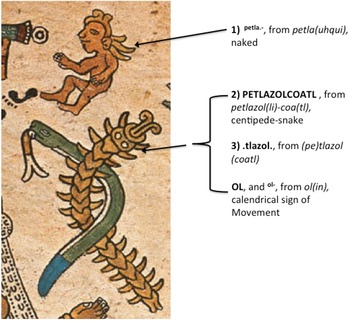
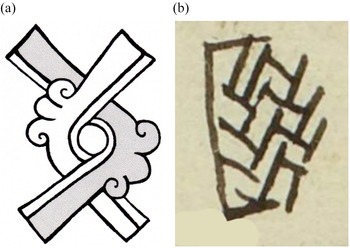
Finally, on the right side of the goddess stands a centipede intertwined with a snake (Figure 16), whose main function is certainly to indicate that Tlazolteotl is the ruler of the trecena beginning on the day Ce-Olin, “1-Movement” (Sullivan Reference Sullivan and Benson1982:29). Indeed, this well-known calendrical sign is made up of two intertwined curves (Caso Reference Caso1967:7, or Codex Borgia n.d.:10) (Figure 17a). But here the sign ol(in), “Movement,” has the peculiarity of containing the name of the goddess Tlazolteotl (Dehouve, Mikulska and Vauzelle Reference Dehouve, Mikulska and Vauzelle2025: in press).
The centipede (petlazolcoatl) to write the calendrical sign Olin, “Movement” as the logogram OL, and the word tla(h)zol(li), “filth,” as the phonogram .tlazol. (Codex Borbonicus n.d.:f. 13) (Courtesy of the Bibliothèque de l’Assemblée Nationale ©).

Glottograms to help with the decipherment. (a) The calendrical sign Olin, “Movement” (Codex Borgia 10) (Drawing by Danièle Dehouve). (b) The anthroponym Petlazol, “Old Mat” (Matrícula de Huexotzinco n.d.: f. 776v). https://aztecglyphs.wired-humanities.org/content/petlazol-mh776v.

In fact, the centipede is called in Nahuatl petlazolli (Karttunen Reference Karttunen1983:192) or petlazolcoatl (Sahagún Reference Karttunen1950–Reference Sahagún1982:bk. 11, f. 86–87). This comes from the Nahuatl compound word petla(tl)-zol(li)-coa(tl), which, read beginning at the end, means “snake-old-straw mat.” The reason for this name was explained by Sahagún’s informants:
Its name comes from petlaçolli and coatl, because it is almost like a serpent. And it is called petlaçolli because it is wide and very many are its legs—400 they say—like a straw mat, one whose edges are frayed; which has many of its rolled edges coming out. They are taken for its legs. (Sahagún Reference Sahagún1950–Reference Sahagún1982:bk. 11, f. 86–87, translation by Dibble and Anderson)
The three words that make up the centipede’s name (petla-, zol-, coatl) are therefore explained: “straw mat,” petla(tl); “old,” zol(li), a substantive which, despite its similarity to zol(in), “quail,” has a completely different meaning; it is used here because a well-used mat has fringed edges that resemble the legs of a centipede; finally, the centipede is described as a “snake” (coatl) from the serpentine shape of its body.
However, it should be noted that the name of the insect is the subject of a pun, because if you break down petlazolcoatl in a different way, you get the word tlazol(li), meaning “rubbish,” which Sahagún’s informants were well aware of, as they added: “Also it is called petlaçolcoatl because it breeds very prolifically there in the rubbish, in the dried maize stalks” (Sahagún Reference Sahagún1950–Reference Sahagún1982:bk. 11, f. 86–87, translation by Dibble and Anderson). Sullivan (Reference Sullivan and Benson1982:18) had already noted this play on words. Finally, it should be added that the verb petlachihua, “to make a mat,” also means “to knit or weave,” and this was one of the goddess’s main functions.
It can therefore be concluded that the insect has a “riddle name.” But this is also the case with its glottographic transcription. A first reading leads to the recognition of the double logogram petlazol(li), “centipede”-coa(tl), “snake,” which forms the complete name of the insect. In Sahagún (Reference Sahagún1950–Reference Sahagún1982:bk. 11), animals are generally represented by drawing the two parts of their names separately. In this case, petlazolcoatl is divided into petlazolli (“centipede” or “old straw mat”) and coatl (“serpent”), as shown in the image of the centipede in Sahagún (1950–Reference Sahagún1982:bk. 11, f. 91r), where the insect’s body rests on an old mat. The same technique is used, for example, to draw the chimalcoatl (“shield serpent”) and xicalcoatl (“gourd vessel serpent”) (respectively Sahagún Reference Sahagún1950–Reference Sahagún1982:bk. 11, f. 85r and 90r). The way of representing an “old mat” is attested in the Matrícula of Huexotzinco (n.d.) (Figure 17b).
The drawing of the centipede in the Codex Borbonicus (Figure 16) is appropriate to its context. It takes the form of the calendrical sign Olin (“Movement”), of which Tlazolteotl is the ruler, and encodes the name of the goddess in the phonogram .tlazol, by truncated reading. We can therefore consider that the representation of ol(in) has a double function: it indicates the name of the trecena and serves as the phonogram ol. used as a phonetic indicator. Finally, we can note that the baby approaching the goddess’s head (which also has its own meaning) is naked (petlauhqui in Nahuatl). It therefore acts as the truncated phonetic indicator .petla. and helps to read the name of the insect petlazolcoatl. This complex combination, which results in the reading of the Tlazol part of the goddess’s name, can be transcribed as .tlazol.-ol.
Teteo Innan
The second name of the goddess is Teteo Innan, Mother of the Gods, from teteoh (“gods”), in-nan (“their mother”), patroness of healers and midwives, and the sweathouse (Sullivan Reference Sullivan and Benson1982:19), and known as the Great Parturient (22).
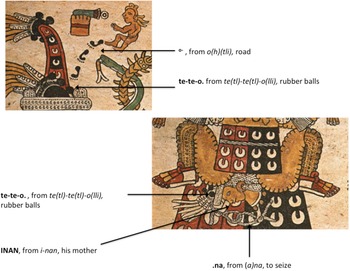
At first glance (see Figure 18), it seems that motherhood is only evoked by the image: at the top, a small naked figure approaches the goddess’s head and enters her body, a movement expressed by several black footprints indicating the direction; at the bottom a small figurine appears between the goddess’s open thighs—she is in the position of a woman in childbirth among the Nahuatl peoples of the past and present.
Possible phonograms of the name Teteo Innan (“Mother of the Gods”): above her head: te-te-o., “rubber balls”; between her thighs: te-te-o., “rubber balls,” and .na, “to seize” (Codex Borbonicus n.d.:f. 13) (Courtesy of the Bibliothèque de l’Assemblée Nationale ©).

However, speculatively, I propose a possible reading of the name Teteo Innan, using phonograms. There are two known ways of expressing the word teo(tl), “god” or “goddess,” in lists of names: using the logogram forming a half-sun (Figure 3) or a phonogram including the sign for stone, te(tl) (Figure 19). I will propose a third way of expressing teo(tl), or rather its plural teteoh, which has not yet been found in any other manuscript, which is why I consider it less certain than my other interpretations.
A representation of the word teo(tl), “god” or “goddess” as the phonograms “stone”-“road” in the anthroponym Xochiteotl, “Flower God” (Codex of Santa María Asunción n.d. National Library of Mexico, Ms 1497bis). After Nicholson (1973:24, Figure 26) and Tlachia 2012 (Glifo A37v_2_A), https://tlachia.iib.unam.mx/glifo/A37v_2_A. (Drawing by Danièle Dehouve).

I suggest that the black rubber balls on the goddess’s head can be read as: “stone,” te(tl), “rubber ball,” ol(li), which gives te-o. for teo(tl). In Nahuatl, objects are counted using numerical classifiers chosen according to their shape. Thus, te(tl), “stone,” was used to count round or oval things, for example, centetl chimalli, “one shield,” mahtlactetl cacahuatl, “10 grains of cocoa” (Dehouve Reference Dehouve2014:58). In the present case, we will read the four rubber balls nauhtetl olli (“four rubber balls”) which in abbreviated reading gives te-o.-.
To this can be added a phonetic indicator—the path—traced by footsteps, which is usually read phonetically as o, from o(h)(tli), “road.” The association between the stone and the path to form the phonogram teo(tl) is attested in the Codex Santa María Asunción belonging to the “Vergara Group” dating from the period following the Conquest, where it indicates the teo(tl) part of the anthroponym Xochiteotl,”Flower deity” or “Sacred Flower” (Nicholson Reference Nicholson and Elizabeth1973:28 and 30–31, Figure 35. See also National Autonomous University of Mexico 2012:https://tlachia.iib.unam.mx/glifo/A37v_2_A) (Figure 19).
On the other hand, the technique of doubling a syllable is often used to mark the plural. A well-known example was published by Nicholson (Reference Nicholson and Elizabeth1973:24, Figure 26). It comes from the Codex Telleriano-Remensis (n.d.:f. 26v) and represents the city of Tezcuco using the truncated phonogram co., from co(mitl), “pot,” repeated twice to be read as -co-co-. We can therefore suggest that in the representation of Teoteo innan the phonogram te belonging to the numerical classifier is doubled in te-te and complements the phonogram o., from ol(li), “rubber ball,” to transcribe teteoh, “the gods.” The composition would be completed by the footprints as a phonetic indicator read -o, from o(h)(tli), “road,” as mentioned above. Meanwhile, at the bottom of the image, the small figurine appearing between the goddess’s open thighs wears three rubber balls in his headdress, which would repeat the word “gods” as the phonogram tete-o., from tete-ol(li), “rubber balls.”
The second part of the goddess’s name (in-nan, “their mother”) could be expressed as an image or a logogram: the representation of a baby emerging from the thighs of a woman giving birth indicates that she is “his mother” (i-nan). But, in addition, the newborn is holding a looping rope in his hands. I have previously suggested that such a rope can be read ana or .na in abbreviated reading, from the verb meaning “to seize” (see Figure 9).
Ixcuina
The etymology of this name is uncertain and, according to Sullivan (1983:12), “must be a borrowing from the Huastec language” where it would mean “Lady Cotton” or “Goddess of Cotton.” Woven cotton fiber was reserved for the nobility, and scholars assume that Ixcuina originated in the Huastec lands of the Gulf Coast, where she was worshipped as the Huastec moon goddess (Sullivan 1983:26). Given the difficulty of interpreting her name, it seems even more risky to search for glottograms. However, these seem to follow logically from the above analysis.
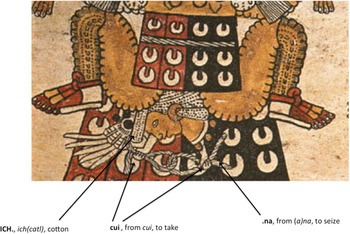
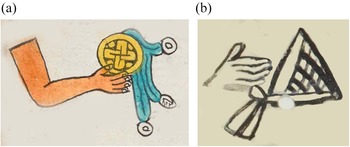
Like his mother, the baby (Figure 20) wears a headband of unspun cotton that may encode the word ich(catl), cotton, as a logogram in truncated reading, which I will note ICH. To my knowledge, the other details of this representation have never been noticed before. I would therefore like to thank Julia Madajczak for bringing them to my attention (personal communication, December 2024; the interpretation that follows is, of course, my own responsibility). The baby has two small white hands grasping a white looping rope. These hands can be read as cui, a verb meaning “to take or grasp” that is found as a phonogram in lists of toponyms or anthroponyms in Wood (Reference Wood2020—present) (Figure 21). Thus, the toponym Teocuitlatlan, “Place of Gold” (Codex Mendoza: Berdan and Anawalt Reference Berdan and Anawalt1997:f. 44r; Wood Reference Wood2020—present:https://aztecglyphs.wired-humanities.org/content/teocuitlatlan-mdz44r) (Figure 21a), is composed of the logogram TEOCUITLA, from teocuitla(tl), “gold,” and two phonetic indicators, -a from a(tl), “water,” and -cui-, from the verb meaning “to take or grasp” expressed by means of an arm extended by a hand grasping gold. The anthroponym Motecuitlani, “He Cares for People” (Matrícula of Huexotzinco n.d.:f. 835r; Wood Reference Wood2020–present:https://aztecglyphs.wired-humanities.org/content/motecuitlani-mh835r) (Figure 21b) is composed of two phonograms: tec, from teuc(tli), “Lord” represented by the royal diadem, and cui, from the verb “to take or grasp” represented by a hand.
Phonograms of the name Ixcuina: ICH.-cui-.na, “cotton”-“to grasp”-“to seize” (Codex Borbonicus n.d.:f. 13) (Courtesy of the Bibliothèque de l’Assemblée Nationale ©).

The phonogram cui in lists of names. (a) The toponym Teocuitlatlan, “Place of Gold” (Codex Mendoza, Berdan and Anawalt Reference Berdan and Anawalt1997:f. 44r; Wood Reference Wood2020—present:https://aztecglyphs.wired-humanities.org/content/teocuitlatlan-mdz44r). (b) The anthroponym Motecuitlani, “He Cares for People” (Matrícula of Huexotzinco n.d.:f. 835r; Wood Reference Wood2020—present:https://aztecglyphs.wired-humanities.org/content/motecuitlani-mh835r).

Finally, we can recognize an umbilical cord in the white looping rope grasped by Ixcuina’s baby (Figure 20). According to my suggestion (Figure 9, repeated in Figure 18), the rope may form the phonogram ana or .na. If this were the case, it would complete the name of the goddess, which could be written: ICH-cui-.na, for Ixcuina.
Reading the glottograms embedded in the representation of Tlazolteotl–Teteo Innan–Ixcuina in the Codex Borbonicus has the advantage of offering an explanation that complements and clarifies the symbolic exegeses that have been put forward to date by many scholars. For example, the quail was chosen to create a phonogram for Tlazolteotl because the goddess received this bird as a sacrifice, like other earthly deities. As for the flayed skin, this has been analyzed as a symbol of agricultural fertility: “In terms of fertility we have to see also the image of Tlazolteotl dressed in the skin of the flayed man in the likeness of Xipe Totec, ‘Our Lord of Flaying,’ the agricultural god par excellence” (Gajewska Reference Gajewska2015:105, my translation). It should be added that the impersonator of the goddess Toci (another name for Tlazolteotl–Teteo Innan) was flayed during the annual Ochpaniztli festival, as were the impersonators of Xipe Totec during Tlacaxipehualiztli. These rituals have given rise to numerous analyses of a symbolic nature (the earliest have been discussed by Seler Reference Seler1963:vol. I, pp. 119–126; among the most recent, see Mazzetto Reference Mazzetto, García and Mazzetto2021; Olivier Reference Olivier, García and Mazzetto2021).
The phonogram expressed by the rubber balls was chosen by the scribe for its symbolic value. In fact, the goddess was not only earthly, but was also a manifestation of the moon, and that is why she wore numerous drawings of half-moons on her headdress and skirt (Mikulska Reference Mikulska2001). Milbrath (Reference Milbrath1997:186) has shown the importance of lunar eclipses in Aztec thought. “During a total lunar eclipse, the moon looks like a dark circle” (187), which makes the round, black rubber ball an excellent choice for creating a phonogram in accordance with a lunar goddess. It is also an attribute of Teteo Innan as goddess of the sweathouse for bathing according to Baena Ramírez (Reference Baena Ramírez2010).
Why is the centipede an animal belonging to Tlazolteotl? This goddess is generally considered to be accompanied by a coral snake (Jansen Reference Jansen1986:104; Sullivan 1983:18). However, her special relationship with the snake was used here to appeal to the centipede, considered by the Nahuas to be a kind of snake (“snake, old, straw mat”), which enabled them to invent a phonogram.
Finally, there is the parturient position: “She is in childbirth posture with her hands and legs outstretched. A child enters her head and she gives birth to it by expelling it from the womb. The scene symbolizes the procreation and fertility of the goddess” (Gajewska Reference Gajewska2015:108, my translation). It is a “symbol of Tlazolteotl-Ixcuina’s generative and regenerative powers” (Sullivan 1983:14). In addition, some scholars have questioned the identity of the baby. According to Seler (Reference Seler1963:vol. I, p. 121), Quiñones Keber (Reference Quiñones Keber1995:180) and Olivier (Reference Olivier, García and Mazzetto2021:62–65), the goddess gives birth to her son Centeotl, Maize God. However, a reading of the glottogram teteo.-o would provide a completely different kind of explanation for the presence of the rubber balls in the baby’s headdress, since it simply expresses the first part of the name Teteo Innan. It is important to consider that these different exegeses are not necessarily contradictory and could add up to several layers of meaning. The important thing is to distinguish precisely the reasons that lead students to put forward a certain type of analysis.
Some specific features of glottograms in images of gods
I have systematically searched for glottograms in representations of gods that are generally considered only from the point of view of their symbolic meaning. To do this, I applied the categories and conventions used so far to decipher the toponyms and anthroponyms contained in lists of names. This exercise led to the identification of some specific features of glottograms when they are embedded in images of the gods. The fact that the same mechanisms can be found in several cases and in different divinatory manuscripts may confirm the interpretation made here and help for those to be made in the future.
The first noteworthy feature is that the main functions of written signs are present; I have indeed encountered logograms and phonograms, all of which can be truncated by abbreviated reading. It should also be noted that the phonetic features of Nahuatl mentioned at the beginning of this article were found throughout the analysis: no notation of glottal stops, a tendency to lose final nasal consonants (-n-), and phonetic transformations between the phonemes -z-, -tz-, -x-, and -ch-.
The glottograms highlighted are perhaps more varied and numerous than those found in lists of names. I have therefore proposed two interpretations, which are currently unpublished and awaiting confirmation or refutation, concerning the meanings of the white string (ana, “to seize, to take”) and the rubber balls (teteoh, “gods”).
I have been struck by the massive, rather than sporadic, presence of phonetic indicators and repetition of the same sound. This technique is part of a more general search for redundancy and communicative accumulation: thus, the same name (such as tlazol- from Tlazolteotl) can be systematically repeated using multiple homophones. In this regard, I have used the term pun or riddle, also coined to refer to wordplays in European languages. Of course, in the divinatory codices, this was not a matter of play, but of reinforcing the effectiveness of rituals by proving, through sound and image, that the power of the gods rested on the multiple homologies that linked words and signs together.
The glottograms were embedded in the images according to the principle of condensation based on semiotic economy. The same sign located in the same image could therefore be read in several possible ways. This is a confusing device that evidently cannot be found in the lists of names. In the representation of Tezcatlipoca, for example, the same scroll is read as the logograms POCA for Tezcatlipoca (“Smoking Mirror”) and EHECATL for Yohuali Ehecatl (“Night Wind”) (Figure 14). In the representation of Tlazolteotl–Teteo Innan, the rubber ball could be read as tlachol or tlaxol. and as teteo. (Figures 15 and 18).
Finally, it should be noted that among the many potential ways of dividing words in Nahuatl, not all are used when creating an image of a deity: the choices made must be consistent with the symbolism of the god in question. Tlachitonatiuh, the Setting Sun, is symbolically linked to a funeral bundle, since he is moving toward the world of the dead, and to Tlaloc, a god lying on the Earth. The pun on Xipe Anahuatl itec (“Lord of Anahuatl” or “Anahuatl in the Belly”) can be understood when one is familiar with the warrior rituals associated with the navel/umbilical cord. As for Tlazolteotl, one must recall the rituals and symbolism of the quail, rubber balls, skinning, and motherhood. What is true for the names of gods is also true for representing anthroponyms and toponyms in lists of names. I have shown that the “hua glyph” was closely associated with the feminine and aquatic world of Chalchiuhtlicue (Dehouve Reference Dehouve, Rosado and Barrio2018). It can be appreciated here that the toponym Teocuitlatlan (Figure 21a), “Place of Gold,” choses two phonograms associated with gold panning in rivers: water and the hand that grasps.
Conclusion
The deciphering of manuscripts from the Nahuatl Central Mexico has made great strides over the last century. On the one hand, many scholars have worked to elucidate their symbolic meanings. On the other hand, in the last twenty years, other specialists have drawn up a repertory of the scriptural procedures used in the lists of names recorded after the Conquest. Unfortunately, these two approaches struggle to converge, as if documents described as iconographic could not contain words written in the Nahuatl language.
This article takes the example of several divine representations to show that they are extremely rich in meaning. The first level is that of a semiotic system based on the articulation of meanings assigned to materials, colors, shapes, and the human body diagram. This is the level generally attributed to what we call “iconography.” The second level corresponds to the insertion of glottograms indicating the names of the gods. I wanted to show that this embedded script used the main scriptural techniques known in Nahuatl writing: logograms, phonograms, and indicators. In this way, the identity of the god, and therefore its ritual effectiveness, was expressed simultaneously visually and phonically.
The presence of phonograms opens the way to a third level of interpretation. From the moment the rebus procedure comes into play, a single sign acquires a double or triple meaning, which conceptually opens the way to play of words and images. This play is already present in the names of the gods. As Nahuatl is a polysynthetic language, which forms words composed of distinct roots, these words can be broken down in several ways. The names of the gods often carry various latent meanings. In addition, the use of phonograms makes it possible to express several meanings at once: one in the main name of the god, and one or more others in the phonograms—as we saw with the example of Tlazolteotl, Goddess of Filth.
In conclusion, we would do well to consider the images of the gods as the product of a complex construction using a variety of semiotic procedures, bringing into play the conceptual, the graphic, and the verbal. Deciphering them requires analysis from a number of different disciplines, including anthropology, linguistics, and semiology. A joint approach to the image and the written word is particularly important in figurative scripts, which are almost exclusively composed of images. Like the ancient Aztecs, we must try to capture the divine images as a whole, in order to grasp all their layers of meaning together.
Acknowledgements
I would like to thank my anonymous reviewers for their helpful comments. My gratitude also goes to Agnieszka Brylak and the TEOTL project (ERC Starting Grant 2022) for the working meetings organized at the UW Faculty of Modern Languages in Varsovia, with the assistance of Berenice Gaillemin, Justyna Kowalczyk-Kądziela, Karolina Juszczyk, Julia Madajczak, Katarzyna Mikulska, Tonne Nardi, Daniel Prusaczyk, Gabriela Piszczatowska and Katarzyna Szoblik. Without the inventiveness, critical spirit, and in-depth knowledge of the Mesoamerican world and the Nahuatl language of these outstanding scholars, this article would not have been what it is. Any errors are, of course, my sole responsibility.