




Introduction
Despite the relative scarcity of secessionist movements in Africa as argued by Englebert and Hummel (Reference Englebert and Hummel2005), the renewed struggle for the independence of Biafra by Igbo elites since 1999 contravenes this assertion. Rooted in the postcolonial moment with several ethnic groups competing for political power in Nigeria, the secessionist aspirations appeared after the two coups in 1966 that involved Igbo military officers that culminated in a Civil War from 1967-70 (Boukari Reference Boukari2018). It is argued that the Civil War erupted due to the perceived inability of the “federal government of Nigeria to address ethnic cleansing of Igbos in the Northern part of the country (Duruji Reference Duruji2012) as well as the decision to turn Nigeria into a unitary state in 1966” (Nixon Reference Nixon1972). However, throughout the military era that followed the Civil War, no single recognised group was publicly agitating for the revival of the Biafran secession as the mainstream discourse aimed to re-integrate Igbos into the Nigerian political process (Duruji Reference Duruji2012). Interestingly, the transition to civilian rule in 1999 and the exit of the military from politics in Nigeria reignited secessionists activities in Nigeria, including that of Biafra. It is worthy to note that most scholars explained this reignited struggle with the ‘assumption of groupness’ – a collective action that evolved from ethnic grievances. Two strands of literature concerning marginalisation and frustration-aggression are found more prominent (see Adebanwi and Ebenezer Reference Adebanwi and Obadare2011; Duruji Reference Duruji2012; Olusola, Oladeji et al. Reference Olusola, Olajide and Ijeoma2017; Onuoha Reference Onuoha2012a, Reference Onuoha2012b and Reference Onuoha2013; Smith Reference Smith2014).
The Biafran Institutions

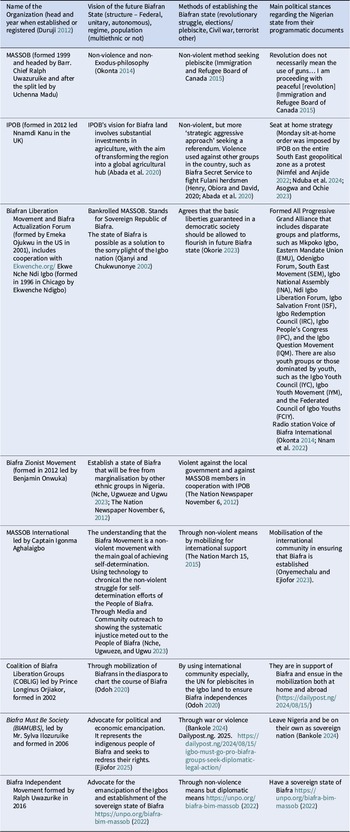
Table 1. Long description
From top to bottom, the table has eight rows and four columns. The first column lists organization names, leaders, and founding years, including MASSOB, IPOB, Biafran Liberation Movement, Biafra Zionist Movement, MASSOB International, COBLIG, Biafra Must Be Society, and Biafra Independent Movement. The second column details each group's vision, such as non-violence, agricultural investment, sovereignty, or emancipation. The third column describes methods, ranging from non-violent plebiscites and international mobilization to violence or war. The fourth column summarizes main political stances, including peaceful revolution, sit-at-home protests, coalition-building, international outreach, and calls for sovereignty. Some cells contain references, web links, or lists of affiliated groups. The table structure is consistent, with each organization's attributes aligned horizontally across the four columns.
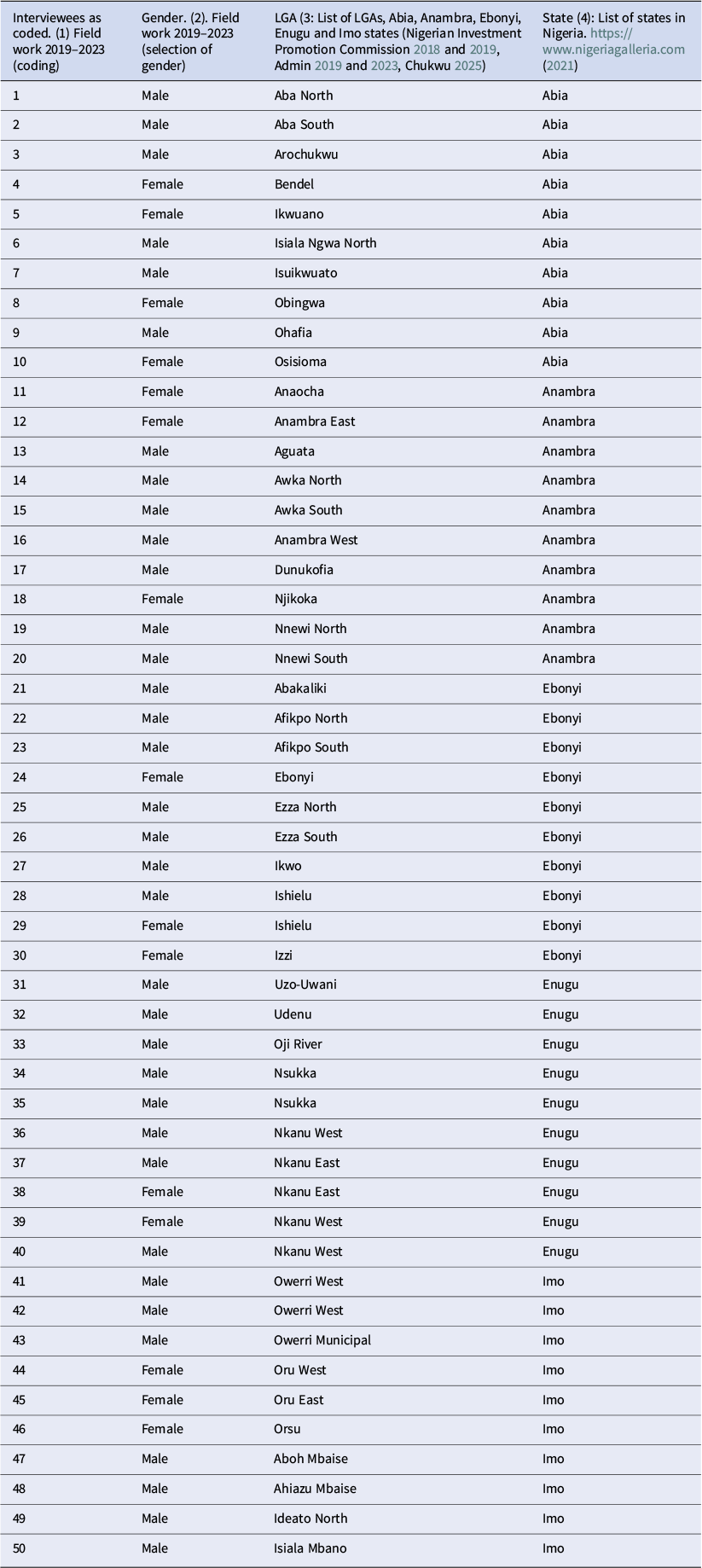
The list of those interviewed as coded for confidentiality; list of LGAs in Abia, Anambra, Ebonyi, Enugu, and Imo States; and the list of states in Nigeria.
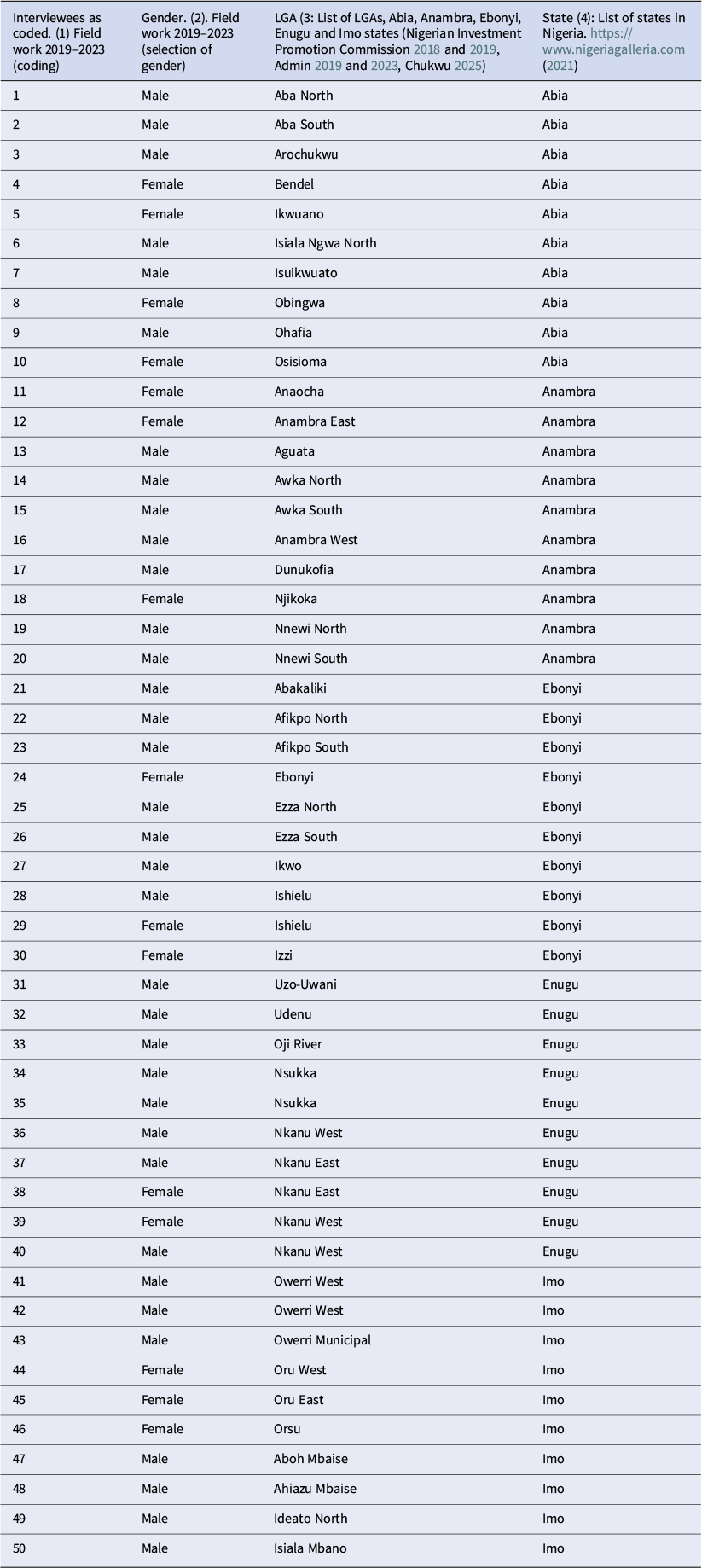
Table 2. Long description
The table contains four columns. The first column lists interviewee codes from 1 to 50. The second column shows gender, alternating between Male and Female. The third column lists local government areas, including Aba North, Aba South, Arochukwu, Bendel, Ikwuano, Isiala Ngwa North, Isuikwuato, Obingwa, Ohafia, Osisioma, Anaocha, Anambra East, Aguata, Awka North, Awka South, Anambra West, Dunukofia, Njikoka, Nnewi North, Nnewi South, Abakaliki, Afikpo North, Afikpo South, Ebonyi, Ezza North, Ezza South, Ikwo, Ishielu, Izzi, Uzo-Uwani, Udenu, Oji River, Nsukka, Nkanu West, Nkanu East, Owerri West, Owerri Municipal, Oru West, Oru East, Orsu, Aboh Mbaise, Ahiazu Mbaise, Ideato North, and Isiala Mbano. The fourth column lists the corresponding states: Abia, Anambra, Ebonyi, Enugu, and Imo. Each row links a unique interviewee code to a gender, a local government area, and a state. The distribution covers all five states, with multiple local government areas represented per state.
First, marginalisation scholarship claimed that Biafran struggle for independence attempted to remedy their suffering (Buchanan Reference Buchanan1997). Academic literature defines marginalisation in two different ways: as the absence of political representation and the denial of the good life that causes economic deprivation. Each of these interpretations has trouble in explaining the absence of unity among the Biafran elites in charge of the secessionist organisations. The first group of scholars linked marginalisation to Marshall’s (1998) classical definition. For them, it is “a process by which a group or individual is denied access to important positions and symbols of economic, religious, or political power within any society” (Scott and Marshall Reference John and Gordon2009: 437). In the bid to operationalise marginalisation as a lack of access to power, Duruji (Reference Duruji2012:329) claims that Igbos have had no fair representation in the political arrangement in Nigeria neither at the national (also see Johnson and Olaniyan Reference Johnson and Olaniyan2017:7, citing Enweremadu Reference Enweremadu2013), nor local levels, especially since the Hausa/Fulani group obtained more influence after the creation of more federal units in the northern part of Nigeria (Nsoedo Reference Nsoedo2019:428).
However, this interpretation cannot explain the struggle since during the eight years (1999-2007) of President Obasanjo notable Igbos, including Evans Enweren, Chuba Okadigbo, Anyim Pius Ayim, Adolphus Wabaraand and Ken Nnamani were presidents of the Senate making them top three citizens in the leadership arrangement in the country of more than 250 ethnic groups (Gandonu Reference Gandonu1978).
Equally, Ezemenaka and Prouza (Reference Ezemenaka and Prouza2016) have operationalised marginalisation of the Biafran agitation as the denial of good life. Accordingly, in an attempt to establish a homogeneous society in search of good life, marginalisation is essentially linked to deprivation. The second interpretation links the renewed struggle for independence to the frustration of the deprived group (for example, Olu Reference Olu2017). It shows how social struggle of people who are deprived of money, status, rights imbue hope that their grievances will be attended to (Ezemenaka and Prouza Reference Ezemenaka and Prouza2016:94). These scholars argue that historically federal governments paid less attention to the situation on the ground as they engaged in corruption through the misappropriation and embezzlement of public funds, which prevented the provision of public goods for the people (Olu Reference Olu2017). Ecological degradation also added value to the struggle (Olu Reference Olu2017:47). Igbos were also frustrated by the disproportionate attention to the “desertification in the north and beach erosion in the western parts of Nigeria by the Federal Government” (Ikpeze Reference Ikpeze, Amadiume and Allah-Na’im2000:98) compared to the problem of soil erosion, which led to the loss of agricultural lands and settlements. As a result, communities become frustrated with their conditions and rebelled against the federal state, seeking to establish their own sovereign entity.
Although the literature on marginalisation and frustration-deprivation points to the important factors that instigated the secession. Interestingly, both scholarships stressed that when ethnic minorities have collective grievances, annoyance and disappointment as a result of withdrawal of expected benefits others are perceived to have denied them, they seek to secede. However, these claims often fail to show the link between the level of frustration and deprivation and the actual decision to secede. In addition, these researches also cannot address marginalisation and deprivation within the same ethnic group. Lastly, the literature does not differentiate the role of the elites in stimulating collective feelings in the case of Biafra. More specifically, these interpretations failed to explain the proliferation, fragmentation, and fracture of the organisations in charge of Biafran independence.
To substantiate our argument more, recent literature began to question the ‘assumption of groupness’ as we seek to argue it in the secessionist strife for Biafra, considering the fact that throughout the 20 years of struggle for shared common cause, there is no unity among the key secessionist organisations (Staniland Reference Staniland2014; Mosinger Reference Mosinger2019; Apikins Reference Apikins2020). With the Movement for Actualisation of the Sovereign State of Biafra (MASSOB) appearing in 2000, a plethora of other organisations have appeared as well, such as Independent People of Biafra (IPOB), Biafra Zionist Movement (BZM), Biafra Foundation (BF), Biafra Actualisation Forum (BAF), Coalition of Biafra Liberation Group (COBLIG), Eastern People’s Congress (EPC), Ekwenche Ndigbo, and the Movement for Igbo Defence (MID). In challenging the ‘assumption of groupness’ we ask what explains such institutional fragmentation in Igbo community despite the common cause as implied in the literature? The question is also warranted by the literature that critiques the ‘assumption of groupness’ from the perspective of ‘greed’ (see Collier Reference Collier, Berdal and Malone2000; Collier and Hoefflert Reference Collier and Hoeffler1999, Reference Collier and Hoeffler2004; Dunn and Englebert Reference Dunn and Englebert2019; Englebert Reference Englebert2009; Englebert and Hummel Reference Englebert and Hummel2005). These scholars have shown that collective grievances have little or insignificant effect in conflicts, where the goal of the warring parties is not to win, but to derive rents from predatory tax on trade from territories they control (Collier Reference Collier, Berdal and Malone2000).
For example, Berdal and Malone (Reference Berdal and Malone2000) and Englebert and Hummel (Reference Englebert and Hummel2005) have applied this premise of greed to the study of secessionist conflicts in Africa to show that war represents not only a breakdown or collapse but rather a creation of an alternative system of profit, power, and protection. It is not a contest for victory: Keen (Reference Keen, Berdal and Malone2000) illustrated such interactions between political and economic agendas showing that the rebels under the cover of grievances disguise the desire to install systems of personal gain derived from outright exploitation and expropriation. The research conducted in multiple cases, including Sierra Leone, Bosnia, Yugoslavia, Burma, and Cambodia, have illustrated this point (David 2000). Thus, local elites do not build local relations of accountability and legitimacy as their energies are focused on trying to gain more from the centre (Englebert Reference Englebert2009; Nathan Reference Nathan2023:3). The link of interpreting violence through the perspective of greed that establishes alternative clientelist networks at local levels in the conditions of scarce state is important for building our own framework. The literature above shows that grievances are inadequate in explaining rent-seeking behaviour of the rebels (for a historiographical review, please see Bates Reference Bates1974, Reference Bates1983; Chandra Reference Chandra2004; Hechter Reference Hechter, John and David1986; Rabushka and Shepsle Reference Rabushka and Shepsle1972). Collective aspirations embodied in the narratives of secession, marginalisation and frustration often hide the desire for power, profit and protection of assets acquired through corrupt practices of local elites against the state.
The ‘greed’ literature confirmed our insights from the fieldwork conducted from 2019-2023 with key members of these organisations who explained the existence of multiple organisations ‘because of greed and self-seeking interest’ (interviewee 9) and because ‘some [elites] are coming to make money, like what we hear of Uwazurike [referring to corruption and embezzlement of funds], the leader of MASSOB then’ (interviewee 35, for details, please see below). Based on the in-depth interviews with major stakeholders in the abovementioned organisations and their acute supporters, as well as open access information, we approach the Biafran secessionist organisations as business models that are driven by predatory rent-seeking practices of Igbo elites in charge of these institutions (for the discussion of terms, please see below). In other words, these secessionist organisations are formally created to express communal grievances and secession of Igbo people, but informally serve as sources for the leaders to derive personal material and symbolic benefits as profits.
Biafran secessionist organisations are organised in a way that enriches and expands the wealth of those in charge of the organisations through rents, without them contributing to the production of this wealth. The rents that are coming in are based on formal donations from diaspora and membership fees, as well as informal dealings with the state, business actors, and those who offer access to resources in exchange for political support. But just like in the business world, proliferation of alternative secessionist organisations causes competition and undermines possibilities of profit and the abilities to derive rents. For leaders of the secessionist organisations, it is important to increase the ‘market share’ of their group or protect it. Therefore, the leaders of these organisations are driven by two imperatives: first, to ensure the expansion and the flow of rents in whatever way possible. Second, to ensure continuous power over these institutions and dominance in the public sphere that is achieved through blackmailing other leaders (read: rivals).
In order to explore the reasons for institutional fragmentation, we relied on qualitative research design, which focuses on understanding the workings of these organisations. We conducted in-depth interviews with the elites from relevant institutions located in five states, Abia, Anambra, Ebonyi, Enugu, and Imo, which encompassed all secessionist areas. Participants were recruited through the purposive sampling method on confidential basis, who possessed insider knowledge of the organisations either as the key members of these organisations, or as ordinary active members. In some cases, referrals were also obtained through a snowball sampling in case more than one actor within the sub-group were willing to offer insights into their respective institution. In the end, 50 people were interviewed using fifteen (15) semi-structured questions. The interviews were recorded with a recorder and transcribed and coded from 1-50 with a supplementary combination of letters and numbers. The coding in numbers was to ensure confidentiality of the interviewees. The numbering in citation in the empirical section of the study is the reflection of the coding pattern of the research. The study therefore employed descriptive and interpretative methods using thematic data analysis.
In addition, in order to eliminate alternative hypotheses, we have supplemented the interview responses with open-source information and outlined political stances of these organisations according to the following criteria: vision of the future Biafran state (federal or unitary), the methods of establishing the statehood (peaceful or violent), position vis-à-vis Nigerian state (cooperative/non-cooperative).
Our argument consists of three parts. In the first section we review the literature on Biafran secession, and the secessionist organisations in Igbo community. In the second part we introduce our analytical framework that treats Biafran secessionist organisations as business models established by Igbo leaders who act as political entrepreneursFootnote 1 engaged in predatory rent-seeking practices. The workings of the models and application to Biafra will be illustrated in the third section of the article. We conclude the article by outlining broader implications of our research.
Post-1999 Biafran Secession: What Do We Know About Institutional Fragmentation?
Since this article explores the question of institutional fragmentation within the Biafra secessionist organisations, there are several possible answers to that question. First, some scholars have conceptualized them as factionalized social movements (McLauchlin and Pearlman Reference McLauchlin and Pearlman2012, Cunningham Reference Cunningham2014, Fjelde and Nilsson Reference Fjelde and Nilsson2018), while others have looked at them through the prism of institutional dynamics characterized by the absence of organisational cohesion (Oyewole. 2019).
The nature of ideological differences among organisations due to factions in social movements has been relatively well explored in literature. Most explanations concentrated on the elites who had different visions of the struggle for self-determination (Nwobashi Reference Nwobashi2014; Apikins Reference Apikins2020). For example, Nwobashi (Reference Nwobashi2014) argues that Biafran struggle lacks strategic elites and is instead dominated by the segmental elites who draw on ethnic separatist agenda when disadvantaged. Strategic elites, on the other hand, are influential across the ethnic divides and maintain political stability in the face of the calls for violence. Biafran struggle represents a classic example of the absence of unifying powerful voices regardless of ethnic differences in the country. When everyone is promoting special interests and no one is stopping them, violence and chauvinism dominate the political field. Indeed, we see that the so-called segmental elites engage with each other in bitter feuds. In other words, when organisations do not have strong leadership (Burch and Ochreiter Reference Burch and Ochreiter2020) and operate in competing leadership structures (Asal et al. Reference Asal, Brown and Dalton2012), the chances for a split are higher. Movements that possess hegemonic unity among the institutions with single group holding strategic control over the struggle have better chances to remain intact and united (see Krause Reference Krause2013). Scholars have also identified that the rapid increase of new members in an organisation causes other secessionist leaders to think of the balance of power that often results in organisational splits (Mosinger Reference Mosinger2019). Similarly, when social base is split between multiple camps, it is hard for the secessionist organisations to retain cohesion (Staniland Reference Staniland2014).
The literature on the secessionist movements presents them as entities that negotiate several ‘competitive dynamics’ (Fliervoet, Feike EM, and Lee JM Seymou Reference Fliervoet and Seymour2023) in their position vis-à-vis the state and vis-a-vis factions within the movement. On the one hand, they must balance the threat of civic unrest that can turn into potentially violent prosecution of their members (Lustick Reference Lustick1993). The movements must also occupy a niche in a common secessionist ideology that is attractive enough to their members (Fjelde and Nilsson Reference Fjelde and Nilsson2018). On the other hand, they also must decide on how loyal they want to be to the dominant coalition of secessionist movements and the regime in power (Vogt et al. Reference Vogt, Bormann, Rüegger, Cederman, Hunziker and Girardin2015). This consideration may be especially valid for armed rebel groups that are rescinded by non-violent secession movements, as well as by state mediation agencies, which see them as terrorist to be eliminated (Boutellis and Zahar Reference Boutellis and Zahar2017; Eiran and Krause Reference Eiran and Krause2016; Krause Reference Krause2013; McLauchlin and Pearlman Reference McLauchlin and Pearlman2012). In addition, fragmentation seems to increase due to the struggle for power within the movements after the leadership repression (Lawrence Reference Lawrence2010). The seminal work of Kathleen Cunningham (Reference Cunningham2014) shows that splintered movements obtain more concessions from the state, especially when the state itself has some level of internal divisions. But negotiations with states do produce uncertainty (Cunningham Reference Cunningham2014) with higher risk of splitting the organisational unity (Duursma and Fliervoet Reference Duursma and Fliervoet2021).
Although the literature on fragmentation of the secessionist social movements is useful in understanding the driving causes behind varying ideologies, its focus on the balancing ‘competitive dynamics’ between the state and factions within the movement but fails to pay sufficient attention to the individuals who lead these movements and their motives.
The second scholarship on the secessionist institutions is more attuned to the role of leaders within such organisations. It treats individual leaders as rational actors sensitive to the dynamics of power balance, where an institutional fragmentation increases the chances for the survival among multiple organisations when tackled by the state (Akcinaroglu Reference Akcinaroglu2012). However, the leadership disputes carry a highly destructive potential to the organisations (Staniland Reference Staniland2012; Christia Reference Christia2012; Pischedda Reference Pischedda2018, Reference Pischedda2020). For example, the power distribution theory states that the leaders will face competitors from the challengers and subordinates who may be dissatisfied with and engage in actions, including violence, to undermine and spoil the leader’s strategy, credibility or status within the organisation (Krause Reference Krause2013, Boutellis and Zahar Reference Boutellis and Zahar2017). Following this research agenda, which explains institutional fragmentation from the perspective of leaders’ concerns for power dynamics within and between organisations, we wish to explore the causes of fragmentation among multiple organisations that stand for a common cause in the case of Biafra.
At the first look, the major conflict between the two primary organisations of MASSOB and IPOB may take place due to ideological differences. We observe bitter feuds between those organisations that aspire to create the federal State of Biafra, such as MASSOB, and the proposal for a unitary Biafra land project proposed by the IPOB. The former argues for the federal structure “shall be a union of voluntary nations with the same irreducible value-system, culture and historical ties” (Ilozue Reference Ilozue2021) and must include different tribes and leaders of Ejegam, Ijaw, Ikwerre, Ibibio, Usokun, Kalabari, Ekpeye, and Eleme (Ilozue Reference Ilozue2021). The goal is,
…devoid of all forms of neo-colonialism, suppression of popular wishes, Machiavellian scheming, subjugation of the commonwealth principles, the sacrifice of the African principles of egalitarianism, playback of sad memories, but see all the parties as a husband with all inalienable rights of parentage and inheritance in concord with local, national and international laws, bills, conventions, charter and declarations
(Ilozue Reference Ilozue2021).Therefore, federalism will grant regional governments or ethnic nationalities more rights, including the right to de-federate if they choose to do so (Ilozue Reference Ilozue2021). In addition, according to the Elder Chris Mocha, Senior Special Assistant to the leader of Biafra Independence Movement and Movement for the Actualisation of Sovereign State of Biafra (BIM/MASSOB), this structure could “allow the component units or regional governments or ethnic nationalities to take 100 percent full charge of their God-given human and natural resources while making contributions agreeable to take care of less bogus central responsibilities (Ilozue Reference Ilozue2021).
Contrary to MASSOB’s federal State of Biafra, IPOB issued a different version of the state. The political system of the Biafra land will be a Parliamentary Republic, based on a unitary structure with vibrant multiparty systems governed by the Prime Minister (Okogi Adolphus Jul 14, 2021). The President will take a more ceremonial role in the political system, although with the power to appoint Prime Minister, power to sign every law and a treaty, and send ambassadors (Okogi Adolphus Jul 14, 2021). Prime Minister will have control over the executive branch, which includes the cabinet of ministries and the state bureaucracy with the power to appoint and dismiss officials from their posts (Okogi Adolphus Jul 14, 2021). Prime Minister will also be in charge of the strategic decisions regarding policy directions and implementation (Okogi Adolphus Jul 14, 2021), which assumes the ‘sovereign powers through the office of the Prime Minister’ (Okogi Adolphus Jul 14, 2021). However, these differences do not feature in mutual accusations, instead, the leaders adopt viral language of personal attacks and blackmail (see below).
Alternatively, institutional fragmentation may be explained not so much by the ideology over the future Biafran state, but by the differences in the tactics of reaching this goal, which has been highlighted in our literature review. Indeed, tactics represent another divide between organisations in the methods of establishing statehood with MASSOB, MASSOB International, BLM, COBLIG, and BIM standing for peaceful methods, while IPOB, BIAMUBS, and BZM pursuing violent tactics assisted by the language of war and revolution to redress the rights and establish justice (Nlerum Reference Nlerum2005). We should expect these organisations to form camps, or some sort of coalitions in order to strengthen their unified position. Such cooperation is also warranted by the fact that most of these organisations do not have a clear vision of the Biafran state but agree that Biafra should be independent. However, we also observe internal rift between the leaders of the violent camp, such as BZM and IPOB who continuously accuse each other of embezzlement and corruption, while competing for the mobilisation of domestic and international support (see below). The language of accusations is highly personalised and aimed at destroying the reputation of leaders in charge of the secession movement.
Some scholars may interpret such accusations as part and parcel of the prebendal politics, where official positions within the state or an organisation become the source of personal material gain (Osaghae Reference Osaghae1995; Albert Reference Albert2004). Public office enables politicians to engage in predatory siphoning of organisation’s income through close supporters and reflects the original meaning of the word ‘prebend’, i.e. a status that allows a member of a Catholic church to share the revenue of the Cathedral (Fakanbi Reference Fakanbi2018).
Indeed, if we take the language of accusations seriously, then ideological differences regarding the future Biafran state or the methods of achieving it are not substantiated. This behaviour among the leaders not only hampers the unity and coherence of the movement but also perpetuates the cycle of fragmentation. The literature review allows us to interpret the organizational divide from the perspective of business model and derive the following points. First, the leaders that establish these organisations receive formal and informal profit that often come in the form of rent, captured because of market power, privatisation, patronage, and corruption (Sanghera and Satybaldieva Reference Sanghera and Satybaldieva2023). In practice, rather than engaging in useful work, rent comes from acquiring control over valuable assets that entitle the owner to an income stream, because they control something that others need or want (Sayer Reference Sayer2015). Rent can be derived from material physical assets, but also from non-physical assets (Christophers Reference Christophers2021), such as from power – a privileged position that enables mobilisation of resources or a reward from the state. However, not all profits are predatory: an affiliated company may construct a hospital or a road, while stealing public money and compromising on the quality of a deliverable. By zooming in on predatory rent-seeking practices we draw a stark contrast between productive rent-seeking, which for the purposes of this article refers to the activities aimed at fostering a common goal of Biafra’s independence. Holcombe (Reference Holcombe2002) argues that “the productive opportunities enable entrepreneurs to profit from enhancing the efficiency of government, while predatory opportunities enable entrepreneurs to profit from forcibly transferring resources from some to others” (Holcombe Reference Holcombe2002:143) that is for their personal interest or their associates. He concludes that the political institutions (i.e. leaders of these organisations) tend to favour predatory over productive political entrepreneurship (Holcombe Reference Holcombe2002) because rent is achieved by the informal rule or force. The imperative us to use the organisations to protect their personal assets by mixing property titles and funding. In other words, by forming a secessionist organisation, Biafran political entrepreneurs begin to amass funds and benefits from their supporters and from the state. Moreover, predatory rent-seeking practices involve not only single opportunistic actions, but also include “the expenditure of resources and effort in creating, maintaining, or transferring rents” through the institutions these leaders have created (Khan Reference Khan2010: 70). Although we are not interested in explaining how these entrepreneurs recruit and sustain networks of their supporters per se, we take the political fragmentation between various elites in change of the organisations for Biafran independence as examples of predatory rent seeking practices, which enables them to create, maintain and transfer rents as a business enterprise.
Second, the leaders use the organisations to increase their political standing and status, which allows them to be recognised by the state and donors and extort more formal and informal benefits personally or for the members of inner circle. In the context of secession, the rent-seeking impulse among the leaders of the organisations depends on keeping the privileged position and the ability to mobilise their supporters (Radnitz Reference Radnitz2010). Aggression becomes part of the equation as actors want to expand their jurisdictions and membership with the scope of assets under their control (Benson Reference Benson2019). The secessionist elites engage in sectarian politics against the state through mobilisation of their support base, and in exchange, community members receive provisions of human needs by actors outside the regime (Radnitz Reference Radnitz2010).
This view treats secessionist organisations as business models and sheds light on an understanding of how political entrepreneurs use fragmented institutions to create and continuously extract opportunities for predation by making profit through corruption, forming a lucrative association with government and business authorities, engaging in an arbitrary distribution of cash and assets in an informal manner. The recognition of power also helps with the protection of the acquired assets. In addition, competition for power is achieved through internal struggle for leadership, suspension and declaration of lack of no confidence as well as blackmailing and factional confrontation against other organisations promoting the same cause, which allows leaders of these organisations to obtain privileges from the state through the recognition of their importance.
The details of this case will be illustrated in the next section that looks at the activities of Biafra secessionist movements.
Biafran Institutional Fragmentation: Making Profits and Competing for Power
The struggle for Biafran independence began with Ralph Uwazurike borrowing the institutional structure and practices from the Ogoni people. By studying activities of Ken Saro Wiwa who established the Movement for the Survival of the Ogoni People (MOSOP) Uwazuruike started the struggle for Biafra’s independence. Leveraging on Ken Saro Wiwa’s initiative, Uwazurike drafted the Bill of Rights and dispatched it to New York, while establishing a similar organisation firmly under his sole control (Okonta Reference Okonta2014:361). The emergence of the Movement for the Actualisation of the Sovereign State of Biafra (MASSOB) in 1999 (with a full take-off in 2000) marked the beginning of neo-Biafra’s struggle for independence. Officially, Mr. Ralph Uwazurike created MASSOB to pursue the Biafra agenda for independence and to emancipate the Ndigbo (the highest socio-cultural group that represents Igbos both in Nigeria and outside Nigeria), which, accordingly, were highly marginalised and frustrated in Nigeria. Citing the Article 1(1) of the International Covenant on Economic, Social and Cultural Rights (ICESCR 1966) on self-determination as a right to determine political status (Oyewole 2019:3), Uwazurike argued that the people of eastern Nigeria were highly neglected and deprived of their opportunities and justified the creation of an independent state of Biafra (Uwazurike 2005, 2008 cited in Duruji Reference Duruji2012). On the 22 May 2000, Uwazurike presided over a flag-hoisting ceremony in Aba, a commercial heart of the Igbo region. Uwazurike’s leadership in MASSOB did not last long as he ended up being accused of corruption, personal enrichment, arbitrary use of funds belonging to the organisations, obtaining political privileges for personal gain, and engaging in blackmailing politics (Oyewole 2019, interviewees 7, 19 and 25).
By establishing MASSOB, Uwazurike created a new line of business (Oluigbo Reference Oluigbo2017) based on the mismanagement of funds and personal enrichment (interviewees 47 and 48). The new business model proved to be lucrative and attracted various splinter organisations, which engaged in a similar set of activities. For example, Nnamdi Kanu who formed IPOB in 2012, was the director of information and was in charge of the Radio Biafra based in London to spread the message of the struggle to the outside world with vigour. In addition, Barrister Benjamin Onwuka who formed Biafra Zionist Movement (BZM) in 2010 was the legal officer at MASSOB. Uchenna Madu, one of the national directors of MASSOB formed a faction within MASSOB that resulted in the impeachment of Uwazurike, while he (Madu) became the new leader of MASSOB after Uwazurike’s expulsion. Nwangwu, Onuoha, Nwosu and Ezeibe (Reference Nwangwu, Onuoha, Nwosu and Ezeibe2020:24) have reiterated that “expectedly, the economic and political benefits associated with the leadership of neo-Biafran groups have made the competition to determine who leads such groups very tense”. In an interview in Business Day held on the 10th September 2017, Nkem Ibekwe the head of the Mezie-Alaigbo Foundation, one among the strongest social-cultural groups in Igbo land claimed that the Biafran agitation is a “big business… [of] the personal aggrandisement of the leaders of these groups that has nothing to do with the Igbo interest…[instead] Uwazuruike has a helipad in his country home at Okwe, Imo State” (Oluigbo Reference Oluigbo2017). To buttress this further, Crenshaw (Reference Crenshaw1999, cited in Oyewole 2019) pointed out that with time, the core values, objectives and aims of separatist organisations were abandoned and rather resorted to structural conservation with the whole aim of seeking patronages and personal interests. Biafran leaders look at such organisations as their personal properties (Oyewole 2019; interviewees 7 and 20). The use of the organisations for personal gain has been widely documented in local media and the interviews from fieldwork that was conducted between 2019-23. To this end, the study at this point goes ahead to show how predatory rent-seeking is achieved by the leaders of the organisations.
(a) Rent and Corruption
By forming a secessionist organisation, the leadership acquires formal income streams, such as the membership fees and donations. Since there is little oversight over expenses, these formal funds often end up in personal accounts of the leaders as rents. Evidence from a four-man panel formed to probe into Uwazurike’s activities from 1999-2014 found out that during this time, MASSOB acquired N500 million in member fees, taxes and identity documents, which went to two accounts controlled by Uwazurike (MASSOB fires Uwazuruike over alleged corruption (The Whistler 1 Dec 2015). In total, Uwazurike appropriated nearly N4 billions of MASSOB’s money throughout 16 years (Johnkennedy Uzoma 9 Dec Reference Uzoma2015). This money allowed Uwazurike to buy an entire street named after himself in a new Owerri settlement (The Whistler 1 Dec 2015; Uzoma 9 Dec Reference Uzoma2015).
Besides formal income streams, such leaders also invent opportunities for profit to expand rent-seeking activities, such as the Biafra International Passport affair. MASSOB’s leader introduced a new document that presumably showcased the belonging to a new Biafran state without recognition of sovereignty by any other state or international recognition. Thousands of people believed that this document would allow them to travel internationally and purchased it, amassing nearly N500 million in revenue that went to Uwazurike himself (Mohammed Useni 5th January Reference Useni2016).
Not only MASSOB leadership was accused of corruption, the coalition of South-East Professionals Network in Nigeria and Diaspora (CSEPNND) accused Nnamdi Kanu, the leader of the splinter organisation IPOB, of corruption when he registered IPOB as a ‘community interest company’ to avoid paying taxes despite the fact that the “company had only two beneficiaries, Mr. and Mrs. Kanu” (Umeh 14 March Reference Umeh2021). This act has been largely interpreted as an attempt of the diaspora-based pro-Biafra political activist to use the platform to achieve personal benefits (Ndidi 13 March Reference Ndidi2021). Indeed, it was also reported by Nwoko, the Enugu-based visionary that Nnamdi Kanu took bribes from the People’s Democratic Party (PDP) presidential candidate Atiku Abubakar. More accusations against Kanu came within IPOB, Mr. Okwudili the so-called new leader of IPOB has accused Kanu’s relatives and treasurer of IPOB in corruption (Facebook, 23 November 2017). Okwudili claimed that the current information available to him shows that over N300 million was collected, with little or no record of where that money was going (Opejobi 2017, cited in Oyewole 2019:17). On a different account, Kanu was also accused of self-enrichment as he reportedly collected £14 million and another $22 million privately for the struggle but used it to purchase landed properties abroad in his name and that of his father, Igwe Israel Kanu (Jannah Reference Jannah2017, in Oyewole 2019:16). As with Uwazurike, the IPOB leader was also accused of “striking a deal and collected money from the federal government ahead of the burial of his parents” (Nwachukwu, 6 February Reference John2019).
In addition, the size of the group also determines the scale of co-optation by the government. The larger the group’s mobilisation potential and propensity to aggression, the more efforts to pacify the secessionist leadership. This tactic was used by the Nigerian government, which at the end of the day offered Uwazurike oil wells from government and business authorities that made him discontinue the struggle he started. Our interviews show that “[h]e was given an oil well and that is where he is making his money now and other leaders are getting the same patronages as well from different sources” (Interviewees 1, 2, 24, 31 and 40).
The desire to extort rents that can be turned into personal profit as well as multiple cases of corruption show that for the leaders of the secessionist organisations, the cause of secession was part of the business model that brought stable income streams. The stable acquisition of rents can be undermined by splinter organisations, which can siphon members and profits. As a result, the leaders act as political entrepreneurs who aim to sustain the dominant position against the rivals as well resulting into fragmentations.
(b) Competition for Power
In attempt to sustain the dominant position, many of the leaders had to fend off internal competition. In doing so, they engaged in blackmailing politics against members within and outside in similar organisations. They have also engaged in building personality cults and oppressing the people they aimed to liberate (for more, see Okonkwo Reference Okonkwo2006).
For example, in 2015 Ralph Uwazurike was expelled from MASSOB, an organisation he formed, by Uchenna Madu on the grounds of corruption and the mismanagement of funds (Sun 2015b). In return, Uwazurike sued Madu claiming that his control of MASSOB was protected and that Madu stopped being a member of MASSOB as from 30th September 2009 (Onyejiuwa and Amaechi Reference Onyejiuwa and Amaechi2015), so that he (Madu) had no authority to expel him. On the next day, Uwazurike claimed that MASSOB was hijacked from him and announced the formation of Biafra Independent Movement (BIM) (Sun 2015c ). The establishment of alternative organisation weakened MASSOB. This forced many capable members of MASSOB to leave the movement (Ukeh Reference Ukeh2015; Sun 2015a) and also split the cause.
Another organisation that was undermining political standing of Mr. Uwazurike was IPOB. In order to discredit it, blackmailing was used as the primary tool. Blackmail was used to ensure dominance of MASSOB and later BIM among a variety of rival organisations. Blackmail was also chosen after an unsuccessful attempt to dispose Kanu from the leadership of IPOB and Radio Biafra in 2017 (Jannah Reference Jannah2017). This attempt was quickly disavowed by the senior leadership of IPOB in Germany, which stated that Kanu “remained the undisputed leader of IPOB and warned members against false news promoted by a faceless group” (Opejobi Reference Opejobi2016). In October 2018 Uwazurike advised Igbos not to consider Nnamdi Kanu as a legitimate IPOB leader after Kanu fled the country avoiding a deadly attack on his home using a British passport. He ended up in Israel, about which Uwazurike the new leader of BIM publicly inquired:
How did he disappear from his country home? How did he survive the onslaught, even when claimed that about 28 people were killed during the military operation in his home? How did he leave Nigeria and what document did he use to traverse all the nations before arriving in Israel? We couldn’t have forgotten so soon that the Department for State Security (DSS) seized his travel document?
(Fikayo Reference Fikayo2018).In this regard, he concluded that he knew whom Nnamdi Kanu is working for, the Department of State Services (DSS), and that he (Kanu) aimed to destabilise MASSOB (Fikayo Reference Fikayo2018). On another dimension, according to Uchenna Madu, the new leader of MASSOB, Uwazurike went as far as serving as a “leading witness against Nnamdi Kanu” in the federal investigation (The Biafra Times, 26 February 2016).
Uwazurike’s grudge against Nnamdi Kanu became eminent as he was using radio Biafra in London publicly to accuse Uwazuruike of mismanaging MASSOB and corruption (Ukeh Reference Ukeh2015). Established in London in 2009 Radio Biafra was used in spreading the secessionist agenda among diaspora community and attracted much financial support (Sun 2015b; Ukeh Reference Ukeh2015 in Oyewole 2019:10). For Kanu, the control of a strategic channel of communication via Radio Biafra represented an opportunity to justify the establishment of IPOB and the opportunity to mobilise support for his organisational style in a similar way to MASSOB. In order to discredit Kanu, the leader of MASSOB accused him in preaching hate speech and promoting violence, so that the funding of the Radio had to be seized (Sun 2015b). The internal competition between IPOB and MASSOB may be considered personal, but other organisations are engaged in similar tactics.
For example, in 2012, Biafra Zionist Movement leader led by Benjamin Onwuuka made the declaration for Biafra independence because he discovered that Kanu the IPOB leader was becoming more famous and too popular (Interviewees 1, 2, 3, 5 and 41). In addition, the Coalition of Biafra over Liberation Groups (COBLIG) accused Ralph Uwazurike of high handiness and misuse of the organisation’s resources for personal gratification, including the building of the massive edifice called the Freedom House in his hometown of Okwe, Imo state (Chimerue, 30 January Reference Chimerue2017).
The internal competition for dominance in the political space of secession acquired vicious forms and led to more dissatisfaction of their followers. According to one of the insiders of these organisations, a declaration for Biafra Independence allows “many people [to] make claims for their efforts and… to occupy office if Biafra is later achieved” (Interviewees 3. 6, 9 and 12). One of the interviewees noted that:
I don’t expect anything different from what we are seeing in Nigeria. Why? because you are not going to manufacture a set of good politicians to occupy expected Biafra, the same thieves are going be the ones dominating everything here and there are going to be the ones to dominate if Biafra is achieved and that is why the issue of Biafra is of no interest to me [now]
(interviewee 49).Many within these organisations claim that ‘they (leaders) are fragmenting the organisations so that every leader of those agitating for Biafra is going to make claim (benefit) if Biafra is achieved’ (interviewee27). Apart from making profit through corrupt practices, association with government and business authorities, arbitrary distribution of cash and assets in an informal manner, outbidding competition between pro-Biafran groups described as blackmailing politics and fractured support within the South-Eastern Nigerian populace are prevalent in most of the organisations we have surveyed. The treatment of Biafran secessionist organisations as business models formed by predatory rent-seeking political entrepreneurs explains the reasons for institutional fracture, scandals, and infighting.
Conclusion
This article challenged the dominant explanations of the struggle for Biafra’s independence that commenced with the Aba Declaration in 2000 by MASSOB and blamed long-standing communal grievances of marginalisation and frustration over deprivation against the Igbo ethnic group in Nigeria. According to these arguments, Igbo people were systemically marginalised and became frustrated with their conditions and rebelled against the federal state, seeking to create their statehood as a remedy to their situation (Buchanan Reference Buchanan1997; Nixon Reference Nixon1972; Duruji Reference Duruji2012; Nsoedo Reference Nsoedo2019; Ikpeze Reference Ikpeze, Amadiume and Allah-Na’im2000; Okonta Reference Okonta2014). The literature on communal grievances could not explain the fact that despite a 20-year-long struggle, we have observed neither a strong unity within the Igbo secessionist organisations, nor a common vision of future statehood. Instead, we observed deeply divided and competing organisations of Igbo origin that emerged in the struggle for the attainment of Biafra’s independence in Nigeria from 2000 and beyond. Reviewing the literature on institutional fragmentation we observed how the literature has paid little attention on the motives and the interests of those that instigate institutional fragmentation in secessionist struggle. The article explained the institutional fragmentation of the secessionist organisations through the perspective of political entrepreneurs who set these organisations as business models that enable them to extort rents. The article views the model in three dimensions. First as leaders that established these organisations receive formal and informal profit that often come in the form of rent, captured because of market power, privatisation, patronage, and corruption. Secondly, they use the organisations to increase their political standing and status, which allows them to be recognised by the state and donors and extort more formal and informal benefits personally or for the members of inner circle. Finally, they use the organisations to protect their personal assets by mixing property titles and funding. In other words, by forming a secessionist organisation, Biafran political entrepreneurs begin to amass funds and benefits from their supporters and from the state. Specifically, we operationalised them as ethnic political entrepreneurs who are driven by predatory rent-seeking desires that engage in political actions to achieve personal symbolic or material rent from a political institution they represent. Such rent signifies the profits or help that is aligned or abrogated to a specific individual rather than a group or an organisation. In their predatory fashion, these organisations have been involved in competition over leadership/membership and resources acquired through the mobilisation of the communal grievances. These leaders aimed to control the largest ‘market share,’ by being the dominant actor in the Biafran struggle in order to appropriate public resources for personal use. Driven by rents and securing power over these organisations, the leaders of Biafran secession engaged in an informal distribution of cash and assets through corrupt practices and compete for popularity. The blackmailing of each other exhibits a competition for more relevance of their organisation in the struggle. Such institutional fragmentation from predatory rent-seeking cannot be explained by literature on communal grievances.
Viewing this struggle through the lens of political entrepreneurs and treating secessionist organisations as business models makes several important implications. First, this article poses a larger question on viability of the Biafran secession as scandals of corruption follow nearly every leader in key organisations. Already, our fieldwork has shown a deep dissatisfaction with the state of things among those working in these organisations and the desire to stop the fight. Such imperative exists in business communities, which try to divert their investments and assets away from Biafra openly calling for peace (Ludovica 2015). Second, comparative studies of different secessionist struggle across Nigeria, but also in a broader context, are important to understand their main imperatives and tailor adequate solutions to resolve violence. The corrupt leaders undermine the possibility for peace as they are no longer able to channel the message and negotiate with Nigerian Federal government using diplomacy and mediation. Instead, various armed groups appear to highjack the struggle causing people to flee their villages to avoid death Third, more studies need to be done on ordinary members of these organisations, their contribution, expectations, and roles in the struggle. Such in-depth overview will shed light on the available choices, reasons for struggle and the viability of the Biafran project in near future.
Acknowledgments
The authors would like to thank God, Near East University and all that were interviewed and provided us with the needed information. Specifically, we wish to sincerely acknowledge the entire faculty members of the Department of Political Science and International Relations, Near East University for all the support given to us to carry out this study. We also acknowledge the Nigeria Police Academy community, family members and friends. More importantly, we wish to acknowledge those who were interviewed and their useful information guided the finding of this research and for this you are highly appreciated.
Disclosure
None.

 Open access

