

Introduction
Domestic architecture and construction practices are commonly recognized as social enterprises, constituting loci and courses of actions that bring people together in various daily or exceptional acts. Architectural construction is, in this sense, a faire social that reaffirms social ties and empowers reciprocity through interaction, cooperation and the development of a common memory (Bailey Reference Bailey, Darvill and Thomas1996; Hodder Reference Hodder, Edmonds and Richards1998; Reference Hodder, Hofmann and Smyth2013; Ingold Reference Ingold2013; Jones Reference Jones2007; Kay Reference Kay2020; Kotsakis Reference Kotsakis and Kotsakis2019; McFadyen Reference McFadyen, Bille and Sørensen2016; Sparkes & Howell Reference Sparkes and Howell2003; Tuan Reference Tuan1977; Whittle Reference Whittle, Darvill and Thomas1996; Wilk Reference Wilk1983). The built environment encompasses numerous socio-cultural dynamics and underlying structuring principles, metaphors and meanings, which are mobilized through social practice (Benson & Whittle Reference Benson and Whittle2007; Eriksen Reference Eriksen2016; Kotsakis Reference Kotsakis, Decourt, Helly and Gallis1994; Love Reference Love2013b; Parker Pearson & Richards Reference Parker Pearson, Richards, Parker Pearson and Richards1994b; Rapoport Reference Rapoport1969). The act of building, whether of a house or of another type of earthen architecture, involves techniques and constellations of knowledge that are socially acquired and transmitted both within groups and between contiguous communities (Oliver Reference Oliver2006). Different people are employed in different capacities and with different degrees of participation (McFadyen Reference McFadyen, Bille and Sørensen2016, 57). The manifestation of unity, cooperation, and status during the construction process contributes to the (re)constitution of these social groups (Vellinga Reference Vellinga2007, 760). The material character of earthen architecture, however, and the entanglements (sensu Hodder Reference Hodder2012) developed in construction processes have drawn little attention in recent archaeological research. Unfolding the successive steps of the building process could shed light on the social dynamics of a given household, group, or community.
In our analysis, we adopt a material-based approach to unravel the variable and intermingled practices integrated in the construction process. To this end, we have chosen to employ the chaîne opératoire approach, adapted to the study of earthen architecture of buildings and thermal structures and supported by a refined concept of technology as a socially embedded process of growth and becoming (Dobres & Robb Reference Dobres and Robb2000; Fitzjohn Reference Fitzjohn2013; Ingold Reference Ingold2013; Miller Reference Miller2007; Riede Reference Riede2006; Schlanger Reference Schlanger, Renfrew and Bahn2005). We emphasize the materiality of construction, which requires technology, cognition and time. We also highlight the cooperation and social performativity involved, rendering this a social event that fosters and reaffirms social relations, obligations and entanglements, and which can reveal the dynamics of a given community. In this respect, the chaîne opératoire offers a holistic and multifaceted approach to considering the act of construction, by integrating cognitive processes and decisions, technological applications and social interfaces (Dobres & Robb Reference Dobres and Robb2000; Pelegrin et al. Reference Pelegrin, Karlin and Bodu1988; Pelmoine & Mayor Reference Pelmoine and Mayor2020; Steadman Reference Steadman1996; Ulanowska Reference Ulanowska2020).
Through the sequential manufacturing practices, we examine various features of the social connotations and human involvement in the spatio-temporal context of a single Neolithic site: Kleitos 2 in Kozani, situated in northwest Greece (Fig. 1). By adopting a local-scale approach, we develop a detailed analytical framework that delves into the intellectual, social and technological steps of the practices involved in the construction of earthen architecture. Buildings and thermal structures are two distinct categories of earthen architecture that shared similar malleable materials and gestures. Although differing remarkably in terms of scale, construction time and effort, they can both be seen as flexible entities encapsulating common social processes, localities and practices, situated within the natural and social surroundings of Neolithic communities (Kay Reference Kay2020). How did local materials, techniques and builders intertwine? How do the properties of the resources used affect the temporal rhythms of the technological process? Can we identify a degree of standardization or diversity in the various stages of the chaîne opératoire of earthen structures? Can we trace reconstruction and maintenance practices and how are these meaningful? Are there indications for the socialities involved, at either the household or communal level? Our analysis endorses a concept of technology as social process that through practice brings people together in a shared act of cooperation and social reciprocity (Dobres & Robb Reference Dobres and Robb2005; Ingold Reference Ingold2013; Schlanger Reference Schlanger, Renfrew and Bahn2005).
Map of Greece, showing the location of the Kleitos 2 Neolithic site. (Drawing: J. Donati.)

The chaîne opératoire: materiality, prospects and constraints
Coined by Leroi-Gourhan (Reference Leroi-Gourhan1943; Reference Leroi-Gourhan1945; Reference Leroi-Gourhan1993), the concept of the chaîne opératoire has come a long way and has been adjusted following developments in the research framework. It has served as a powerful analytical tool and a testable framework for materials science (Martinón-Torres Reference Martinón-Torres2002, 38), and its contribution to the advancement of our understanding of past societies is well recognized (Riede Reference Riede2006, 50). The methodology employed is based on a sequential analysis of the gestures, operations and sequences of operations involved in the production, use, maintenance and, ultimately, discarding of artefacts. It aims to trace and reconstruct the tangible and intangible aspects of technology and allows us to understand better the social contexts, actions and forms of cognition required to produce a given object (Dobres Reference Dobres2000). The methodology has been widely employed in the analysis of various categories of material culture, especially in the study of lithic industries and pottery (e.g. Balfet Reference Balfet and Sauter1973; Cahen & Karlin Reference Cahen and Karlin1980; Martinón-Torres Reference Martinón-Torres2002; Pelegrin et al. Reference Pelegrin, Karlin and Bodu1988; Perlès Reference Perlès1987; Schlanger Reference Schlanger, Renfrew and Bahn2005). Nevertheless, it has increasingly been applied to other crafts or even ‘non-object’ technologies (Miller Reference Miller2007; Pelmoine & Mayor Reference Pelmoine and Mayor2020; Ulanowska Reference Ulanowska2020). The concept of the chaîne opératoire has been introduced to link technical developments with social acts. In practice, however, it has often been restricted to the systematic description of technical processes, while little attention has been paid to the social context of the acts of human interaction and collaboration entailed in the production of a given artefact.
Latest archaeological applications of the chaîne opératoire methodology underline its ongoing impact on the study of material remains and iron out the main flaws and anachronisms inevitably associated with it (Lewis & Arntz Reference Lewis and Arntz2020). It is now commonly accepted that the technological and social processes in the construction of a given artefact are not linear, but interlinked with numerous cultural, social and symbolic developments (Cresswell Reference Cresswell1990; Lemonnier Reference Lemonnier1993; Lucas Reference Lucas, Alberti, Jones and Pollard2013; Sillar & Tite Reference Sillar and Tite2000). Recent studies on material culture and agency-based approaches to technology have allowed for a more comprehensive application of the chaîne opératoire that moves beyond functional analyses and further unravels less prominent stages and ramifications of construction (Coupaye Reference Coupaye and Soulier2015; Dobres Reference Dobres2000; Ingold Reference Ingold2013; Knappett Reference Knappett, Knappett and Malafouris2008; Sillar & Tite Reference Sillar and Tite2000). The latest analytical approaches have emphasized the historical socio-contextual dependency, limitations, constraints and possibilities of construction processes (Gell Reference Gell1998; Knappett Reference Knappett, Knappett and Malafouris2008; Martinón-Torres Reference Martinón-Torres2002, 30; Sillar & Tite Reference Sillar and Tite2000, 4; Skibo Reference Skibo2013, 13). The historical development of the chaîne opératoire has led to a plethora of approaches addressing questions of society, technology, human agency and tradition. Most recently, an adaptable framework of the chaîne opératoire has been proposed that can be manipulated and combined with other complementary methodologies to maximize the information provided (Eriksen Reference Eriksen2016; Kay Reference Kay2020; Lewis & Arntz Reference Lewis and Arntz2020, 11). For the architectural elements we are examining, we have adapted a more flexible analytical framework for the application of the chaîne opératoire, while retaining the fundamental principles of the concept. Given that the sequential order of construction in architectural elements is not straightforward, but a rather intermittent process of various intermingled construction practices, we did not follow a strict sequencing of every task performed. Instead, the different operations and sequences were grouped in more general steps, which refer to the gradual development of the construction project, combined with evidence of the timing, agency, use-life, maintenance and the abandonment of the structure. In doing so, our analysis benefited from the developent of a consistent recording system, comparable with other spatio-temporal contexts. Overall, integrating spatio-temporal data to our analysis enabled us to attribute historical perspective further in the materiality of construction practices.
The chaîne opératoire of earthen architecture
In the case of earthen features, including cooking installations and buildings, the concept and methodology associated with the chaîne opératoire have occasionally been employed in both archaeological and anthropological case studies (e.g. Pelmoine & Mayor Reference Pelmoine and Mayor2020; Prévost-Demarkar Reference Prévost-Demarkar2019). Architectural remains, however, have been more commonly viewed as containers of other artefacts and activities, rather than as technological products or artefacts in themselves. As a result, their technological features have not always been the primary focus in analytical inquiries. This contrasts with the centrality of earthen architecture in the habitus of Neolithic southeastern Europe (Souvatzi Reference Souvatzi2008; Stevanović Reference Stevanović1997), and with the impact of earthen architectural remains on the formation of the archaeological record (Lucas Reference Lucas, Alberti, Jones and Pollard2013). Recent developments in the study of prehistoric architecture, however, have overcome the stale description of form and size, suggesting a rather variable and complex approach for the effect of building making to the formation of shared social traditions through cooperation (Benson & Whittle Reference Benson and Whittle2007; Fitzjohn Reference Fitzjohn2013; Kay Reference Kay2020; Love Reference Love2013a, Reference Loveb; McFadyen Reference McFadyen2006; Reference McFadyen and Last2007; Reference McFadyen, Bille and Sørensen2016; Uzdurum Reference Uzdurum, Douché and Richon2018). To this end, there is a current understanding of prehistoric monuments and architecture as practice rather than as container or object (McFadyen Reference McFadyen, Bille and Sørensen2016, 59). Inspired by Hill (Reference Hill2003), Leslie McFadyen suggested that the process of construction requires a rich set of interaction and cooperation between people (builders and users) and things (building materials) (McFadyen Reference McFadyen, Bille and Sørensen2016, 53). Ultimately, she suggested a closer examination of the effect of practice and participation in building making (McFadyen Reference McFadyen, Bille and Sørensen2016, 55). Contemporary studies of prehistoric architecture approach builders as active agents over resource availability, suggesting that the purposeful selection of material practices is socially informed, complementing the complexity of the construction practice (Love Reference Love2013b, 752). The application of a sequential methodology in the analysis of thermal structures, such as hearths, ovens, fire pits, benches and cooking-related portable features, is relatively straightforward. Compared to buildings, thermal structures are smaller constructions that require the procurement of fewer materials, a smaller workforce and less team coordination. When it comes to buildings, however, certain limitations to the strict application of a sequential methodology arise. The construction of a house is a complex project entailing different reductive, transformative and additive processes that cannot always be traced in archaeological records (Kloukinas Reference Kloukinas2014; McFadyen Reference McFadyen, Bille and Sørensen2016). They are characterized by their own spatio-temporal frameworks and can be combined in various ways without necessarily changing the end result. The main building materials, including earth and timber, need to be processed according to their own sequence of operations, before being shaped and incorporated into the structure itself (Love Reference Love2013a, 270). It may therefore be argued that segmenting all the different processes in a strict sequential order is not always feasible. Further complicating the difficulties presented, buildings should be seen as never-quite-finished patchworks, rather than the result of pre-existing plans (Fitzjohn Reference Fitzjohn2013; Ingold Reference Ingold2013; Kay Reference Kay2020). This leaves little room for ideal reconstructions. Even so, the ‘checklist’ aspect of the chaîne opératoire methodology (Gosselain Reference Gosselain, Smith, Cornelissen, Gosselain and MacEachern2017) is important for tracking technological evidence and thus enabling comparative approaches at different scales of analysis in time and space: the spatial scale as for the occupation of a structure is space, the different requirements of raw materials needed, the varied scale of interaction, reciprocity and collaboration, the scale of time required for the construction of a feature and the unequal ways in which people worked together (McFadyen Reference McFadyen, Bille and Sørensen2016, 57). What is important is to identify ‘meaningful observation units’ (Balfet Reference Balfet and Sauter1973, 12), whether they are operations, sequences, or phases.
The case study
Two neighbouring Late and Final Neolithic dispersed sites, Kleitos 1 and Kleitos 2, were uncovered during large-scale rescue excavation works in the northwestern part of the Kitrini Limni basin in Kozani, northwestern Greece. Archaeological evidence shows that the region was densely populated throughout prehistory (Andreou et al. Reference Andreou, Fotiadis and Kotsakis1996, 568–9; Fotiadis & Hondroyianni-Metoki Reference Fotiadis and Hondroyianni-Metoki1997, 21; Karamitrou-Mentesidi Reference Karamitrou-Mentesidi1987). The two sites cover an area of 2.00 ha and 0.25 ha, respectively, and were excavated almost in their entirety (Ziota et al. Reference Ziota, Hondroyianni-Metoki, Magouretsiou and Karamitrou-Mentesedi2013; Ziota Reference Ziota, Stefani, Merousis and Dimoula2014). Kleitos 2 is located c. 100 m northeast of the larger Kleitos 1.
The Neolithic settlement was situated on a low mound with a northwest–southeast orientation (Hondroyianni-Metoki Reference Hondroyianni-Metoki and Karamitrou-Mentesedi2011; Ziota et al. Reference Ziota, Hondroyianni-Metoki, Magouretsiou and Karamitrou-Mentesedi2013, 71). The remains of at least four buildings, nine clay-based thermal structures, pits and cobble-paved areas were unearthed during excavations on site (Fig. 2). Buildings 1, 2, 3 and 4 were preserved as concentrations of fire-hardened clay rubble, in situ wall sections, floors and clay surfaces. The spatial allocation of the buildings was loose, with wide open-air intervals between them.
Plan of the building distributions at the Kleitos 2 site. (Drawing: J. Donati.)

Geomorphological investigations suggest that Kleitos 2 was developed on an alluvial terrace formed during stream flooding (Ziota Reference Ziota, Stefani, Merousis and Dimoula2014, 329). Excavations on site identified the course of three streambeds, which separated the two Neolithic sites and demarcated the eastern area of Kleitos 2 (Ziota et al. Reference Ziota, Hondroyianni-Metoki, Magouretsiou and Karamitrou-Mentesedi2013, 59). During the Neolithic, the landscape at the Kitrini Limni basin was incised by shallow streams and gullies, while parts of it were probably covered by stagnant or slowly running waters forming marshy areas (Fotiadis et al. Reference Fotiadis, Hondroyianni-Metoki, Kalogirou, Maniatis, Stroulia and Ziota2019). The relationship between the inhabitants and this complex wetland environment is reflected in the earthworks of Kleitos 1 and other possible waterworks, such as the retaining wall uncovered at Kleitos 2, immediately to the south of the north streambed (Ziota et al. Reference Ziota, Hondroyianni-Metoki, Magouretsiou and Karamitrou-Mentesedi2013, 76). Charcoal analyses (Ntinou Reference Ntinou, Stefani, Merousis and Dimoula2014) show that the surrounding landscape of the two sites was covered by an array of riparian species, such as ash (Fraxinus sp.), elm (Ulmus sp.), willow/poplar (Salix/Populus), and extensive reed stands. Sub-mediterranean to sub-continental mixed oak (Quercus sp.), oriental hornbeam forests and alluvial hardwood forests have been also identified (Marinova & Ntinou Reference Marinova and Ntinou2017, table 4; Ntinou Reference Ntinou, Stefani, Merousis and Dimoula2014, table 2). It has been supported (Bottema Reference Bottema1982) that the mountains surrounding the basin were covered by coniferous woodlands. This is, however, based on palynological investigations of a number of lakes to the north of the Kitrini Limni basin.
Our analysis focuses on two buildings, namely Buildings 3 and 4, and the assemblage of nine thermal structures uncovered at the site (Fig. 3). The two buildings were selected mainly based on their sufficient preservation status due to conflagration and collapse that protected the archaeological material and provided us with the opportunity to have a sufficient overview of building technology. Building 3 preserves three successive construction Phases A, B and C, indicating a minimum of three different habitation periods (Chondrou Reference Chondrou2020, 287; Kalogiropoulou & Ziota Reference Kalogiropoulou and Ziota2021). For Building 3, the analysis of architectural remains derives from the earliest and better-preserved Phase C. Building 3 stands out on account of its outstanding concentration of six in situ and well-preserved clay-based cooking-related features and the preservation of large quantities of stored products (Ziota et al. Reference Ziota, Hondroyianni-Metoki, Magouretsiou and Karamitrou-Mentesedi2013, 76; Valamoti & Stylianakou Reference Valamoti and Stylianakou2015, 67). Building 4, on the other hand, is identified by a fire-hardened daub spread but contains no in situ cooking-related features. A single hearth is recorded in the deposits of Building 2, placed at the core of the building, while the remaining two hearths were found outdoors as single features (Table 1). Buildings 1 and 4 were empty of in situ cooking-related facilities.
Plan of Buildings 3 and 4 with thermal structures. (Drawing: J. Donati, © Ephorate of Antiquities of Kozani, Hellenic Ministry of Culture and Sports.)

List of nine thermal structures at Kleitos 2 Neolithic site in Kozani.

*circular round plate (lower part); ** cylindrical clay tube (top part); *** height of clay tube; ∅ diameter
How were earthen structures constructed? A six-step analytical framework
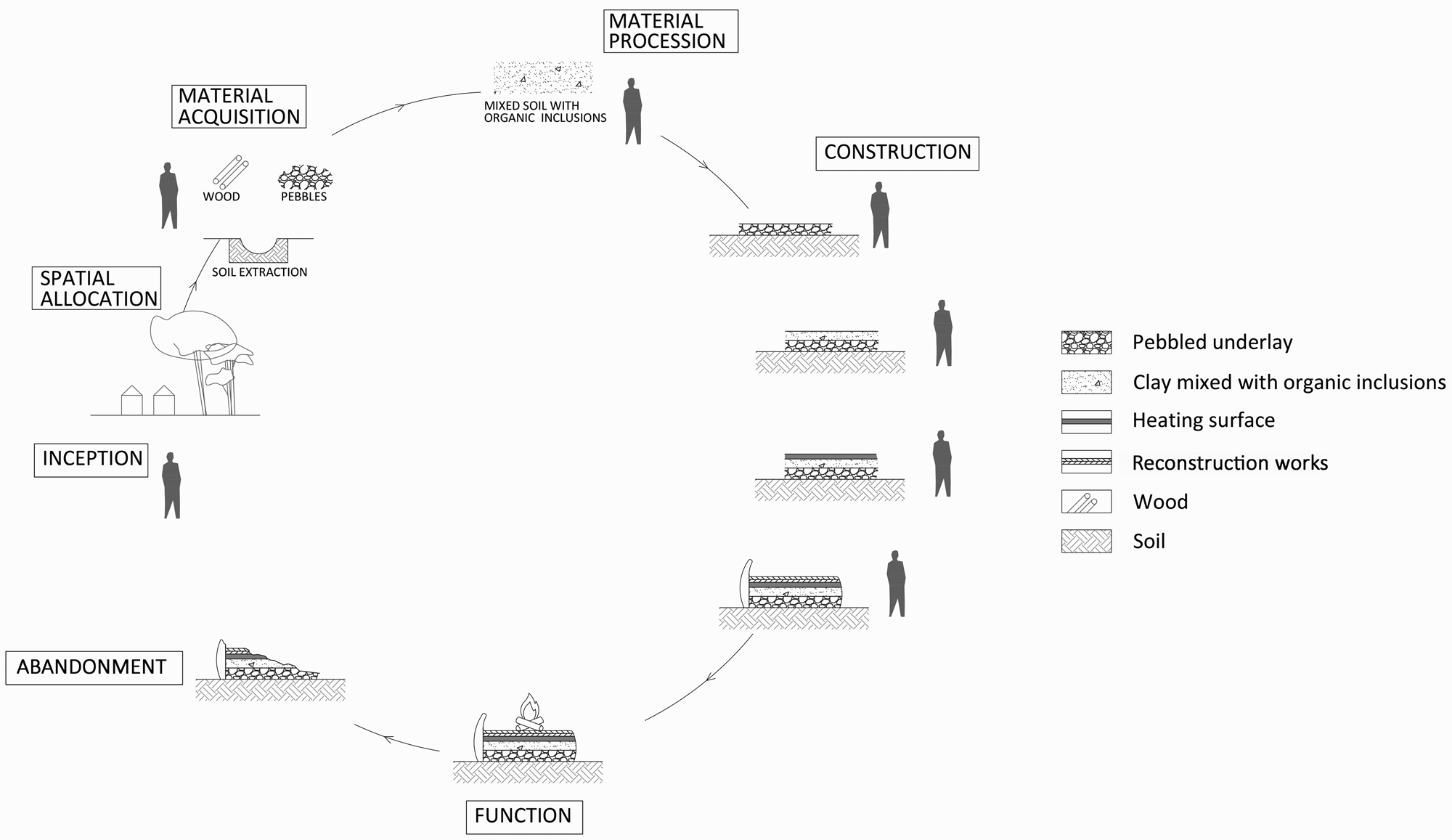
In order to tackle the limitations of a traditional technological analysis of earthen structures, we are proposing a schematic framework informed by the effects of time, space and human interaction on the construction practices. The developed step-by-step outline integrates decision-making processes, spatial allocation and form, material acquisition, material processing, details of the manufacturing practices, use and function and elements of the end-life of earthen features (Fig. 4).
The chaîne opératoire of construction practices of earthen architecture. (Drawing: K. Roumelioti.)
Step 1. Form and spatial allocation
Regarding the initial stages of the chaîne opératoire of earthen structures, the built form and spatial allocation of the structures are significant aspects of the planning and manufacturing process. Both involve multifactorial decisions based on social interaction, community rules and traditions, technological and topographical constraints and cultural perceptions. Form, however, develops dynamically over time, which adds a transformative quality to cultural products. Rather than deriving from a fully preconceived plan, form largely results from the builders’ experiences with different materials, terrains, subsoils and weather conditions (Ingold Reference Ingold2013).
The selection of the construction site set the sequential order for various ground-preparation and building practices. The clearance of vegetation, flattening of hilly spots and the levelling of previously inhabited or demolished areas were prerequisite steps that preceded the construction of earthen features (Kalogiropoulou & Ziota Reference Kalogiropoulou and Ziota2021). Evidence from Kleitos 2 indicates that the Neolithic inhabitants carried out some sort of levelling practices which seems to have involved layering a substratum. Building 4 was erected on top of a layer with a relatively high content of natural yellowish clay marl, while comparable layers were identified both between the successive phases of Building 3 and beneath the use surface from its earliest phase (Ziota et al. Reference Ziota, Hondroyianni-Metoki, Magouretsiou and Karamitrou-Mentesedi2013, 73).
For Neolithic builders, orientation was another significant component of the decision-making process. This was based on natural elements, such as the sun/sunlight and the direction of the prevailing winds; on cultural proxies, like other structures, yards, and plot areas; and on symbolic connotations and cosmic references (Gillespie Reference Gillespie, Joyce and Gillespie2000, 137–8; Parker Pearson & Richards Reference Parker Pearson, Richards, Parker Pearson and Richards1994a, 15–17). Socio-cultural influences, including the proximity of and affiliation to other social units, also play a crucial role in the location and orientation of buildings and associated structures.
At Kleitos 2, both buildings under study were detached and followed a roughly rectilinear ground plan, as well as a similar north–south orientation. The dimensions of Building 3 during Phase C are estimated to be 11×5 m, covering an area of about 55 sq. m. The interior space was probably partitioned off with post-frame features and two walls made of ‘compacted clay’, which appear to screen the northern and southern ends of the building (Ziota et al. Reference Ziota, Hondroyianni-Metoki, Magouretsiou and Karamitrou-Mentesedi2013, 73–5). Building 4 is the northernmost building of the settlement and was uncovered 10 m to the northwest of Building 3. Its remains, which cover an area of approximately 90 sq. m, reflect a larger rectilinear structure estimated to be 12.50 × 7.00 m, with a single building phase.
The diverse assemblage of clay-based cooking-related structures found in Kleitos 2 is grouped into four categories: a single oven, hearths, food preparation benches and portable features (Table 1). Five horseshoe-shaped hearths—T.S. 55, T.S. 60, T.S. 112, T.S. 56 and T.S. 79—constitute the dominant category of this assemblage, indicating preferences for open-fire cooking practices, such as grilling, boiling, smoking and roasting (Atalay & Hastorf Reference Atalay and Hastorf2006; Kalogiropoulou Reference Kalogiropoulouin press; Uzdurum Reference Uzdurum, Douché and Richon2018; Valamoti Reference Valamoti2011). The two structurally unique and spatially adjacent portable structures T.S. 107 and T.S. 111 make up the second category identified in the settlement. Additionally, a single oven T.S. 109 and one bench T.S. 108 were also found in Kleitos 2. The size of these structures varies, ranging from small (e.g. T.S. 112, 0.40 × 0.40 m) to average (e.g. T.S. 56, 0.75 × 0.50 m) and large (e.g. T.S. 55, 2.30 × 1.10 m). Their preservation ranges from average to good; however, all the features bear evidence of their form and provide details as to their construction techniques.
Thermal structures were mainly placed indoors, with a typical orientation along the west–east axis. In contrast, hearth T.S. 56 is recorded at the open-air space between Building 3 and 4, while hearth T.S. 59 was found at the northern area of the settlement, distant from other structures. A single hearth, T.S. 60, is recorded in the deposits of Building 2, placed at the core of the building, which underlines the centrality of daily routines and practices for the Neolithic inhabitants. On the contrary, a large assemblage of six thermal structures (T.S. 55, T.S. 109, T.S. 112, T.S. 111, T.S. 107, T.S. 108) was found in Building 3, forming a designated, diverse kitchen space (Fig. 5). The spatial distribution of the structures covered the northern part of Building 3, leaving the southern half empty of cooking installations. This suggests that it was used for a different purpose, possibly being marked out as a sleeping or gathering area (Kalogiropoulou & Ziota Reference Kalogiropoulou and Ziota2021; Uzdurum Reference Uzdurum, Douché and Richon2018). Spatially, the six structures were arranged in close proximity and interdependency with one another, allowing for a collaborative arrangement of simultaneous, diverse cooking and eating practices. The large oven T.S. 109 was constructed in the northwestern area of Building 3. In addition, the Neolithic builders constructed another considerably smaller hearth 112, 2.00 m to the south, while hearth 55 formed another cooking space 2.00 m southeastwards of that one. At the centre of this designated kitchen space, and within easy reach of all three hearths, two portable features—T.S. 107 and T.S. 111—were placed next to each other, demonstrating that advanced food preparation and cooking practices took place at the core of the assemblage. Adjacent to T.S. 111, a rectangular auxiliary bench set the northern boundaries of this complex kitchen space.
Spatial distributions of thermal structures in Building 3 (Drawing: J. Donati, © Ephorate of Antiquities of Kozani, Hellenic Ministry of Culture and Sports.)

Steps 2 and 3. Material acquisition and processing
The step relating to the acquisition of materials is closely linked with knowledge of the properties of the selected natural resources and the degree of standardization of construction practices. The recurrent use of certain categories of raw materials, which were systematically introduced during designated steps of the building process in Kleitos 2, reflects a certain consistency in the construction of both buildings and thermal structures. In addition, the processing of the materials required human intervention in order to transform the raw materials into cultural products. This entailed the implementation of knowledge, skills and traditions.
At the Neolithic site of Kleitos 2, earth, wood and water were the basic elements used for the construction of earthen features. As already noted, water resources were available near the site. Therefore, the procurement and transportation of water was probably not particularly challenging. Water was used to moisten the earth and turn it into malleable daub, as well as to mix it with tempering materials before shaping the earthen structures. As far as the earth used for construction purposes is concerned, the alluvial, clay-rich horizon and the natural clay marl substratum of the site offered suitable resources for both buildings and thermal structures. The excavators argue that certain pits, especially those that were irregular in shape, could have been initially cut for the procurement of earth (Ziota et al. Reference Ziota, Hondroyianni-Metoki, Magouretsiou and Karamitrou-Mentesedi2013, 65). Nearby outcrops may also have been exploited and the material further processed on site. Shapeless accumulations of clay marl were found in different parts of the excavation, often near structures, and were interpreted as raw materials gathered for construction purposes (Ziota et al. Reference Ziota, Hondroyianni-Metoki, Magouretsiou and Karamitrou-Mentesedi2013, 65).
Clayey sediments with occasional inclusions of pebbles and gastropods were preferred for coating the timber support of house walls and roofs, while yellowish clay marl was used for plastering both building surfaces and cooking installations (see also Ziota Reference Ziota, Stefani, Merousis and Dimoula2014, 329). Neolithic builders regularly tempered the earth used for construction purposes with organic inclusions such as chopped straw, chaff, reeds or other grass-like materials, which are preserved in daub as round and elongated pseudomorphic voids or as macroscopically visible silicified remains. Apart from tempering materials, the inclusions recorded also comprise pottery sherds, pebbles, bone and chipped stone fragments. Such inclusions attest to the fact that daub was processed within the settlement area and were probably ‘tolerated’ thanks to their usefulness in the drying process. On the contrary, the thermal structures at Kleitos 2 do not preserve coarse inclusions and demonstrate the use of finer earth materials, containing medium- to small-sized elements, such as finely chopped straw or pebbles and twigs, which were often used as part of the underlay on account of their heat-resistant qualities.
Wood was used for the timber framework of the buildings and occasionally in secondary parts of thermal structures. The acquisition of timber was associated with the availability of natural resources in the area close to the settlement, while processing wood required an autonomous series of treatment processes before being assembled as part of the timber framework. Woodworking operations comprise tree-felling, branch clearing, occasional barking, straightening, chopping, sawing and hollowing. At Kleitos 2, there is little evidence of bark or sapwood having been removed, while sawing is indicated by a number of fragments bearing ‘wavy impressions’, less abundant than in other sites, probably associated with advanced know-how, labour invested or preference for other techniques.
In terms of the tree species exploited, a charcoal analysis of the Kleitos assemblage (Ntinou Reference Ntinou, Stefani, Merousis and Dimoula2014) supports a range of options. Thanks to its durability and availability, oak would have been suitable for constructing the main load-bearing and framing elements. Coniferous species, such as black pine and juniper, would also have been suitable choices for similar purposes (Marinova & Ntinou Reference Marinova and Ntinou2017, 8; Ntinou Reference Ntinou, Stefani, Merousis and Dimoula2014, 412). Other species found in the nearby deciduous oak and riparian woodlands could have been used for constructing the walls and roofs. Less sizeable elements were made of saplings or the shoots of various tree species. Wattle frames (e.g. for partition walls) require long stems, such as hazel rods, willow withies and viburnum branches. Finally, the gathering of reeds is indicated by the presence of numerous impressions on daub and by their preservation in silicified form on-site. They were probably gathered with the aid of sickles or sickle blades from reed stands found in the nearby stream courses and wetland areas. The gathering and assembling of reed bundles would have been a demanding, time-consuming activity involving considerable quantities of plant material (Bakels Reference Bakels1978, 90; Fitzjohn Reference Fitzjohn2013, 635).
The quantity or volume of the resources used during the building process is difficult to estimate, as it presupposes an accurate reconstruction of the building dimensions and the techniques applied. In addition, the approximation of the person-hours of work without an adequate knowledge of the organization of production offers solely a sense of scale. In any case, estimations that are commonly based on ideal models (Fitzjohn Reference Fitzjohn2013; Love Reference Love2013a; Shaffer Reference Shaffer1983) confirm that large quantities of building and tempering materials were required to erect a single building. The same stands for the buildings of Kleitos 2, where a minimum of 15–20 cubic metres of construction earth, several thousand litres of water and several cubic metres of timber and other plant resources were used for the construction of the exterior walls alone. Even if these materials were easily accessible at a short distance, the participation of a more or less extensive group of people would have been necessary for their acquisition, transportation and processing.
Step 4. Construction
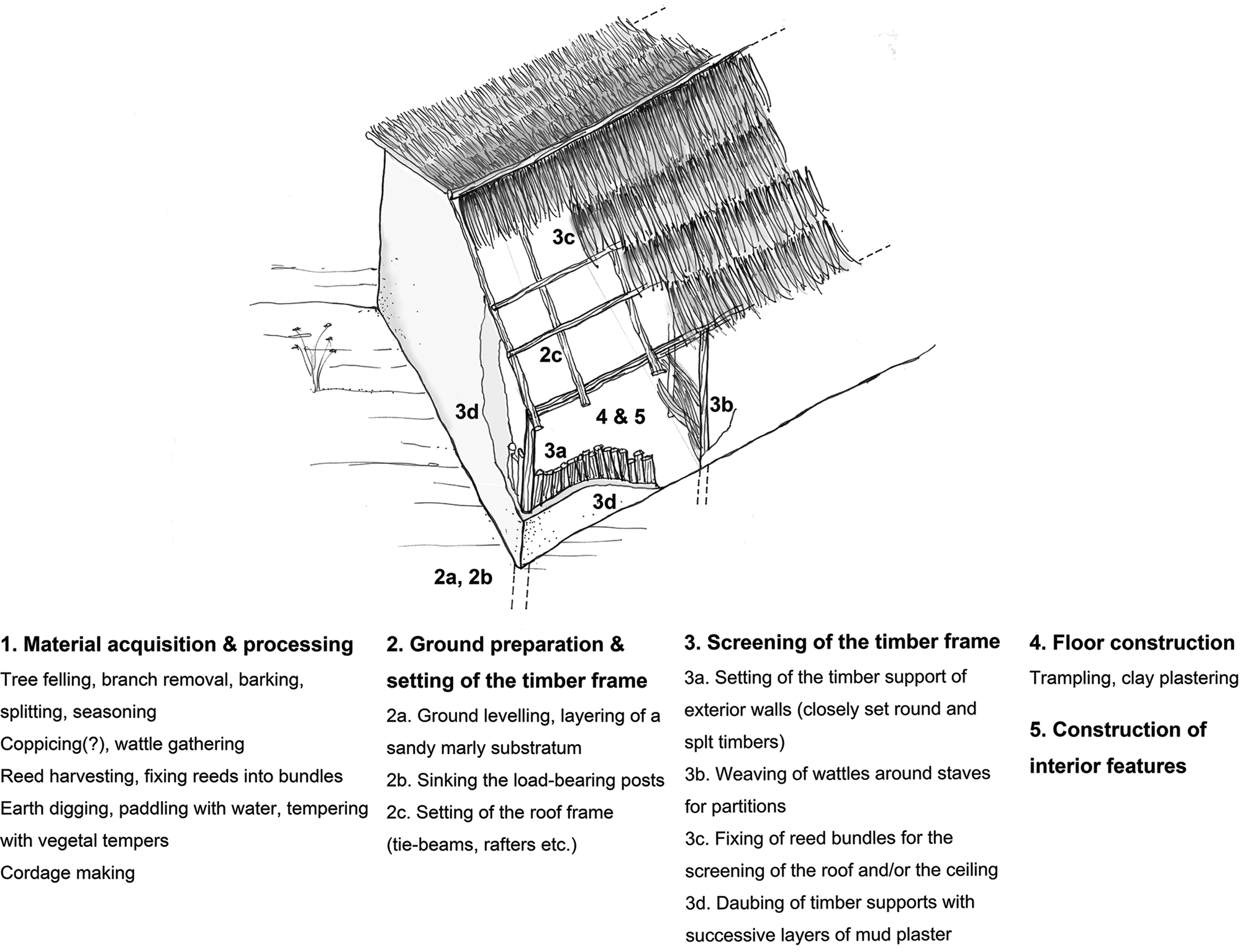
Buildings (Fig. 6): ground preparation was followed by the construction of the foundations and the erection of the main framework. The techniques applied seem to adhere to the basic principles of earthfast architecture, which involve transferring all vertical loads to the ground. The rarity of post-holes may reflect the restricted number of load-bearing elements used. Although the preservation of elements belonging to the roof frame is extremely rare in Neolithic Greece (but see Chourmouziadis Reference Chourmouziadis1971), the roofs are commonly thought to have been either gabled or hipped, with adequate overhanging eaves to protect the walls from rainwater. Tentative reconstructions are primarily based on clay house models and parallels from vernacular architectural records. In the case of Kleitos 2, a clay house model with triangular narrow walls (Fig. 7) supports the construction of gabled roofs. Their basic frame could have been set by joining the vertical posts to tie beams.
Plan summarizing the main operations associated with house constructions. (Drawing: D. Kloukinas, A. Marda-Stypsianou.)
Clay house model with two stories from Kleitos, Late Neolithic. (© Ephorate of Antiquities of Kozani, Hellenic Ministry of Culture and Sports.)
Once the timber framework was in place, the builders had to screen the walls, the partitions and the roof. The macroscopic study of fire-hardened superstructural material indicates that the main walling technique involved a timber support coated with successive layers of the earth used for construction purposes (Fig. 8a, b). Thin poles, split or halved timbers and thin branches were closely set to create a compact wall screen. Impressions of round poles indicate a mean diameter ranging from 0.04 m to 0.08 m. The use of split timbers in place of round ones is reflected by a number of wavy impressions, while thin branches measuring approximately 0.02–0.03 m in diameter were possibly used to fill in the interstices between the more sizeable elements. Rare samples bear thin parallel lines (wood rays) which follow the direction of the round impression. They suggest that the people involved in woodworking occasionally removed the bark, probably to speed up the drying process and to protect the timber against insects and decay.
(a, b) Daub fragments with impressions of thin poles and split timbers and (c, d) woven branches. (Photographs: D. Kloukinas.)

The exact technique by which the timber support was fixed is elusive. Evidence from sites including Dikili Tash (Martinez Reference Martinez2001), Sosandra (Georgiadou Reference Georgiadou2015) and Avgi (Kloukinas Reference Kloukinas2014; Stratouli et al. Reference Stratouli, Bekiaris, Katsikaridis, Kloukinas, Koromila and Kyrillidou2020) indicate that Neolithic builders probably used horizontally placed split poles, transverses and cordage to deal with horizontal movements (Kloukinas Reference Kloukinas, Sarris, Kalogiropoulou, Kalayci and Karimali2017; in press). In the case of Kleitos 2, they probably did not sink these timbers deep into the soil, as reflected by the absence of stake-holes at the building's perimeter (Ziota et al. Reference Ziota, Hondroyianni-Metoki, Magouretsiou and Karamitrou-Mentesedi2013, 73). On the contrary, the timbers may have rested on the ground, on a wooden foot in the form of a sleeper beam (see Efstratiou Reference Efstratiou2002, 248), or inside narrow trenches. The latter could be supported for Building 4, where a narrow foundation trench was uncovered along the eastern boundary of the rubble area (Ziota et al. Reference Ziota, Hondroyianni-Metoki, Magouretsiou and Karamitrou-Mentesedi2013, 73).
The screening of the wall frame was followed by the daubing and plastering of wall surfaces (Fig. 9a–c). The builders coated one or both sides of the timber support with successive layers of ‘plant-tempered earth’, which were probably left to half-dry before the next layer was laid. This may be supported by the fact that, in most cases, the different layers were separated during conflagration and collapse. Daub fragments of the first layer are commonly about 0.08–0.10 m thick and ceramified. Their incidental inclusions comprise a few pebbles and gastropods, pointing to the alluvial/lacustrine environment of the site. The second layer is generally thinner, about 0.06 m, and yellowish in colour, probably due to the natural clay marl. The wall surfaces were finished with a thin layer measuring around 0.008–0.015 m thick and pinkish/yellowish plaster. Evidence of wall decoration in the form of painted or relief/grooved designs, which have been identified at Kleitos 1 (Ziota et al. Reference Ziota, Hondroyianni-Metoki, Magouretsiou and Karamitrou-Mentesedi2013, 75), are missing from Kleitos 2. The thickness of the wall is estimated at approximately 0.20–0.25 m, although this could be increased considerably if the coating of both sides is postulated.
(a) Daub fragment showing layers of plaster and (b, c) details of fire-hardened daub fragments with macroscopically visible inclusions. (Photographs: D. Kloukinas.)

The construction of internal partitions seems to have been carried out using different techniques. In the case of Building 4, a number of well-preserved fragments with thin, round impressions, c. 0.015–0.025 m in diameter, reflect the application of the wattle-and-daub technique (Fig. 8c, d), which has often been attributed to partition walls (Kloukinas Reference Kloukinas, Sarris, Kalogiropoulou, Kalayci and Karimali2017; in press; Prévost-Demarkar Reference Prévost-Demarkar2019). The Neolithic builders wove pliant branches or reeds around vertical posts or staves in order to form a dense support with no need of further fixings. Following this, they plastered the timber support on both sides with plant-tempered earth. Evidence for the possible application of this technique in the case of Building 3 is restricted to a couple of poorly preserved fragments. The internal partitions of Building 3 seem to have followed a ‘compacted clay’ technique, as indicated by the two parallel, poorly preserved wall sections uncovered.
Moving to the covering of the roof frame (and/or the ceiling?), the information provided derives primarily from the remains of the destruction layer of Building 3. The remains take the form of silicified thatch material and daub fragments with multiple round impressions ranging between c. 0.003 m and 0.014 m in diameter (Fig. 10). These dimensions fit well with the stems of the common reed (Phragmites australis), which are occasionally preserved in situ (Fig. 10a, b). Other round impressions, measuring c. 0.02 m in diameter, are occasionally arranged perpendicularly to the reed impressions and could represent thin branches. The available evidence supports the possibility that the Neolithic builders constructed a framework of beams, rafters and purlins, which they later covered with bundles of common reeds. They may also have used leaves of reeds or rushes as light cordage material, as suggested by the occasional preservation of elongated impressions running on top of reed bundles (Fig. 11b). Another hypothesis is that stalks of willow or other species were used instead of cordage, which is also reported ethnographically (Efstratiou Reference Efstratiou2002, 266 & fig. 109; Hatzimichali Reference Hatzimichali2010, 208). This could be supported by several leaflet impressions (Fig. 11a, c) that have been tentatively identified (Kloukinas in press) as ash (Fraxinus sp.) or willow (Salix). Alternatively, their inclusion in the daub could have been accidental. The identification of groups of parallel impressions running diagonally to each other may suggest that the builders placed layers of thatch material in such a way that they partially overlapped. At Kleitos 2, the occasional identification of impressions of reed leaves and inflorescences (Fig. 11a) may suggest that the working group did not invest a lot in their removal before fixing the stems into bundles. Nevertheless, this could also reflect a purposeful practice aimed at maximizing the volume of the roofing material.Footnote 1 After its placement, the thatch was plastered with daub for extra protection against wind and change.
(a, c) Daub fragments with impressions of parallel reed stems; (b) detail of (a) with reeds preserved in a silicified form. (Photographs: D. Kloukinas.)

(a, c) Daub fragments with impressions of reed inflorescences, reed stems and leaflets; (b) Daub fragment with impression of reed stems and probable cordage material. (Photographs: D. Kloukinas.)

As already noted, the floors of both buildings were laid on top of a substratum with a high content of yellowish clay marl. The floor of Building 4 was sealed by the collapsed superstructural material and was preserved as a thin greyish-black layer. This represents a burnt trampled surface with minor preparation. The earliest floor surface of Building 3 has been described (Ziota et al. Reference Ziota, Hondroyianni-Metoki, Magouretsiou and Karamitrou-Mentesedi2013, 75) as ‘clay-made’. It was 0.05–0.07 m in thickness and had been resurfaced at least three times. The latest floor was partially preserved and it is also described as ‘consisting of successive layers of clay on top of sherds’ (Ziota et al. Reference Ziota, Hondroyianni-Metoki, Magouretsiou and Karamitrou-Mentesedi2013, 73).
Thermal structures: five hearths—55, 60, 112, 56 and 79—constitute the dominant category of the assemblage, indicating preferences for open-fire cooking practices. The hearths demonstrate outstanding homogeneity in terms of the sequence of building techniques applied. They vary in size and shape, as irregular, square and with a horseshoe shape (Fig. 12). Two building techniques are identified in this assemblage.
(a) Plan of hearth 109; (b) section of hearth 109; (c) plan of hearth 56. (Drawing: K. Roumelioti.)

Technique A involves the initial flattening of the ground and the construction of the underlay directly on top (Fig. 12). At this point Neolithic builders designed the shape of the structure as irregular, horseshoe-shaped or square. Subsequently they set a pebble or twig layer directly on top of the designated flattened area for the construction of the underlay. A yellowish marl has been identified at hearths T.S. 112 and T.S. 56, as part of the underlay construction or as an adjacent plastered floor for cooking preparation practices. The underlay was then covered by a layer of clay mixed with organic inclusions, which formed the heating surface of the structure. At Kleitos 2, the heating surface was simply smoothed, forming a flattened, even upper level. A fine-grained clay marl plaster was used to line the side walls of the hearths and was occasionally applied on top of the underlay construction of their heating surfaces (Ziota Reference Ziota, Stefani, Merousis and Dimoula2014, 329).
Technique B, on the other hand, is presented at a single feature, T.S. 56, through the digging of a shallow pit with a maximum depth of 0.20 m, filled with rubble from the collapse of the upper structure. The pit was dug directly in the ground and its side walls were covered with finer clay plaster. A smoothed clay heating surface, which resembles dome construction and was rich in organic mixtures, with a central perforation measuring 0.16 m in diameter, was produced to cover the shallow pit. The builders formed two small adjacent cavities at the western part of the heating surface of the hearth, possibly as auxiliary constructions for certain cooking practices or other food-preparation routines (Fig. 12). After the heating surfaces had been constructed, a low perimetric side wall with a maximum height of 0.20 m was built using a coiling technique, leaving an average opening of 0.30 m on one side of the structures in order to facilitate cooking activities. The outer surface of the side walls is rough, with no preserved signs of smoothing or decoration.
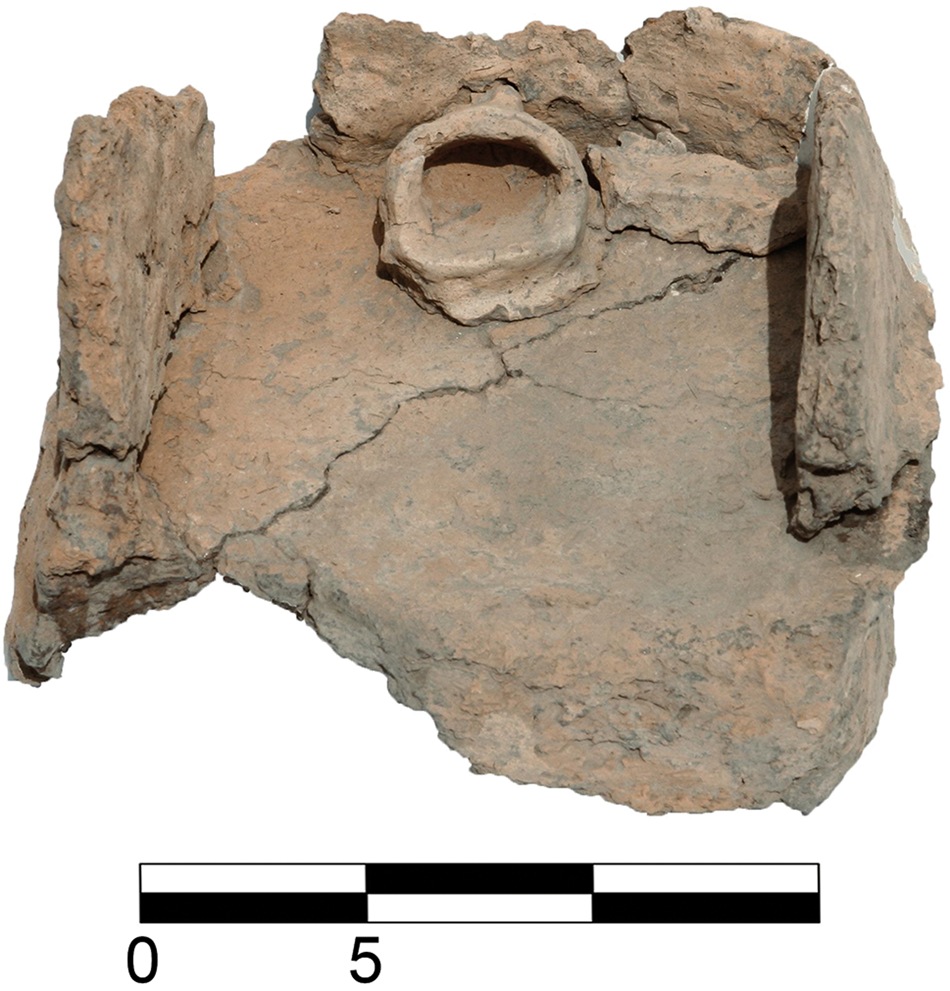
The steps involved in constructing the two identical portable features, T.S. 107 and T.S. 111, resemble the steps for manufacturing a large pot. These two earthen structures are comparable in size and height (Fig. 13). They consisted of two parts, both constructed using a coiling technique applied to tempered earth with organic inclusions. Macroscopically, both parts seem to have been constructed with the same earthen material. The clay includes a high concentration of organic material (chopped chaff, straw and grass) and possibly intentionally powdered gravels. Abundant organic matters at both structural parts of the features were possibly used to make the constructions lighter for their potential transfer. The lower part of the structure is a curved, round discoidal plate with round edges averaging 0.45 m in diameter. The centre of this circular plate was hollowed, where the upper cylindrical feature was placed and adjusted. The upper part of the structure is a clay cylinder with an open-mouth top end averaging 0.24 m in diameter and a bottom base attached to the lower part of the construction. The sequence of construction starts with building the round discoidal plate by successively stacking coils. The outer and bottom inner surfaces of the plate part were smoothened and left to dry. Further smoothing and plastering at the outer surface of the clay plate was then performed. The cylindrical top part was produced separately. First, the builders made an even, circular clay plate, which constituted the base of the cylindrical tube. Successive coils were then stacked one on top of the other, reaching a maximum height of 0.15 m. The outer surface of this clay tube was smoothed, whereas the inner surface of the structure was left rough. Before this part was dried, it was attached with its base down on top of the clay plate, leaving the top open mouth to form the upper end of the whole structure. The structures were initially dried and then fired to solidify them for use.
Plan and section of portable feature 111. (Drawing: K. Roumelioti.)

The single oven T.S. 109 found in the deposits of Building 3 follows the standard construction steps with other parallel examples of contemporary sites in northern Greece, such as Avgi (Kalogiropoulou Reference Kalogiropoulouin press; Stratouli et al. Reference Stratouli, Bekiaris, Katsikaridis, Kloukinas, Koromila and Kyrillidou2020), Servia (Ridley et al. Reference Ridley, Wardle and Mould2000) and Dikili Tash (Prévost-Demarkar Reference Prévost-Demarkar2019). A shallow pit of 0.10 m depth was cut in the ground and its side walls were covered with clay plaster. A pebbled layer was spread on the bottom of the cut for the construction of the underlay. This was subsequently covered by a clay layer mixed with organic inclusions, which formed the heating surface of the structure. Four successive heating surfaces were identified on oven T.S. 109, showing evidence of reconstruction work. All four heating surfaces were simply smoothed. A coiling technique applied to tempered clay with abundant organic inclusions was used for the construction of the side walls and the roofed chamber construction. Coils were put successively one on top of the other to produce the side walls and vault of the structure. The side walls have been preserved to 0.15 m height and were covered with clay plaster from both sides (inner and outer). The form of the vault is unknown (either curved or flat), due to the lack of material remains from this part of the structure. The oven had a wide (1.55 m) entrance opening at its western side. Based on experimental work, after the end of the construction the feature was left to dry for one or two days according to weather conditions and then a light fire would be started so the oven could harden properly (Conati Barbaro et al. Reference Conati Barbaro, La Marca, Forte, Eramo, Muntoni, Rossi and Georgiou2019; Duričić Reference Duričić, Vitezović and Antonović2014, 265).
The rectangular bench, low in height and above the ground, was constructed directly on top of the floor of the house. The underlay of the structure was made using mixed materials, such as pebbles and twigs. Its side walls were made by placing two parallel lines of large potsherds vertically on the ground. Neolithic builders filled its two side walls with earth rich in organic inclusions. They then smoothed the upper surface of the structure with finer clay fabric, without any organic mixtures. After its construction was complete, the bench was left to dry before being used. Evidence of low heat or burning could be linked with the destruction by fire and collapse of Building 3.
Step 5. Use and function
The function of the two case-study buildings is difficult to decipher in their full extent. Evidence from the interior of Building 4 is quite limited, as the floor surface was found empty of in situ structures. Based on the current analysis of architectural and contextual data, Building 4 represents the residence of a single unit or of a nuclear family, and hosted various domestic activities, such as sleeping, storage, protection from weather, and gathering (Flannery Reference Flannery, Ucko, Tringham and Dimbleby1972). On the other hand, Building 3 differs considerably in terms of preservation. Apart from the numerous thermal structures and rich archaeobotanical assemblage of stored products, a large group of pots includes a deep bowl turned upside down, a storage vessel and part of a large pithoid vessel directly associated with working bench T.S. 108.
Macroscopic, spatial and contextual analysis of the nine clay-based thermal structures in Kleitos 2 supports their primary domestic-scale use. Consistent typological evidence of their size, shape and construction suggests that all nine structures were used for daily domestic routines, such as cooking, food preparation, lighting and heating. Instead, it could be proposed that due to its outdoor spatial allocation between Buildings 3 and 4, hearth 56 could be a shared structure for the residences of both domestic units. Furthermore, the form of hearth 56 and the perforation of its heating surface indicates the performance of certain cooking routines that involved boiling (Kalogiropoulou Reference Kalogiropoulouin press). Contextual and archaeobotanical remains in Building 3 point to extensive storage and food-preparation activities, compatible with the domestic operations of a household (Valamoti & Stylianakou Reference Valamoti and Stylianakou2015; Ziota et al. Reference Ziota, Hondroyianni-Metoki, Magouretsiou and Karamitrou-Mentesedi2013, 75). Nevertheless, the rich assemblage of six in situ thermal structures and the great accumulation of portable finds at the deposits of Building 3 in Phase C, together with its continuous rebuilding at the same place, make possible the hypothesis of a suprahousehold or a medium-scale gathering place addressed to more people or different groups within the community. Such a place has been identified at the adjacent Kleitos 1 settlement. Therefore, a tradition of community sharing cannot be excluded in the case discussed (Kalogiropoulou & Ziota Reference Kalogiropoulou and Ziota2021). Additionally, the diverse group of clay-based structures in Building 3 suggests a high degree of variability of cooking-related practices. The large single oven enabled baking and roasting, while open-air direct or indirect cooking, such as boiling in pots, roasting on the heating surfaces, grilling, warming of cooked food in skins or baskets, smoking and parching, could be performed on the two hearths (Atalay & Hastorf Reference Atalay and Hastorf2006; Hastorf Reference Hastorf2017; Valamoti Reference Valamoti2011). The central placement of the bench in easy reach from all six structures underlined its auxiliary use as a food-preparation platform.
Furthermore, the use of the two portable structures T.S. 107 and T.S. 111 could be better understood from their content. The top cylindrical tube of T.S. 107 was filled with ashes and layers of carbonized organic material, while the inner surface of the bottom clay plate was sooted. Additionally, the structure was placed directly on top of a layer of large, joined potsherds, possibly used as a supplementary heating surface for the placement of cinder or low-heat fire underneath the feature. A functional hypothesis for these twin features is that they were used for smoking raw ingredients, such as meat and fish. Smoking is a suggested practice also used for preserving food at Neolithic sites in Greece and could partly explain the portability of the structures (Kalogiropoulou Reference Kalogiropoulouin press).
Step 6. Maintenance, reconstruction, and end life
In terms of maintenance, the renovation of building walls and the heating surfaces of thermal structures was common. The successive layers of wall plaster indicate that the occupants carried out periodic (wholesale or not) renovations and repairs of wall surfaces. Evidence of repeated renovation and reconstruction works, which reached four successive heating surfaces, can be identified in two hearths. Up to four replastering layers are recorded on the outer surface of the lower plate part of the twin portable features. In addition, a minimum of seven successive layers of renovation works on the top surface of the bench are also noted.
Regarding their end life, all the buildings uncovered at the site and at the neighbouring site of Kleitos 1 were burnt. Comparable assemblages in the wider Balkan region have often been seen as the result of intentional conflagration aimed at marking the location and providing a foundation for the new structure (Stevanović Reference Stevanović1997, 338). According to the excavators (Ziota et al. Reference Ziota, Hondroyianni-Metoki, Magouretsiou and Karamitrou-Mentesedi2013), in the case of Kleitos 2 there is no evidence of a widespread conflagration episode. In the case of the earlier phase of Building 3, destruction by fire and the collapse of the reed-thatched roof resulted in the preservation of large quantities of stored products (Valamoti & Stylianakou Reference Valamoti and Stylianakou2015, 67; Ziota et al. Reference Ziota, Hondroyianni-Metoki, Magouretsiou and Karamitrou-Mentesedi2013, 76) and in situ features. It is hard to ascertain whether this supports a sudden destruction episode or a differential function of the building. Whatever the case may be, the building was replaced and set alight twice more before being abandoned. Building 4 was also destroyed by a fire, which led to the preservation of collapsed, fire-hardened superstructural material on top of a thin greyish-black layer representing the floor. Nevertheless, no in situ internal installations were uncovered. Again, it is difficult to determine whether a situation entailing the clearance of the inventory of the building before conflagration was involved.
Evidence regarding how the end life of the thermal structures was reached at the Neolithic site of Kleitos 2 points to practices of abandonment. The thermal structures in Kleitos 2 do not show any signs of intentional destruction. When out of use, cooking installations were abandoned with no distinct causal indications. When inside buildings, the end life of cooking installations is synonymous with that of the destruction of the building, as in the case of the seven features found in the rubble remains of Buildings 3 and 4. The two features found outdoors went out of use without any signs of demolition or intentional damages.
Discussion: socializing the chaîne opératoire of earthen architecture
Any attempt to people the prehistoric past clearly faces serious difficulties. It is not possible to identify a simple relationship between architectural features and individual acts of kinship or co-residency and technological traditions, except through specific examples (see Hodder Reference Hodder, Hofmann and Smyth2013). Nevertheless, the purpose of this analysis has been to focus on earthen structures as works of architecture and social practice and to underline the multiple dynamics involved in their construction (see Vellinga Reference Vellinga2007). The entire project of building a house or a thermal structure is here viewed as a dynamic taskscape (Ingold Reference Ingold1993), where various operations are characterized by their own temporalities and socialities. Carried out either in succession or in parallel with one another, the different stages of the project often intersect with other activities, bring together different bodies of social interactions and correspond to various socio-cultural concerns. Chaine opératoire has been a valuable tool to organize, compare and approach the social effects of building making through the nuanced steps of practice and to tackle technological skills and know-how, social time, labour, solidarity and traditions of construction that contain the core of this research.
Moving beyond the conceptual links identified, similarities in the chaînes opératoires of the features under study are noted. In both buildings and thermal structures, the procurement and processing of the earth used for construction purposes required a comparable set of technical gestures, embodied skills and mental operations. As has been argued (Catapoti & Relaki Reference Catapoti and Relaki2020), these may be viewed as fundamental within the technical regimes that defined a Neolithic being-in-the-world. Kleitos inhabitants were evidently familiar with the local geology in terms of the available soils and sediments as well as the properties of the resources used. This acquired knowledge is evident from the selection of varied clay sources and the use of specific clay to certain parts of the earthen structures. Such an example is the application of yellow marl in specific parts of the features, for wall plastering in buildings and thermal structures, on top of the underlay construction of their heating surfaces, or for the construction of auxiliary plaster floors for food preparation attached to cooking-related structures, as in the cases of hearths T.S. 112 and T.S. 56. Our step-by-step analytical approach gave us the chance to identify more details of construction practices that unfolded the skills and capability of Neolithic builders at Kleitos 2. For example, abundant organic matter in all thermal structure categories was used in the tempering of specific parts of their construction, as in side walls, vault elements or the plate part of portable structures, possibly to reduce the overall load of the features. Lighter constructions with abundant organic matter in the clay parts of the roofs/ceilings of the buildings were also chosen.
As is the case with ‘techniques of the body’ (Mauss Reference Mauss1936), these ‘instrumental techniques’ and the related technological know-how were socially and culturally acquired and transmitted within groups and between contiguous communities (Oliver Reference Oliver2006). Neolithic builders in Kleitos 2 were making recurrent choices in both material selection and technological application. Intra-site standardization of the forms and techniques of the earthen features studied here attests to the existence of community-wide traditions dictating the processes and steps of construction. Even if the technologies applied were, to an extent, set by the affordability of the materials, the consistency of combinations of raw materials and techniques for particular parts of the constructions shows technological standardization and know-how that was potentially passed down from one generation to another through education, experimentation, practice and observation. To this end, intensive earthwork activity and pit digging also required skills shared and transmitted among the builders. In the case of thermal structures, the typical chaîne opératoire of building technology, material selection and form suggests a common tradition that could potentially indicate specific cooking routines, culinary preferences and tastes (Hastorf Reference Hastorf2017, 41; Özbaşaran Reference Özbaşaran, Arsebük, Mellink and Schirmer1998, 558). Although the assemblage of thermal structures is diverse, evidence of regularity in the selection of material resources and the sequence of construction is marked. Except for the building consistency of side walls and vault parts described above, the construction of the underlay in all categories of cooking-related features in the settlement suggests the systematic placement of pebbles and twigs for the making of the substructure layer (instead of other materials such as, for example, straws, reeds, daub, or sherds in second use, also available on site). In this respect, the heating surfaces of the oven and of all four hearths recorded at Kleitos 2 were made by a finer clay layer that was simply smoothed and not polished, as is the case of other contemporary sites in the region (e.g. Kleitos 1, Avgi, Servia).
Apart from the acquisition of skills and techniques inscribed in the hands and muscles of the inhabitants (Robb Reference Robb2007, 84), the construction process as a whole reveals itself as a significant faire social. The spatial allocation of earthen structures was defined by social organization, social interaction and affiliations. The spatiality of building practices, which is not always emphasized in other sorts of technical actions, plays a central role in architectural works. The settlement space emerges from practices and is dictated by socially and culturally informed possibilities that define where architectural earthen structures will be built (Fitzjohn Reference Fitzjohn2013; Love Reference Love2013a; McFadyen Reference McFadyen, Bille and Sørensen2016; Nielsen Reference Nielsen, Bille and Sørensen2016). This is significant when trying to understand the underlying decision-making process. In the case of Kleitos 2, all four buildings were subsequently constructed along a north–south axis and were grouped at the central area of the settlement, forming close spatial associations (Fig. 2). The central outdoor space developed among the buildings hosted numerous communal domestic routines and socialities, such as food preparation and cooking, as indicated by the construction of hearth T.S. 56, that enabled visibility and social monitoring among the co-residences. To this direction, the maintenance and reconstruction of specific features in the same position indicates that certain practices were associated with fixed notions of place. The fact that the Neolithic inhabitants repeatedly reconstructed Building 3 in the same place raises the possibility that certain social units were related to specific plots of land. Along with the incorporation of preceding architectural elements in the final Phase C, this could be linked to claims of locus and residence (Bailey Reference Bailey and Samson1990; Tringham Reference Tringham, Joyce and Gillespie2000), which would have had a considerable influence on the spatial allocation of the dwellings. Similar practices, including the replastering of side walls and the renovation of heating surfaces, are regularly recorded in the case of thermal structures. They are interpreted as efforts to prolong the life and use of the structures in fixed spaces and to retain their spatiality, thus maintaining a routine choreography for food preparation and cooking (Felski Reference Felski2000; Kalogiropoulou Reference Kalogiropoulou, Stefani, Merousis and Dimoula2014; Kalogiropoulou & Ziota Reference Kalogiropoulou and Ziota2021; Sørensen Reference Sørensen2000, 161).
Discussing the procurement of materials and the construction stages, several socialities, temporalities and dynamics are involved. The working group participating in the construction processes is a dynamic one and may range from a restricted number of individuals belonging to the extended household or close kin to a much larger group, or even a community-wide one. Its size and synthesis depends greatly on the task undertaken and the labour force that a dwelling group can mobilize thanks to its kinship relationships, reciprocal obligations and status (Wilk Reference Wilk1983, 105). It is not uncommon for the time-consuming, labour-intensive process of constructing a house to involve collective work by groups exceeding the size of the future resident unit. Whether causally related to or encouraged by the ‘domestic mode of production’ (Sahlins Reference Sahlins1974), such practices have been interpreted as coping mechanisms to counteract risks of economic failure (Halstead Reference Halstead, Halstead and O'Shea1989, 72–3) and as ‘a capital of services rendered’ (Bourdieu Reference Bourdieu1977, 60) within a wider context of reciprocity and solidarity in practice. The gathering and assembling of reed bundles, for example, would have been a demanding, time-consuming activity involving considerable quantities of plant material (Bakels Reference Bakels1978, 90; Fitzjohn Reference Fitzjohn2013, 635). Inherent temporalities are hidden, for instance, in relation to the process of drying the earth used for construction purposes and the plasters, in the allocation of raw materials to the designated area of construction, as well as to the seasoning of structural timbers or the use of wattles while fresh and flexible. Moreover, time and labour are key factors for intensive earthwork activities and pit digging, which would demand collective work or a large group of people undertaking the tasks. The construction of Buildings 3 as potential suprahouse or communal gathering place could offer an exceptional opportunity for social interaction and cohesion in this respect. Certain tasks that were more demanding in terms of technical knowledge and craftsmanship would have been carried out by smaller groups of skilled and experienced individuals. The procurement and working of structural timbers, for example, could have involved individuals with a good knowledge of the appropriateness of tree species from the surrounding microenvironments. Other operations, which required the aid of several hands and involved more generic knowledge and skills, could have been carried out by larger groups of helpers and ascribed with significant affinal connotations (Hugh-Jones Reference Hugh-Jones, Carsten and Hugh-Jones1995, 228). These tasks include the digging and paddling of soil, the transfer of bulky resources (including earth and water) and daubing or plastering. The setting of the main frame and the thatching of the roof are also occasions for communal labour, potentially supervised by experienced individuals (Waterson Reference Waterson1997, 126–7).
Instead, the construction of thermal structures is a smaller-scale project with obvious differences in both the time and the people required. It therefore involves different dynamics in terms of decision-making and planning, as well as in terms of social participation and human agency. The construction of a single thermal structure is a much less time-consuming task compared to buildings, even in the case of large and structurally demanding features. Moreover, any category of thermal structure could be accomplished by a single individual or a small group of co-residents or family members. The necessary quantities of raw materials suggest that the procurement of materials—including extracting soil, selecting pebbles, processing organic materials, and acquiring twigs—did not constitute a copious or time-consuming step in the manufacturing chain. The intermediate steps carried out to access and process the different categories of raw materials were neither particularly time-consuming nor technologically demanding. Moreover, the different stages of the building process—including flattening the soil, digging shallow pits, framing the underlay with pebbles or twigs, chopping organic inclusions, mixing soil and layering heating surfaces—are tasks that could be carried out by a single person or a small team of not necessarily exceptionally skilled but nonetheless experienced co-workers. The community preference for the indoor allocation of thermal structures made their construction a private process, less visible to the wider community, not only during construction but also during their use. At the same time, the possibility of a community-wide Building 3 made the features accessible to the group of participants allowed indoors, enabling visibility of the structures. Regardless of their domestic or communal function, however, numerous social interactions were developed among co-users and co-residents during the use of thermal structures.
The above analysis suggests that the processes involved in constructing the diverse categories of earthen structures pose different demands and provide different opportunities for social interaction, co-operation and shared experiences among the participants. The actual construction of earthen buildings should be seen as ‘the culmination of an extended process of planning and preparation’ (Robb Reference Robb2007, 83), which brings together varying groups of people and allows group affiliation and unity to manifest itself. In terms of both its construction and the end result, the house may be seen to have served an outward purpose, communicating with the community. This is often expressed in the form of elaborate rituals and community-wide festivities following certain stages of the process, including the gathering and assembling of materials, arrival of helpers, foundation of the new structure and its completion (Gibson Reference Gibson, Carsten and Hugh-Jones1995, 144; Jennings Reference Jennings2003, 145; Kerlogue Reference Kerlogue, Sparkes and Howell2003, 63; Oliver Reference Oliver2003, 119; Skafida Reference Skafida, Decourt, Helly and Gallis1994; Waterson Reference Waterson1997, 121). Thermal structures, on the other hand, have served both outward purposes with the features built at the open-air spaces of the settlement, but also the inward-looking aspects of the dwelling group or of the social group(s) taking part in possible communal activities. What is more, the sharing of the hearth, as well as the cooking and eating arrangements, often symbolize the unity of the household (Carsten Reference Carsten, Carsten and Hugh-Jones1995, 113; Trankell Reference Trankell, Sparkes and Howell2003, 137). The construction process for thermal structures, which is carried out at the level of the dwelling group, may also invoke similar notions of belonging.
Thinking of architecture as a ‘cumulative process’ (Benson & Whittle Reference Benson and Whittle2007, 359) that involves numerous sets of practices, decision making, human interactions and collaborations is an effective mode of argument, when it engages with the details of the evidence (McFadyen Reference McFadyen, Bille and Sørensen2016, 60). The employment of chaine opératoire in this material-based analysis has proved to be a useful tool for understanding elements of community formations and deciphering the many actions and social interactions behind participation and co-working for the construction of earthen architecture. Through the nuanced study of building making, we have argued that Neolithic architecture was primarily a set of community practices and involvements that embedded decisions, traditions, technological skills and social collaboration. Moreover, the integration of time and space in this technological study of architecture has offered a window on the planning strategies of Neolithic communities, which has further expanded the boundaries of the analytical method to a rather targeted, human-centred endeavour. Including the proxies of time, labour investment and spatial arrangements in the analytical methodology developed has shown that earthen structures of Kleitos 2 constitute assemblages bringing together materials from the local environment, techniques and various actors. The materials, including both earth and timber, and the techniques used are characterized by malleability, intertwined by numerous agencies and temporalities. As seen by the study of the different chaînes opératoires, the techniques used at Kleitos 2 are defined by standardization, which may reflect their social transmission. There are common materials and operations between the different categories of earthen structures studied. Nevertheless, there is a difference in scale (and probably participation), which should be seen as meaningful in terms of the socialities involved. Overall, the construction period of earthen structures created a gathering routine in practice that may have enhanced collaboration and reciprocity, empowered social ties and shared memories, and ultimately sustained communal solidarity. In conclusion, this study reveals that as architecture is accepted as active material culture (Love Reference Love2013b, 755), we gradually become better at understanding its contribution in the shaping of past social formations.
Acknowledgements
The authors would like to thank the Director of the Ephorate of Antiquities of Florina, Dr Christina Ziota, who has generously given her permission for the study of the material and has always been supportive of our research. We also wish to extend our gratitude to the Director of the Ephorate of Kozani, Dr Areti Chondroyianni-Metoki, who has kindly provided all the help we have required in terms of people and resources. Drawings were produced by J. Donati, A. Marda-Stypsianou and K. Roumelioti, whom we thank wholeheartedly. This research was co-financed by Greece and the European Union (European Social Fund-ESF) through the Operational Programme ‘Human Resources Development, Education and Lifelong Learning 2014–2020’ in the context of the project ‘Searching for the Neolithic “Landscapes of Action” through an analysis of architectural remains: the case of Kleitos 2, Kozani’ (MIS 99092). Any remaining mistakes are, of course, the responsibility of the authors.


 Open access

