


Introduction
Public sector policies can exert a significant influence on what organizational forms and models (i.e., organizational frameworks) social enterprise (‘SEs’) adopt (Choi et al., Reference Choi, Berry and Ghadimi2020; Young & Lecy, Reference Young and Lecy2014). These policies can affect SEs’ modal properties and attributes, including their resource mixes, governing interests, and institutional trajectories (Bidet et al., Reference Bidet, Eum and Ryu2018; Defourny et al., Reference Defourny, Nyssens and Brolis2021). Furthermore, public sector policies focused on SEs enable their emergence and the incubation of organizations that serve the public interest (Claassen et al., Reference Claassen, Choi and Mair2023b; Klein et al., Reference Klein, Mahoney, McGahan and Pitelis2010). Research has associated the worldwide trend in the adoption of supportive public policies aimed at incubating and capacitating SEs with governments’ intention to instrumentalize SEs to complement or substitute the public sector in achieving social policy goals (Mazzei, Reference Mazzei2017; Roy et al., Reference Roy, McHugh, Huckfield, Kay and Donaldson2015). Relatedly, public sector funding often constitutes an important component of the resource mix of SEs in conjunction with earned income and charitable contribution (Herranz et al., Reference Herranz, Council and McKay2011). Finally, public policies can play a critical role in the diffusion of SE models as they convey recognition and legitimacy (Defourny & Nyssens, Reference Defourny and Nyssens2010, 241).
Research on SEs has also treated models that can be directly influenced by public policy as distinct types. In related SE typologies, Defourny et al. (Reference Defourny, Nyssens and Brolis2021) and Defourny and Nyssens (Reference Defourny and Nyssens2017) refer to the theoretical existence of a ‘(semi-)public sector’ SE model. They define the ‘(semi-)public sector’ model as SEs that have either been (partially) launched by the public sector and (i.e., a public sector SE model) or which emerged due to the public sector’s active institutional support as a partner and enabler but not an entrepreneur (i.e., a semi-public sector model). This can be related to Gordon’s (Reference Gordon2013) notion of ‘public statist purpose’ or ‘public’ SEs, which is defined as the ‘reconfiguration or “externalisation” of public services in social enterprise organisational form’ (8), which also conforms to the notion of ‘public sector spin-off’ SEs of Spear et al. (Reference Spear, Cornforth and Aiken2009). Yet, research on (semi-)public sector models of SE have mostly been confined to case studies across diverse national contexts (e.g., Dai et al., Reference Dai, Lau and Lee2017; Hrafnsdóttir & Kristmundsson, Reference Hrafnsdóttir, Kristmundsson, Defourny and Nyssens2021; O’Hara & O’Shaughnessy, Reference O’Hara, O’Shaughnessy, Defourny and Nyssens2021).
The South Korean (‘Korean’) SE ecology presents a unique opportunity to examine semi-public sector SEs, including homogeneity and heterogeneity among such SEs, given the well-documented and instrumental role of the public sector in the emergence and quantitative growth of SEs (Choi et al., Reference Choi, Berry and Ghadimi2020; Kil et al., Reference Kil, Lee, Kim, Shin, Lee, Lee, Kim and Ahn2017). Through the Ministry of Employment and Labor’s prerogative to grant SE certification and thereby the benefits of public sector patronage, the number of government-certified SEs (‘GCSEs’) has surged from 55 in 2007 to 3572 by May 2023 (see Appendix I). Although research exists on SE diversity in Korea (e.g., Bidet et al., Reference Bidet, Eum and Ryu2018), GCSEs as a specific SE model have been underexamined. Existing literature mainly offers a descriptive overview without proposing a stylized typology (e.g., Kil et al., Reference Kil, Lee, Kim, Kim and Ahn2020), underlining the need for further exploration.
Harrison and Klein’s (Reference Harrison and Klein2007) notion of ‘diversity’ provides a framework for examining variance within semi-public sector SEs, defining it as differences in distribution among unit members regarding a common attribute (e.g., organization type). Assessing within-category organizational diversity furthers theory development relative to SE models (e.g., Defourny et al., 2022; Young & Lecy, Reference Young and Lecy2014) by providing insights into the nuanced models that semi-public sector SEs assume within the context of an ‘enabling’ regulatory environments (Toepler et al., 2021). Furthermore, investigating such semi-public SE models possesses practical utility as it speaks to the public sector’s ability to cultivate a variety of SEs, which address different societal needs, that are not essentially quasi-governmental entities lacking genuine autonomy (Brandsen et al., Reference Brandsen, Trommel and Verschuere2015; Chan et al., Reference Chan, Ryan and Quarter2017) or which are confined to ‘vendorism’ (Frumkin, Reference Frumkin2005). Moreover, a significant potential hazard of public sector SE promotion is the misuse of the public sector support, and public investment, by organizations that superficially adopt the ‘SE’ label to benefit from public sector patronage, but which are ‘unproductive’, ‘opportunistic’, or ‘rent-seeking’ in their (mis)alignment of their economic objective(s) and social mission(s) (see Dey & Teasdale, Reference Dey and Teasdale2013, Reference Dey and Teasdale2016; Klein et al., Reference Klein, Mahoney, McGahan and Pitelis2010; Teasdale et al., Reference Teasdale, Lyon and Baldock2013; Claassen et al., Reference Claassen, Bidet and Kim2023a).
Identifying and exploring the potential ‘diversity’ of semi-public SEs is crucial to discerning whether their ostensibly ‘complementary’ relationship (see Toepler et al., 2021) with the public sector has yielded a diverse SE ecosystem or has resulted in largely similar organizations. Although coercive isomorphic pressures, e.g., from legal and regulatory frameworks, can legitimize new organizations forms such as GCSEs to address social needs (Frumkin & Galaskiewicz, Reference Frumkin and Galaskiewicz2004; Klein et al., Reference Klein, Mahoney, McGahan and Pitelis2010), they might also curtail organizational diversity (see Bode, Reference Bode2006; Brandsen et al., Reference Brandsen, Trommel and Verschuere2015; Park & Wilding, Reference Park and Wilding2013). Nevertheless, it has been suggested that diverse organizational forms can emerge, even under the auspices of public sector patronage, as organizations negotiate varying institutional logics from the market, civil society, and public sector (Min, Reference Min2022; Teasdale & Dey, Reference Teasdale and Dey2019; Vickers et al., Reference Vickers, Lyon, Sepulveda and McMullin2017). This is congruent with the notion of ‘pluralistic’ organizations, defined as organizations that possess multiple objectives and are, thereby compelled to align multiple institutional logics while contending with ‘diffuse power’ (i.e., both internal and external stakeholders such as the public sector, shareholders, beneficiaries, et cetera) (Denis et al., Reference Denis, Langley and Rouleau2007). In Korea, government certification positions the public sector as a pivotal stakeholder that influences GCSEs' strategic direction through mandated certification requirements and objectives, which can influence the model GCSEs adopt amid the dual challenges of public mandates, regarding their organizational forms (e.g., the government’s emphasis on participatory decision-making structures regarding the internal governance of GCSEs), economic performance, and social objectives (see Lurtz & Kreutzer, Reference Lurtz and Kreutzer2017; Young, Reference Young2001). This study primarily invokes the literature on organizational hybridity (e.g., Doherty et al., Reference Doherty, Haugh and Lyon2014) as it relates to the alignment of institutional logics, although it is important to note the ‘pluralistic organization’ literature as it acknowledges the importance of the external environment and thereby the potentially important role of the public sector in shaping semi-public sector SE models.
We implement a hierarchical cluster analysis using Ward's method and correlation clustering to ascertain the GCSE models that have emerged following the enactment of the Social Enterprise Promotion Act in 2007 by utilizing enterprise-level data obtained from the Ministry of Employment and Labor-affiliated Korea Social Enterprise Promotion Agency (KoSEA). The methodological approach of this study is particularly apt for exploratory research and enables comparison across diverse variables in high-dimensional datasets (Kimes et al., Reference Kimes, Liu, Hayes and Marron2017; Kriegel et al., Reference Kriegel, Kröger and Zimek2009). The following research question guides our analysis: What distinct models of semi-public sector social enterprises exist, if any, and how can these models be typologized?
Literature Review
Extending Perspectives on Semi-public Sector Social Enterprises as Hybrid Organizations
Research on SEs has benefitted from theoretical perspective on hybrid organizing and institutional pluralism. This research tradition has helped to understand how SEs internally manage and combine third sector (e.g., social impact, inclusivity, social justice, et cetera) and commercial institutional logics (e.g., profitability, efficiency, et cetera) and contend with the concomitant internal tensions (e.g., Battilana & Lee, Reference Battilana and Lee2014; Wolf & Mair, Reference Wolf and Mair2019). It has also provided insights on how (complex) institutional environments characterized by the institutional pluralism shapes the behavior and form of SEs (e.g., Mair & Rathert, Reference Mair and Rathert2019; Stephan et al., Reference Stephan, Uhlaner and Stride2015).
Studies on SEs as hybrid organizations have predominantly focused on how they combine pursuing a social mission(s) with a financially sustainable commercial model. Yet, as Doherty et al. (Reference Doherty, Haugh and Lyon2014) note, organizational hybridity can involve drawing from two or more institutional logics, and, as such, the institutional logic that pertains to the public sector. As noted by Herranz et al. (Reference Herranz, Council and McKay2011), the public sector’s contributions to the resource mix of SEs can be substantial. As such, it is imperative to investigate how a public sector institutional logic can impact the hybridity of SEs. As suggested by the literature on selective coupling (Pache & Santos, Reference Pache and Santos2013), SEs may engage in selective coupling strategies by adhering to particular aspects of each institutional logic while discarding others and thereby creating unique organizational configurations that align with their social mission(s) and capabilities.
GCSEs, while not launched or (partially) owned by the public sector, have predominantly emerged due to public sector opportunity signaling, patronage, and a supportive regulatory environment (see Choi et al., Reference Choi, Berry and Ghadimi2020). This situates them as semi-public sector SEs, highlighting the public sector’s enabling role in their establishment and operation (see Defourny et al., Reference Defourny, Nyssens and Brolis2021). Yet, at present, how such (semi-)public sector SEs manifest in practice remains underexplored despite significant interest in the potential of SEs, as important partners of the public sector, to address complex social challenges (Baglioni, Reference Baglioni2017; Choi et al., Reference Choi, Berry and Ghadimi2020; Klein et al., Reference Klein, Mahoney, McGahan and Pitelis2010). Case studies on semi-public sector models frequently use work-integration SEs as examples, which may have influenced the predominant findings (e.g., Dai et al., Reference Dai, Lau and Lee2017; O’Hara & O’Shaughnessy, Reference O’Hara, O’Shaughnessy, Defourny and Nyssens2021). Nevertheless, Gordon’s (Reference Gordon2013) empirical findings suggest that SE traditions (‘mutual’, ‘community’, ‘altruistic’, ‘ethical’, ‘private market’, and ‘public statist’ purpose) can merge in diverse ways, suggesting potential variations in semi-public sector SE models.
While the unique organizational SE models arising from various institutional logic configurations are well-studied, less explored are the models of semi-public sector SEs grappling with added complexity and regulatory pressures from the public sector, such as government certification, while balancing their social mission(s) and commercial objective(s). Hybrid organizations, such as GCSEs, tend to exhibit flexibility in balancing these pressures (Battilana & Lee, Reference Battilana and Lee2014; Sætre, Reference Sætre2022). This hints at potential diversity among semi-public sector SEs as they manage institutional synergies and tensions in potentially distinct ways, particularly when their operations are interwoven with public service provision (Powell et al., Reference Powell, Gillett and Doherty2019). Assessing GCSEs thus presents an opportunity for examining hybrid organizations that have emerged owing to government institutional support and which operate at the intersection of market, public, and third sector logics. Such a research trajectory complements case-based research while simultaneously extending research on the SE models that constitute the semi-public sector SE model, which has largely been treated as a uniform model.
Semi-Public Sector Social Enterprises in Korea
The conceptual underpinnings of SEs in Korea trace back to pioneering endeavors initiated by civil society organizations and grassroots social movements (Bidet & Eum, Reference Bidet and Eum2022). While civil society played an instrumental role in the conceptualization of SEs, their subsequent development and quantitative scaling has been intimately linked with the interests of the Korean public sector (Choi et al., Reference Choi, Berry and Ghadimi2020) and the logic of the developmental state (Jeong, Reference Jeong and Kerlin2017).
In a somewhat statist context such as Korea (Choi et al., Reference Choi, Berry and Ghadimi2020), the government wields greater authority over SEs than in contexts such as the USA and the UK (Choi et al., Reference Choi, Berry and Ghadimi2020; Jang, Reference Jang2017). This has prompted work on the ability of Korean GCSEs to remain autonomous (Bidet, Reference Bidet2012; Jang, Reference Jang2017), and thus their ability to adopt differential models due to the standardization pressures associated with a substantial degree of coercive isomorphism (Frumkin & Galaskiewicz, Reference Frumkin and Galaskiewicz2004; Kerlin et al., Reference Kerlin, Lall, Peng and Cui2021; Park & Wilding, Reference Park and Wilding2013). These coercive isomorphic pressures have been documented in the Korean social economy by Min (Reference Min2022) and Park and Wilding (Reference Park and Wilding2013).
Organizations aiming for GCSE status usually start as ‘preliminary’ SEs, a provisional legal category that grants limited public patronage and is typically contingent on designation by a local government or ministry (Choi & Kim, Reference Choi and Kim2014). They then must fulfill specific criteria to attain GCSE status, namely: (1) democratic decision-making structure, (2) social purpose reinvestment, (3) expenditure, (4) financial support, (5) financial performance, (6) employment, (7) social service provision, (8) local community involvement, and (9) partnerships. The high application success rate following 2015 may suggest that a consensus has been reached as to what constitutes a SE fit for certification (see Appendix I). A survey by Kil et al. (Reference Kil, Lee, Kim, Shin, Lee, Lee, Kim and Ahn2017) showcased the public sector’s pivotal role in incentivizing GCSE status pursuit, facilitating preliminary SEs’ transition to GCSEs, and supporting GCSE operations.
As per Jeong (Reference Jeong and Kerlin2017), public sector policy design has allowed GCSEs to retain strategic diversity and a semi-strategic focus in pursuing a social mission encased within the public sector’s parameters, suggesting an inherent capacity for a variety of models. This potential for diversity is further reinforced by Teasdale and Dey's (Reference Teasdale and Dey2019) observation that SEs, while operating within formal public sector objectives, often informally diverge to pursue their unique visions of public value—a divergence often anticipated, tolerated, and accepted by the public sector. Min (2021) indicates that such organizational hybridity could be an outcome of the interplay between contrasting institutional logics of the public sector and civil society. This perspective is corroborated by Bidet et al. (Reference Bidet, Eum and Ryu2018) who have documented diversity among Korea’s ‘public policy-driven’ SEs.
Nonetheless, Defourny et al. (Reference Defourny, Nyssens and Brolis2021) found that the ‘social business’ model predominates in Asia, typically initiated by a single entrepreneur and characterized by a primary focus on shareholder interests. They define a ‘social business’ model SE as driven primarily by the interests of shareholders (i.e., a ‘capital interest’) yet simultaneously, but to a lesser extent, ‘general interests’ that are of benefit to society. Their social mission can, at times, be akin to well-developed corporate social responsibility initiatives launched by for-profit organizations. In contrast, the ‘entrepreneurial nonprofit’ model refers to nonprofits pursuing marketization in the pursuit of the public interest (i.e., a ‘general interest’). Additionally, the ‘social cooperative’ model combines the interests of its members (i.e., a ‘mutual interest’) with, to a lesser extent, the general interests of society and has a cooperative legal form.
Most GCSEs appear to exhibit features of the ‘social business’ model. Kil et al. (Reference Kil, Lee, Kim, Kim and Ahn2020) found that 62% of GCSEs were registered as for-profits while only 21% were nonprofits, 14% cooperatives (including social cooperatives), and 3% farming associations. This suggests a semi-public sector and social business model blends feature most prominently, which aligns with Bode’s (Reference Bode2006), finding that co-production structures encourage (third sector) organizations to adopt market-oriented identities. This trend can potentially be attributed to New Public Management reforms, which apply business and private sector management concepts to public service administration (Brandsen & Kim, Reference Brandsen and Kim2010; Sætre, Reference Sætre2022) in conjunction with New Public Governance reforms that emphasize co-production (i.e., when public and non-public sector actors both participate in policy design and the implementation of public services) (Brandsen et al., Reference Brandsen, Trommel and Verschuere2015; Pestoff et al., Reference Pestoff, Osborne and Brandsen2006).
Dimensions of Semi-public Sector Social Enterprise Models
We identified three interrelated dimensions to assess the models of GCSEs for the purposes of this study. A strategic orientation dimension was derived based on the literature that proposes that SEs can be defined by their relative degree of embeddedness in the market and social welfare domains (Garrow & Hasenfeld, Reference Garrow, Hasenfeld, Gidron and Hasenfeld2012), may emerge due to government failure in welfare provision or from market opportunities (Nicholls, Reference Nicholls, Gidron and Hasenfeld2012), and can engage in ‘tactical mimicry’ by symbolically adopting the label of ‘SE’ in order to benefit from public sector patronage (e.g., access to quasi-market(s)) (Dey & Teasdale, Reference Dey and Teasdale2016). This dimension serves to gauge whether a GCSE’s principal aim appears to learn toward addressing welfare gaps or capitalizing on a (quasi-)market opportunity. The second dimension, the mission focus, complements the first by invoking the SE literature on the intrinsic and extrinsic antecedents of SE formation (Kruse et al., 2019; Choi & Kim, Reference Choi and Kim2014) by probing whether a GCSE’s mission focus appears to be driven more intrinsically or extrinsically. Finally, a third dimension is introduced that relates to the literature on SE alignment of institutional logics (Battilana & Lee, Reference Battilana and Lee2014; Defourny et al., Reference Defourny, Nyssens and Brolis2021; Mair et al., Reference Mair, Mayer and Lutz2015; Mikołajczak, Reference Mikołajczak2020; Wolf & Mair, Reference Wolf and Mair2019). This hybridity dimension, rooted in principles of interest and institutional alignment, probes the interplay and potential prioritization of institutional logics within GCSEs, i.e., whether differential logics have been integrated or whether a hegemonic–subordinate relationship exists. These dimensions represent an attempt to compare GCSE models across existing theoretical parameters for assessing SEs. Nevertheless, a more fine-grained elaboration on the relevance of these dimensions with reference to the literature is imperative.
First, the strategic orientation dimension weighs the focus of GCSEs on addressing welfare gaps against exploiting market opportunities. The ‘filling a welfare gap’ level of this dimension aligns with theories on government and market failure (see Salamon & Anheier, 1995), which posit that third sector and civil society organizations are often supported by the public sector due to their low profitability and high social utility (Salamon, Reference Salamon1987, Reference Salamon1995).
The ‘exploiting a market opportunity’ level aligns with the new public management paradigm promoting public sector efficiency, competition, and outsourcing (see Brandsen & Kim, Reference Brandsen and Kim2010). Transaction cost economics (see Williamson, Reference Williamson, Barney and Ouchi1986) and resource dependence theory (see Pfeffer & Salancik, Reference Pfeffer and Salancik1978) help explain this level by highlighting aspects of organizational behavior that are of relevance. The former suggests that GCSEs seek to reduce transaction costs (e.g., the costs involved in finding business partners, enforcing contracts, et cetera) by gaining public contracts and/or procurement and thereby reducing market uncertainty through more predictable revenue streams and contracts and by gaining access to less competitive environments than open markets. The latter perspective conveys the notion that GCSEs seek to secure critical resources through public sector patronage, and thus strategically align with the public sector. This involves operating within ‘quasi-markets’, i.e., markets crafted by public sector efforts that lead to more predictable revenues and stable contracts (Coupet & McWilliams, Reference Coupet and McWilliams2017). This renders this level applicable to organizations that nominally identify as SEs to qualify for public sector funding (see Teasdale et al., Reference Teasdale, Lyon and Baldock2013; Dey & Teasdale, Reference Dey and Teasdale2013, Reference Dey and Teasdale2016).
The mission focus dimension is bifurcated into two facets. The first, ‘filling a niche’, refers to addressing niche social challenges through novel business models, and can be related to the intrinsic antecedents of SE formation (Kruse et al., 2019). The ‘policy priority’ relates to SE formation's extrinsic antecedents (Choi & Kim, Reference Choi and Kim2014), implying GCSEs tailor their operations or mission to public policies and derivative public value creation goals. This speaks to the ‘organized publicness’ of SEs (Choi et al., Reference Choi, Berry and Ghadimi2020, Reference Choi, Lee and Hur2021), which considers the public sector’s influence on an organization's structure, funding, and goals.
A third dimension—hybridity—relates to GCSEs’ configuration of institutional logics, of their ‘hybridity’ model. The ‘principles of interest’ level of this dimensions derives from research on the unique ways in which SEs configure general interest, mutual interest, and capital interest institutional logics (see Defourny et al., Reference Defourny, Nyssens and Brolis2021). This approach is concordant with the EMES (Emergence of Social Enterprises) framework, which has the following dimensions: economic and entrepreneurial, social, and participatory governance (Defourny & Nyssens, Reference Defourny and Nyssens2012).
The second level—‘institutional alignment’—derives from Wolf and Mair’s (Reference Wolf and Mair2019) distinction between differentiated and integrated SEs as types of hybrid organizations. Wolf and Mair (Reference Wolf and Mair2019) differentiate between SEs operating in two streams (differentiated) and those pursuing both goals—their social and commercial interests—through one activity (integrated). This distinction is important for understanding whether GCSE certification is sought for symbolic or substantive reasons. Mair et al. (Reference Mair, Mayer and Lutz2015) suggest that some hybrid organizations (mostly) conform to a single dominant institutional logic (e.g., social welfare or commercial) while others dissent by balancing and aligning plural institutional logics’ prescriptions.
Research Design
Our research design utilized hierarchical clustering to dissect data from the KoSEA’s Voluntary Management Disclosure System’s 2018 dataset, pertaining to GCSEs’ disclosures from 2017. This dataset has been independently audited, rendering it the latest reliable dataset. We utilized Euclidean distance combined with Ward's linkage method (see Gere, Reference Gere2023), followed by the application of the PAM (‘partitioning around medoids’) clustering algorithm. We leveraged the average silhouette method to identify the optimal number of clusters. We also employed correlation clustering given the high-dimensional dataset of this study (see Kriegel et al. Reference Kriegel, Kröger and Zimek2009). Skewness was addressed through inverse hyperbolic sine transformations and subsequent Z-score scaling. Heterogeneity was verified using the Hopkins statistic. Following clustering, we utilized ANOVA (analysis of variance) coupled with pairwise comparisons that integrated bootstrapped t tests and Bonferroni corrections to identify differentiators. However, ANOVA was not employed as a tool to identify and interpret statistical significance in the traditional sense, but rather to discern cluster characteristics by identifying discriminative variables that significantly contributed to cluster formation. This approach generally aligns with the methodology of Vicent et al. (Reference Vicent, Gonzálvez, Sanmartín, Fernández-Sogorb, Cargua-García and García-Fernández2019) and was adopted due to its aptness for identifying complex multi-dimensional associations, rendering it particularly apt for the exploratory research aims of this study.
The variables used for this study’s cluster analysis mirror those adopted by KoSEA to assess GCSEs and are consistent with the variables used by Defourny et al. (Reference Defourny, Nyssens and Brolis2021). The categories that contain the variables are as follows, with detailed descriptions available in Appendix IIa: (1) nominal data, (2) decision-making structure, (3) shareholding ratio (i.e., ‘ownership distribution’), (4) employment, (5) beneficiaries, (6) social service and social purpose reinvestment, (7) financial performance, (8) financial support, and (9) public procurement. In Appendix IIb, we elaborate on the (3) shareholding ratio category.
Appendix IIIa provides the descriptive statistics of the quantitative variables. Multicollinearity was tested, as shown in Appendix IIIb, and variables with high levels of multicollinearity were removed. For instance, ‘assets’ was removed due to a strong linear association (x > 0.9) with the amalgamation of ‘liabilities’ and ‘capital’. Additionally, 13 outliers were removed using a boxplot analysis.
Results
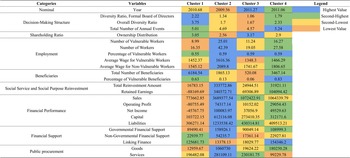
The results of our analysis are shown in Tables 1, 2, and 3 and Appendix IVa and IVb. We derived four clusters from our dataset, with the following order of frequency: cluster 4 (n = 204; 43.59%); cluster 3 (n = 113; 24.15%), cluster 1 (n = 81; 17.31%) and cluster 2 (n = 70; 14.96%). We first detail the commonalities between clusters and then differentiate between them and propose four representative GCSE clusters of semi-public sector SE types that have emerged. As shown in Appendix IIIb, differences are not attributable to size, e.g., there was no correlation between sales, the number of vulnerable workers, and the number of beneficiaries.
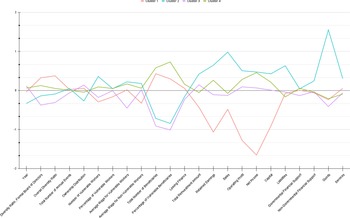
Differences between clusters (means)

All monetary values are in South Korean won, with one unit equaling 1000 South Korean won; ‘number of workers’ was calculated post hoc
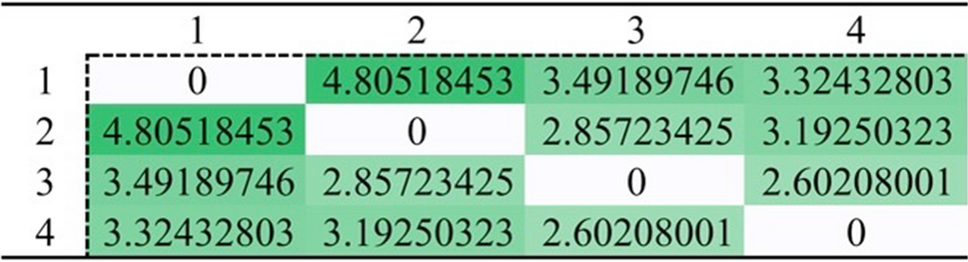
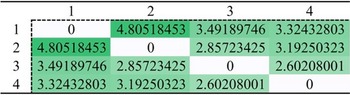
Distance between clusters, by variable
Distance between clusters
Government-Certified Social Enterprise Clusters
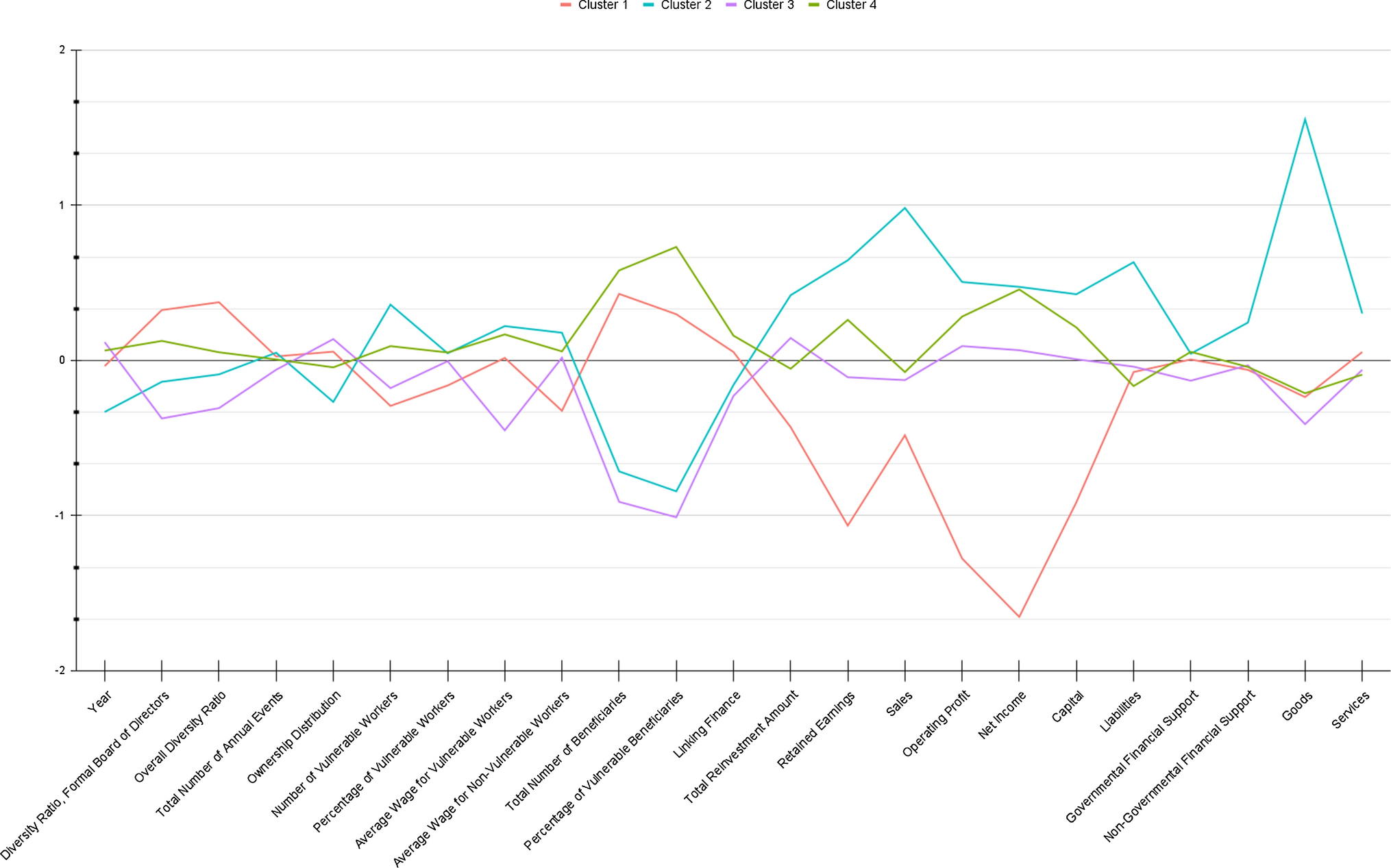
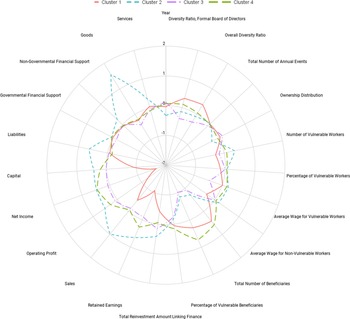
We illustrate the inter-cluster differences in a more granular manner in Tables 2 and 3, including by means of a radar chart in Fig. 1. The clusters can be distinguished as follows:
Korean government-certified social enterprise cluster attributes

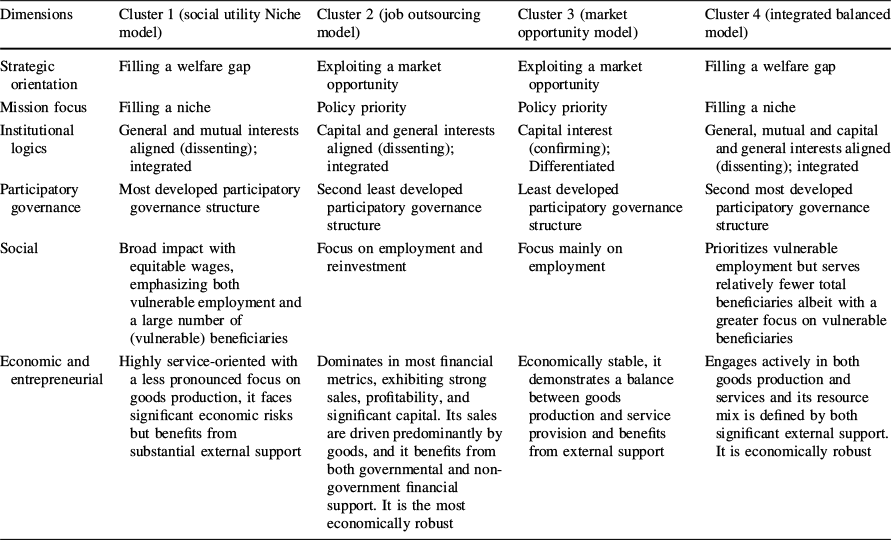
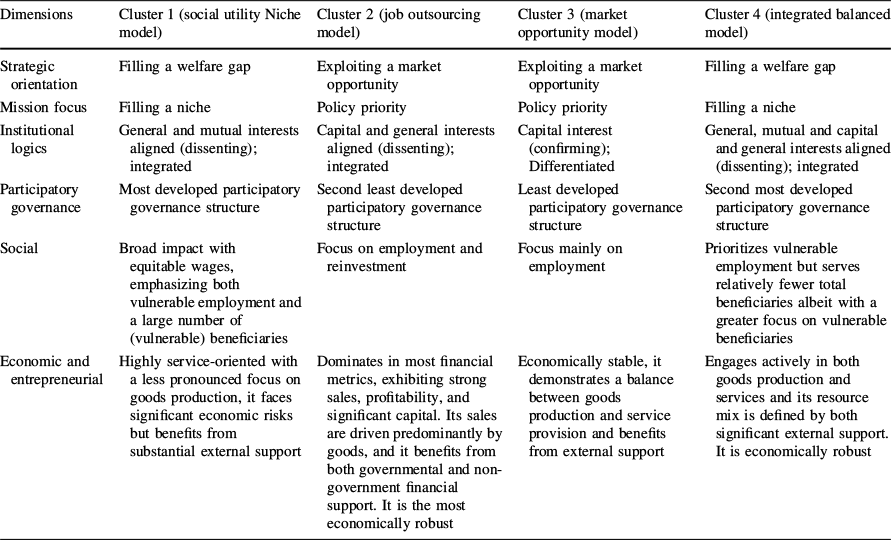
A comparison of the characteristics of the clusters is provided in Table 4. Clusters are compared across their strategic orientation, mission focus, and hybridity dimensions as well as the EMES dimensions.
Comparison of cluster characteristics
Dimensions |
Cluster 1 (social utility Niche model) |
Cluster 2 (job outsourcing model) |
Cluster 3 (market opportunity model) |
Cluster 4 (integrated balanced model) |
|---|---|---|---|---|
Strategic orientation |
Filling a welfare gap |
Exploiting a market opportunity |
Exploiting a market opportunity |
Filling a welfare gap |
Mission focus |
Filling a niche |
Policy priority |
Policy priority |
Filling a niche |
Institutional logics |
General and mutual interests aligned (dissenting); integrated |
Capital and general interests aligned (dissenting); integrated |
Capital interest (confirming); Differentiated |
General, mutual and capital and general interests aligned (dissenting); integrated |
Participatory governance |
Most developed participatory governance structure |
Second least developed participatory governance structure |
Least developed participatory governance structure |
Second most developed participatory governance structure |
Social |
Broad impact with equitable wages, emphasizing both vulnerable employment and a large number of (vulnerable) beneficiaries |
Focus on employment and reinvestment |
Focus mainly on employment |
Prioritizes vulnerable employment but serves relatively fewer total beneficiaries albeit with a greater focus on vulnerable beneficiaries |
Economic and entrepreneurial |
Highly service-oriented with a less pronounced focus on goods production, it faces significant economic risks but benefits from substantial external support |
Dominates in most financial metrics, exhibiting strong sales, profitability, and significant capital. Its sales are driven predominantly by goods, and it benefits from both governmental and non-government financial support. It is the most economically robust |
Economically stable, it demonstrates a balance between goods production and service provision and benefits from external support |
Engages actively in both goods production and services and its resource mix is defined by both significant external support. It is economically robust |
Cluster 1) Integrated General Interest-Oriented Public Purpose ‘Social Utility Niche’ Model (17.31%):
In this model, semi-public sector hybrid SEs prioritize social welfare, with their institutional logic focused on ‘general interest’ over ‘capital interest’. While they face challenges in fully integrating a robust commercial model, their commercial activities support their social mission(s). They address social needs that have not been met by the public sector and the market, both by filling gaps in public sector welfare provision and/or by generating employment for the disadvantaged. As measured by the absolute number of vulnerable beneficiaries, these SEs tend to have the greatest social impact. However, this cluster is relatively heterogeneous in terms of social impact models. Although a plurality of this model’s SEs are formally work-integration SEs in terms of their primary social mission, the work-integration SEs in this cluster commonly provide social services that benefit vulnerable individuals beyond their own employees. This model aligns with the ‘entrepreneurial nonprofit’ model but is not limited to nonprofit legal forms. Additionally, it exhibits well-developed participatory governance characteristics. We refer to this cluster as the ‘social utility niche’ model.
Examples of Cluster 1 GCSEs include ‘Can Child, Move Mom’ (GCSE ID: No. 2016-083). This for-profit educational enterprise was founded in 2013 to cater to children with disabilities (Korea Social Enterprise Promotion Agency, 2014). Alongside its core educational focus, which integrates sport and therapy, the company initiated a café in 2018 to employ those with disabilities. Furthermore, it offers subsidized or free programs to underserved children. Its affiliation with KoSEA’s ‘third social entrepreneur fostering project’ in 2013 provided a range of resources such as workspace, funding, and mentoring. The founder was inspired by a friend’s involvement in KoSEA’s preceding SE nurturing project. Another Cluster 1 GCSE is ‘Sharehouse Woozoo’ (GCSE ID: No. 2015-092) (see The Japan Research Institute, 2016). Founded in 2012 and distinguished as Korea’s first B-Corp in 2013, it provides affordable co-housing through its 100 + branches. Lastly, the Warm Heart Youth Center (GCSE ID: No. 2014-235) represents another Cluster 1 GCSE, functioning as a nonprofit dedicated to aiding low-income youth by covering their essential needs and offering educational services.
Cluster 2) Integrated Work-Integration Public Purpose Social Business ‘Job Outsourcing’ Model (14.96%):
This cluster comprises semi-public sector hybrid work-integration SEs. They tend to align their efforts to create jobs with their commercial interests. As these SEs are aligned with the public sector’s efforts to create employment opportunities for vulnerable populations, their efforts are endorsed by the public sector and typically do not extend beyond job creation. As such, this model is strongly influenced by the public sector’s goal of fostering job creation. They typically appear to lack well-developed participatory governance practices. They represent a public sector-endorsed job outsourcing model to the private sector that bears some resemblance to the social business SE model. Accordingly, although their capital interest institutional logic assumes primacy, they align their general interest institutional logic with their capital interest logic in a way that enables them to contribute substantially to social welfare. We term this the ‘job outsourcing’ model.
‘Korea Material Industry’ (GCSE ID: No. 2013-176) and ‘TestWorks’ (GCSE ID: No. 2017-096) are examples of Cluster 2 GCSEs. The former was founded as a for-profit construction company with a mission to provide employment for disabled individuals after its founder encountered the ‘SE’ concept in 2011 (Yoon, Reference Yoon2022). It boasts a workforce of over 60, including 21 disabled and 17 elderly. The founder believes that while SEs are pivotal in creating jobs, they should be supported by public sector initiatives and projects. ‘TestWorks’ specializes in training related to dataset construction, processing, and software testing and seeks to helps vulnerable groups transition into roles in the information technology sector (Jang et al., Reference Jang, Oh, Shin, Park, Lee, Chou and Kang2019). Post its 2013 certification, the company witnessed a 462.5% rise in revenue and increased its number of employees from 22 to 60 by 2019.
Cluster 3) Differentiated Capital Interest-Oriented Public Purpose ‘Market Opportunity’ Model (24.15%):
This cluster’s SEs are primarily driven by a dominant commercial logic (i.e., a capital interest institutional logic), and it is closely aligned with differentiated and conformist models. It is common for them to adopt a job creation model, and they may integrate corporate social responsibility programs, but not necessarily. GCSE certification appears to be a common strategy for these SEs to capitalize on public sector patronage, including labor subsidies and public procurement. As such, they appear to perceive attaining GCSE status principally as a market opportunity. The commercial models within this cluster demonstrate robustness; however, their capital interest institutional logic seems to overshadow and operate independently of the institutional logics of general interest and mutual interest. This hierarchy is evidenced by the relatively underdeveloped state of their social impact initiatives and participatory governance practices relative to their financial performance. Accordingly, GCSEs that belong to this cluster likely seek to build relationships with the public sector for multiple reasons, including to gain critical resources, enhance competitiveness, and reduce costs. The members of this cluster essentially exemplify this transactional delegation of social objectives to the market and appear to be attracted by government efforts to create quasi-markets that incentivize privately-led service delivery. This model is labeled the ‘market opportunity’ model.
‘Winion’ (GCSE ID: No. 2016-069) serves as an example of Cluster 3 GCSEs. Founded in 2011 and certified five years after, this for-profit organization specializes in manufacturing and selling home appliances. Fully owned by its founder, the company employs four vulnerable staff members, compensating them near the minimum wage. Winion’s social mission is dual-fold: repairing home appliances for vulnerable households and educating beneficiaries on appliance repairs. In 2017, 46 individuals availed of these social services. Financially, while its reinvestment in social causes is modest compared to retained earnings, its net income, a prime metric for profitability, has seen a downward trend, although still in the positive realm. Concurrently, the company’s debt has risen, yet sales revenue has grown. Public sector grants have been a significant source of support, aiding in employment of the vulnerable and hiring managerial professionals, such as those in marketing and accounting. However, Winion has not received aid from non-public sector entities or private donations.
Cluster 4) Integrated Balanced Public Purpose ‘Integrated Balanced’ Model (43.59%):
SEs in this cluster conform most closely to differentiated, dissenting models relative to the other clusters. Most of the SEs in this cluster are engaged in job creation as well as pursuing other social impact initiatives, though this is not universal. Such diverse social endeavors are underpinned by robust commercial models. They demonstrate more developed participatory governance structures than their counterparts in the ‘market opportunity’ and ‘job outsourcing’ models. These SEs can be considered as closely aligning with the EMES ‘ideal-type’ model (Defourny & Nyssens, Reference Defourny and Nyssens2012), and its economic and entrepreneurial, social, and participatory governance dimensions. We label this the ‘integrated balanced’ model as it has the most balanced alignment of the EMES dimensions.
‘Human Care’ (GCSE ID: No. 2008-050) (see Hwang, Reference Hwang, Bidet and Defourny2019) is a cluster 4 GCSE that offers free domiciliary care services to poor households and generates jobs for vulnerable groups. It relies on government support to avoid net losses. Its products and services include care services for the disabled and elderly, the provision of medical welfare devices, and medical equipment sales and rentals. The organization has significant employee stock ownership (41.6%) and has transitioned from a for-profit to a social cooperative.
Shared Characteristics
Referencing the nine comparative criteria shown in Appendix IIa and the modal trends shown in Appendix V, significant isomorphic tendencies can also be observed. ‘Job creation’ (work-integration) for-profit GCSEs aiding vulnerable groups such as low-income earners, the elderly, and disabled are modally the most prominent across the clusters. Common services include gratis repairs, donations, and charitable food provisions. As highlighted in Appendix IVa and IVb, GCSEs tend to have been established following the enactment of Social Enterprise Promotion Act and tend to benefit from sales from public procurement, significantly more governmental than non-governmental financial support, and linking finance and are also characterized by similar proportions of vulnerable employees, which typically account for more than half of employees, and their relatively low remuneration offered to such employees. This suggests that that prominent social policy goal of employment creation has exerted a significant isomorphic pressure, of a coercive type (Di Maggio & Powell, Reference Di Maggio and Powell1983), that pertains to GCSE certification and, thereby, public sector endorsement and patronage. Notably, ownership distribution was not a significant cluster differentiator as all clusters displayed varying ownership distributions, as shown in Appendix IIb.
Discussion and Conclusion
Thus far, there has been little explicit exploration of the semi-public sector hybrid SE subpopulations that have emerged as products of public sector entrepreneurship, which imbues this study with value as we provide empirical, population-level evidence of the diverse forms of GCSEs have assumed. We empirically demonstrate the types of SEs that may emerge in response to the state’s adoption of the language of social entrepreneurship, illustrating that government-led promotion of SEs can facilitate the emergence of distinct SE models that hybridize the logics of civil society and the third sector, the corporate sector, and the public sector in distinct ways. This has implications for the rich literature on the identities of SEs, particularly in the underexplored domain of the interstice of social entrepreneurship and public sector entrepreneurship (e.g., Teasdale, Reference Teasdale2012). As shown by our analysis, distinct subpopulations of hybridized semi-public sector SEs exist with markedly different features, and which can be categorized in very distinct ways. This suggests that a vibrant ecology of semi-public sector hybrid SEs has emerged in Korea, and that public sector efforts to enable the emergence of SEs have not resulted in the formation of a single type of uniform organizational form in the ‘image’ of the government. Furthermore, as shown regarding the ownership dispersion (Appendix IIb) and decision-making structures (Appendix IIIa and Appendix IVa), GCSEs are defined by self-governance (see Wagner, Reference Wagner2012) and many GCSEs display features associated with the associative tradition of third sector and civil society organizations, in particular participatory governance (see Defourny & Nyssens, Reference Defourny and Nyssens2017). Notably, our findings illustrate that GCSEs constitute relatively novel SE models and are dissimilar from public service models of SE that mostly obtain contracts and/or subsidies from the public sector, such as ‘supported SE’ model (Chan et al., Reference Chan, Ryan and Quarter2017) and work-integration SE public schemes (Nyssens, Reference Nyssens, Defourny, Hulgård and Pestoff2014).
Though research on SEs has begun to acknowledge models directly influenced by public policy as unique types (e.g., Defourny et al., Reference Defourny, Nyssens and Brolis2021), the dominant narrative typically portrays SEs as market–civil society or business–charity hybrids. Our study contrasts with the dominant narrative and extends research SE models by examining policy-influenced models, which allows for a better understanding of the diverse forms that SEs can assume, beyond the traditional market or charity-based frameworks. This analysis is crucial, as it provides a more nuanced understanding of how SEs operate and evolve in response to policy and regulatory landscapes.
This finding adds complexity to the discourse on the hazard(s) of government ‘manufacturing’ of ‘third sector’ organizations by suggesting that GCSEs do enjoy considerable autonomy in crafting their organizational structure and pursuing their social missions despite the coercive isomorphic pressures associated with their public sector-induced genesis. Albeit, this autonomy is bounded by quasi-governmentality, given that their fabric has intrinsically been imprinted upon by their genesis as a manifested contingency of government intervention.
Regarding the limitations of this study, the most obvious shortcoming of this study is the sample size. Ideally, this study would have incorporated KoSEA’s Voluntary Management Disclosure System’s 2019 or 2020 datasets, which contain much larger sample sizes. Yet, neither have been independently audited yet. Furthermore, the study may have suffered from self-selection bias as many GCSEs did not disclose their data. Finally, the generalizability of this study is undermined by its single-country focus. Nevertheless, we believe that our empirical analysis does carry lessons of a more general, universalist nature as they relate to how SEs contend with multiple institutional logics, particularly those emanating from the public sector.
Acknowledgements
None.
Funding
Open Access funding enabled and organized by Projekt DEAL. Korea Foundation, 2019 Fellowship for Field Research, Casper Hendrik Claassen, 2016 Fellowship for Field Research, Eric Bidet
Declarations
Conflicts of interest
We have no conflicts of interest to disclose.
Ethical Standards
All data is publicly accessible and has been made available by the Ministry of Employment and Labor-affiliated Korea Social Enterprise Promotion Agency of South Korea. The data can be accessed here: https://www.socialenterprise.or.kr/social/ente/evalGongsi.do?m_cd=E006


 Open access

