




Introduction
Slovaks settled in present-day Vojvodina – the autonomous province in the north of the Republic of Serbia – during a colonization process that started in the mid-18th century. They settled in the southern parts of the Hungarian Kingdom (at that time, part of Austrian Empire; since 1867, the Austro-Hungarian Empire), known as the Lower Land (Slovakian: Dolná zem), and they were referred to as Lowland Slovaks. The migration was thus within the borders of a single state. After the fall of the Austro-Hungarian Empire in 1918 and the formation of Czechoslovakia, the links between the Slovak population of the former Lower Land and the kin-state grew weaker (Botík Reference Botík2011, 24). From then on, their future was determined by the new political frameworks of the successor states – Hungary, Romania, and Yugoslavia – in which they had become minorities (Botík Reference Botík2011, 24). In Yugoslavia, particularly in Vojvodina, Slovaks enjoyed a relatively high standard of minority rights. They displayed a loyalty to the Yugoslav state and, since its dissolution in 1991, to the Republic of Serbia. Although members of the researched community identify themselves as Slovaks, they have lived in contemporary Serbia for approximately three hundred years and consider Serbia their homeland. Nevertheless, they have been separated from Slovakia not only geographically but also politically by state borders for more than one hundred years. After the dissolution of Austria-Hungary, the intensity of contact between them and Slovakia was considerably lower than after the political changes of 1989.
Intense and radical changes followed the events of 1989 in Czechoslovakia’s political, economic, and social spheres. These included the fall of the Iron Curtain, the post-communist transformation of society, and the federation’s dissolution into the Czech Republic and Slovakia in 1993. Radical changes also occurred in Yugoslavia, including the wars that led to the federation’s collapse, the deep economic crisis in the Republic of Serbia, international sanctions, and a reduction in the autonomy of the provinces of Vojvodina and Kosovo. In Slovakia, a shift in migration patterns also occurred. Earlier, it was a country shut off behind the Iron Curtain during the Cold War, before later occupying a peripheral position vis-à-vis Czechoslovakia until 1993 (with this peripherality producing migrants in recent times). Later, Slovakia gradually became a state that both produced and received migrants of its own (Dalberg Reference Dalberg and Brhlíková2019). The first wave was refugees from the former Yugoslavia, who left after the wars in the early 1990s. Only a tiny proportion of these people remained in Slovakia. The Vojvodina Slovak community members, who began migrating to Slovakia in the early 1990s because of the war and deep economic crisis in Yugoslavia, were among the first groups of foreign nationals to consider Slovakia a destination for foreign migration after the political changes in 1989. Neither the Slovak institutions nor the inhabitants of Slovakia were ready for this.
Furthermore, while Slovakia became a member of the EU in 2004 and a target state for international migration, including co-ethnic migration from Serbia, Serbia remained in a long-standing sluggish transformation. The next wave of migration from the Vojvodina Slovak community occurred because of the 2007–2008 Global Financial Crisis. This migration intensified after 2015; it grew to such an extent that some community members described it as an exodus (Marušiak and Zlatanović Reference Marušiak and Zlatanović2020, 146). According to population censuses, the size of the Slovak community in Serbia has been continually decreasing significantly since 1991, as has their percentage share of the total population. In 1991, they numbered 66,772; in 2002, they numbered 59,021; in 2011, they numbered 52,750, and according to the latest results, in 2022, they numbered 41,730 (Census 2023, 21). The reasons for this decline are complex; one reason is migration abroad, especially to Slovakia, but the reasons also include assimilation and low birth rates, typical of Serbia as a whole and of Vojvodina in particular. From 2011 to 2022, this province’s population declined from 1,931,809 to 1,749,356 – a decrease of 182,453 people (Census 2023).
According to the 2022 census, Slovaks account for 0.63% of the Serbian population. This means that their numbers are decreasing even in relative terms, as in 1948 they accounted for 1.12% of the total population of Serbia, and in 1971, their share dropped down to 0.91% (Census 2023, 22). The vast majority live on the territory of the Autonomous Province of Vojvodina, where they make up 2.29 % of the population. They thus represent the fourth-largest ethnic community in the province, after Serbs (68.43%), Hungarians (10.48%), and Roma (2.35%) (Census 2023, 28–29). They do not inhabit a contiguous territory, with the highest proportion in the municipality of Bački Petrovac (60.5%), a relative majority in the municipality of Kovačica (40.9%), and a high proportion in the municipalities of Bač, Bačka Palanka, Stara Pazova, and Šid (Census 2023). Slovak is one of the official languages of Vojvodina. In 1918, representatives of the Slovak community in Vojvodina actively supported the integration of Vojvodina into the Kingdom of Serbs, Croats, and Slovenes; and in later periods, they continued to be loyal to the Yugoslav and Serbian state, respectively. Vojvodina was part of the Habsburg monarchy from the 18th century onward, so it developed differently from other parts of Serbia. Its colonization in the 18th and 19th centuries was multiethnic, which contributed to the formation of a specific transethnic, multilingual, and multiconfessional Vojvodinian regional identity, marked by a consensus-based approach to interethnic relations (Petsinis Reference Petsinis2019).
Migration from Vojvodina relates to wider migration processes from Serbia, which link, in turn, to the country’s economic situation. These processes also affect other ethnic communities and the majority population. Co-ethnic migrations have been common in Vojvodina since the 1990s, and are particularly pronounced among the largest minority community of not only Vojvodina but also of Serbia – the Hungarian minority (Filep et al. Reference Filep, Váradi, Takács, Erõss, Nagy, Tátrai and Wastl-Walter2013; Lendák-Kabók, Popov, and Lendák Reference Lendák-Kabók, Popov and Lendák2020). Yet Vojvodina also became a destination for Serbian migrants, especially those who left Croatia, Bosnia and Herzegovina, either during or after the 1990s Yugoslav Wars.
Globalization processes, which have affected the changing role of national borders in individuals’ lives (especially here in the context of EU integration), and the development of infrastructure facilitating physical and virtual mobility have created a context in which the migration and transnational functioning of many members of this community have become possible. The migration of Slovaks from Vojvodina to Slovakia is part of a European migratory process. The legal framework for such migration is supported not only by Slovakian and Serbian state legislation but also by EU legislation, which allows the free movement of people within the EU. The migration of Slovaks from Vojvodina was earlier facilitated by the liberalization of people’s movement after 1989, which allowed them to leave the door fully or at least partially open for a return to their country of origin. This means that members of the researched community may legally reside in two or more countries simultaneously.
The migration of Slovak community members from Serbia to Slovakia is a textbook example of co-ethnic or ethnically privileged migration; the migrants have the same ethnicity as the population of the country to which they will migrate. While this migration is similar to other co-ethnic migrations in many respects, it has numerous specific features. In this article, we will explore the intra-ethnic aspects of this migration at the institutional level (namely, the politicization of diaspora issues, the Slovak community of Serbia in the hierarchy of Slovakia’s diaspora policy, and co-ethnic relations as a subject of negotiations), and at the level of intra-ethnic relations and boundaries between migrants and the old population (language and co-ethnic migration, nonrecognition by co-ethnics in Slovakia, intra-ethnic boundary-making in everyday interaction, integration, and the consequences of migration on intra-ethnic relations among members of the community that remains). Thus, we will examine the current migration of Vojvodina Slovaks from Serbia to Slovakia through a combination of perspectives “from above” and “from below,” including points where these two perspectives meet. The intention here is to make an empirical and analytical contribution to understanding the complexity of co-ethnic migration by members of the Slovak minority in Serbia.
In the research conducted to date, there has been a tendency to use the language of “groupism” (in the sense defined by Brubaker); the community of Slovaks in Vojvodina is described as a substantial and static entity, as an internally homogeneous and externally bounded group (Reference Brubaker2004, 7–27). Researchers have only been marginally interested in the consequences of the social transformation after 1989 in both countries of which this migration is a part. In other words, little attention has been paid to the dynamics of the transformation. This also applies to current migration.
In relation to mass migration flows, the migration of Vojvodina Slovaks from Serbia to Slovakia is small-scale in terms of both the number of migrants and the spatial distance they traverse. Consequently, it is less visible than other migrations in Europe. Nevertheless, it is the product of global processes that shape its form, which can be explored through its example, precisely following the title of Eriksenʼs book Small Places, Large Issues (Reference Eriksen2010).
Theoretical and Methodological Framework
Conceptualizing Co-ethnic Migration and Additional Theoretical Lenses
Co-ethnic migration generally refers to the migration of members of a minority community to their “ethnic homeland,” where they become part of the majority population of the same ethnicity (Čapo Žmegač Reference Čapo Žmegač2005, 199). As Jasna Čapo Žmegač explains, in co-ethnic migrations, “ethnicity figures as a prominent factor […] both at the point of origin and at the point of destination” (Reference Čapo Žmegač2005, 200; Reference Čapo Žmegač, Žmegač, Voß and Roth2010, 9). Given the importance of ethnicity in such resettlements, they are referred to as co-ethnic migrations. Immigrants belong to the same ethnic group as the population in the regions they have migrated to, so this type of migration is defined as ethnically privileged (Münz and Ohliger Reference Münz and Ohliger1997; Čapo Žmegač Reference Čapo Žmegač2005). Although a more straightforward integration process may be expected under such circumstances, the results of many studies in different parts of the world show that the migrant and the longtime inhabitants sharing the same ethnic affiliation does not necessarily play a significant or connective role (Čapo Žmegač Reference Čapo Žmegač2002; Reference Čapo Žmegač2005; Čapo Žmegač, Voss, and Roth Reference Žmegač, Jasna and Roth2010; Duijzings Reference Duijizings2000, 52–64; Zlatanović Reference Zlatanović2018, 203–268). Encounters and interactions between newcomers and the established population in their daily lives are complex processes shaped by ambivalence, rejection, and conflict.
A symbolic interactionist approach offers an appropriate lens through which to view intra-ethnic boundary-making, although it has mainly been applied to the study of interethnic relations. Symbolic interactionism is one approach used to study ethnicity. It views ethnicity as a form of social identification produced and reproduced in social interactions along and over the ethnic boundary, which contributes to its constitution (Jenkins Reference Jenkins2008, 54, 65). Social interactions, the symbolism of social practice, individual and collective perceptions of social realities, and actors’ viewpoints all form the center of this approach. It also stresses the processes of identification – both internal and external – and how they are interlinked and mutually conditioned (Jenkins Reference Jenkins2008).
The transnational approach, oriented toward “multiple ties and interactions linking people or institutions across the borders of nation-states” (Vertovec Reference Vertovec1999, 447), is a productive approach to the issue of migration. A transnational perspective allows the study of cross-border phenomena, relationships, and the practices of individuals, groups, and organizations and their involvement in the lives of at least two societies (Glick Schiller, Basch, and Blanc-Szanton Reference Glick Schiller, Basch and Blanc-Szanton1992). A transnational lens makes it possible to include the perspective of relevant non-migrants in order to achieve a comprehensive picture of the community under study, some members of which live in the receiving country, while others remain in the sending country (Boccagni Reference Boccagni2012). Since “transnational phenomena are always simultaneously local, national, and global” (McAdam-Otto and Nimführ Reference McAdam-Otto and Nimführ2021, 42), we have attempted to follow the co-ethnic migration of members of the Vojvodina Slovak community at points where the local, national, and global meet.
Research Methodology
The article is based on extensive multi-sited fieldwork (Marcus Reference Marcus1995), an established practice applied to transnational migration studies. A multi-sited approach defines the terrain as a network of localities and provides an overview of the dynamics of different interconnected parts of the community (Hannerz Reference Hannerz2003). This research was conducted among both migrants and non-migrants who remained in Vojvodina, while many members of the community are both here and there. Thus, the sending country (Serbia) and the receiving country (Slovakia) represent one combined research field.
The fieldwork was qualitative and consisted of a combination of semistructured interviews, free conversations, and participant observation. The research was conducted between 2015 and 2021 in Bratislava (Slovakia), in the towns of Bački Petrovac and Kovačica, and the village of Padina in the municipality of Kovačica (Serbia, Vojvodina), which has a majority Slovak population. We spoke with community members residing in other parts of Slovakia or Serbia, or those living in other countries, via Skype. Most of the research was completed in Bratislava in 2017 and 2019. We completed in-depth interviews with over 80 interlocutors: more than 50 in Bratislava, around 20 in Serbia, and 9 via Skype. We tried to ensure that the research included interlocutors of different genders, ages, levels of education, and professions who had migrated to Slovakia at different times. The number of men and women interlocutors was approximately equal. Interlocutors in Slovakia were mostly aged between 25 and 50, while in Serbia some were older. They had completed secondary school education (factory workers, retail workers) or university education, with those having studied social sciences and humanities, broadly defined, predominating. We met some interlocutors several times and had repeated conversations with them. We had already spoken with some of them earlier, while others became friends over the course of the research. We had, or we came to establish, professional cooperation with some (through participating at conferences and other events dedicated to the Low Land Slovaks, etc.). We gained valuable information and insights in conversations outside of research interviews, which are a contrived context. For some of our interlocutors, their migrant situation changed during our long-term research, and for some, how they perceived their migrant situation changed. We aimed to explore the emic perspective, the diversity of individual viewpoints, and the experiences of those belonging to the researched community.
We let our interlocutors choose which language they wished to speak. We were aware that one researcher’s first language was Slovak and the other’s was Serbian, but both spoke the other language at the solid conversational level required. Members of the Vojvodina Slovak community were bilingual, and both languages were used, but Slovak tended to dominate. Only one interlocutor in Bratislava explicitly said he wanted to speak in Serbian, because he cannot express himself well enough in Slovak. The use of both languages in the interviews enabled us to gain insights into the linguistic competencies of our interlocutors.
The data collected in the field were complemented by other sources (legal documents, statistical data, media, information procured from representatives of relevant institutions for our research, such as the Office for Slovaks Living Abroad, Ministry of Interior of the Slovak Republic, etc.) to gain an overview of the broader social and political structures within which this migration occurred. A multidisciplinary (political science, history, and social anthropology) approach to research into the multifaceted phenomenon of transnational migration has been shown to be essential if all of its multidimensionality is to be considered.
The Institutional Framework of Co-ethnic Relations
The Politicization of Diaspora Agenda
The disintegration of the Soviet Bloc brought about not only the Iron Curtain’s dismantling but also the creation of new borders through the formation of new national states out of the former communist federations of the USSR, Yugoslavia, and Czechoslovakia. Furthermore, the integration of Central and Eastern European countries into the EU also resulted in a new border between EU member states and those that had not yet become full members. Just as importantly, the integration processes and uneven development in the individual countries of Central and Eastern Europe led to the most significant increase in people’s mobility since the immediate post-World War II period. According to Thomas Hylland Eriksen, “accelerated and intensified contact, which is a defining characteristic of globalization, leads to tensions, contradictions, conflict and changed opportunities in ways that affect identity, the environment and the economy” (Reference Eriksen2016, 16). The accelerating pace of globalization poses a challenge to the redefinition of identities within the European Union and at its borders.
Both the interest in diasporas and the need to revise the concept were triggered by waves of nationalism that have swept across the Central and Eastern European regions since the early 1980s. This kind of nationalism was ethnic in character in most countries in the region, and so its claims transcended existing state borders. Diasporas can be regarded not only as communities characterized by “dispersion in space,” a “persistent orientation to a ʻhomeland’,” and “boundary maintenance over time,” which lead them to present a distinctive identity that contrasts with that of the host society; rather, they are also “an idiom, a stance, and a claim” – that is, a phenomenon formulated, created, and revalued not only by members of communities living in places remote from their mother country but also by actors of their “putative homeland” (Brubaker Reference Brubaker2005, 5–6, 12).
The relationship between the kin-state and the communities of ethnic diasporas has expanded the scope of supporting minority culture so that it has gradually assumed a political character (Halász Reference Halász2013, 53–54). It has become part of redefining the role of nationalizing states (Brubaker Reference Brubaker1996b) in international politics. Although diaspora politics is often the subject of research, primarily as an element of interstate relations (Waterbury Reference Waterbury2010a; Halász Reference Halász2013) between the country of residence of the diaspora community members and their “external homeland” (Brubaker Reference Brubaker1996a, 6–9), it is no less important to observe how it affects the creation of intra-ethnic relations and internal political discourse in kin-states.
The Slovak Republic’s Diaspora Politics
Some post-communist countries sought to redress historical wrongs through their diaspora politics by reviewing their state borders during the 20th century (such as Poland, which argued for a need to take care of the “Poles in the East” – that is, those in the former USSR states), or even as a tool for “extending their sovereignty beyond state borders and maintaining cross-border solidarity.” The latter was the case with Hungary, whose representatives interpret care for its diaspora as rectifying the consequences of the 1920 Peace Treaty of Trianon when a large number of ethnic Hungarians found themselves within the borders of the newly formed neighboring states (Waterbury Reference Waterbury2010a). Countries such as Slovakia or Ireland, in contrast, experienced large waves of (predominantly labor-related) emigration, which drove a considerable part of the respective ethnic group out of their homeland. Forging unity between Slovaks in Slovakia and those living abroad was supposed to serve as symbolic compensation for the uneasy fate of the nation, or rather a state (1939–1945, and after 1993), which was smaller in population and considered the most minor compared with its neighbors (Slovak National Gallery 2016).
For polity-seeking nationalism in non-state nations (Brubaker Reference Brubaker1996a, 79), such as Slovakia in the pre-1993 period, however, diaspora politics was mainly viewed as an avenue for constructing national subjectivity and for people being able to manage and conduct certain activities abroad autonomously, that is, not exclusively through the state institutions of the former Czechoslovakia (Koncepcia 2015). In exile, but also in Slovakia after the political changes in 1989, some representatives of the Slovak diaspora, particularly those living in the West, actively participated in establishing the emancipation process, which resulted in the dissolution of the Czech and Slovak Federal Republic in 1992, even though the diaspora’s role in this process, and in the political life of Slovakia, should not be overestimated (Rychlík Reference Rychlík2012, 123–126). Through ethnic claims, Slovak political and social elites – both in Slovakia and abroad – could emphasize its importance as an actor.
Meanwhile, the return of members of the Slovak diaspora to the post-1989 public discourse, especially those in the West, served to redress the injustices enacted by representatives of the Slovak State (1939–1945); and, later, the communist regime against their opponents, particularly exiled persons, through their erasing them from public life and prohibiting contact with their homeland. Hence, we agree with Surová that since 1993, Slovak nationalism and nation-building projects have emphasized “a strong link between Slovak ethnicity and the state” (2020, 10). This is also reflected in the wording of the Constitution of the Slovak Republic of 1992 (Constitution 1992), whose preamble includes a combination of ethnic nationalism, liberal individualism, and the recognition of ethnic minorities as state-building elements. However, the “Slovak nation,” the torchbearer of state sovereignty, is defined as a collective body, whereas “members of national minorities and ethnic groups” are mentioned only as individuals. Ethnic principles also occupy a dominant position in the policy of the Slovak Republic toward the diaspora (Marušiak Reference Marušiak2017).
From a political perspective, there was a boom in interest in the diaspora in the first half of the 1990s. In his address, which followed immediately after the announcement of the Declaration on the Sovereignty of the Slovak Republic in July 1992, Prime Minister Vladimír Mečiar also spoke to foreign Slovaks (NCSR 1992). The relationship, however, between the “external homeland” and members of expatriate communities was legally regulated only in 1997, when Act No. 70/1997 Coll. for Foreign Slovaks – the first such act – was adopted. While the terminology it used was inconsistent (Surová Reference Surová2016), it defined the term “foreign Slovak” through an ethnocultural principle as a person who “is not a citizen of the Slovak Republic if they are of Slovak nationality or Slovak ethnic origin and shows Slovak cultural and linguistic consciousness” (§ 2, para. 2). Nationality had to be proven with documents such as a birth certificate, baptism certificate, an extract from the registry office, a certificate of state citizenship, or the applicant’s permanent residency certificate (§ 2, para. 4). “Slovak cultural and linguistic consciousness” was understood as “at least passive knowledge of the Slovak language together with a basic orientation in Slovak culture or active expression of belonging to the Slovak ethnic community” (§ 2, para. 6). In addition, national awareness could also be demonstrated through a statement of the results of the applicant’s public activities, through the testimony of a compatriot organization or “two Slovaks living abroad who live with the applicant in the same country” (§ 7, para. 4).
Hence, self-declaration alone is insufficient to confirm Slovak ethnicity (Surová Reference Surová2020). The status of a Slovak living abroad does not apply to those without Slovak citizenship who are not of Slovak nationality, even though they or their ancestors may have come from Slovakia. Meanwhile, in the past, members of other ethnic groups (such as Ruthenians, Jews, Germans, Hungarians, or Roma) left the territory of present-day Slovakia for economic, political, or other reasons. By contrast, over the 20th century, large groups of Jews, Germans, and Hungarians left Slovakia under coercion. Even Pannonian Rusyns, a subgroup of Ruthenians living in Vojvodina, cannot apply for the status of Slovak diaspora, although a considerable proportion of their ancestors came from eastern Slovakia (Subotić Reference Subotić2018).
Vladimír Repka, then head of the House of Foreign Slovaks (the first state institution that comprehensively addressed diaspora issues), described the adoption of this law as the “righting [of] ʻold wrongs’” (Blahová Reference Blahová, Vukov, Gergova, Matanova and Gergova2017, 82), but relations with Slovaks living abroad as a political commitment were, however, only outlined in the 1999 Declaration of the National Council of the Slovak Republic, which recognized them as an integral part of the nation and considered “their life and history as part of Slovak national history and their culture as part of the national cultural heritage” (Koncepcia 2022). The 2001 amendment to the Constitution of the Slovak Republic also included Article 7a, which stipulated that “the Slovak Republic shall support the national consciousness and cultural identity of Slovaks living abroad; it shall support their institutions established to achieve this goal and their relations with the homeland.” The new 2005 law (Act No. 474/2005 Coll. on Slovaks Living Abroad) already referred to Slovaks living abroad. It expanded this category to include persons who, while being citizens of the Slovak Republic, did not have permanent residency in the territory of Slovak Republic (§ 2). While the obligation to prove Slovak identity remained, the ethnocultural principle was supplemented by a civic principle that also allowed persons with other than Slovak nationalities to apply for the status of a Slovak living abroad.
Hungarian diaspora policy had a significant influence on how the principles underpinning the Slovak diaspora policy were formulated. Since the 19th century, Hungarian nationalism has been the constitutive Other against which Slovak nationalism has been defined. The Hungarian practice of “extension of sovereignty beyond the state border” (Waterbury Reference Waterbury2010a) is widely perceived by Slovak political elites as a potential source of the region’s destabilization. This is why Slovak foreign policy repeatedly emphasizes the principle of territorial integrity and the inviolability of borders as one of its key priorities, such as with its refusal to recognize Kosovo’s independence in 2008. Slovakia’s diaspora policy – which, according to the Act on the Slovaks living abroad is limited to the areas of education, science, and research, as well as information and the promotion of minority culture and media (§ 5, para. 1) – is also subordinated to this principle. Unlike in Hungary, the support of compatriot communities abroad is not political in nature and the relevant legislation is implemented only on the territory of the Slovak Republic, not extraterritorially.
Serbia’s Slovak Community in the Hierarchy of Slovakia’s Diaspora Policy
In official political discourse, Slovaks living abroad are presented as part of the Slovak nation, which is understood as both an ethnocultural and a political community. Thus, Slovak identity is conceived of as both state-centered and transnational (Blahová Reference Blahová, Vukov, Gergova, Matanova and Gergova2017, 77). For example, the relevant legislation permits Slovaks living abroad admission to any school in the Slovak Republic when staying in Slovakia – an entitlement that Slovak citizens also receive. Slovaks living abroad are also entitled to seek and gain employment without needing the relevant work permits or residence permits to work or stay in the Slovak Republic; these people enjoy the right to own and acquire real estate or do business in the country, and other rights, especially social ones (such as the right to material assistance for those in need or the right to access social services). Slovaks living abroad have the right to gain Slovak citizenship, provided they have lived in the Slovak Republic for three consecutive years, while other applicants can apply for Slovak citizenship only after eight years of continuous residence (Právne postavenie 2021; see also Vašečka and Žúborová Reference Vašečka, Žúborová, Lafeur and Vintila2020). Such applicants must also meet other criteria applied to foreign nationals of the Slovak Republic – e.g., the criterion of integrity – and they must fulfill obligations arising from the Act on the Residence of Foreigners in the Slovak Republic, etc. The applicant must not pose a threat to the public order and security of the Slovak Republic. An amendment to the Slovak Republic Citizenship Act No. 40/1993 Coll. of 2022 abolished the obligation for those possessing a certificate confirming their status as a Slovak living abroad to prove their command of the Slovak language in both written and spoken form and their general knowledge of the Slovak Republic (§ 7), which gave them a further advantage over other foreigners living in Slovakia.
Nevertheless, members of the Slovak diaspora continue to have a foreigner status even after arriving in the country, unless they are citizens of the Slovak Republic. They lose the status as a Slovak living abroad when they gain permanent residency in Slovakia. But this latter status may be lost if legally convicted of a deliberate crime; the 1997 Act granted a certificate conditional on the declaration that the applicant does not have a contagious disease, the transmission of which is punishable by law. As Halász reported, these are typical elements of foreign regimes (Reference Halász2013, 65). The legal status of such persons thus distinguishes them from the domestic population; although compared with other foreigners living in Slovakia, they enjoy a privileged position. The status of a Slovak living abroad is also defined politically; the applicant “may not engage in activities detrimental to the interests of the Slovak Republic” (§ 7, para. 2), although the relevant legislation does not specify what particular activities may be considered detrimental.
In contrast to similar laws in force in Hungary, Slovenia, and in Poland until 2019, the Slovak legislation does not distinguish between individual categories of members of the Slovak diaspora based on their place of residence or the length of their stay abroad (Halász Reference Halász2013, 63). A hierarchical principle, which provides guidelines depending on the diaspora members’ country of residence, has also been applied by Serbia and Greece (Mylonas and Žilović Reference Mylonas and Žilović2019). Unlike the above states, Slovakia’s policy is based on a rather informal hierarchical approach. Relevant factors include geography, the level of Slovak language proficiency, and a person’s overall perception of their own Slovakness; with these in mind, one can speak of three types of communities among the Slovak diaspora.
The “traditional” Slovak communities in Western Europe and overseas are largely assimilated. Members typically possess a limited level of Slovak language proficiency, and Slovakness primarily represents a continuity with generations of their ancestors. The second group is composed of “autochthonous” minorities in the countries of Central and Eastern Europe – in parts of the former Austria-Hungary (Hungary, Serbia, Croatia, Romania, Poland, the Czech Republic, and Ukraine), whose formation was heavily influenced by the post-1918 changes in state borders. These members, except for a significant subsection of the Slovak community in Hungary, generally have a relatively solid Slovak language proficiency and a network of national schools with varying models of Slovak language teaching or learning. The third, most recent category, is the “new Slovak diaspora,” made up of citizens from the Slovak Republic who have settled abroad for a short or long time after 1989. These groups also have different needs from the Slovak state authorities. Such a division was first considered only in the State Policy Concept of the Slovak Republic in relation to Slovaks living abroad for the 2022–2026 period (Koncepcia 2022); this factor was not included in the previous concepts (Koncepcia 2008; 2015).
In the 1990s, for political reasons, attention was paid primarily to communities in Western Europe and overseas countries. In later years, the need to build relations with members of the “new Slovak diaspora” came to the fore. This community is economically significant as remittances – that is, funds that Slovak citizens send to their families from abroad – account for approximately 2% of the gross domestic product (approximately two billion euros) (Koncepcia 2022, 21). Compared with the other two categories, the Slovak Central and East European minority communities has remained the least visible; Serbia is the country of residence of the largest Slovak “autochthonous” minority population (52,750), according to the 2011 census (Census 2012). Meetings with its representatives, however, are a standard part of the program of official visits by state representatives of the Slovak Republic. The situation began to change, at least partly, after 2015, mainly because of economically motivated migrations to Slovakia of persons from Serbia, Romania, and Ukraine, including members of the local Slovak communities. As a result, these communities received more media coverage in Slovakia than in the past.
Changes to the legislation on the rights and obligations of diaspora members are of greater relevance to the “new Slovak diaspora” than to the other diaspora categories. These include the introduction in 2006 of the right to vote in parliamentary elections and referenda from abroad by mail (TASR 2012). The Office for Slovaks Living Abroad – a state body operating as part of the Ministry of Foreign and European Affairs of the Slovak Republic and coordinating the work with the diaspora – has developed a multipoint document detailing a strategy directed at the “new diaspora.” This strategy aims to encourage the return of its members to Slovakia and to simplify how they can exercise their right to vote in Slovakia (OSLA n.d.). In addition, the July 2022 amendment to the Act on Slovak Citizenship rescinded the provision of 2010, which stipulated that those who applied for citizenship in another country would lose their Slovak citizenship. The amendment now allows foreign nationals to retain their prior Slovak citizenship, as long as they have resided abroad for at least five consecutive years. This amendment also permits those who lost their citizenship between 2010 and 2022 to regain it.Footnote 1 The main legislatory change to affect Slovak minority elites in the countries of Central and Eastern Europe is the amendment of Article 7, para. 3, which allows the granting of Slovak citizenship to the holder of an ID card of a Slovak living abroad as long as they have “been permitted residence on the territory of Slovakia and have made a significant contribution to the community of Slovaks living abroad from which they descend in the economic, scientific, technical, cultural, social, or sports areas.”
The liberalization of the 2022 Slovak Citizenship Act considers migration levels not only from Slovakia abroad but also to Slovakia, and it is increasingly becoming a receiving country for migrants, some of whom are members of Slovak communities abroad. They also retain, however, a status as foreigners immediately after arriving in Slovakia, which also holds after they are granted permanent residence in the Slovak Republic. Yet, in this case, the period between their possessing a foreign migrant status and a settler status is shorter than that for members of other immigrant groups.
Over time, the Slovak Republic’s institutional framework for co-ethnic migrants has improved, but even those interlocutors who migrated during the substantial waves of 2015 and later encountered nonrecognition and certain misunderstandings that arose from it. They are particularly dissatisfied to find out that, in order to apply for citizenship and become fully fledged citizens of Slovakia, they must have three years of continuous residence in the country and pay fees they perceive as high, especially when they must pay for all family members individually. When they apply for citizenship, they also have to wait a long time for a decision – sometimes several years. They often view all this as confirming the practices of nonacceptance.
Co-ethnic Relations as a Subject of Negotiations
While the official wording of the Office for Slovaks Living Abroad’s documents that set out the relationship of the Slovak Republic to members of the diaspora, concerning the “autochthonous” Slovak minorities in Central and Eastern Europe, predominantly refers to support for the preservation of Slovak identity, the Migration Policy of the Slovak Republic. Perspective Until the Year 2020 (2011), adopted by the Slovak government in 2011, refers to members of the above Slovak communities, especially in Serbia and Ukraine, primarily as a source of labor. In other words, they are mentioned as part of an ethnicity-based, controlled economic migration. This ultimately, however, contributes to a decline in their numbers. Consequently, the result of the policy contradicts Slovakia’s declared policy objectives toward Slovaks living abroad. The new Migration Policy of the Slovak Republic with a View to 2025 (2021), adopted in 2021, no longer mentions members of Slovak communities abroad, and the number of certificates issued to Slovaks living abroad has gradually decreased since 2019.
Communication between the Slovak Republic’s state authorities and diaspora members is not unidirectional; such communication occurs via multiple channels. One example is the Standing Conference on the Slovak Republic and Slovaks Living Abroad, organized by the Office for Slovaks Living Abroad since 2010. Slovakia’s policy toward members of the diaspora is thus not only the subject of negotiations, but also of criticism from its representatives or individual members. The questions of the right to vote and the requirements for increasing financial subsidies for diaspora activities are among the key demands made by organizations representing the Slovak diaspora abroad. In Serbia, some of the Slovak community’s representatives, but also some of our interlocutors, suggest that the Slovak Republic should draw inspiration from Hungary’s policy in this field, for example, by supporting families whose children learn Hungarian at primary schools outside Hungary. Similarly, these groups praise Hungary’s policy of granting citizenship to members of Hungarian minorities. Indeed, based on these claims, Hungarian citizenship is accepted even by people who are not ethnic Hungarians in regions such as Transcarpathia (Ukraine) or Vojvodina.
Another argument some consider worth adopting is Hungary’s support for members of its diaspora in agriculture (Spevák and Komora Reference Spevák and Komora2020). Indeed, some representatives of the Slovak community in Serbia appreciated Serbia’s policy toward Serbs living abroad, such as the special funding regime available for “autochthonous” Serbian communities in other former Yugoslav states, support for their economic activities, and the existence of minority media, which they view as examples of good practice. They believe that economic investments in regions populated by Slovak communities would help to raise their standard of living, and thus prevent their migration and depopulation in these areas (Melegová-Melichová Reference Melegová-Melichová and Pavelcová2019). At present, however, the migration continues, with the vast majority of migrants moving to Slovakia where, among other factors, these people from the Serbian Slovak community also compensate for Slovakia’s labor force deficit.
Several of our interlocutors aired their grievances about problematic access to Slovak citizenship for members of the Slovak community of Serbia, and they demanded that this procedure be simplified. They spoke favorably of the Hungarian policy toward its diaspora, regardless of whether they lived in Slovakia or Serbia. We also encountered a case in which some members of the Slovak community in Serbia first attended Hungarian language courses, hoping to obtain Hungarian citizenship and apply for employment in Hungary; only later did they learn about the possibility of employment in Slovakia after obtaining a certificate as a Slovak living abroad (m. 1956).
In Vojvodina, although “external homelands” such as Slovakia, Hungary, and Romania actively support the cultural and educational activities of “their” minorities abroad, their migration policies are contributing to a decline in the number of minorities. Moreover, educational migration has contributed to the out-migration of young people. In the case of Vojvodina, the National CouncilsFootnote 2 of Slovak and Hungarian minorities are trying to counter this brain drain with systems of institutional support, such as scholarships, to motivate young people to stay in the country (Lendák Kabók 2022, 62–67). The National Council of the Slovak Minority provides approximately ten scholarships per year to graduates of schools belonging to the Slovak language secondary education network (Slovak language secondary school or Serbian language secondary school with pupils attending classes in Slovak with elements of national culture). However, the scholarship is conditional upon participation in Slovak primary or secondary schools, the Slovak language media, or other Slovak cultural institutions after graduation (Lendák-Kabók Reference Lendák-Kabók2022, 67; Đorđević Reference Đorđević2023). In this sense, the policy of the National Council of the Slovak Minority differs from that of the Hungarian National Council, which has created a number of incentives to encourage young members of the Hungarian minority to study at accredited institutions in Serbia. This includes a boarding school in Novi Sad and courses aimed at improving Serbian language proficiency, attendance at which is conditional on applicants remaining in Serbia for at least three years after graduation from college (Lendák-Kabók Reference Lendák-Kabók2022, 62–67). The National Council of the Romanian Minority currently does not offer any scholarship programs for students of Romanian ethnicity in Serbia (Lendák-Kabók Reference Lendák-Kabók2022, 67). However, the Hungarian system of support is not linked to work in minority institutions and is therefore more comprehensive in nature. Notwithstanding these differences, about one-third of ethnic minority Hungarian, Slovak, and Romanian high-school students leave Serbia and study abroad, predominantly in their motherland (Lendák-Kabók, Popov, and Lendák Reference Lendák-Kabók, Popov and Lendák2020, 133). Slovak high-school graduates often benefit from a system of government scholarships. Besides economic reasons, an important factor is the desire to obtain an EU degree. For students of Hungarian nationality, the language barrier also plays an important role (Lendák-Kabók Reference Lendák-Kabók2022, 127).
The interests of the “external homeland” do not always necessarily coincide with those of the diaspora members or their representatives. Nevertheless, the Hungarian compatriot policy, which has long been the subject of multiple conflicts between Slovakia and Hungary – for example, with Hungary adopting the Status Law in 2001 or the conflict over the current Hungarian citizenship Act (Chmel Reference Chmel2002) – is viewed favorably by many members of the Slovak diaspora. The case of Slovakia also confirms Waterbury’s thesis, which states that the formation of transnational relations is often the result of purposeful activities by kin-states, whose political elites perceive their diasporas abroad as “a set of unique cultural, material, and political resources,” which they come to recognize and seek to capture (Waterbury Reference Waterbury, Baubock and Faist2010b). Hence, diaspora policies are first and foremost determined by the interests of the kin state.
Intra-ethnic Relations and Boundaries
Language and Co-ethnic Migration
In their new environment, the Vojvodina Slovaks’ speech marks them as Others. The Slovak they speak differs from the standard: it sounds archaic to other Slovak speakers and has many dialectal words and Serbian borrowings. Vojvodina Slovaks usually make an effort to adapt linguistically to their new environment; however, this process requires time. They achieve results at the lexical level, but sentence structures and accents prove harder to change. People with less education often find it harder to identify their mistakes and thus rectify them. Younger and more educated people adapt their speech more quickly to their new linguistic environment. Nevertheless, with many of our interlocutors who had received a university education in Slovakia and who had lived there for a while, longer than 20 years in some cases, the Serbian influence was still noticeable in terms of syntax, and some also used dialectal words used in Vojvodina.Footnote 3 One of our interlocutors (1974) said that when she came to Bratislava in the mid-1990s, people did not understand her because she spoke a local Vojvodina variant of Slovak specific for its archaisms. “That Slovakian had to be dusted down,” she concluded. When she first arrived in Bratislava, this interlocutor worked in a pizzeria and initially translated the orders she received into Serbian because she had adopted those expressions in Serbian. This is how she overcame the mental block she was experiencing. The language question was particularly sensitive to these individuals when they communicated with the Slovakian population.
During their studies, younger people encountered language problems and misunderstandings,Footnote 4 and some avoided participation in class discussions. Some of them chose to write their seminars and final dissertations in English. An interlocutor who graduated from the Academy of Music recalled an incident from the beginning of her studies:
It happened in the first year of my studies. Everyone was asked to play their part. We played and I said, “Slower, please.” Back home in Serbia, we’d say, “trošku pomenšie.” But in Slovakia they say “trošku pomalšie.” So, it’s really a minimal difference, but the professor said, “Haha! That’s how my grandma used to speak!” Just a detail, but he identified it as an archaism. (f. 1978)
Others also speak of language differences and misunderstandings with their co-ethnics while studying in Slovakia.
The language was the greatest barrier for me. When they said I was Hungarian or that I was Ukrainian, that’s when the barrier formed. I had problems at the university; I didn’t want to speak. I didn’t join in the discussion; I wasn’t active in class because of the language. It was a problem. I was shy. I am a Slovak, but they don’t understand that. (f. 1990)
I asked some classmates from my group if a biro worked. And they answered with a snicker, “yes, it works.” I didn’t understand the problem. It turned out that for them, biros write, and with us in Serbia – they work. (f. 1980)
The speech of Slovaks from Vojvodina is characterized by a softening, so we could also identify such Slovaks during random encounters (in shops where they are employed, in public transport, etc.). One of our interlocutors, a graduate in philology, said that she still speaks “softer” in Slovakia and does not want to give up this pronunciation. While in Bratislava, her way of speaking was perceived, according to her, as “strange, even funny,” in central Slovakia, where she lives now, people tell her, “You speak so beautifully, so softly.” She believes this difference is because numerous folklore festivals are held in central Slovakia, in which Slovaks from the Lower Land participate, and in that part of Slovakia, they know more about their culture and therefore accept Lowland people better.
Certain interlocutors drew a sharp line between “us” and “them” on this language issue.
The people here in Bratislava speak in a way that sounds more like Czech. Hard – “ale, lebo.” And we say – “ľebo.” And you know, when I speak, I soften it. I say, “ľebo, aľe, aľebo.” And they say it with a hard “l.” (f. 1996)
Oh! That hard Bratislava pronunciation! It took me a long time to learn it. We soften everything. (f. 1979)
Code-switching is commonplace among members of the Vojvodina Slovak population: in the private sphere, when among their own, in zones imbued with cultural intimacy (Herzfeld Reference Herzfeld1997), Vojvodina Slovak is spoken. Yet when communicating with other people who live in the new environment, they use standard language (or at least tend to use it). Certain members of the community define Vojvodina Slovak as their mother tongue, and they draw a boundary between it and the Slovak spoken in Slovakia.
From the outset, I tried to speak like them. […] With my own, I refuse to speak that language of theirs. I don’t know; it would be uncomfortable somehow. […] When Dad speaks for a longer time with someone who’s from here, he follows their way of speaking to begin with, and then lapses more and more into our dialect. They understand him, sometimes they ask about the odd word or two. (f. 1996)
I use my mother tongue with my best friend. And the Slovak I use with people in Slovakia is different. (f. 1979)
The dynamics of the continuous thirty-year co-ethnic migration of Slovaks from Vojvodina are also reflected in language. Those who came to Slovakia in the 1990s encountered significant linguistic differences when communicating with the host population. They were not prepared for such differences, nor could they find information that would help them adapt linguistically to the new environment. Over time, however, the people who came to Slovakia became better informed about the various aspects of life in their “ethnic homeland.” Slovaks in Vojvodina were increasingly able to follow television channels and other media from Slovakia; they were interested in political and other kinds of events, and they believed that everyone had someone close to them who was there, permanently or temporarily. In this way, they acquired the standard Slovak language. They obtained information about the language from their relatives and friends who have migrated or who live both here and there. Some young people prepare to study in Slovakia to bring their Slovak language closer to the standard. As usual, people in ethnically mixed marriages have a weak knowledge of the Slovak language; thus, they are attracted by study or employment opportunities and take lessons before leaving or learn the language upon their arrival in Slovakia.
Those who came to Slovakia then faced a further linguistic challenge besides those already mentioned – the need to learn Czech. This language is quite distant from the Slovaks of Vojvodina, but because Czech literature is used in study programs in Slovakia, they have to invest some effort in learning the language or finding their way around this issue (for example, by finding Serbian translations or originals in English, or translations via Google Translate, etc.). In Slovakia’s linguistic landscape, Czech is found everywhere – in the media (for example, films and series are dubbed in Czech without translation into Slovak, except for children’s programs), in stores (especially in bookstores), in call centers, and so on. Young people gain an understanding of the Czech language over time, while those who migrate in the later years of life find it very difficult. One interlocutor (m. 1986), who graduated from a university in Slovakia, said that the intense presence of Czech “was one of the cultural shocks” for him.
Many studies have shown that language plays a crucial role in co-ethnic interactions by problematizing the relationship between different language varieties – between less prestigious and more prestigious or hegemonic varieties – and often the relationship between standards and dialects (Čapo Žmegač Reference Čapo Žmegač2002; Leutloff-Grandits Reference Leutloff-Grandits, Žmegač, Voß and Roth2010; Petrović Reference Petrović, Žmegač, Voß and Roth2010; Voß Reference Voß, Žmegač, Voß and Roth2010; Zlatanović Reference Zlatanović2018, 256–264, etc.). For the co-ethnic interaction considered here, there is substantial hierarchical asymmetry in the relationship between standard and dialect, and the standard Slovak language norms followed in Slovakia are hegemonic in relation to the local speech of Vojvodina Slovaks. Under the specific circumstances that Slovaks from Vojvodina face, this is compounded by the fact that, apart from encountering the hegemonic Slovak language standard, they also have an additional challenge with the Czech language, which is foreign to them.
“In Serbia, I’m a Slovak, and here I’m a Serb” – Nonrecognition by Co-ethnics in Slovakia
Vojvodina Slovaks, who emigrated during the first wave in the late 1980s and the early 1990s, lacked institutional support. Indeed, they believed that the institutions did not see them as welcome. Almost all our interlocutors described unpleasant experiences with the Department of Foreign Police, to which they had to report frequently. At the Department of Foreign Police, they were treated the same way as other foreign nationals; they waited for hours in line for their turn together with people from other countries, and then they encountered unpleasant questions and labels. One woman interlocutor offered a justification for this, suggesting that initially, the institutions were ill-equipped to respond appropriately because they were not prepared for such a large influx of Slovaks from Serbia.
The Vojvodina Slovaks were very disappointed that neither the state institutions nor the people of Slovakia recognized them as Slovaks, but saw them, rather, as Yugoslavs or Serbs, labeling them pejoratively in some situations as “dirty Yugos” (in Slovakian, špinaví Juhoši). Over that period, Yugoslavia,Footnote 5 or later Serbia, evoked connotations of the Orient, the Balkans, the exotic, war, and of illegal activities.Footnote 6 One interlocutor who arrived in Slovakia with his parents at the age of eleven related his experience of not belonging, or more precisely, of being a double-outsider:
We had a really, really negative experience of how “our” people received us. […] Like, they wanted to confirm to us that we didn’t belong. […] At that time, with the culmination of nationalism in the nineties, we didn’t belong there, but we didn’t belong here either. There we were a minority, and we were a minority here too, but, at the same time, we were Slovaks! (m. 1982)
For our interlocutors, the most sensitive aspect of their encountering co-ethnics in Slovakia from the end of the 1980s until today is the fact that their co-ethnics do not recognize them as Slovaks but rather perceive them as foreigners and treat them accordingly – both institutionally and when they come into contact with ordinary people as they go about their daily lives. Many of our interlocutors emphasized in our conversations that members of the Slovak community in Serbia are committed to maintaining their tradition and their specific Slovak identification. The fact that they are not recognized or valued in their “ethnic homeland” for this in particular deeply affects them, and the ordinary Slovak people they encounter know little or nothing about their community in Vojvodina. Legally, Slovakia has defined primordial criteria for belonging to the nation: Slovaks living abroad must document their ethnic origin to receive a certificate through which they can exercise the right to stay, work, and study in Slovakia. Several of our interlocutors pointed out that they had proven their Slovak origin up to the third or fourth generation and that, despite this, they were not recognized and accepted as Slovaks in their “ethnic homeland.”
In an interview, one interlocutor returned several times to the fact that the people working in Slovak state institutions called her a Serb. Yet her interactions with people in everyday life were mainly positive.
I was very angry with Slovakia! I came here a proud Slovak, and very quickly, I was forced to realize that it wasn’t going to be as wonderful as I’d expected. We come to our own country, and they said, “Hi, welcome to our country!” and that everything will be great. And it turned out that, in these institutions, they called me a Serb. That was the first thing. And the second thing was that I simply didn’t understand Czech! […] It was very painful. I was among my own people, and they called me a Serb. […] They identified us as Serbs. Government officials. Ordinary people heard how I spoke and saw that I spoke good Slovak; I told them I was a Slovak from abroad, and they accepted that I was Slovak. In the institutions, they saw my passport and nothing more. […] Ordinary people showed interest and paid attention. I would always say in advance that I am a Slovak from abroad – I realized it had to be that way. And they would be happy; they’d say, “We’d rather have you than some Chinese.” There were more positive than negative reactions. (f. 1979)
In the statements of almost all our interlocutors, there were apparent emotions of disappointment and sadness due to this external definition – they were not being recognized or accepted as “among their own.” They tried repeatedly to explain who they were in conversations with their co-ethnics and show their multigenerational commitment to preserving their ethnic uniqueness – their “Slovakness.” One statement also touched on the issue of a hierarchy of co-ethnics:
They look on us as if we were Serbs. [Researcher: And what exactly does that mean?] They have some reservations about us. […] I think they would accept us if they knew about us, if they knew that Slovaks live somewhere else. They would accept us as their own! […] In school, they learn about Slovaks in America, and Slovaks in America don’t even speak Slovak! Nevertheless, they are Slovaks, and we’re Serbs! (f. 1996)
Furthermore, what’s really, really strange, the majority of people wouldn’t understand, but in Serbia, I never had the problem that I’m a minority – a Slovak. When they heard that I could speak with them in good Serbian, then there were no boundaries – “You’re one of us. You’re from Serbia” – and that was that! But here in Slovakia, it’s always been, “OK, but you’re a Serb.” I reply, “But I’m not a Serb, I’m a Slovak! I am from Serbia, but I’m a Slovak.” They say, “OK, but you’re from Serbia, you don’t know how it is here. It’s just different with us.” And that’s how it is, even today! And in conversation, people say, “And here we have a Serb.” And I’ve been speaking Slovak for eight years with these people. […] They can’t understand that I’m a Slovak with Serbian citizenship. For them, I’m eternally a Serb! (f. 1990)
In Serbia, I’m a Slovak, and here I’m a Serb. At work, they joke and say, “You Balkanites, Serbs.” (m. 1991)
I didn’t get my bearings there. To me, those people there had a somewhat different mentality… Every day I had to explain where I learned Slovak so well and introduce them to our three-hundred-year-long history. That alone made me feel like a stranger. They didn’t perceive me as their own, but as a Serbian woman, as someone other. I never felt at home in Slovakia, and always somehow like someone alien. Those were the war years; there was a negative attitude toward Serbia. [After completing her studies in Slovakia, this interlocutor returned to Serbia – authors’ note] (f. 1978)
Several interlocutors pointed out that the popular television folklore show Zem spieva (“The Land Sings”) – which was broadcast from 2017 to 2020 on the Slovak public broadcasting service RTVS, and included performances by folklore ensembles and individuals (singers and dancers) from Vojvodina – made them more visible and recognizable to their co-ethnics in Slovakia. This, more than anything else, contributed to their improved position in everyday co-ethnic interactions.
Members of the Slovak community from Romania who migrated to Slovakia also faced the fact that their co-ethnics in their “ethnic homeland” did not perceive them as nominal members of the same nation but identified them according to their country of origin – “There we were Slovaks, here we are Romanians” (Bošelová Reference Bošelová, Ambruš, Hlásnik and Unc2017). Other studies of co-ethnic migration in Europe also point to cases where old residents name newly arrived co-ethnics according to the country from which they immigrated from (cf. Varjonen, Linda Arnold, and Jasinskaja-Lahti Reference Varjonen, Arnold and Jasinskaja-Lahti2013).
Intra-ethnic Boundary-making in Everyday Interactions
Our interlocutors spoke extensively of the large and, according to some, enormous differences in the way of life and value systems in Slovakia and Serbia, and of differences in the mentality of co-ethnics in Slovakia compared with Slovaks from Vojvodina. They pointed out the cultural differences and otherness of Slovaks in Slovakia, mentioning situations of misunderstanding and difficulties in defining mutual boundaries in everyday interactions. They explained that they were surprised by intra-ethnic differences – they expected differences, but not such pronounced ones (Marušiak and Zlatanović Reference Marušiak and Zlatanović2020, 154). Almost all of our interlocutors described co-ethnics in Slovakia as closed and unapproachable,Footnote 7 and interpersonal relations as distant and formalized. What they missed most in Slovakia was the socializing they were used to in Serbia, and a warmth and openness in interpersonal communication. They pointed out that people in Serbia – both Slovaks and Serbs – are prepared to help one another. Yet this is not the case for Slovakia. One of our interlocutors had visited Slovakia several times to participate in folklore. When he came to Bratislava for work, he was surprised by the attitude of his co-ethnics:
I was a little surprised by the attitudes because I saw the mentality of Slovaks as different from those I’d met in folk-dancing circles here. Most people from the folk-dance associations, as far as I know, were more like that old world that I grew up in. They were more open, had better intentions, and were more willing to help. […] That’s how I imagined the whole of Slovakia! But when I arrived in Bratislava, no one wanted to do anything for me, no one opened the door to me. […] they turned their backs on my requests for help. [Interlocutor switches to imitate a trendy youth Bratislava speech – authors’ note] Everyone was terribly busy and didn’t have time for anything. (m. 1986)
Memories of frequently going “for coffee” with friends in Serbia were repeated as a nostalgic chorus in the statements of many. These memories simultaneously depicted the discomfort arising from rigid intra-ethnic boundaries in Slovakia:
In Slovakia, relations between people are more formal, in terms of addressing and manners, while in Serbia, communication between people is more spontaneous and open. “Što na um – to na drum” [a Serbian proverb that literally translates as “What’s on the mind, is on the road,” and it means that people say what they are thinking in a given moment – authors’ note] […] In Serbia, people always find time for coffee with a friend, friends see each other often, every day you have coffee with someone, while in Slovakia it is complicated to fit in a meeting. (f. 1985)
I miss meeting people for coffee and talking about everything. In Slovakia, they don’t talk about everything like that; everything is more closed. (f. 1979)
I love the liveliness of the streets in Serbia, and I miss that in Slovakia. The cafés are full; a man will give his last dinar for coffee with friends. In Slovakia, people are more rational; they want an apartment, a car, a job. (m. 1986)
In Slovakia, everything is with kid gloves. I think that here we’re, I’d say, more open, more cordial. Maybe we picked that up from the Serbs. (f. 1978)
Our interlocutors described interpersonal communication in Slovakia as highly formal because certain phrases and titles are mandatory when addressing others. Many of our interlocutors rated the frequency of use of certain expressions in communication as excessive, while others expressed satisfaction with these manners and forms of address, judging them to be “more cultured” than in Serbia:
After eighteen years here, I’ve learned to speak their way – you need to say everything in detail, to describe it in detail, because if something is said in an abbreviated form, that’s not good. There is a lot of emphasis on form! (f. 1980)
And the fact that everyone has to be addressed as “Mister”! I understand that you should say “Mister” to a doctor and “Mister” to a priest, but addressing your neighbor as “Mister” – that’s just funny! (m. 1969)
Our interlocutors mainly explained the intra-ethnic differences they had experienced, which formed the boundaries between “us” and “them,” contextually. They referenced different historical experiences and life in different political, social, and cultural circumstances that had made them different (compare with, for example, the interlocutor statements in Marušiak and Zlatanović Reference Marušiak and Zlatanović2020, 154). It is precisely here – in relation to the attributed inferiority linked to certain connotations of the Balkans, colored by orientalism – that they respond and defend themselves by explaining and stressing the superiority of their community in relation to their co-ethnics in Slovakia. They stress that they were raised and matured as people in socialist Yugoslavia, which they described as a free country with a high standard of living, in contrast to their co-ethnics in Slovakia, who lived in a closed country where the entire urban landscape was “gray.” One interlocutor reacted to the experienced hegemonic relationship of co-ethnics by recalling the socialist period; he defines members of his Vojvodina Slovak community as “foreigners” in Slovakia:
They look down on us. Us foreigners. They like to look at us that way, and they had no idea what it was like 30 years ago. They’ve forgotten that the map was flipped over and could flip again. (m. 1970)
Members of the researched community mention their sociability, willingness to help others, openness, and cordiality toward others, while their co-ethnics in Slovakia are closed and “somehow do not know how to socialize” (f. 1980). In discussions about the current migration and its consequences for the Slovak community of Vojvodina, many interlocutors said that Slovaks from Vojvodina are constantly involved in a migration process and a struggle for a better life. They described their ancestors as enterprising and hardworking, those who bravely moved to the Lower Land, where they built a new life and gained respect and recognition as a community.Footnote 8 Like their ancestors, they have retained their vitality and willingness to change what they do not like, so they have migrated to Slovakia in search of a better life. In relation to the local population in Slovakia, they perceive themselves as more active, more combative, more determined, more capable of enduring hardship, more hardworking, and more adaptable. Thanks to these qualities, they believe that many have quickly built successful careers in the new environment and, in general, have progressed quickly.
It is necessary to consider the fact that members of the Vojvodina Slovak community are primarily from smaller towns and rural areas, and that in Slovakia, they find work in Bratislava and other larger cities in order to understand the intra-ethnic dynamics of the boundaries between the newly arrived and established populations. The perception of co-ethnics as closed, unapproachable, and too busy, and their citing examples of neighbors who do not visit or even know each other serve to illustrate these distanced interpersonal relations, certainly stems in part from their experience of living in smaller towns or villages.
Co-ethnic Migration and Integration
In their new environment, members of the Vojvodina Slovak community are generally pragmatic in outlook, regardless of whether they intend to stay in Slovakia permanently or temporarily. As students, they focus on their studies, as workers they focus on work, earnings, and professional and economic advancement. Overall, they expressed satisfaction with their jobs, earnings, working conditions, and their rights as workers (in Serbia, many of them worked in the informal economy. They were underpaid, in constant fear of being fired, and some suffered from political pressures). With a longer stay in Slovakia and the adoption of the cultural and linguistic norms of the environment, intra-ethnic boundaries become more permeable. Many interlocutors expressed satisfaction with their level of integration and professional status; some married partners were born in Slovakia. Interlocutors constantly compared the two countries’ way of life and value systems. In these comparisons, the way of life in Slovakia was described as materially more secure and more prosperous, and Slovakian society as better organized. In addition, they mentioned that politics does not intrude into all spheres of life, as is the case in Serbia (Marušiak and Zlatanović Reference Marušiak and Zlatanović2020; Reference Marušiak, Zlatanović, Kmeť and Kunec2022).
Nonetheless, many find a partner among “their own.” Many of them socialize with other members of the community of Slovaks from Vojvodina. This gives them a sense of security in the new environment, but it complicates integration. Given that members of the Vojvodina Slovak community are firmly attached to Serbia, those in Slovakia interact intensively and network with other migrant workers from Serbia, regardless of ethnicity. They are interlinked by country of origin within zones of cultural intimacy. Some of them organize and participate in YU parties, where they listen to music that was popular in Yugoslavia. In their statements, Vojvodina Slovaks often outlined their liminal position and minority subethnic identity in relation to the established population of Slovakia, based on contextually conditioned cultural differences (cf. Čapo Žmegač Reference Čapo Žmegač2005, 214).
It’s like they’re not at home there because they’re a minority in Serbia, but they’re not at home here either because when they arrive here, they’re too exotic. They bring a lot of the Balkans here, but there maybe they only have a little so they can fit in with the Serbs. […] They belong neither here nor there. When they’re there, they’re not satisfied, and when they’re here, they’re still not satisfied. (m. 1982)
Members of the community who decided to return to Serbia after spending a certain amount of time in Slovakia, and those who remained in Vojvodina and did not intend to migrate to Slovakia, often cited different cultural values and norms. They mentioned nonacceptance by members of the established population, distant interpersonal relationships, and a lack of companionship, which is an essential aspect of their lifestyle. The assumed superiority of one’s own culture served as an excuse for their not accepting the culture of the population in the resettled country (cf. Čapo Žmegač Reference Čapo Žmegač2002, 113). The psychoanalyst Akhtar also points out that in migration situations, the place of origin is often idealized, and the place of reception is devalued, and oscillations and ambivalences are present (Reference Akhtar1995, 1057–1060).
The Vojvodina Slovak community members are heterogeneous in origin, education, occupation, economic status, and they have migrated to Slovakia for different reasons, with different patterns, and at different times. They have also made different decisions on whether to stay there permanently or temporarily. Their individual integration strategies in the new environment are also heterogeneous and depend on age, education, occupation, family situation, social skills, personal flexibility (depending on their capacity for separation from previous circumstances and adaptation to new ones, Akhtar Reference Akhtar1995; 1055; 1058), and other complex factors. Although the migration of Slovaks from Vojvodina to Slovakia is a paradigmatic example of ethnically privileged migration, the fact that they share an ethnic affiliation with the older population does not guarantee a simple and smooth integration process.
The experiences of members of the Vojvodina Slovak community as regards their integration with the established population in Slovakia are very similar to the experiences of members of the Vojvodina Hungarian community uppon moving to Hungary, despite the fact that Hungary provides members of its diaspora with more favorable conditions, for instance, in terms of obtaining citizenship (cf. Filep et al. Reference Filep, Váradi, Takács, Erõss, Nagy, Tátrai and Wastl-Walter2013; Gábrity Molnár et al. Reference Molnár, Irén, Takács and Tátrai2013). Members of both communities are strongly attached to the country of their birth, and a specific Vojvodinian identity contributes to this, as a “common substratum that transgresses ethnic cleavages” (Petsinis Reference Petsinis2008, 275).
The Consequences of Migration on Intra-ethnic Relations among Members of the Community that Remains
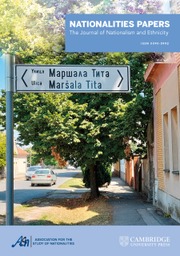
The number of members of the Slovak community in Serbia has been declining over the years, as the results of the census and other indicators illustrate. This has implications for the way of life of those who remain, and for their intra-ethnic relations. Because of the migration, the Slovak community has transformed from a predominantly Vojvodinian community to a transnational one. The new migration situation deeply affects their family lives; some family members remain in Vojvodina and others living abroad, mostly in Slovakia. Houses they have lived in for generations are being sold at low prices. During our research stay in Bački Petrovac in 2021, the large number of empty houses was conspicuous. Many interlocutors mentioned the statistic that more than four hundred houses are on sale in the town. The houses are bought mainly by members of the Serbian community. This means that the ethnic structure and visual features of Bački Petrovac, and other areas with a Slovak population, are changing. In the shops and other public places, signs written in Serbian and the Cyrillic script are becoming dominant. When putting up new street signs in Stara Pazova, instead of signs in Serbian and Slovak, only signs in Serbian (in the Cyrillic and Latin scripts) are put up. Similarly, at the entrance and exit to the municipality of Bački Petrovac, the signs marking the edge of the municipality are only written in Serbian, in Cyrillic script.
The decrease in members of the community particularly affects certain professions, such as teachers in Slovak primary schools, in which a dwindling number of children learn in Slovak. Consequently, the school departments for Slovak are being consolidated or closed down. As a result, the assimilation of those who remain is becoming more intensive. Parents of children from mixed Slovak-Serbian marriages mostly choose to learn in the majority language, which they explain in terms of their aspiration for their children to be better socially integrated (Lendák-Kabók et al. Reference Lendák-Kabók, Černak, Maran, Lazar, Gudurić, Dražić and Stefanović2022, 566–567, 569).
Many members of the community who stay in Vojvodina have expressed concerns over the community surviving in Serbia, because predominantly younger and more educated people are leaving. Nevertheless, there are those who believe that such population movements are good for the community – in Slovakia, they are able to learn the standard language, make new contacts, and acquire new knowledge and abilities, which can all be of benefit to the community.
Concluding Remarks
Ethnicity has always played a significant role in shaping Slovak statehood. This fact is also reflected in the wording of the Slovak Republic’s core policy documents that refer to the creation of “its” diaspora, which emphasizes the bond between Slovaks living abroad and the ethnic “kin-state,” with the former defined as part of the Slovak nation. Individuals belonging to such communities, however, are subject to special legal regulations. In most cases, unless these individuals have preserved or acquired Slovak citizenship, they are considered foreigners. But under certain conditions, if they can prove their Slovak descent, they may enjoy certain privileges compared with other foreigners living in Slovakia, in terms of employment, education, entrepreneurship rights, and access to state-provided social services. Nevertheless, state authorities have adopted a hierarchical approach toward members of Slovak communities living abroad. In the first years of the independent Slovakia’s existence, Slovak communities that had long been settled in the countries of Western Europe and overseas were arguably prioritized. Over the last two decades, members of what is now referred to as the new Slovak diaspora – that is, those who left Slovakia after 1989 – have gained more attention.
Members of the Slovak communities in the countries of Central and Southeastern Europe remain relatively less visible in terms of legal regulations and wider public interest. From the perspective of Slovak state institutions, they constitute “autochthonous” ethnic minorities that protect, preserve, and promote Slovak cultural heritage with a significant commitment as part of their everyday lives (especially in Serbia and Romania). Their somewhat low profile also translates into their lower “visibility” in Slovakia, despite the high number of immigrants from their communities abroad. This then affects their everyday interactions with the domestic majority population. The situation began to gradually change just before 2020, and at present, the Slovak public’s awareness of the existence of Slovak diaspora communities in the mentioned countries is growing. Yet this is not the result of deliberate efforts by the Slovak state authorities; rather, it is due to the enterprise of show business and the media, which have begun to draw attention to their status. Co-ethnic encounters, whether at the level of state administration or in everyday life, and linguistic and cultural practices, rather create situations that emphasize dissimilarities between the Slovak local population and the diaspora. Even many years after immigrating to Slovakia, comparisons with life in Serbia persist among members of the first generations of Slovak communities from Serbia who decided to settle in Slovakia after 1990.
On the one hand, Vojvodina Slovaks wish for a warming of ties with the established population in Slovakia; on the other hand, they often maintain close relations with other labor immigrants from Serbia, regardless of their ethnicity. Until they obtain Slovak citizenship, they remain foreigners, albeit ethnically privileged. By not completely breaking ties with the country they were born in – Serbia – they gain transnational experience. In this manner, their communities have transformed from being predominantly territorial to transnational.
In this particular migration situation, when, despite their common ethnic origin, these resettled Slovaks become less marked as different to both the Slovak authorities and the majority population, Brubaker’s triadic nexus of national minorities, nationalizing states, and external national homelands (1996b) becomes problematized from the perspective of co-ethnic migrants, as what they perceive as an “external homeland” (Serbia or Slovakia) shifts in their individual perception when they migrate, depending on their migration experience.
The reasons why members of the Slovak community from Serbia emigrate are mainly economic. Complex dynamics drive the interactions between migrants and the established population, from the established population not recognizing them as co-ethnics and perceiving them as people from Balkans, through the lens of cultural and linguistic hegemony, orientalizing stereotypes, misunderstandings, and misinterpretations in communication, often due to the lack of many migrants’ linguistic and cultural competence. They react to the attributed inferiority by playing up their community’s superiority, for example, by arguing that although their ancestors left the territory of present-day Slovakia around three hundred years ago, they managed to preserve their “Slovakness,” including their good command of the language and the knowledge and observance of traditions in their everyday lives. Furthermore, they highlighted a greater openness and cordiality in interpersonal relations in Serbia compared with more formal interpersonal relations in Slovakia. Nevertheless, the intra-ethnic boundaries became porous for the Slovak community members from Serbia who adopt the language and cultural norms of their new environment. In this research, we are dealing with an ethnically privileged migration, but for migrants, this still involves the necessity of overcoming various legal, cultural, and linguistic barriers.
The migration of Vojvodina Slovak community members is, compared with other current (over the last 30 years) migrations in the world, small in terms of the number of migrants and the distance they travel. Nevertheless, it is relevant as a paradigmatic example of how globalization processes work and how events in Southeast Europe spill over into Central Europe.
Financial support
The study was supported by VEGA grant nr. 2/0068/23 “Forms and mechanisms of differentiation and reconfiguration of public and political life. Collective actions and political attitudes.”
Disclosure
None.

 Open access

