


1. Introduction
Climate change poses a fundamental challenge to modern economies, not only due to its long-term environmental consequences but also because of its complex interactions with macroeconomic policy. While carbon pricing mechanisms—such as carbon taxes and cap-and-trade systems—are widely regarded as efficient tools to internalize environmental externalities (Weitzman, Reference Weitzman1974; Goulder and Parry, Reference Goulder and Parry2008), their implementation generates fiscal revenues and interacts with existing tax systems (Barrage, Reference Barrage and Barrage2017), nominal rigidities, and business cycle dynamics. Understanding these interactions is crucial for designing climate policies that are both environmentally effective and macroeconomically sound (Annicchiarico and Di Dio, Reference Annicchiarico and Di Dio2015).
In recent years, a growing body of research has explored the integration of environmental policy into dynamic stochastic general equilibrium (DSGE) models. These models allow for a rigorous analysis of how climate policy instruments affect macroeconomic variables over time, particularly in the presence of nominal frictions and distortionary taxation (Annicchiarico and Di Dio, Reference Annicchiarico and Di Dio2015; Heutel, Reference Heutel2012; Fischer and Heutel, Reference Fischer and Heutel2013). However, much of this literature has focused on steady-state comparisons or optimal policy design, often abstracting from the role of aggregate shocks and the fiscal mechanisms used to recycle environmental revenues.
This paper contributes to this literature by studying the dynamic effects of environmental and fiscal policy shocks in a New Keynesian DSGE modelFootnote 1 with a polluting intermediate goods sector, nominal rigidities in prices and wages,Footnote 2 and alternative climate policy regimes.Footnote 3 Specifically, I analyze how the economy responds to two types of aggregate shocks: (i) shocks to the cost of pollution abatement, which capture uncertainty in mitigation technologies and learning-by-doing processes (Annicchiarico and Diluiso, Reference Annicchiarico and Diluiso2017; Roach, Reference Roach2021), and (ii) shocks to government spending, which are relevant in the context of large-scale fiscal interventions such as those observed during the COVID-19 pandemic or in climate-resilient development strategies (Schipper et al., Reference Schipper, Revi, Preston, Carr, Eriksen, Fernandez-Carril, Glavovic, Hilmi, Ley, Mukerji, Muylaert de Araujo, Perez, Rose, Singh, Schipper, Revi, Preston, Carr, Eriksen, Fernandez-Carril, Glavovic, Hilmi, Ley, Mukerji, Muylaert de Araujo, Perez, Rose and Singh2022).Footnote 4
I consider two canonical forms of climate regulation: a carbon tax and a cap-and-trade system in the spirit of Weitzman (Reference Weitzman1974). Both instruments are calibrated to achieve the same emissions reduction target in steady state, but they differ in their dynamic responses to shocks. I also examine three fiscal adjustment rules for recycling environmental revenues: lump-sum transfers, reductions in labor income taxes, and reductions in consumption taxes. These mechanisms are central to the double dividend hypothesis, which posits that environmental tax reform can yield both environmental and efficiency gains (Bovenberg and Goulder, Reference Bovenberg, Goulder, Bovenberg and Goulder2002; Goulder, Reference Goulder2013).
The model builds on and extends previous work in several ways. First, I incorporate both price and wage stickiness,Footnote 5 allowing me to assess how nominal rigidities shape the transmission of environmental and fiscal shocks (Blanchard and Galí, Reference Blanchard and Galí2007; Christiano et al., Reference Christiano, Eichenbaum and Rebelo2011). Second, I explicitly model abatement cost uncertainty as a stochastic process along the lines of Annicchiarico and Diluiso (Reference Annicchiarico and Diluiso2017), rather than as a deterministic trend or static parameter. Third, I explore the interaction between climate policy and fiscal rules in a unified framework, highlighting the trade-offs involved in different revenue-recycling schemes in the spirit of Barrage (Reference Barrage and Barrage2017). Finally, I contribute to the emerging literature on climate-macro interactions in DSGE models by providing a detailed analysis of impulse responses under various policy configurations (Grodecka and Kuralbayeva, Reference Grodecka and Kuralbayeva2015; Ferrari and Nispi Landi, Reference Ferrari and Nispi Landi2024; Gibson and Heutel, Reference Gibson and Heutel2023).
The quantitative results reveal several important insights. First, I find that abatement cost shocks—interpreted as negative supply shocks—lead to a contraction in output and consumption, with the magnitude of the response depending critically on the climate policy regime and the degree of nominal rigidity. Under a carbon tax, firms respond by reducing abatement effort and increasing emissions, while under a cap-and-trade system, the emissions constraint forces firms to absorb the shock through higher permit prices and reduced output. These dynamics are amplified when both prices and wages are sticky, consistent with the predictions of New Keynesian models with real rigidities.
Second, I show that the fiscal use of environmental revenues plays a crucial role in shaping the macroeconomic response to shocks. Recycling revenues through reductions in distortionary taxes—particularly consumption taxes—can significantly mitigate the adverse effects of abatement cost shocks. This result supports the double dividend hypothesis and highlights the importance of fiscal design in enhancing the resilience of climate policy. In contrast, lump-sum transfers are less effective in stabilizing output and consumption, especially when nominal rigidities are present.
Third, I analyze the effects of government spending shocks—interpreted as positive demand shocks—under both climate policy regimes. In line with standard New Keynesian predictions, fiscal expansions raise output and labor, with stronger effects under sticky prices and wages. However, the interaction with environmental policy introduces additional trade-offs. Under a carbon tax, emissions rise with output, while under a cap-and-trade system, the emissions constraint leads to higher permit prices and increased abatement effort. These dynamics imply that the environmental consequences of fiscal expansions depend on the regulatory framework in place.
Finally, the findings have clear policy implications. In environments characterized by abatement cost uncertainty and nominal rigidities, carbon taxes may offer superior stabilization properties relative to cap-and-trade systems. Moreover, the choice of revenue recycling mechanism is critical: using environmental revenues to reduce consumption taxes yields the strongest macroeconomic stabilization, particularly in the presence of price stickiness. These results indicate the need for coordinated fiscal and environmental policy design as suggested by Fodha and Yamagami (Reference Fodha and Yamagami2025), Jaimes (Reference Jaimes2023) and Barrage (Reference Barrage2020), especially in economies facing both climate and business cycle challenges.
The remainder of the paper is organized as follows. Section 2 presents the model. Section 3 describes the calibration strategy. Section 4 discusses the main results. Section 5 concludes.
2. The model
To analyze the macroeconomic effects of environmental and fiscal policy shocks, I develop a New Keynesian DSGE model with nominal rigidities, a polluting intermediate goods sector, and alternative climate policy regimes. The model is designed to capture the interaction between environmental regulation, fiscal policy, and business cycle dynamics, with a particular focus on the role of revenue recycling and the amplification effects of nominal frictions. It builds on the frameworks of Annicchiarico and Di Dio (Reference Annicchiarico and Di Dio2017, Reference Annicchiarico and Di Dio2015) and Erceg et al. (Reference Erceg, Henderson and Levin2000), and incorporates both price and wage stickiness à la Calvo (Reference Calvo1983).
The economy consists of households, firms, a government, and an environmental regulator. Final goods are produced under perfect competition, while intermediate goods producers operate under monopolistic competition and generate emissions as a by-product of production. Households supply differentiated labor services and face wage-setting frictions. The government finances exogenous public expenditures using distortionary taxes or lump-sum transfers and receives revenues from environmental policy instruments. These revenues are recycled through alternative fiscal channels, allowing the model to assess the implications of different revenue-recycling schemes for macroeconomic stabilization and environmental outcomes.
The model features two canonical climate policy instruments: a carbon tax and a cap-and-trade system. Both are calibrated to achieve the same emissions reduction target in steady state, but they differ in their dynamic responses to shocks. The carbon tax imposes a fixed price on emissions, while the cap-and-trade system fixes the quantity of emissions and allows the permit price to adjust endogenously. This distinction is central to the analysis of policy trade-offs under uncertainty, as explored in Section 4.
Monetary policy follows a Taylor-type rule that responds to inflation and output deviations. The interaction between monetary and fiscal policy is particularly relevant in the presence of nominal rigidities, which amplify the real effects of shocks. The model is solved using a second-order approximation around the deterministic steady state, allowing for a rich characterization of the dynamic responses to both supply and demand shocks.
2.1. Households
To introduce wage stickiness, I assume that households supply differentiated labor services, $N_{jt}$
, to a competitive labor “packer” firm, which aggregates them into total labor input,
$N_{jt}$
, to a competitive labor “packer” firm, which aggregates them into total labor input, $N_t$
, used by intermediate goods producers.
$N_t$
, used by intermediate goods producers.
2.1.1. Competitive labor “packer” firm
Differentiated wages, $W_{jt}$
, are set as in Erceg et al. (Reference Erceg, Henderson and Levin2000), assuming the existence of a labor packer firm. Total labor input is given by:
$W_{jt}$
, are set as in Erceg et al. (Reference Erceg, Henderson and Levin2000), assuming the existence of a labor packer firm. Total labor input is given by:
 \begin{equation} N_t=\left (\int _{0}^{1} N_{jt}^{\frac {\theta ^h-1}{\theta ^h}}dj\right )^{\frac {\theta ^h}{\theta ^h-1}} \end{equation}
where $\theta ^h$
denotes the elasticity of substitution across labor types. As in standard New Keynesian models with wage rigidities, the demand for a particular labor type
$\theta ^h$
denotes the elasticity of substitution across labor types. As in standard New Keynesian models with wage rigidities, the demand for a particular labor type $j$
is:
$j$
is:
 \begin{equation} N_{jt}=\left (\frac {W_{jt}}{W_t}\right )^{-\theta ^h}N_t \end{equation}
where the aggregate wage index, $W_t$
, is defined as:
$W_t$
, is defined as:
 \begin{equation} W_t = \left (\int _{0}^{1} W_{jt}^{1-\theta ^h} dj\right )^{\frac {1}{1-\theta ^h}} \end{equation}
2.1.2. A representative infinitely-lived agent
A representative household maximizes expected lifetime utility:
 \begin{equation} \mathbb{E}_t \sum _{i=0}^\infty \beta ^t \left (\frac {C_{t}^{1-\sigma }}{1-\sigma }-\mu _N \frac {N_{jt}^{1+\eta }}{1+\eta }\right ) \end{equation}
subject to the period-by-period budget constraint:
 \begin{align} (1+\tau _t^C)P_tC_t + Q_{t,t+1}^N \tilde {B}_{t+1} &= (1-\tau _t^N)W_{jt}N_{jt}+D_t + \tilde {B}_t + T_t \end{align}
 \begin{align} N_{jt} &= \left (\frac {W_{jt}}{W_t}\right )^{-\theta ^h}N_t \end{align}
where $\beta$
is the discount factor,
$\beta$
is the discount factor, $\sigma$
is the coefficient of relative risk aversion,
$\sigma$
is the coefficient of relative risk aversion, $\eta$
is the inverse Frisch elasticity of labor supply, and
$\eta$
is the inverse Frisch elasticity of labor supply, and $\mu _N$
governs the disutility of labor.
$\mu _N$
governs the disutility of labor. $P_t$
is the price of the consumption good,
$P_t$
is the price of the consumption good, $\tilde {B}_{t+1}$
designates risk-free bond demand and
$\tilde {B}_{t+1}$
designates risk-free bond demand and $Q_{t,t+1}^N$
is the price of bonds,
$Q_{t,t+1}^N$
is the price of bonds, $C_t$
is consumption,
$C_t$
is consumption, $D_t$
are dividends from firms, and
$D_t$
are dividends from firms, and $T_t$
denotes lump-sum transfers.
$T_t$
denotes lump-sum transfers. $\tau _t^C$
and
$\tau _t^C$
and $\tau _t^N$
are the tax rates on consumption and labor income, respectively.
$\tau _t^N$
are the tax rates on consumption and labor income, respectively.
The first-order condition for consumption yields the standard Euler equation:
 \begin{equation} 1=\beta (1+i_t) \mathbb{E}_t \frac {C_{t+1}^{-\sigma }}{C_t^{-\sigma }} \left (\frac {1+\tau _{t}^C}{1+\tau _{t+1}^C}\right ) \frac {P_t}{P_{t+1}} \end{equation}
where $i_t$
is the nominal interest rate.
$i_t$
is the nominal interest rate.
To introduce wage stickiness, I assume that households supply differentiated labor services and set wages in a staggered fashion, following the Calvo (Reference Calvo1983) mechanism. That is, each household can reset its nominal wage with probability $1 - \alpha _W$
in any given period. With probability
$1 - \alpha _W$
in any given period. With probability $\alpha _W$
, the wage remains fixed at its previously set level. This friction implies that not all households can optimally adjust their wages in response to economic conditions each period. Let
$\alpha _W$
, the wage remains fixed at its previously set level. This friction implies that not all households can optimally adjust their wages in response to economic conditions each period. Let $w^*_t$
denote the optimal real wage chosen by a household when it has the opportunity to reset.Footnote
6
The optimal wage
$w^*_t$
denote the optimal real wage chosen by a household when it has the opportunity to reset.Footnote
6
The optimal wage $w^*_t$
satisfies the following condition:
$w^*_t$
satisfies the following condition:
 \begin{equation} {w_t^*}^{1+\theta ^h \eta }=\frac {\theta ^h}{\theta ^h-1} \frac {\mathbb{E}_t \sum _{i=0}^\infty \beta ^i \alpha _W^i \mu _N w_{t+i}^{\theta ^h(1+\eta )}\Pi _{t+i}^{\theta ^h(1+\eta )}N_{t+i}^{1+\eta }}{\mathbb{E}_t \sum _{i=0}^\infty \beta ^i \alpha _W^i C_{t+i}^{-\sigma } \left (\frac {1-\tau _{t+i}^N}{1+\tau _{t+i}^C}\right ) w_{t+i}^{\theta ^h}\Pi _{t+i}^{\theta ^h-1}N_{t+i}} \end{equation}
where $w_t = W_t/P_t$
is the real wage and
$w_t = W_t/P_t$
is the real wage and $\Pi _{t+i} = P_{t+i}/P_t$
is the gross inflation rate.Footnote
7
In the special case where wages are fully flexible (
$\Pi _{t+i} = P_{t+i}/P_t$
is the gross inflation rate.Footnote
7
In the special case where wages are fully flexible ( $\alpha _W = 0$
), the household can adjust its wage every period. In this case, the optimal wage simplifies to a static markup condition:
$\alpha _W = 0$
), the household can adjust its wage every period. In this case, the optimal wage simplifies to a static markup condition:
 \begin{equation} w_t=\underbrace {\frac {\theta ^h}{\theta ^h-1}}_{\text{markup}}\underbrace {\frac {\mu _N N_t^\eta }{C_t^{-\sigma }}}_{\text{MRS}} \underbrace {\frac {1+\tau _t^C}{1-\tau _t^N}}_{\text{tax distortion}} \end{equation}
This expression shows that the real wage is a markup over the marginal rate of substitution (MRS) between consumption and labor, adjusted for tax distortions. The MRS reflects the household’s willingness to trade off consumption for leisure, while the markup arises from the household’s market power in setting wages.
2.2. Firms
2.2.1. Final good
The final good is produced by a representative firm operating under perfect competition. This firm aggregates a continuum of differentiated intermediate goods, $Y_{it}$
, using a CES technology:
$Y_{it}$
, using a CES technology:
 \begin{equation} Y_t=\left (\int _{0}^{1} Y_{it}^{\frac {\theta ^f-1}{\theta ^f}}di\right )^{\frac {\theta ^f}{\theta ^f-1}} \end{equation}
where $\theta ^f \gt 0$
denotes the elasticity of substitution across intermediate varieties. The firm minimizes the cost of acquiring intermediate inputs, taking prices as given. The demand for each intermediate good
$\theta ^f \gt 0$
denotes the elasticity of substitution across intermediate varieties. The firm minimizes the cost of acquiring intermediate inputs, taking prices as given. The demand for each intermediate good $i$
is:
$i$
is:
 \begin{equation} Y_{it}=\left (\frac {P_{it}}{P_t}\right )^{-\theta ^f}Y_t \end{equation}
where $P_{it}$
is the price of variety
$P_{it}$
is the price of variety $i$
and
$i$
and $P_t$
is the aggregate price index, defined as:
$P_t$
is the aggregate price index, defined as:
 \begin{equation} P_t = \left (\int _{0}^{1} P_{it}^{1-\theta ^f} di\right )^{\frac {1}{1-\theta ^f}} \end{equation}
2.2.2. Intermediate goods
Intermediate goods are produced by a continuum of monopolistically competitive firms. Each firm uses labor as the sole input and generates emissions as a by-product of production along the lines of Annicchiarico and Di Dio (Reference Annicchiarico and Di Dio2017). The production function is given by:
 \begin{equation} Y_{it}=\Lambda _t A_t N_{it} \end{equation}
where $N_{it}$
is labor input,
$N_{it}$
is labor input, $A_t$
is total factor productivity,Footnote
8
and
$A_t$
is total factor productivity,Footnote
8
and $\Lambda _t$
captures climate-related damages. Total factor productivity evolves according to a stationary AR(1) process:
$\Lambda _t$
captures climate-related damages. Total factor productivity evolves according to a stationary AR(1) process:
 \begin{equation} \log A_t = (1-\rho _A) \log \bar {A} + \rho _A \log A_{t-1} + \epsilon _{A_t} \end{equation}
with $\rho _A \in (0,1)$
and
$\rho _A \in (0,1)$
and $\epsilon _{A_t}$
an i.i.d. shock with zero mean. Climate damages are modeled as in Golosov et al. (Reference Golosov, Hassler, Krusell and Tsyvinski2014), with
$\epsilon _{A_t}$
an i.i.d. shock with zero mean. Climate damages are modeled as in Golosov et al. (Reference Golosov, Hassler, Krusell and Tsyvinski2014), with $\Lambda _t$
decreasing in the stock of pollution
$\Lambda _t$
decreasing in the stock of pollution $M_t$
relative to its pre-industrial level
$M_t$
relative to its pre-industrial level $\overline {M}$
:
$\overline {M}$
:
 \begin{equation} \Lambda _t = \exp (\!-\chi (M_t-\overline {M})) \end{equation}
where $\chi \gt 0$
measures the sensitivity of productivity to environmental degradation.
$\chi \gt 0$
measures the sensitivity of productivity to environmental degradation.
Firms generate emissions $Z_{it}$
proportionally to output, but can reduce emissions by allocating resources
$Z_{it}$
proportionally to output, but can reduce emissions by allocating resources $X_{it}$
to abatement. As in Annicchiarico and Di Dio (Reference Annicchiarico and Di Dio2017, Reference Annicchiarico and Di Dio2015) and Heutel (Reference Heutel2012), emissions are given by:
$X_{it}$
to abatement. As in Annicchiarico and Di Dio (Reference Annicchiarico and Di Dio2017, Reference Annicchiarico and Di Dio2015) and Heutel (Reference Heutel2012), emissions are given by:
 \begin{equation} Z_{it}=(1-X_{it})\psi Y_{it} \end{equation}
where $\psi \gt 0$
is the emissions intensity of output. The cost of abatement, expressed in units of output, is:
$\psi \gt 0$
is the emissions intensity of output. The cost of abatement, expressed in units of output, is:
 \begin{equation} \mathbb{C}_{X_{it}}=\phi _1 B_t X_{it}^{\phi _2}Y_{it} \end{equation}
where $\phi _1, \phi _2 \gt 0$
and
$\phi _1, \phi _2 \gt 0$
and $B_t$
captures abatement cost uncertainty. As in Annicchiarico and Diluiso (Reference Annicchiarico and Diluiso2017),
$B_t$
captures abatement cost uncertainty. As in Annicchiarico and Diluiso (Reference Annicchiarico and Diluiso2017), $B_t$
follows:
$B_t$
follows:
 \begin{equation} \log B_t = \rho _B \log B_{t-1} + \epsilon _{B_t} \end{equation}
with $\rho _B \in (0,1)$
and
$\rho _B \in (0,1)$
and $\epsilon _{B_t}$
an i.i.d. shock with zero mean.
$\epsilon _{B_t}$
an i.i.d. shock with zero mean.
The law of motion for the stock of pollution is:
 \begin{equation} M_{t+1}=(1-\delta _M)M_{t}+Z_{t}+\overline {Z} \end{equation}
where $0 \lt \delta _M \lt 1$
is the natural decay rate of pollution,
$0 \lt \delta _M \lt 1$
is the natural decay rate of pollution, $Z_t$
is aggregate industrial emissions, and
$Z_t$
is aggregate industrial emissions, and $\overline {Z}$
denotes constant non-industrial emissions.
$\overline {Z}$
denotes constant non-industrial emissions.
Each firm minimizes costs subject to its production function and the demand for its variety. The first-order conditions for labor and abatement are:
 \begin{align} \varphi _{t}\Lambda _t A_t &= \frac {W_t}{P_t} \end{align}
 \begin{align} \frac {\phi _1 \phi _2}{\psi } B_t X_{t}^{\phi _2-1} &= \frac {P_{Zt}}{P_t} \end{align}
where $\varphi _t$
is the marginal cost of labor, and
$\varphi _t$
is the marginal cost of labor, and $P_{Zt}$
is the price of emissions (or the permit price under cap-and-trade).
$P_{Zt}$
is the price of emissions (or the permit price under cap-and-trade).
Since all firms face the same prices, the marginal cost and abatement effort are identical across firms. Real profits are:
 \begin{equation} D_{it}=\left [\frac {P_{it}}{P_t}-MC_t\right ]Y_{it} \end{equation}
with total marginal cost:
 \begin{equation} MC_t=\varphi _t+\frac {P_{Zt}}{P_t}(1-X_t)\psi +\phi _1 B_tX_t^{\phi _2} \end{equation}
The first term reflects labor costs, the second captures emissions costs, and the third represents abatement costs.
To introduce price stickiness, I assume that firms can reset prices with probability $1-\alpha _P$
each period, as in Calvo (Reference Calvo1983). The optimal reset price
$1-\alpha _P$
each period, as in Calvo (Reference Calvo1983). The optimal reset price $P_t^*$
satisfies:
$P_t^*$
satisfies:
 \begin{equation} \frac {P_t^*}{P_t}=\frac {\theta ^f}{\theta ^f-1} \frac {\mathbb{E}_t \sum _{j=0}^\infty \alpha _P^j Q_{t,t+j}^R MC_{t+j}\left (\frac {P_{t+j}}{P_t}\right )^{\theta ^f}Y_{t+j}}{\mathbb{E}_t \sum _{j=0}^\infty \alpha _P^j Q_{t,t+j}^R \left (\frac {P_{t+j}}{P_t}\right )^{\theta ^f-1} Y_{t+j}} \end{equation}
In the absence of price rigidities ( $\alpha _P = 0$
), the optimal price is a constant markup over marginal cost:
$\alpha _P = 0$
), the optimal price is a constant markup over marginal cost:
 \begin{equation} \frac {P_t^*}{P_t}=\underbrace {\frac {\theta ^f}{\theta ^f-1}}_{\text{markup}} MC_t \end{equation}
2.3. Fiscal policy
The government finances a stream of exogenous public expenditures using a combination of distortionary taxes and environmental revenues. Government consumption, $G_t$
, is modeled as an aggregate of differentiated goods, analogous to private consumption:
$G_t$
, is modeled as an aggregate of differentiated goods, analogous to private consumption:
 \begin{equation} G_t=\left (\int _{0}^{1} G_{it}^{\frac {\theta ^f-1}{\theta ^f}}di\right )^{\frac {\theta ^f}{\theta ^f-1}} \Longrightarrow G_{it}=\left (\frac {P_{it}}{P_t}\right )^{-\theta ^f}G_t \end{equation}
Government spending follows a stochastic AR(1) process:
 \begin{equation} \log G_t = (1-\rho _G) \log \bar {G} + \rho _G \log G_{t-1} + \epsilon _{G_t} \end{equation}
where $\rho _G \in (0,1)$
and
$\rho _G \in (0,1)$
and $\epsilon _{G_t}$
is an i.i.d. shock with zero mean.
$\epsilon _{G_t}$
is an i.i.d. shock with zero mean.
The government budget constraint is satisfied each period and includes revenues from labor and consumption taxes, lump-sum transfers, and environmental policy:
 \begin{equation} P_tG_t = P_{Zt}Z_t + \tau _{t}^N W_t N_t + \tau _{t}^C P_t C_t + T_t \end{equation}
where $P_{Zt}Z_t$
represents revenues from carbon pricing (either taxes or permit sales), and
$P_{Zt}Z_t$
represents revenues from carbon pricing (either taxes or permit sales), and $T_t$
denotes lump-sum transfers (or taxes if negative).
$T_t$
denotes lump-sum transfers (or taxes if negative).
To explore the interaction between fiscal and environmental policy, I consider three revenue-recycling regimes in the quantitative analysis:
-
(i) Lump-sum adjustment: Tax rates on consumption and labor are fixed at their steady-state values, and lump-sum transfers adjust to balance the budget.
-
(ii) Labor tax adjustment: Lump-sum transfers are fixed, consumption taxes are constant, and labor income taxes adjust endogenously.
-
(iii) Consumption tax adjustment: Lump-sum transfers and labor taxes are fixed, and consumption taxes vary to satisfy the government budget constraint.
These scenarios allow for a systematic evaluation of how different fiscal instruments interact with environmental revenues and nominal rigidities in shaping the macroeconomic response to shocks.
2.4. Environmental policy
Environmental regulation is modeled as a constraint on emissions, with firms taking the policy regime as given. I consider two canonical instruments, following the prices-versus-quantities framework of Weitzman (Reference Weitzman1974) and the implementation in Annicchiarico and Di Dio (Reference Annicchiarico and Di Dio2015):Footnote 9
-
(i) Cap-and-trade: Emissions are fixed at $Z_t = \bar {Z}$
, and firms purchase permits at the market-determined price
$P_{Zt}$
.
$Z_t = \bar {Z}$
, and firms purchase permits at the market-determined price
$P_{Zt}$
. -
(ii) Carbon tax: A constant real tax rate
$\tau _Z = P_{Zt}/P_t$
is levied on emissions.


Both instruments are calibrated to achieve the same emissions reduction target in steady state, but they differ in their dynamic responses to shocks. Under cap-and-trade, the emissions price adjusts endogenously, while under a carbon tax, the emissions quantity is flexible. This distinction is central to the analysis of policy trade-offs under uncertainty.
In the quantitative analysis, I examine how these regimes interact with nominal rigidities and fiscal recycling schemes in shaping the transmission of abatement cost and government spending shocks.
2.5. Monetary policy
Monetary policy is modeled using a standard Taylor rule, which responds more than one-for-one to deviations of inflation from its target following the Taylor Principle. As in Annicchiarico and Di Dio (Reference Annicchiarico and Di Dio2015), the nominal interest rate, $i_t$
, evolves as:
$i_t$
, evolves as:
 \begin{equation} i_{t}=\frac {1}{\beta } \Pi _t^{\varepsilon _1} \left (\frac {Y_t}{\bar {Y}}\right )^{\varepsilon _2} - 1 \end{equation}
where $\Pi _t = P_t / P_{t-1}$
is the gross inflation rate,
$\Pi _t = P_t / P_{t-1}$
is the gross inflation rate, $\bar {Y}$
is the steady-state level of output, and
$\bar {Y}$
is the steady-state level of output, and $\varepsilon _1 \gt 1$
,
$\varepsilon _1 \gt 1$
, $\varepsilon _2 \in (0,1)$
are policy response coefficients.
$\varepsilon _2 \in (0,1)$
are policy response coefficients.
I assume that the central bank does not respond to wage inflation. As shown by Blanchard and Galí (Reference Blanchard and Galí2007), in the presence of wage stickiness, the divine coincidence breaks down, and monetary policy faces a trade-off between stabilizing inflation and the output gap. Throughout the analysis, I focus on an active monetary policy regime, which implies that fiscal expansions are partially offset by interest rate increases, thereby dampening their stimulative effects.Footnote 10
2.6. Aggregation and additional equilibrium conditions
This subsection presents the key aggregate relationships that close the model. Let $D_{pt} = \int _{0}^{1}\left (\frac {P_{it}}{P_t}\right )^{-\theta ^f}di$
denote the price dispersion index, which arises due to staggered price setting. Then, aggregate output, emissions, and abatement costs can be expressed as:
$D_{pt} = \int _{0}^{1}\left (\frac {P_{it}}{P_t}\right )^{-\theta ^f}di$
denote the price dispersion index, which arises due to staggered price setting. Then, aggregate output, emissions, and abatement costs can be expressed as:
 \begin{align} Y_t &= \Lambda _t A_t N_t D_{pt}^{-1} \end{align}
 \begin{align} Z_t &= (1 - X_t)\psi Y_t D_{pt} \end{align}
 \begin{align} \mathbb{C}_{Xt} &= \phi _1 B_t X_t^{\phi _2} Y_t D_{pt} \end{align}
where $N_t = \int _0^1 N_{jt} dj$
is total labor input. The resource constraint for the economy is:
$N_t = \int _0^1 N_{jt} dj$
is total labor input. The resource constraint for the economy is:
 \begin{equation} Y_t = C_t + G_t + \mathbb{C}_{Xt} \end{equation}
where government consumption is assumed to be a constant share of output, $G_t = g_G Y_t$
.
$G_t = g_G Y_t$
.
2.6.1. Price and wage dynamics
The evolution of the aggregate price level follows from the Calvo pricing mechanism:
 \begin{eqnarray} P_t &=& \left (\int _{0}^{1} P_{it}^{1-\theta ^f} di\right )^{\frac {1}{1-\theta ^f}} \nonumber \\ &=& \left [(1-\alpha _P){P_t^*}^{1-\theta ^f} + \alpha _P P_t^{1-\theta ^f}\right ]^{\frac {1}{1-\theta ^f}} \end{eqnarray}
Dividing by $P_{t-1}$
and rearranging yields the inflation dynamics:
$P_{t-1}$
and rearranging yields the inflation dynamics:
 \begin{equation} 1 = \alpha _P \Pi _t^{\theta ^f - 1} + (1 - \alpha _P){p_t^*}^{1 - \theta ^f} \end{equation}
where $p_t^* = P_t^*/P_t$
is the relative reset price. The law of motion for price dispersion is:
$p_t^* = P_t^*/P_t$
is the relative reset price. The law of motion for price dispersion is:
 \begin{equation} D_{p,t} = (1 - \alpha _P){p_t^*}^{-\theta ^f} + \alpha _P \Pi _t^{\theta ^f} D_{p,t-1} \end{equation}
Similarly, the evolution of the aggregate wage index, $W_t$
, implies the following dynamics for real wages:
$W_t$
, implies the following dynamics for real wages:
 \begin{equation} 1 = (1 - \alpha _W){\Pi _{w,t}^*}^{1 - \theta ^h} + \alpha _W \Pi _t^{\theta ^h - 1} \Pi _{w,t}^{\theta ^h - 1} \end{equation}
where $\Pi _{w,t}^* = w_t^*/w_t$
is the relative reset wage and
$\Pi _{w,t}^* = w_t^*/w_t$
is the relative reset wage and $\Pi _{w,t} = w_t/w_{t-1}$
is the gross wage inflation rate.
$\Pi _{w,t} = w_t/w_{t-1}$
is the gross wage inflation rate.
2.7. Definition of equilibrium
A stationary competitive equilibrium for this economy is defined as follows:
Definition 1. Given a set of parameters and initial conditions, a stationary competitive equilibrium is a sequence of allocations $\{A_t, C_t, Y_t, B_t, Z_t, X_t, \mathbb{C}_{Xt}, G_t, D_{pt}, N_t, M_t, MC_t, \Lambda _t\}_{t=0}^\infty$
, and a sequence of prices, taxes, and transfers
$\{A_t, C_t, Y_t, B_t, Z_t, X_t, \mathbb{C}_{Xt}, G_t, D_{pt}, N_t, M_t, MC_t, \Lambda _t\}_{t=0}^\infty$
, and a sequence of prices, taxes, and transfers $\{i_t, w_t, w_t^*, p_t^*, p_{Zt}, \Pi _t, \tau _t^C, \tau _t^N, T_t\}_{t=0}^\infty$
such that:
$\{i_t, w_t, w_t^*, p_t^*, p_{Zt}, \Pi _t, \tau _t^C, \tau _t^N, T_t\}_{t=0}^\infty$
such that:
-
1. Households maximize expected utility subject to their budget constraint and wage-setting frictions;
-
2. Firms maximize profits subject to production, pricing, and abatement constraints;
-
3. The government budget constraint and fiscal rules are satisfied;
-
4. The monetary authority sets the nominal interest rate according to the Taylor rule;
-
5. The environmental policy constraint (cap or tax) is enforced;
-
6. All markets clear and the resource constraint holds.
The model is solved using a second-order approximation around the deterministic steady state, following the method of Schmitt-Grohé and Uribe (Reference Schmitt-Grohé and Uribe2004). Simulations and impulse response functions are computed using Dynare.Footnote 11
3. Calibration of parameters
Time is measured in quarters. The model is calibrated to match key macroeconomic and environmental features of the U.S. economy and to ensure comparability with previous studies. For macroeconomic parameters, I follow closely the calibration in Correia et al. (Reference Correia, Farhi, Nicolini and Teles2013) and Christiano et al. (Reference Christiano, Eichenbaum and Rebelo2011), while the environmental block is based on Annicchiarico and Di Dio (Reference Annicchiarico and Di Dio2017) and Heutel (Reference Heutel2012). The calibration strategy is designed to capture the interaction between nominal rigidities, fiscal policy, and environmental regulation, which is central to the analysis in Sections 4 and 5.
Table 1 reports the values for the standard parameters in the utility function and the nominal frictions. The discount factor $\beta$
is set to 0.99, implying an annual real interest rate of approximately 4%. The coefficient of relative risk aversion
$\beta$
is set to 0.99, implying an annual real interest rate of approximately 4%. The coefficient of relative risk aversion $\sigma$
is set to 2, consistent with standard values in the literature. The elasticity of substitution across labor types
$\sigma$
is set to 2, consistent with standard values in the literature. The elasticity of substitution across labor types $\theta ^h$
is set to 3, and the inverse Frisch elasticity
$\theta ^h$
is set to 3, and the inverse Frisch elasticity $\eta$
is set to 1. The disutility of labor
$\eta$
is set to 1. The disutility of labor $\mu _N$
is calibrated to ensure that steady-state labor supply equals 0.2. The Calvo parameters for price and wage stickiness are both set to 0.75, implying an average duration of three quarters between adjustments.
$\mu _N$
is calibrated to ensure that steady-state labor supply equals 0.2. The Calvo parameters for price and wage stickiness are both set to 0.75, implying an average duration of three quarters between adjustments.
Parameter values for macroeconomic variables

Total factor productivity is normalized to $A = 5.115$
to ensure that steady-state output equals one in the absence of environmental policy. The elasticity of substitution across intermediate goods
$A = 5.115$
to ensure that steady-state output equals one in the absence of environmental policy. The elasticity of substitution across intermediate goods $\theta ^f$
is set to 6, consistent with estimates in the literature. Fiscal parameters are calibrated to match a government consumption share of 20% of GDP,Footnote
12
and tax rates are set to reflect average U.S. values. The Taylor rule parameters imply an active monetary policy stance, with a strong response to inflation and no response to output, consistent with the baseline in Christiano et al. (Reference Christiano, Eichenbaum and Rebelo2011).
$\theta ^f$
is set to 6, consistent with estimates in the literature. Fiscal parameters are calibrated to match a government consumption share of 20% of GDP,Footnote
12
and tax rates are set to reflect average U.S. values. The Taylor rule parameters imply an active monetary policy stance, with a strong response to inflation and no response to output, consistent with the baseline in Christiano et al. (Reference Christiano, Eichenbaum and Rebelo2011).
Table 2 presents the calibration of the environmental block. The abatement cost function parameters $\phi _1$
and
$\phi _1$
and $\phi _2$
are taken from Annicchiarico and Di Dio (Reference Annicchiarico and Di Dio2017), and the emissions intensity parameter
$\phi _2$
are taken from Annicchiarico and Di Dio (Reference Annicchiarico and Di Dio2017), and the emissions intensity parameter $\psi$
is set to 0.123, consistent with U.S. state-level data on CO
$\psi$
is set to 0.123, consistent with U.S. state-level data on CO $_2$
emissions and GDP.Footnote
13
$_2$
emissions and GDP.Footnote
13
Parameter values for environmental variables

The climate damage function parameter $\chi$
is set to a small positive value to ensure that damages are economically meaningful but not dominant in the short run. The pollution decay rate
$\chi$
is set to a small positive value to ensure that damages are economically meaningful but not dominant in the short run. The pollution decay rate $\delta _M$
is set to 0.002, and the emissions reduction target,
$\delta _M$
is set to 0.002, and the emissions reduction target, $\varrho$
, is calibrated to 30%, in line with international climate agreements. This calibration ensures that the model captures key empirical regularities, such as the procyclicality of emissions and the inelastic response of pollution to output. It also allows for a meaningful comparison of policy regimes in terms of both environmental effectiveness and macroeconomic stabilization.
$\varrho$
, is calibrated to 30%, in line with international climate agreements. This calibration ensures that the model captures key empirical regularities, such as the procyclicality of emissions and the inelastic response of pollution to output. It also allows for a meaningful comparison of policy regimes in terms of both environmental effectiveness and macroeconomic stabilization.
4. Main results
This section presents the dynamic effects of environmental and fiscal policy shocks under alternative climate policy regimes and revenue-recycling schemes. I begin by comparing the deterministic steady-state outcomes under a business-as-usual (BAU) scenario and an environmental policy targeting a 30% reduction in emissions. I then analyze the impulse responses to two types of aggregate shocks: (i) abatement cost shocks, which capture uncertainty in mitigation technologies, and (ii) government spending shocks, which represent fiscal demand stimuli. Throughout, I emphasize the role of nominal rigidities and the fiscal use of environmental revenues in shaping the macroeconomic transmission mechanisms. Figures 1–4 illustrate the key results, and Appendix Figures http://doi.org/10.1017/S1365100525100424A.1–http://doi.org/10.1017/S1365100525100424A.4 report additional robustness exercises.
4.1. Deterministic steady-state calibration
Table 3 reports the steady-state values under the BAU scenario and under an environmental policy calibrated to achieve a 30% reduction in emissions. Following Annicchiarico and Di Dio (Reference Annicchiarico and Di Dio2015), I assume that carbon taxes and cap-and-trade systems are equivalent in steady state, as both are designed to meet the same emissions target. The introduction of environmental policy reduces emissions , lowers the stock of pollution , and mitigates climate damages . Most of the adjustment occurs through a modest decline in consumption (−0.49%), while output and labor are held constant for comparability.
Deterministic steady-state values

The implementation of the emissions constraint leads to an increase in the emissions price and abatement effort, reflecting the cost of internalizing the environmental externality. Lump-sum transfers rise due to the additional revenues generated by the environmental policy. Welfare declines slightly (−0.36%), capturing the trade-off between environmental gains and the economic cost of abatement. These steady-state results provide a benchmark for interpreting the dynamic responses to shocks in the next subsections.
4.2 Abatement cost shocks
I now examine the dynamic effects of a one percent increase in abatement costs, interpreted as a negative supply shock. This shock raises the marginal cost of pollution mitigation and affects firms’ production and abatement decisions. I compare the responses under two environmental policy regimes: (i) a carbon tax and (ii) a cap-and-trade system. In each case, I explore how the presence of nominal rigidities and the fiscal use of environmental revenues shape the macroeconomic adjustment.
4.2.1. Carbon tax policy
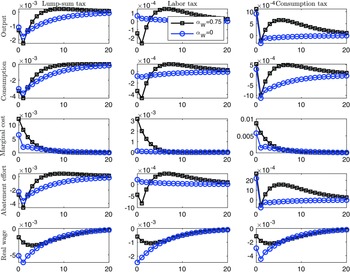
Figure 1 displays the impulse responses to an abatement cost shock under a carbon tax regime. Since the emissions price is fixed, firms respond by reducing abatement effort and increasing emissions, thereby raising environmental tax revenues. This substitution effect is consistent with cost-minimizing behavior, as firms reallocate resources away from abatement toward production.
Dynamic responses to an abatement cost shock under a carbon tax.
Note: Each column reports the dynamic paths for selected variables under different fiscal policy specifications. The blue line with circles represents the model with flexible wages, the black line with squares represents the extension with sticky wages. Horizontal axis displays the time which is measured in quarters. Vertical axis values refer to deviations from steady state in percentage.

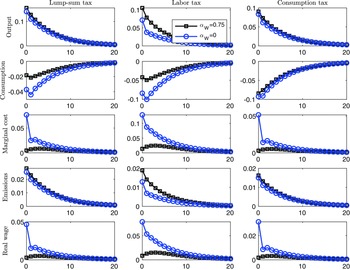
Dynamic responses to an abatement cost shock under a cap-and-trade system.
Note: Each column reports the dynamic paths for selected variables under different fiscal policy specifications. The blue line with circles represents the model with flexible wages, the black line with squares represents the extension with sticky wages. Horizontal axis displays the time which is measured in quarters. Vertical axis values refer to deviations from steady state in percentage.

Nominal rigidities play a central role in the transmission of the shock. When both prices and wages are sticky (black line with squares), the economy experiences a pronounced contraction in output and consumption. Firms are unable to adjust prices in response to higher marginal costs, and households face rigid nominal wages that prevent real wage adjustment. In contrast, when wages are flexible (blue line with circles), the real wage adjusts downward, partially absorbing the shock and mitigating the decline in employment and output. This result echoes the findings of Blanchard and Galí (Reference Blanchard and Galí2007), who show that wage rigidity amplifies the real effects of supply shocks in New Keynesian models.
The fiscal use of environmental revenues significantly affects the propagation of the shock. When revenues are recycled through labor tax reductions, the contraction is dampened, particularly under wage rigidity. This occurs because lower labor taxes reduce the wedge between the MRS and the real wage, encouraging labor supply (see Figure http://doi.org/10.1017/S1365100525100424A.1). The most effective stabilization, however, arises when revenues are used to cut consumption taxes. This policy directly lowers the effective price of consumption, stimulating demand and offsetting the contractionary effects of the shock. These results provide strong support for the double dividend hypothesis (Bovenberg and Goulder, Reference Bovenberg, Goulder, Bovenberg and Goulder2002), especially when tax cuts target intertemporal margins.
The interaction between fiscal policy and nominal rigidities is particularly important. Under sticky prices, the reduction in consumption taxes has a stronger effect on output because it boosts demand in a context where firms cannot adjust prices downward. In contrast, if lump-sum transfers increase via fiscal adjustment, reflecting the endogenous rise in emissions and tax revenues, which are redistributed to households, this channel is less effective in stimulating demand compared to targeted tax cuts. Overall, the results highlight the importance of coordinating environmental and fiscal policy in the presence of nominal frictions, as emphasized by Annicchiarico and Di Dio (Reference Annicchiarico and Di Dio2015) and Roach (Reference Roach2021).
4.2.2. Cap-and-trade policy
Figure 2 presents the impulse responses of the economy to a one percent increase in abatement costs under a cap-and-trade regime. Unlike the carbon tax case, where the emissions price is fixed, the cap-and-trade system imposes a quantity constraint on emissions. Firms must purchase permits at a market-determined price, which adjusts endogenously to clear the allowances market. When abatement costs rise, firms reduce their mitigation efforts and increase their demand for permits, driving up the emissions price. This mechanism amplifies the cost shock, as the higher emissions price enters the marginal cost function and tightens the supply side of the economy.
The rigidity of the emissions cap implies that firms cannot increase emissions in response to the shock. Instead, they must either pay more for permits or reduce output. This constraint exacerbates the contractionary effects of the shock, particularly in the presence of nominal rigidities. When both prices and wages are sticky (black line with squares), firms are unable to adjust nominal variables to absorb the increase in marginal costs, resulting in a sharper decline in output and consumption. These dynamics are consistent with the findings of Annicchiarico and Diluiso (Reference Annicchiarico and Diluiso2017), who show that cap-and-trade systems can be more distortionary in the short run when abatement cost uncertainty is high.
Figure 2 also explores the role of fiscal policy in this context. When environmental revenues from permit sales are used to reduce labor income taxes, the contraction in output and consumption is partially mitigated. However, the most effective stabilization again arises when revenues are used to reduce consumption taxes. This policy lowers the effective price of consumption, stimulating demand and partially offsetting the negative supply shock. The model highlights that under a cap-and-trade regime, the intertemporal distortion from consumption taxes is particularly costly, as it compounds the rigidity imposed by the emissions cap. This finding aligns with Roach (Reference Roach2021), who emphasizes the importance of revenue recycling design in enhancing the macroeconomic resilience of climate policy.
The interaction between nominal rigidities and fiscal policy is especially important under cap-and-trade. With sticky prices, the increase in the emissions price cannot be passed on to consumers immediately, compressing firm profits. Wage stickiness further exacerbates the downturn by preventing real wage adjustment, leading to a sharper decline in labor supply and consumption (see Figure http://doi.org/10.1017/S1365100525100424A.2). These results emphasize the importance of flexible fiscal instruments in buffering the economy against environmental cost shocks. In particular, using environmental revenues to reduce consumption taxes provides a countercyclical stimulus that is both timely and efficient, especially when monetary policy is constrained or focused on inflation stabilization.
4.3. Government consumption shocks
This subsection analyzes the dynamic effects of a temporary one percent increase in government spending, modeled as a positive aggregate demand shock. I examine the responses under two alternative climate policy regimes—carbon taxation and cap-and-trade—and assess how nominal rigidities and fiscal recycling schemes shape the macroeconomic transmission. As before, the focus is on the interaction between environmental revenues and fiscal instruments in the presence of price and wage stickiness.
4.3.1. Carbon tax policy
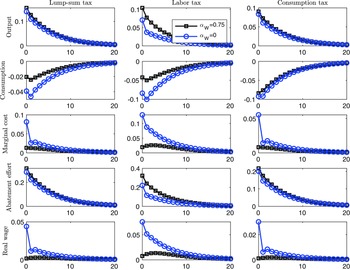
Figure 3 shows the impulse responses of the economy to a government spending shock under a carbon tax regime. The shock is modeled as a temporary increase in exogenous public consumption, financed through different fiscal instruments. In the baseline case, the government adjusts lump-sum transfers to satisfy its budget constraint. The increase in government spending raises aggregate demand, leading to an expansion in output and labor. This response is consistent with standard New Keynesian dynamics, where fiscal multipliers are positive in the presence of nominal rigidities (Christiano et al., Reference Christiano, Eichenbaum and Rebelo2011; Drautzburg and Uhlig, Reference Drautzburg and Uhlig2015).
Dynamic responses to a government spending shock under a carbon tax.
Note: Each column reports the dynamic paths for selected variables under different fiscal policy specifications. The blue line with circles represents the model with flexible wages, the black line with squares represents the extension with sticky wages. Horizontal axis displays the time which is measured in quarters. Vertical axis values refer to deviations from steady state in percentage.

The magnitude of the expansion depends critically on the degree of nominal rigidity. When both prices and wages are sticky (black line with squares), the fiscal multiplier is largest. Firms cannot adjust prices upward in response to higher demand, so they increase production and employment instead. Wage rigidity prevents nominal wages from rising, keeping real labor costs low and encouraging hiring (see also Figure http://doi.org/10.1017/S1365100525100424A.3). In contrast, when wages are flexible (blue line with circles), the real wage increases in response to higher labor demand, partially offsetting the expansion. This mechanism is embedded in the wage-setting equation, where the optimal wage reflects expected future labor disutility and consumption paths.
The increase in output also raises emissions, which in turn boosts environmental tax revenues. However, since the carbon tax is fixed, firms do not adjust their abatement effort, and the emissions intensity of output remains unchanged. As a result, the environmental externality worsens during the expansion, highlighting a potential trade-off between short-run stabilization and long-run environmental goals. The additional revenues are not sufficient to fully finance the increase in government spending, so lump-sum transfers must fall. This reduction in household income contributes to the observed decline in consumption, which is further exacerbated by the rise in the nominal interest rate. The Taylor rule responds aggressively to inflation, crowding out private demand and reinforcing the contraction in consumption (Leeper et al., Reference Leeper, Traum and Walker2017).
Figure 3 also explores alternative fiscal financing schemes. When the government uses labor income taxes, the expansionary effect is smaller than under lump-sum financing. This is because labor taxes increase after-tax wages, raising the marginal cost of labor and dampening the employment response. Moreover, increasing consumption taxes has a less favorable impact. It raises the effective price of consumption, discouraging demand and partially exacerbating the contractionary effects of monetary tightening. This result sheds light on the relevance of the tax instrument used to finance public spending. In line with the findings of Furlanetto (Reference Furlanetto2011), the model shows that fiscal multipliers are larger when financing is non-distortionary and when nominal rigidities are present.
4.3.2. Cap-and-trade policy
Figure 4 presents the impulse responses of the economy to a one percent increase in government spending under a cap-and-trade regime. As in the carbon tax case, the shock is modeled as a temporary increase in exogenous public consumption, financed through alternative fiscal instruments. However, the emissions constraint imposed by the cap introduces a distinct transmission mechanism that interacts with nominal rigidities and fiscal policy in important ways.
Dynamic responses to a government spending shock under a cap-and-trade system.
Note: Each column reports the dynamic paths for selected variables under different fiscal policy specifications. The blue line with circles represents the model with flexible wages, the black line with squares represents the extension with sticky wages. Horizontal axis displays the time which is measured in quarters. Vertical axis values refer to deviations from steady state in percentage.

The increase in government spending stimulates aggregate demand, raising output and labor. However, since emissions are fixed by the cap, firms cannot respond by increasing emissions. Instead, they must either purchase additional permits at a higher market price or intensify abatement efforts. This leads to an endogenous increase in the emissions price, which enters the marginal cost function and acts as a supply-side constraint (see also Figure http://doi.org/10.1017/S1365100525100424A.4). The resulting rise in marginal costs partially offsets the expansionary effects of the fiscal shock, especially when nominal rigidities are present. This mechanism is consistent with the findings of Annicchiarico and Diluiso (Reference Annicchiarico and Diluiso2017), who show that cap-and-trade systems can amplify the macroeconomic effects of cost shocks due to the endogenous adjustment of permit prices.
Nominal rigidities significantly shape the propagation of the shock. When both prices and wages are sticky (black line with squares), firms are unable to adjust nominal variables to accommodate the higher emissions price. This results in a larger increase in real marginal costs, compressing firm profits. Wage rigidity further exacerbates the downturn by preventing real wage adjustment, leading to a sharper decline in labor supply and consumption as emphasized by Blanchard and Galí (Reference Blanchard and Galí2007) and Christiano et al. (Reference Christiano, Eichenbaum and Rebelo2011).
The fiscal instrument used to finance the increase in government spending plays a critical role in shaping the macroeconomic response. Under lump-sum taxation, the expansionary effects are strongest, as the fiscal stimulus is not offset by distortionary tax increases. The weakest expansion occurs when consumption taxes are used to finance the spending increase. Higher consumption taxes raise the effective price of consumption goods, reducing household demand and amplifying their contractionary effects. This result again is consistent with the findings of Furlanetto (Reference Furlanetto2011) and Drautzburg and Uhlig (Reference Drautzburg and Uhlig2015).
5. Discussion and concluding remarks
This paper has examined the dynamic effects of environmental and fiscal policy shocks in a New Keynesian DSGE framework with nominal rigidities and alternative climate policy regimes. The analysis sheds light on the relevance of both the design of climate instruments—carbon taxes versus cap-and-trade—and the fiscal mechanisms used to recycle environmental revenues. I find that the macroeconomic consequences of climate policy are highly sensitive to the interaction between nominal frictions, fiscal policy design, and the nature of the shock. In particular, the presence of wage and price stickiness amplifies the real effects of both abatement cost and government spending shocks, underscoring the need to account for these frictions in climate-macro modeling.
A key insight from the results is that cap-and-trade systems, while equivalent to carbon taxes in steady state, generate more volatile responses to shocks due to the endogenous adjustment of permit prices. This feature makes cap-and-trade regimes more distortionary in the short run, especially when abatement cost uncertainty is high. In contrast, carbon taxes provide a more stable price signal and allow firms to adjust emissions more flexibly in response to shocks. These findings echo the classic “prices versus quantities” debate (Weitzman, Reference Weitzman1974) and suggest that the choice of climate instrument should be informed not only by long-run efficiency considerations but also by short-run macroeconomic stabilization concerns (Annicchiarico and Di Dio, Reference Annicchiarico and Di Dio2015; Roach, Reference Roach2021).
The analysis also provides strong support for the double dividend hypothesis. I show that recycling environmental revenues through reductions in distortionary taxes—particularly consumption taxes—can significantly mitigate the adverse effects of abatement cost shocks and enhance the expansionary effects of government spending. This result is robust across climate policy regimes and degrees of nominal rigidity. In line with Bovenberg and Goulder (Reference Bovenberg, Goulder, Bovenberg and Goulder2002) and Goulder (Reference Goulder2013), the findings suggest that well-designed fiscal recycling schemes can improve both environmental and economic outcomes. Moreover, the interaction between fiscal policy and nominal rigidities is particularly important: when prices are sticky, reducing consumption taxes provides a direct stimulus to demand, which is especially valuable in the presence of supply-side constraints.
From a policy perspective, the results yield several recommendations. First, policymakers should consider the macroeconomic stabilization properties of climate instruments when designing environmental policy. For instance, in contexts where abatement cost uncertainty is high and nominal rigidities are binding, carbon taxes may be preferable to cap-and-trade systems. Second, the use of environmental revenues should be explicitly integrated into fiscal policy design. Recycling revenues through reductions in consumption taxes can enhance the effectiveness of climate policy and support aggregate demand, particularly during downturns. Third, coordination between monetary and fiscal authorities is essential. When monetary policy is constrained, e.g., at the effective lower bound, fiscal instruments become even more critical for stabilization. In such cases, the countercyclical use of environmental revenues can serve as an automatic stabilizer. Finally, future research should explore the distributional implications of these policies, as the burden of environmental taxation and the benefits of revenue recycling may vary across households and sectors.
Supplementary material
The supplementary material for this article can be found at https://doi.org/10.1017/S1365100525100424.
Acknowledgements
I am grateful to the Associate Editor and the two anonymous reviewers for their careful readings and valuable recommendations. I am deeply indebted to Reyer Gerlagh and Sjak Smulders for their insightful comments and guidance. I also thank Margaret Insley, Roweno Heijmans, Samuel Okullo, Rick van der Ploeg, Lukas Tomberg, and the participants of the SEEDS Annual Workshop, SURED 2020, the 25th EAERE Annual Conference in Berlin, the 24th EAERE Annual Conference in Manchester, the 24th Spring Meeting of Young Economists in Brussels, and the GSS Seminar in Tilburg for their helpful feedback. All remaining errors are my own.
Competing interests
The author(s) declare none.




 Open access

