




Consider the following opera plot: two lovers living in a repressive feudal society on the edge of Europe must appeal to their overlord to secure their future together, but said overlord’s unrestrained desire for the bride and intention to invoke his right of prima nocta puts a blight on their marriage day. The lord’s lusty, androgynous serving boy attempts to help the lovers, but this travesti cupid is more harm than help. And then – all is lost and the lovers perish at the hands of the lord’s brutal enforcers. Pyotr Ilyich Tchaikovsky’s first fully realised opera has been dismissed by many critics as an unsuccessful, out-of-date attempt to graft Russian local colour onto Western European opera stylings.Footnote 1 Oprichnik’s title refers to the position created by tsar Ivan IV (known as ‘the Terrible’) in 1565. The oprichniki were a Muscovite praetorian guard who carried out a reign of terror against Ivan’s personal enemies for nearly a decade.Footnote 2 However, the opera’s libretto, which Tchaikovsky himself adapted from a drama by Ivan Lazhechnikov, has very little to do with violent statecraft and much more to do with the conventional woes of star-crossed lovers. A plot that could be characterised as The Marriage of Figaro – but tragic, but Russian – could hardly hold critics’ attention when placed alongside deep political psychodrama the likes of Boris Godunov, which, unfortunately for Tchaikovsky, premiered the very year he completed his Oprichnik (1872). Generations of critics and scholars have primarily looked at Oprichnik from this harsh vantage, writing about it in terms of ‘national content’ and comparing it unfavourably to the other ‘national’ operas of the 1870s; most give it only a paragraph or footnote. Even the few scholars who have written full essays on Oprichnik express puzzlement as to why the young cosmopolitan Tchaikovsky chose to write this opera on sixteenth-century Muscovite themes. I argue that a key detail is missing from these assessments: the opera’s author-composer and one of its major supporting characters (Ivan IV’s favourite Fyodor Basmanov) were both men who loved other men. Oprichnik can be effectively approached as a work engaged with gay and broader queer themes and whose structure and execution exemplify historic technologies of queer expression within a society where ‘same-sex’ relationships were officially disallowed but nonetheless pursued in life and explored in art.Footnote 3 With this perspective, I assert that Oprichnik ultimately offers a window into the creative process of reconciling the then-emerging concept of ‘homosexuality’ (gomoseksualizm)Footnote 4 with patriarchal Russian nationalism and monarchism – a process that reflects a central dynamic of Tchaikovsky’s personal and professional lives.
Tchaikovsky’s World(s)
Historical context is important to understanding Oprichnik from any perspective, including a queer one, and my reading is deeply indebted to the historiographical work of Tchaikovsky scholars Alexander Poznansky and Richard Taruskin. My analysis draws on Poznansky’s identification, based on a wide reading of sources (including memoirs, letters, erotica, scientific publications), of the coincidence of Tchaikovsky’s musical career with the decades in which ‘homosexuality’ began to be appreciated as something approaching an identity and a (sub)culture in Europe.Footnote 5 This process begins in the late 1860s with the appearance of the first medical reports on human sexuality, treating ‘homosexuality’ as a psychological condition rather than a behavioural phenomenon.Footnote 6 This epistemic shift did not lead to wider acceptance of same-sex relationships across Europe; indeed, in many areas it increased the fear and marginalisation of persons who came to be seen by scientific and legal authorities as pathologically deviant from the norm. However, it did set the stage for the articulation of identities and communities of sexual difference which would, decades later, become the foundations of liberational movements, and in the meantime would massively influence the aesthetic and philosophical currents of fin-de-siècle Europe.
The late 1860s were a meaningful time for men-loving men in Russia for another, more local reason: for the first time, censorship had relaxed enough to usher in a spate of theatrical depictions of the above-mentioned autocrat, Ivan the Terrible, who was alleged to have had both male and female lovers. Ivan IV (1530–84) was the first Grand Prince of Moscow to claim for himself the title ‘Tsar of All Russia’, extending the project of centralisation of power away from the feudal structure of regional lords begun by his forefathers in the fourteenth and fifteenth centuries. He became the most famous Russian ruler of the (first) era in which Moscow was the seat of state power. Western and Central European visitors to ‘Muscovy’Footnote 7 wrote many colourful accounts of a land they perceived as barbaric, and their descriptions would inform generations of historiographers, including Russian writers of the post-Petrine era.
The persistent feature of foreigners’ accounts of Muscovy that bears consideration here is a perceived social tolerance for sex between men, cited with disgust as an indication of the monstrous backwardness of this land. Beneath the exaggerated xenophobic moralising of statements such as versifier George Turberville’s memorable ‘Perhaps the Mausick hath a gay and gallant wife: / To serve his beastly lust, yet he will leade a bowgards life. / The monster more desires a boy within his bed / Than any wench, such filthy sinne ensues a drunken head’,Footnote 8 there may be an element of truth. In Muscovite Russia, sexual activity was primarily regulated by the Church and not the state, meaning that consensual homosexual practices which were punishable by imprisonment or even death in Western European countries such as England were there disciplined with prayer and fasting. Medieval Orthodox Christian canons did strictly forbid homosexual relations, but in terms no harsher than those forbidding all sexual activity that deviated from a narrow definition of sanctioned procreative activity begrudgingly tolerated by a Church which strongly favoured total abstinence. Men who had sex with men were equal in the eyes of the Church (and perhaps also society) to men who had sex with women outside of sanctified marriages.Footnote 9 Though the various accounts of sexual impropriety committed by the Muscovites and their leaders can generally not be verified, Ivan IV was a confirmed sexual apostate who broke with the Church over the issue of remarriage. Ivan’s fourth to seventh marriages were all unsanctioned by the Church, which permitted remarriage only under certain circumstances, including a limit of three marriages in one man’s life. Thus, contemporary accusations that Ivan committed the ‘sin of Sodom’ (sodomskii grekh) had a factual basis. Further extrapolations made from this point may not have a claim to verifiable truth, but their appeal to the popular imagination has proved enduringly resonant.
The first theatrical depiction of Ivan IV to be approved by the Russian Imperial censor belonged to Ivan Lazhechnikov’s tragedy Oprichnik, which had been written in 1834 and published in the journal Russian Word (Russkoe Slovo) in 1859, but barred from production until 1867.Footnote 10 Lazhechnikov’s play, which two years later became the source for Tchaikovsky’s libretto, makes a plot point out of the tsar’s excessive sexual appetite for young women, but leaves his rumoured taste for young men on the level of subtext. It’s a subtext that has plenty of room to breathe in the character of Ivan’s beautiful young cupbearer, Fyodor Basmanov, alleged to have been the Tsar’s lover. Their relationship was first mentioned in a polemical tract attributed to Ivan’s prominent political opponent Prince Andrei Kurbsky.Footnote 11 The allegation became a fixed feature of the tsar’s image in popular perception with the publication of Nikolai Karamzin’s authoritative A History of the Russian State in the early nineteenth century.Footnote 12
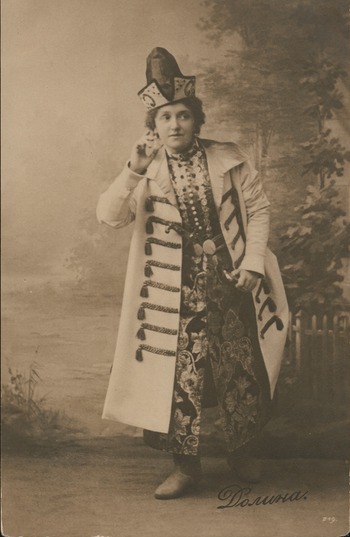
The creation of a role for Fyodor Basmanov on the Russian imperial stage opened a new avenue for exploring and depicting sexual difference. Tchaikovsky would take this path by casting Basmanov (Figure 1) as the ‘Cherubino’ type travesti character in a tragic Marriage of Figaro-style plot. The late nineteenth-century characterisations of gay men as a ‘third sex’ or ‘inverted’ feminine men, outdated though they may be, do fit the popular-historical image of Basmanov, who was rumoured to have used his ‘womanly’ beauty to charm the tsar, performing entertainments for him in female dress.
Photographic postcard of contralto Maria Dolina as Basmanov in Tchaikovsky’s Oprichnik, c.1897. Image courtesy of the author.

These rumours about Basmanov were explored extensively in the most popular historical novel of the nineteenth century concerning Ivan the Terrible, Alexei Konstantinovich Tolstoy’s Prince Serebryany (1862),Footnote 13 and were arguably present enough in the Russian popular imagination to provide any work depicting him with at least the potential for queer subtext. Here is how Basmanov is first introduced in Tolstoy’s novel:
One of the oprichniki in particular drew Serebryany’s attention. This was a young man of about twenty years, of unusual beauty, but with an unpleasant, impudent facial expression. He was dressed more richly than the others and, contrary to custom, wore his hair long, had no beard at all, and in his movements expressed a sort of womanly nonchalance.Footnote 14
Throughout the novel, a handful of characters reference Basmanov’s reputation for dancing in women’s clothes. Basmanov himself responds to the rumour cagily when the novel’s hero Serebryany brings it up during a heated encounter in the oprichnik’s tent the evening after the two meet on the battlefield fighting Tatars:
The more prurient rumour, of Basmanov’s sexual relations with the tsar, is never related in explicit terms, but is spoken around in such a manner as to make the unsaid quite clear to educated readers. Tolstoy employs a dramatic form of allegorical censorship to place intense meaning upon the unnamed ‘sin’ that Basmanov says he and the tsar committed together. Both times that Fyodor attempts to confess this ‘sin’ in the novel, he is violently silenced by other oprichniki.
Тhe second time, Fyodor is silenced forever.
Tolstoy spent over a decade writing and refining his novel, and when he finally submitted it to the journal Russian Herald (Russkii vestnik) for serial publication in 1862, it was with the stipulation that not a word be censored.Footnote 18 One may infer from this that he had reason to be concerned about censorship, but was, at this late point in his career, confident enough that he could get around it. His confidence may also have been boosted by the print publication of Lazhechnikov’s previously banned Oprichnik. Footnote 19
Lazhechnikov first attempted to publish his play in 1842, but it was fully rejected by the censor. Lazhechnikov writes in the foreword to an 1867 republication that he waited for ‘a more fortuitous time’ to resubmit his manuscript and made another attempt in 1859, this time successful.Footnote 20 A drama in blank verse in the mode of Shakespeare’s historical plays (some of which were published in Russian translation in the very same journal, Russian Word), Oprichnik is of a quite different genre than the novel Prince Serebryany, but the two have many similarities in plot structure and details relating to setting and character. Both centre a fictional and highly conventional doomed-love plot with Ivan and the oprichniki as menacing background figures taken straight from Karamzin’s History. Lazhechnikov does not include references to Fyodor Basmanov’s transgressive ‘womanliness’ and rumoured cross-dressing in Oprichnik, but he does include several references to the especial closeness of the Tsar and his current favourite (liubimets) that are certainly compatible with the version of their relationship presented in Prince Serebryany.
The 1867 staging of Oprichnik at the Maly Theatre in Moscow set a precedent for permitting stage depictions of Ivan and his reign, and a great many plays and operas on the subject appeared in the 1870s. The imperial censor’s decision to finally approve a staging of Lazhechnikov’s play did not give theatres carte blanche: the censor acted on a case-by-case basis, carefully scrutinising each potential performance of every work. Petitions for performance could be rejected for any number of reasons, and the political climate of the precise moment at which the submission was reviewed was as important a factor in the censor’s decision as anything in the work’s content. Possibly concerned about getting past the censor,Footnote 21 Tchaikovsky removed the character of Ivan IV in his condensed reworking of Lazhechnikov’s play into an opera libretto. Tchaikovsky also reduced the number of named oprichniki down to two, and they carry the function of speaking for the unseen tsar and metonymically representing his sovereign personality and will. The oprichnik who most directly embodies ‘The Terrible’s’ imperious persona is the austere Prince Vyazminsky (an alternate spelling of the surname belonging to a historical oprichnik, Prince Afanasy Vyazemsky), a commanding baritone who presides over the ceremony of induction into the oprichnina (an action carried out by Ivan himself in Lazhechnikov’s play). The other oprichnik is Fyodor Basmanov, who acts as the most direct ‘go-between’ for onstage characters and the offstage tsar. He has the special rank of cupbearer (kravchii), which puts him in closer personal contact with the tsar than any other oprichnik. Footnote 22 The analysis of queerness in the formal and thematic elements of the opera that I offer will focus on his character. But before I get to analysis of the text, I will round out the historical contextualisation of Oprichnik with a consideration of Tchaikovsky’s personal history in the years of its composition.
Tchaikovsky relocated from St Petersburg to Moscow in 1866 and took a teaching position at the Moscow Conservatory, which opened its doors later that year. Giving up the life of a popular St Petersburg dandy to launch a musical career in the less-cosmopolitan Moscow was a major move for the ambitious young composer. In letters, he discussed the move with his childhood friend Alexei Apukhtin, an openly gay poet whose verse would be immortalised in Tchaikovsky’s song arrangements.Footnote 23 Apukhtin teasingly berated Tchaikovsky for abandoning his Petersburg friends by comparing the move to Prince Kurbsky’s defection from the court of Ivan IV, specifically citing A.K. Tolstoy’s version of events in his poem ‘Vasily Shibanov’ (c.1848).Footnote 24
There are a great many potential ironies at play in this joke, the first being the fact that Tchaikovsky had ‘defected’ to Moscow, not from it. Tchaikovsky now lived in the Terrible tsar’s former capital, which was much changed since the sixteenth century but still considered a stronghold of ancient Russian culture. Tchaikovsky was evidently familiar enough with the Muscovy-centred historical fiction of A.K. Tolstoy for his close friend to include specific references to his work in letters. It is extremely plausible that he noticed the amusing parallels between his position as a professor at a newly formed conservatory, beloved and feared by his students, and Ivan’s position as authoritarian leader of the newly formed oprichnina surrounded by his zealous young oprichniki. Tchaikovsky was presumably also familiar with Fyodor Basmanov as he appears in A.K. Tolstoy’s work: a devilishly beautiful young military commander with a taste for bloodshed who provocatively affects the manners and grooming of a woman.
The Basmanov who appeared in Lazhechnikov’s Oprichnik was much more restrained than Tolstoy’s, both in terms of his bloodlust and his transgressive expressions of sexuality and gender. In Lazhechnikov’s markedly nineteenth century recreation of the oprichnina, Basmanov resembles a cruel dandy, perhaps a heartless, dashing officer in the mode of poet Mikhail Lermontov’s popular creation Pechorin.Footnote 25 In this contemporary, genteel Basmanov, Tchaikovsky could certainly have recognised aspects of people he knew personally. Of the many men in Tchaikovsky’s life, one troublesome young dandy was in fact directly involved in the composition of Oprichnik and played a significant role in shaping Tchaikovsky’s new Moscow social life: his student Count Vladimir Shilovsky. Tchaikovsky spent significant amounts of his time off from the conservatory living on his pupil’s vast estate, where he could work on his compositions, including Oprichnik, in seclusion. According to the account of the composer’s brother Modest, Tchaikovsky even included Shilovsky’s music in one of Oprichnik’s orchestral entr’actes. Footnote 26
Shilovsky and Tchaikovsky’s relationship extended beyond the pedagogical and musical: they had a lasting, if strained, friendship, complicated by Shilovsky’s tempestuous personality and frequent entanglement in homosexual intrigues of a more dramatic and transgressive nature than those of the socially conservative Tchaikovsky. Particularly scandalous was Shilovsky’s open involvement with men beneath his social class. In Tchaikovsky’s time, Russian aristocratic men were rarely brought before the law for engaging in consensual homosexual acts, but in the rare cases when they were, the transgression that earned punishment was often one that subverted additional social norms, such as discretion and conformity to the hierarchies of class and rank.Footnote 27
Shilovsky became one of Tchaikovsky’s guides to new social circles, including that which Poznansky terms the ‘Moscow homosexual mirok’,Footnote 28 a state-within-a-state populated by men who pursued sexual relationships and encounters that transgressed both gender and class lines, and who also sometimes transgressed gender norms in their own self-presentation. In his letters, Tchaikovsky mentions with a mixture of affection and approbation interactions with men who use stylistically feminised and grammatically feminine speech patterns and call each other ‘aunties’ (tyotki).Footnote 29 For all his professed distaste for this feminised affect and his consistent projection of a more traditionally masculine persona, Tchaikovsky did at least at times dabble in feminisation, especially in his letters to his gay younger brother Modest. There using female names and grammatical markers was both an entertaining game and a way of superficially disguising the true nature of some of his more unbecoming liaisons with sex workers and lower-class men in the likely event that his letters were read by the authorities.Footnote 30 And judging by the references in several letters to a certain memorable outing, Tchaikovsky did at least once, likely at Shilovsky’s instigation, attend a masked ball in woman’s dress.Footnote 31
In his new life in Moscow, Tchaikovsky was exposed to different modes of gender expression and sexuality than he had been in his aristocratic Petersburg bubble. Considering that Tchaikovsky composed Oprichnik in the midst of this heady experimentation, I assert that it may be insightfully read as a sort of experiment itself. Tchaikovsky would ultimately pronounce it a youthful failure – where else but in our youthful failures can we experiment so passionately with the mechanisms of our identities and desires?
Oprichnik the Opera and its Operatic Antecedents
Opera in Imperial Russia was a heavily restricted medium in terms of both official censorship and set public expectations, opera depicting the rule of a historical Russian monarch even more so. Tchaikovsky, however, was well on his way to becoming the future master of manipulating conventions and constraints. He also had at hand a variety of artistic techniques used to explore gender and sexual difference in societies where queerness was regulated to the margins in life and art.Footnote 32
Before discussing the opera, I will offer a brief plot summary to explain the role of Fyodor Basmanov to those unfamiliar with this little-performed work. Tchaikovsky’s libretto radically simplifies the plot of Lazhechnikov’s play, extracting from it a classic thwarted-love drama with a minimal number of characters. In the first act, the greedy Prince Zhemchuzhny (bass) finalises his contract with Molchan Mitkov (bass), a wealthy older man who has agreed to wed the prince’s daughter, Natalia (soprano), without dowry. Natalia had previously been engaged to Andrei Morozov (tenor), the son of a disgraced, deceased nobleman. Zhemchuzhny himself orchestrated the downfall of old Morozov and now the two families are mortal enemies. Act I ends in Natalia’s quarters, where she laments her imprisonment in a gilded cage and is comforted by her nurse (mezzo-soprano) and maids.
Act II begins with Basmanov (contralto) helping Morozov spy on Zhemchuzhny and Mitkov from behind the garden fence. Basmanov has been trying to convince Andrei to join the ranks of the oprichniki. Basmanov’s lusty paeon to the carnal pleasures available to the tsar’s enforcers in their copious leisure time washes over Andrei, who claims that he is becoming an oprichnik only to gain the power to avenge his family’s honour and force Zhemchuzhny to give Natalia back to him. Before they part, Basmanov gives Andrei a purse of silver and a friendly, pointed suggestion to take some time to enjoy freewheeling oprichnik life before settling down with his bride. Natalia hears the men as they leave her yard and pines to be reunited with her love, prompting her nurse and maids to perform more cheerful songs for her.
Act III consists of two ‘tableaux’ (kartiny). The first shows the impoverished Morozov home, where the widow Morozova (mezzo-soprano) weeps and prays for her son. Andrei returns and offers his mother Basmanov’s money, which she refuses in disgust out of hatred for the immoral oprichniki. Andrei convinces her to take the money by claiming it was honest money earned by Basmanov’s father in military service. She is still disturbed by the knowledge that her son has been with Basmanov, his ‘sworn brother’ from his time fighting in the tsar’s army. She begs her son not to abandon her for a life of violence and he decides to keep his plans a secret, leaving her with the vague declaration that he is going to restore his father’s honour.
The second ‘tableau’ shows the oprichnik court, where the ‘brothers’ of this blasphemous order are singing prayers. Basmanov enters their midst to tell them he has just been with the tsar, who, having accepted Andrei’s request to join the oprichniki, bids the highest-born oprichnik Prince Vyazminsky (baritone) oversee his formal induction. Vyazminsky balks at the order to swear in the son of a man who hated the oprichniki and the Vyazminsky family especially. Basmanov reminds him that the father Morozov is dead and bids him forgive the son. Vyazminsky complies rather than defy the tsar’s command, but Basmanov is wary and determines to keep an eye out for Andrei’s safety. He leads Andrei to his initiation, a dark ceremony in which the initiate must renounce all family ties and pledge to serve the tsar’s every command as slavishly and brutally as a dog – all while encircled by the drawn daggers of the witnessing oprichniki. Andrei falters at the thought of renouncing his mother and his betrothed, but Basmanov applies pressure and, when that fails, cries out ‘I vow!’ on Andrei’s behalf. This also fails, and the oprichniki prepare to execute Andrei if he doesn’t take the oath. Reluctantly, Andrei gives his vow to avoid being put to death and the oprichniki sing a triumphant hymn to the tsar.
Act III opens in a Moscow square, where people are lamenting the tsar’s abandonment of them.Footnote 33 Morozova enters the scene, on her way to church to pray for her wayward son. A crowd of boys teases her for being one of the damned oprichniki and she doesn’t have time to figure out why before Natalia rushes over, begging for protection from the father and suitor from whom she has just fled. Zhemchuzhny is not far behind, with an entourage of servants prepared to take Natalia by force. Just as they descend on her with rope, a band of oprichniki appear, Andrei among them. Natalia runs to Andrei, but Morozova rejects him and damns him to hell for becoming an oprichnik and bringing shame to their family. All those present react in horror to the mother’s furious disowning of her only son. Basmanov breaks the spell of dismay, reaching out to Andrei with the suggestion that they go to the tsar with a request to release him from oprichnik service.
Act IV depicts the wedding feast of Andrei and Natalia. Basmanov is seated at their table, reminding Andrei that his release from the ranks of oprichniki was set for midnight and his vow remains in effect until then. With that cryptic message, he leaves. Andrei is happy to keep partying with his oprichnik friends, but Natalia is uncomfortable among them. She senses disaster approaching. Basmanov returns in a panic and pulls Andrei aside to tell him that a terrible threat is upon them, triggered by Andrei’s decision to leave the oprichnina. Vyazminsky enters, come to destroy the happiness of his enemy’s son. He tells Andrei that the tsar has heard of his bride’s beauty and demands a private audience with her at once. Andrei is shocked at this invocation of jus primae noctis and vows that he would die before letting his bride be taken from his side. Basmanov attempts to intervene, begging Andrei to comply rather than die, but it is of no avail. Andrei is subdued by the oprichniki and sent to his execution while Natalia is taken away to the tsar’s bedchamber. Vyazminsky has the last, evil, laugh when he contrives to bring Morozova to watch her son’s execution. She dies of terror on the spot and the oprichniki reprise their hymn to the tsar as the curtain falls.
There are many angles from which one may approach queerness as a theme in this opera, but one stands out as particularly warranting an investigation it has heretofore not received in scholarly literature: the cross-gender casting of Fyodor Basmanov. His vocal part is written for contralto, thus making it one of the few ‘trouser roles’ (male parts sung by low-voiced women) in Russian opera, and the only one in Tchaikovsky’s operatic œuvre.Footnote 34 The composer played an active part in casting the premiere staging, discussing in letters to his publisher Vasily Bessel the suitability of various singers at the Mariinsky Theatre for roles.Footnote 35 The first singer cast as Basmanov was contralto Antonina Abarinova. Shortly before the premiere (she is still mentioned as the prospective Basmanov in a letter from 2 March and the premiere was 24 April), Abarinova fell ill. A contralto or mezzo-soprano with the abilities required for the role could not be found and a tenor, Vasily Mikhailovich Vasiliev, was brought in.Footnote 36 According to at least one account, given in a 1905 history of Russian opera by the critic Vsevolod Cheshikhin, the composer was greatly dissatisfied with the move, as ‘neither in voice, nor in appearance did the singer fit the description of the pampered, effeminate favourite of the tsar’.Footnote 37 Tchaikovsky hastily rewrote the part for tenor, but this version of the score did not survive long; in the next season and all subsequent performances, the original contralto part has been used and only one other male singer has ever appeared in the role, in a recent and abortive attempt by a Russian government official to enforce ‘traditional gender roles’.Footnote 38
There may be ample aesthetic and musical justification for Tchaikovsky’s creation of a contralto Basmanov, but the significance of making this particular historical figure a trouser role cannot be ignored. This creative decision deploys socially sanctioned theatrical cross-dressing to encode the popular perception of Basmanov as a transgressor of gender and sexual boundaries into the very structure of the opera in which he plays a secondary but highly visible role. While he only has one arioso,Footnote 39 he is the only secondary character who appears on stage in every act, and he manipulates the action through both his influence on Andrei and his access to the tsar.
The history of trouser roles in nineteenth-century Russian opera is brief enough to give an overview here, providing context for the aesthetic milieu in which Tchaikovsky created this role. The canon-defining first wave of ‘native’ Russian opera of the 1830s–40s that came from the pen of Mikhail Glinka brought forth two important mezzo trouser roles: the hero Ivan Susanin’s adopted son Vanya in A Life for the Tsar (1836) and the hero Ruslan’s rival-turned-ally, Khazar prince Ratmir, in Ruslan and Lyudmila (1842). Vanya and Ratmir were both supporting but relatively consequential and developed characters, and each of them established a different archetype for mezzo parts in Russian opera.Footnote 40
Vanya was the first Russian trouser role, and the popularity of the character co-created by Glinka and mezzo trailblazer Anna Petrova-Vorobyova proved the viability of this casting practice on the Russian stage. As such, Vanya may be considered a forerunner of Tchaikovsky’s Basmanov, though his function in the narrative is quite different. Vanya serves as a support to the hero Ivan Susanin, a peasant who gives his life to save the young new tsar Mikhail I from Polish invaders. While Susanin leads the would-be kidnappers of the tsar away from their target and deep into the forest, Vanya runs to warn the royal family. This trouser-role archetype – the virtuous but vulnerable young son-figure who supports the powerful patriarch hero – was very popular with audiences and composers after Glinka. Tchaikovsky’s Fyodor does bear some basic traits of Vanya’s lineage: both are young men in Muscovite Russia who passionately pledge themselves to the tsar’s service. But Fyodor is older, seasoned in battle and spoiled by the sensual pleasures enjoyed by the tsar’s men at their leisure. This particular path away from Vanya-like innocence brings him much closer in character to the other foundational Russian trouser role, from Glinka’s less successful second opera.
Richard Taruskin identifies Glinka’s Ratmir as an early avatar of a particular strain of Orientalism in Russian opera, an eastern other (here, a prince of the southeastern Khazar kingdom) inclined towards sensual pleasures, femininity and above all nega, a sort of tender bliss identified by Taruskin as ‘a prime attribute of the orient as imagined by Russians’.Footnote 41 Ratmir is lured from the quest to rescue Lyudmila by enchanting nymphs in the service of the evil sorceress Naina. Ratmir, homesick for his harem, gives himself to the nymphs, becoming a willing prisoner of Naina’s magic garden of nega. He invites the hero Ruslan to do likewise, but of course the honourable Kievan (i.e. proto-Russian)Footnote 42 knight remains steadfast in his quest and faithful to his betrothed Lyudmila. Ratmir is redeemed when he eventually follows Ruslan’s example and returns to the warrior’s path to pursue action, valour and monogamy.
Though the plots and styles of the two operas are quite different, Tchaikovsky’s Basmanov plays a similar role in his relationship to the hero of Oprichnik, the disgraced but still honourable young nobleman Andrei Morozov, as Ratmir does to Ruslan. He is something of an ally and something of a sinful tempter. Like Ratmir, Basmanov is an elite warrior, but too morally dissipated to be a properly helpful companion to a valorous hero; he exhorts his comrade-in-arms to forsake his noble aims and promised bride to join him in the pursuit of wanton sensual pleasures. Basmanov belongs to noble Russian lineage, but there may be said to be a latent strain of Orientalism in his characterisation. As the hedonistic, effeminate servant and implied homosexual concubine of an autocratic tyrant, he represents aspects of Russian history and culture considered barbaric and ‘oriental’ from a latter-day ‘westernised’ perspective.
Russian artists of Tchaikovsky’s western training were uniquely positioned to turn Europe’s exotifying eastward gaze inward.Footnote 43 This dynamic of internalised orientalism can be identified as one of the cultural forces that shaped Oprichnik. It is most clearly spelled out in the denouement of the opera. When Morozov realises just why the tsar is summoning his newlywed bride for a private audience, his indignant response is ‘We do not live in heathen lands’ (‘Ne v basurmanskom zemle zhivem’ – the word basurman being an archaic epithet for followers of religions other than Eastern Orthodoxy, often used for Islamic peoples to the south and east of Rus′).Footnote 44 Tchaikovsky did not explore orientalist themes in his music as extensively or seriously as many other nineteenth- and twentieth-century Russian composers, but such stereotypes were certainly part of his imagination, especially during his early Moscow years. An intimate letter penned in 1871 to his friend Ivan Klimenko suggests that the connection between the imagined ‘oriental’ and perceived sexual and gender deviance was something with which Tchaikovsky, like so many queer European artists, playfully self-identified. In this letter, he casts himself as a ‘voluptuous Sultan’ and Klimenko as ‘the most beloved of the concubines of my harem, […] Klimena’.Footnote 45
It would be amiss to discuss only the Russian precedents for the Basmanov trouser role given both the massive popularity of western (particularly Italian) opera on Imperial Russian stages and Tchaikovsky’s own close engagement with the modes and stylings of this tradition in his own operas. In particular, his closeness to Mozart bears consideration.Footnote 46 Given this well-established musical lineage and the uncanny similarity between the plots of Oprichnik and The Marriage of Figaro, Basmanov may be considered as much a descendent of Cherubino as of Ratmir.
This comparison too has its limits. Basmanov’s position as cupbearer and leading oprichnik is significantly higher than that of a mere page such as Cherubino, but then again, his lord is not simply a local duke, but the Tsar of All Russia. Regardless, the theatrical archetype is very much the same: the beautiful, androgynous youthFootnote 47 in a high-ranking service position to the central figure of patriarchal authority. He acts as a go-between for the lover-protagonists and this authority, and his overflowing, undefined sexuality has effects on both parties (as well as on the audience, we may presume). Existing under significant censorial constraints and in the genre of ‘serious’ tragedy, Basmanov’s sexuality is confined to subtext – and intertext. As Basmanov was an infamous historical figure whose sexual transgressions were noted in both the major historiographic texts and popular historical fiction of the time, Tchaikovsky could easily have expected the decently well-read members of his audience to fill in the blanks. Making Basmanov a trouser role of the recognisable ‘beautiful, impetuous serving-boy’ type may well have served as an additional hint at his transgressive sexuality and indeterminate gender to those in the audience more familiar with Italian and French opera than Russian history.Footnote 48
The most salient instantiation of Basmanov’s transgressions left unmentioned in Oprichnik, but discussed in historiographic and popular texts and hinted at through his similarity to Mozart’s Cherubino, is his cross-dressing. Ivan IV was famed for his love of dancing and theatrical entertainments – indeed, this was a major point of criticism voiced by his detractors. It is in this context that rumours first appeared about how the tsar’s erstwhile favourite Fyodor Basmanov danced for or even with him in female dress. This legend found its place among the many that ‘the Terrible’ accrued during and after his reign, and would have been familiar to a Russian audience in the 1870s from Prince Serebryany. Censorship of the stage was stricter than that of literature in nineteenth-century Russia, and mentioning, let alone showing, the tsar’s favourite oprichnik dancing in women’s dress would have been unthinkable. However, given the conventionality of casting women in the roles of young men, especially in opera where vocal range was the main determining factor of one’s fitness for a role, it was entirely possible for a cross-dressing Fyodor Basmanov to grace the Imperial stage in inverted form, with a woman dressed up as the man rumoured to dress up as a woman. This complex recursion of gender-performance-transgressions has a well-known precedent in Cherubino, who dresses up as a woman in order to lure his master into a self-incriminating assignation. Given Tchaikovsky’s deep affinity for Mozart, or simply the fact that he wrote a Russian-language translation of the text of Figaro for his conservatory students to perform in the same years he was writing and composing Oprichnik, it is more than likely that Tchaikovsky saw in Basmanov a dark version of Cherubino.Footnote 49 And he pushed his characterisation as far in that direction as he was able to within the confines of censorship (perhaps too far: the composer was forced to rewrite a key passage, as I will discuss below).
On a more subtle, narrative level, Tchaikovsky creates imaginative space for Basmanov’s queerness by working him into a framework of situational and moral doubles that call attention to his gender and sexual difference. As previously mentioned, in Tchaikovsky’s libretto Basmanov and Prince Vyazminsky are the only oprichniki with named roles. They are diametrically opposed in their relationship to the hero Morozov: Basmanov plays the role of ally and intercessor, motivated by friendship, and Vyazminsky plays the role of adversary, driven by a grudge against Morozov’s deceased father. They are also extreme foils in terms of male-gendered types in operatic tradition. Basmanov’s androgynous, teasing alto seems all the more marked next to Vyazminsky’s menacing, patriarchal baritone. In nineteenth-century historical fiction, Vyazminsky (Vyazemsky) and Basmanov also appear as representations of two extremes on an imagined male sexual spectrum. Vyazminsky is aggressively, excessively, heterosexual, a vicious abuser of women; Basmanov is excessively homosexual, in nineteenth-century terms an ‘invert’ who loves men and has a feminine affect.Footnote 50
The doubling of Basmanov takes on deeper and more potently queer meaning when the pairing crosses gender lines. The narrative and musical structure of Oprichnik is such that Basmanov acts as a double/foil to each of the two principle female characters. In narrative terms, the opera is, as critics have noted, extremely conventional in its plot, which positions the dynamic heroes between binarily opposed static forces. The heroes are the typical young man and young woman in love; their union is opposed by the woman’s father, who has recently promised her to a richer suitor. The father and suitor represent one line of force on the lover-heroes, one that is oppositional to their desires, but supportive to the social and moral expectations of the setting.Footnote 51 Both representatives of patriarchal tradition are archetypical overbearing basses.
The main conflict, however, takes place between forces that act on Morozov alone: his mother who forbids him to join the oprichniki, and his oprichnik friend who pressures him to enlist. The oppositional pairing of Morozova and Basmanov in the narrative sets up a potential for them to serve as doubles of each other, and this potential is supported musically by the similarity between their voices. The great difference in their personalities is reflected in the contrast between their style of singing, but their ranges are so close that many nineteenth-century Russian mezzos who sang one part in the opera’s heyday had experience in the other as well.Footnote 52
Morozova and Basmanov do not interact with each other directly. They appear on stage together only once, in the final scenes of Act III, where Andrei’s internal conflict over joining the oprichniki turns into a physical confrontation. In scene 5, Morozova is teased by children in a town square who seem to know that her son has just become an oprichnik;Footnote 53 in scene 6, a gang of oprichniki approach the square, Andrei among them. Andrei’s attempts to placate his distraught mother come to naught; she disowns and damns him. Basmanov is among the oprichniki present at this drama and while he does not speak directly to Morozova, he observes her rejection of Andrei with concern as one of the voices in the powerful quartet (Basmanov, Zhemchuzhny, Andrei and Natalia) that becomes the climactic moment of Act III.
Basmanov’s negative judgement on Morozova’s action, made out of concern for Andrei, faintly recalls an earlier, crucial moment in the conflict between mother and son in which Morozova passes judgement on Basmanov, informed by the lurid rumours that surround his close relationship with the tsar (Act II tableau 1 scene 2). Morozova’s lines provide the only external characterisation of Basmanov voiced on stage and are thus crucial to understanding his character. That this characterisation should be given by Morozova, the other major mezzo role, establishes a subtle, aurally imbedded link between the two characters.
To a lesser but still significant extent, Basmanov also appears as a double of Natalia. Morozov, Basmanov and Natalia are the only named characters of their generation; all the remaining characters are their parents’ contemporaries and much of the conflict in the opera is generational, with Natalia and Morozov struggling against the feudal patriarchal tradition that robs Natalia (and by extension Morozov) of sexual agency. In nineteenth-century European opera tradition, such a grouping of young people (tenor, soprano, mezzo) would conventionally portray a love-triangle with two women, the lower-voiced one being the soprano’s unsuccessful rival. In Oprichnik, however, the mezzo is the tenor’s close male friend en travesti. Their relationship as krestovye brat′ia Footnote 57 suggests a certain intimacy and the homoerotic implications of such a close bond forged in the high-stakes homosocial context of war are brought to the fore in the first scene in which the two are alone on stage together. This scene (Act I scene 4) features Basmanov’s arioso, the text of which was the main site of conflict between Tchaikovsky and the Imperial censor. In the arioso, Basmanov lauds Morozov’s decision to become an oprichnik by expounding on the pleasures of oprichnik life. The text is Tchaikovsky’s own reworking of lines spoken by Basmanov in Lazhechnikov’s play, in a scene in which Basmanov invites his friend to take his pick from the ‘drove of [female] beauties’ (tabun krasavits) available to the oprichniki at court.Footnote 58 This scene may be clearly read as a ‘homoerotic triangle’ in which a man offers sex to another man through an absent woman intermediary.Footnote 59
Tchaikovsky takes this scenario even further from the pretence of heterosexuality by obfuscating the gender of the proffered sexual intermediary. The arioso begins with Basmanov singing a couplet that hangs in the air as a recruitment slogan for the oprichnina.
The oprichnik’s lusty motto with the words ‘by night, a [female] beauty’ (chto noch′ – krasavitsa) being sung solo by a mezzo en travesti, gives it a very different feel than it had in the traditionally masculine low-voiced chorus. The music pauses and we may linger on the irony and ambiguity of the trick here (just who is the ‘beauty’? – is she not here on the stage in male disguise?) for just a moment before sweeping strings usher in Basmanov’s real solo, a lilting, drawn-out crescendo whose text goes beyond the implicitly androgynous innuendo of the previous lines, reaching towards a total liberation from gender markers.
The text is adapted from Lazhechnikov’s original, which also has Basmanov tempt Andrei with a litany of enticing characteristics of lovers he might take as an oprichnik. The list includes virtually the same items, but in Lazhechnikov’s version, they are more clearly grammatically anchored to the preceding noun krasavitsa, which refers to a female beauty.Footnote 63 In Tchaikovsky’s version, the referential noun recedes, and along with it the explicit specification of the hypothetical lover’s gender as female. In this poetically obtuse diction, there are simply no clear grammatical identifications of the gender of the sexual partners that Basmanov describes in hypothetical scenarios emphasising the freedom of choice available to the privileged oprichniki. Footnote 64 The two words that do carry a cultural-semiotic implication of gender – kosa (braid) and rusalka (mermaid) – are external to the imaginary lovers, free-floating nominal signifiers of the feminine that could be taken on by persons of any gender.
This fantasy of sexual indulgence unfettered by either the strict Orthodox laws of monogamous heterosexual marriage or grammatically imposed gender markers is precisely what the censor demanded Tchaikovsky rewrite. In a letter to Bessel in dated 25 March 1873, Tchaikovsky laments the censor’s decision and offers up new lines mostly about the pleasures of drinking, with only the tiniest hint of sexuality confined to the ‘voluptuous, wondrous dream’ that comes to an oprichnik after a day of alcohol-soaked feasting.
Tchaikovsky apparently wrote the new lines in such a slap-dash fashion that they did not align well with the music, creating difficulty for performers. Some productions, notably the two versions recorded in the Soviet Union by the All-Union Radio Symphony in 1948 and 1980, substituted different newly written texts that fit the music better – but still steered clear of the original’s sexual themes. Other productions, such as the small handful of post-Soviet Russian stagings, have restored Tchaikovsky’s original text to its place.Footnote 66
Though Basmanov’s arioso appears to have been the only portion of the libretto Tchaikovsky was forced to fully rewrite, Oprichnik overall would have other troubles with censorship throughout its performance history. Keeping within the limited scope of the current essay, I will mention only one incident, from within the composer’s lifetime. An 1880 production was cancelled during rehearsals; Tchaikovsky wrote in a letter to his patroness Nadezhda Von Meck that ‘they banned it because they found the plot too revolutionary for the current time’.Footnote 67 There seems a certain irony in Tchaikovsky’s tone, and certainly the situation is ironic given the composer’s conservative tsarist politics and personal closeness to the royal family.Footnote 68 It would take a high level of either imagination or paranoia to read Oprichnik as revolutionary. Yes, a Russian monarch is characterised as violent, repressive and sinful, but his legitimacy as a divinely ordained hereditary monarch is never questioned. The repeated invocation of storm imagery throughout the libretto as a metaphor for the tsar recognises his authority as a natural force. His laws are inevitable and immutable; their cruelness and immorality do not change that. Two choruses describing the tsar, juxtaposed on either side of an entr’acte, are especially illustrative of this dynamic. The first is sung by the oprichniki after the completion of Morozov’s initiation ceremony (Act II tableau 2 scene 2):
The chorus that follows the entr’acte is sung by the people of Moscow (Act III scene 1):
Тhese characterisations of the tsar – formidable and implacable, willed by God and obeyed by the people – are fully in line with a tsarist worldview. The apologist line from the sixteenth century to the present has been that Ivan IV’s brutal use of state terror was necessary to unite and strengthen the divided and besieged Russian lands. The excessive suffering of the innocent heroes of Oprichnik, sympathetically conveyed in a lush, romantic musical idiom replete with ornamental flourishes and flights of fantastic lyricism, might invite the audience to question that line, to ask just how much brutality should be excused in the name of nation-building. However, the opera does not suggest an answer to this questioning. It ends with the curtain slowly falling to the sound of the oprichniki singing their praise chorus, and it is incumbent on the staging to either sell or undermine the glorification of the tsar.Footnote 71
Oprichnik offers those who would stage it a variety of ways to reflect on the act of submission to authority. It is neither a psychologically deep nor historically realistic work in the idolised canonical mode of nineteenth-century Russian opera. It is, as its detractors claimed, more comparable to earlier Western forms of opera that do not attempt to ‘overcome’ the artificiality of the medium, but instead take aesthetic and creative pleasure in that artifice. Of the many pleasures to be found in the conscious use of artifice, gender play is timeless and preeminent, a crucial tool of expression for artists and communities marginalised along the artificially drawn lines of gender and sex. Tchaikovsky’s Oprichnik is most remarkable for its deft use of gender play and other methods of queer expression within a work that revolves around a key figure of the Russian national mythos whose stage depictions were subject to intense scrutiny by state censors. Alexander Poznansky wrote of Oprichnik that in it Tchaikovsky ‘attempted to combine the Russian national tradition of Glinka with the Romantic methods and principles of Meyerbeer. From the very beginning, […] he sensed the contradictory character of this conflation and the incompatibility of the whole project with the nature of his own creative strengths. A new operatic vision, at once Russian and European, embodied in such masterpieces as Eugene Onegin and The Queen of Spades, was as yet several years away.’Footnote 72 I do not disagree with this summation, but I assert that it stops short of making a crucial observation in a broader context: what may amount to a troubled premature experiment in Tchaikovsky’s career emerges in time as a forerunner to major endeavours of the heavily queer Russian high art world of the 1890s–1910s.
Tchaikovsky’s trial combination of Western European Neo-Classical and Romantic techniques and aesthetics with early modern history, Slavic folkways, homoeroticism and gender play anticipates the very tendencies that would come to define the Russian ‘Silver Age’. The provocative alignment of primordial, pre-Petrine ‘Russianness’ with sexual and gender diversity beyond the contemporary, ‘civilised’ European norm staged in Oprichnik resonates strongly with artistic statements later made by influential (and openly queer) figures of the Modernist era such as Mikhail Kuzmin, Zinaida Gippius, Vyacheslav Ivanov and Lydia Zinovyeva-Annibal, to name only a few from a large and productive milieu. It is surely no coincidence that the 1890s–1910s was this opera’s most successful period, with numerous new stagings mounted in various theatres across several major cities of the Empire. It was, indeed, a frequent feature of the Russian stage during the decades in which many among the next two generations of artistic innovators and cultural emissaries were working at or attending the theatre.Footnote 73 One might say this work, undervalued by its composer and his critics, finally found its most appreciative audience in this era of fervent and increasingly open exploration of sexuality and gender in the scheme of Russian ‘otherness’ in art.
Despite its high profile in this era which saw Russian opera gain global popularity, aided by the efforts of queer Modernist cultural emissaries such as Sergei Diaghilev, Oprichnik never quite attained an international appreciation. Only two documented professional performances have ever taken place outside the former Russian Empire, and only one of these (Teatro Lirico di Cagliari, 2003) was a full staging (the other was a concert performance at the Edinburgh International Festival in 1992). Oprichnik remains a work of great potential for revisitation by both scholars and artists. The present study, performed by a scholar with a literary rather than musical background, and who specialises in the twentieth century and not the nineteenth, was limited to a narrow purview of analysis, seeking to fill the most glaring gap in the literature on this opera – an examination of Fyodor Basmanov as a queer character envisioned by a queer artist. This discussion was made unfortunately timely by the criminalisation of public discussion of ‘non-traditional’ sexual orientations and personal association with ‘LGBT’ identities enacted by Russian legislation in 2023. In this century when Tchaikovsky emphatically belongs to the public domain of world culture, one state’s homophobic government cannot exclusively control the destiny of his queerest opera.

 Open access

