

1 Overview
South(ern) African politicians increasingly treat judicial dissents as signs of factionalism on the bench (e.g. Taylor Reference Taylor2021). ‘Activist’ judges, meanwhile, celebrate them as badges of judicial independence (e.g. Dingake Reference Dingake2020, pp. 52–62, 248; generally Entrikin Reference Entrikin2019). This article, however, combines new interview and statistical evidence to argue that dissenting patterns are best explained by transforming judicial cultures shaping institutional arrangements.
Much political science has long doubted the capacity of judicial ‘activism’ to explain dissent. An ‘attitudinalist’ view holds that in fact dissent varies with ideological distance between presiding judges (famously, Segal and Spaeth Reference Segal and Spaeth2002).Footnote 1 Political alignment, not legal agreement, produces unanimity. These attitudinalists accept, however, that institutional rules matter. Large judicial panels, most obviously, increase scope for disagreement. Security of tenure and docket control, meanwhile, help grant the ‘life-tenured justices of the US Supreme Court … freedom to … further their personal policy preferences’ (Segal and Champlin Reference Segal, Champlin, Howard and Randazzo2017, pp. 19–20).
Related ‘institutionalist’ views emphasise a wider range of formal and informal rules (famously, Hall and Brace Reference Hall and Brace1989). Many examine ‘dissent avoidance’, assuming courts suffer reputational damage when judges disagree. Voting in sequence, for example, allows the last judges to avoid dissents when outcomes are already obvious (de Mendonça Lopes Reference de Mendonça Lopes2019). Meanwhile, rules that grant court leaders discretion over the composition of panels and the writing of opinions can allow them to engineer unanimity (Brace and Hall Reference Brace and Hall1990, pp. 58–59). Perhaps the most important of all institutional constraints, however, is case-load. Below constitutional courts, that is, most judges have little time for writing dissents. Adding to colleagues’ workload by obliging them to respond to a minority opinion makes judges unpopular (Epstein et al. Reference Epstein2011).
This article presents evidence from Southern Africa that broadly supports this ‘institutionalist’ view. It compares regional appeal courts, identifying a dissenting trend compatible with explanations emphasising case-loads and institutional rules. Judicial philosophies, political attitudes and security of tenure do not explain it so well. My central claim, however, is that an adequate account of Southern African dissent requires an understanding of the plural and fast-changing culture of the region’s senior judiciary. This culture indirectly explains the frequency of minority judgments. It accounts for why certain institutional rules are as they are, why some forms of dissent have proved contentious and others not and why styles of adjudication favouring dissent in certain areas (such as contract law) have aroused particular hostility. It may not be enough, in other words, to adopt the political science approach of simply looking for ‘consensual norms’ on a court (e.g. Haynie Reference Haynie2003, pp. 73–75). These norms may apply differently across legal areas and to different forms of dissent.
Even institutionalists do in fact tacitly concede the need for more ethnography. Garoupa et al. (Reference Garoupa2012, pp. 804–805), for example, note that a ‘collegial working environment with a culture of dissent avoidance’ is a particularly important feature of the Spanish Supreme Court. But they do not actually analyse this culture. Instead they lump it together with rules and arrangements under the umbrella term ‘institution’, and conflate it with ‘judicial demeanor in the civil-law tradition’ more broadly (compare Mendonça Lopes (Reference de Mendonça Lopes2019, p. 937). In Southern Africa, however, legal traditions tell us little about dissenting norms. This is not simply a function of the region’s complex blend of Roman-Dutch, customary and common law. As sketched below, it is instead the transition from apartheid that has produced diverging judicial cultures.
2 Context: a transforming judicial cultureFootnote 2
A shared senior judiciary is a lesser-known legacy of imperial and apartheid rule in Southern Africa’s smallest states. During late colonialism the British Empire created a common Appeal Court for its High Commission Territories (HCTs). With decolonisation in the mid-1960s these became Botswana, Lesotho and Swaziland (renamed Eswatini in 2018). After independence they created their own appeal courts. These, however, remained part-time institutions sharing judges. Most appointees were eminent, relatively liberal South African retirees.Footnote 3 In the early 1980s Botswana began following East African practice and also appointing from other Commonwealth jurisdictions. Unlike many other Anglophone African countries, the former HCTs did not create new or expanded apex courts with constitutional competence after 1989.
During apartheid, meanwhile, Namibia was effectively incorporated into South Africa as its so-called ‘fifth province’. South African judges have therefore also sat on its highest court.Footnote 4 At independence in 1990 Namibia adopted a notably progressive Bill of Rights (Ellmann Reference Ellmann2019, pp. 374–84). But its new judicial institutions were more akin to those of the former HCTs than what would become the post-Cold War norm. Its new Judicial Service Commission was, like those of its neighbours, small. It had only five members, and its Supreme Court a coram of only three (Garoupa and Ginsburg Reference Garoupa and Ginsburg2015, pp. 203–206). These institutional similarities and shared personnel make it possible to analyse Botswana, Lesotho, Namibia and Swaziland/Eswatini collectively as ‘BLNS’: a label originally designed to capture their incorporation into South Africa’s economic periphery.
In South Africa itself, by contrast, apartheid’s demise transformed judicial culture and institutions. The claim that South Africa upheld rule of law standards had been central to apartheid ideology and propaganda. This allowed liberal lawyers and organisations space to oppose government on its own terms if they adopted strict legalist postures (Abel Reference Abel1995). An impersonal formalism thus became central to the profession’s self-image. This, of course, did little to legitimate the law for the Black majority. Most judges were recruited from the ranks of practising advocates via an opaque ‘soundings’ process similar to that operating in England and Wales – in 1990 all South African judges were White and all but two were male (Corder Reference Corder and Phun2011, pp. 97–98). Meanwhile, draconian security legislation in the 1980s had helped make the Appellate Division, in Bloemfontein/Mangaung, synonymous with legalised racial oppression (e.g. Abel Reference Abel1995, p. 17).
The late 1980s saw new attitudes toward courts within opposition forces. Some African National Congress (ANC) and (allied) Communist Party intellectuals began arguing that human rights could make law a tool for social change. During the negotiations ending apartheid (1990–94) the ANC eventually accepted property rights and the continuity of legal order (Klug Reference Klug2000, pp. 81–85). It insisted, however, on new jurisprudence, new judges and a new court. In the teeth of fierce opposition from the judiciary, the Bill of Rights was eventually applied ‘vertically’ and ‘horizontally’, governing relations between private parties (for the rest of this paragraph, Spitz and Chaskalson Reference Spitz and Chaskalson2000, pp. 268–300). Declaring the constitution’s supremacy over the common law was intended to end ‘privatised apartheid’. Section 39(2) thus stipulated that ‘when developing the common law … every court … must promote the spirit, purport and objects of the Bill of Rights’. The Chief Justice denounced these interpretation clauses as a ‘wretched idea which ignored the skills of the South African bench’.
These changes would be implemented by a new Constitutional Court (ZACC) in Johannesburg, built on the site of a prison that once housed Gandhi and Mandela. The ZACC initially had only constitutional competence, leaving the old Appellate Division – soon renamed the Supreme Court of Appeal (SCA) – as the apex court in other matters. This was intended to prevent the ZACC from becoming ‘simply … an extension of the existing judiciary’ (O’Malley Reference O’Malley1993). An unusually large (in international terms) Judicial Service Commission (twenty-five members), with an equally unusual majority of political appointees, was charged with the ‘transformation of the judiciary’: ensuring that appointees reflected South African society in racial and gender terms, and embraced the new constitution’s progressive outlook (Garoupa and Ginsburg Reference Garoupa and Ginsburg2015, pp. 203–206).Footnote 5 The first ZACC appointments included academics with no courtroom experience (for details Corder Reference Corder and Phun2011). A spectacular new building reflected the new judicial culture. Huge glass windows symbolised transparency. Mechanisms for establishing social distance and impersonality were undermined. Justices were no longer referred to as ‘My Lord’ or ‘My Lady’, and they shared (unisex) toilets with staff. Counsel addressed them at eye level during oral argument (Bizos Reference Bizos2007, p. 523; Ellmann Reference Ellmann2019, pp. 442–44; Moseneke Reference Moseneke2020, pp. 83–86). One Chief Justice created controversy simply by working on an old wooden desk (Johnson Reference Johnson2019).Footnote 6
That this new institutional culture would have consequences for patterns of judicial dissent was evident from the ZACC’s first case. S v. Makwanyane (1995) found the death penalty incompatible with the Bill of Rights.Footnote 7 As would become commonplace, the case was heard by all eleven justices sitting en banc. The SCA, by contrast, hears cases in panels of three or five. This striking design feature of the ZACC was aimed at breaking with the impersonal formality of the apartheid era. Large panels would bring a wide variety of lived experiences to bear on constitutional questions (Constitutional Court Oral History Project 2011a, p. 13; Meiring Reference Meiring and Meiring2017). Makwanyane illustrated this: all eleven justices wrote judgments, reaching the same conclusion via a conspicuously wide variety of jurisprudential routes (Bizos Reference Bizos2007, pp. 522–40). As we shall see, it is separate judgments of this kind – which appear to reflect idiosyncratic interpretations of broad constitutional values, rather than disagreements about specific points of law or fundamental principle – that have proved so controversial in the old judicial culture. Dissent per se has not been so discouraged.
The effects of this cultural shift are now felt within BLNS. 2005–15 saw the late but sudden ‘localisation’ of the region’s senior judiciary. Retired expatriate judges from other Commonwealth jurisdictions had previously dominated. South Africans were easily the best represented across the region as a whole, but Ghanaians and Scots were particularly numerous on Botswana’s Court of Appeal, and Zambians and Zimbabweans were often appointed to Namibia’s Supreme Court. Judges continue to circulate to an extent unparalleled elsewhere outside small island regions (compare Dixon and Jackson Reference Dixon and Jackson2019). But since 2014/15 local judges have been likely to form the majority on every court. Since 2016 most new acting appointments from South Africa were female justices appointed early to the ZACC but then subsequently forced to retire before age sixty after an extended fifteen-year term.Footnote 8 Most were from unconventional academic backgrounds. The ‘old boys club’ of SCA retirees is thus no more (see below). And as we shall see, some of the new generation of BLNS appellate judges appear to have very different attitudes toward dissent.
3 Method
Studying a system where judges circulate between courts allows us to test whether particular judicial philosophies favour dissent. Assuming that philosophies do not change when judges cross borders, we can hope to observe the effect of varying case-loads and institutional arrangements (at least in the absence of marked ideological disagreement). With my research assistant, Maryam Nahhal, I assembled a database of 2,340 decisions handed down between 1990 and 2019 and uploaded to the Southern African Legal Information Institute (SAFLII) database. This includes all rulings by the Namibian Supreme Court and Botswanan Court of Appeal uploaded for 1990–2019, and all those by the Supreme Court of Swaziland/Eswatini and Court of Appeal in Lesotho uploaded for 2005–19.Footnote 9 These dates allow us to observe the consequences of ‘localisation’ in every jurisdiction. We have recorded the names of judges, dissents and separate concurrences, basic subject matter (criminal or civil appeal) and panel sizes. These are core categories in the South African Journal of Human Rights’ (SAJHR) annual ZACC statistics, emulating those collected for the US Supreme Court by the Harvard Law Review.
These numbers must, however, be treated with great caution. Overall, using SAFLII improves on similar previous projects. Haynie et al. (Reference Haynie2007) used law reports for a rich database of decisions by other regional appeal courts: the SCA (1970–2000) and Supreme Courts of Zambia (1973–97) and Zimbabwe (1989–2000). But BLNS law reports only capture a small, unrepresentative proportion of appeal court activity. Both writing judges and law reporters must typically consider the judgment significant for legal development. This criterion favours cases where existing law is unsettled and dissent therefore more likely.Footnote 10 SAFLII, by contrast, is maintained by volunteers simply attempting to record all decisions. It only lacks decisions entirely from one jurisdiction (Botswana), for five years.Footnote 11 The law reports, by contrast, have over forty such years across all jurisdictions.Footnote 12 Yet just one of SAFLII’s years with missing judgments, 1992, saw three reported dissents in Botswana. Minority judgments are so rare this represents over a third of that country’s total. This indicates just how skewed our figures may be, despite using improved source material.
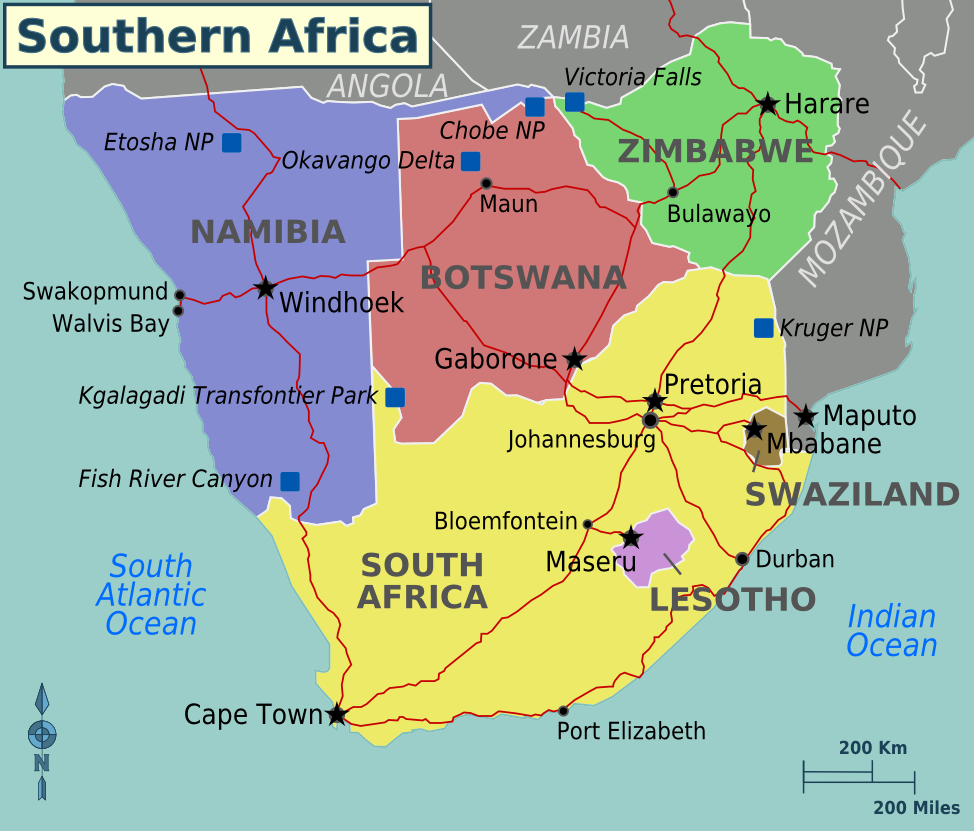
Southern Africa.

Figure 1 Long description
The map of Southern Africa displays major cities such as Windhoek, Gaborone, Pretoria, Johannesburg, Durban, Cape Town, Harare, Bulawayo, Maseru, Maputo, and Mbabane. It also highlights significant national parks like Etosha National Park, Chobe National Park, Kgalagadi Transfrontier Park, and Kruger National Park. Notable geographic features include the Okavango Delta, Victoria Falls, Fish River Canyon, and the countries of Namibia, Botswana, South Africa, Lesotho, Eswatini, and Zimbabwe. The map uses stars to mark cities and squares to denote national parks, providing a clear visual representation of the region's key locations and natural attractions.
The upshot is that dissent is so frequent, and the data sufficiently incomplete, that statistical comparison is liable to seriously mislead. Notably, such comparisons risk concealing the startling contribution of individual judges to small totals. And these disproportionate contributions have important methodological implications. For example, seventeen ZACC justices sat in its first twelve years, but one (Kate O’Regan) nonetheless wrote a quarter of dissents. Another, Albie Sachs, wrote 30 per cent of separate concurrences. By contrast, the future Chief Justice (Ismail Mahomed, from 1997) and ZACC President (Arthur Chaskalson) never dissented (Bishop et al. Reference Bishop, Chamberlain and Kazee2008, p. 355). In the decade following their retirement (2009–19) Chris Jafta wrote almost twice as many dissents as any other judge.Footnote 13 In Namibia, Swaziland/Eswatini and Lesotho individual over-representation is even more pronounced. Half of the Namibian dissents (6/12) were written by Bryan O’Linn, who only sat regularly between 1999 and 2006. Three of the six Swazi dissenting judgments were handed down by Majahenkhaba Dlamini, who only joined the Supreme Court in 2015. Zimbabwean Moses Chinhengo wrote both dissenting judgments from Lesotho, despite only joining the Court of Appeal in 2016. Chinhengo has also sat in four of the five cases with separate concurrences.
Even these individual stories, moreover, require closer inspection. Politicians sometimes use dissent as a proxy for judicial quality. In 2012, for example, South African President Jacob Zuma tried to use the ZACC’s regular disagreements to justify reviewing its powers (de Vos Reference de Vos2012). Since then the Judicial Service Commission has sometimes asked judges if they are regular dissenters (e.g. Judges Matter 2018a, p. 16). As Paterson (Reference Paterson2013, p. 154, n.130) has noted, however, the simple fact of a dissent may not reveal a judge’s attitude toward it. Dissents may have begun life as lead judgments, only to see the other panel members persuaded by the dissenters’ logic (e.g. Judges Matter 2018b, p. 24). It appears as if one of Moses Chinhengo’s two apparent dissents in Lesotho is of this variety, although the judgment does not describe deliberations in detail.Footnote 14 Bryan O’Linn’s Namibian dissents, by contrast, make it clear he remained in the minority throughout post-trial conferences.Footnote 15 O’Linn, unlike Chinhengo, can thus be more safely characterised as a dissenter by conviction. Matters are even more complex on the most collegial courts. There judgments are drafted so collectively that even dissents come to partially reflect the views of the majority. For Johann Kriegler, a former judge of the ZACC, it is thus ‘facile and downright misleading to try and glean the philosophy of an individual judge on the basis of a number of judgments that appeared over his or her name’ (Meiring Reference Meiring and Meiring2017).
This last possibility illustrates difficulties with methodologically individualist approaches. This study tackles these by analysing culture alongside formal rules. Since 2017, and as part of a broader project studying these courts, I have conducted unstructured interviews with (South African and local) judges who have served on these appeal courts, as well as with those who have argued before them.Footnote 16 Other ‘immersive’ activities have also helped understand judicial culture from within. These have included reviewing and listening to approximately 120 hours of life history and Judicial Selection Commission interviews with judges. I have also sought to read – in order of decreasing confidence in my success – every available memoir, obituary and newspaper interview published by, or relating to, a judge who has served on BLNS appeal courts since 1990.
4 Findings
At least two general trends can be safely identified from the above. Outside of South Africa, first of all, dissent is extremely uncommon. Its frequency at the ZACC is similar to that of apex courts in Canada and Australia (Paterson Reference Paterson2013, p. 113). In regional terms, however, the ZACC is a clear outlier. Within BLNS, secondly, there is a less marked but nonetheless obvious distinction between Namibia and the former HCTs. The Namibian Supreme Court’s unanimity rate matches that of the Zimbabwean Supreme Court (1989–2000), and its dissent rate matches that of the Zambian Supreme Court (1973–97) (Haynie et al. Reference Haynie2007). The appeal courts of Lesotho, Botswana and Swaziland/Eswatini are dissent averse even by these stringent standards. SAFLII records 400 consecutive decisions for Lesotho’s Court of Appeal between 2005 and 2016 without a single dissent.
Human rights cases do not seem particularly prone to dissent (contrast Blackwell Reference Blackwell2020). SAJHR’s annual statistics show that the proportion of rights-based cases at the ZACC has stayed relatively stable at around 60 per cent. Dissent rates, however, increased dramatically after 2006. Inconsistent summarising methods mean that SAFLII offers no ready means of coding case content in BLNS (see generally Blackwell Reference Blackwell2020, p. 292). In Botswana, Lesotho and Swaziland/Eswatini, five-judge panels are, however, often required for constitutional rights hearings (see below). Still, only two such cases, both from Eswatini, have produced minority judgments. Only one dissent in our sample involved the subjective ‘balancing’ of rights that, some critics argue, increases indeterminacy (e.g. Alder Reference Alder2000, p. 224).Footnote 17
Criminal cases are, by contrast, overrepresented, accounting for ten of the sample’s twenty-one split decisions. Half of these dissents in our sample are, however, in appeals against conviction for rape. Judges may rely on shared norms and prejudice when giving (sexual) morality legal form (Dupret Reference Dupret2021). But such shared norms may be relatively absent from multinational courts.
5 Discussion
The next section assesses common explanations for the frequency of dissent. It finds that variation between courts appears better explained by ‘institutions’ than judicial attitudes or philosophies. It concludes that these institutions should be understood as plural, dynamic cultures, rather than as rules.
5.1 Judicial philosophies
Dissent is not a function of judicial philosophy. As noted earlier, four justices have issued a wildly disproportionate number of dissenting judgments and separate concurrences: Kate O’Regan, Albie Sachs, Chris Jafta and Bryan O’Linn. Of these only O’Regan and Sachs could be safely described as both jurisprudential and political progressives. Neither had progressed through the ranks of the profession under apartheid. Sachs, a lawyer who became an academic after imprisonment for anti-apartheid activities, was by far the most contentious appointment. He had served on the ANC National Executive while in exile, and struggled in interview to explain how he had prevented torture in ANC-run camps (e.g. Ellmann Reference Ellmann2019, pp. 436–38). O’Regan, a young labour law academic, was another ANC member.
Since their retirement in 2009 Chris Jafta became the ZACC’s most frequent dissenter (see above). Strikingly, Jafta had also been an academic before joining the bar. Former academics elsewhere are also more ‘activist’ and less deferential than judges from other backgrounds (Skiple et al. Reference Skiple, Bentsen and Hanretty2020, p. 280). This evidence indicates they may also be greater dissenters. Kirby’s (Reference Kirby2007, pp. 387–88) claim that common law barristers and advocates are most likely to demonstrate this ‘vigorous intellectual independence’ is not supported. Indeed, four ZACC justices wrote no dissenting judgments during Sachs’s and O’Regan’s tenure. All were former advocates (Bishop et al. Reference Bishop, Chamberlain and Kazee2008, p. 356).Footnote 18
Jurisprudentially, however, Jafta, like O’Linn, was no progressive. He was regularly identified on the court’s conservative wing, and criticised for ‘formalistic legal reasoning that harks back to a pre-constitutional era’ (Calland Reference Calland2013, p. 284; de Vos Reference de Vos2018).Footnote 19 In 2016–17 the ZACC delivered a series of strikingly ‘activist’ rulings combating maladministration (Brett Reference Brett2020, pp. 132–39). Now Jafta often found himself as the only dissenter, seeking to restore ‘a proper balance … between … other arms of Government and the courts’.Footnote 20 These dissenting tendencies are all the more remarkable for dating back to Jafta’s time at the SCA (2004–09) where, as described below, institutional rules favour unanimity (eJudgements’ SA Online Law Reports 2019).
Bryan O’Linn’s Namibian Supreme Court dissents constituted an even louder protest against values-based jurisprudence. During apartheid he had been one of few ‘progressive whites’ in South-West Africa. After becoming an advocate in 1961 he regularly defended members of the leading national liberation movement: SWAPO (South-West African Peoples’s Organisation). This was regarded as treachery in White society (Smuts Reference Smuts2019). O’Linn was thus overlooked for judicial appointment until 1989, the eve of independence. His independent-mindedness then caused immediate conflict with the new (judicial) authorities. O’Linn’s chief antagonist became Ismail Mahomed. This extraordinary South African advocate had advised SWAPO during constitutional negotiations before becoming Namibian Chief Justice in 1993. He had been the ultimate outsider in the apartheid legal system. Even as South Africa’s first non-White Senior Counsel, Mahomed had been denied rooms in chambers and had eaten lunch in the toilets. He later denounced these injustices from the bench (Andrews Reference Andrews2021). According to Sill and Haynie’s (Reference Sill and Haynie2010, p. 274) ideological scores he became the SCA’s most liberal judge. Mahomed’s appointment in Namibia signalled an intention to give form to post-apartheid jurisprudence. O’Linn, however, dissented from this new order as vigorously as he had from the old.
In 1991, as an acting judge, Mahomed wrote a lead judgment that has ‘framed the interpretation of the Namibian constitution in general’ ever since, ‘anchoring …[its] interpretation … on values’ (Zongwe and Tjatjara Reference Zongwe, Tjatjara, Warikandwa and Baloro2022, pp. 9–10). In Ex Parte Attorney General (1991) Mahomed found corporal punishment degrading and thus unconstitutional.Footnote 21 His test for degrading treatment was not, however, a clarified concept of human dignity (for criticism Horn Reference Horn2016, pp. 125–26; Zongwe and Tjatjara Reference Zongwe, Tjatjara, Warikandwa and Baloro2022). Instead it was ‘a value judgment … regard being had to the contemporary norms, aspirations, expectations and sensitivities of the Namibian people’. For lawyers like O’Linn, trained in the old South African legal culture, this ‘idea of treating a constitution differently, challenged their basic understanding of the law’ (Horn Reference Horn2016, p. 174). O’Linn criticised Ex Parte Attorney General in High Court judgments, questioning whether it constituted precedent. The risk, he wrote, was that the ‘personal subjective views of the Court or Judge’ would substitute for legal tests.Footnote 22 In the old judicial culture, subjectivity was worse than dissent. In 1995 O’Linn circulated a discussion paper to all judges criticising Mahomed’s approach. Mahomed, outraged, asked him: ‘do you think you are the House of Lords?’ (O’Linn Reference O’Linn2010, p. 114).
Mahomed never invited O’Linn to act on the Supreme Court, so neither could dissent from the other. After Mahomed’s death in 2000, however, O’Linn dissented more often and in more conspicuous ways than any other justice. As noted by Chief Justice Peter Shivute, ‘he would always have the last word by including additional paragraphs in response to views expressed in a dissenting judgment’ (New Era 2015). Some of these dissents were outrageous to SWAPO, finding that Namibia was bound by international law to provide legal aid to secessionists, and that fellow justices were ‘strengthen[ing] the accusation of “judicial timidity” on behalf of the courts’ by not imprisoning a minister for contempt.Footnote 23 The region’s leading dissenters were both conservative and progressive.
5.2 Ideological distance
If, however, we assume that judicial ideologies can be both jurisprudential and political, then such conservative dissents might support a modified ‘attitudinalism’ (n.1). Dissent might vary with ideological distance between judges, rather than with ideology per se. It could, in other words, simply reflect Jafta and O’Linn’s status as conservative outliers on the bench. The extreme rarity of dissent in BLNS as a whole, however, would then have to be explained by a truly extraordinary uniformity of judicial attitudes – doubly improbable on such multinational courts. Such attitudinalist claims are also hard to reconcile with the fact that expatriate judges, of all ideological persuasions, dissent less often in BLNS. This is true both of progressive ZACC justices – including Kate O’Regan – and of those from the SCA and Zimbabwean and Zambian Supreme Courts.Footnote 24 Between 1993 and 2011 we have recorded over 1,000 cases by South African judges without a single dissent. (Even those justices who had sat at the SCA between 1990 and 1995, when it was still undoubtedly an apex court, had dissented between 1 per cent and 4 per cent of the time.)Footnote 25
Some differences in how judges behave on different courts are unsurprising given differing panel sizes. In BLNS cases are usually heard by panels of three, but scope for disagreement is greater at the ZACC, where cases are heard en banc by between eight and (often) eleven justices. Panel size alone, however, can hardly account for differences of this magnitude. Even former SCA judges consistently behave very differently in BLNS, even though panels in Bloemfontein/Manguang are also relatively small – three or (more commonly) five judges. Dissent must therefore be conditioned by a wider range of institutional arrangements and cultural practices (e.g. Garoupa et al. Reference Garoupa2012; Sill and Haynie Reference Sill and Haynie2010, p. 282, n.7).Footnote 26
5.3 Job security
Job security might be thought to explain variation better than institutional or cultural factors. Most BLNS appeal judges have had fixed-term contracts. Attitudinalists expect this to limit dissent (see overview), and so South African judges’s higher levels of job security might explain their lower levels of unanimity. Nonetheless, those few judges to obtain permanent appointment in BLNS do not appear to have behaved differently from their fixed-term colleagues. In Namibia the first Supreme Court panel entirely composed of permanent appointees dates from 2012. But at least one permanent appointee (usually the Chief Justice) has presided over more than 90 per cent of cases.Footnote 27 These permanent appointees have only penned four of the twelve dissents. In Lesotho’s Court of Appeal both de jure and de facto security of tenure are rare. Approximately half our cases were heard by panels composed entirely of expatriates appointed for three-year fixed terms, or local judges in acting capacities. But the rest were heard by panels including the Court of Appeal President, at least notionally a permanent appointee. These Presidents have never dissented. Swaziland/Eswatini is the only partial exception. Permanent appointees have delivered four of the seven dissents in the sample, three by former Attorney General Majahenkhaba Dlamini.Footnote 28
5.4 Political culture
Political not judicial culture is another possible explanation. BLNS contexts might be systematically less conducive to dissent than South Africa. The most obvious candidate for such an explanation is Swaziland/Eswatini, Africa’s last absolute monarchy. Here the British Protectorate ended up strengthening instead of displacing monarchical rule. Mswati III’s critics have accused him of ‘(re-) invention’ and ‘abuse of tradition’, but without denying that reworked monarchical idioms appeal powerfully to some constituencies (e.g. Masuku and Limb Reference Masuku and Limb2016, p. 519). According to the best known of these – umlomo longacali manga – the King is ‘the mouth that does not lie’. State agencies, including courts, should therefore speak without contradiction (Dube and Nhlabatsi Reference Dube and Nhlabatsi2016). It is perhaps no accident, therefore, that SAFLII lacks the most famous Swazi dissent.Footnote 29 In 2008 acting judge Thomas Masuku – dissenting from his four brethren – interpreted the 2005 constitution in ringing ‘activist’ terms to find that political parties were allowed to compete for power. This (unreported) judgment, soon regularly cited by lawyers representing imprisoned journalists and regime critics, helped precipitate Masuku’s 2011 impeachment (Langwenya Reference Langwenya2012, pp. 103–105, 116, n.58).
No other judge in BLNS, however, has suffered such consequences for dissenting. Only in cases such as these, moreover, where Swazi royal interests are at stake, is there any significant possibility that expatriate judges could have feigned unanimity to appease the King. Swazi royal anger has generally been provoked by the content not form of judgments. Dissents relating to commercial contracts and even court jurisdiction over chieftaincy appointments elicited no obvious backlash.Footnote 30 By contrast, unanimous decisions directly challenging royal authority produced wholesale assaults on judicial independence. In November 2002 an all (white) South African appeal court upheld a judgment by Masuku frustrating royal interests in a land dispute, declaring a Royal decree making fraud a non-bailable offence unconstitutional. The government refused to comply with both rulings, accusing the judges of being influenced by ‘forces outside’ Swaziland. The court resigned en masse and only sat again in 2005 after international pressures forced the government to relent (Amnesty International 2004, pp. 21–23; Tebbutt Reference Tebbutt2016, pp. 209–15). Ten years later the South African Law Society pressured South African judges into resigning again after new Chief Justice Michael Ramodibedi impeached Masuku and blocked all litigation citing the King (Dube and Nhlabatsi Reference Dube and Nhlabatsi2016, pp. 272–73; Jele Reference Jele2012).
It might be supposed, finally, that historical sensitivities might make South African judges, in particular, hesitate before dissenting. Guilty feelings about apartheid, or felt allegiances to law’s ‘civilising mission’, might both be thought to favour unanimity. South African judges might believe, that is, that they should not be the ones to diminish law’s authority by voicing disagreement. In fact, however – as illustrated by the Swazi episode recounted above – South African judges have not felt especially bound to uphold the reputation or authority of local legal orders. In Lesotho in particular, and to a lesser extent in Swaziland/Eswatini, judgments written by panels with majorities of retired SCA judges regularly contained astonishingly forthright criticisms of the quality and even integrity of local legal practice.Footnote 31 If a sense of law’s civilising mission did exist, in other words, it may have encouraged rather than suppressed criticisms that risked undermining judicial authority. If South African judges avoided dissent, this did not reflect any premium on unanimity in national political cultures.
5.5 Case-load
Dissent patterns do appear broadly compatible with explanations emphasising case-load. Institutionalists argue that busy courts avoid dissents because they slow drafting and deliberation (Epstein et al. Reference Epstein2011, pp. 102–104; also Hall and Brace Reference Hall and Brace1989, pp. 397–98). And in BLNS appeal courts with the highest case-loads – Botswana, Lesotho and Swaziland/Eswatini – dissent the least.Footnote 32 A simple statistical comparison, however, may both understate and exaggerate the contrast with the ZACC. It may be understated because judges in BLNS have less time and less assistance. Court sessions are broadly similar across the region, but expatriate judges are only resident for short periods each year.Footnote 33 They typically complete judgments before the ‘holidays’ (e.g. Tebbutt Reference Tebbutt2016, p. 195). ZACC justices, meanwhile, have at least two clerks recruited from among the best law graduates in South Africa and beyond (Ellmann Reference Ellmann2019, pp. 464–70; Moseneke Reference Moseneke2020, pp. 86–88).Footnote 34 Some judges in Botswana, Lesotho and Swaziland/Eswatini have complained of no assistance whatsoever, even with complex cases in short timeframes.Footnote 35 One, in Lesotho, assembled the roll himself and couriered records in his car.Footnote 36
Patterns of dissent on Southern African appeal courts
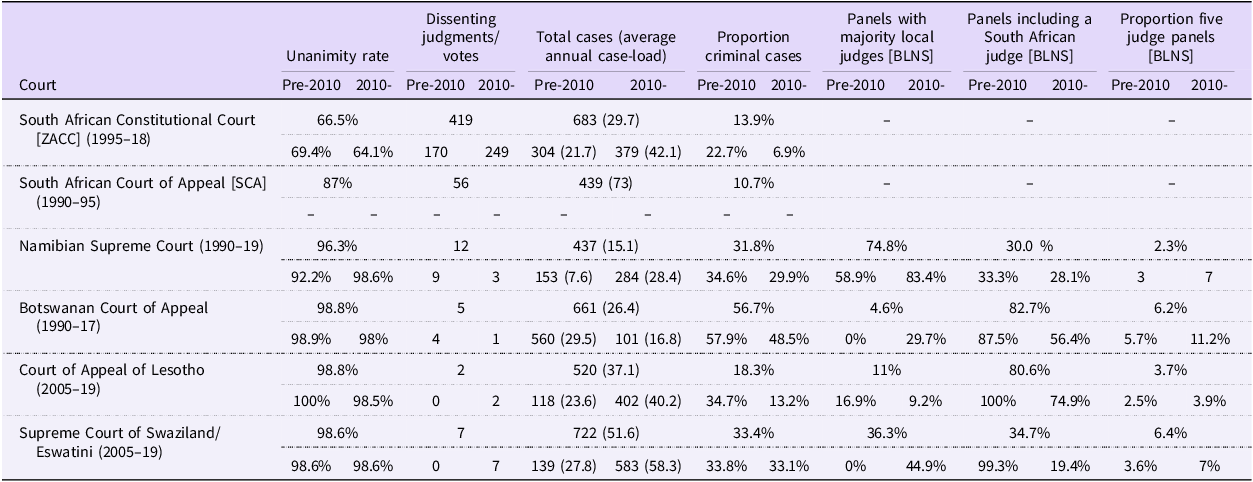
Table 1 Long description
The table presents data on dissent patterns across several Southern African appeal courts, including the South African Constitutional Court, South African Court of Appeal, Namibian Supreme Court, Botswanan Court of Appeal, Court of Appeal of Lesotho, and Supreme Court of Swaziland/Eswatini. It features eight columns: Unanimity rate, Dissenting judgments/votes, Total cases (average annual case-load), Proportion criminal cases, Panels with majority local judges [BLNS], Panels including a South African judge [BLNS], and Proportion five judge panels [BLNS], each split into pre-2010 and 2010- periods. The table includes data on unanimity rates, dissenting judgments, total cases, proportion of criminal cases, and the composition of judicial panels. Notable trends include variations in unanimity rates and the proportion of criminal cases across different courts and time periods. For instance, the Botswanan Court of Appeal shows high unanimity rates and a significant proportion of criminal cases, while the South African Constitutional Court has a lower unanimity rate and a smaller proportion of criminal cases.
Note: Unless otherwise indicated measures follow Klaaren (Reference Klaaren1996). Partial dissents are thus dissents. Disagreements with lead judgments’s reasons are non-unanimous separate concurrences. Separate judgments agreeing with both reasons and orders are unanimous. Only panels of three or more are included. Case-load average includes only years with recorded decisions. SCA is data from Haynie et al. (Reference Haynie2007). ZACC data is from available SAJHR annual statistics.
The contrast may be exaggerated, however, because the work of apex courts differs in both kind and degree. ZACC justices have justly criticised conflating case-load with workload (a common political science mistake). Critics often highlight their low case-load, relative to the SCA (e.g. Gauntlett Reference Gauntlett2011). But in one former justice’s words: ‘[c]ases aren’t cases, it’s what their content is. Fifty/fifty, rabbit and horse pie, one rabbit, one horse’ (O’Malley Reference O’Malley1999). The ZACC began with no precedent, and had to study constitutional jurisprudence worldwide. These workload implications were compounded by its unusually collegial working methods. Any judgment ‘is the product of tens of minds and significant debate’ (Meiring Reference Meiring and Meiring2017). Intensive discussion takes place online and offline, with and without clerks and before and after post-hearing conference (Ellmann, Reference Ellmann2019 pp. 447–62; Moseneke Reference Moseneke2020, pp. 88–89). Nowhere in BLNS do budgets or time pressures make such arrangements feasible. Even when case-load and workload are properly distinguished, however, it still appears that these arrangements favour dissent at the ZACC. The Court recently delayed some judgments, trying to reduce separate concurrence (Ngalwana Reference Ngalwana2020). But even drafts of unanimous decisions pass through so many hands that dissents have no particular capacity to extend deliberations. Actual workloads are thus partially a function of (in)formal rules governing courts’ operations.
5.6 Institutional rules
Political scientists agree that such rules have consequences for dissent. Attitudinalists highlight case control alongside panel size and job security. This is because courts that can choose cases will select politically salient ones liable to divide judges (e.g. Segal and Champlin Reference Segal, Champlin, Howard and Randazzo2017, p. 20). ‘Institutionalists’ emphasise a wider range of arrangements. For example, voting rules allowing (some) judges to predict the majority view – such as voting by seniority – allow junior judges to feign agreement with seniors (de Mendonça Lopes Reference de Mendonça Lopes2019). Non-random opinion and panel assignment, meanwhile, allows Chief Justices to reward conformists and punish dissenters, producing unanimity over time (Brace and Hall Reference Brace and Hall1990, pp. 58–59).
Confirming institutionalist expectations, the ZACC possesses most dissent-favouring arrangements. Its justices (usually) serve twelve-year terms and sit in large panels. They enjoy unusual docket control. Until 2013 the SCA was still technically the apex court for non-constitutional questions. But South Africa’s 17th Constitutional Amendment then allowed the ZACC to hear any case if ‘it is in the interests of justice’. Like the SCA it can dismiss applications for leave to appeal without reasons, but unlike the SCA it is not obliged to hear (applications for) appeals granted by lower courts (Sill and Haynie Reference Sill and Haynie2010, pp. 271–72). As many as 90 per cent of cases may have been dismissed in chambers (Ngalwana Reference Ngalwana2020). In Botswana, Lesotho and Swaziland/Eswatini, where dissents are least frequent, some applicants can appeal by right.Footnote 37 These typically straightforward hearings reduce dissent. In Botswana, there is appeal by right in all constitutional matters and where the High Court acts as court of first instance.Footnote 38 This explains its much larger proportion of criminal cases, since all trials for serious offences begin at High Court level. In 1989 there were so few applications for leave to appeal they could be dealt with by teams of two judges in a single day (Amissah Reference Amissah and Otlhogile1989 [1996], pp. 210–11; compare Tebbutt Reference Tebbutt2016, p. 195).Footnote 39
Second, ZACC leaders have limited scope to assign panels and opinions to punish dissenters. Since it sits en banc they cannot assign cases to panels of like-minded judges, as was once routine at the Appellate Division (Haynie Reference Haynie2003, pp. 83–85). In BLNS, by contrast, panel allocation has rarely been random. The Law Society of Botswana has argued that the process should be transparent (Shapi Reference Shapi2015). In 2016 Namibia responded to similar concerns by automating allocation.Footnote 40 ZACC leaders do decide who writes judgments (e.g. Ellmann Reference Ellmann2019, p. 447; Moseneke Reference Moseneke2020, p. 120). But the Court’s unusually collegial writing methods limit this power’s strategic value.
ZACC voting arrangements, finally, differ from courts with higher case-loads. The SCA votes by seniority. This allows junior judges to avoid ineffectual dissents (de Mendonça Lopes Reference de Mendonça Lopes2019). Indeed, one (technically) junior SCA judge was accused of not being a ‘team-player’ after causing two 4–1 splits with his final vote (eJudgements’ SA Online Law Reports 2019). The ZACC, by contrast, deliberately undermines the culture of seniority. There are no assigned seats at post-hearing conference. The first Court President served tea himself. Decision-making embodies ‘the principle of the equality of the justices’ (Ellmann Reference Ellmann2019, p. 449). This, according to one serial dissenter, means ‘[y]ou don’t feel the inhibition that you can’t express a view against the Chief Justice’ (Jafta J, in Constitutional Court Oral History Project 2011a, p. 14). At the SCA during late apartheid even chairs in the tea room were effectively allocated, and until recently seating remained self-segregated along racial and gender lines (Judges Matter 2017, p. 3; Meiring Reference Meiring and Meiring2017).
5.7 Institutional cultures
These examples illustrate how institutional rules may reflect institutional cultures. Elements of these cultures, such as an emphasis on seniority, have constrained dissent without being reducible to dissent avoidance ‘norms’. This sub-section analyses the consequences of another such element: aversion to judicial personality. It shows how this helps explain why styles of adjudication favouring dissent have been more tolerated in constitutional than contract law. Then it describes how this older culture travelled with retired South African judges to neighbouring jurisdictions, particularly those worried by dramatic transformations at home. Finally, it shows how the recent localisation of the senior judiciary in these jurisdictions has had divergent consequences for dissent.
5.7.1 Varying consensual norms
The political science concept of dissent avoidance ‘norms’ – where minority judgments are simply taboo for certain courts – obscures why certain forms of dissent are more tolerated than others. Such differentiated attitudes are, however, commonplace. Beliefs that constitutional adjudication has a distinctive and legitimate capacity to mobilise judges’s political attitudes are reflected in superior court procedure worldwide. In European civil law jurisdictions only constitutional courts typically permit separate judgments (Entrikin Reference Entrikin2019, p. 94). BLNS appeal courts, similarly, reserve five-judge panels for constitutional cases.Footnote 41 In these cases judges often insist on the normative appropriateness of separate opinions. One thus felt ‘constrained’ because of ‘the importance to which this case is entitled … to add my own words.’Footnote 42 While for another ‘it is important in constitutional adjudication … that all judges should at least show where they stand … my concurrence is not just a matter of show of hands’.Footnote 43
That dissent was distinctively appropriate in constitutional cases was also a feature of the old South African judicial culture. Late apartheid appeal judges commonly claimed not to make law, unlike their counterparts in constitutional democracies (compare Abel Reference Abel1995, p. 18; Haynie Reference Haynie2003, pp. 62–72).Footnote 44 This did not, however, prohibit minority opinions. Dissent at the SCA was rare, but still higher than in neighbouring jurisdictions, and ‘fairly constant’ over time and between judges (Haynie Reference Haynie2003, p. 72). Such dissent could only, however, be justified on grounds of intellectual integrity. Indeed, justices identifying with the common law tradition celebrated colleagues who refused to change views they felt intellectually compelled to adopt (e.g. Corbett Reference Corbett1994, p. 380). This attitude resembled the old American Bar Association’s Code of Judicial Ethics (1923–72): ‘dissenting opinions should be discouraged’ except ‘in case of conscientious difference of opinion on fundamental principle’ (in Paterson Reference Paterson2013, p. 112, n.192). Dissents such as Bryan O’Linn’s in Namibia – which could be presented as a defence of this tradition, and as a safeguard against judicial subjectivity – were thus legitimate. Claims like Chris Jafta’s, by contrast – ‘we have to have splits, because those represent truly the views which we believe are representative of the various sections of the population’ – were anathema (Constitutional Court Oral History Project 2011a, p. 13).
The real prohibition, then, attached to dissents that were either avoidable or justified on explicitly subjective grounds. Only these dissents, not dissents in general, threatened to undermine the ‘myth that there is a single correct answer for legal questions’ (contrast Garoupa and Ginsburg Reference Garoupa and Ginsburg2015, pp. 30–31). They threatened the impersonal formalism of late apartheid jurisprudence. This formalism explains the furious reaction to academic studies linking judges’s attitudes and backgrounds to decisions (e.g. Cameron Reference Cameron1982; Corder Reference Corder and Corder1989). Lawyers were expected to avoid public statements on even non-political controversies (Cameron Reference Cameron1993, p. 53). Judicial memoirs were rare, and even ‘bare bones’ biographical sketches contentious (e.g. Southwood Reference Southwood1988, p. 24; Diemont Reference Diemont1995, p. 8). One academic critic was Edwin Cameron, today a retired ZACC judge who has spoken often, and movingly, of how his experience of living with HIV affects his approach to law. He railed against ‘the rites of self-effacement’ (Cameron Reference Cameron1993, p. 61). Today some judges of the older generation, who went on to serve in BLNS, see him as an unfortunate – if intellectually gifted – example of the new ‘celebrity judge’.Footnote 45 They are now generally less critical, however, of the ZACC’s most prolific dissenters – Chris Jafta and Kate O’Regan – who have not cultivated such distinctive public profiles.
Cameron is not, however, the judge who has most antagonised the old orthodoxy. That is, unquestionably, Albie Sachs. This hostility is partly political, stemming from Sachs’s ANC role (see above). But it also stems from Sachs having ‘made himself an outsider to many of the traditions of the South African legal establishment’ (Cameron Reference Cameron1993, p. 53, n.12). Sachs has written more separate judgments than any other ZACC justice (see above)Footnote 46 . These judgments provocatively situated legal reasoning within lived experience. They reflected Sachs’s long-standing belief that ‘even the more progressive judges’ had ‘grown up … in a certain setting’ (O’Malley Reference O’Malley1993). In The Strange Alchemy of Life and Law, he argued that judges could draw upon ‘experiential truth’ without sacrificing ‘legal coherence’ for ‘vague and subjective notions of the good’ (Sachs Reference Sachs2011, pp. 82, 203).
This sacrifice is, however, exactly what Sachs’s critics accuse him of. Gauntlett (Reference Gauntlett2011), an advocate and former appeal court judge in Lesotho, used a speech attacking the ‘self-indulgent multiplicity of voices’ at the ZACC to particularly condemn:
‘the refusal by Justice Sachs in the Sidumo case to join Justice Ngcobo and others in determining whether the right in issue was a labour right or an administrative justice right, he urging a “move away from unduly rigid compartmentalisation so as to allow judicial reasoning to embrace fluid concepts of hybridity and permeability”’.
Another former appeal judge from Lesotho, recently retired from the SCA, used this same dissent to train aspirant judges in how not to write (Nugent Reference Nugent2015). Sachs’s mode of disagreement was particularly controversial because it was not strictly necessary for settling legal questions. He often found himself ‘in the pleasant but awkward position of agreeing with colleagues who disagree with one another’.Footnote 47 His minority judgments were ‘near-scriptural’ (Moseneke Reference Moseneke2020, p. 129). They reconciled competing positions using ‘overarching values’. ‘[T]he Constitution’, Sachs asserted, ‘obliges us to join together what the [separate] judgments put asunder’.
5.7.2 Saving contract from constitutional dissensus
This use of overarching values to interpret the constitution is exactly what judges feared during the post-apartheid transition (see above). Adherents of the old judicial culture have sought to protect the common law, in particular, from this approach. They tolerate dissents reflecting political disagreements in constitutional cases (where they believe legal vagueness makes them inevitable), but abhor them in contractual disputes. Conflict began in the late 2000s, when the ZACC finally began asserting constitutional control over the common law (Moseneke Reference Moseneke2020, pp. 95–96; Wallis Reference Wallis2015, p. 968, n.7). New judges appointed to the SCA began finding that ‘judges who had been appointed earlier … groomed in the model of the common law’ avoided deciding cases on constitutional grounds (Constitutional Court Oral History Project 2011a, p. 10; Ngalwana Reference Ngalwana2019). Nonetheless, in a series of split decisions, the ZACC began finding that contracts could be unenforceable if contrary to public policy as defined by constitutional values, such as reasonableness, fairness and good faith. Dissenters criticised the majority for failing to derive objective legal standards from these values.Footnote 48
The SCA looked on anxiously. Some judges argued that making the enforceability of contracts subject to judges’s personal sense of fairness endangered legal certainty and even the market economy (Wallis Reference Wallis2015, pp. 969–70). (Southern Africa has numerous specialised appeal courts that deal with commercial, competition and labour matters. None have a record of judicial dissent.)Footnote 49 Justice Fritz Brand highlighted a minority judgment by Sachs finding insurers could not rely on small print in standard-form contracts. ‘[T]reat[ing] mass-produced script as sanctified legal scripture’, Sachs had written, ‘dishonour[s] the moral and philosophical foundation of contract law’.Footnote 50 ‘As a general principle’, Brand (Reference Brand2009, p. 87) argued, this threatened the ‘modern commercial system’.
‘Polarisation’ between these courts has become so ‘severe’ that ‘détente’ is required.Footnote 51 ZACC justices have failed to dispel ‘the caricature of rogue judges imposing their own subjective and arbitrary opinions of what is fair and reasonable’.Footnote 52 A consistently more unanimous SCA has declared it will only invalidate contracts ‘in the clearest of cases’ which do not ‘depend on the idiosyncratic inferences of a few judicial minds’.Footnote 53 In South Africa, then, the most serious clash of cultures has been provoked not by dissent itself, but by a jurisprudence promising to make it routine in even putatively predictable areas of law. According to an older orthodoxy, attitudes and backgrounds should only determine decision-making where constitutional vagueness makes it inescapable.
5.7.3 South African judges on Southern African courts
This constrained tolerance for dissent travelled with South African judges to neighbouring jurisdictions. The culture of the SCA was perhaps most transplanted to the appeal courts of Lesotho and Swaziland, before their racial composition changed (in approximately 2015 and 2010 respectively). References to the constitution and purposive interpretation were minimised (e.g. Mosito Reference Mosito2014, p. 58). Before 2010 our sample contains no full-blown dissents for either court, and only two separate concurrences. Ian Farlam dissented in November 2011 but this was his last session before resigning from SwazilandFootnote 54 . It was also the last before the Supreme Court’s first all-Black bench in 2012. Former ZACC justice van der Westhuizen (Reference van der Westhuizen2016) suggested impending retirement favours such dissents. He cited country singer Kris Kristofferson: ‘gone are the reasons for changing my mind … you don’t tell me what to do’.
Social ties certainly allowed these judges to resolve all manner of disagreements (Devins and Baum Reference Devins and Baum2019). Appointments were arranged through friendships not formal processes.Footnote 55 In one judge’s words, this familiarity allowed them to ‘speak in code’ when walking between court and chambers. Most ate together most nights. The relatively large number of Scottish and West African judges in Botswana somewhat disrupted these routines (e.g. Tebbutt Reference Tebbutt2016, p. 182). Nonetheless, South African colleagues fondly recall mechanisms creating esprit de corps among this new cohort. Until 2012 judges slept and dined at Lobatse’s Cumberland Hotel. The social highlight, for one South African at least, was the Scottish Burns Night celebration. In this all-male world, however, a member of hotel staff had to be drafted in to read the ‘Reply From the Lassies’!Footnote 56
These courts functioned, therefore – in these judges’s own words – as an ‘old boys club’. They were relatively shielded from South Africa’s racial, legal and gender transformations. For Black judges appointed to the SCA, Bloemfontein – the capital of Afrikanerdom – had emphatically not been their city. Their experience was absent from its folklore: ‘they no longer wanted to hear these stories from the bar’.Footnote 57 And the court building, its corridors lined with photographs from ‘the old days’, was not theirs (Judges Matter 2017, p. 2; Johnson Reference Johnson2019).Footnote 58 The Court of Appeal in Lesotho, by contrast, was – in one judge’s view – ‘[Michael] Corbett’s [Chief Justice 1989–96] SCA preserved in aspic’.Footnote 59 Its social routines afforded additional time for the resolving and softening of disagreements.
5.7.4 A new judicial culture for BLNS?
The localisation of the senior judiciary in BLNS has had varying consequences for dissent patterns. Footnote 60 In Namibia the most noticeable symptom of the old culture’s passing was actually greater unanimity. A conservative like Bryan O’Linn is no longer there to dissent against creeping judicial subjectivity. In Botswana, meanwhile, dissent remains rare, even if not actively ‘suppressed’ by ‘judicial policy’ (Dingake Reference Dingake2020, p. 56). As elsewhere in BLNS decolonising patterns of legal education have seen a ZACC-inspired values-based jurisprudence gain ground among younger High Court judges.Footnote 61 This has created contrasts with the more conservative Court of Appeal (e.g. Dinokopila Reference Dinokopila2017, p. 16). But White Motswana Judge President Ian Kirby (2010–21) may have retained enough influence over appointments and institutional practice to prevent any significant change in judicial culture, despite gradual localisation (for strong criticism Motshegwa Reference Motshegwa2017).
In Lesotho and Swaziland/Eswatini, by contrast, localisation had dramatic consequences. Between 2004 and 2015 all but one appeal court judge in Lesotho was White South African. Seven had come from the SCA, four from the Western Cape.Footnote 62 Since 2018, however, only retired ZACC justice Johann van der Westhuizen has sat. The ‘old boys club’ was a victim of Lesotho’s notoriously volatile factional politics (Monyake Reference Monyake2020, p. 2). Prime ministerial control over senior appointments ensures this volatility has institutional effects. Thus in February 2015, on the eve of internationally-brokered snap elections, Prime Minister Thabane appointed a new Chief Justice and replaced Acting President of the Court of Appeal Douglas Scott with Kananelo Mosito: an academic heading the Labour Appeal Court (Shale Reference Shale2018, pp. 172–73). (The Court’s last ruling had stopped Thabane compelling the Director of Public Prosecutions to take early retirement.) The South African judges then resigned en masse, highlighting, among other grievances, the importance of promotion by seniority.Footnote 63 Pakalitha Mosisili’s incoming coalition appointed three South Africans to investigate Mosito’s tax affairs. Their adverse findings justified replacing Mosito with Robert Nugent as President of the Court of Appeal: a recent SCA retiree. But Nugent’s appointment would itself be reversed after Mosisili’s coalition lost new elections in June 2017. Thabane’s re-appointment of Mosito was annulled and reconfirmed in the courts numerous times – once, abortively, in favour of former ZACC justice Yvonne Mokgoro (Shale Reference Shale2018, pp. 175–76; Monyake Reference Monyake2020, p. 8).
Since 2015 Mosito has, nonetheless, stayed in post often enough to re-shape the Court. Johann van der Westhuizen sat alongside expatriate colleagues from Zambia, Namibia and Zimbabwe. In 2011–12 the Law Society – which represents attorneys – was already lamenting the Court of Appeal’s ‘consisted [sic] display of concurring judgements’, arguing that ‘it is … dangerous … when a whole generation of members of the bench pass judgments without dissent’ (Rasekoai Reference Rasekoai2012, p. 3). As an academic Mosito (Reference Mosito2014, p. 58) had criticised the South African appeal judges for their ‘conservative approach’ to constitutional rights. Promoting new adjudication styles allowed Mosito to symbolically distance his court from theirs. His view that ‘the tradition of having a judge simply having to concur with other judges’s verdict has to be revisited’ translated into practice (Molomo and Phakela Reference Molomo and Phakela2019). In 2016–19 there were two dissents (by Moses Chinhengo) and five separate concurrences. There had been neither in the previous decade.
In Swaziland/Eswatini, similarly, every dissent bar Ian Farlam’s (cited above) dates from after 2015. Three are by Majahenkhaba Dlamini. It is (former Ugandan Chief Justice) Benjamin Odoki’s, however – in NUR and Sam v Galp (2015) – that is most suggestive of a new judicial culture.Footnote 64 Controversially, Dlamini sat on this case while still Attorney-General, becoming simultaneously a member of the judiciary and the executive. The dispute was seemingly mundane, concerning a petrol station lease agreement. But Dlamini managed to persuade two colleagues to join his initial dissent. Mbutfo Mamba ended up concurring with Odoki’s (technical) minority judgment: hers the only dissenting vote from all 2,340 decisions in our sample. The majority found the lease agreement ‘contrary to public policy’, citing contentious progressive ZACC precedent (see above). For a bewildered Odoki, however, it was simply ‘a normal commercial or business contract entered into freely and voluntarily between the parties’. Those legal transformations that South Africa’s judges once sought shelter from had, finally, therefore, reached their periphery.
6. Conclusion
Evidence from Southern Africa broadly supports the ‘institutionalist’ claim that mundane facts of court organisation explain patterns of judicial dissent better than judges’s ideological or jurisprudential attitudes. These ‘institutions’, however, must be understood to include judicial cultures, and must be distinguished from formal legal traditions. These cultures contain overlapping elements with potential significance for patterns of dissent, such as the old South African emphasis on seniority and aversion to public display of judicial personality. There is thus no reason to assume that isolated ‘norms’ governing dissent avoidance can readily be identified. Nor need these norms apply uniformly across legal areas. To approach judicial cultures with any level of sophistication we must, at a minimum, incorporate those insights which have been basic to anthropological study for generations. They must be seen, that is, as plural, dynamic and built through relations and oppositions (famously, Barth Reference Barth1969, pp. 9–38). The need for this approach may be particularly obvious in the case of South Africa itself, with its socially divided legal profession, and a case law shaped by highest courts embodying contrasting judicial philosophies. But dissenting judgments and even public deliberations are now being adopted by constitutional courts in jurisdictions where they would only recently have been wholly inconceivable (Entrikin Reference Entrikin2019). And in that sense, at least, Southern Africa may represent a more global future. Judicial cultures worldwide are now transforming with extraordinary rapidity. They can no longer be treated as simple variables by empirical scholarship.
Acknowledgements
The author would like to thank Maryam Nahhal for her excellent research assistance. This paper has been long in the making, for a variety of unusual reasons, but he is extremely grateful to the many colleagues who provided helpful feedback over the years. The greatest thanks, however, are owed to Sophie Andreetta and Susanne Verheul, who organised the original workshop for which this paper was produced, and then greatly improved the manuscript. The original fieldwork was funded by a British Academy/Leverhulme Small Grant (SG161671).
Competing interests
No competing interests to declare.


 Open access