1 From Bottled Water to Water Languaging
1.1 Thinking With Water
Consider bottled water. Compared to water flowing in a stream, it is still, contained, immobile. Water flows, and often (but not always) does so in its natural state, but it can also be put in a container and carried around; its fluidity makes it easily containable. Bottled water is an example of modern water (Linton, Reference Linton2010), water that has been created in a particular time and place within modernity: It is clean, purified, odorless, and a product sold for profit. While the tap is one of the most obvious symbols of modern water – clean, purified water is summoned with a twist of the hand – bottled water is another: both give us access, for a cost, to water of supposedly guaranteed purity. Bottled water – encased in a layer of polluting plastic – often carries its credentials on a label, testifying to its carefully regulated composition. It is frequently linked, at least in the Global North, to exercise, health, and the need to hydrate, and is subject to discourses that denigrate tap water and its common additives (chlorine and fluoride) and poorly controlled chemical makeup.
While tap water has, over the past few decades, been transformed from a public right to a neoliberal commodity, bottled water has from the outset been a privately owned product. In many regions of the Global South, water is neither safe nor accessible. The direct contrast between bottled water and its less-safe counterpart, tap water, has more credibility in the Global South than the confected, and often misguided, comparison in the Global North. Bottled water, as Jaffee (Reference Jaffee2023) reminds us, has over the course of half a century been transformed from a luxury item to a ubiquitous global consumer good. In both North and South, it sits at the conjunction of three major social and environmental struggles: access to safe and affordable drinking water, the ecological crisis of plastic waste, and the battle over public ownership of water systems. Water, bottled or unbottled, is central to human and nonhuman life: it not only makes life possible, but it is part of our social, cultural, and political worlds. Water matters.
This Element is about language, water, and power. It draws together ideas from the oceanic turn in social science that “seeks to discover and emphasize oceanic presence in life on Earth” (Picken and Waterton, Reference Picken, Waterton, Picken and Waterton2024, p. 4). Challenging the terracentric bias of much scholarship, this makes oceans and maritime environments central in investigations of history, culture, society, and politics. The blue humanities (in contrast to the general environmental concerns of the green humanities) place the planet’s disturbed and distressed waters (oceans, lakes, rivers, waterways) on center stage from a variety of cultural, historical, ethical, and theoretical perspectives (Oppermann, Reference Oppermann2023). The blue humanities foreground “human relationships with water in all its forms” (Mentz, Reference Mentz2023, p. 17). Like the oceanic turn in the social sciences, this is a concern with human relationships with water, showing the importance of water in shaping human lives and relationships. Blue humanities stake “a claim for the vital role of humanities, arts, social sciences, and critical thinking in understanding and shaping our relationships with the more-than-human” (Hansen and Newlands, Reference Hansen, Newlands, Newlands and Hansen2024, p. 6).
One way to think about language and water is in metaphorical terms. “A large proportion of everyday and scholarly argumentation in a language such as English,” as Mühlhäusler (Reference Mühlhäusler1995, p. 282) points out, “is dominated by a small number of basic metaphorical concepts (e.g. time is money, languages are systems).” It has become common in recent approaches to sociolinguistics to contrast the idea of languages as structures, systems, or objects with alternative metaphors of languages as liquids, perhaps most often in the contrast between fixity and fluidity. A focus on fixity describes languages as relatively stable and static entities – bounded, standardized, linked to territory – while a focus on fluidity presents a very different flow of linguistic resources. Such analogies clearly do some useful conceptual work: Thinking of languages as analogous to water and therefore always in motion, and with indeterminate boundaries, can take us forward in our thinking about what languages are and do. To see that languages as structures and languages as fluids are equally metaphorical can be useful in shedding light on our conceptual assumptions. Analogies between bottled water and languages – where planetary water and language resources have been confined, controlled, and commodified – have considerable explanatory potential.
This Element seeks to push further than this, however, not only because, as Neimanis (Reference Neimanis2017a) makes clear, fluidity is itself a limited way to understand water, but also because this is about “living, thinking and writing with water” as a way of “attending to emerging and enduring social and ecological concerns” (Moles and Bates, Reference Moles, Bates, Bates and Moles2023, p. 1). Just as Tuck and Yang (Reference Tuck and Yang2012) urge us to move beyond understanding decoloniality in metaphorical terms, so thinking and feeling with water is about embodiment and place, materiality and consequences, history and memory, politics and sociality. The aim is to think with water: not just to use water as an analogy or a conceptual metaphor but to use our relationships to water as ways of reencountering language and power. Water itself, rather than water as a metaphor, becomes the focus. To understand the substance, flows, movements, and currents of water as actants (Latour, Reference Latour2005), as molding human activity at the same time that humans try to shape water to their own interests, makes it possible to see how water is entangled with human societies, political economy, technologies, and cultural and linguistic practices (Ross, Reference Ross2024).
There are affinities here with ecolinguistic interests in language not merely as discourse about the environment but as ecological itself, as “coordinative activity embedded in practices that have epistemic and ontological effects on ecosystems” (Steffensen et al., Reference Steffensen, Döring, Cowley, Steffensen, Döring and Cowley2024, p. 2). Both language and water, from this perspective, are part of a relational world. Thinking with water, because of the kinds of relationship we have with water, involves more than cognition or literacy in their limited cerebral sense; rather, it is also about embodiment and the senses. This is not, therefore, a question only of language being fluid like water, but of rethinking human relations to the planet. Like human relations with language, “human interactions with water are intimately bound up with questions of hierarchy, inequality and power” (Ross, Reference Ross2024, p. 10). Thinking–feeling with water can reorient our assumptions about what matters and relocate language as part of a pluriversal planet. The privatization, commodification, standardization, and purification of modern water point both to questions of power – control over water – and relations to language – clean modern water has clear affinities with clean, modern, bottled languages. Just as bottled water urges us to consider questions of access, ecological harm, and public ownership, bottled language (particularly as packaged through schooling) raises questions of access to language and how language is managed in the public domain.
1.2 Rivers as Living Entities
Think for a moment of a river, perhaps flowing fast between boulders, or meandering slowly through fields, a vast brown expanse of water sliding gently between tree-clad banks, or a busy city thoroughfare, arched with bridges and bustling with boats (and, perhaps, with discarded plastic water bottles washed up on the edges). Compared to bottled water, it is tempting to see rivers as water in its more natural state, yet such culture-nature divides are deceptive. It is hard to disentangle rivers and human history. People have been living with rivers since they first started settling: Rivers were a source of water, food, washing, transport, power (water mills), and effluent removal. Indeed, one of the oldest human-made structures in the world – the UNESCO world heritage listed Budj Bim Cultural Landscape, located in the traditional Country of the Gunditjmara people in Victoria in southeastern Australia – includes one of the world’s most extensive and oldest aquaculture systems. Thousands of years ago, and for several thousand years, the Gunditjmara people used local volcanic rock to manage water flows through channels, weirs, and dams in order to trap kooyang (short-finned eel – Anguilla australis). Humans and rivers share long and interrelated histories that erode the nature/culture divide.
In an attempt to “imagine water otherwise,” Macfarlane (Reference Macfarlane2025, p. 15) explores the implications of taking seriously “the idea of a river’s aliveness.” Like Kohn’s (Reference Kohn2013) question whether forests can think, Macfarlane examines the idea of a river as a living entity. Scott’s (Reference Scott2025) biography of the Ayeyarwady River (Myanmar) similarly suggests that rivers are alive, dynamic, and untameable: They are born, their channels change, their movement may be violent or slow, they hold many life forms, and they may die (or be killed). One of the rivers Macfarlane (Reference Macfarlane2025) explores in Ecuador was one of the first to be covered by new laws addressing the rights of Nature. Other countries followed suit: In 2017, New Zealand afforded the Whanganui River (North Island) protection as a “spiritual and physical entity.” The Ganges and Yamuna rivers in India are now recognized as “living entities,” as is the Mutehekau Shipu (Magpie River) in Canada. Each of the rivers explored by Macfarlane (Reference Macfarlane2025, p. 15) is “understood in some fundamental way to be alive.” Since 2017, various rivers, lakes, wetlands, and other bodies of water have been granted rights as legal or living entities within various jurisdictions (O’Donnell, Reference O’Donnell2020; O’Donnell and Holley, Reference O’Donnell and Holley2024). For Escobar (Reference Escobar, Takyiakwaa, Makoni, Khasandi-Telewa and Hartig2025, p. 47), a “pluriversal contact zone” emerges in the encounter between discourses of the state around the Atrato River in the Pacific rainforest region of Colombia – this is water, H2O, a river, at best an ecological system – and discourses of Indigenous people – the river is alive, we are one with the river. As we shall see further in Section 3, relations between Indigenous people and rivers and between waterscapes and languages can thus make languages equally alive.
None of this is therefore new to many Indigenous communities around the world, who have long recognized rivers not only as natural resources but also as spiritual entities. The Yarra River (Birrarung) that flows through Victoria and Melbourne is now protected with the lands around it as a living and natural entity (Yarra River, Reference River2017). The preamble to that document, in English and Woi-wurrung, explains that “the Birrarung is alive, has a heart, a spirit and is part of our Dreaming” (Manyi Birrarung murrondjak, durrung ba murrup warrongguny, ngargunin twarnpil) (p. 1). Macfarlane (Reference Macfarlane2025) describes his endeavor to think about rivers as living entities, not as writing about rivers but as writing with rivers, seeing them as coauthors of his texts. In a similar vein, the RiverofLife, the Martuwarra River in Western Australia, is the first author of a paper on living water, arguing that water is connected to “identity, culture, livelihoods and economies” and entwined with “ethics, values, custom, law, language and inter-generational obligation” so that “the management of rivers, billabongs, springs, soaks, flood plains and aquifers are all connected, and based on reciprocal relationships” (Martuwarra et al., Reference Martuwarra, Taylor and Poelina2021, p. 40). Thinking through water involves water epistemologies (Ingersoll, Reference Ingersoll2016) – thinking based on a relation with water – that involve Indigenous and embodied ways of knowing(Makoni and Pennycook, Reference Makoni, Pennycook, Li, Phyak, Lee and García2026).
Rivers are also powerful. Many contemporary landscapes have been created by the slow power of rivers. As Godfrey-Smith (Reference Godfrey-Smith2024, p. 51) explains, the Blue Mountains, West of Sydney, with their cliffs and gorges full of gum trees (the rising eucalyptus oil gave them their name), were not formed like many other mountain ranges through volcanic action or colliding plates. They are, rather, “Island-like remains of an older, high plateau carved out by rivers and streams. They were sculpted by water.” Somerville (Reference Somerville2020) emphasizes the importance of walking along rivers as a way of understanding their power and presence. Of significance are the riparian zones between the aquatic and terrestrial environments, those places between high and low water marks (particularly with estuarial rivers), and those areas affected by high water and flooding. These are transitional areas where particular types of soil and plants exist because of their proximity to large bodies of water. Increased flooding also brings to the fore questions of climate change and the Anthropocene, an era in which “humans are in a chronically exploitative relationship” with rivers and the sea (Moriarty, Reference Moriarty2025, p. 947). As Hayman et al. (Reference Hayman, James, G̱ooch, Wedge and Aan2018) lament, the glaciers with which First Nations people of the circumpolar North have a particular relation are the future rivers of the Anthropocene.
There is a long line of thinking in the Western tradition – comparable in various ways to Buddhist thought – that dates back to Heraclitus’ observation that we can never step into the same river twice. In its simplest interpretation, this suggests that because the water in a river is always flowing, it is always a different river; that to step again into a river is to enter different water. Or perhaps, as Scott (Reference Scott2025) suggests, we cannot step into the same river because humans have radically changed the flows and ecologies of rivers. As many thinkers have observed, however – from Michel de Montaigne (Reference Montaigne1580) to Virginia Woolf (Reference Woolf1953) – thinking in terms of the flow of a river has wider implications, suggesting that humans are part of a wider flow of time and experience. It is not only that humans – specifically located in time and place – cannot step into the same river again, but that we are also part of an ever-changing flow of life: we are part of the flow. Thinking about language in relation to water, therefore, is not merely about seeing language as a flow into which we as humans dip our toes. It suggests, rather, that language, water, people, and power are all in a fluid relationship. Rivers do not always flow – in central Australia, for example, there are dry riverbeds, barely discernible from the air, where water has not run for years – but when water is static – in pools, ponds, or icicles – this state, like that of static language, needs explanation (Schneider, Reference Schneider2025). Rivers open our eyes to relational and pluriversal forms of thought (Escobar, Reference Escobar2020), where things exist in relation to each other and are only stable insofar as that relationship holds.
1.3 Water Languaging
There are many reasons for bringing a greater consideration of water into the social sciences (Picken and Waterton, Reference Picken, Waterton, Picken and Waterton2024). Our planet (oddly called “the earth” in English, and equivalents in other languages – la terre, die Erde, 地球, and so forth – when its description as a “blue planet” is more appropriate) is made up of far more water than land. The climate crisis is, above all, a water crisis since the oceans, constantly in motion, drive almost all natural processes on the planet (Czerski, Reference Czerski2023). Water matters, most obviously in the mundane sense of there being a lot of it and our planet being largely water, but also because living creatures (including humans) are made up of about 80 percent water, life being impossible without it, water not being “out there” but “in us” (Neimanis, Reference Neimanis2017a). For Neimanis, common Enlightenment conceptions of human beings as individual, bounded, autonomous, and discrete have obscured the possibilities of seeing a different material reality as bodies of water. Also important is the question of what water does and what we do with it: It is quite possible to write a history of human life from the perspective of the oceans, our voyages, livelihoods, trading, invasions, and wars (Abulafia, Reference Abulafia2019). Water matters as a site of social and political struggle, of storytelling and myths. It is part of the social imaginary, providing the “countless stories, metaphors, and images for understanding” (Muñoz, Reference Muñoz2023, p. 39).
Neimanis (Reference Neimanis, Christian and Wong2017b, p. 52) asks how paying attention to water, not just as substance but as movement, in relation to what it does and how it organizes itself, can “open up a different sort of imaginative space, perhaps interrupting some of the foundational concepts and beliefs in dominant Western systems of thought.” Can thinking with water rather than about water, inviting water into a collaborative relationship, help us to imagine a better world while treating water itself better? Linguistics, along with other social sciences, has been resistant to water, rarely making connections between water and language.Footnote 1 This is in part because languages have become linked to land and territory, mapped onto a cartographic and territorial vision of the world. As Joseph (Reference Joseph, Ayres-Bennett and Fisher2022, p. 21) suggests in his paper “Every line is a lie,” the idea of mapping the location of languages geographically is grounded in “a tacit faith in the immediate reality of visual, spatial representation of where languages are,” and therefore in a belief in the possibility of plotting linguistic descriptions onto territorial domains. Missing in this way of thinking are a greater skepticism about the fixity of language boundaries, questions of mobility, and the possibilities of taking nonterrestrial implications seriously. “If boundaries are being crossed in the course of language mixing,” Wee (Reference Wee2021, p. 15) asks, “what is the theoretical status of such boundaries?” As Jue (Reference Jue2020, p. 2) explains, “human languages have taken form within a range of terrestrial and coastal environments that, at minimum, all share the experience of gravity and horizontal (rather than volumetric) movement.” Likewise, our thinking about language and languages is equally constrained by thinking along these terracentric plains.
Some water images in language studies show what may be possible here. In their paper “navigating turbulent waters,” Seltzer et al. (Reference Seltzer, Collins, Angeles, García and Kleyn2016, p. 150) point to the importance of understanding the underlying corriente (current) of translanguaging that runs through the classroom, the “flow of students’ dynamic bilingualism that exists in all bilingual spaces.” The corriente, García et al. (Reference García, Johnson and Seltzer2016) explain, refers to the translingual flow that courses through bilingual classrooms. Rather than looking at two banks of a river – representing the solid ground of the school language (e.g., English) on one side and the home language (e.g., Spanish) on the other – understanding the temporality of the river banks and the flow of water beneath the waterline reveals a world that is far more dynamic, intermingled, and complex. As García and Klein (Reference García, Kleyn, García and Kleyn2016, p. 192, italics in original) put it, “translanguaging education policy takes the internal under-the-water-line view (how bilinguals themselves utilize the features of their single linguistic system), and not simply the external one of two separate riverbanks (how society views the languages of bilinguals as two separate systems).” This is not, therefore, to limit this analogy to the rather obvious comparison between language and water, whereby both are seen, in their natural state, to be fluid and to be constrained by unnatural forces. By thinking in terms of riverbanks and underwater views, this thinking takes us toward a perspective that emphasizes the differences between riparian (terrestrial and riverbank) perspectives and a view from beneath the water.
Bringing together divergent currents in ecolinguistic thinking, Steffensen et al. (Reference Steffensen, Döring, Cowley, Steffensen, Döring and Cowley2024, p. 5) propose that “by seeing the ecolinguistic archipelago as a single, continuous geological formation immersed in the sea,” it is possible to see how languages are “integral to living and the ecology” (italics in original). In the context of Hong Kong protests against limitations to democratic rights, Lee (Reference Lee2023, p. 912) suggests that the spontaneous shifts to Konglish (Hong Kong hybrid English) and English-only comments she reports in her study echo “the be water approach to protesting.” This idea of “be water” derives from martial arts film star Bruce Lee’s injunction to be formless like water. As discussed in Section 6, Lee is also apparently drawing here on Lao Tzu’s (Laozi / 老子) Daoist philosophy of being like water (both soft and strong). In the context of the Hong Kong protests, Lee (Reference Lee2023, p. 912) argues that this refers to the “strategy of moving swiftly across the city to create new protest sites, being flexible and changing tactics as events unfold, just like the flow of water.” For Lee (Reference Lee2023), a close connection can be made between fluidity of movement and the “spontaneous, formless, and fluid linguistic practices in online political discourse, which may as well be called water languaging.” This is not merely to suggest that fluid uses of language (water languaging) mirror the fluidity of water, but to show how being water and water languaging are both political strategies and ontological statements. It is to develop such insights about language, water, and power that the different sections in this Element turn.
1.4 Relational Thinking: Language, Water, and Power
In this Element, I will explore relations with water in ways that shed light on questions of language and power. Power is necessarily central in our critical language projects. It was central to Fairclough’s (Reference Fairclough1989) critical discourse analysis (CDA), Language and power. For Fairclough, CDA sought to make evident the relationships between discursive practices, events, and texts and wider social and cultural structures, relations, and processes. The point was to show how texts are ideologically shaped by relations of power. Versions of CDA have done important work over the years, but by making power external to textual practices (power operates on language from the outside), CDA has become centrally a methodological tool rather than a conceptual framework (power has to be defined elsewhere). From Marxist-inspired analyses that map socioeconomic relations (orders of society) against language (orders of language) to Bourdieu-inspired notions of linguistic capital, there has been an awkward melding of socioeconomic or sociopolitical ideas of power and ideas of language. As Jue (Reference Jue2020) notes, Bourdieu’s (Reference Bourdieu1982) concepts of habitus, field, and capital are examples of terracentric thinking that constrain the possibilities for thinking otherwise.
Luke (Reference Luke and Hawkins2013) is indubitably right that we need to reconcile historical materialist critique of the state and political economy with studies of discursive production: The two need to be seen as intertwined rather than as oppositional (materialist vs. social constructivist). Yet it is equally important to see how both language and power saturate the social world, and to do that we need alternative ways of thinking. Foucauldian biopower (biopouvoir) focuses on the “capillary” effects of power as it “reaches into the very grain of individuals, touches their bodies and inserts itself into their actions and attitudes, their discourses, learning processes and everyday lives” (Reference Foucault and Gordon1980, p. 39). An insistence on understanding the body as produced through relations of power (Butler, Reference Butler1993) takes us further in thinking about power as operating not so much on society as through it: Power flows through language as part of the social world. First Nations’ accounts of life, language, and being – diverse though they are – contribute to this picture, particularly by helping us see that the distinctions we make between language and nature or land and water are cultural and ideological divisions. A focus on language and power as dispersed, as operating throughout society, as being embodied can be greatly enhanced through an understanding of water.
In the next section – where the central focus is on swimming pools – I take the exploration of modern water beyond bottled water and taps, and suggest that not only the idea of the swimming pool, or related water activities, but also the struggles over who can access pools, can help us see how modern ideas of and relations to language, suggest a history of civic containment. It is not that there is anything wrong with swimming pools or chlorinated language – those of us with access to them often use them for health and leisure – but they are a very particular form of water management that is always exclusionary and constrained. This discussion of swimming pools, language, and power will address the ways pools, like languages, have been regulated, and recalls the 1965 “freedom ride” in rural Australia that sought to overcome the “whites only” policies of some pools. Section 3 – with a focus on surfing – looks at our relationship with water from its edges (beaches and other littoral domains) and explores in greater detail the idea of embodied relations with water. Water, which for many Indigenous people (e.g., various “saltwater peoples”) is part of Country and holds a sacred place in their cosmology, is both expansive and spiritual. This section looks at embodied spiritual relations to water, from navigation to surfing, with a particular interest in First Nations’ understandings of the possibility that language is already in the water.
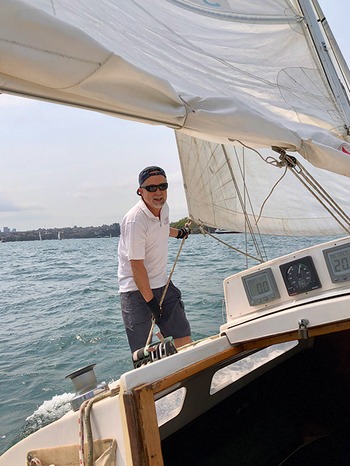
Section 4 – with an interest in sailing and sea journeys – makes the hydrosocial and hydrocolonial (Hofmeyr, Reference Hofmeyr2022) roles of oceans central, bringing in questions of control over water and trade, along with slavery, and creole languages. From Gilroy’s (Reference Gilroy1993) classic work, The Black Atlantic, to Shilliam’s (Reference Shilliam2015) The Black Pacific, studies of oceans and those who crossed them in search of resources to be extracted, or those forced to cross them as enslaved plantation labor, have shown how oceans are central to colonial history, and the spread and development of certain languages. Looking at oceans as historical arrangements helps us understand how the sea, particularly for Black diasporas, is history (Walcott, Reference Walcott1989). Section 5 takes us beneath the surface and looks at the underwater world from the perspective of divers. Although diving, like so many other histories, has a story of exploitation (e.g., Japanese pearl divers in Broome in Northern Australia), this section asks how the experience of diving makes possible different views of the world that can help us think of alternative ways of being and doing (Godfrey-Smith, Reference Godfrey-Smith2017). The transhuman reconfiguration of possibilities brought about by modern diving equipment enables a return to prehuman origins in the oceans (Raycraft, Reference Raycraft, Picken and Waterton2024). The final section brings these ideas together into a concluding argument for talking about language, water, and power together as critical hydrosocial language studies.
2 Swimming Laps: Modern Water and Filtered Languages
2.1 Modern Water
It is a pleasure, particularly in summer, to have access to a good swimming pool. It is also a remarkably privileged possibility. Ten minutes’ bike ride from where I live in Sydney is the Andrew “Boy” Charlton pool, an outdoor saltwater pool on the edge of Woolloomooloo Bay on Sydney Harbour.Footnote 2 This is not like the ocean pools by the sea (filled naturally by the waves) but a 50-meter pool with treated and heated water from the harbor that provides through the summer an unusually clear, salty swimming experience with harbor views. Fifteen minutes by bike takes me to another 50-meter pool at the Ian Thorpe Aquatic Centre (ITAC), named, like the Andrew Charlton Pool, after one of Australia’s great Olympic swimmers. Also operated by the City of Sydney, the ITAC is covered, but still light and airy, and usable throughout the year (kept at about 26 degrees Celsius). People have long swum in natural pools, ponds, lakes, waterholes, billabongs, and other relatively safe bodies of nonflowing water. They are safer (and often warmer) than rivers or the sea, and, if commonly used, may have ways of getting into or out of the water more easily: a jetty, swing, ladder, or steps. The ocean pools by many Sydney beaches (the Bondi Icebergs pool is the best known) – natural rock pools (adapted with some extra concrete) filled by ocean waves – provide an experience somewhere in between: enclosed ocean water. The modern swimming pool is bounded, usually of a set length, filled with chlorinated water, and kept at a comfortable temperature.
“Lap swimming only” announces a sign above all but one ITAC lane, followed by the relative speed and stroke (slow, medium, fast, freestyle, and any stroke). “Laps” for some refer to the same as a “length” (from one end of a pool to another), and for others two lengths (ending up where you started, like the lap of a running track). Either way, a lap is in a straight line, guided by lane markers on the surface and lines on the bottom. Such pools are a form of modern water. In the previous section, I gave the examples of bottled water or taps, yet it is perhaps the swimming pool that gives us one of the best examples of modern water in the social domain. In its standardized version it has even become a unit of measure: All the gold ever mined could apparently fill two Olympic-sized swimming pools, while privatized water companies in the southwest of England lose 100 Olympic-sized swimming pools of water per day through leaks. “Modern water” is the term Linton (Reference Linton2010, p. 8) uses to describe water that is “not complicated by ecological, cultural, or social factors.” It is a substance to be easily managed. It is universal and natural so that “all waters, in whatever circumstances they may occur, are reducible to the abstraction of universal water and its core essence or structure: H2O.” Modern H2O, the hygienic and hydraulic waters of utility and industry, the often privately owned resource that is clean and usable, this “social creation of modern times,” sits in contrast to water in its other freer states, and its importance as part of our myths, symbols, and subconscious (Illich, Reference Illich1986, p. 76).
There is often a “placelessness” to modern water. The control of water in placeless discourses of hydrological engineering and infrastructural management renders it a substance of economic value and manipulation. For Linton (Reference Linton2010, p. 14), modern water is “the dominant, or natural, way of knowing or relating to water, originating in Western Europe and North America, and operating on a global scale by the later part of the twentieth century.” To understand what modern water means is to take the hydrosocial view of water seriously, the idea that modern water is an invention (of the Global North). Water can be understood as both a physical and a social actant in cultural and political processes. Industrialized, modern water is designed to be neutral, tasteless, and unremarkable (Spackman, Reference Spackman2023). Although it is filled with both intentional (chlorine and fluoride) chemicals to sanitize it and make it good for our health, and unintentional chemicals (from lead to microplastics and PFASFootnote 3), it is designed and manufactured to be neutral, lacking taste. We should not notice it. Those who opt out of the tap version of modern water by drinking bottled water (or those obliged to because industrial water has not yet reached their water supply) are engaged with another version of industrial water, packaged, labeled, and polluting.
Analogies with language can already be discerned in parallels with languages in modernity. Modern languages are, like modern water, an invention, reproduced by related institutions, discourses, and social processes. This is not only to observe that the ways we divide oceans up into separate entities (Atlantic, Pacific, Indian, etc.) – a puzzling idea when we stand on a promontory where two oceans meet – is in a number of ways akin to the ways we divide language into separate named entities – a puzzling idea when we observe how language, like water, flows in many directions. It is also to observe that both the idea and the substance of tap water and contemporary languages are creations of modernity. Modern language, like modern water, has a certain placelessness, the modern tap strangely resembling the “talking heads” of Saussurean linguistics: Turn them on and out comes water or language, flowing freely across empty space. Modern language, like modern water, is universal and natural so that all languages, in whatever circumstances they may occur, are reducible to the abstraction of universal language and its core essence or structure. There are a number of relations between water and language at social, political, and material levels. It may be tempting to accord to both water and language a certain “natural” property: On the one hand, an essential part of the planet we live on; on the other hand, an evolutionary development that propelled our hominid ancestors forward. Yet both water as a social and political aspect of modern life and language as a communicative apparatus that sits at the heart of social life are not so much pregiven entities waiting to be discovered and used as products of social relations.
In its quest to become a science of language, linguistics has reduced language to the equivalent of H2O, a clean, homogenous product available to all. Alongside this placeless (universal) language are the territorially defined languages, both inventions of modernity. Standardized languages are also, like modern water, supposed to be invisible, taste-free, unremarkable, and normalized, though they too have many added chemicals (rules, norms, and correct ways of doing things) that maintain this invisibility. It is those who do not speak standard language who have an accent or speak a dialect. These contemporary understandings of what constitutes water and languages have come to take a prominent place in the modern episteme, yet we cannot take modern ideas such as language or water (or gender or race) as empirical givens but rather must seek to account for their social and historical development as ideas. Understanding hydrosocial relations requires a “shift from regarding water as the object of social processes,” to an understanding of water “that is both shaped by, and shapes, social relations, structures and subjectivities” (Linton and Budds, Reference Linton and Budds2014, p. 170). Likewise, understanding sociolinguistic relations requires a shift from regarding language as the object of investigation to an understanding of languages as shaped by and shaping social relations, structures, and subjectivities. A hydrosocial perspective urges us to consider not only the social – the point that neither language nor water is simply given in the environment but is fundamentally social – but the shaping effects of language and water on social life. The seascape, in Moriarty’s (Reference Moriarty2025, p. 950) view, is “a relational force that co-produces ecological, social, and political realities.”
2.2 Civic Containment, Ownership, and the Hydrocommons
The parallel between swimming pools and standardized languages raises the question of access. There are estimated to be around 400,000 private pools in Sydney, many in backyards (and not just behind the houses of the wealthy) and others attached to private schools and clubs. The pools mentioned in section 2.1, however, are public pools: Anyone can swim there for a small fee. Sydney is fortunate in having a good number of high-quality swimming pools (there are five within easy distance of where I live, each accessible with the same City of Sydney card). It was not always the case, however, that anyone could swim in a public pool. Indeed, the battle over access to swimming pools in Australia and elsewhere reveals not only a history of civic containment but also a history of racial exclusion. In Australia, as in the USA and elsewhere, racial segregation was common across recreational spaces, with the swimming pool a particular concern about the wrong type of body in the sanitary water (Wolcott, Reference Wolcott2014). In 1965 a “freedom ride” (taking inspiration from the US Civil Rights Freedom Ride of 1961) of Sydney University students led by Arrente student and activist Charlie Perkins,Footnote 4 and later joined by Gumbaynggirr man Gary Williams, set out across rural NSW to investigate and oppose racial discrimination against Indigenous people.
The focus in Moree, a small town in Northeast New South Wales, was the local swimming baths – artesian baths and swimming pools – that were reserved for whites only: First Nations people had not been allowed to use them since they opened in the 1920s (NSW Aboriginal Land Council, 2025). Opposed by a jeering crowd throwing fruit and other missiles, Charlie Perkins and the other students took a group of Indigenous children for a swim in the town pool. Aboriginal people, particularly in smaller towns, were confronted by many forms of discrimination, from segregated cinemas to denial of entry to clubs and shops. This image of young Indigenous kids being taken for a swim was to have a lasting effect on a wider Australian consciousness of discrimination and its effects. While they were soon prevented from swimming again in Moree, the freedom ride, the images of kids splashing around in the pool while angry crowds stood outside, and the activist work of Charlie Perkins and others would play an important role in encouraging Aboriginal leadership and the successful 1967 referendum that removed discriminatory references to Aboriginal people from the Constitution and brought about more positive legislation for First Nations people (Curthoys, Reference Curthoys2002). The struggle continues.
Questions of swimming pool access, therefore, point to larger concerns over racist limitations on access to public space, and more broadly, the questions of access to and ownership of water. A key idea that connects modernity and territory is ownership. The right to own land and property has been a defining aspect of liberal–capitalist democracy, but it was the excesses of neoliberal ideology that put into motion the idea that public water could be privatized. The privatization of water has developed as part of the neoliberal politics that have consumed the world over the last half-century. For the World Bank, the apparent failure of countries to provide adequate public water suggested that privatization was the answer: Private companies would henceforth provide water at cost, and water would no longer be part of a common good but a commercial property to be bought and sold (Jaffee, Reference Jaffee2023). In this light, the idea of the hydrocommons (Neimanis, Reference Neimanis2017a) suggests both water as commons – and thus part of a shared world not amenable to private ownership – as well as a shared sense of more-than-human embodiment that links humans and other water-sharing beings. If we accept Hardt and Negri’s (Reference Hardt and Negri2017, p. 59) contention that “precarity and the common are the key terms for recognizing the poverty and potential of the multitude in the age of neoliberalism,” then the struggle over resources suggested by the hydrocommons points to important ways forward in opposition to neoliberal forms of confinement. Control over water and access to (clean) water are two basic concerns of politics and human rights. Access to water is seen as a fundamental basic human right under articles 11 and 12 of the UN International Covenant on Civil and Political Rights.
Struggles over the control of water have been termed hydropolitics (Ohlsson, Reference Ohlsson1995). Water resources management, Mollinga (Reference Mollinga2008, p. 10; italics in original) reminds us, is “inherently political” because “water control is at the heart of water resources management,” a process of “politically contested resource use.” The control of water resources by one power – often a country – over another has been termed hydro-hegemony (Zeitoun and Warner, Reference Zeitoun and Warner2006) and includes many contemporary struggles over water sources: Israel has control over Palestinian water, India and Bangladesh have disputed claims to the Ganges, Egypt and Ethiopia are in dispute over the Grand Ethiopian Renaissance Dam. Indeed, water is a major site of conflict across Western Asia (the “Middle East”) and elsewhere. For Cascão and Zeitoun (Reference Cascão, Zeitoun, Earle, Jägerskog and Ojendal2010), hydrohegemony consists of four types of hegemonic power – geographical, material, bargaining, and ideational – that give certain actors control over water resources. More broadly, questions of water pollution, access to clean water, changing sea levels, and melting glaciers all make water – necessary for human life to continue, and for hygiene, agriculture, and much more – a highly political domain. From the struggle for survival in Pacific Islands to the shortages of fish in our polluted oceans, from the deaths as a result of drinking unclean water to the work carried out by young women transporting water to their homes, water politics are all around us.
2.3 The Politics of Language and Water Management
Understanding that hydrohegemony involves not so much the imposition of one form of power over others but rather the interplay of forms of power – spatial, material, interactional, and ideological – can help us develop understandings of language and power that integrate a wider set of social actors than is usually the case. Language management, in Spolsky’s (Reference Spolsky2012, p. 1) influential development of the concept, refers to “conscious and explicit efforts by language managers” to control language choices. Central to this view is a focus on the ways people in authority exert overt influence over other people’s language use in various domains of language. Like restricted views of water management, the stress here is on certain people having power, with language and water being resources that can be rationally apportioned, and these decisions affecting personal choices in relation to water or language use. These modernist views on language management – with power vested in certain people, languages as separate and controllable entities, policy as explicit and conscious, and individual choice as the preferred mode of freedom – overlook the lessons from thinking in terms of hydro- or linguistic hegemony.
The political liberalism that runs through much of sociolinguistics has tended to focus on the individual, idiolects, and choice at the expense of a more grounded examination of language and politics (Williams, Reference Williams1992). By making the idiolect fundamental to linguistics – an idiolect or I-language is “the actual grammar, lexis, phonology etc., that we each carry around in our heads” (Hall, Reference Hall, Hall and Wicaksono2020, p. 17) – linguistics maintains “the doctrine of the fixed code” (Harris, Reference Harris1998, p. 49), and considers language as largely sanitized, contained and private. Language has been considered in terms of individual actors rather than the more social understandings that are necessary to see it as “a distributed system and not located within an organism” (O’Grady and Bartlett, Reference O’Grady and Bartlett2023, p. 21). Thinking with water makes it easier to think of language beyond its bottled, tapped, or pooled versions. To understand language and power (and therefore ideas such as policy or management), we need to think about the relational effects of spatial, material, interactional, and ideological forces that take us beyond some people exerting linguistic influences over others and enable us to see language as steeped in power.
Thinking with water can help us appreciate that while language is very different from water (it is not, contrary to conservative critiques, more and more polluted, nor is it a limited resource in the same way), it can be seen as an invention (modern water), a shared resource that is struggled over (access to language is unequal), and something that should not be subject to ownership (Pennycook, Reference Pennycook, Maciel, Tilio, de Jesus and Chaves de Barros2019). One approach to the ownership of language followed the ownership of private property, so that by the nineteenth century in the Global North, copyright – the ownership of text – was embedded in the laws of nation-states that had claimed ownership over particular versions of language. A goal of twentieth-century neocolonialism was to oblige the Global South to sign up to these ideological tenets, to agree to international regulations on copyright, and to move toward forms of language policy that cemented particular forms of language at the national level (Pennycook, Reference Pennycook1996). Both translanguaging and English as a Lingua Franca (ELF), according to Widdowson and Seidlhofer (Reference Widdowson, Seidlhofer and Murata2024), are united by an interest in undermining forms of linguistic ownership, transcending the linguistic boundaries of modernity. Rather than assuming that translanguaging is just the mixing of pregiven linguistic entities (akin to that archetypal symbol of modern water, the mixer tap), a translingual perspective challenges assumptions about fixed norms of language definition and use and undermines the territorial boundedness of languages as national properties. An ELF perspective denies the ownership of English to its so-called native speakers and argues instead that it is the property of all who use it.
This does not, however, necessarily undermine the notion of ownership itself: It merely redistributes language ownership to a wider group of speakers. The problems of water ownership – the privatization and desecration of water supplies, the hydrohegemony of control over water resources – suggest a counterstrategy not only of better distribution of ownership but of deeper challenges to the very possibility of ownership. In this light, raciolinguistic arguments that “racialized bilinguals lack a construct known in schools as ‘academic language’” (García et al., Reference García, Flores and Seltzer2021, p. 209) can be seen as continuations of the arguments of ownership and exclusion that denied access to swimming pools. The challenge is to resist forms of enclosure (privatization, incarceration, and commodification) demanded by capital through a focus on the commons, as space, community, and possibility. Thinking in terms of the hydrocommons helps combine the ideas of the commons, southern epistemologies, and water. Water epistemologies suggest not so much the imposition of one form of power over others but rather that power saturates the social body. Understanding relational power in terms of spatial, material, interactional, and ideological forces takes us beyond both concern over individual choices in relation to rule-governed language patterns and initiatives of expanded ownership.
2.4 Language, Water, and Control
Lack of access to safe water, as Jaffee (Reference Jaffee2023, p. 10) notes, is a “key marker of social and environmental inequity on a global scale.” We need to be careful, therefore, not to critique modern water itself as part of the general critique of modernity: The conflation of coloniality and modernity (Mignolo, Reference Mignolo2021) can lead to all forms of modern life being critiqued as forms of coloniality. This misses the point that public access to modern water remains a laudable goal. While access to swimmable water may be a luxury, access to drinkable water is a necessity. The claim, however, by former Shadow Minister for Indigenous Australians, Senator Jacinta Nampijinpa Price, that “now we’ve got running water” suggests that there are “no ongoing negative impacts of colonisation” for Indigenous Australians (ABC News, 2023), overlooks the larger picture of hydrohegemony. The very real benefits of modern water and language – safe water, standardized language – have to be set against the vastly negative consequences of colonial dispossession and the effects of language and water colonialism on Indigenous communities (Hartwig et al., Reference Hartwig, Jackson, Markham and Osborne2022; Moggridge and Thompson, Reference Moggridge and Thompson2021). Modern water is clean, beneficial, and contained, but it comes at a cost, from the literal cost of water charges to the more general cost of lives constrained by state intervention.
Sovereignty over languages and water can include both access to resources and the need for local control over what they mean. Thinking about language and water in relation to swimming pools can help us reflect on questions of standardization, containment, and exclusion: Water is cleaned and enclosed, and access is regulated through means akin to the ways languages are constrained by a host of civic institutions. Yet the swimming pool analogy complicates this picture. There is a tendency in sociolinguistics to demonize standardized languages as if the natural state of language is free-flowing and unconstrained, and to standardize is to place unnatural limits on the social use of language (akin, perhaps, to claiming that the Indigenous kids in Moree would have been better off swimming in the local river anyway). The dichotomous separation of natural (everyday) and social (standardized) ways of using language may also obscure our thinking here. While this quasi-libertarian position rightly points to the exclusionary effects of standardization (denigrating other ways of speaking), it unhelpfully opposes the social and the natural (both are social ways of doing things) and overlooks the ways that regularities in speaking are socially reproductive, irrespective of what variety that may be.
Swimming pools and standard languages are human creations that enable certain, constrained things to happen. If power is understood only in terms of the imposition of standards from above, we miss the ways that regularity emanates from social practices (ways of being and doing are kept in place by socially repeated actions: we swim laps and speak along regularized lines) and that both pleasure and advantage can be had in following social norms: conformity is not only obeisance. The question is whose social norms prevail. As Alim (Reference Alim2005, p. 28) observes, “well-meaning educators attempt to silence diverse languages in White public space by inculcating speakers of heterogeneous language varieties into what are, at their core, White ways of speaking and seeing the word/ world.” While access to language and water are key concerns, the central issue is whose version of each predominates. Swimming pools and modern water may have beneficial effects: However regulated and constraining, swimming pools are also generally a site of pleasure and well-being: swimming is good for you. Yet without self-determination to control the supply and meaning of language and water, neither may bring real advantages. While I have focused in this section on modern water and the swimming pool and images of containment, standardization, individualization, and ownership, I want to focus on the act of swimming itself in the next section, though in this case with a focus on the sea. This is about embodiment and other ways of knowing.
3 Bodyboarding at Bronte: Language and Embodiment
3.1 Littoral Domains
A thirty-minute bike ride takes me beyond the enclosed bodies of modern water in the city and out to the vast expanse of the Pacific Ocean. Bondi BeachFootnote 5 is the closest, though it can get crowded, so I prefer beaches to the south, such as Bronte, Coogee, or Maroubra. These coastal places are important sites in themselves, a place not only in between land and water but a domain where particular interactions are played out. We tend to think of the line between land and water, Czerski (Reference Czerski2023, p. 121) argues, as a sharp, distinct line drawn on a map, yet the “boundary between the land and the sea is often fuzzy, with its own complex and distinctive character.” These littoral domains suggest alternative ways of thinking about relations between land and water and our terracentric framing of language, a borderland in Anzaldúa’s (Reference Anzaldúa1987) terms, a place of alternative, lived and embodied knowledge beyond the colonial matrix of power (Mignolo, Reference Mignolo2000). Thinking in terms of the borders between land and water – beaches, seashores, tidal zones, riverbanks – takes us to those in-between spaces that suggest not only a fuzziness to the dividing line (like the common acknowledgement that languages have fuzzy borders) but a significance in itself for these places that are sometimes land, sometimes water. From a littoral perspective, the beach is not just an indistinct line between two entities – land and sea – but a site of dynamic interaction.
Atlantic Africans, as Dawson (Reference Dawson2023a, p. 17) argues, with a focus particularly on the era of African enslavement, did not just live along fresh and saltwater bodies but were “water-facing people who actively engaged with water to create ‘human shores.’” Atlantic Africans “merged land and water into waterscapes, creating places of meaning and belonging as they crafted aquatic traditions in coastal plains, rainforests, savannahs, and Sahel to understand their diverse hydrographies – marine geography and how tides, currents, and winds inform navigation.” Beaches have been a domain of interaction between Indigenous people and the sea for millennia. The Goolarabooloo peoples of Northwest Australia have long lived in close relation with the sea, fishing with spears, gathering cockles and other shellfish, and nurturing themselves, the seascape, and their cultures and languages in relation to each other (Eadie and Muecke, Reference Eadie, Muecke, Picken and Waterton2024, p. 18). Walking the Lurajirri trail through Goolarabooloo Country, one loses an individual sense of self in favor of “being-with-place” (p. 24) or what Taussig (Reference Taussig2009, p. 13) calls “not really a position at all but something more like swimming, more like nomads adrift in the sea.”
The ways the “beach” and the “seaside” may be currently understood are a result of cultural and material changes in modernity. The “seaside holiday” is largely a product of industrial culture: While nineteenth-century “bathing boxes” made it possible for some people to change discreetly, the development of designated places and practices of leisure for working people was a significant part of twentieth-century industrialization (see Figure 1). More recent “blue tourism” and the emphasis on pristine seascapes are the product of contemporary ecomodernist approaches to the coast (Moriarty, Reference Moriarty2025). Lamb (Reference Lamb2024) opens his account of multispecies discourse analysis in this littoral space, as tourists, turtles, and turtle guardians gather on a beach in Hawaii. At stake, he explains, is not just meaningful interaction between humans and other species, but ways of understanding ourselves when we take into account our relations with a wider world of beings. Studies of multispecies discourse “multiply our perspectives of what language and discourse are, perspectives which will necessarily be as diverse as the multispecies relations from within which we are able to learn about them” (Lamb, Reference Lamb2024, p. 194).
Seaside holidays for the working class: Ian, Agnes, William (Snr) and William (Jnr) Pennycook, 1934

One of the most important coastal domains is that of the mangrove, a plant of the tropics, a littoral tree that makes the divide between land and sea unclear. Mangroves, like other littoral zones are subject to tides, the rise and fall of water in relation to the earth’s movement and the pull of the moon. Caribbean poet and thinker Kamau Brathwaite (Reference Brathwaite1975) talks in terms of tidalectics, a way of thinking that emphasizes this backward and forward movement of water, making cyclical rather than linear time and movement central. The dense network of interrelations, the relational ontology of the “mangrove-world” Escobar explains (Reference Escobar2016, p. 18) is “enacted minute by minute, day by day, through an infinite set of practices carried out by all kinds of beings and life forms, involving a complex organic and inorganic materiality of water, minerals, degrees of salinity, forms of energy (sun, tides, moon, relations of force), and so forth.” Mangroves, as a particular instance of rhizomes, help us to think littorally, in less terracentric terms, in ways that challenge distinctions between land and water, and in terms of a domain, often disregarded, despised, and uprooted, that is central for maintaining life.
The mangrove is a crucial part of marine ecosystems and a domain under threat from human destructiveness: As Glissant (Reference Glissant and Wing)1997) laments, the rhizomatic mangrove forests, where he played as a child and whose murky waters and land-sea in-betweenness suggest so well the linguistic, cultural and identificational configurations of the Caribbean, have been reclaimed to make way for industrial zones and the new Martinique airport. This emphasis on water, on the recurrent and interconnected nature of oceanic experience, like the islands of the Pacific (as both water and land), runs through Caribbean thought and writing. From Césaire’s (Reference Césaire1969) Une Tempête – his anti-colonial rewriting of Shakespeare’s The Tempest – to Derek Walcott’s rewriting of Homer in Omeros (1990), with its focus on Caribbean fishermen, the burden of colonialism, and the diversity of Caribbean identity, the sea is always there. “Where is your tribal memory? Sirs, / in that grey vault. The sea. The sea / has locked them up. The sea is History” (From Walcott, 1979 [Reference Walcott1989] “The Sea is History.” For the Trinidadian poet Dionne Brand (Reference Brand2001, p. 6), “Water is the first thing in my imagination … All begins in water, all ends in water.”
The shore has long been a site of encounter that can be traced back into European antiquity (Kosmin, Reference Kosmin2024). Such encounters were often more violent than cultural: This is where European invaders landed and quickly used their weapons when they thought they were threatened (Captain James Cook’s first encounter with a Gweagal man in Botany Bay (Kamay in Dharawal) in 1770, involved Cook shooting the man in the leg). As Robert Hughes (Reference Hughes1986) suggests in his history of convict transport to Australia, The Fatal Shore, it may also be a mortal destination. In contexts of settler colonialism (such as South Africa) beaches have been spaces of symbolic domination and political struggle as racialized bodies – in ways not dissimilar to the discussion of swimming pool segregation in the previous section – were excluded and controlled (Deumert, 2022). From Cape Town to Sydney or Rio de Janeiro, beaches have often been patrolled White spaces. The Cronulla riots in 2005 between white Australian nationalists draped in flags and youths predominantly of Lebanese background also centred around who owned the beach (Kabir, 2015).
The shore and shallow waters were also a site of extractive exploitation: Like the massive overfishing of the oceans, the extractive practices of the European invaders would destroy many local shoreline ecologies. Cook was astonished by the abundance of shellfish in Botany Bay. Elsewhere, European invaders found vast oyster beds (that had been tended by Indigenous Australians) and middens (mounds of discarded shells). The shells could be burned to make lime for building (shell fragments can still be seen in the mortar of old colonial buildings) and by the mid nineteenth-century large-scale exploitation of the oyster beds of Moreton Bay (Queensland) had begun (for both food and shells) so that by the early 1890s at least 35 million oysters were hauled in from the waters of the bay (Bradley, Reference Bradley2024). Many of the rock oyster reefs and beds have been wiped out. These carefully tended coastal resources were decimated by European extraction and exploitation.
3.2 Waves of Knowing
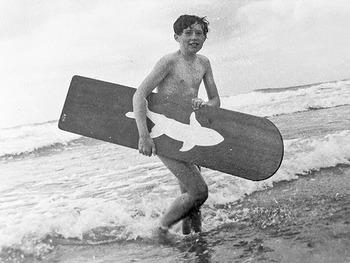
The beach is also where we may plunge into the waves – either just for a swim or for a bit of surfing – bringing an experience with water where its direct power confronts us. Surfing, as Tim Winton (Reference Winton2008) emphasizes, is both an engagement with the deep force of ocean waves as well as a sensual experience of being in the moment, aware only of waves, boards, and bodies (see Figure 2). A focus on swimming and surfing looks at our relationship with water from its edges (beaches and other littoral domains) and explores in greater detail the idea of embodied relations with water. “Our watery relations” (Neimanis, Reference Neimanis2017a, p. 2) when humans – like other animals, largely liquid – take to the water suggest a “more-than-human hydrocommons.” Here the hydrocommons is not only about the common ownership of water (as discussed in the previous section) but also about the commonality of animals and water. Our “wateriness” (Neimanis, Reference Neimanis2017a, p. 2), both materially and conceptually, implies that the human is always part of a wider, more-than-human world. This is a call for “an engagement with the fluid, dynamic, and amorphous narrative of human–nature relationships” (Moriarty, Reference Moriarty2025, p. 948) in which “the seascape is understood as a fluid, multispecies entangled system, where the porous boundaries between the human, nonhuman, and more-than-human are in a constant state of flux” (p. 951).
The author, Porth Joke beach, Cornwall, UK, 1967
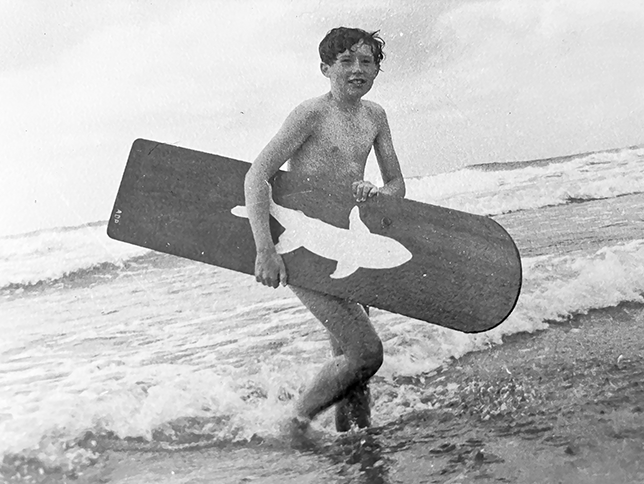
Ingersoll’s (Reference Ingersoll2016, p. 1) seascape epistemology emphasizes the ways Indigenous Hawaiian identities emerge when they enter the water; “I become a historical being riding waves, running as a liquid mass, pulled from the deep and thrown forward with a deafening roar. I disappear with fish and strands of seaweed as I course through veins of ocean currents.” It is in the ocean that Indigenous Hawaiians can reconnect with their Kanaka heritage. Seascape epistemology suggests an “approach to knowing presumed on a knowledge of the sea, which tells one how to move through it, how to approach life and knowing through the movements of the world” (Ingersoll, Reference Ingersoll2016, p. 5) This is an “approach to knowing through a visual, spiritual, intellectual and embodied literacy of the ‘āina (‘land’) and kai (‘sea’): birds, the colors of the clouds, the flows of the currents, fish and seaweed, the timing of ocean swells, depths, tides and celestial bodies all circulating and flowing with rhythms and pulsations” (Ingersoll, Reference Ingersoll2016, p. 6). Bringing together Hawaiian practices of he’e nalu (“surfing” – literally “wave sliding”), ho’okele (“way-finding or oceanic literacy”), and lawai’a (“fishing”), Ingersoll shows how entering the water is to “enter an indigenous thought-world stimulated by cultural memory, imagination, perception, and understanding” (Ingersoll, Reference Ingersoll2016, p. 115). Surfing has a long history and predates European contact with Polynesian cultures. The earliest written account of surfing dates to the 1640s on the Gold Coast, now Ghana (Dawson, Reference Dawson2023a). For Ingersoll, however, this is not a casual pastime nor a recent Western cultural constellation – the Beach Boys, camper vans, bleached hair, and doing a “hang ten” on a longboard – but a way of being, feeling, and knowing.
Such waves of knowing include remarkable navigation skills that enabled Polynesian people to settle and move between the islands of the Pacific (Hutchins, Reference Hutchins2005; Thompson, Reference Thompson2019). Polynesian navigation techniques used a set of common components, including detailed knowledge of stars and star paths, different ways of understanding orientation, and various means of finding land (from reading swell and waves to interpreting clouds and knowing the feeding habits of seabirds). Some of these forms of knowledge can be “translated into Western conceptual terms,” while others “reflected ways of seeing and thinking with no obvious corollary in the European tradition” (Thompson, Reference Thompson2019, p. 265). This is not only a question of knowledge as commonly understood in Euromodern thought, but also about how navigation is experienced as an embodied practice, a range of learned ways of experiencing the world, coupled to “the deep, inherited cultural understanding of island and ocean that was shared by those who for thousands of years lived in and with the sea” (Thompson, Reference Thompson2019, p. 272). Such navigational expertise is therefore not just an alternative knowledge but rather “knowing in a different way” (Reference Thompson2019, p. 293, italics in original): The models used by Micronesian and Polynesian navigators “operate in a different frame of reference and on the basis of different fundamental representational assumptions from those that are common in the Western world” (Hutchins, Reference Hutchins2005, p. 1569). For one Hawaiian navigator, this meant achieving an intuitive sense of sea and sky, of “thinking not just with his conscious mind but with his body, in some sense feeling his way across the ocean” (Thompson, Reference Thompson2019, p. 293).
Terracentric ways of thinking often overlook the ways that Indigenous understandings of land may equally include water. Islands are not so much isolated clumps of land surrounded by water but waypoints on oceanic highways (Epeli Hau‘ofa, 2008). Oceania (Océanie), outside the Anglophone world, is usually treated as a continent itself, as one part of the world. Land, for First Nations, can refer to “all more than human life forms … found in the sky, water, and land” (Hermes et al., Reference Hermes, Engman, Meixi and McKenzie2022, p. 1 fn 1). In Australian Aboriginal English, the notion of Country encompasses “the seas, waters, rocks, animals, winds, and all the beings that exist in and make up a place, including people” (Bawaka Country et al., Reference Bawaka, Burarrwanga, Ganambarr and Ganambarr-Stubbs2022, p. 436). The Karrabing Indigenous Corporation – karrabing is an Emiyengal (Northern Territory) term referring to the point at which the tide has reached its lowest point – Povinelli (Reference Povinelli2016, p. 25) suggests, takes a different approach to land rights, rejecting state forms of land tenure and group recognition (and the anthropological assumptions about clan and territory) while still maintaining “modes of belonging to specific countries” that include water, tides, and creeks. A focus on water (the Grand River in Southern Ontario), Stevenson (Reference Stevenson2018, p. 109) explains in the Canadian context, highlights “the limitations of land rights issues that remain fixed within the material ordering practices of Western property regimes and the social relations of capital.” Water, which for many Indigenous people in Australia is part of Country and holds a sacred place in their cosmology, is both expansive and spiritual.
The Yolŋu Mata (North East Arnhem Land) word for water, gapu is a significant spiritual symbol in Yolŋu culture, pointing to the importance of water in climate and culture. These embodied spiritual relations to water suggest that language is already in the water. Bodies of water for Indigenous Australians, Langton (Reference Langton, Bruno, Barker and McNiven2006, p. 144) explains, are more than just a physical domain: “They are construed spiritually, socially and jurally, according to the same fundamental principles as affiliations to terrestrial places in the land.” It is the transformative powers of the spiritual beings that inhabit places, whether landscapes, waterscapes, or skyscapes, that matter. For Aboriginal people, “the distinctions between land and water are not absolute.” They are seen instead as cultural and linguistic spaces. Australian waterscapes, or saltwater country, as seen through Indigenous worldviews, are entangled in social relations (Langton, Reference Langton, Bruno, Barker and McNiven2006). From this point of view, saltwater country extends beyond littoral boundaries and includes coastal, island, and marine environments (Whitehouse et al., Reference Whitehouse, Watkin Lui, Sellwood, Barrett and Chigeza2014), and language is similarly not constrained by terrestrial boundaries.
3.3 Saltwater Words
From Indigenous points of view, “what is called ‘the language’ often inheres in what people call themselves, their lands, waters and place” (Nicholas and McCarty, Reference Nicholas, McCarty and MacSwan2022, p. 230). Since language derives from country (land and sea) for many First Nations peoples, and forms a more important relationship than between language and people, different water ontologies suggest different language ontologies. Tlingit (First Nations people of the circumpolar North) perspectives on glaciers offer “an alternative ontological awareness of glaciers as well as a nuanced Indigenous empirical scientific knowledge that moves away from the Eurocentric models of categorizing and understanding the natural world” (Hayman et al., Reference Hayman, James, G̱ooch, Wedge and Aan2018, p. 77). Such perspectives can “inform and potentially reimagine contemporary international debates concerning water ethics, water law, water governance, and water management” (p. 77). There are tensions in many water management projects between the different water ontologies at stake (Moggridge and Thompson, Reference Moggridge and Thompson2021): modern, controllable, manageable water on the one hand, and spiritual embodied relations to water on the other. River management as envisaged by Traditional Owners is all too often ignored in favor of “conventional policies and laws that abstract waters, conceptually and materially, from their socio-cultural context while guaranteeing access to this ‘resource’ to settlers” (Jackson et al., Reference Jackson, O’Donnell, Godden and Langton2023, p. 278). In a similar vein, language revival projects are often confounded by different language ontologies: clean, containable, describable languages on the one hand, and fluid, embodied, and spiritual relations on the other (Leonard, Reference Leonard, Leonard and De Korne2017).
The issue is not just that we need to include different perspectives in language reclamation projects but that those perspectives give us insights into other ontologies: language and water may be alive. This is to connect the idea of living waters (see Section 1) to the imperative to “delink from Western notions of ‘language’ as decontextualized and instead think of language as interwoven with bodies and land, and in this sense, alive” (Hermes et al., Reference Hermes, Engman, Meixi and McKenzie2022, p. 26). This is not merely to consider a language to be living (still used) as opposed to dead (no longer used) but to understand rivers and languages as living entities. Talk of land or country includes different forms of water: Rivers, creeks, lakes, seas, billabongs, and all forms of water that are part of the country. When a speaker of Maringa (Arnhem Land, northern Australia) characterizes the way they speak (and its difference from other ways) as “saltwater words” (Vaughan, Reference Vaughan2018, p. 127), this has to be taken seriously in relation to both language and the role of different kinds of water in shaping language. Many Indigenous Australian groups see themselves as sea or saltwater people, often today using this broad Aboriginal English (saltwater) designation, and drawing distinctions between, for example, monuk gapu (salt water) and raypiny (fresh water) in Yolŋu Mata.
From the katungal (“sea people”) of the Gadigal (of the coastal region around Sydney) or the Bundjalung, Yugambeh, and Quandamooka people of northern New South Wales (accomplished seafarers along maritime routes in their canoes) to the Ngaro and Yuwibara people around modern Mackay in Queensland (marine hunters, gatherers, and skilled navigators), the Gudjuda people in the northeastern corner of Australia, with a special relation to the sea country of the Great Barrier Reef, or the Larrakia of the Northern territory (who have long had a close relationship with the sea and trade), or the Wadandi traditional owners of Wadandi Boodja (saltwater people’s country) in the South West of Western Australia, many coastal First Nations Australians are sea or saltwater people. It is not so much a question of these languages having particular words for water, navigation, fish, and so on (they do, of course) but that spiritual, ancestral relations connect water and language. The wuymurri songspiral (a story/song about a whale and the water and spirits) tells of the salt water, its inhabitants, of being in and with the water and the current (Gay’wu Group of Women et al., Reference Burarrwanga and Ganambarr2019).
Songspirals are “the doing, being, thinking, understanding of Yolŋu life-worlds. They are a generative ontological manifestation of relationality, of the ongoing emergence of everything in relation with everything else, of the co-becoming of time and place” (Bawaka Country et al., Reference Bawaka, Burarrwanga, Ganambarr and Ganambarr-Stubbs2022, p. 437). With language and sea country indelibly linked, these languages cannot be understood without their saltwater connections. Water, as Muñoz (Reference Muñoz2023, p. 39) emphasizes, “makes life possible, not as a process that animates individual humans, but as a spirit that connects us to all beings in creation, in which humans are small elements in the dynamic system of life.” Bruce et al. (Reference Bruce, Bang and Lees2023, p. 19) stress the importance of “Indigenous water pedagogies.” Water, they argue, is “under-articulated when it comes to land-based, place-based, and field-based science education.” Framing education solely around land, “without enough emphasis on water, fails to disrupt colonial paradigms that position land as the basis for property and territorial claims,” conflicting with “those of many Indigenous peoples, for whom water is central not only to territorial struggles but to defining who we are as a people.” Of the many lessons that can be learned through closer attention to Indigenous ontologies, one of the most important is that language and water are connected. Water as commons implies language as commons, not in the idealist sense of a universal capacity but in the material and spiritual ways that people, language, and water are united.
3.4 Critical Waterscape Practices
As accounts of swimming – and particularly in oceans rather than swimming pools – tell us, swimming “entangles place and practice to show us that we are vulnerable and sometimes uncomfortable within the sea” (Bates and Moles, 2024, p. 188), yet also brings a sense of embodiment that we rarely achieve on land. Rethinking embodiment in watery terms challenges “the discrete individualism that underpins dominant Western theories of body-subjects as discrete and autonomous” (Neimanis, Reference Neimanis2017a, p. 169). Thinking about bodies in watery terms erodes the methodological individualism that has so hampered our understandings of language. This takes us further than the observation that water is a useful metaphor for a fluid account of language, that fluid water provides us with a way of thinking about language and languages that start with the idea of a flow within and between languages rather than a sense of languages as self-contained earthly systems. Thinking in terms of embodiment and waterscape epistemologies not only takes fluidity as our starting point (rather than the blurring of fixed boundaries) but pushes toward an alternative understanding of engagement – spiritual, material and embodied – that starts not with autonomous individuals and their languages but with thought-worlds where imagination, perception, and understanding are part of a felt world (Ingersoll, Reference Ingersoll2016).
For Neimanis (Reference Neimanis2017a), Euromodern conceptions of the human experience – as discrete, bounded, autonomous individuals – have obscured our material reality as bodies of water. This takes us toward an understanding of the distributed nature of being, where language, cognition, and identity are not the property of the individual but part of a wider ecology of material relations. From a linguistic point of view, thinking and feeling with water (like Escobar’s (Reference Escobar2016) thinking–feeling with the earth) opens up an understanding of language embodiment, where the body is central to any understanding of language (Bucholtz and Hall, Reference Bucholtz, Hall and Coupland2016). Thinking in and with the sea (Moriarty, Reference Moriarty2025, p. 952) emphasizes both the need to think with water and the need to be in water as a way to estrange ourselves “from human-centred ontologies.” This opens up an understanding of distributed language (Cowley, Reference Cowley and Cowley2012), where language is no longer seen as residing within the individual but rather as a set of relations between people, place, and things. Our embodied relations with water suggest that to understand language, we should start not just with the importance of the body for communication but with a sense of embodiment as part of a larger world. Both embodiment and littoral thinking give us different starting points – bodies of language and water, borders that come and go – for thinking about language.
Accounts of waterscapes and wet bodies (Dawson, Reference Dawson2023b) point to the ways people, land, and water have been bound together (in coastal West Africa): fish and shellfish provide nourishment and trade, coastal life and inland waterways enable connections and set the rhythms of daily life. Such relations to water can be very different according not just to physical aspects of sea and land but also to cultural and ideological orientations to water. Rethinking language as watery takes us beyond flows between predetermined languages and instead takes us into a realm of language as already distributed and diverse. A water orientation encourages us to capture relational thinking, which has been “ignored, invisibilized, under-articulated, or unintelligible” (Chen et al., Reference Chen, McLeod, Neimanis, Chen, McLeod and Neimanis2013, p. 13). Unlike the atomistic ontologies that constitute the foundation of Western liberalism, relational thinking encourages us to develop a sense of language plurality within a pluriversal world (Escobar, Reference Escobar2020). An exploration of the nature of water (Yates et al., Reference Yates, Harris and Wilson2017) urges us to reconsider easy assumptions about the fluidity of languages in opposition to their territorial fixity. Relational thinking suggests that languages may be ontologically diverse and that the flows between them may imply more than mere fluidity.
Waterscape epistemologies provide a strong contrast to the locatedness and rootedness of languages and their speakers in the landscape. Viewing the sea as more than a backdrop against which language can be understood, it is possible to investigate ways the ocean provides a fertile environment for “reconceptualizing understandings of space, time, movement and experiences of being in a transformative and mobile world” (Steinberg and Peters, Reference Steinberg and Peters2015, p. 247). This suggests the importance of understanding our embodied relation with water as part of a way of rethinking what it means to do critical work. This is not only a “green applied linguistics that investigates the role of language in problematic human–environment relations” (Lamb, Reference Lamb2020, p. 923) – an argument that any critical linguistic project needs not only a critical approach to society but a critical approach to the environment – but also a call to renew critical approaches to language by attending to bodies, actions and engagements with all that is not human. As Moriarty (Reference Moriarty2025, p. 952) notes, “swimming as an embodied method for semiotic landscape research is an underutilised methodology.” A project that connects swimming with sharks or jellyfish, ecological feminism, and language embodiment can start to articulate an alternative kind of critical, embodied, positioned practice (Appleby and Pennycook, Reference Appleby and Pennycook2017). The move from human semiosis to embodied practice enables a move from grounded theory to waterscape epistemology as a wave of knowing about language.
4 Sailing Through the Heads: Hydrocolonial Relations
4.1 Setting Sail
Between the safety of the swimming pools and the wildness of the ocean beaches – about twenty minutes by bike – is a harbor bay where I keep an old sailing boat moored. It’s a worn boat, always in need of a bit of work,Footnote 6 but it allows us to sail out onto the blue waters of Sydney Harbour (Port Jackson), to enjoy both the peace and excitement of a boat under sail (see Figure 3). Sailing northeast takes us out toward the Heads – the two cliffs that mark the entrance to the harbor. Sailing through this gap between the cliffs that run south to Bondi and north to Manly, the motion of the boat changes as it meets the slow swell rolling in from the Pacific beyond. Out ahead is the vast ocean, and a sense of what it means to set out on a real sea voyage, leaving the land behind and feeling the slow power of the water all around. Rather than swimming or surfing in the water – embodied relations to water discussed in the previous section – this is to sail over the water. There can be a great joy in sailing: looking out across the water to the horizon, the land becoming smaller and less relevant behind, cruising along with aquatic giants such as whales,Footnote 7 feeling the motion of a boat beneath your feet and waves washing over the bow, sensing the wind and trimming sails accordingly, enjoying the peacefulness of the sea without engines and noise, while respecting the great power of the ocean.
Sailing in Sydney Harbour: The author, 2022
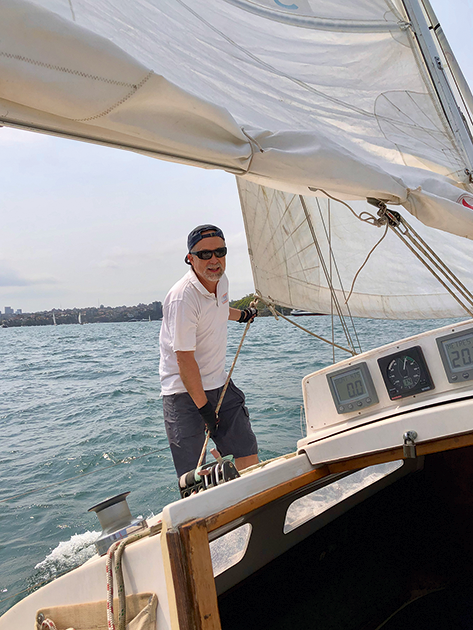
Sailing has generated its own terminology. From halyards (the ropes used to pull up sails) to sheets (those for controlling sails), shrouds (wires holding up the mast) to the boom (the horizontal spar at the foot of the mainsail), the corners and sides of sails (head, tack, clew; luff, foot, leech) to the parts of a boat (keel, gunwales, transom, bow, stern), sailing has a vocabulary particular to its domain (with equivalents in other languages). The challenges of communicating at sea led to the development of communicative systems that worked over distance (semaphore, flags, and Morse code). Maritime communication predates the developments and precision of aviation communication (Estival, Reference Estival2026). Shipboard communication, meanwhile, is influenced not only by this maritime lexicon, but by the makeup of crews: with officers often coming from the country that runs the ship (not the same as the “flags of convenience” – Panama, Liberia, Marshall Islands, amongst others – where a ship is formally registered) and crews drawn from the Philippines, India, China, and Indonesia amongst others, onboard communication is often in that language of convenience, English, or less stable translingual practices. The great ocean voyages and trade systems would give rise both to the spread, particularly of European languages (it is worth reminding ourselves that they did not just “spread” but were borne on ships) and the evolution of creole languages.
While part of the story of sailing is about great sea voyages – the Vikings across the Atlantic, Zheng He’s (鄭和) massive fleets across the Indian Ocean, Polynesians across the Pacific – it is also a history of colonialism and conquest, of hydrocolonial battles for supremacy. It was a fleet of boats coming the other way, in through the Heads, that started the process of European colonization of Australia. On January 26, 1788, the “First Fleet”– made up of eleven boats, including six convict transports, carrying more than 1400 convicts, marines, sailors, and officials – sailed through the Heads. The arrival of these ships was to have huge destructive implications not only for the lives and languages of the Eora, Dharawal, and Dharug people who lived from the abundant resources around the bay, but eventually for many other people across this huge territory. There had been earlier encounters between Europeans and First Nations: The British were not the first to have these shoreline confrontations, and as noted in the previous section, these were often bloody encounters. In 1788, the First Fleet moved a few kilometers north to Port Jackson from Botany Bay,Footnote 8 starting the decline of hundreds of Indigenous languages.
4.2 Creolization and Relation
When asked by his friend, filmmaker and scholar Manthia Diawara, what a biographical film of his life should focus on, the great Martinican writer and thinker Édouard Glissant suggested that he should “wait until we were in the middle of the Atlantic Ocean, and point the camera at the mass of water, its abyssal expanse. That would be the whole film in one shot, for him” (Alvarez, nd). In 2009, Manthia Diawara had accompanied Glissant aboard the Queen Mary II on a trans-Atlantic journey (for health reasons, Glissant no longer flew) from the UK (Southampton) to the USA (New York). Their conversations about Glissant’s theory of relation – an anti-imperialist and anti-essentialist way of thinking that Glissant saw as centered on the Caribbean (antillanité or Caribbeanness) but with far wider implications – are recorded in Diawara’s film Édouard Glissant: One World in Relation (2010). Like their former high school teacher, Aimé Césaire, and Glissant’s school friend, Frantz Fanon, Glissant “combined a passionate commitment to the politics of decolonization with a concern to analyze the modes and structures of French colonialism” (Nesbitt, Reference Nesbitt2013, p. 932). In much of his work, it is the unforgettable history of the slave trade, the bodies tossed overboard, the terror of the Middle Passage, to which he returns. “La traite. Ce qu’on n’effacera jamais de la face de la mer / Lesklavaj-la. Sa i opa ka’y janmen sa éfasé anlé lanmé a” (The slave trade. Which will never be erased from the face of the sea) (Glissant, Reference Glissant1956 / Reference Glissant2005; Chant quatrième p. 106).
The human cargo was often thrown overboard, weighed down with ball and chain: “These underwater signposts mark the course between the Gold Coast and the Leeward Islands. Navigating the green splendor of the sea. … still brings to mind, coming to light like seaweed, these lowest depths, these deeps, with their punctuation of scarcely corroded balls and chains” (Glissant, Reference Glissant and Wing)1990/Reference Glissant and Wing)1997, p. 6). As he says in his shipboard discussion with Manthia Diawara, “when you lean over the ship’s railing, you can’t stop thinking about the Africans at the bottom of the sea … It seems to me that it’s another way of meditating on what’s happened in the world” (Glissant and Diawara, Reference Glissant and Diawara2011, p. 5). Mbembe (Reference Mbembe2017, p. 181) likewise stresses the importance of considering “the underside of our history” and a world “built on countless human bones buried under the ocean, bones that little by little transformed themselves into skeletons and endowed themselves with flesh.” For Derek Walcott, in his Nobel Prize acceptance speech, “The sea sighs with the drowned from the Middle Passage, the butchery of its aborigines, Carib and Aruac and Taino, bleeds in the scarlet of the immortelle, and even the actions of surf on sand cannot erase the African memory, or the lances of cane as a green prison where indentured Asians … are still serving time” (Walcott, Reference Walcott1992).
If the Mediterranean Sea – “an inner sea surrounded by lands, a sea that concentrates” (Glissant, Reference Glissant and Wing)1997, p. 33) – gave rise to the unstable blend that became known as the “lingua franca” (a term now used to refer to widely used second languages more generally) – the Caribbean Sea, by contrast, “explodes the scattered lands into an arc. A sea that diffracts” (Glissant, Reference Glissant and Wing)1997, p. 33). The “reality of archipelagos in the Caribbean or the Pacific,” Glissant (Reference Glissant and Wing)1997, p. 34) explains, “provides a natural illustration of the thought of Relation” (p. 34). Dwelling on Glissant’s understanding of silt as a “residue deposited along the banks of rivers, in the midst of archipelagos, in the depths of oceans, along valleys and at the feet of cliffs,” Mbembe (Reference Mbembe2017, p. 181) draws attention to the ways silt “gave birth to new forms of life, labor, and language.” For Glissant (Reference Glissant and Wing)1997), the Caribbean is best summed up in terms of creolization and relation, not just métissage but “a new and original dimension allowing each person to be there and elsewhere, rooted and open, lost in the mountains and free beneath the sea, in harmony and errantry” (p. 34). As Glissant makes clear, creole languages are the legacy of these voyages and the plantations they fed. Too much emphasis is often placed on a terracentric understanding of colonialism, dwelling particularly on the end result of one-way voyages (settler colonialism) and their linguistic implications (dominant European languages). Paying more attention to the oceanic origins of languages can help us see how processes of diffraction operate.
It is important, therefore, to consider not only the settling of colonial languages but also the linguistic effects of trade and plantation colonialism, which were central both to the development of the colonial capitalist system and to creole languages. Rather than the Anthropocene (or other options such as the capitalocene) to mark the era where human effects on the planet equal geological forces, an argument can be made that the plantationocene would be a better term (Haraway, Reference Haraway2015). The slave plantation system was both the model and the driver of the mechanized factory system generally seen as the inflection point for the Anthropocene. This draws attention to the development of slave plantations as ecological structures formed by the histories, movements, and production of cash-crops fueled by enslaved labor, recognizing that plantation economies, characterized by large-scale monocultures such as sugar, tobacco, and cotton, “laid the groundwork for the extraction of resources and the commodification of nature” (Wu and Xu, Reference Wu and Xu2024, p. 4). The social stratification and exchanges of plantation colonies, with enslaved Africans and European owners, overseers, and workers, led to the ways creole languages developed in the Caribbean and elsewhere (Mufwene, Reference Mufwene2001), not as a category of structurally distinct languages but as languages with a violent oceanic and labor history.
4.3 Hydrocolonialism and Control of the Oceans
One approach to the politics of oceans emerged in “Afro- modern thought that developed around the edges of the Atlantic, a thought that takes this oceanic and transnational formation as the very unit of its analysis” (Mbembe, Reference Mbembe2021 [Reference Mbembe2010], p. 69). Most influential here was Gilroy’s The Black Atlantic, with its focus on slave ships as both all-too-real voyages as well as metaphors for the in-betweenness and double consciousness of Black bodies between different places and cultures. Here the Atlantic becomes both a hidden graveyard of countless Black lives and bodies – “water holds Black memory” (Tolbert, Reference Tolbert2022, np) – as well as an arena for cultural renewal through multiple creative forces such as jazz and reggae. Modern black cultural history, Gilroy (Reference Gilroy1993, p. 80) argues, has been impoverished by “doggedly monocultural, national, and ethnocentric” accounts that overlook the “transnational structures which brought the black Atlantic world into being” in “a system of global communications constituted by flows.” For Gilroy, we should “take the Atlantic as one single, complex unit of analysis” (Reference Gilroy1993, p. 15). A central image for Gilroy is “ships in motion across spaces between Europe, America, Africa, and the Caribbean” (Reference Gilroy1993, p. 4). This is to see the Black Atlantic as a modern political and cultural formation.
Shilliam’s (Reference Shilliam2015) The Black Pacific takes up these themes, showing both how the Black Atlantic and Pacific are connected in many ways (e.g., how reggae music resonates in Pacific islands, or how the Polynesian Panthers reworked the politics of their Black counterparts) and how the lives of Pacific islanders can be seen against the backdrop of racial categorizations and economic exploitation. Gandhi’s (Reference Gandhi2022) focus on archipelagos as spaces in between land and sea brings critical refugee studies into dialogue with settler colonial studies by focusing particularly on Vietnamese refugees in contexts such as the Pacific archipelago of Guam. The Indian Ocean was central to the main cultural and economic powers prior to the rise of European imperialism (Ghosh and Muecke, Reference Ghosh, Muecke, Ghosh and Muecke2007). Oceanic studies open up alternative scales of time and place. Braudel’s (Reference Braudel1949) study of the Mediterranean, as Blommaert (Reference Blommaert, Arnaut, Sif Karrebaek, Spotti and Blommaert2017) notes, was significant not just for the close study of the people that live and work in and around the sea – fishing, travelling, fighting – but also for the light it sheds on concepts of time, from the slow durée of climate and landscape to the daily history of événements.
For Braudel, capitalism emerged as a world-system from sixteenth-century maritime trade based on the accumulation of mercantile wealth in ports such as Venice, Genoa, Amsterdam, and London. These different scales based around the different paces of life and change round this body of water would later influence Wallerstein’s (Reference Wallerstein2004) World System Analysis and Blommaert’s (Reference Blommaert2010) sociolinguistics of globalization. Exploring the relationship between capitalism and the sea (Campling and Colás, Reference Campling and Colás2021) makes visible the submerged histories of capitalism, from seaborne slave trades to offshore financial deposits, the devastation of fish populations to the warming of the oceans. Unlike a particular line of liberal thought that views the oceans as empty spaces to be heroically crossed in the pursuit of legitimate trade interests, a more critical analysis points to the ways that capitalism is a recent, aberrant and violent historical period, and the sea has been one of the key domains of exploitation, brutality, war, conquest, oppression, and degradation. Oceans, as well as rivers, have always been central to trade: The British Empire depended on the control of the oceanic trade routes by British ships, and in this sense, we can start to understand hydrocolonialism as linking “sea and land, empire and environment” (Hofmeyr et al., Reference Hofmeyr2022, p. 309).
Campling and Colás (Reference Campling and Colás2021) show how the modern economy was shaped by maritime trade over millennia. For them, it is important to look at the material geophysical attributes of the sea, which make the ocean not just a space to be traversed but a very real, material player in the development of the global economy. The sea “with its non-human and more-than-human constituents, is an active agent of climate change, vulnerability, and resilience,” Moriarty (Reference Moriarty2025, p. 950) suggests. From a hydrocolonial perspective, the sea “has been a protagonist in the development of capitalism from the very beginning” (Campling and Colás, Reference Campling and Colás2018, p. 778) from the accumulation of mercantile wealth in European seaports (Venice, Genoa, Amsterdam, and London) to overseas conquest and wealth extraction, the Atlantic slave trade, and commercial wars among Europe’s naval powers in the early era of capitalist production (Marx, Reference Marx1867). The history of capital, as Sharpe (Reference Sharpe2016) reminds us, is inextricably bound up with the history of Atlantic chattel slavery. Starting initially as a medium of trade routes, with the advent of industrial capitalism the oceans became sites for the production of value, from shipbuilding and timber and steel industries to industrial fishing and whaling. Terracentric assumptions that the sea is a domain only of transport while the land is the place of value and production overlook the importance of the sea as a site of the production of surplus value in fishing and maritime transport.
From a terracentric viewpoint, it is common to view seaports as land-based places where goods are sent and received. The importance of the Hanseatic League, however, which dominated trade in Northern Europe between the thirteenth and fifteenth centuries and connected the city states of Lübeck, Reval (Tallinn), Bergen, London, Kraków, and many others, helps us see how these cities were part of an integrated network of cities – linked by their sea trade – rather than land-bound trading posts.Footnote 9 As a handbook on cargo puts it, a “port is a shore-based installation for the transfer of goods from and to ships” (cited in Hofmeyr, Reference Hofmeyr2022, p. 2). It is the terracentric insistence on land that has led to the overemphasis on ideas such as the Silk Road(s) (Frankopan, Reference Frankopan2015). Studies of these overland routes give us insights into the importance of trade routes, horses, and Central Asia, yet as Dalrymple (Reference Dalrymple2024) shows, before the thirteenth-century conquest of Central Asia, it was the sea – “the golden road” – and India that were more significant. It is by sea that vast amounts of trade in spices, metals, and textiles were carried to South East Asia. When the rapacious empires of the Europeans moved in to try to take over these trade routes, it was the ports that they built in order to control this trade – the British establishing Bombay (Mumbai), Calcutta (Kolkata) and Madras (Chennai), the latter just a few miles north of the formerly great port of Mamallapuram – from where goods had flowed to Southeast Asia for centuries.
European imperialism relied heavily on control over the sea and ports. Strategic ports such as Malacca (on the West coast of Malaysia, part then as now of an important shipping route) had been peopled by people from many places: According to a Portuguese visitor, Tomé Pires in 1515, there were perhaps a hundred different people and languages, including “Moors from Cairo, Mecca, Aden, Abyssinians,” as well as “Turks, Turkomans, Christian Armenians, Gujaratis,” and “merchants from Orissa, Ceylon, Bengal” and others form “Cambodia, Champa, Cochin China, the Moluccas, Banda, Bima, Timor, Madura, Java, Sunda, Palembang … the Maldives” and so on (cited in Gunn, Reference Gunn2011, p. 168). It was this trade and its diversity that the European powers – first the Portuguese, then the Dutch, then the British – sought to control. The vast trading companies – the Vereenigde Oostindische Compagnie (VOC or Dutch East India Company) or the British East India Company (EIC) – as Dalrymple (Reference Dalrymple2019, p. 397) reminds us, remain today “history’s most ominous warning about the potential for the abuse of corporate power – and the insidious means by which the interests of shareholders can seemingly become those of the state.” The extraordinary and destructive history of the EIC – its “conquest of India remains the supreme act of corporate violence in world history” (Reference Dalrymple2019, p. 394) – should not be seen as an isolated aberration of eighteenth- and nineteenth-century India but rather the best example of the overreach of capital and the devastation it can bring, as well as the importance of oceans as the medium through which such corporate violence was achieved.
4.4 Toward Hydro-Decolonization
Studies of oceans and those who crossed them in search of resources to be extracted, or those forced to cross them as plantation labor, have shown how oceans are central to colonial history and the spread and development of certain languages. To the extent that sociolinguistics often assumes that power implies the imposition of language by those with power on those without, it is common to conclude that, for example, colonialism imposed colonial languages on colonized people as a tool of colonial control. The picture is a much more complicated one, however, not only because colonial authorities were concerned with both the expense and the perceived threat of large populations learning the colonial languages, but also because providing an education in vernacular languages was seen as a better guarantor of compliance with the colonial regime (Pennycook, Reference Pennycook1998). Hydrocolonial perspectives push us to see beyond the colonialism of territory to ask instead what implications the control over the flow of goods between territories, the transportation and disposal of enslaved bodies, or the interconnections among forms of cultural revival may have for our understanding of language. European imperialism was a “‘hydro-social’ enterprise, a process of expansion and subjugation that reordered relationships between water and human societies across large swathes of the globe” (Ross, Reference Ross2024, p. 19).
Hydrocolonialism can include maritime imperialism, colonization of water resources and waterways, the development of colonialism through control over trade routes, and the imposition of the idea of water as a private resource (Hofmeyr, Reference Hofmeyr2022). The control of water – “managing the hydrosphere” (Ross, Reference Ross2024, p. 4) – was a central part of imperial projects. Throughout the European empires, not only was water “an object of material intervention,” but it also “shaped contemporary understandings of colonial environments more generally” (p. 4). For colonial administrators from more temperate regions of Europe, water in the colonies was either too scarce or overabundant, and it needed control. Whether for increased agricultural production or transport, concerns about health, or the need for energy, “efforts to subjugate water” were central to the colonial mission (Ross, Reference Ross2024, p. 5). While the territorial claims of European empires can be more easily mapped, colonial hydrological projects have been less apparent. Not only were seas and rivers the sites of colonial conquest, but large-scale irrigation projects to feed the new crops of colonial agricultural capitalism had massive effects on colonized populations.
The irrigation of the Punjab under the British Raj, for example, was to have major effects on people’s lives, as well as long-term implications for land, water, agriculture and mobility (Ross, Reference Ross2024). The introduction of fish species in many waterways – some for colonial sport fishing, others to increase nutrition for both colonizing and colonized populations – would also have major effects on contemporary fish stocks. The continuation of major water projects after independence – such as the proliferation of dams in newly independent countries (akin to the abundance of educational systems in European languages) – points to the importance of understanding neohydrocolonialism (the perpetuation of colonial socioeconomic and political relations with respect to water), and hydrocoloniality (the continuation of colonial/modern ideologies of water control) within any understanding of decolonization. A focus on hydrocolonial relations also makes salient the ways that Indigenous attachments to water are denied by settler colonial states. Water and water places are “crucial to Indigenous peoples’ spirituality, well-being, livelihoods and identities” and “an essential element in complex attachments to place and the reciprocal, ethical relations that bind people and their territories” (Hartwig et al., Reference Hartwig, Jackson, Markham and Osborne2022, p. 31). Settler states not only deny many people access to fresh water but also deny these grounds for affiliation between animate waters, language, and people. Colonization dispossessed people of their relation to water while subsequent water planning and management (particularly through forms of farming) “transformed the waterscapes of Indigenous territories” (Hartwig et al., Reference Hartwig, Jackson, Markham and Osborne2022, p. 31). Hydrocolonialism thereby deprived communities of their means of subsistence while eroding ways of life founded on relations to water.
Hydrocolonial relations make creole languages rather than settler languages central, not as a class of exceptional or structurally different languages – contrasted with “normal languages” – but as languages forged through oceanic histories. Creole languages are “an artificially created class of languages” (Hollington, Reference Hollington, Deumert, Storch and Shepherd2020, p. 227); they are “normal language varieties that have speciated in a non-exceptional fashion from their lexifiers” (Mufwene, Reference Mufwene, Deumert, Storch and Shepherd2020, p. 289). As Faraclas (Reference Faraclas, Deumert, Storch and Shepherd2020, pp. 79–80) explains, the linguistic grounds for the distinction between creole and other languages are tenuous since “linguists have found no consistent formal criteria which can be used to distinguish Creoles from other languages.” A focus on creole languages is not, then, a form of creole exceptionalism – “linguists’ most dangerous myth” (DeGraff, Reference DeGraff2005, p. 534) – but of creole normalization. Once we make the oceans central to our analysis, it is the languages of the land that become the outliers. A hydrocolonial view of language development not only makes creole languages central – emphasizing the diffractive processes of the Caribbean over the concentrating processes of the Mediterranean – but it makes oceanic ways of thinking essential for our understanding of languages historically and in the present.
As discussed in the previous section, deep relations between people, water, and language mean that one cannot be considered without the others. Colonial control over water not only limits access to water sources and denies the depth of relations to water but also overlooks the complexities of relations between language, water, and identity. Despite many differences across Indigenous communities, it is common to understand water and water justice in terms of relational mutual interdependence: “Water is to be respected as kin, as a sacred, lifegiving being, inseparable from and interconnected with relationships and obligations to landscapes, territories and past, current and future generations” (Hartwig et al., Reference Hartwig, Jackson, Markham and Osborne2022, p. 33). Forms of restitution therefore need to address not only redistributive justice (the reallocation of appropriated resources) and recognition (the acknowledgment of Indigenous self-determination) – in Fraser’s (Reference Fraser2000) terms – but also socioecological relations, or the relationality of human and nonhuman life (Boelens et al., Reference Boelens, Vos, Perreault, Boelens, Perreault and 59Vos2018; Hartwig et al., Reference Hartwig, Jackson, Markham and Osborne2022; Yaka, Reference Yaka2019). Embedded hydrocolonial injustices cannot therefore be addressed just by reallocating water and recognizing concerned communities: Language and water need to be addressed together as part of a wider hydro-decolonization process.
5 Watching Weedies 20 Meters Down: Other Worlds
5.1 Depths of Difference
In the next bay along from where I go sailing, a local dive boat picks us up early in the morning. These days I do more of my diving elsewhere – particularly in the Philippines, where I work as a volunteer diver for the Coastal Conservation and Education Foundation (CCEF) in CebuFootnote 10 – but it is always a pleasure returning to the familiar waters around the entrance to Sydney Harbour. We go looking for one of the local creatures, the weedy sea dragon (“weedies”), and often run into some of the other locals on the way. Lurking on a rocky shelf, blending into the rocks, sand, and seaweed is a wobbegong shark (Orectolobus maculatus). The wobbegong shark (a “carpet shark”) is a bottom dweller, lying in wait for small fish and crustacea, disguised by its mottled brown skin and seaweed-like appendages below its jaw (that give it its name) (see Figure 4). They can grow to about 1.5 meters and have sharp, pointed teeth but generally ignore divers (as long as you don’t annoy them). One of the things we learn from diving is that the term “shark” describes a very wide variety of fish, most of them fairly harmless. Around Sydney, there is also the Port JacksonFootnote 11 shark (Heterodontus portusjacksoni), a blunt-headed and innocuous creature, and the grey nurse shark, which looks more like a classic shark than the other two but has no record of attacking humans, and indeed is itself endangered (much more threatened by humans than the other way round). Swimming with sharks (Appleby and Pennycook, Reference Appleby and Pennycook2017) – often sensationalized – can be a pleasurable and relaxing experience.
Wobbegong Shark, Shelley Beach, Manly
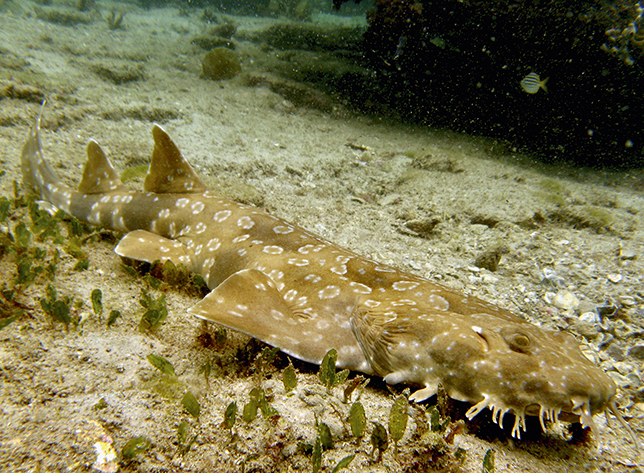
Another creature we often encounter (if you look under overhangs) is the remarkable giant cuttlefish (Ascarosepion apama): Its skin can constantly change color, both as a display and as a form of camouflage. Hovering in the water in front of one of these creatures, watching the extraordinary displays of fluctuating colors, can be a mesmerizing experience.Footnote 12 Coleoid cephalopods (octopus, squid, and cuttlefish) have the largest nervous systems among the invertebrates and present other striking morphological innovations, including camera-like eyes, prehensile arms, and a remarkably sophisticated adaptive coloration system. Cephalopods are “evolutions’ only experiment in big brains outside of the vertebrates” (Godfrey-Smith, Reference Godfrey-Smith2017, p. 160), and the octopus, with its intelligence distributed through its eight-legged invertebrate body, has significant intellectual capacities. Cephalopods provide insights into embodied cognition not so much because they are also smart beings but because their bodies and minds differ in very important ways from vertebrates, having a much less determinate shape, size or form and an even less clearly demarcated line between brain and body: “The octopus is suffused with nervousness; the body is not a separate thing that is controlled by the brain or nervous system” (Godfrey-Smith, Reference Godfrey-Smith2017, p. 75).
The weedy sea dragon is harder to find, for although the wobbegong shark blends in with the floor of the ocean, and giant cuttlefish can change color to mimic their surroundings, the weedy sea dragon really does look like a fragment of floating seaweed. It is not uncommon to get excited about a piece of floating kelp, convinced that it is in fact a weedy sea dragon, only to realize it is just that: a piece of seaweed (see Figure 5). The weedy sea dragon (Phyllopteryx taeniolatus) is related to seahorses and has a similar-shaped snout. The body is a light red with yellow and purple striped markings and leaf-like appendages that resemble seaweed. Unlike brightly colored reef fish that will dart away when you get too close, the sea dragon seems confident in its resemblance to a piece of seaweed and will often hover immobile in the water. It is a wonderfully beautiful and strange creature. This section takes us beneath the surface of the sea and looks at the underwater world from the perspective of divers, asking how the embodied experience of diving and a view of the world from below can help us think of alternative ways of being and doing.
Weedy Sea Dragon, North Head, Sydney
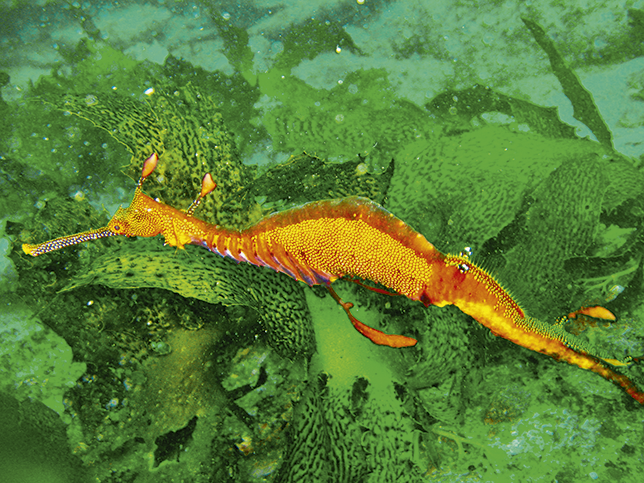
5.2 Feeling What the Fish Scales Know
Not all diving is coral reefs and butterfly fish,Footnote 13 rocks and sharks, sponges and cuttlefish. Humans have been descending to the ocean floor with diving bells for centuries. While Alexander the Great’s purported descent in a glass diving bell is likely more myth than fact, Aristotle recounts people sinking beneath the waves in upturned cauldrons, and certainly by the seventeenth century diving bells were used for salvage work, among other purposes. Divers have for many centuries taken food (particularly shellfish) from the seabed, sometimes free diving (holding one’s breath) and at other times with air supplied by hoses from the surface. While Aboriginal and Torres Straits people had collected oyster shells from the shallow waters in the Torres Strait (North Australia) for centuries, the growth in pearl fishing and the overextraction of oysters in shallower waters, meant that by the 1870s commercial fishing was the norm, with divers – particularly Japanese – using a helmet and a rubber air hose, 6-kilogram boots and 50 kilograms of lead strapped to their body. The oyster beds around Broome (Western Australia) were 30 to 40 meters down, a depth that can present serious dangers to divers. For many such divers, work was very physically demanding and dangerous, while Australia’s racial hierarchies presented both barriers and discrimination to the Japanese, Malay, and Timorese workers in the industry. More broadly, diving for shellfish - from Greek to Korean islands – or commercial diving – from bridge to oil-well construction - has long been a dangerous and exploited activity.
It was the development of scuba (self-contained underwater breathing apparatus) equipment, or what its co-inventor (with Émile Gagnan), Jacques Cousteau, called the “aqua-lung” in the 1940s, that made diver autonomy possible. Once divers became independent of an air supply from above and moved from walking with weighted boots on the seabed to swimming horizontally in the water, our relationship to land and water changed. As Jue (Reference Jue2020, p. 2) puts it, as she learned to dive, it would be some time before, in the words of Jacques Cousteau, she would experience her “flesh feeling what the fish scales know.” Divers, Raycraft (Reference Raycraft, Picken and Waterton2024, p. 202) suggests, “see the ocean from below and gain embodied knowledge about the phenomenology of submersion.” Diving makes it possible to transcend biophysical limitations while also reflecting “a return to a form of being that is less complicated by abstract, linguistic thinking and is perhaps more in tune with the environment” (Reference Raycraft, Picken and Waterton2024, p. 202). Jue (Reference Jue2020, p. 163) sees diving as “a method of cognitive estrangement that makes visible the terrestrial biases that have calcified in the way that we figuratively speak about the world.”
The practice of learning to dive, Jue (Reference Jue2020, p. 2) explains, makes it clear “how our instinctive postures, embodied habits, and muscle memory are all adapted to the gravitational conditions of walking on land and breathing air.” Diving takes the discussion of our engagement with water (swimming and surfing) forward in several ways. It is an embodied experience that changes how we think of weight, posture, and our surroundings, a feeling of being in the water, of feeling the power of water around the body. Among the tactile and fluid experiences of being in water, diving is also about pressure, more specifically, dealing with the effects of the weight of water on the body: one atmosphere (the weight of the air above us on land) every 10 meters. It is this pressure that affects how long we can spend underwater because it conditions the way oxygen and nitrogen are absorbed (under pressure) through our lungs and into the bloodstream. If you dive deep – I have descended to 60 meters on the wreck of the Coolidge in Vanuatu – the water above is exerting huge pressure on the body (about 6 kilograms per square centimeter at 60 meters) though we don’t generally feel it. What we do have to consider, however, is a very long and slow ascent (much longer than the dive itself) to allow the pressurized gas to slowly dissipate as the pressure decreases. The technical apparatus that makes diving possible (the scuba gear that allows us to breathe air at the right pressure) turns our bodies into transhuman, enhanced machines that can only survive beneath the waves as long as the technology keeps working.
Being in the medium of water has other implications. Underwater communication, for example, is nonverbal. Deaf divers are at a serious advantage here: A fully developed visual communication system is very useful underwater. The rest of us use a series of fairly basic signs: The thumbs up sign does not mean “good” (that’s a circle with finger and thumb) but rather the intention to ascend to the surface. There is also a wider array of not generally agreed on signs (they are often discussed before a dive): A shark is often shown by its dorsal fin, an octopus by its legs, and the dive boat by its shape. Underwater navigation is also important. Navigation while diving – and all sorts of problems may ensue if you don’t make it back to where you started – involves a range of practices that include relocalizing a diagram or description into a physical environment, using a series of instruments and measurements (time, air pressure, depth, and direction), observing and remembering topographical features (rocks, coral outcrops, sand patches), using one’s knowledge of reef structure (e.g., seaward and landward sides of a reef crest will generally have different features), orienting in a bodily fashion (feeling the current, sensing water temperature (thermoclynes), gauging speed through the water) and staying in touch with and communicating with other divers (watching, sending signals, attracting attention, monitoring problems). “Being underwater,” Raycraft (Reference Raycraft, Picken and Waterton2024, p. 195) notes, “comprises a set of experiences that includes one’s sense of touch, and the sensations that accompany changes in pressure, buoyancy, temperature, depth, and current.” To spend time underwater (a good dive can last an hour) is to spend time in a very different physical world, and to encounter creatures quite dissimilar to those on land.
5.3 Different Worlds
Diving brings two particular and important additional aspects to the discussion so far: a different sense of embodiment and a view of a different world. This section asks how the experience of diving – a transhuman reconfiguration of human possibilities (through scuba equipment) enabling a return to prehuman origins (a world from which we emerged long ago) (Raycraft, Reference Raycraft, Picken and Waterton2024) – makes possible a different understanding of the world (Godfrey-Smith, Reference Godfrey-Smith2017): “From shores, docks, and boats, humans view the ocean from above, thinking through a land-based epicentre that does not reflect the actual makeup of the blue planet. Earth is an ocean world and scuba diving offers a visceral reminder of this encompassing reality” (Raycraft, Reference Raycraft, Picken and Waterton2024, p. 202). To dive, then, is not only an intellectual challenge to terracentric ways of thinking, but a bodily encounter with difference that urges a reconsideration of what it means to be. Diving unsettles “engrained land-based biases that colour popular narratives about nature” (Raycraft, Reference Raycraft, Picken and Waterton2024, p. 193). Challenging terrestrial-based ways of knowing, diving reorients our perception of the world by considering “the ocean as a vital starting place to develop” milieu-specific analysis, drawing attention to “the differences between perceptual environments and how we think within and through them as embodied observers” (Jue, Reference Jue2020, p. 3).
The weight and opacity of seawater transforms how information is created, stored, transmitted, and perceived, and so to understand seawater as a medium demands that we consider both how we perceive in such environments and what we take for granted in our airy, terrestrial surroundings as embodied observers. Terrestrial bias, Jue (Reference Jue2020, p. 9) argues, is not so much a flaw but a form of Donna Haraway’s (Reference Haraway1988) situated knowledge. Both Jue and Raycraft dwell on scuba diving as a methodological reorientation: Jue (Reference Jue2020, p. 32) makes a case for “scuba diving as a humanities methodology that not only figures as a form of witnessing but also constitutes a meaningful interpretive practice that trains the diver to read from below.” Raycraft (Reference Raycraft2020) reimagines scuba diving as a form of ethnographic immersion that allows humans to experience life on earth from an underwater perspective. Both suggest that one of our methodological challenges is to learn to see otherwise, to undo assumptions so that we can interpret what we see and feel in different ways. For Moriarty (Reference Moriarty2025, p. 948), seascapes open up the possibilities for a “multisensory semiotic landscape approach” to sociolinguistics. Seeing from below is a deeply significant way to reorient the ethnographic gaze. Language, as commonly understood, is generally absent from this environment, a tool left on the shore with our dry clothes, forcing us to turn our semiotic and embodied understandings in different directions.
For Godfrey-Smith (Reference Godfrey-Smith2017), it is not so much the medium of the ocean, or the embodied experience of diving, as the opportunity it affords to reflect on alternative kinds of life. The “alien minds” and bodies of cephalopods – octopus, cuttle fish, and squid – point to very different forms of consciousness and distributed intelligence (Godfrey-Smith, Reference Godfrey-Smith2017). We have tended to overlook cephalopods for several reasons. We give special attention to vertebrates because we humans have backbones and recognize backbonedness in others. Yet, by exploring the other 95 percent of the animal kingdom – the invertebrates – we can learn vast amounts about life and diversity, and, in the case of cephalopods, other ways of being and thinking. Thinking about cephalopods forces us to engage with “alien minds,” levels of difference that we do not understand: “Octopuses represent the great mystery of the Other. They seem completely alien, and yet their world – the ocean – comprises far more of the Earth … than does land” (Montgomery, Reference Montgomery2015, p. 2). Godfrey-Smith’s (Reference Godfrey-Smith2017, p. 77) question “What does it feel like to be an octopus?” takes us beyond an investigation of subjectivity and consciousness based on terrestrial assumptions and focuses instead on the feeling of life: “Waking up, watching the sky, eating – these things all have a feel to them … How can the fact of life feeling like something slowly creep into being?” (Godfrey-Smith, Reference Godfrey-Smith2017, p. 78).
This suggests that to understand questions of consciousness – one of Godfrey-Smith’s (Reference Godfrey-Smith2017) central concerns – the issue is not one of the brain in the head becoming aware of itself, but of the feeling of life. To ask what it feels like to be an octopus compels us to start to think otherwise, to move away from assumptions about humans, knowledge, subjectivity and things, and to pursue different questions about the edges of what and how we know. Cephalopods are deeply different creatures from humans (their average lifespan is only a few years, rendering cultural transmission – used by humans, whales, and other creatures – less significant), yet to understand this difference opens up important avenues for thinking about cognition as distributed, consciousness as feeling, and communication as multidimensional. A “really inclusive sociolinguistics,” Cornips (Reference Cornips, 60Cutler, Røyneland and Vrzić2025, p. 58) argues, challenges the “anthropocentric hierarchically ordered dualisms” such as “language versus noise, subject versus object, nature versus culture, human versus animal, structure versus agency, mind versus body, reason versus emotion.” A consideration of cephalopods takes us further in this exploration of what sociolinguistics cannot yet encompass. For Moriarty (Reference Moriarty2025, p. 951), the seascape, as a “fluid, multispecies entangled system” unravels assumed boundaries between “the human, non-human, and more-than-human.” Both Cornips and Moriarty make the case for a more expansive sociolinguistics that includes multisensory and multidimensional accounts of semiotic assemblages.
5.4 Language, Power, and Otherness
Aside from being a wonderful (though privileged) experience in itself, diving presents us with a series of challenges to assumptions about bodies, land, thinking, and being. Spending time below the surface of the water introduces us to a different medium where we perceive differently. “Like other forms of submersion, scuba diving provides an underwater perspective on the planet and reminds divers that Earth is actually an ocean world” (Raycraft Reference Raycraft, Picken and Waterton2024, p. 194). Diving in the ocean, Jue (Reference Jue2020) observes, draws attention to different perceptual environments, and the specificity of our land-based assumptions. As embodied observers, we think in and through such environments in distinctive ways. Swimming below the surface of the water presents radically different conditions from those on land, including different kinds of three-dimensional movement (diving can feel like flying), perceptual effects produced by light refraction and magnification, and a world in which language is largely absent yet one in which sounds can travel much further (though it is harder to detect the direction of a sound). The ocean, for a diver, becomes “a material and imaginative space for the conditions of perception that we have taken for granted” (Jue, Reference Jue2020, p. 3).
The implications of the undersea world for our understanding of language are in their infancy and have rarely been extended to language learning and teaching (Pennycook, Reference Pennycook, Deumert and Makoni2023). Yet “thinking with the ocean productively estranges the terrestrially inflected ways of theorizing and thinking to which we have become habituated” (Jue, Reference Jue2020, p. 6). Thinking in and with the ocean takes us into a different space so that we can ask how questions of language, flow, divisibility, orientation, and understanding start to look different. Scuba diving can change how we perceive the ocean, from top-down representation to bottom-up lived experience. Being underwater renders water a medium whose power is not felt in the same way that waves knock us about on the shore or rock us in our boats: It is pervasive, pressing down on us. This helps us see that starting with visible power, the power of certain actors or institutions, may overlook the ways power seeps through society, affecting micro-actions. This can take us beyond sovereign power, as Foucault (Reference Foucault and Gordon1980) argued, but also beyond governmentality since it makes it possible to see not only that we become both subjects and objects of the circulation of power but that power presses on our bodies and can make resurfacing a slow and difficult process.
Scuba diving is made possible by “a particular human/technology interface that is both prehuman and posthuman” and “fosters a particular form of subjectivity and positionality in relation to our current ecological crisis” (Raycraft, Reference Raycraft2020, p. 315). Not only does it urge us to reflect on what it means to be human, but it also makes our relation to environmental degradation both urgent and different. Ecolinguistics, Stibbe (Reference Stibbe, Hart and Cap2014, p. 585) argues, is borne out of a perception that “mainstream linguistics has forgotten, or overlooked, the embedding of humans in the larger systems that support life.” Being underwater can help us feel this embeddedness and move beyond CDA of environmental discourse and engage instead with embodied relations. Our relationships with sharks (Appleby and Pennycook, Reference Appleby and Pennycook2017) or jellyfish (Moriarty, Reference Moriarty2025) are not merely about humans and dangerous fish or “stingers” but imply a set of relations that are part of the construction of humans, language, masculinity, culture, nature, and materiality. When divers and sharks come face to face underwater, Raycraft (Reference Raycraft, Picken and Waterton2024, p. 198) argues, “there is a form of critical engagement where sharks see humans as underwater subjects.” This is not, therefore, an argument only for greater ecological care, for critical analysis of environmental discourse, or for more attention to nonhuman animals in language studies. This is part of an attempt, both analytic and pedagogical, to rethink how humans, other animals, and the environment interact.
Part of the work I do in the Philippines involves the establishment and evaluation of Marine Protected Areas (MPAs) – areas of ocean, usually close to the shore, that are protected from fishing and other activities. This is in itself a complex ecological process involving both underwater and overwater worlds: a lot of work is done (by CCEF staff and others) with local communities to show why establishing and then monitoring an MPA is in their interest; and comparing the state of the reef and the biomass of fish over time involves skilled identification and analysis. Tempting though they may be, ecological analogies with language can be risky: If we start to draw close parallels between endangered languages and endangered species (Skutnabb-Kangas, Reference Skutnabb-Kangas and Mair2003), or between a protected sea environment and a classroom as a safe space for language revival, we run the danger of naturalizing processes of social change, rendering languages as discrete entities in the environment, and suggesting that building a fence around a language can save it from outside threats (Pennycook, Reference Pennycook2004). By suggesting a natural equivalence between, for example, language and fluidity, or as Jue (Reference Jue2020, p. 115) notes, between water and data flows, we run the danger of naturalizing social and technological processes.
If we move beyond equivalences such as languages and species, however, and consider instead the complexity of an MPA, the many creatures that it protects and the movement in and out of its permeable borders, we can also consider that while languages may be considered endangered, it is the complex ecologies with which they are entangled that we need to find ways to incorporate into our thinking. As García et al. (Reference García, Johnson and Seltzer2016) suggest with respect to translanguaging, this may entail paying more attention to the underwater currents of the classroom than to the static walls that enclose it. From an ecolinguistics perspective, this concerns the ways “languages and practices impact on the life-sustaining future of both humans and non-humans” (Steffensen et al., Reference Steffensen, Döring, Cowley, Steffensen, Döring and Cowley2024, p. 4). A language entanglement perspective makes it possible to see that language, like a coral reef, is part of an intricate ecology (Hansen and Newlands, Reference Hansen, Newlands, Newlands and Hansen2024; Pennycook, Reference Pennycook2020). As suggested in the first section, the way forward here is not so much to use ecological metaphors or analogies in order to show how language can be understood ecologically but to break down the distinctions that necessitate metaphorical thinking in the first place: Language is part of the ecological landscape.
Diving makes possible forms of cognitive estrangement. A “lifelong obsession with the wonderfully enchanting alterity of marine creatures” coupled with “a response to the real anthropogenic threats that the ocean faces today” (Jue, Reference Jue2020, p. 32) compel us to think differently about the world. Much of our applied linguistic thinking about otherness extends only as far as languages being differently structured and cultures orienting us in different ways. More critical approaches introduce questions of gender, race, or sexuality as key to any understanding of difference. Yet we know from ethnographic investigations that a central tool in moving toward better understanding is a process of distancing, of making the familiar unfamiliar. Thinking in and with water – and particularly through experiences such as diving – presents a means to do this on a wider scale, to question the familiarity of our bodies on land, of languages passing back and forth through the air, of other animals trotting round on four legs, of cognition being located in the head. As we move toward a transhuman world where language and thought are increasingly handed over to forms of acritical intelligence, thinking–feeling with and in water can help us look at this from a different perspective.
6 Critical Hydrosocial Language Studies
6.1 Spiritual Waters
Water – that strange combination of airy oxygen and hydrogen atoms – circulates through our world. It changes shape and form, evaporating from the oceans to form clouds, dropping again as rain, and flowing back to the sea in rivers. This may happen quite quickly, or it may be held up as snow for a winter, or longer as part of a glacier; it may sink into the earth and sit in underground caverns for centuries; it may become part of the vast cold-water currents that circulate at the bottom of the oceans. It can be water, steam, or ice, a puddle, a cloud, or an icicle. Our world is made up of water, both the vast expanses and largely unexplored depths of the oceans as well as the water that is a significant part of plants and creatures. It is crucial for human and other animal life. It is also a destructive force through floods, tsunamis, and drownings. Water can be a border between two regions or countries, a means of nation building, a foundation of empire, a link between past and present (Boelens et al., Reference Boelens, Hoogesteger, Swyngedouw, Vos and Wester2016). The sea, as Derek Walcott (Reference Walcott1989) announced, is history. Or as Shafak (Reference Shafak2024) suggests, “Water remembers. It is humans who forget” (p. 18). While we can focus on water in chemical terms as H2O – the hygienic and hydraulic waters of utility and industry, the often privately owned resource that is clean and usable, this creation of modernity – water is also part of our myths, symbols, and subconscious (Illich, Reference Illich1986, p. 76).
Humans have long recognized water for its spiritual role: It is not just essential for washing but also symbolizes purification, cleansing, and healing. Water often plays a role in spiritual and religious practices, from baptism in the Christian tradition, washing before prayers in the Muslim faith, or a site of purification and pilgrimage (e.g., the Ganges) in Hinduism. Buddhists celebrate the birthday of Buddha by pouring fragrant water over a statue of Buddha three times to symbolize the cleansing of the body, speech, and thoughts. Like rain dances in many First Nations’ communities, the “calling for rain” Buddha in Laos (the Buddha in a standing pose with extended hands by his sides) summons water for the rice fields during Boun Pi Mai (Lao New Year). Water, for the Japanese takes an honorific prefix お (お水 / o-mizu). “If I were called in / To construct a religion,” Philip Larkin (Reference Larkin1988) wrote in his poem Water, “I should make use of water.” From a Daoist perspective – the Watercourse Way (Watts, Reference Watts1975) – water is a model for human life: while fluid and soft, it can wear down hard surfaces like rock. It is both soft and strong. People should indeed, as Bruce Lee says (Section 1; Lee, Reference Lee2023), be like water: It is powerful yet yielding, it overcomes without competing, and is of benefit to all things (Chan, Reference Chan1963, p. 113).
The traditional oral narratives, toponyms, and cultural practices of the Tlingit and Tagish (First Nation people of the circumpolar North) suggest an “alternative ontological water (ice) consciousness” (Hayman et al., Reference Hayman, James, G̱ooch, Wedge and Aan2018, p. 77). In the Tlingit language, water is héen, a central part of Tlingit cosmology and a way of thinking that is more material, spiritual and spatial than “modern” water (Hayman et al., Reference Hayman, James, G̱ooch, Wedge and Aan2018). Bodies of water for many Indigenous Australians are social and spiritual places. For First Nations people of Australia, water holes and freshwater springs may be occupied by ancestral beings, including Yawkyawks – “young women spirit beings” – in the stories of the Kunwinjku people of West Arnhem Land. The distinction between land and water is not absolute and Australian waterscapes – rivers, billabongs, or saltwater country – are entangled with spiritual histories, social relations, and language (Langton, Reference Langton, Bruno, Barker and McNiven2006). With language and sea country indelibly linked, many Indigenous languages cannot be understood without their water connections. A nomadic Mongolian herder might say “Хэл ус минь тасарчихвал би хэн ч биш” – “If I lose my language and water, I am no one,” pointing to the ways that while water keeps the herds alive and guides where and when nomadic herders move, language is the means by which their stories, customs, and identities are kept alive.Footnote 14 A central theme of this Element has been the ways language and water sustain body, mind, and spirit.
Yet we modern humans, proud of walking upright on land (perhaps with a water bottle in our hand), do not notice water much in our general thinking about the world (unless it rains). As communities that live near water are threatened by rising sea levels, as our waterways become clogged by pollution, as plastic and other pollutants flow through water and animal bodies, humanities scholars and oceanic social scientists, environmentalists, and many others, are calling for us to think not only about water but with water. This is not just a call to think about environmental catastrophe but a demand to think differently: Thinking with water (hydrologics), Niemanis (Reference Neimanis, Christian and Wong2017b, p. 52) explains, demands that we “think about power and subordination, master models, binary oppositions, nature, and culture – about who or what gets listened to, and who or what is relegated to an unacknowledged supporting role – and these are all deeply feminist questions.” Recognizing our terrestrial bias in relation to language as a form of situated knowledge, as a necessarily partial perspective, “erodes the dream of a master language that would be totally objective, distant, and adequate to articulating and describing the world in its entirety” (Jue, Reference Jue2020, p. 10). Thinking with language and water demands that we consider power, models of mastery, oppositions between language, culture, and nature, who listens and who or what is heard; and all are deeply political questions. Such thinking makes it possible to consider language and power in deeper ways than sovereign power, coercive versus collaborative power, the powerful imposing on the weak: Power seeps through the social body.
Developing a watery orientation to language makes it clear that neither water nor language can be adequately captured through a single analytic approach. The difficulty in grasping these fluid media renders our understanding partial and incomplete (Neimanis Reference Neimanis2017a; Yates et al., Reference Yates, Harris and Wilson2017). Yet we persist with our terracentric metaphors of trees, land, and borders, seeking to move beyond these forms of fixity with ideas such as crossing or fuzzy boundaries (Burkette and Warhol, Reference Burkette and Warhol2021; Rampton,Reference Rampton1995). The idea that languages leak has more potential. Knowledge about language, like water treatment, is all too often left to the domain of technical experts (linguists and hydro-engineers) but I have tried to show here that thinking with water – carefully opening the flood gates to the blue humanities and the oceanic turn in the social sciences – has diverse implications for thinking about languages as inventions, language and ownership, language and politics, and language and materiality. Recognition of the critical and substantive presence of water makes it possible to develop a politics of language that is open to a wider set of concerns than is commonly the case.
6.2 Beyond Fluidity
This Element has explored language, water, and power. Some might argue that it is all very well to introduce watery themes to the social sciences and humanities, but humans have been land-based through a long evolutionary history. In this view the language humans have developed only has a terrestrial history: The very development of spoken language depends on air as a medium. The separate languages that mark different cultural and ethnic groups have been developed in distinct territorial domains. Reasonable though such a territorial case may seem (despite the development of language being a more complex case involving signs and bodies; Pennycook, 2018), such arguments miss the central point of what is being suggested here. Once we consider the entanglements of people, water, and language, we are shifting the grounds on which we think about language, so that we do not privilege the human before the rest of the world. This enables different kinds of relationships between language and ecology. Ecolinguistics, broadly understood, studies “how language affects the ecosystems that sustain life on Earth” (Steffensen et al., Reference Steffensen, Döring, Cowley, Steffensen, Döring and Cowley2024, p. 1): Humans and their language practices are part of an entangled world. From the perspective developed here, the issue is how language is part of these ecosystems, and that to understand language, we therefore need to understand ecosystems. Water is central to global ecologies.
It has been common in recent sociolinguistics to contrast fixity and fluidity, the one implying languages in a static position – bounded, standardized, linked to territory – the other suggesting a very different flow of linguistic resources. Translinguistic perspectives are generally based on this second orientation, emphasizing the free flow of linguistic items across supposed language boundaries. Following Bauman’s (Reference Bauman2012) discussion of liquid modernity – where change is the only constant in modern life – Li Wei and Lee (Reference Lee2023, p. 9) link the fluidity of identity to the fluidity of language, suggesting a “propensity for linguistic fluidity on the part of a multilingual person.” Such fluidity, they argue, suggests that identities are not so much organic or unitary but rather “a contingent disposition simultaneously marked by ambivalence (both/and), ambiguity (either/or), and negation (neither/nor).” Also drawing on Bauman’s liquid modernity, Schneider’s (Reference Schneider2025) Liquid languages asks under what conditions languages become static like puddles, ponds, or icicles. Taking language fluidity as the norm, and looking in depth at language practices and ideologies in Belize, where stable language norms may not be considered useful, she asks what combinations of belonging, prestige, and material culture lead to the emergence of languages as constrained linguistic flows.
There have of course been critiques of this emphasis on fluidity, most notably from Jaspers and Madsen (Reference Jaspers, Madsen, Jaspers and Madsen2019), who suggest that the emphasis on fluidity at the expense of fixity, and the assumption that the former is more authentic than the latter, overlook the need to see both fluidity and fixity together, and to recognize that we live in a languagized world where relatively fixed languages are the social norm. An emphasis on fluidity may also, as suggested in Section 2, overlook the importance of understanding the “safe spaces” of swimming pools and standardized languages. Suggesting an equivalence between flows of language and water – or data and water (Jue, Reference Jue2020) – may naturalize social processes in unhelpful ways. As Neimanis (Reference Neimanis2017a) makes clear, moreover, the very source of this metaphor is itself unstable: Fluidity is a rather impoverished way of understanding the logics of water. The contrast itself and the emphasis on fluidity are based on terrestrial assumptions, a prior understanding of fixedness with which it is contrasted. Fluidity is thought of in terms of terrestrial nonfixity, rather than an exploration of what fluidity might be to start with. The hydrologics of water suggest a move beyond a terracentric viewpoint that emphasizes mobility across and between territorial languages.
When Bauman (Reference Bauman2012, p. 90) considers social categories in terms of their liquidity – “liquids, unlike solids, cannot easily hold their shape” – he is also pointing to time and change: “it is the flow of time that counts, more than the space they happen to occupy.” This is not, therefore, the idle observation that water is a good metaphor for a fluid account of language, but rather an account of how thinking in terms of liquids shifts our attention from bounded space to temporal change. If we think in terms of waterscape epistemologies, and take fluidity as our starting point (rather than the blurring of fixed boundaries), we end up with a very different engagement – spiritual, intellectual and embodied – that starts with flows and rhythms, with entering a thought-world where imagination, perception, and understanding are part of a felt world (Ingersoll, Reference Ingersoll2016). As Gandhi (Reference Gandhi2022) reminds us, the Vietnamese word for homeland, nu’ó’c, meaning water, renders home fluid, changeable, always in motion. This implies not merely starting with fluidity as the norm but rather questioning the very idea of fluidity as a contrast with more terrestrial fixity.
6.3 Language and Water Justice
Swimming opens up several dimensions that can lead us to rethink the relation between our bodies and water. The modern water of swimming pools can help us reflect on questions of standardization, containment, and exclusion: Water and language are cleaned, contained, and controlled through an array of civic organizations, from city councils to educational institutions. That archetype of modern water – bottled water – “advances the private enclosure of water globally because it delivers the very same substance – plain water – in small volumes, at much higher prices and with far greater environmental impact, and in the process also helps weaken the political will needed to sustain public provision of high-quality drinking water” (Jaffee, Reference Jaffee2023, p. 266). The growth in consumption of bottled water has major implications for the basic human right to safe drinking water and the long-term project of universal public provision of clean drinking water. Thinking in terms of the hydrocommons challenges forms of ownership and enclosure (privatization, incarceration, and commodification) in favor of a wider engagement with community, southern epistemologies, and alternative possibilities of language use and politics.
Swimming is not confined, however, to the modern water of the swimming pool. In both historical and contemporary times, it is far more common to use open bodies of water – rivers, lakes, ponds, the ocean – for swimming. Swimming can help us move from a critique of the regulation of and denial of access to forms of language and water to a wider consideration of how we engage in bodily ways with language and water. The “cultural practice and social world of outdoor swimming,” particularly from littoral domains such as a beach, can bring together the entanglements of “water, well-being, and wildness” (Bates and Moles, Reference Bates, Moles, Picken and Waterton2024, p. 177). Ocean swimming or surfing is an encounter with the power and scope of wild water, and an injunction to rethink embodiment in ways that challenge the individualism at the center of dominant Western views on minds, bodies, and language. Swimming, as Moriarty (Reference Moriarty2025) reminds us, as an embodied research method, has great potential for thinking both in and with water. Once we start with water epistemologies and a felt world rather than independent individuals and their separate languages, we can start to see how language, embodiment, and perception happen together (Ingersoll, Reference Ingersoll2016).
Swimming below the surface of the water presents radically different conditions from those on land, shifting both our perceptions of self and of the media we move through. For a diver, the ocean becomes a material and inventive space from which the deep differences of encounter (with other sea creatures) and the medium for perception challenge our taken-for-granted norms. Critical subaquatic sociolinguistics reorients linguists toward their interdependence with the material realm, where language is not a reflection of but part of an inequitable world. For a diver, the ocean becomes a material space from which underwater epistemologies challenge habitual terrestrially inflected ways of being and doing (Makoni and Pennycook, Reference Makoni, Pennycook, Li, Phyak, Lee and García2026), creating the possibilities for new interpretive and ethnographic practices in research. This is to understand critical work less in terms of the demystification projects of ideology critique (which reduce political agency to human agency) and instead in terms of a politics that reorients humans toward their ethical interdependence with the material world (Bennett, Reference Bennett2010). Swimming in the ocean, swimming with sharks, swimming deep below the surface bring together embodiment, ecological concerns, and posthumanist language ideologies as part of an endeavor to reconfigure critical language studies and to articulate a particular kind of critical, embodied, positioned practice.
One reason for the wider focus on water in ecological and social sciences is the crisis in water quality and availability across the world and the changes to the water currents that are driving climate change. In response, there is a call for forms of water justice, which can be understood as attempts to bring together grassroots, academic, activist, and policy work to critically explore knowledge about, allocation of, and governance over water resources. The goal is to combine struggles against water-based forms of dispossession, ecological destruction, political exclusion, and cultural discrimination in relation to water (Boelens et al., Reference Boelens, Vos, Perreault, Boelens, Perreault and 59Vos2018). Water justice research and action seek to engage diverse water actors, to appreciate that there are multiple water worldviews, involving “critical engagement with water movements, dispossessed water societies, and interactive design of alternative hydrosocial orders” (Boelens et al., Reference Boelens, Vos, Perreault, Boelens, Perreault and 59Vos2018, p. 23). Decolonial activism in relation to water addresses the need not just to reclaim stolen waters but to imagine different futures and incorporate alternative relations to water (Murtuwarra et al., 2021).
Such an understanding goes beyond both redistributive justice (reallocation of resources) and recognition (prominence of community participation) to emphasize socioecological relationality, where language is bound up with both vulnerable and sustainable ecologies. In a similar vein, language activists (or “public sociolinguists”) articulate “the real and symbolic effects of language inequality,” provide “an inexhaustive catalogue of resources that are needed to advance transformation and change,” and “embody acts that represent linguistic fairness in interaction but also support the needs to defend language and multilingualism” (Williams, Reference Williams, Cutler, Røyneland and Vrzić2025, p. 180). While general water literacies can be understood as “water-related knowledge, attitudes and behaviors” (McCarroll and Hamann, Reference McCarroll and Hamann2020, p. 2), critical water literacies suggest the need to move beyond common understandings of all three of these terms. As McElhinny (Reference McElhinny, Percio and Flubacher2024) points out, common critiques of commodification, capitalism, or colonialism often remain stuck in a mode of scholarly criticism that fails to engage with spiritual and bodily relations. Water, she argues, and particularly Indigenous relations to water, can be a key site for thinking beyond such critiques since it makes it possible to consider other ways of being, doing, and relating.
Such perspectives, as Hawke (Reference Hawke2012, p. 236) makes clear in her study of cross-cultural water projects involving Indigenous (Widjabul/Bundjalung Nations of New South Wales) and nonindigenous authorities, see water “less in terms of a resource and more in terms of spirituality, culture, reverence and the ways of being connected to a place, and how place sustains being.” Water from such perspectives shifts from a commodity, resource or right, to a spiritual and relational entity. Literacy in these terms is not so much knowledge about water as physical and spiritual engagement with other beings. For McElhinny (Reference McElhinny, Percio and Flubacher2024, p. 424) pedagogies that aim to “build a more just and ecologically regenerative world” are more about embodiment than discussion, and need to be both critical and enabling: critical in order to “identify the relations of power that structure the ways that land and water are understood” and enabling in order to support the move from “critique to transformation.” This is not so much “knowledge about” water but ways of knowing in and through water. Water-informed linguistic justice addresses dispossessed communities struggling to gain access to language and particular languages, appreciates that there are many different ways of understanding language and what it means, and that change requires engagement with multiple actors and collaborative work to design alternative futures.
Different thinkers in critical geography, cultural and literary studies, water sciences, feminist and decolonial politics, amongst others, have pointed to the oceans as much more than empty spaces between the firm territories of land. The ocean is simultaneously a natural resource and an arena of contested social relations. It is a place of movement and freedom as well as captivity and slaughter: Vast modern cruise ships make it possible for millions of people to dine, be entertained, sleep peacefully, or peer over the railings as they cross the ocean over the traces of slaving vessels of the past and in the wake of the factory fishing ships of today. In an era of multinational finance systems, “offshore” tax havens, vast data flows, predictive data harvesting and surveillance capitalism, and control of overseas trade routes and underwater data highways (the vast amount of information is carried by networks of undersea cables) are as important as ever. Oceans are the domains through which colonialism, slavery, and the domination over the South by the North have been played out. The African diaspora lives in the wake of the slave trade (Sharpe, Reference Sharpe2016). The wake is that line of disturbed water, the trace of a passing ship, a past written into the present of the water, as well as a process of mourning. To be in the wake is a form of consciousness, an understanding of that history and the still-unfolding present. Language too has its wakes. The traces of slavery, racism, gender violence, and more lie across our languages.
6.4 Thinking Downstream
“Garima gala nyabay. Gala nyabay garima ngali ngih” (“Look after the water. The water looks after us,” Uncle Roy C. Gordon, Widjabul Elder and linguist, cited in Hawke, Reference Hawke2012, p. 235). We would do well to take this injunction seriously and to listen to the broader wisdom of our Indigenous Elders. Not only do we need to care for water, but we also need to think with water. This Element has sought to explore what this can mean in relation to both language and power. Like Jue (Reference Jue2020, p. 33), I see this as a “pre-activist” work, written in the hope that rather than proposing an agenda for action, thinking with water can open up new perspectives on language and power that can develop modes of action downstream. This poses new challenges for how we think about language, not as a reflection of an inequitable world but as part of that world, where language is assembled and reassembled in an ever-changing pattern of social, cultural, political, and material relations (Pennycook, Reference Pennycook2024). Rivers teach us that we are always in motion, that language flows, and that power is as much about endurance as strength (and so time matters). If, as suggested in the first section, rivers are alive, then what it means to live, and what it means to language, shifts into a different understanding from the modern water of taps, bottles, and swimming pools.
A key consideration in relating language and coloniality is to move beyond maps of power that reductively suggest only that colonial languages were imposed by colonial powers. It is, of course, evident that the wide use of European languages around the world can be traced to colonial histories, but a hydrocolonial perspective expands our understanding of language movement, regulation, and creation and thus opens up wider considerations of language and colonial relations. This is not only about noting that categories such as “first” or “second language speakers” or “native speakers” are colonizing categories of language education that need to be undermined (García, Reference García and Macedo2019), or reducing the Northern bias in how languages of the global South and their speakers are understood (Mufwene, Reference Mufwene, Deumert, Storch and Shepherd2020, p. 290), but also reconfiguring assumptions about what languages are and how they meet. Stevenson’s (Reference Stevenson2018, p. 97) focus on water in relation to First Nation land rights (and the limitations inherent in this notion of land) addresses the ability of water to both act and be acted upon, to produce and be produced by social relations, opening up “a rethought ethical and political paradigm based in theories of action and responsibility that cross human and non-human divides.” Such an approach to “decolonial hydrosocial relational ethics” (p. 95) makes it possible to rethink our decolonial imperatives outside a settler-colonial territorial frame.
Like the circumpolar North, where people located within different territories and beside different oceans share forms of commonality, thinking in terms of the Oceanic South centers the ocean that surrounds the (melting) ice of Antarctica, and suggests a way of thinking both about the southern hemisphere (which, like humans, is about 80 percent water) and the Global South. Looking at Southern theory from the position of the Southern Ocean avoids the stability of being “grounded” in favor of “ways of reading that are alive to turbulence, drift, refraction, and the more-than-human materialities of the oceanic South” (Samuelson and Lavery, Reference Samuelson and Lavery2019, p. 38). In her critique of the ways southern knowledges are appropriated and recycled by the Global North, Rivera Cusicanqui (Reference Rivera Cusicanqui2012, p. 104) suggests that “Ideas run, like rivers, from the south to the north and are transformed into tributaries in major waves of thought.” In a more optimistic vein, Mbembe (Reference Mbembe2017, p. 1) sees his book Critique of Black Reason (Critique de la raison nègre) “as a river with many tributaries, since history and all things flow toward us now. Europe is no longer the center of gravity of the world. This is the significant event, the fundamental experience, of our era.” Referring to all those disregarded forms of culture and knowledge that flow through the Global South, Mbembe (Reference Mbembe2017, p. 181) notes that the “world will not survive unless humanity devotes itself to the task of sustaining what can be called the reservoirs of life.” Part of those reservoirs of life are the reservoirs of language,Footnote 15 the linguistic possibilities that flow across southern contexts.
Luis Javier Pentón Herrera
VIZJA University
Luis Javier Pentón Herrera, Ph.D., D.Litt. (Hab.) is an award-winning Spanish and English educator and a best-selling author. In 2024, he was selected as the 2024 TESOL Teacher of the Year, awarded by the TESOL International Association and National Geographic Learning. He is a Professor (Profesor uczelni, in Polish) at Uniwersytet VIZJA, Poland. Originally from La Habana, Cuba, Luis Javier enjoys creative writing, playing with his two doggies, Virgo and Maui, and running.
Sender Dovchin
Curtin University
Sender Dovchin is a Professor and a Dean International at the Faculty of Humanities and Senior Principal Research Fellow at the School of Education, Curtin University, Australia. She is an Australian Research Council Fellow and Kakenhi Japan Society for the Promotion of Science Fellow. She is an Editor-in Chief of the Critical Inquiry into Language Studies journal. Her research advances second language education for migrant and Indigenous communities. She was named a Top Researcher in Language & Linguistics by The Australian (2021/2024/2025) research magazine and one of the Top 250 Researchers in Australia in 2021/2024/2025 respectively.
Editorial Board
Anna Becker, Polish Academy of Sciences (Poland)
Pramod K. Sah, The Education University of Hong Kong (Hong Kong)
Vander Tavares, University of Inland Norway (Norway)
Serafín M. Coronel-Molina, Indiana University Bloomington (USA)
Shaila Sultana, BRAC University (Bangladesh)
Annelies Kusters, Heriot-Watt University (UK)
Huseyin Uysal, The Education University of Hong Kong (Hong Kong)
Nashid Nigar, Monash University (Australia)
Michał Wilczewski, Uniwersytet VIZJA (Poland)
Ana Barcelos, Universidade Federal de Viçosa (Brazil)
Yasir Hussain, Quaid-i-Azam University (Pakistan)
About the Series
This Elements series explores the profound influence of language as a source of power and its role in shaping social dynamics. It examines how language can unite and divide, harm and heal, while also shaping perceptions, constructing realities, and influencing relationships within and across individuals, communities, and languages. Importantly, the series is interested in exploring the empowering and oppressive dimensions of language from various interdisciplinary perspectives.