





Early language acquisition relies on caregivers providing communicative input that relates to children's ongoing activities: for example, temporally contingent verbal input in response to children's verbalizations or actions facilitates their learning of new words (Tamis-LeMonda, Kuchirko, & Song, Reference Tamis-LeMonda, Kuchirko and Song2014), and verbal input that follows the children's current focus of attention relates positively to children's acquisition of object labels (Dunham, Dunham, & Curwin, Reference Dunham, Dunham and Curwin1993; Tomasello & Todd, Reference Tomasello and Todd1983). Beyond the broad literature addressing input related to children's ongoing behavior or the immediate context, some research also considers linguistic input extending beyond the immediate context or current events – that is, decontextualized talk (Snow, Reference Snow1991; see also Adamson & Bakeman, Reference Adamson and Bakeman2006; Demir, Rowe, Heller, Goldin-Meadow, & Levine, Reference Demir, Rowe, Heller, Goldin-Meadow and Levine2015; Rowe, Reference Rowe2012; Westby, Reference Westby and Simon1985). Decontextualized talk in their input is a significant predictor of children's later linguistic skills (Demir et al., Reference Demir, Rowe, Heller, Goldin-Meadow and Levine2015; Rowe, Reference Rowe2012). However, these studies have reported that decontextualized talk is used only rarely with young children (Demir et al., Reference Demir, Rowe, Heller, Goldin-Meadow and Levine2015; Rowe, Reference Rowe2012; Sachs, Reference Sachs and Nelson1983), presumably because it imposes greater cognitive and linguistic demands.
We suggest that, in order to obtain a more fine-grained picture of how parents may scaffold understanding of talk about the there-and-then from early on, it is necessary to consider different dimensions of decontextualization (see below) when analyzing verbal input. Therefore, we analyzed decontextualized talk in the input to children younger than those observed previously – namely, to 12-month-old infants.
Research on decontextualized talk in caregivers’ input is spread over different approaches. Rowe (Reference Rowe2012) and Demir et al. (Reference Demir, Rowe, Heller, Goldin-Meadow and Levine2015) analyzed input as being decontextualized when it referred to either invisible entities or abstract ideas (e.g., formal definitions), or to past or future events (e.g., narratives). Ornstein, Haden, and Hedrick (Reference Ornstein, Haden and Hedrick2004) described a specific kind of elaborated input that relates to children's previous experiences as ‘associative talk’. Rohlfing (Reference Rohlfing2011) identified so-called ‘bring-in strategies’ that parents use during task-oriented dialogue with their children in which they include references to familiar events in order to facilitate the child's understanding of the tasks. Similarly, in a book-reading setting, Yont, Snow, and Vernon-Feagans (Reference Yont, Snow and Vernon-Feagans2003) observed that mothers of 12-month-old infants relate the book content to the child's previous experiences in everyday activities. Haden, Reese, and Fivush (Reference Haden, Reese and Fivush1996) applied the term ‘extratextual talk’ for when reading to children was accompanied by comments about the book content beyond the written text. Lucariello and Nelson (Reference Lucariello and Nelson1987) described ‘temporal displacement’ – that is, talk about events in the past or future, but events that happened or will happen in the present spatial surrounding (see also Hudson, Reference Hudson2002).
Compared to contextualized talk, decontextualized talk provides children not only with different content but also with more complex vocabulary and syntax. Hence, it appears to be “linguistically richer” (Demir et al., Reference Demir, Rowe, Heller, Goldin-Meadow and Levine2015, p. 161). Thus, decontextualized talk probably imposes greater demands on children's representational capacities (Ganea & Saylor, Reference Ganea and Saylor2013; Gelman, Chesnick, & Waxman, Reference Gelman, Chesnick and Waxman2005). These greater demands result from the need to rely more on linguistic and associative capabilities rather than on resources from the immediate context if decontextualized talk is to be understood (Nelson, Reference Nelson2009). Therefore, we argue that children who experience early forms of this kind of talk early in their development will receive more opportunities to practice their linguistic capabilities than children who might deduce the meaning of the input from ongoing behaviors and present objects.
Because decontextualized talk requires more advanced cognitive and communicative skills from children before they will be able to understand or produce it, some researchers have suggested that parents use it only infrequently with children younger than 30 months (Demir et al., Reference Demir, Rowe, Heller, Goldin-Meadow and Levine2015; Rowe, Reference Rowe2012; Sachs, Reference Sachs and Nelson1983). In her longitudinal study that observed children between 14 and 42 months and one of their caregivers during everyday activities, Rowe (Reference Rowe2012) found that only about 2% of all parental utterances toward their 18-month-old children were decontextualized. By the time the children were 30 months of age, the percentage of decontextualized talk had increased to about 7% of all utterances. However, in a study with 22- to 24-month-old children, Rohlfing (Reference Rohlfing2011) investigated how mothers made use of associative talk while instructing their children to put two objects together in a particular spatial relation. In this specific task, mothers used utterances or told stories that referred to topics that were familiar to the child but that did not address the immediate context. This kind of input occurred more often than utterances describing what the child was actually doing (about 19% of input) – a difference that was particularly pronounced in Korean compared to English mothers (Choi & Rohlfing, Reference Choi, Rohlfing, Iwasaki, Hoji, Clancy and Sohn2010). Hence, decontextualized talk plays a role in the input to young children – at least in contexts that structure the interaction in a task-oriented way as opposed to situations without specific instructions.
Another recent study looked at younger infants and the input of mothers to their 6-month-olds during diaper changing (Nomikou, Koke, & Rohlfing, Reference Nomikou, Koke and Rohlfing2017). Input at such a young age can be characterized as being tightly related to the here-and-now, not only in terms of the content of the verbal utterances being related to ongoing actions, but also in terms of reference being strongly supported by greater temporal synchrony between verbal behavior and the actions performed (Nomikou et al., Reference Nomikou, Koke and Rohlfing2017; Nomikou & Rohlfing, Reference Nomikou and Rohlfing2011). Nevertheless, even though mothers’ language content and timing were tightly related to the ongoing actions, they also used verbs that were not related to immediate actions such as mental state verbs or action verbs referring to temporally or spatially distal entities. The use of these decontextualized verbs in the input turned out to be a significant predictor of children's productive use of verbs at 24 months of age (Nomikou et al., Reference Nomikou, Koke and Rohlfing2017).
Demir et al. (Reference Demir, Rowe, Heller, Goldin-Meadow and Levine2015) found that parents’ use of decontextualized talk to their children at 30 months of age was a significant predictor of the children's linguistic skills such as vocabulary, syntax, and narratives at around six years of age. In the same vein, Rowe (Reference Rowe2012) reported relations between decontextualized language in the input toward children aged 3;6 and their word comprehension at 4;6. Interestingly, decontextualized talk seems to play an important role for children with lower language skills (Demir et al., Reference Demir, Rowe, Heller, Goldin-Meadow and Levine2015): The authors compared decontextualized input of mothers of typical developing children (TD) with that of mothers of children with brain injury, and found that it correlated strongly with later narrative skills in the latter group. In a recent study using the Italian version of the MCDI (Caselli, Bello, Rinaldi, Stefanini, & Pasqualetti, Reference Caselli, Bello, Rinaldi, Stefanini and Pasqualetti2015), parents reported that their 29-month-old children with language delay (LD) had weaker comprehension of decontextualized input than their typically developing peers (Bello, Onofrio, Remi, & Caselli, Reference Bello, Onofrio, Remi and Caselli2018). In the parental questionnaire, decontextualized input was operationalized with one item asking parents whether their child understands them when they are speaking about past and future events. Given that parents rate the comprehension of decontextualized input as being lower in LD children compared to TD children, it is reasonable to assume that parents adapt their linguistic input to individual differences in children's language development from early on.
Operationalization of decontextualized talk in parent–child interactions
Theoretically, in linguistics, speech is contextualized on three dimensions or grounded in the immediate context. In addition to the spatial (the ‘here’) and the temporal context (the ‘now’), the immediate context also consists of the personal context (the ‘I’) (Bühler, 1934/Reference Bühler1999). Of these three dimensions, research on decontextualized talk in the input toward young children considers, by definition, the non-immediate spatial and temporal context. In contrast, the personal context is sometimes still contextualized, and caregivers use it to draw on shared experiences in the there-and-then. The personal context in talk to young children, however, does not seem to be restricted to the ‘I’ alone, but to also include the ‘we’ or close others. Interestingly, the categories of decontextualized talk in the input used in different studies vary in the dimensions on which they are abstracted from the immediate context and on which they are contextualized. However, this observation has not been conceptualized consistently. In the following, we review how decontextualized talk has been operationalized so far (see Table 1 for an overview of the different studies).
Decontextualized talk in other studies

The category of narratives in Rowe (Reference Rowe2012) and Demir et al. (Reference Demir, Rowe, Heller, Goldin-Meadow and Levine2015) includes talk about personal experience in the past or future and, thus, is decontextualized from the spatial and temporal context. It also includes stories about characters in a book that the caregivers are currently reading to their children. Hence, it goes beyond the immediate temporal and personal context while staying in the immediate spatial context (i.e., the book). In their review of research on the development of narratives, Westby and Culatta (Reference Westby and Culatta2016) pointed out, however, that personal event narratives such as conversations about events experienced in the past should be differentiated from fictional narratives because of the different cognitive demands they impose and because they are assumed to involve different memory systems. In terms of decontextualization, fictional narratives can be decontextualized in all three dimensions, whereas the personal event narratives are grounded in at least the personal context. The ‘bring-in’ strategies described by Rohlfing (Reference Rohlfing2011) also represent forms of early personal event narratives. Interestingly, these forms of narratives that are not decontextualized on all of the dimensions are one of the earliest forms of narratives, and they are based on talk about shared experiences in early parent–child interactions (Westby & Culatta, Reference Westby and Culatta2016). These early forms may serve as a scaffold for children's developing narrative skills. We therefore suggest differentiating between different forms of children's narratives in research on decontextualized input.
Other authors focus on input that is decontextualized only from the temporal context but not from the present spatial surrounding (the ‘here’) – that is, “temporal displacement” (Lucariello & Nelson, Reference Lucariello and Nelson1987, p. 221; see also Hudson, Reference Hudson2002). Lucariello and Nelson (Reference Lucariello and Nelson1987) found that mothers talk about the past and future mainly in recurring situations that they report to be highly familiar to and predictable for their individual two-year-old child (“scripted events”, p. 220, such as lunch routine or morning routine that are highly predictable in their sequence of actions) compared to other, less predictable situations such as free play. Hence, they decrease demands on memory (Lucariello & Nelson, Reference Lucariello and Nelson1987) and representational capacities (Ganea & Saylor, Reference Ganea and Saylor2013), while also keeping the spatial context stable, because reference to past and future are defined as occurring prior to or after the recording session. The results of Lucariello and Nelson's (Reference Lucariello and Nelson1987) study underline that routinized, familiar situations are particularly suitable for introducing new linguistic forms, as also proposed in the concept of the pragmatic frames (Rohlfing et al., Reference Rohlfing, Wrede, Vollmer and Oudeyer2016). If young children are to successfully understand the reference to absent entities or persons, they require such a supportive environment (Ganea & Saylor, Reference Ganea and Saylor2013). This might be established if speech is decontextualized on only one or some of the dimensions mentioned while being grounded in the immediate context on another dimension. Hudson (Reference Hudson2002) further distinguished reference to events that had happened already or that will certainly happen in the future from utterances about hypothetical events in the future (‘future hypothetical’). It is assumed that the latter contain different linguistic markers such as subjunctives or words like ‘maybe’.
As shown in Table 1, most of the categories of decontextualized speech observed in the various studies using different methodological approaches within parent–child interactions do utilize the immediate context to a certain degree. This might support communication, understanding, and the usage of decontextualized speech (Sachs, Reference Sachs and Nelson1983). In fact, in an experimental study, Osina, Saylor, and Ganea (Reference Osina, Saylor and Ganea2013) showed that, if talk is displaced only in time but not in space (when talking about a hidden object that was introduced in the same room), even 12-month-old children showed some understanding of the label of an absent toy. Similarly, Ganea and Saylor (Reference Ganea and Saylor2013) also reported that 13- and 16-month-olds understand temporally displaced references to persons who are familiar to them. In addition to verbal reference, Liszkowski and colleagues have shown that 12- and 18-month-old children understand and produce a pointing gesture referring to absent entities (Liszkowski & Ramenzoni, Reference Liszkowski and Ramenzoni2015; Liszkowski, Schäfer, Carpenter, & Tomasello, Reference Liszkowski, Schäfer, Carpenter and Tomasello2009). Possibly, parental input relates to infants’ early skills of displaced communication.
To sum up, the literature shows that different forms of decontextualized input are decontextualized on not just one of the dimensions described in Bühler's theory (1934/Reference Bühler1999) but on different dimensions. By taking the three dimensions of decontextualized talk (temporal, spatial, and personal context) into account in the current study, we explored whether and to what extent this particular kind of input is already present in talk to 12-month-old children. Given that the input probably is a function of linguistic and cognitive skills and abilities, we investigated whether possible differences in the input to children are related to various trajectories in language development. We reanalyzed a longitudinal sample from a previous study (Lüke, Grimminger, Rohlfing, Liszkowski, & Ritterfeld, Reference Lüke, Grimminger, Rohlfing, Liszkowski and Ritterfeld2017; Lüke, Ritterfeld, Grimminger, Liszkowski, & Rohlfing, Reference Lüke, Grimminger, Rohlfing, Liszkowski and Ritterfeld2017) and compared a subsample of children whose later language scores indicated typical language development at 24 months to a subsample of those who were later categorized as language delayed at 24 months.
Methods
Participants
Fifty-nine German-learning infants (28 girls, 31 boys) and one of their primary caregivers (97% mothers) participated in a longitudinal study of communication and language development between 12 and 30 months of age. This is the same sample as that reported in Lüke, Grimminger et al. (Reference Lüke, Grimminger, Rohlfing, Liszkowski and Ritterfeld2017) and Lüke, Ritterfeld et al. (Reference Lüke, Grimminger, Rohlfing, Liszkowski and Ritterfeld2017). An additional seven parent–child dyads were observed but excluded from the data analyses for the following reasons: fussiness of the child (n = 1), increasing exposure to a second language across the second year of life (n = 4), parental behavior contrary to the instruction (n = 1), and later identification of chronic otitis media in the child (n = 1). Here, we report the data when children were 12 months of age (M = 12 months and 6 days, SD = 11 days). Language development was assessed at both 24 months of age (mean age: 24 months and 10 days, SD = 9 days) and 30 months of age (mean age: 30 months and 6 days, SD = 5 days). For further information on the assessment see below.
Procedure
To elicit spontaneous communicative behavior from both caregivers and infants, they were observed in a semi-naturalistic setting within a laboratory room that was decorated selectively with 14 interesting objects or pictures (Liszkowski & Tomasello, Reference Liszkowski and Tomasello2011) and 2 events (e.g., sudden onset of a water fountain). The event items were presented at predetermined intervals operated with a programmable clock. They were switched on three times for 6 s. The first event happened after the dyads had been in the room for 3 min; the second event after 5 min.
Over the course of the longitudinal study, the dyads were observed multiple times in this setting. Here, we report data from the first session. Caregivers were instructed to engage with their children for 6 min while carrying them and looking at the objects presented in the decorated room without touching any of them. Four cameras recorded the scene from different angles in the room.
Assessment of children's language development
The children's language development at 12 months of age (i.e., their receptive and productive vocabulary skills as well as their use of gestures and their fine motor skills) was assessed using the ELFRA-1 (Grimm & Doil, Reference Grimm and Doil2000) – the German version of the MCDI: Words and Gestures (Fenson et al., Reference Fenson, Reznick, Thal, Bates, Hartung, Pethick and Reilly1993).
At 24 and 30 months of age, the parental questionnaire FRAKIS (Szagun, Stumper, & Schramm, Reference Szagun, Stumper and Schramm2009) was used to assess productive vocabulary as well as morphological and syntactical skills (German version of MCDI: Words and Sentences; standardized for 18–30 months of age). Any language delay at 24 months was identified using a German standardized language measure (Sprachentwicklungstest für zweijährige Kinder – SETK-2 [test of language acquisition for two-year-old children]; Grimm, Reference Grimm2000). This tests the comprehension and production of both words and sentences. In accordance with other authors (Heilmann, Ellis Weismer, Evans, & Hollar, Reference Heilmann, Ellis Weismer, Evans and Hollar2005; Sachse & Suchodoletz, Reference Sachse and Suchodoletz2008), a two-year-old child was defined as being language delayed if she or he scored 1.5 standard deviations below the mean (i.e., T score of ⩽ 35) in at least one of the four subtests of the SETK-2 and one standard deviation below the mean (i.e., T score of < 40) in at least one additional subtest. Fourteen of the 59 children (7 girls, 7 boys) were diagnosed as being language delayed at 24 months (24%). The percentage in our sample is higher than reported elsewhere (e.g., Horwitz et al., Reference Horwitz, Irwin, Briggs-Gowan, Heenan, Mendoza and Carter2003), probably due to our tailored recruitment strategy. We had specifically addressed families in which a sibling or one of the parents had a history of language impairment. Research has shown a higher risk for language delay in these children (Rice, Smith, & Gayán, Reference Rice, Smith and Gayán2009).
Coding of decontextualized talk
All verbal utterances of the caregivers were transcribed using ELAN (Sloetjes & Wittenburg, Reference Sloetjes and Wittenburg2008). An utterance was defined as a unit of speech with a single intonational contour typically rising or falling at the end of the sentence, as is characteristic for questions and declarative sentences. Main and subordinate clauses were transcribed into separate utterances. Single interjections or affirmative sounds were not treated as utterances.
In a next step, decontextualized utterances were identified and further assigned to different subcategories based on the previous research reviewed above, as well as on a preliminary assessment of the content of the dataset while taking the three dimensions on which language can be decontextualized into account (Bühler, 1934/Reference Bühler1999). We classified decontextualized talk into (a) different forms of narratives – that is, bring-in strategies that were subdivided into personal story, non-personal story, comparison, and pretend talk; (b) explanations; (c) temporal displacement subdivided into past and future (predicTable); and (d) future hypothetical (see Table 2). In the following, we explain the reasons for this approach. All utterances that were not coded as decontextualized were considered to be contextualized.
Categories of decontextualized talk

Bring-in strategies
Based on Rohlfing's (Reference Rohlfing2011) observations of mothers’ use of different narratives which draw on the children's knowledge when introducing novel spatial relations to 22- to 24-month-olds (‘bring-in’), together with the review by Westby and Culatta (Reference Westby and Culatta2016), we analyzed the category of narratives in a more fine-grained way than Demir et al. (Reference Demir, Rowe, Heller, Goldin-Meadow and Levine2015) and Rowe (Reference Rowe2012). That is, we coded different bring-in strategies as forms of narratives: (a) personal stories defined as utterances about events that the child, the caregiver, or other family members already have experienced or will experience again (e.g., “we take the bus all the time, too”); (b) non-personal stories such as utterances about objects, their functions, or further features (e.g., “you can make music with it” when talking about a picture of a drum); and (c) comparisons defined as utterances that draw a parallel between a present object or a current situation and something the child already knows (e.g., “like a lamp”, when referring to an electric disco ball with colorful flying spots; or “you know that from home”).
We also assigned pretend talk (Demir et al., Reference Demir, Rowe, Heller, Goldin-Meadow and Levine2015; Rowe, Reference Rowe2012) to the bring-in strategies, because it draws on routines with which the child is familiar, or it might initiate a certain action from the child (“do the flowers smell” when looking at a plastic flower). In the coding process, we noted that some caregivers used utterances to draw on routines not only in order to initiate those routines from their children (petting the picture of a baby, waving good-bye to a stuffed animal), but also during or after a corresponding action of their child – thus ‘translating’ the child's current action. As the latter is commenting on the immediate context, we treated these utterances as contextualized ones, and excluded them from the decontextualized ‘pretend’ category.
Explanations
Utterances containing conditional (e.g., ‘if’, ‘in the case that’) and causal clauses (e.g., ‘because’) were defined as decontextualized explanations if these clauses referred to something outside the immediate context. Examples are provided in Table 2.
Temporal displacement
Decontextualized utterances that were only “displaced in time from the present situation” (Lucariello & Nelson, Reference Lucariello and Nelson1987, p. 219) but not in location (thus about the ‘here-and-then’) were differentiated from bring-in strategies and classified as temporal displacement. More specifically, these are utterances referring to objects and situations in the decorated room, but refer to what had happened already (past), or will (very likely) happen while the parent and the child are in the room (predictions). These categories were included in the coding scheme because we presented not only static objects but also event items. Further, because we observed the caregivers and their children several times over the course of the longitudinal study, there were subsequent observations in which caregivers referred to objects or events that were present in previous sessions or events that were very likely to happen while in the decorated room.
Future hypothetical
A further category of temporally displaced talk that might differ linguistically from talk about the past and future is future hypothetical, as identified by Hudson (Reference Hudson2002). Future hypothetical talk is defined as referring to events possibly happening in the future, and includes subjunctives or words like ‘maybe’. In our analyses, and based on Hudson's taxonomy, we coded utterances containing subjunctives as an additional category – future hypothetical – because they referred to possible actions in the future that were, unlike utterances coded as temporal displacement, decontextualized from the current situation in both time and location.
Inter-coder reliability
Data were coded by one independent coder. Reliability was assessed by giving 20% of the data to a second coder and calculating Krippendorff's alpha (Krippendorff, Reference Krippendorff2011). Inter-coder reliability was very high (α = .953; 1,434 cases, including contextualized utterances). Because of the large number of overlapping contextualized utterances that might bias inter-coder agreement, we also calculated reliabilities only for those cases in which one or both coders judged an utterance to be decontextualized. Again, reliability was very high (α = .896; 271 cases).
Results
Parental decontextualized speech
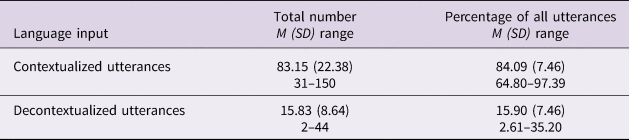
First, we calculated the number of decontextualized utterances in the parental input toward 12-month-old children (see Table 3). On average, almost 16% of all parental utterances were decontextualized, with an individual variation from 3% to 33%. This corresponds to an average of 2.62 decontextualized utterances per min. When looking at the different categories of decontextualized talk separately, we found that non-personal stories were the most frequently used type, followed by temporally displaced utterances about past events and comparisons of something present to something the child knows (see Table 4). Thus, even for the investigated context, the decorated room, which had been designed to successfully elicit referential talk about the here-and-now, we could confirm previous findings indicating that a certain degree of decontextualized talk is also present in the input to young children (Nomikou et al., Reference Nomikou, Koke and Rohlfing2017; Rohlfing, Reference Rohlfing2011).
Contextualized and decontextualized language input
Categories of decontextualized language input

Correlations between decontextualized input and children's language measures
We were also interested in whether the decontextualized language input would relate to children's concurrent and subsequent language measures – both receptive and productive. A total of six Pearson correlations between the percentages of decontextualized utterances at 12 months and the language scores assessed at 12 and 24 months of age revealed no significant relations between the percentage of caregivers’ decontextualized input and children's concurrent or subsequent language measures (see Table 5). Additional Pearson correlations with the percentages of different categories of decontextualized speech revealed positive relations between the proportional use of personal stories at 12 months of age and the T score on the subtest ‘sentence comprehension’ from the SETK-2 at 24 months (r = 0.344, p = .012, n = 53) and the subtest ‘sentence production’ (r = 0.295, p = .038, n = 50). For the proportional use of non-personal stories, however, we found a negative correlation with the T score on the subtest ‘word comprehension’ from the SETK-2 at 24 months (r = –0.269, p = .045, n = 56). Table 5 reports all statistical values for the correlations. Bootstrapped confidence intervals were added to estimate the value in the population.
Pearson correlations [and 95% confidence intervals] for the percentage of decontextualized input at 12 months and language measures at 12 and 24 months of age

Notes. a Assessed using parental questionnaire ELFRA-2 (Grimm & Doil, Reference Grimm and Doil2000; b T scores of standardized language measure SETK-2 (Grimm, Reference Grimm2000); * p < .05.
Comparison between decontextualized input toward children and different trajectories in language development
Because decontextualized language input seems to play a greater role in children with lower language skills, we examined whether the amount of parental use of decontextualized speech at 12 months of age in a group of children later identified as showing typical language development (TD) at 24 months of age would differ from that in a group of children later identified as being language delayed at 24 months of age. Because of unequal sample sizes, we applied non-parametric group comparisons (Mann–Whitney U test). Comparisons of both groups in terms of their receptive and productive vocabulary at 12 months of age revealed significant differences in both the number of words the children understood (TD children: M = 34.91, SD = 27.67, range 8–111; LD children: M = 23.46, SD = 42.46, range 0–158; U = 146, Z = –2.73, p = .006), and the number of words they produced (TD children: M = 3.0, SD = 3.21, range 0–15; LD children: M = 1.15, SD = 2.15; range 0–7; U = 168, Z = –2.39, p = .017) (cf. Lüke, Ritterfeld et al., Reference Lüke, Ritterfeld, Grimminger, Liszkowski and Rohlfing2017).
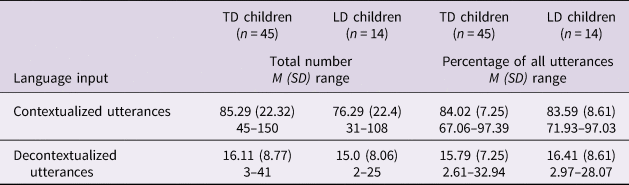
However, analyses of the input revealed no differences between the caregivers of the group of TD versus LD children in the use of decontextualized or contextualized language at 12 months of age (all ps > .05; see Table 6 for the descriptive statistics). Thus, even though the group of children later identified as being language delayed already had smaller vocabularies at 12 months of age, we could not confirm our hypothesis.
Decontextualized language input toward TD and LD children
Discussion
The aim of this study was to investigate whether decontextualized talk in infants’ input is present earlier than assumed so far (namely, already at 12 months of age) in a context designed more specifically to elicit referential acts about the here-and-now (decorated room; Liszkowski & Tomasello, Reference Liszkowski and Tomasello2011). Further, we wanted to investigate whether this kind of input at 12 months of age varies as a function of the differently developing language skills of the children. We analyzed caregiver–child interaction data from a longitudinal study of children's communication and language development in a semi-naturalistic context in which mothers were asked to refer to present objects and events. Our longitudinal study allowed us to assess whether children's language development was typical or delayed at 24 months of age, and to retrospectively compare these two language groups in terms of whether or not there were differences in the decontextualized language input at 12 months of age.
Taking into account different dimensions of decontextualization in talk to young children, we were able to show that, on average, caregivers’ input toward their 12-month-old children consists of about 16% decontextualized utterances within the decorated room setting. This corresponds to an average of 2.62 decontextualized utterances per min. Just descriptively, this percentage is higher than that reported by Demir et al. (Reference Demir, Rowe, Heller, Goldin-Meadow and Levine2015) for children at age 30 months (7%), or by Rowe (Reference Rowe2012) for children at age 18 (2.2%) and 42 months (9.4%). One reason for these differences might be the settings in which caregivers’ language input was investigated. Rowe (Reference Rowe2012) and Demir et al. (Reference Demir, Rowe, Heller, Goldin-Meadow and Levine2015) observed caregivers and their children for 90 min in everyday activities, including meal time, book-reading, and toy play – and they did this in natural interactions without instructing caregivers on what to do and how to interact. In contrast, we observed caregivers and their children in a more constrained, yet very specific observational situation in which different objects and events were presented; and we asked caregivers to spend 6 min looking at them with their children. This observational situation is suitable to elicit referential acts, but, as we have shown, not only those about present objects and events, but also about content that is not immediately present. As not only Tamis-LeMonda, Kuchirko, Luo, Escobar, and Bornstein (Reference Tamis-LeMonda, Kuchirko, Luo, Escobar and Bornstein2017) but also Yont et al. (Reference Yont, Snow and Vernon-Feagans2003) have shown, input differs in quantity in structured versus unstructured parent–child interactions. More specifically, input in less structured situations (such as in the observations of everyday activities by Rowe, Reference Rowe2012, and Demir et al., Reference Demir, Rowe, Heller, Goldin-Meadow and Levine2015) seems to be reduced, less frequent, and less complex. This line of argumentation is corroborated by comparing the decontextualized utterances per min in our study (about 2.62) with those reported in Demir et al.’s (Reference Demir, Rowe, Heller, Goldin-Meadow and Levine2015) study at 18 months of age (about 0.7 for TD children). Again, these findings underscore the importance of the context of activities in which observation takes place (Tamis-LeMonda, Custode, Kuchirko, Escobar, & Lo, Reference Tamis-LeMonda, Custode, Kuchirko, Escobar and Lo2018; Tamis-LeMonda et al., Reference Tamis-LeMonda, Kuchirko, Luo, Escobar and Bornstein2017; Yont et al., Reference Yont, Snow and Vernon-Feagans2003).
A second reason for the difference compared to other results might be the variations in the operationalizations of decontextualized speech. In our theory-based coding scheme (Table 1), we took into account different dimensions on which speech can be decontextualized (cf. Bühler, 1934/Reference Bühler1999) and classified the decontextualized input in a more fine-grained way. We distinguished between, for example, stories about personal events and those about fictional events or object properties that are not directly observable, because Westby and Culatta (Reference Westby and Culatta2016) have pointed out that these types of narratives involve different memory systems.
The most frequent types were non-personal stories, temporally displaced talk about the past, and comparisons of something present to something the child knows. Interestingly, these categories are similar in terms of the dimensions on which they are decontextualized or contextualized. Because each type refers to something spatially present, this input is grounded in the spatial context, which possibly makes it easier for the child to access. The temporal and often the personal context, however, is decontextualized. Hence, caregivers “might introduce material that is still outside the child's system, but that the child is ready to acquire” (Sachs, Reference Sachs and Nelson1983, p. 16). However contrary to our assumption based on Westby and Culatta's (Reference Westby and Culatta2016) review, caregivers made greater use of non-personal narratives compared to narratives related to shared experiences. This observation might be an effect of the observational setting in which objects and pictures were presented. As a result, caregivers provided utterances about objects, their functions, or further features. Obviously, in our observational setting, the early forms of decontextualized talk utilize the immediate context to a certain degree. Possibly, this conjunction of contextualized and decontextualized dimensions in these forms allows the semantics to develop in manifold ways, mutually influencing each other by grounding abstract concepts in bodily experience (e.g., Nomikou & Rohlfing, Reference Nomikou and Rohlfing2011; Nomikou et al., Reference Nomikou, Koke and Rohlfing2017), but also constantly abstracting immediate experience in the sense that it becomes related to the here-and-then, before being related to the more decontextualized there-and-then. What might also support understanding of the temporally displaced forms of decontextualized input is that they refer to very recent events that have just happened before or will be about to happen (within minutes). With young children, these more immediate temporal references seem to be used more commonly than more distant temporal references (Hudson, Reference Hudson2002).
Consistent with the assumptions of Lucariello and Nelson (Reference Lucariello and Nelson1987) and Ganea and Saylor (Reference Ganea and Saylor2013), caregivers might scaffold young children's comprehension of decontextualized talk by providing this kind of talk – talk that is decontextualized on only one or some but not all dimensions – thus decreasing demands on memory and representational capacities (Ganea & Saylor, Reference Ganea and Saylor2013). In Osina et al.’s (Reference Osina, Saylor and Ganea2013) study, even 12-month-olds were able to understand displaced talk when it was grounded in the spatial context. Based on our results, we argue that decontextualization in the input does not occur suddenly at a certain age. Instead, it is present in input from early on, and that there are different dimensions of decontextualization: spatial, temporal, and personal. For the future, the question remains whether the different dimensions are more or less scaffolded at different ages in children. Indeed, the function of the decontextualized aspects present in the talk to young children is not fully understood, although there are some studies revealing a close relation to children's later linguistic and school-related skills (Demir et al., Reference Demir, Rowe, Heller, Goldin-Meadow and Levine2015; Rowe Reference Rowe2012). For young infants at the age of 6 months, decontextualized verbs in their input have been shown to relate to later advancements in children's language skills (Nomikou et al., Reference Nomikou, Koke and Rohlfing2017). In this paper, we investigated how crucial decontextualized talk is at 12 months of age, and whether caregivers already adapt to individual language skills of their children when using decontextualized talk – given the assumed complexity of this kind of talk. We hypothesized that decontextualized input would correlate with concurrent and subsequent linguistic skills, and found correlations between caregivers’ use of personal stories at 12 months and children's later sentence production and sentence comprehension scores at 24 months. However, these correlational results need to be interpreted with caution, given the possibility of Type I error. We further hypothesized that group comparisons would reveal differences in the input toward children with typical language development in their second year of life compared to those with delayed language development. However, we could not confirm this hypothesis. We likewise found no significant differences between the groups in the caregivers’ use of certain categories of decontextualized talk at 12 months of age, but also no differences in the total number of utterances or the number of contextualized utterances. These results might reflect the fact that language development at this young age is characterized by great individual variability, and that caregivers might not yet have started to adapt their contextualized or decontextualized language input. Future analyses should address decontextualized language input at later ages and focus on individual differences in children's linguistic development.
Acknowledgements
This research was supported by a grant awarded to Katharina J. Rohlfing (RO 2443/3-1) from the Deutsche Forschungsgemeinschaft. We thank the participating families for being part of our longitudinal study, and our research assistants for transcribing and coding the data.
Ethics
This research has been ethically approved by the Ethics Committee of the Medical Counsil and the Medical Faculty at the University of Münster, Germany (2011-517-f-S) on 3 November 2011. Informed consent was obtained from each participating family.


 Open access

