


As argued by Lefkowitz et al. (Reference Lefkowitz, Zickar, Cascio and Kochan2026), we agree that industrial-organizational (I-O) psychology has historically and systematically overlooked organized labor, including the study of blue-collar work. This neglect is evident in the absence of labor-focused content within major handbooks, graduate training guidelines, and historical accounts of the field (Katzell & Austin, Reference Katzell and Austin1992; Stagner, Reference Stagner1981). The limited attention given to a substantial segment of the workforce is problematic for many reasons articulated by the authors of the focal article. We respond directly to the authors’ call to action regarding potential remedies for this gap: “What, if anything, can graduate programs in I-O psychology do to enhance the likelihood of I-O psychologists engaging with labor unions? Should they do so? What might be the pros and cons of such?” (p. 28). In this commentary, we propose three concrete and actionable approaches that I-O psychology graduate programs can implement to increase the likelihood that future I-O psychologists engage with and study labor.
Current graduate training in I-O psychology largely centers on white-collar employes, management, and leadership, with minimal exposure to organized labor, such as blue-collar workers (We note that white-collar professions can also unionize; however, for the scope of this commentary, we focus specifically on blue-collar workers in organized labor because they are more likely to operate within formal union structures and face distinct labor relations dynamics that warrant focused attention by I-O scholars and practitioners.) (Bergman & Jean, Reference Bergman and Jean2016). This omission creates significant gaps in knowledge and application pertaining to a stakeholder group that is critical to the success of businesses, industries, communities, and countries. To address this gap, we outline three ways I-O master and doctoral programs can more intentionally incorporate organized labor into training: (a) providing hands-on experiences with labor unions, (b) adopting a more interdisciplinary and pluralistic approach to the study of work by drawing from fields and perspectives such as sociology and critical management studies, and (c) strengthening ethical training to more directly align I-O education with the profession’s code of conduct and responsibility to promote worker well-being.
Hands-on experience
Graduate training in I-O psychology frequently includes a practicum, internship, or applied learning component embedded within coursework (e.g., “Introduction to I-O Psychology” or “Applied I-O Learning” courses). These experiences are designed to help students connect theory-to-practice; however, they are often limited to traditional white-collar, managerial, or corporate settings. To broaden students’ understanding of work and workers, these applied experiences should incorporate exposure to nontraditional and blue-collar work contexts, including organized labor environments. For example, applied practicum courses could partner with local organizations such as police departments, manufacturing plants, healthcare facilities (i.e., nursing), or unionized worksites to provide observational and experiential learning opportunities. Graduate students might participate in police ride alongs, tour manufacturing facilities (unionized and non-unionized), or observe shift-based labor environments to gain firsthand insight into the nature of the work, workplace hazards, power dynamics, and organizational structures that characterize these settings. Such experiences would allow students to better understand the lived realities of workers whose experiences are largely absent from mainstream I-O research and training.
When direct field experiences are not feasible, coursework could incorporate high-quality, realistic case studies grounded in organized labor and blue-collar work contexts. These cases might focus on issues such as collective bargaining, worker safety, job insecurity, scheduling demands, or labor-management conflict, and could be paired with reflection assignments that connect course theories to unionized settings. For example, one case study examines the nurses’ strike at Stanford University Hospital and Packard Children’s Hospital using participant interviews across key phases to highlight lessons for healthcare organizations (Gerardi, Reference Gerardi2001), whereas another contrasts coal miners’ lived experiences with historic photographs to prompt critical analysis of labor representations (Margolis, Reference Margolis1998). Together, these real-world situations and experiences broaden applied learning beyond white-collar contexts and better prepare future I-O psychologists to engage with organized labor in research and practice.
Interdisciplinary education
Many traditional I-O psychology graduate programs include coursework that implicitly centers on top management and leadership, positioning managers as the primary stakeholders of interest. As a result, organizational productivity, efficiency, and the financial bottom line can become framed as the dominant goals of I-O psychology. For example, many required readings and course discussions emphasize financial performance outcomes, organizational success, and leadership effectiveness, which can inadvertently signal that the primary role of the I-O psychologist is to serve and support top management. Relatedly, much of I-O education centers around the interests of those in power, often treating these interests as neutral or universal rather than being shaped by particular values and priorities. Yet, society is unequal, and different groups have different goals and interests by virtue of their roles or circumstances. Thus, people usually benefit (or suffer) from differing policies (e.g., organizational practices).
This traditional framing in I-O education risks marginalizing the experiences, needs, and well-being of workers, particularly those in non-managerial or unionized roles. This likely contributes to the limited attention labor unions receive in both research and practice, given their absence from traditional I-O curricula. We must acknowledge the reality that labor goals and interests are not inherently aligned with, and in fact may directly conflict with, capital owners’ goals and interests. A more objective science actively questions dominant perspectives; in I-O psychology, this means moving beyond managerial assumptions and engaging labor as a legitimate and informative counterpoint for understanding work and organizations.
To support this shift, graduate programs should intentionally incorporate more interdisciplinary coursework, drawing from fields such as sociology, industrial relations, law, and critical perspectives on work (Islam & Sanderson, Reference Islam and Sanderson2022). For example, programs could require at least one elective outside of psychology, such as a course on labor relations, employment law, or organizational inequality. Alternatively, I-O programs could formally cross-list courses with departments in sociology, public policy, or business to increase interdisciplinary exposure and broaden students’ theoretical and applied perspectives. Interdisciplinary training could further be implemented through joint seminars, guest lectures from scholars in labor and employment fields, or collaborative research projects that pair I-O students with faculty or students from other disciplines. Requiring electives and/or incorporating exposure to content across related disciplines would promote a more well-rounded education and equip future I-O psychologists to approach workplace issues from multiple perspectives, including those of both workers and managers with their (often competing) goals and interests. This broader lens would encourage students to examine power, inequality, and labor dynamics alongside performance and efficiency concerns.
Ethics in training
A third area for growth in I-O graduate training is placing greater emphasis on ethics and values-based education. In their focal article, Lefkowitz and colleagues present a hypothetical consulting scenario in which an I-O psychologist is asked to administer a climate survey with a hidden goal of undermining a unionization effort. This example illustrates the kinds of ethical dilemmas practitioners may encounter and how professional decisions are shaped by underlying values. It also highlights a critical gap in training: many I-O psychologists may face situations like this in practice without feeling adequately prepared to respond.
Too often, I-O training does not expose students to realistic, high-stakes ethical challenges that commonly arise in applied work. In addition, the ethical code and broader mission of I-O psychology to improve individual, organizational, and societal well-being (APA, 2017; SIOP, 2025) are rarely emphasized in a way that is meaningful or actionable for students. Viewed through this ethical lens, the hypothetical consulting project clearly violates core APA principles, including beneficence, integrity, justice, and respect for autonomy, by relying on deception and risking harm to employes (APA, 2017). Graduate training should more explicitly integrate moral reasoning, concern for employe well-being, and attention to the societal consequences of I-O work, alongside focused instruction on both APA and SIOP ethical guidelines.
One promising training approach could involve placing students in the “hot seat,” where they have to respond to ethical dilemmas under time pressure and justify their decisions using I-O values that adhere to our ethical standards. This activity simulates real-world pressures and helps students internalize the importance of ethical decision-making, reinforcing how I-O psychologists can advocate for fair treatment and protect employe rights—core goals that align with the broader mission of unions. Such exercises could even be incorporated into comprehensive or qualifying exams for students intending to enter practice, ensuring that graduates demonstrate not only technical competence but also ethical judgment and values alignment before working as I-O consultants in the field.
See Table 1 for a summary of the three recommended strategies presented above, along with the pros and cons of each approach.
Three Methods for Integrating Labor Union Training Into I-O Graduate Programs, Including the Pros and Cons of Each Approach
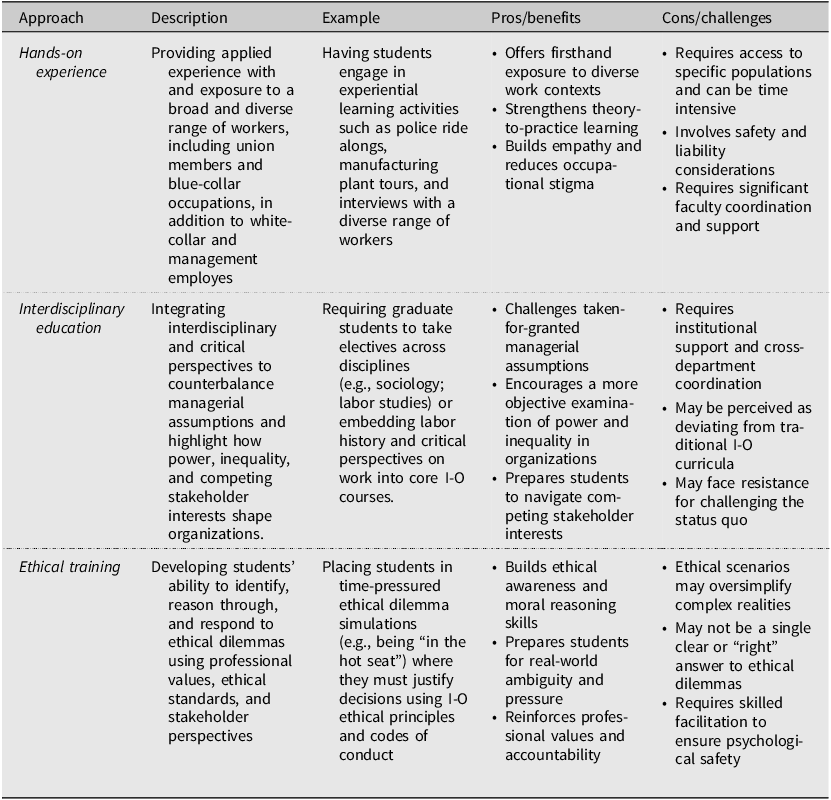
Table 1 Long description
The table presents a structured comparison of three approaches for incorporating labor union training into industrial-organizational (I-O) graduate programs. It includes four columns: Approach, Description, Example, Pros/benefits, and Cons/challenges. The first row details the Hands-on experience approach, which involves providing applied experience with a diverse range of workers. The second row covers Interdisciplinary education, integrating interdisciplinary and critical perspectives to counterbalance managerial assumptions. The third row discusses Ethical training, developing students' ability to identify and respond to ethical dilemmas. Each approach is accompanied by examples, benefits, and challenges. The table highlights the benefits such as firsthand exposure, strengthening theory-to-practice learning, and building ethical awareness, while also noting challenges like access to specific populations, institutional support, and ethical scenario simplification.
Concluding remarks
Integrating organized labor into I-O psychology graduate training is both a necessary and achievable step toward broadening the field’s relevance and impact. By providing hands-on experiences in unionized and blue-collar settings, incorporating interdisciplinary perspectives, and strengthening ethics education, programs can better prepare students to understand, engage with, and advocate for workers across all levels of the workforce. Such training not only addresses longstanding gaps in research and practice but also aligns I-O psychology with its ethical commitment to promoting fairness, well-being, and equitable treatment in the workplace. Embracing these approaches would be a positive step toward ensuring that future I-O psychologists are equipped to serve all stakeholders, including labor, effectively, and responsibly.

 Open access

