

Introduction
The Conservative Government formed in 2019 increased the power of the UK Executive by degrading constraints on powers interfering with human rights, and this was largely via a ‘back door’ created by repeated parliamentary marginalisation. Between 2021 and 2023, 11 pieces of primary legislation expanded a specific set of coercive and/or administrative powers, while weakening Executive accountability mechanisms, in a manner identified as weakening human rights protections by the Joint Committee on Human Rights (JCHR).Footnote 1 Echoing recent and long-standing trends in UK law-making, these reforms were passed while employing mechanisms of parliamentary marginalisation, undermining scrutiny of the changes.Footnote 2 Passing a set of constitutionally significant legislation in this way created a back door through which the UK Executive was able to expand its powers. This back door is constituted by a passage for legislative change facilitating minimal scrutiny. Such backdoor Executive empowerment supports recent scholarship highlighting the lack of firm UK constitutional constraints of the Executive.Footnote 3 While this paper’s analysis does not make any claim about the overall status of UK democracy, it does argue that the recent legal reform mirrors dynamics identified with respect to scholarly accounts of democratic erosion, suggesting the need for further assessment of the UK’s democratic health.
The principle of parliamentary sovereignty, that Parliament is free to legislate as it wishes and that no person or body can override or set aside its legislation,Footnote 4 is persistently upheld as central to the UK constitution.Footnote 5 However, there have long been concerns that the fusion of the Executive with the Legislature leaves UK law-making vulnerable to Executive domination and that the system can favour weak parliamentary input.Footnote 6 For some, this has resulted in an ‘elective dictatorship’ in which Parliament is structurally incapable of resisting the Executive’s will.Footnote 7 Others have pushed back against the idea that Parliament is constitutionally powerless, emphasising its ability to influence law-making or recall the Executive and initiate confidence votes.Footnote 8 Yet, while all Governments face accusations of overreaching their power,Footnote 9 the UK Government was repeatedly associated with carving out for itself increased levels of law-making power usually reserved for Parliament – particularly in relation to Brexit,Footnote 10 and the Covid-19 pandemic.Footnote 11 This was principally via the increased use of delegated legislation and, in the case of Brexit, reliance on broad Henry VIII powers.Footnote 12 More generally, there has been an increase in instances of the Executive passing significant policy matters via delegated legislation, which has led parliamentarians themselves to accuse the UK Executive of governing ‘by diktat’.Footnote 13
Against this background, while this paper does not attempt to assess whether there has been an overall expansion of Executive power in recent years, it examines further expansions of UK Executive power in specific areas of law. These are in areas of constitutional significance due to their impact on human rights and the entrenched nature of such law as primary legislation. The expansions were attached to 11 pieces of primary legislation passed through the UK’s Westminster Parliament, which received Royal Assent between 2021 and 2023. This legislation has been explicitly assessed by the JCHR to expand, or minimise judicial scrutiny of, Executive powers which interfere with human rights.Footnote 14 The changes introduced by the legislation include creating new Executive powers for deporting individuals with fewer limitations including those protecting human rights;Footnote 15 restricting protests;Footnote 16 preventing ‘foreign power threat activity’;Footnote 17 and authorising some Government departments to break the law when considered necessary on a set of public interests grounds.Footnote 18 The legislation also enabled the Government to intervene further in the administration and monitoring of UK elections,Footnote 19 and set minimum service levels that must be complied with in public services during workplace strikes.Footnote 20 Furthermore, some of the legislation restricted access to judicial review of the UK Government’s exercise of its powers,Footnote 21 including with respect to the UK’s overseas operations.Footnote 22 Being in primary legislation, the expansions of Executive power contained within those Acts are invulnerable to most forms of judicial review due their perceived democratic legitimacy. This embedded nature, and the significant impact of this legislation on human rights protections, means that its substance and the manner it was passed warrants attention.
The Constitution Society observed the ‘scale’ and ‘speed’ of much of this legislative programme.Footnote 23 Other organisations raised concerns regarding the undermining of parliamentary scrutiny to pass law contained in this programme.Footnote 24 Indeed, close examination of the legislative process underpinning the programme confirms the marginalisation of Parliament in its scrutiny of the 11 pieces of primary legislation. This stemmed from six forms of obstruction to scrutiny experienced by Parliament with respect to the legislation passed. These are: (1) a lack of pre-legislative scrutiny or consultation; (2) exploitation of the parliamentary timetable; (3) legislative overload including the late-stage overload of amendments to legislation; (4) reliance on skeleton Bills containing broad powers for the UK Government to fill in the details of such legislation via delegated legislation; (5) failure to provide crucial information during Common’s scrutiny and (6) reliance on spurious claims in justifying the substantive content of the legislation. It is true that all UK governments are prone to manipulating the legislative process for their own gain, and these mechanisms are in themselves not new.Footnote 25 However, the repeated reliance on such mechanisms in relation to a constitutionally significant set of legislation has helped to create a back door to facilitate Executive empowerment in the areas examined. The claim that this empowerment took place through the back door is not based on a comparative analysis of law-making across different UK Governments. As is set out below, such an analysis risks being superficial considering the constantly shifting sands of parliamentary procedure. Rather, the claim is based on an analysis of basic standards of scrutiny constitutionally required of Parliament and the extent to which Parliament was equipped with the basic resources to meet those standards.
In making this argument, this paper is divided into four sections. Section 1 sets out the UK’s recent programme of legislative reform causing Executive empowerment in specific areas of law relating to human rights protections. Sections 2 and 3 shows how such Executive empowerment in these areas has taken place via the back door, due to six mechanisms marginalising Parliament. Section 4 sets out certain consequences of such marginalisation for parliamentary scrutiny and the knock-on effects on civil society. Section 5 then examines Executive empowerment in broader contexts, with respect to the UK’s constitution and global trends of democratic degradation. It further examines the prospects of a new approach under the current Labour Government as well as recent proposals for reform to improve the UK Parliament’s legislative process.
1. UK Executive empowerment via primary legislation
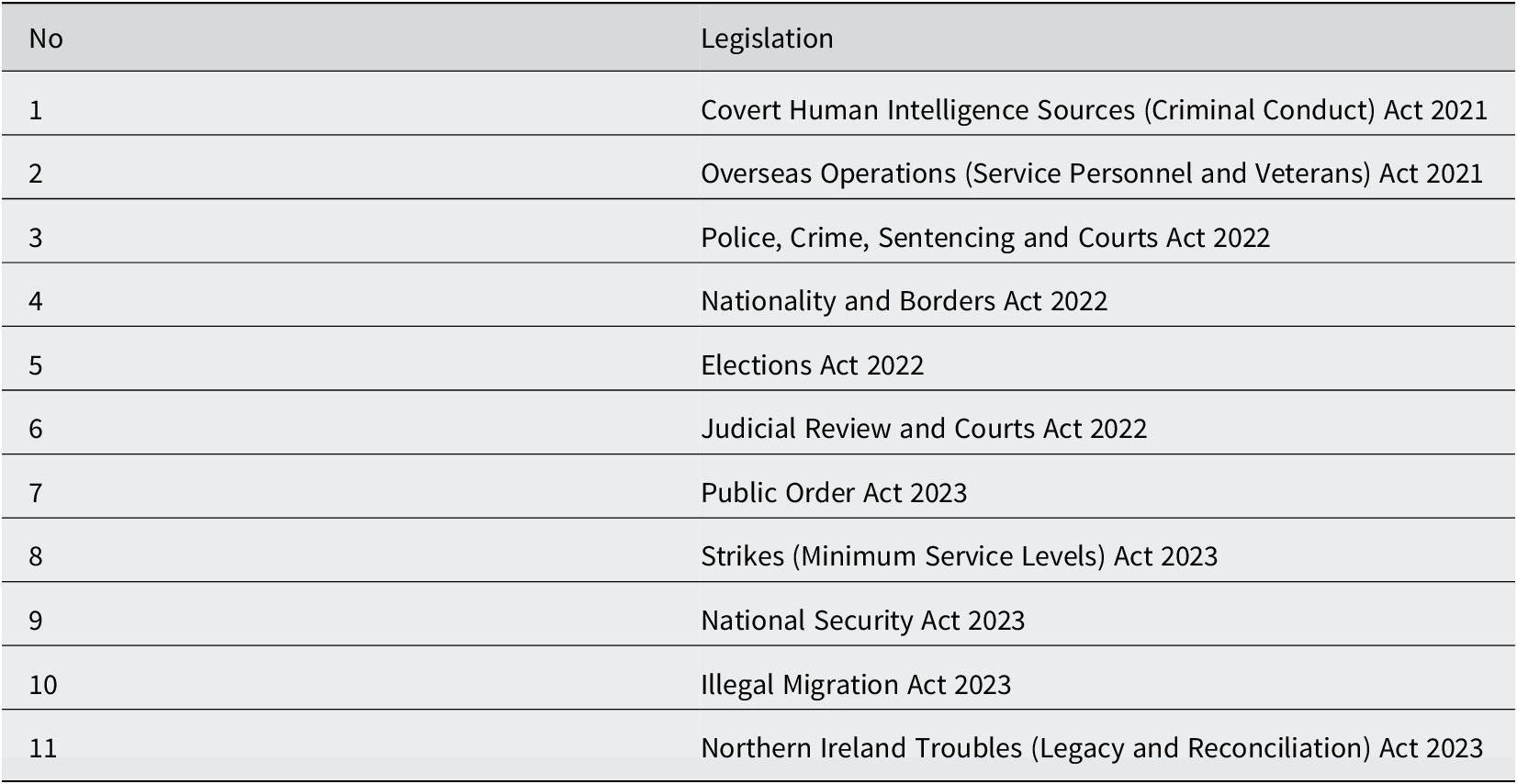
This section examines the 11 pieces of primary legislation passed between 2021 and 2023, listed in Table 1 below. They were chosen as examples of primary legislation passed during this time period that caused Executive empowerment with respect to specific powers interfering with human rights in the UK, as identified by the JCHR.Footnote 26 There are also examples below of Executive empowerment which expanded power less directly through weakening the ability of the judiciary to act as a check on powers interfering with human rights. While recognising the precise boundaries of Executive power are generally opaque and open to debate,Footnote 27 including in the UK context,Footnote 28 the UK Executive is taken here to be made up of the ‘core Executive’ – central government, Ministers and the senior civil service,Footnote 29 as well as a broader range of public authorities with principal responsibility for implementing Government policy, including the security and intelligence agencies and the police (despite the police being politically independent from the Government).Footnote 30 The Judiciary is not taken to be part of the Executive despite the overlap in functions between the two branches.Footnote 31
Executive empowerment legislation passed 2021–2023
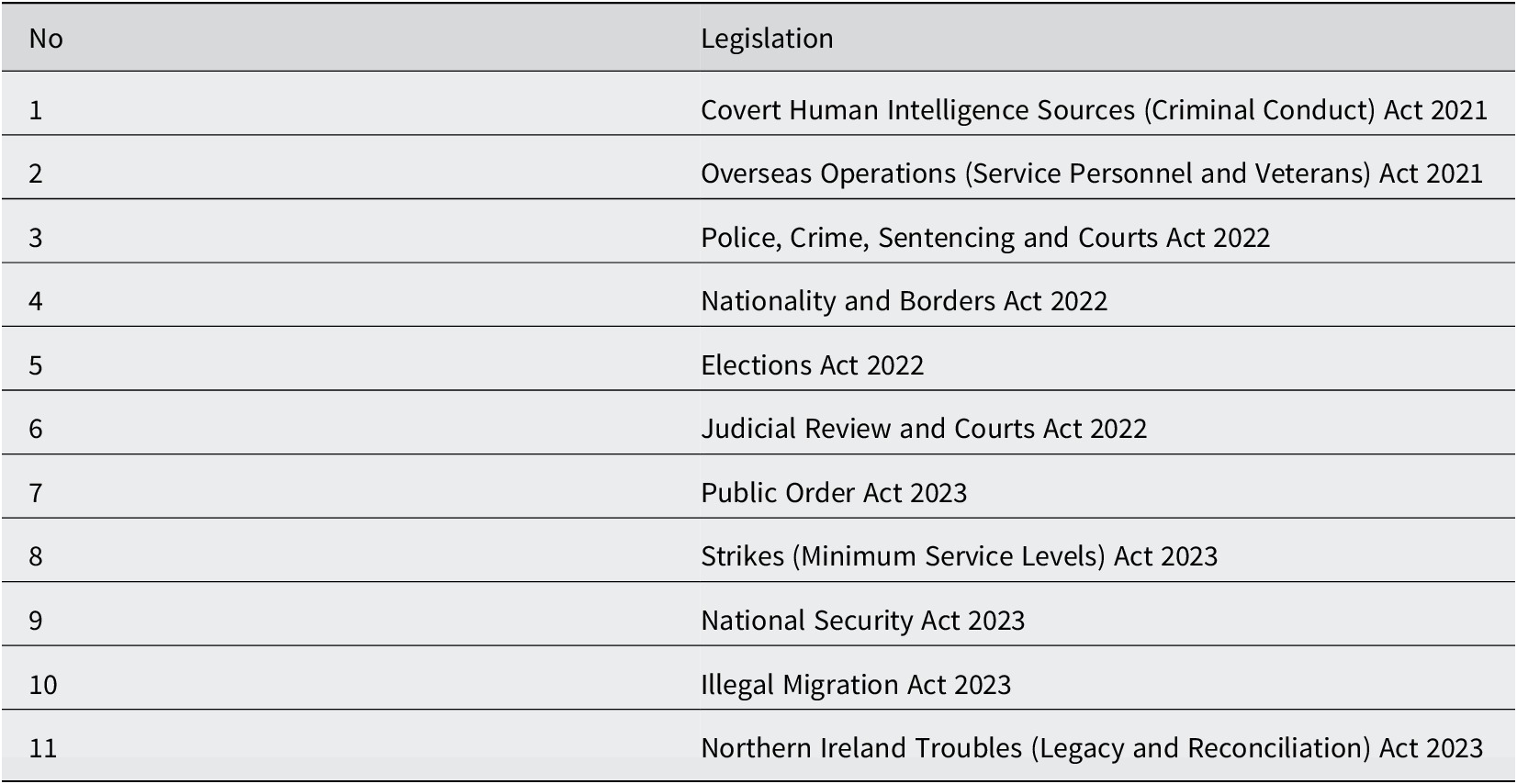
The legislation is introduced in chronological order, according to the date each piece received Royal Assent. The legislation referred to is extensive in the changes it makes across many areas of UK law and only a small selection of powers is introduced below.
(a) Recent legislative reform empowering the UK Executive
The Acts referred to above have resulted in UK Executive empowerment in the UK by expanding specific Executive powers or limiting judicial review of such powers. This was in a manner which reduced horizontal and/or vertical constraints on the Executive with respect to powers interfering with human rights, as set out below.
i. Damage to horizontal constraints on the UK Executive
The legal reform damaged horizontal constraints on the Executive in several ways. First, it damaged the accountability of the Executive for engaging in criminal conduct. The Covert Human Intelligence Sources (Criminal Conduct) Act 2021 created a statutory regime for ‘relevant authorities’ to authorise covert human intelligence sources to commit criminal acts where this is ‘necessary’.Footnote 32 Such necessity must be on grounds which include that the relevant act is in the interests of national security, preventing disorder, or the UK’s economic well-being where this is considered proportionate to that aim.Footnote 33 There are no limits on the conduct that can be carried out.Footnote 34 The Act does not directly provide immunity for such conduct in criminal proceedings. Yet, such authorisations reduce accountability for criminal behaviour by providing the cover usually associated with state actions – such as secrecy surrounding investigations where such conduct might take place and access to legal advice. This was emphasised by the JCHR, which stated that submissions to its inquiry on the legislation ‘raised serious questions’ as to whether the legislation provided ‘adequate safeguards for a power that poses severe risks to human rights’.Footnote 35 It also expressed concern that the law contained no express limits on the criminal conduct which could be authorised, despite limits existing in comparative jurisdictions,Footnote 36 and that the powers had been provided to a ‘wide range of public authorities’.Footnote 37
The Overseas Operations (Service Personnel and Veterans) Act 2021 also weakened the horizontal accountability of those acting for the UK Government, in the form of British troops operating outside of the British Isles. This was by creating a presumption against criminal prosecutions of British troops where alleged criminal conduct took place abroad over five years ago, to be applied by the Attorney General who is to provide consent for such prosecutions.Footnote 38 The Act further imposed a six-year limit on bringing civil claims with respect to death and/or personal injury in relation to events involving British troops outside of the UK.Footnote 39 Following concerns expressed by the UN High Commissioner for Human Rights, an amendment was successfully added to the Act, stating that the presumption against prosecution did not apply with respect to war crimes as contained in the Rome Statutes.Footnote 40 However, the JCHR described the time limit introduced with respect to civil claims as risking breaching the UK’s human rights obligations and preventing access to justice.Footnote 41 The Committee highlighted that had the time limit existed previously it would have prevented justice for victims of inhuman and degrading treatment of detainees by UK armed forces and would also have meant that such practices would have continued unchecked.Footnote 42
The Northern Ireland Troubles (Legacy and Reconciliation) Act 2023 further reduced accountability for Executive criminal conduct by ending legal proceedings concerning Troubles-related criminal conduct, including by those acting for the UK Executive.Footnote 43 The legislation terminated ongoing legal investigations and inquests of Troubles-related deaths and ‘other harmful conduct’.Footnote 44 The Act also established a new Independent Commission for Reconciliation and Information Recovery with responsibility for reviewing such investigations,Footnote 45 and granting immunity from prosecution to individuals who meet certain conditions, such as having provided a truthful account of their conduct.Footnote 46 It further gave the UK Government the power to veto the disclosure of information by the new Commission to ‘any other person’ on the ground of it being ‘protected international information’.Footnote 47
While such accountability relates to criminal conduct committed many years ago, the fact remains that the legislation reduced accountability for Executive criminal conduct. This erosion of accountability is exacerbated by the Executive veto regarding the disclosure of information, which could include that related to Executive criminal conduct. This was emphasised by the Northern Ireland Court of Appeal in finding the legislation incompatible with the UK’s obligations under the ECHR and the Windsor Framework.Footnote 48 Anticipating such findings, the JCHR had stated that it had ‘serious doubts’ that the Northern Ireland Troubles (Legacy and Reconciliation) Act 2023 was compatible with the procedural obligations underpinning the right to life under Article 2 of the ECHR,Footnote 49 which require states to undertake effective investigations into alleged interferences or violations of the right.Footnote 50
In reducing Executive accountability for criminal conduct, these three pieces of legislation also reduced the extent to which courts can function as a check on powers interfering with human rights exercised by the Executive. The same is also true of the Illegal Migration Act 2023, Judicial Review and Courts Act 2022 and Nationality and Borders Act 2022. The Illegal Migration Act 2023 imposed a duty on the Secretary of State to make arrangements for the removal of individuals who arrive in the UK in breach of immigration control, as soon as is reasonably practicable, subject to a limited set of exceptions.Footnote 51 Ouster clauses in the Act established that protection claims – such as those related to modern slavery and certain human rights claims – are inadmissible for challenging the removal of individuals.Footnote 52 The legislation also blocked the applicability of section 3 of the Human Rights Act 1998 to the Act’s powers,Footnote 53 and gave Ministers legislative permission to ignore interim measures issued by the European Court of Human Rights (ECtHR) in exercising the powers.Footnote 54 In this way, the Act reduced the role of the UK courts and the ECtHR in holding the Executive to account for human rights violations. This included, as emphasised by the JCHR, changing the long-standing position in current UK law that it is for the courts to decide whether a period of detention is reasonable or not.Footnote 55
The Judicial Review and Courts Act 2022 also weakened Executive accountability to the courts by limiting judicial review of permission-to-appeal decisions (referred to as ‘Cart judicial reviews’) of the Upper Tribunal, which principally examines immigration and social security cases.Footnote 56 The Act introduced ‘prospective-only quashing orders, in which quashing will not take effect until a future date specified and any retrospective effect of the order is limited or removed’.Footnote 57 According to the JCHR, this amounted to an ‘unnecessary, albeit low level, intrusion in judicial discretion’,Footnote 58 and could be used to deny an effective remedy for a human rights violation.Footnote 59 The Committee also stated that the ‘extensive use of ouster clauses’ in the legislation would ‘diminish the ability of judicial review to challenge executive action and expose unlawfulness’.Footnote 60 Lastly, the Nationality and Borders Act 2022 undermined Executive accountability to the courts with respect to powers to remove individuals from the UK. This was through introducing an expedited appeal procedure which ousted the jurisdiction of the Court of Appeal from a sizeable proportion of removal decisions.Footnote 61 Across this legislation, the shutting down of legal constraints has eroded fundamental forms of horizontal Executive accountability and enabled the Executive to wield significant powers impacting human rights with fewer constraints than before.
ii. Damage to vertical constraints on the UK Executive
In addition to weakening horizontal constraints on the UK Executive, vertical constraints have also been undermined. This is through the creation of broad discretionary powers to intervene against political protests, contained in the Police, Crime, Sentencing and Courts Act 2022 and Public Order Act 2023. The Police, Crime, Sentencing and Courts Act 2022 created new powers for police to intervene in public processions on several grounds, including where ‘the noise generated by persons taking part’ may result in ‘serious disruption to the activities of an organisation which are carried on in the vicinity of the procession’.Footnote 62 The Public Order Act 2023 created a cluster of new offences related to protest, including an offence of ‘locking on’,Footnote 63 ‘being equipped for locking on’,Footnote 64 ‘obstruction etc of major transport works’ and ‘interference with use of operation of key national infrastructure’.Footnote 65 Both sets of legislation allow for protests to be shut down even when this is not necessary for the public interests specified in human rights law. For example, with respect to the Police, Crime, Sentencing and Courts Act 2022, the JCHR stated that the noise trigger introduced for imposing conditions in public processions represents a ‘restriction on the right to protest that is not necessary in a democratic society’.Footnote 66 It further asserted that the legislation underpinning such powers ‘fails to provide convincing safeguards against arbitrary or discriminatory use of these powers’.Footnote 67 With respect to the Public Order Act 2023, the JCHR emphasised that the offence relating to obstructing major transport works is ‘so widely drafted that it could easily criminalise peaceful exercise’ of the right to freedom of assembly protected by Article 11 of the ECHR and the right to freedom of expression protected by Article 10 of the ECHR.Footnote 68 In this way, the powers contained in both pieces of legislation are damaging to vertical constraints on the Executive. They risk criminalising peaceful protest, a key means for the public to holds the Executive to account.Footnote 69 As highlighted by the UN High Commissioner for Human Rights, they are likely to have chilling effects, further damaging Executive accountability, encouraging individuals to self-censor by not attending protests, out of fear that they will suffer repression from the state.Footnote 70
The Strikes (Minimum Service Levels) Act 2023 also weakened vertical means of holding the Executive to account, by providing the Government with powers to specify minimum service levels which must be provided during strikes. This is with respect to public services including health services, fire and rescue services, education services, transport services and border security.Footnote 71 Through creating new means to prevent those working in public services from going on strike, the Act undermined the right to freedom of assembly. This right is a cornerstone for any democracy as it carves out protected spaces for people to politically organise, and which are essential for maintaining genuine political contestation. The JCHR argued that the legislation risked interfering with the right to strike due to its broad powers for the Secretary of State to define what ‘minimum service levels’ are and the manner in which such levels must be maintained by workers.Footnote 72 It further stated the legislation ‘arguably contains insufficient protection against arbitrary interference with Article 11 rights’.Footnote 73
The National Security Act 2023 further narrowed avenues for political dissent through the creation of coercive powers which are applicable, at least on paper, to a broad range of circumstances, including certain types of political activities. It created ‘prevention and investigation measures’, which are civil restrictions of a person’s day-to-day activities, which can be imposed where the Secretary of State considers an individual ‘is, or has been, involved in foreign power threat activity’.Footnote 74 Foreign power threat activity is activity in preparation of, or conduct which assists, several acts. This includes assisting a foreign intelligence service, or entering a prohibited place for a purpose prejudicial to the safety or interests of the UK, sabotage or foreign interference.Footnote 75 The JCHR stated that the use of the ‘safety and interests of the United Kingdom’ phrase without any indication of the severity of the potential prejudice to those interests, or as to how it may be interpreted, created ‘legal uncertainty as to how these criminal offences might apply’, contrary to the right to liberty provided by Article 5 of the ECHR and the right to a fair trial under Article 6 of the ECHR.Footnote 76 While protections are provided for journalists, no protections are provided for other types of researchers or non-governmental organisations, whose work may be accused of supporting ‘foreign powers’ and constitute ‘foreign power threat activity’. Consequently, such legislation may also create chilling effects among certain communities working to hold the UK Executive to account.
Finally, the Elections Act 2022 also damaged vertical constraints on the Executive powers interfering with human rights, specifically with respect to the ECHR obligation on states under Article 3, Protocol 1, to hold free elections at regular intervals.Footnote 77 The Act introduced new powers for the UK Government to amend the ‘Strategy and Policy Statement’ of the Electoral Commission - the UK’s elections monitoring body, which the Commission must have regard to in carrying out its work.Footnote 78 While it is generally not unusual for an Executive to set the broad policy parameters of statutory bodies, the introduction of a mechanism by which the UK Executive can set the terms of the work of the UK’s principal body responsible for overseeing elections, via a Strategy and Policy Statement, is a significant example of Executive empowerment. This was reflected in three parliamentary committees – the Public Administration and Constitutional Affairs Committee, the Levelling Up, Housing and Communities Committee and the Speaker’s Committee – having found such a mechanism to be unjustified and liable to undermine the Electoral Commission’s independence and effectiveness.Footnote 79 The Statement produced by the UK Executive also received criticism from both the Welsh and Scottish Governments due to its being seen to unnecessarily interfere with the work of the Electoral Commission in carrying out its role,Footnote 80 and was the subject of a House of Lords’ statement of regret on the same grounds.Footnote 81 By undermining the operational independence of the UK’s official institution for monitoring the integrity of UK elections, the Elections Act 2022 has put the competitiveness of UK elections at risk, as well as, therefore, putting at risk the integrity of the key means by which the Executive is held to account vertically.
2. Executive empowerment via the back door
The key contention of this paper is that the legislative reform outlined above was implemented through the backdoor. This is in the sense that the relevant legislation was passed via the significant marginalisation of Parliament in carrying out its basic scrutiny role, which also undermined broader public scrutiny of the legislation. The six key mechanisms of marginalisation are set out below.
Before the mechanisms are set out, it is important to understand Parliament’s basic scrutiny role as required by the UK constitution. In the first instance, this role is underpinned by the principle of parliamentary sovereignty, which assigns Parliament as the supreme lawmaker.Footnote 82 As emphasised by NW Barber, this means that while the Executive has a role in ‘setting policy and determining people’s entitlements’, it should be Parliament that determines the ‘broad policy direction of the state’.Footnote 83 This generally holds even where Parliament has delegated law-making power to the ExecutiveFootnote 84 or in situations of crisis.Footnote 85 Of course, some might argue there are some areas that Parliament cannot determine due to a lack of expertise or knowledge, such as in relation to national security.Footnote 86 However, aside from in rare cases, it is not clear how this principle, if broadly applied, could be compatible with Parliament being sovereign. Where expertise or information may be generally lacking, it is for the Executive to provide parliamentarians with access to it to decide whether that law is appropriate. This is standard practice, as the Government is required to give evidence to a range of parliamentary committees about the nature and purpose of legislation it introduces to Parliament, including with respect to national security matters.Footnote 87 It also regularly produces factsheets and additional briefings to accompany legislation. In this way, the system is meant to ensure that Parliament is in the driving seat when it comes to passing legislation, even with respect to issues where the Executive may possess expertise or information.
Given Parliament’s constitutional role, scrutiny of legislation is Parliament’s ‘most important function’.Footnote 88 As such, the legislative process, which refers to the steps by which laws are formally passed in Parliament, is of central constitutional importance.Footnote 89 It is governed by constitutional principles and conventions, as well as rules determined by Parliament itself, referred to as Standing Orders.Footnote 90 Scrutiny is built into stages each Bill must pass into in order to become primary legislation.Footnote 91 The structuring of the legislative process in this way does not mean that Parliament has exclusive control over the legislative process. As emphasised by Stephen Laws, Parliament’s role in legislation is reactive rather than proactive, in that it will usually be responding to Government proposals for legislation.Footnote 92
The precise means by which we can measure the extent to which constitutional standards for scrutiny are met can be difficult to assess and are not straightforwardly amenable to comparative analysis.Footnote 93 Legislative scrutiny is one of many duties parliamentarians have to undertake.Footnote 94 Partly due to this, there has been a culture of trial and error in developing parliamentary procedure to balance the roles of parliamentarians, as well as periods of reform with hugely varying impacts on the legislative process and parliamentarians’ role.Footnote 95 This constantly evolving and often opaque landscape of parliamentary procedure creates shifting sands which undermine precise comparative analysis between different periods of law-making.
Beyond comparative analysis of scrutiny, determining a threshold of ‘good scrutiny’ by which to assess a particular period of scrutiny is also not straightforward. It is not always clear what kind of scrutiny is important for Parliament to fulfil its constitutional function.Footnote 96 As emphasised by Alexander Horne, general scrutiny is not a ‘panacea’ if the government is not prepared to ‘listen and heed honest criticism’.Footnote 97 Moreover, as highlighted by the House of Lords Select Committee on the Constitution, the ability to change a Bill is not the only way scrutiny processes in each House are valuable.Footnote 98 Parliamentarians testing whether a Bill will have the intended policy effect may also represent an effective form of scrutiny.Footnote 99 It is also true that open scrutiny may not be the only way parliamentarians exert influence on legislation, such influence may take place behind closed doors through informal conversations.Footnote 100
While there are such complexities, this analysis takes as instructive Kate Dewsnip’s assessment of effective scrutiny as having three broad features.Footnote 101 These are, first, that such scrutiny enhances the technical quality of legislation, which includes that laws are ‘necessary, effective, clear, coherent and accessible’ rather than ‘ineffective, inaccessible, disjointed, unclear and unnecessary’.Footnote 102 Secondly, good scrutiny should ensure executive accountability; and thirdly, should facilitate policy influence. Such features are indispensable to ensure Parliament is clear on the legislation it is voting through and can steer the direction of the legislation. They also have implications for the kind of resources Parliament requires to be able to conduct its scrutiny. These include that Parliament has the information and time to form a rudimentary understanding of the broad scope and operation of any legislation in question, as must be required for meaningful influence. It is assumed here that whether such resources were available is a helpful starting point for assessing the extent to which parliamentarians were able to carry out the constitutionally required scrutiny.
As we will see, because the Executive relied on the six mechanisms set out below, parliamentarians were deprived of the resources, including both time and information regarding the changes, to form such rudimentary understanding of crucial aspects of the legislation referred to above. While some anecdotal comparison is made below, the overall claim on scrutiny is not a comparative one positing that the undermining of scrutiny in this way is exceptional.Footnote 103 As noted above, all governments are prone to exploiting the parliamentary process using the mechanisms outlined. The claim here is that in holding back sufficient resources for parliamentarians to form a rudimentary understanding of many of proposed changes, the Executive not only departed from several constitutional conventions underpinning the law-making process but undermined parliamentarians in meeting the threshold to a conduct basic scrutiny role. This created a back door through which much of the legislation could be passed. The analogy of a back door is particularly apt in this context due to the constitutionally significant nature of the legislation, which meant basic scrutiny was limited in a context in which parliamentary sovereignty would have required additional scrutiny.
The Executive did not utilise each mechanism uniformly with respect to each piece of legislation. Rather, these mechanisms are repeating themes across the programme of reform outlined. Moreover, the legislation was subject to significant moments of parliamentary intervention and scrutiny, as already acknowledged above with respect to the Overseas Operations (Service Personnel and Veterans) Act 2021. Another example is the Covert Human Intelligence Sources (Criminal Conduct) Bill, in relation to which Labour praised the scrutiny it had been subject to as it passed through Parliament.Footnote 104
3. Six mechanisms obstructing parliamentary scrutiny
(a) Lack of pre-legislative scrutiny or consultation
The first mechanism obstructing parliamentary scrutiny with respect to the legislative programme outlined above is the lack of pre-legislative scrutiny or consultation associated with it. Since 1997, according to Erskine May, the Government has ‘undertaken to work with Parliament to ensure a systematic approach to pre-legislative scrutiny with a view to improving legislation and reducing the need for subsequent amending legislation’.Footnote 105 As a result of this commitment, each parliamentary session, ‘several public Bills’ are meant to be published in draft form for pre-legislative scrutiny by a parliamentary committee.Footnote 106 However, none of the 11 pieces of legislation set out above was subject to pre-legislative scrutiny. This was despite the legislation being wide-ranging. Moreover, almost half (5/11) of the pieces of legislation did not receive any reference in the Conservative Party Manifesto 2019.Footnote 107 The remaining six pieces of legislation introduced changes that were only partially referred to.Footnote 108
There was also a lack of consultation evident in the drafting of several pieces of legislation. During the passage of the Illegal Migration Bill, parliamentarians complained about the UK Government’s lack of consultation with an Independent Anti-Slavery Commissioner – one was not in post at the time of the Bill’s passage.Footnote 109 Parliamentarians also complained that there had been a lack of consultation with the Children’s Commissioner.Footnote 110 With respect to the Police, Crime, Sentencing and Courts Bill, the police expressly stated that they were not consulted regarding the main changes introduced by the Bill in relation to protest law.Footnote 111 Moreover, in relation to the Elections Bill, the House of Commons Public Administration and Constitutional Affairs Committee complained about the lack of consultation with the public more broadly.Footnote 112 While there was a short consultation in the lead up to the Nationality and Borders Bill, the process was described as a ‘sham’ in an open letter signed by over 200 civil society bodies, referred to in a House of Commons briefing paper on the Bill.Footnote 113 In addition, the Government’s introduction of the Northern Ireland Troubles (Legacy and Reconciliation) Bill occurred at a time when Stormont was not functioning properly and could not provide an official response, which also amounted to a lack of consultation. As emphasised by Lord Murphy of Torfaen, the ‘right place’ for the powers in the Bill to be debated and discussed was Belfast rather than Westminster, and it was problematic that the Bill was put forward in London when it had ‘no support in Northern Ireland at all’.Footnote 114
(b) Exploitation of the parliamentary timetable
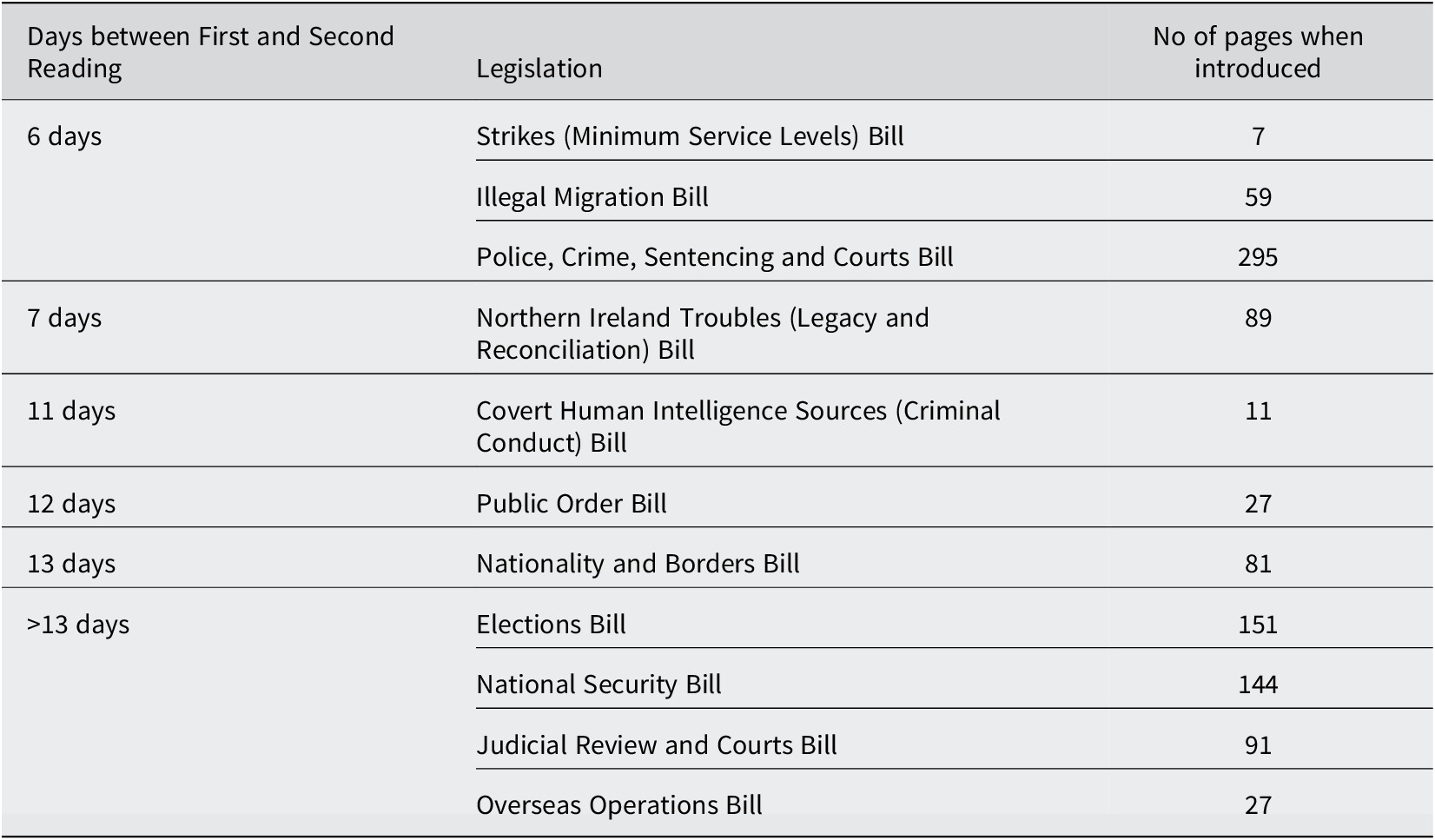
A second mechanism by which Parliament was marginalised during the legal reform is through exploitation of the parliamentary timetable. Such exploitation principally took the form of timetabling noticeably brief time periods between the First and Second Readings in the House of Commons. The Cabinet Office’s ‘Guide to Making Legislation’ has set out a ‘conventional minimum timetable’ in which two weekends must elapse between First and Second Reading of primary legislation ‘of reasonable length and complexity’ in the House of Commons.Footnote 115 According to the Guide, Bills may be accorded a ‘higher priority’ if they are ‘politically very important or have a fixed deadline for Royal Assent’. Below, Table 2 sets out the time elapsed between First and Second Reading in the House of Commons scrutiny of the legislative programme.
Time elapsed between First and Second Reading
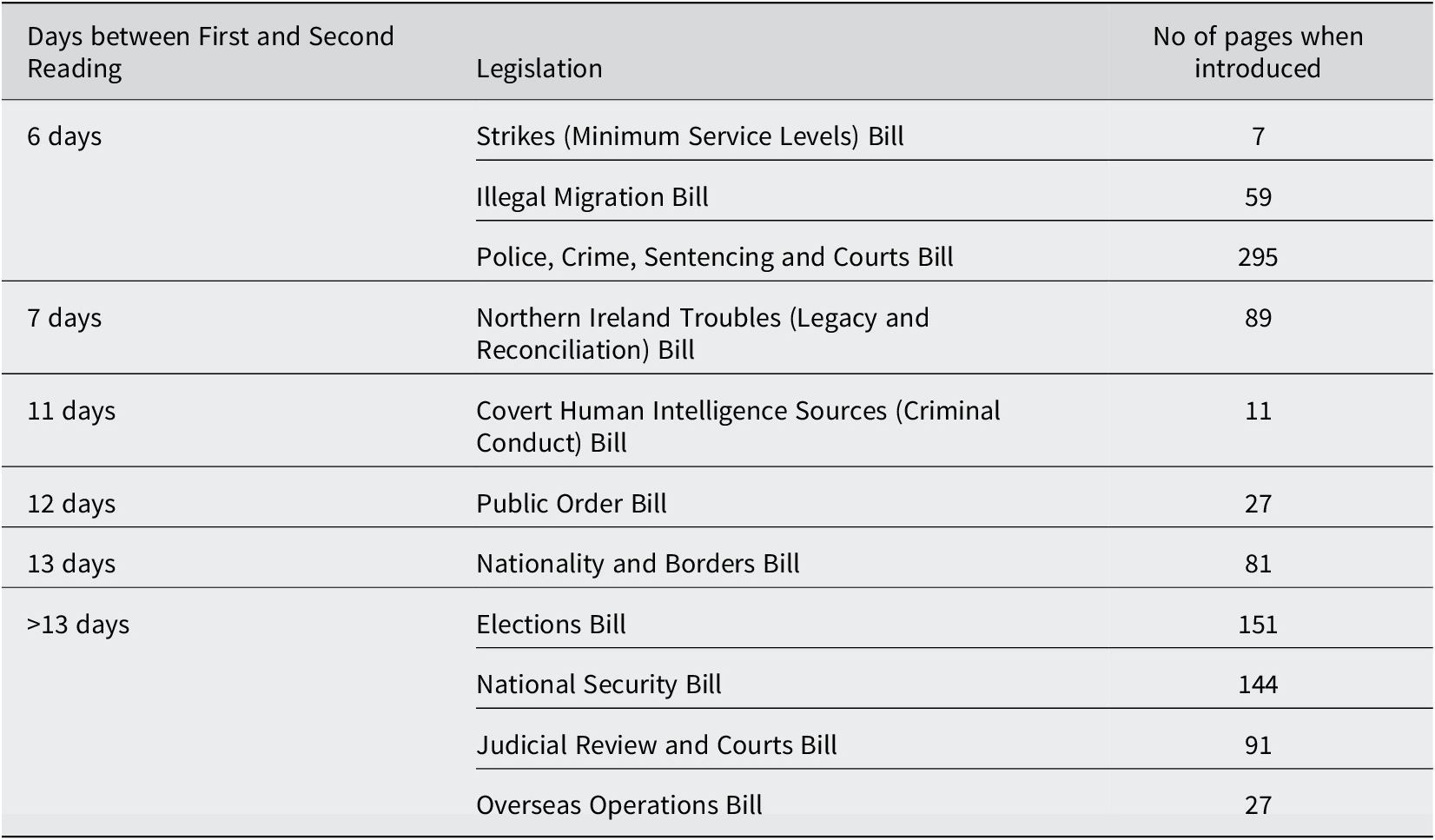
As can be seen from the table, four pieces of legislation were timetabled in a way which meant that MPs had just a few working days between First and Second Reading.Footnote 116 Given there was no clear fixed timetable for the Royal Assent deadline, no doubt the UK Government would claim the rushed timetable was justified by the legislation being ‘politically very important’. However, no detailed case was provided as to why the legislation met this standard. Notably, there were repeated complaints by parliamentarians that the timetable for parliamentary scrutiny was too rushed. This includes with respect to the consideration of amendments. During the Committee Stage of the Strikes (Minimum Service Levels) Bill, Angela Rayner MP complained that there was ‘no reasonable timetable’ and that MPs would have ‘only five hours’ to debate over one hundred amendments.Footnote 117 She added that MPs had had ‘no line-by-line scrutiny of the Bill’ and had been ‘unable to hear any evidence’, which was a ‘major concern’.Footnote 118 Similar concerns were raised with respect to the Illegal Migration Bill, as emphasised by Alice Lilly, who stated that ‘instead of the usual detailed consideration and evidence-gathering at Committee Stage, the Bill had only two days on the floor of the House of Commons, hence a maximum of twelve hours of debate’.Footnote 119 This is further evidence of an exploitative approach to parliamentary timetabling in a manner which undermined parliamentary scrutiny.
Another form of timetable exploitation was the anti-social scheduling of a crucial debate that took place on the Illegal Migration Bill. On the final day of ‘ping pong’ in the House of Lords, the debate was scheduled to start in the late evening, beginning at 10.15pm.Footnote 120 Notably, the Lord Bishop of Bristol explicitly cited the ‘lateness of the hour’ during the debate in deciding not to move Motion E1 to amend the Bill to strengthen protections for vulnerable children.Footnote 121 In this way, parliamentary scrutiny was demonstrably obstructed through its timetabling by the UK Government.
(c) Legislative overload
A third mechanism of marginalisation is that of ‘legislative overload’, closely related to the issue of exploitative timetabling. The term is employed here to refer to a process by which Parliament is overloaded with a high volume of complex and broad-ranging law it must scrutinise, in a manner that stretches its capacity to exert meaningful scrutiny. In this way, the term overlaps with the concept of ‘constitutional overload’ articulated by Mike Gordon, which refers to an escalating volume, scale and complexity of interactions of constitutional changes and is discussed below.Footnote 122 There are two forms of legislative overload visible with respect to the legislation assessed here. First, legislative overload stems from the Government introducing to Parliament multiple laws undermining UK democracy and human rights simultaneously. Second, it occurs due to the Government tabling large quantities of amendments during scrutiny, which limits the capacity of Parliament to consider non-Government amendments.
The Acts considered here were passed in under three years, and often contained lengthy, complex provisions spanning a broad range of areas. The most controversial Bills were passed in the same period of under a year. As can be seen from the table above, the Police, Crime, Sentencing and Courts Bill was 295 pages long when introduced in July 2021, before it received Royal Assent in April 2022. Its provisions pertained to vastly different areas of governance, from introducing new sexual offences, to road traffic offences, to provisions on sentencing, public order, court proceedings, and offensive weapons. The Nationality and Borders Bill was introduced and scrutinised in the same months as the Police, Crime, Sentencing and Courts Bill. It was 81 pages when introduced and contained such significant wide-ranging reforms that the JCHR published its report containing scrutiny of the Bill in four parts.Footnote 123 The Elections Bill and Judicial Review and Courts Bill were also introduced and scrutinised during this same period of months. Another batch of controversial bills – the Strikes (Minimum Service Levels) Bill, the Public Order Bill and the Illegal Migration Bill – also received the bulk of scrutiny simultaneously.
This bulk of legislation is notable for its high volume, which is visible, by way of comparison, when assessing the volume of legislation undermining UK democracy and human rights during the New Labour years. In his 2010 book Bonfire of Liberties: New Labour, Human Rights, and the Rule of Law, Keith Ewing refers to ten pieces of legislation weakening human rights passed in over a decade during successive Labour Governments.Footnote 124 While this analysis does not seek to compare the extent to which each set of legislation impacted UK human rights and democracy overall, the fact that Ewing’s list is the same length while covering seven additional years of law-making time is consistent with such overload taking place.
There is also evidence of legislative overload in the form of the Government tabling large quantities of amendments during scrutiny, to the point that time to consider amendments from non-Government parliamentarians was significantly limited. This occurred, for example, with respect to the Strikes (Minimum Service Levels) Bill, at the House of Commons Report Stage. As highlighted by Alice Lilly, the UK Government published over a hundred amendments ‘at late notice dealing with both substantive and highly technical issues, many of major constitutional importance’.Footnote 125 This meant ‘many MPs had only a few minutes to speak to their non-Government amendments’.Footnote 126 In this way, parliamentarians were limited in their scrutiny due to the Government overloading parliamentarians with law to scrutinise.
As with Gordon’s constitutional overload, legislative overload undermines Parliament’s ability to exert scrutiny. However, while constitutional overload involves competing narratives on constitutional legitimacy which structurally disrupts all scrutiny processes, legislative overload in this context does not necessarily prevent any meaningful scrutiny. Though it does reduce the capacity for parliamentarians to comprehend and assess the implications of the legislative change. Moreover, the more broad-ranging legislation that is introduced at the same time, the less capacity there is for parliamentarians to assess the context in which each new piece of legislation will exist, and the way that such legislation interacts with the other proposed changes.
That so much controversial legislation has been passed alongside many other significant events occurring at the level of the Westminster Executive since 2021 adds to the impact of legislative overload in stretching Parliament’s capacity. Such events include the Covid-19 pandemic, two Prime Ministerial resignations, and the formal British exit from the EU in January 2020. It is also true that in addition to the 11 pieces of primary legislation, Parliament was required to scrutinise other legislation with significant human rights implications that did not end up being passed. The most significant legislation in this regard was the Bill of Rights Bill, which sought wholesale reform of the UK human rights system through repeal of the Human Rights Act 1998 and the introduction of a series of new tests for adjudicating compatibility with ECHR rights. The Bill was first introduced to Parliament on 22 June 2022, with the Bill’s Second Reading due to take place soon after Parliament’s summer recess of that year. However, the Bill ended up being delayed and was officially withdrawn on 27 June 2023. Parliamentarians were also responsible for scrutinising the Higher Education (Freedom of Speech) Bill, with significant human rights implications.Footnote 127 Such circumstances will only have reinforced the effects of legislative overload in weakening Parliament’s capacity to comprehend and assess the legislative reform proposed.
(d) Inclusion of broad powers to make secondary legislation
A fourth mechanism of marginalisation was the reliance by Government on ‘skeleton bills’ and broad powers to make secondary legislation. Skeleton legislation contains ‘only the barest general principles’ and permits ‘matters which closely affect the rights and property of the subject [to] be left to be worked out in the Departments, with the result that laws are … [not] made by, and get little supervision from, Parliament’.Footnote 128 Such legislation contains broad provisions for the UK Government to make delegated legislation, which undermine parliamentary scrutiny as they render opaque the practical meaning of legislation for parliamentarians, and how it will operate in practice. Notably, in describing the Strikes (Minimum Service Levels) Bill, Jacob Rees-Mogg MP stated it was ‘almost so skeletal that we wonder if bits of the bones were stolen away by wild animals and taken and buried somewhere, as happens with cartoon characters’.Footnote 129 This was linked to the fact that the legislation left it up to the Secretary of State to define, via secondary legislation, what counts as ‘minimum service levels’ that public services must maintain. This meant the Bil’s core trigger to exercise its powers was left for the UK Executive rather than Parliament to define.
The Public Order Act 2023 contained broad powers lacking in detail. For example, it contained a power enabling the Secretary of State to issue guidance on the exercise of police functions in relation to serious disruption prevention orders.Footnote 130 The Delegated Powers and Regulatory Reform Committee described this as ‘an extreme example of a power to issue guidance on the exercise of statutory functions’.Footnote 131 It stated that the power allowed the Secretary of State to ‘influence the exercise by the police of functions that could prove to be highly controversial’.Footnote 132 Exactly what this influence would look like and how it could affect the exercise of police functions would not have been clear to parliamentarians during the passage of the Public Order Bill, further undermining scrutiny on this legal regime.
Another key example is the power in the Illegal Immigration Act 2023 which enabled the Secretary of State to amend the definition of ‘serious and irreversible harm’,Footnote 133 the key threshold for challenging removal from the UK – where individuals can show they would be subject to such harm, they may not be removed. The House of Lords Select Committee on the Constitution stated that the implications of the definition were ‘so significant’ it should ‘only be amended by primary legislation’.Footnote 134 Despite such concerns, the Government refused to remove this power during the legislative process.
(e) Failure to provide crucial information
A fifth mechanism of marginalisation is a failure on the part of the UK Government to provide parliamentarians with crucial information. With respect to the Illegal Migration Bill, the Home Office only published the Bill’s economic impact assessment, children’s rights impact assessment and equality impact assessment after the Bill had left the House of Commons. Moreover, the Home Office did not respond to detailed questions from the JCHR on 24 April 2023, until after the Bill had begun the Committee Stage in House of Lords, on 2 June 2023. Equally, the Strikes (Minimum Service Levels) Bill was passed through the House of Commons before an impact assessment was published. Moreover, once published, the impact assessment was rated ‘not fit for purpose’ by the Regulatory Policy Committee.Footnote 135 Sometimes other information that was provided by the Government was also lacking. This was the case, for example, with respect to the delegated powers memorandum provided in relation to the Northern Ireland Troubles (Legacy and Reconciliation) Bill. The Delegated Powers and Regulatory Reform Committee described the explanations of the broad powers to make delegated legislation as ‘very brief, even inscrutable’.Footnote 136
Crucial information was also delayed with respect to the Illegal Migration Bill and Nationality and Borders Bill, using ‘placeholder clauses’. Such clauses are regulation-making powers that the government has said it intends to ‘replace … with substantive provisions’ in later stages of scrutiny.Footnote 137 The Nationality and Borders Bill contained six placeholder clauses which were not replaced with substantive provisions until the Committee Stage in the House of Commons.Footnote 138 In response to this, the Lords Constitution Committee stated that the ‘delayed introduction of so many significant clauses, the legal implications of which are in some cases far from clear, is unacceptable’.Footnote 139 At the time, the Committee added that ‘this must not become a normal way of legislating’.Footnote 140 However, two placeholder clauses in the Illegal Migration Bill were then identified by the Lords Constitution Committee, described as being ‘constitutionally significant’ and ‘unacceptable’ due to their reducing the ‘opportunity for the finalised policy to be considered’.Footnote 141 With such placeholder clauses not being replaced until late in the stages of parliamentary scrutiny, parliamentarians missed crucial details in key stages of Commons’ scrutiny.
(f) Spurious or misleading claims
The final mechanism of marginalisation was the UK Government’s reliance on claims which later turned out to be spurious or misleading, during the passage of legislation. For example, with respect to the Nationality and Borders Bill, a FOI response revealed that the Home Office statement related to the Bill could not be verified. When the Bill was given its Second Reading in the House of Commons, then Home Secretary Priti Patel MP told parliamentarians that there had been an ‘alarming increase in the number of illegal entrants and foreign national offenders, including child rapists and people who pose a national security risk’ abusing the modern slavery system to ‘avoid immigration detention and frustrate removal from the UK’.Footnote 142 An FOI request then revealed that the Home Office’s Modern Slavery Unit responsible for collecting data in this area did not possess data for child rapists, national security threats or failed asylum seekers referred into the modern slavery system.Footnote 143
Then, during the Police, Crime, Sentencing and Courts Bill’s Second Reading in the House of Commons, Priti Patel told parliamentarians she had ‘worked closely’ with the Police Federation on producing the changes in the Bill, though not specifying what changes she was referring to.Footnote 144 Following this statement, the Police Federation issued a statement that it ‘did not provide a written submission nor were we consulted on issues of protest-related legislation’,Footnote 145 and an FOI request confirmed this.Footnote 146
In presenting spurious or misleading information, the Government marginalised parliamentarians from their scrutiny by distorting the context of the legislation and therefore preventing parliamentarians from making their decisions on that legislation based on concrete facts.
4. Impacts of marginalisation on parliamentary and public scrutiny
When viewing the reliance on all six mechanisms of marginalisation, it is clear they combine to provide a significant obstacle to parliamentarians gaining a rudimentary understanding of many of the key powers contained in the legislation above. This was due to a deficit of time and information provided for such scrutiny to take place. The marginalisation of parliamentarians from scrutiny presumably also had a knock-on effect on broader public scrutiny of the changes. Where reform is rushed, and parliamentarians are not provided with sufficient time to comprehend the changes, they will be limited in publicly responding to them. Without a public response to the proposed changes, the media and other parts of civil society are less likely to be engaged. Moreover, where civil society is engaged, it is likely to become just as overloaded and lacking in capacity as parliamentarians, due to the lack of information and time.
5. Assessing the broader context of UK’s backdoor Executive empowerment
The UK’s recent backdoor Executive empowerment has several implications for broader contexts. First, it lends support to those sending warnings regarding the UK constitutional vulnerability in being able to protect parliamentary sovereignty and the legislative process in the face of Executive overreach.Footnote 147 The mechanisms of marginalisation amount to an abuse of the legislative process by the Executive, leading to the rapid expansion of Executive powers interfering with human rights, despite many parliamentary protestations.
Based on the analysis above, questions remain as to whether the UK is not only lacking in Executive constraints but is also procedurally set up to encourage the Executive to engage in abusive practices. For governments wanting to undermine UK democracy and human rights, it appears easier within the current UK constitutional framework to do it via mechanisms of marginalisation rather than through a legislative process which supports meaningful parliamentary scrutiny. As emphasised by Merris Amos with respect to the proposed Bill of Rights Bill, Parliament is susceptible to autocratic methods in law-making.Footnote 148 This is linked to the fact that, unlike many other constitutional systems, the UK has no formal processes for introducing or removing constitutional changes. The Executive can pass legislation significantly expanding its powers using the usual legislative process, and there are no concrete penalties for setting obstacles to full scrutiny via marginalisation. In fact, using these mechanisms can be beneficial. For example, the Executive is less likely to receive political backlash if it enacts constitutional changes quickly and simultaneously due to the dynamics of legislative overload which minimises scrutiny, as described above. That the UK’s current system would benefit such Executive behaviour supports those scholars who argue that genuine protection of parliamentary sovereignty requires the UK constitution to form more robust Executive constraints.
(a) Parallels with global trends
While the analysis above does not provide a sufficiently full picture of the overall direction of Executive power to establish that the UK is in the process of democratic backsliding, the UK’s backdoor Executive empowerment has echoes in recent global trends identified within comparative constitutionalism. This is insofar as the legislative reform outlined above introduced rapid expansions of Executive power, damaging both horizontal and vertical forms of Executive accountability.Footnote 149 A particular feature of the UK’s Executive empowerment, consistent with global trends, is its highly legal nature. This chimes with dynamics identified by Kim Lane Scheppele as part of ‘autocratic legalism’.Footnote 150 This occurs when elected leaders use law to undermine the ability of democratic publics to exercise basic democratic rights, such as the right to free elections and the right to protest – which we have seen were undermined by recent UK legislative reform.
Backdoor Executive empowerment also echoes the form of Executive power expansions identified by Larry Bartels.Footnote 151 In his analysis of mechanisms of democratic backsliding in Europe, such backsliding is not linked to bottom-up changes in public attitudes and desires with respect to democracy, but via top-down mechanisms. In making this argument, Bartel contrasts his view to what he terms the ‘folk theory’ of democracy, which holds that citizens’ preferences are the primary forces animating political change.Footnote 152 Bartel’s thesis relies on huge datasets of public polling and many broad, contested, political concepts. Consequently, it is not considered determinative of the nature of democratic erosion here. However, it does chime with the UK’s experience as presented in the analysis above. To the extent that the UK changes were shielded from parliamentary and public scrutiny, there is no clear way of linking up many of the changes with democratic will. The enactment of such legal reform via marginalisation prevented a basic level of democratic engagement such that the changes could not represent a clear expression of democratic will. In this way, the UK experience would seem consistent with Bartel’s picture of recent democratic backsliding being principally linked to top-down rather than bottom-up mechanisms of political change.Footnote 153
(b) Prospects of reform
With a new Labour Government taking office, this has naturally raised questions about the prospect of reform, both with respect to reversing the substantive Executive empowerment as well as protecting the UK’s legislative process against mechanisms of parliamentary marginalisation. As to the substance of the legislation, Keir Starmer’s Government has made a commitment to repealing the Strikes (Minimum Service Levels) Act 2023Footnote 154 and the Northern Ireland Troubles (Legacy and Reconciliation) Act 2023.Footnote 155 It has also committed to repealing the Safety of Rwanda (Asylum and Immigration) Act 2024, which is not included in the timeframe of the analysis but was a clear case of Executive empowerment.Footnote 156 However, the Government has not so far stated it will repeal any of the other legislation included in this analysis, including particularly controversial protest-related legislation. Indeed it chose to continue with the previous Government’s appeal against a High Court ruling quashing the controversial protest regulations amending the definition of ‘serious disruption’ up until the Court of Appeal upheld the High Court’s ruling.Footnote 157 It further sought leave to appeal the Northern Ireland Court of Appeal’s ruling on the unlawfulness of the Northern Ireland Troubles (Legacy and Reconciliation) Act 2023, while stating it would potentially be open to reforming the new accountability body rather than scrapping it altogether.Footnote 158 Moreover, the Labour Government has already sought to pass legislation which is its own form of Executive empowering reform while appearing to emulate the marginalisation above. This includes the creation of ‘counter terror style’ powers to be used to enforce border control introduced via the Border Security, Asylum and Immigration Bill.Footnote 159 In relation to this legislation, the Government left only six working days between the First and Second Reading and provided no opportunity for pre-legislative scrutiny.
As to the prospect of the new Labour Government addressing previous problems of parliamentary marginalisation, there appears to be work underway to develop and consider proposals for reform. The Government has established a ‘Modernisation Committee’ which has a stated aim of ‘reforming procedures to make the Commons more effective’.Footnote 160 The Committee is chaired by Lucy Powell MP, Leader of the House of Commons, who, before entering into Government, stated that Labour would be committed to reforming the legislative process to enhance parliamentary scrutiny of legislation.Footnote 161 The Attorney General has also made statements emphasising the new Government’s commitment to the rule of law, as well as addressing the excessive use of delegated powers.Footnote 162 A range of proposals on legislative reform has already been proposed outside of the Government, including from the Grieve Commission,Footnote 163 the Institute of Public Policy Research,Footnote 164 the Constitution Unit,Footnote 165 and the Institute for Government.Footnote 166 Many of these proposals are focused on enhancing the resources of parliamentarians to conduct scrutiny, whether this is by articulating principles to give parliamentarians more time for scrutiny, including pre-legislative scrutiny, or giving parliamentary committees more power to have impact on legislation. Despite the commitment of Lucy Powell, and the wealth of proposals which have been offered, its focus on parliamentary scrutiny has been mediated through a broader focus on investigating how to make parliament more accessible and inclusive for those with disabilities. Perhaps changes will come in future but so far, no concrete changes have been made to improve parliamentary scrutiny and address the structural imbalance of power between Parliament and the Executive which gives way to mechanisms of marginalisation.
One significant way to enhance legislative scrutiny is to bring the legislative process, and its potential abuses, more into public consciousness. As has long been highlighted, much of the legislative process is deeply opaque, and therefore inaccessible to the kind of public scrutiny that could incentivise parliamentarians to promote more democratic approaches to legislative scrutiny.Footnote 167 In this regard, Meg Russell’s recent proposals that Parliament publish annual figures on key metrics related to the legislative process – such as time spent on debates, numbers of placeholders clauses relied on in Bills – are of great assistance.Footnote 168 The proposals may be taken further in requiring that certain features of the legislative process are required to be published with respect to each piece of legislation as it is introduced and passed through Parliament. This might include the use of a running clock on the Parliament website to show how long a Bill has been debated so far. It could further include requirements that placeholder clauses and powers to make delegated legislation be highlighted and listed in a highly visible summaries accompanying Bills. Importantly, these are just piecemeal examples of what should be much broader and systematic changes to transform both parliamentary and public scrutiny in those areas, such as above, affecting our most fundamental and democratic rights.Footnote 169

 Open access

