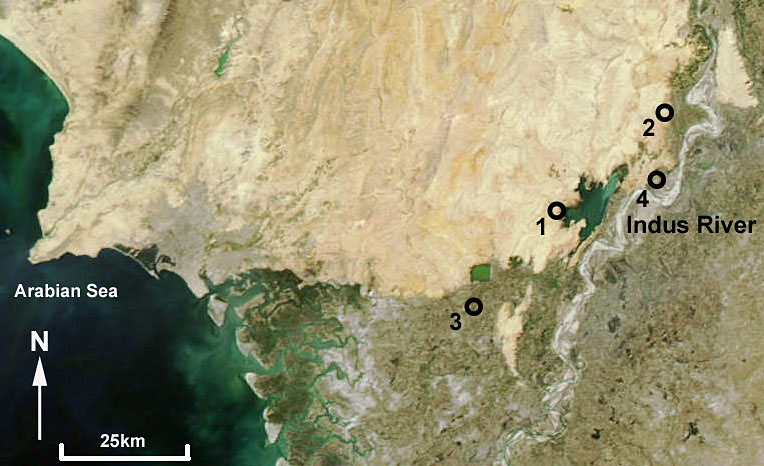


Until recently the only prehistoric flint mining area in Sindh to be exploited during the Indus civilisation was thought to be the Rohri Hills (Reference Allchin and TaddeiAllchin 1979; Reference Starnini and BiagiStarnini & Biagi 2006; Reference Biagi, Starnini, Kostov, Gaydarska and GurovaBiagi & Starnini 2008). However, recent discoveries made at Ongar and Daphro, south of Kotri, revealed that these hills also show evident traces of flint mining, although most of the prehistoric extractive structures have been destroyed by ongoing industrial activities (Reference Biagi and SelinBiagi 2008; Reference Biagi, Franco and GelichiBiagi & Franco 2008). Now surveys carried out by the Italian Archaeological Mission in January and February 2010 have discovered good-quality flint sources, mining areas and workshops in the neighbourhood of Jhimpir, in Lower Sindh (Figure 1).
Location of the sites mentioned in the text: 1) Jhimpir; 2) Ongar; 3) Tharro Hills; 4) Kot Raja Manjera.

Flint mines near Jhimpir
The presence of chert in the Ranikot beds north-west of Jhimpir had already been intimated by Reference BlandfordBlandford (1880: 152). This author reports that, close to the railway station 'a part of the rock is flinty and cherty' (Reference BlandfordBlandford 1880: 153). Although a brief survey made in the above area did not reveal any flint seam in situ in the limestone deposits, further investigations south-southwest of Jhimpir led to the discovery of two distinct flint outcrops on two parallel limestone terraces, oriented east-west.
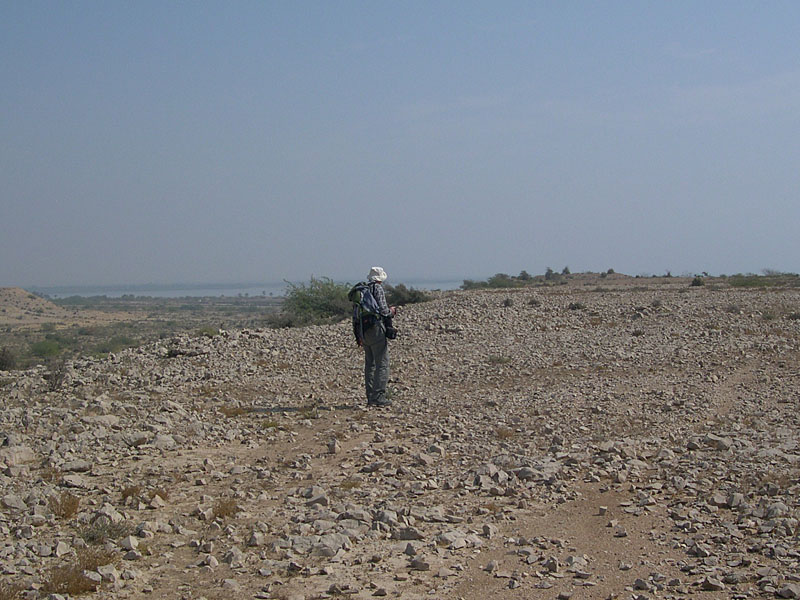
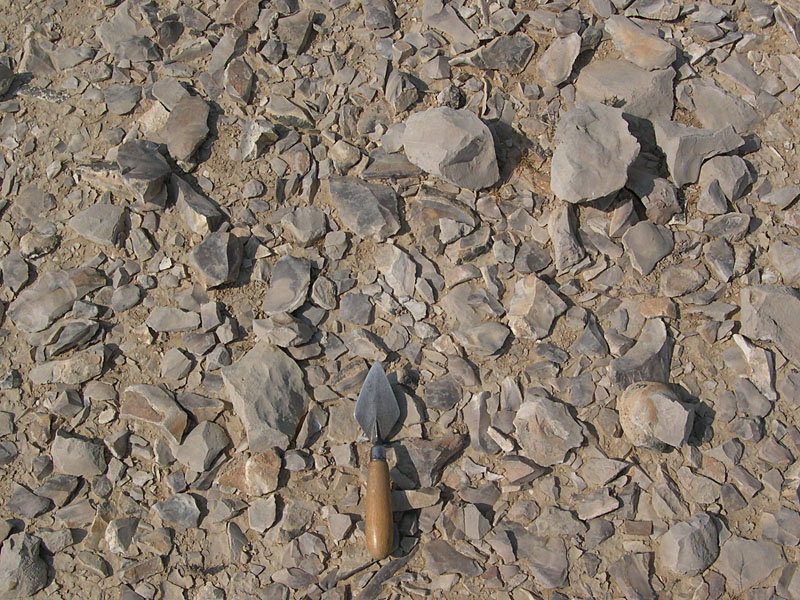
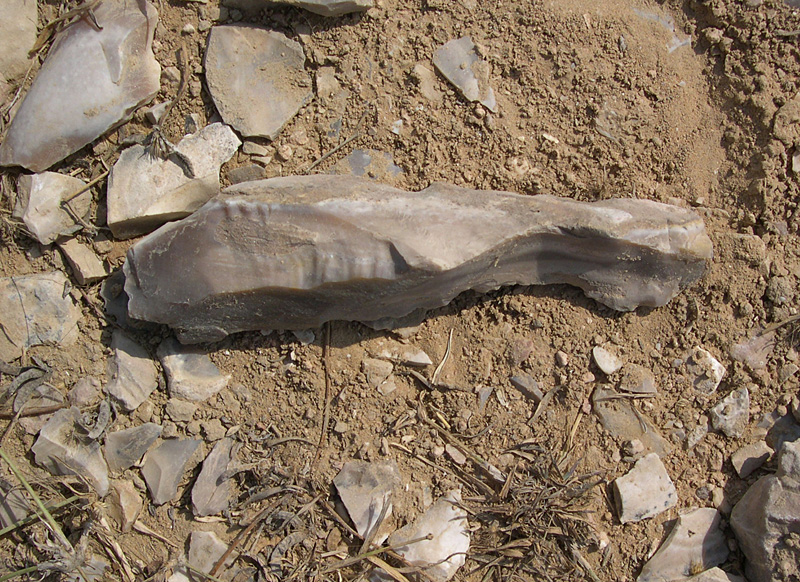
The most evident traces of prehistoric flint exploitation were recorded on a flat terrace close to the Larinadi dry riverbed, called JMP-21. All the westernmost part of the mesa (some 40m) is marked by mining trenches, which were excavated parallel to the terrace edges (Figure 2). Many flint workshops (Figure 3), indicated by flakes, blade cores, crested blades (Figure 4) and bifacial picks, were found. According to our preliminary field notes, the mining area seems to be delimited between 24°59'47"-24°59'37" N and 68°00'11"- 68°00'03" E.
Flint mining trenches along the southern edge of JMP-21.

A small flint workshop on the surface of JMP-21.

Crested blade on the surface of JMP-21 mining area.

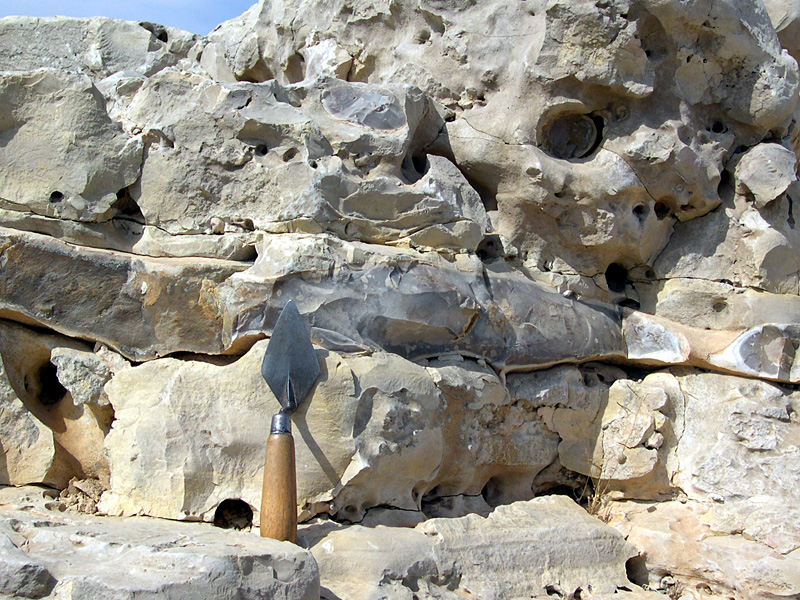
Seams and nodules of good quality flint of a light grey colour (7.5YR 7/1), outcropping from the top of an inclined terrace, were also observed about 1 mile south of the above-mentioned seam (Figure 5). The surface of this second outcrop, called JMP-28, which is at present exploited on a small scale for industrial purposes, yielded a white patinated, marginally retouched blade, probably attributable to Copper/Bronze Age exploitation of this source.
Seams of light grey, good quality flint at the top of the limestone beds of JMP-28.

Discussion
The discovery of another flint mining area in Lower Sindh is of major importance for the understanding of the exploitation of the raw materials, and their distribution in the region. It shows that our knowledge of the exploitable sources is still very poor, and the problems connected with them are much more complicated than previously suggested (Reference Law, Hassan Baqri, Khalid and KhanLaw et al. 2002-2003). Although we cannot yet attribute the Jhimpir mines to the Indus Civilisation, there are indications of an association: blade cores closely recall the Amri specimens from the Tharro Hills (Reference BiagiBiagi 2005), and other Amri sites are known in the region, including Kot Raja Manjera (Reference KhanKhan 1979), some 20km east of JMP-21.
Acknowledgements
The authors are very grateful to Mir Atta Mohammad Talpur, Mir Ahmed Farooq Talpur and Mir Abdul Rehman Talpur who made the research at Jhimpir possible. Thanks are due to the Gnutti EURAL, Rovato, Brescia that financed the 2010 fieldwork in Sindh.