

Collective action involving natural resources can have profound political ramifications. Mobilisation by Russian and Ukrainian miners played a crucial role in the collapse of the Soviet Union (Crowley Reference Crowley1997). In South Africa, the National Union of Mineworkers was an important part of the anti-apartheid struggle (Botiveau Reference Botiveau2017). During the Iranian revolution, an oil strike ‘was the greatest single blow to the Shah’s power’ (Halliday Reference Halliday1979: 11). And a work stoppage by Serbian coal miners sealed the fate of Slobodan Milošević (Bunce and Wolchik Reference Bunce and Wolchik2011: 110–111). Environmental campaigns involving natural resources can also be consequential. Across Latin America, environmental impact assessment processes for proposed extractive projects have rallied – and divided – communities (Jaskoski Reference Jaskoski2022). Indigenous activism over pipelines and timber in Canada (Maclean et al. Reference Maclean, Robinson and Natcher2015; Wyatt et al. Reference Wyatt, Hébert, Fortier, Blanchet and Lewis2019) and water rights in Bolivia (Simmons Reference Simmons2016) have resulted in major victories for organisers – and in the Bolivian case, have empowered new political parties. In Indonesia, dispossessed villagers and environmentalists challenging mines have effectively linked their efforts to those of transnational civil society groups (Brown and Spiegel Reference Brown and Spiegel2017).
However, movements confronting natural resource interests – or even just operating in areas reliant on natural resources – face substantial obstacles. Entrenched resource firms can intimidate community members (Gaventa Reference Gaventa1980) and exercise ‘boundary control’ vis-à-vis external, democratising forces (Gibson Reference Gibson2013). The importance of such companies to local employment, moreover, tends to drive a wedge between potential allies, frustrating ‘red-green alliances’ of workers and environmentalists especially (Uzzell and Räthzel Reference Uzzell, Räthzel, Räthzel and Uzzell2012). Remote settings like those where resources are typically extracted do not offer activists the well-financed non-governmental organisations, high-profile public gathering spaces and media access enjoyed by urban organisers (Castells and Kumar Reference Castells and Kumar2014; Patel et al. Reference Patel, Bunce, Wolchik and Lynch2014; Turner and Cornfield Reference Turner and Cornfield2007). More broadly, resource rents fund authorities’ coercive capacity and ability to pay off critics (Bellin Reference Bellin2004; Jensen and Wantchekon Reference Jensen and Wantchekon2004; Morrison Reference Morrison2009). Indeed, a recent study has found that, all else equal, non-violent movements, in particular, fail more often in resource-rich countries than in other countries (Kirisci and Demirhan Reference Kirisci and Demirhan2021).
Natural resource campaigns may, at the same time, enjoy certain advantages. For instance, resource-reliant communities can be extraordinarily tightly knit (see, for instance, Turner Reference Turner2021). These bonds bolster organisers. The paternalist traditions of company towns can at times also be turned against local elites, who feel pressured to uphold an unspoken social contract, and those elites can, under the right conditions, align themselves with workers and other community members against a perceived external enemy, like the central government (Evans Reference Evans2025). Clark Kerr and Abraham Siegel (Reference Kerr, Siegel, Kornhauser, Dubin and Ross1954) have influentially argued that the isolation of miners and other resource employees lends their activism the intense militancy of ‘a kind of colonial revolt’ (see also Church et al. Reference Church, Outram and Smith1991). And the ability of such activists to choke off access to a product essential to the functioning of a country’s entire economy is, of course, also a uniquely powerful weapon (Mitchell Reference Mitchell2011). However, in general, if there is one thing that makes resource organising special, it is its incredible difficulty.
When, then, are movements likely to succeed under these circumstances? In this article, we use an original dataset of 1,525 reports of collective actions and their outcomes (mostly immediate outcomes) from the Appalachian state of West Virginia, one of the United States’ major coal producers and historically the site of bitter and protracted conflicts over coal, to examine in a preliminary manner the evidence for three arguments that have been made about the outcomes of natural resource-related struggles: that local party politics are crucial; that small-scale and persistent activism is the best use of the limited means that such movements possess and has the greatest impact (one-off, big mobilisations are said to often be counterproductive in the natural resource context); and that peacefully disruptive tactics are effective, but physical violence by protesters, regardless of the circumstances, tends to backfire on movements. We furthermore explore the possible differences between what appears to ‘work’ for environmental versus labour activism when resources are involved.
Our findings both challenge and provide support for existing claims in interesting ways. First, we show that the party in power in the state is not predictive of the outcomes of collective actions, but individual politicians do correlate with more or less movement success. Second, large actions do not increase wins in coal disputes above and beyond a general positive correlation that we observe between participation and concessions in any type of dispute. At the same time, small but persistent movements do not seem to do better than others either. And, finally, while peaceful disruption tends to be effective in general, it is negatively correlated with concessions when coal is involved. We show that this last correlation, however, masks considerable heterogeneity with regard to the issues motivating a conflict: while peaceful disruption appears to backfire in environmental disputes involving coal, it seems to actually be quite effective in labour disputes involving coal.
In the following sections, we first provide some background on West Virginia and its history of coal-related contention. Next, we introduce the three arguments we will be testing, drawing on both the small body of research that has been conducted on conflicts in natural resource-dependent areas and the broader literature on social movements more generally, briefly discussing how each argument might apply to the West Virginia case. Then, we explain how we created our dataset based on a regional newspaper, Charleston Gazette-Mail, using a combination of hand coding and machine learning, and we detail the results of our statistical analysis. Finally, digging further into the environmental–labour divide, we offer some anecdotes drawn from the individual reports that make up our dataset, wherein mine truck blockades and other forms of civil disobedience deployed by environmentalists have angered surrounding communities. Our conclusion discusses some possible implications of our findings and how this line of research might be developed going forward.
West Virginia’s history of coal and contention
West Virginia has historically been marked by high levels of popular unrest related to coal. The conflict in the state can be traced back more than a century and a half. Following the US Civil War, as in other parts of Appalachia, mountaineers in West Virginia were cut off from the forest commons that they had relied upon, deprived of their homesteads by land speculators brandishing deeds to their property, and ultimately forced into coal mining company towns (Catte Reference Catte2018; Stoll Reference Stoll2017; Williams Reference Williams1976). After several unsuccessful campaigns, United Mine Workers of America (UMWA) organisers launched a series of showdowns with their bosses, starting with the Paint Creek and Cabin Creek strikes of 1912 and culminating in the Battle of Blair Mountain of 1921, an armed insurrection involving thousands of miners pitted against sheriff’s deputies intent on keeping the union out of two southern counties (Corbin Reference Corbin2015; Green Reference Green2015). This worker activism, which was remarkably multiethnic in character, laid the groundwork for an upsurge in minefield unionisation during the New Deal (Green Reference Green2015; Lewis Reference Lewis1989: Chapter 7).
After World War II, mining in Appalachia in general and in West Virginia in particular mechanised and slowed. Many Appalachian families migrated to the Midwest in search of jobs, emptying out their former towns, including previously thriving African American communities, but joining fresh social movements in their new homes, such as the Young Patriots in Chicago (Sonnie and Tracy Reference Sonnie and Tracy2011; Turner Reference Turner2021). West Virginia became a target of federal anti-poverty initiatives and the destination of scores of local and out-of-state college-educated volunteers, who joined forces with community organisers to challenge local elites on issues ranging from healthcare to education (Eller Reference Eller2013; Kiffmeyer Reference Kiffmeyer2008; Wilkerson Reference Wilkerson2019). These initiatives encountered powerful pushback from politicians (see, e.g., Perry Reference Perry2011). As in other parts of Appalachia, further campaigns in the state centred on union reform and revival (Kahle Reference Kahle2016; Nyden Reference Nyden, Brenner, Brenner and Winslow2010; Smith Reference Smith2020), opposing environmentally destructive practices like strip mining (Montrie Reference Montrie2003) and mountaintop removal (Bell Reference Bell2016), and winning compensation for black lung disease (Hamby Reference Hamby2020; Smith Reference Smith2020). When local progress was blocked, activists pushed for federal legislation on some of these issues.
From the 1970s and 1980s onwards, West Virginia’s socioeconomic context shifted further, but conflict continued. New industries rose in the state, as in the region more generally, from tourism to prisons, to healthcare – and with these new sectors came new forms of contention (Hennen Reference Hennen2021; Schept Reference Schept2022). In 2018 and 2019, for instance, West Virginia was rocked by a pair of teachers’ strikes that eventually spread to other states like Oklahoma (Blanc Reference Blanc2019). Yet coal companies continue to powerfully shape the state’s politics, exercising an effective veto over environmental legislation and dominating decisions by the state public utilities commission (Van Nostrand Reference Van Nostrand2022). West Virginia thus amounts to an ‘extreme case’, where the dynamics that are of interest to this study – powerful natural resource interests and collective action involving them – should appear with special clarity (Gerring Reference Gerring, Box‐Steffensmeier, Brady and Collier2008). We next introduce three arguments for why resource-related collective actions might succeed rather than fail – arguments relating to local politics, participation and disruption.
Local politics
The first argument we test is the most straightforward one: that local party politics is crucial to conflict outcomes. Social movement theorists have long argued that openings in the ‘political opportunity structure’ signal to activists that they have a chance of making a difference (e.g. Kitschelt Reference Kitschelt1986; Tarrow Reference Tarrow2022). Party realignments are a key form these openings can take (McAdam Reference McAdam1999). Usually, analysis focuses on national-level realignments. However, local politics may also be consequential. Along these lines, in his study of mine disputes in Peru, Moisés Arce (Reference Arce2014) argues that levels of party competition in certain resource-dependent areas determine which side in a dispute carries the day. One can imagine that these dynamics might also apply to West Virginia. During the state’s early twentieth-century mine wars, some governors showed more support for miners than others. But party lines did not map neatly onto attitudes towards labour. For instance, Governor William E. Glasscock (Republican) declared martial law during the Paint Creek and Cabin Creek strikes of 1912, but his successor, Henry D. Hatfield (also Republican), pardoned arrested miners while also imposing a settlement that union radicals opposed (Green Reference Green2015). Today, West Virginia’s Democrats and Republicans share a fiercely pro-coal orientation (Van Nostrand Reference Van Nostrand2022). The state’s Governor-turned-Senator, Jim Justice, has belonged to both parties at different times and himself owns several mining companies. Former Governor and Senator, Joe Manchin (Democrat), was the co-founder of a coal brokerage company, and current Governor, Patrick Morrisey (Republican), sued the Environmental Protection Agency over its policies on coal-fired power plants before becoming governor (Waldman Reference Waldman2022).
Participation
The second argument is that the uniquely entrenched power of natural resource firms requires their opponents – and perhaps even people active on other issues in resource areas – to adopt a small-scale but persistent approach to organising in order to be successful. Findings about the impact of movement size on outcomes are mixed in the broader social movements literature (e.g. Butcher and Pinckney Reference Butcher and Pinckney2022; McAdam and Su Reference McAdam and Su2002). According to Rose Spalding (Reference Spalding2023), in her study of anti-mining movements in Nicaragua, Guatemala, Costa Rica and El Salvador, a broad and cohesive campaign is key to successful regulation of the sector. However, in the Appalachian context, historian and activist Charles Keeney (Reference Keeney2021) posits that, given the low populations of rural areas and therefore the costs involved in assembling large numbers of people, organisers against coal companies should operate like ‘special ops’ teams composed of individuals with knowledge of the state regulatory system, rather than stage showy demonstrations. Shannon Bell (Reference Bell2016), meanwhile, builds on an important tradition in social movement research when she claims that ‘micro-mobilization’ provides the space for grassroots activists to build the confidence they need to stand up to mine bosses. And in his classic analysis of conflict in a Kentucky coal town, John Gaventa (Reference Gaventa1980) contrasts the failure of a large-scale campaign by the Communist-backed National Miners’ Union in the 1930s with a lower key but ultimately more successful campaign involving documentary filmmakers, who encouraged community reflection in the 1970s. Accounts of Appalachian campaigns for black lung compensation and for mine-related flood compensation, meanwhile, highlight skilful advocacy by individual law firms and their clients, alongside mass protest (Hamby Reference Hamby2020; Smith Reference Smith2020; Stern Reference Stern2008). Also in line with this pattern: in 1999, the law firm Mountain State Justice won a surprise case against mountaintop removal mining, when a federal judge ruled that the Clean Water Act did not ‘permit the destruction of waterways through the dumping of rocks and soil from mountaintop removal projects into nearby valleys’ (the case was later overturned on appeal).Footnote 1
Peaceful disruption
Third and finally, it has been posited that peaceful disruption is the most effective approach for confronting natural resource interests. There is a longstanding (but not unchallenged) belief in the literature that campaigns that upset business-as-usual achieve breakthroughs, while those that institutionalise and work through established channels stagnate (Piven and Cloward Reference Piven and Cloward1977). William A. Gamson (Reference Gamson1990) calls this the ‘success of the unruly’. With regard to the precise form that disruption takes, researchers have found that peaceful tactics are effective but that violence tends to backfire, though these findings have been disputed (Chenoweth and Stephan Reference Chenoweth and Stephan2011; Dworschak Reference Dworschak2023; Gamson Reference Gamson1990; Wasow Reference Wasow2020). Jessica Steinberg (Reference Steinberg2019) has compared copper and coal mining operations in Mozambique, Zambia and the Democratic Republic of Congo, finding that the level of disorder threatened by protesters and the cost-benefit calculations of extractive firms and governments determine whether locals are compensated or environmental impacts are addressed. Ching Kwan Lee’s (Reference Lee2017: Chapter 5) work on protests at Zambian copper mines comes to similar conclusions. West Virginia has a powerful history of armed struggle over coal, as exemplified by the aforementioned Battle of Blair Mountain. But Karen Beckwith (Reference Beckwith2000) argues that civil disobedience, such as sit-ins, was what carried miners to victory against the Pittston Coal Group during an extended strike in Virginia and West Virginia in 1989–1990. Sometimes, non-violent disruption takes creative forms. In the 1920s and 1930s, for example, anthracite miners in Appalachian Pennsylvania frustrated coal bosses by ‘bootleg’ mining from abandoned mines while on strike and surviving on the proceeds (Troutman Reference Troutman2022). Tactics like this are hard to stop.
Our dataset
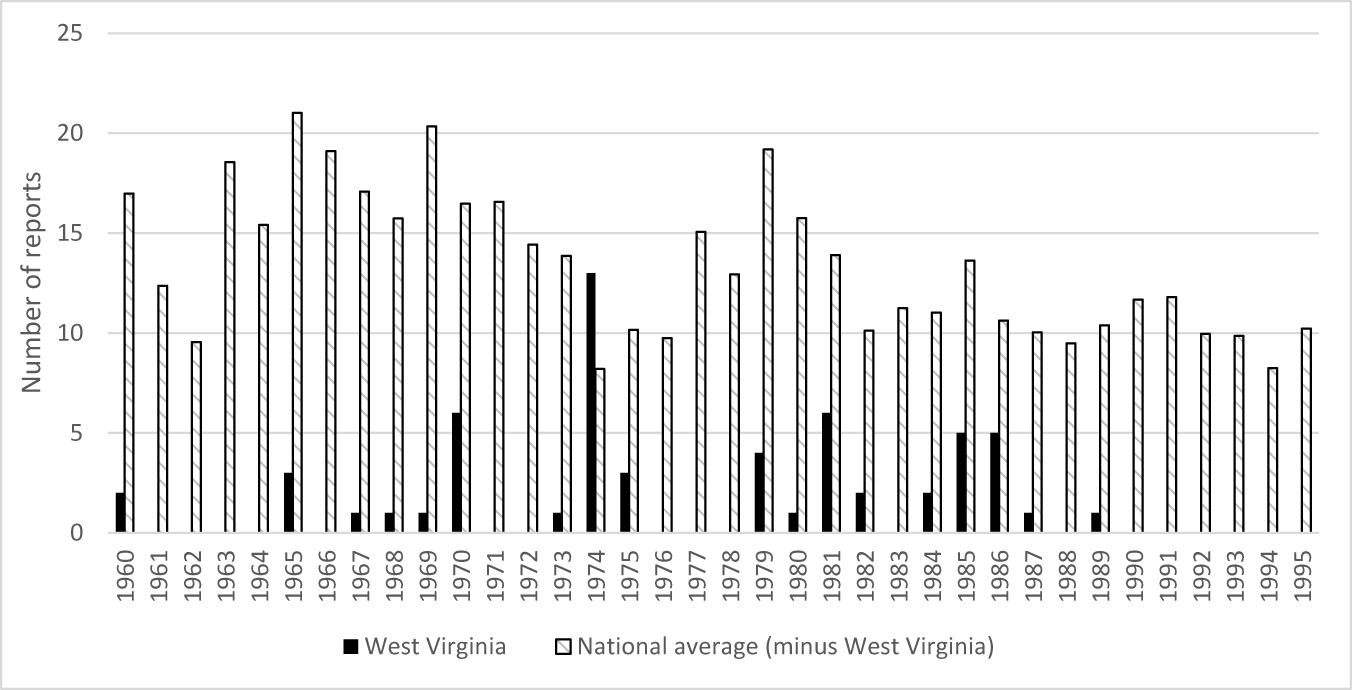
To test these arguments, we use an original quantitative dataset of 1,525 reports on 1,036 collective actions occurring in West Virginia between 1995 and 2001. Although excellent qualitative studies have been conducted on campaigns over natural resources and in natural resource-dependent areas, such advocacy has not, for the most part, been subjected to quantitative ‘protest event analysis’, which tracks patterns in popular unrest with regard to important properties like ‘frequency, timing and duration, location, claims, size, forms, carriers, and targets’ (Koopmans and Rucht Reference Koopmans, Rucht, Klandermans and Staggenborg2002). This gap may stem from two forms of selection bias in existing protest event datasets based on national-level newspapers (Earl et al. Reference Earl, Martin, McCarthy and Soule2004). The first form of bias is that certain ‘families’ of social movement organisations are tracked very closely – think of the organisations associated with the Civil Rights Movement or the Tea Party Movement in the United States – while others are given only cursory attention (Amenta et al. Reference Amenta, Caren, Olasky and Stobaugh2009). The other is that movements in urban areas, where major media outlets are based, receive more attention than rural movements. Natural resource activism is rarely directly linked to the most talked-about contention of the day, and it typically occurs in the countryside. Figure 1 shows the number of reports per year from West Virginia compared to the average for all 49 other states captured by the Dynamics of Collective Action project, which relies on The New York Times. Note that, for many years, there are zero events whatsoever recorded by the project.
Collective Actions in West Virginia versus the Average for Other States in the Dynamics of Collective Action Dataset

Figure 1 Long description
A graph shows the average number of collective actions per state (minus West Virginia) captured by the Dynamics of Collective Action project versus the number captured for West Virginia for each year between 1960 and 1995. Except for the year 1974, the national average consistently exceeds the West Virginia number, and for many years, no collective actions are recorded in West Virginia whatsoever.
To remedy this oversight, our new dataset is based on reports appearing in a regional, not national source: West Virginia’s main newspaper, Charleston Gazette-Mail. In general, ‘media coverage is seldom neutral and ascribes legitimacy to certain actors, demands, and strategies, while denying it to others’ (Koopmans Reference Koopmans, Snow, Soule and Kriesi2007: 32). And there are clear examples of ‘description bias’ in our data: reports frequently value the perspectives of coal companies over, say, the companies’ employees or environmental advocacy groups (Earl et al. Reference Earl, Martin, McCarthy and Soule2004). However, sources like ours have the potential to capture many more events in their areas of focus than an outlet like The New York Times. Indeed, our dataset at present includes an average of 218 reports on 148 actions per year. The incidents covered touch on issues ranging from school prayer to international trade. The targets thus span geographic scales. However, most of the conflicts are ‘local’ in the sense that they are also most directly aimed at sub-national centres of power like county courthouses and education boards and company offices and, with the exception of some environmental campaigns, rarely drew people from outside West Virginia. Our dataset is publicly available for download via the Harvard Dataverse at https://doi.org/10.7910/DVN/MQLXKO.
We have collected our reports through a ‘semi-automated approach’; that is, one that combines computer analysis with hand coding. Specifically, using a lightly adapted version of the search query employed by Jasmine Lorenzini et al. (Reference Lorenzini, Kriesi, Makarov and Wüest2021), a team of research assistants downloaded an average of 11,223 articles per year over the 25-year period between 1995 and 2019 using Lexis Nexis.Footnote 2 They then identified and categorised by hand 275 reports of actual collective action out of the 7,581 reports downloaded for 1 year, 1998, plus 626 collective actions out of 3,182 reports downloaded for 2010 (representing approximately a quarter of that second year’s total number of reports). Based on the frequency with which certain key words appeared in the full text of the confirmed collective action-related articles, another group of researchers then used a random forest algorithm to generate a model predicting whether any given article truly concerned collective action. The model was trained using the entire 1998 dataset combined with a random sample of 80% of the labelled 2010 data, and it was tested using the remaining 20% of the labelled 2010 data.Footnote 3 Once the team was confident in the accuracy of the model’s results, they used it to create lists of likely protest-related articles for the remaining years. Finally, the first group of assistants culled these lists of false positives and coded the confirmed collective actions according to the Dynamics of Collective Action guide, which captures a wide range of attributes of collective action events, defined to include everything from petitioning to lawsuits, to marches, to rioting (McAdam et al. Reference McAdam, McCarthy, Olzak and Soule2009). Funding constraints have (for now) prevented processing the lists from 2002 onwards. However, the timeframe we cover is understudied but analytically useful, as it represents a lull or transition period between the Massey and Pittston strikes of the 1980s and the peak of anti-mountaintop removal activism in West Virginia in the late 2000s.
Our dataset allows us to study collective actions at different levels of analysis. In line with Cook and Weidmann’s (Reference Cook and Weidmann2019) advice, we made each row of our collection an individual news report rather than an incident (see also Weidmann and Rød Reference Weidmann and Rød2019). Doing so minimised information loss and arbitrary coding decisions: we did not have to decide at the outset whether two reports concerned the same incident and, if so, which report described the incident more accurately. However, we also went back over the dataset and assigned the reports a shared four-digit incident code if they described an event taking place at the same time and place, with the same participants and claims, and with no more than a 24-hour gap in activity (if there was only one report made about an event, then the four-digit code corresponded to just that one report). Grouping reports in this manner allowed us to, say, calculate the average or minimum number of people reported to be involved in a given incident across different reports. Finally, we grouped the incidents into ‘campaigns’, which we defined as a set of incidents that shared the same claim and the same participants or organisations (or organisations within the same alliance with the same claims but not necessarily with the same targets, to allow for targets shifting over the course of a campaign). We identified a total of 585 different campaigns in this way.
The collection furthermore includes measures of success – something missing from the Dynamics of Collective Action project and many others. We coded concessions on a 1–4 scale, with each concession measured at the level of an individual news report and defined by the level to which protesters’ stated demands were met; in other words, with regard to the movements’ goals rather than some broader criterion (Amenta and Young Reference Amenta, Young, Giugni, McAdam and Tilly1999; Gamson Reference Gamson, Goodwin and Jasper2009). Coders were asked to assess whether the target(s) of a collective action, that is, local government or business or other actor, agreed to all of the demands of protesters or, alternatively, were willing to grapple with the root causes of the issues raised, even if they did not meet all demands; if so, the event would be coded as a 4. If some of the demands were met and negotiation took place, then partial concessions were reached, which was coded as a 3. If a report just mentioned the target of collective action engaging with protesters, this was considered a 2. If there is no recorded response to protesters and activists, then that was a 1.Footnote 4 We did not subtract repression from concessions to create a composite score, but rather separately tracked police tactics alongside any carrots offered by the targets of actions. Although scholars have often tracked responses to popular pressures over a longer period or through indirect measures like vote counts in legislatures, there are other studies that have, like ours, tracked concessions at the article or event level (Butcher and Pinckney Reference Butcher and Pinckney2022; Carey Reference Carey2006; Chenoweth et al. Reference Chenoweth, Pinckney and Lewis2018; Leuschner and Hellmeier Reference Leuschner and Hellmeier2024).
We also added several other variables. First, we noted the governor who was in office at the time of the protest event. During the seven years of coded data, three governors served in West Virginia: William Gaston Caperton III (1989–1997, Democrat), Cecil Underwood (1997–2001, Republican) and Robert Wise (2001–2005, Democrat). We furthermore documented whether an incident was connected in a direct manner to coal. Examples included strikes by coal miners or lawsuits over coal waste in creeks. Even in a state like West Virginia, only a small percentage of disputes were coal-related: 168 (11%). Additionally, we added a pair of claims to those already in the Dynamics of Collective Action guide, to capture grievances that appeared frequently in West Virginia in the period under study: water rights and demands for protective tariffs. Finally, we marked the longitude and latitude of each report down to at least the level of the county. Figure 2 overlays the incident locations on a map of 2005 coal employment. Our remaining codes – about tactics, claims and police responses, etc. – were drawn directly from the Dynamics Collective Action project, using the same coding criteria and even the same variable names, allowing for easier comparisons with findings by other scholars from other contexts in the United States.
Collective Actions in West Virginia and Coal Employment

Figure 2 Long description
A map of West Virginia shows that collective actions from the author’s dataset are clustered in counties with high coal employment (plus the state capital, Charleston). Counties with higher coal employment in 2005 are marked darker. Some of the dots for collective actions are piled on top of each other.
There were other approaches we could have taken to assembling the dataset. For instance, we could have scraped images of conflicts on social media using machine learning (Zhang and Pan Reference Zhang and Pan2019). Yet, so far, algorithms have had difficulty parsing the claims, targets, tactics and other important dimensions of the incidents they identify (Hutter Reference Hutter2019: 61). We were also concerned that by scraping in this way, we would miss quieter forms of collective action, like petitioning or lawsuits. In their article that similarly deals with protest and natural resources, Mustafa Kirisci and Emirhan Demirhan (Reference Kirisci and Demirhan2021) use the NAVCO 2.0 dataset that limits itself to campaigns with a clear political objective. Many resource-related conflicts are directed at economic entities, however, so we declined to go down this route. Yet another approach not taken would have been categorising concessions in the simpler manner of Peter Eisinger (Reference Eisinger1973): concessions, no concessions, action deferred/postponed and outcome undetermined. But this would not have captured the level of claim that was addressed (here, Kirisci and Demirhan’s coding is closer to ours). Most news articles about an incident are filed shortly after the incident has occurred. Given that we adopted an article-by-article approach to assembling our data, our collection thus mainly captures short-term reactions by targets, not reactions coming months or years after the fact. It could, moreover, be the case that the sorts of incidents that incite short-term reactions are distinctive in other ways (by being bigger or less spontaneous, for example). We perhaps therefore ought to refer to our ‘concessions’ variable as ‘immediate concessions’, for the sake of clarity. Again, though, we have reduced arbitrariness by not asking coders to make their own judgements about what long-term developments are connected to what actions. Trade-offs like these should be noted when using our data.
Testing the arguments
We conduct our analysis via seven ordered logistic regression models, each with the four levels of concessions – or, more accurately, ‘immediate concessions’ – coded in our dataset as the dependent variable. Our first model includes a dichotomous variable capturing whether the incident in a report is directly related to coal or not; another dichotomous variable reflecting the party of the governor at the time of an incident; the minimum number of participants reported to have been involved in an incident across the different reports on an incident, captured on a six-level scale;Footnote 5 the number of prior incidents in the campaign to which an incident belongs;Footnote 6 whether peacefully disruptive tactics were used;Footnote 7 and a variable for whether an incident involved physical violence towards other persons by collective action participants (an incident could be coded as involving both peacefully disruptive tactics and violent tactics). The second model substitutes dummies for the individual governors in the place of the party variable. Models 3–7 then include different interaction terms involving our measures of party politics/individual governors, scale of participation and campaign persistence, and disruption, on the one hand, and whether an incident is coal-related, on the other. Every model includes year fixed effects and county- and incident-level random effects (the level of analysis is the individual report). Table 1 provides a selection of summary statistics from the dataset, while Table 2 shows our results.
Summary Statistics

Table 1 Long description
The table provides summary statistics for various variables related to incidents, including their frequency and descriptive statistics. Labour-related incidents are the most common, accounting for 66% of cases, followed by peacefully disruptive tactics at 44%. The mean number of prior incidents is 16, with a standard deviation of 33, indicating significant variability, ranging from 0 to 174 incidents. The minimum number of participants averages 3.3, with a standard deviation of 1.4, suggesting a relatively consistent participant count across incidents. Concessions vary, with none being the most frequent at 48%, while full concessions are rare at 3%. The data highlights the prevalence of labour-related issues and the variability in prior incidents, but lacks detailed information on other variables such as coal-related or violence incidents.
Notes: This table provides summary statistics for all the variables used in the paper’s analysis. Most notably, 168 (11%) of the disputes in the dataset are related in some way to coal, and the number of prior incidents for any given incident has a mean of 16 and ranges from 0 to 174. Full concessions are only achieved in 3% (43) of the reports; partial concessions in 11% (167); and engagement in 39% (588).
Testing Arguments about Coal and Collective Action
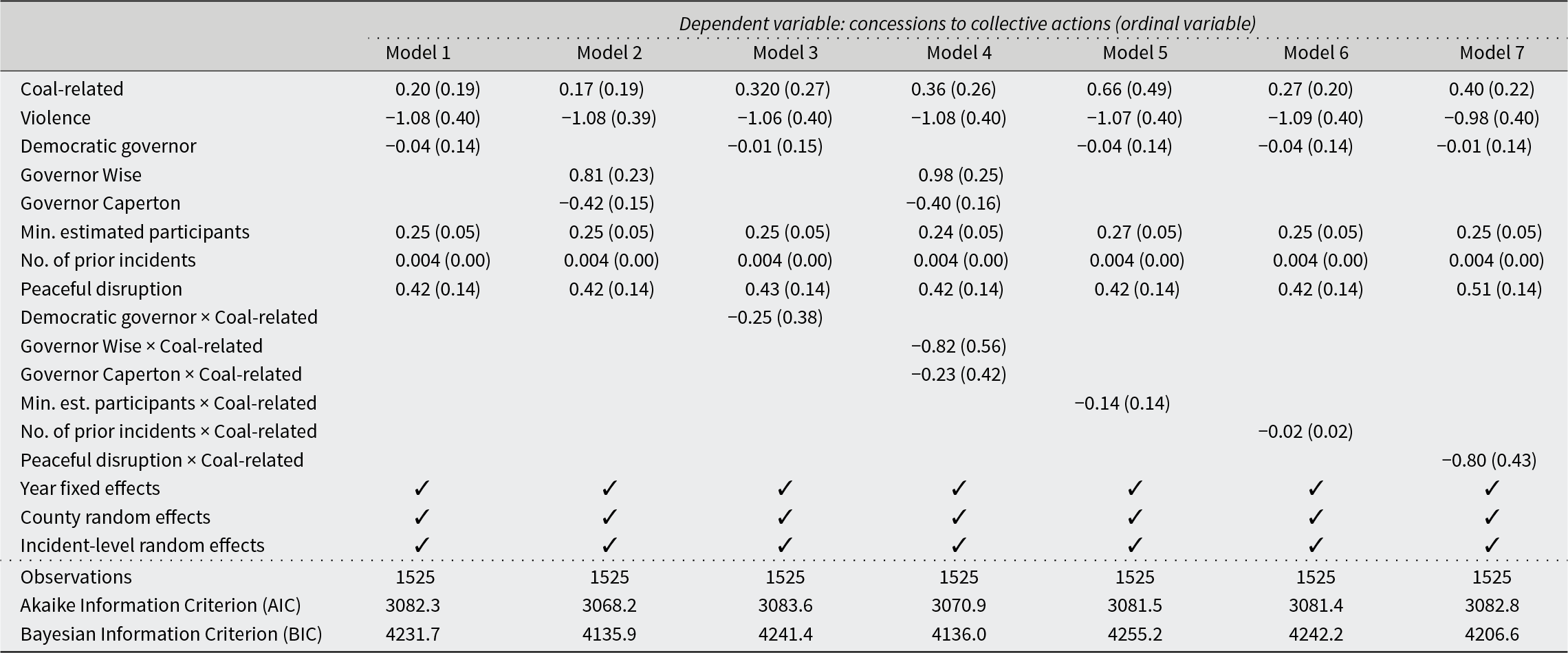
Table 2 Long description
The table examines factors influencing concessions to collective actions, focusing on coal-related issues, violence, and political leadership. Violence consistently shows a strong negative impact on concessions, while peaceful disruption and the number of participants have positive effects. Democratic governors and specific governors like Wise and Caperton have varying influences, with Wise showing a significant positive effect in models 2 and 4. Interaction terms with coal-related factors are explored in later models, indicating nuanced effects. Year, county, and incident-level effects are controlled across all models, ensuring robust analysis. The number of observations remains constant, and model fit statistics like AIC and BIC vary slightly, suggesting model complexity differences.
Notes: This table shows the correlations between various variables and concessions to collective actions. The minimum estimated number of participants in an action, the number of prior incidents before a given action and the use of peacefully disruptive tactics are all significantly positively correlated with concessions, on their own. In terms of the interaction terms between coal and various characteristics of the actions, only peaceful disruption × coal is significant (the correlation is negative). Ordered logistic regression. *p < 0.10 **p < 0.05 ***p < 0.01.
Source: Authors’ dataset.
Regarding local party politics, we find that different governors are associated with significantly more or less movement success in general (Model 2). Specifically, using the administration of our lone Republican governor, Underwood, as the reference, Caperton’s administration shows significantly less success and Wise’s administration significantly more. Such differences may, though, be a function of time: collective actions are more successful under each successive occupant of the governor’s mansion. Given this variation amongst Democrats – again, historically, intra-party variation is common in the state – the binary party variable is not significant (Model 1). In interaction terms, neither the party variable (Model 3) nor the variable for individual governors (Model 4) shows any meaningful relationship with outcomes of coal disputes, in particular, that goes beyond general correlations. We thus do not find evidence for the party competition argument. Our dataset only covers three governors, though, and we do not have information on county-level political leadership. A longer time frame and lower-level analysis might capture competition in the sense studied by Arce (Reference Arce2014) better – and reveal different results.
Our findings with regard to the argument that natural resource movements should be small-scale and persistent to succeed are interesting and run somewhat counter to the argument from existing qualitative research introduced above. In general – that is, with respect to all disputes, not just the coal-related ones in the dataset – both larger-scaled incidents and ones that are preceded by more incidents are significantly correlated with more concessions. Specifically, a move from the lowest level of participation possible to the highest level increases the odds of achieving a higher level of concession 300%, while an increase in the number of prior incidents from zero to the average for the dataset (16 incidents) increases the odds of a higher concession by a much more modest 6.6%. The interaction terms involving these factors and coal are not significant, meaning that scale and persistence do not matter for coal in a manner above and beyond their general importance. Such a null finding is in itself interesting. It fits with a possible extension of the ‘special ops’ claim made by Keeney (Reference Keeney2021): more people do not necessarily add anything to resource activism in and of themselves. However, we do not find evidence that small groups do better in coal disputes. Nor is litigation – the form that successful small actions around coal have taken in many existing studies – significantly correlated with success (litigation is one of the standard variables we carry over from the Dynamics of Collective Action project; see Table 1 in the Supplementary Material). Of course, it is possible that a regional outlet like the Charleston Gazette-Mail might miss the sort of preliminary, intimate gatherings that Bell (Reference Bell2016) sees as crucial to building the confidence of activists over the long haul.
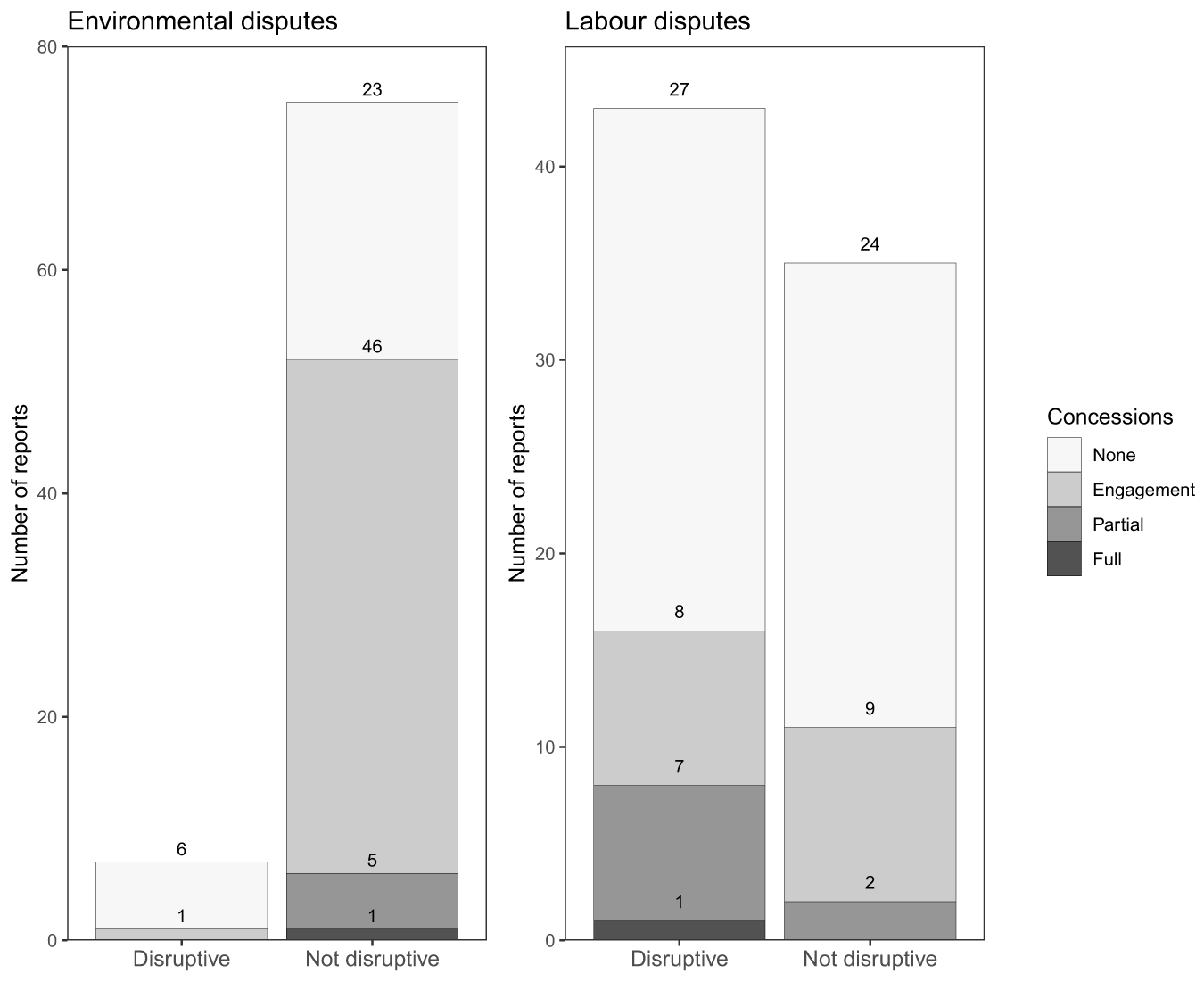
When it comes to peacefully disruptive tactics, our results again clash with an existing claim in the literature. But there is heterogeneity here with regard to the issues driving a dispute. In general, such tactics are significantly correlated with success in our dataset. All else equal, the deployment of peaceful disruption raises the chance of a higher level of concession by 51.6%. However, in directly coal-related disputes, captured by us with the interaction term involving peaceful disruption and coal, the relationship is significantly negative. Although this finding is surprising, if we dig deeper, we find that labour and environmental disputes play out very differently. If we look only at coal-related disputes (again, there are 168 of these) and drop our random and fixed effects because of the reduced sample size, we discover intriguing patterns. While labour-related incidents that involve peacefully disruptive tactics have a significant positive correlation with concessions, environment-related disputes have a significant negative correlation. In fact, there are few instances of peacefully disruptive tactics yielding even engagement with the targets of the actions in environmental coal disputes. Figure 3 illustrates this. Notably, physical violence towards other persons is significantly negatively correlated with success in most of our models, in keeping with others’ findings (Chenoweth and Stephan Reference Chenoweth and Stephan2011; Wasow Reference Wasow2020).Footnote 8
Peacefully Disruptive Tactics in Environmental versus Labour Disputes over Coal

Figure 3 Long description
A bar chart shows that peacefully disruptive tactics are associated with more concessions in labour compared to environmental disputes. The different levels of concessions are shaded. There are next to no successful instances of peacefully disruptive tactics being deployed when environmental issues are at stake.
Might these results be the product of quirks in our operationalisation of key variables? Ordered logistic regression models like the ones we estimate are based on the assumption that the effect of the independent variable in question is the same for each step up or down in the levels of the dependent variable: in our case, the effect, then, is assumed to be the same for a change from no concessions whatsoever to engagement with activists (levels 1 and 2) and from partial concessions to full concessions (levels 3 and 4). An analogue of the Brant (Reference Brant1990) test shows that this ‘proportional odds assumption’ mostly holds for our data – but not for the first level of concessions compared to other levels and not for particular variables in some of the models (such as our measure of protester violence in several instances). We therefore also estimate a series of binary logistic regression models, with the dependent variable either (a) one that treats everything from engagement to full compliance with movement demands as a ‘1’ (and everything else a ‘0’) or (b) one that only treats anything from partial compliance onwards, not mere engagement, as a ‘1’. The results point in largely the same directions: again, participation and peaceful disruption are generally associated with success (and so, too, is the number of prior incidents in a campaign, in some models); disruption is negatively correlated with success in coal disputes, in particular; but only environmental disputes show the negative correlation with disruption when environmental and labour disputes are separated. The level of significance of the results drops, though, when the stricter definition of compliance is used. Tables 2a and 2b in the Supplementary Material contain the full details.
What might our results look like if we estimated models at the campaign level instead? Recall that our dataset contains 1,525 reports, but these reports are grouped into 585 campaigns. A campaign-focused approach captures the effects of protracted activism better, but it introduces the dilemma of how to capture concessions for a whole campaign when concessions are coded at the level of individual reports. We try out two operationalisations: the concessions recorded in the last report from a campaign and the maximum concessions recorded at any point in a campaign (as some campaigns may make big strides at their outset or mid-point but only incremental progress from there on in). In both cases, we return to the four-level, ordinal measurement of the dependent variable. For our independent variables, we use dummy variables capturing whether any report in a campaign related to coal featured physical violence by participants or included the use of peacefully disruptive tactics. We also add measures of the average estimated number of participants across all reports from a campaign, whether a Democrat was in the governor’s office for the majority of a campaign or not, and the total number of incidents in a campaign. As before, our models feature interaction terms involving coal and our main independent variables. As seen in Tables 3a and 3b in the Supplementary Material, when the concessions from the last report of a campaign are used as the dependent variable, estimated participation on its own is significantly positively correlated with success, but none of the interaction terms are significant (except, interestingly, the interaction term involving Democratic control of the governor’s office, which is negative). However, when maximum concessions are the dependent variable instead, the interaction term involving coal and the estimated number of participants is negatively related to concessions (albeit at the p < 0.10 level). This fits with a much stronger version of the ‘special ops’ claim: more people are actually bad for activism when resources are involved.
The reasons for the different outcomes observed in environmental versus labour disputes involving peacefully disruptive tactics are not clear. However, we can imagine different things driving this pattern. A mining road blocked by environmentalists can be unblocked. Disruption in labour actions, such as strikes, in contrast, can bring production to a halt for an extended period. It may also be the case that a confrontational approach in environmental disputes tends to rally the local community to the side of the natural resource firm. In contrast, in labour disputes, where miners can be a sizable share of the surrounding population, there may be more fellow-feeling from the community. Or at least there may be more such feelings today – early organising against strip mining, which could be quite disruptive, but which framed the practice as violating the property rights of farmers, had broad support (Montrie Reference Montrie2003). Bell (Reference Bell2016) argues that because environmentalists are more likely than before to be non-locals, their movement is increasingly viewed as an ‘outsiders’ movement’ in Appalachia. In a similar manner, the failed National Miners' Union campaign, as described by Gaventa (Reference Gaventa1980: 109–116), ran afoul of local religious sensibilities and was an easy target of anti-communist demagoguery. Finally, the disruptive tactics of some environmentalists might overlap with ambitious demands, for example, to end mountaintop removal mining or even coal mining altogether, which leads to their actions being coded as unsuccessful – the demands simply cannot be met by targets, at least in the short term.
Our data offer some insights into these different possibilities. Looking again at only coal-related disputes, peacefully disruptive tactics in both environmental- and labour-related disputes increase the chances of repression, understood as police actions such as the dispersion of protesters or arrests, for example (see Table 4 in the Supplementary Material).Footnote 9 However, labour conflicts are correlated with fewer counter-demonstrators, while environmental conflicts are correlated with more counter-demonstrators, albeit in neither case significantly so (see Table 5 in the Supplementary Material). Yet, even when we include a control for maximal demands, such as ending mountaintop removal mining, disruptive environmental activism remains significantly negatively correlated with concessions (Table 6 in the Supplementary Material). Less easily definable cultural divides are harder to capture with the data. In the next section, we review select reports from our dataset to capture how the contrasting results for environmental activism, in particular, appear ‘on the ground’.
Illustrative reports
A few reports from our dataset illustrate what the different results achieved by different tactics in environmental disputes might mean more concretely. In 1998, 400 people rallied in Boone County against mountaintop removal mining. A speaker at the event called for a return to the type of direct action that had won black lung compensation. One local official who was present was quoted, though, as remarking, ‘The average mine employs 300 people.… You tell the 300 people who don’t have a job that it’s all in the name of saving trees and keeping a mountaintop green’.Footnote 10 A talk by the developer of a proposed new pulp mill South of Point Pleasant drew 120 protesters in 1995, who claimed the mill would poison the water. Although this incident did not involve coal, it did involve a natural resource, timber, and featured ‘heated, nose-to-nose debates’ between anti-mill protesters and a pro-mill counter protester. Police confined the environmental activists to a small portion of a parking lot and prevented them from using a portable public address system.Footnote 11 In 2001, the UMWA blocked the road to a Massey Energy Co. subsidiary after slurry from a mine owned by the (non-union) company poured into a creek near Madison. But an environmental inspector downplayed the spill, describing it as ‘miniscule’ compared to other recent pollution.Footnote 12
In contrast, smaller, less disruptive actions have won more in the environmental disputes captured by our dataset. For instance, in 1999, local citizen pushback supported by West Virginia’s Department of Environmental Protection resulted in a coal company dropping its ‘plans to build a new coal tipple along Rich Creek’, which people believed would have polluted the trout stream and brought ‘too much heavy truck traffic through their community’.Footnote 13 There were no large-scale demonstrations or forms of civil disobedience reported in connection with this concession. Similarly, in 1995, the US Office of Surface Mining offered funding to help with cleaning up the Owl Creek near Morgantown following a lawsuit against the Omega Mine.Footnote 14 A small delegation of protesters backed by both environmental groups and the UMWA gathered at the Massey Energy headquarters near Kanawha City and presented a petition in 2001, calling for several slurry impoundments to be closed and for coal dust mitigation, on the anniversary of a spill in Kentucky; although no commitments were made by the company, the petition was at least received by Massey representatives.Footnote 15 Brief anecdotal evidence like this cannot fully unpack the mechanisms underpinning our statistical results. However, it reinforces the idea that, in natural-resource-dependent areas, loud green advocacy can backfire, while quieter efforts can ‘get the goods’. Again, the same dynamic does not seem to hold for organised labour actions.
Conclusion
Organisers confronting resource interests must fight an uphill battle. In our article, we have used a new quantitative dataset from West Virginia to test in a preliminary manner three arguments from the existing, qualitative literature for why movements in such situations nonetheless succeed: that local political competition affects outcomes, that small-scale but persistent organising is necessary to win, and that peacefully disruptive tactics are especially effective. Our findings provide evidence for some of these arguments, but not others. Specifically, the results of a series of ordered logistic regressions at the level of individual reports suggest that the party in the governor’s mansion does not affect who wins in resource conflicts, though individual governors might. We also find that large-scale mobilisations have no additional benefit for coal-related conflicts above and beyond the general utility of increased participation in any conflict. Our results here roughly fit with the small-but-persistent argument. However, at the same time, small groups do not do any better than big groups and persistent groups do not do any better than one-off ones when coal is concerned. Estimating our models at the campaign level instead, though, reveals a significant negative correlation for participation. Of the three theories we test, we find the strongest evidence for the last one regarding peaceful disruption – but only for labour disputes, as environmental disputes display the opposite pattern. Reviewing a few illustrative reports from the dataset, we raise the possibility that this dynamic may result from the different economic and community contexts of these two types of collective actions today.
There are limitations to our study. The dataset only spans seven years. And, although we cover more natural resource disputes than other comparable datasets, the number of these disputes that we document is still low. As noted, we hope to extend our timeline closer to the present. More years would mean more incidents, including more coal incidents. A closer, qualitative analysis of particular campaigns – a much closer analysis than that allowed by our anecdotes above – could capture some of our variables in a more nuanced manner. Even if greater participation is no panacea, might participation that builds gradually, for instance, be more effective than a campaign that starts with a bang and then diminishes? If we looked beyond immediate concessions of the sort captured by our data – even concessions operationalised at the campaign level in the ways we attempt – and observed truly long-term results, might some movement tactics be revealed to be more impactful than they appear here? Could ‘radical flank effects’ come into play over a more extended time frame? For example, might disruptive environmental activism eventually make moderate environmentalists more palatable to their opponents or the public at large? Again, in-depth case studies would likely answer questions like these best. Attention to settings with seemingly less entrenched interests, like the mining communities of Colorado or Montana in the US context, might clarify the scope conditions for our findings. Extreme cases, as we have argued, can be especially good at revealing general dynamics, but such cases are ultimately best suited to exploratory investigations. A multi-case, comparative study could furthermore clarify the contributions of American political institutions to the outcomes we see.
Nonetheless, we have hopefully provided some direction for further analysis of resource conflict outcomes. And further analysis is critical. As noted, disputes of this sort have historically had ripple effects that go well beyond the immediate issues that sparked them. Regimes have fallen when miners have marched. Political arenas have opened when marginalised groups have made environmental claims. Moreover, although this element of the issue has not been discussed here, understanding resource disputes can help us tackle the serious challenges we face in effecting a ‘just transition’ to more renewable energy sources. There is a broad consensus that coal will have to be phased out as a source of electricity in the future, even if metallurgical coal will still be needed to make the steel for wind turbines, electric cars and the like. For any solution to climate change to be politically sustainable, it must involve local stakeholders, especially those who have made their living from fossil fuels in the past – not just ‘average’ workers and consumers (Harrison and Sundstrom Reference Harrison, Sundstrom, Harrison and Sundstrom2010). How can climate organisers engage rather than alienate these people? What tactics build broad alliances? Resource-related collective action can have enormously important consequences for the people involved – and, perhaps, for the fate of the globe. But it requires enormous care.
Supplementary material
The supplementary material for this article can be found at https://doi.org/10.1017/gov.2026.10044.
Data availability
Replication data for the article are available via the Harvard Dataverse at: https://doi.org/10.7910/DVN/MQLXKO.
Acknowledgements
The authors would like to acknowledge the research support they received from Nijiati Abulizi, Atmaza Chattopadhyay, Eric De Roulet, Jesse Ghashti, Amir Golzan, Trevor Jing Nam Li, Ryder Mason, Mashal Narsi, Abdullah Naseer Ud Din, Izak Olson, Evan Sidrow, Stefano Mezzini, Biljana Stoykova, Hoi Kee Tsang, Xuege Wang and Atlas Wu. Methodological guidance, reading recommendations and thoughtful advice on previous drafts from Brad Epperly, Allison Evans, Eli Friedman, Ian Hartshorn, Maxime Heroux-Legault, Elaine Hui, William Hurst, Trish Kahle, Jieun Kim, Kevin Lin, Yao Lu, Ralf Ruckus and Rudra Sil greatly improved the paper. The work benefited from feedback received at the annual meetings of the American Political Science Association and Association for Asian Studies, as well as at workshops at Columbia University, the University of British Columbia, the University of Nevada, Reno, and New York University, Shanghai.
Financial support
This research was supported by a Social Sciences and Humanities Research Council of Canada Insight Development Grant (Award 430-2022-00527).
Ethics statement
The research using human subjects has been approved by the Behavioral Research Ethics Board of the University of British Columbia’s Okanagan campus (H22-03233-A001).
Disclosure statement
The authors report that there are no competing interests to declare.




 Open access

