


1 Introduction
Nature provides a wealth of innovative solutions to technical challenges. Bionics offers a systematic approach to analyze, abstract, and adapt these principles for engineering applications (Lachmayer et al., Reference Lachmayer, Ehlers and Lippert2024; Nachtigall, Reference Nachtigall2002). One prominent example is the efficiency optimization of heat exchangers, essential components across various industrial applications (Deng et al., Reference Deng, Zhao and Wang2021; Reference Rong, Wang, Wu, Yin, Li and YuRong et al., 2023; Reference Stephan, Kabelac, Kind, Mewes, Schaber and WetzelStephan et al., 2019; Yu et al., Reference Stephan, Kabelac, Kind, Mewes, Schaber and Wetzel2024). Systems found in nature, such as the specialized vascular structures in seagull feet, demonstrate effective thermoregulation with minimal energy loss under extreme conditions (Zerbst, Reference Zerbst1987). Bio-inspired designs hold significant promise for creating heat exchangers that are more compact, lightweight, and resource-efficient, without compromising performance (Pieper & Klei., Reference Pieper and Klein2011; Wu et al., Reference Zhu, Li, Qi, Hu, Cheng, Cao, Zhang and Peng2023; Zhu et al., Reference Wu, Shen, Yang, Dong, Song, Zhu and Wang2023). However, the complexity of these designs often exceeds the capabilities of traditional design and manufacturing methods. Additive manufacturing (AM) provides a viable solution, enabling the production of intricate geometries and already being successfully applied in the development of high-performance, compact heat exchangers (Ehlers et al., Reference Ehlers, Meyer, Oel, Bode, Gembarski, Lachmayer, Lachmayer, Bode and Kaierle2023; Kahlfeld et al., Reference Niedermeyer, Ehlers and Lachmayer2023; Niedermeyer et al., Reference Kahlfeld, Meyer, Kabelac, Lachmayer, Lachmayer, Bode and Kaierle2023). Designing heat exchangers, however, presents significant challenges. The development of internal structures often relies heavily on expert knowledge, shaped by individual experience in simulation and thermodynamics (Lebaal et al., Reference Lebaal, SettaR, Roth and Gomes2022). Standardized approaches for identifying suitable internal structures and integrating them into heat exchangers remain limited. Furthermore, harnessing the potential of additive manufacturing to thermodynamically and structurally optimize heat exchanger development requires new strategies to address existing process limitations (Niknam et al., Reference Niknam, Mortazavi and Li2021; Scheithauer et al., Reference Scheithauer, Kordaß, Noack, Eichenauer, Hartmann, Abel, Lordick, D., Scheithauer, Noack, Eichenauer, Hartmann, Abel, Lordick and D.2018).
This work aims to tackle these challenges by developing a modular, extendable generative CAD algorithm that facilitates the integration of internal structures into heat exchanger designs. The algorithm focuses on enhancing thermal performance while ensuring manufacturability and scalability. The study begins with a review of strategies for improving heat exchanger performance. A case study then explores the design, simulation, and manufacturing of optimized internal structures for heat exchangers. Finally, the findings are synthesized into actionable recommendations and future directions for advancing heat exchanger design and development.
2 Strategies for improving heat exchanger performance
While conventional methods for improving heat transfer have made significant progress, they face manufacturing and thermodynamic limitations. AM enables the targeted design of complex, flow-optimized structures, offering new approaches to enhancing efficiency. This section provides an overview of the current state of research on existing optimization strategies, including both conventional methods and additively manufactured structures for improving heat exchanger performance.
2.1 Conventional methods for optimizing heat transfer
In a heat exchanger, heat transfer occurs through convective heat transfer from the hot fluid to the wall, thermal conduction within the wall, and subsequent heat transfer to the cold fluid (Baehr & Stephan, Reference Ning, Wang, Sun, Zheng, Zhang, Zhao, Liu and Yan2019; Ning et al., Reference Baehr and Stephan2022). The heat flow $\dot Q$
is determined by the temperature difference (
1 –
2) and the total thermal resistance R. For cylindrical walls, this relationship can be expressed as:
$\dot Q$
is determined by the temperature difference (
1 –
2) and the total thermal resistance R. For cylindrical walls, this relationship can be expressed as: $\dot Q = \;{{{\vartheta _1}\; - \;{\vartheta _2}} \over R},\;\;\;R = \;{1 \over {{\alpha _{{\rm{inner}}}}\; \cdot \;{A_{{\rm{inner}}}}}} + {\delta \over {\lambda \; \cdot \;{A_{{\rm{middle}}}}}} + {1 \over {{\alpha _{{\rm{outer}}}}\; \cdot \;{A_{{\rm{outer}}}}}}$
A lower total resistance R results in a higher heat flow, which is desirable for efficient heat transfer (Cengel & Ghaja., Reference Cengel and Ghajar2020; Fawaz et al., Reference Jouhara, Nieto, Egilegor, Zuazua, González, Yebra, Igesias, Delpech, Almahmoud, Brough, Malinauskaite, Vlasopoulos, Hill and Axcell2022; Jouhara et al., Reference Fawaz, Hua, Le Corre, Fan and Luo2023). The equation suggests the following approaches for optimization:
-
Maximizing the surface area A
-
Maximizing the heat transfer coefficient α
-
Maximizing the thermal conductivity λ through material selection
-
Minimizing the wall thickness δ
This work focuses on geometric adaptation. Bergmann et al. (Reference Bergmann, Lavine, Incropera and DeWitt2018) distinguish four conventional approaches to improving heat transfer in internal pipe flows. An increase in α can be achieved through surface roughness or pipe inserts. Such inserts allow for retrofitting existing heat exchangers but may introduce thermal resistance due to poor contact with the pipe surface (Webb, Ralph L. & Kim, Nae-Hyun, Reference Ralph, Kim and Nae-Hyun2005). Helical spring inserts generate turbulence through additional roughness, while twisted-tape inserts induce tangential flow components and enhanced mixing due to their helical geometry (Webb, Ralph L. & Kim, Nae-Hyun, Reference Ralph, Kim and Nae-Hyun2005). Another approach involves increasing the wetted surface area A. Shah and Sekulić (Reference Shah and Sekulić2003) distinguish between primary surfaces, which are directly in contact with the fluids and conduct heat, and secondary surfaces (extended surfaces), which create a larger area through additional geometries, such as longitudinal fins, but do not allow direct contact between the fluids. Extended surfaces are often used on the gas side of flow, as the heat transfer resistance is higher there (Webb, Ralph L. & Kim, Nae-Hyun, Reference Ralph, Kim and Nae-Hyun2005). While A can be increased by a factor of 10 to 100, additional thermal resistance occurs along the fins (Baehr & Stephan, Reference Baehr and Stephan2019). Combined approaches, such as spiral fins, simultaneously increase both A and α, thereby utilizing both effects (Bergmann et al., Reference Bergmann, Lavine, Incropera and DeWitt2018).
2.2 Additively manufactured structures for enhancing heat transfer efficiency
Several recent studies have explored the potential of additively manufactured structures to optimize heat transfer in heat exchangers (Dixit et al., Reference Dixit, Hajri, Paul, Nithiarasu and Kumar2022; Reference Lebaal, SettaR, Roth and GomesLebaal et al., 2022; Liang et al., Reference Liang, Shi, Li, Chen and Chyu2023; Reference Mahmoud, Tandel, Yakout, Elbestawi, Mattiello, Paradiso, Ching, Zaher and AbdelnabiMahmoud et al., 2023; Sajjad et al., Reference Mahmoud, Tandel, Yakout, Elbestawi, Mattiello, Paradiso, Ching, Zaher and Abdelnabi2022). For instance, Lebaal et al. (Reference Lebaal, SettaR, Roth and Gomes2022) numerically modeled and analyzed octahedron lattice structures. The lattice was designed using CATIA V5 and optimized by arranging unit cells. The results demonstrated a 70 % reduction in pressure drop and a 7.1 K increase in outlet temperature, significantly improving heat dissipation compared to conventional heat exchangers. Powder bed fusion of metals using a laser beam (PBF-LB/M) was proposed as a suitable additive manufacturing method; however, the component was not fabricated within the scope of this study. Mahmoud et al. (Reference Mahmoud, Tandel, Yakout, Elbestawi, Mattiello, Paradiso, Ching, Zaher and Abdelnabi2023) designed heat exchanger channels utilizing gyroid structures created with nTopology software and analyzed them through computational fluid dynamics (CFD) simulations in ANSYS Fluent. The structures were manufactured using PBF-LB/M. The results confirmed that gyroid designs can significantly enhance the thermal efficiency of heat exchangers. Dixit et al. (Reference Dixit, Hajri, Paul, Nithiarasu and Kumar2022) investigated a compact, 3D-printed heat exchanger featuring gyroid lattice structures. With a high surface-to-volume ratio (670 m2/m3) and turbulence-inducing geometry, the heat exchanger achieved a 55 % higher effectiveness while occupying only one-tenth the size of conventional heat exchangers. The gyroid structure was designed using SolidWorks™ and manufactured through stereolithography (SLA). The study highlights that additive manufacturing technologies like SLA enable the creation of lightweight, compact, and highly efficient heat exchangers that are unattainable with traditional methods.
These studies collectively underscore that heat exchangers with additively manufactured structures exhibit improved thermal performance compared to conventional designs. Optimization is primarily based on maximizing the surface area A and/or the heat transfer coefficient α. The targeted selection of specific structural geometries has not yet been systematically investigated but is mostly compared to conventional designs. Additionally, there is a lack of comprehensive consideration that accounts not only for manufacturability but also for compatibility with standardized simulation programs.
3 Case study: optimizing heat exchangers through internal structures
This case study follows a systematic approach: Based on a literature review, a design catalog is created, from which a preliminary selection of suitable variants of internal structures is made. These structures are designed using algorithm-aided design to ensure both simulation and manufacturing feasibility. Subsequently, flow simulations are conducted to evaluate and further refine the selection of structures, which are then fabricated in the final step. Finally, specific recommendations for action are derived.
3.1 Preliminary selection of internal structures based on a design catalog
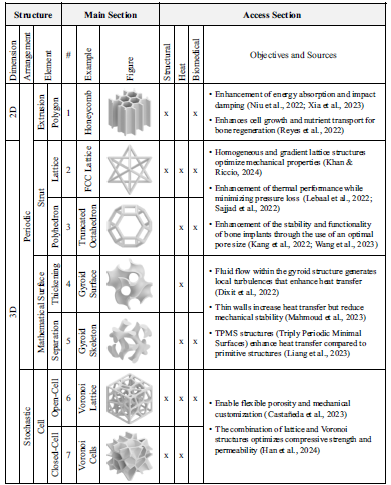
Additive manufacturing enables the production of internal structures, which can significantly enhance heat transfer efficiency (Wahl et al., Reference Wahl, Niedermeyer, Bernhard, Hermsdorf and Kaierle2022). This section presents the preliminary selection of internal structures based on a literature-based design catalog, developed following the methodology based on (Roth, Karlheinz, Reference Roth and Karlheinz2001) and visualized in Figure 1. The catalog classifies structures based on their dimension (2D or 3D), arrangement (Periodic or Stochastic), and element type (Extrusion (Niu et al., Reference Niu, Xu, Zou, Fang, Zhang and Xie2022; Reyes et al., Reference Xia, Huang, Chang, Zhang, Liao and Cai2022; Xia et al., Reference Reyes, Ghim, Kang, Park, Gwak and Cho2023), Strut (Kang et al., Reference Kang, Sakthiabirami, Jang, Jang, Oh, Park, Fisher and Park2022; Reference Khan and RiccioKhan & Riccio, 2024; Lebaal et al., Reference Lebaal, SettaR, Roth and Gomes2022; Reference Mahmoud, Tandel, Yakout, Elbestawi, Mattiello, Paradiso, Ching, Zaher and AbdelnabiSajjad et al., 2022; Wang et al., Reference Sajjad, Rehman, Ali, Park and Yan2023), Mathematical Surface (including Triply Periodic Minimal Surfaces (TPMS)) (Dixit et al., Reference Dixit, Hajri, Paul, Nithiarasu and Kumar2022; Liang et al., Reference Mahmoud, Tandel, Yakout, Elbestawi, Mattiello, Paradiso, Ching, Zaher and Abdelnabi2023; Mahmoud et al., Reference Liang, Shi, Li, Chen and Chyu2023) or Cell (Castañeda et al., Reference Han, Wang, Wang, Dong, Li, Song, Cai, Yan, Yang and Wang2023; Han et al., Reference Acosta, Garzón-Alvarado, Márquez-Flórez, Quexada-Rodriguez and Velasco2024)). Examples of each structure group are illustrated in the main section, while the access section highlights key objectives and potential applications. The structures are categorized into three primary application areas: structural components, heat transfer, and biomedical engineering. As shown in the catalog, a wide range of structural variations has been applied for heat transfer. From these, three particularly promising structures were selected: “Lattice” and “Polyhedron” from periodic strut structures, as well as “Thickening” from periodic mathematical surface structures.
Design catalog for internal structures with classification and application objectives

3.2 Design of internal structures for simulation and manufacturing suitability
While PBF-LB/M enables the production of entirely novel and innovative structures, the tools available in conventional CAD environments are primarily designed for traditional manufacturing methods (Niedermeyer et al., Reference Niedermeyer, Schlenker, Huuk, Ehlers, Denkena and Lachmayer2024). These tools often reach their limits when creating intricate internal structures, failing to fully exploit the potential of additive manufacturing via PBF-LB/M. Algorithms-Aided Design offers a compelling alternative approach (Müller et al., Reference Müller, Synek, Stauß, Steinnagel, Ehlers, Gembarski, Pahr and Lachmayer2024; Steinnagel et al., Reference Steinnagel, Bastimar, Gembarski, Plappert, Müller, Lachmayer, Lachmayer, Bode and Kaierle2023; Yao et al., Reference Zhang, Liu, Qin, Dou, Meng, Xu and Lv2024; Zhang et al., Reference Yao, Pan, Mu and Wei2022).
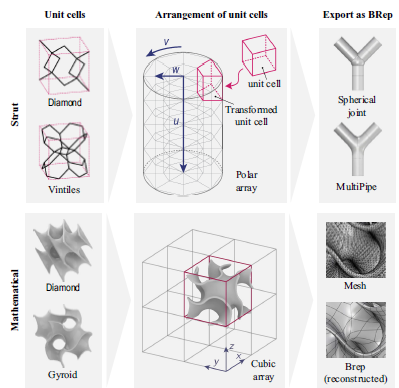
In this study, Rhino® 7, with its integrated Grasshopper® visual programming environment, was employed. This tool enables the creation of algorithms specifically tailored to the automated generation of various internal structures. Additionally, its extensive library of third-party plugins enhances functionality to meet specific application requirements. While many existing algorithms and workflows are limited to generating structures as meshes only, this study focuses on creating a closed Boundary Representation (BRep) solid model. This model serves as the foundation for exporting to the universal STEP exchange format, allowing for further processing in external software. Crucially, it ensures compatibility with conventional CFD software and facilitates seamless integration into the specific CFD workflow selected later in this study. To generate the chosen structures, two distinct workflows, illustrated in Figure 2, were employed. These workflows are tailored to address different structure types: mathematically derived surfaces and strut-based designs (Data available at: https://doi.org/10.25835/8eitlrmr).
Mathematical and strut-based workflow for generating BRep structures

Strut-based “Lattice” and “Polyhedron” structures are initially created as single unit cells composed of lines using the IntraLattice plugin. These unit cells are then arranged in either a rectangular or polar array to conform to the outer pipe geometry. Since the resulting skeleton is not a solid body, the lines must be thickened, which is achieved through two different approaches. The first approach involves thickening the lines with cylindrical elements that are joined by placing spheres at their intersections and using Boolean operations. The second approach employs the “MultiPipe” component built into Grasshopper® to automatically generate a smooth, continuous subdivision body with integrated joints, which can be seamlessly converted into a BRep body. In contrast, the periodic mathematical structures are created by inputting the corresponding mathematical function into the plugin Axolotl, which first generates a volumetric voxel representation. This volume is then converted into a mesh and uniformly thickened to form a sheet. Since BRep bodies are essential for the later employed workflow, the resulting meshes undergo a reconstruction process. This involves quadratic remeshing, subdivision, and final conversion into a BRep format.
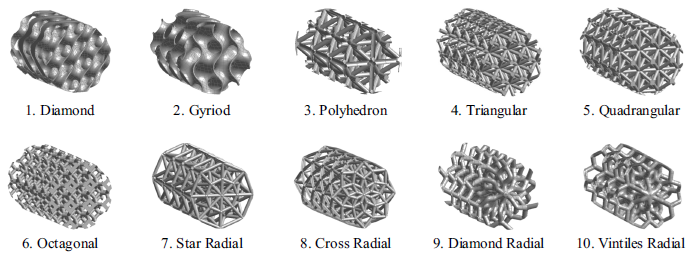
For this study, a total of ten structures in various configurations were generated to cover a wide range of design variations. As illustrated in Figure 3, the structures include mathematical surfaces (1–2), struts in a rectangular array with spherical joints (3–6), struts in a polar array with spherical joints (7–8), and struts in a polar array with MultiPipe joints (9–10). All BRep bodies were subsequently combined into a unified geometry for simulation purposes using Boolean operations, with the final assembly enclosed within a pipe body, completing the design. Depending on the structure, the computation time for each script ranges from 2 to 6 minutes, with the majority of the time spent on either the boolean union of individual struts or the quadratic remeshing process and conversion to BRep, respectively.
Design of various internal structures for CFD simulation

3.3 Detailed selection of internal structures based on simulation
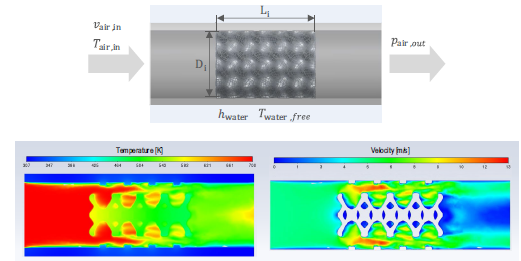
In this section, a fine selection of the ten structures presented in the previous chapter is made based on CFD simulations in ANSYS Fluent®. The boundary conditions of the simulation are defined as cooling of hot air with an inlet velocity v air,in of 5 m/s and an inlet temperature T air,in of 700 K, with an outlet pressure p air,out of 101325 Pa. The heat transfer on the outside of the pipe is modeled as a convective heat transfer coefficient h water of 1200 W/m2K at a free flow temperature T water,free of 300 K. This corresponds, for example, to a tube in a tube bundle with water flowing around it. To validate the results, a mesh independence analysis was carried out on one of the structures, varying the number of cells (i.e., the mesh resolution) between approximately 3·106 and 9·106 elements. A suitable number of elements was found to be 5.5·106. Further mesh refinement did not result in any change in the transferred heat flux. The settings of this mesh were used for all simulations. The geometry of the simulated tube and resulting temperature and velocity distributions can be seen in Figure 4.
Geometry (Ø25 × 80 mm with Di = 20 mm und Li = 30 mm), boundary conditions and exemplary results of diamond radial structure

To evaluate the performance of the structures, the ratio between the resulting heat flow and pressure loss is analyzed using the R-factor (Reference Yilmaz, Comakli, Yapici and SaraYilmaz et al., 2005). This factor represents the ratio of the transferred heat flow $\dot Q$
and the pump power P
pump required to compensate for the pressure loss. A higher R-factor indicates a more efficient heat exchanger.
$\dot Q$
and the pump power P
pump required to compensate for the pressure loss. A higher R-factor indicates a more efficient heat exchanger. ${\rm{R}}-{\rm{factor\;}} = {\rm{\;}}{{\dot Q} \over {{P_{{\rm{pump}}}}}}$
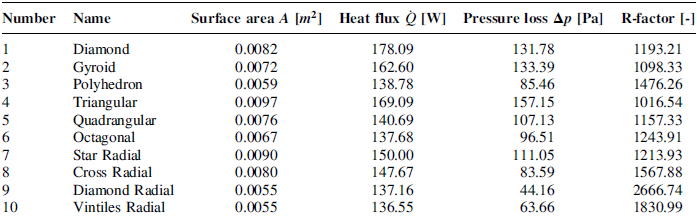
Table 1 presents the heat flows transferred within the structured area of the pipe, the pressure losses, and the resulting R-factor for various structures.
Surface area, heat flux, pressure drop and R-factor of the simulated structures

The heat transfer and, in particularly, the pressure loss of the structures differ significantly. The “Diamond” structure (1) achieves the highest heat transfer. In contrast, the centrally oriented “Diamond Radial” structure (9) exhibits the lowest pressure loss. The transferred heat flux of this structure is 23 % lower than the “Diamond” structure, while the pressure loss is 66.5 % lower. Based on these results, the “Diamond Radial” structure can be selected as the optimal choice, as it achieves the highest R-factor and thus offers the greatest potential to enhance the performance of heat exchangers.
3.4 Demonstration of manufacturability: Integration of internal structures into heat exchangers
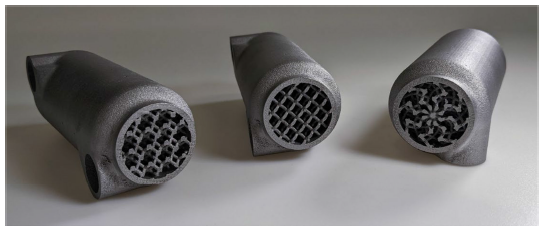
This section demonstrates the successful manufacturability and integration of internal structures into heat exchangers through practical implementation. For the exemplary demonstration, generated structures were integrated into a double-pipe heat exchanger functioning as a gas cooler using the CAD software SolidWorks®. The heat exchanger enables the cooling of a hot gas stream (inner pipe), while cooling water flows through the outer helical jacket and absorbs the heat through the inner pipe wall. The entire heat exchanger (dimensions: Ø46 × 120 mm) is manufacturable using the PBF-LB/M process without the need for additional support structures inside the component. For the fabrication, three exemplary heat exchangers with differently oriented diamond-shaped internal structures were produced from the material 1.2709 maraging steel using an EOS M280 system (laser power: 200 W, scan speed: 1200 mm/s). Figure 5 illustrates the successful fabrication of the design.
Additively manufactured heat exchangers with different diamond structures

3.5 Derivation of measures and recommendations for action
Algorithms-Aided Design has proven to be a highly promising tool for developing customized workflows for additively manufactured heat exchangers. The methods and workflows employed in this study, including third-party plugins, performed effectively in generating and processing complex geometries. However, the long-term applicability of such approaches depends heavily on the maintenance and support of these third-party tools, introducing a level of risk to future projects. Exporting structures as BRep solids worked well for simulation purposes and manufacturing, but significant challenges were encountered with large data volumes and high computational times in Grasshopper® and Rhino®, particularly during surface reconstruction. It remains unclear whether the current workflow is scalable to larger full-scale heat exchangers or if there is a practical upper limit to the complexity that can be handled efficiently. The same applies to the analysis with CFD simulations, which become increasingly computationally intensive when applied to complex, complete heat exchanger designs. Despite these limitations, the Grasshopper® workflow and associated scripts offer significant potential for future development and customization. For example, the generated structures can be further enhanced by introducing gradation in structure size or by integrating manufacturability considerations into the design process. Such enhancements could include warnings for excessive overhangs, predictions of expected surface roughness, or automated adjustments to improve printability.
4 Summary and outlook
This study focuses on the optimization of heat exchangers through the integration of internal structures enabled by additive manufacturing. A case study demonstrates the successful manufacturing and integration of these structures to enhance thermodynamic efficiency and structural flexibility. Additive manufacturing facilitates the creation of designs with enlarged surface areas for high heat transfer rates, as well as compact and adaptable constructions tailored to various gas and water flow rates. The findings underscore the potential of combining simulation-driven design and additive manufacturing to advance heat exchanger development.
The next step is to experimentally analyze the additively manufactured heat exchangers by measuring their heat transfer and pressure loss characteristics, comparing them with simulated values, and subsequently evaluating the results. This allows for the identification of specific optimization potentials for future designs. Additionally, material variation – such as the use of multi-material components – holds significant potential for making future structures even more efficient and application-specific (Meyer et al., Reference Meyer, Oel, Ehlers and Lachmayer2023; Meyer, Glitt, et al., Reference Meyer, Glitt and Ehlers2025; Meyer, Messmann, et al., Reference Oel, Rossmann, Bode, Meyer, Ehlers, Hackl and Lachmayer2025; Oel et al., Reference Meyer, Messmann, Ehlers and Lachmayer2023). Another promising avenue for research is the use of these structures in hydrogen applications. Topology-optimized and mathematically-defined geometries significantly increase internal surface areas, making them ideal for hydrogen metal hydride storage and gas diffusion layers in polymer electrolyte membrane (PEM) fuel cells (Niblett et al., Reference Röver, Roth, Hoffmann, Baetcke and Herzog2022; Röver et al., Reference Niblett, Guo, Holmes, Niasar and Prosser2023). Additively manufactured lattice structures offer superior performance due to their higher surface area and interconnectivity, enhancing hydrogen production and storage (Lei et al., Reference Lei, Li, Wang, Xu, Zhou, Yu and Zheng2019; Mesecke et al., Reference Ndoye, Ouedraogo, Demisse, Grizzle, Mutunga and Tyagi2025; Ndoye et al., Reference Mesecke, Meyer, Oel and Lachmayer2021). Finally, comparing additively manufactured lattice structures with conventional designs in terms of their thermal and mechanical properties remains a valuable approach. The presented methods thus offer substantial potential to further optimize existing design and manufacturing processes while setting new standards in the design of internal structures for heat exchangers.
Acknowledgement
The project “Additive Fertigung multimaterieller Komponenten zur nachhaltigen Energiewandlung” was funded by the European Regional Development Fund (ERDF) and the state of Lower Saxony – Project number ZW 7 - 87011865.

 Open access

