


After Obama’s Presidency, political scientist Michael Tesler (Reference Tesler2020) asked whether America had entered its post-racial or its most-racial age. The election of Donald Trump in 2016 and the resurgence of White Nationalism, exemplified by the Unite the Right Rally in 2017, which echoed White anxiety over changing demographics and “replacement,” seemed to suggest that America had entered its most-racial stage. Yet, by the summer of 2020, the pendulum appeared to have swung the other way. Protests in the aftermath of George Floyd’s murder by police were marked by calls for a national racial reckoning, in what one commentator called, “The Great Awokening” (Yglesias Reference Yglesias2019). Many people across the nation protested racial injustice, including “unusual allies” like the Republican senator Mitt Romney, and members of the police force (Boudreau et al. Reference Boudreau, MacKenzie and Simmons2022, p. 497).
Correspondingly, polls showed large shifts in public opinion regarding racial attitudes. Progressive racial attitudes were especially pronounced among White Democrats. For example, in June of 2020, a Pew survey found that 92% of White Democrats said they supported the Black Lives Matter movement, compared to only 86% of African Americans (Parker et al. Reference Parker, Horowitz and Anderson2020). Similar trends were found in the General Social Survey (Yglesias Reference Yglesias2019), as well as data from Civiqs and University of California, Los Angeles/Nationscape (Cohn and Quealy Reference Cohn and Quealy2020). Using survey and experimental data, we examine the extent of White Democrats’ commitment to racial egalitarianism in 2020 by comparing younger and older generations of White Democrats to younger and older White Republicans.
We expect younger Democrats to register as uniquely progressive on race. The reason for this expectation is twofold. First, Millennials, regardless of party, have been shown to be uniquely liberal on many social issues (Rouse and Ross Reference Rouse and Ross2018; Teixeira Reference Teixeira2010) including race (Nteta and Greenlee Reference Nteta and Greenlee2013). Second, this racial liberalism of the Millennial generation should be especially pronounced among Democrats. Parties send strong messages to their constituents about where they stand (Dyck and Pearson-Merkowitz Reference Dyck and Pearson-Merkowitz2023; Zaller Reference Zaller1992), including race, causing partisans to adjust their own beliefs accordingly (Engelhardt Reference Engelhardt2020). Because the Democratic Party is more closely associated with racial justice than the Republican Party, younger White Democrats should be more committed to racial progressivism in 2020 than older generations of Democrats and both younger and older Republicans.
We use longitudinal data and experiments to test the expectation that White Millennial and Generation Z Democrats exhibit the most progressive attitudes on race in 2020. Next, we probe whether these younger generations of White Democrats are as committed to policy as they are to the rhetoric of racial justice. As Schildkraut (Reference Schildkraut2019) notes, it is important to “distinguish between whites who appear “woke” but do not act on their “wokeness” from whites for whom an awareness of privilege motivates them toward an anti-racist agenda” (p. 421).
Using American National Election Studies (ANES) data and the racial resentment scale we find that Democrats who are members of Generation Z, but not the Millennial generation, hold more liberal attitudes on race than older generations of Democrats and Republicans of any generation. Moreover, we find that all generations of White Democrats are less racially resentful in 2020 than comparable younger generations of Democrats in 1986. Since racial resentment is merely one indicator of racial attitudes, we employ additional measures to probe the extent of racial progressivism. We use four framing experiments to explore the commitment of White Millennial and Generation Z Democrats to both the rhetoric and policy of racial equality. Our experiments show that White Generation Z and Millennial Democrats sometimes strongly endorse progressive racial rhetoric, but not always. Contrary to our expectations, older generations of Democrats often respond similarly to their younger counterparts. This suggests that while generational cohort sometimes plays a role, partisanship also shapes racial attitudes. More importantly, it shows that younger generations of White Democrats are not always uniquely progressive on race. In addition, when we test whether younger White Democrats’ support for racially progressive rhetoric corresponds to an equally strong endorsement of racially progressive policy, our data suggest that younger generations of White Democrats are somewhat indifferent to changing the racial status quo.
In sum, our findings are mixed. On the one hand, we uncover evidence for a generational effect. On the other hand, we find that party affiliation also matters. Democrats are overall more progressive on race than Republicans regardless of generation. Importantly, our study shows that racial progressivism among Whites has limits. Even younger generations of Democrats, who are often the most racially progressive, fail to endorse policy designed to redress racial inequality.
Racial Ideology: The Role of Generational Change and Partisan Cues
Scholars have credited the civil rights era with reducing old-fashioned, or biological, racism among Americans (Nteta and Greenlee Reference Nteta and Greenlee2013). The civil rights period also paved the way for the era of color-blindness, the prevailing racial ideology in contemporary America. Color-blind racial ideology is characterized by the belief that race is no longer a determining factor in society. However, as Bonilla-Silva (Reference Bonilla-Silva2018) points out, color-blindness is merely a framework that serves “to explain and justify […] the racial status quo (p. 9).” In other words, color-blind ideology—and the non-racial language it employs—allows contemporary racial inequality to remain unchallenged. Similarly, Knowles et al. (Reference Knowles, Lowery, Chow and Unzueta2014) argue that because color-blind ideology permits White Americans to ignore the role of race in society, they can also deny the privilege it confers.
Parallel to the language of color-blindness, however, Americans dabble in the ideology of multiculturalism. Multiculturalism recognizes and values racial and ethnic difference (Knowles et al. Reference Knowles, Lowery, Chow and Unzueta2014). Moreover, recent scholarship has documented that a significant number of White Americans are sympathetic to the hardships many Black Americans face, exhibiting what Chudy (Reference Chudy2024) calls “racial sympathy.” Moreover, large segments of Americans now express increased awareness of their race and sometimes their privilege (Schildkraut Reference Schildkraut2019). This self-reflective trend accelerated in response to the Black Lives Matter movement and George Floyd’s murder in 2020. Many Americans protested racism in 2020, including some Republican political figures and members of the police (Boudreau et al. Reference Boudreau, MacKenzie and Simmons2022), contributing to large shifts in racial attitudes.
In this paper, we examine whether younger Americans are more progressive on race than their older counterparts in 2020. Our expectation is rooted in research suggesting that Millennials are uniquely liberal on many social issues including race. Rouse and Ross (Reference Rouse and Ross2018) theorize that Millennials are more progressive because they are more racially diverse than preceding cohorts. Moreover, studies suggest that Millennials view themselves as post-racial (Feldman, Reference Feldmann2014) and Nteta and Greenlee (Reference Nteta and Greenlee2013) found that White Americans who reached adulthood when Obama won the presidency are less racially resentful than older White Americans. Thus, we predict that the widespread condemnation of structural racism, and both historical and contemporary White advantage, should have resonated most strongly with younger Americans in 2020.
However, we are cautious in our optimism. Some research suggests that younger generations today are not more racially progressive than older generations (Cohen Reference Cohen2011; DeSante and Smith Reference DeSante and Smith2019, Reference DeSante and Watts Smith2020; Schildkraut and Marotta Reference Schildkraut and Marotta2018). And although this scholarship is based on data collected before 2020 and America’s “Great Awokening” (Yglesias Reference Yglesias2019), these studies temper our expectation about generational change. Moreover, we are cautious because scholars have pointed out that progressive racial attitudes do not always correspond to calls for structural change, or policies designed to undo inequality (Hutchings Reference Hutchings2009). For example, recognition of White privilege has not contributed to greater anti-racism (Christiani and Britt Reference Christiani and Britt2024). Moreover, greater understanding of structural racism does not readily translate into support for policies designed to address it. For example, Chudy (Reference Chudy2024) shows that people favor individual (rather than structural) solutions to address the causes of systemic Black disadvantage.
This inconsistency in racial attitudes is reminiscent of the well-documented principle-policy gap in White public opinion. While Gunnar Myrdal and others did not use the term “principle-policy gap,” the idea has been central to the study of race relations in the US. The term refers to the discrepancy between the principles or values people profess to hold and the policies they favor. In other words, the principle-policy gap refers to the contradiction between White people’s stated commitment to equality and their simultaneous unwillingness to support policies to achieve just that. Scholars have repeatedly documented the principle-policy gap, most recently among Millennials (Smith and Mayorga-Gallo Reference Smith and Mayorga-Gallo2017), suggesting that true progress is lacking.
Nevertheless, even if broad generational change in Americans’ racial attitudes is dubious, there is some evidence that racial attitudes have been changing in a meaningful way among Democrats (Jardina and Ollerenshaw Reference Jardina and Ollerenshaw2022). This points to the possibility of generational change in racial attitudes among younger White Democrats, which we explore in this paper. While much research points to generation as an important covariant of racial ideology, partisanship also matters. The parties have aligned themselves with different racial politics at least since the passage of the Civil Rights Act (Carmines and Stimson Reference Carmines and Stimson1980) and elite cues on where the parties stand on race are readily available to the public (Dyck and Pearson-Merkowitz Reference Dyck and Pearson-Merkowitz2023; Engelhardt Reference Engelhardt2020).
Before the Great Depression, the Grand Old Party; The Republican Party was the party of progress and freedom for Black Americans (Philpot Reference Philpot2009). However, as the Civil Rights Movement gained momentum and the Democratic Party became the face of civil rights legislation, many White Southern voters began to shift their support to the Republican Party, which took a more conservative stance on racial issues. This racial realignment accelerated in the decades following the Civil Rights Movement and crescendoed in the election of Donald Trump in 2016, whose explicit racial remarks constituted a break from political norms (Hopkins and Washington Reference Hopkins and Washington2020).
Scholars contend that racial realignment is in part responsible for the subsequent partisan sorting, whereby Americans brought their partisan identity in line with their political ideology (Levendusky Reference Levendusky2009). Thus, partisan identity and ideology, including racial ideology, are closely connected today. White voters who are racially conservative are more likely to identify as Republicans, while non-White voters and racially liberal voters are more likely to identify as Democrats. Importantly, Engelhardt (Reference Engelhardt2020) suggests that since 2000 partisans have overwhelmingly brought their racial attitudes in line with their party’s stance on race. According to this theory, people stopped sorting themselves into the parties based on their racial attitudes toward the end of the 20th Century. Instead, people began to take on their party’s racial ideology (Engelhardt Reference Engelhardt2020). This may explain why Jardina and Ollerenshaw (Reference Jardina and Ollerenshaw2022) find that Democrats have become more progressive on race over time and are more supportive of policies designed to create greater equality.
Partisan Racial Cues
It is easy for partisans to learn about their party’s racial ideology. Partisan differences in racial ideology are accompanied by significant differences in how partisans talk about race, racial inequality, and racism. Engelhardt (Reference Engelhardt2019) shows that liberal and conservative partisans offer starkly divergent accounts explaining the causes of racial inequality. For example, liberal rhetoric emphasizes the exclusion of Black Americans from many of the economic policies enacted after World War II that allowed White Americans to build wealth, to explain the racial wealth gap.Footnote 1 Conservative racial rhetoric, by contrast, often attributes racial inequality to perceived deficiencies in the Black community, such as a lack of “success oriented values” and the prevalence of violence and substance abuse.Footnote 2 Overall, Engelhardt (Reference Engelhardt2019) shows that liberal partisan rhetoric emphasizes structural racism whereas conservative elite rhetoric emphasizes individualism, rejecting the notion that race plays a role in shaping a person’s life and echoing color-blind ideology. These divergent elite partisan conversations are part of the mechanism through which liberal Democrats and conservative Republicans learn about race and form opinions. Thus, racial liberalism should manifest in such a way that Democrats—especially younger cohorts of Democrats—agree significantly more with progressive rhetoric about race (e.g., rhetoric that emphasizes structural racism) than Republicans, regardless of age.
Hypotheses
The literature reviewed above suggests that younger Americans and Democrats ought to be more progressive on race than older and Republican Americans. We first examine the prediction that younger contemporary generations of Americans (Generation Z and Millennials) are more racially liberal both cross-sectionally and when compared to similar age cohorts at earlier points in time (H 1a ). Next, we test whether younger generations of White Democrats (Generation Z and Millennials) are less racially resentful in the ANES when compared to older generations of Democrats and both younger and older Republicans (H 1b ). Then, we expect to observe the greatest agreement with progressive racial rhetoric among younger generations of Democrats (Generation Z and Millennials), across multiple framing experiments, when compared to their older counterparts (e.g., Generation X and Baby Boomers) (H 2 ). Lastly, because the scholarship presented in this article suggests that White Americans’ racial attitudes are often contradictory, we examine whether younger generations of Democrats are consistent. If they are the group most in support of progressive racial rhetoric, they should also be in favor of racially progressive policy–especially when such a policy is presented in a rhetorically progressive frame (H 3 ).
Study 1—ANES DATA OVER TIME
We start by constructing Kinder and Sanders’ (Reference Kinder and Sanders1996) symbolic racism scale available in the ANES Cumulative Data File to assess contemporary racial attitudes (also known as the racial resentment scale). At the time the symbolic racism scale was developed, outright racism was no longer an acceptable expression of racial ideology. However, people felt comfortable expressing negative attitudes towards Black Americans by disapproving of African Americans’ presumed violation of core American values and the Protestant work ethic. The centrality of the American creed served as an ideological shield that insulated White respondents from charges of racism.
While this scale is widely used, it has also been critiqued. Importantly, DeSante and Smith (Reference DeSante and Watts Smith2020) argue that the racial resentment scale no longer adequately captures the racial attitudes of younger generations because the language focusing on the American creed was normed on the Boomer generation and thus may fail to capture contemporary racial attitudes. Other research, however, suggests that Kinder and Sanders’ scale does measure racial attitudes reliably among both younger and older Americans. According to Engelhardt (Reference Engelhardt2021), the scale has measurement equivalence, capturing the same construct across different generations. Thus, rather than producing artificial impressions of progress, decreases in racial resentment using Kinder and Sanders’ scale are real, and not the result of social desirability, underreporting, or some other bias (Engelhardt Reference Engelhardt2021). We use the symbolic racism measure as an initial test of our hypotheses.
The symbolic racism scale is commonly comprised of four items that ask respondents to express their level of (dis)agreement with the following statements.
-
(1) *Generations of slavery and discrimination have created conditions that make it difficult for Blacks to work their way out of the lower class.
-
(2) *Over the past few years, Blacks have gotten less than they deserve.
-
(3) It’s really a matter of some people not trying hard enough; if Blacks would only try harder they could be just as well off as whites.
-
(4) Irish, Italian, Jewish, and many other minorities overcame prejudice and worked their way up. Blacks should do the same without any special favors.
-
(*reverse coded)
All items range from 1 to 5 and are coded so that the higher scores correspond to greater racial resentment. All four questions were available biennially from 1986 to 1994, and in 1998, 2000, 2004, 2012, 2016, and 2020. In total, there are 25,009 respondents with valid answers to all 4 questions. The average inter-item correlation of the four items is .525 and the items scale together with a standardized Cronbach’s alpha of .816. To create the measure, we scale the variables using a principal components analysis and return the loadings from the first component, which has an eigenvalue of 2.58. The dependent variable is then a scale with a 6-point range (from -3.277 to 2.630) with a mean of 0 and a standard deviation of 1.607. Positive scores indicate more conservative racial ideology, and negative scores represent more liberal racial ideology.
To capture the effect of generation, we group the data into age cohorts that match the Pew Research Center’s definitions for generations (Dimock Reference Dimock2019) in 2020, thus coding Generation Z (18–23 year-olds), Millennials (24–39-year-olds), Generation X (40–54 year-olds), Baby Boomers (55–74 year-olds), and Silent Generation (75 years old and up), respectively. This allows us to compare racial attitudes between these contemporary generations.
Next, we use the same age cutoffs to create comparison groups in an earlier time in US history when racial resentment was first measured. While these age groups are not meaningful for other years in the data, this provides a clean test of whether the younger generations in 2020 (Generation Z and Millennials) are distinct when compared to their age counterparts in earlier decades in the ANES data. In other words, we do this to account for the possibility that younger generations are simply always more progressive on race.
Study 1—Results
To test our hypothesis that younger contemporary generations of Americans (Generation Z and Millennials) are more racially liberal both cross-sectionally and when compared to similar age cohorts at earlier points in time, we model racial resentment as a function of the interaction of age groupings matching generations in 2020 and time, with controls for gender, education, party identification (7-point), and ideology (5-point), while also isolating party effects by restricting separate models of only Democrats and only Republicans.Footnote 3 The results of the regression analyses are available in Appendix Table A1. To make the data easier to interpret, we present graphical depictions of the effects in the main text.
Figure 1 depicts the effect of age on racial resentment comparing age cohorts (consistent with 2020 generations) in 1986 and 2020 for all White respondents in the ANES data. The analysis here suggests higher levels of racial liberalism among contemporary youth cohorts than older youth cohorts, especially when comparing members of Generation Z (18–23 year-olds) to all others. This suggests a distinct generational effect in 2020, as 18–23-year-olds in 1986 are not distinct from the other age groupings.
Predicted values of racial resentment by age and study year, 1986–2020 ANES.

To be sure, most of the effect shown in Figure 1 is being driven by young Generation Z Democrats. In Models 2 and 3 in Appendix A1, we explicitly test for party differences (H 1b ). The substantive effects are depicted in Figure 2. As we expected, when the data are separated by party identification, a more nuanced picture emerges. For White Republicans, we see very little evidence of increased racial liberalism over time (indeed, most generations are more racially conservative in 2020 than their 1986 counterparts). In addition, we do not observe any meaningful difference between Generation Z White Republicans and other 2020 generations, nor between Generation Z White Republicans and their comparison group (18–23 year-olds) in 1986.
Predicted values of racial resentment by age, study year, and party ID 1986–2020 ANES.
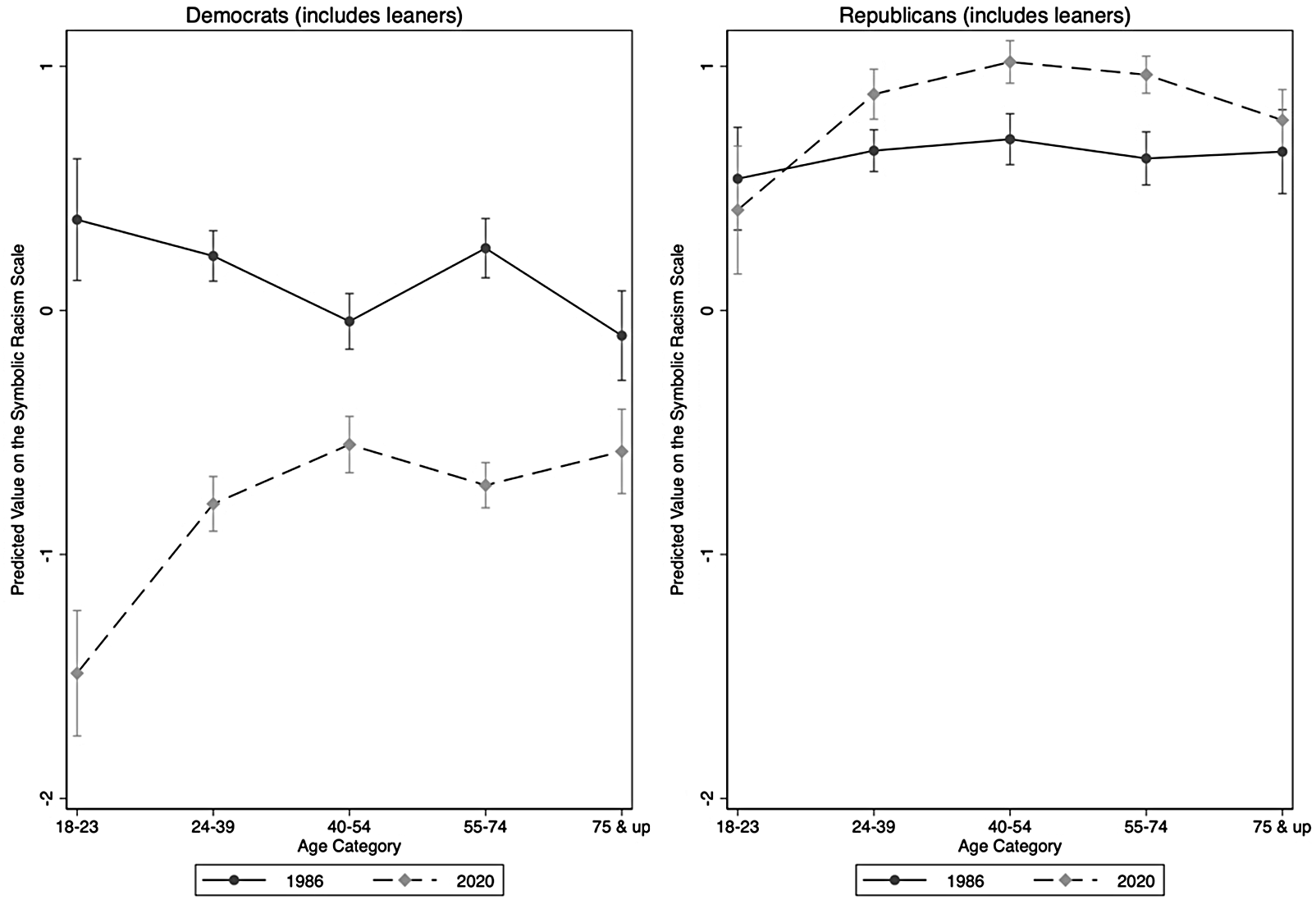
Turning to Democrats, several interesting findings emerge. First, at every age grouping, 2020 generational cohorts are more racially liberal than similarly grouped respondents in 1986. Moreover, consistent with our expectations, there is evidence of a substantively large and statistically significantly larger shift in racially progressive attitudes that distinguishes Gen Z White Democrats in 2020 (those aged 18–23) from all other generations. Somewhat surprisingly, Millennials are more similar in their racial attitudes to members of Gen X and Baby Boomers than they are to those from Gen Z.
The evidence, overall, then, points to changes in the way that White respondents are reacting to racial resentment questions, and the effects are strongest among Democrats, and strongest among the most recent generation, Generation Z—but not Millennials. Next, we deploy four framing experiments to further probe the commitment of young (Gen Z and Millennial) and old (Gen X, Boomer, and up) Democrats and Republicans to racial equality.
Study 2—FRAMING EXPERIMENTS
We examine racial attitudes further because the literature reviewed earlier in this article suggests that we should be cautious about the finding that younger Americans are more progressive on race. Importantly, scholars have demonstrated that even those who are racially sympathetic or acknowledge their privilege often do not endorse structural remedies for racial inequality (see Christiani and Britt Reference Christiani and Britt2024; Chudy Reference Chudy2024; Hutchings Reference Hutchings2009; Schildkraut Reference Schildkraut2019). We use several framing experiments to test the commitment of younger White Democrats to both the rhetoric of racial progressivism and to a racially progressive policy (reparations).
At their most basic level, framing experiments test the effect of alterations in language, which makes them helpful in the study of racial attitudes because language undergirds the expression of norms around race. For example, Hopkins and Washington (Reference Hopkins and Washington2020) argue that Trump’s first presidency caused a clarification of norms—sharpening what racial rhetoric was acceptable. Importantly, DeSante and Smith (Reference DeSante and Watts Smith2020) argue that contemporary language is better suited to fully understand younger Americans’ racial attitudes. Lastly, the literature we reviewed in this paper shows that there are significant differences in how conservative and progressive elites communicate about race (Engelhardt Reference Engelhardt2019). Thus, we use framing experiments with contemporary language to better test the expectation that younger White Democrats consistently endorse racially progressive rhetoric and policy.
We use two basic types of frames in our experiments: equivalence and emphasis frames (Druckman Reference Druckman2011). Equivalence framing is the presentation of political issues in different but logically equivalent ways (Cacciatore, Scheufele, and Iyengar Reference Cacciatore, Scheufele and Iyengar2016). Because the frames are logically equivalent, participants should respond the same to the frames if they recognize the frames as equal. As Tversky and Kahneman (Reference Tversky and Kahneman1981) famously showed, people have cognitive biases that cause uneven responses to logically equivalent frames. Specifically, Kahneman and Tversky showed that—even when the outcomes are substantively the same—people’s expressed preferences can change depending on the frame used to describe the outcome. In one of their experiments, the same number of people lived and died, but the frames emphasized either survival or mortality, changing people’s expressed preferences.
We borrow from Kahneman and Tversky and use equivalence frames to test how people understand racial inequality, which can be framed either as White advantage or as Black disadvantage. In our experiments, we explicitly position White racial advantage (or privilege) as the logical equivalent—the flipside—of Black racial disadvantage (or discrimination) to test how these frames affect respondents’ expressed attitudes. Young White Democrats should recognize White advantage and privilege as the inverse of Black discrimination and disadvantage (see Christiani and Britt Reference Christiani and Britt2024; Knowles et al. Reference Knowles, Lowery, Chow and Unzueta2014; Schildkraut Reference Schildkraut2019). Consequently, they should condemn White privilege, a contemporary understanding of racial inequality, to the same degree they would condemn discrimination, for example.
The second type of framing we use is emphasis framing, which occurs when—as the name suggests—some dimension or aspect of an issue is emphasized, while another is omitted or downplayed (Iyengar Reference Iyengar1994). Here, we rely on Engelhardt (Reference Engelhardt2019), who shows that elite liberal racial rhetoric emphasizes structural racism, whereas conservative elite rhetoric emphasizes individualism. Because elite partisan conversations help Democrats and Republicans learn about race and form opinions, Democrats should agree significantly more with rhetoric emphasizing structural racism than individual responsibility. Because younger generations should be more progressive on race, we expect younger Democrats to agree with progressive racial rhetoric the most (H 2 ).
Lastly, we lean on the logic of scholars who have written about the principle-policy gap (e.g., Bobo and Kluegel Reference Bobo and Kluegel1993) to assess whether young White Democrats’ progressive attitudes have “teeth.” Do young Democrats support policies designed to create greater racial equity? We use a race-targeted policy to test young Democrats’ commitment to racial egalitarianism. Policies like criminal justice reform, housing or nutrition assistance, welfare, education, etc., benefit both Black and White Americans and might thus introduce other considerations (e.g., class), making them a suboptimal test of racial egalitarianism. Scholars often use affirmative action to test people’s commitment to racial egalitarianism since it is race-targeted. We use reparations.
Reparations, like affirmative action, are explicitly race-targeted and are the only policy that would directly address the origin of racial inequality in the United States—slavery and subsequent decades of economic marginalization and discrimination. Importantly, reparations are in line with our desire to test contemporary ideas around race. Reparations were widely debated in 2020 after Coates (Reference Coates2014) “singlehandedly rekindled” discussions about the need for reparations (Táíwò Reference Táíwò2022, p. 1). Moreover, although restorative justice for victims of disasters, hazards, veterans, and other groups is common in the US, restorative justice for Black Americans is politically charged (Bilmes and Brooks Reference Bilmes and Brooks2024) and is largely unpopular (Chudy Reference Chudy2024). White people do not support reparations. Yet 77% of Black Americans favor them (compared to 12% of White Americans), according to a Pew study conducted in 2021.Footnote 4 Compare this lack of support for reparations to the near-universal support for Black Lives Matter in 2020 among Democrats, which we cited in the introduction.
We argue that precisely because support for reparations is mostly lacking among White Americans, they are a good test of racial progressiveness. In other words, while symbolic support for Black causes may be easy to come by in 2020, actual material support may be harder to find. Thus, in our final experiment, we test (H 3 ) whether younger generations of White Democrats are supportive of reparations. Younger generations of Democrats should be more supportive of reparations for Black Americans than all other groups—especially when reparations are presented in a racially progressive frame, namely as a policy to remedy past discrimination.
Method
We fielded four survey experiments in a poll that was independently funded and conducted by the University of Massachusetts, Lowell’s Center for Public Opinion and collected by YouGov.Footnote 5 The final dataset contains a representative sample of 1,000 American adults, with an adjusted margin of error of +/−4%. We restrict the sample to White respondents (N=739). Of those, 303 identify as Republicans and 312 identify as Democrats (including leaners). Consistent with our hypothesis, we divide the sample into young (Generation Z and Millennials) and old (Generation X and Boomers). One hundred and ninety-one cases were between the ages of 18 and 39 (Generation Z and Millennials), and 548 cases were older than 40 (Generation X, Boomers). We compare these two age groups, which reflect younger and older generations in the US across all experiments. Unfortunately, the number of younger people in the survey is small, which prevents us from analyzing Generation Z and Millennials separately (see Rouse and Ross Reference Rouse and Ross2018, for similar problems).
Because our dependent variables are ordered and range from 1 to 5, we first fit the data using ordinal logistic regression. Next, we use ordinary least squares regression. Because the ordered logit and ordinary least squares regression (OLS) produced substantively the same results, all marginal effects shown in this paper are based on OLS regressions that we present in the appendix. Note also that we set all tick marks in all Figures in this paper to the actual range of the outcome variable. Doing so presents an accurate picture of treatment and age effects and allows for proper comparisons between several graphs.Footnote 6
Setting tics to the full range of an outcome variable, however, can have the visual effect of smaller differences between predictive margins. Smaller optical differences between margins and overlapping confidence intervals may suggest that some marginal effects are not significantly different. But this is incorrect. Confidence intervals often overlap or touch even when the marginal effects are significantly different. This is because outliers can cause large and overlapping confidence intervals despite distributions being significantly different. Thus, to interpret our data, we do not rely on the graphs shown in this paper exclusively. Instead, we compute pairwise comparisons (with Bonferroni correction to account for multiple comparisons) across both levels of our treatment and age variables for each model we run. This provides us with conservative p-values indicating the presence or absence of statistically significant differences between predictive marginsFootnote 7 that we present in the appendix.
Study 2
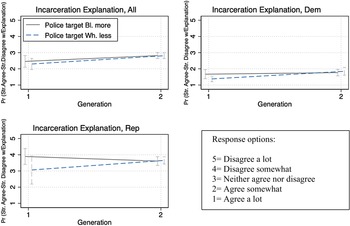
Experiment 1. Incarceration. In our first experiment, we test whether younger generations of White Democrats are the group most amenable to the idea that they possess advantages due to their race that protect them from the carceral state. The recognition of unearned racial advantage due to structural racism in the context of mass incarceration entered mainstream progressive rhetoric in 2020 after the murder of George Floyd. For example, on August 13, 2020, the Columbus Dispatch (a mainstream newspaper in Columbus, Ohio) published an editorial entitled “White privilege, biased criminal justice system kept me from harsh sentence, prison” (Duerksen Reference Duerksen2020). We believe that young Democrats will register as the group most in agreement with the progressive understanding that Whiteness can protect people from the carceral state. We use the inverse of White advantage, namely Black disadvantage, as a baseline to see how people react to a logically equivalent, but ideologically less progressive, frame.
We randomly assigned respondents to read version A or B of the following frames. Respondents were asked: “How much do you agree or disagree with the following statement? African Americans are imprisoned at much higher rates than Whites for drug possession although Whites and Blacks use drugs at about the same rate. This shows that…” Condition A: “the police are more likely to target Blacks” and Condition B: “the police are less likely to target Whites.” As noted above, these frames are logically equivalent and consistent with research that has shown that White Americans are under far less surveillance than Black Americans, which is one reason for the racial disparities in incarceration (Alexander Reference Alexander2010). Condition A highlights the disadvantage faced by Black Americans, whereas Condition B recasts the disadvantage of Black Americans as an advantage available to White Americans, representing a contemporary progressive understanding of structural racism in the context of criminal justice.
Experiment 1—Results. Respondents did not distinguish between these two frames (see Figure 3) which suggests they view them as equal. However, there is a significant generational effect (albeit at p= .078; see Figure 3 top left panel and the corresponding regression in Table B_1_1 the appendix). Younger generations agree more strongly with both explanations for racial incarceration gaps (that Black people are targeted by police more and the inverse, that White people are targeted less) than members of Generation X and the Boomer generation. Thus, younger generations recognize that race is associated with uneven incarceration rates, but they point equally to White privilege and Black disadvantage as the cause.
Predicted values of agree/disagree with explanation for incarceration rates by generation (Gen Z and Millennials vs. Gen X and Boomers) and experimental condition.
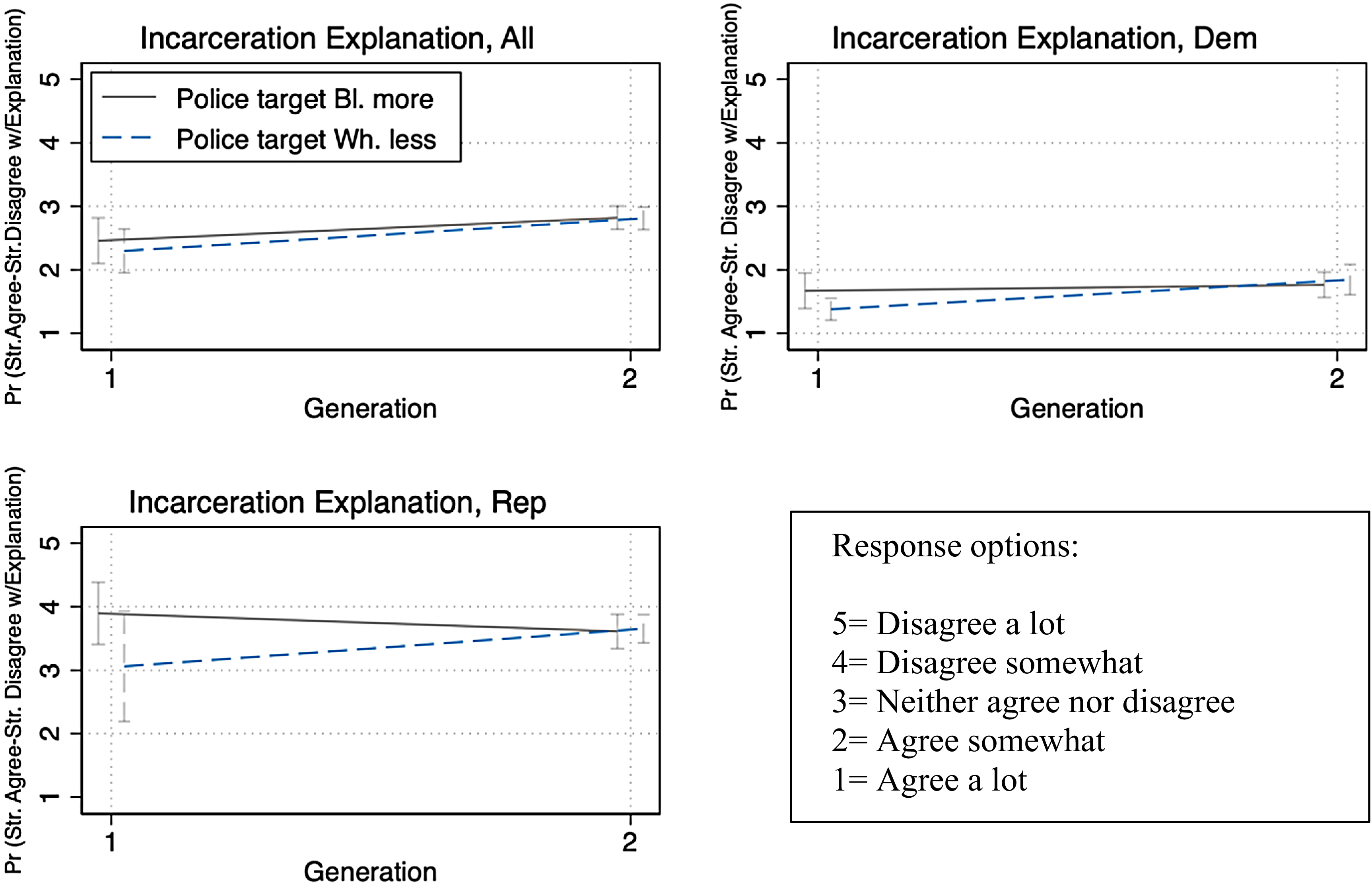
Next, we restrict our analysis to just Democrats. The main effect for generation is no longer significant in the OLS regression; however, there is a treatment effect emerging (p<.10) (see Table B1_2_1 in the appendix). The treatment effect is driven by a significant (p<.012) difference between the predicted margins of younger and older Democrats in the condition where lower incarceration rates are explained by Whites being targeted less, which reflects the most progressive understanding of uneven incarceration. Figure 3, top right panel (dashed line) illustrates this finding and shows that younger Democrats (Gen Z and Millennials) are significantly more in agreement with the explanation that points to racial advantage than older Democrats. When we examine Republicans by themselves, we find that there are no significant main effects and no interaction effects (see Figure 3 bottom left panel and corresponding Table in appendix). Thus, there are no generational or framing effects among Republicans and their responses overall point to disagreement with the notion that race and incarceration rates are connected.
Discussion. Our first experiment supports our expectation that younger generations of Democrats are significantly more in agreement with a structural explanation for disparate incarceration rates than their older generational counterparts. This supports our hypothesis.
Experiment 2. Racial Privilege. In our second equivalence experiment, respondents were asked about their feelings regarding racial discrimination and its flipside, racial privilege. In this experiment, we did not specify a particular domain of structural racism as we did in our first experiment where we focused on incarceration. White privilege is a decidedly contemporary framing of structural racism, making White identity visible, which had been obscured by color-blind ideology (Christiani and Britt Reference Christiani and Britt2024). White privilege is also contested. White people often deny that white privilege exists (Knowles et al. Reference Knowles, Lowery, Chow and Unzueta2014), and not all White people think their privilege is a problem (Jardina Reference Jardina2019; Schildkraut Reference Schildkraut2019). White progressives have, however, connected White privilege to structural racism (Knowles et al. Reference Knowles, Lowery, Chow and Unzueta2014), and have cast it as the opposite of Black discrimination (Christiani and Britt Reference Christiani and Britt2024; Schildkraut Reference Schildkraut2019). Thus, consistent with (H 2 ), we expect young Democrats to condemn White privilege, just as they would condemn Black disadvantage. Both violate basic notions of fairness and racial egalitarianism. Furthermore, racially conservative respondents should reject the notion of privilege and discrimination, while racial moderates should accept the existence of discrimination while expressing skepticism toward privilege. Respondents were randomly assigned to version A or B. Respondents were asked: “How much do you agree or disagree with the following statement?” Version A: Discrimination against Blacks makes me upset. Version B: White privilege makes me upset.
Experiment 2—Results. There is a large substantive and statistical main effect of our treatment. This is obvious in Figure 4 (top left panel) and shows that people are not viewing the two phenomena, discrimination and privilege, as a reflection of the same underlying problem. Respondents are significantly more upset by racial discrimination than by racial privilege. This finding holds when we look at younger generations. While younger generations are significantly more upset about inequality in general (across both treatment conditions), there are no generational differences when we compare young and old respondents within the same treatment condition (see Table B2_1_3 in the appendix for all comparisons of marginal predictions).
Predicted values of agree/disagree with feeling upset about discrimination vs. privilege by generation (Gen Z and Millennials vs. Gen X and Boomers) and experimental condition (Discrimination vs. Privilege).

When we examine Democrats alone, the generation main effect disappears (see Figure 4, top right panel). While this experiment delivers no evidence that younger White Democrats are particularly accepting of White privilege, both older and younger Democrats “agree somewhat” that White privilege is upsetting. Hence, the responses indicate that Democrats recognize privilege as negative, even if not as negative as discrimination. (See the pairwise comparisons of predictive margins in the appendix.)
Note also the strong partisan difference on this question. As Figure 4 and a comparison of the top right panel (Democrats only) and bottom left panel (Republicans only) shows, Democrats are overall more in agreement that both privilege and discrimination are upsetting. In fact, younger and older generations of Republicans are about as upset about discrimination as young and old Democrats are about privilege.
Discussion. This equivalence experiment shows that younger Democrats are more upset about discrimination than privilege. This finding conflicts somewhat with the results from the first experiment where younger White Democrats were able to connect Black disadvantage to their own advantage. Yet, both younger and older Democrats see their privilege as something negative. Thus, Democrats in general appear somewhat progressive in this instance, pointing toward the party as a potential force in shaping racial attitudes.
Experiment 3. Racial Wealth Gap. This time, we use an emphasis framing experiment to test young White Democrats’ commitment to progressive principles of racial justice as compared to their older and their Republican counterparts. Emphasis framing occurs when an aspect of an issue is emphasized, while another is omitted or downplayed. We use emphasis framing to present competing explanations for the racial wealth gap—one progressive and one conservative frame.
Respondents were randomly assigned to version A or B. All respondents were asked: “How much do you agree or disagree with the following statement?” Participants in condition A saw a structural explanation for the gap: “Research has shown that Black families have only one-tenth of the net wealth of White families. Gaps in wealth between Black and White households reveal the effects of historically accumulated inequality and discrimination, as well as differences in opportunity that can be traced back to this nation’s inception.” Participants in condition B, however, saw an explanation based on color-blind individualism: “Research has shown that Black families have only one-tenth of the net wealth of White families. Gaps in wealth between Black and White households reveal the effects of hard work and educational attainment.” Our second hypothesis predicts a strong interaction between treatment and generation. Young Democrats should be significantly more likely to agree with the structural explanation for the racial wealth gap than older Democrats and Republicans, who should endorse the individualistic explanation.
Experiment 3—Results. There are strong main effects of treatment and age (see Table B3_1_1 in the appendix). There is also a strong interaction effect (Figure 5, top left panel), and we find substantial partisan differences. Members of Generation Z and Millennials agree significantly more with the notion that the wealth gap results from inequality than Generation X and Boomer respondents. Older generations instead believe that work ethic and educational attainment explain the wealth gap. This experiment strongly supports the idea that younger White people have a more progressive understanding of the underlying causes of the racial wealth gap than older White people.
Predicted values of agree/disagree with explanation for wealth gap by generation (Gen Z and Millennials vs. Gen X and Boomers) and experimental condition (Structural vs. Individual Explanation for the Wealth Gap).
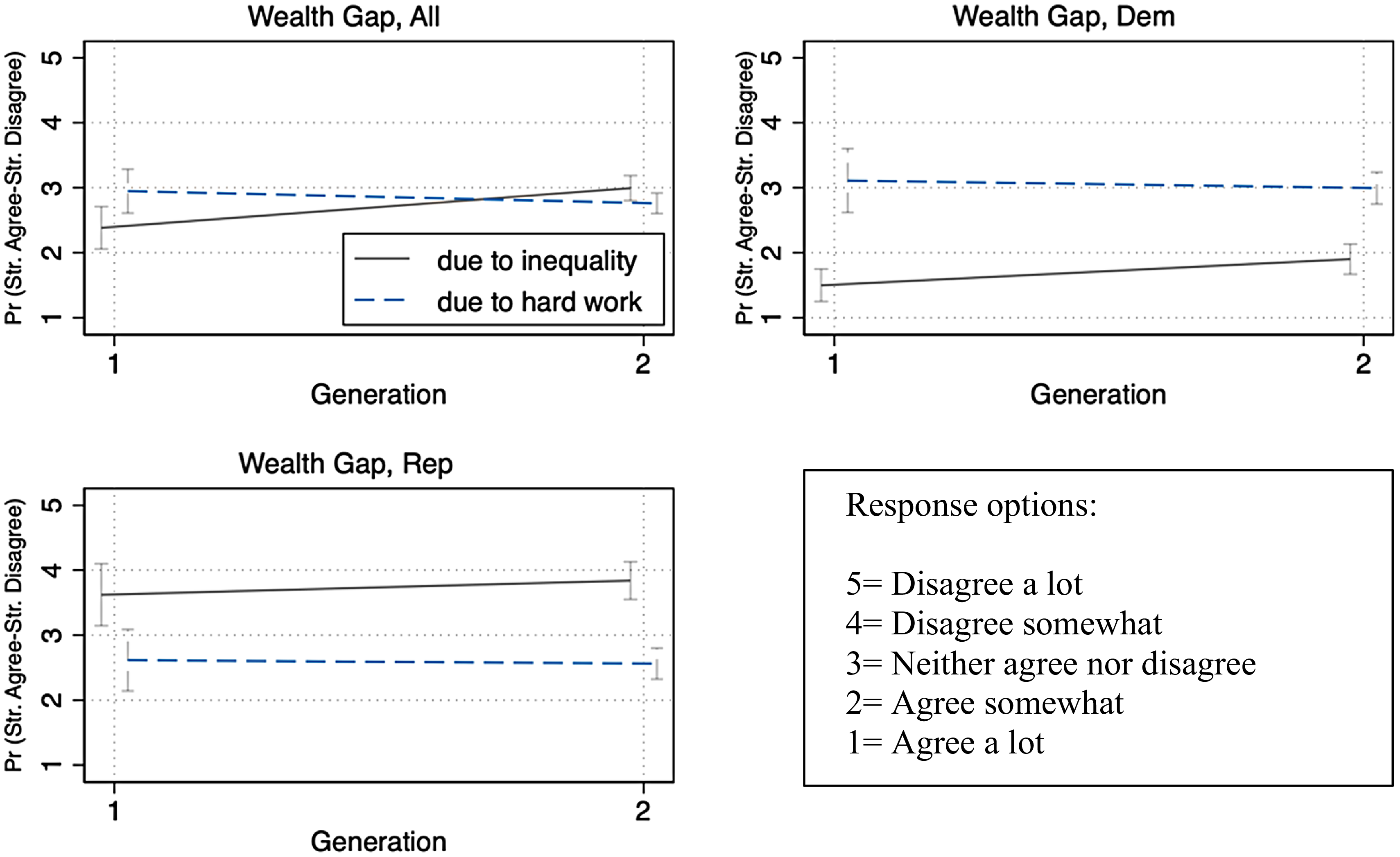
The analysis by party (Figure 5, panels top right and bottom left) shows that our frames align with differences in partisan racial ideology (see Engelhardt Reference Engelhardt2019). Republicans strongly prefer the individualistic explanation, whereas Democrats prefer the structural explanation. Yet younger Democrats are no more in agreement with the structural explanation than older Democrats. While Figure 5 suggests that younger Democrats might be more in agreement with the structural explanation than their older counterparts, the appendix demonstrates there is no statistically significant difference between these two groups (see Table B3_2_3). This experiment again undermines our expectation that younger generations are uniquely progressive. Younger and older Democrats look more alike than hypothesized.
Discussion. The results demonstrate that younger generations are significantly more likely to side with an explanation for the racial wealth gap that points to historical inequality and exclusion from wealth-building opportunities, which is the progressive frame. However, younger Democrats are not uniquely progressive on this issue when compared to their older counterparts; instead, they appear to echo the party’s stance on this issue: Older Democrats are just as accepting of a structural frame to explain the racial wealth gap. Thus, partisan identity appears to be stronger than generational differences in both this and the previous experiment.
The Principle-Policy Gap
Experiment 4—Reparations. Our experiments tested what Bobo and Kluegel (Reference Bobo and Kluegel1993) call the “cognitive dimension of racial attitudes,” which measures people’s understanding of “structural impediments” to the advancement of Black Americans (p. 447). In one of the three experiments, we just presented, young White Democrats demonstrated significantly more understanding of structural impediments Black Americans face. However, in two of the experiments, they were statistically indistinguishable from their older peers. In our final experiment, we test whether young Democrats support reparations.
As noted earlier, reparations are not the only policy that would benefit Black Americans. However, reparations are one of only a few race-targeted policies, and they are largely unpopular among White respondents. As we noted earlier, the fact that reparations are unpopular that makes them a good test. If young White Democrats are indeed committed to the principle of racial egalitarianism (as revealed through their preference for racially progressive rhetoric), they should be consistent; that is, they should be among the small percentage of White people who support racially egalitarian policy—reparations. Borrowing from the language of principle-policy gap scholarship—they should close the principle-policy gap, especially if they are reminded of the historical reasons for reparations.
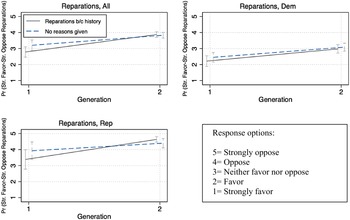
Respondents were randomly assigned to one of two conditions and asked whether they supported reparations. In condition A, participants saw a summary of historical reasons for reparations, and in condition B, no reasons were provided. Listing the historical reasons for reparations is consistent with the discourse that had emerged on the political left prior to our study (e.g., a widely circulated article by Coates Reference Coates2014). We expected that younger Democrats would support reparations, especially in condition emphasizing historical reasons for reparations (H 3 ).
Participants in condition A were shown the following vignette: “One way to correct historical injustices like slavery, lynching, redlining, and exclusion from economic opportunities like the GI Bill or New Deal, is to enact reparations for Blacks.” In condition B, participants were simply shown the following statement: “One idea is to enact reparations for Blacks.” No explanation for reparations was given in the second condition. Afterward, all participants were asked: Do you strongly favor, favor, neither favor nor oppose, oppose, or strongly oppose reparations?
Experiment 4—Results. Hearing that reparations were a way to correct for past injustice produced a main effect, albeit at p<.074 (see Table B4_1_1 in the appendix). We take this to be an indication that some White respondents can be moved in their appraisal of reparations, a generally unpopular policy, if they are reminded of the historical reasons for reparations.
There is also a strong generation effect (p<.000). Older generations of White respondents are significantly more likely to oppose reparations than young people. Moreover, there is an interaction effect (p<.081) suggesting that young White people might be less opposed to reparations if they are reminded of the historical reasons motivating the policy. This does not mean that young White people support reparations, however. A quick look at the tick marks in Figure 6 and their substantive interpretation shows that young Americans appear to settle somewhere around indifference toward the policy. They neither endorse nor oppose reparations. Are younger generations of Democrats more in favor of the policy?
Predicted values of favor/oppose reparations by generation (Gen Z and Millennials vs. Gen X and Boomers) and experimental condition (with or without Historical Context).

When we consider Democrats alone, there is no significant treatment effect. There is, however, a strong generational main effect. Young Democrats are significantly less opposed to the policy than older Democrats—irrespective of treatment (see Figure 6, top right panel and Table B4_2_3 in the appendix). This is consistent with our general expectation that young Democrats are more progressive on race than other groups. A close look at the tick marks, however, shows that White young Democrats’ average opinions fall between “neither favoring nor opposing” and “favoring,” reparations. While this group is less opposed to reparations than their older generational counterparts, their support is rather lukewarm, especially when we look back at the previous experiments where younger Democrats often enthusiastically endorsed progressive racially egalitarian ideas, along with their elders.
Moreover, a look at the Republican panel (bottom left) and the underlying OLS regression shows that young Republicans, too, are less opposed to reparations than their older counterparts. Taken together, however, these findings do not suggest that Generation Z and the Millennials are especially progressive. While Republicans lean toward “oppose,” Democrats lean toward “favor.” Their leanings seem to cancel each other and add up to indifference. This undermines the notion that Millennials and Generation Z are uniquely racially progressive.
Discussion. While this is hardly an all-out endorsement for reparations by younger Democrats, it does a signal willingness to consider the policy. This is important given that scholarship has repeatedly shown reparations to be unpopular (Chudy Reference Chudy2024). Yet, when we compare younger White Democrats’ responses to reparations to their responses in the wealth gap experiment, for example, their lukewarm support for reparations is reminiscent of the well-documented principle-policy gap and other scholarship documenting inconsistencies in White Americans’ racial attitudes (e.g., Chudy Reference Chudy2024). While our Wealth Gap experiment (third experiment) shows that young Democrats unambiguously recognize that the wealth gap exists because of historically accumulated disadvantage, they are unenthusiastic when it comes to a policy that would redress these historical harms. And although reparations are not the only race-based policy we could have used, we believe that this final experiment coheres with our overall results. Younger White generations of Democrats are inconsistent in their commitment to racial egalitarianism.
Discussion
Summary of findings. We used ANES data and four experiments to examine generational changes in racial attitudes by party among White Americans. We found mixed evidence for the notion that younger generations of White Democrats are especially progressive when it comes to race and strong evidence for the cross-cutting nature of partisanship. While Generation Z Democrats are the least racially resentful group in the ANES, the same is not true for Millennials. And, although Generation Z and Millennials agree significantly more with the idea that racial privilege explains uneven incarceration rates than older Democrats and young and old Republicans, they fail to recognize White privilege as the flipside of Black discrimination. Moreover, while young White Democrats point to structural racism as the primary explanation for the racial wealth gap and reject the conservative notion that work or educational outcomes are to blame, they do not endorse reparations. Our results, summarized in Table 1, suggest that partisan identity plays a large role in structuring racial attitudes.
Summary of results
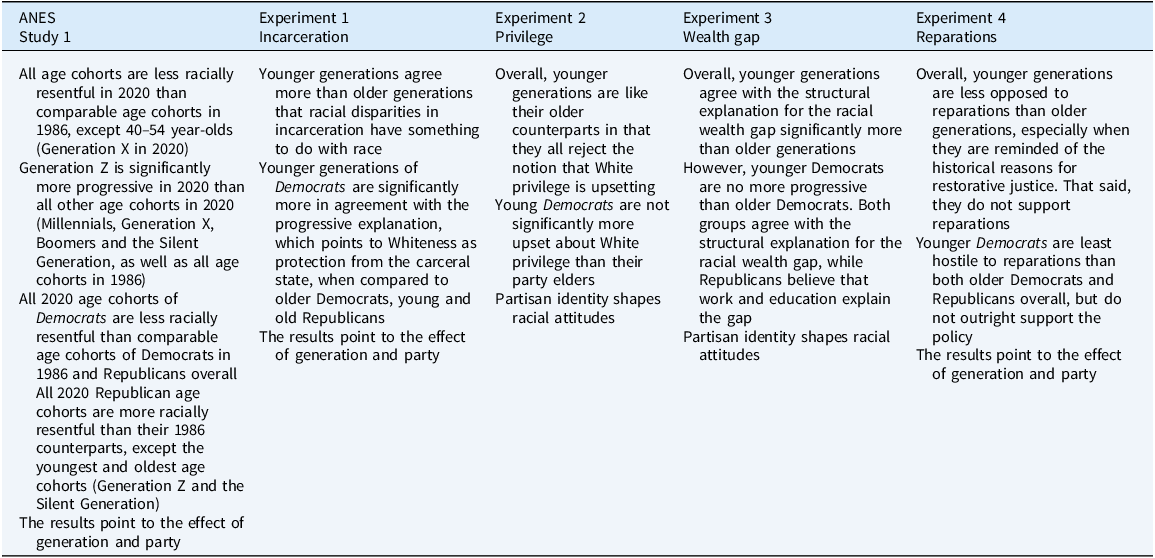
Our study replicates the finding that Democrats are the more racially progressive party. Across both studies and all experiments, the effect of party was important. And while younger generations are sometimes racially more progressive overall, the expectation that Generation Z and Millennial White Democrats would be significantly more progressive on race than their older and Republican counterparts was not always supported.
These mixed results make sense, however. After all, it is not costly to endorse racially progressive principles on issues, especially on issues for which partisan cues are readily available (e.g., incarceration and the wealth gap). However, it might be more costly to recognize racial privilege, which has primarily been an academic idea (e.g., see McIntosh Reference McIntosh1990) and can feel like a threat (Knowles et al. Reference Knowles, Lowery, Chow and Unzueta2014) or to support reparations, a policy that would not directly benefit White Democrats. Young Democrats’ reluctance to condemn White privilege and their reluctance to endorse reparations may also reveal an underlying indifference to changing the racial status quo.
The inconsistency in young White Democrats’ attitudes, we uncover echoes findings from other studies like the principle-policy gap scholarship and research documenting other contradictions in White Americans’ racial ideology. For example, Chudy (Reference Chudy2024) shows that people who are racially sympathetic and view racism as a structural problem, nevertheless believe that individual solutions are the best way to address racism. Similarly, recognition of White privilege does not cause greater engagement with anti-racism (Schildkraut Reference Schildkraut2019).
It is also important to consider the timing of our survey to fully understand what our results mean. The survey was conducted during the early summer of 2020, during the pandemic lockdown, and the political fallout from the highly publicized murders of George Floyd and Breonna Taylor. The events in 2020 likely shaped the responses given in this survey. As such, we cannot assume that people would register as progressive on race today as they did in 2020. Thus, if anything, these data likely overestimate respondents’ commitment to racial justice. Especially when we consider that the reaction to George Floyd’s murder was motivated—at least in part—by dissatisfaction with the government and coronavirus-related grievances (Chudy Reference Chudy2024). In other words, some of the racial attitudes recorded in this survey may reflect other considerations.
That said, it could be that our generational effects are muted because we did not capture enough members of Generation Z in our second study. Since Generation Z emerged as particularly progressive in the ANES data, it could well be that there are not enough Generation Z respondents in our experiments to show a decisive difference between younger and older generations. This is a limitation that other studies have faced as well (e.g., Rouse and Ross Reference Rouse and Ross2018). However, the 2024 election should give pause to the expectation that Generation Z is especially progressive. Exit polls demonstrated that Donald Trump won the majority of first-time voters in 2024, and we urge caution not to overstate the ANES findings.
Conclusion
In this paper, we carefully examined the racial attitudes of White Americans in the aftermath of George Floyd’s killing in 2020 by focusing on age cohorts and party. Overall, we find some support that younger generations are more progressive on race. Especially younger Democrats are often significantly more in agreement with racial discourse that challenges White dominance than older Democrats and both younger and older Republicans. However, young Democrats’ attitudes are inconsistent, and sometimes, they are indistinguishable from their older counterpart.
We draw two broad conclusions from this research. The first is that partisanship is a critical part of understanding changes in racial liberalism in contemporary American politics. We have seen meaningful movement in racial resentment among all Democrats, including members of both the Baby Boomers and the Silent Generation, whom these older measures of racial resentment were normed on. In addition, there are stark differences between the way that younger Democrats and young Republicans now view race, racism, and racial resentment in the ANES data and the experiments.
The racial resentment scale is polarized in 2020, whereas it was not in the 1980s, and it is most polarized among the youngest American generation—Generation Z. To be sure, this does not strike us as particularly surprising, but it is certainly meaningful. Part of what happens in the process of elite-driven polarization is that Americans learn what they are supposed to think. Indeed, our expectation is that the polarization may even be starker as the post-2020 era saw a Republican backlash to mass acceptance of systemic and structural explanations of racism that were encapsulated in the “anti-Critical Race Theory” movement led by Governor Ron DeSantis of Florida and now the Trump administration. On this, more work is clearly needed. However, our research is consistent with scholarship showing that when the parties provide countervailing messaging on race and racial attitudes, the public mirrors these attitudes.
However, our study also questions whether the commitment to contemporary principles of racial equality extends to a willingness to do anything about it. Our research shows that when it comes to making a difference, young White people’s response is marked by indifference. This response could also be ultimately driven by elites. The discourse on racial liberalism from Democratic Party elites has rarely been willing to cross lines of demarcation into policy domains like reparations; therefore, perhaps we should not be surprised that younger Democrats espouse less racially resentful attitudes, yet that inconsistencies persists.
Supplementary material
The supplementary material for this article can be found at https://doi.org/10.1017/rep.2025.10022.
Acknowledgements
We would like to thank Tabitha Bonilla and Nazita Lajevardi for their valuable comments on an early draft of this paper at the 2023 Midwest Political Science Association Annual Meeting and we are grateful to the reviewers for their thoughtful and careful reading of the manuscript. Their constructive critiques significantly improved the clarity, rigor, and overall quality of this paper. Last, we thank the University of Massachusetts, Lowell’s Center for Public Opinion for providing access to the data used in this study.






 Open access

