





In October 2016, Milanese local councillor Anita Pirovano made headlines in Italy when she brought her eight-month-old child to a local council meeting. It was an emergency, with the child waiting to be moved to a new crèche and the mother unable to find a babysitter (Gallione Reference Gallione2016). One month later, Pirovano introduced a proposal in the council to extend crèche hours. This proposal was suggestively titled ‘If I could have one Friday night a month’ and had been a major part of her electoral campaign earlier that year (Liso Reference Liso2016).
Such anecdotal evidence indicates that women continue to feel as if they must make a choice between childrearing and working, especially in formal employment. This choice revolves around the degree to which time devoted to childcare – especially during an early stage of life – constrains the ability to work. For men who work, the constraint posed by the unavailability of childcare is rare and/or modest – wives or partners take on the childcare if none is available otherwise – and thus there is usually little or no choice to be made. However, women who work still disproportionately remain responsible for childcare. In the absence of available (or affordable) childcare, a woman’s choice is thus between working and caring for her child(ren).
From a societal economic standpoint, this choice represents a sub-optimal outcome: economies are stronger and have greater production potential where women’s share of the labor force is large and/or increasing (ILO 2017; Tsani et al. Reference Tsani, Paroussos, Fragkiadakis, Charalambidis and Capros2013). Countries with sizeable welfare states and aging populations (i.e., shrinking workforces) thus face the twin challenge of encouraging births while trying not to discourage women’s labor force participation. Many active social policies have been suggested as potential ways to absolve women of this choice, including providing subsidies for childbearing that can be used to pay for childcare expenses, increasing financial incentives for men’s sharing of household duties and childcare provision, and providing access to free, state-run childcare facilities (Bonoli Reference Bonoli2013). While each of these policies is costly, the economic benefit of women returning to and remaining in the workforce after childbirth is less visible and thus difficult to claim credit for. In short, the potential state-based policy solutions to the otherwise ‘individual’ choice that women must make between childrearing and working are often challenging for democratic governments to sell to their electorates. Thus, despite knowing the potential and likely benefit, the component of redistributive policies and resources devoted to reducing a woman’s choice between family and work often remains persistently small in many countries (Morgan Reference Morgan, Morel, Palier and Palme2011).
One counterargument is that women, whose choices are being constrained, might pursue expansions of family work policies to benefit both personally and as a group. As women comprise a greater share of political decision-makers, they should therefore expand resources for and access to opportunities that reduce the need for women to make the decision between childrearing and work (Bratton and Ray Reference Bratton and Ray2002; Morgan Reference Morgan2013). Yet, there is mixed support for this argument in scholarly analyses of the relationship between improvements in women’s descriptive representation and positive changes in women’s substantive representation more generally (Childs and Krook Reference Childs and Krook2006; Clayton and Zetterberg Reference Clayton and Zetterberg2018; Funk et al. Reference Funk, Paul and Philips2022; Wängnerud Reference Wängnerud2009). At the heart of this inconsistent empirical record lies a key critique of gender essentialism: women occupy most or all parts of the political ideological spectrum, and thus even when prioritizing similar issues (e.g., education spending), they often hold very different views on the state’s role and responsibility, how best to address challenges, and where and how they see resource expenditure as effective and efficient. In other words, scholars assume that men have widely variable political preferences because their interests and goals are assumed to be heterogenous, and the same should arguably be true for women.
Here, we offer a new piece to solving this puzzle, focusing on the provision of and expenditure on pre-primary education as a policy whose appeal bridges the cross-ideological spectrum gap in women’s shared political interests. While women may have heterogenous preferences on most policy issues, women who pursue elected office will share the same goal of reducing the work–family trade-off they and other women face and thus will coalesce around support for a policy that aids in eliminating the need to choose between childrearing and working. While our general logic follows that of Weeks (Reference Weeks2022), here we focus on a specific caregiving policy that enables mothers – distinctly from fathers – to return to or remain in the workforce while concurrently caring for preschool-aged children. We expect this to be especially pronounced where Left-oriented parties have failed to enact wider active labor market policies at the national level, and where subnational governments and localities shoulder the burden of this type of welfare and redistributive policymaking and resourcing.
We examine pre-primary education provision in Italy, a country where increases in early childhood education and care opportunities have been empirically linked to improvements in a range of important gendered outcomes, such as women’s labor force participation, children’s educational attainment, and fertility rates (Brilli et al. Reference Brilli, Del Boca and Pronzato2016; Guetto et al. Reference Guetto, Alderotti and Vignoli2025; Scherer et al. Reference Scherer, Pavolini and Brini2023). Despite evidence that this provision can lead to generally positive economic outcomes, Italian women continue to shoulder childcare burdens because the country has traditionally lagged behind European counterparts due to a range of factors, such as persistence of traditional views on the detrimental effects of maternal employment on children’s development and slower integration of women into the labor force (Mancini Reference Mancini2018; Morgan Reference Morgan2013: 101–102).
In addition to this being a ‘difficult’ case in which to envision widespread shifts in support and resourcing for pre-primary education provision, two factors make this the ideal case to test our theory: (1) in Italy, municipal governments are responsible for funding the policy issue under investigation: pre-primary education; and (2) a 2012 electoral reform led to the adoption of gender quotas for municipalities with 5,000+ population, providing the opportunity to test the effect of exogenously induced variation in women’s representation. Through a regression discontinuity (RD) approach that compares municipalities just above and below the quota-required population threshold, we show that the increase of a single additional woman municipal councillor increases pre-primary education expenditure by 33%. Our finding suggests that increases in women’s descriptive representation can directly lead to women’s substantive representation where a policy reflects a common interest of women across the political spectrum. The increase in women’s representation, therefore, has important implications for the provision of a social welfare measure that permits and encourages women’s lifetime earning potential and economic independence, in Italy and beyond.
The expansion of childcare provision and women’s descriptive representation
Many policy solutions, including the creation and expansion of parental leave, family allowances, and child benefits, reduce the choice between working and caring by compensating income loss due to time away from paid work. These solutions to alleviating the trade-off between income and family time tend to result in a specific outcome: the financial replacement is rarely designed or sufficient to enable both parents to remain in and/or return to the workforce (Morgan Reference Morgan2006; Weeks Reference Weeks2022). Policies that focus on replacing lost income rather than promoting active labor market participation are thus gendered since women’s employment, more so than men’s, is distinctly (i.e., less positively) affected by their adoption. In contrast, childcare provision has been shown to promote women’s employment (Attanasio et al. Reference Attanasio, Low and Sánchez-Marcos2008; Bick Reference Bick2016; Brilli et al. Reference Brilli, Del Boca and Pronzato2016), at least in part by freeing women’s time from childcare responsibilities rather than simply replacing the income ‘lost’ in the fulfillment of those responsibilities (Gornick and Meyers Reference Gornick and Meyers2003).
Given the economic costs incurred by policies designed to address the work–family balance, their adoption and expansion require political will and financial commitment. Post-Cold War policy expansion was theorized to ameliorate falling fertility rates that imperiled the welfare state or placed women’s potential contributions to the economy as the motivation for the adoption of policies that would hopefully encourage women’s labor force participation (Gauthier Reference Gauthier2007). Beyond economic rationalist models of work–family policy solutions, such policies were more likely to be adopted in countries with cultural attitudes and/or mass publics that favored gender egalitarian principles more generally (Budig et al. Reference Budig, Misra and Boeckmann2012; Kremer Reference Kremer2007; Van der Lippe and Van Dijk Reference Van der Lippe and Van Dijk2002). Evidence shows a persistent gap between desired and met demands for childcare and work–life policies in many countries (Calzada and Brooks Reference Calzada and Brooks2013; Gingrich and Ansell Reference Gingrich and Ansell2015), which suggests a need to understand why governments lag behind their citizens in the degree to which they devote attention and resources to work–life policies.
Women’s descriptive political representation has long been hoped to lead to the advancement and prioritization of policies that disproportionately affect women, such as work–life balance. Alongside the recognition that women are not a monolithic group, there is some consensus that women are more likely than men to hold certain political preferences. Studies show that women legislators, compared to men, tend to prioritize social welfare, development, and humanitarian aid policies in both the establishment of legislation and government spending (Bolzendahl and Brooks Reference Bolzendahl and Brooks2007; Carroll Reference Carroll and Carroll2001; Clayton and Zetterberg Reference Clayton and Zetterberg2018; Hicks et al. Reference Hicks, Hicks and Maldonado2015; Kittilson Reference Kittilson2008; Lu and Bruening Reference Lu and Breuning2014). Even among the general public, women tend to have greater attentiveness to redistribution (e.g., Conover Reference Conover1988; Huddy et al. Reference Huddy, Cassese, Lizotte, Wolbrecht, Beckwith and Baldez2008). As a result of a high degree of shared life experience and ubiquity of socialized gender norms that disproportionately place them into uncompensated caregiving roles, women are more likely to pay attention to, and prioritize, issues related to social welfare when compared to men.
Despite evidence that increases in women’s representation at the national level can translate into distinct policy adoption and spending patterns, scholars have highlighted why this translation occurs inconsistently (Beckwith and Cowell-Meyers Reference Beckwith and Cowell-Meyers2007; Reingold Reference Reingold2008). Consider that women are not necessarily uniformly likely to prioritize social welfare or redistribution relative to other issues. Take, for example, a woman who lives in a city with a high rate of violent crime. She may care more about social welfare than her male counterparts, but less about social welfare than her female (and male) counterparts who live in cities with lower rates of crime. At the forefront of such explanations is the recognition that women hold diverse priorities with respect to the policy agenda (Celis and Childs Reference Celis and Childs2012; Clayton Reference Clayton2021), as well as powerful and potentially very political identities in addition to their gender (Smooth Reference Smooth2011). For example, American Republican and Democratic women exhibit similar levels of interest in a range of policy areas, such as reproductive rights, but have vastly different perspectives on how to address them (Reingold et al. Reference Reingold, Kreitzer, Osborn and Swers2021; Rolfe-Haase and Swers Reference Rolfe-Haase and Swers2022). Therefore, even if women share policy priorities, distinct approaches to their resolution can still lead to differences in the form and financing of legislation to address them. As a result, even when more women are elected, the associated legislative outcomes and spending decisions may vary.
Time and financial resource constraints also shape how and where access is split along gender lines. A selection effect separates individuals with both the financial and time resources to devote evenings and weekends to meeting with constituents and conducting legislative or council work from individuals without one or both of these resources. In a study of would-be women candidates in California, those who are family breadwinners disproportionately choose not to run for office given the financial constraints of doing so (Bernhard et al. Reference Bernhard, Shames and Teele2021). The resulting self-selection into representative roles has clear implications for policy and spending priorities, since the voices and preferences of individuals who possess one or neither of these resources will go unheard. Women, typically more constrained by financial and time resources than men, inevitably self-select out of the process of becoming subnational and local representatives, and thus their voices and preferences over policies and resources to resolve the family–work decision go unheard and unaddressed. Wide-ranging affirmative action policies – notably candidate quotas and reserved seats – have been employed in a large number of the world’s countries in recent years to combat this inequity (UN Women Reference Women2021). Such affirmative action policies have subsequently been shown to shape the provision of work–family policies when they expand women’s descriptive representation in fairly universal ways (e.g., Weeks Reference Weeks2022).
A cross-cutting theory of improving childcare provision
If women have distinct policy priorities that are shared among them, such as the provision of childcare that reduces the individualized burden of choosing between family and work, we should theoretically see these reflected in budgetary spending patterns where women are elected at higher rates. As Ana Catalano Weeks argues, the adoption of affirmative action policies should help us understand this impact, where the adoption of gender quotas usher in an immediate shift in women’s representation rates that are more likely to span the ideological spectrum (Reference Weeks2022). As such, we expect that as women’s political representation increases, so do women’s opportunities to directly pursue their policy and spending priorities; they will subsequently reshape spending to shift resources from security toward social welfare spending.
However, women’s ability to drive changes in spending may be heavily moderated at the national level where legislative structures (e.g., committee systems) often lead to a prioritization of the policy and spending preferences of members with seniority and those in party leadership roles who are typically men. Furthermore, when affirmative action policies are introduced to diversify the candidate pool, constraints on the ability of women to exert their policy preferences may actually be exacerbated; some literature (see Clayton et al. Reference Clayton, Josefsson and Wang2014) has shown that there may be backlash against or skepticism of the capacity and qualifications of legislators elected via gender quotas. As a result, focusing on shifts in national-level spending may lead to an underestimation of the link between women’s political representation and increases in social welfare expenditures.
As a result of the diversity of women’s policy priorities and constraints on their ability to successfully pursue and shape policymaking and expenditures, some of the underlying difficulty in observing a causal link between women’s political representation and social welfare expenditure comes from the motivational ambiguity associated with such a wide-ranging policy area. For example, previous work has shown that quota-induced increases in women’s descriptive representation are correlated with improvements in women’s health outcomes without being able to evaluate the underlying source of those improvements (Westfall and Chantiles Reference Westfall and Chantiles2016). Additionally, numerous studies have found that women’s representation leads to an increase in health expenditures (Clayton and Zetterberg Reference Clayton and Zetterberg2018; Shair-Rosenfield and Wood Reference Shair-Rosenfield and Wood2017; Swiss et al. Reference Swiss, Fallon and Burgos2012), providing a specific mechanism (spending decisions) through which women representatives shape policy that affects an outcome of interest to women. Yet, these studies have often focused on analyses that oversample from the developing world and post-conflict cases where improvements in health expenditures as a reflection of women’s greater prioritization on social welfare seem appropriate, given that improved health in rebuilding or lower- and middle-income contexts is widely associated with a range of other outcomes such as economic development and peace durability. Thus, careful attention to the mechanism through which women representatives can shape policy and the scope conditions under which such mechanisms operate are essential to explaining this evidence supporting the women’s representation–social welfare relationship: women across the political spectrum are much more likely to share views about this particular form of social welfare in such cases that have a distinct socioeconomic and/or political profile.
Here, we build from the rationale that specific policy issues can generate common or shared motivation for women across political or partisan boundaries and thus are able to offer a cross-cutting theoretical argument that is more universal. We begin with the expectation of a positive relationship between women’s representation and social welfare spending in the context of increases in spending on pre-primary education, which is defined as an organized learning environment that occurs prior to compulsory schooling and is often known by the more country-specific terms of ‘early childhood education’, ‘nursery’, ‘preschool’, or ‘crèche’. In the Norwegian and German contexts, previous work has highlighted the ability of increases in municipal-level women’s descriptive representation to translate into greater spending on pre-primary education (Baskaran and Hessami Reference Baskaran and Hessami2025; Bratton and Ray Reference Bratton and Ray2002). The relationship is especially clear when the existing rate of women’s representation or the existing rate of pre-primary expenditure is still relatively low, suggesting potential gains to be made in a relatively neglected policy area.
We also focus on pre-primary education because this is a policy area where women’s ability to work and their earning potential are more dependent on its provision when compared to other forms of family benefits or parental leave. Women’s work is often considered to be more expendable, precarious, or contingent than men’s, both within and across households. As during the Covid-19 pandemic, when schooling is or becomes unavailable, it is typically mothers whose work time and earning potential are reduced as they become the household’s primary caregiver on a more full-time basis (Carlson et al. Reference Carlson, Petts and Pepin2021; Zamberlan et al. Reference Zamberlan, Gioachin and Gritti2021). Around the world, women disproportionately assume unpaid childcare responsibilities and expansions in availability, or reductions in the cost, of childcare that are associated with increases in women’s labor force participation (Attanasio et al. Reference Attanasio, Low and Sánchez-Marcos2008; Brilli et al. Reference Brilli, Del Boca and Pronzato2016). In contrast, men are rarely assumed to be the primary caregiver or to take on unexpected or long-term full-time caring responsibilities in the home and are thus far less affected by whether pre-primary education opportunities are available and/or state-funded. Even among political conservatives, a gender-based trend has emerged where conservative women favor social welfare programmes and some aspects of redistribution more than conservative men, with childcare a particular point of divergence (Barnes and Cassese Reference Barnes and Cassese2017: 129).
This is especially true at the municipal level where women council members are more likely than their national legislative counterparts to be constrained in the time available to perform public service commitments alongside caring responsibilities for preschool-aged children (Durose et al. Reference Durose, Gains, Richardson, Combs, Broome and Eason2011; Farrell and Titcombe Reference Farrell and Titcombe2016). In municipalities, councillors will have fewer resources, such as staff to carry out organizational tasks, and thus, this is where the demand for the provision of preschool is most likely to be acutely felt. As a result, state provision of pre-primary education is more likely to be an issue that is of greater concern to women than men, more likely to span partisan divisions among women, and an issue which justifies shifts and prioritization in expenditure to improve its financing and availability to the wider public. This leads to our central hypothesis: Increases in women’s representation lead to increases in pre-primary education expenditures.
Unlike wider theories of demand for women’s substantive representation, this theoretical perspective emphasizes that a distinct aspect of a woman’s lived experience (e.g., juggling work–life balance) drives their advocacy for the shift in pre-primary education spending. Therefore, we diverge from the perspective of scholars such as Weeks (Reference Weeks2022) in that we do not argue that women’s representation will necessarily lead to a similar increase in other social welfare expenditures, such as general education spending, or a contrasting decrease in security expenditure that might represent the ideological ‘trade-off’ often assumed within the wider gender and politics literature. The reason for this distinct expectation regarding pre-primary education lies in what makes pre-primary educational access distinct: it represents an issue of unique interest to women – compared to men – that potentially unites all women (i.e., is ‘cross-cutting’), rather than divides them by partisanship, ideology, or another identity in terms of the prioritization or shape the policy solution takes. Not all women have, want to have, or are currently raising children while seeking elected office. However, our theoretical argument reflects that women disproportionately must or feel compelled to make work–life balance choices that their male counterparts do not, and this is especially true for an activity such as running for elected office.
For example, education as a policy domain covers a wide range of sub-categories, including basic primary and secondary schooling, tertiary education, and vocational training, meaning that ‘education expenditures’ may provide fewer advantages to women than men, who are more often the beneficiaries of resources devoted to enhancing earning potential in specific fields that are male-dominated (i.e., vocational training). Alternatively, education spending may be viewed as a wider redistributive investment and thus perceived as a commitment to economic development for the whole population aligned with a general Left-oriented ideological perspective rather than something addressing the needs of a specific subgroup (i.e., women who want to continue in paid employment). Thus, it is unclear that an increase in women’s descriptive representation should exert a distinct effect on education spending compared to when men predominate in the political arena.Footnote 1 From the contrasting standpoint, women’s policy priorities are often expected to diverge from men’s on security issues, and so a gender-based difference where women prefer to spend less than their male counterparts might be predicted. Previous studies have shown that women typically favor greater gun control and less militarized approaches to conflict resolution (Brooks and Valentino Reference Brooks and Valentino2011; Huddy et al. Reference Huddy, Cassese, Lizotte, Wolbrecht, Beckwith and Baldez2008). However, more recent studies suggest that partisanship trumps gender on this issue, with women’s views on policing more similar to their male co-partisans than women non-partisans (Hansen and Navarro Reference Hansen and Navarro2023). In sum, the cross-cutting theoretical rationale for expecting that an increase in women’s descriptive representation leads to an increase in pre-primary education spending does not extend to increases in other common forms of social welfare expenditures or decreases in expenditures in countervailing policy areas.
Empirical approach
Four aspects of the Italian case make it ideal for testing the theory we propose. First, early childcare services in Italy are provided by local authorities (Dominici et al. Reference Dominici, Cavallini and Masi2024). As a result, estimating whether there has been a shift in spending priorities in municipalities due to shifts in women’s representation on municipal councils can avoid the drawbacks associated with analysis at the national level by focusing on a local level where authority matters a great deal in terms of policy adoption and implementation. Demonstrating the relative power of municipal councillors to shape spending priorities at the local level, previous work has shown that the sex of Italian mayors matters for spending on the environment when there is greater gender diversity in the composition of the municipal council (Casarico et al. Reference Casarico, Lattanzio and Profeta2022).
Second, we were able to collect Italian spending data disaggregated at the municipal level, including breakdowns of spending in multiple categories of social welfare and security expenditures. These data are available from a single repository housed by the Italian government and universally and comprehensively cover Italian municipalities. This enables an estimation strategy that can pinpoint specific policy area spending shifts both cross-unit and cross-temporally without concerns about data missingness or inconsistent coverage and variable categorization across units of analysis.
Third, in 2012, Italy adopted an electoral reform requiring the application of a gender quota – a maximum of 2/3 of candidates from either gender can comprise each candidate list – in municipalities with populations of 5,000+. This leads to a high level of variation in women’s representation levels when comparing across the large number of municipalities, including those where lists were required to include substantially larger numbers of women candidates and those that were not. Through the adoption of the quota that applies strictly based on local population size, we can account for endogeneity between women’s representation and municipality characteristics. To do this, we conduct a two-stage analysis: in the first stage, we implement a regression discontinuity (RD) design to predict women’s representation in localities just above and just below the population threshold; in the second stage, we use this exogenously driven variation in women’s representation to predict spending practices. Previous work capitalizing on this match between policy implementation and causal inference approaches in Italy shows increases in women’s descriptive representation as a result of the quota’s adoption (Baltrunaite et al. Reference Baltrunaite, Casarico, Profeta and Savio2019) and increases in security spending as a result of the descriptive representation increase (Andreoli et al. Reference Andreoli, Manzoni and Margotti2022).
Finally, Italy has historically lagged behind other European countries in the provision of welfare related to family issues, such as targeted assistance to single-parent (usually women-headed) households and reduced tax burdens for social transfers (Utili and Rostagno Reference Utili and Rostagno1998). Often attributed to social, cultural, and economic factors that also keep the women’s labor force participation rate comparatively low (Mancini Reference Mancini2018), this lack of spending on family issues has often been associated with the country’s relatively low birthrate and high childhood poverty rate within the Organisation for Economic Development (OECD) (Dalla-Zuanna and McDonald Reference Dalla-Zuanna and McDonald2023). In the Italian context, where the familial welfare state model and unequal division of household work and childcare disproportionately penalize working mothers (Menniti et al. Reference Menniti, Demurtas, Arima and De Rose2015; Saraceno Reference Saraceno2016), gender gaps and inequality are more pronounced in rural areas where traditional gender norms are likely to limit redistributive pressures built on gendered lines. As a result, Italy is an important case to test expectations about what leads to positive change in this form of expenditure because such an increase has been otherwise difficult to achieve: evidence of increased spending is unlikely to simply reflect wider social and cultural acceptance of policies and resources devoted to permitting women’s inclusion into the workforce.
In addition to the utility of the Italian case, multiple reasons make the Italian municipality the most suitable unit of analysis to answer our research question. From an institutional standpoint, women’s political representation is more likely to have a demonstrable impact on spending in the local government context compared to the national level. Councils are smaller, meaning there is less ambiguity about who makes decisions and less ability to claim that women’s influence is obscured by a larger number of decision-makers and veto players. At the local level, there is also a lower likelihood that women councillors are excluded from fiscal decision-making processes (as happens when women are pushed into less prestigious national legislative committee assignments and removed from more prestigious discussions about budgets). Furthermore, the municipal councils control the local budget and how they choose to adopt, prioritize, revise, and implement policy. Yet, they do so within the confines of national legislation and standards, providing a high degree of conceptual comparability in this approach. For instance, there is limited risk in interpreting what variables of interest represent across municipal boundaries, which is common with measures of welfare state spending cross-nationally. Additionally, political parties can run lists, but most local councillors in Italy are elected on non-partisan lists (lista civica), thus limiting the effect of women’s representation due solely to their political affiliations (Fava Reference Fava2017). The high frequency of lista civica is especially relevant when considering the distinctiveness of women’s descriptive representation related to a policy issue with cross-cutting appeal and interest, rather than an expectation that female local councillors from Leftist political parties are driving an increase in childcare spending. Finally, the absence of a quota at the national level generating cross-cutting support via more universal election of women is the reason Weeks argues there has been limited policy change in this area (Reference Weeks2022). However, a gender quota operates at the municipal level in Italy and is applied in a way that permits a causally identified test of increasing women’s representation.
Data and methods
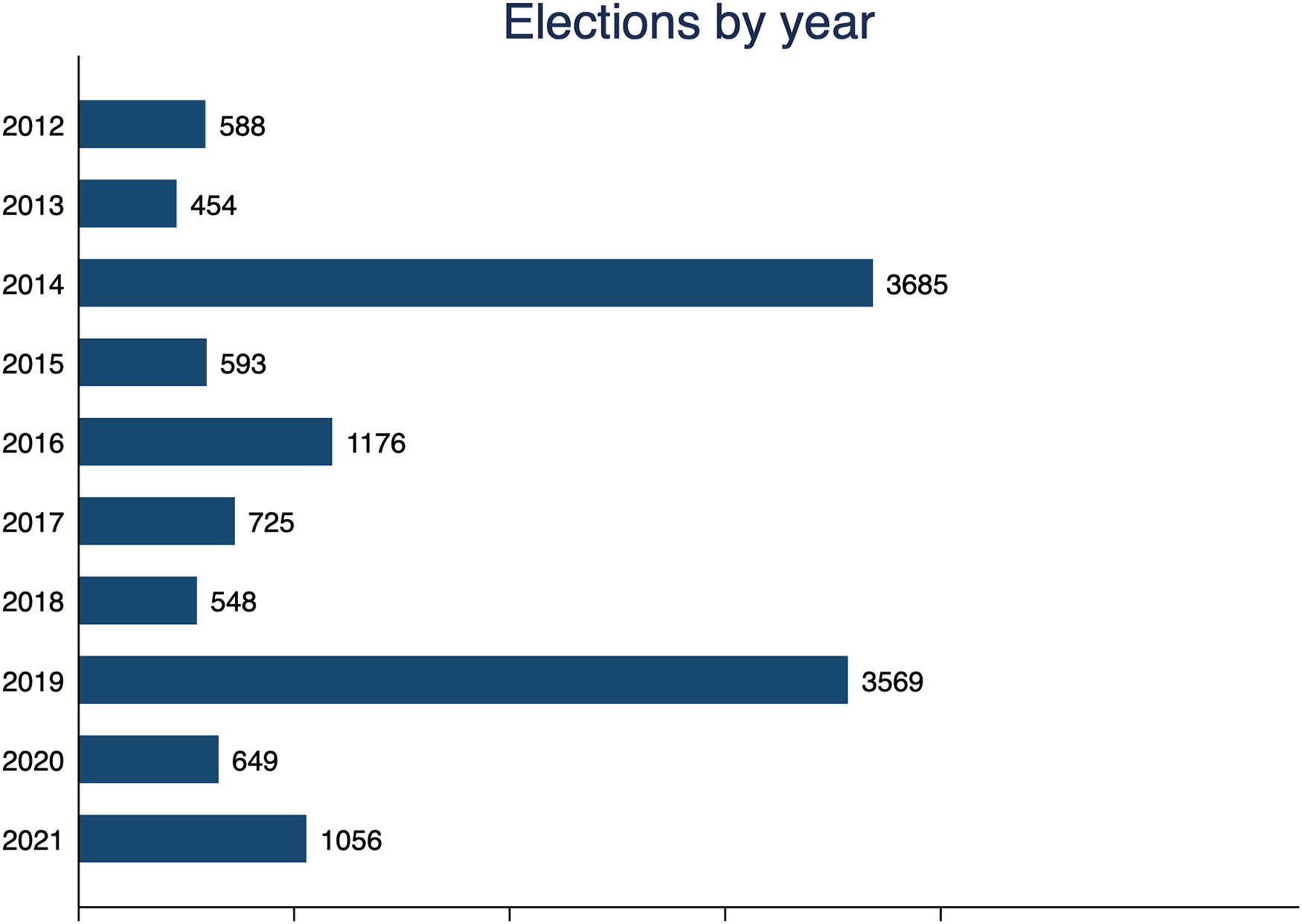
We are interested in the relationship between women’s representation in local councils and spending patterns. We measure women’s representation as the percent of women in each council. The Ministry of Internal and Territorial Affairs provides information about the composition of each local council at the end of each calendar year (https://dait.interno.gov.it/elezioni/anagrafe-amministratori), including information about the date when the council was elected and the population of the locality at the time of election. The treatment condition is determined based on the reported population. Local elections in Italy take place every five years and are scattered, with elections in every year covering different numbers of localities.Footnote 2 Figure 1 reports the annual number of municipal council elections.
The number of Italian local elections per year (2012–2021).

To create our dependent variable capturing spending behavior, we use spending data collected from municipal current accounts (bilanci consuntivi) (www.openbilanci.it). The Ministry of Interior revised its mode of calculations in 2016, making it difficult to compare aggregate expenditure items reported before and after 2016 (Andreoli et al. Reference Andreoli, Manzoni and Margotti2022). As the pre-2016 education data do not contain detailed information about spending on pre-primary education, which is essential for testing our theory, we focus our analysis exclusively on the period since 2016. Our dependent variable measures the amount of spending on preschool activities expressed as the percent of total spending in each locality each year. Therefore, the unit of analysis is the locality/year, and the dataset includes observations between 2016 and 2021.
An observational analysis of the relationship between women’s representation and spending patterns is fraught with endogeneity: voters in localities that elect large numbers of women likely also favor policies that have traditionally been associated with the presence of women in leadership positions. As such, one could argue that women-friendly policies and spending in localities with high women’s representation would have been implemented without high women’s representation by male councillors who are simply following public opinion.
To separate the effect of women’s representation from endogenous forces related to public opinion, a stronger identification strategy is needed. The Italian case provides such a strategy. Law 215 of 2012 requires that at least one-third of all candidates on each list be women. However, the law only applies to localities above 5,000 inhabitants, thus creating a discontinuity that we can exploit to insulate the effect of women’s representation. Our approach takes the form of a two-stage instrumental variable analysis depicted in Figure 2. In the first stage, we use the population discontinuity to predict women’s representation. We expect higher levels of women’s representation in localities just above the 5,000 threshold than in localities right below it. In the second stage, we use the exogenously driven variation in women’s representation to predict spending behavior.
The two-stage model.

The main assumption of instrumental variable analysis is the exclusion restriction, meaning that the instrument (gender quota) does not affect the dependent variable (spending) directly. Any relationship between the two should only happen through the intermediate variable (women’s representation). For instance, this assumption is violated if larger, more urban localities where the quota applies are more likely to spend on childcare because they have younger families that require such spending.
The use of the RD approach for the first stage analysis should mitigate such concerns and insure the validity of the exclusion restriction. By focusing on localities with populations just above and below the 5,000 person threshold, we can assume that these localities are similar with regard to all/most characteristics that may affect spending choices. What differentiates localities above and below the threshold is the implementation of the quota, so their assignment into the treatment or control categories can be considered as good as random. Any relationship between the treatment status and spending can be assumed to take place exclusively through women’s representation. Below, we provide some tests for the validity of the RD design (RDD).
Additionally, one might argue that members of local councils elected in localities where gender quotas apply may act differently than those where the quota does not apply. Previous research has argued that women elected under gender quotas are more likely to pursue the interests of women than women who are not (Wang Reference Wang2023). Such a scenario would threaten our exclusion restriction assumption. In the online Appendix 5, we address this issue, showing that there is no evidence of different behavior with regard to spending on preschool activities between local councillors elected in localities with the quota and those elected in localities without the quota.
RD design validation: the density of the running variable and balance
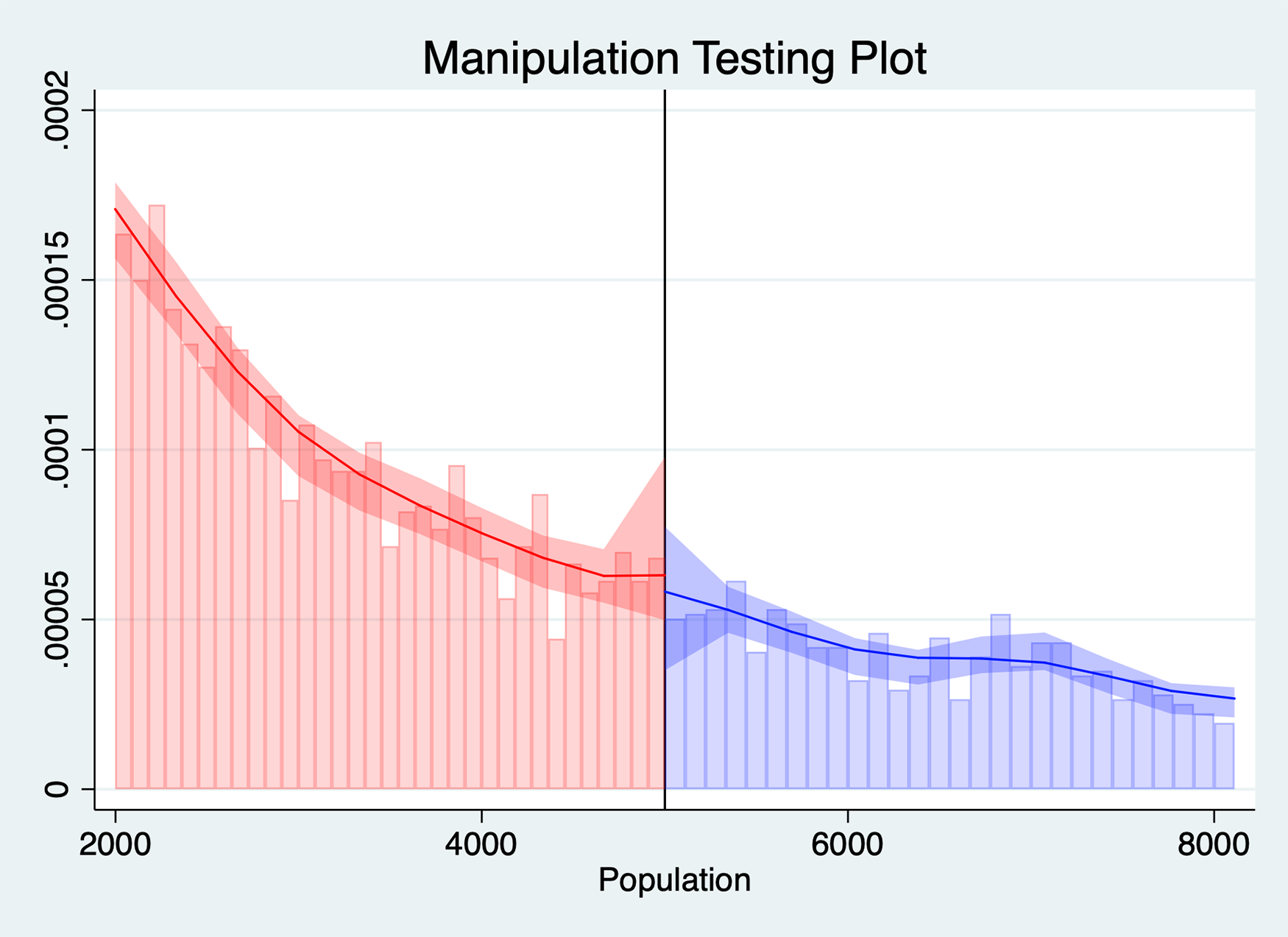
We first report the results of two important tests for design validation: density of running variable and balance. An important issue facing RDD analyses in which researchers use population thresholds is sorting around the threshold (Eggers et al. Reference Eggers, Freier, Grembi and Nannicini2018). Simply put, when the population of a locality changes between censuses enough to move the locality either below or above the threshold, authorities may be inclined to misreport these changes so that the rules at stake do not change. Such manipulation would pose a serious threat to the as-random assumption and implicitly to the validity of our estimates. To assess whether this is the case, we implement a test of the null hypothesis that the density of the running variable is continuous at the threshold (Cattaneo et al. 2018, Reference Cattaneo, Jansson and Ma2020). Intuitively, if authorities intentionally misreport the true size of the population to keep them just above or just below the threshold, one should see a surprising change in the distribution of the population around the threshold.
Based on the tests reported in Figure 3, we have no reason to believe there is manipulation at the threshold. While there appears to be a drop in population distribution at the threshold, the confidence intervals of the two lines (below and above threshold) overlap considerably. We can thus conclude that the internal validity of our design is not threatened by population manipulation around the threshold.
The population distribution of Italian localities.
Note: Results obtained using the rddensity command in Stata (Cattaneo et al. Reference Cattaneo, Jansson and Ma2018, Reference Cattaneo, Jansson and Ma2020).

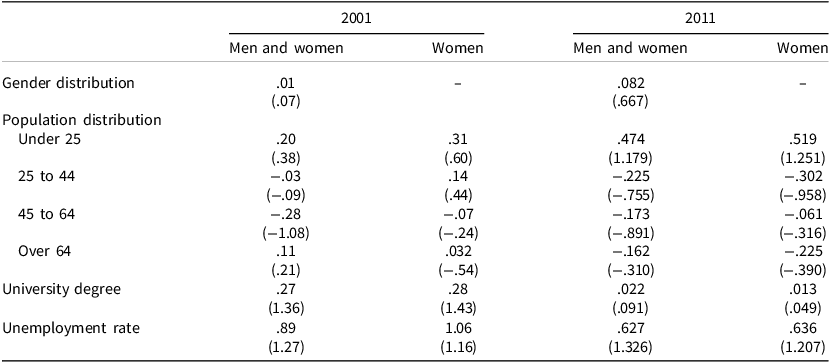
A key assumption of an RD design is that observations narrowly below and above the treatment threshold are similar on relevant pretreatment characteristics. To test this assumption, we look at four locality-level variables reported in the official 2001 and 2011 censuses (https://www.istat.it/notizia/basi-territoriali-e-variabili-censuarie/): gender distribution (ratio of men to women), age distribution, unemployment levels, and tertiary education.Footnote 3 For the latter three variables, we report results for the entire population as well as just women. The estimates in Table 1 are analyses using a continuity-based RD specification with 5,000 population threshold in which each covariate is plugged in separately as the dependent variable. These continuity-based results show no evidence of a jump at the treatment threshold for any of these variables.
RD estimates of various covariates on population

Notes: z-statistics are in parentheses; continuity-based results with data-driven bandwidth using the algorithm are proposed in Calonico et al. (Reference Calonico, Cattaneo and Titiunik2014).
Additionally, our RD analyses may be subject to compound treatment, as the 5,000 population threshold is associated with other policies (Andreoli et al. Reference Andreoli, Manzoni and Margotti2022). We address this issue in online Appendix 3, where we show that there is no reason to believe that our inferences are threatened by compound treatment.
Results
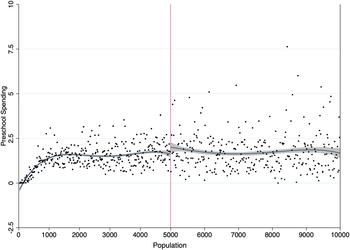
Before reporting the results of the two-stage analysis, we graph the dependent variable against the locality population in Figure 4. The graph suggests a high jump in spending on preschool activities at the population threshold, but the two confidence intervals slightly overlap.Footnote 4
Relationship of population, treatment status, and spending on preschool.
Note: The lines are spline fourth-order polynomial fits obtained with the rdplot command in Stata (Calonico et al. Reference Calonico, Cattaneo and Titiunik2015).

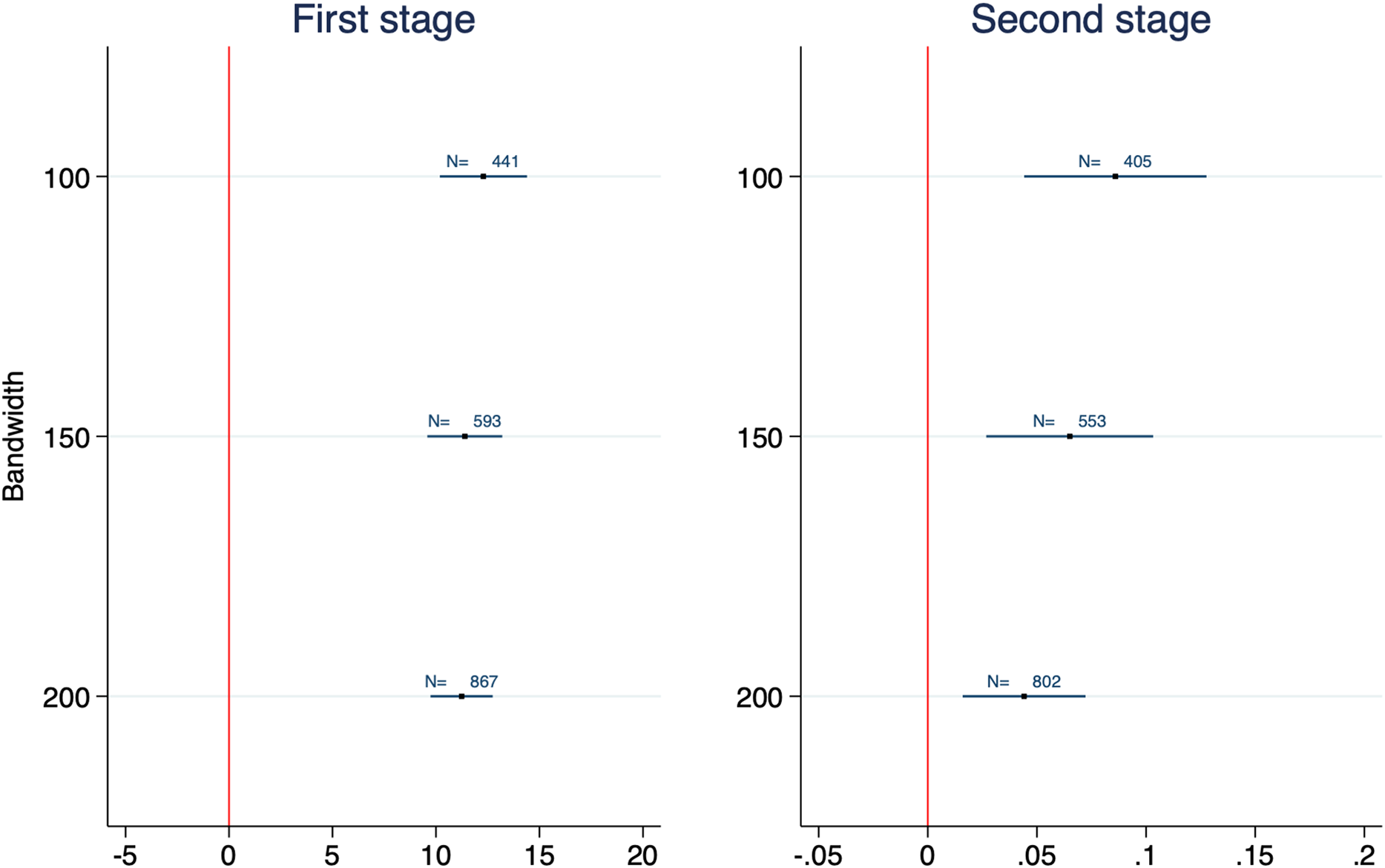
While the graph in Figure 4 suggests higher levels of spending on preschool activities in localities just above the 5,000 population threshold, here, we further investigate this relationship by focusing on the role of our intermediate variable, women’s participation in local councils. In Figure 5, we report the results of the two-stage ordinary least squares (OLS) analyses with limited samples that include localities with populations within three population bandwidths around the threshold: 100, 150, and 200. The results graphed in the left-hand panel (first stage) confirm the expected relationship between the gender quota and the election of women in Italian local councils. Depending on the selected bandwidth, a local council above the threshold has between 9.7% and 11.5% more women than a council below the threshold.
The effect of women’s representation on preschool spending in Italian municipalities: two-stage instrumental variable models.
Notes: Two-stage OLS instrumental variable analyses. The difference in sample sizes between the two stages comes from a lack of preschool spending data in some localities/years.

The second-stage analysis considers whether the exogenously driven variation in women’s representation in local councils leads to more spending in preschool activities. The results graphed in the right-hand panel confirm the hypothesized causal relationship between women’s representation and spending on preschool-related activities. In our sample, mean spending on preschool activities is roughly 2% of total spending, while the average council size is 13. In substantive terms, since the estimated increase in women’s representations to Italian municipal councils as a result of the gender quota is approximately 10% (at the 150 bandwidth), this should result in an average pre-primary education spending increase of roughly 0.65 percentage points – or roughly one-third – in municipalities where the gender quota was applied. Based on our calculations (Appendix 7), this spending would add an average of 10 extra daycare places in privately run daycares or 4 extra places in state-run daycares.
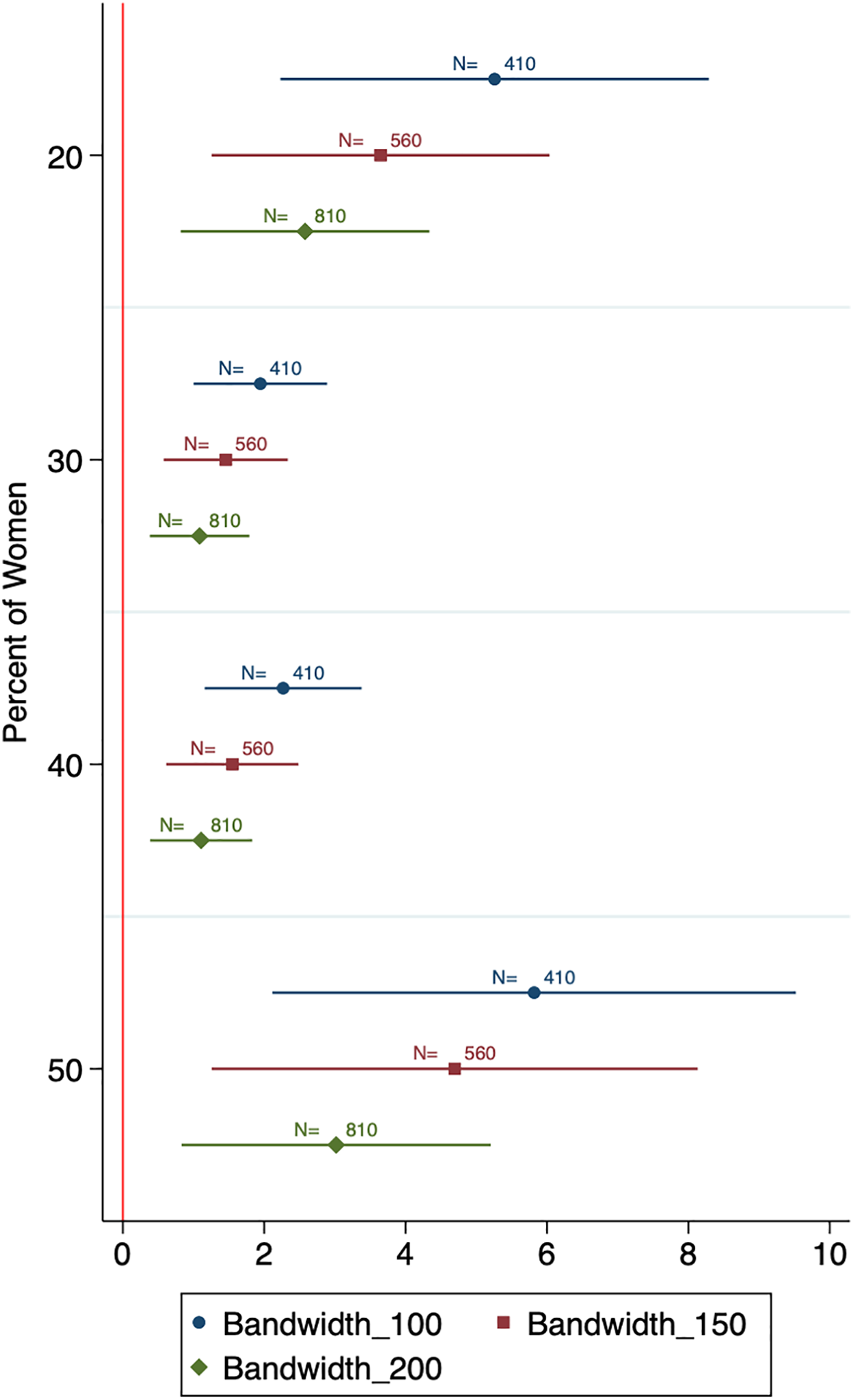
To account for the possibility of a critical mass argument, such as quota ‘shocks’ as argued by Clayton and Zetterberg (Reference Clayton and Zetterberg2018) or the power of women’s majority representation argued by Karpowitz and Mendelberg (Reference Karpowitz and Mendelberg2014), we test whether women’s representation is more likely to influence spending when this representation reaches certain levels. To do so, we re-run the main analysis, but we replace our intermediate variable (women’s representation) with a series of dummy variables separating localities above a certain level of representation from localities below that level. The local treatment effects (second stage analysis) are reported in Figure 6. The X-axis in Figure 6 denotes the thresholds. For instance, the effect next to the 40 value on the X-axis comes from the regression in which the intermediate variable distinguishes between local councils with women’s representation above 40% (score of ‘1’) and local councils with women’s representation under 40% (score of ‘0’).
The effect of women’s representation on preschool spending: two-stage instrumental variable models with representation thresholds.

Our approach raises some concerns about degrees of freedom at high and low thresholds of women’s representation, an issue that is exacerbated by our focus on a small number of localities above and below certain population thresholds. For instance, when using the 100 population bandwidth, there are only 14 local councils out of 447 with female representation below 10%, and 10 local councils with representation above 60%, making it difficult to establish meaningful relationships. As such, in Figure 6, we report the local treatment effects for regressions with representation dummies between 20% and 50% only.Footnote 5 Results with lower and higher levels of representation are reported in Appendix 6.Footnote 6 The results graphed in Figure 6 suggest a curvilinear pattern, with the relationship more pronounced when women occupy a smaller (i.e., 20%) or larger (i.e., 50%) percentage of the council’s seats. This curvilinear relationship suggests that especially where a quota’s implementation may substantially boost women’s representation to parity with men’s, this cross-cutting policy is more likely to receive higher levels of funding. While the pattern is an interesting one, the reader should treat these results with caution because of the degrees of freedom concerns raised above.
Confirming the specific influence of the increase in pre-primary expenditure
What if the increase in pre-primary expenditure is not an indication of the cross-spectrum appeal for women of this specific policy but instead reflects a broader commitment to general spending, welfare spending, or spending on a wider range of women’s interests? Without examining other dependent variables of various spending categories as a proportion of total expenditure, it is not possible to rule out three alternative explanations. First, pre-primary education spending increases may signal wider, more welfare-oriented shifts in policymaking and resourcing: if women’s descriptive representation has increased predominantly with increases in the election of Left-oriented parties, perhaps the pre-primary education spending increase is not suggestive of advancing a cross-spectrum women’s policy interest so much as a wider governing party/coalition commitment to greater redistribution. Second, pre-primary education spending increases may signal that there are wider women’s interest similarities than previously thought: if women’s descriptive representation has also led to a decrease in spending on a traditionally masculine-associated policy area, such as security and policing, perhaps the pre-primary education spending increase indicates that women hold greater shared interests about where to make spending cuts to fund pre-primary education. Third, pre-primary education spending increases may reflect an increased propensity to spend more generally and across multiple issue areas that have a limited theoretical or evidentiary relationship to gender – such as energy policy or the environment – supporting an argument that spending changes occurred irrespective of changes in women’s descriptive representation.
If the first alternative explanation is correct, proportional pre-primary education spending increases should be similarly reflected in proportional education, social, and labor policy spending increases. If the second alternative explanation is correct, proportional pre-primary education spending increases should be similarly reflected in proportional policing spending decreases. If the third alternative explanation is correct, proportional pre-primary education spending increases should be similarly reflected in proportional spending increases in total spending, on environmental policies, and on energy policies.
To ascertain these alternative mechanisms, we re-run the main models with seven different dependent variables measuring municipal spending in the following budget categories: (1) Total spending per capita (Total spending); (2) Energy and diversification of energy sources (Energy); (3) Sustainable development and protection of territory and the environment (Environment); (4) Primary and secondary education (Education); (5) Policies for labor and professional development (Labour); (6) Public order and safety (Police); and (7) Social rights, social policies, and family (Social). All variables except Total spending are expressed as a percentage of total yearly spending.
In Figure 7, we report the results of the second-stage analyses with all additional dependent variables, together with the results of tests with our original dependent variable, preschool spending.Footnote 7 To allow for a better comparison, all dependent variables have been standardized to have a mean of ‘0’ and a standard deviation of ‘1’. While most of the effects from the additional tests are positive, they are generally not statistically significant.Footnote 8 We can therefore rule out the alternative explanations about the mechanisms connecting women’s representation and spending on preschool activities.
The relationship between women’s representation in Italian local councils and spending levels in various policy areas.
Notes: Two-stage instrumental variable models with robust standard errors clustered by locality and standardized dependent variables. The graphs report the average local treatment effect together with 95% confidence intervals.

In the online Appendix, we report additional tests that confirm and strengthen our main finding. First, we run a series of placebo tests in which we artificially change the population threshold. Second, we conduct a so-called donut-hole analysis, in which we remove observations very close to the threshold to be sure that the main results are not driven by these observations. Third, we address the issue of compound treatment, as the 5,000 population threshold is also associated with a jump in mayors’ salaries. We show that there is no evidence of a relationship between a mayor’s salary and spending on preschool.
Conclusion
Our results underscore a clear relationship between women’s descriptive and substantive representation: where more women are elected to Italian municipal councils, municipal funding is increasingly spent on pre-primary education. By focusing on a specific policy issue and spending area – pre-primary education – that disproportionately affects women of child-bearing age, we show that women may represent women’s interests when the issue is one that affects women in a way that is relatively universal regardless of their individual partisanship or ideology. In choosing a less controversial issue than reproductive rights or equal pay, and a more specific issue than ‘social welfare’ or general ‘education’, we are able to pinpoint how women might represent women when there are few barriers to perceiving a shared and collective concern. Our method allows us to identify the causal nature of this relationship.
Additionally, our findings complement existing scholarship and policy advocacy aimed at unpacking the relationship between women’s representation and family–work policy spending patterns. As Weeks (Reference Weeks2022) convincingly shows, gender quotas provide the opportunity for a change in women’s substantive representation when the increase in women’s descriptive representation occurs across the political spectrum and involves a policy issue with cross-cutting appeal. Our findings confirm this theoretical logic, and our results within the Italian municipal context highlight two additional important aspects of the relationship between women’s descriptive and substantive representation. First, the logic extends to and perhaps is even easier to appreciate where policy issues are decided and funded below the level of the national government. In these more local spaces, women’s voices may actually further amplify their advocacy on specific policy issues and funding decisions because the gendered institutional constraints of the national level are absent or moderated. Second, the cross-cutting salience of gendered issues is perhaps even easier to appreciate when the salience is not only ideological but also represents a truly pragmatic consideration. For local councillors who often do not hold salaried positions and for whom available childcare is essential to carrying out their work as councillors, the issue of balancing work and family is not just theoretical but also a fact of daily life. Even for salaried national legislators, caring responsibilities and work–family balance remain an important and highly gendered issue in the context of both representational and campaign pressures (e.g., Allen et al. Reference Allen, Cutts and Winn2016; Teele et al. Reference Teele, Kalla and Rosenbluth2018).
Finally, from a policy standpoint, our findings point to a potential solution for countries struggling with low birthrates and an aging population, such as Italy. While various factors influence the reconciliation of caring responsibilities and women’s labor force participation, such as the quality of government institutions and the presence of corruption at subnational levels (Giannantoni and Rodríguez-Pose Reference Giannantoni and Rodríguez-Pose2025), the policy solutions and resources needed to combat poor-quality governance are substantial and take time. In recent decades, most OECD countries, alongside others such as China and Turkey, have perceived the pressing need to quickly combat slow population growth because of birthrates of fewer than two children per woman, which is the level needed for population replacement and capable of supporting an extensive welfare state. People of child-bearing age typically say they desire more children than they plan to have (Beaujouan and Berghammer Reference Beaujouan and Berghammer2019), and a commonly cited justification for having fewer or no children is the cost of childrearing. A range of policy interventions have been debated and some undertaken in different countries, including offering financial subsidies for multiple births, increasing flexible working arrangements and expansions to parental leave, and providing interest-free loans to couples having multiple children. Yet, in Italy and many other countries, traditional gender norms and gender inequality often limit the introduction of policies designed specifically to alleviate pressures on working mothers or to enable women to return to/remain in the workforce, despite the fact that this would directly contribute to offsetting costs of child that prevent people from having their desired number of children.
Offering publicly funded (and provided) pre-primary education provides a critical solution to this problem by giving working-aged mothers the opportunity to return to the workforce at a much earlier stage of a child’s life. This has the ability to reduce both the short- and long-term effects of childrearing in the cost calculus of would-be parents. The provision of pre-primary education can reduce the immediate costs for mothers, who no longer have to make the trade-off between having a child and engaging in paid employment outside the home until their child is old enough to attend primary school. This may also have spillover effects to the lifetime earning potential of mothers, who are no longer required to forfeit many years of experience and tenure in full-time paid employment outside the home. It is traditionally a mother’s earnings – both immediate and longer-term – that are most directly affected by the shift in provision of publicly provided pre-primary education. As a policy solution to low birthrates, the long-term effect represents a secondary outcome that makes pre-primary education provision more compelling than other financial incentives that do not positively alter the lifetime earning potential of parents. Given the ability of women’s earning potential to be augmented by this particular policy solution to low birthrates, it is perhaps unsurprising that it emerges as a result of the election of more women across the political spectrum. However, reaching the point where this type of policy is adopted takes an increase in women’s political representation that rarely occurs by chance or without additional intervention. For countries battling low birthrates, the implementation of electoral gender quotas may prove a key driver in the adoption of vital policies that can combat low birthrates while continuing to include women in the labor force.
Supplementary material
The supplementary material for this article can be found at https://doi.org/10.1017/S1475676526101212
Data availability statement
Data and replication code for all analyses included in the text and supplemental materials are available at the publicly available OSF Registry at https://osf.io/A76sj/.
Acknowledgments
We would like to thank Amanda Clayton for helpful feedback on an earlier draft of the manuscript. All remaining errors are our own.
Funding statement
There are no funders to disclose or acknowledge.
Competing interests
There are no conflicts of interest to declare.
Ethical standards
No analysis relies on human subjects data.



 Open access

