


1. Introduction
The rising energy demand of industrial processes leads to increasing thermal loads on components and systems (Reference van Heddeghem, Lambert, Lannoo, Colle, Pickavet and Demeestervan Heddeghem et al., 2014), which represent a dominant load case in many applications and require advanced geometric solutions for efficient energy conversion, transfer, and dissipation (Reference Osman, Mehta, Elgarahy, Hefny, Al-Hinai, Al-Muhtaseb and RooneyOsman et al., 2022). Improving thermal management increases system load capacity and extends component service life, making it a key objective in modern engineering design (Reference Rao, Lyu, Du, He, Huo and LiuRao et al., 2022).
Current research and development activities therefore focus on enhancing heat transfer efficiency within the limited installation space of heat exchangers (HX). A central design objective is the maximisation of compactness, defined as the ratio of heat transferring wall surface area to component volume in m2/m3. Compact heat exchangers (CHX) typically exhibit compactness values exceeding 200 to 700 m²/m³ (Reference Oh, An, Seo, Kim, Park and ParkOh et al., 2023; Reference ZohuriZohuri, 2017). The design of CHX aims to maximise the available heat transferring surface within a given design space, largely independent of the structural configuration used. In conventionally manufactured plate and lamella HX, further increases in compactness are mainly achieved by reducing wall thickness and are ultimately limited by manufacturing constraints (Reference Guo, Li, Zhai and WangGuo et al., 2024; Reference ZohuriZohuri, 2017).
Additive manufacturing has significantly expanded the geometric design freedom for HX, enabling complex internal structures that are not feasible with conventional production methods (Reference Holtzhausen, Seidler, Scheithauer, Schwarzer-Fischer, Wiemer and PaetzoldHoltzhausen et al., 2023; Reference Scheithauer, Kordaß, Noack, Eichenauer, Hartmann, Abel, Ganzer, Castro Gómez and Manuel Velázquez FloresScheithauer et al., 2019; Reference Seidler, Holtzhausen, Sander and Paetzold-ByhainSeidler et al., 2023). As a result, recent studies have increasingly focused on lattice like (Reference Meyer, Kahlfeld, Messmann, Oel, Stauss, Kabelac and LachmayerMeyer et al., 2025) and cellular structures, with particular attention given to Triply Periodic Minimal Surfaces (TPMS) (Reference Gado, Al-Ketan, Aziz, Al-Rub and OokawaraGado et al., 2024). TPMS are defined by a mean curvature of zero at every surface point, meaning that local convex and concave curvatures are balanced across the entire surface.
TPMS structures were first described in the late nineteenth century (Reference SchwarzSchwarz, 1890; Reference NeoviusNeovius, 1883), and more than one hundred distinct TPMS geometries are now known (Reference Gado, Al-Ketan, Aziz, Al-Rub and OokawaraGado et al., 2024; Reference Wakjira, Cioni and LemuWakjira et al., 2025). Their high specific surface area, open porous morphology, and geometric symmetry make them particularly suitable for heat transferring wall applications. The complex labyrinth like geometry increases the available surface area for heat transfer and extends fluid flow paths, which enhances thermal performance (Reference Wang, Sun, Zeng, Wang and ChengWang et al., 2024). Previous research has primarily focused on the analysis and optimisation of individual TPMS structures for HX applications (Reference Jiang, Hu, Wang, Lei, Luo and LiuJiang et al., 2023; Reference Oh, Kim, Jang, Kim, Park and ParkOh et al., 2025). Among the most prominent TPMS cell types are the gyroid, diamond, Schwarz, and Fischer Koch S structures (Reference Yeranee and RaoYeranee & Rao, 2022). These geometries are defined by comparatively simple level set equations and form bicontinuous channel networks without isolated pores or dead ends. The effectiveness of TPMS based heat transferring surfaces is exemplified by gyroid structures, for which compactness values of 570 m²/m³ have been reported, corresponding to a 108 percent improvement over conventional plate HX (Reference Röver, Kuehne, Bischop, Clague, Bossen and EmmelmannRöver et al., 2023).
Despite their thermal advantages, TPMS based HX face significant manufacturability challenges. TPMS geometries inherently contain overhanging surface regions that can cause defects or leakage when produced by additive manufacturing processes such as powder bed fusion laser beam melting (Reference Liu, Cheng, Oo, McCrimmon and BaiLiu et al., 2024; Reference Peng, Gao and HuPeng et al., 2019). In this process, surfaces inclined below approximately 40 degrees relative to the build plate exhibit insufficient heat dissipation during the manufacturing process, leading to local overheating, unintended powder melting, increased residual stresses, and surface bulging, which collectively degrade surface quality and disrupt subsequent layer deposition (Reference Viale, Stavridis and SalmiViale et al., 2022). The use of support structures to mitigate these effects is not feasible for internal flow channels because they cannot be removed after fabrication and would significantly increase flow resistance. While TPMS geometries provide partial mitigation due to their intrinsic self-supporting characteristics (Reference Chouhan and GunjiChouhan & Gunji, 2023), manufacturing defects remain common, particularly at small wall thicknesses, resulting in increased surface roughness and reduced thermal and hydraulic performance (Reference Röver, Kuehne, Bischop, Clague, Bossen and EmmelmannRöver et al., 2023). Consequently, the design of metallic TPMS cellular structures requires careful minimisation of overhang critical surface areas. In this context, the superposition of TPMS cells alters the local distribution of heat transferring surface area within overhang regions and thereby directly influences manufacturability and thermal performance.
Most existing studies have focused on homogeneous TPMS structures optimised within a single cell type (Reference Attarzadeh, Attarzadeh-Niaki and DuwigAttarzadeh et al., 2022; Reference Jiang, Hu, Wang, Lei, Luo and LiuJiang et al., 2023; Reference Oh, Kim, Jang, Kim, Park and ParkOh et al., 2025) or on the combination of two homogeneous cell types within a structure (Reference Yang, Quan, Zhang and TianYang et al., 2014). In contrast, the systematic integration and superposition of different TPMS cell types to create hybrid unit cell architectures has received little attention. Such an approach has the potential to increase the heat transferring surface area while simultaneously reducing unfavourable overhang regions. Furthermore, combining distinct TPMS geometries may expand the available design space and enable multidimensional optimisation with respect to functionality, manufacturability, and structural morphology. These relationships have not yet been quantified and therefore represent an open research question addressed in this work.
The objective of this study is to analyse the influence of superposing different TPMS cell types on the heat transferring wall surface area and on overhang critical regions. Within a target conflict optimisation framework, optimal TPMS superpositions are identified that balance maximum functional performance, defined by the heat transferring surface area, with high manufacturability, defined by minimal overhang critical surface areas. The study demonstrates the potential of this approach to enhance both the thermal performance and manufacturability of CHX. A geometric analysis is conducted for three prominent TPMS structures, the gyroid, Schwarz, and diamond, using a constant unit cell size of 5 mm. Systematic parameter studies are performed to evaluate functional and manufacturing relevant properties, with the aim of identifying novel geometric combinations that offer combined thermal and manufacturing advantages.
2. Material and methods
2.1. Geometry synthesis
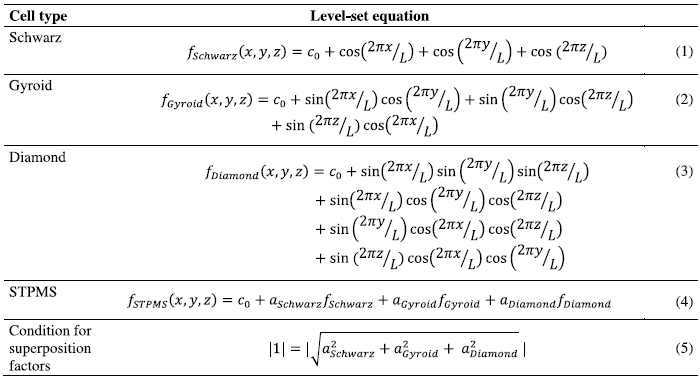
The software nTop (nTop, 2025) is utilised for geometry synthesis. The geometries of the Triply Periodic Minimal Surfaces (TPMS) are described using a level set method via trigonometric functions in Cartesian space. The present work focuses on the superposition of the three most frequently studied TPMS structures. The equations that describe the Schwarz-P TPMS (Equation 1), the Gyroid TPMS (Equation 2), and the Diamond TPMS (Equation 3) are listed (Table 1). The selection of these three cell types was made on the basis of the Schwarz-P TPMS being characterised by low pressure losses, a high specific surface area, and a simple geometric shape (Reference Si, Sun, Zhang, Wang and ChengSi et al., 2025). The gyroid TPMS is considered the most frequently studied structure in research (Reference Yeranee and RaoYeranee & Rao, 2022). Its defining characteristics are high compactness, a favourable ratio of mechanical strength to mass, and good manufacturability due to self-supporting effects in overhang areas (Reference Liu, Cheng, Oo, McCrimmon and BaiLiu et al., 2024). Furthermore, the complex curved surfaces induce secondary flows in the fluid stream, which have a positive effect on thermal energy transfer. The diamond TPMS has been described in various studies (Reference Attarzadeh, Rovira and DuwigAttarzadeh et al., 2021; Reference Liu, Cheng, Oo, McCrimmon and BaiLiu et al., 2024; Reference Röver, Kuehne, Bischop, Clague, Bossen and EmmelmannRöver et al., 2023) as having particularly advantageous thermodynamic properties due to its high compactness and complex fluid flow through the structure. In a multitude of comparisons (Reference Gado, Al-Ketan, Aziz, Al-Rub and OokawaraGado et al., 2024; Reference Gao, Qu, Ding, Liu and SongGao et al., 2023; Reference Yeranee and RaoYeranee & Rao, 2022), it is consequently regarded as one of the most appropriate wall geometries for heat transfer applications. For these reasons, the effect of superposition is investigated using the Schwarz, Gyroid, and Diamond TPMS cells as representative examples. In the superimposed TPMS (STPMS) formulation (Equation 4), the individual TPMS functions are multiplied by weighting factors and subsequently combined. The superposition is parameterized by the factors aSchwarz, aGyroid, and aDiamond, each ranging from −1 to 1. These factors are subject to a normalization constraint that fixes the combined magnitude of the weighting vector to unity (Equation 5). This constraint removes the inherent scaling ambiguity of the superposition, since uniformly scaled factor sets yield identical TPMS geometries at a fixed isovalue. As a result, the investigation is restricted to a normalized parameter space in which only the relative contributions of the individual TPMS structures are varied, thereby avoiding redundant descriptions of identical geometries.
Level-set equations of TPMS

All TPMS structures use the same isotropic cell size, fixed at
 = 5 mm, since the analysis focuses solely on the effects of superposition on heat-transferring surface area and overhang proportion. The wall thickness is intentionally excluded, as the evaluation is based on the geometric fluid–surface description. Therefore, the offset constant
 , which is related to the wall thickness, is set to zero. The present investigation employs skeletal TPMS geometries to isolate the effects of topology and superposition. Unlike sheet-based TPMS, which introduce wall-thickness–dependent geometric coupling, skeletal TPMS enable a clearer interpretation of the structural response to variations in TPMS cell superposition.
The boundary geometries of the individual and superimposed cells are illustrated (Figure 1). In addition to the Schwarz TPMS (Figure 1, red), the Gyroid TPMS (Figure 1, green), and the Diamond TPMS (Figure 1, blue), the superposition of all three structures (Figure 1, yellow) are illustrated using exemplary parameter sets.
Illustrative representation of the boundary geometries of the STPMS

2.2. Geometry analysis
Depending on the TPMS, the space is invariably divided into two approximately symmetrical volumes. Subsequently, geometric analysis is performed on one of the two resulting fluid volumes. The heat-transferring wall surface AHX between the partial volumes is determined using a discrete, surface-describing triangular mesh. In addition, the overhang-critical area proportion AOH of the heat-transferring surface is determined using an angle field α (Figure 2). Here, a conservative definition is employed, whereby all area proportions exhibiting a downskin angle between 0° and 45° are designated as overhang (Figure 2, red). In addition to the absolute value, the relative surface area AOHrel is also determined, defined as the ratio of AOH to AHX. This enables the manufacturing-related aspect represented by AOH to be evaluated in relation to the total heat-transferring wall surface.
Visualization for determining the surface area in the overhang region (downskin zone), exemplified by a STPMS (aSchwarz = -0.25; aGyroid = -0.6124; aDiamond = 0.75)

It should be noted that the present study constitutes a topology-driven analysis focused on the superposition of TPMS cell types. Although the downskin surface fraction is evaluated relative to a fixed build direction, the cell orientation itself is neither varied nor optimized. Build orientation is thus treated as an external process parameter rather than an intrinsic geometric property, which represents a deliberate limitation of the present analysis.
2.3. Optimization
The sample-based response surface method is applied in a multi-stage investigation to analyse and optimise the superposed TPMS structures. Latin hypercube sampling (LHS) is utilised to ensure a stochastic and space-filling exploration of the design space. In order to parameterise the superposition, the three weighting factors
 corresponding to the Schwarz, Gyroid, and Diamond components are represented on the surface of a unit sphere. This guarantees that each combination satisfies the constraint defined in (Equation 4, 5). Two normalized metaparameters, u1 and u2, are sampled via LHS and transformed into spherical coordinates φ and θ (Equations 6, 7). The individual superposition factors are then obtained through equations (Equations 8 - 10), yielding a valid superposition vector for every generated sample. For each design sample, the geometric quantities relevant to functional and manufacturing evaluation are subsequently computed. These are AHX, AOH and AOHrel. The distribution of characteristic values on the spherical design space is visualised using colour-coded maps in order to identify correlations and local optimisation tendencies.
Sensitivity analysis was performed in Ansys OptiSLang 2024R2 (Ansys Inc., 2024). Interpolated response surfaces (RS) were constructed using isotropic kriging to approximate parameter–response relationships. A coefficient factor of 1 was applied to ensure sufficient sample support and reduce overfitting. The resulting surrogate models enabled detailed evaluation of parameter influence and interaction across the design space.
Moreover, the optimal superpositions are identified for varying weightings between functionality (maximisation of AHX) and manufacturability (minimisation of AOH). For this purpose, the weighted evaluation function according to (Equation 11) is utilised. This combines the normalized heat transfer surface
 and the inversely normalized overhang-critical area proportion
 for all design samples
 . The inverse normalization ensures that a lower overhang-critical area proportion is assigned a higher utility value, thereby ensuring that both criteria have the same preferred direction in the maximization.


3. Results
The LHS was utilised to generate a total of 600 design samples, thereby ensuring sufficient density for the development of reliable surrogate models. As the sampling procedure was conducted employing spherical coordinates, the outcomes of AHX (Figure 3a), AOH (Figure 3b) and AOHrel (Figure 3c) are exhibited through the utilisation of colour-coded maps on a spherical surface with a radius of 1.
Distribution of a) AHX, b) AOH and c) AOHrel over the spherical design space

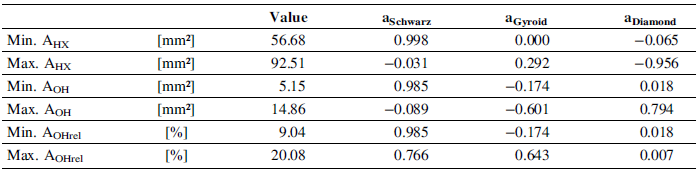
The extreme values of the target dimensions were determined based on the calculated samples, and the corresponding superposition factors are summarised (Table 2). The maximum heat transfer surface AHX are achieved with a dominant diamond structure a Diamond = −0.956, while aSchwarz and aGyroid make only minor contributions. Conversely, the lowest overhang-critical surface areas, AOH and AOHrel, are observed in a distinctly Schwarz-dominated combination, a Schwarz = 0.985. The largest AOH results from a strongly diamond-dominated structure with a negative contribution from aGyroid, while the maximum AOHrel is achieved with almost equal weighting of aSchwarz and aGyroid.
Minimal and maximal values of the design samples and the contributing superpositioning factors

The findings thus far demonstrate that the extreme values of the geometric parameters under consideration occur when all three TPMS cells are superimposed. In order to quantify the influence of the individual superposition parameters on the AHX, AOH, and AOHrel values, a sensitivity analysis was performed based on the sampled data. The underlying dependencies were determined by applying isotropic Kriging for response surfaces (RS) modelling to reveal both local and global trends in the parameter space (Figure 4).
Response surfaces (CoPave = 0.97) showing the relationships between aSchwarz and aDiamond for a) AHX, b) AOH, c) AOHrel, and between aGyroid and aDiamond for d) AHX, e) AOH and f) AOHrel

The RSs demonstrate clear nonlinear dependencies between the superposition factors and the target variables. It was determined that linear sensitivity measures were inadequate in capturing the relationships; therefore, distance correlation was employed as a sensitivity measure. In contradistinction to linear correlation measures, distance correlation facilitates the robust capture of both linear and nonlinear relationships. Consequently, distance correlation is particularly well-suited to the evaluation of complex, nonlinear design relationships, such as those encountered in STPMS. However, distance correlation only quantifies the magnitude of influence and not its direction, necessitating additional measures for directional sensitivity analysis, which is why the RSs were additionally used to assess the directional trends within the parameter space.
For the heat-transferring wall surface AHX, the parameter aSchwarz exerts the most significant influence (0.46), followed by aDiamond (0.35) and aGyroid (0.22). The nonlinear dependencies of AHX were visualized through RSs constructed for (aDiamond, aSchwarz) (Figure 4a), and (aDiamond, aGyroid) (Figure 4d). The influence of aSchwarz and aDiamond on the critical area AOH is nearly identical (0.35), while aGyroid has a slightly lower influence (0.30). The corresponding parameter-response relationships are illustrated in the RS for (aDiamond, aSchwarz) (Figure 4b) and (aDiamond, aGyroid) (Figure 4e).
For the relative overhang area proportion AOHrel, the influence ratios shift markedly. The parameter aGyroid exerts the strongest influence (0.39), followed by aDiamond (0.29). In contrast, the aSchwarz demonstrates the least impact (0.19). These relationships are visualized in the RS for (aDiamond, aSchwarz) (Figure 4c) and (aDiamond, aGyroid) (Figure 4f).
The RS (Figure 4) illustrate the pronounced nonlinear relationships between the superposition parameters and the geometric target variables examined. In the design of CHX, the fulfilment of functional requirements is typically prioritised, particularly through the implementation of a large AHX. Manufacturability limitations caused by large downskin areas (Figure 2) are commonly addressed retrospectively, leading to repeated design iterations. In order to address both requirements simultaneously, the optimal parameter combinations were determined in addition to the results in the discrete optimization space according to equation (Equation 11), taking into account both functionality and manufacturability. It is demonstrated (Figure 5) that varying the weighting factor in five increments results in a total of four optimal superimposed cell designs. The cell colour in Figure 5 corresponds to the weighting factor
 between functionality and manufacturability.
Optimal cell geometry for weighted consideration of functionality and manufacturability

Figure 5 Long description
The table presents a comparison of different cell geometries for weighted consideration of functionality and manufacturability. It includes four panels, each representing a different geometry with associated parameters. Each panel contains a 3D structure and a set of values. The columns are labeled with parameters such as a_Schwarz, a_Gyroid, a_Diamond, A_HX, A_OH, and A_OHrel. The rows are labeled with different values of w. Panel A: w ranges from 0 to 0.25. Panel B: w is 0.5. Panel C: w is 0.75. Panel D: w is 1. Each panel shows the corresponding values for a_Schwarz, a_Gyroid, a_Diamond, A_HX, A_OH, and A_OHrel. The table also includes a color gradient bar indicating manufacturability and functionality.
It is evident that, when greater consideration is given to manufacturability (w < 0.5), the optimum result is a specific superposition combination (Figure 5 blue/purple cell). However, by taking functionality into equal or greater consideration (w ≥ 0.5), a diamond-dominated cell design of the optimal STPMS is achieved, due to the greater weighting of AHX.
4. Discussion
The superposition of the three TPMS structures has been demonstrated to enhance both the heat transferring surface of the unit cells and the reduction of overhang-critical surface areas. As illustrated (Figure 3), the use of spherical representations demonstrates that a significant predominance of the aSchwarz over the aDiamond and aGyroid results in structures characterised by low AHX and low AOH. This finding is supported by the RS (Figure 4a-c). As demonstrated (Figure 4a), an increase in aSchwarz results in a substantial decrease in AHX. This effect exhibits a pronounced increase for values of aSchwarz exceeding 0.5. Accordingly, the sensitivity analysis is based on a direction-independent distance correlation, and thus only the RS provides information about the direction of these influences. It is demonstrated that a high aSchwarz proportion is associated with a functional disadvantage, which is reflected in the weighted optimisation. This is evidenced by the observation that, with a functional weighting w ≥ 0.5, aSchwarz approaches a value range close to zero (Figure 5).
Conversely, an elevated aSchwarz fraction has been demonstrated to enhance manufacturability. This phenomenon is demonstrated in the RS for AOH and AOHrel (Figure 4b, c) through the presence of a minimum for parameter combinations with aDiamond close to zero and small fractions of aGyroid, which consequently leads to a maximum aSchwarz fraction as a result of the boundary conditions imposed by the normalized superposition. Consequently, manufacturability can be enhanced in a targeted manner by increasing aSchwarz, although this is often at the expense of functional design freedom. This phenomenon is also evident in the weighted optimization, as the optimum converges to a design with a high aSchwarz ratio from w ≤ 0.25 onwards. However, aSchwarz alone does not yield the optimum solution. The moderate contribution of aGyroid reduces surface areas in the overhang region, such that the superposition generates a modified cell topology with improved manufacturability. The resulting reduction in overhang area proportion may also enhance hydrodynamic performance, as smaller critical areas reduce the proportion of rough overhang surfaces. This relationship should be investigated in future work.
The parameter aDiamond exerts the strongest influence on the functionality of the STPMS. The RS and sensitivity analysis both demonstrate a clear positive correlation between aDiamond and AHX (Figure 4a, d). It is evident that as the diamond fraction increases, the heat transfer surface area concomitantly increases. This tendency is corroborated by the parameter combinations that yield the maximum AHX values in Table 2, which invariably demonstrate aDiamond proportions close to 0.95. As demonstrated by both the sphere representation (Figure 3) and the RS (Figure 4) display, there is a marked symmetry of influence, indicating that the sign of aDiamond has no significant effect on the STPMS behaviour. Even when balanced weighting is applied (w ≥ 0.5) to account for functionality and manufacturability, the aDiamond fraction remains high, exceeding 0.9 (Figure 5).
These results provide further evidence that a superposition with aDiamond significantly increases AHX. However, the maximum AHX does not occur in a homogeneous diamond cell (aDiamond = 1), but in combination with moderate aGyroid contributions, indicating that a heterogeneous cell topology provides optimal functionality. Concurrently, an increase in aDiamond proportions result in an augmentation of overhang-critical areas fraction AOH. However, analysis of the response surface of AOHrel (Figure 4c, f) indicates a plateau for aDiamond > 0.5, suggesting only moderate sensitivity within this range. For aDiamond < 0.5, the influence on AOH is more pronounced. It has been observed that absolute AOH values increase with functionality (AHX maximize), yet the corresponding AOHrel remains moderate for the identified optimum configurations. This finding suggests that AOH does not scale linearly with AHX. Consequently, a high level of thermal performance can be achieved while maintaining comparatively good manufacturability. Although the influence of aGyroid on AHX is negligible, it has a sign-dependent effect on manufacturability. Positive values above 0.25 have been shown to significantly increase both AOH and AOHrel, corresponding to the global minimum of the weighted optimisation (Equation 11). Conversely, moderate negative values have been shown to reduce the relative overhang area and are therefore preferred when manufacturability is prioritised (Figure 5). It can be concluded that the aGyroid proportion functions as a regulatory parameter within a multi-objective trade-off.
Overall, both functional and manufacturing optimal cell designs favour STPMS over homogeneous TPMS. A comparison with homogeneous cells shows that pure Diamond or Schwarz P structures favour either functionality or manufacturability, whereas the optimal configurations lie within the interior of the parameter space. Thus, STPMS enable a more balanced trade-off between AHX and AOHrel. However, as the present study is limited to geometric analysis, further numerical and experimental validation is required to confirm functional performance and practical applicability.
5. Conclusion
The objective of this study was to evaluate the feasibility of superimposing different TPMS configurations to develop cellular topologies for compact heat exchanger design. Schwarz P, Gyroid, and Diamond structures were combined using normalized superposition factors, and the resulting design space was explored through LHS. The parameter sensitivities were evaluated using distance correlation and response surface analysis, enabling a systematic assessment of geometric interactions and locally optimal trade-offs between heat transfer surface area and overhang critical regions.
The findings demonstrate that superposition facilitates targeted modification of cell topologies with regard to manufacturability and functional surface area. The contributions of Schwarz P and Diamond exhibited the strongest geometric influence. Increasing the Schwarz P proportion reduced the heat transfer surface while simultaneously decreasing the overhang critical area, indicating improved manufacturability. Conversely, an enhanced Diamond proportion has been observed to augment the heat transfer area, concurrently elevating the proportion of overhang critical regions. Although the Gyroid proportion did not show a dominant direct effect on the selected metrics, moderate Gyroid contributions were consistently present in configurations approaching locally optimal solutions within the investigated design space. Within the defined parameter range, measurable improvements in the selected analytical metrics were achieved, highlighting the potential of superposition to refine geometric performance characteristics.
It is recommended that future research extend the analysis to encompass thermo-fluid simulations and experimental validation, with the objective of quantifying heat transfer and flow behaviour under realistic conditions. In view of the considerable number of available TPMS geometries, systematic combinatorial studies of additional cell types represent a promising direction.




 Open access

