

Introduction
Major Depressive Disorder (MDD) is a complex heterogeneous disorder associated with a significant impact on the individual and on society. It is associated with low levels of physical activity, high sedentary behaviour, reduced cardiorespiratory fitness, elevated smoking rates, poor diet, and, overall, a reduction in life expectancy (Chen et al. Reference Chen, Liu, Li, He, Li, Qin, Jiang, Chen, Wang, Su, Wang, Liang, Hua, Wu, Ma, Hu and Qin2025b; Chourpiliadis et al. Reference Chourpiliadis, Zeng, Lovik, Wei, Valdimarsdóttir, Song, Hammar and Fang2024; Vancampfort et al. Reference Vancampfort, Firth, Schuch, Rosenbaum, Mugisha, Hallgren, Probst, Ward, Gaughran, De Hert and Carvalho2017; Teasdale et al. Reference Teasdale, Machaczek, Marx, Eaton, Chapman, Milton, Oyeyemi, Pelupessy, Schuch, Gatera, Ahmed, Diatri, Jidda, Gutiérrez-Peláez, Elshazly, Fugu, Grinko, Indu, Oo and Rosenbaum2025).
A graded approach to a variety of pharmacological and non-pharmacological treatment strategies are recommended for the management of depression, depending on severity (NICE 2022). These recommendations include individual and group-based behavioural activation and exercise programmes, together with mindfulness/meditation interventions and cognitive behavioural therapy (CBT) (NICE 2022). Despite the effectiveness of existing treatments for some individuals, there remains a growing need to develop evidence-based, non-pharmacological interventions for managing MDD (Teasdale et al. Reference Teasdale, Machaczek, Marx, Eaton, Chapman, Milton, Oyeyemi, Pelupessy, Schuch, Gatera, Ahmed, Diatri, Jidda, Gutiérrez-Peláez, Elshazly, Fugu, Grinko, Indu, Oo and Rosenbaum2025; Wasserman Reference Wasserman2024; Kelly et al. Reference Kelly, Cosgrove, Judd, Scott, Loughlin and O’Keane2019).
Climbing involves a dynamic interplay of physiological, social, and psychological factors, offering unique therapeutic potential for various mental health conditions, including MDD. In particular, social support, distraction, and self-efficacy have been proposed as key mechanisms underlying its benefits (Frühauf et al. Reference Frühauf, Heußner, Niedermeier and Kopp2021; Michelsen et al. Reference Michelsen, Jenuwein, Luttenberger and Calvano2024; Liu et al. Reference Liu, Gong, Li and Li2022).
Climbing therapy combines the physical challenges of bouldering and/or roped climbing with elements of CBT, such as exposure training, problem solving, goal setting and practising new functional behaviours, together with mindfulness and relaxation exercises. Climbing therapy is gaining traction as a promising therapeutic intervention to improve mental health and well-being (Liu et al. Reference Liu, Gong, Li and Li2022; Gassner et al. Reference Gassner, Dabnichki, Langer, Pokan, Zach, Ludwig and Santer2023; Chen et al. Reference Chen, Sundaram, Lo, Gawash, Papachristou and Raja2025a). Preliminary clinical evidence points towards a potential therapeutic role in the management of depression and anxiety disorders (Luttenberger et al. Reference Luttenberger, Karg-Hefner, Berking, Kind, Weiss, Kornhuber and Dorscht2022; Karg et al. Reference Karg, Dorscht, Kornhuber and Luttenberger2020; Kratzer et al. Reference Kratzer, Luttenberger, Karg-Hefner, Weiss and Dorscht2021; Schwarz et al. Reference Schwarz, Dorscht, Book, Stelzer, Kornhuber and Luttenberger2019; Stelzer et al. Reference Stelzer, Book, Graessel, Hofner, Kornhuber and Luttenberger2018; Kleinstäuber et al. Reference Kleinstäuber, Reuter, Doll and Fallgatter2017; Luttenberger et al. Reference Luttenberger, Stelzer, Först, Schopper, Kornhuber and Book2015; Bichler et al. Reference Bichler, Niedermeier, Hüfner, Gálffy, Gostner, Nelles, Schöttl, Perner-Unterweger and Kopp2022a; Bichler et al. Reference Bichler, Niedermeier, Hüfner, Gálffy, Sperner-Unterweger and Kopp2022b; Cantrell et al. Reference Cantrell, Bulgarelli and Ashimi2016; Larsson et al. Reference Larsson, Larsson and Nordeman2025).
One form of climbing therapy developed in Germany is Bouldering Psychotherapy (BPT). This is a manualised programme (BouldApy) designed to reduce depressive symptoms. It combines bouldering with mindfulness and CBT exercises. The largest trial conducted to date – the StudyKuS trial (Klettern und Stimmung; Climbing and Mood) – randomised 233 individuals diagnosed with MDD to BPT, a home-based supervised exercise programme, or group CBT (Luttenberger et al. Reference Luttenberger, Karg-Hefner, Berking, Kind, Weiss, Kornhuber and Dorscht2022; Dorscht et al. Reference Dorscht, Karg, Book, Graessel, Kornhuber and Luttenberger2019; Karg et al. Reference Karg, Dorscht, Kornhuber and Luttenberger2020; Kratzer et al. Reference Kratzer, Luttenberger, Karg-Hefner, Weiss and Dorscht2021). The study found that BPT was equally effective as group CBT in reducing depressive symptoms and improving self-efficacy, and more effective than the home-based exercise programme (Karg et al. Reference Karg, Dorscht, Kornhuber and Luttenberger2020).
Given the need to develop additional strategies for the management of MDD, and the promising preliminary evidence suggesting a therapeutic role for climbing therapy, this mixed-methods study was conducted to explore the feasibility of delivering a 10-week manualised climbing therapy group programme, based on the protocol outlined in the BouldApy manual, for adults diagnosed with MDD within a community mental health service.
Methods
Ethical and other approvals
Tallaght University Hospital/St. James’s Hospital Joint Research Ethics Committee approved the study (Project ID: 0530). The study was insured under the Clinical Indemnity Scheme. The Dublin Climbing Centre had public liability insurance in place.
Study design
The study utilised a mixed-methods, single-arm pilot feasibility design to evaluate a 10-week manualised climbing therapy programme for adults diagnosed with MDD (Figure 1).
Study timeline and key activities.

Recruitment
Adults with MDD were recruited from the Tallaght Mental Health Services in Dublin, Ireland (https://www.hse.ie/eng/services/list/4/mental-health-services/dsc/dubwestsouth/tallaght/). Recruitment flyers were emailed to the four community mental health teams within the catchment area and displayed in the waiting rooms. Community mental health team members also directly approached service users considered to be suitable for this study.
Screening and assessment
Eligibility for the study was based on inclusion criteria adapted from “StudyKus” including a PHQ-9 ≥ 10, and extended to include people who may have experienced other psychiatric disorders in the past five years. This was deemed more inclusive of the experience of people within a secondary mental health service.
See Supplementary Information (SI) for full inclusion and exclusion criteria. Referral forms were submitted by the community mental health teams and screened by SO’C and ÁO’R. Potential participants were contacted by phone to determine whether they met eligibility criteria.
Delivery of climbing therapy
This study followed a modified version of the BPT manual (BouldApy), originally developed for the German “StudyKuS” programme (Dorscht et al. Reference Dorscht, Karg, Book, Graessel, Kornhuber and Luttenberger2019). The manual was translated into English and culturally adapted for the Irish context. All materials were available online free of charge (Luttenberger Reference Luttenberger2025).
The programme included climbing activities, mindfulness exercises, and a themed weekly reflection on climbing experiences, with a focus on how these could be applied to everyday life (Table 1).
Climbing therapy sessions

The sessions were adapted to also include top rope climbing, where the climber is anchored to the top of the climbing wall by a rope which is adjusted by their climbing partner as the climber moves upwards. This broadened the range of climbing experiences beyond bouldering (climbing lower walls without ropes), to include the additional experience of learning to belay (securely hold the climbing rope while another person is climbing).
Feasibility outcomes
Feasibility was evaluated through willingness to complete assessments, attendance rates, dropout rates, acceptability and tolerability.
Exploratory measures
Participants completed questionnaires on two occasions; one week before the intervention began (baseline/week 0), and the week following completion of the intervention (week 11).
Qualified Psychiatrists (JRK, KL, TB, CC) administered the MADRS (Montgomery and Asberg Reference Montgomery and Åsberg1979).
Participants completed the PHQ-9 (Kroenke et al. Reference Kroenke, Spitzer and Williams2001), the Positive and Negative Affect Schedule (Watson et al. Reference Watson, Clark and Tellegen1988), the Generalised Anxiety Disorder-7 (Spitzer et al. Reference Spitzer, Kroenke, Williams and Löwe2006), the New General Self-Efficacy Scale (NGSE) (Chen et al. Reference Chen, Gully and Eden2001), the Perceived Stress Scale (PSS) (Cohen et al. Reference Cohen, kamarck and Mermelstein1983), the Oxford Happiness Questionnaire (OHQ) (Hills and Argyle Reference Hills and Argyle2002), Research Attitudes Questionnaire (RAQ) (Kim et al. Reference Kim, Kim, McCallum and Tariot2005; Rubright et al. Reference Rubright, Cary, Karlawish and Kim2011), and the Client Satisfaction Questionnaire (Larsen et al. Reference Larsen, Attkisson, Hargreaves and Nguyen1979).
Statistical analysis
A formal power analysis for the sample size was not completed, as the primary outcomes were feasibility measures, and not clinical effectiveness. Paired t-tests were conducted using SPSS v26.0.
Qualitative approach and data collection
The qualitative inquiry was informed by prior research on the acceptability and feasibility of physical activity-based interventions (Ashdown-Franks et al. Reference Ashdown-Franks, DeJonge, Arbour-Nicitopoulos and Sabiston2022). A semi-structured interview schedule (see SI) was developed based on this literature, covering topics such as programme design, delivery, engagement, and participants perspectives on the programme. Separate guides were used for participants and stakeholders to reflect their differing roles. Participants, facilitators and referrers were invited to take part in a semi-structured qualitative interview conducted by a clinical psychologist in training (AM), to explore their experiences.
Interviews with participants took place in person at a community mental health centre, with three conducted via MS Teams at participants’ request. Interviews were recorded and transcribed verbatim. The interviews ranged from 47–100 minutes in duration and included participants (n = 9), peer support volunteer (n = 1), occupational therapist (n = 1), speech and language therapist (n = 1), climbing coaches (n = 2), and consultant psychiatrist/referrer (n = 1). Aside from the consultant psychiatrist/referrer, all other stakeholders were involved in group facilitation.
Qualitative data analysis
Qualitative data were analysed using reflexive thematic analysis (Braun and Clarke Reference Braun and Clarke2006; Braun and Clarke Reference Braun and Clarke2021) following an inductive, data-driven approach. The interviewer transcribed and coded all interviews, identifying data segments relevant to the research aims. Codes were compared across the dataset and grouped into potential themes, which were refined iteratively to ensure coherence and depth. Analytic rigour was maintained through regular supervision meetings. Themes were finalised once data were deemed sufficient, providing rich accounts addressing the research aims.
Interviewer Reflexivity
The interviewer, a trainee clinical psychologist with no prior relationship to participants, adopted a reflective and respectful stance, recognising participants as experts in their own experiences. As a recreational climber, the researcher shared some common ground with participants, which supported rapport but posed potential bias. This was mitigated through regular reflection and supervision. Reflexive thematic analysis was used to critically examine the researcher’s position and subjective influence on data interpretation.
Results
Recruitment, retention, and completion rates
Demographic details and clinical measures

In the pre-intervention phase for Group 1 (April–June 2023), one participant was excluded due to mild depression (MADRS score < 20). Seven participants started Group 1. Two participants dropped out.
In pre-intervention phase for the Group 2 (April–June 2024), one participant was excluded as the primary diagnosis was not MDD. Five participants started Group 2, and one dropped out.
In total, three participants dropped out. Of the participants who dropped out, two participants completed one session, while one participant completed three sessions. One participant cited difficulty tolerating the physical demands of the programme due to underlying health issues; another reported feeling overwhelmed and unable to commit to additional activities; the third participant withdrew after experiencing improvement in symptoms, stating that they could no longer justify the time required to continue attending sessions.
Participants attended an average of 88% of the scheduled ten sessions (range: 60–100%).
There were no serious adverse events during the study period.
Exploratory results
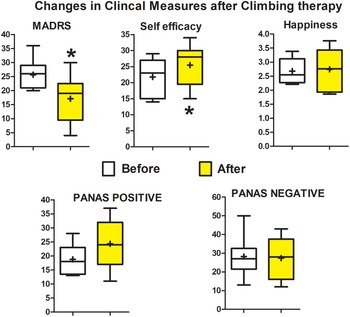
See Table 2 and Figure 2 for the results of the exploratory measures.
Changes in clinical measures before and after climbing therapy. MADRS; Montgomery–Åsberg Depression Rating Scale, Self-efficacy; General Self-Efficacy Scale, Happiness; Oxford Happiness Questionnaire, PANAS; Positive and Negative Affect Schedule. Measures were completed one week before climbing therapy (baseline/week 0) and post-intervention (week 11). + represents mean.

Qualitative findings
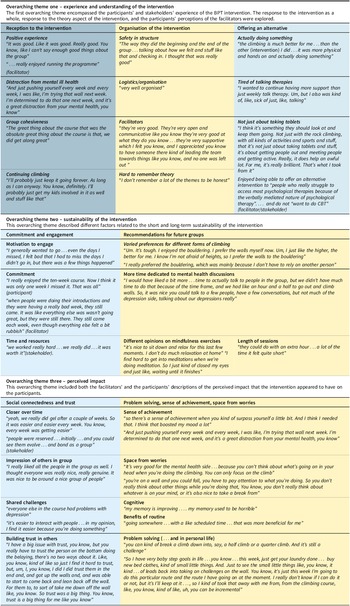
Three overarching qualitative themes were identified: Experience of the Intervention, Sustainability and Feasibility of the Intervention, and Perceived Impact of the Intervention. Quotes relating to each theme are presented in Table 3.
Themes, subthemes, and quotes

Discussion
This mixed-methods feasibility study demonstrated that a single-arm, 10-week manualised climbing therapy group programme for adults with MDD, delivered within a community mental health setting, was feasible in terms of recruitment, retention, and completion. The intervention was characterised by high session attendance, strong completion rates for study visits, and high levels of participant satisfaction.
Preliminary findings from the exploratory clinical outcomes were promising, suggesting that climbing therapy may improve mood and self-efficacy, consistent with previous studies (Schwarz et al. Reference Schwarz, Dorscht, Book, Stelzer, Kornhuber and Luttenberger2019; Stelzer et al. Reference Stelzer, Book, Graessel, Hofner, Kornhuber and Luttenberger2018; Kratzer et al. Reference Kratzer, Luttenberger, Karg-Hefner, Weiss and Dorscht2021; Thaller et al. Reference Thaller, Frühauf, Heimbeck and Voderholzer2022; Karg et al. Reference Karg, Dorscht, Kornhuber and Luttenberger2020; Dorscht et al. Reference Dorscht, Karg, Book, Graessel, Kornhuber and Luttenberger2019; Luttenberger et al. Reference Luttenberger, Karg-Hefner, Berking, Kind, Weiss, Kornhuber and Dorscht2022). Our mixed-methods approach provided valuable insights, with thematic analysis highlighting sense of achievement, confidence, trust, and social connectedness as key experiences of the intervention. These findings also align with previous research on the therapeutic benefits of climbing therapy (Frühauf et al. Reference Frühauf, Heußner, Niedermeier and Kopp2021; Michelsen et al. Reference Michelsen, Jenuwein, Luttenberger and Calvano2024; Liu et al. Reference Liu, Gong, Li and Li2022; Zöbl et al. Reference Zöbl, Frühauf, Heimbeck, Voderholzer and Kopp2025).
While previous studies have indicated that climbing therapy may reduce anxiety (Bichler et al. Reference Bichler, Niedermeier, Hüfner, Gálffy, Gostner, Nelles, Schöttl, Perner-Unterweger and Kopp2022a; Bichler et al. Reference Bichler, Niedermeier, Hüfner, Gálffy, Sperner-Unterweger and Kopp2022b; Karg et al. Reference Karg, Dorscht, Kornhuber and Luttenberger2020), consistent with broader evidence on the anxiolytic and antidepressant effects of resistance-based exercise (Gordon et al. Reference Gordon, McDowell, Hallgren, Meyer, Lyons and Herring2018; Banyard et al. Reference Banyard, Edward, Garvey, Stephenson, Azevedo and Benson2025), no clear reductions in anxiety or stress levels were observed in our study. It is possible that these outcomes were influenced by significant life events reported by several participants over the course of the intervention.
Social support has been defined as the care and assistance individuals receive from other climbers, playing a role in fostering social interaction and building interpersonal trust (Liu et al. Reference Liu, Gong, Li and Li2022; Michelsen et al. Reference Michelsen, Jenuwein, Luttenberger and Calvano2024). In our study, social support emerged as a salient theme in the qualitative analysis. Participants reported the value of belonging, describing the importance of a structured activity, opportunities for social interaction, and a sense of inclusion. This desire for continued connection was evident in their initiative to create a WhatsApp group to maintain contact and organise further climbing sessions beyond the formal conclusion of the study. Many participants found meaning in spending time with others who shared similar experiences, noting the significance of feeling connected and engaging with like-minded individuals.
Additionally, the nature of climbing itself appeared to facilitate the development of trust, particularly during roped climbing activities. Participants and facilitators both identified this trust as a distinctive and important aspect of the intervention, suggesting it contributed to the overall sense of psychological safety and group cohesion.
Self-efficacy emerged as another key theme in both the quantitative and qualitative data. Many participants reported a sense of achievement resulting from the intervention, highlighting the positive impact of skill development and personal progress. As they observed their own improvement, some participants appeared to experience increased confidence and motivation. Facilitators similarly noted the significance of goal attainment, observing that these successes contributed to enhanced self-efficacy.
Consistent with the Distraction Hypothesis reported in previous studies of climbing therapy (Frühauf et al. Reference Frühauf, Heußner, Niedermeier and Kopp2021; Michelsen et al. Reference Michelsen, Jenuwein, Luttenberger and Calvano2024; Liu et al. Reference Liu, Gong, Li and Li2022), some participants reported experiencing single-channelled attention during climbing activities. This focused engagement was described as offering relief from intrusive thoughts and contributing to a reduction in negative thinking. Although the intervention appeared to enhance concentration and engagement during sessions, as noted above, quantitative measures showed limited changes in anxiety and stress post-intervention.
Other elements uncovered by thematic analysis related to more practical elements of the feasibility of running the programme, including the acceptability of the intervention on the part of the facilitators (Sekhon et al. Reference Sekhon, Cartwright and Francis2017). Clinician and climbing wall instructor feedback indicated that developing the programme required significant initial resources including therapist training, securing grant funding, translation of the manual, and ensuring adequate risk assessment.
Feedback from the climbing centre staff was also positive about their experience of taking part in this research, indicating that the community partnership element worked well, and built capacity for participation of people with mental health difficulties in the local climbing gym. This synergistic use of local community resources to benefit people’s mental health aligns with, and reinforces, national mental health promotion strategies (Doherty et al. Reference Doherty, Sheridan, De Brun, Chambers, O’Mahony, Sheehan, Phelan, Power, Donohue, Heavy, Molloy, Rogan, Mcgrath, Rafferty, Walsh, Barry, Woods, Diamond and Mcelhinney2022; DoH 2020; DoH 2021; Health Research Board 2024).
As expected, there was variability in participants’ experiences, and the sense of achievement reported by many was not universal. One participant, for example, described increasing difficulty with the climbs, which led to feelings of pressure and detachment from the group. The participant attributed this response to his mental health challenges, suggesting that although the intervention was initially beneficial, some of its positive effects diminished over time. This highlights the potential difficulty individuals with depression may face in developing the cognitive and physical skills required to overcome plateaus in performance. Addressing these challenges may warrant specific attention in the design of future climbing therapy studies. Participants also discussed difficulties in remembering and applying the theoretical aspects of the programme and demonstrated a mixed response to the mindfulness elements, ranging from enjoyment to difficulties in accessing the experience.
The adverse event monitoring period was aligned with, and concluded at, the end of the study (week 11). During this period, there were no adverse events. However, shortly after completion of the study, one of the participants fractured both lower limbs after a stumble from the bouldering wall onto crash mats during a recreational climbing session. This underscores the importance of adopting individualised approaches to the intensity and duration of climbing, as well as recognising how the physical demands may affect individuals differently. Moreover, it suggests that top rope climbing may be more suitable for some people, as it offers greater support and a gentle descent after completing a climb.
Indoor climbing carries a relatively low risk of injury, with an estimated rate of 0.02 injuries per 1,000 hours (Schöffl et al. Reference Schöffl, Hoffmann and Küpper2013). This is substantially lower than injury rates reported for some other sports, such as 5.5 injuries per 1,000 football match hours (Aus der Fünten et al. Reference Aus der Fünten, Tröß, Hadji, Beaudouin, Steendahl and Meyer2023), and 283.5 per 1,000 hours of rugby (Gabbett Reference Gabbett2002). Nevertheless, effective risk management remains essential within climbing practice, particularly in indoor climbing gyms, where the majority of therapeutic interventions have taken place (Wilcox Reference Wilcox2022).
Given the generally positive recruitment and retention rates, the high acceptability among participants and facilitators, and the encouraging improvements in mood and self-efficacy, a full-scale trial is warranted. In a larger, future trial, key refinements could include the addition of a control or comparator group, more detailed examination of demographic characteristics, assessment of physical activity, investigation of social connections and relational dynamics, and extended follow-up to evaluate longer-term outcomes.
In addition to a larger study in MDD, and considering that the therapeutic effects of climbing therapy are likely multimodal, encompassing physical, cognitive, and psychosocial mechanisms, exploring the motor, cognitive, and neurobiological effects of the complex sensorimotor demands of three-dimensional climbing across different disorders represents a compelling avenue for future research (Di Paola et al. Reference Di Paola, Caltagirone and Petrosini2013; Bichler et al. Reference Bichler, Niedermeier, Hüfner, Gálffy, Gostner, Nelles, Schöttl, Perner-Unterweger and Kopp2022a; Luttenberger et al. Reference Luttenberger, Donath, Graessel, Kornhuber, Schlüter, Dorscht and Kind2024b; McClung Reference Mcclung1984; Schwarzkopf et al. Reference Schwarzkopf, Dorscht, Kraus and Luttenberger2021; Kind et al. Reference Kind, Luttenberger, Leßmann, Dorscht, Mühle, Müller, Siegmann, Schneider and Kornhuber2023; Rosenkranz et al. Reference Rosenkranz, Schmidt-Schuchert, Luttenberger and Greffin2025; Schiffler et al. Reference Schiffler, Reiter, Kapan, Kranz, Kotzian and Haider2024; Luttenberger et al. Reference Luttenberger, Baggenstos, Najem, Sifri, Lewczuk, Radegast and Rosenbaum2024a; Luttenberger et al. Reference Luttenberger, Rosenbaum, Najem and Baggenstoß2024c; Smith et al. Reference Smith, Peckham and Agtarap2025). Furthermore, research could evaluate climbing therapy as an adjunctive intervention for individuals with psychotic disorders, assessing mental and physical health outcomes as well as practical considerations for implementing such programmes within community mental health services.
Conclusion
This mixed-methods feasibility study showed that a single arm, 10-week manualised climbing therapy programme for adults with MDD from a public community mental health service in Ireland was feasible, acceptable and well-received. A sense of achievement, as well as improved confidence, trust, and social connectedness emerged as important findings in the qualitative analysis. The preliminary clinical findings were encouraging, particularly related to mood and self-efficacy, and add to the growing body of evidence advancing a therapeutic role for climbing therapy. This lays the groundwork for a larger trial in Ireland and offers potential for collaboration with international research networks.
Limitations
While our study provides valuable feasibility data, certain aspects warrant further critical examination and elaboration. This was a feasibility study to ascertain whether it was possible to deliver a complex intervention within a public community mental health service. There was no control group, and we acknowledge that it restricts our ability to attribute observed outcomes directly to the intervention. The study is not powered to conduct sub-analyses according to demographic variables.
Given the recruitment advertisement/flyers were distributed amongst the four local community mental health teams, we could not record the number of people that were approached about the study. Therefore, it was not possible to estimate the recruitment rate. This recruitment method may also have introduced selection bias, as participants who chose to take part might differ from those who did not. Consequently, this limits the generalisability of our findings.
We did not collect data on employment, or years of education, or levels of physical activity. We did not formally record the previous climbing experience, but most participants did not have any prior climbing experience. This could also limit the generalisability of our findings. We acknowledge that the study was of short duration and was limited by the absence of longer-term follow-up.
While none of the facilitators were formally qualified, registered, or practising psychotherapists, all sessions were led by experienced mental health clinicians with substantial expertise in therapeutic settings. We cannot exclude an effect of facilitator qualifications on delivery. We also acknowledge that, while participants reported positive experiences, the once-weekly frequency of the intervention may have limited the magnitude of improvements in mood and self-efficacy. Future studies could examine whether increasing session frequency yields greater or more sustained benefits.
While our study involved a Peer Support Volunteer with lived experience who contributed to the cultural adaptation of the BouldApy manual and delivery of Group 1, the design of a future, larger trial will seek to more fully integrate the perspectives of people with lived experience.
Supplementary material
The supplementary material for this article can be found at https://doi.org/10.1017/ipm.2026.10187.
Acknowledgements
We would like to sincerely thank our participants, who despite their challenges during this period, participated in a generous spirit. We would also like thank the members of the Dublin Climbing Centre for giving their time, especially Conor O’Connor and Philip Duke, who helped set up the programme and Niamh Murphy, Peer Support Volunteer, Dublin Climbing Centre. We would like to thank Seán Fortune and value his devotion to climbing. We thank Frédérique Valliere, who supervised Ashlie Macpherson’s thesis. We would also like to thank the Irish Mountaineering Club and Mountaineering Ireland for their support, and would like to specifically acknowledge the “Climbing For All” ethos. We would like to thank Daria Hartmann for the translation of the BouldApy manual and to Prof. Katharina Luttenberger and her team in Germany for their support. We are grateful to Dr Thomas McMonagle, Clinical Director, Dublin South Central Mental Health Service, who supported this research project and broader research activities. We appreciate the Adelaide Foundation support.
Funding statement
This project was supported by the Adelaide Foundation.
Competing interests
The authors declare none.
Ethical standards
The authors assert that all procedures contributing to this work comply with the ethical standards of the relevant national and institutional committee on human experimentation and with the Helsinki Declaration of 1975, as revised in 2024.




 Open access

