


Introduction
On July 26, 2023, Niger’s military ousted the president, Mohamed Bazoun, in a coup. With the military junta keeping him under house arrest and threatening prosecution, President Bazoun sought legal recourse not from his country’s domestic courts, but rather from an international court, the ECOWAS Court of Justice.Footnote 1 The Court, in concert with widespread regional and international condemnation of the coup – including from the political leadership of ECOWAS (Yabi Reference Yabi2023) – obliged, by ruling in December 2023 that the junta unlawfully detained Bazoun and ordering that he return to office (Mednick Reference Mednick2023). The junta responded by withdrawing the country from ECOWAS, and, thus, the Court’s jurisdiction (Wong Reference Wong2024), which rendered this international legal remedy for a direct assault on democracy impotent.Footnote 2
The case of Niger illustrates a significant development in the role of international courts. Whereas international courts have had the task of addressing issues such as war crimes prosecutions (e.g., Simmons and Danner Reference Simmons and Danner2010), economic regulation (e.g., Burley and Mattli Reference Burley and Mattli1993), and maritime law, among others (e.g., Abbott et al. Reference Abbott, Keohane, Moravcsik, Slaughter and Snidal2000), they are increasingly adjudicating disputes over fundamental democratic norms and the very nature of democracy itself. From the rule of law crisis in the European Union (e.g., Kelemen Reference Kelemen2017; Jakli and Stenberg Reference Jakli and Stenberg2021; Cheruvu, Krehbiel and Mussell Reference Cheruvu, Krehbiel and Mussell2024) to the protection of democratic rights by the Inter-American Court of Human Rights (e.g., Follesdal and Ulfstein Reference Follesdal and Ulfstein2018), international courts are finding themselves a critical line of defense against democratic backsliding and autocratization. Yet with such newfound, potentially powerful roles, come significant challenges to international courts’ power, like obtaining compliance and the risk of political backlash, as the ECOWAS Court found.
While these difficulties are present for essentially any court, domestic or international (e.g., Staton and Moore Reference Staton and Moore2011; Vanberg Reference Vanberg2015; Carrubba and Gabel Reference Carrubba and Gabel2017), they may be particularly acute for international courts seeking to redress attacks on democracy. Sustaining domestic democratic politics is often beyond international courts’ original purview, many of which – including the high courts of ECOWAS and the EU – primarily resolve disputes over economic issues (e.g., Alter and Helfer Reference Alter and Helfer2010; Carrubba and Gabel Reference Carrubba and Gabel2015). For such courts, taking on cases involving democratic backsliding may represent an expansion of judicial authority that invites resistance (e.g., Alter, Hafner-Burton, and Helfer Reference Alter, Hafner-Burton and Helfer2019). Even for those international courts that have a longer linkage with democracy-related concerns, such as those that emphasize human rights, assessing the democratic quality of a country’s domestic political system touches on a sensitive subject, as backlashes against courts like the European Court of Human Rights demonstrates (e.g., Hillebrecht Reference Hillebrecht2014; Voeten Reference Voeten2020). This backlash can ultimately leave international courts in a vulnerable position when called upon to uphold democracy.
In this paper, we consider a critical determinant of international courts’ ability to overcome such challenges and confront democratic backsliding: public support in backsliding democracies for judicial power to protect democracy. Applying insights from the expansive and robust literature on citizens’ attitudes toward courts (e.g., Gibson and Nelson Reference Gibson and Nelson2014; Bartels, Horowitz, and Kramon Reference Bartels, Horowitz and Kramon2023; Cheruvu Reference Cheruvu2023) to the context of international courts’ jurisdiction over democratic standards (e.g., Madsen, Cebulak, and Wiebusch Reference Madsen, Cebulak and Wiebusch2018; Cheruvu, Krehbiel, and Mussell Reference Cheruvu, Krehbiel and Mussell2024), we posit that support for an international court’s judicial power in backsliding democracies is a function of one’s democratic values. We go on to argue, however, that the influence of democratic values on support for judicial power is powerfully conditioned by partisanship. To demonstrate these dynamics, we present a series of analyses using novel survey data collected in a particularly salient case of democratic backsliding, Hungary (e.g., Bánkuti, Halmai, and Scheppele Reference Bánkuti, Halmai and Scheppele2012; Kelemen Reference Kelemen2017; Jakli and Stenberg Reference Jakli and Stenberg2021). These analyses, which examine the Hungarian public’s support for the judicial power of the European Union’s Court of Justice (CJEU),Footnote 3 reveal that while opponents of the Fidesz government tended to exhibit greater support for the CJEU’s judicial power of questions related to democracy, the strength of opposition supporters’ attachment to democratic values increased the magnitude of this difference. Taken together, these findings indicate that while the judicial power of international courts such as the CJEU may rely on political opposition forces when it comes to democracy-related issues, this foundation of support is itself perhaps not as iron-clad as it first appears, but rather is dependent on the ideological and attitudinal makeup of citizens’ attitudes. As such, where the political opposition includes substantial numbers with weak attachment to democratic values, international courts may be on weaker ground than partisanship alone might suggest.
This paper is organized as follows. The next section briefly reviews the existing literature on public support for judicial power, after which we develop a theoretical account of citizens’ attitudes toward international courts’ authority to resolve challenges involving democratic norms and standards. We then discuss our research design, and present our empirical results. We conclude with a discussion of the study’s potential implications for the efficacy of international courts and their role regarding the prospects of liberal democracy.
Values, partisanship, and support for international courts’ judicial power
Scholars of judicial politics have long recognized the importance of public support for courts to serve as effective democratic guardrails. Unable to directly implement their decisions, courts are reliant on the cooperation of governments to transform their rulings from words on paper into action (e.g., Ferejohn and Weingast Reference Ferejohn and Weingast1992; Rogers Reference Rogers2001; Ramseyer and Rasmusen Reference Ramseyer and Rasmusen2003). When such compliance is contrary to the government’s interest, such as when a court seeks to stymie a government’s undermining of democratic checks on its authority, this dynamic leaves courts in need of political muscle to compel elected officials’ acquiescence (e.g., Rosenberg Reference Rosenberg1991).
It is at this juncture that citizens’ backing of judicial institutions becomes critical. Were a sufficient portion of the public to demand that officials follow a court’s orders, the subsequent political backlash for failing to do so – whether it be at the ballot box or in the streets – has the potential to shift a government’s calculus (e.g., Gibson and Caldeira Reference Gibson and Caldeira1998; Stephenson Reference Stephenson2004). Recognizing the power of this relationship, scholars have regularly characterized courts’ efficacy in terms of their ability to marshal public support for the implementation of their decisions (e.g., Vanberg Reference Vanberg2005; Carrubba Reference Carrubba2009; Staton Reference Staton2010; Krehbiel Reference Krehbiel2016; Krehbiel and Cheruvu Reference Krehbiel and Cheruvu2022).
While scholars have long emphasized the significance of judicial legitimacy for a court’s capacity to enforce constitutional order (e.g., Bartels and Johnston Reference Bartels and Johnston2013; Gibson and Nelson Reference Gibson and Nelson2014), recent scholarship specifies a more pointed concept, judicial power, which Bartels, Horowitz, and Kramon (Reference Bartels, Horowitz and Kramon2023, 791) define as “a court’s independence and ability to achieve compliance with its rulings” (e.g., Gibson and Caldeira Reference Gibson and Caldeira1998; Vanberg Reference Vanberg2005; Carrubba Reference Carrubba2009; Staton Reference Staton2010). This distinction centers on the judiciary’s capacity to demand or prohibit a government’s action, whereas judicial legitimacy encompasses a broader attitude regarding citizens’ loyalty to a court as an institution (Gibson and Caldeira Reference Gibson and Caldeira1992). Just as both concepts are immensely useful for theorizing and evaluating courts’ efficacy, judicial power most closely links public opinion with the ability of courts to incur politically meaningful effects through their decisions, as it directly engages with the fundamental compliance challenge faced by all courts, including international courts (Staton and Moore Reference Staton and Moore2011).
Given the significance of judicial power for courts’ ability to effectively serve as guardians of democracy, a considerable literature identifies the determinants of citizens’ support for – or opposition to – a court that can compel or prohibit government actions (e.g., Carrubba Reference Carrubba2009). From this scholarship, two key determinants of support for judicial power particularly stand out. First, a lengthy stream of research links citizens’ commitment to democratic values with their support for judicial institutions (e.g., Murphy and Tanenhaus Reference Murphy and Tanenhaus1968; Gibson and Caldeira Reference Gibson and Caldeira2009). By such accounts, factors such as one’s education and socialization into democratic society (e.g., Caldeira Reference Caldeira1977; Cheruvu Reference Cheruvu2023) foster a strong attachment to democratic values like the rule of law, judicial independence, and, ultimately, judicial legitimacy and power (Gibson and Nelson Reference Gibson and Nelson2015). As a result of this tight linkage between support for judicial power and a broader basket of attitudes related to democratic norms and ideals, the conventional wisdom holds that the foundation of a court’s public support lies with the presence of a citizenry deeply bound to the fundamental tenets of democracy itself.
The relationship between democratic values and support for judicial power may be particularly salient for international courts dealing with questions of democracy. As citizens’ commitment to democratic values increases, they may similarly prefer that their institutions – international or domestic – take actions to protect them. In backsliding democracies, however, incumbents may have effectively neutralized domestic courts (e.g., Ginsburg and Huq Reference Ginsburg and Huq2018) that are conventionally responsible for safeguarding liberal democracy (e.g., Staton, Reenock, and Holsinger Reference Staton, Reenock and Holsinger2022). Citizens that support democracy, thus, may turn to their international courts as a safeguard and a meaningful check against their backsliding government’s agenda (e.g., Ginsburg Reference Ginsburg2019). Indeed, scholars provide evidence that activists and interest groups often turn to international courts as a means to achieve policy victories that are unattainable domestically (e.g., Alter Reference Alter2001; Simmons Reference Simmons2009). With international courts serving as a potential avenue to secure democratic rights and liberties, those that highly value such protections should similarly support an international courts’ judicial power over them. This logic leads to the following hypothesis:
Hypothesis 1 Support for international courts’ judicial power over questions of democracy increases with support for democratic values.
Recent research, however, calls into question the extent to which democratic values insulate public support for judicial power from partisan considerations (e.g., Nelson and Gibson Reference Nelson and Gibson2019; Graham and Svolik Reference Graham and Svolik2020; Bartels, Horowitz, and Kramon Reference Bartels, Horowitz and Kramon2023) By these accounts, the congruence of a court’s decisions with citizens’ partisan preferences, not values, serves as the foundation of judicial power. That is, citizens afford their support for judicial power only to courts seen as favorable to one’s political party (e.g., Nicholson and Hansford Reference Nicholson and Hansford2014; Christenson and Glick Reference Christenson and Glick2015). As such, one’s support for judicial power may not necessarily be reflective of a broader commitment to the institutions of liberal democracy (e.g., Easton Reference Easton1975), but rather may be conditional on the outcome. This correlation of support for judicial power with partisan gains and loses, thus, implies that support for judicial power is instrumental (e.g., Carrubba Reference Carrubba2009) and potentially subject to fluctuation over time.
We might suspect that partisanship similarly comes into play for citizens’ evaluating an international court’s judicial power over the protection of democracy. For opposition supporters witnessing an incumbent sidelining their political party, this form of judicial power provides a clear instrumental benefit, namely the preservation of a democratic system that allows for their continued participation and contestation for political power. That is, judicial power over questions of democracy provides opposition supporters a potential lifeline for their political party’s ability to effectively participate in governance. Importantly, such a dynamic does not necessarily imply that opposition supporters are staunchly committed to democratic values – while that may well be the case – it could alternatively be that they simply do not want to be marginalized by an autocratizing political system and, thus, for instrumental reasons, find themselves supporting pro-democracy positions (e.g., Bartels, Horowitz and Kramon Reference Bartels, Horowitz and Kramon2023). When an incumbent government captures the judiciary, opposition supporters may become particularly keen on an international court’s judicial power, as domestic institutions no longer offer sufficient recourse. If international courts potentially offer more favorable outcomes in the protection of democratic values relative to domestic courts, we should expect opposition supporters to be supportive of their rulings (e.g., Madsen et al. Reference Madsen, Mayoral, Strezhnev and Voeten2022), and therefore, supportive of their judicial power over questions of democracy. Our second hypothesis follows:
Hypothesis 2 Support for international courts’ judicial power over questions of democracy is stronger among opposition supporters.
While the preceding discussion suggests that opposition supporters should, on average, report higher levels of support for judicial power than government supporters, the magnitude of this difference may vary. In particular, returning to the influence of democratic values on support for judicial power directs us to consider how partisan considerations might interact with values-based concerns. For those citizens who have both partisan and values-based incentives to support judicial power – that is, those opposition supporters with a strong attachment to democratic values. – we should expect particularly robust support for judicial power over democracy-related issues in contrast to those opposition supporters whose backing of judicial power is predicated on their partisan interest alone due to a weaker commitment to democratic values. Put differently, opposition supporters that have less value for democracy derive less utility from an international court’s defense of democracy and are, thus, less likely to support judicial power over such cases.Footnote 4 Taken together, we hypothesize the following:
Hypothesis 3 Among opposition supporters, support for international courts’ judicial power over questions of democracy increases with support for democratic values.
Data and methods
To empirically test our theoretical framework, we conducted a survey of 2,000 Hungarian respondents in partnership with YouGov from March 17–31, 2022. Hungary is an ideal context, as it is a prominent instance of democratic backsliding (e.g., Bermeo Reference Bermeo2016; Haggard and Kaufman Reference Haggard and Kaufman2021) in which international courts – the CJEU and the European Court of Human Rights in particular – have adjudicated cases (e.g., Blauberger and Kelemen Reference Blauberger and Kelemen2017). Since the Fidesz government under Prime Minister Viktor Orban came into power in 2010, it has engaged in electoral gerrymandering to insulate its supermajority (e.g., O’Dwyer and Stenberg Reference O’Dwyer and Stenberg2022), reduced the judiciary’s ability to serve as a check against the executive by packing the courts with judges that are partisan loyalists (e.g., Epperly Reference Epperly2019), and systematically altered the media landscape to suppress dissent (e.g., Bátorfy and Urbán Reference Bátorfy and Urbán2020). In response, the CJEU has made rulings against Hungary – such as on the Rule of Law Conditionality Mechanism, in which the Commission suspended COVID-19 recovery funds from Hungary for its violation of the EU’s democratic standards (e.g., Cheruvu, Krehbiel, and Mussell Reference Cheruvu, Krehbiel and Mussell2024) – on questions of democratic backsliding.
Furthermore, we fielded this survey in March 2022, in advance of the Hungarian election on April 3, 2022. The election’s most salient issue was the state of Hungarian democracy, as all of the major opposition parties formed the United Opposition Footnote 5 to run against Fidesz in the election (Bayer Reference Bayer2022). This de facto two party system, thus, allows us to easily distinguish government supporters from opposition supporters in the survey. Descriptively, one-third of survey respondents selected “Democracy and the Rule of Law” as the most significant issue in the election, ahead of the 22% that selected “Foreign Policy and Russia’s invasion of Ukraine” (which occurred on February 24) and the 25% that selected the “Economy and Taxes.” Taken together, Hungary is both substantively and empirically valuable as a case to test our hypotheses regarding international courts’ judicial power over questions of democracy.
Following Bartels, Horowitz, and Kramon (Reference Bartels, Horowitz and Kramon2023), we aim to measure support specifically for CJEU interventions on questions of democracy. We asked survey respondents if, “[the CJEU] should have the final say on whether a Hungarian law violates democratic standards.” Respondents had five possible answer choices ranging from “Disagree Strongly,” to “Neither agree nor disagree,” to “Agree Strongly.” We scale the resulting measure CJEU Judicial Power from 0 to 1, with higher values indicating greater support for judicial power, to serve as our dependent variable for our analysis. While questions about citizens’ support for judicial power more broadly are substantively relevant in their own right (e.g., Bartels and Kramon Reference Bartels and Kramon2020), we may expect that citizens may support the CJEU’s judicial power in some policy areas instead of others. As such, a more general judicial power question may not properly measure attitudes toward the CJEU’s jurisdiction over questions of democracy. Thus, the question specifically asks about the CJEU’s power over a Hungarian law’s violation of democratic standards.
To test our first hypothesis, we require a variable for respondents’ democratic values. Given the multifaceted nature of the concept (Teorell et al. Reference Teorell, Coppedge, Lindberg and Skaaning2019), we follow Cheruvu, Krehbiel, and Mussell (Reference Cheruvu, Krehbiel and Mussell2024) to tap into multiple dimensions of democracy by asking our respondents which of the following statements was closest to their view (the resulting variable name is bolded), with the second statement for each being more supportive of democratic values:
-
1. Strong Leader: “We need a strong leader who does not have to be elected by the vote of the people.” vs. “Although things may not always work, electoral democracy, or the popular vote, is always best.”
-
2. Democracy Preferable: “Ordered society is preferable, even if that means limiting democracy.” vs. “Democracy is preferable, even if it is sometimes unstable.”
-
3. Rule of Law Support: “In some cases the government should be able to ignore the law in order to solve important social or economic problems.” vs. “The government should always follow the law, even if it causes some harm to society.”
-
4. Accountability: “It is more important to have a government that can get things done, even if we have no influence over what it does.” vs. “It is more important for citizens to be able to hold government accountable, even if that means it makes decisions more slowly.”
We then assign a value of 1 for each question if a respondent chose the (second) option more supportive of democracy, and 0 if they chose the first option for each statement. Additionally, we create a variable, Democratic Values, that takes the average of all four statements for each respondent, with higher values indicating greater support for democracy. To demonstrate robustness, we include model specifications with Democratic Values and each of its constituent components individually.
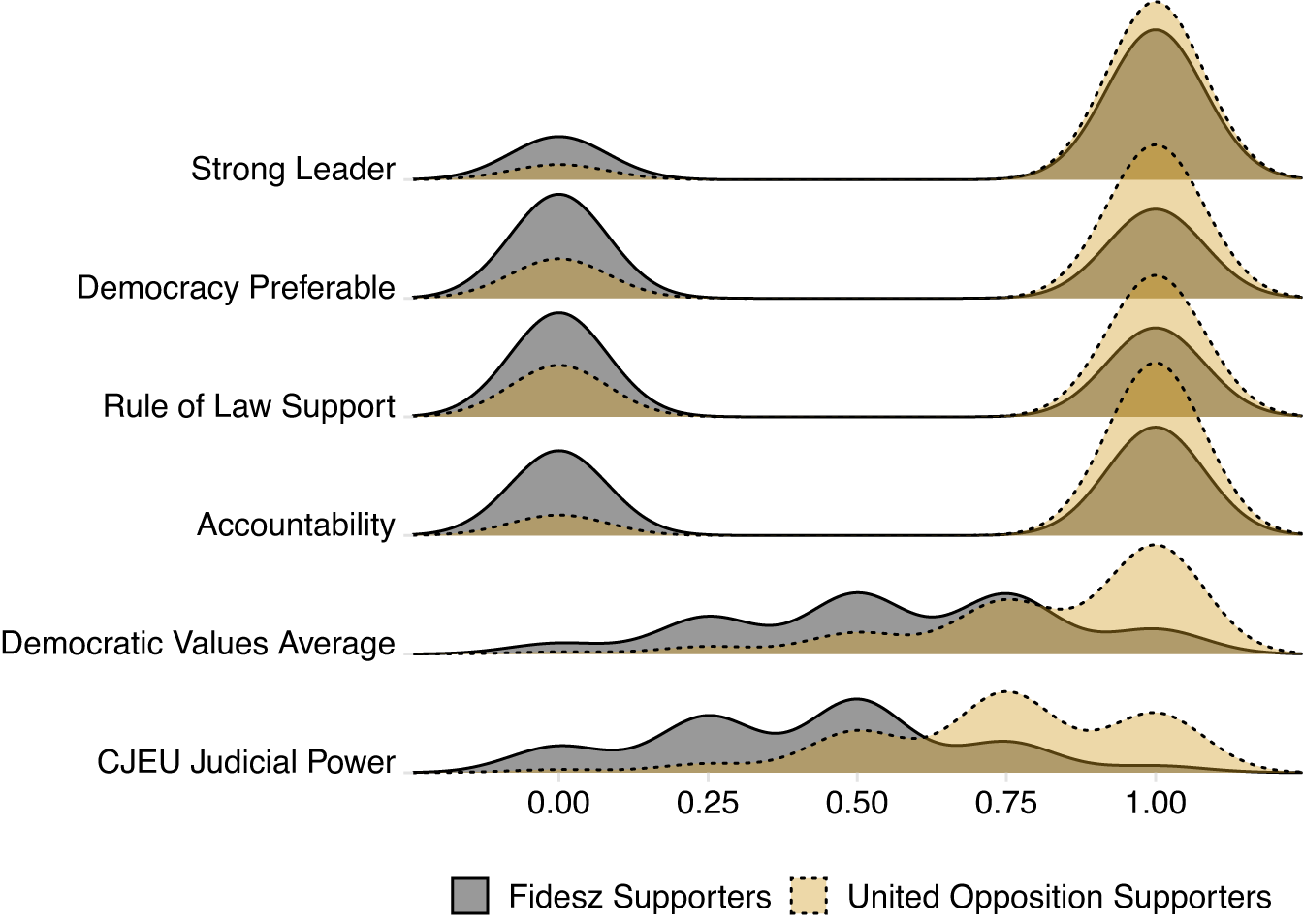
Given that our second and third hypotheses concern partisanship, we asked respondents whether they would vote for Fidesz, the United Opposition, or would not vote. We remove the non-voters from these data and create the variable United Opposition Supporters, taking the value of 1 if the respondent indicates they would vote for the United Opposition. Although Hungary is conventionally a multi-party parliamentary system, during the run up 2022 election, major opposition parties formed an electoral coalition to increase their chances of defeating Fidesz. Our analysis is aided by this effective two-party system and allows us to make direct comparisons between supporters of each party. Figure 1 plots the distribution for supporters of both parties across each of the independent variable democratic values questions, the Democratic Values average, and for our dependent variable CJEU Judicial Power.
This Plot Provides the Density for the Primary Independent Variables as well as the Dependent Variable CJEU Judicial Power Separately for Fidesz Supporters and United Opposition Supporters.
To account for potential confounding, we include a number of control variables. First, we asked respondents questions regarding other political attitudes that may also influence their view of CJEU Judicial Power. Among these political views is their general satisfaction with democracy, which scholars use as a measure of “specific support” (e.g., Easton Reference Easton1975) for democracy (e.g., Canache, Mondak, and Seligson Reference Canache, Mondak and Seligson2001; Claassen Reference Claassen2020). The question read, “In general, how satisfied are you with the way that democracy works in Hungary?” These responses range on a four point scale from “Very satisfied” to “Very dissatisfied,” with our resulting variable Democratic Satisfaction coded from 0 to 1, with higher values indicating greater satisfaction with democracy. Additionally, we account for respondents’ ideology on a 10-point scale, with the corresponding variable Ideology rescaled from 0 to 1, with higher values indicating that the respondent is more right wing. Given ideology often correlates with partisanship as well as attitudes towards the CJEU more broadly (e.g., Cheruvu and Krehbiel Reference Cheruvu and Krehbiel2024), it is possible that respondents’ ideology is the primary driver of their attitudes toward the court’s decisions over democracy. Furthermore, as in this Hungarian electoral context the United Opposition included political parties across the ideological spectrum (e.g., Bayer Reference Bayer2022), stronger reason exists to believe that respondents view the court’s decision-making through an ideological rather than a partisan framework. Scholars also provide reason to believe that one’s perception of their identity as Hungarian or European may affect their attitudes toward the actions of EU-level institutions (e.g., Hooghe and Marks Reference Hooghe and Marks2005). We thus ask respondents the following question: “Which option best characterizes how you identify yourself?” The answer choices were “Hungarian only,” “Hungarian and European,” “European and Hungarian,” “European only,” or “Neither Hungarian nor European.” For our variable National Identity, we code those that responded “Hungarian only” as 1 and all other respondents with 0.
To supplement the aforementioned control variables, we also ask respondents about their attitudes about the CJEU. In particular, we first ask about respondents’ awareness of the CJEU, and create the variable CJEU Awareness, taking into account whether respondents said they were “very aware,” “somewhat aware,” “not very aware,” or had “never heard of the CJEU.” Scholars provide substantial evidence that support toward a court’s decisions is very frequently correlated with one’s awareness of it (e.g., Gibson and Caldeira Reference Gibson and Caldeira1995; Gibson, Caldeira and Baird Reference Gibson, Caldeira and Baird1998). Furthermore, support for a court’s judicial power should be also correlated with general confidence in a court’s decision-making. As such, we include the variable CJEU Confidence, which is based on respondents’ stating that they either have “A great deal of confidence,” “Only some confidence,” or “Hardly any confidence” in the CJEU. We rescale both variables between 0 and 1, with higher values indicating greater awareness and greater confidence respectively.
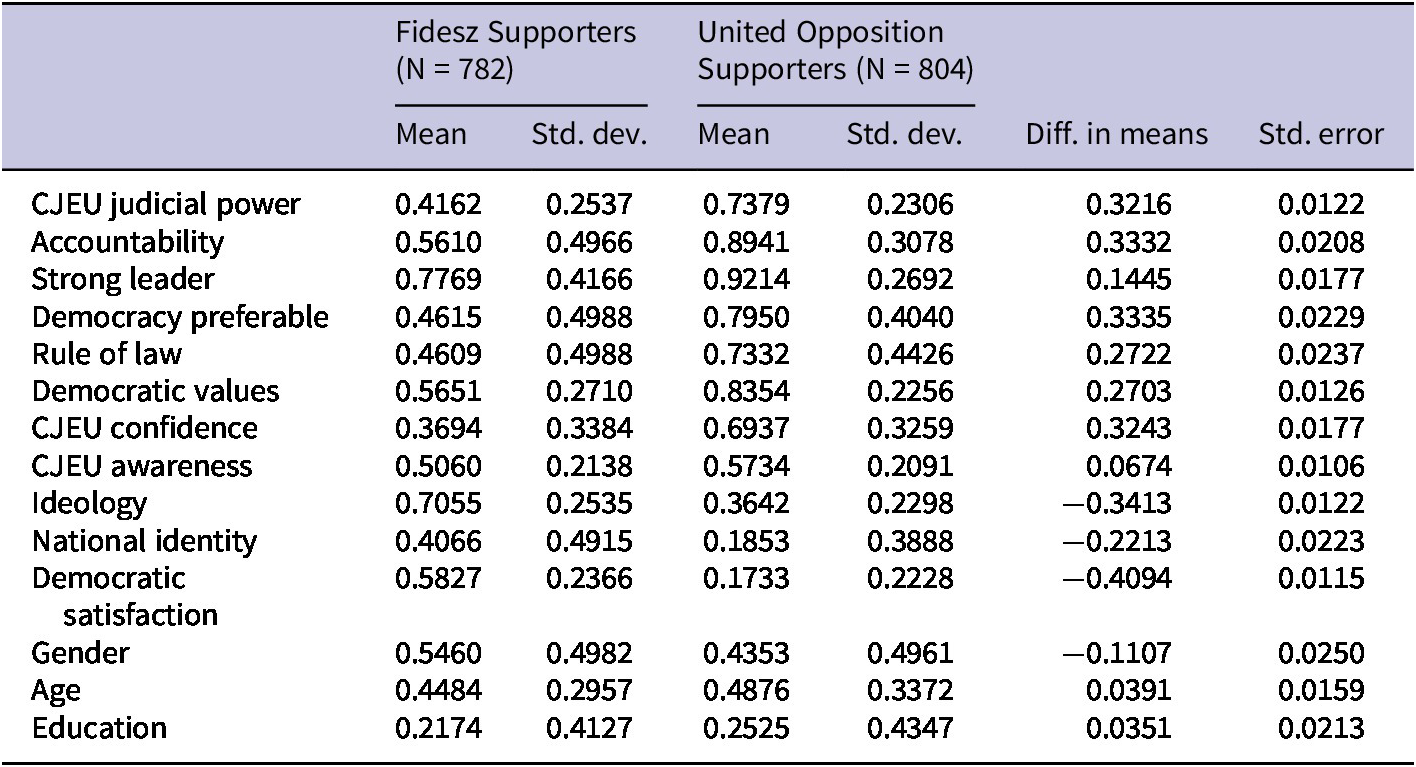
Our final set of controls accounts for demographic characteristics of our respondents, specifically age, gender, and education. Our Age variable categorizes respondents into 18–29 years, 30–44 years, 45–64 years, and 65 and older. We rescale this variable between 0 to 1, with higher values indicating that the respondent is older. Gender is a dichotomous variable with female taking the value of 1. Lastly, Education takes the value of 1 if the respondent is college-educated, and takes the value of 0 otherwise. Table 1 provides descriptive statistics of all variables used in our model specifications by partisanship.
Descriptive Statistics by Partisanship
Formally, we estimate ordinary least squares regressions for each individual i of the following form with the equation number corresponding to the hypothesis number:
 $$ {\mathbf{Y}}_i={\beta}_0+{\beta}_1\cdot \mathrm{DEMOCRATIC}\ \mathrm{VALUES}+\delta {\mathbf{X}}_i+{\unicode{x025B}}_i $$
 $$ {\displaystyle \begin{array}{l}{\mathbf{Y}}_i={\beta}_0+{\beta}_1\cdot \mathrm{UNITED}\ \mathrm{OPPOSITION}\ \mathrm{SUPPORTER}+\delta {\mathbf{X}}_i+{\unicode{x025B}}_i\end{array}} $$
 $$ {\displaystyle \begin{array}{l}{\mathbf{Y}}_i={\beta}_0+{\beta}_1\cdot \mathrm{DEMOCRATIC}\ \mathrm{VALUES}+{\beta}_2\cdot \mathrm{UNITED}\ \mathrm{OPPOSITION}\ \mathrm{SUPPORTER}+\\ {}\hskip3em {\beta}_3\cdot \mathrm{DEMOCRATIC}\ \mathrm{VALUES}\cdot \mathrm{UNITED}\ \mathrm{OPPOSITION}\ \mathrm{SUPPORTER}+\delta {\mathbf{X}}_i+{\unicode{x025B}}_i\end{array}} $$
with $ \delta {\mathbf{X}}_{ict} $
a vector of the aforementioned control variables, and
$ \delta {\mathbf{X}}_{ict} $
a vector of the aforementioned control variables, and $ {\unicode{x025B}}_i $
heteroskedasticity-robust standard errors. For equations 1 and 2, a positive and statistically significant
$ {\unicode{x025B}}_i $
heteroskedasticity-robust standard errors. For equations 1 and 2, a positive and statistically significant $ {\beta}_1 $
would be evidence supporting our hypotheses. For equation 3, a positive and statistically significant average marginal effect for United Opposition Supporter conditional on Democratic Values Average would provide evidence favoring hypothesis 3.Footnote
6
$ {\beta}_1 $
would be evidence supporting our hypotheses. For equation 3, a positive and statistically significant average marginal effect for United Opposition Supporter conditional on Democratic Values Average would provide evidence favoring hypothesis 3.Footnote
6
Results
We first present in Figure 2 the raw data across each of the components of the Democratic Values average. It provides the mean and 95% confidence intervals for CJEU Judicial Power for both Fidesz and United Opposition supporters across the range of possible values for each independent variable. Without imposing a functional form on these data, across all of our democratic values measures, we find a stronger positive correlation with CJEU Judicial Power for United Opposition supporters relative to Fidesz supporters, as a respondent’s values become more pro-democracy.
This Plot Provides the Mean and 95% Confidence Intervals of These Data for CJEU Judicial Power Separately for Fidesz Supporters and United Opposition Supporters for the Range of Possible Values for Each Independent Variable. Each Facet Denotes an Independent Variable, With the Dashed Line Illustrating the Slope in the Outcome for Fidesz and United Opposition.

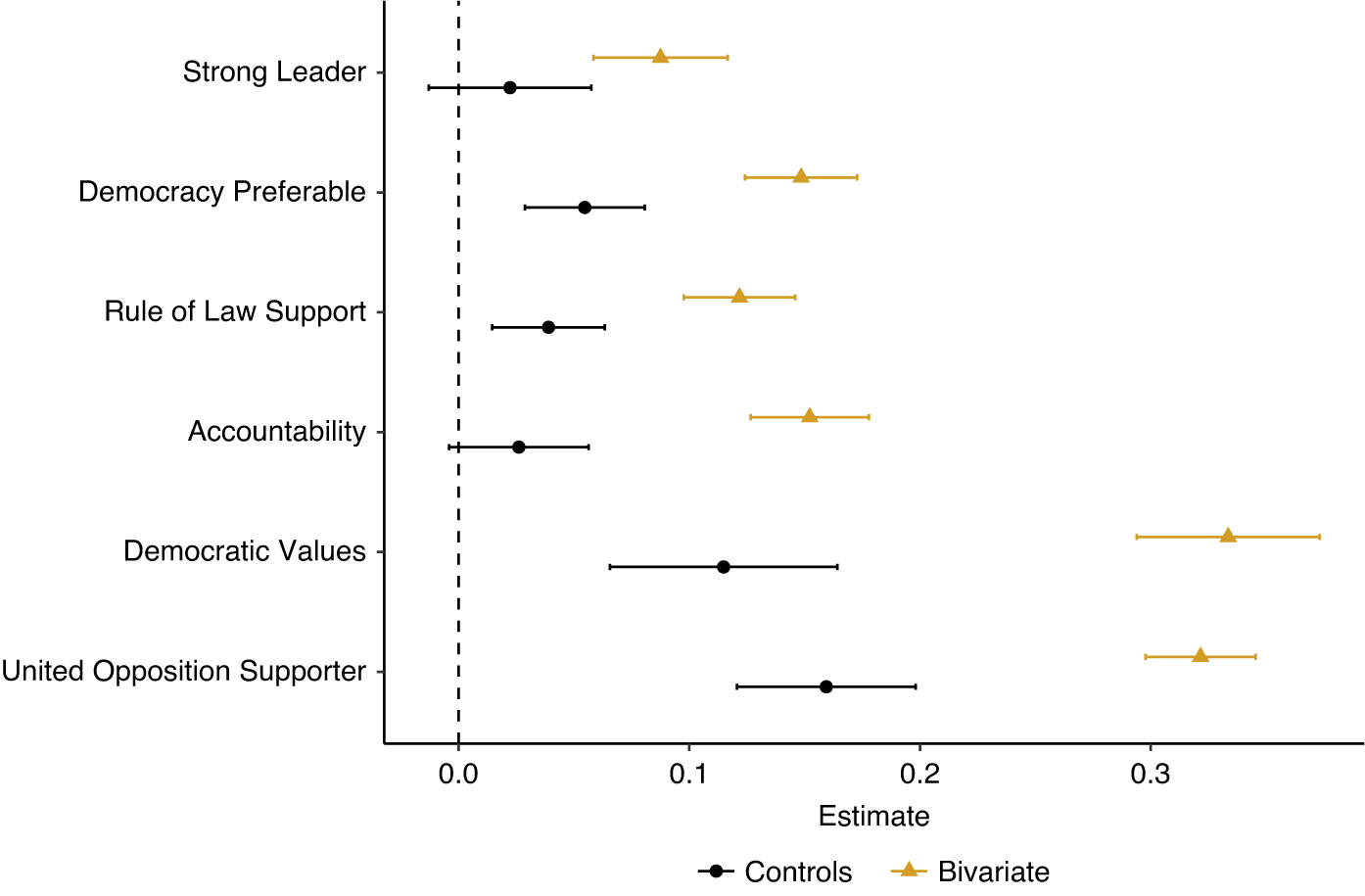
Figure 3 plots the results for hypothesis 1 and hypothesis 2, which are based on Table A.1 in the appendix. For hypothesis 1, we expect a positive coefficient for each of our measures of democratic values. Across our bivariate specifications, we find a strong and statistically significant relationship across all of our independent variables. When controls are included, the coefficient for Strong Leader remains positive, but is not statistically significant, and the coefficient for Accountability remains statistically significant at the 90% level (p $ = $
0.91). These results demonstrate that across various measures individually, as well as aggregated, a strong correlation exists between CJEU Judicial Power and democratic values. Similarly for hypothesis 2, we expect a positive correlation between United Opposition Supporter and CJEU Judicial Power. In our bivariate specification, we find strong support for this expectation (β = 0.32, p < 0.01). Furthermore, our result is robust to the inclusion of control variables (β = 0.16, p < 0.01).
$ = $
0.91). These results demonstrate that across various measures individually, as well as aggregated, a strong correlation exists between CJEU Judicial Power and democratic values. Similarly for hypothesis 2, we expect a positive correlation between United Opposition Supporter and CJEU Judicial Power. In our bivariate specification, we find strong support for this expectation (β = 0.32, p < 0.01). Furthermore, our result is robust to the inclusion of control variables (β = 0.16, p < 0.01).
Based on Table A.1 in the Appendix. This Plot Provides the Coefficient Estimate and 95% Confidence Intervals for the Primary Independent Variables in the Models Testing Hypothesis 1 and Hypothesis 2.
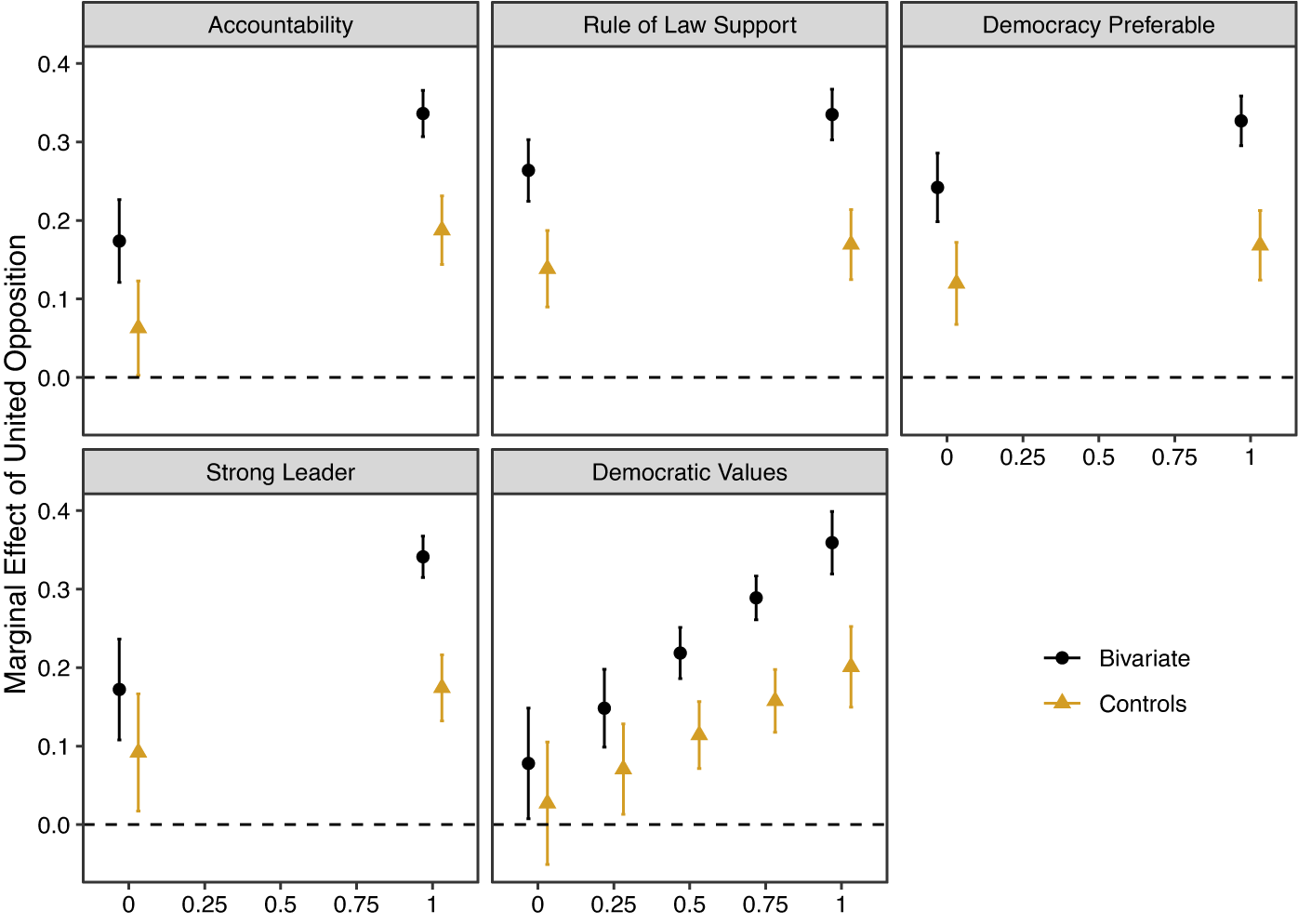
We now turn to our third hypothesis, which predicts that among opposition supporters CJEU Judicial Power will increase with support for democratic values. The results for this analysis can be found in Table A.2 in the appendix, with Figure 4 providing the marginal effect of United Opposition Supporter across each of our measures of democratic values. Across all democratic values measures and specifications with and without control variables, we find that a positive and statistically significant marginal effect of United Opposition Supporter on CJEU Judicial Power. In fact it is only when Democratic Values is 0 – meaning that all the constituent components of the average are also 0 – that the difference between United Opposition and Fidesz supporters in the models including controls is statistically indistinguishable from 0. This result is unsurprising, given only nine United Opposition Supporters have a value of 0 for Democratic Values.
Based on Table A.2 in the Appendix. This Plot Provides the Marginal Effect Of United Opposition Supporter and 95% Confidence Intervals for the Range of the Primary Independent Variables in the Models Testing Hypothesis 3.
Conclusion and discussion
International courts are increasingly adjudicating cases related to democratic backsliding. These courts’ efficacy insofar as having governments obey their decisions is dependent on citizens’ support for their judicial power over questions of democracy. In this article, we argue that this support is conditional on democratic values and partisanship, with commitment to democratic values specifically relevant for opposition supporters. Leveraging an original survey from Hungary leading up to its 2022 legislative elections, and the de facto two party system that opposition parties created by forming a unified coalition in advance of the election, we provide supporting empirical evidence for our claims. Below we detail our study’s implications for international courts’ judicial power and ability to effectively confront democratic backsliding.
With scholars theoretically distinguishing judicial power from other related concepts such as judicial legitimacy (e.g., Bartels and Kramon Reference Bartels and Kramon2020), to our knowledge, we are the first to apply this framework to the study of an international court, as existing scholarship primarily studies domestic courts (e.g., Staton Reference Staton2010; Bartels, Horowitz and Kramon Reference Bartels, Horowitz and Kramon2023). Exploring questions regarding judicial power over democracy relative to other policy domains can help further specify in which areas citizens are willing to accept rulings, and can help delineate which types of rulings may reach the level of convincing citizens that it is better to leave the jurisdiction of a court altogether (e.g., Madsen et al. Reference Madsen, Mayoral, Strezhnev and Voeten2022; Cheruvu, Krehbiel, and Mussell Reference Cheruvu, Krehbiel and Mussell2024). Citizens, for example, may be willing to tolerate an international courts’ decisions on economic matters (e.g., Cheruvu and Krehbiel Reference Cheruvu and Krehbiel2024), but not on questions of political asylum (e.g., Strezhnev, Simmons, and Kim Reference Strezhnev, Simmons and Kim2019). Given the expanding scope of international law and role of international courts in interpreting and applying that law, exploring the bounds and dynamics of citizens’ acceptance of international courts’ judicial power is critical for assessing the likely efficacy and impact of these increasingly salient institutions.
Our findings further speak to the ongoing debate over the relative influences of partisanship and democratic values on citizens’ attitudes toward judicial institutions. As we demonstrate in this study, and as other scholars demonstrate with regards to judicial power more broadly (e.g., Bartels and Kramon Reference Bartels and Kramon2020), support for judicial power may be conditional on partisanship. Indeed, our results with respect to supporters of the governing Fidesz party revealed a consistent lack of support for judicial power irrespective of commitment to democratic values. While our analyses do not further explore the dynamics of government supporters’ views toward judicial power, for instance, by examining the extent to which these citizens are satisfied with the current state of Hungarian democracy or other possible intervening considerations, they do point to the potential power of partisanship when it comes to shaping public views of international courts. This relationship may be particularly pronounced for lower salience international courts, as a lack of familiarity may lead citizens to more heavily weight heuristics such as partisan cues when evaluating judicial power. With the growing politicization of international law (e.g., Strezhnev, Simmons, and Kim Reference Strezhnev, Simmons and Kim2019), this dynamic can become more pronounced, leaving the efficacy of international courts increasingly dependent on citizens’ attachments to the political party that is affected by their decisions.
We also note that, while aspects of our discussion relate to courts in general, some features of an international court’s judicial power may be theoretically distinct from a domestic court’s judicial power. First, the international agreement to which an international court belongs may affect how citizens perceive the international court. If citizens are receiving benefits from an international court over time, when their court ventures into the territory of questions regarding democracy, citizens may be more willing to accept it making rulings on such sensitive issues precisely because they believe cooperating with the international agreement is beneficial to them in the long run (e.g., Carrubba Reference Carrubba2009). In examining the CJEU, our study features a court that provides substantial economic benefits to citizens as part of the world’s largest single market (e.g., Gabel et al. Reference Gabel, Carrubba, Ainsley and Beaudette2012). It is possible that international courts that have seldom provided citizens tangible benefits would not enjoy such support to intervene against backsliding incumbents, even among opposition supporters. Future research, thus, should examine other international courts and international agreements to determine whether citizens are similarly supportive of their interventions in domestic affairs (e.g., Ginsburg Reference Ginsburg2019).
While we have focused our discussion on the theoretical implications of our results, we can also view them through the lens of the Hungarian political context. Consider, for example, the makeup of United Opposition supporters. The set of parties that came together to form this coalition varied substantially in their political ideology and values, including some such as Jobbik seen as having weaker attachments to democratic norms. This diversity of ideologies and viewpoints is borne out in our results, as we repeatedly see distinctions within the opposition between those with highly-robust support for democracy and those with weaker support for key norms like the rule of law and democratic accountability. Our findings suggest this diversity means, at least in part, that the CJEU, and perhaps other EU institutions like the Commission, may not be able to rely on the uniform support of United Opposition supporters in confronting the rule of law crisis in Hungary. That said, the clear relationship between democratic values and support for CJEU judicial power also points to the potential impact of efforts by both opposition parties and Fidesz to affect citizens’ views of these norms and their application to the Hungarian context. Were, for instance, opposition parties able to strengthen attachment to democratic norms, particularly among those currently least inclined to support them, then such efforts might rebound to the benefit of international institutions like the CJEU. More generally, the application of our theoretical framework to the Hungarian context highlights the extent to which the ideological makeup of a pro-democracy opposition influences the determinants of their support for an international court’s judicial power. Future research, then, might exploit variation in this respect to assess the relative influence of factors left unexamined here, such as polarization or the extent of coordination among opposition parties.
Likewise, our findings with respect to Fidesz supporters raise potential questions for future research, such as variation in the conceptualization of democracy among government supporters in backsliding democracies (e.g., Krishnarajan Reference Krishnarajan2023) and its implications for how these citizens view the proper role of international courts vis-à-vis their own domestic political structures (e.g., Madsen et al. Reference Madsen, Mayoral, Strezhnev and Voeten2022). If it were the case that government supporters view themselves as strong supporters of democracy – at least in the form that Fidesz has constructed in the country – yet remain opposed to the CJEU interjecting itself into questions regarding the country’s democratic system, then even efforts to increase respect for democratic norms might fall short of engendering support for the Court. This would suggest, as our findings revealed, that appealing to Fidesz supporters’ attachment to democratic norms is unlikely to be a particularly successful strategy for the CJEU even among those who otherwise might view themselves as pro-democracy (Cheruvu, Krehbiel, and Mussell Reference Cheruvu, Krehbiel and Mussell2024). Taken together, then, one takeaway from our analyses, both in general and in Hungary specifically, is that the ideological makeup of the United Opposition, coupled with Fidesz supporters’ weak support for democratic norms in forms that benefit support for CJEU judicial power, represent potentially significant barriers to the strengthening or growth of the Court’s capacity to effectively exert its power over rule of law and democracy-focused cases.
Lastly, our research provides insights on how international courts may serve as bulwarks of democracy. In many backsliding contexts, domestic judicial institutions are among those that aspiring autocrats choose to manipulate as a means to reduce constraints on their power (e.g., Ginsburg and Huq Reference Ginsburg and Huq2018). These incumbents often leverage legislative majorities to rewrite the law in a way that is favorable to them (e.g., Helmke, Kroeger, and Paine Reference Helmke, Kroeger and Paine2022), thus, adversely affecting the ability of domestic courts to meaningfully constrain the executive (e.g., Staton, Reenock, and Holsinger Reference Staton, Reenock and Holsinger2022). International courts have an advantage in that they are difficult for any one member state to capture. The CJEU, for example, has one judge appointed separately from each member state, effectively preventing any individual member state from packing the court with its own loyalists (e.g., Kelemen Reference Kelemen2012). As such, in times where domestic legal remedies are unavailable, activists can coalesce around international courts as a means to obtain decisions that protect democracy (e.g., Simmons Reference Simmons2009). If a domestic public has sufficient support for international court’s judicial power, it can potentially serve as a valuable mechanism of coordination (e.g., Weingast Reference Weingast1997) to replace a domestic constitutional order in crisis.
Supplementary material
The supplementary material for this article can be found at http://doi.org/10.1017/jlc.2024.25.
Acknowledgments
The authors recognize the generous support from the Jim and Gail Woolwine Political Science Faculty Travel Fund at WVU for the survey fielded in Hungary. The survey was reviewed and cleared by the University of Texas at Dallas Institutional Review Board.
Competing interest
The author declares no conflict of interest.
Data availability statement
The data and replication files for this manuscript can be found at the Journal of Law and Courts dataverse.


 Open access

