





Introduction
The past two decades have witnessed an unprecedented global expansion in deliberative democratic innovations (DIs), particularly randomly selected minipublics such as citizens’ juries, deliberative polls, and citizens’ assemblies (Organisation for Economic Co-operation and Development [OECD] 2020). Despite this ‘deliberative wave’, the adoption of innovations remains highly uneven across established democracies. While some countries such as Belgium, France, and the UK have embraced minipublics as regular features of their democratic toolkit, others, such as Switzerland and Norway, have been notably slower to adopt these mechanisms.
This variation in adoption patterns raises fundamental questions about the institutional conditions that facilitate or inhibit deliberative innovation. What explains why some democracies readily embrace minipublics, while others remain resistant? How do different configurations of democratic institutions – consensus versus majoritarian systems, federal versus unitary structures, and varying degrees of direct democratic participation – shape the receptivity to new forms of citizen engagement?
Recent comparative research has begun to challenge linear theoretical expectations about the relationship between institutional settings and participatory developments. Geissel and Michels (Reference Geissel and Michels2018) demonstrate that the choice between direct democratic instruments and deliberative innovations ‘is neither dichotomous nor is it related to the respective pattern type of democracy’. Their analysis of OECD countries reveals that consensus and majoritarian democracies exhibit diverse combinations of participatory mechanisms, with some countries scoring high on direct democracy and public deliberation, while others remain low on both dimensions.
These findings are particularly intriguing when we zoom in on specific cases. Countries with extensive existing participatory mechanisms as a decentralised system or consensus mechanisms might be expected to lead in deliberative innovation, yet some demonstrate surprisingly low adoption rates. Conversely, systems with limited traditional participation channels sometimes prove remarkably receptive to minipublics. Such patterns suggest that the relationship between institutional context and deliberative innovation adoption may be more complex than previously understood, requiring systematic analysis of how different institutional features configure rather than examining their effects in isolation.
Switzerland provides a compelling illustration of this puzzle. The Swiss political system stands out globally because of its unique combination of institutional features that, theoretically, might be expected to facilitate DIs. These include the institutions of direct democracy with frequent use of tools such as facultative referendums and popular initiatives (e.g., Kriesi Reference Kriesi2005); historically developed federalism that grants significant powers to cantons and municipalities (e.g., Linder and Vatter Reference Linder and Vatter2001); and the practice of ‘concordance’, where executives at all levels (federal, cantonal, municipal) include representatives from all major political parties without formal coalition agreements (e.g., Vatter Reference Vatter2007). This configuration creates a predominantly bottom-up decision-making process that combines liberal and radical elements, distributing power widely across elites and the public sphere (Bühlmann, Vatter, Dlabac et al. Reference Bühlmann, Vatter, Dlabac and Schaub2014).
From a systemic perspective, cases such as that of Switzerland demonstrate how institutional frameworks can effectively bridge the public and empowered spheres, as conceptualised by deliberative democrats (Parkinson and Mansbridge Reference Parkinson and Mansbridge2012). Instruments such as direct democracy, consensus executives, and high levels of decentralisation not only allow citizens closer proximity to the empowered sphere but also enable them to transmit their claims more effectively from a bottom-up perspective. In this respect, through the referendum system, the empowered entities repeatedly express their political agendas, thereby acknowledging public demands, which in turn enhances the mechanisms of accountability (El-Wakil Reference El-Wakil2020). Executives, being formed by multiple parties that engulf all the political spectrum from left to right, also represent a broader segment of citizens, thereby accounting for a wider array of viewpoints and concerns.
However, despite benefiting from complex power-sharing systems, countries such as Switzerland are not recognised as hubs for DIs. Specifically, they lack discourse-centric innovations such as randomly selected minipublics, which aim to enhance equal participation and representation of ordinary citizens. Surprisingly, such polities have been late adopters of minipublics (OECD 2020). The Swiss case is not unique in presenting such puzzles, though it may represent an extreme configuration. Other countries with distinctive institutional profiles also demonstrate adoption patterns that challenge simple theoretical expectations. This suggests that minipublic adoption may be better understood through a configurational lens that considers how combinations of institutional features interact to create contexts more or less conducive to deliberative innovation, rather than examining individual institutional effects in isolation.
This paper addresses these theoretical puzzles through systematic comparative analysis. Our main research question is: What institutional configurations explain cross-national variation in minipublic adoption among advanced democracies?
Specifically, we examine how three key institutional dimensions – consensus democracy, federalism, and direct democracy – combine to influence minipublic adoption rates. We focus on these dimensions as the literature on participatory developments (e.g., Mahoney and Thelen Reference Mahoney and Thelen2010) suggests that institutional contexts shape preferences for specific types of participatory governance mechanisms, though recent evidence challenges simple linear relationships (Geissel and Michels Reference Geissel and Michels2018). Empirically, these dimensions show significant variation across established democracies and can be measured consistently using available cross-national data. Moreover, as Geissel and Michels (Reference Geissel and Michels2018) demonstrate, countries exhibit diverse combinations of these features, with some scoring high on consensus democracy and direct democracy, while others show different configurational patterns. This variation provides the analytical leverage necessary for systematic comparative analysis.
Given the complex and configurational nature of the phenomenon under scrutiny, we decided to use qualitative comparative analysis (QCA) (e.g., Ragin Reference Ragin2008) to determine which factors are crucial for the implementation of DIs’ minipublics. QCA is particularly suited to this research question because it can identify the complex, configurational relationships between institutional context and DI adoption while accounting for cases that may not fit simple linear relationships. Yet, one of the analytical strengths of QCA is to uncover asymmetric relationships, or the identification of causal paths that explain the absence of an outcome. As discussed in the conclusive remarks, our findings highlight the paradox that systems with extensive participatory traditions, such as Switzerland, may be less inclined to adopt new DIs – not because of resistance, but because existing mechanisms already fulfil many deliberative functions. Nevertheless, we believe that, even in such polities, integrating minipublics could strengthen deliberation, counter polarisation, and update the democratic repertoire by blending tradition with innovation.
Core concepts: DIs and deliberative minipublics
In its theoretical capacity, deliberative democracy offers invaluable perspectives by conceptualising governance systems as intricate networks wherein various spheres interconnect by the means of communication (e.g., Bächtiger, Dryzek, Mansbridge et al. Reference Bächtiger, Dryzek, Mansbridge and Warren2018). Central to this notion is the dynamic interplay between the public sphere, representing civil society, and the empowered sphere, where decisions are formulated. This interaction is facilitated by macro-discursive mechanisms, as elucidated by Parkinson and Mansbridge (Reference Parkinson and Mansbridge2012). The deliberative systemic framework underscores two primary mechanisms: transmission and accountability. Transmission entails the exchange of perspectives from the public domain to the decision-making realm, while accountability necessitates decision makers to justify their actions to the public (O’Flynn and Curato Reference O’Flynn and Curato2015).
As a practical political endeavour, deliberative democracy unfolds through concerted efforts aimed at strengthening transmission and accountability frameworks across the empowered and public spheres. This endeavour encompasses a spectrum of initiatives, with DIs occupying a prominent position. Despite ongoing scholarly debate regarding their precise nature, DIs generally fall into two primary categories: discourse-centric innovations, prioritising deliberative approaches and aiming at improving systemic deliberative capacity, and mass-participatory innovations, which, while not strictly deliberative, contribute to bolstering accountability and transmission mechanisms (Veri Reference Veri2023).
Within the realm of DIs, discourse-centric endeavours such as minipublics, characterised by small, randomly selected representative groups of citizens convened to deliberate on specific issues or policies, stand out as pivotal political projects within deliberative theory. Their significance has grown notably over the past two decades, a trend underscored by a report from the OECD showcasing their widespread acceptance and adoption (OECD 2020).
Normatively, minipublics have a claim-making function, aiming to advance reasoned claims directed at decision makers (e.g., Jacquet and van der Does Reference Jacquet and van der Does2021; Niemeyer, Veri, Dryzek et al. Reference Niemeyer, Veri, Dryzek and Bächtiger2024). Their relationship with the empowered sphere is typically advisory, providing inputs for collective will-formation among elites. The versatility of minipublics is evident in their varied applications across the globe, adapting to diverse socio-political contexts. In this respect minipublics can, complementary to existing institutions, reinforce accountability and transmission mechanisms by, for example, advancing claims for marginalised groups and scrutinising elite decisions (Setälä Reference Setälä2021). Additionally, minipublics can serve as alternative communication tools, providing different means for advancing claims or being requested by political activists, such as Extinction Rebellion, to ensure all voices are included (Machin Reference Machin2023). They offer a platform to explore views on climate change in an equal and fair manner, demonstrating their capacity to facilitate inclusive and balanced discourse on pressing global issues.
A second crucial role of minipublics is democratising the public sphere. According to their promoters, they enhance the quality of public debates by serving as trusted information sources (McKenzie and Warren Reference McKenzie, Warren, Parkinson and Mansbridge2012), brokers of knowledge, and builders of deliberative capacity (Niemeyer Reference Niemeyer, Grönlund, Bächtiger and Setälä2014). They also act as platforms for anticipating future public concerns (Lafont Reference Lafont2019). By being instruments of the public sphere that work to improve it, minipublics have the potential to foster and undermine systemic deliberation. Therefore, developing frameworks for their critical evaluation is vital (Curato and Böker Reference Curato and Böker2016).
In more broad terms, minipublics can therefore serve as a tool of public deliberation by involving ordinary people participating in policy matters (Blacksher, Diebel, Forest et al. Reference Blacksher, Diebel, Forest, Goold and Abelson2012). In this respect minipublics can enhance the deliberative capacity in democratic processes by connecting to other components of the deliberative system, with differences in their design and impact (Felicetti, Niemeyer, and Curato Reference Felicetti, Niemeyer and Curato2016). Thus, minipublics play a dual role: improving the transmission of public claims to decision makers and enriching the quality of public discourse, ultimately strengthening the overall democratic process.
Consensus, decentralised, and direct democracy
Geissel and Michels (Reference Geissel and Michels2018) demonstrate that democracies do not necessarily choose between direct democracy and deliberative mechanisms in predictable ways based on their institutional type. These finding challenges simple theoretical expectations and suggests that institutional effects on participatory innovation are more complex and configurational than previously understood.
Building on this insight, we argue that patterns of minipublic adoption can be better understood by examining how three key institutional dimensions – consensus democracy, federalism, and direct democracy – interact to create contexts that are more or less conducive to deliberative innovation. These dimensions are theoretically significant because each represents a different power-sharing mechanism through which democratic systems enhance citizen participation and representation, potentially creating complementary or substitutive relationships with minipublics depending on their specific combination and interaction effects.
Power-sharing mechanisms are generally distributed horizontally, vertically, or top-to-bottom (Vatter Reference Vatter2009). Horizontally, they rely on Lijphart’s concept of consensus democracy (Lijphart Reference Lijphart1999). On the one hand, consensus democracies might be expected to readily adopt deliberative minipublics because both share emphasis on inclusion and deliberation. On the other hand, it can be argued that the institutional logic of power-sharing and broad representation in consensus systems creates political cultures that already value inclusive decision-making (Bühlmann, Vatter, Dlabac et al. Reference Bühlmann, Vatter, Dlabac and Schaub2014; Linder and Mueller Reference Linder and Mueller2021), potentially creating contexts less receptive to additional deliberative mechanisms (Hendriks and Michels Reference Hendriks and Michels2011). This substitution logic suggests that the very institutional features that make consensus democracies theoretically compatible with deliberative practices may simultaneously reduce incentives for adopting new participatory mechanisms.
Empirical evidence supports this theoretical complexity. While some consensus democracies such as Belgium have embraced deliberative innovations extensively, others such as Switzerland show more limited adoption despite exhibiting strong consensus features. Thus, this variation cannot be explained by consensus democracy alone but likely depends on how consensus institutions interact with other institutional features.
Within this framework, federalism introduces another layer of institutional complexity that intersects with consensus democracy effects in important ways. It relies on a vertical power-sharing mechanism which emphasises local autonomy. Decentralisation creates multiple venues for democratic experimentation, potentially facilitating minipublic adoption through the ‘laboratory effects’ (e.g., Karch Reference Karch2007). Decentralised governance structures provide numerous sites where subnational governments can experiment with deliberative mechanisms, reducing risks associated with innovation by allowing testing at smaller scales before broader adoption. This multiplication of opportunity structures may increase overall minipublic adoption rates even when individual jurisdictions remain cautious about implementing new participatory mechanisms (Veri and Stojanovic Reference Veri and Stojanović2026).
However, federalism’s relationship with minipublic adoption becomes more complex when considered alongside consensus democracy features. Federal systems that also exhibit strong consensus characteristics may experience different adoption patterns than those with more majoritarian features at the national level. The interaction between these institutional dimensions could either reinforce facilitation effects – creating multiple venues for experimentation within inclusive political cultures – or generate competing institutional logics that complicate innovation adoption decisions.
Direct democracy presents the third dimensional institutional complexity from a top-to-bottom perspective. Direct democratic tools – including compulsory, non-compulsory, and citizen-initiated referendums (called ‘popular initiatives’) – provide mechanisms for citizens to either support or oppose governmental policies and parliamentary decisions or to propose political reforms (Vatter Reference Vatter2007). This system ensures that governmental authority remains closely aligned with the will of the people. These mechanisms help guarantee strong bottom-up claim-making processes; they constitute veto points that can regulate conflicts and facilitate negotiation and compromise (Vatter Reference Vatter2007), and they balance formal rules with informal political behaviours through consensus democracy, involving various interest groups at early stages of drafting (Linder and Mueller Reference Linder and Mueller2021). Moreover, diverse power-sharing mechanisms allow for a broad distribution of power between citizens and the empowered spheres, promoting inclusive governance.
The conjunction of decentralisation and direct democracy merits particular attention, as this combination may create synergistic effects that strengthen overall deliberative capacity. Decentralisation distributes power across governance levels, bringing decision-making closer to citizens and enhancing transparency and accessibility (Ladner Reference Ladner and Steytler2024). Within decentralised frameworks, direct democracy offers action-centred mechanisms such as referendums and popular initiatives that allow citizens to actively engage in governance while enhancing accountability and ensuring that citizen voices directly influence policy decisions.
The configurational nature of these institutional interactions becomes apparent when we consider how different combinations might produce varying effects on minipublic adoption. Understanding these patterns involves examining how public engagement and policy-making intertwine within the broader context of systemic deliberation, supported by transmission and accountability mechanisms allowing the public to advance their claims and ensure policymakers consider these inputs. In this process, the interaction between the public and empowered spheres is crucial, incorporating citizens’ discussions and reasoning into policy-making (Parkinson and Mansbridge Reference Parkinson and Mansbridge2012). An effective deliberative system ensures inclusivity, authenticity, and reflection, enabling diverse voices to shape decision-making processes (Erman Reference Erman2019).
Countries combining high consensus democracy with extensive federalism but limited direct democracy may facilitate deliberative innovation by providing inclusive cultures and multiple experimentation venues while avoiding institutional crowding. Conversely, countries with strong consensus features and extensive direct democracy but limited federalism may experience substitution effects that inhibit minipublic adoption, as existing power-sharing and direct democratic mechanisms already provide robust citizen–elite interaction channels without federalism’s multiple venue benefits.
Methodology
Our approach recognises a complex web of causation where various interconnected factors converge to produce outcomes. Mackie (Reference Mackie1980) introduced the insufficient but necessary part of an unnecessary but sufficient condition (INUS) theory, which states that a factor is insufficient but necessary for an outcome and becomes sufficient only when combined with other factors. This perspective emphasises the crucial role each factor plays in a multifaceted and dynamic system. In a similar fashion to Mackie’s understanding of causation, each factor – such as decentralisation, consensus representatives, and direct democratic tools – may decrease or increase the demand for direct instruments to build systemic deliberative capacity, as with a minipublic. In this regard, such factors may have specific causal roles that are triggered only when combined with other factors, meaning that one cause alone may not be sufficient to lead to a higher (or lower) demand for DIs. Notably, as described by Mahoney and Snyder (Reference Mahoney and Snyder1999), factors work in conjunction as structural and action-centred conditions, in which some actions are causally relevant only if certain contexts pre-exist.
To establish the causal link between decentralisation, consensus democracy, and direct democracy, and to understand how these factors are configured concerning the need for minipublics, it is essential to cross-validate findings across multiple cases with varying institutional combinations to identify patterns of necessary and sufficient conditions that cannot be captured through single-case analysis. QCA (e.g., Ragin Reference Ragin2008) is particularly suited for this task, as it allows for within-case and cross-case analysis (Veri and Barrowman Reference Veri and Barrowman2022). As highlighted by Gerrits and Pagliarin (Reference Gerrits and Pagliarin2020), this methodology treats each political system as a unique configuration of conditions and outcomes, identifying causality through the contextual nuances of each case. This approach is suitable for examining how specific actions and structural conditions relate to the presence or absence of minipublics. Through QCA, we can systematically compare different cases, reveal context-dependent causal paths, and uncover different configurations of conditions leading to similar outcomes.
Sample and data
Deliberative minipublics have gained prominence since the 1970s, with a significant increase in the past 15 years (OECD 2020), but the global total remains unknown. Three initiatives aim to classify these events: Participedia (www.participedia.net), the OECD database, and the Doing Mini-Publics database,Footnote 1 funded by the German Research Foundation, which seeks to create the most comprehensive dataset on deliberative minipublics.
The Doing Mini-Publics dataset stands out for its systematic and rigorous approach, unlike the OECD’s top-down focus or Participedia’s crowdsourced entries. It includes assemblies from small groups (12 participants) to large gatherings (800 participants), all randomly selected and engaged in structured deliberative processes. The dataset includes cases in which participants received information and professional moderation and produced consensus or majority statements that informed public debate and policy-making. This makes the Doing Mini-Publics dataset the most reliable source for research and provides the raw data to operationalise our outcome factor.
For other conditions, we use data from Lijphart and Varieties of Democracy (V-Dem). Decentralisation and consensus democracy are based on Lijphart (Reference Lijphart1999), which captures shared power dimensions between vertical and horizontal distribution (Vatter and Bernauer Reference Vatter and Bernauer2009). Although Ganghof (Reference Ganghof2010) criticises Lijphart’s framework for not distinguishing between institutions and behaviours, it suits our research by considering these as contextual-structural factors influencing the embrace of minipublics.
The direct voting condition, drawn from Altman (Reference Altman2017) and operationalised by V-Dem (v2xdd_dd), evaluates the feasibility, effectiveness, and potential impact of direct democracy mechanisms worldwide. It captures direct democracy’s role as a key instrument of recursive representation (El-Wakil Reference El-Wakil2020), emphasising institutional potential rather than merely tallying actual occurrences of direct democratic processes. A key limitation is its exclusive focus on national-level direct democratic practice potential, excluding subnational variations. To ensure comparability, we focus on countries with high democratic levels according to the Democracy Index from the Economist Intelligence Unit (EIU),Footnote 2 chosen for its comprehensive view of civil liberties and political culture (Veri and Sass Reference Veri and Sass2023). This subgrouping is crucial in QCA, allowing the examination of causal relationships without the confounding influence of varying levels of democracy (Kekic Reference Kekic2007).
Data calibration
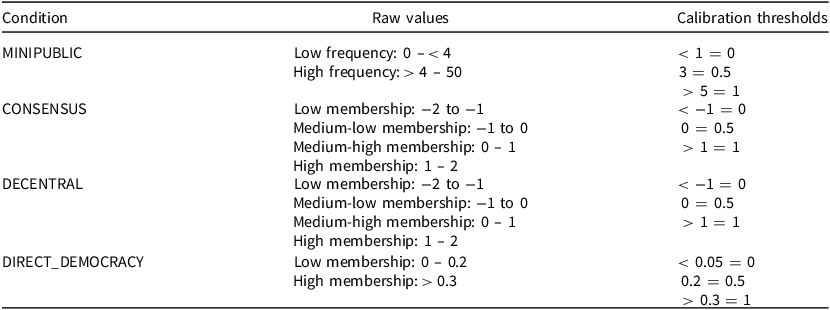
In QCA, calibration transforms raw data into sets of membership functions, capturing differences in degree. Specifically, we decided to employ fuzzy-set QCA (fsQCA) using the QCA package in R. Fuzzy scores are mapped onto a scale from 0 to 1, using three qualitative anchor points: full membership (1), non-membership (0), and the threshold of qualitative ambiguity (0.5). This process ensures that variations in membership degree are accurately represented, providing a nuanced data analysis which ultimately favours granular information retention. Table 1 summarises the established anchor points, with the rationale provided in the online Appendix.
Qualitative anchor points

CONSENSUS, derived from Lijphart’s factor analysis dataset, calibrates Lijphart’s scores below −1 as 0 (non-consensual, majoritarian), 0 as 0.5 (mixed systems), and above 1 as 1 (strong consensus via inclusive governance). Empirically, it assumes a normal distribution with 0 as the mean; theoretically, it reflects Lijphart’s emphasis on broad agreement and negotiation. In similar fashion, DECENTRAL also is derived from Lijphart’s dataset and follows the same calibration. Empirically, it uses 0 as the mean decentralisation level; theoretically, it captures Lijphart’s federalism dimension, where scores above 1 indicate robust subnational autonomy, enhancing consensus.
DIRECT_DEMOCRACY (V-Dem v2xdd_dd) calibrates below 0.05 as 0, 0.2 as 0.5, and above 0.3 as 1. Empirically, it accounts for skewed distributions; theoretically, it aligns with Altman’s Direct Democracy Practice Potential (DDPP), distinguishing negligible from robust direct democracy potential.
MINIPUBLIC calibrates below 1 as 0, 3 as 0.5, and above 5 as 1, using the median (3) as crossover. Theoretically, it complements Lijphart’s participatory elements, emphasising frequent deliberative engagement.
Analysis
QCA involves two critical analytical steps: (a) the analysis of necessity (reported in the online Appendix, as it reveals that there are no necessary conditions) and (b) the analysis of sufficiency via the truth table minimisation analysis (the Appendix reports the whole solution formula comprehensive of parsimonious and conservative solutions).
Table 2 presents factor configurations linked to high minipublic frequency, while Table 3 covers those linked to low frequency. Both tables include consistency scores (Cons) to indicate the strength of the causal sufficiency relationship. Additionally, they feature the product of reduction in consistency score (PRI) to assess the logical robustness of the solutions, and coverage scores (raw coverage (CovS) and unique coverage (CovU)) to show empirical relevance. For low levels of minipublics, configurations with consistency and PRI values above 0.8 indicate strong sufficiency (Table 3). High levels of minipublics are also analysed (Table 2), with a robust PRI of 0.6 (Greckhamer, Furnari, Fiss et al. Reference Greckhamer, Furnari, Fiss and Aguilera2018).
High minipublic frequency

Low minipublic frequency

The solution formula suggests that minipublics are common in countries where horizontal and bottom-up power mechanisms are absent and there is a strong vertical power distribution. This indicates that such countries, for example, Australian or Canada, with relatively concentrated power within majoritarian governments (∼CONSENSUS – where the ‘∼’ sign means ‘NOT’) and few opportunities for direct democratic participation through referendums (∼DIRECT_DEMOCRACY) are more prone to organising minipublics, presumably as an antidote to such power concentration. Additionally, within these countries, the high level of proximity between citizens and authorities, established through decentralised governance (DECENTRAL), presumably provides the ideal structure that ultimately facilitates the organisation of minipublics. This allows citizens to address gaps within their systems and advance their claims.
Returning to the core of this paper, the reasons linked to the low frequency of minipublics point to two distinct directions. Firstly, the absence of decentralised governance (∼DECENTRAL) implies that, in countries with predominantly strong centralised systems and high levels of consensus democracy (CONSENSUS), such as Norway, there are fewer contextual opportunities for citizens to engage with authorities in a proximate way. This limits the organisation of minipublics. This observation contrasts with the solution formula for high-frequency minipublics (Table 2). Centralised governance structures hinder citizens’ ability to voice concerns and shape policies directly through forms of deliberative mobilisation, such as minipublics, because of their lack of proximity to power.
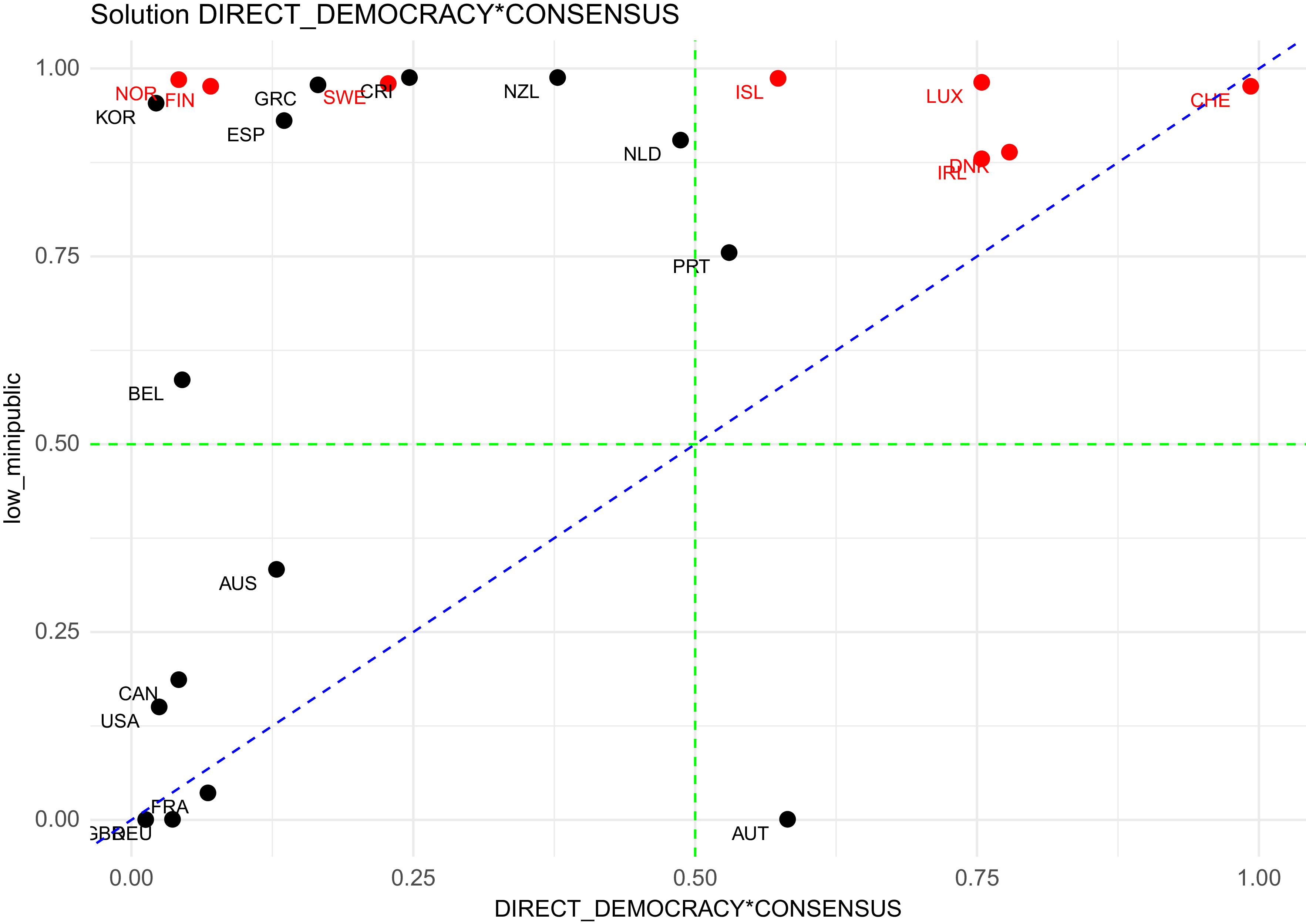
The second solution formula, in contrast, points to the Swiss case. As Figure 1 indicates, Switzerland is covered by this solution and stands out as the most typical case, being located in the top right corner of the XY plot (Figure 1).
XY plot DIRECT_DEMOCRACY * CONSENSUS.

In this respect, we can posit that having a high level of consensus democracy (CONSENSUS) coupled with direct democratic tools (DIRECT_DEMOCRACY) provides ample opportunity for citizens to advance their claims, as in the case of Switzerland. Consensus democracy creates the contextual foundation that enhances the effectiveness of direct democracy. Vatter and Bernauer (Reference Vatter and Bernauer2009) argue that there is a strong relationship between consensus and direct democracy, and that cabinet type can be seen as a variant of consensus democracy characterised by a power-sharing strategy distinct from the parliamentary-representative type. While the representative type is marked by the broad integration of political forces into the government, the direct-consensus type is shaped by the pursuit of compromise in the parliamentary arena. This configuration aims to prevent opposition parties from using referendums to obstruct government legislation, thereby incorporating more consensual decision-making processes into the political system (Vatter and Bernauer Reference Vatter and Bernauer2009). Considering a deliberative systemic perspective, the consensus-direct democratic structure is fostering higher levels of accountability, as elites seek compromise and integrate substantial segments of citizen claims, thus mitigating the veto power of referendums. On the other hand, consensus democracy provides the context through which popularly initiated referendums, as tools for advancing claims, best operate. It obliges political actors to take a stance on such claims during the campaign, compels the parliament to discuss and position itself on these issues, and allows minorities to access a larger section of the political arena. Within this context, direct democratic tools foster extensive dialogue and compromise among diverse political actors and stakeholders (Parkinson Reference Parkinson2020), integrating multiple viewpoints and encouraging the continuous refinement of ideas to prevent the veto power of referendums by the opposition. Frequent referendums also drive ongoing dialogue between citizens and political parties (El-Wakil Reference El-Wakil2020), further enhancing the inclusivity and responsiveness of the deliberative system.
Discussion
Political systems with dense institutional frameworks, characterised by widespread power-sharing, may hinder DI more than systems with simpler, more centralised structures. For example, the empirical analysis highlights that countries such as Canada, which combine concentrated power structures with federal arrangements and limited participatory mechanisms such as referendums, exhibit a high adoption of minipublics. This suggests that institutional ‘gaps’ – where opportunities for citizen participation are limited – create stronger incentives for adopting compensatory innovations such as minipublics compared with systems where power is already broadly distributed.
This pattern becomes clearer when contrasted with countries with strong consensus democracy combined with extensive direct democracy, as in the most typical case of Switzerland, which creates such robust citizen engagement channels that minipublics appear redundant. These results show that consensus democracy provides a strong platform for referendums to produce substantial deliberative effects, supporting existing literature. Indeed, referendums and popular initiatives in direct democracy foster extensive communication among diverse political stakeholders, enhancing interactions and fostering dialogue (Parkinson Reference Parkinson2020). These tools facilitate dynamic forms of representation and enrich recursive representation (El-Wakil Reference El-Wakil2020). Frequent referendums promote continuous dialogue between citizens and political parties, compelling parties to transparently reveal their agendas. Within the inclusive decision-making framework of consensus democracy, referendums act as a powerful accountability mechanism. They require political parties to articulate their agendas openly in response to new claims from popular initiatives. This extends beyond the traditional role of referendums and underscores their function as a stringent accountability tool.
Finally, federalism operates differently across institutional contexts. In majoritarian systems, it provides crucial experimentation venues despite concentrated national authority, supporting Karch’s (Reference Karch2007) ‘laboratory effects’. However, federalism appears less relevant in consensus systems where power-sharing already occurs through other mechanisms. Centralised consensus democracies such as Norway achieve broad inclusion through established practices but lack decentralised venues for institutional innovation.
Limitations
While our analysis provides valuable insights into the configurational effects of institutional dimensions on minipublic adoption, several limitations must be acknowledged to contextualise the findings.
First, QCA is inherently a static method that does not capture temporal dynamics in institutional evolution or participatory practices. As such, our results reflect average frequencies of minipublic adoption across the studied period rather than evolving trends over time. This cross-sectional approach may overlook how institutional configurations and innovation patterns change dynamically, for example, through gradual reforms or shifting political cultures that could alter receptivity to deliberative mechanisms in the long term.
Second, our dataset relies on the Doing Mini-Publics database, which, while providing an interesting and rigorous sample of minipublics, has inherent limitations in coverage and timeliness. The data are restricted to events up to 2019, and we acknowledge potential gaps in the dataset, such as underreporting of smaller-scale or informal and bottom-up initiatives. Consequently, the analysis does not account for developments after 2019, during which circumstances may have evolved significantly. For instance, the Covid-19 pandemic disrupted traditional governance and spurred interest in alternative participatory tools, potentially accelerating minipublic adoption in some contexts (Fominaya Reference Fominaya2024). Similarly, in countries such as Switzerland, a small but significant wave of DIs – including increased experimentation with citizens’ assemblies and deliberative minipublics – has emerged in recent years, as evidenced by projects such as Demoscan (demoscan.ch), initiated in 2019, and growing scholarly attention to citizen support for such mechanisms. Hence, these post-2019 shifts could alter the patterns identified in our study, highlighting the need for updated datasets to capture contemporary trends.
Third, our democratic indicators primarily capture national-level perspectives, which may ignore important subnational dynamics in participatory governance. This focus on aggregate national measures overlooks variations at regional or local levels, where institutional practices can differ substantially. The USA serves as an exemplary case: While no referendums are held at the national level, direct democratic mechanisms exist subnationally, with many states featuring robust initiative and referendum tools. Such subnational heterogeneity could influence overall minipublic adoption in federal systems, suggesting that future research should incorporate multilevel data to provide a more comprehensive understanding of institutional interactions.
Conclusions
Our findings challenge linear thinking about institutional reform. Systems with comprehensive participatory arrangements may paradoxically become less receptive to new citizen engagement forms, not through resistance but because existing mechanisms fulfil innovation functions. This creates a theoretical puzzle: If DIs emerge partly as responses to institutional deficits, what drives innovation in systems with extensive participatory opportunities?
The evidence suggests innovation adoption follows different logics across institutional contexts. Majoritarian federal systems embrace minipublics as supplements to limited participatory mechanisms, while consensus systems may view them as redundant additions. The configurational nature of these effects implies that institutional designers must consider systemic properties emerging from combinations rather than individual mechanisms alone.
By zooming in on Switzerland as a central case, we can observe how this configurational puzzle manifests in practice. Switzerland’s stance on deliberative innovations reveals a complex interplay of structural factors, as its extensive use of direct democratic mechanisms contrasts sharply with its relative hesitance to adopt deliberative minipublics. Our study explores the reasons behind this dichotomy, focusing on how direct democracy and consensus democracy might have reduced the perceived need for deliberative minipublics, as other systemic deliberative mechanisms are already in place. However, Switzerland is not a perfect model immune to democratic pathologies. While its direct and consensus democratic structures enhance accountability and citizen engagement, increasing polarisation and intense political campaigns push citizens to trust symbolic and propagandistic reasons (Bochsler, Hänggli, and Häusermann Reference Bochsler, Hänggli and Häusermann2015). This undermines the potential benefits of direct and consensus democracy in the future.
Supplementary material
The supplementary material for this article can be found at https://doi.org/10.1017/S1682098326100290.
Funding statement
None.
Competing interests
The authors declare no potential conflicts of interest with respect to the research, authorship, and/or publication of this article.
Use of AI declaration
The authors made use of Claude (Sonnet 4, Anthropic, accessed via on August 2025) to assist with proofreading for grammatical accuracy. The authors take full responsibility for the scientific content of this article and confirm that it adheres to the journal’s authorship policy.




 Open access

