




1. Introduction
In Germany, under the Arzneimittelmarktneuordnungsgesetz (AMNOG) procedure, manufacturers have the freedom to launch new, innovative medicines (new therapeutic entities) immediately after receiving marketing authorisation. During the first six months following the launch, they can set a profit-maximising price and obtain full reimbursement from the social health insurance (SHI) per label. However, new products and new indications undergo an early benefit assessment (EBA) to determine whether there is sufficient evidence of added medical benefits compared to existing therapeutic alternatives (G-BA), primarily based on relative risks like the hazard ratio. Orphan medicinal products are considered to have proven added benefits if their expected annual turnover is less than €30 million in the inpatient and outpatient sectors (German Social Code Book (Sozialgesetzbuch) § 35a section 1). The EBA is not required for products with less than €1 million annual turnover in the SHI (G-BA, 2024) and reserve antibiotics against multi-resistant bacteria (German Social Code Book (Sozialgesetzbuch) § 35a section 1c). The results of the EBA are used to negotiate an appropriate reimbursement price within six months between manufacturers and representatives of the SHI (German Social Code Book (Sozialgesetzbuch) § 130b section 4). If an agreement cannot be reached, an arbitration board will make a final decision on the reimbursement price (German Social Code Book (Sozialgesetzbuch) § 130b section 4).
The AMNOG procedure in Germany was influenced by the French system for pricing and reimbursement, which similarly employs a concept of evaluating medical benefit through cost-containment bodies and mandates price negotiations for pharmaceutical products (Natz and Campion, Reference Natz and Campion2012). The AMNOG process provides a framework that balances cost control, value-based pricing and market access, but it also presents challenges that could affect innovation. One of the primary benefits is its ability to control costs by requiring pharmaceutical companies to prove the additional benefit of new drugs compared to existing treatments. The process also supports value-based health care by incentivising the development of innovative drugs that offer improvements in patient-relevant outcomes. Additionally, it fosters transparency through public assessments and discussions about new drugs, promoting trust among manufacturers, payers and the public. However, the path from preparing an AMNOG dossier to price negotiation can be lengthy and financially demanding, as it requires comprehensive data to prove a drug's added benefits. This rigorous requirement often necessitates extensive clinical trials, which can be both time-consuming and costly for pharmaceutical companies.
The current power dynamic between manufacturers and the G-BA (German Federal Joint Committee) may be perceived as unbalanced (Dintsios and Chernyak, Reference Dintsios and Chernyak2022). Manufacturers make substantial investments in drug development and may feel the AMNOG process undervalues their contribution. Moreover, there is a risk that the prices may be set too low. If drug prices are too low, pharmaceutical companies may lack the motivation to invest in research and development, potentially hindering progress in medical science (Kourouklis and Gandjour, Reference Kourouklis and Gandjour2022).
At the request of drug makers or health insurers, the Institute for Quality and Efficiency in Health Care (IQWiG) is commissioned to conduct a cost-effectiveness analysis, which then informs a renegotiation of the reimbursement price (German Social Code Book (Sozialgesetzbuch) § 130b section 8). IQWiG uses a conventional incremental cost-effectiveness ratio (ICER) calculation, such as a cost-utility analysis (CUA) that assesses costs per quality-adjusted life year (QALY) gained, for the purpose of informing reimbursement prices since December 2022 (IQWiG, 2023). This approach marks a significant shift in methodology compared to the previously used efficiency-frontier (EF) method (IQWiG, 2022), which had been developed by an international panel of experts (Caro et al., Reference Caro, Nord, Siebert, McGuire, McGregor, Henry, de Pouvourville, Atella and Kolominsky-Rabas2010). Under the EF method, the ICER of a new drug compared to the next effective intervention should not exceed the ICER of the next effective intervention compared to its next effective alternative (IQWiG, 2022). This rule, also known as the proportional rule, implies a constant trade-off between costs and health benefits, ensuring that costs increase in proportion to incremental health benefits (Gandjour and Gafni, Reference Gandjour and Gafni2011; Gandjour, Reference Gandjour2012).
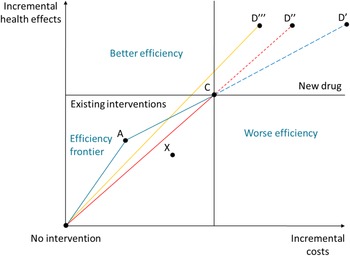
According to the EF method, different alternatives are positioned on a cost-benefit plane (Figure 1), and an ‘efficiency frontier’ is drawn along non-dominated alternatives (A and C in the figure). The reimbursement price D' is then determined by extrapolating the last segment of the EF from point A to C. In the past, IQWiG had also presented stricter variations of this rule, resulting in lower reimbursement prices. One approach considers the ICER of the currently most effective intervention compared to no intervention, leading to reimbursement price D'' in Figure 1 (IQWiG, 2009). Another approach takes the average cost-effectiveness ratio of all non-dominated alternatives in a therapeutic area, resulting in reimbursement price D''' (IQWiG, 2009). We will refer to IQWiG's base-case rule as the ‘marginal rule’ and the rule based on the ICER of the most effective intervention compared to no intervention as the ‘no intervention rule’ (Gandjour, Reference Gandjour2013a).
Pricing rules provided by different versions of the efficiency-frontier method.

Notably, the ‘no intervention rule’ in the EF approach can lead to lower prices for new drugs compared to extrapolating the last segment of the EF (‘marginal rule’). This is because the slope of the last segment of the EF is smaller than the slope of the EF compared to no intervention. As a result, when using the ‘no intervention rule’, the price premiums for new drugs may be lower, reflecting a more conservative approach to pricing.
Under the EF method, prices within each therapeutic area are assessed separately, and no direct comparison is made between therapeutic areas.
Despite initial expectations at the time of the introduction of the AMNOG law that payers or manufacturers might commission IQWiG for a cost-effectiveness analysis – anticipating a potentially more favourable price compared to the arbitration decision (Gandjour, Reference Gandjour2013b) – this scenario ultimately did not occur. For further details on the EF method, refer to IQWiG (2015). For objections against the EF method and counterarguments, such as concerns that the approach does not represent societal preferences or the life-cycle of drugs, see a review by Sandmann et al. (Reference Sandmann, Mostardt, Lhachimi and Gerber-Grote2018). It is worth noting that since the publication by Sandmann et al., the EF method has been shown to be mathematically consistent using proof by contradiction (Gandjour, Reference Gandjour2020a). Mathematical consistency, particularly through methods like proof by contradiction, is sufficient for theoretical validation, as it ensures logical soundness and internal consistency.
The main objective of this conceptual study is to compare different pricing approaches for new and innovative drugs in the German health care system and to inform policymakers about potential differences in pricing outcomes. Specifically, the article aims to compare the reimbursement prices resulting from negotiation (including arbitration) with prices resulting from cost-effectiveness analysis. Two types of cost-effectiveness analysis are addressed in the study: CUA and the EF method, which was previously used by IQWiG. The rationale behind this comparison is to provide a comprehensive understanding of how different pricing strategies might impact the cost of new medications, ultimately aiding in policy decisions that balance cost control with incentives for pharmaceutical innovation. It is important to note that cost-effectiveness analysis under the current law (German Social Code Book (Sozialgesetzbuch) § 130b section 8) is not separated from negotiation but serves as one input factor. Nevertheless, it was considered a distinct alternative in this analysis to show its potential impact.
2. Methods
2.1 Comparison matrix and pairwise comparisons
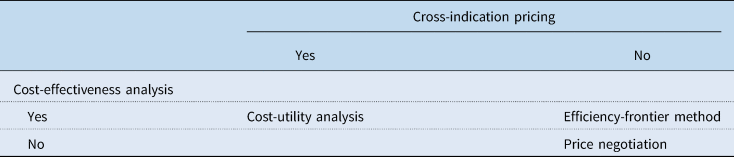
To compare the different pricing methods (negotiation, CUA and EF), the study used a 2 × 2 matrix with the dimensions ‘cross-indication pricing’ and ‘cost-effectiveness analysis’ (Table 1). In the context of CUA, utility is measured in QALYs. As shown, EF and negotiation are indication-specific as they both use indication-specific price comparators for setting reimbursement prices. Three pairwise comparisons were conducted: negotiation vs EF, negotiation vs CUA and CUA vs EF.
Categorisation of pricing approaches

2.2 Relative risk reductions (RRRs) and endpoints
For the comparison between negotiation and EF, the study assigned RRRs for considerable and major added benefits based on IQWiG's (2022) method paper. It is important to note that major benefits have only been warranted three times, each in one subpopulation (Storm, Reference Storm2022). Other sizes of added benefits (non-quantifiable and minor) were not considered due to a lack of information on associated RRRs in IQWiG's (2022) method paper.
Two different endpoints were considered to assign RRRs for considerable or major added benefits: (i) mortality and (ii) severe symptoms, complications, adverse events and health-related quality of life.
2.3 Retrospective analysis of price premiums based on negotiation
The relative price premiums obtained from negotiation were derived from a retrospective analysis of pricing and arbitration decisions for 106 non-orphan drugs (Gandjour et al., Reference Gandjour, Schüßler, Hammerschmidt and Dintsios2020). These price premiums also include the outcomes of arbitration.
2.4 Calculation of price premiums based on the efficiency frontier (EF)
Price premiums based on the EF were determined using the EF's ‘no intervention rule’ and ‘marginal rule’. Regarding the EF's ‘no intervention rule’, except in the rare case where no intervention leads to immediate death, it is inappropriate to assign zero costs and health benefits to no intervention, as patients continue to live and incur costs. To estimate the costs and benefits compared to no intervention, the study therefore assumed that 50 per cent of medical progress in Germany was attributable to factors outside the health care system, based on data from Eurostat (2022) on amenable and preventable mortality for the period between 2014 and 2019 (earlier data were not available). Factors outside the health care system that contribute to medical progress include improvements in public health measures, lifestyle changes, environmental factors, socioeconomic conditions and advancements in education. These non-medical factors play an important role in enhancing overall health outcomes and reducing mortality rates, recognising that not all improvements can be solely credited to medical technologies. This adjustment leads to a reduction in the health benefits associated with existing medical technologies compared to no intervention. As a result, the ICER increases, reflecting a higher cost per unit of health benefit gained.
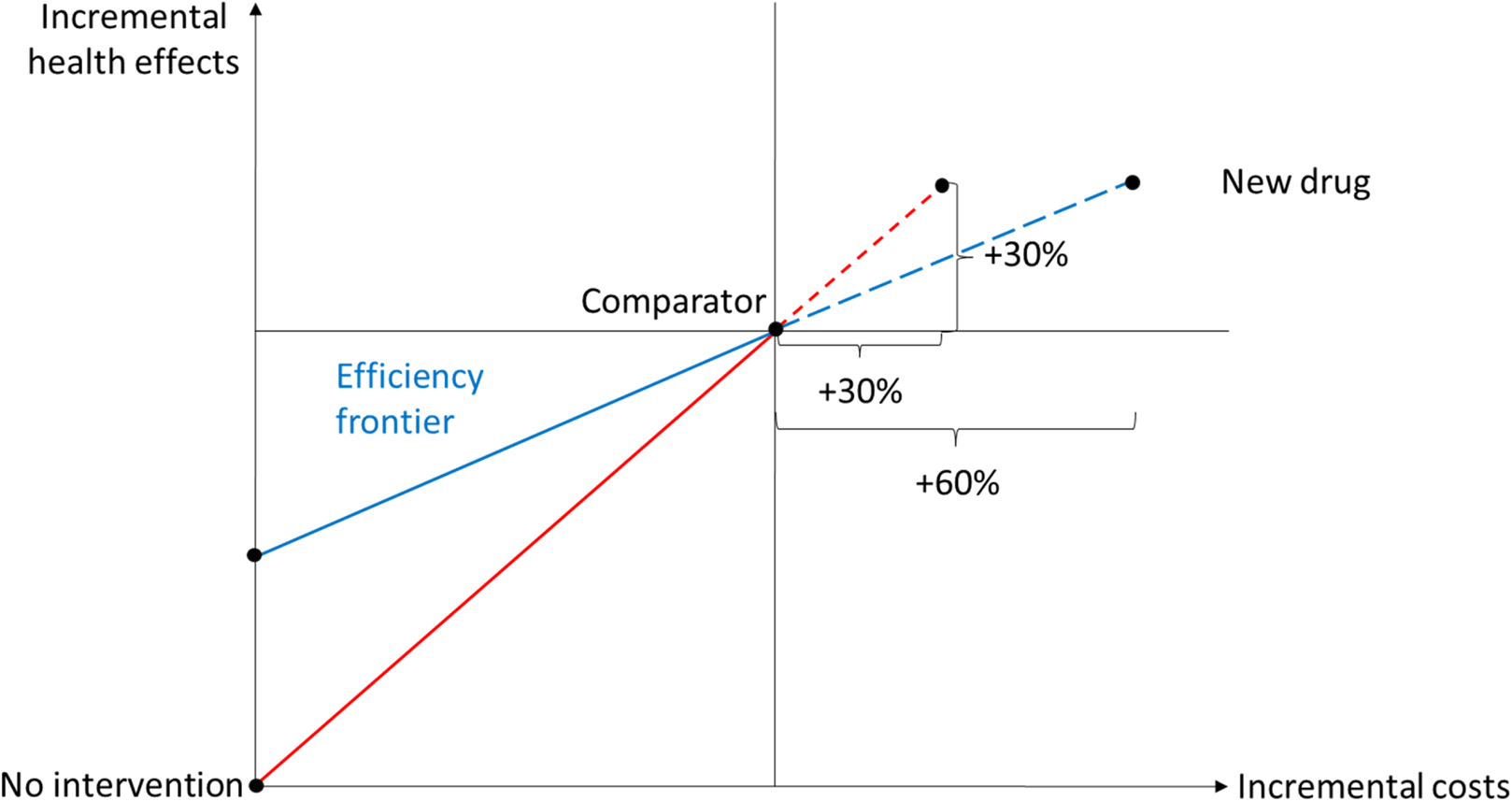
When assigning zero costs and health benefits to no intervention (as per Figure 2), the EF method stipulates that augmenting the benefit of a new drug by, say, 30 per cent compared to the comparator's benefit, equivalent to a 30 per cent RRR, corresponds to a 30 per cent increase in price premium, as illustrated by the red line in Figure 2. This is because the EF method mandates a proportional relationship between costs and health benefits. However, when accounting for factors external to the health care system, a 30 per cent RRR elevates the price premium by 60 per cent, as demonstrated by the blue line in Figure 2.
Price premiums based on the efficiency frontier approach using the ‘no intervention rule’ assuming that 50 per cent of medical progress was attributable to factors outside the health care system.

While IQWiG's proportional rule is a fixed rule without associated uncertainty, and the Eurostat (2022) data on amenable and preventable mortality are national (German) statistics also considered certain, the RRRs for considerable and major added benefits do carry some uncertainty, as reported in IQWiG's 2022 publication. Therefore, these uncertainties were reflected in the extrapolated price premiums calculated above. However, it is unclear from the publication whether the uncertainty ranges truly represent 95 per cent confidence intervals.
Price premiums under the EF's ‘marginal rule’ are also calculated based on a proportional relationship between costs and health benefits. This means that the ICER of a new drug compared to the next effective intervention should not exceed the ICER of that intervention compared to its next effective alternative. When using negotiated drug prices as a pricing comparator, the premium is, ceteris paribus, commensurate with the increase in health benefits. This was considered an upper limit, however, because negotiated drug prices pertain to patented drugs only, whereas EF's ‘marginal rule’ also includes cheaper generic drugs and biosimilars as comparators, along with less frequent non-pharmacological interventions. Moreover, approximately 18 per cent of medicines, as indicated by international data (Kim et al., Reference Kim, Silver, Kunst, Cohen, Ollendorf and Neumann2020), not only provide health benefits but also result in cost savings. These medicines are likely to be generic drugs, thereby contributing to the reduction of price levels under EF's ‘marginal rule’.
2.5 Cost-utility analysis vs efficiency frontier
The method used to determine the threshold value for CUA aims to incorporate health opportunity costs, which Vallejo-Torres et al. (Reference Vallejo-Torres, García-Lorenzo, Castilla, Valcárcel-Nazco, García-Pérez, Linertová, Polentinos-Castro and Serrano-Aguilar2016) deem the most appropriate approach under budgetary constraints, such as those faced by the German sickness funds. Although the proportion of taxes in the total revenue of the sickness funds in Germany for 2023 was only 5 per cent (BMG 2024), tax subsidies play a critical role in funding on the margin. These subsidies effectively determine the upper limit of the total revenue of the sickness funds. The threshold value derived from health opportunity costs is €88,107 per-life-year gained in Germany (Gandjour, Reference Gandjour2023).
In contrast, according to Vallejo-Torres et al. (Reference Vallejo-Torres, García-Lorenzo, Castilla, Valcárcel-Nazco, García-Pérez, Linertová, Polentinos-Castro and Serrano-Aguilar2016), willingness to pay (WTP) surveys are hindered by their nonlinearity in valuing health gains associated with quality of life improvements and duration, which challenges the commonly used linear assumption. Studies have also highlighted nonlinear effects due to factors such as severity and mortality risk. Furthermore, combining results from different methods, such as WTP and utility questionnaires, can complicate evaluations and may lead to potentially infinite QALY values when individuals are willing to trade in one metric but not another. Additionally, the choice of aggregation method and survey technique – whether standard gamble or time trade-off, or closed vs open-ended questions – significantly impacts valuation outcomes, resulting in varied results.
For the comparison between CUA and EF, it was noted that a threshold value for CUA can be formally represented as a weighted average of indication-specific cost-effectiveness ratios, which reflect the EFs in the respective therapeutic areas (Gandjour, Reference Gandjour2020b). The weights are calculated based on the number of treated patients and the size of health gains in each therapeutic area (Gandjour, Reference Gandjour2020b). Furthermore, it should be noted that waste (i.e. process inefficiency) and overuse (i.e. dominated alternatives) in health care can impact the threshold value for CUA but not the threshold set by the EF approach, which explicitly excludes dominated alternatives. As a result, ceteris paribus, the threshold for CUA is higher. Estimates on waste in international health care systems range from 20 per cent to a third of total health care spending (Couffinhal and Socha-Dietrich, Reference Couffinhal, Socha-Dietrich and OECD2017), indicating that a threshold ICER that includes waste increases by 25–50 per cent compared to a threshold without such consideration (Gandjour, Reference Gandjour2020b).
The difference of 25–50 per cent specifically pertains to comparing the average cost-effectiveness of the health care system with EF's ‘no intervention rule’. Conversely, the comparison between a threshold reflecting the marginal cost-effectiveness of the health care system (i.e. health opportunity costs) and EF's ‘marginal rule’ is also influenced by the fact that EF's ‘marginal rule’ predominantly relies on drugs as comparators, whereas the marginal cost-effectiveness of the health care system is influenced by various other types of health care interventions as well.
2.6 Cost-utility analysis vs negotiation
The study indirectly compares prices between CUA and negotiation using the EF's ‘no intervention rule’ as a bridge comparator. It should be reemphasised that in the German AMNOG procedure, the distinction between CUA and negotiation as separate alternatives is somewhat blurred. This is because the results of the CUA inform the renegotiation of the reimbursement price. Nevertheless, it is not possible to assess the results of CUA without establishing a threshold cost-effectiveness ratio or a range thereof. It should also be recognised that under budgetary constraints, a misjudged threshold can lead to a welfare loss (Gandjour, Reference Gandjour2014a). Essentially, the price derived from negotiations that include CUA results is a blended price, incorporating elements of both traditional negotiation and CUA. Thus, the final price represents a combination of these two distinct approaches.
3. Results
As depicted in the 2 × 2 matrix in Table 1, both EF and negotiation share the characteristic that reimbursement prices are set independently for each indication. This means that the prices are determined based on the price level specific to each indication, without being influenced by the prices and ICERs of other indications.
CUA diverges from price negotiations in Germany by establishing prices based on a cross-indication threshold ICER. Consequently, shifting from negotiation to CUA requires undertaking two major steps simultaneously.
Table 2 displays the results of the comparison between negotiation and EF's ‘no intervention rule’ for non-orphan drugs. This finding of higher negotiated prices for considerable added benefits appears robust, as the non-overlapping uncertainty ranges for both negotiation and EF suggest a significant difference. However, it is important to note that while the uncertainty ranges for negotiation are 95 per cent confidence intervals of the mean, the uncertainty ranges for EF may not represent 95 per cent confidence intervals.
Comparison of price premiums between price negotiation and efficiency frontier for non-orphan drugs

QoL, quality of life; RRR, relative risk reduction.
For price negotiation, 95% confidence intervals of the mean are reported in parentheses (based on Gandjour et al., Reference Gandjour, Schüßler, Hammerschmidt and Dintsios2020). For the efficiency frontier, uncertainty ranges are also reported in parentheses.
However, this finding cannot be confirmed for major added benefits. Specifically, for severe symptoms and quality of life endpoints, prices obtained from EF surpass those of negotiation. This suggests a significant difference, as indicated by the non-overlapping uncertainty ranges between negotiation and EF.
As mentioned in the Methods section, the threshold ICER for CUA is 25–50 per cent higher than for EF. This allows an indirect comparison between CUA and negotiation using EF's ‘no intervention rule’ as a bridge comparator. If price premiums based on negotiation are approximately 10–40 per cent higher than those based on EF's ‘no intervention rule’ (excluding price premiums for a major added benefit due to rarity), then negotiation leads to smaller price premiums than CUA. More precisely, the discrepancy between negotiation and the EF method is roughly 10–15 per cent smaller than that between CUA and EF. As a result, the price level of CUA for non-orphan drugs is expected to be 10–15 per cent higher than that of negotiation. Importantly, this analysis holds, strictly speaking, for CUA using the average cost-effectiveness ratio as a threshold because this is the appropriate comparator of EF's ‘no intervention rule’ when applying the 25–50 per cent difference.
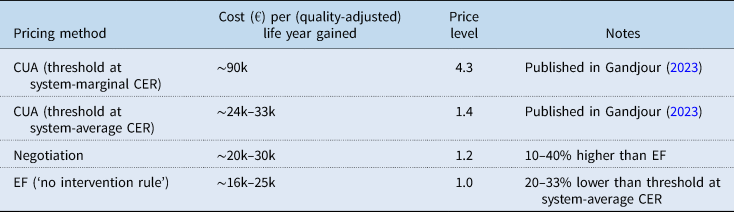
From the price factor differences and information on the average and marginal cost-effectiveness ratio of the health care system, we are able to construct the following order of prices levels set by the different pricing methods: CUA based on marginal cost-effectiveness threshold > CUA based on average cost-effectiveness threshold > negotiation > EF's ‘no intervention rule’. As for EF's ‘marginal rule’, it is a priori unclear how its price levels compare to those of EF's ‘no intervention rule’. On one hand, as illustrated by Figure 1, EF's ‘marginal rule’ exhibits a flatter slope, indicating higher ICERs. On the other hand, cost-saving drugs used as comparators can result in negative prices, a scenario avoided by EF's ‘no intervention rule’.
Table 3 provides the threshold cost-effectiveness ratios and the price multipliers indexing the price obtained by the ‘no intervention rule’ at 1. It is important to note that the calculation of price levels assumes that the cost-effectiveness ratio and prices have a linear relationship, which assumes that downstream costs and savings are negligible compared to drug prices.
Comparison of incremental cost-effectiveness ratios and price levels obtained by different pricing methods

CUA, cost-utility analysis; CER, cost-effectiveness ratio; EF, efficiency frontier.
As an application example, consider a drug for a chronic condition that yields an annual health benefit of 0.1 QALYs. Based on the price levels indicated in Table 3, the annual per-patient drug costs for CUA based on the marginal cost-effectiveness threshold, CUA based on the average cost-effectiveness threshold, negotiation and EF's ‘no intervention rule’ are €9,000, €2,400–€3,300, €2,000–€3,000 and €1,600–€2,500, respectively.
4. Discussion
In Germany, negotiations for reimbursement prices of new, innovative medicines have garnered broad acceptance from both sickness funds and manufacturers. In agreement, there seems to be limited public pressure on sickness funds to actively engage in cost-effectiveness analysis and implementation. One possible reason for this is that policymakers may introduce additional price regulations in response to continually rising annual treatment costs, providing a fallback option for sickness funds.
As a result, there has been a lack of knowledge regarding the quantitative differences between the various pricing approaches. This article presents the first systematic exploration of this topic. The average ICER of negotiated prices projected in this study (€25,000 per life year gained) can be indirectly validated by a comparison with ICERs in England. This validation is based on two key premises. First, the National Institute for Health and Care Excellence (NICE) typically uses a cost-effectiveness threshold range of £20,000–£30,000 per QALY when evaluating non-orphan drugs, which translates to approximately €23,200–€34,800 per QALY. For the majority of cases where drugs are considered cost-effective, the average ICER is likely to be closer to the lower end of this range (around £20,000 or €23,200 per QALY). Second, the negotiated drug prices in Germany may not be higher than in England (Mulcahy et al., Reference Mulcahy, Schwam and Lovejoy2024: 17). These premises together support the reasonableness of the €25,000 ICER projected in this study.
Both price negotiations and the EF approach have been criticised for their sensitivity to the prices of comparator treatments, which can significantly influence pricing outcomes (Sandmann et al., Reference Sandmann, Mostardt, Lhachimi and Gerber-Grote2018; Storm, Reference Storm2022). Nevertheless, the analysis indicates a potential cost-saving advantage of the EF's ‘no intervention rule’ compared to negotiation for non-orphan drugs. This finding is corroborated by single case studies comparing EF and negotiation (Gandjour et al., Reference Gandjour, Gafni and Schlander2014b; Gandjour, Reference Gandjour2020c).
However, it is worth noting that under certain circumstances, EF's ‘no intervention rule’ may result in higher prices than negotiation. For example, this can occur if the added benefit of a new drug is considered ‘major’, as demonstrated in this study. Furthermore, it is essential to exercise caution since negotiated prices are not determined algorithmically, leading to considerable variance around the point estimates. For a considerable added benefit, the actual percentage increase can be anywhere from 20 per cent to over 100 per cent, depending on the specific circumstances and negotiation outcomes. Drugs treating severe or life-threatening conditions or those that fill a therapeutic gap tend to be at the higher end of this range. If the price premium for a considerable added benefit is at the lower end, EF will again result in higher prices than negotiation. Finally, when the comparator's comparator is already expensive, it can lead to limited upward potential based on negotiation. An illustration of this phenomenon is seen with add-on regimens, where the price premium of the add-on drug decreases as the backbone therapy becomes more expensive (Dintsios and Beinhauer, Reference Dintsios and Beinhauer2020; Vfa, 2022).
In addition to the cost-saving potential of EF's ‘no intervention rule’, the EF method offers a more transparent price calculation than negotiation and was favoured over CUA in a survey of the general public (Gandjour et al., Reference Gandjour2014a). However, sickness funds may have concerns about an algorithmic price determination, which could limit flexibility and their power in pricing negotiations. This concern is likely one of the major reasons why cost-effectiveness analysis has not been requested since the enactment of AMNOG in 2011.
The indirect comparison between CUA and negotiation suggests that CUA, based on an opportunity cost threshold, is predicted to result in more than threefold higher prices than negotiation. This implies that it can be strategically advantageous for pharmaceutical companies to advocate for the implementation of CUA in Germany based on an opportunity cost threshold.
An advantage of CUA compared to negotiation is the ability to present the relationship between drug costs and benefits in a more transparent way, similar to the EF method. Furthermore, the lifetime perspective commonly adopted in economic evaluations enables manufacturers to demonstrate significant QALY gains despite only minor added benefits, which are measured on a relative scale.
However, the study findings suggest that transitioning towards CUA from the current negotiation approach would involve overcoming two significant hurdles, making the adoption of CUA likely to encounter resistance. It is important to note that the resistance is not due to feasibility, as it is already possible to commission IQWiG with a cost-effectiveness analysis, including a CUA, as mentioned in the introduction. Instead, the reluctance to embrace CUA seems to stem from a lack of desirability or willingness to embrace this pricing approach.
If policymakers adopt a policy threshold that is not based on opportunity costs, prices for CUA could be lower than those negotiated. Based on Table 3, the average threshold for negotiation is around €25,000 per life year gained. From a manufacturer's perspective, however, the overall upside pricing potential of mandatory CUAs seems larger than the downside risk.
One limitation of this study is its primary focus on economic and methodological aspects of drug pricing, without delving into the ethical and societal implications of adopting different pricing approaches in Germany. For a comprehensive discussion on the ethical considerations, particularly with regard to distributive justice, and societal consequences of implementing negotiation, CUA or EF pricing methods, readers are encouraged to refer to other relevant publications (Deutscher Ethikrat, 2011; Gandjour, Reference Gandjour2011). Balancing fair pricing with incentives for pharmaceutical innovation is another challenge. If drug prices are too low, companies may lack the motivation to invest in research and development, potentially hindering progress in medical science.
The potential transition from negotiation to CUA in Germany represents a pivotal shift in health care policy, particularly in light of our study's findings that CUA could result in higher price premiums for drugs compared to the current negotiation methods. This has profound implications for policymakers who are considering the integration of more systematic economic evaluations like CUA into drug pricing decisions. Although German health care budgets are increasingly strained, which might impede the swift adoption of CUA, the benefits of such a change could be considerable. Transitioning to CUA could enhance the transparency and accountability of pricing decisions, supporting a more value-based approach. This would align drug costs more directly with their therapeutic benefits, potentially improving patient outcomes and ensuring that spending is targeted towards treatments that offer the most significant health gains. Therefore, despite financial constraints, the long-term benefits of adopting CUA might justify the initial challenges, suggesting that stakeholders should carefully weigh these factors in their deliberations.
For future research, this study recommends assessing and aggregating ICERs of new, innovative medicines in Germany to improve the estimated aggregate ICER of negotiated drugs. Systematically collected data are lacking, making it difficult to infer an aggregate ICER from past negotiation outcomes. Additional research is also needed to compare negotiation, CUA and EF, specifically concerning orphan drugs.
Acknowledgements
The author would like to express gratitude to Charalabos-Markos Dintsios, the participants at the Pharma Trends 2023 meeting organised by the FORUM Institut für Management (Berlin 2022), and three anonymous reviewers for their valuable comments and feedback on an earlier version of this work.
Financial support
This article received no specific grant from any funding agency in the public, commercial or not-for-profit sectors.
Competing interests
None.


 Open access

