


Impact statement
Dryland cities are home to more than two billion residents and are rapidly increasing throughout the world. This paper provides an overview of key challenges, opportunities and uncertainties that affect the resilience of urban systems in drylands. New research directed to dryland cities is needed to help achieve sustainable development goals and contribute to more comprehensive theories of social–environmental systems spanning neighborhood to global scales.
Introduction
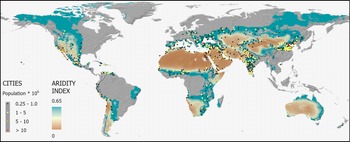
Cities are globally distributed key locations of human impacts to the biosphere and focal locations where people experience the environment (Grimm et al. Reference Grimm, Faeth, Golubiewski, Redman, Wu, Bai and Briggs2008; Seto et al. Reference Seto, Güneralp and Hutyra2012a). As complex socio-environmental systems, cities function through combinations of interactions that reflect self-organization, decision-making and external constraints (Bettencourt et al. Reference Bettencourt, Lobo, Helbing, Kühnert and West2007; Batty Reference Batty2008). Cities are also highly heterogeneous landscapes with geographic variability spanning from the urban core featuring dense urban development and populations to associated teleconnected zones that provide resources for the urban core (Luck and Wu Reference Luck and Wu2002; Zhou et al. Reference Zhou, Wang and Cadenasso2017; Seto et al. Reference Seto, Reenberg, Boone, Fragkias, Haase, Langanke, Marcotullio, Munroe, Olah and Simon2012b). Given the increasing importance of urbanization to society and biosphere, extensive ongoing basic research and increasingly use-inspired research developed in collaboration with stakeholders are expanding to meet the theoretical and practical uncertainties of urban trajectories (Bai et al. Reference Bai, McPhearson, Cleugh, Nagendra, Tong, Zhu and Zhu2017). Drylands are especially important loci of urbanization that differ in important characteristics from cities in wetter environments. With good reason, drylands served as the cradle of urban development in Mesopotamia, Indus Valley, China and Mesoamérica as social organization was required for constructing elaborate irrigation systems (Wittfogel Reference Wittfogel1957; Scarborough Reference Scarborough2003). Currently, 2.1 billion people or 56% of all urban residents live in a city where precipitation is substantially less than potential evaporation (Figure 1) and some of the most rapid rates of urbanization are occurring in dryland environments of Africa, Latin America and Asia (Seto et al. Reference Seto, Güneralp and Hutyra2012a; Liu et al. Reference Liu, Huang, Xu, Li, Li, Ciais and Lin2020). With the global expansion of drylands and increasing frequency of dry conditions in historically wet regions (Huang et al. Reference Huang, Yu, Guan, Wang and Guo2016), dryland cities also serve as a useful model for urban development and resilience globally. Exemplifying this challenge, by 2050 between 1.7 and 2.4 billion urban residents are projected to experience water scarcity (He et al. Reference He, Liu, Wu, Pan, Fang, Li and Bryan2021). To achieve sustainable development goals and enhance opportunities for urban residents, an expanded perspective of urbanized drylands is needed (FAO 2022).
Global distribution of cities of more than 250,000 residents in drylands (aridity index <0.65). Aridity layer was obtained from Trabucco and Zomer (Reference Trabucco and Zomer2009). City data were obtained from geonames by opendatasoft.

Achieving sustainable development goals in the context of urbanization includes the maintenance of resources and environmental conditions for future generations while also enhancing an adaptive capacity to allow cities to continue responding to changing conditions (Wu Reference Wu2014). Essential to both is increasing the resilience capacity of urbanization to ensure continued supply of resources, maintain natural biodiversity and ensure equitable societal improvements (Chelleri et al. Reference Chelleri, Waters, Olazabal and Minucci2015; Meerow et al. Reference Meerow, Newell and Stults2016). Urban planning, from a resilience perspective, in part focuses on enhancing the capacity to recover and reorganize after disturbances such as fires and flooding from biophysical drivers or economic shocks and riots from societal drivers (Ahern Reference Ahern2011). The resilience perspective reflects both system and landscape attributes central to urban dynamics (Wu Reference Wu2014; Groffman et al. Reference Groffman, Cadenasso, Cavender-Bares, Childers, Grimm, Grove, Hobbie, Hutyra, Jenerette, McPhearson, Pataki, Pickett, Pouyat, Rosi-Marshall and Ruddell2017). Increasingly researchers and practitioners recognize that urban resilience capacity is dependent on interactions occurring throughout the urban continuum from urban core and suburban to more distal areas including teleconnected zones and wildland urban interfaces (WUIs) (Seitzinger et al. Reference Seitzinger, Svedin, Crumley, Steffen, Abdullah, Alfsen, Broadgate, Biermann, Bondre, Dearing, Deutsch, Dhakal, Elmqvist, Farahbakhshazad, Gaffney, Haberl, Lavorel, Mbow, McMichael, deMoraís, Olsson, Pinho, Seto, Sinclair, Smith and Sugar2012). Throughout these diverse zones of urbanization innovation that generates urban adaptive capacity can be promoted (Ernstson et al. Reference Ernstson, van der Leeuw, Redman, Meffert, Davis, Alfsen and Elmqvist2010). Fostering resilience in dryland cities is an essential goal for research, planning and policy development to ensure progress in improving in achieving sustainable development goals.
To date, the majority of research into dryland cities and pathways to enhance their resilience has been primarily through case studies although some efforts have also been directed to cross-city comparisons. Phoenix, AZ, USA, in particular has served as an extensive test bed to understand urban dryland dynamics and develop frameworks for enhancing their resilience. Beginning in 1998, the Central Arizona–Phoenix Long Term Ecological Research project has catalyzed researchers and practitioners throughout the metropolitan region. Key findings from this project have demonstrated the role of vegetation and associated irrigation on reducing neighborhood heat risks and that the distribution of vegetation density and cooler microclimates are associated with neighborhood wealth and racial makeup (Jenerette and Larsen Reference Jenerette and Larsen2006). This work has also pioneered research into urban resident desires leading to scenario framing as a pathway toward convergence research (Larson et al. Reference Larson, Corley, Andrade, Hall, York, Meerow, Coseo, Childers and Hondula2019; Iwaniec et al. Reference Iwaniec, Cook, Davidson, Berbés-Blázquez, Georgescu, Krayenhoff, Middel, Sampson and Grimm2020; Brown et al. Reference Brown, Larson, Lerman, Childers, Andrade, Bateman, Hall, Warren and York2020). Other case study cities have also provided valuable insights into dryland urbanization, including ongoing research in Los Angeles, USA (Kucera and Jenerette Reference Kucera and Jenerette2023; McPherson et al. Reference McPherson, Simpson, Xiao and Wu2010), Barcelona, Spain (Anguelovski et al. Reference Anguelovski, Shi, Chu, Gallagher, Goh, Lamb, Reeve and Teicher2016; Baró et al. Reference Baró, Palomo, Zulian, Vizcaino, Haase and Gómez-Baggethun2016), Mexico City, Mexico (Bravo-Bello et al. Reference Bravo-Bello, Martinez-Trinidad, Valdez-Lazalde, Romero-Sanchez and Martinez-Trinidad2020; Velasco et al. Reference Velasco, Pressley, Allwine, Westberg and Lamb2005) and Melbourne, Australia (Ossola et al. Reference Ossola, Hahs and Livesley2015; Threlfall et al. Reference Threlfall, Gunn, Davern and Kendal2022). In addition to detailed case studies, work has also been directed to cross-site comparisons of dryland cities. Network approaches have been used in the southwestern United States to document the importance of climate and irrigation gradients on interurban variation in heat and vegetation (Jenerette et al. Reference Jenerette, Miller, Buyantuev, Pataki, Gillespie and Pincetl2013; Shiflett et al. Reference Shiflett, Liang, Crum, Feyisa, Wang and Jenerette2017; Ibsen et al. Reference Ibsen, Santiago, Shiflett, Chandler and Jenerette2023). Global syntheses have also been conducted for dryland cities that evaluate sources of variation in urban heat risks (Wheeler et al. Reference Wheeler, Abunnasr, Dialesandro, Assaf, Agopian and Gamberini2019; Dialesandro et al. Reference Dialesandro, Wheeler and Abunnasr2019). Other comparative studies have included dryland cities in a broader selection of cities that have shown important differences between dryland cities compared to more mesic cities in context of vegetation, climate and soils (Jenerette et al. Reference Jenerette, Clarke, Avolio, Pataki, Gillespie, Pincetl and Nowak2016; Herrmann et al. Reference Herrmann, Schifman and Shuster2020; Ibsen et al. Reference Ibsen, Borowy, Dell, Greydanus, Gupta, Hondula, Meixner, Santelmann, Shiflett, Sukop, Swan, Talal, Valencia, Wright and Jenerette2021). With this baseline of cross-city comparisons and ongoing case studies, there is a need for an overarching perspective of dryland urbanization. In looking toward this need, the objective here is to develop a framework for characterizing key sources of variability in dryland urbanization structure, function and capacity for resilience. The resulting framework will be used to better identify challenges, solutions and research needs to improve a theory of dryland cities and enhance the resilience of these systems.
Defining dryland urbanization and sources of variability
What is a water limited city or dryland urbanization? A defining feature of urbanization in drylands is a chronic terrestrial deficit between precipitation and the capacity for evaporation (defined as an aridity index of 1 – precipitation/potential evapotranspiration less than 0.65), a commonly used definition of dryland (He et al. Reference He, Liu, Wu, Pan, Fang, Li and Bryan2021). In this sense, a dryland city is one where the land surface could have higher rates of evaporation if additional water were available in an unmanaged condition. Characteristics reflecting an increasing magnitude of water deficit include infrequent precipitation events, low atmospheric humidity, high temperatures, dry soils and reduced vegetation. In part because of these characteristics, dryland cities are exposed to elevated risks from water insecurity, wildfires, heat waves and flooding during episodic precipitation events (Lian et al. Reference Lian, Piao, Chen, Huntingford, Fu, Li, Huang, Sheffield, Berg, Keenan, McVicar, Wada, Wang, Wang, Yang and Roderick2021; Yin et al. Reference Yin, Gao, Chen, Yu, Wilby, Wright, Ge, Bricker, Gong and Guan2023). These features affect urban development and shape opportunities to enhance urban resilience in drylands. Nevertheless, this definition does not imply that dryland cities themselves lack water, in contrast many cities in dryland environments have extensive water resources. Water for urban uses can be acquired from surface and groundwater resources naturally located within or adjacent to the city (McDonald et al. Reference McDonald, Weber, Padowski, Flörke, Schneider, Green, Gleeson, Eckman, Lehner, Balk, Boucher, Grill and Montgomery2014). Water is also captured from conveyances that may store and transport water great distances. Examples of such conveyance systems include the historic aquaducts of Rome that transported water more than 90 km and the modern Great Man-Made River in Libya that transports water up to 1,600 km in supplying multiple dryland cities. Thus, while the definition of terrestrial water limitation provides a key lens for considering dryland urban dynamics, the amount of water available to a city may be extensive and support additional vegetation, high rates of evaporation and perennial downstream water flows.
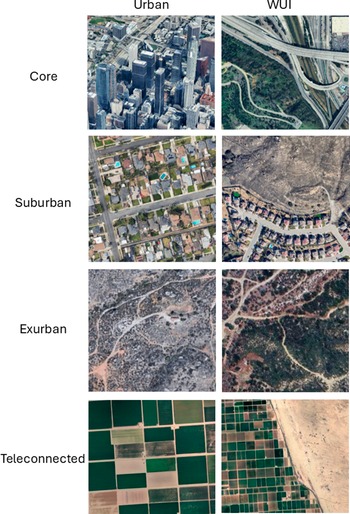
In addition to the challenges of defining urban water limitation, identifying the scope of urbanization itself is also contested. Urbanization has been challenging to define as it is a combination of a system of interconnected social and environmental processes encompassing a large number of quasi-autonomous agents participating in webs of organizations with key processes occurring throughout a landscape (Wu Reference Wu2014; Groffman et al. Reference Groffman, Cadenasso, Cavender-Bares, Childers, Grimm, Grove, Hobbie, Hutyra, Jenerette, McPhearson, Pataki, Pickett, Pouyat, Rosi-Marshall and Ruddell2017). People and their interactions are the hallmark of urbanization where interactions span informal to formal as well as private to governmental institutions and interactions are characterized by varying degrees of cooperation and conflict. In this sense, urbanization encompasses a decentralized system of people and the environment. At the same time, urbanization is a geographic concept associated with extensive landscape heterogeneity found at multiple scales (Luck and Wu Reference Luck and Wu2002; Seto et al. Reference Seto, Reenberg, Boone, Fragkias, Haase, Langanke, Marcotullio, Munroe, Olah and Simon2012b). Delineations of urban extent are connected to a variety of geographic indicators associated with population and social concentration, land cover distributions and governmental regulations (Raciti et al. Reference Raciti, Hutyra, Rao and Finzi2012; Meerow et al. Reference Meerow, Newell and Stults2016). By using a simplified landscape model of urban development, a city can be separated into distinct zones of urbanization from the urban core, suburban, exurban, to teleconnected lands and WUIs (Figure 2). Both among and within contrasting zones extensive variability in both landscape structure and system functioning are found. Within urban core areas, development is most intense with extensive distributions of impervious surfaces and limited amounts of cultivated vegetation, although many urban core areas include parks and other greenspaces. Within suburban areas, more open space is available, building materials diversify, and alternative opportunities for development are found. In exurban areas, the densities of built structures are low and extensive open space can be found. Finally, in teleconnected zones, the direct physical footprint of urban development is lacking, but the effects of urbanization in these areas can lead to highly modified ecosystems for the production of goods, such as agriculture, or locations for waste (Seto et al. Reference Seto, Reenberg, Boone, Fragkias, Haase, Langanke, Marcotullio, Munroe, Olah and Simon2012b). Interfaces between urban and natural processes, or WUIs, are prominent interactions that further shape urban dynamics and can be found across all urbanization zones (Jenerette et al. Reference Jenerette, Anderson, Cadenasso, Fenn, Franklin, Goulden, Larios, Pincetl, Regan, Rey, Santiago and Syphard2022; Schug et al. Reference Schug, Bar-Massada, Carlson, Cox, Hawbaker, Helmers, Hostert, Kaim, Kasraee, Martinuzzi, Mockrin, Pfoch and Radeloff2023). Concomitant with this spatial variability, the different zones are integrated into the dynamics of the whole city. For example, while urban core and suburban zones frequently rely on imports of water resources, WUI, exurban and teleconnected zones may be sources of water that are brought to a city directly or transported virtually through other goods such as food (Jenerette and Larsen Reference Jenerette and Larsen2006; Paterson et al. Reference Paterson, Rushforth, Ruddell, Konar, Ahams, Gironás, Mijic and Mejia2015). Across all zones of urbanization, both landscape and system characteristics influence urban structure and functioning. Together, a general definition of dryland urbanization is locations of development occurring where the terrestrial landscape is water limited.
Examples of contrasting zones of urbanization from urban core, suburban, exurban and teleconnected lands (top to bottom) showing both urban and wildland urban interface (WUI) components (left and right). These examples are from the Los Angeles, CA, USA, metropolis. Imagery from Google Earth.

In addition to large heterogeneities within an urban system, cities differ dramatically throughout drylands. While a water balance definition of drylands suggests a threshold between dryland and more mesic cities, it also reflects a continuum of cities from subhumid to hyper-arid conditions. These interurban differences further reflect differences in physiography, societies, and legacies of historical conditions. Differences in physiography can have a large effect on urban dynamics and sustainability challenges especially related to availability of water, heat and open spaces. Climate differences among cities, including local water balance, timing of precipitation, or temperatures, have a large impact on current and future vulnerabilities (Imhoff et al. Reference Imhoff, Zhang, Wolfe and Bounoua2010; Anguelovski et al. Reference Anguelovski, Shi, Chu, Gallagher, Goh, Lamb, Reeve and Teicher2016). Topographic variation, including presence of mountains or riverine systems, can provide opportunities for enhanced water availability (Padowski and Gorelick Reference Padowski and Gorelick2014). Coastal conditions, either adjacent to an ocean or lake system, can also influence climatic conditions among cities and introduce large climate gradients within a single urban system (Tayyebi and Jenerette Reference Tayyebi and Jenerette2016). In contrast to physical drivers of interurban variation, social drivers also lead to large differences in urban structure and functioning, but the effects of these differences are not well understood. Cultural differences among dryland urban residents globally lead to contrasting urban design aesthetics and approaches for addressing sustainability challenges (Kihato et al. Reference Kihato, Massoumi and Ruble2010). Social resources for enacting changes also vary among cities with wealthy cities having much greater capacity to affect change throughout contrasting urban zones and respond to extreme events as well as worsening chronic conditions (Zenghelis Reference Zenghelis2017). Finally, historical legacies differently influence dryland cities both in terms of structure and function (Schell et al. Reference Schell, Dyson, Fuentes, Des Roches, Harris, Miller, Woelfle-Erskine and Lambert2020; Roman et al. Reference Roman, Pearsall, Eisenman, Conway, Fahey, Landry, Vogt, van Doorn, Grove, Locke, Bardekjian, Battles, Cadenasso, van den Bosch, Avolio, Berland, Jenerette, Mincey, Pataki and Staudhammer2018). These sources of differences among cities individually and interactively can affect how different cities achieve more sustainable conditions that limit vulnerabilities of urban residents and institutions.
Challenges for advancing dryland urban resilience
Increasing opportunities to maintain and improve resident well-being and urban functioning is a crosscutting theme for achieving multiple sustainable development goals. While all urban systems face a wide range of sustainability challenges, cities in water limited environments have constraints that differ from more mesic environments and are exacerbated by increasing magnitudes of water deficit. These challenges include ensuring access to needed resources, reducing vulnerabilities to hazards and enhancing conservation of threatened and endangered species. All of these challenges are influenced by multiple effects of urbanization on soils, vegetation, climate and hydrology (Maldonado et al. Reference Maldonado, Gatica, Cardus and Campos2023). Central to achieving sustainable urban futures is enhancing the resilience capacity of urban systems to cope with continually changing social and environmental conditions (Ernstson et al. Reference Ernstson, van der Leeuw, Redman, Meffert, Davis, Alfsen and Elmqvist2010; Ahern Reference Ahern2011). Equitable distributions of urban conditions and the processes generating these conditions are key challenges for all cities and reflect current decisions and legacies of systemic racism (Pulido Reference Pulido2000; Schell et al. Reference Schell, Dyson, Fuentes, Des Roches, Harris, Miller, Woelfle-Erskine and Lambert2020). Elevated equity challenges in dryland cities may reflect the heightened dependence on key resources for well-being and the intensity of potential hazards (Jenerette et al. Reference Jenerette, Harlan, Stefanov and Martin2011). The process of crafting urban policy and management actions needs to leverage the diversity of conditions throughout a city and the corresponding sensitivities to environmental conditions.
Ensuring water security is a major constraint for dryland cities and is a focus of extensive urban planning (Hoekstra et al. Reference Hoekstra, Buurman and van Ginkel2018; McDonald et al. Reference McDonald, Weber, Padowski, Flörke, Schneider, Green, Gleeson, Eckman, Lehner, Balk, Boucher, Grill and Montgomery2014; He et al. Reference He, Liu, Wu, Pan, Fang, Li and Bryan2021). Water security encompasses multiple dimensions spanning uses and sources that vary spatially and temporally. Indoor water use is needed for residential, commercial and industrial uses. Water is also used outdoors to support vegetation in both private and public green spaces as well as extensive water features such as artificial lakes or other recreational locations (Steele and Heffernan Reference Steele and Heffernan2014). In addition to water quantity, ensuring water quality criteria are satisfied is essential for ensuring its safe use. However, urbanization itself is a cause of degraded water quality associated in part with increasing contamination by novel synthetic compounds (McGrane Reference McGrane2016). To address water quality concerns, urban water undergoes a range of treatments before use, which varies with potable water requiring much higher standards than outdoor uses. Expanding equity in access to water in both contexts of quantity and quality is essential (Hoekstra et al. Reference Hoekstra, Buurman and van Ginkel2018; He et al. Reference He, Liu, Wu, Pan, Fang, Li and Bryan2021). A widespread component of water inequity is associated with outdoor water uses for growing vegetation (Jenerette et al. Reference Jenerette, Harlan, Stefanov and Martin2011; Fang et al. Reference Fang, Li and Ma2023). In visioning for dryland urban resilience, the needs and strategies for ensuring adequate and equitable water resources vary within and throughout the different zones of urbanization. Throughout these zones, the relative proportion of indoor to outdoor water will vary, for example, urban core areas needing more water for residences and industry while in suburban areas the proportion of outdoor water may be larger. Similarly exurban, teleconnected and WUI components may be sources of water resources and more suburban and core components much more consumers of water.
Sustainable access to additional resources beyond water, including energy and food as well as recreational opportunities and aesthetic benefits, is also needed for dryland cities. Frequently, these resources in dryland environments have substantial embodied or virtual water requirements (Garcia et al. Reference Garcia, Rushforth, Ruddell and Mejia2020). Energy availability is a key resource with multiple ties to water availability: hydropower from both WUIs and teleconnected regions is a critical energy source while at the same time energy use for delivering water can be extensive either for pumping and conveyance of freshwater or desalination of high saline water (Gober Reference Gober2010; Wakeel et al. Reference Wakeel, Chen, Hayat, Alsaedi and Ahmad2016). Potentially offsetting the energy demands of dryland cities, the generally clear sky conditions associated with drylands create favorable conditions for expanding solar energy production. Water in dryland environments is also used for food production, which occurs throughout urban zones from the urban core via urban gardening to teleconnected agricultural centers. Along with these “first-order” resource needs, urban residents also have needs for recreational and well-being activities that include access to greenspaces. These natural resources generally also require water resources. Ensuring adequate resources for urban systems especially in water limited environments where additional resources are also strongly connected to water availability is a key challenge in achieving resilience goals.
In addition to ensuring adequate resources, urban sustainability is also challenged by risks from hazards that are exacerbated by water limited conditions. For many dryland cities, fire in the WUI is an overarching concern that causes extensive damage directly through burning (Radeloff et al. Reference Radeloff, Helmers, Kramer, Mockrin, Alexandre, Bar-Massada, Butsic, Hawbaker, Martinuzzi, Syphard and Stewart2018; Jones et al. Reference Jones, Abatzoglou, Veraverbeke, Andela, Lasslop, Forkel, Smith, Burton, Betts, van der Werf, Sitch, Canadell, Santín, Kolden, Doerr and Le Quéré2022). Fires also contribute to degraded air quality, which can affect entire metropolitan regions. In addition to fires, high heat, especially occurring during heat waves, is a major hazard to human health that is increasing in frequency, duration and intensity and may be exacerbated by conditions associated with water limitation and urban development (Kalnay and Cai Reference Kalnay and Cai2003; Patz et al. Reference Patz, Campbell-Lendrum, Holloway and Foley2005; Maldonado et al. Reference Maldonado, Gatica, Cardus and Campos2023). High heat is already the greatest cause of weather-related mortality and causes substantially more heat-related illnesses (Vaidyanathan et al. Reference Vaidyanathan, Malilay, Schramm and Saha2020). High heat also compounds the effects of low air quality, both by increasing pollutants, for example with ozone formation, and susceptibility (Sha et al. Reference Sha, Ma, Zhang, Janechek, Wang, Wang, García, Jenerette and Wang2021; Areal et al. Reference Areal, Zhao, Wigmann, Schneider and Schikowski2022). Flooding risks can also be high in water limited systems, where soils may have limited water holding capacity and episodic nature of precipitation can cause flash flooding events (Kundzewicz et al. Reference Kundzewicz, Kanae, Seneviratne, Handmer, Nicholls, Peduzzi, Mechler, Bouwer, Arnell, Mach, Muir-Wood, Brakenridge, Kron, Benito, Honda, Takahashi and Sherstyukov2014; Yin et al. Reference Yin, Gao, Chen, Yu, Wilby, Wright, Ge, Bricker, Gong and Guan2023). While not all hazards are exacerbated by increasing water limitation, many hazards are and these pose critical challenges to the resilience of dryland cities.
Another challenge for many dryland cities is ensuring the sustainability of threatened and endangered species as well as rare habitats (Ren et al. Reference Ren, He, Huang, Shi, Zhang and Güneralp2022). Many dryland cities throughout the world are situated in areas of high conservation concern. Terrestrial species are directly affected by the loss and alteration of habitats associated with urban expansion with extensive risks occurring in WUIs as well as in exurban and teleconnected urban zones (McDonald et al. Reference McDonald, Mansur, Ascensao, Colbert, Crossman, Elmqvist and Gonzalez2020; Simkin et al. Reference Simkin, Seto, McDonald and Jetz2022). Aquatic species can be affected by development patterns but are also affected by hydrological alterations to water flow regimes and water quality (Cassady et al. Reference Cassady, Anderson, Schwabe and Regan2023). Both terrestrial and aquatic species can be affected by releases of invasive species that often have origins of invasion within urban settings. Ensuring the persistence of natural biodiversity in the face of urban development is an ongoing sustainability challenge.
Solution axes for sustainable dryland urbanization
In addressing the sustainability challenges of cities in drylands, solutions are needed that enhance the safety and well-being of urban residents and institutions while fostering systems with robust adaptive capacity throughout the urban continuum. While individual challenges pose unique sources of uncertainty and require tailored planning to achieve specific goals, axes of solutions provide a more general approach for envisioning future dryland urban sustainability. The solution axes perspective highlights the importance of interactions among challenges and the reality that many challenges reflect a nexus of interconnected components (Liu et al. Reference Liu, Hull, Godfray, Tilman, Gleick, Hoff, Pahl-Wostl, Xu, Chung, Sun and Li2018). Across all solutions, the combination of systems and landscape thinking is needed to evaluate the feedback between social and environmental dynamics that define urbanization.
One overarching solution axis is directed to ensuring hydrologic integration (Hoekstra et al. Reference Hoekstra, Buurman and van Ginkel2018). This has direct implications for ensuring water security, as well as the close linkages between water and energy, food production and hazards including flooding, wildfire and high heat (Wakeel et al. Reference Wakeel, Chen, Hayat, Alsaedi and Ahmad2016). Water security is affected by both availability and usage; increasing water security can be achieved by appropriately modifying both. Diversifying sources of water, augmenting local water resources and recycling water is a key direction for enhancing water security in dryland cities. Ensuring opportunities to capture and store local water can serve to both increase water resources while also reducing flood risks (Porse et al. Reference Porse, Mika, Litvak, Manago, Hogue, Gold, Pataki and Pincetl2018). Increasingly, especially for coastal cities but also inland cities with saline aquifers, desalinization technologies are new sources of water, although this has large energy costs and potential environmental degradation to marine habitats through brine releases (Jones et al. Reference Jones, Qadir, van Vliet, Smakhtin and Kang2019). Across the urban continuum there are many conflicts in water distributions especially between the urban core and suburban zones that use water for residential and commercial uses with those in exurban and teleconnected zones – primarily associated with agricultural water uses (Flörke et al. Reference Flörke, Schneider and McDonald2018). Improved hydrologic frameworks can help avoid these conflicts. One useful direction includes accounting for the water use efficiency of specific uses for comparison and including the context of embodied water (Shashua-Bar et al. Reference Shashua-Bar, Pearlmutter and Erell2009; Flörke et al. Reference Flörke, Schneider and McDonald2018). Addressing hydrologic issues as an integrated axis of dryland urbanization provides a comprehensive approach for addressing direct impacts, through water security and flooding control, while also indirectly affecting other resources, hazards and well-being.
A second solution axis is the expansion of nature-based opportunities, also known as green infrastructure, or ecosystem services (Hobbie and Grimm Reference Hobbie and Grimm2020; FAO 2022; Fang et al. Reference Fang, Li and Ma2023). Nature-based solutions, such as enhancing vegetation, provide bundles of simultaneous services through suites of co-benefits (Raudsepp-Hearne et al. Reference Raudsepp-Hearne, Peterson and Bennett2010; Lamy et al. Reference Lamy, Liss, Gonzalez and Bennett2016). For example, nature-based solutions are frequently targeted to reduce risks such as heat, where vegetation cools surfaces through shading as well as cooling the larger areas through increased rates of evaporation (Gober et al. Reference Gober2010; Kabisch et al. Reference Kabisch, Frantzeskaki, Pauleit, Naumann, Davis, Artmann, Haase, Knapp, Korn, Stadler, Zaunberger and Bonn2016; Iungman et al. Reference Iungman, Cirach, Marando, Barboza, Khomenko, Masselot, Quijal-Zamorano, Mueller, Gasparrini, Urquiza, Heris, Thondoo and Nieuwenhuijsen2023). A unique benefit of using vegetation for urban cooling is that this approach can function as a negative climate feedback, providing more cooling in hotter and drier conditions (Jenerette et al. Reference Jenerette, Harlan, Stefanov and Martin2011; Ibsen et al. Reference Ibsen, Borowy, Dell, Greydanus, Gupta, Hondula, Meixner, Santelmann, Shiflett, Sukop, Swan, Talal, Valencia, Wright and Jenerette2021). For these reasons, in some dryland areas, cities with irrigation supported vegetation can be cooler than outlying natural landscapes (Campos et al. Reference Campos, Gatica, Andino, Maldonado and Cardús2023). At the same time, vegetation provides co-benefits of enhanced water infiltration and is often a pathway for reducing flooding risks and enhancing water quality (Berland et al. Reference Berland, Shiflett, Shuster, Garmestani, Goddard, Herrmann and Hopton2017). Finally, expanding vegetation in greenspaces also leads to many benefits for well-being associated with both mental and physical health (Rojas-Rueda et al. Reference Rojas-Rueda, Nieuwenhuijsen, Gascon, Perez-Leon and Mudu2019). Highlighting these bundles of services, urban agriculture within the urban core or suburban zones is increasingly viewed as nature-based approach to enhance food security in cities while also providing cooling and health benefits (Brown and Jameton Reference Brown and Jameton2000). However, nature-based solutions approaches may not achieve all desired outcomes and may exacerbate other challenges. For example, while vegetation is a desired tool for reducing exposure to atmospheric pollutants, extensive data suggest that the effects are minimal at best and can potentially enhance exposure to pollutants (Kumar et al. Reference Kumar, Druckman, Gallagher, Gatersleben, Allison, Eisenman, Hoang, Hama, Tiwari, Sharma, Abhijith, Adlakha, McNabola, Astell-Burt, Feng, Skeldon, de Lusignan and Morawska2019). In another example, while increasing trees to shade buildings is desired for reducing high heat impacts, this approach can also elevate fire risks (Syphard et al. Reference Syphard, Brennan and Keeley2014). In the context of water use, a nature-based solutions axis for dryland cities will require increasing urban vegetation and outdoor water uses, which creates challenges for reducing water uses to enhance water security. An integrative and cross axis solution directed toward maximizing the water use efficiency of nature-based solutions is a needed approach for ensuring resilience of dryland cities.
Such an integrative approach is the hallmark of a third solution axis, a landscape sustainability approach, which can further incorporate hydrologic and nature-based solution axes to enhancing urban system resilience in drylands (Ahern Reference Ahern2011; Wu Reference Wu2014; Wu Reference Wu2021). Landscape sustainability science has been defined as a focus “on understanding how ecological consequences of spatial heterogeneity (e.g., species, community, ecosystem functions) cascade to affect human well-being (e.g., basic material, freedom of choice, health, social relations, security, inequality) as well as impacts of social changes to natural systems” (Liao et al. Reference Liao, Qiu, Chen, Chen, Fu, Georgescu and He2020). This approach explicitly features a design component and strong connections between managers, stakeholders and researchers. Essential to a landscape sustainability approach is the characterization of location specific constraints and drivers of urban resilience. Importantly, a recognition that the constraints and drivers will vary across scales from individual parcels to entire metropolitan regions. Urban morphology and physiognomy can in many cases be strongly linked to sustainability indicators (Lamy et al. Reference Lamy, Liss, Gonzalez and Bennett2016; Zhang et al. Reference Zhang, Ghosh and Park2023) because in part the location of landscape elements throughout a city can affect their functioning (Alberti Reference Alberti2005). Solutions that address and leverage spatial heterogeneity throughout cities provide a comprehensive axis for landscape and urban system management. Exemplifying the effects of landscape interactions, individual tree species can vary in their functional responses to the environment depending on where they are located (Ibsen et al. Reference Ibsen, Santiago, Shiflett, Chandler and Jenerette2023), which is consistent with increases in the effectiveness of vegetation cooling increases in more arid locations (Tayyebi and Jenerette Reference Tayyebi and Jenerette2016). Harnessing cross-scale interactions provides additional mechanisms for balancing trade-offs. In particular, the inclusion of teleconnected zones as part of urbanization recognizes the inherent connectivity of urban and hinterland systems. Similarly, the inclusion of WUIs as part of the urban system opens opportunities to address key hazards, ecosystem services and species conservation that simultaneously affect urban sustainability (Jenerette et al. Reference Jenerette, Anderson, Cadenasso, Fenn, Franklin, Goulden, Larios, Pincetl, Regan, Rey, Santiago and Syphard2022). A landscape sustainability framework provides a geographical and system dynamic framework that can further be combined with other axes. For example, landscape assessments that evaluate urban greening contributions to heat reductions and water uses (Zhang et al. Reference Zhang, Murray and Turner2017; Liang et al. Reference Liang, Anderson, Shiflett and Jenerette2017). Beyond science, a landscape sustainability approach requires engagement with urban designers, architects and planners who envision future urban configurations as well as decision-makers who implement policies (Nassauer Reference Nassauer2012; Wu Reference Wu2014). An example of this approach is the creation of superblocks in Barcelona, Spain – where a set of three by three street blocks of dense urban core area is transformed through creation of pedestrian and biking walkways, increasing vegetation and reducing car traffic (Mueller et al. Reference Mueller, Rojas-Rueda, Khreis, Cirach, Andrés, Ballester, Bartoll, Daher, Deluca, Echave, Milà, Márquez, Palou, Pérez, Tonne, Stevenson, Rueda and Nieuwenhuijsen2020). While integrative in principle, implementation of a landscape sustainability approach is challenging due to the diversity of agents and environmental conditions found throughout cities, nonetheless such a framework is useful direction for enhancing the sustainability of dryland urbanization.
Research needs
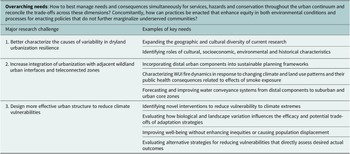
Many theoretical and place-based uncertainties limit the capacity to enhance resilience of dryland cities. While many science needs are general to all cities regardless of local climate conditions, dryland cities have needs specifically related to water security and addressing the many challenges that increase with aridity (Table 1). Convergence research, which brings together interdisciplinary scientists and knowledge users (National Research Council 2014), provides a framework to both address fundamental uncertainties in dryland urban system dynamics and contribute to decision-making and land management. Such use inspired research into how solutions to dryland urban challenges can be most effectively implemented needs both systems and landscape perspectives to realize their benefits and minimize negative trade-offs. In part, this challenge reflects uncertainties in how decision-making across the large number of stakeholders with contrasting values can benefit everyone (Iwaniec et al. Reference Iwaniec, Cook, Davidson, Berbés-Blázquez, Georgescu, Krayenhoff, Middel, Sampson and Grimm2020; Mansur et al. Reference Mansur, McDonald, Güneralp, Kim, de Oliveira, Callaghan, Hamel, Kuiper, Wolff, Liebelt, Martins, Elmqvist and Pereira2022). An overarching concern is: How to best manage needs and consequences simultaneously for services, hazards and conservation throughout the urban continuum and reconcile the trade-offs across these dimensions (Jenerette et al. Reference Jenerette, Anderson, Cadenasso, Fenn, Franklin, Goulden, Larios, Pincetl, Regan, Rey, Santiago and Syphard2022)? Concomitantly, how can practices be enacted that enhance equity in both environmental conditions and processes for enacting policies that do not further marginalize underserved communities (Anguelovski et al. Reference Anguelovski, Connolly, Cole, Garcia-Lamarca, Triguero-Mas, Baró, Martin, Conesa, Shokry, del Pulgar, Ramos, Matheney, Gallez, Oscilowicz, Máñez, Sarzo, Beltrán and Minaya2022)? Addressing these complementary uncertainties in dryland cities should simultaneously enhance the well-being of urban residents, ensure the viability of threatened and endangered species, while encouraging resilience throughout the urban continuum.
Key research needs for enhancing the resilience of urbanized drylands

Within these overarching concerns, one key research need is to better characterize the societal and cultural causes of variability in urban landscape structures and system dynamics that relate to resilience of these systems at global scales. Such aspects include differences in landscape design, demographic segregation and environmental feedback. The vast majority of urban research has been conducted in the United States, European Union, and Australia with expanding science contributions also originating from China. Latin America, Africa, the Middle East region and much of Asia are not well represented in current data or models (Ziter Reference Ziter2016; Nagendra et al. Reference Nagendra, Bai, Brondizio and Lwasa2018). These areas are some of the most rapidly expanding urban regions in the world and face increasing aridity. Cultural, socioeconomic, environmental and historical characteristics in cities from these regions certainly differ from conditions where most research has been conducted. Characterizing the differences and causes among cities will lead to a more comprehensive consideration of urbanization and its interactions with local, adjacent and teleconnected environments for places undergoing the most rapid changes.
In another research priority, while much research has been directed to urban sustainability within the urban core or suburban zones, more research directed to increased integration of urban sustainability with adjacent, that is WUIs, and teleconnected zones is needed (Seto et al. Reference Seto, Güneralp and Hutyra2012; Jenerette et al. Reference Jenerette, Anderson, Cadenasso, Fenn, Franklin, Goulden, Larios, Pincetl, Regan, Rey, Santiago and Syphard2022). These more distal components of the urban system have strong impacts to urban dynamics associated with hazards, provisioning of key ecosystem services, and conservation of threatened and endangered species. Challenges with incorporating these distal urban components into frameworks of sustainable planning arise from the contrasting management jurisdictions, environments and social systems between more central and distal urban zones. For example, WUIs are made of a patchwork of regulation and decision-making that is frequently disconnected from the purview of urban core and suburban regions (Jenerette et al. Reference Jenerette, Anderson, Cadenasso, Fenn, Franklin, Goulden, Larios, Pincetl, Regan, Rey, Santiago and Syphard2022). Teleconnected zones can be distributed globally, limiting opportunities for direct management especially through urban policymaking. While core-distal issues affect urbanization in all climatological conditions, in drylands key issues come to the fore, especially in response to fire and water security. For example, uncertainties in dryland WUI fire dynamics include both biophysical drivers of fire dynamics in response to both changing climate and land use patterns as well as public health issues related to effects of smoke exposure (D’Evelyn et al. Reference D’Evelyn, Jung, Alvarado, Baumgartner, Caligiuri, Hagmann, Henderson, Hessburg, Hopkins, Kasner, Krawchuk, Krenz, Lydersen, Marlier, Masuda, Metlen, Mittelstaedt, Prichard, Schollaert, Smith, Stevens, Tessum, Reeb-Whitaker, Wilkins, Wolff, Wood, Haugo and Spector2022). Similarly, research is needed into water conveyance systems from WUI and teleconnected zones to suburban and urban core zones. Ensuring sustained water availability has both hydrological components into terrestrial water balances but also decision-making across potentially competing uses (Jenerette and Larsen Reference Jenerette and Larsen2006; Flörke et al. Reference Flörke, Schneider and McDonald2018). These examples of fire and water security highlight the uncertainties in linking urban core with more distal zones showcase the need for geographically integrated frameworks for enhancing the resilience of dryland urbanization.
A third research need is reducing uncertainties in designing more effective urban structures to reduce climate vulnerabilities. Cities are warming much faster than natural ecosystems and are also exposed to greater risks from climate change induced disturbances including heat waves, flooding and fires. Novel interventions to reduce vulnerability to climate extremes and research that provides guidance on their implementation are needed (Wu Reference Wu2014). The efficacy and potential trade-offs of adaptation strategies are in many cases uncertain and are related to the role of biological and landscape variation on functioning of individual interventions (Georgescu et al. Reference Georgescu, Morefield, Bierwagen and Weaver2014). For example, plant trait variation across and within species as well as local environmental context may affect the cooling capacity and water use efficiency of urban trees (Rahman et al. Reference Rahman, Stratopoulos, Moser-Reischl, Zölch, Häberle, Rötzer, Pretzsch and Pauleit2020; Yu et al. Reference Yu, Yang, Zuo, Jorgensen, Koga and Vejre2020). Unanswered question include: What species are most effective and is biodiversity important now and in the future? Where and in what arrangement should trees be planted to enhance effectiveness? How can expanding tree cooling capacity in vulnerable neighborhoods to contribute to gentrification? More broadly, research that evaluates alternative strategies not only for effects on risks but continues to assess actual outcomes, such as human health and energy demands. Addressing climate vulnerability research needs in dryland cities is especially needed as risks associated with hotter and drier conditions are increasingly having debilitating consequences to urban residents and systems.
Conclusions
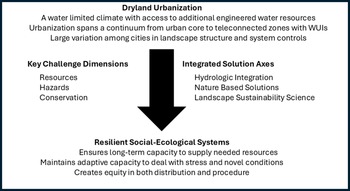
Drylands are the cradle of urbanization and a crucible for developing sustainable pathways for a rapidly growing and urbanizing planet. Characterizing the variability of dryland urbanization, recognizing key challenges, applying axes of solutions and developing science that meaningfully improves urban resilience while contributing to a more comprehensive theory of human environmental interactions is a pressing scientific challenge (Figure 3). Chronic water limitation both poses multiple sustainability challenges to cities and yet has also been a source of innovation and organization both historically and today. These differences reflect environmental and social determinants as well as reflecting unique characteristics derived from the self-organization of individual cities. Enhancing the resilience of dryland cities is an important goal that will require interdisciplinary scientists, designers and planners, as well as decision-makers and managers coming together. Framing urbanization as a multiple-scale phenomenon spanning a continuum from urban core to teleconnected zones with extensive WUIs throughout these zones provides a comprehensive perspective for understanding urban development and functioning. Envisioning solutions as axes or a nexus of interlinked approaches is a fruitful strategy to accomplish specific goals while also enhancing the capacity of urban systems. Dryland urbanization requires a holistic and adaptive approach that balances human needs with environmental sustainability. By leveraging innovative technologies, sustainable practices and community involvement, cities in water limited regions can thrive despite the climate challenges. With a history extending to the first cities and a current unprecedented increase of urban development, improved knowledge of dryland urbanization will contribute both to advancing theories of human–environmental interactions and improving the lives of billions of people.
Framework for organizing definitions, challenges and solutions of dryland urbanization for achieving resilient social ecological systems. Dryland cities have multiple challenges that can reduce their capacity for resilience. Nevertheless, integrated solution axes instead of individual “fixes” provide pathways to address bundles of connected issues and address resulting trade-offs.

Open peer review
For open peer review materials, please visit https://doi.org/10.1017/dry.2024.7
Acknowledgments
I thank Fernando Maestre for his invitation to submit this article and feedback on ideas during its development. Robert Johson conducted the GIS analyses for Figure 1. The background for the graphical abstract was generated using DALL-E (OpenAI).
Financial support
This work was in part supported by the National Science Foundation (EAR–1923150).
Competing interest
None.

 Open access


Comments
Professors Osvaldo Sala and David Eldridge,
I am submitting an invited review on the topic of dryland urbanization with a vision towards enhancing the resilience of these critical systems. I intended for this review to provide a comprehensive framework for dryland urbanization that identifies definitional characteristics, key issues, solutions, and uncertainties. I look forward to reviewer comments and hope you find this manuscript appropriate for your new journal.
Sincerely,
Darrel Jenerette