

Introduction
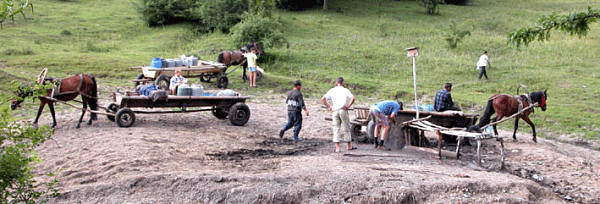
The oldest evidence for salt production in Europe, and probably worldwide, is from Poiana Slatinei-Lunca in eastern Romania, in the Early Neolithic (6050-5500 cal BC) (Weller & Dumitroaia 2005). This salt spring is located in the Moldavian Subcarpathians, where there are about 200 salt springs, in an area densely populated from the Pre-Cucuteni and Cucuteni cultures onwards (5100-3500 cal BC). Salt must have influenced prehistoric communities in fundamental ways, and yet this is hard to determine directly from the archaeological remains themselves. A distinctive element of the Moldavian salt springs is the fact that they remain in use, and even today are exploited at a high level of intensity (Figure 1). This has motivated an ethnoarchaeological approach to the study of prehistoric salt (Alexianu et al. 1992).
Saltwater supply at Poiana Slatinei, Lunca (photograph O. Weller).

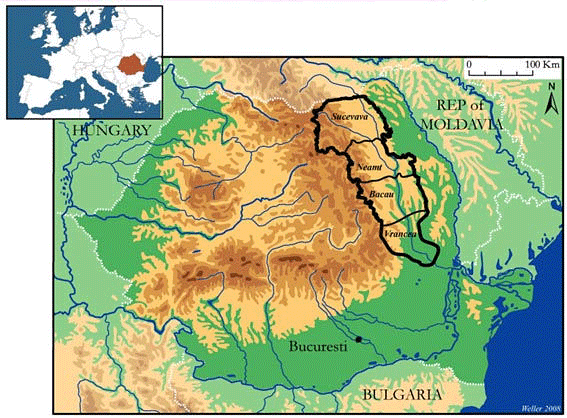
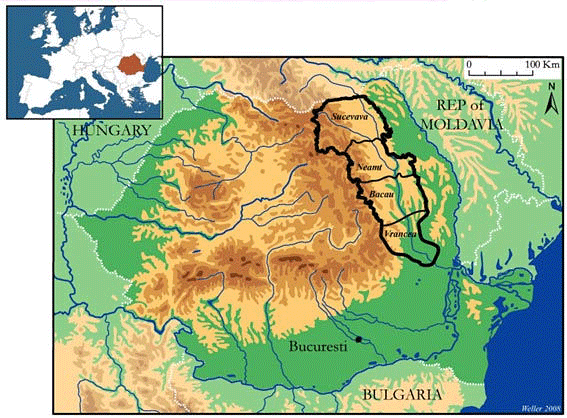
The archaeological and ethnoarchaeological work has been intensified since 2004, with a Franco-Romanian team (O. Weller and M. Alexianu since 2004; R. Brigand since 2005), accelerating in 2007 with a three-year project known as Ethnosal financed by the Romanian government. The project now extends to the whole of the Moldavian Subcarpathians (Suceava, Neamt, Bacau and Vrancea counties) (Figure 2), with Neamt as the main focus (Reference AlexianuAlexianu et al. 2008). The agenda has expanded to ensure holistic understanding of the complex phenomenon of long-term saltwater exploitation, starting with the Early Neolithic (Starcevo-Cris culture).
Location of the study area.
Research objectives and aims
The main research objectives are as follows: 1) identification of all Moldavian salt springs and associated archaeological remains; 2) analysis of the role of salt springs as a resource structuring the territory and also as a resource for the development and stability of human communities through time; 3) examination of early texts (Oriental, Greek, Latin and medieval) through an ethnohistorical approach; 4) use of ethnographic research for finding more analogies.
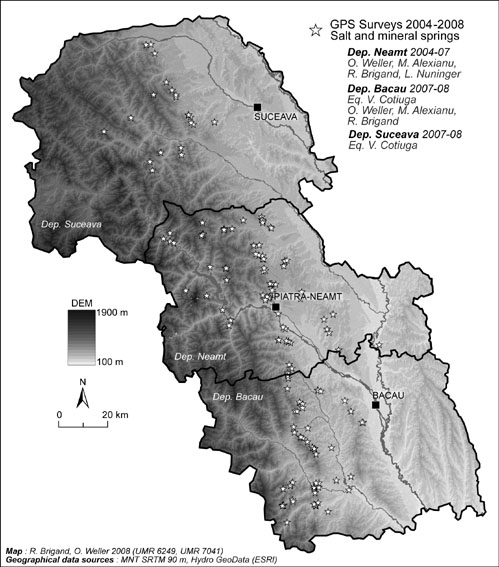
To achieve the first objective, we use various documentary sources, historical and toponymical data, geological and pedological maps, as well as information from ethnographic surveys. The salt springs are geo-referenced with GPS in order to map all the springs in the Moldavian Subcarpathian area (Figure 3). GIS is being used to analyse and compare the distribution of salt springs and settlement patterns, mainly for the prehistoric periods (Reference WellerWeller et al. 2007).
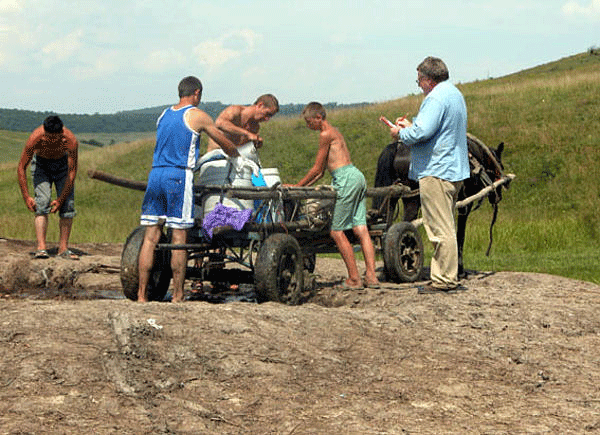
Ethnographic study in progress at Halabutoaia, Tolici (photograph O. Weller).

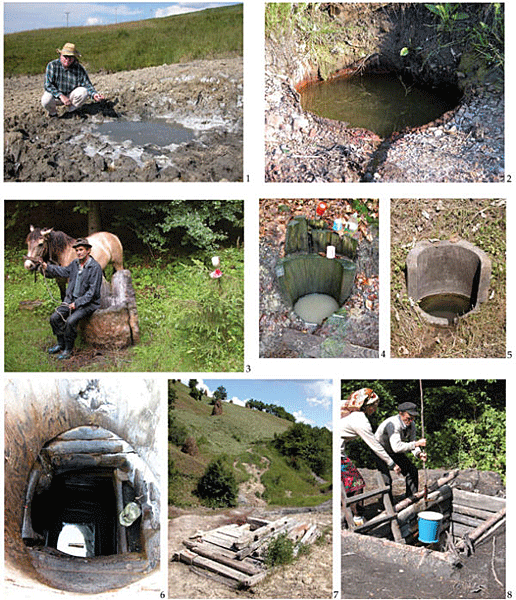
As regards the ethnohistoric project, the purpose is to identify concordances and define spatial and chronological behavioural trends generated by the presence of salt springs (exploitations, uses, barter transaction, trade, social and symbolic aspects etc.). We describe the types of salt springs (wells, flow, uses...) and undertake survey around to find potential archaeological remains of indigenous salt production (Figures 4 and 5). The project also intends to collect saltwater samples to identify chemical elements and salinity level for all known springs.
Location of salt springs surveys (2004-2008).

Saltwater wells in contemporary use (photographs O. Weller & R. Brigand).

The principal aim of the systematic ethnographic research is to help answer questions related to the archaeology of salt springs. The ethnographic survey involves: 1) identification of salt springs; 2) spatial analysis; 3) transport; 4) uses of saltwater; 5) game and hunting; 6) crystallization of salt from the springs with thermal treatment; 7) frequency of supply; 8) trade and exchange; 9) behaviours/ethnoscience; 10) symbolism of salt.
The ethnographic and ethnohistorical evidence, correlated with data on water chemistry, population density and topography, modelled and then interpreted, will soon provide a solid basis for investigating the prehistory of salt springs exploitation, a tradition that has almost disappeared in Europe today. The various models obtained through the project will be tested in other areas of the world where there is archaeological evidence for salt springs exploitation, but no present-day use of the springs. The new working hypotheses should improve understanding of archaeological evidence: activities around springs, the spatial organisation of salt production and the amazing diversity of its use.
Web Links
-
• http://ethnosal.uaic.ro (in Romanian)
-
• http://ethnosal.uaic.ro/about.html (in English)
Acknowledgements
The Ethnosal project - The salt water springs of Moldavia. The ethnoarchaeology of a polyvalent natural resource - whose main lines of research were elaborated in 1992, involves a small-sized team (Dr Marius Alexianu, manager; Dr Olivier Weller, expert researcher, PhD candidates Roxana Curca, Vasile Cotiuga, Iulian Moga). We would like to acknowledge the Romanian government for their support (project CNCSIS IDEI n° 167/2007), the department of archaeology and social sciences of the French Ministry of Foreign Affairs and the CNRS Human and Social Sciences Department.