


There is no satisfactory explanation for the increased incidence of schizophrenia among several immigrant groups to Europe (e.g. Reference Cantor-Graae, Pedersen and McNeilCantor-Graae et al, 2003). Migration from the previous Dutch colony Surinam to The Netherlands is of particular research interest, because it was large-scale and relatively unselective. We therefore conducted a first-contact incidence study in Surinam to test the hypothesis that the increased incidence of schizophrenia among Surinamese immigrants could be explained by a similarly high incidence in Surinam. We used data from a study in The Netherlands, in which exactly the same inclusion criteria and instruments had been applied (Reference Selten, Veen and FellerSelten et al, 2001).
METHOD
Incidence study in Surinam
Surinam gained independence in 1975 and during the period 1973–1990 more than a third of its population migrated to The Netherlands. Its current population is about 481 000; the capital, Paramaribo, has 244 000 inhabitants. Most people speak Dutch. The population consists of African Surinamese (41%), East Indians (37%), Javanese (15%) and others (7%). All people have access to mental health care, provided by Psychiatric Centre Surinam. In two remote districts care is provided by physicians of the Medical Mission.
For the study sample we tried to recruit everyone aged 15–54 years making their first-ever physician contact for a (suspected) psychotic disorder during the period 1 February 2002 to 1 February 2003. General practitioners and physicians in remote districts were asked by letter to refer all eligible patients, and at intervals were reminded of the study by telephone. The six psychiatrists in Surinam were visited personally. One author (C.Z.), of Dutch–Surinamese origin, made weekly checks in Psychiatric Centre Surinam to find out if any patient with a first psychotic episode had been seen at the outpatient department or admitted to the ward. She screened the medical files for information and interviewed all patients using the Dutch translation of the Comprehensive Assessment of Symptoms and History (Reference Andreasen, Flaum and ArndtAndreasen et al, 1992). No patient refused to be interviewed. C.Z. also interviewed at least one key informant about each patient, using the Instrument for the Retrospective Assessment of Symptoms and History (Reference Häfner, Riecher-Rössler and HambrechtHäfner et al, 1992). Occasionally, an interpreter was used. A urine drug screen was performed in 78% of the sample. Three psychiatrists, one from Surinam (R.D.) and two from The Netherlands (J.P.S. and P.N.v.H.), discussed with C.Z. the patient's history and arrived at a consensus DSM–IV diagnosis (American Psychiatric Association, 1994).
Incidence study in The Netherlands
For comparison we used data from a study conducted in The Hague between 1 April 1997 and 1 April 1999 (Reference Selten, Veen and FellerSelten et al, 2001). This study found that the risk of a DSM–IV schizophrenic disorder (schizophrenia, schizophreniform or schizoaffective disorder) for Surinamese of the first generation was 3.2 times higher (95% CI 1.8–5.7) than that for Dutch natives and that the risk for members of the second generation was 5.5 times higher (95% CI 2.5–11.9).
Statistical analysis
To avoid underestimation of the rapidly growing population, we used as denominator the April–June 2003 census data. A post-enumeration survey showed that the census's underestimation was maximally 2.6%. In August 2003 a fire destroyed the Bureau for Statistics and some results were lost. Consequently, the Bureau's figures for that year's population (241 837 males, 239 292 females) were not subdivided by age. However, it was possible to estimate figures for 5-year age groups using the Bureau's estimations for 2000. Standardised first-contact rates for schizophrenic disorders were derived by direct standardisation for age and gender to the world standard population in 1990 (United Nations, 1991). To compare the risk for Surinamese immigrants to The Netherlands with that for residents of Surinam, relative risks adjusted for 5-year age group and gender were calculated by Poisson regression analysis.
RESULTS
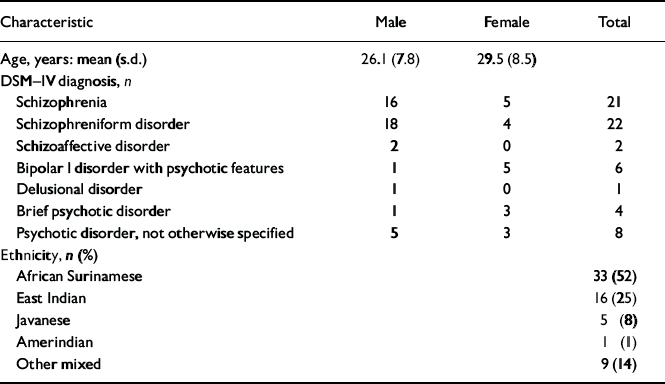
In Surinam, 64 people made a first contact for a psychotic disorder (Table 1). The median interval between psychosis onset and first contact was 8 weeks (interquartile range 3–76 weeks). Residents of Paramaribo (about half of the population) were overrepresented in the sample of patients: 47 patients (73% of the sample) lived in this city, and the remaining patients lived in smaller towns and villages (n=11) or in the country's interior (n=6). Thirty-eight patients had been to an alternative healer before they contacted a physician.
Characteristics of the Surinam incidence study sample
| Characteristic | Male | Female | Total |
|---|---|---|---|
| Age, years: mean (s.d.) | 26.1 (7.8) | 29.5 (8.5) | |
| DSM-IV diagnosis, n | |||
| Schizophrenia | 16 | 5 | 21 |
| Schizophreniform disorder | 18 | 4 | 22 |
| Schizoaffective disorder | 2 | 0 | 2 |
| Bipolar 1 disorder with psychotic features | 1 | 5 | 6 |
| Delusional disorder | 1 | 0 | 1 |
| Brief psychotic disorder | 1 | 3 | 4 |
| Psychotic disorder, not otherwise specified | 5 | 3 | 8 |
| Ethnicity, n (%) | |||
| African Surinamese | 33 (52) | ||
| East Indian | 16 (25) | ||
| Javanese | 5 (8) | ||
| Amerindian | 1 (1) | ||
| Other mixed | 9 (14) |
The crude first-contact rate for schizophrenic disorders (DSM–IV code 295.x) was 1.68 per 10 000 (95% CI 1.23–2.25). The standardised rate for schizophrenic disorders was 1.77 per 10 000 (95% CI 1.53–2.03). The risk of a first contact for a schizophrenic disorder for Surinamese first-generation residents of The Hague was 2.4 times higher than for those resident in Surinam: age- and gender-adjusted relative risk (RR) 2.4, 95% CI 1.3–4.2. The risk for people in Surinam was not significantly higher than the risk for Dutch natives in The Hague (RR 1.2, 95% CI 0.8–1.9).
DISCUSSION
The incidence of schizophrenic disorders in Surinam was found to be significantly lower than that among Surinamese immigrants to The Netherlands and not significantly higher than that of Dutch natives in The Hague. Most people eligible for the study in Surinam are likely to have been examined, owing to the well-organised healthcare system and the excellent collaboration with all the psychiatrists in that country. Although the single previous incidence study in Surinam relied on first admissions and on hospital diagnoses, its results were similar (Reference Hanoeman, Selten and KahnHanoeman et al, 2002). The increased incidence among the migrants is not explained by an overrepresentation in The Netherlands of an ethnic group with a high risk: most migrants who participated in the incidence study in The Hague were East Indians (74%), who constitute the majority of the Surinamese community in The Hague (80%) and are a group with a low risk in Surinam (Table 1). Our study and previous incidence studies in Caribbean populations concur in finding no excess of schizophrenia in the sending country (e.g. Reference Mahy, Mallett and LeffMahy et al, 1999). The study in Surinam is the first to examine a sending population with a non-British cultural background.
Interpretation
The risk of schizophrenia depends on the level of urbanicity of the place of upbringing (Reference Pedersen and MortensenPedersen & Mortensen, 2001). The overrepresentation of patients resident in Paramaribo suggests that the urban factor is also operative in Surinam. However, Surinam and The Hague differ in their levels of urbanisation: Paramaribo has a lower population density than The Hague (1338 v. 5415 persons per km2) and other towns in Surinam are small. Consequently, if one considers the risk for Surinam in the light of its lower level of urbanisation compared with The Hague, the somewhat higher risk for people in Surinam than for Dutch natives in The Hague is surprising. This pattern of findings suggests that Dutch people resident in areas with levels of urbanisation similar to Paramaribo might have somewhat lower rates than people in Surinam. The increased risk for Surinamese immigrants would thus appear to be attributable to an increased base rate in the Surinamese population and to some unidentified factor in The Netherlands. It is unlikely that this factor consists solely of exposure to the urban factor, because the risk for second-generation Surinamese brought up in the same city as their Dutch peers is also greater. Difficulties in adaptation to the competitive Dutch society may be important here (Reference Selten and Cantor-GraaeSelten & Cantor-Graae, 2004).
Acknowledgements
We thank Mr H. Reeder (Director of Psychiatric Centre Surinam) and the. psychiatrists R. Jadnanansing (Medical Director), K. Nannan Panday-Jhingoeri, E. Bergen, R. Haarloo and E. S. M. A. Joemmankhan. The authors also thank Dr. E. Cantor-Graae and Mr M. P. C. Alders for their advice. The study was. supported by the Dienstbetoon, De Zaaier and De Drie Lichten Foundations.




eLetters
No eLetters have been published for this article.