




1 Introduction
Language acquisition occurs through everyday linguistic interactions, which often follow a sequentially structured pattern in which different participants take turns and respond to each other. This dynamic, unpredictable, and rapid interaction poses a challenge for children who strive to participate despite their limited linguistic knowledge (Bates et al., Reference Bates, Camaioni and Volterra1975; Clark, Reference Clark2018; Ninio & Snow, Reference Ninio, Snow and Levy1988). Initially, children’s responses may be non-verbal or consist of simple words, which may or may not be considered appropriate by their conversational partners. Over time, children show the developmental changes in their linguistic choices, eventually exhibiting more adult-like behaviour. However, the factors that drive this transformation in children’s response behaviour remain insufficiently explored. One of the possible factors is social interaction. The primary goal of social interaction is to manage relationships (Enfield, Reference Enfield2014), which predicts that children, as well as adults, assess and alter their own linguistic behaviour with respect to this goal. This study investigates the developmental changes in children’s responses to Who-questions and the impact of these changes on conversational sequences by analysing corpora of naturalistic Japanese conversation. Our aim is to shed light on the relationship between the local dynamics of question interaction and developmental changes in children’s response behaviour.
1.1 Children’s responses to questions as cooperative actions
Engaging in conversation is primarily cooperative behaviour. Important conversation analytic studies such as Atkinson and Heritage (Reference Atkinson and Heritage1984) have pointed out speakers’ tendency to maximize cooperation and affiliation while minimising conflict during a conversation. One way to achieve cooperation is by accomplishing an activity intended by the speaker of the preceding turn. In his argument on adjacency pairs, Schegloff (Reference Schegloff2007: 59) states, that ‘(s)equences are the vehicle for getting some activity accomplished, and that response to the first pair part which embodies or favours furthering or the accomplishment of the activity is favoured – or, as we shall term it, preferred – second pair part’. In the case of a Question-Answer sequence, the question is typically followed by an answer in the next turn, thus accomplishing the activity that is initiated by the question. Progressivity, as discussed by Goffman (Reference Goffman1983), Heritage (Reference Heritage2013), Lerner (Reference Lerner and Ochs2006), Robinson (Reference Robinson2006), Sacks (Reference Sacks, Button and Lee1987), and Stivers and Robinson (Reference Stivers and Robinson2006), refers to the basic feature of interaction that each component of the organisation of interaction should ‘progress’ to the next relevant component immediately after, or contiguously to, the prior component. Progressivity is the norm or default; therefore, behaviour that halts progressivity is accountable (Garfinkel, Reference Garfinkel1967) and thus examined by participants for its interactional import.
Numerous previous studies have documented developmental changes in how children gradually become able to respond to questions in an adult-like manner. Infants typically use their first words to direct others’ attention and negotiate immediate activities (Dore, Reference Dore1974; Snow et al., Reference Snow, Pan, Imbens-Bailey and Herman1996), rather than to respond to questions. Around the age of two to three, children are generally responsive to questions in both caregiver–child and peer interaction (Ervin-Tripp, Reference Ervin-Tripp and Ochs1979; Gallagher, Reference Gallagher1981; Snow, Reference Snow1977; Wellman & Lempers, Reference Wellman and Lempers1977), with a gradual increase in responsiveness in later years (Garvey & Hogan, Reference Garvey and Hogan1973; Mueller, Reference Mueller1972; Van Hekken & Roelofsen, Reference Van Hekken and Roelofsen1982). Children’s understanding of the question-response structure in conversation allows them not only to respond to others but also to ask questions of others. Mueller (Reference Mueller1972) investigated peer interactions among children aged 3;6 to 5;6 and found that ~85% of their utterances successfully received replies from others. At these ages, children can produce well-formed utterances, tailored to their listener’s perspective, and timed to coincide with the listener’s attention. In terms of response types, children generally seem to show adult-like preferences. They prefer answer responses to non-answer responses from as early as 2–3 years (Dore, Reference Dore1977), and informative responses to non-informative responses from 5 to 11 years (Van Hekken & Roelofsen, Reference Van Hekken and Roelofsen1982). These studies suggest that children learn to respond to their interlocutors’ questions in a cooperative manner. Children’s turn-taking latency also changes. It is initially slower than adults, but becomes quicker as they get older (Casillas et al., Reference Casillas, Bobb and Clark2016; Ervin-Tripp, Reference Ervin-Tripp and Ochs1979). Casillas et al. (Reference Casillas, Bobb and Clark2016) also observed that turn-taking latency was influenced by the increasing complexity of conversations during children’s development. Additionally, the type of interlocutor (e.g., adult or peer) and the number of interactants play a crucial role in children’s successful and smooth participation in conversations, with multi-party interactions presenting greater challenges than dialogic ones (Ervin-Tripp, Reference Ervin-Tripp and Ochs1979). Children gradually become skilled at joining varied conversational interactions by mastering interactive and linguistic strategies. The first part of this study tests whether these developmental changes in question-answering, mainly reported for English, also occur in Japanese. Our prediction is that children’s responses will become more cooperative, showing an increase in the provision of requested information and their relevance to the interaction.
1.2 Linguistic and functional complexity in response utterances
Turning our attention to the linguistic expressions used in interactions, speakers’ responses to questions are far more complex and varied than the mere provision of a word corresponding to the requested information. A response can assume a virtually infinite range of linguistic forms. While speakers can produce a minimally informative answer, they can also produce a more complex answer by expressing their attitude toward the content or the interlocutor. They can also adjust the turn-taking or steer the ongoing interaction in a particular direction. For instance, responding to a question ‘what is this?’ with ‘cat’ or ‘it’s a cat, isn’t it?’ might seem inconsequential, as both are accepted as correct and cooperative answers. However, linguistic details such as the tag question or copula verb construction in this specific example, represent the speaker’s linguistic choices in a given social interaction, reflecting distinct functions like expressing certitude or engaging the interlocutor. The presence of such linguistic variation in actual conversation underscores the fact that question-answering cannot be reduced to a simple exchange of information between participants.
The general developmental trajectory in child language involves the use of longer utterances (Ervin-Tripp, Reference Ervin-Tripp1978; Ochs et al., Reference Ochs, Schieffelin, Platt, Ochs and Schieffelin1979) and a wider variety of constructions, which also applies to responses to questions (Mueller, Reference Mueller1972). Responses from younger children are often characterised by norm-violating expressions, like a simple ‘No’ in response to a request (Stivers et al., Reference Stivers, Sidnell and Bergen2018). This elementary example illustrates the extent to which adults’ responses, whether they seek to soften a negative response or to account for it (e.g., ‘uh sorry I don’t have time’), entail social and interactive calculation. Previous studies on child language have investigated question-answering by focusing on grammatical well-formedness, interactional aspects such as responsiveness and turn-taking, or informativeness (see Stivers et al. (Reference Stivers, Sidnell and Bergen2018) for a summary), but have overlooked how children develop in terms of their strategic choice of linguistic expressions within actual social interactions. The importance of focusing on linguistic expressions in interaction has been pointed out in a number of important qualitative studies on social interaction (Ervin-Tripp et al., Reference Ervin-Tripp, Guo and Lampert1990; Goodwin & Goodwin, Reference Goodwin, Goodwin, Philips, Steele and Tanz1987; Kyratzis & Ervin-Tripp, Reference Kyratzis and Ervin-Tripp1999). In addition, connecting the functional analysis of complex speech in interaction with other levels of analysis, such as the analysis of developmental change, has been a challenge. One way to do this systematically is to restrict the range of interactions and turn designs and to focus on the primary functional properties of utterances in these interactions in a way that allows quantitative evaluation of development change.
This study focuses specifically on Who-questions and answers in Japanese. Question sequences are particularly well-suited to analysing the coherence within sequenced turns as the ‘strongest demand for relevance in a conversation arises when a question is asked’ (Ervin-Tripp, Reference Ervin-Tripp1978: 359). As such, a question creates a face-threatening situation that conversational participants need to jointly manage, which explains why its sequence is organized via a very robust set of social norms (Dale & Spivey, Reference Dale and Spivey2006; Sidnell, Reference Sidnell, Farrell, Kagan and Tisdall2016). We chose Who-questions as the target for this study because these questions focus on a relatively controlled range of interactions, primarily those revolving around information requests for animate references. Another reason is that who-questions emerge relatively early, along with what-questions and where-questions, compared with other wh-questions about time, activities, reasons, and manners in different languages such as English, Korean, and Japanese (Bloom et al., Reference Bloom, Merkin and Wootten1982; Cairns & Hsu, Reference Cairns and Hsu1978; Clancy, Reference Clancy1989; Uno, Reference Uno and Ortega2017). In child–caregiver interaction, questions are often not a genuine search for information, as their referents tend to be given information and also present at the time of speaking (Uno, Reference Uno and Ortega2017). Nonetheless, answering these questions with an animate reference is generally a valid choice. In sum, Who-question sequences allow us to evaluate children’s responses in terms of their provision of a requested piece of information and also of adult-like ‘normal’ linguistic choices in social interaction.
Concerning the target language of this study, Japanese presents an intriguing case for exploring speech in social interaction because of its diverse array of modal and politeness-related expressions (Burdelski, Reference Burdelski, Duranti, Ochs and Schieffelin2011; Chang et al., Reference Chang, Tatsumi, Hayakawa, Yoshizaki and Oka2021; Clancy, Reference Clancy and Slobin1985; Cook, Reference Cook, Hoji and Clancy1990; Nakamura, Reference Nakamura, Nelson, Aksu-Ko, Johnson and Aksu-Koc2014). These expressions add layers of social and interactional dynamics that wrap around the propositional content of the sentence, as posited by Japanese grammarians (e.g., Masuoka, Reference Masuoka1991; Kenkyūkai, 2003). For example, a Japanese speaker in a situated interaction would rather produce utterances such as zettai ame furu yo (‘(I believe) it will definitely rain’, in plain register) or kitto ame ga furimasu (‘It is likely to rain’, in polite register) rather than a simple ame ga furu ‘it will rain’. The former two expressions encompass a broader dimension such as the speaker’s judgement on the propositional content, epistemic stance as well as social attitude. These functions make the utterances appropriate and natural in a given social interaction. Since such functionally complex expressions are customary in a normal conversation, the child’s task lies in eventually assimilating these norms and incorporating such expressions into their responses to questions. Accordingly, we hypothesise that, as children develop, their responses will become longer and assume a broader array of functions.
1.3 Children’s linguistic choice and interaction
As the literature review indicates, children gradually acquire the ability to produce more adult-like speech. Nevertheless, the reasons for this developmental change remain relatively unexplored within the research field. To address this question, and understand how children, as active participants, shape interaction with their own speech, various studies have explored the significance of conversational sequences in child language acquisition. Maternal responses that were contingent upon infant vocalisations have been shown to enhance both the quantity and quality of such vocalisations (Bloom et al., Reference Bloom, Russell and Wassenberg1987; Goldstein & West, Reference Goldstein and West1999; Topping et al., Reference Topping, Dekhinet and Zeedyk2013). Warlaumont et al. (Reference Warlaumont, Richards, Gilkerson and Oller2014) demonstrated that the relevance of children’s utterances increases conversational interaction. Adults were observed to respond frequently when children’s linguistic production was related rather than unrelated to speech. Furthermore, these adult responses had a positive impact on the likelihood of the children’s speech-related vocalisation in subsequent turns. Investigating a longitudinal dataset, Nikolaus et al. (Reference Nikolaus, Prévot and Fourtassi2022) found that caregivers’ temporally contingent responses to children’s utterances positively influenced the speech-relatedness and intelligibility of the children’s subsequent utterances. These studies illustrate how semantic relatedness or contingency within neighbouring turns promotes more interaction. Building on this line of research, our focus is on exploring how children’s linguistic choices affect the dynamics of conversational interaction. If children learn to be proficient conversationalists, their behaviour should contribute to the defining factors of a normal conversation: progressive interaction and joint activity.
As conversation-analytic studies contend, progressivity constitutes a fundamental aspect of conversational interactions (Heritage, Reference Heritage2013; Sacks, Reference Sacks, Button and Lee1987; Stivers & Robinson, Reference Stivers and Robinson2006). For a progressive interaction, children need to infer the intentions underlying their interlocutor’s action and find a way to meet those intentions. When confronted with an information-requesting question, children must recognize the expectation to supply the requested information or, at minimum, offer something relevant to the interlocutor’s intent. This allows them to contribute to the completion of the ongoing sequence, facilitating the transition to a new one. Insights from developmental psychology suggest that humans possess inherent prosocial and cooperative tendencies (Dunfield et al., Reference Dunfield, Kuhlmeier, O’Connell and Kelley2011; Warneken & Tomasello, Reference Warneken and Tomasello2006, Reference Warneken and Tomasello2007). Even preverbal children exhibit the capacity to engage in joint activities, grasp others’ intentions, understand goals, and show helping behaviours in various social contexts (Ashley & Tomasello, Reference Ashley and Tomasello1998; Liszkowski et al., Reference Liszkowski, Carpenter, Striano and Tomasello2006; Smiley, Reference Smiley2001). These cognitive abilities form the foundation for a goal-oriented and cooperative, thus progressive, conversation.
Another fundamental structure is joint activity. Conversational participants take turns and jointly make contributions to establish a common ground, and to cope with any breakdowns in communication. Child–caregiver interactions indeed shift toward more joint activity as children mature (Dale & Spivey, Reference Dale and Spivey2006; Sokolov, Reference Sokolov1993). Initially, caregivers tend to take the lead, constantly encouraging the child to engage to sustain the interaction. As the child develops, conversations tend to become more balanced, with both parties actively engaging in the exchange. This equilibrium entails children adopting behaviours similar to those of adults and obtaining a degree of control over the interaction.
The current study focuses on progressive and balanced interaction as potential factors underlying children’s changes in their linguistic behaviour. It postulates that these factors play an essential role in influencing how children monitor and adjust their own speech to achieve more effective social interaction in the future.
1.4 Goal of this study
The current study aims to explore how children’s linguistic behaviour changes over development, and how these changes are related to interactional dynamics. To this end, we test the following hypotheses by running quantitative analyses on a corpus-based dataset of Who-question sequences in Japanese.
-
1. Children’s responses become more cooperative, showing an increase in the provision of requested information and relevance.
-
2. Children’s responses become longer and serve more functions as they develop.
-
3. Children’s longer and multifunctional responses contribute to a quicker completion of the interactive sequence (more progressivity) and to more joint and balanced interaction within the sequence.
2 Method
2.1 Data
In this study, we used the seven Japanese longitudinal corpora available in the CHILDES database (MacWhinney, Reference MacWhinney2000). These corpora consist of naturalistic conversations, mostly between target children and their caregivers, who are all monolingual Japanese speakers. They include data from three children (Aki, Ryo, and Tai) that comprise the Miyata corpus (Miyata, Reference Miyata2004a, Reference Miyata2004b, Reference Miyata2004c), and four children (ArikaM, Asato, Nanami, and Tomito) that comprise the MiiPro corpus (Miyata & Nisisawa, Reference Miyata and Nisisawa2009, Reference Miyata and Nisisawa2010; Nisisawa & Miyata, Reference Nisisawa and Miyata2009, Reference Nisisawa and Miyata2010).
All data were reorganised into a turn-unit dataset by using R (R Core Team, 2024). We extracted all Who-question sequences that started with a Who-question by a caregiver, followed by the target child’s and the caregiver’s turns (815 sequences in total). We excluded the sequences that were preceded by another question in the immediately preceding turn, and those that included participants other than the target child and caregiver in the following 10 turns. We also removed overlaps of sequences within 5 turns (on the basis of 5.177, the mean + standard deviation of the sequence completion score, as detailed in the coding section), to avoid including follow-up or repeated who-questions within a sequence as a new target sequence. The age range of the children was from 1;1 (years; months) to 5;2.
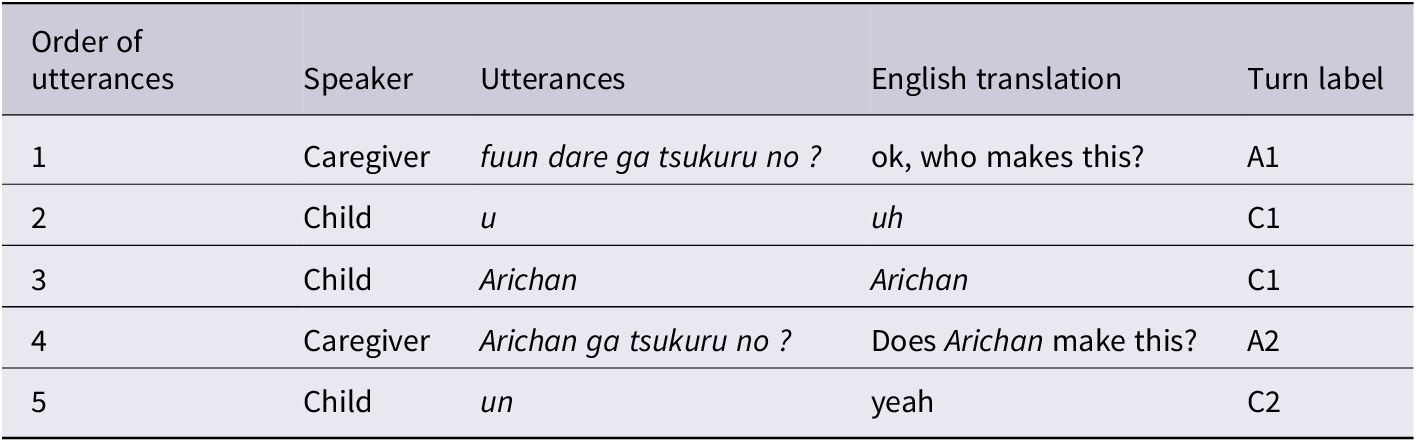
Table 1 shows an example of a Who-question sequence. For the sake of systematicity, we used the turn as the unit of analysis. Turns were defined as single utterances or sequences of utterances in the original transcripts bounded by speaker changes. The only exceptions were instances where the child produced no verbal response immediately after the Who-question at the beginning of a sequence, in which case, we coded no response for the C1 turn, although there was no speaker change between the question and the caregiver’s succeeding utterance. Turns could consist of a single short utterance, such as a label or a backchannel, or of multiple utterances varying in length. Overlaps between speakers were common in the corpora, but less common in our Who-question dataset, where none of the Who-question turns overlapped with neighbouring turns. Where there were overlaps between the turns following Who-question turns, we systematically followed the order of utterances in the transcripts and treated the first overlapping utterance as belonging to a different preceding turn from the second overlapping utterance, which was taken to be the beginning of a different succeeding turn. We sometimes refer to different turns within a sequence by the turn labels shown below.
Labels for utterances in a sequence (Nanami, 3;2.20)

2.2 Coding
In addition to the information available in the original corpora, we coded several other variables for our analyses.
The first analysis looks at how children’s responses become more cooperative. To this end, we classified children’s responses in the C1 turn into basic response types; Cooperative and Uncooperative. Note that here the terms ‘Cooperative’ and ‘Uncooperative’ do not refer to children’s intentions or attitudes. Instead, they mean that the verbal production or the lack of it can be interpreted as cooperative or uncooperative by the interlocutor in interaction or by an observer. Cooperative responses are further classified as either Expected or Unexpected to distinguish responses that include an animate reference from those that do not. The animate reference need not be the right answer but can be any word that refers to an animate entity that is not included in the preceding Who-question. Unexpected responses are related to the question but lack the animate reference. These responses consist of function words, metalinguistic expressions (acknowledging a problem in answering the question such as ‘I don’t know’, and repairs like ‘huh?’) or repetitions of any word in the preceding who-question (e.g., producing ‘clock’ following the question ‘who has this clock?’). These response types were automatically classified by defining categories in terms of the formal features in the transcription and morphological coding in the original corpora. After identifying the lack of a child response as well as unintelligible and nonverbal responses, our R script coded the animate references, and the relatedness of response to classify all the C1 turns into two categories with subcategories: Cooperative (Expected and Unexpected responses), Uncooperative (Unrelated, No response, and unintelligible responses).
The second and third sets of analyses required the coding of the functions of linguistic expressions. We defined five functional categories, namely Reference, three Modalities (Evaluation, Action, and Social), and Interaction, each of which is associated with a group of different linguistic forms listed in Table 2. Reference points to entities. When a speaker produces a noun, noun phrase, or personal pronoun (e.g., ‘dinosaur’, ‘grandma’s train’, ‘me’), this is coded as a Reference. By definition, all Expected responses are referential. While some responses minimally refer to an object by using only its label, other responses are longer and include additional linguistic expressions. Japanese grammarians have characterized Japanese sentences as having a proposition at the core, with the core accompanied by different modality elements (Masuoka, Reference Masuoka1991; Nihongo Kijutsu Bunpō Kenkyūkai, 2003). Although the definition of modality varies considerably from one researcher to another and also across languages, we posit three categories on the basis of important overlaps in Japanese studies on modality; Evaluation Modality, Action Modality, and Social Modality. Evaluation Modality refers to epistemic and evidential expressions. Epistemic modality expresses the degree of speaker’s certainty that what they are saying is true. Evidential modality expresses the source of evidence a speaker has for their statement (de Haan, Reference de Haan, Frawley, Eschenroede, Mills and Nguyen2006). Action Modality covers a range of speech act categories such as questions, requests, proposals, invitations, and commands. It includes not only speaker-oriented modalities for cases in which the speaker gives someone an order or permission (Bybee, Reference Bybee1985; de Haan, Reference de Haan, Frawley, Eschenroede, Mills and Nguyen2006), but also other cases in which the speaker is in need and asks someone for help. These expressions tend to initiate a new sequence other than the who-question sequence in our dataset. Social Modality expresses the speaker’s engagement with the interlocutor. It includes speakers’ assumptions about the degree to which their attention or knowledge is shared by the addressee (Evans et al., Reference Evans, Bergqvist and San Roque2018), as well as politeness and formulaic addresses. In addition to these is the Interaction category. It refers to the speech elements or vocalisations for negotiating turns at the interface with other turns. We thus have five function categories, each of which may or may not be expressed by linguistic means in an utterance or turn. Using our coding scheme, the turn kaiju da yo ‘that’s dinosaur’, for example, refers to an object (kaijuu ‘dinosaur)’, encodes judgement modality (da yo is assertive) as well as social modality (yo marks intersubjectivity). It does not contain linguistic expressions that signal action modality or interaction functions. Another example is anoo kore kore ne otoosan ‘uhm, this, this is, father’. This turn has a reference (otoosan ‘father’), encodes social modality (ne for establishing common ground), and interaction (anoo is a filler to start a turn). Table 2 explains our working definitions and coding scheme.
Definition and corresponding linguistic forms for function categories (note that these are not general or exhaustive, but are intended only to cover the linguistic forms in our response dataset)

We coded all children’s response turns as well as caregivers’ turns into these functional categories using R. Each of the categories was defined by linguistic forms that were found in our data following the classification in Table 2. This allowed us to ensure consistency by coding the data automatically. A turn can have some or all of the functions in Table 2, ordered in different ways, and can also use multiple linguistic elements to express a function. We dealt with the variation and complexity of naturalistic speech data by coding the presence and absence of these five functions regardless of order and redundancy. This means that the number of functions in a turn varies between 1 and 5. Note that we do not assume a one-to-one or clear-cut mapping between function and form, but treat linguistic forms as cues for functions. Despite being very broad, we believe that our five functional categories are useful in elucidating developmental changes in child speech, and may also be useful for comparing different languages in future studies.
Sequence completion is a measure of progressivity for the third set of analyses. It refers to the turn at which participants start a new sequence (e.g., asking a different question, introducing a new topic, etc.). In other words, it is the turn immediately after the last turn of a who-question sequence. This factor was also coded automatically using R commands to ensure consistency. The beginning of a new sequence was identified as the first turn that introduces a new topic in a given who-question sequence. In our coding scheme, a new topic means a word that is not included in any of the following categories that constitute turns within a who-question sequence: (1) animate references within the 10 turns from the who-question, (2) grammatical words (existential/copula verbs, case particles, modal particles, formal nouns, demonstrative pronouns and adverbs), (3) tokens for acknowledgement, denial, interjections and fillers (e.g., un yes, chigau not right, hee ah, anoo uhm), and (4) metalinguistic expressions for perception and understanding including repair request (e.g., wakannai ‘don’t understand’, dore ‘which?’) as well as part-words that are mostly considered as false-starts or hesitation. Another way to identify the beginning of a sequence is by detecting expressions that initiate a move, which basically corresponds to the first pair part of an adjacency pair. These expressions include wh-questions and follow-up questions (e.g., kore/kotchi wa? ‘and this?’, and dore ga ii ‘which do you like better?’), commands (e.g., kudasai ‘give me’, matte ‘wait’ mite ‘look’), and offer (doozo ‘here it is’). The sequence completion for a sequence was coded by detecting these forms, searching from C1 to later turns for each sequence. We acknowledge that this method, like any other, can only approximate sequence completion in spontaneous interaction. Still, this automated method is an improvement in hand-coding in terms of systematicity and reproducibility. The following example illustrates this coding process conducted automatically in R. C1 turn has a new word compared with A1, which is obaasan ‘grandmother’. This turn is considered within the sequence because it is an animate reference. The next A2 turn adds two new animate reference nouns, one of which (obaachan) repeats the referent of the C1 noun obaasan, and the other is a new animate referent, oneechan ‘older sister’. It also adds chigau ‘not right’, and deshoo ‘isn’t it’. A2 turn is also a part of the who-question sequence because none of these words add a new topic or initiate a new move. This turn is the last turn in the who-question sequence because the following C2 turn adds a new topic hambaaga ‘hamburger’, which is not included anywhere in the preceding turns A1–A2.
Example of the coding of sequence completion (Ryo, 2;1.18)

2.3 Analysis
We tested our hypotheses by using generalized mixed-effect linear models (lme4 packages, Bates et al., Reference Bates, Mächler, Bolker and Walker2015) on R (R Core Team, 2024), with corpora, which corresponds to speaker/dyad distinctions, as a random effect.
In addition to these quantitative analyses, we report qualitative analyses on a range of examples of question sequences from our conversational dataset. These examples not only complement our arguments but also highlight the variation and complexity that we find in real social interactions. The dataset and analysis script are published online on the OSF website (https://osf.io/v3xhu/?view_only=f48936b74c2549a8ad61a086a492ef2f).
3 Results
3.1 Do children’s responses become more cooperative as they get older?
To test the prediction that children’s responses become more cooperative as they get older, we first classified children’s responses to Who-questions into Cooperative, Uncooperative, and Other responses. The cooperative category is further subdivided into Expected (with an animate reference) and Unexpected (without an animate reference). Example 1 shows a typical example of an Expected response, in which C1 is a good answer to the question in A1. Following C1, A2 turn confirms the answer, with a slight modification of the name in question, and moves on by asking a new question. Unexpected responses are related to the question but lack the animate reference. They include utterances that focus on the child’s lack of the knowledge required to answer the question, repair utterances, and so on. Examples 2 and 3 are two such instances, in which the child indicates their inability to answer the question, with different linguistic means. Note how the child and adult try to understand each other, which results in an extended sequence in Example 3. Uncooperative responses are not related to the question, including instances of no verbal response. Example 4 is an instance of no verbal response from the child. In this case, the adult closes the sequence by giving the answer to her own question. These different examples show not only the different types of child responses to Who-questions, but also the impact of these responses on the interactional dynamics.
Example 1. (Nanami, 2;8.19)

Example 2. (Tai, 2;5.19)

Example 3. (Ryo, 2;4.22)

Example 4. (ArikaM, 3;1.4)

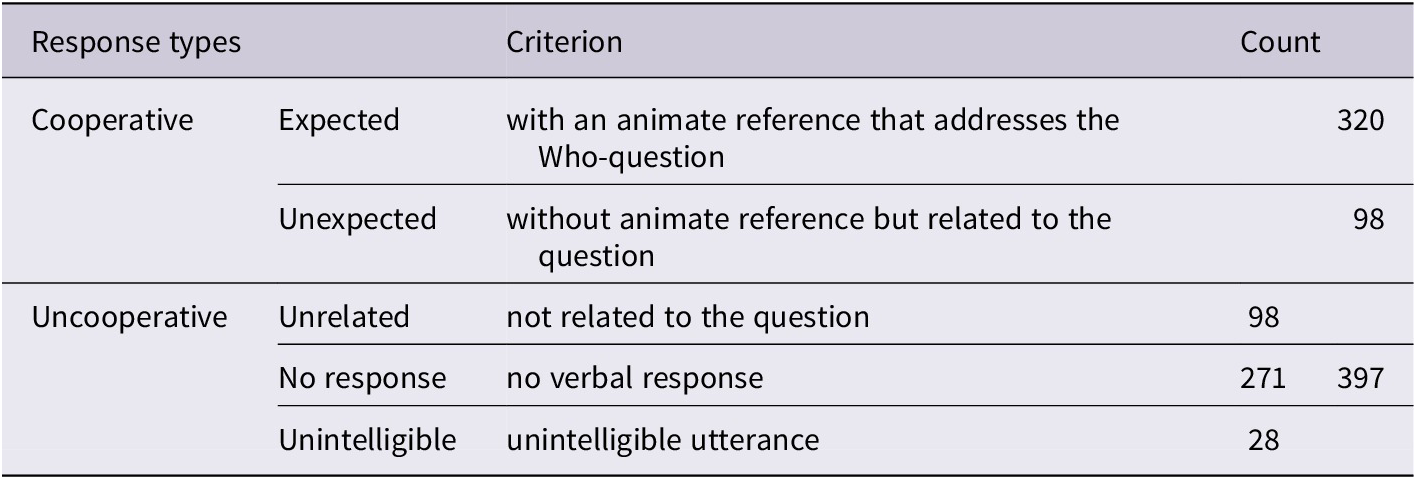
Table 3 shows the breakdown of children’s responses to Who-questions. Cooperative and Uncooperative responses each account for approximately half of the data.
Counts of different response types

More importantly, as shown in Figure 1, the proportion of these different types of responses changes across development. Our results from a generalized mixed-effect model show that children’s responses become more cooperative as they get older. Expected responses, which pick out an animate referent in answer to a Who-question, increase over development (Estimate = 0.044, SE = 0.008, z = 5.321, p = 1.03e−07). Cooperative but unexpected responses also show a significant increase (Estimate = 0.030, SE = 0.010, z = 2.863, p = 0.004). This means that children become cooperative not only in their provision of information, but also in their meta-interactive behaviours that signal, for example, non-understanding, non-hearing or their lack of knowledge for answering the question. In contrast, uncooperative responses decrease over time (Estimate = −0.059, SE = 0.008, z = −7.046, p = 1.84e−12). These age effects complement the previous studies’ findings that children’s preference for cooperative responses is adult-like (Dore, Reference Dore1977; van Hekken & Roelofsen, Reference Van Hekken and Roelofsen1982), by supporting our hypothesis that children’s responses become more cooperative as they get older.
Proportion of children’s response types by their age.

Our analyses in this first section have shown that children’s responses become more cooperative as they develop. Not only do children’s Expected Cooperative responses (i.e., with an animate reference) increase, but also the Unexpected Cooperative responses (i.e., without animate reference but relevant) increase. The increase in this latter type of response suggests that children exhibit increasing meta-interactional awareness, indicating their improved ability to navigate interactions by addressing the risk of communication breakdowns. Given these developmental changes in children’s responses, an obvious question is what these changing linguistic choices bring to the interaction. Before directly addressing this question in the last section, we will now narrow our focus to children’s answer utterances to gain insight into what children try to achieve in interaction.
3.2 What are children’s response utterances designed to do?
This section attempts to capture the developmental changes in children’s linguistic expressions, particularly in terms of utterance length and multifunctionality. Children’s responses become longer in terms of word count. Notably, not only does the proportion of children’s no responses diminish over time, but the length of Expected responses also exhibits an increase. Figure 2 visually represents the effect of children’s age on the length of their Expected Cooperative responses (Estimate = 1.250, SE = 0.178, z = 7.007, p = 2.44e−12). The earliest stages are characterized by child responses consisting of a single word, yet such responses become less frequent in the later stages. Typically, a single word is sufficient for providing the information sought by a Who-question. For instance, Example 5 shows a child’s simple reply of kakka ‘Mom’. In contrast, a longer answer in Example 6, exhibits greater complexity. It involves a kore wa X ‘this is X’ construction, as well as the use of the modal particle ne whose important function is to establish an affective common ground with the interlocutor (Cook, Reference Cook, Hoji and Clancy1990). This response also uses a genitive modification (‘sister rabbit’s’) to give detailed information. As these contrastive examples illustrate, the developmental increase in the length of the response utterance seems to imply that children not only furnish the requested information but also encode additional functions in their utterances. Note that we do not assume that children have an adult-like functional or semantic understanding of all these linguistic expressions, but that these expressions shape the interaction since they are interpreted and responded to by the interlocutor.
Utterance length (in word count) of children’s C1 turn responses by age.

Example 5. (Tai, 1;7.8)

Example 6. (Aki, 2;10.28)

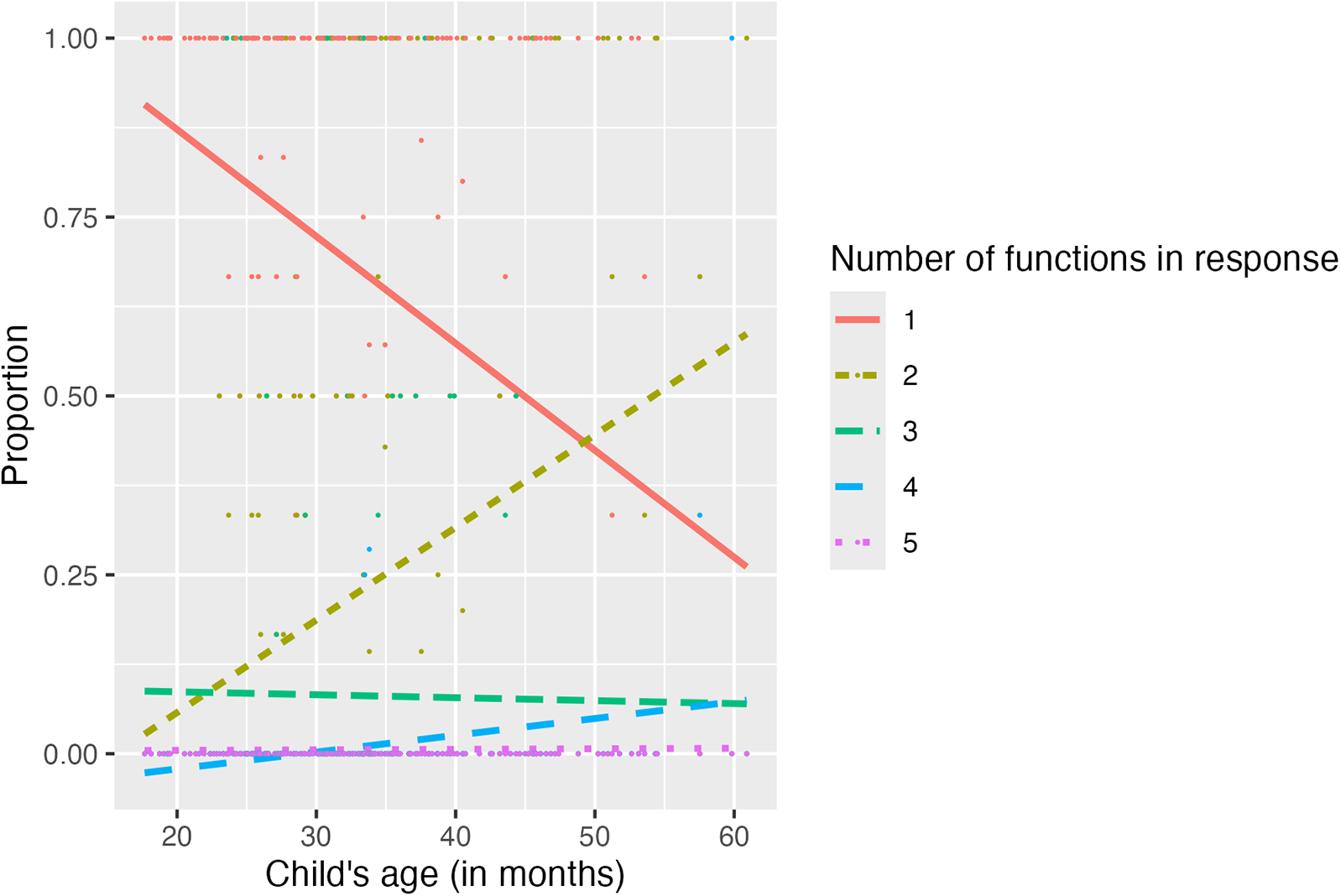
We now turn to the functions of children’s linguistic choices. As explained in the method section, we used five functional categories; Reference, Evaluation Modality, Action Modality, Social Modality, and Interaction. The multifunctionality is coded in terms of number of function categories. Most early verbal responses are only referential, and simply provide the piece of information requested by the interlocutor’s Who-question (one function in Figure 3 and Figure 4). The earlier Example 1 is such an instance (C1 only provides a character’s name as their response). The proportion of two-function turns also reduces over development. In contrast, 3- to 5-function turns increase, showing that children’s responses become functionally more loaded. Example 7 below shows one such multifunctional response. The C1 includes discursive fillers (anoo ‘uhm’), a modal particle (ne), which is typically used for establishing common ground with the interlocutor, in addition to the target reference ‘father’. These items are coded into Interaction, Social, and Reference functions, respectively.
Example 7. (Nanami, 1;11.10)

Example 8 shows a case in which the child uses Evaluation and Social modality as well as Reference (kaijuu ‘dinosaur’). What follows the noun is a finite copula verb da that expresses an assertive stance toward the proposition. The modal particle yo reflects both Evaluation and Social modalities, as it is assertive, and marks the stance that the propositional information belongs to the speaker rather than the interlocutor.
Example 9 shows another kind of response, in which the child answers the question and then asks the interlocutor to play with them by verbally expressing Action modality. Action modality is less frequent than other categories in our data. This modality, which includes requests and questions, characteristically initiates a new sequence, and is therefore not the most typical modality for the turn immediately following a question. Yet children sometimes actively manipulate the interaction by throwing in a question or command of their own.
All these verbal elements specify and manage different aspects of the ongoing interaction. Children do not simply answer with the requested information, but encode, for example, their stance toward the information or the interlocutor. Such functions influence the way in which the interlocutor responds in the next turn. The construction da yo in Example 8 marks the fact that the child speaker is assertive about the fact that it is a dinosaur, and that this information belongs to the child himself rather than to the interlocutor. This turn is followed by the caregiver’s questioning in A2. The hortative verb construction (‘let’s …’) in Example 9 creates a new sequence that invites the caregiver to respond to the child’s proposal. These examples show how the linguistic choices in a turn shape the next turn. Children, by choosing what to say, manipulate the interaction.
Example 8. (Asato, 3;3.18)

Example 9. (Asato, 3;3.18)

We analysed how children’s Expected responses changed in terms of the number of functions they expressed. Figure 3 shows how this variable differs among the seven children in our dataset. The general distribution is similar across all children, responses with only one function are the most common. The more functions the less responses.
Distribution of number of functions by corpus (child).

Figure 4 shows the general tendency for responses to include more functions with age. The proportion of responses with one function decreases (Estimate = −0.072, SE = 0.017, z = −4.232, p = 2.32e−05), and conversely those with multiple functions increase. Note that the responses with only one function are those with only Reference. Reference is the defining element of Expected responses, but the proportion of answers with only Reference decreases sharply over development. We do not discuss every observed combination of the five functions, but instead add that the probability of all other categories (Evaluation, Action, Social, and Interaction) increases, and that children code more functions in their C1 turns over development.
The number of functions in children’s C1 response turn by their age.

This second set of analyses looked at the developmental changes that occur at the linguistic level by focusing on the length and multifunctionality of children’s answer responses. Children produce longer responses as they develop, which implies children’s coding of more functions than a minimal provision of requested information. Our qualitative analysis has in fact illustrated that children generate responses that encompass diverse functions. More importantly, children increasingly produced multifunctional responses over development. Given these results, our next question is what serves as the driving force behind these changes in children’s linguistic choices. The last section thus examines the hypothesised relationship between children’s responses and the subsequent interaction within a question sequence.
3.3 How do children’s responses shape subsequent interaction?
To investigate the underlying factors behind the observed shifts in children’s linguistic choices, we posit that these changes benefit interaction. Our first prediction is that children’s longer and more multifunctional responses contribute to increased progressivity in interaction, – resulting in a quicker completion of question sequences. Our second prediction holds that such responses on the part of the child create more balanced joint activity within the sequence.
The first prediction refers to the progressivity of conversational sequences, which is considered as one of the general factors behind adults’ conversational structures. Conversation-analytic studies have demonstrated that we tend to conclude a sequence as quickly as possible (Stivers & Robinson, Reference Stivers and Robinson2006), to minimize the collaborative effort of conversational participants (Clark & Schaefer, Reference Clark and Schaefer1989; Clark & Wilkes-Gibbs, Reference Clark and Wilkes-Gibbs1986). In a question-answering sequence, we typically answer a question in its immediately following turn. The quick completion of a given question sequence, rather than a slow or delayed completion, is the normal and preferred pattern of conversational interaction. Furthermore, it yields various advantages, including heightened cooperation and information acquisition, as a swift sequence completion creates space for new sequences to follow. In light of these observations, we posit progressivity as one of the driving forces propelling the changes in children’s linguistic behaviours. These changes refer to, as we have shown in the prior section, children’s response utterances becoming longer and marking more functions as they develop. If indeed the long and multifunctional responses facilitate progressive interaction, then this can serve as a motivation for children to produce such responses. To empirically assess this idea, we examined the relationship between the number of turns leading to the completion of a question sequence and the number of functions in C1 turns. Our prediction is that a multifunctional C1 turn tends to close the Who-question sequence quickly, without needing additional turns, either by child or adult, to complement or sustain the interaction.
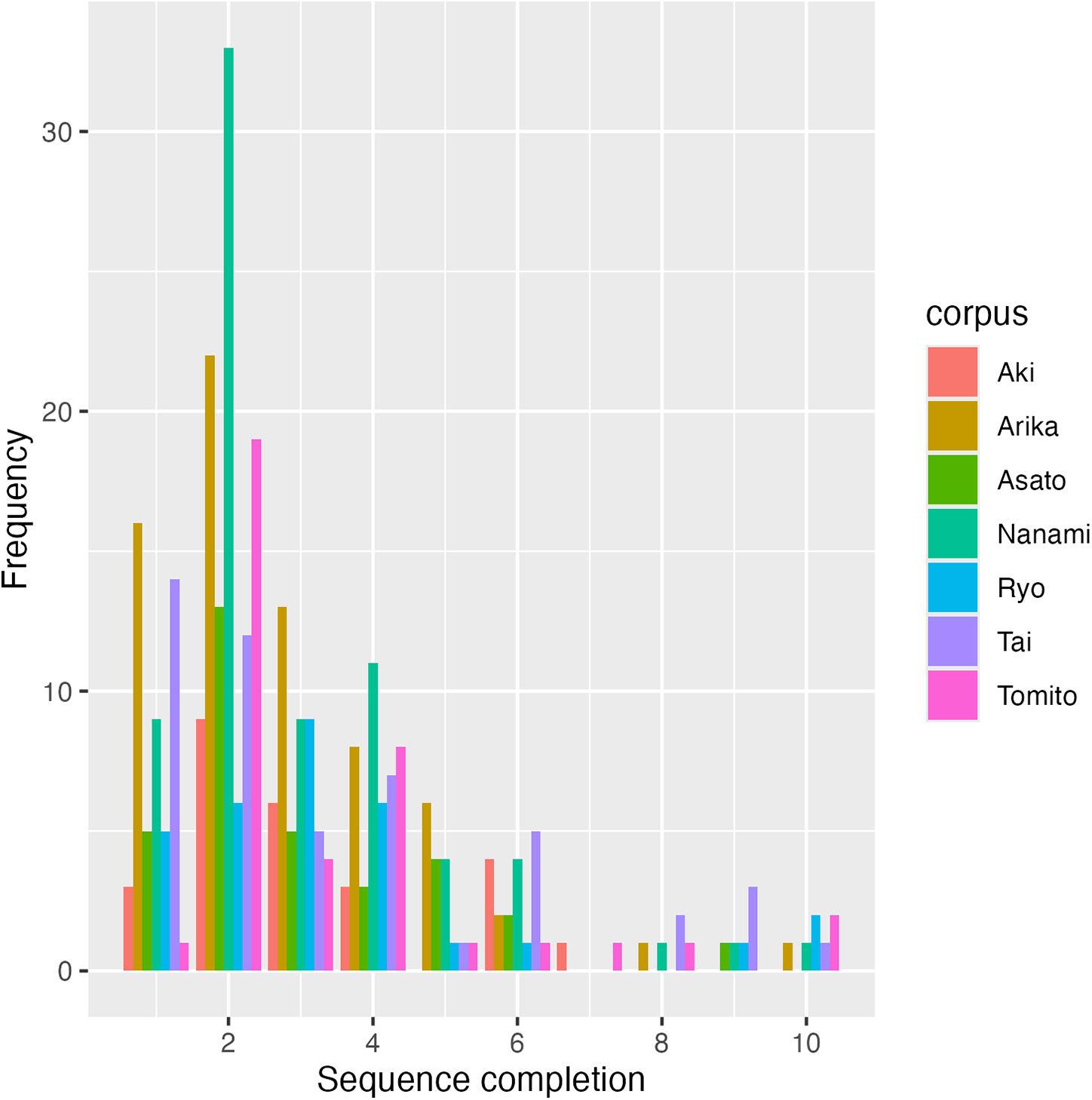
To investigate the relationship between C1 turn and the characteristics of the sequence, we created the variable of sequence completion. Figure 5 shows its distribution by individual child. Sequence completions at turn 1 (C1), 2 (A2), 3 (C2), and 4 (A3) are common. A score of 10 groups all sequences that extend over C5. Despite individual differences, sequence completion occurs most often at A2, meaning that the second turn from the caregiver (following the child’s response to the who-question) tends to initiate a new sequence, in all corpora.
Distribution of sequence completion by corpus (child).

Figure 6 shows the negative relationship between the length of Who-question sequences (number of turns) and the length of C1 turns (number of words). Our model analysis confirms that the longer the C1 turn the quicker the sequence completion (Estimate = −0.103, SE = 0.019, z = −5.344, p = 9.11e−08). Figure 7 also shows a negative association with the number of functions encoded in C1 turns (Estimate = −0.245, SE = 0.052, z = −4.729, p = 2.26e−06). As detailed in the method section, the number of functions ranges between 1 (only Reference function) and 5 (Reference, Evaluation, Action, Social, and Interaction functions). These results are in line with our prediction that longer or multifunctional responses help complete the question sequence quickly. Despite its greater cognitive effort, a longer or multifunctional response has an interactional advantage, namely greater progressivity.
Relationship between the length of Who-question sequences (number of turns) and the length of C1 turns (number of words).

Relationship between the length of Who-question sequences (number of turns) and the number of functions in C1 turns.

Next, we investigate our second prediction that children’s multifunctional responses create more balanced joint activity within a sequence. Conversation is a cooperative activity between different participants, who constantly seek to establish normal interaction through a range of resources such as repair, back-channelling and so on, to cope with or hedge difficulties. When a speaker’s turn lacks a certain element, it is possible that another participant attempts to provide it in subsequent turns. Example 10 can be seen as such an example. The child in the C1 turn gives a simple answer nena ‘sis’. Although this is the right reference for answering the Who-question, the caregiver in A2 turn follows this response up by asking a fully-fledged question, including an affirmative finite verb and modal particle, for confirmation. The sequence ends in A3, with the caregiver’s acknowledgement token un, after the child repeats the same word three times in C2. This example suggests not only that producing the target answer word alone sometimes invites more interaction in a sequence, but also that the interlocutor may be prompted to provide the absent functions. In other words, participants complement each other in pursuit of normal interaction. When a young child interacts with an adult, the child’s short and simple response will require the adult to make more effort to manage the interaction. As the child grows older and produces responses with more words and functions, the interaction will become more balanced, with both the child and adult contributing to the interaction.
Example 10. (Ryo, 1;10.12)

We therefore hypothesise that the functions in children’s C1 turn and those in their interlocutor’s (A’s) subsequent turns within a Who-question sequence are in a predicted trade-off relationship. To test this idea, we investigated whether the number of functions in the child response in C1 turn is negatively associated with the number of functions in caregivers’ turns that follow children’s responses within the question sequence. The model results support our prediction that child’s multifunctionality is a negative predictor of caregiver’s multifunctionality (Estimate = −0.203, SE = 0.064, z = −3.167, p = 0.002) as shown in Figure 8. This result implies a trade-off relationship between the child and caregiver regarding functional load in their conversational turns.
Relationship between the number of functions of A turns (interlocutor’s turns until the end of sequence) and the number of functions of C1 turn.

This section has demonstrated the association between children’s long and multifunctional responses and enhanced progressivity and more balanced interaction. In conjunction with the developmental changes that children produce longer and more functionally-loaded utterances, we argue that children’s linguistic behaviour evolves in a way that facilitates progressive and joint interaction.
4 Discussion
This study has examined Who-question sequences focusing on the interactive factors of progressivity and joint activity, which potentially link the children’s immediate linguistic choices and their developmental adaptations. Our corpus-based quantitative analyses revealed that (1) children’s response becomes more cooperative throughout development, (2) their response utterances become longer and include more functions over time, and (3) their longer and multifunctional responses correlate with more progressivity and balanced interaction within question sequences.
As previous studies have reported, children’s responses shift toward greater cooperativity over development. In our dataset of Japanese Who-question sequences, an increase was observed both in children’s provision of animate references in the C1 turn and in their non-answer responses that maintain relevance to the question, such as saying wakaranai ‘I don’t know’. These cooperative responses indicate children’s awareness and linguistic articulation of normative conversational structure. Conversely, non-cooperative responses – namely irrelevant or absent responses – diminish as children get older. With regard to the existing claim of an adult-like preferences for answer responses over non-answer responses or for informativeness in children (Dore, Reference Dore1977; Van Hekken & Roelofsen, Reference Van Hekken and Roelofsen1982), our results suggest a gradual longitudinal shift toward information-providing and cooperative responses. This implies a learning process whereby children adjust their behaviour choices through experience.
Another important developmental change, illuminated by our second set of analyses, reveals that children’s answers to Who-questions become longer and more multifunctional. While a Who-question can be succinctly answered with a single word, children often craft longer utterances to express evaluative, social and interactive stance in C1 turns. They become able to attend linguistically to these varied communicative aspects, which make them competent conversational participants. Who-questions necessitate not merely an informational exchange, but an interaction wherein participants mutually invest in sharing their belief and attitude toward the propositional content, saving face, and modulating turn-taking. Such demands increase the proficiency of children’s linguistic production, requiring the right choice of words and constructions that effectively communicate their intentions.
Our third set of analyses explored the impact of C1 turns’ length and multifunctionality on the dynamics of question sequences. These factors showed a positive correlation with a quicker completion (progressivity) of question sequences, implying that children’s long or multifunctional utterances in C1 turns generally contribute to a quicker completion of the ongoing sequence. Consequently, they are able to achieve a local interactional goal, namely, satisfying the interlocutor’s request expressed in the form of a question. Furthermore, these utterances are associated with balanced interaction amongst participants. Children, by adding varied functions to their utterances, actively engage themselves in communication. We identify this as a pivotal phenomenon that is necessary for explaining the longitudinal transition in the nature of interaction from being adult-led to being a more balanced joint activity (Dale & Spivey, Reference Dale and Spivey2006; Sokolov, Reference Sokolov1993). From a broader perspective, these findings suggest a probabilistic contingency between children’s C1 turn and its subsequent sequence. Experiencing this contingency between their own linguistic behaviour and its consequence in interaction is an important learning opportunity if children wish to adapt to normal conversational interaction.
Contemplating the relationship between children’s linguistic behaviour and subsequent interaction invites different possible interpretations. One crucial question is the level of goal-directedness that we attribute to children’s linguistic behaviour. On the one hand, imitation or copying behaviour is a basic learning strategy especially until around two years of age. A number of studies have shown that infants copy others’ behaviour with or without an understanding of the goal or intention. For example, 2-year-olds imitate model’s inefficient actions for reaching an object with a tool without revising them according to the goal (Nagell et al., Reference Nagell, Olguin and Tomasello1993). This means that children focused more on reproducing the observed behaviour than attaining the goal. Early linguistic choices are also heavily dependent on copying and repeating of the most recent or frequent forms in the perceived input (Bloom et al., Reference Bloom, Hood and Lightbown1974). These behaviours are motivated not only by learning needs but also by the basic pro-social tendency for children to try to behave like the people around them (Uzgiris, Reference Uzgiris1981). On the basis of these studies, one might assume that children, at least at the earliest stages, are not capable of accessing or paying attention to the goals of the interaction, let alone of evaluating conversational sequences against these goals.
On the other hand, children are known to be teleological, showing certain intentional and goal-directed actions already by the end of the first year (Carpenter et al., Reference Carpenter, Nagell, Tomasello, Butterworth and Moore1998; Gergely & Csibra, Reference Gergely and Csibra2003). For example, children copy adults’ adjectives more when these adjectives serve descriptive or contrastive functions in the input, but not when they are produced by a slip-of-the-tongue (Bannard et al., Reference Bannard, Klinger and Tomasello2013; Nielsen, Reference Nielsen2006). Although we cannot assume that children recognise goals in a completely adult-like manner, children’s developmental change in their response behaviour in the current study seems to suggest that children pay attention to basic goal-related intentions. If children perceive the goal of answering a question and thereby finishing a sequence of interaction, they probably (at least attempt to) plan and execute behaviour to attain this goal. They will thus choose their linguistic expressions to achieve this goal and assess these expressions against observed outcomes – namely, whether the goal was in fact achieved. If their use of functionally complex utterances tends to lead to a more successful subsequent interaction, children may learn to increase their use of this kind of utterance in future interactions. Similarly, balanced joint activity may also serve as an interactive goal for children in a way that children try to match the level of contribution with that of adults’. As both progressivity and joint activity inherently define normal cooperative conversations, they may also motivate children to fine-tune their own linguistic behaviour choices over time.
Another pivotal factor in elucidating children’s linguistic behaviour is children’s active moves to manipulate interactions. Children’s long and multifunctional utterances encompass an array of actional modalities such as proposals, commands, and requests. They may also extend the existing topic or introduce a new one. They sometimes combine these new spontaneous moves with their question-answering (e.g., provide the requested information first and then propose a new activity in the same turn). Expressing these different demands verbally in interaction often necessitates diverse and complex utterances.
Our study underlines the significance of interactional goals within conversational interaction. Given our prevailing knowledge regarding children’s abilities to comprehend goals and intentions (Carpenter et al., Reference Carpenter, Nagell, Tomasello, Butterworth and Moore1998; Gergely & Csibra, Reference Gergely and Csibra2003), self-monitor their behaviour (e.g., self-repair, Forrester, Reference Forrester2008), and construct social understanding (Carpendale & Lewis, Reference Carpendale and Lewis2004), children’s linguistic behaviour must also be understood in the light of their conversational goals. Progressivity, or satisfying the interlocutor’s request quickly, could represent such a goal, as it is fundamental in explaining the structure of question sequences. Joint activity is also essential in conversation and, more broadly, in social interaction, in that it encapsulates turn-taking and cooperation. Our results reveal that children participate in sequenced interactions where specific facets of their linguistic behaviour in a turn invite quicker completion and more balanced interaction in immediately succeeding turns. The mechanism through which children associate their linguistic behaviour with subsequent interactions merits further, more comprehensive investigation.
As a study on naturalistic corpus data, the current study investigated sequences initiated by Who-questions, irrespective of preceding interactions and the context of their speech and activities. Certain sequences are unmistakably identified as information requests, while others are not. A typical discourse function of Wh-questions is to introduce a topic, allocate a turn and elicit conversation, with the latter two elements being particularly essential in child–caregiver conversations (Snow, Reference Snow, Fletcher and Garman1986). Children may experience less pressure to deliver an informative response in these cases, which is a potential source of bias in our dataset. There are also likely to be individual differences between children, which are difficult to evaluate in this study because our dataset consists of data from seven child–caregiver pairs which extend over different developmental periods and include interactions over a range of different activities. A future study could explore naturalistic interactions within a controlled task to discern more directly the relationship between children’s goal-oriented linguistic behaviours and their interactive repercussions, as well as individual differences.
Children participate in social interactions regardless of their linguistic capability, and their speech significantly shapes interactions. Their participation creates opportunities to learn from contingent interactions and refine future behaviour choices. Investigating this process constitutes a meaningful challenge for any ecological approach to language acquisition that regards social interaction as both the site and goal of language use.
Acknowledgement
Julian Pine is a Professor in the International Centre for Language and Communicative Development (LuCiD) at The University of Liverpool. The support of the Economic and Social Research Council [ES/L008955/1] is gratefully acknowledged.





 Open access

