

Introduction
Archaeological interest in sourcing obsidian artefacts has increased exponentially since Renfrew’s ground-breaking work with Aegean obsidian (Reference RenfrewRenfrew et al. 1965; Reference AspinallAspinall et al. 1972). Although Mediterranean obsidian has received the lion’s share of attention, sources in Central and Eastern Europe have recently become the focus of characterisation efforts. This is timely—Carpathian obsidian was first exploited during the Middle Paleolithic, and was traded widely throughout Europe during later times (Reference Williams ThorpeWilliams Thorpe et al. 1984, Reference KilikoglouKilikoglou et al. 1996). Identifying Carpathian sources of obsidian artefacts may therefore provide data on human cultural interactions ranging from social boundaries to resource-procurement patterns over a considerable period of time. Despite increased international collaboration aimed at characterising Carpathian obsidians (Reference BigazziBigazzi et al. 1990; Reference KilikoglouKilikoglou et al. 1997; Reference OddoneOddone et al. 1999; Reference ConstantinescuConstantinescu et al. 2002), advances in understanding of the archaeological significance of Central and Eastern European obsidian sources have been hampered by difficulties of language and access (Reference KunovKunov et al. 2003; Reference BiróBiró 2004; Reference RyzhovRyzhov et al. 2005).
Obsidian sources have unique chemical compositions, and it is possible to source artefacts by comparing their chemistries to those of geological material of known geographic origin. Identification of all or most geological sources is a fundamental component of any sourcing study. Despite previous efforts, much remains to be learned about European obsidian and its prehistoric use. Therefore, the long-term goals of our research are to produce compositional profiles for all known European obsidian sources, and to begin using these data to address questions of prehistoric cultural interaction.
Central and Eastern European obsidian sources
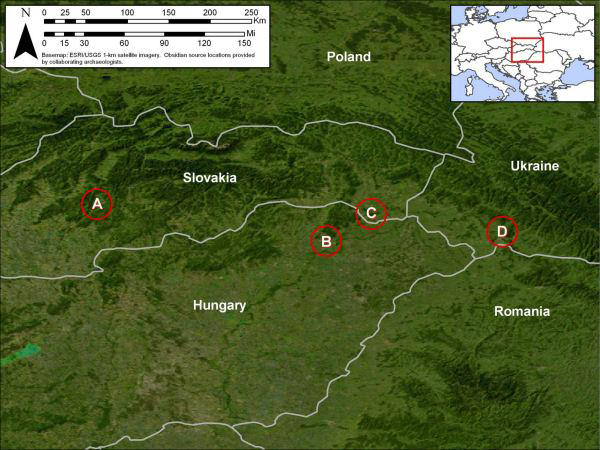
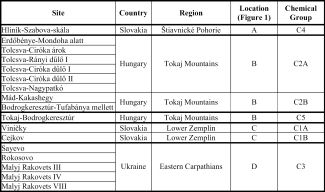
Obsidian is a product of geologically recent volcanic activity during which lava cools rapidly; therefore, obsidian is typically found along seashores and volcanic island arcs. Obsidian in Central and Eastern Europe occurs within the Carpathian Basin (Figure 1, Table 1; detailed geological descriptions of the Carpathian Mountains are given by Reference GyarmatiGyarmati 1977, Reference HámorHámor 2001 and Popov et al. 2006). Carpathian obsidian formed during the Middle Miocene (c. 20 to 10 Ma), when the region was similar to the modern-day Mediterranean. The area was covered by the Paratethys Sea, and volcanic island eruptions created lava flows of varying chemistries (Reference OddoneOddone et al. 1999; Reference BiróBiró 2004). Most eruptions produced non-vitreous lithologies (e.g. perlite, pumice, scoria, etc.); yet volcanic-glass production did occur in what became modern-day Slovakia (Lower Zemplín), Hungary (Tokaj Mountains), and Ukraine (Eastern Carpathian Mountains).
The Carpathian Basin, encompassing portions of modern-day Slovakia, Hungary, Romania and Ukraine. Obsidian sources and archaeological sites mentioned in the text are shown (see Table 1).


Today, perlitic obsidian exists near Hliník, Slovakia, and Tokaj-Bodrogkeresztúr, Hungary, but good-quality (glassy, translucent/transparent, with high SiO 2 content) obsidian is found near Viničky and Cejkov of south-eastern Slovakia. Both locations in south-eastern Slovakia were used prehistorically (Reference BiróBiró 1984, 2004; Reference BiróBiró et al. 2000). In Hungary, obsidian is present in the southern and central ranges of the Tokaj Mountains (Mád and Tolcsva environs, respectively). These locations yield non-transparent obsidian with low SiO 2 content. Reference JanšákJanšak (1935) identified Viničky as a primary source of Carpathian obsidian, but the other, above-mentioned obsidians occur in secondary geological contexts as scattered nodules—the result of heavily weathered lava flows. In Ukraine, obsidian occurs in Transcarpathia along the Vihorlat-Gutinian Ridge as strombalites—volcanic bombs ejected from explosive eruptions during the last (IV) orogenetic phase of regional volcanic activity (Reference NasedkinNasedkin 1963; Reference MaleevMaleev 1964) roughly 8 to15 Ma (Reference ShevkopljasShevkopljas et al. 1986).
Previous characterisation efforts
Williams Thorpe and colleagues (1984) initially determined that compositions of Carpathian obsidians could be divided into two major groups termed Carpathian 1 (C1) found near the towns of Viničky and Cejkov, Slovakia, and Carpathian 2 (C2) from the Tokaj Mountains, near Tolcsva and Erdőbénye, Hungary. Work by Biró and colleagues (1986, 1988) verified and expanded these preliminary geological source designations. At present, the C2 compositional group is known to contain at least two distinct subgroups (referred to as C2A and C2B). In cultural contexts, Reference Williams ThorpeWilliams Thorpe et al. (1984) determined that C2 obsidian-use was restricted to the Aurignacian, with a later resurgence in the Neolithic. Conversely, C1 obsidian appears to have been continuously used from the Gravettian through the Neolithic.
Though not assessed by Reference Williams ThorpeWilliams Thorpe et al. (1984), obsidian sources in Transcarpathia (Ukraine) were first analysed by Reference PetrougnePetrougne (1960, Reference Petrougne1972, Reference Petrougne1986), and intensively sampled by Reference GladilinGladilin and Sitlivyj (1990). Recent surveys in eastern Ukraine near the villages of Rokosovo and Maly Rakovets reveal continuous use of local obsidian sources throughout the Lower, Middle, and Upper Paleolithic (Reference GladilinGladilin & Sitlivyj 1990; Reference SitlivyjSitlivyj & Ryzhov 1992; Reference RyzhovRyzhov 1998, Reference Ryzhov1999, Reference Ryzhov2003; Reference RyzhovRyzhov et al. 2005).
Method
X-ray fluorescence (XRF) and neutron activation analysis (NAA) were used to study Carpathian obsidian sources, even those that seem unlikely to have been used prehistorically. Non-destructive (semi-quantitative) XRF was used to determine concentrations of 12 elements, and NAA was used to identify 27 elements at trace levels. The combination of both techniques provides accurate and precise chemical source profiles. Additionally, a combined approach makes it possible to tailor future sourcing projects to specific archaeological inquiries. XRF offers an alternative to sampling museum-quality artefacts for NAA, but may not discriminate between all Carpathian sources.
Archaeological samples in our study come from the site of Malyj Rakovets IV, a Middle Paleolithic–Neolithic site in the Khust region of Transcarpathia, Ukraine (Reference RyzhovRyzhov 1998, Reference Ryzhov2003; Reference RyzhovRyzhov et al. 2005). Artefacts from different periods were analysed to identify diachronic patterns in obsidian procurement.
Results
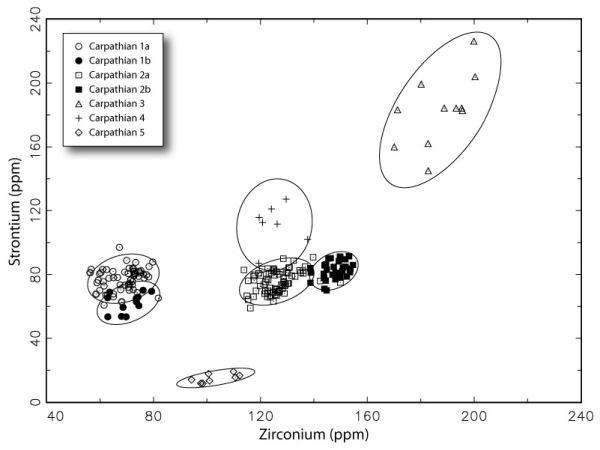
Our XRF data reveal five compositional groups (Figure 2). The previously defined C1 and C2 groups are clearly identifiable. Newly identified here is a third group composed exclusively of Ukraine obsidian. We designate this group Carpathian 3 (C3) following nomenclature of Williams Thorpe et al. (1984). The two remaining groups are composed of perlitic obsidian from Hliník and Tokaj-Bodrogkeresztúr, and these are herein designated Carpathian 4 (C4) and Carpathian 5 (C5) respectively.
Bivariate plot of Zr and Sr concentrations determined by non-destructive XRF analysis. Ellipses represent 90% confidence intervals of group membership. Elements Fe, Y, Rb, Mn and Zn are also effective in discriminating these groups.

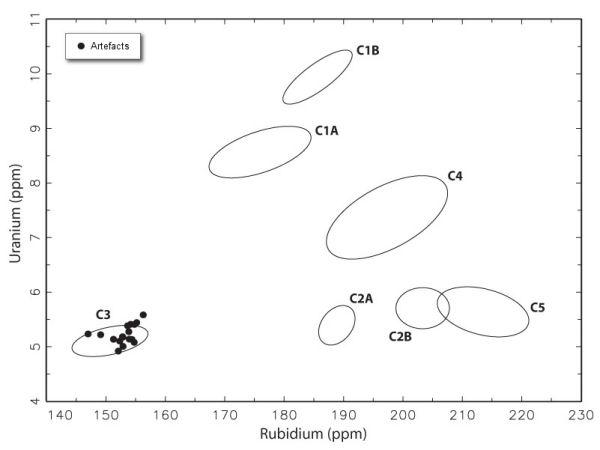
Compositional data determined by NAA also verify the two compositional groups identified by Reference Williams ThorpeWilliams Thorpe et al. (1984), as well as the two subgroups C2A and C2B. NAA data are able to distinguish two subgroups of C1 based on concentrations of Rb, U, Sb, and Sc (Figure 3). Similar to the XRF data, NAA data indicate Ukraine obsidian is chemically different from other Carpathian obsidians, and suggest that the Ukraine material is internally homogenous. Artefacts from Malyj Rakovets IV are similar to geological samples from Ukraine, suggesting that obsidian procurement focused on local sources.
Bivariate plot of Rb and U concentrations determined by NAA. Artefacts from Malyj Rakovets IV are projected against compositional groups defined for Carpathian obsidian. Groups are labeled with abbreviations from Table 1. Ellipses represent 90% confidence intervals of group membership. Note that elements Th, Cs, Sb, Sc, Ba and Zr are also effective in discriminating these groups.

Discussion and future research
Though preliminary, our findings bear directly on understanding regional interaction and long-distance trade. Thus demonstrated, the compositional data provide concrete evidence for the long held assumption that local sources were mostly used in Ukraine. This project is an initial step towards the distant goal of a comprehensive obsidian-source database for Europe. Three new compositional groups of Carpathian obsidian and two new subgroups have been identified and characterised. Additionally, our results demonstrate that XRF can distinguish among C1, C2, C3, C4 and C5 obsidians, but that NAA allows further discrimination of subgroups within C1 and C2. We recommend that future source-characterisation efforts employ both techniques, to produce a mutually informing database and to facilitate future analyses of existing as well as new collections.
Our research will continue to identify and analyse new sources of obsidian, as well as continue analyses of artefacts from Europe. In the end, we hope obsidian sourcing will provide a method for reconstructing patterns of resource procurement, use, and trade, as well as myriad other cultural interactions
Acknowledgements
The Archaeometry Laboratory at MURR is supported by a grant from the National Science Foundation (grant #0504015). Special thanks are extended to Dr Maximilian O. Baldia for facilitating communication across the Atlantic Ocean.