


1 Introduction
People across the world are deeply divided along partisan lines, a fact on striking display in recent years in the United States (Abramowtiz, 2010; Baldassari & Gelman, 2008; Reference Westfall, Van Boven, Chambers and JuddWestfall et al., 2015). Political identification is one of the strongest group affiliations in contemporary America: Dislike of, and willingness to discriminate against, political others are stronger than what is observed for race (Reference Chambers, Schlenker and CollissonChambers et al., 2013; Reference Wetherell, Brandt and ReynaWetherell et al., 2013); trust, as measured through monetary transfers in a trust game, is more affected by a partisan divide than by racial or socioeconomic differences (Reference Carlin and LoveCarlin & Love, 2016); and the diffusion of information rarely crosses political boundaries (Reference Brady, Wills, Jost, Tucker and Van BavelBrady et al., 2017). Indeed, it seems that contemporary political division is less about substantive policy differences and more about simple dislike of political opponents (Reference Iyengar, Sood and LelkesIyengar et al., 2012; Reference Iyengar and WestwoodIyengar & Westwood, 2015). The strength of political attitudes likely stems from factors known to heighten intergroup animosity, including heated zero-sum competition and the rich connections between political and cultural identity (Reference HoggHogg, 2016; Reference Stephan and StephanStephan & Stephan, 2000). These considerations, as well as the general ineffectiveness of anti-bias interventions in other domains (Reference Paluck and GreenPaluck & Green, 2009), give ample reason to suppose that intergroup antipathy based on political attitudes will be exceedingly difficult to change and that political polarization is here to stay.
Political identities may, however, be more malleable than these facts suggest (Reference Carsey and LaymanCarsey & Layman, 2006; Reference Hillygus and JackmanHillygus & Jackman, 2003; Reference Rand, Pfeiffer, Dreber, Sheketoff, Wernerfelt and BenklerRand et al., 2009). While affiliations with a political party are typically strong and enduring (Reference Green, Palmquist and SchicklerGreen et al., 2004), the specific targets that those affiliations direct themselves towards regularly change, even across a single election season, shifts that skillful candidates attempt to harness and direct (Reference Ridout and HollandRidout & Holland, 2010). Consider supporters of Bernie Sanders during the fractious 2016 Democratic primary. Much was made of the perceived difficulty of getting such individuals to rally around Hillary Clinton, and for good reason: their intraparty contest had many of the same features (zero-sum competition; differing cultural identities) that characterize intractable interparty (and other forms of intergroup) conflict. But there are important differences as well, most centrally the subsequent efforts (particularly at the party conventions) to create unity and to emphasize — almost like a psychologist well-versed in intergroup dynamics — the presence of a superordinate goal (defeat the rival party) and a superordinate identity (as Democrat). A similar story can be told with respect to supporters of the defeated rivals of Donald Trump. Indeed, in the political science literature it has been noted that lukewarm supporters tend to “come home” to their party’s eventual candidate, though the motivating factors underlying this shift as well as its general prevalence continue to be debated (Erikson & Wlezian, 2012; Reference Gelman and KingGelman & King, 1993; Reference HendersonHenderson, 2015; Reference HolbrookHolbrook, 1996; Reference Makse and SokheyMakse & Sokhey, 2010). Thus, the transition from primary to general election should create a context in which even powerful political animosities (exemplified by the well-publicized “Never Hillary” and “Never Trump” movements) can be overcome – a prediction we publicly endorsed before collecting any data (Reference Dunham and RandDunham & Rand, 2016).
Here, we evaluate this prediction by tracking in-group bias among thousands of online participants recruited from Amazon Mechanical Turk (Reference Horton, Rand and ZeckhauserHorton et al., 2011) across two critical periods of the 2016 election season: the 13-week period encompassing the transition from contentious primaries through party conventions in June through September 2016 (Wave 1; N = 2,183), and the 5-week period in October and November 2016 ending on the evening before the general election (Wave 2; N = 1,775). We use incentivized economic games as a direct behavioral index of in-group bias that sidesteps some of the concerns with self-report scale items, collecting data at regular intervals in order to capture the possibility of dynamic change in group affiliation of these two broad periods. Thus, Wave 1 runs from the ends of the presidential primary for each party into the summer primary lull where Clinton and Trump were the de facto nominees for their respective parties, and through both party conventions and their short-term aftermath. Wave 2 captures the tumultuous finale of the election season, including the final presidential debate and the announcement of new developments in the FBI’s Clinton probe. Taken together, our dataset allows us to chart the evolving dynamics of behavior with a temporal resolution going far beyond past research on intergroup attitude change. Critically, we do not focus on interactions between parties, which we would expect to be acrimonious across this entire interval, but instead on interactions between supporters of the rival primary candidates within each party. As a proxy for meaningful intergroup attitudes, we used the Dictator Game (DG), a simple behavioral measure of prosociality that is widely used to measure in-group bias (Reference Fowler and KamFowler & Kam, 2007; Reference Iyengar and WestwoodIyengar & Westwood, 2015; Reference Rand, Pfeiffer, Dreber, Sheketoff, Wernerfelt and BenklerRand et al., 2009; Reference Whitt and WilsonWhitt & Wilson, 2007; Reference Yamagishi and MifuneYamagishi & Mifune, 2008). Specifically, supporters of Clinton versus Sanders on the Democratic side, and supporters of Trump versus any other Republican primary candidate on the Republican side, played a DG in which one participant unilaterally decided how much money to share with the other participant. We also provide exploratory evidence of the real-world relevance of the DG measure by showing that patterns of DG giving predict voting intentions, and may even provide predictive information about voting above and beyond standard polling questions.
2 Method
2.1 Participants
Using the online labor market Amazon Mechanical Turk (Reference Horton, Rand and ZeckhauserHorton et al., 2011), we recruited US residents with at least a 90% approval rating. We collected data in two periods or waves: a 13-week period encompassing the transition from party primaries through party conventions in June through September 2016 (Wave 1), and the 5-week period ending on the evening before the general election in October and November 2016 (Wave 2). We arbitrarily selected a sample size of 150 subjects per week at the outset of the study, and then increased to 300 subjects per week once initial data indicated that we were not getting a sufficient fraction of Republican subjects. A total of 5,799 Dictator Game decisions were made in our study, of which 274 were excluded due to duplicate Amazon Mechanical Turk Worker IDs or IP addresses (indicating that they were not independent observations). We also excluded 62 decisions from participants who indicated that they were not United States residents (or that we could not categorize as residents because they did not complete the demographics questionnaire), leaving us with an effective sample of 5,463 individual decisions (the average age of participants in this sample was 35.03 years (s.d. 11.29), and 53.45% were female). Furthermore, our main analyses excluded the 1,505 participants who answered one or more of the game comprehension questions incorrectly (see Supplementary Materials, SM, for experimental instructions, which include the complete set of variables used in this study), leaving a final sample of 2,183 participants in wave 1 and 1,775 participants in wave 2. However, we note that our key results are qualitatively unchanged if we include participants who failed comprehension questions (see SM Section 1.1). SM Section 1.1 also compares demographics between Wave 1 and Wave 2, and shows that our results are robust to including controls for the various demographic variables we collected, which helps address concerns about our results being driven by changes over time in the make-up of the MTurk subject pool (see, e.g., Gelman et al., 2016).
2.2 Materials and Procedure
Participants in our experiment made a single unilateral decision of how much of a 40-cent endowment to give to another participant (i.e., played a one-shot Dictator Game), a stake size that past research suggests is sufficient to elicit preferences similar to those in laboratory games with higher stakes (Reference Amir, Rand and Kobi GalAmir et al., 2012). Before playing the game, participants were asked about their preference for the Democratic versus Republican party, and for their preferred 2016 presidential primary candidate within their preferred party (Clinton or Sanders for Democrats, Trump or a different candidate for Republicans). Each question had only two options. Of the 3,958 participants (Mage=35, 51.34% female), 65.23% reported preferences for the Democratic Party and 34.77% for the Republican Party; Donald Trump was favored by 44.48% of the Republicans, whereas Hillary Clinton was supported by 29.63% of the Democrats.
When making their decision in the game, participants were matched with a supporter of the same party, and informed of that person’s preferred primary candidate. Thus our experimental manipulation was whether participants were matched with a partner who supported the same primary candidate or a different primary candidate. Finally, participants completed a demographic survey that included a question about their voting intention in the election (although this question was only added to the survey on August 8, and thus is not available for the first half of Wave 1). Data and model specifications supporting the findings of this study are available in its supplementary information files. We report all measures, manipulations and exclusions.
3 Results
3.1 Wave 1
As predicted, regression analysis showed the expected negative main effect of being paired with a supporter of the other primary candidate, β =−.083, t(2181)=−3.89, p<.001, but this effect was qualified by a significant positive interaction with week (coded numerically), β =.149, t(2179)=2.72, p=.007: Over the course of our 13-week study, in-group bias decreased significantly. Interestingly, post-hoc analysis revealed a significant 3-way interaction between out-group partner, week, and political party, β =.237, t(2175)=2.23, p=.026. Decomposing by party (Figure 1, top panel) showed that the interaction between out-group partner and week was significantly positive for Democrats, β =.232, t(1447)=3.48, p<.001, but was non-significant (and directionally negative) for Republicans (Figure 1, bottom panel), β =−.029, t(728)=−.30, p=.767 (see also SM Tables S4 and S5).
Fraction transferred in the Dictator Game in each week of the first wave of the study, with Locally Estimated (LOESS) 95% Confidence Intervals. RNC: Republican National Convention; DNC: Democratic National Convention.
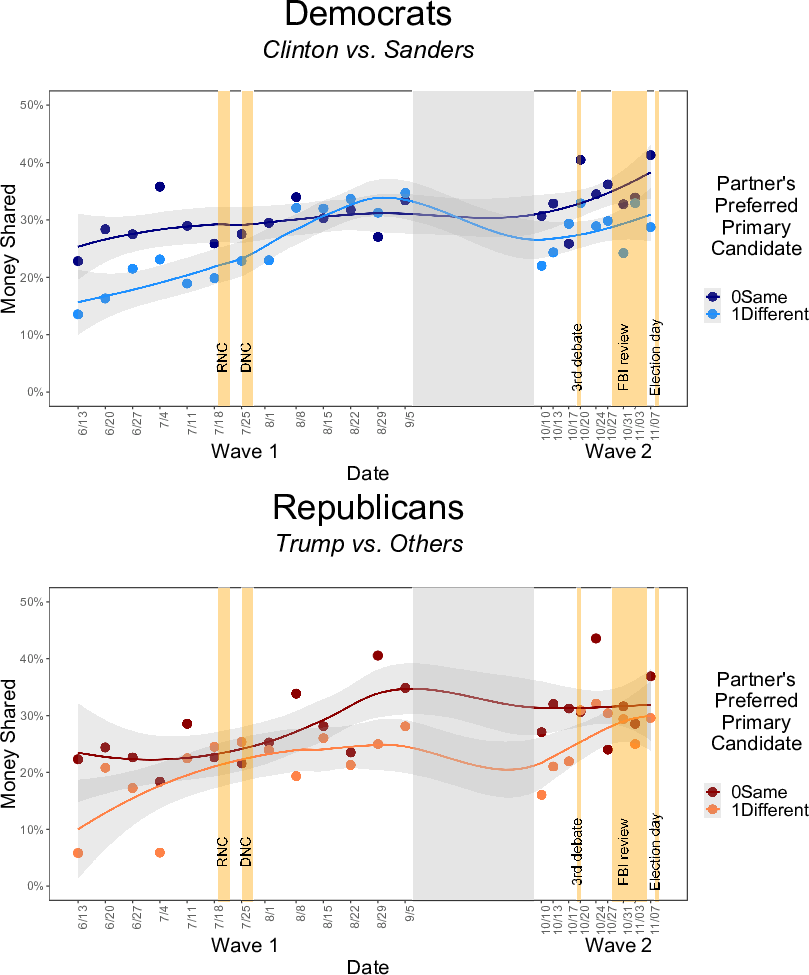
The data also suggest that the reduction in bias among Democrats in Wave 1 was not a gradual decrease over time, but rather happened abruptly following the Democratic National Convention: using a dichotomous predictor indicating whether data was collected prior to August 8th fits the data slightly better (AIC=143.98) than a continuous predictor for week (AIC=144.52). Furthermore, robust in-group bias is observed before August 8th, β =−.154, t(778)=−4.35, p<.001, while no significant bias existed afterward, β =.026, t(669)=.68, p=.495 (see SM Tables S6 and S7).
Among Republicans, although bias in Wave 1 was high both before and after the conventions, there appears to have been a temporary reduction in bias during the period in which the conventions were actively occurring: a post-hoc analysis found a significant interaction between a dichotomous predictor indicating whether data were collected during the weeks of July 18 (RNC) and July 25 (DNC) and having an out-group partner, β =.117, t(728)=2.17, p=.030; and, while significant in-group bias was observed both before the conventions, β =−.178, t(170)=−2.35, p=.020 and afterwards, β =−.137, t(439)=−2.90, p=.004, no significant bias was observed during the convention weeks, β =.063, t(117)=.69, p=.50 (see SM Table S8).
Finally, we note a significant positive main effect of week for all political party and out-group partner combinations (ps < .003), except for Democrats supporting the same primary candidate, β =.059, t(721)=1.59, p=.113 (and it is this lack of increase that causes the decrease in bias among Democrats).
3.2 Wave 2
Similar to Wave 1 results, regression analysis of the Wave 2 data showed the expected negative main effect of being paired with a supporter of the other primary candidate, β =−.108, t(1773)=−4.57, p<.001. However, this time the effect was not qualified by an interaction with the day data was collected, β =.112, t(1771)=.66, p=.512, nor by a 3-way interaction between out-group partner, day, and political party, β =−.481, t(1767)=−1.46, p=.146. Thus, in contrast to the end of Wave 1, in-group bias was present for both parties throughout Wave 2. That is, the bias among Democrats that had disappeared during Wave 1 reappeared prior to the beginning of Wave 2, and was maintained throughout. Indeed, decomposing by party showed that the interaction between out-group partner and day was non-significant for Democrats, β =−.082, t(1127)=−0.39, p=.700, and non-significant (but directionally positive) for Republicans, β =−.427, t(640)=1.48, p=.138 (see SM Tables S4 and S5).
While bias was fairly constant for Democrats across Wave 2, Figure 1 suggests an important temporal reduction in bias among Republicans beginning after the last presidential debate and continuing through the announcement of new developments in the FBI’s Clinton probe. Consistent with this visual inspection, a post-hoc analysis found a significant and positive interaction between out-group partner and day during this period, β =−.979, t(426)=2.05, p=.041. In addition, we observe in-group bias until this point, β =−.111, t(428)=−2.32, p=.021, but not afterwards, β =−.071, t(212)=−1.03, p=.304.
Furthermore, we note a significant positive main effect of day only for Republicans with an out-group partner and for Democrats with an in-group partner (ps<.026). That is, during this period, the difference in amount shared between Democrats facing an in-group versus an out-group partner increased, whereas for Republicans this difference decreased.
3.3 Vote intention
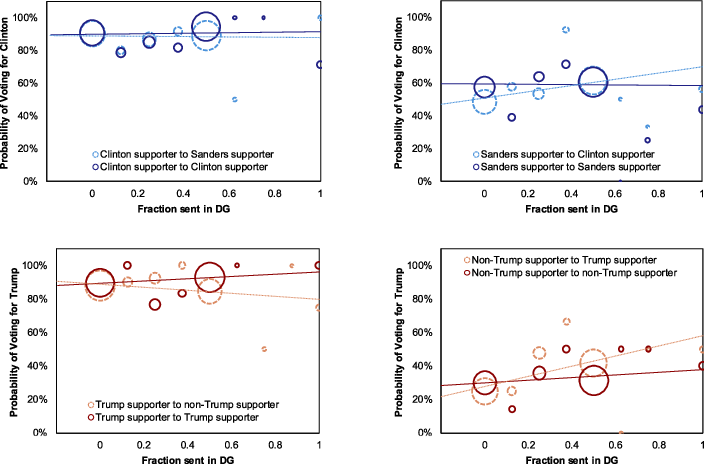
A unique feature of our design is our ability to investigate, if in a more exploratory fashion, the relevance of our DG measure for political behavior. First, we ask how giving in the DG predicted voting intentions in the 2016 Presidential Election. What pattern should be expected here, based on our conceptualization of giving in the DG as an indicator of shared group identity? Supporters of the candidates who won the primaries have no need to remodel group identity as a means of shifting support towards the general election candidate, as they already supported their party’s candidate. Thus, we should not expect giving in the DG – our identity measure – to predict voting intention for Clinton supporters or Trump supporters. Where identity dynamics do matter, however, is for supporters of the losing candidates, i.e., supporters of Sanders or the non-Trump Republican candidates. In these cases, we hypothesize that the dynamics of their superordinate party identity should exert pressure in the direction of supporting their party’s eventual nominee. Based on this account, we would expect the amount given by Sanders supporters to Clinton supporters to predict intention to vote for Clinton, and the amount given by non-Trump supporters to Trump supporters to predict intention to vote for Trump.
Results of this analysis, shown in Figure 2, support this prediction. There was a positive correlation between amount given by Sanders supporters to Clinton supporters and probability of voting for Clinton, p=.011, top right panel, and a positive correlation between amount given by non-Trump supporters to Trump supporters and probability of voting for Trump, p=.004, bottom right panel. Conversely, there was no significant correlation between amount given in the DG and intention to vote for the candidate of one’s party for any of the other pairings, ps > .30 for all, left two panels. Taken together, these results thus suggest that shared identity, as tracked by giving in the DG, may have implications for voting behavior.
Probability of voting for the winning candidates of the primary elections and the fraction sent in the Dictator Game.
Additionally, we provide suggestive evidence that bias in the DG may provide additional information beyond traditional self-report voting intention polling. Many polls during the campaign showed Clinton substantially ahead of Trump, such that some people – including Trump himself – found Trump’s victory extremely surprising (Reference McCaskillMcCaskill, 2016). Examining voting intentions in our data paints a broadly similar picture to what was observed in national polling: Clinton appeared to solidify her support among Democrats between the second half of Wave 1 (8/8 to 9/5, which is the period in which we elicited voting intentions as well as the period in which Democrats had apparently unified following the DNC) and Wave 2. Specifically, Democrats in Wave 2 reported a higher likelihood of voting for Hillary Clinton in Wave 2 compared to the second half of Wave 1, β =.052, t(1800)=−2.20, p=.028. Importantly, this was true among both Sanders supporters and Clinton supporters (see Figure 3A). Thus, based on this polling question, the unification of the Democrats seemed to hold – or even improve slightly – in Wave 2.
Fraction of participants not voting for the presidential candidate of their party, and the corresponding in-group bias in DG giving over time. 95% Confidence Intervals.
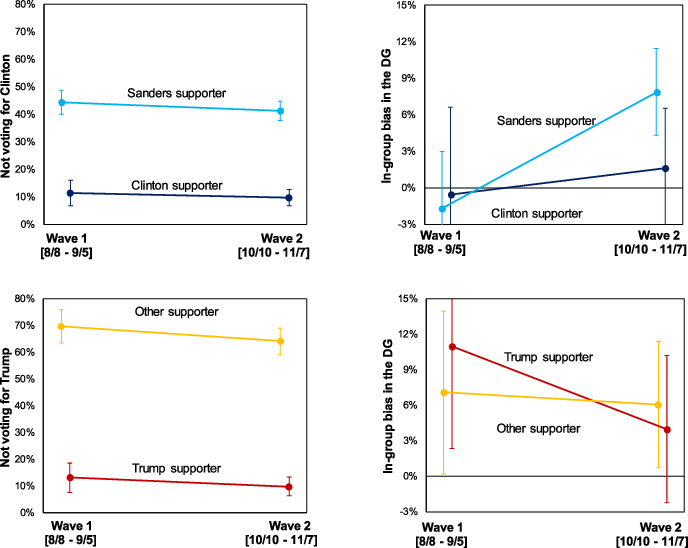
This pattern differs from what was observed above in Figure 1 for in-group bias in the DG: As summarized in Figure 3, while Democrats who supported Hillary Clinton remained unbiased in the second wave, β =.033, t(390)=0.65, p=.518, Democrats who supported Bernie Sanders showed significant in-group bias in the second wave, β =.157, t(737)=4.32, p<.001. Thus, while explicit reports of voting intentions showed increased support for Hillary Clinton among Democrats in Wave 2 – consistent with national polls reported during that time and supporting the expectation of a Clinton victory in the election – the level of bias in the DG painted a different picture, suggesting a fracturing of identity among Democrats. In particular, Sanders supporters appeared to de-identify with Clinton supporters, despite reporting the intention to vote for Clinton.
Finally, in the interests of complete reporting, we also note that Republicans were almost significantly more likely to report an intention to vote for Donald Trump in Wave 2 than in Wave 1, β =.059, t(1002)=1.88, p=.061, and that in-group bias remained present in both waves among supporters of non-favored candidates, β =.116, t(366)=2.23, p=.026, though supporters of Donald Trump became unbiased in the second wave, β =.075, t(274)=1.25, p=.212.
4 Discussion
Our data demonstrate that strong, culturally embedded attitudes reinforced by heated conflict are surprisingly dynamic in the face of shifting contexts. In this sense, our results provide a conceptual replication of, as well as important additions to, prior work on dynamic attitude change generally (Reference Sherif, Harvey, White, Hood and SherifSherif et al., 1961) and in the political domain in particular (Reference HendersonHenderson, 2015; Reference Hillygus and JackmanHillygus & Jackman, 2003; Reference Henderson, Hillygus and TompsonHenderson et al., 2010; Reference Misch, Fergusson and DunhamMisch et al., 2018; Reference Rand, Pfeiffer, Dreber, Sheketoff, Wernerfelt and BenklerRand et al., 2009). Most centrally, most prior work on attitude change incorporated only two or three time points, and therefore cannot provide insight into the precise temporal dynamics of change in the face of shifting real-world events. And prior work on changing political identities looked only at the dynamics within a single party, limiting generalizability (Reference Rand, Pfeiffer, Dreber, Sheketoff, Wernerfelt and BenklerRand et al., 2009).
The multi-wave nature of our data reveals both the discontinuity and contingency of change. For Democrats, rather than resolving gradually as conflict apparently waned and sympathy for members of their own party seemed to increase (as measured by DG giving), bias among Democrats persisted essentially unchanged until a reformation event (the convention) eliminated it. But this unity was itself short-lived: bias reappeared and remained in the final run-up to the election. In spite of the party’s efforts to preserve unity, Clinton’s support was probably offset by the extensive media coverage of Clinton-related scandals, or because the assumption that Clinton would win allowed prior animosities in Sanders’s supporters to reemerge. While the details differ, Republicans in many ways showed a similar overall dynamic. They showed only a very brief elimination of bias during the convention period, but then appeared to rally in the final run-up to the election, perhaps responding with greater unity to the same media coverage that fostered division among Democrats. It is likely that continued conflict between Trump and powerful Republicans (Cruz, Romney, etc.) during and after the primary prevented the convention gains in unity from being maintained throughout the post-convention period. These findings add important qualifications to past work in political science, which has argued that convention bumps generally bring the electorate in line with the eventual election outcome (Reference HolbrookHolbrook, 1996), and that supporters of candidates defeated in even acrimonious primaries do tend to “come home” late in election cycles (Erikson & Wleizen, 2012; Reference HendersonHenderson, 2015; Reference Henderson, Hillygus and TompsonHenderson et al., 2010; but cf Reference Makse and SokheyMakse & Sokhey, 2010).
Another intriguing aspect of these data concern the link between bias in the DG and voting intentions. We find that DG giving predicted intention to vote for the party candidate only in those who previously supported a losing primary candidate. For those individuals, the DG apparently served as a means of enacting — or withholding — support for the intraparty rival. Increased giving in the DG during those periods in which it was observed can thus be conceptualized as a remodeling of identity away from the previously supported candidate and in the direction of the broader party. By contrast, for those who had supported the victor all along, no remodeling was necessary, and DG decisions presumably unfolded according to the individual’s baseline prosocial preferences in a way that was decoupled from voting intentions (which were uniformly high in this group).
This result suggests an important question for future research, namely whether economic games like the DG may provide additional value over and above voting intentions in predicting actual voting behavior. That is, most conventional opinion polling tended to view Clinton as a robust favorite heading into the general election, and did not suggest a substantial weakening of support for her among Democrats in the final days of the election. By contrast, our DG data did capture at least a relative erosion of support, especially among former Sanders supporters. Thus, a non-verbal incentivized task like the DG may tap into a form of identity commitment that direct polling may not. If replicated in future election cycles, this finding could form the basis for new methods to measure political commitment and future voting behavior.
Turning to some limitations, while our data provide interesting insights into the dynamic nature of group identity, our MTurk sample was far from nationally representative, and our experiment involved different participants in every collection rather than being a longitudinal study of a fixed set of participants. Thus, caution should be used in extrapolating from these results to the broader national political stage. In addition, our study does not include a between-party benchmark, which would have been useful when comparing the magnitude of bias within and across parties. Furthermore, with regards to understanding how group identities can be remodeled, we acknowledge that future work will be needed to test specific causal mechanisms, including the role of individuals and organizations in creating unity, and the potential interactions between superordinate goals and identities. Indeed, some of the most intriguing findings in these data – regarding the relationship between DG giving and voting – were not pre-registered predictions, and so must be interpreted cautiously prior to future replication. Nonetheless, the real-time dynamics of attitude change revealed here are valuable precisely because they provide a critical new window into the factors most likely to impact voting decisions.
More broadly, our findings regarding intraparty animosity may have implications for the fractured state of American politics, and can hint at ways to reduce the interparty animosity that has all but deadlocked the legislative process on many key issues. Past research has sometimes been taken to suggest that superordinate goals (Reference Pettigrew, Tropp, Wagner and ChristPettigrew et al., 2011; Reference Sherif, Harvey, White, Hood and SherifSherif et al., 1961) and superordinate identities (Reference Gaertner and DovidioGaertner & Dovidio, 2012) can reduce intergroup animosity and pave the way for reconciliation and collaboration. Why, then, does the United States remain so divided along partisan lines, even in the face of threats to the country as a whole – such as terrorism, climate change, resource depletion, or the opioid epidemic, all of which should engage the pursuit of goals shared by Democrats and Republicans? Our data suggest that, although these threats may indeed create superordinate goals that require collaboration across party lines to achieve, these goals are not sufficient to affect a lasting reduction in interparty hostility. Real progress in bridging the partisan divide paralyzing the United States will likely require pairing these superordinate goals with a concerted effort by leaders of both parties to emphasize a shared identity as Americans. In our data, it was only when shared goals and common identity were successfully paired and actively maintained that intraparty animosities gave way to party unity.


 Open access

