


Do material or symbolic considerations drive policy evaluations across racial and partisan divides? What knowledge and experiences shape how individuals weigh the symbolic importance of a policy against its material benefits? We explore these questions using the uptick in local-level reparations initiatives in the United States. Some suggest reparations should be paid directly to African Americans by the federal government—the party responsible for both slavery and Jim Crow—and substantial enough to close the Black–White racial wealth gap (Darity and Mullen Reference Darity and Mullen2022). Working from this understanding of reparations, local-level reparations initiatives may be better understood as a form of symbolic politics—policies that reflect affective commitments to racial equality while failing to bring about the thing itself (Sears, Hensler, and Speer Reference Sears, Hensler and Speer1979; Sears Reference Sears1993). Addressing this topic lends insights to the study of opinion formation in an understudied policy domain and highlights fractures within an already tenuous political coalition: African Americans and White Democrats.
Initiatives aimed at securing reparations for African Americans date back to the Early Republic (Balfour Reference Balfour2023) but are best represented by the promise of “40 acres and mule”—a phrase attributed to General William T. Sherman’s Special Field Order No. 15. This order emerged from conversations between Sherman, Secretary of War Edwin M. Stanton, and Black leaders in Savannah, Georgia, about how the federal government should compensate emancipated African Americans in the wake of the Civil War (Foner Reference Foner2014). Released on January 16, 1865, the order specified that each Black family receive a 40-acre plot of tillable land along the coastal plains of Florida, Georgia, and South Carolina and guaranteed management of this land to African Americans (Sherman Reference Sherman1865).Footnote 1 While “40 acres and a mule” is symbolic of aspirational political goals—including attempts to address structural inequality—it also provided material benefits from the federal government to address an egregious injustice.
Following the assassination of President Lincoln, President Johnson rescinded the order in the fall of 1865, evicting 40,000 Black Americans from their newly acquired 40-acre plots. White Southerners were invited to reclaim this land (Foner Reference Foner2014).Footnote 2 While the premature end to Reconstruction and the restoration of white supremacy in the South sidelined discussions about reparations for African Americans at the federal level for nearly thirty years (Du Bois Reference Du Bois1935; Mickey Reference Mickey2015) the promise of “40 acres and a mule” remained salient within the Black counterpublic (Berry Reference Berry2006).
While reparations are controversial in the United States, recent public opinion data suggest Americans are becoming more receptive to compensating African Americans for decades of racist policies (Blazina and Cox Reference Blazina and Cox2022). Shifts in public opinion reflect ongoing initiatives in the state of California and a growing number of municipalities—including San Francisco, St. Paul, Detroit, and Asheville—where local officials are exploring how to deliver reparations to Black residents (Whiteside Reference Whiteside2023). This includes a $10 million, publicly funded reparations initiative approved in March 2021 by the city council in Evanston, Illinois—an affluent, strongly Democratic, and predominantly White—Chicago suburb.
Evanston’s reparations funds were earmarked for Black residents who could prove they or one of their ancestors experienced housing discrimination in the city between 1919 and 1969. The funds initially came in the form of $25,000 housing grants that could be used to pay down an existing mortgage, renovate a home, or use for a downpayment on a new house. While Evanston’s policy has received significant attention as a successful local reparations initiative, some critics have characterized it as a “detour,” delivering a win for White Democrats while sidestepping the concerns of many Black residents who questioned labeling housing grants as “reparations” (Darity and Mullen Reference Darity and Mullen2022; Newton and Nelsen Reference Newton and Nelsen2024). To accurately gauge public evaluations of reparations policies, we believe it is necessary to account for a wider variety of reparations-related policies.
We define reparations-related policies as a class of three distinct policy types. True reparations are policies funded by the federal government, providing material benefits, including cash. Formal apologies, meanwhile, acknowledge a wrong but provide no material benefits. Social spending programs have more eligibility requirements and dictate how recipients can use reparations funds (e.g., Evanston’s housing grants). Each of these policy types invokes the symbolic weight of reparations but to different ends. We theorize that different reparations-related policies may win favor with distinct political constituencies who draw from unique experiences to adjudicate between the symbolic and material considerations of policies.
Leveraging a set of forty-one in-depth interviews with Black and White residents of Evanston, we highlight political socialization as one mechanism that may explain why support for reparations-related policies may differ across groups. These interviews reveal that residents formed their opinions about the city’s reparations initiative using their pre-existing understanding of what reparations should entail. Black interviewees often linked their understanding of true reparations to early socialization experiences at home, in predominantly Black classrooms, or simply to “being Black.” White interviewees, meanwhile, formed their opinions about reparations-related policies within the confines of contemporary (and highly localized) reparations debates. White Democrats viewed their support for Evanston’s reparations housing grants as symbolic of their—and their city’s—longstanding commitments to racial equality, even while acknowledging that the policy itself did not qualify as true reparations. White Republicans, meanwhile, characterized the policy as an undeserved handout, reflective of a once conservative community that had lost its way.
Drawing from the racialized trends in political socialization observed in the interviews, we design a conjoint experiment on reparations-related policies fielded within the 2022 Cooperative Election Study. We assess whether racialized understandings of reparations-related policy attributes also emerge nationally. Overall, we find that Americans—especially White Republicans—possess less pre-existing historical knowledge of “40 acres and a mule” and remain strongly opposed to reparations policies, regardless of the form they take. While White Democrats are supportive of reparations policies mirroring Evanston’s, Black Americans—those who possess the greatest pre-existing knowledge of “40 acres and a mule”—support direct cash payments, regardless of their political identification.
Evanston illuminates an irony within the public policy process: the preferences of White Democrats in a national sample are better reflected in Evanston’s housing program than those of African Americans. While Evanston’s program may provide a strategic step forward in a pluralist society, we argue that reparations-related policies should center the concerns of the intended beneficiaries within the policy process. Reflecting existing tensions within the current Democratic party coalition, many Black interviewees felt that Evanston’s most marginalized African American residents—renters and the elderly—were left behind as White Democrats celebrated a symbolic win.
Measuring Support for Reparations-Related Policies
Efforts to secure reparations for African Americans are not new but measuring public opinion towards these initiatives are. One study examined Black–White differences in public opinion towards reparations for Black enslavement and Japanese internment using a national survey (Dawson and Popoff Reference Dawson and Popoff2004). Notably, the authors measured support for formal apologies vis-à-vis financial compensation. They found that Black respondents were more supportive of both formal apologies and compensation for both slavery and Japanese internment than White respondents (59-62). Strikingly, just 4% of White respondents—compared to 67% of Black respondents—supported compensating ancestors of enslaved African Americans (62). In comparison, 26% of White and 59% of Black respondents supported compensation for Japanese internment. This work provided early evidence that race, partisanship, and policy type all shape how individuals evaluate reparations policies.
In recent years, numerous public opinion surveys have asked broad questions about support for reparations. Pew asked respondents whether “the descendants of people enslaved in the U.S. should be repaid in some way” (Blazina and Cox Reference Blazina and Cox2022). As summarized in table 1, these surveys show tepid but growing support for reparations within national samples. Between 2019 and 2022—the period corresponding to the emergence of Evanston’s reparations ordinance—multiple surveys showed around 30% of respondents supporting reparations for Black Americans. White respondents in both parties expressed a great deal of skepticism. Less than half of Democrats supported reparations in Gallup and Pew polls conducted in 2019 and 2021, respectively. However, support for reparations increased in the 2022 CES, with 37% of respondents—including 67% of Democrats—supporting reparations to Black Americans. These data also suggest there is more support for these initiatives among young people.
Percent support for reparations by race and partisanship across six public opinion surveys

Table 1 Long description
The table compares support for reparations across Gallup (2002, 2019), GenForward (2019, 2020), Pew (2021), and C E S (2022) surveys.
* All Respondents: Support grew from 14 percent in 2002 to 37 percent in 2022.
* Asian: Support was 47 percent in 2019 (GenForward), 62 percent in 2020, and 33 percent in both 2021 and 2022.
* Black: Consistently highest support, ranging from 55 percent in 2002 to a peak of 80 percent in 2020.
* Latine: Support ranged from 38 percent to 57 percent across the surveys.
* White: Support grew from 6 percent in 2002 to 30 percent in 2022.
* Democrat: Support ranged from 48 percent to 67 percent.
* Independent: Support ranged from 31 percent to 49 percent.
* Republicans: Consistently lowest support, ranging from 5 percent to 28 percent.
* Sample sizes (N) range from 1,000 to 10,425.
In August 2020, the GenForward Survey found that 52% of young adults (18-36) supported reparations, including majorities of Asian, Black, and Latine young adults. This survey, conducted after racial justice protests in 2020, found significant increases in support for reparations among young adults compared to a similar survey in 2019. However, recent public opinion data are unable to assess whether different types of reparations-related policy affect public support in the ways first laid out by Dawson and Popoff (Reference Dawson and Popoff2004).
Reparations-Related Policies
We define reparations-related policies as a class of three distinct policy types—true reparations, formal apologies, and social spending programs. Each of these reflect distinct policy rationales—policymakers’ justifications of goals, selection of target populations, policy tools, and the use of government funds (Schneider and Ingram Reference Schneider and Ingram1993, 339).Footnote 3 While each policy type invokes the symbolic language of reparations, they do so to different political ends. Policy rationales providing benefits to marginalized groups (e.g., African Americans) “emphasize justice-oriented legitimizations rather than instrumental ones” (340). Thus, examining various types of reparations-related policies is crucial to understanding differences in public opinion that emerge across racial and partisan divides. Beneficiaries of reparations-related policies may place greater emphasis on material considerations while others may prioritize symbolic considerations, since they will not benefit from the policy.
True reparations are funded by the responsible party and provide material benefits substantial enough to redress that wrong. Examples of true reparations include the short-lived promise of “40 acres and a mule” for emancipated African Americans as well as initiatives that targeted other marginalized groups. Notably, the Civil Liberties Act of 1988 provided reparations in the form of a formal apology and a $20,000 tax-exempt payment to every surviving U.S. citizen or legal resident of Japanese ancestry interned during World War II. Similarly, Germany has paid a total of €80 billion to survivors of the Holocaust, which includes monthly pensions and annual payments to survivors (Chappell Reference Chappell2023).Footnote 4 In each of these instances, a specific political constituency received a substantial, material benefit from the federal government as compensation for an egregious injustice.
Formal apologies acknowledge a wrong perpetuated by the responsible party against a marginalized group but provide no material benefit. In April 2021, for example, members of the House Judiciary Committee introduced H.R. 40 in the House of Representatives, a legislative attempt to establish a commission to study reparations and the federal government’s culpability in maintaining racist policies (Lee Reference Lee2021). Similarly, in October 2024, President Biden apologized for the United States’ role in running Native American boarding schools where children were separated from their families, abused, and had their tribal identities erased (Pietrorazio Reference Pietrorazio2024). In these instances, formal apologies and admissions of wrong, while well-intentioned, are symbolic—they stand in for addressing the harm that has been done without providing material benefits to rectify the harm itself.
Social spending programs labeled “reparations” provide a targeted material benefit to a subset of a larger marginalized group that experienced an injustice. In Florida, for example, descendants of the 1923 Roseland Massacre—in which a White mob burned a prosperous Black community to the ground—successfully lobbied the state legislature to grant free, in-state college tuition to the descendants of the victims (Samuels Reference Samuels2020, Bassett Reference Bassett1994). Similarly, Evanston’s ordinance provides material benefits to Black residents who could prove they or one of their direct ancestors faced housing discrimination in the city in the form of housing grants. In each of these cases, social spending programs labeled “reparations” dictate how subsets of a broader population (e.g., Black descendants of a specific atrocity or Black victims of a racist housing policy) can use reparations funds. While these policies provide material benefits to address an injustice, they are distinct from true reparations. In Evanston, funds were not available to all Black residents, not federally funded, narrow in scope, and had their use dictated by city government.
Symbolism and Support for Reparations-Related Policies
Policymakers invoke symbols to activate individuals’ pre-existing emotional attachments in order to win support for their legislative agendas (Dietrich and Hayes Reference Dietrich and Hayes2022, 1369; Sears Reference Sears1993). Thus, symbolic references can influence how constituents evaluate elected officials, political processes, and public policies (Hayes and Hibbing Reference Hayes and Hibbing2017). Of course, symbols can hold distinct meanings for different political constituencies and politicians sometimes leverage these symbols with varying degrees of success (Dietrich and Hayes Reference Dietrich and Hayes2022, 282-283).
We contend that reparations-related policies provide a useful case for assessing whether material or symbolic considerations drive policy evaluations across racial and partisan divides. While existing work demonstrates the important role of symbols within political activism, legislative proceedings, and public opinion (Gillespie Reference Gillespie2019), we highlight processes of political socialization that lead to different evaluations of the same policy, even among those who may seem politically aligned. Public opinion scholars have long recognized that symbolic politics—affective, habitual commitments such as racial tolerance—are grounded in political socialization and more strongly predict preferences than self-interest (Sears, Hensler, and Speer Reference Sears, Hensler and Speer1979, 371; Sears, Lau, and Tyler Reference Sears, Lau, Tyler and Allen1980, 671-672). Individuals leverage their experiences to develop a set of “facts” that they use to evaluate public policies (Cramer and Toff Reference Cramer and Toff2017) and that these “facts” might be distinct across racial and partisan divides.
Different groups possess distinct forms of political knowledge due, in part, to political socialization—the process through which individuals come to develop their political values and ideas about politics (Sapiro Reference Sapiro2004). Families, schools, and churches can impart political lessons that may lead students to develop more crystallized partisan identities and attitudes towards race-conscious policies, including reparations (Nelsen Reference Nelsen2023; Anoll Reference Anoll2022; Tyler and Iyengar Reference Tyler and Iyengar2023; Dawson Reference Dawson1994). National survey data demonstrates that Black respondents tend to possess more knowledge about civil rights (Niemi and Junn Reference Niemi and Junn2005) and the carceral state (Cohen and Luttig Reference Cohen and Luttig2020) than their White peers, reflecting racialized processes of political socialization and distinct forms of experiential knowledge. Thus, we suspect that knowledge about true reparations—“40 acres and a mule”—may be concentrated among African Americans and that this experiential knowledge shapes their evaluations of reparations-related policies that are distinct from White Americans, including those who share a partisan identity.
Talking about Reparations
Studying public opinion at the local level offers several methodological advantages. Intimate, everyday conversations offer unique insights into how people develop their ideas about public policies (Cramer Walsh Reference Katherine2003; Harris-Perry Reference Harris-Perry2006). We conducted interviews in Evanston, IL, between March and October 2022, allowing us to capture a variety of responses from Evanstonians in the months immediately following the initial distribution of the city’s reparations housing grants.Footnote 5
Evanston is a theoretically rich case for studying the emergence of a symbolic policy like reparations given its racial diversity and political culture. We compiled a set of 41 in-depth, semi-structured interviews with 21 Black and 20 White residents to explore how individuals developed their ideas about reparations, whether they supported Evanston’s policy, and whether Black and White Democrats were aligned in their assessments of the city’s reparations-related policy. We focus on Black and White residents because they comprise the two largest racial groups in Evanston, accounting for 80% of the city’s population.Footnote 6
Existing work suggests that Black interviewees may acquiesce when talking about race when an interviewer is White (Davis Reference Davis and Wilson1997a; Reference Davis and Wilson1997b). Since our interview protocol focuses on reparations, the race of the interviewer matched that of the participant in each interview to preemptively address this concern. Of course only random interviewer assignment can gauge a true “interviewer effect” (see White and Laird Reference White and Laird2020).
Some individuals were recruited using snowball sampling, in which we relied upon our personal connections to the city to find an initial group of residents to interview (Mosley Reference Mosley2013, 41). These individuals connected us to their own networks that were subsequently used to recruit additional participants. We chose to use snowball sampling in Evanston in order to hear from two hard-to-reach groups: Republicans and those who were not politically engaged. While it may seem strange to characterize Republicans and the politically disengaged as “rare” populations, in Evanston 77% of eligible voters cast a ballot in the 2024 presidential election and less than 10% percent of these individuals voted for Donald Trump (Hirsh Reference Hirsh2024). Moreover, during our interviews, respondents—including those who identified as conservatives—frequently mentioned that Republicans stay quiet about their political beliefs. Similarly, Evanston is characterized by high rates of educational attainment—nearly 70% of residents 25 years and older have a bachelor’s degree or higher. Since educational attainment is strongly associated with political engagement, it was initially difficult to recruit interviewees who did not hold strong opinions about Evanston’s reparations housing grants. We discuss the limitations of this sampling approach within appendix A.
Each participant completed a brief demographic questionnaire, participated in a 45- to 60-minute interview, and received a $20 gift card for participating. During the interview, participants were asked to define reparations, to reflect upon where their understanding of reparations came from, and to explain whether they supported Evanston’s reparations initiative. The semi-structured nature of the interview protocol (refer to appendix A) allowed interviews to be conversational. It also allowed participants to bring up themes we did not account for in the interview questions. After each interview, we completed a brief memo capturing our initial impressions of the conversation. Interview recordings were transcribed verbatim, linked to pre-questionnaire responses, and analyzed in NVivo. We coded the interview transcripts using an emic (insider) approach such that participants’ words guided our coding strategy (Strauss Reference Strauss1987).
We use these interviews to uncover mechanisms and processes of socialization that highlight how individuals’ experiences led them to support or oppose one reparations-related policy (Small Reference Small2009, 22). Our interviews demonstrate that considerations about reparations operate differently across racial and partisan divides in complex ways. What people learn about reparations and when they learn about them does more than simply inform whether they support or oppose Evanston’s policy. These processes of political socialization help crystalize how people—including those who share the same partisan identity—weigh both the symbolic and material considerations of reparations-related policies.
Racialized and Partisan Trends in Political Socialization
While the Black interviewees tended to be critical of specific attributes of Evanston’s reparations housing grants (which we discuss later), White participants were more supportive of the program—a finding consistent with a survey of 3,500 residents conducted by the city of Evanston and Northwestern University in October 2023 (City of Evanston 2023; refer to figure 1A). This may seem counterintuitive in light of existing trends in national public opinion data and the nature of self-interests but recent work suggests that racial attitudes among White Democrats—a key political constituency in Evanston—have become more liberal since 2012, translating to greater support for racially inclusive policies (Sides, Tesler, and Vavreck Reference Sides, Tesler and Vavreck2018; Jardina and Ollerenshaw Reference Jardina and Ollerenshaw2022). We contend that experiences tied to political socialization—an emergent theme within our interviews in Evanston—offers a powerful explanation for why White Democrats may be more supportive of some reparations-related policies vis-à-vis African Americans.
Familiarity with “40 Acres and a Mule” by Race

Of the twenty-one Black participants, eighteen described learning about reparations early in life, either from their parents, in majority Black classrooms, or in Black history courses in college. These early socialization experiences reflect how Black residents discussed the historical significance of this issue; “40 acres and a mule” emerged naturally in conversation, highlighting an understanding of reparations predating recent municipal level initiatives. Black interviewees’ historical understandings of reparations were largely distinct from those of White residents and correspond with greater support for true reparations. In other words, Black Evanstonians’ assessments of the city’s policy were shaped by expectations of compensation from the federal government and political processes where the views of Black residents were taken seriously.
Meanwhile, White residents’ understandings of reparations tended to be forged in response to contemporary, locally oriented initiatives and calls for racial justice more broadly. Seven of the twenty White participants characterized Ta-Nehisi Coates’ Reference Coates2014 article “The Case for Reparations”—which discusses reparations in the context of housing discrimination specifically—as their first introduction to the topic of reparations. Four others mentioned that the murder of George Floyd and the corresponding racial justice protests of 2020 led them to join community groups such as Dear Evanston, which explicitly endorsed the city’s reparations initiative.Footnote 7 While these individuals developed commitments to racial justice early in life, their knowledge about reparations was a recent development. Two young White residents were less familiar with the city’s reparations ordinance but expressed abstract support for it once the interviewer provided details. Two conservative White residents strongly opposed the initiative on ideological grounds, characterizing reparations as an undeserved handout. Notably, the five White residents who had learned about reparations early on in life—including one person who grew up during apartheid in South Africa—expressed reservations about Evanston’s reparations program. While these comments mirrored those of many Black residents, these White residents still supported the policy, characterizing it as a first step and a reaffirmation of their—and the city’s—progressive values. In other words, for many of the White Democrats we interviewed, symbolic politics trumped material considerations.
Differences between White respondents who only recently learned about reparations and those who grew up knowing about it, suggest a link to political socialization. While both groups understand the symbolic importance of reparations, for some, the policy must be coupled with material benefits to right a past injustice. For others, the existence of the policy in any form is enough to stand in for their personal commitments to racial justice.
Our conversations with residents of Evanston highlight seven policy attributes that figured prominently in how the people we interviewed thought about the city’s policy: 1) policy type, 2) tax burden, 3) funding source, 4) spending amount, 5) form of the benefit, 6) eligible recipients, and 7) historical appeals. These characteristics are not an exhaustive list of the possible considerations individuals may have in understanding reparations-related policies across contexts, but rather reflect how residents of one city came to understand one particular policy based on their own knowledge and experiences.
Here, we present the interview evidence that previews the conjoint design discussed later. We did not go into the interviews with the intent to ask participants about each of these seven policy attributes. Rather, the attributes emerged naturally in conversation alongside one another in intuitive ways. For example, participants concerned about the financial toll of Evanston’s reparations housing grants frequently shared anxieties about tax increases and funding sources (e.g., property tax versus sales tax) while justifying their support for other types of reparations-related policies (e.g., formal apologies). Similarly, Black interviewees frequently compared the attributes of Evanston’s policy alongside their expectations for true reparations, lending itself to interrelated discussions about the benefit amount, form of benefit, and eligibility requirements. In other words, we group our discussion of policy attributes in ways that reflect how the interviewees made sense of different reparations-related policies.
In the process, we use an emic (insider) approach to construct a series of hypotheses that we test using a survey distributed to a national sample later in the article. The goal of these hypotheses is not to assess whether the insights of single case study can be extrapolated to the nation. Rather they aim to highlight the process whereby evaluations of a hypothetical reparations policy are shaped by racial and partisan differences in knowledge and experiences (Small Reference Small2009, 23). Throughout the remainder of the article, we show that both Black Americans and White Democrats recognize the weight of the term reparations but differ significantly in whether to prioritize symbolic considerations or material benefits when actualizing policy. As our interviews reveal, these differences are explained in part by racialized processes of political learning.
Policy Type, Source of Funding, and Tax Increases
In Evanston, reparations represent a “new” policy issue for many residents. Thus, the policy rationale—including the type of policy, the source of funding, and the financial burden—becomes incredibly important as the public determines whether the proposal represents a legitimate use of government resources (Schneider and Ingram Reference Schneider and Ingram1993). How political elites justify a policy—for example calling for a “reparations ordinance” versus a “social spending program” or a “formal apology”—can contribute to significant differences in public support. Michael, a 59-year-old Black resident, defined reparations as “40 acres and a mule”—an unfulfilled promise by the federal to compensate Black people for slavery (see Newton and Nelsen Reference Newton and Nelsen2024, 122, for the full quote). “Forty acres and a mule” provided an important point of reference for how many Black interviewees evaluated Evanston’s reparations housing grants. When asked to explain how he came to develop his ideas about reparations, Michael discussed socialization experiences.
Both my parents … participated in the civil rights movement … . They taught me about the history of the harm that had been created by White people towards Black people in America. And so there’s a long history of Blacks desiring repair that goes all the way back to the Emancipation Proclamation. And so I studied a lot of that stuff in and outside of formal education in schools, just through my own family, parents, the books that they shared, and stories that they told. So that’s kind of where I develop my thinking around justice … . And I’ve thought a lot about it, because of my parents and their history.
Unlike Michael, Phyllis, a 74-year-old Black woman, did not grow up learning about reparations. However, when news of Evanston’s reparations ordinance emerged, she turned to other sites of political learning: texts written by Black intellectuals: “I read [Darity and Mullen’s] From Here to Equality. And that just solidified it for me … that’s when we formulated our little resistance group of Evanston Rejects Racist Reparations.” Like Darity and Mullen (Reference Darity and Mullen2022), Phyllis links the need for monetary compensation to the unpaid labor of her ancestors and presents an account of true reparations that differs significantly from Evanston’s policy—one that includes cash payments to Black people and social spending in areas such as education and health care (see Newton and Nelsen Reference Newton and Nelsen2024, 123-124, for the full quote).
Michael and Phyllis’ understandings of reparations are representative of the Black Evanstonians we interviewed. They are supportive of multifaceted policies including both direct cash payments and social spending. These ideas appear to reflect processes of political socialization within the Black counterpublic, be it through reading the work of Black intellectuals, joining community organizations, or processing family histories (Dawson Reference Dawson1994). These responses, coupled with existing public opinion data, suggest the following:
Hypothesis 1: When evaluating reparations-related policies, Black people will be more likely to support policies that convey material benefits to the recipients (compensation payments and social spending) compared to policies that are cost-neutral (formal apology). Conversely, White people will be more likely to support a cost-neutral formal apology compared to policies that convey material benefits to the recipients.Footnote 8
White Democrats that we interviewed framed their support for the city’s reparations housing grants around symbolic commitments to civil rights and racial justice. Like Black residents, these commitments were often developed within families. For example, Maureen, a 57-year-old White resident, initially framed her support for reparations around long-standing, affective commitments to social justice developed through socialization experiences during childhood. This closely aligns to Sears, Hensler, and Speer’s (Reference Sears, Hensler and Speer1979) conception of symbolic politics.
My father was a criminal defense lawyer in Chicago and often took indigent cases. I don’t know if this is an amazing childhood memory, but he would often be away for six or eight or 12 weeks, depending on how long a trial would last, couldn’t come home for dinner. And he would take a picture of his client, who nine times out of ten was an African American young man, and that picture would be in our breakfast room on the wall, so that we would know where he was, who he was defending, why he was defending them, even if they were guilty. And it built a sense in all of us that there has to be justice in the world. There has to be justice.
During our interviews, Black and White Democrats like Michael, Phyllis, and Maureen expressed strong support for any policy—regardless of whether it was labeled reparations, or a social spending related to housing or education—aimed at addressing racial inequality in the city. While Democrats in Evanston may be relatively more progressive than Democrats nationally, existing public opinion data coupled with these interview responses suggest the following:
Hypothesis 2: When evaluating reparations policies, Democrats will be more likely to support policies that convey material benefits to the recipients (compensation payments and social spending) compared to policies that are cost-neutral (like a formal apology). Conversely, Republicans and Independents will be more likely to support a cost-neutral formal apology compared to policies that material benefits to the recipients.
However, like most White Democrats we interviewed, Maureen did not possess a crystallized understanding of reparations prior to the emergence of Evanston’s ordinance. For example, when asked to reflect upon when she first learned about reparations, she noted she “may have heard about H.R. 40” and erroneously linked the policy to John Lewis. Eventually, she arrived at the following: “It really wasn’t until Illinois legalized recreational marijuana that the idea came up … . Evanston could tax those sales … and could use that money to pay reparations. And that just struck me as brilliant and something that I could easily support and get behind.”
Not all residents agreed with Maureen regarding how to raise the revenue for the reparation’s ordinance, which initially relied on a 3% municipal sales tax on recreational cannabis sales.Footnote 9 While many White Democrats praised the symbolism of using cannabis sales to fund reparations in light of “the history of over prosecution of small time drug offenses in Black communities,”Footnote 10 Black residents were highly skeptical of this approach, questioning whether it would be able to adequately fund a $10 million reparations ordinance. Dorothy, a 60-year-old Black resident, grounded her understanding of reparations in the unfulfilled promise of “40 acres and a mule” and expressed frustration that the city would call an ordinance with an unstable, municipal-level funding source “reparations”: “Instead of saying, well, we hope more people smoke weed this year … . It should be treating it the way that they treat their pension fund obligations” (see Newton and Nelsen Reference Newton and Nelsen2024, 128, for the full quote).
While White Democrats often viewed their support for the recreational cannabis tax as reflective of their broader commitments to racial justice, it is also important to note that such a tax ensured that most White residents would not have to foot the bill through a property tax increase. In fact, half of the White participants—Democrats and Republicans alike—claimed the city’s high taxes had inflicted harm upon them. Thus, individuals may support policies that symbolize commitments to racial justice while falling short of the material benefits imagined by Black residents. It is only when we consider existing historical knowledge about reparations that we see heterogeneity among White Democrats.
A handful of White Democrats who were active in multiracial, justice-oriented organizations in the community noted that funding reparations must chip away at the generational wealth gap, either by taxing the rich or wealthy property owners in the city. One 45-year-old White interviewee, for example, called on the city’s White residents to voluntarily give up 10% of their annual income to fund the ordinance. For most White residents, however, the municipal sales tax on cannabis provided a way to distance themselves from having to help fund the ordinance while still championing the policy they viewed as reflective of their affective commitments to racial equality. While this tax is unique to Evanston, reparations organizations such as FirstRepair have elevated the success of this policy attribute specifically. Thus, we expect the following:
Hypothesis 3: When evaluating reparations related-policies, White Democrats will be more likely to support policies funded by a tax on cannabis sales than other funding sources (raising property taxes, private donations, and taxing the rich). Conversely, Black people (of any party) will be more likely to support reparations-related policies that are funded by more consistent funding sources (tax increases on the wealthy).
In contrast, the White Republicans we spoke with were strongly opposed to Evanston’s reparations ordinance and any form of reparations-related policy. These individuals frequently mentioned the housing grants would place an additional tax burden on residents, that it was not their responsibility to atone for past racial discrimination. When asked to explain how they developed their ideas about this issue, two of the three White Republicans talked about how reparations were antithetical to traditional American values (e.g., hard work) they learned early in life. For example, Mary, a 74-year-old resident of Evanston, dismissed the program as an undeserved handout to Black residents funded by hardworking people like herself (see Newton and Nelsen Reference Newton and Nelsen2024, 124, for the full quote).
The positions of White Republicans in Evanston may reflect widespread opposition to reparations-related policies among Republicans and White Americans more broadly who adhere to racialized notions of the “protestant ethic” (Davis and Wilson Reference Davis and Wilson2021). In Mary’s mind, America has already “apologized and dealt with” slavery and characterizes contemporary initiatives to bring about greater racial equity as discriminatory towards White people and other racially marginalized groups.
Conservative Republicans such as Mary do not view this position to be a racist one. During the interview, she couched her criticisms of Evanston’s reparations ordinance with non sequiturs that appear to preemptively address accusations of racism. Rather she views her opposition to “handouts” as reflective of Christian values learned from her parents, and, in her recollection, values that once characterized Evanston’s civic culture.
I don’t like Evanston at this point. It’s way too liberal. When my husband was alive, he was outraged about the reparations. Outraged. I had a Black nanny growing up, that was just like the nanny in Gone with the Wind. She was part of our family. Her parents were slaves. Wonderful person. We treated her like the family.
While Evanston represents only one case with a significantly smaller portion of Republicans than the nation, we expect the perspectives of these respondents to be well-aligned to Republicans nationally. Thus:
Hypothesis 4: When evaluating reparations-related policies, Republicans will be more likely to support a formal apology—which does not require additional spending or taxation—relative to Democrats and Independents.
Hypothesis 5: When evaluating reparations-related policies, White people will be more likely to support a formal apology—which does not require additional spending or taxation—relative to Black people.
Our interviews suggest that there are certain circumstances when reparations-related policies are viewed more favorably by White Republicans. A generous reading of Mary’s interview excerpt, for example, could glean passing support for an apology for slavery. She also offered explicit support for Holocaust reparations: “I have no problem with the Jewish people getting money. It was the worst atrocity in history … . That’s fine but anything else, no.” Thus, rather than framing our hypotheses around outright support or opposition for reparations-related policies, our hypotheses assume some degree of base line support for reparations in the form of a formal apology, including among White Republicans.
Modality, Benefit Amount, and Eligibility
Interestingly, White interviewees were less opposed to the city’s reparations ordinance than Black participants. (City of Evanston 2023; refer to figure 1A). Recall that over one-third of our White interviewees mentioned Coates’ Reference Coates2014 article on housing reparations having forged their early understandings of what reparations-related policies should entail. Fittingly, these residents noted that a housing program—as opposed to other modalities—would increase the property values of the entire city. They also highlighted the extensive historical record showing the long-term effects of redlining on Evanston’s racial wealth gap as helping to protect the ordinance from legal challenges. While some White residents questioned whether a housing program should be labeled “reparations,” they also supported disbursing the housing grants through local financial institutions that would shoulder the tax burden—something that would not occur if the funds were delivered as cash payments, at least according to local officials.
Black participants, meanwhile, were skeptical of this effort for four reasons. First, many did not believe a policy could be labeled reparations if the government told recipients how to use the funds —a key feature of Evanston’s program. Rather, Black interviewees characterized Evanston’s ordinance as a social spending program. For example, Phyllis, the 74-year-old Black resident strongly supportive of true reparations described Evanston’s reparations ordinance in the following way:
It’s a damn housing program that they just tack on the name reparations … and I’ve literally heard our mayor, stand up and tell the news media “Oh, you know, this isn’t truly reparations.” And he was saying that within my earshot … . After that guy got through interviewing him, I said, “Do you want to hear the truth about reparations?” And they came over and interviewed me … . And I told him a mouthful, that this is not reparations here in Evanston. And literally, it’s a political ploy by the city to use the term reparations and in order to call attention to itself as being the first city nationwide to offer reparations. And no, this is not reparations at all.
Phyllis’s position on Evanston’s reparations program was shared by many of the Black interviewees. In their view, Black people should dictate the terms of their grievances and determine how those grievances should be addressed by the government. After all, the promise of “40 acres and mule” ensured that Black people would have sole ownership over their reparations compensation (Sherman Reference Sherman1865).
Second, many Black respondents raised ethical concerns about allowing local financial institutions—real estate agencies and banks—to disburse the housing grants. After all, these were the very institutions that sustained the city’s redlining policies in the first place. In other words: reparations is not merely about passing policies called “reparations,” but securing funds in ways that do not rearticulate a historic wrong. For example, Michelle, a 64-year-old Black resident who attributes her ideas about reparations to knowledge that comes with “growing up in a Black family in Chicago:”
I mean, another thing with this reparation thing is implementing harm, so, reparations in of itself is meant to address the discrimination in housing. So who is responsible for that? Real estate agencies and banks. Who’s going to administer this money through the reparation program? Real estate agencies and banks. So, you’re telling people that you’re doing this great thing for them, that the organizations that cause the harm in the first place are actually profiting off of this program.
Third, several Black interviewees raised concerns that the eligibility requirements for the housing program excluded vulnerable members of the Black community: renters and the elderly. For generations, racist housing, credit, and insurance policies prevented Black Americans from becoming homeowners and accruing generational wealth (Thurston Reference Thurston2018; Rothstein Reference Rothstein2017). Initially, many of the eligible Black residents were unable to claim their funds because they did not have an existing home to renovate, a mortgage to pay down, or the wealth needed to purchase a new home in Evanston’s expensive housing market (Newton and Nelsen Reference Newton and Nelsen2024, 127; Davies, Jackson, and Knight Reference Davies, Jackson and Knight2024).
Finally, the Black people we interviewed emphasized that any comprehensive reparations program would have to provide more than $25,000 to residents. Some supported ongoing contributions to Black people—rather than a one-time housing grant—that aimed to close the Black-White racial wealth gap. Cherie, a 72-year-old Black resident emphasized that reparations must invest in future generations of Black people through scholarships and education programs and concluded that “when you give somebody $25,000 that doesn’t come close to reparations, and then when you tell them what they have to do with it. That’s a grant. That is definitely not reparations” (see also Newton and Nelsen Reference Newton and Nelsen2024, 124-125). Eligibility criteria and the type and amount of compensation were concerns frequently raised by Black interviewees, reflecting racialized trends in political socialization that led to distinct understandings of what true reparations should entail. With this in mind, we expect the following:
Hypothesis 6A: When evaluating reparations-related policies, Black respondents will be more likely to support policies extending reparations to all Black people rather than to specific subsets (Black descendants of slavery or Black victims of housing discrimination). Conversely, White respondents will be more likely to support reparations for specific subsets of Black people than reparations for all Black people.
Hypothesis 6B: When evaluating reparations-related policies, Black people will favor higher compensation amounts while White people will favor lower compensation amounts.Footnote 11
Historical Appeals
Historical appeals were a salient theme within our interviews. All but three White participants discussed reparations alongside the legacy of slavery at some point during our interviews. However, nearly one-third of White respondents broadened this historical discussion, framing their support by referencing the Holocaust and Japanese internment. Several White, Jewish interviewees affiliated with progressive synagogues in the city expressed a moral obligation for supporting Black reparations while reflecting upon the reparations paid to Jewish communities following the Holocaust. Moreover, 16% of the White interviewees discussed reparations for Japanese internment when we asked them to explain their support for Evanston’s reparations ordinance. David, a 72-year-old White resident, connected his support for reparations to his Jewish identity, noting that European Jews were also the beneficiaries of reparations following World War II. Here, he explicitly references both the Holocaust and Japanese internment alongside Evanston’s ordinance:
So just by the notion of Evanston passing reparations, I’ve come to the realization that I really have to act differently in my daily life, towards African Americans and understand the harm and suffering that they’ve encountered. I actually am fully in favor, as you would imagine, of providing some sort of compensation for those that have suffered, knowing … of the German reparations to the Jewish people who suffered from the Holocaust, now estimated at close to $70 billion. And of course, the Japanese Americans who suffered from relocation during World War II and, of all people, Ronald Reagan was responsible for signing the bill that provided, I believe $20,000, to each of the Japanese families.
Research in the realm of civic education suggests that historical appeals are an effective way to foster empathy toward other ethnoracial groups, at least among adolescents (Nelsen Reference Nelsen2023). While Evanston’s high rates of educational attainment, progressive politics, and racial diversity may uniquely elevate the importance of historical appeals in the policy realm, our interviews suggest the following:
Hypothesis 7: When evaluating reparations-related policies, all respondents will be more supportive of compensation payments to Black people for slavery and post-slavery race discrimination when other historical reparations programs are mentioned (German Holocaust Reparations or reparations to Japanese American World War II internees in the United States).
Framing Reparations on a National Scale
To assess whether a national sample shares patterns of support with Evanston’s reparations policy, we fielded a conjoint experiment within the 2022 Cooperative Election Study, an online, opt-in panel maintained by YouGov (Schaffner, Ansolabehere, and Shih Reference Schaffner, Ansolabehere and Shih2023). The survey was included in one module of the CES before the 2022 midterm election and includes a sample of 1,000 respondents closely resembling the U.S. population on many important observed demographic background variables (Nelsen et al. Reference Nelsen, Newton and d’Urso2025).Footnote 12 Demographic comparisons between the CES and Evanston samples are summarized in table 2. Most notably, White Evanstonians were stronger Democrats and more liberal relative to the CES average among White respondents. Furthermore, the average age of Black interviewees in Evanston were older relative to the average age of Black respondents in the CES sample. Finally, both Black and White interviewees were wealthier, on average, relative to the Black and White respondents in the CES, respectively.
Demographic breakdowns of sample
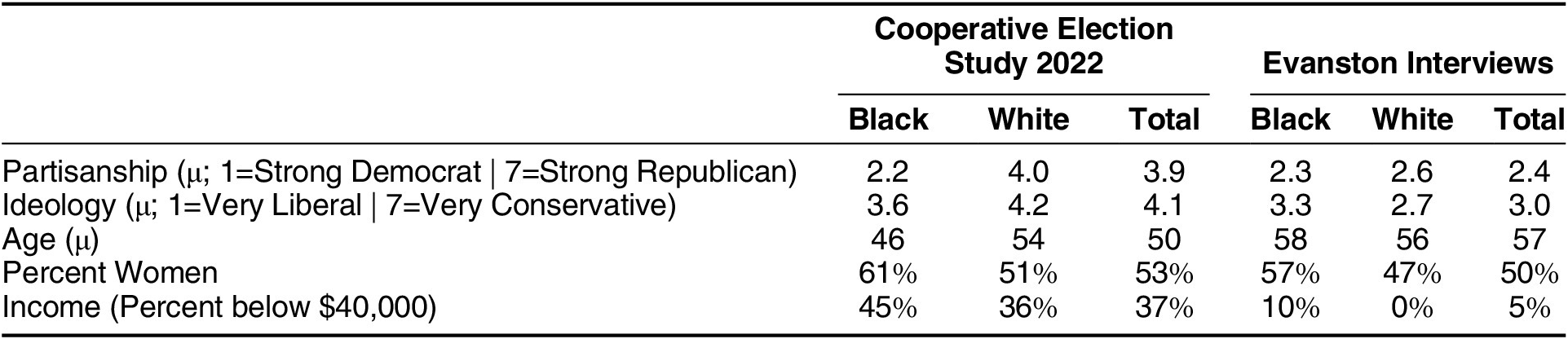
Table 2 Long description
The table compares two datasets: Cooperative Election Study (C E S) 2022 and Evanston Interviews. Each dataset is broken down into Black, White, and Total columns.
* Partisanship (mean mu; 1 equals Strong Democrat, 7 equals Strong Republican): C E S 2022 shows Black 2.2, White 4.0, Total 3.9. Evanston Interviews show Black 2.3, White 2.6, Total 2.4.
* Ideology (mean mu; 1 equals Very Liberal, 7 equals Very Conservative): C E S 2022 shows Black 3.6, White 4.2, Total 4.1. Evanston Interviews show Black 3.3, White 2.7, Total 3.0.
* Age (mean mu): C E S 2022 shows Black 46, White 54, Total 50. Evanston Interviews show Black 58, White 56, Total 57.
* Percent Women: C E S 2022 shows Black 61 percent, White 51 percent, Total 53 percent. Evanston Interviews show Black 57 percent, White 47 percent, Total 50 percent.
* Income (Percent below $40,000): C E S 2022 shows Black 45 percent, White 36 percent, Total 37 percent. Evanston Interviews show Black 10 percent, White 0 percent, Total 5 percent.
Again, our interviews highlight a link between historical knowledge and support for specific policy attributes. As a first step, we provide descriptive data on levels of pre-existing familiarity with “40 acres and a mule” in the CES sample. Respondents were asked the following: “Certain phrases hold historical significance in the United States, such as ‘Life, liberty, and the pursuit of happiness.’ Other phrases are less commonly known. How familiar are you with the following statement? ‘40 acres and a mule’” (1=Not at all familiar | 5=Extremely Familiar). While a single survey question is admittedly a rough proxy for racialized trends in political knowledge, distributions from this question suggest that similar processes of political socialization may occur nationally.
In fact, there are significant differences between the levels of familiarity about true reparations—“40 acres and a mule”—across racial and partisan groups. Figure 1 plots respondents’ race on the x-axis, with their familiarity with the phrase on the y-axis.Footnote
13 Black respondents (
$ \overline{x} $
 = 0.665) express greater familiarity with “40 acres and a mule” compared to White respondents (
$ \overline{x} $
= 0.665) express greater familiarity with “40 acres and a mule” compared to White respondents (
$ \overline{x} $
 = 0.430; p < 0.001). Figure 2 presents results across partisanship. Democrats had the highest knowledge of reparations (
$ \overline{x} $
= 0.430; p < 0.001). Figure 2 presents results across partisanship. Democrats had the highest knowledge of reparations (
$ \overline{x} $
 = 0.527) relative to both Independents (
$ \overline{x} $
= 0.527) relative to both Independents (
$ \overline{x} $
 = 0.479) and Republicans (
$ \overline{x} $
= 0.479) and Republicans (
$ \overline{x} $
 = 0. 359). All differences are statistically significant at p < 0.001 level.
Familiarity with “40 Acres and a Mule” by Partisanship

Similar trends emerge when we examine distributions of pre-existing familiarity with “40 acres and a mule” across racial and partisan subgroups. As demonstrated by figure 3, White Democrats (
$ \overline{x} $
 = 0.480) possess greater familiarity than White Republicans (
$ \overline{x} $
= 0.480) possess greater familiarity than White Republicans (
$ \overline{x} $
 = 0.355; p < 0.001), and Black Democrats (
$ \overline{x} $
= 0.355; p < 0.001), and Black Democrats (
$ \overline{x} $
 = 0.697) express higher rates of reparations knowledge relative to Black Republicans (
$ \overline{x} $
= 0.697) express higher rates of reparations knowledge relative to Black Republicans (
$ \overline{x} $
 = 0.500; p < 0.001). Finally, Black Democrats possess greater familiarity with the phrase relative to White Democrats (p < 0.001) and Black Republicans more than White Republicans (p < 0.001). It is important to keep these trends in mind when considering the broader processes animating the conjoint results.
Familiarity with “40 Acres and a Mule” between Black and White Partisans

Figure 3 Long description
The y-axis is labeled Mean Familiarity with 40 acres and a mule, ranging from 0.00 to 1.00 in increments of 0.25. The x-axis is labeled Respondent's Partisanship with two categories: Democrat and Republican. A legend at the bottom indicates that light gray bars represent White respondents and dark gray bars represent Black respondents. Each bar includes a vertical error bar representing the confidence interval.
* Democrat group: The White respondent bar reaches approximately 0.48. The Black respondent bar is significantly higher, reaching approximately 0.70.
* Republican group: The White respondent bar reaches approximately 0.35. The Black respondent bar is higher, reaching approximately 0.50, though it has a wider error bar compared to the other categories.
Overall, Black respondents in both political groups demonstrate higher mean familiarity with the phrase than their White counterparts, with Black Democrats showing the highest overall familiarity.
We use a conjoint design to examine how the attributes of a policy observed in Evanston affect support in a national sample. Conjoint analyses are designed to identify the multidimensional preferences underlying a particular choice in the context of a survey experiment (Hainmueller et al. Reference Hainmueller, Hopkins and Yamamoto2014). Rather than asking respondents to directly rank preferences or creating a treatment condition for all possible combinations of preferences, conjoints measure respondents’ stated preference. In this case, we ask respondents to select one of two reparations-related policies with randomized attributes. Each respondent completed this task seven times. This approach reveals the attributes most important to respondents on average (Bansak et al. Reference Bansak, Hainmueller, Hopkins and Yamomoto2022). We alter the attributes of reparations policies to estimate which characteristics are most important to Americans, and subsequently, which proposals they are most likely to support.
Table 3 summarizes the attributes, generated from our interviews with Evanstonians, tested in our design: 1) type of reparations-related policy; 2) recipient eligibility; 3) the modality of the policy; 4) spending amount; 5) funding source; and 6) and necessary tax increase (see Druckman Reference Druckman2022, 101-103 on motivating conjoint attributes). The levels associated with each attribute were generated using our interview data as well as other real-world reparations policy proposals. Each of the levels included in the amount attribute come from three different reparations policies currently in place or being considered—$10,000 college scholarships paid through Georgetown University’s Reconciliation Fund, $25,000 housing grants in Evanston, and $50,000 payments (funded by the Bush Foundation) for descendants of slavery residing in Minnesota and the Dakotas (Miller Thomas and Korte Reference Taylor and Korte2023; DePass Reference DePass2023; Svlurga Reference Svrluga2023).Footnote 14 The levels for tax increase were generated in reference to Evanston’s three percent recreational cannabis tax. Some features were only shown conditional upon other features. For instance, if the proposal was framed as a formal apology, the modality was always “No monetary compensation” with no dollar amount paid. Moreover, if the funding source was private donations, no tax increase would be needed.
Conjoint design, example, and dependent variable
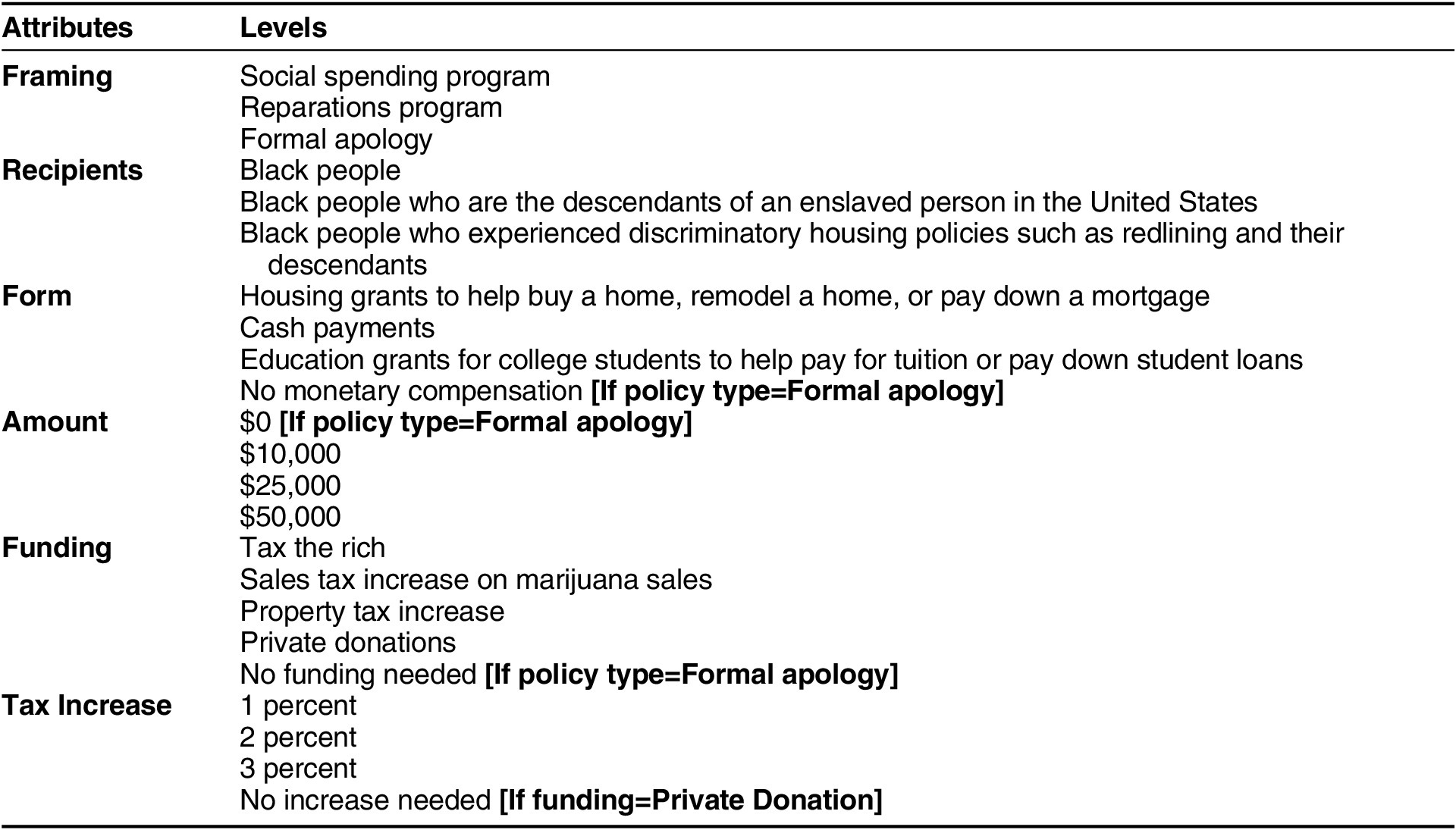
Table 3 Long description
The table consists of two columns: Attributes and Levels.
* Framing: Levels include Social spending program, Reparations program, and Formal apology.
* Recipients: Levels include Black people; Black people who are the descendants of an enslaved person in the United States; and Black people who experienced discriminatory housing policies such as redlining and their descendants.
* Form: Levels include Housing grants to help buy a home, remodel a home, or pay down a mortgage; Cash payments; Education grants for college students to help pay for tuition or pay down student loans; and No monetary compensation (only if policy type is Formal apology).
* Amount: Levels include $0 (only if policy type is Formal apology), $10,000, $25,000, and $50,000.
* Funding: Levels include Tax the rich, Sales tax increase on marijuana sales, Property tax increase, Private donations, and No funding needed (only if policy type is Formal apology).
* Tax Increase: Levels include 1 percent, 2 percent, 3 percent, and No increase needed (only if funding is Private Donation).
Note: During the review process, we were made aware of the xenophobic origins of the word “marijuana.” While discussing the results, we use the term “cannabis,” but have left “marijuana” in the figures since this is the language seen by survey respondents.
Table 4 presents an example of one conjoint task. Respondents were shown two proposals and asked, “In your opinion, which of the two policies is best?” Respondents repeated this task—picking between two proposals—seven times.
Example conjoint

Table 4 Long description
The table consists of three columns: Attribute, Policy 1, and Policy 2.
* Policy Type: Policy 1 is a Social spending program; Policy 2 is a Formal apology.
* Recipients: Both policies target Black people who are the descendants of an enslaved person in the United States.
* Modality: Policy 1 offers Housing grants to help buy a home, remodel a home, or pay down a mortgage; Policy 2 offers No monetary compensation.
* Amount: Policy 1 is valued at $25,000; Policy 2 is $0.
* Funding: Policy 1 is funded by a Sales tax increase on marijuana sales; Policy 2 requires No funding needed.
* Tax Increase: Policy 1 involves a 1 percent increase; Policy 2 requires No increase needed.
The final row is labeled Outcome and asks: In your opinion, which of the two policies is best? Options provided are Policy 1 or Policy 2.
We report marginal means to capture the “level of favorability toward profiles that have a particular feature level, ignoring all other features” (Leeper, Hobolt, and Tilley Reference Leeper, Hobolt and Tilley2020, 209). Marginal means tend to offer an easier interpretation of findings relative to average marginal component effects (AMCE), especially when there is no clear or theoretical baseline and when comparing subpopulations.Footnote 15 Since this design was forced-choice between two profiles, the baseline mean for the null hypotheses is 0.5, or “as good as random.” Stated preferences, therefore, are those choices statistically distinguishable from 0.5 with the marginal mean corresponding to the probability a given attribute level is selected. Attributes selected at rates higher than 0.5 are preferred while those below 0.5 were not preferred. Moreover, since all variables are standardized from zero to one and the marginal means are presented on a scale between zero and one, all of the marginal means represent the relative substantive effect sizes. Additionally, we also compare the differences in mean between key subgroups—Black and White respondents and between partisans. Any negative number in the difference in marginal means implies that the subtrahend was larger than the minuend—the referent group. One issue with conjoint analyses is the number of hypotheses tested in a given conjoint design can lead to false positives (Liu and Shiraito, Reference Liu and Shiraito2023). As such, we present results adjusting for multiple comparisons.Footnote 16 We present the figures in the article with corresponding tables with ASh correction in appendix B. All p-values presented are two-tailed.
We test our Evanston-generated hypotheses across three categories: differences across racial groups (Hypothesis 1 , Hypothesis 5 , Hypothesis 6 ), differences across partisanship (Hypothesis 2 , Hypothesis 3 , Hypothesis 4 ), and the role of historical appeals (Hypothesis 7 ). We find attitudes about reparations policies differ among White and Black Americans. White Americans are significantly more likely to favor policies that avoid invoking the language of reparations and provide no compensation for Black Americans. White Democrats’ preferences of reparations-related policies are slightly more aligned with Black Americans’ preferences, regardless of their partisanship. However, there is still a substantive gap between the reparations-related policies that White Democrats support relative to Black Americans. Part of this gap is due to the differences in political socialization between White Americans—including White Democrats—ncluding and Black Americans, revealing the complexity in the symbolic versus substantive aims of these policies.
The differences we report on support for reparations-related policies by racial and partisan lines are consistent with previous public opinion polls on support for reparations. However, although these polls show us public opinion trends, they cannot address why Evanston passed the ordinance it did, why the policy looked the way that it did, and why White Evanstonians were most supportive of the policy. Although Evanston is not representative of the country at large, the results from our national sample shows striking similarities among partisans and across race with what we find in our interviews. White Democrats support proposals aimed at redressing historic injustices against Black Americans, but the make-up of those policies is more limited in scope relative to the policies Black Americans support. This offers an important caveat to the trends showing increased support for reparations, particularly among White Democrats. While they may express support for these policies, they prefer those that offer fewer material benefits.
Which Policy Characteristics Drive Support for Reparations across Racial Groups?
Our results suggest that Black and White Americans think differently about reparations policies (Hypothesis 1
, Hypothesis 5
, and Hypothesis 6
). Consistent with Hypothesis 1
, figure 4 shows Black respondents, compared to White respondents, are less likely to select proposals framed as formal apologies relative to reparations or social spending programs. Specifically, the probability that Black respondents select policies labeled formal apologies (
$ \overline{x} $
 = 0.286, p < 0.001) is significantly lower than that of White respondents (
$ \overline{x} $
= 0.286, p < 0.001) is significantly lower than that of White respondents (
$ \overline{x} $
 = 0.605, p < 0.001). Black respondents are least likely to select formal apology policies while White respondents are most likely to select this option. The difference between these means is highly significant (difference in
$ \overline{x} $
= 0.605, p < 0.001). Black respondents are least likely to select formal apology policies while White respondents are most likely to select this option. The difference between these means is highly significant (difference in
$ \overline{x} $
 = 0.314, p < 0.001); White respondents are more likely to select formal apologies relative to Black respondents, all else constant. This is also in line with Hypothesis 5
which states that Whites will be more supportive of no monetary compensation and no increase in taxes relative to Black respondents (difference in
$ \overline{x} $
= 0.314, p < 0.001); White respondents are more likely to select formal apologies relative to Black respondents, all else constant. This is also in line with Hypothesis 5
which states that Whites will be more supportive of no monetary compensation and no increase in taxes relative to Black respondents (difference in
$ \overline{x} $
 = 0.314, p < 0.001). In line with one component of Hypothesis 6
, Black respondents were supportive of proposals which involved cash payments (
$ \overline{x} $
= 0.314, p < 0.001). In line with one component of Hypothesis 6
, Black respondents were supportive of proposals which involved cash payments (
$ \overline{x} $
 = 0.568, p < 0.01) whereas White respondents avoided such proposals (
$ \overline{x} $
= 0.568, p < 0.01) whereas White respondents avoided such proposals (
$ \overline{x} $
 = 0.367, p < 0.001). In fact, proposals with cash payments had the lowest relative substantive effect size among White respondents. The difference in marginal mean support for cash payments between Black and White respondents was also highly statistically significant (
$ \overline{x} $
= 0.367, p < 0.001). In fact, proposals with cash payments had the lowest relative substantive effect size among White respondents. The difference in marginal mean support for cash payments between Black and White respondents was also highly statistically significant (
$ \overline{x} $
 = –0.199, p < 0.001). Consistent with Hypothesis 5
and Hypothesis 6
, compensation amount affects policy support differently across racial groups. Higher compensation results in less support for the policy among White respondents. The opposite is true for Black respondents who report increased support for policies offering greater compensation amounts. Proposals with the highest amount given—$50,000—had the highest relative substantive effect among Black respondents. The difference in marginal means between Black and White respondents’ preferences was also highly statistically significant (p < 0.001). Among both Black and White residents, $10,000 payments were neither supported nor opposed. Unsurprisingly, the differences in means between Black and White recipients was also not statistically significant.
= –0.199, p < 0.001). Consistent with Hypothesis 5
and Hypothesis 6
, compensation amount affects policy support differently across racial groups. Higher compensation results in less support for the policy among White respondents. The opposite is true for Black respondents who report increased support for policies offering greater compensation amounts. Proposals with the highest amount given—$50,000—had the highest relative substantive effect among Black respondents. The difference in marginal means between Black and White respondents’ preferences was also highly statistically significant (p < 0.001). Among both Black and White residents, $10,000 payments were neither supported nor opposed. Unsurprisingly, the differences in means between Black and White recipients was also not statistically significant.
Support for Reparations-Related Policies by Race

Figure 4 Long description
A dot plot with error bars showing marginal means on an X-axis ranging from 0.3 to 0.7. A vertical reference line is at 0.5. Data is split by Respondent's Race: Black (dark purple) and White (light green).
* Type: For Reparations program, Black support is near 0.6, White support is near 0.45. For Social spending program, Black support is near 0.58, White support is near 0.47. For Formal apology, Black support is near 0.28, White support is near 0.6.
* Recipient: Support is similar for both races (near 0.5 to 0.53) for Black victims of housing discrimination, Black descendants of slavery, and Black people.
* Modality: For Cash payments, Black support is near 0.57, White support is near 0.37. For Education and Housing grants, support is similar near 0.5. For No monetary compensation, Black support is near 0.28, White support is near 0.6.
* Amount: For $50,000 and $25,000, Black support is high (0.6 to 0.63) while White support is low (0.4 to 0.44). For $0, Black support is near 0.28 and White support is near 0.6.
* Funding: Black respondents show higher support for Tax the rich (0.62) and Private donations (0.64). White support is highest for No funding needed (0.6).
* Tax: For 3 percent, 2 percent, and 1 percent increases, Black support remains high (0.56 to 0.61) while White support is lower (0.4 to 0.49). For No increase needed, Black support is near 0.28 and White support is near 0.6.
Moreover, consistent with part of Hypothesis 6
, Black respondents are more likely to select social spending proposals and reparations proposals overall and relative to White respondents. Black respondents were supportive of proposals that were social spending programs (
$ \overline{x} $
 = 0.580, p < 0.001) but White respondents are less likely to select social spending programs (
$ \overline{x} $
= 0.580, p < 0.001) but White respondents are less likely to select social spending programs (
$ \overline{x} $
 = 0.466, p < 0.001). The difference in marginal means between Black and White respondents selecting social spending programs is highly statistically significant (difference in
$ \overline{x} $
= 0.466, p < 0.001). The difference in marginal means between Black and White respondents selecting social spending programs is highly statistically significant (difference in
$ \overline{x} $
 = –0.113, p < 0.001). Black respondents are more likely to select reparations proposals (
$ \overline{x} $
= –0.113, p < 0.001). Black respondents are more likely to select reparations proposals (
$ \overline{x} $
 = 0.599, p < 0.001) while White respondents are less likely to select policies labeled “reparations” (
$ \overline{x} $
= 0.599, p < 0.001) while White respondents are less likely to select policies labeled “reparations” (
$ \overline{x} $
 = 0.445, p < 0.001). The difference in marginal means between Black and White respondents’ support for reparations programs is highly statistically significant (difference
$ \overline{x} $
= 0.445, p < 0.001). The difference in marginal means between Black and White respondents’ support for reparations programs is highly statistically significant (difference
$ \overline{x} $
 = –0.153, p < 0.001). Black respondents were more likely to select both social spending and reparations programs and less likely to select formal apologies both overall and relative to White respondents.
Contrary to one of the expectations presented within Hypothesis
6, Black respondents show little concern for the intended recipients specified within each proposal. They are substantively just as likely to select Black people, Black descendants of slavery, or Black victims of housing discrimination when considering their policy preferences. White respondents, on the other hand, do use intended recipients to differentiate between policies to some degree. Specifically, White respondents are less likely to support proposals earmarked for all Black people (
$ \overline{x} $
 = 0.463, p < 0.001) and are more likely to support proposals for Black victims of housing discrimination (
$ \overline{x} $
= 0.463, p < 0.001) and are more likely to support proposals for Black victims of housing discrimination (
$ \overline{x} $
 = 0.521, p < 0.01). White and Black respondents had similar preferences (i.e., no statistically significant differences between their respective means) on recipients who were Black descendants of slavery or victims of housing discrimination. However, relative to White respondents, Black respondents were more likely to select proposals in which the intended recipient was all Black people (
$ \overline{x} $
= 0.521, p < 0.01). White and Black respondents had similar preferences (i.e., no statistically significant differences between their respective means) on recipients who were Black descendants of slavery or victims of housing discrimination. However, relative to White respondents, Black respondents were more likely to select proposals in which the intended recipient was all Black people (
$ \overline{x} $
 = –0.025, p < 0.05).
In sum, the racial divide between Black and White respondents is stark. Black respondents, by and large, support a variety of reparations policies, including cash payments and social spending, while White respondents do not. Moreover, Black and White respondents differed in their preferences between each other on nearly every attribute at levels that are highly statistically significant. Consistent with existing public opinion data and the qualitative data collected in Evanston, White Americans, writ large, appear highly skeptical of reparations.
Which Policy Characteristics Drive Support for Reparations across Partisan Groups?
The results of the conjoint experiment suggest our findings about the importance of partisanship in our Evanston interviews hold in a national sample (Hypothesis 2
, Hypothesis 3
, and Hypothesis 4
), as shown in figure 5. We find full support for Hypothesis 2
. Democrats were the only partisan group less likely to select formal apology proposals whereas the largest relative substantive effect was among Republicans who selected formal apologies. Relative to both Independents (
$ \overline{x} $
 = 0.577, p < 0.001) and Republicans (
$ \overline{x} $
= 0.577, p < 0.001) and Republicans (
$ \overline{x} $
 = 0.763, p < 0.001), Democrats (
$ \overline{x} $
= 0.763, p < 0.001), Democrats (
$ \overline{x} $
 = 0.362, p < 0.001) were statistically significantly less likely to select formal apologies (difference in
$ \overline{x} $
= 0.362, p < 0.001) were statistically significantly less likely to select formal apologies (difference in
$ \overline{x} $
 = 0.211, p < 0.001 relative to Independents; difference in
$ \overline{x} $
= 0.211, p < 0.001 relative to Independents; difference in
$ \overline{x} $
 = 0.396, p < 0.001 relative to Republicans). Moreover, Democrats are the only partisan group more likely to select social spending (
$ \overline{x} $
= 0.396, p < 0.001 relative to Republicans). Moreover, Democrats are the only partisan group more likely to select social spending (
$ \overline{x} $
 = 0.544, p < 0.001) and reparations (
$ \overline{x} $
= 0.544, p < 0.001) and reparations (
$ \overline{x} $
 = 0.569, p < 0.001) proposals. Independents (
$ \overline{x} $
= 0.455, p < 0.001) and Republicans (
$ \overline{x} $
= 0.396, p < 0.001) were both less likely to select proposals labeled “reparations.” The difference in marginal means between Democrats who selected policies labeled “reparations” relative to Independents (difference in
$ \overline{x} $
= –0.113, p < 0.001) and Republicans (difference in
$ \overline{x} $
= 0.569, p < 0.001) proposals. Independents (
$ \overline{x} $
= 0.455, p < 0.001) and Republicans (
$ \overline{x} $
= 0.396, p < 0.001) were both less likely to select proposals labeled “reparations.” The difference in marginal means between Democrats who selected policies labeled “reparations” relative to Independents (difference in
$ \overline{x} $
= –0.113, p < 0.001) and Republicans (difference in
$ \overline{x} $
 = –0.193, p < 0.001) is highly statistically significant. Although Independents were ambivalent on proposals that were social spending programs, the difference in marginal mean between Democrats’ and Independents’ support for social spending programs is statistically significant (difference in
$ \overline{x} $
= –0.064, p < 0.001). Finally, Republicans did not support proposals that were social spending programs (
$ \overline{x} $
= –0.193, p < 0.001) is highly statistically significant. Although Independents were ambivalent on proposals that were social spending programs, the difference in marginal mean between Democrats’ and Independents’ support for social spending programs is statistically significant (difference in
$ \overline{x} $
= –0.064, p < 0.001). Finally, Republicans did not support proposals that were social spending programs (
$ \overline{x} $
 = 0.396, p < 0.001) and the difference between Democrats’ and Republicans’ support was also statistically significant (difference in
$ \overline{x} $
= 0.396, p < 0.001) and the difference between Democrats’ and Republicans’ support was also statistically significant (difference in
$ \overline{x} $
 = –0.147, p < 0.001). Democrats are much more willing to support reparations-related policies that convey material benefits to the recipients (reparations and social spending), whereas Republicans and Independents prefer policies that are cost neutral (formal apologies).
Support for Reparations-Related Policies by Party Identification

Figure 5 Long description
The horizontal axis represents Marginal Mean ranging from 0.4 to 0.8. A vertical reference line is set at 0.5. Data points are color-coded: purple for Democrat, blue for Independent, and light green for Republican. Each point includes a horizontal error bar representing confidence intervals.
* Type: For Reparations program, Democrats are highest at approximately 0.58, followed by Independents at 0.48 and Republicans at 0.38. For Social spending program, Democrats are at 0.55, Independents at 0.51, and Republicans at 0.41. For Formal apology, Republicans lead significantly at 0.77, followed by Independents at 0.58 and Democrats at 0.36.
* Recipient: Support for Black victims of housing discrimination, Black descendants of slavery, and Black people generally shows all three parties clustered closely between 0.45 and 0.55.
* Modality: Democrats show highest support for Education grants at 0.63 and Housing grants at 0.59. Republicans show highest support for No monetary compensation at 0.77, while their support for Cash payments is lowest at 0.32.
* Amount: For $50,000, $25,000, and $10,000, Democrats consistently show higher support around 0.55 to 0.58. For $0, Republicans show high support at 0.77.
* Funding: Democrats strongly favor Tax the rich at 0.64. Republicans favor No funding needed at 0.77.
* Tax: For 3 percent, 2 percent, and 1 percent tax increases, Democrats show higher support than Republicans. For No increase needed, Republicans show high support at 0.77.
Contrastingly, Republicans prefer formal apologies (
$ \overline{x} $
 = 0.763, p < 0.001) over both social spending programs (
$ \overline{x} $
= 0.763, p < 0.001) over both social spending programs (
$ \overline{x} $
 = 0.396, p < 0.001) and reparations (
$ \overline{x} $
= 0.396, p < 0.001) and reparations (
$ \overline{x} $
 = 0.374, p < 0.001), as specified by Hypothesis 4
. Independents are also more likely to support formal apologies, albeit to a lesser extent than Republicans (
$ \overline{x} $
= 0.374, p < 0.001), as specified by Hypothesis 4
. Independents are also more likely to support formal apologies, albeit to a lesser extent than Republicans (
$ \overline{x} $
 = 0.577, p < 0.001). Independents are also less likely to select reparations (
$ \overline{x} $
= 0.577, p < 0.001). Independents are also less likely to select reparations (
$ \overline{x} $
 = 0.455, p < 0.001) but selected proposals for social spending programs at random. The differences in Democrats’ preferences on proposals which are formal apologies, social spending programs, or policies labeled “reparations” relative to both Independents and Republicans were highly statistically significant (p < 0.001 for all comparisons).
Consistent with Hypothesis 4
, Republicans are most supportive of proposals offering no monetary compensation (
$ \overline{x} $
 = 0.763, p < 0.001) and are least supportive of cash payment proposals (
$ \overline{x} $
= 0.763, p < 0.001) and are least supportive of cash payment proposals (
$ \overline{x} $
 = 0.290, p < 0.001), which was the attribute level with the smallest relative substantive effect size among partisans. They are also unsympathetic towards both education (
$ \overline{x} $
= 0.290, p < 0.001), which was the attribute level with the smallest relative substantive effect size among partisans. They are also unsympathetic towards both education (
$ \overline{x} $
 = 0.405, p < 0.001) and housing grants (
$ \overline{x} $
= 0.405, p < 0.001) and housing grants (
$ \overline{x} $
 = 0.454, p < 0.01). Independents follow a similar, yet less muted, pattern as Republicans. Political Independents are most supportive of no monetary compensation (
$ \overline{x} $
= 0.454, p < 0.01). Independents follow a similar, yet less muted, pattern as Republicans. Political Independents are most supportive of no monetary compensation (
$ \overline{x} $
 = 0.577, p < 0.001) and least supportive of cash payments (
$ \overline{x} $
= 0.577, p < 0.001) and least supportive of cash payments (
$ \overline{x} $
 = 0.403, p < 0.001), but indifferent towards both housing and education grants. One might expect the opposite pattern among Democrats. While Democrats are the least supportive of no monetary compensation (
$ \overline{x} $
= 0.403, p < 0.001), but indifferent towards both housing and education grants. One might expect the opposite pattern among Democrats. While Democrats are the least supportive of no monetary compensation (
$ \overline{x} $
 = 0.362, p < 0.001), they are indifferent toward proposals offering cash payments (
$ \overline{x} $
= 0.362, p < 0.001), they are indifferent toward proposals offering cash payments (
$ \overline{x} $
 = 0.482) opting instead to support proposals for education (
$ \overline{x} $
= 0.482) opting instead to support proposals for education (
$ \overline{x} $
 = 0.596, p < 0.001) or housing (
$ \overline{x} $
= 0.596, p < 0.001) or housing (
$ \overline{x} $
 = 0.589, p < 0.001) grants. The differences in Democrats’ preferences on proposals that are cash payments, education grants, or housing grants relative to both Independents and Republicans were highly statistically significant (p < 0.001 for all comparisons). As we saw in our interviews with Evanstonians, Democrats support reparations-related policies most when they do not provide cash payments.
Ultimately, Republicans report the strongest opposition to reparations or social spending programs regardless of the modality, the amount, and the funding source. Independents mostly follow Republican trends, albeit to a lesser degree. Democrats generally oppose proposals framed as formal apologies with no monetary compensation but also do not favor material benefits frequently proposed by Black residents of Evanston. Democrats oppose policy proposals intended for all Black people and are indifferent toward whether the proposals aim to assist either the Black descendants of slavery or Black victims of housing discrimination. They are also indifferent toward policy proposals promoting cash payments, $50,000 in compensation, or call for higher tax increases to fund the proposal. In other words, the Democrats included in the national sample favor a reparations policy that mirrors Evanston’s—a policy that Black Evanstonians are highly skeptical of. But to what extent do White Democrats differ from African Americans in their support for reparations?
Black respondents—regardless of partisanship—are statistically significantly less likely to select proposals that are formal apologies relative to White Democrats.Footnote
17 Recall, Black respondents are less likely to select proposals that are formal apologies (
$ \overline{x} $
 = 0.286, p < 0.001). White Democrats are also less likely to select formal apologies (
$ \overline{x} $
= 0.286, p < 0.001). White Democrats are also less likely to select formal apologies (
$ \overline{x} $
 = 0.396, p < 0.001). While formal apologies are each the attributes with the smallest relative substantive effect sizes among Black respondents and White Democrats, White Democrats are statistically significantly more likely to select formal apologies relative to Black respondents (difference in
$ \overline{x} $
= 0.396, p < 0.001). While formal apologies are each the attributes with the smallest relative substantive effect sizes among Black respondents and White Democrats, White Democrats are statistically significantly more likely to select formal apologies relative to Black respondents (difference in
$ \overline{x} $
 = 0.096, p < 0.01). Moreover, White Democrats are less likely to select proposals which are labeled “reparations” relative to Black respondents (difference in
$ \overline{x} $
= 0.096, p < 0.01). Moreover, White Democrats are less likely to select proposals which are labeled “reparations” relative to Black respondents (difference in
$ \overline{x} $
 = –0.049, p < 0.05). Both Black respondents and White Democrats are supportive of educational grants or housing grants, but Black respondents are also supportive of cash payments (
$ \overline{x} $
= –0.049, p < 0.05). Both Black respondents and White Democrats are supportive of educational grants or housing grants, but Black respondents are also supportive of cash payments (
$ \overline{x} $
 = 0.568, p < 0.01) whereas White Democrats do not support cash payments (
$ \overline{x} $
= 0.568, p < 0.01) whereas White Democrats do not support cash payments (
$ \overline{x} $
 = 0.452, p < 0.01) and these differences are statistically significant (difference in
$ \overline{x} $
= 0.452, p < 0.01) and these differences are statistically significant (difference in
$ \overline{x} $
 = –0.104, p < 0.001). Black respondents are also more likely to select policies which offer recipients $50,000 (
$ \overline{x} $
= –0.104, p < 0.001). Black respondents are also more likely to select policies which offer recipients $50,000 (
$ \overline{x} $
 = 0.630, p < 0.001), but White Democrats do not support nor oppose proposals that offer $50,000 to recipients. Moreover, the difference between how often Black respondents select $50,000 and White Democrats who select that option is statistically significant (difference in
$ \overline{x} $
= 0.630, p < 0.001), but White Democrats do not support nor oppose proposals that offer $50,000 to recipients. Moreover, the difference between how often Black respondents select $50,000 and White Democrats who select that option is statistically significant (difference in
$ \overline{x} $
 = –0.130, p < 0.001). Finally, White Democrats and Black respondents select proposals funded through cannabis sales tax or taxing the rich at similar rates, but Black respondents are more in favor of funding through private donations (
$ \overline{x} $
= –0.130, p < 0.001). Finally, White Democrats and Black respondents select proposals funded through cannabis sales tax or taxing the rich at similar rates, but Black respondents are more in favor of funding through private donations (
$ \overline{x} $
 = –0.081, p < 0.05) or property tax increases (
$ \overline{x} $
= –0.081, p < 0.05) or property tax increases (
$ \overline{x} $
 = –0.060, p < 0.05) relative to White Democrats. Interestingly, taxing the rich had among the largest substantive effect size, particularly among White Democrats. Finally, we are not able to reject the null of Hypothesis 3
; White Democrats were ambivalent towards proposals funded through cannabis sales tax increases.
= –0.060, p < 0.05) relative to White Democrats. Interestingly, taxing the rich had among the largest substantive effect size, particularly among White Democrats. Finally, we are not able to reject the null of Hypothesis 3
; White Democrats were ambivalent towards proposals funded through cannabis sales tax increases.
Overall, the results from figure 6 indicate that partisan effects are not driven by Black respondents alone. Moreover, the policies White Democrats support align more closely with the Evanston reparations policy: reparations (
$ \overline{x} $
 = 0.542, p < 0.01) or social spending programs (
$ \overline{x} $
= 0.542, p < 0.01) or social spending programs (
$ \overline{x} $
 = 0.544, p < 0.001) disbursed through education (
$ \overline{x} $
= 0.544, p < 0.001) disbursed through education (
$ \overline{x} $
 = 0.606, p < 0.001) or housing grants (
$ \overline{x} $
= 0.572, p < 0.001) but not cash payments (
$ \overline{x} $
= 0.606, p < 0.001) or housing grants (
$ \overline{x} $
= 0.572, p < 0.001) but not cash payments (
$ \overline{x} $
 = 0.452, p < 0.01). They support policies awarding $10,000 (
$ \overline{x} $
= 0.452, p < 0.01). They support policies awarding $10,000 (
$ \overline{x} $
 = 0.582, p < 0.001) or $25,000 (
$ \overline{x} $
= 0.582, p < 0.001) or $25,000 (
$ \overline{x} $
 = 0.565, p < 0.001) through a 1% (
$ \overline{x} $
= 0.565, p < 0.001) through a 1% (
$ \overline{x} $
 = 0.581, p < 0.001) or 2% (
$ \overline{x} $
= 0.581, p < 0.001) or 2% (
$ \overline{x} $
 = 0.549, p < 0.01) tax increase, preferably on the rich (
$ \overline{x} $
= 0.549, p < 0.01) tax increase, preferably on the rich (
$ \overline{x} $
 = 0.651). While White Democrats and Black respondents do align on many aspects of these proposals, overall Black respondents support greater material benefits relative to White Democrats.
Support for Reparations-Related Policies Among Black Respondents (any Party) and White Democrats

Figure 6 Long description
A coefficient plot with a horizontal X-axis labeled Marginal Mean ranging from 0.3 to 0.7. A vertical reference line is at 0.5. Data points represent marginal means with horizontal error bars. Dark purple points represent Black (Any Party) and light green points represent White Democrats.
* Type: For reparations and social spending programs, both groups are above 0.5, with Black respondents showing higher support. For formal apology, Black respondents are near 0.3 while White Democrats are near 0.4.
* Recipient: Support is clustered around 0.5 for both groups across all sub-categories (housing discrimination victims, descendants of slavery, and Black people).
* Modality: Black respondents show higher support for cash payments (above 0.5) compared to White Democrats (below 0.5). Both groups support education and housing grants. No monetary compensation shows low support, near 0.3 for Black respondents and 0.4 for White Democrats.
* Amount: Support increases with dollar amounts ($10,000 to $50,000) for both groups. $0 amount shows the lowest support, mirroring the ‘no monetary compensation’ trend.
* Funding: ‘Tax the rich’ has the highest support (above 0.6). Private donations show a large gap, with Black respondents much more supportive (above 0.6) than White Democrats (near 0.53).
* Tax: Support for tax increases (1, 2, or 3 percent) is generally above 0.5 for both groups, while ‘No increase needed’ shows the lowest support, consistent with previous ‘no action’ baselines.
Do Historical Appeals Bolster Support for Reparations-Related Policies?
Finally, we assess whether the historical appeals contribute to higher levels of support for reparations-related policies within a national sample. Before participating in the conjoint tasks, each participant was randomly assigned to one of three conditions, summarized in table 5.
Historical appeals conditions

Table 5 Long description
The table consists of three columns titled Control, Holocaust, and Japanese Internment.
All three columns share a common base text: Local governments throughout the United States are currently exploring what it would look like to give reparations to Black people to make amends for past wrongs. Some opponents of reparations suggest that the government should instead increase social spending for those impacted by discriminatory policies rather than trying to ‘re-write the past.’ Others say governments should make formal apologies for past wrongs, but do not support reparations.
The Holocaust column adds a specific appeal: One supporter of reparations said, ‘If Germany did it for Jews after the Holocaust, then we can do the same for Black Americans.’
The Japanese Internment column adds a specific appeal: One supporter of reparations said, ‘If the U. S. federal government did it for Japanese Americans sent to internment camps during World War I I, then we can do the same for Black Americans.’
Contrary to the expectations laid out in Hypothesis 7 , we see no evidence that discussing reparations for Black Americans alongside other examples of reparations influences overall levels of support. The differences in either historic appeal, relative to no appeal, are all not statistically significant. The results presented in figure 7 largely mirror the main effects for the entire sample (refer to figure 1C). Historical appeals may matter in the context of an extended policy debate such as Evanston’s but we do not find evidence that historical appeals affect support for reparations-related policies in the survey. Political socialization, as opposed to brief exposure to a single piece of historical information, is an extended process. Thus, isolated references to historical instances in which other marginalized groups were financially compensated for an injustice (e.g., Japanese internment and the Holocaust) may be insufficient for building support for reparations for slavery across constituencies. Rather, as our interviews suggest, beliefs about reparations are grounded in prolonged socialization experiences within families, schools, and community organizations. Table 6 provides a summary of our findings. We find support for all hypotheses except Hypothesis 3 and Hypothesis 7 .
Support for Reparations-Related Policies by Historical Appeal

Figure 7 Long description
The plot uses a horizontal axis for Marginal Mean ranging from 0.4 to 0.6, with a vertical reference line at 0.5. Data points represent means with horizontal error bars indicating confidence intervals. The legend at the bottom identifies three conditions: No historic appeal (dark purple), Holocaust appeal (blue-grey), and Japanese Internment appeal (light green).
* Type: Formal apology has the highest support, exceeding 0.5 for all conditions. Social spending and Reparations programs hover near or below 0.5.
* Recipient: Support is highest for Black victims of housing discrimination and Black descendants of slavery, while support for Black people generally is lower, particularly in the No historic appeal condition.
* Modality: Education and housing grants show higher support than cash payments. No monetary compensation has the highest support, especially for the No historic appeal condition.
* Amount: Support decreases as the dollar amount increases. $0 and $10,000 are above 0.5, while $50,000 is the lowest, falling below 0.45.
* Funding: No funding needed and Tax the rich show the highest support. Marijuana sales tax and Property tax increases show the lowest support, falling below 0.5.
* Tax: No increase needed and a 1 percent tax have the highest support. Support decreases as the tax percentage increases to 2 and 3 percent.
Summary of significant findings by hypothesis

Table 6 Long description
The table consists of two columns: Hypotheses and Statistically Significant.
* H 1: Regarding Black people favoring economic benefits and White people favoring cost-neutral apologies. Result: Confirmed with a checkmark.
* H 2: Regarding Democrats favoring economic benefits and Republicans or Independents favoring cost-neutral apologies. Result: Confirmed with a checkmark.
* H 3: Regarding White Democrats favoring cannabis tax funding and Black people favoring taxes on the wealthy. Result: n.s. (not statistically significant).
* H 4: Regarding Republicans being more likely to support a formal apology than Democrats or Independents. Result: Confirmed with a checkmark.
* H 5: Regarding White people being more likely to support a formal apology than Black people. Result: Confirmed with a checkmark.
* H 6 a: Regarding preferences for universal versus subset-specific reparations based on race. Result: n.s. (not statistically significant).
* H 6 b: Regarding Black people favoring higher compensation amounts and White people favoring lower amounts. Result: Confirmed with a checkmark.
* H 7: Regarding increased support when other historical reparations programs are mentioned. Result: n.s. (not statistically significant).
Note: ✓= Confirmed hypothesis.
n.s.= Not statistically significant.
Conclusion
Debates over reparations date back to the nation’s founding. However, proposals to compensate Black Americans for the multigenerational harm caused by slavery and other racist policies have been sidelined for decades. This study is one of the first to unravel the heterogeneity of the reparations-related policies and highlights how individuals weigh symbolic considerations (e.g., affective commitments to racial justice) alongside material benefits. Black Americans and White Democrats may seem similarly aligned in support for “reparations,” broadly defined. However, their support is substantively different. This reveals an added complexity when examining the relationship between what a policy symbolizes and what it is intended to accomplish. We suggest that racialized processes of political socialization may explain a puzzling development within municipal-level reparations debates: White Democrats express higher rates of support for reparations–related policies such as Evanston’s than Black people the intended beneficiaries of the policy.
Throughout this article, we show that people’s lived experiences guide them to different “facts” that they use to evaluate specific attributes of reparations-related policies. We do so by leveraging both qualitative interviews with residents of Evanston and a survey distributed to a large national sample. White Americans, who are less familiar with Sherman’s “40 acres and mule” prefer formal apologies that provide no compensation to Black Americans for past discrimination. Contrastingly, African Americans, those who are most familiar with the phrase, are more likely to support reparations-related policies including cash payments, housing grants, and educational funds that maximize material benefits for Black people, regardless of whether they are called reparations or social spending programs.
Partisanship also plays a significant role in shaping reparations-related policy preferences. Consistent with existing public opinion data, Republicans in both our interviews and the national sample are strongly opposed to reparations-related policies. These individuals are less familiar with “40 acres and mule” and instead draw from notions of the “protestant ethic” when framing their opposition to reparations-related policies. Contrastingly, Democrats—and particularly White Democrats—are supportive of reparations-related policies mirroring Evanston’s: housing grants made available to Black residents who can show they or their ancestors were the victims of redlining. Again, political socialization may help to explain why this is the case.
In our interviews, many White Democrats acknowledged that they had only recently learned about the history of “40 acres and a mule” and justified their support for Evanston’s reparations ordinance as a necessary response to the racial justice protests of 2020. Even White Democrats who grew up learning about reparations and were willing to admit that Evanston’s reparations housing grants were not true reparations strongly supported the policy. In other words, for White Democrats, the policy was symbolic of their—and the city’s—commitments to racial justice, even if the policy itself was not true reparations.
While one might view Evanston as a blueprint for how to build reparations support nationwide, it is also important to remember that both the Black people we interviewed and surveyed—including Black Republicans—supported direct cash payments. In other words, Evanston raises an important question regarding the future of the reparations debate in the United States: Who are reparations-related policies actually for? Black people or White Democrats? Our conversations with Evanstonians—substantiated by a national sample—suggest the preferences of White Democrats are driving the conversation.
For generations, “40 acres and a mule” has served as a rallying cry; one that seeks to hold the United States government accountable for the legacy of slavery and generations of anti-Black racism by providing significant material benefits to African Americans. While it is laudable that the affective commitments of White Democrats have translated into growing support for reparations-related policies, it is important to recognize that the aspirational political pursuit of true reparations is deeply rooted within the Black counterpublic. As municipalities consider reparations-related policy initiatives, the case of Evanston highlights an irony within the public policy process: the city implemented a reparations-related policy that is more popular among White Democrats than Black beneficiaries. At a moment when political cleavages between White Democrats and African Americans appear to be growing, scholars and policymakers should be attuned to the tensions between the symbolic and material considerations of justice-oriented policies, and how these tensions manifest across racial and partisan lines. Afterall, sidelining the concerns of a policy’s intended beneficiaries—Black Americans in this instance—risks losing important expertise from key stakeholders and an opportunity to make the public policy process more equitable.
Data replication
Data replication sets are available in Harvard Dataverse at: https://doi.org/10.7910/DVN/4R0ZP7.
Supplementary material
To view supplementary material for this article, please visit http://doi.org/10.1017/S1537592725000751.
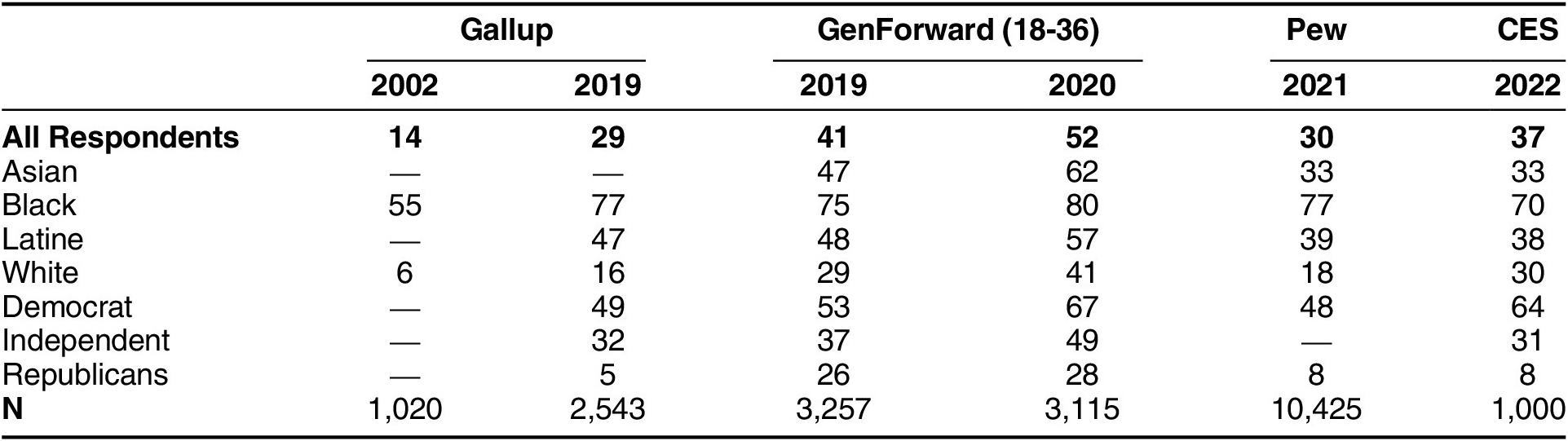
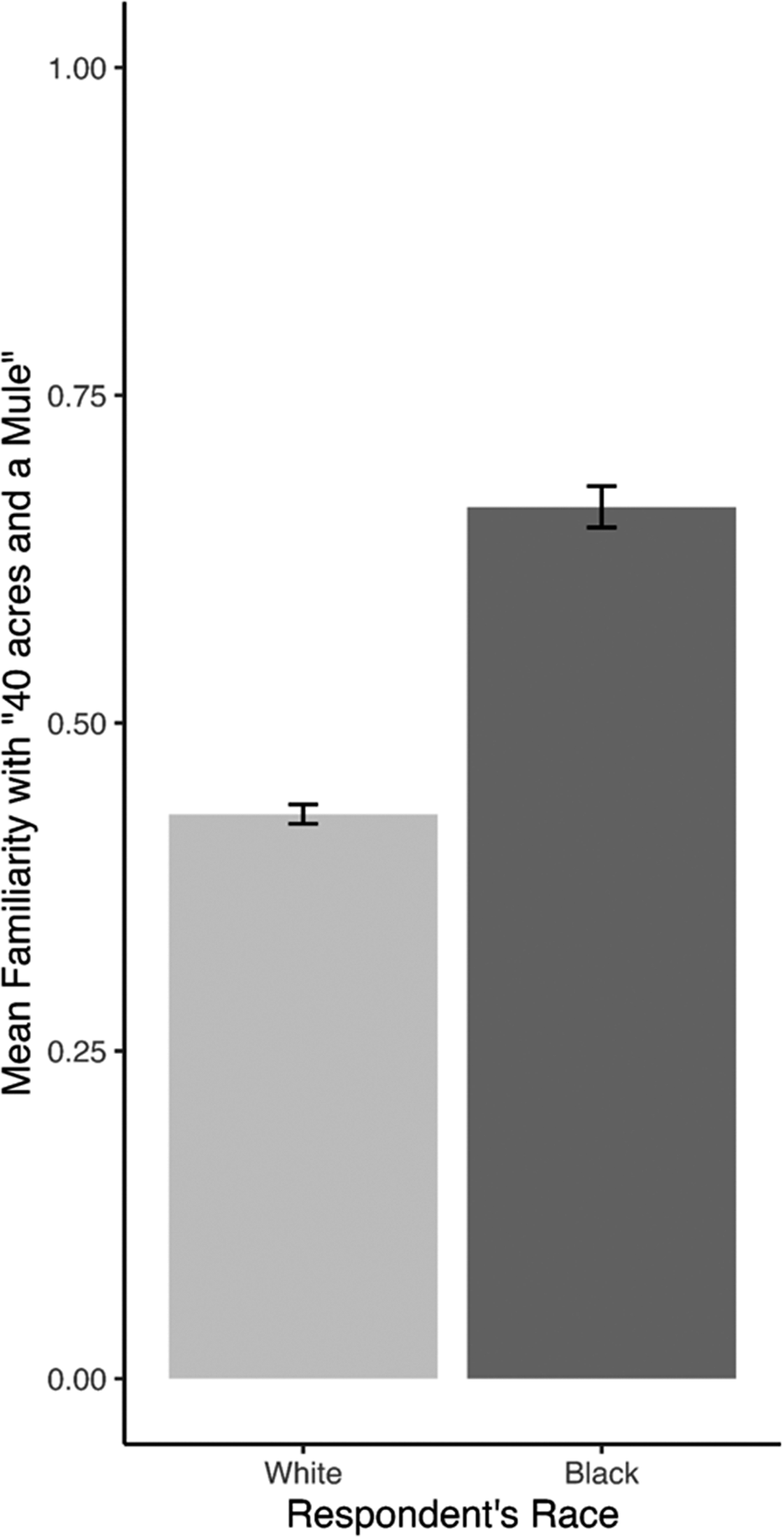
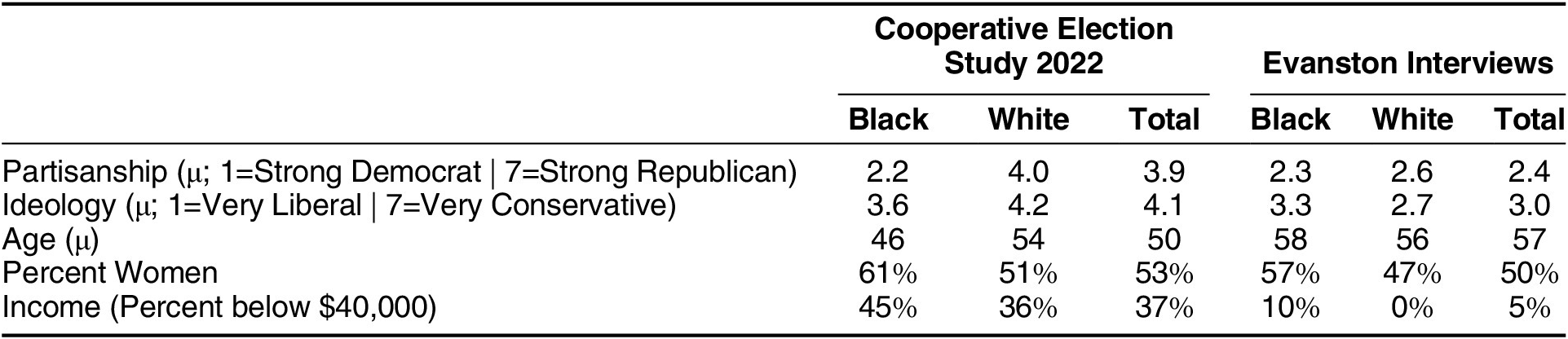
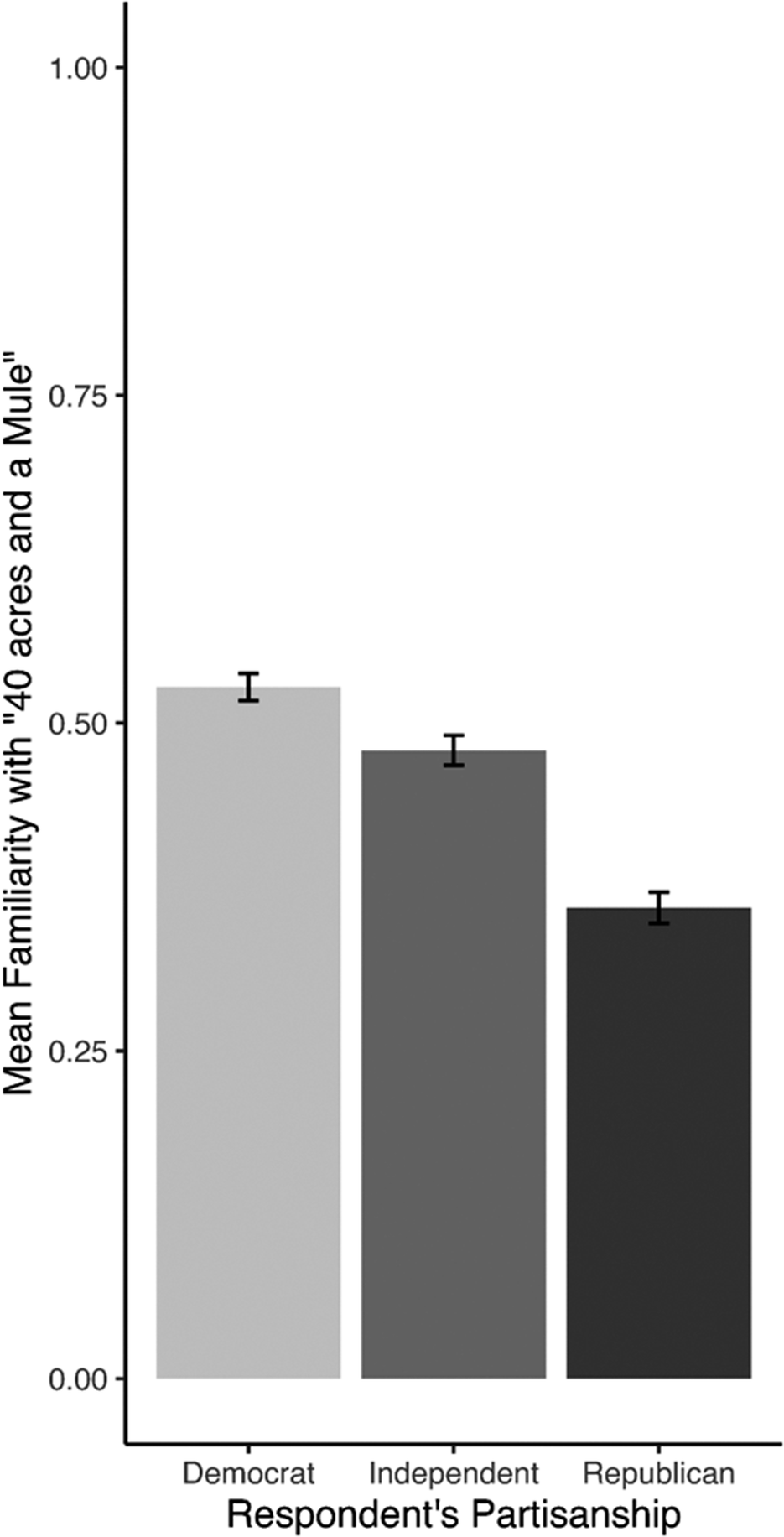
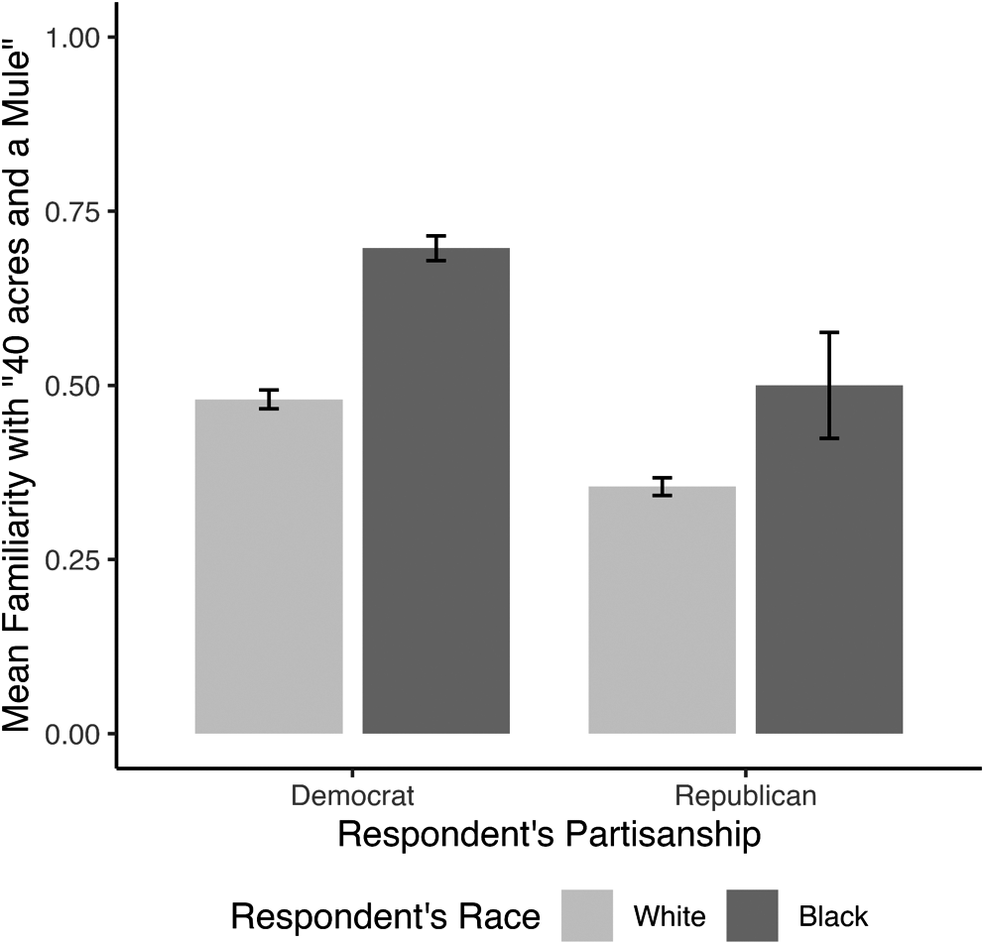
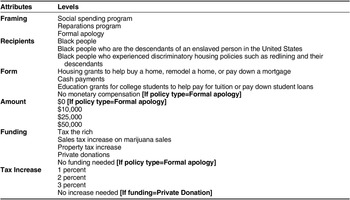
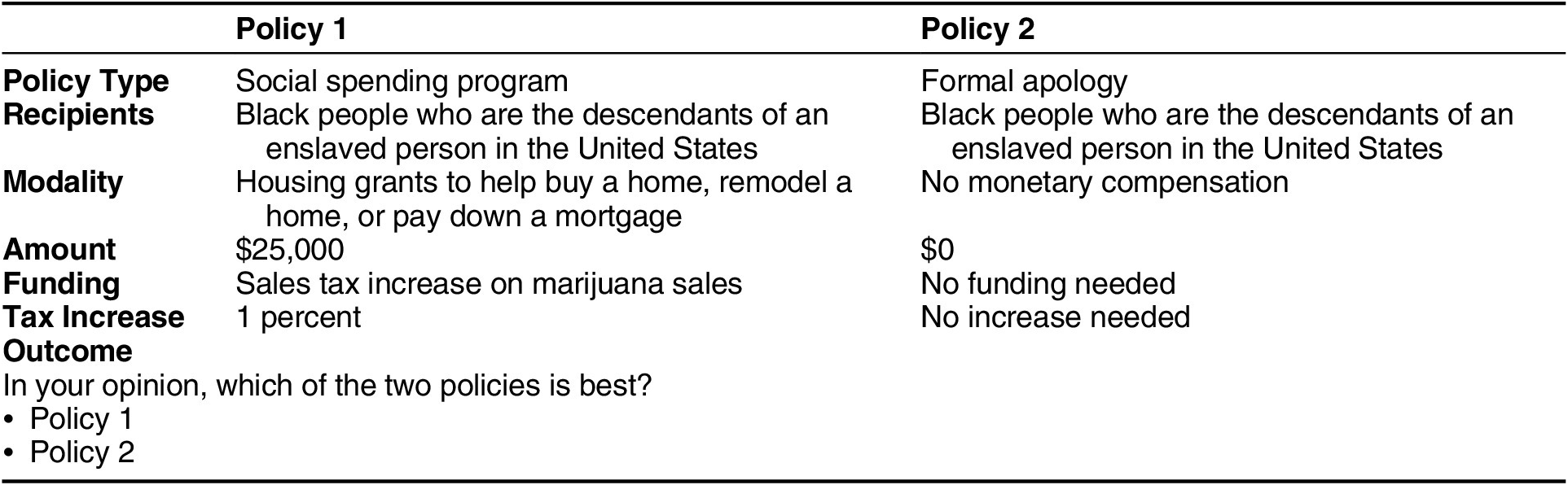

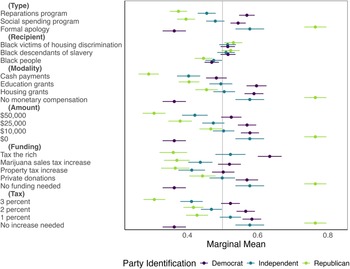

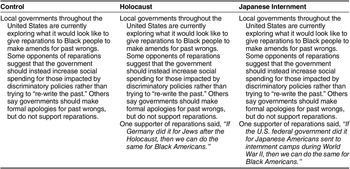

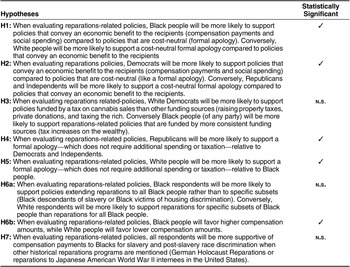


 Open access

