

In 2002 and 2004, the University of Toronto conducted excavations in Wadi Ziqlab, northern Jordan, where survey in 2000 had discovered Neolithic artefacts (Maher & Reference BanningBanning, 2001). These produced evidence for Late Neolithic occupation with some artefacts recalling the Wadi Rabah culture in northern and western Israel, and strong similarities to material from the project's earlier excavations at Tabaqat al-Bûma (c. 5800-5200 cal BC), a site some 7km upstream. The new fieldwork contributes to better understanding of this underrepresented aspect of Jordan's late prehistory, when farmsteads appear for the first time to have supplemented aggregated villages (Reference BanningBanning, 2001; Banning et al. 1994).
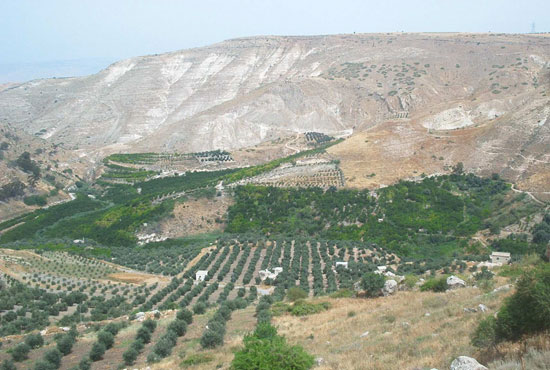
The new site, al-Basatîn (WZ 135) occupies a broad, sloping terrace about 25m ASL and 1km downstream from another Neolithic site, Tell Rakan (WZ 120, Banning & Najjar, 2000), in part of the valley where numerous springs feed a perennial stream with several waterfalls (figure 1). Neolithic artefacts also occur on and in a lower terrace (WZ 140, c. 0m ASL). Both terraces exhibit some artefacts that are probably Palaeolithic, Epipalaeolithic, Pre-Pottery Neolithic B, and Roman or Byzantine, while the upper one has architecture and artefacts of Chalcolithic and Early Bronze Ages.
View of Wadi Ziqlab, looking north. Al-Basatîn is on the oval terrace at lower centre.

The excavation began in 2002 with one-metre squares on both terraces, in an attempt to determine the extent and character of Neolithic deposits. This showed that most of the Neolithic material on the lower terrace was mixed with Epipalaeolithic or later artefacts in colluvium that probably derived from the upper one. There, discovery of a context with two large, basalt grinding stones and many Neolithic artefacts, including adzes and sickle elements, focussed further excavation nearby.
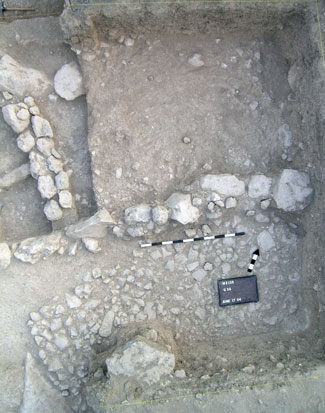
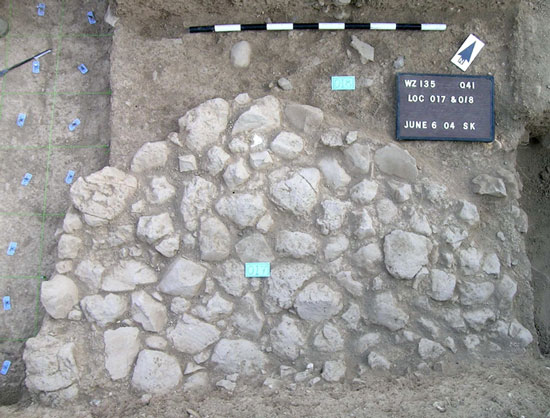
Neolithic architecture includes single-leaf stone walls but also several cobble-paved floors or platforms without walls (figures 2 and 3), perhaps for storage or for use with tent structures. There are also stone and clay storage features. Many superimposed outdoor surfaces were densely covered with Neolithic flakes, tools, sherds, and animal bone.
Late Neolithic architecture at al-Basatîn, including a subrectangular cobble floor in Area Q36.

Late Neolithic cobbled platform in Area Q41 at al-Basatîn.

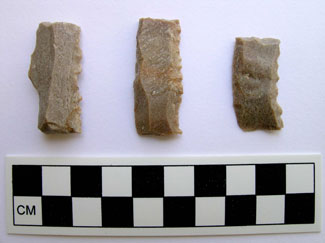
Artefacts from al-Basatîn include sickle elements with steep retouch on one edge and both truncated ends, and usually deep denticulations on the other edge (figure 4). Although these are often closely similar to ones previously found at Tabaqat al-Bûma, there is a greater tendency to make sickle elements from blades here than at the latter site. Several unfinished sickle elements provide evidence for their production sequence. There are also flint axes or adzes, cortical scrapers, and ground stone tools, such as stone vessels, handstones, pestles, a grinding slab, and a mortar. Cores are predominantly amorphous.
Three denticulated sickle elements from al-Basatîn.

The Late Neolithic pottery is crudely constructed and poorly fired, yet sometimes shows expressive surface treatment. Two bases from the lower terrace show pebble impressions on the bottom, and some sherds from both terraces have combed surfaces. Others show traces of red slip, and a few have black burnished surfaces. Where form is evident, cups, bowls and small jars appear common.
The fauna include Bos sp. (cow or aurochs), Sus scrofa (pig or wild boar), and Ovis sp./Capra sp. (sheep/goat), while Cervus sp. (deer) and Gazella sp. (gazelle) that occur on the lower WZ 140 terrace are not certainly associated with the Late Neolithic. A pierced bivalve pendant and sawn cowry shell indicate contacts as far away as the Red Sea and Mediterranean.
Al-Basatîn provides new evidence for the poorly-known sixth millennium cal BC in the southern Levant while also showing cultural connections between Wadi Rabah sites in Israel and the previously unique site of Tabaqat al-Bûma (WZ 200) farther east in Wadi Ziqlab (Banning et al. 1994; Blackham 1996).