

Introduction
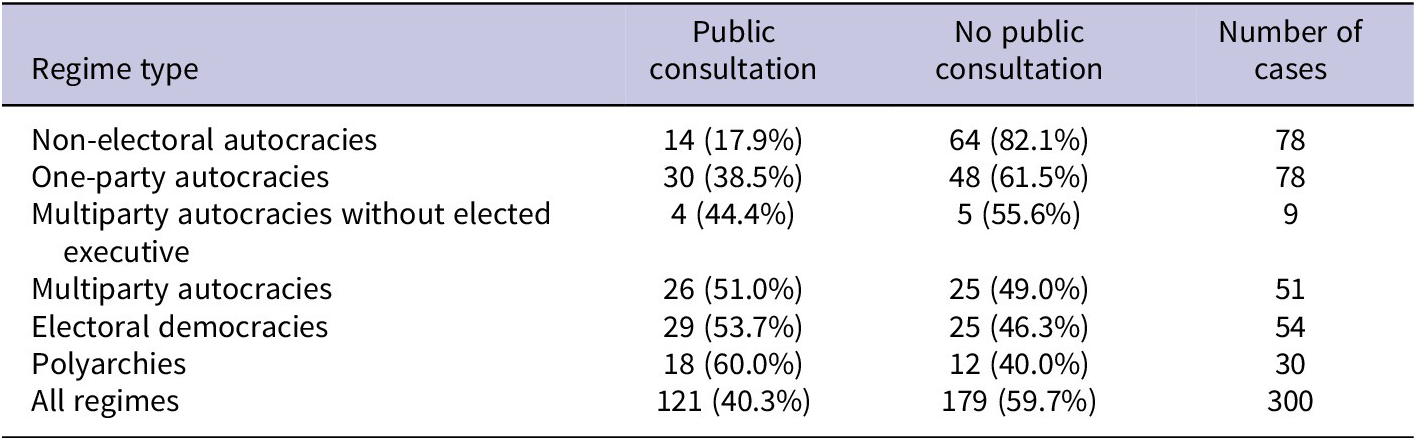
Public consultation has become part of the zeitgeist of modern constitution-making (Cruz et al. Reference Cruz2023; Eisenstadt, LeVan, and Maboudi Reference Eisenstadt, LeVan and Maboudi2017; Hirschl and Hudson Reference Hirschl and Hudson2024; Hudson Reference Hudson2021). More than two out of every five constitutions promulgated from 1974 to 2021 (40.3%) were prepared through processes that incorporated some form of public consultation, whereby regimes gathered citizen preferences through debates, hearings, written submissions, and other channels. Citizens have provided drafters massive amounts of input across a myriad of contexts – from the most repressive dictatorships to the most advanced democracies. A drafting commission formed by the Communist Party of Cuba in 2018 generated over 10,000 proposals from nationwide meetings in which 78% of the population reportedly participated (Backer, Sapio, and Korman Reference Backer, Sapio and Korman2019). The 1988 Constituent Assembly of Brazil received 72,719 handwritten postcards containing citizens’ suggestions for the new constitution (Hudson Reference Hudson2021). Federal officials in Switzerland collected more than 3,000 questionnaires on constitutional principles and rights distributed alongside the draft text under review in 1995–96 (Bigler Reference Bigler2013). These cases provide but a glimpse of the vast, and growing, landscape of public consultation in constitutional design.
Beyond referenda, which often involve binary choices, non-electoral forms of public consultation allow for a deeper exchange of ideas and preferences between citizens and elites. As Landemore (Reference Landemore2020b, 180) observes, “the democratic will now is no longer supposed to exercise itself indirectly and at the end of the process but from the start, throughout, and in more direct ways.” The conventional wisdom is that creating more space for public consultation results in national charters that are perceived as more legitimate (Brandt et al. Reference Brandt2011; Hart Reference Hart2003, Reference Hart and Miller2010). This “diffuse support” (Easton Reference Easton1975) is crucial for an incipient constitution to command voluntary obedience from citizens and elites and thus achieve proper functioning. Indeed, an emerging literature finds a link, albeit more complex than conventionally presumed, between public participation and constitutional legitimacy (Maboudi and Nadi Reference Maboudi and Nadi2022), even in the absence of impact on the actual text (Hirschl and Hudson Reference Hirschl and Hudson2024; Hudson Reference Hudson2021). The question of legitimacy, however, has been largely examined from the citizen perspective in existing research.
Amassing, analyzing, and interpreting the constitutional preferences of the general public would seem a Herculean task for drafters. Public consultation has the potential to incur significant costs such as polarization (Ghai and Galli Reference Ghai, Galli, Large and Sisk2006), ethnic tension (Bannon Reference Bannon2007), and civil conflict (Widner Reference Widner2005), among other contingencies. However, the rewards may be massive. If the constitution is perceived as legitimate, leaders can enhance their authority and credibility among domestic and international audiences, particularly in light of the emergence of participatory constitution-making as an international norm (Eisenstadt, LeVan, and Maboudi Reference Eisenstadt, LeVan and Maboudi2015; Franck and Thiruvengadam Reference Franck, Thiruvengadam and Miller2010). Public consultation thus has a clear strategic value for some political elites. Why, then, do some regimes choose to consult the public when drafting new constitutions? Who, among political elites, stands to benefit from the legitimacy-conferring power of public consultation?
To address this puzzle, I introduce an original dataset of public consultations organized during constitution-making processes from 1974 to 2021 (n = 300). I propose a unifying conceptual framework for public consultation to account for the relevant actors and the wide range of mechanisms used to gather public input. On a descriptive level, I map the temporal and geographical variation in the use of public consultation in constitution-making since the third wave of democracy. I also examine differences across regime types (Skaaning, Gerring, and Bartuseviˇcius Reference Skaaning, Gerring and Bartusevičius2015). These data present a significant step toward systematic cross-national analysis, allowing me to explore why political elites across various contexts gather public input when drafting a new constitutional text.
Theoretically, I understand public consultation not as a device for ascertaining the public’s “true” preferences, but as a way for elites to build consensus for their preferred project. Particular groups should have distinct incentives to instrumentalize public consultation and its benefits to legitimate the new constitutional order. I identify the circumstances under which political elites adopt public consultation as part of their strategic toolkit. I underscore that public consultation is used across regime types in response to shifts in the balance of power as a way for certain political elites to consolidate their authority in the post-constituent period. In democracies, factional majorities that enjoy a greater degree of control over the constitution-making process, and newcomer elites and coalitions in particular, drive the use of public consultation to legitimate a break from the constitutional status quo. In autocracies, governing coalitions, particularly those whose right to rule depends on successful performance, and those who enjoy a greater degree of party institutionalization, push for public consultation to preserve favorable power-sharing arrangements.
Public consultation represents a high-stakes gambit for democratic elites – an opportunity for new political leaders to reshape political competition in their favor by capitalizing on citizen discontent. In contrast, for autocratic leaders, it serves as a calculated survival strategy – a means for the governing coalition to mitigate elite threats to regime stability by providing a veneer of responsiveness to public demands. To test these hypotheses, I leverage my data and provide empirical evidence from a series of logistic regressions. My study suggests the need to move beyond treating regimes as monolithic entities, and instead more closely examine the relationship between participatory procedures in constitution-making and competition among political elites.
Consultation in global perspective
The growing popularity of consultation mechanisms such as written submissions, face-to-face meetings, and questionnaires or surveys (Houlihan and Bisarya Reference Houlihan and Bisarya2021) is suggestive of a turn toward more substantive forms of public participation in constitutional design (Landemore Reference Landemore2020b). Constitutional design is considered more participatory “if the mass public has more opportunities by which to both oversee and engage in the process” (Elkins, Ginsburg, and Blount Reference Elkins, Ginsburg and Blount2008, 363). Participatory mechanisms fit into one of two categories: (1) indirect participation (“representation”), when citizens select delegates to formulate and adopt constitutional provisions on their behalf; and (2) direct participation (“consultation”), when citizens engage firsthand with constitutional ideas.
When mapping the landscape of participatory mechanisms in constitution-making, however, public consultation has been treated as an afterthought. For some, public participation and consultation are coterminous (Samuels Reference Samuels2006). Others understand public consultation in expansive terms, as a way of “gathering the views of the mass public” (Hudson Reference Hudson2021, 18) or the “submission of suggestions for change” (Choudhry and Tushnet Reference Choudhry and Tushnet2020, 174). These conceptual schemas leave unclear which mechanisms are best classified as forms of public consultation, and what subtypes exist in the representation-consultation dichotomy. Figure 1 conceptualizes some of these subtypes, distinguishing between electoral and non-electoral forms of public consultation.
Conceptual Map of Public Participation in Constitution-Making.
Note: The red dashed line indicates my area of focus: non-electoral forms of public consultation.
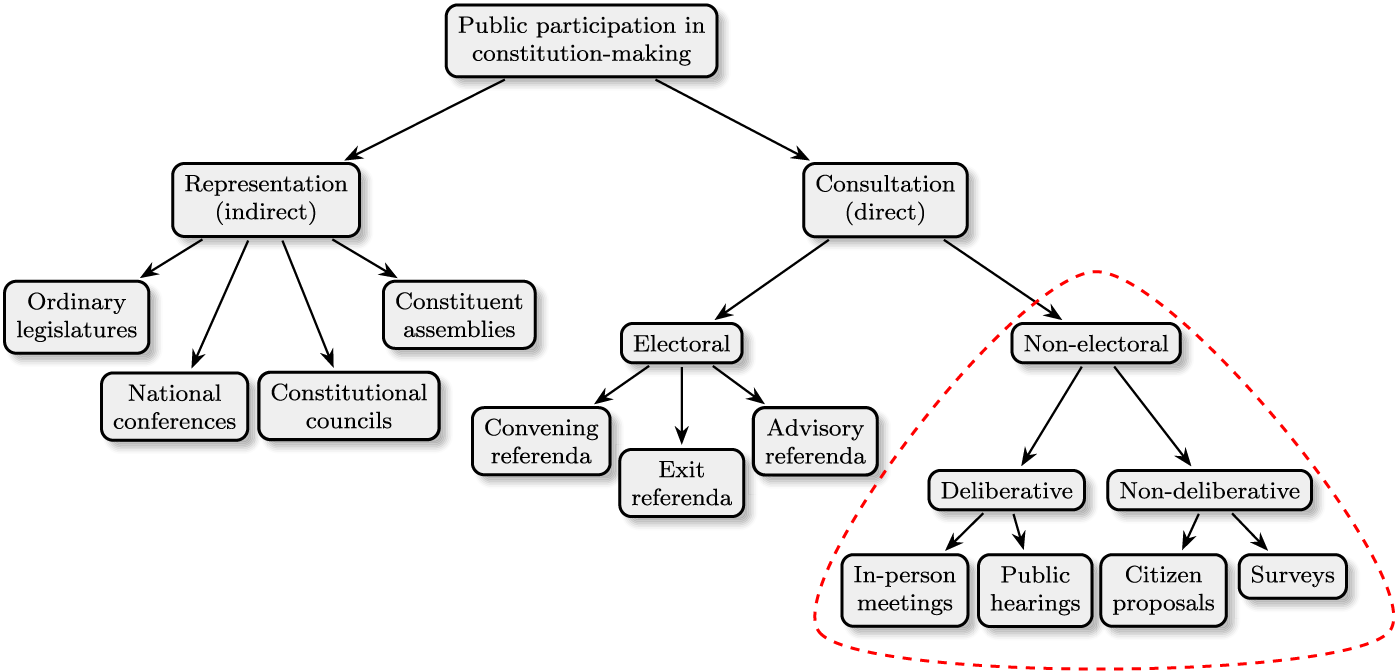
Through non-electoral forms of public consultation, citizens provide input on a range of constitutional matters (see Cruz et al. Reference Cruz2023), rather than simply casting a vote in a referendum. These substantive mechanisms of public consultation may reveal more about the relationship between governors and the governed during constituent moments, as “elites reveal their deliberations to a larger public in an effort to solicit feedback and corroboration” (Samuels Reference Samuels2006; Blount Reference Blount, Ginsburg and Dixon2011, 46). Consequently, the non-electoral subtype of public consultation is the focus of my study (hereafter referred to simply as “public consultation”). It is important to note, however, that electoral and non-electoral forms of public consultation are not mutually exclusive; any or all variants can coexist in the same process of constitutional replacement.
Public consultation can occur during any of the four phases of constitution-making: (1) initiation; (2) agenda-setting and procedural design; (3) drafting, deliberation, and decision making; and (4) approval (Elster Reference Elster1995). The level of public participation throughout the process is often thought to assume the shape of an hourglass (Elster Reference Elster2012; Russell Reference Russell2004). According to this model, constitution-making opens up to public input at the beginning (agenda-setting) stage, narrows closer to the drafting stage, and re-opens at the end (approval) stage (Hudson Reference Hudson2021).
This analogy, however, is complicated by the reality of public consultation. The general public may be consulted “before development of [an] initial text or prior to final revision and ratification,” or at both stages (Widner Reference Widner2007, 1529). The inflection point is the publication of a draft constitutional text. In fact, nearly 50% of public consultations have occurred after a draft text was released to the public (see Table 2)—that is, during the drafting, deliberation, and decision-making phase when public input should be constrained according to the hourglass model.
Public consultation in constitutional design is best likened to a sink faucet. In essence, public input is channeled through two streams: (1) before the publication of a draft constitutional text (pre-draft consultation); and (2) after the release of a draft (post-draft consultation). The relative proportion of these channels varies, with some cases involving a single channel and others involving both (dual-stage consultation). Drafters control the faucet handles, determining not only when to engage the public, but also the overall volume of input. This analogy underscores the key role that political elites play in shaping the sequence and flow of public consultation during constitutional replacement. I thus define a public consultation in constitution-making as the following:
The formal solicitation of input from the general public (individual citizens and/or groups) by a country’s standing regimeFootnote 1 before the publication of a draft constitutional text, after the release of a draft, or at both the pre- and post-draft stages.
My definition is intentionally minimalist to account for the relevant actors and the range of mechanisms used to gather public input globally. Below, I present examples of public consultations that have assumed each of these three forms across various countries.
Pre-draft consultation
Pre-draft public consultation is typically presented as a form of collective brainstorming to determine public priorities. By definition, these exercises are organized prior to the publication of a draft constitutional text at the agenda-setting stage or the early drafting stage. Accordingly, they may be more dynamic and suffer from less inertia, compared to post-draft consultations where inter-elite bargaining has settled contentious issues (Blount Reference Blount, Ginsburg and Dixon2011, 46). Alternatively, Horowitz (Reference Horowitz2021, 180–181) suggests that consulting the public at the beginning of the process, without a concrete set of proposals, can be distracting for decision-making. Regardless, pre-draft consultation emphasizes information gathering, specifically citizens’ preferences and expectations for the constitution-making process (Banks Reference Banks2007; Haberfeld Reference Haberfeld and Lemont2006). Relevant mechanisms include citizen proposals, public hearings, and surveys or questionnaires, among others. There may be some overlap between these mechanisms, or they may occur in phases.
In Madagascar (2009–10), for example, the public consultation campaign unfolded in three stages. Initially, the constitutional committee welcomed proposals from diverse segments of Malagasy society, receiving over 300 submissions from civil society organizations, political parties, former leaders, and ordinary citizens. Preliminary dialogues were then conducted across the nation’s 119 districts. Finally, a national conference was organized, during which the committee administered a 138-question survey (International IDEA 2022). The Gambia (2017–18) held traditional gatherings called bantaba to serve as deliberative fora and opportunities for in-person surveys to collect relevant public input for decision-making during drafting (Houlihan and Bisarya Reference Houlihan and Bisarya2021; Perfect Reference Perfect2022). In Fiji (1987–90), a constitutional commission organized public hearings in town halls and courtrooms across the archipelago to gather more than 800 written and oral submissions from individual citizens and civic groups (Cottrell and Ghai Reference Cottrell, Ghai and Miller2010; Lal Reference Lal1997; Saati Reference Saati2020). Although these pre-draft consultations were designed, in theory, to influence the agenda of drafters, it is uncertain to what extent the data were later used during decision-making. Indeed, the degree to which drafters analyze these data is a background question here, and part of my ongoing research.
Post-draft consultation
Post-draft consultation is commonly described as a feedback channel for validating and refining the proposed constitutional text. The draft gives the exercise, and the input generated, a sense of direction. Some have compared post-draft consultation to polling (Blount Reference Blount, Ginsburg and Dixon2011; Fishkin Reference Fishkin2009), even suggesting that these processes amount to “participation without power” (Banks Reference Banks2007, 1045). Practitioners such as Brandt et al. (Reference Brandt2011, 29) note that post-draft consultations allow citizens “to react to a concrete and comprehensive set of proposals, and assess with some confidence its significance for them and the state.” There is also evidence from some cases that post-draft consultation resulted in revisions to the draft (Manning Reference Manning2002; Ofcansky and Berry Reference Ofcansky and Berry1993; Saati Reference Saati2017; Walker and Williams Reference Walker and Williams2010). The mechanisms used to consult the public at this stage often resemble those employed during pre-draft consultations. There is, however, a greater reliance on written comments and submissions as well as in-person discussions, specifically in reaction to the draft.
The post-draft consultation held throughout the Soviet Union in 1977 is noteworthy. Upon publication of the draft text, the Brezhnev regime organized an all-Union “public debate” in which thousands of letters containing proposals or suggestions were published in state media and some 1.5 million meetings to discuss the draft held at all levels of Soviet society (Schneider Reference Schneider1979; Sharlet Reference Sharlet1977). The process, not without criticisms, mirrored the discussion of the 1936 Stalinist constitution, one of the earliest public consultations on record (Getty Reference Getty1991; Lomb Reference Lomb2018; Velikanova Reference Velikanova2018). Post-draft consultations have assumed a similar form under other communist regimes such as Cuba (1976, 2019), China (1982), and Vietnam (1980, 1992) (Khng Reference Khng1992; Klein Reference Klein1978; Saich Reference Saich1983), but these exercises are also relevant for democracies. Following Montenegro’s proclamation of independence, for instance, the Parliament hastily prepared a draft text, and the April–May 2007 public debate generated more than 400 pages of opinions, suggestions, and proposals (Banović Reference Banović, Fruhstorfer and Hein2016). Of course, post-draft consultation can be more comprehensive. In 2014, the Constituent Assembly of Tunisia organized a multi-stage process through which 200 proposals were collected from civil society organizations in a two-day Open Dialogue. More than 2,100 oral and written suggestions were amassed through 44 meetings, 18 of which were held abroad, as part of a National Dialogue, and another 200 were gathered online (Maboudi Reference Maboudi2020). Although these consultations are anchored, in some sense, to the draft at hand, they do not necessarily have less thematic breadth or depth.
Dual-stage consultation
Lastly, dual-stage consultation engages stakeholders both before and after the drafting of a proposal. Public input thus flows through both streams, to return to the faucet analogy. Because these exercises encompass both pre- and post-draft consultation mechanisms, they tend to be more logistically intensive for regimes to organize. Moreover, they grant citizens an opportunity to “judge to what extent their views have been taken seriously” during the constitution-making process (Brandt et al. Reference Brandt2011, 29). Such openings for public evaluation of the process may present unwanted risks for drafters, or even greater legitimacy benefits. The precise calculus is even more challenging than single-stream consultation, which may help explain why dual-stage consultation is relatively rare (see Table 2).
The constitutional experience of Nicaragua (1985–87), during the war between the Sandinista regime and the right-wing Contras, is an elucidating example. Following the formation of the National Constituent Assembly, a constitutional commission held public hearings for three months to gather proposals from political parties and social groups concerning the content of the new constitution (Morgan Reference Morgan1990; Reding Reference Reding1987; Walker and Williams Reference Walker and Williams2010). After publishing the draft, the Constituent Assembly organized seventy-five town hall meetings (“cabildos abiertos”) across the country to solicit reactions and recommendations between May and June 1986. Approximately 100,000 citizens from a broad cross-section of society participated in these forums, contributing 2,500 presentations and 1,800 written comments (Morgan Reference Morgan1990; Reding Reference Reding1987; Walker and Williams Reference Walker and Williams2010).
Even more extensive was the dual-stage consultation organized by the provisional government of Eritrea in the early years of independence (1994–97), before the country became one of the most repressive dictatorships in the world. Prior to the drafting of the text, a constitutional commission organized some 157 public debates across the country, and 16 debates abroad, in which approximately 158,000 Eritreans discussed a number of constitutional topics and proposals under consideration (Rosen Reference Rosen1999).Footnote 2 Upon publication of the draft text, the commission distributed thousands of copies in local vernaculars and organized another round of public debates at home and abroad, in which more than 400,000 Eritreans participated (Rosen Reference Rosen1999; Selassie Reference Selassie1997, Reference Selassie1998).
From a global perspective, public consultation in constitution-making is remarkably diverse, though there are parallels in terms of the form and function of the mechanisms employed across contexts. As shown by the examples above, many regimes have gone to great lengths to gather public input when drafting a new social contract.
Public consultation in constitution-making dataset
To explore the range and causes of public consultation, I have developed an original, cross-national dataset of all public consultations in constitution-making processes since the beginning of the third wave of democracy in 1974 to 2021 – the Public Consultation in Constitution-Making Dataset (PCCD). The central goal of the dataset was to move beyond reliance on case studies and take a step toward systematic, comparative analysis of constitutional design procedures related to public consultation. The underlying logic is that “design choices matter” (Elkins, Ginsburg, and Melton Reference Elkins, Ginsburg and Melton2009b, 10), as do the procedural decisions that shape them.
Each observation is a process of constitutional replacement that resulted in a new constitution for an independent state, along with the year in which the text entered into force. I include only new and interim national constitutions, excluding any other constitutional events (e.g., amendments). I thus record only those processes that inaugurate a new constitutional system – the period during which a constitution is in force before it is replaced or suspended. New and interim constitutions are identified using the “Chronology of Constitutional Events” dataset created by Elkins, Ginsburg, and Melton (Reference Elkins, Ginsburg and Melton2009a). My sample includes a total of 300 observations (n = 300),Footnote 3 encompassing constitution-making processes from 1974 to 2021.
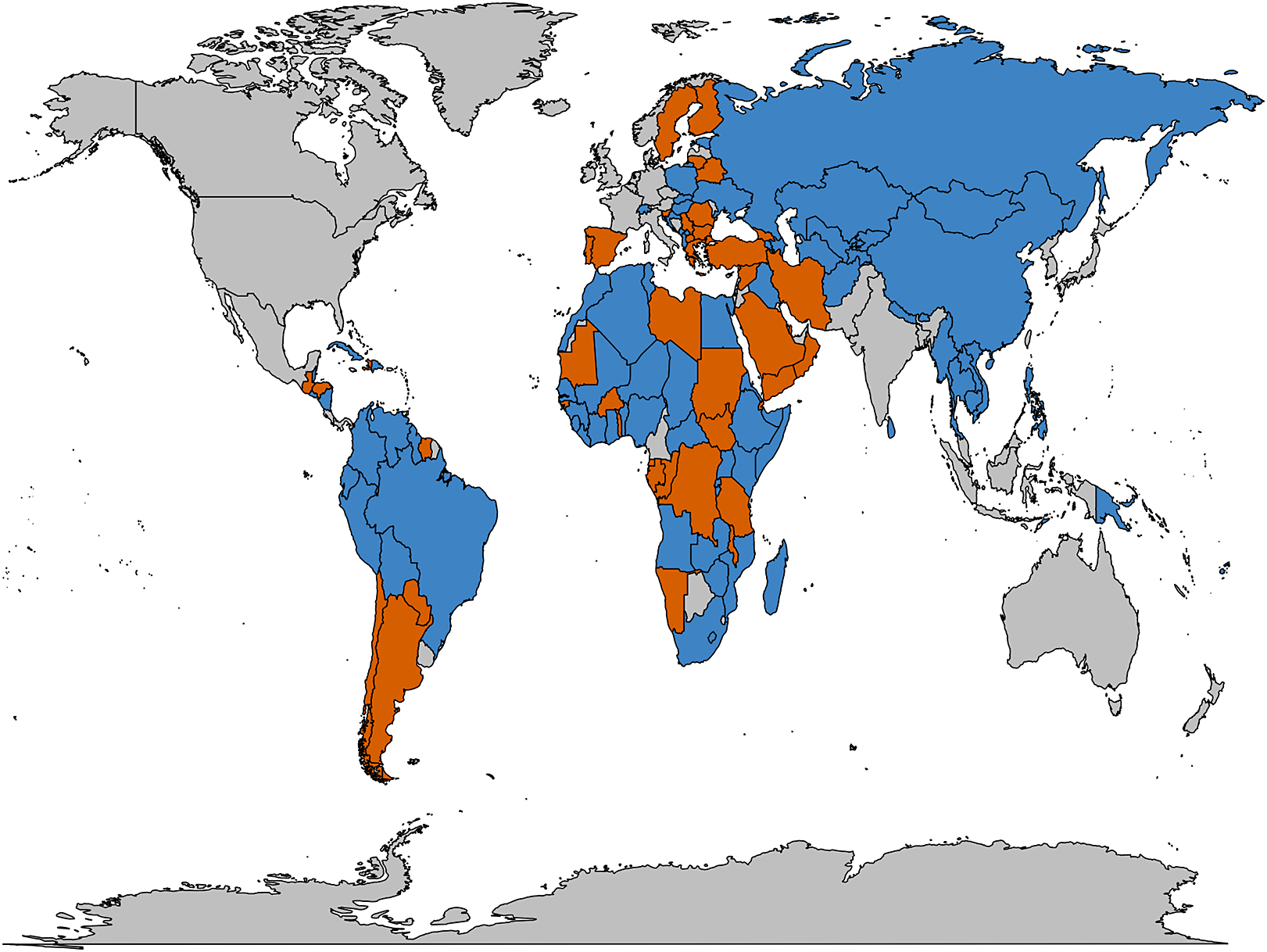
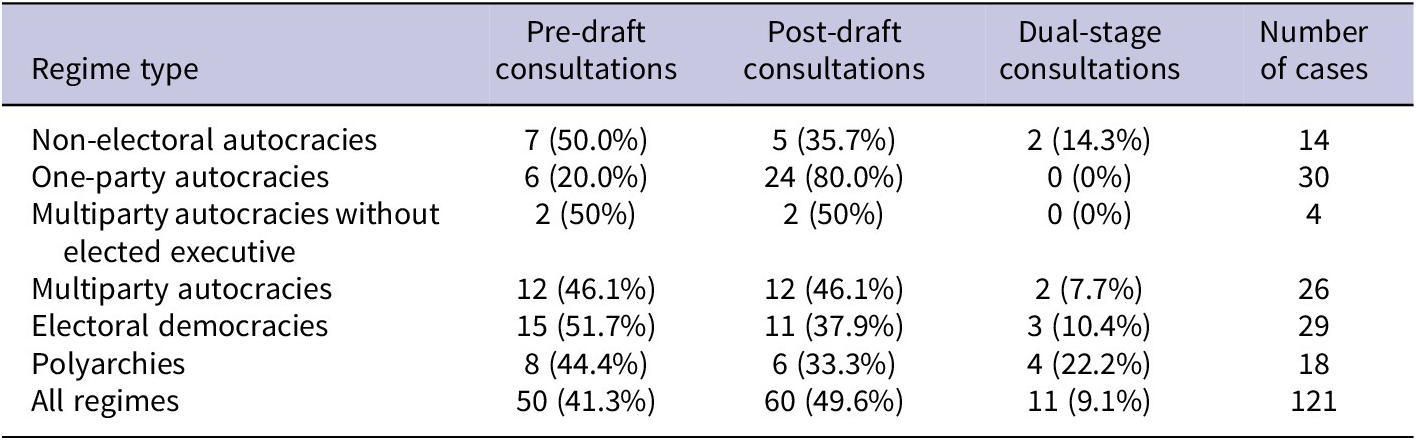
During this period, 121 constitutions (40.3%) were prepared via processes that included public consultation. Figure 2 shows a world map of public consultations. These exercises are the most common in Asia and the Pacific, where 56.6% of constitution-making processes (30) included some consultation mechanism(s). Western Europe and North America have had only one case out of eight, Switzerland, where the public was consulted during the drawing up of the constitution. The proportion of constitution-making processes that incorporate public consultation also has been steadily increasing by decade. During the 1980s, that number was roughly 36%, but by the 2010s, it had increased to well over half (58%). These data offer clear evidence that public consultation is growing more prevalent in global constitution-making. Moreover, Table 2 reveals the structure of these public consultations. Overall, 50 (41.3%) were held before the publication of a draft text, 60 (49.6%) after publication, and 11 (9.1%) at both stages.
World Map of Public Consultation in Constitution-Making (1974-2021).
Note: The countries in blue held at least one public consultation in constitution-making between 1974 and 2021; the countries in red did not. Some former states (e.g., Yugoslavia) are not shown due to the use of current borders.
To assess variation across regime types, I use the “Lexical Index of Electoral Democracy” (Skaaning, Gerring, and Bartuseviˇcius Reference Skaaning, Gerring and Bartusevičius2015), which operationalizes democracy along an ordinal scale. If I treat democracy as dichotomous, 34.3% of autocracies (74) and 56% of democracies (47) that replaced their constitutions since 1974 used some form of public consultation. The results are far more interesting when using the seven categories of democracy captured by the Lexical Index. Table 1 shows a positive correlation between a regime’s level of democracy and the percentage of regimes in the respective category that adopt public consultation. In terms of what type of public consultation these regimes implement (pre-draft, post-draft, or both), the data are less clear. The most striking data points from Table 2 are that one-party autocracies overwhelmingly use post-draft consultations at 80.0% (24), and polyarchies use dual-stage consultations more than other regimes at 22.2% (4).
Public Consultation in Constitution-Making by Regime Type (1974–2021)
Type of Public Consultation in Constitution-Making by Regime Type (1974–2021)
Why consult?
In addressing the question at hand, the core issue is the distortion between public consultation as a normative ideal for constitution-making and the empirical relevance of public consultation. The conventional account is that public participation reinforces the legitimacy of constitutions drafted by elites (Elkins, Ginsburg, and Blount Reference Elkins, Ginsburg and Blount2008), but existing research advances mostly prescriptive arguments. Chambers (Reference Chambers2004, 158) contends that there is a strong association, in theory, between consultation and the perceived legitimacy of the constitution, as the process symbolizes a form of popular sovereignty. Practitioners also depict public consultation as a best practice, stressing these apparent legitimacy benefits (Brandt et al. Reference Brandt2011; Dann et al. Reference Dann2011; Ebrahim, Fayemi, and Loomis Reference Ebrahim, Fayemi and Loomis1999). Hart (Reference Hart2003, 1) claims that “process has become equally as important as the content of the final document for the legitimacy of a new constitution.” By showing some consideration of citizen preferences, drafters seem to have an opportunity to boost public acceptance of the constitution.
Legitimacy-seeking explanations for public consultation are complemented by arguments that underscore the emergence of participatory constitution-making as an international norm (Eisenstadt, LeVan, and Maboudi Reference Eisenstadt, LeVan and Maboudi2015; Franck and Thiruvengadam Reference Franck, Thiruvengadam and Miller2010). Think tanks and non-governmental organizations such as the United States Institute of Peace, International IDEA, and the Carter Center have played a key role in promoting public consultation, often providing technical support. Researchers have also advocated for the recognition of an international right to participate in constitution-making on the basis of the Universal Declaration of Human Rights and the International Covenant on Civil and Political Rights (Ebrahim, Fayemi, and Loomis Reference Ebrahim, Fayemi and Loomis1999; Franck and Thiruvengadam Reference Franck, Thiruvengadam and Miller2010; Hart Reference Hart2003, Reference Hart and Miller2010). Since the 1990s, regimes around the globe have taken the hint (Landemore Reference Landemore2020a), as an increasing proportion of constitution-making processes include public consultation. By adhering to the norm, drafters may bolster the legitimacy of the new constitution not only domestically but also on the international stage. The “seeming consensus” (Choudhry and Tushnet Reference Choudhry and Tushnet2020, 178) is that public consultation serves as a gold standard, normatively speaking, for modern constitution-making.
The empirical relevance of public consultation in constitution-making, however, is far less clear. In general, scholars are most interested in the relationship between consultation and a specific type of constitutional legitimacy – that is, sociological legitimacy, or the degree to which the constitution “is accepted (as a matter of fact) as deserving of respect or obedience” (Weber Reference Weber1947; Fallon Jr Reference Richard2005, 1790.) Yet the empirical research is remarkably thin. In the case of Uganda, Moehler (Reference Moehler2006, Reference Moehler2008) concludes that participation did not increase citizens’ support for the constitution (a partial measure of legitimacy). Conversely, Maboudi and Nadi (Reference Maboudi and Nadi2022) find that, in Tunisia, participants in the public consultation were more likely to support the constitution compared to non-participants. In the most rigorous study to date, Hirschl and Hudson (Reference Hirschl and Hudson2024) find experimental evidence across six countries that broader cues about the procedural fairness of the public consultation, not the mere act of participation, have significant positive effects on the legitimacy of the constitution. Other related questions, such as how long the boost to sociological legitimacy endures (if one exists), remain unaddressed (Hudson Reference Hudson2021, 182). Altogether, the empirical relationship between public consultation and the legitimacy of the constitution is much more complicated than normative accounts otherwise suggest.
If the legitimacy benefits are ambiguous at best, why consult the public? Some scholars have postulated why regimes consult the public when drafting constitutions, but these arguments expand only modestly on the conventional accounts above. Widner (Reference Widner2005, 507), for example, posits that “devices to ensure high levels of popular consultation may be more influential in areas without much history of electoral politics, and where the legitimacy of delegates may be in question.” This argument is echoed by Horowitz (Reference Horowitz2021, 169) who considers public consultation a substitute for meaningful representation. These scholars are accompanied by practitioners such as Brandt et al. (Reference Brandt2011) who suggest that regimes give priority to participatory mechanisms during constitution-making when they lack established channels of interest representation. These are untested claims, but they add some nuance to the idea that public consultation is a legitimacy-seeking mechanism. In particular, they underscore that public consultation is not unique to democratic constitution-making, but prevalent among autocracies, which the data confirm (see Table 1). The central issue, however, is that there is no theoretical explanation for why any regime, democratic or autocratic, would consult the public during constitution-making when the legitimating power of these mechanisms is empirically questionable.
Conventional explanations assume that political elites involved in constitution-making have an equal interest in producing a constitution that is legitimate.Footnote 4 As Hudson (Reference Hudson2021, 32) observes, “the actual motivation of constitutional drafters in creating opportunities for public consultation is an empirical question that has yet to be addressed.” Namely, left unanswered is the question of who, among the political elites composing a regime, sees public consultation as a valuable legitimation strategy. Drafters refer to a global repository of ideas, norms, and experiences, ultimately drawing on those design procedures that best suit their purposes, comparable to how specific constitutional provisions are chosen (Brinks and Blass Reference Brinks and Blass2018, 221). In her study of constitution-making processes in Fiji, for example, Saati (Reference Saati2020) highlights the instrumentalization of public consultation as a way to steer the course of elite negotiations. Public consultation is thus valuable insofar as the political elites who control the process anticipate that public input will align with their interests and provide a tool for elite negotiations.
In essence, public consultation is a normative ideal for certain elites. A constitution-making process involving broad-based public consultation is perhaps the most powerful exercise of constituent power, as the people “establish the constitutional order of a nation” (Roznai Reference Roznai2015, 7). Of course, the fundamental issue is that no social contract has ever been drafted by an entire nation. Therein lies the contradiction of pouvoir constituant in theory versus practice. Constituent power exists, in theory, beyond the bounds of legality and constitutional rules (Kelsen Reference Kelsen2006; Schmitt Reference Schmitt2008). Yet the development of authority and legitimacy is endogenous to the political system, meaning political elites construct a “will of the people” that ultimately grants them the power to govern. This paradox exposes the inherently political nature of public consultation. If constitutions are “power maps” (Duchacek Reference Duchacek1973; Okoth-Okendo Reference Okoth-Okendo1993) embodying settlements between elites, public consultation is a procedural strategy for gaining the legitimacy, at least in theory, to bargain those agreements and establish a new constitutional order.
Main arguments
Public consultation is a tool employed by political elites to contest power in the constitutional arena. Constitutions themselves are the product of partisan competition among opposing camps of elites during constituent moments (Higley and Burton Reference Higley and Burton2006; Lijphart Reference Lijphart1984; Negretto Reference Negretto2013). Design procedures, too, should be examined through this lens. Public consultation provides an opportunity for particular groups of political elites to strengthen their bargaining position during negotiations, thereby consolidating power in the post-constituent period. One may therefore expect a relationship between the level of political competition and the use of public consultation, regardless of who seeks to capture the legacy of the “constitutional moment” (Ackerman Reference Ackerman1991).
The specific actors in competition depend on the configuration of the ancien régime, and how the institutions of the soon-to-be-obsolete constitutional order shape the practice of competition. The level of democracy, in particular, should be a key explanatory variable, as the essence of contemporary democracy is political competition (Dahl Reference Dahl1971; Schmitter and Karl Reference Schmitter and Karl1991; Schumpeter Reference Schumpeter1942). Interestingly, scholars tend to study the effects of public participation on the level of democracy (Eisenstadt, LeVan, and Maboudi Reference Eisenstadt, LeVan and Maboudi2015; Negretto and Wandan Reference Negretto and Wandan2020; Saati Reference Saati2015), not the other way around. In contexts where ordinary politics allows for greater competition, constitutional politics should also accommodate a higher degree of competition. Given these factors, I propose my first hypothesis:
H1: More democratic regimes are more likely to use public consultation in constitution-making.
If regime type matters, there is reason to theorize how the distinction between democracy and autocracy relates to the use of public consultation. Both democracies and autocracies want to consolidate power, set out a particular vision of the state and its institutions, and gain legitimacy when drafting new constitutions (Elkins, Ginsburg, and Melton Reference Elkins, Ginsburg and Melton2014; Ginsburg Reference Ginsburg and Beeman2020; Horowitz Reference Horowitz2021; Negretto Reference Negretto2020). In both contexts, political elites have committed to a process of constitutional replacement, which “always involves a bit more uncertainty than does ordinary political competition” (Ginsburg Reference Ginsburg and Farber2010, 264). When the general uncertainty of constituent moments is compounded by the fragmentation of power, the incentive to engage in all-or-nothing play grows, and public consultation presents an appealing strategy to do so. As Partlett and Nwokora (Reference Partlett and Nwokora2019, 177) note, “constitutional politics frequently includes participatory mechanisms that are absent from, or peripheral to, ordinary politics,” highlighting the intense competition that tends to drive constitution-making. The competition-consultation nexus suggests that public consultation can be used as a tool either to disrupt or reinforce existing power relations, depending on the political elites who wield them. Below I bifurcate my theory, identifying conditions under which democratic and autocratic regimes would be more likely to consult the public during constitution-making.
Democracies
In democracies, public consultation is used by political elites to disrupt existing power relations during constitution-making. The stakes of democratic constitution-making, in many ways, could not be higher – political elites entrench rules about rules that structure the institutional landscape of the state. Negotiation and deliberation among competing groups thus play a central role in the foundation of democratic constitutions (Negretto and Wandan Reference Negretto and Wandan2020). When none of the elite camps involved in a constitution-making process have the popular support or institutional resources necessary to make decisions unilaterally, they often construct institutions that provide “insurance” against future majorities and protect the alternation of power (Finkel Reference Finkel2005; Ginsburg Reference Ginsburg2003).
Nevertheless, the “threat of faction” – that is, a majority “united and actuated by some common impulse of passion, or of interest, adverse to the rights of other citizens, or to the permanent and aggregate interests of the community” (Madison Reference Madison, Hamilton, Madison and Jay2009b) – presents a special threat to constitutional politics (Partlett and Nwokora Reference Partlett and Nwokora2019). Only a small number of constitutions establish procedures for their own replacement (Elkins et al. Reference Elkins2014; Partlett Reference Partlett and Negretto2020), meaning there are few preexisting rules to constrain emboldened actors during the heat of the constitutional moment. Because political elites are competing to structure the future of political competition, there exists “a strong incentive for a majority faction to exploit its dominant position to eliminate institutional checks and thereby undermine the pluralism at the heart of democratic governance” (Partlett and Nwokora Reference Partlett and Nwokora2019, 178). The power of political elites, however, depends on their social support, making appeals to constituent power a particularly attractive way to unleash the power of the factional threat unto constitutional politics. As Madison (Reference Madison, Hamilton, Madison and Jay2009a, 112) observed in Federalist No. 49, “the most rational government will not find it a superfluous advantage to have the prejudices of the community on its side.” He stressed, more than two centuries ago, that recurrent appeals to the people run the risk of disrupting the constitutional equilibrium.
The greater the control over the constitution-making process, the greater the chance of confirmation bias (Nickerson Reference Nickerson1998; Ross, Greene, and House Reference Ross, Greene and House1977). Extending Madison’s logic, drafters conflate “public passions” in agreement with their own preferences as indicative of a larger societal consensus about the contours of future political competition. When some group enjoys greater control of the process, they can more easily “filter input from the public through their already formed understanding of what the constitution should do” (Hudson Reference Hudson2021, 36). In short, more dominant groups are better positioned to shape the consultation process to their advantage. Scholars should understand public consultation not as a mechanism for uncovering the genuine preferences of the public, but rather as a tool for elites to cultivate consensus in support of their preferred constitutional reforms.
The “factional threat” can manifest in constitutional politics through the use of public consultation in a variety of forms, some more pernicious than others. In Côte d’Ivoire, for example, President Alassane Ouattara, supported in Parliament by his super-majority coalition, the Rally of Houphouëtists for Democracy and Peace, organized consultations with forty stakeholder groups, including opposition parties, civil society organizations, and traditional and religious leaders, ultimately achieving a constitutional replacement that enabled him to run, and win, a third term in office (Branson Reference Branson2016). In contrast, Seychelles’ Constitutional Commission, dominated by the ruling People’s Progressive Front, allowed for written submissions and organized public hearings after an initial unsuccessful attempt at constitution-making devoid of public consultation (Hatchard Reference Hatchard1993). Interestingly, the second attempt at constitution-making provided for the country’s return to multiparty politics and the continued dominance of the Seychelles People’s Progressive Front. Therefore, there may exist a relationship between the level of control over the constitution-making process and the likelihood of public consultation, leading to my second hypothesis:
H2: In democratic regimes, public consultation in constitution-making is more likely when the constituent body is dominated by a single party or coalition.
This hypothesis is agnostic to the specific political elites in control of the constitution-making. Newcomer elites should have an even greater incentive to employ public consultation, as they fear being suppressed by the old guard. Social support of the existing constitution tends to wane in tandem with the discrediting of traditional political elites and their parties, which are regarded as ineffective and corrupt benefactors of the defunct constitutional regime (Negretto Reference Negretto, Ruth, Welp and Whitehead2017). Political elites are forced to respond, summoning the constituent power of the people (Colón-Ríos Reference Colón-Ríos2012; Jacobsohn and Roznai Reference Jacobsohn and Roznai2020). The contested nature of these junctures favors the interests of new elites and parties advocating for a break from the constitutional status quo, as incumbent elites and entrenched power structures become discredited. Public consultation then presents an attractive way for newcomers to instrumentalize social discontent, as citizens reject state institutions and demand reforms to strengthen representation and governability (see Luna Reference Luna2016). By engaging citizen concerns, newcomers have the opportunity to strengthen the authority of the constitution as a reflection of the will of the people, further eroding the dominance of traditional power holders. They also need to prove that their reforms, and a rupture from the constitutional status quo, have broad social support. Public consultation thus presents a valuable strategy for newcomer political elites to demonstrate the democratic legitimacy of a process they use to redistribute power and construct a sphere of constitutional justice in their favor (see Brinks and Blass Reference Brinks and Blass2018).
Many Latin American cases, for example, appear to follow this argument. In cases such as Venezuela (1998–99), Bolivia (2006–09), and Ecuador (2007–08), newcomer parties dominated the democratically elected constituent bodies where each of them could function without any major constraints from the opposition (Landau Reference Landau2012; Negretto Reference Negretto, Ruth, Welp and Whitehead2017). In such cases, public consultation lends credibility to the newcomers’ claims to execute the will of the people when there is less representative pluralism in the constituent body. In these contexts, consulting the people may indeed function as a “substitute” for representation (Horowitz Reference Horowitz2021; Widner Reference Widner2005). The newcomer party or coalition that dominates the constituent body also has the power to implement the consultation mechanisms that suit their needs, possibly reducing the risk of unforeseen consequences. From the arguments above, I propose the following conditional hypothesis:
H3: In democratic regimes, public consultation in constitution-making is more likely when the constituent body is dominated by a newcomer party or coalition.
Autocracies
In autocracies, public consultation is employed by governing coalitions to reinforce existing power relations via constitution-making. It is tempting to discount these participatory exercises as mere shams, as some scholars depict autocratic constitutions (Elster Reference Elster2013; Law and Versteeg Reference Law and Versteeg2014; Lutz Reference Lutz1994; Murphy Reference Murphy1993). In reality, constitutions have a number of important functions in autocracies, serving as operating manuals, billboards, blueprints, or window dressing (Ginsburg Reference Ginsburg and Beeman2020; Ginsburg and Simpser Reference Ginsburg and Simpser2013b). The relative balance of these functions depends on the context, but, in practice, they share one goal: the consolidation of political power. Constitutions cement new distributions of power by fostering goodwill between the dictator and their “launching coalition” (Albertus and Menaldo Reference Albertus and Menaldo2012) and holding dictators to power-sharing commitments (Meng Reference Meng2020). By promoting internal coordination within governing coalitions, autocratic constitutions contribute to regime endurance (Albertus and Menaldo Reference Albertus, Menaldo, Ginsburg and Simpser2014). Perhaps it is then no surprise that autocrats replace constitutions far more often than do their democratic counterparts (Elkins, Ginsburg, and Melton Reference Elkins, Ginsburg and Melton2014).
If autocratic constitution-making is purely an elite game, why then do some autocracies resort to public consultation and others do not? In certain contexts, support for the existing constitutional order tends to wane in tandem with the decline of the regime’s performance on key social and economic outcomes such as material and physical security (Gerschewski Reference Gerschewski2013; Levi, Sacks, and Tyler Reference Levi, Sacks and Tyler2009; Perry Reference Perry2008; Soest and Grauvogel Reference Soest, Grauvogel, Brusis, Ahrens and Wessel2016). Importantly, the legitimacy of autocratic regimes is more performance-based than is often assumed (Gerschewski Reference Gerschewski2013). Moreover, performance-based rule is strongly and positively correlated with personalist rule (Tannenberg Reference Tannenberg2023), which is considered inherently unstable and temporary (Weber Reference Weber1947).
When initial crisis conditions dissipate or new crises arise, dictators often face greater resistance or competition from political elites who made their rise to power possible, or the “launching coalition” (Albertus and Menaldo Reference Albertus and Menaldo2012). In the face of performance issues, autocracies may pursue a strategy of appeasement in lieu of repression (Acemoglu and Robinson Reference Acemoglu and Robinson2005). As the leader’s influence declines, there is an incentive to embrace law and legal institutions – rational-legal authority – as an alternative source of legitimacy (Ginsburg and Moustafa Reference Ginsburg and Moustafa2008; Massoud Reference Massoud2013; Whiting Reference Whiting2017). If the governing coalition of an autocratic regime agrees to reassess the boundaries of political contestation via constitution-making, then public consultation becomes a strategy for the dictator and their associates to renegotiate power-sharing arrangements from a position of power. If they demonstrate popular support, perhaps reinforcing performance claims, opponents should have less incentive to threaten regime stability. I hence put forward the first hypothesis for autocracies:
H4: Public consultation in constitution-making is more likely to occur under autocratic regimes that are more performance-based.
In other contexts, dictators are less concerned about legitimacy. Leaders may prioritize speed and efficiency in the constitution-making process in order to quickly implement desired changes or reforms. Public consultation can be time-consuming and may involve navigating political opposition or negotiating with different stakeholders, which can delay the process and hinder the leader’s ability to enact their agenda. Bypassing public consultation allows autocrats to expedite the constitution-writing process and implement changes more rapidly, allowing them to maintain momentum and control over the political agenda. Moreover, and perhaps most importantly, public consultation may not have the outcome that the leader intended, as is the case for other nominally democratic institutions under autocracy, such as elections (Brancati Reference Brancati2014). New competitors may gain control of the political narrative and shape the outcome of the consultation according to their own interests. In the case of Egypt (2012), for example, “public input was rendered ineffective when all channels of communication and compromise between the two opposing groups in the Assembly failed and non-Islamists challenged the constitution and the Brotherhood-led government through public unrest” (Maboudi and Nadi Reference Maboudi and Nadi2016, 727). If the governing coalition does not have sufficient control over the institutional bodies responsible for drafting and approving the new charter, organizing a public consultation could embolden opposition groups and further undermine the coalition’s grip on power.
As in democracies, groups of autocratic political elites with strong control over the constitution-making process have a greater capacity to shape public consultation to suit their interests. The difference, of course, is that authoritarian elections do not provide an accurate representation of the distribution of political power, as there is significant variation in terms of opposition candidates’ and parties’ ability to organize autonomously (Gandhi and Lust-Okar Reference Gandhi and Lust-Okar2009). Rather, the level of party institutionalization may reveal more accurate information about the extent to which the governing coalition controls ordinary, and by extension, constitutional politics. In autocracies where ruling parties are more institutionalized, there tends to be a more structured form of political competition among elite factions. For example, institutionalized parties often have established procedures for candidate selection, decision-making, and resource allocation, which facilitate formalized power struggles and bargaining processes among elite factions (see Meng Reference Meng2020). If party institutionalization is the process by which parties establish themselves, acquiring value via stable roots in society (Huntington Reference Huntington1996; Mainwaring and Scully Reference Mainwaring and Scully1995), then greater party institutionalization should signal greater control over processes of constitutional replacement, and therefore greater capacity to instrumentalize public consultation.
H5: Public consultation in constitution-making is more likely to occur under autocratic regimes with greater party institutionalization.
Put simply, public consultation is a survival strategy for certain autocracies. When dictators can no longer effectively arbitrate conflicts among competing factions, the ruling coalition – those elites who hold the key to regime survival (Svolik Reference Svolik2009) – turns to the public to resolve disputes and retain dominance. Public consultation in constitution-making thus serves to secure legitimacy in the eyes of the public and bargaining power over competing elites, the two fundamental conflicts of authoritarian rule (Svolik Reference Svolik2012). In this way, “institutions matter, for authoritarians as well as democrats” (Ginsburg Reference Ginsburg and Beeman2020, 134). If constitutions provide arenas for political contestation within narrow autocratic elites (Schedler Reference Schedler2013), public consultation presents a means to redraw the boundaries of the arena in the dictator’s favor.
Alternative explanations
Although I underscore the strategic importance of public consultation, my argument should not be treated as a uni-causal pathway. Rather than providing a comprehensive explanation for the use of public consultation across all contexts, I seek to identify the conditions under which this participatory design procedure is likely to emerge – when the strategic value of public consultation may reach its zenith.
That said, the clearest alternative explanation for the use of public consultation in constitution-making is pressure from civil society, specifically NGOs and think tanks advocating for participatory design procedures (Brandt et al. Reference Brandt2011; Gluck and Ballou Reference Gluck and Ballou2014; Hart Reference Hart2003, Reference Hart and Miller2010). These civil society organizations can provide research and policy recommendations supporting public consultation, offer capacity-building initiatives and training programs for stakeholders, and even lobby governments to adopt consultation mechanisms. In fact, these organizations are the protagonists in norm-based explanations of participatory constitution-making (Ebrahim, Fayemi, and Loomis Reference Ebrahim, Fayemi and Loomis1999; Franck and Thiruvengadam Reference Franck, Thiruvengadam and Miller2010). The problem is that pressure from civil society may not always be as decisive as perceived. Political elites responsible for constitution-making ultimately have the autonomy to make procedural decisions based on their own objectives, as they do for substantive decisions (Brinks and Blass Reference Brinks and Blass2018, 221). Political dynamics, power struggles, and institutional factors hence may shape procedural decisions more profoundly than advocacy efforts alone.
The civil society explanation, moreover, leaves the puzzle of public consultation in autocratic constitution-making unaddressed. All autocracies, good or bad, tend to have weaker civil societies than democracies (Che, Chung, and Qiao Reference Che, Chung and Qiao2013). Nonetheless, more than one out of every three autocratic constitutions (34.3%) were prepared via processes that included some form of public consultation. Where participatory procedures are manipulated by governing coalitions to serve their own interests, NGOs may struggle to prevent co-optation. The incentives for elite capture loom large over constitution-making in certain contexts, including some democracies. I do not argue that civil society exerts no influence whatsoever on participatory design procedures. Rather, scholars should consider more closely how the impetus for public consultation in constitution-making may stem from strategic considerations that are then complemented, or not, by civil society efforts.
Statistical models
To test my arguments, I assemble four logit models: one for the full dataset, two for the subset of democracies, and a final one for the subset of autocracies. My unit of analysis is each process of constitutional replacement that produced a new constitution and the specific year when the text entered into force. My outcome of interest is whether a regime employs public consultation in the process of constitution-making. My dependent variable is thus binary: (1) yes, a consultation was held during the course of constitution-making; or (0) no, a consultation was not held. I am agnostic to the specific structure and mechanisms of consultation – for now.Footnote 5
To test the hypothesis for the full set of observations (n = 300), my key independent variable is the level of democracy as measured by the Lexical Index of Democracy (Skaaning, Gerring, and Bartusevičius Reference Skaaning, Gerring and Bartusevičius2015). This variable operationalizes electoral democracy as a series of necessary-and-sufficient conditions on an ordinal scale (0 = non-electoral autocracy, 7 = polyarchy). Version 6.5 of the Lexical Index covers all independent countries and most semi-sovereign polities from 1789 to 2022, which includes virtually all observations in my sample. To accurately capture the unique effects of each level of democracy and to avoid the assumption of equal intervals between the ordinal scale points, I represent the level of democracy using a series of dummy variables. This approach allows for the modeling of non-linear relationships and ensures that the distinct influence of each level on the dependent variable is appropriately captured. Equation 1 for my first logit model is shown below.
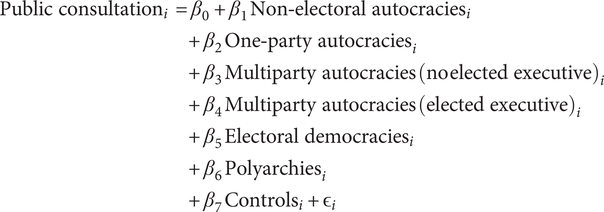 $$ {\displaystyle \begin{array}{c}{\mathrm{Public}\ \mathrm{consultation}}_i={\beta}_0+{\beta}_1\;\mathrm{Non}\hbox{-} {\mathrm{electoral}\ \mathrm{autocracies}}_i\\ {}\hskip1em +{\beta}_2\;\mathrm{One}\hbox{-} {\mathrm{party}\ \mathrm{autocracies}}_i\\ {}\hskip1em +{\beta}_3\;\mathrm{Multiparty}\ \mathrm{autocracies}\;{\left(\mathrm{no}\;\mathrm{elected}\ \mathrm{executive}\right)}_i\\ {}\hskip1em +{\beta}_4\;\mathrm{Multiparty}\ \mathrm{autocracies}\;{\left(\mathrm{elected}\ \mathrm{executive}\right)}_i\\ {}\hskip1em +{\beta}_5\;{\mathrm{Electoral}\ \mathrm{democracies}}_i\\ {}\hskip1em +{\beta}_6\;{\mathrm{Polyarchies}}_i\\ {}\hskip1em +{\beta}_7\;{\mathrm{Controls}}_i+{\unicode{x025B}}_i\end{array}} $$
I introduce several controls to my model. To account for time, I include one variable measuring the number of years since a country’s last constitution was promulgated. This control is meant to capture temporal effects on constitutional processes, as countries with longer intervals since their last constitution may face unique political, social, and institutional conditions that could influence the decision to include public consultation in drafting processes.
I introduce binary variables for democratic breakdown and democratic transition in the year the constitution became effective, sourced from the Lexical Index of Democracy (Skaaning, Gerring, and Bartusevičius Reference Skaaning, Gerring and Bartusevičius2015). A provisional government emerging from a transition to democracy may enjoy greater baseline legitimacy due its democratic credentials, reducing the perceived need for public consultation in constitution-making. Conversely, an autocrat, following the collapse of a democracy, may eschew public consultation to expedite the imposition of a new constitution and avoid public scrutiny. Therefore, these two variables measure changes in the level of democracy (in both directions), allowing me to capture confounding effects.
The ideological character of the regime may also affect the tendency to use public consultation in constitution-making, as left-wing and nationalist political elites have historically valued the kind of mass mobilization that public consultation may instigate (Beissinger Reference Beissinger2002; Fagen Reference Fagen1966; Tsai Reference Tsai1999). I incorporate country-level measures of socialist and nationalist ideology from Varieties of Democracy (V-Dem) (Coppedge et al. Reference Coppedge2023).
Having discussed the role of NGOs and think tanks, I include a V-Dem measure of the extent to which civil society organizations are consulted by policymakers (Coppedge et al. Reference Coppedge2023). This control accounts for the influence of civil society actors, which often advocate for public consultation initiatives, thereby impacting their implementation during constitution-making.
Moreover, my model includes a binary variable for whether there was a civil war occurring at the time (Haber and Menaldo Reference Haber and Menaldo2011) and the level of political mass mobilization such as demonstrations, strikes, protests, and riots (Coppedge et al. Reference Coppedge2023). The former may generate intense violence, and the latter may reflect generalized social unrest, both of which could make organizing a public consultation logistically and politically challenging. Finally, I control for the average growth in gross domestic product (GDP) during the five-year period prior to the new constitution, as the broader socioeconomic environment can impact the constitutional order (Negretto Reference Negretto, Ruth, Welp and Whitehead2017; Przeworski Reference Przeworski1991) and the institutional capacity to undertake public consultation.
To test the hypothesis for democracies (n = 84), I have two independent variables of interest. The first is the level of control that the largest political party or coalition has over the institutional body approving the new constitution. This variable is measured as a proportion between 0 and 1, depending on how many seats the dominant party or coalitionFootnote 6 held out of the total number of seats in the approval body. This institution represents the last “veto point” in the constitution-making process, or the last point of agreement to secure the new constitution (Tsebelis Reference Tsebelis2003, Reference Tsebelis2022). I treat this as a proxy for the degree of control over decision-making during drafting when political elites make procedural decisions such as whether to consult the public. Equation 2 presents my second (unconditional) model.
 $$ {\mathrm{Public}\ \mathrm{consultation}}_i={\beta}_0+{\beta}_1\;{\mathrm{Seat}\ \mathrm{share}}_i+{\beta}_2\;{\mathrm{Controls}}_i+{\unicode{x025B}}_i $$
The second variable is whether the largest political party or coalition in the aforementioned constitutional body is a newcomer. To qualify as a newcomer, the party or coalition must have not had control over the government within ten years prior to the promulgation of the new constitution.Footnote 7 I examine the interaction between seat share and newcomer status to assess their joint influence on the likelihood of public consultation during the drafting process. Below I present equation 3 for my third (conditional) logit model.
 $$ {\displaystyle \begin{array}{c}{\mathrm{Public}\ \mathrm{consultation}}_i={\beta}_0+{\beta}_1\;{\mathrm{Seat}\ \mathrm{share}}_i+{\beta}_2\;{\mathrm{Newcomer}\ \mathrm{status}}_i\\ {}+{\beta}_3\;{\mathrm{Seat}\ \mathrm{share}}_i\times {\mathrm{Newcomer}\ \mathrm{status}}_i\\ {}+{\beta}_4\;{\mathrm{Controls}}_i+{\unicode{x025B}}_i\end{array}} $$
I include almost the same set of controls used in the first logit model: years since the previous constitution, democratic transition, socialist and nationalist ideology, civil society, mass mobilization, and average GDP growth. I remove the controls for democratic breakdown and civil war, as there is no variation in these variables for the subset of democracies.
To test the hypotheses for autocracies (n = 216), I have two independent variables of interest. The first is performance legitimation, or the extent to which the regime refers to performance (e.g., economic growth, poverty reduction, effective and non-corrupt governance, security) to justify the regime in place (Coppedge et al. Reference Coppedge2023, 224). The variable is on an ordinal scale of 0 (“Not at all”) to 4 (“Almost exclusively”) and converted to an interval by V-Dem. Performance legitimacy serves as a way for rulers to establish a reciprocal social contract, as citizens perceive that the incumbent’s right to rule is conditioned on their ability to meet citizens’ material needs (Tannenberg Reference Tannenberg2023, 11).
My second variable of interest for autocracies is party institutionalization, which measures the extent to which political parties are institutionalized (Coppedge et al. Reference Coppedge2023). This index captures various features of the political parties in a country including the level and depth of organizations, links to civil society, cadres of activists, and ideological coherence. I employ this variable as a proxy for intra-elite political competition under autocracy. Given the challenges of directly measuring intra-elite political competition in autocracies, party institutionalization serves as an appropriate analog of the proxy used to measure control over the constitution-making process in democracies.
Again, I control for almost the same set of variables from the first logit model. I remove the control for democratic transition, as there is no variation in this variable for the subset of autocracies. Below I present equation 4 for my second logit model.
 $$ {\displaystyle \begin{array}{c}{\mathrm{Public}\ \mathrm{consultation}}_i={\beta}_0+{\beta}_1\;{\mathrm{Performance}\ \mathrm{legitimation}}_i\\ {}\hskip1em +{\beta}_2\;{\mathrm{Party}\ \mathrm{institutionalization}}_i\\ {}\hskip1em +{\beta}_3\;{\mathrm{Controls}}_i+{\unicode{x025B}}_i\end{array}} $$
To address missing data, I employ predictive mean matching (PMM). PMM identifies cases with complete data profiles that are similar to those with missing values based on other observed variables (Little and Rubin Reference Little and Rubin2019; Rubin Reference Rubin1987). This method ensures that imputed values closely reflect the distribution of the observed data, minimizing bias and preserving statistical properties (Landerman, Land, and Pieper Reference Landerman, Land and Pieper1997). I perform twenty imputations, following recommendations to err on the side of more imputations (Graham, Olchowski, and Gilreath Reference Graham, Olchowski and Gilreath2007). This number reduces variability between imputed datasets, providing more stable parameter estimates (Little and Rubin Reference Little and Rubin2019; Rubin Reference Rubin1987).
I cluster standard errors by country in my results below. This adjustment is necessary because many countries have multiple observations (constitutions) in the dataset. Clustering accounts for non-independence among observations within the same country due to shared historical, political, or institutional factors. This approach mitigates intra-country correlation and enhances the robustness of statistical inference by preventing biased standard errors. Additionally, I ran the same logistic regressions as linear probability models as a robustness check, and the results remain consistent (see Appendix).
Results
First, I present the results from the logit model for my full dataset, which includes both democracies and autocracies. Certain levels of democracy are significantly associated with higher likelihoods of public consultation during constitution-making. Specifically, one-party autocracies ( $ \beta =1.02 $
,
$ \beta =1.02 $
, $ p<0.01 $
), multiparty autocracies with elected executives (
$ p<0.01 $
), multiparty autocracies with elected executives ( $ \beta =1.67 $
,
$ \beta =1.67 $
, $ p<0.001 $
), electoral democracies (
$ p<0.001 $
), electoral democracies ( $ \beta =1.68 $
,
$ \beta =1.68 $
, $ p<0.001 $
), and polyarchies (
$ p<0.001 $
), and polyarchies ( $ \beta =1.63 $
,
$ \beta =1.63 $
, $ p<0.05 $
) exhibit significantly higher log-odds of engaging in public consultation compared to the reference category, non-electoral autocracies.
$ p<0.05 $
) exhibit significantly higher log-odds of engaging in public consultation compared to the reference category, non-electoral autocracies.
The Lexical Index of Democracy represents an ordinal scale where higher values indicate higher levels of democracy, but the categories are not necessarily evenly spaced or linearly related. The conditional adjusted predictions, however, demonstrate some degree of linearity, increasing consistently from non-electoral autocracies (0.18), to one-party autocracies (0.38), to multiparty autocracies (0.54), to electoral democracies (0.55). Yet, the predicted probability for polyarchies (0.53) is lower than that of electoral democracies and multiparty autocracies.
To further evaluate the linearity of the relationship between the level of democracy and the likelihood of public consultation, I run an alternative model using V-Dem’s electoral democracy index.Footnote 8 The analysis reveals a significant positive association between the level of democracy and public consultation $ \left(\beta =2.16,p<0.01\right). $
Figure 3(b) illustrates this relationship, where the probability of public consultation increases markedly from 26% to 71% across the range of the scale.
$ \left(\beta =2.16,p<0.01\right). $
Figure 3(b) illustrates this relationship, where the probability of public consultation increases markedly from 26% to 71% across the range of the scale.
Predicted Probability of Public Consultation Across Level of Democracy.
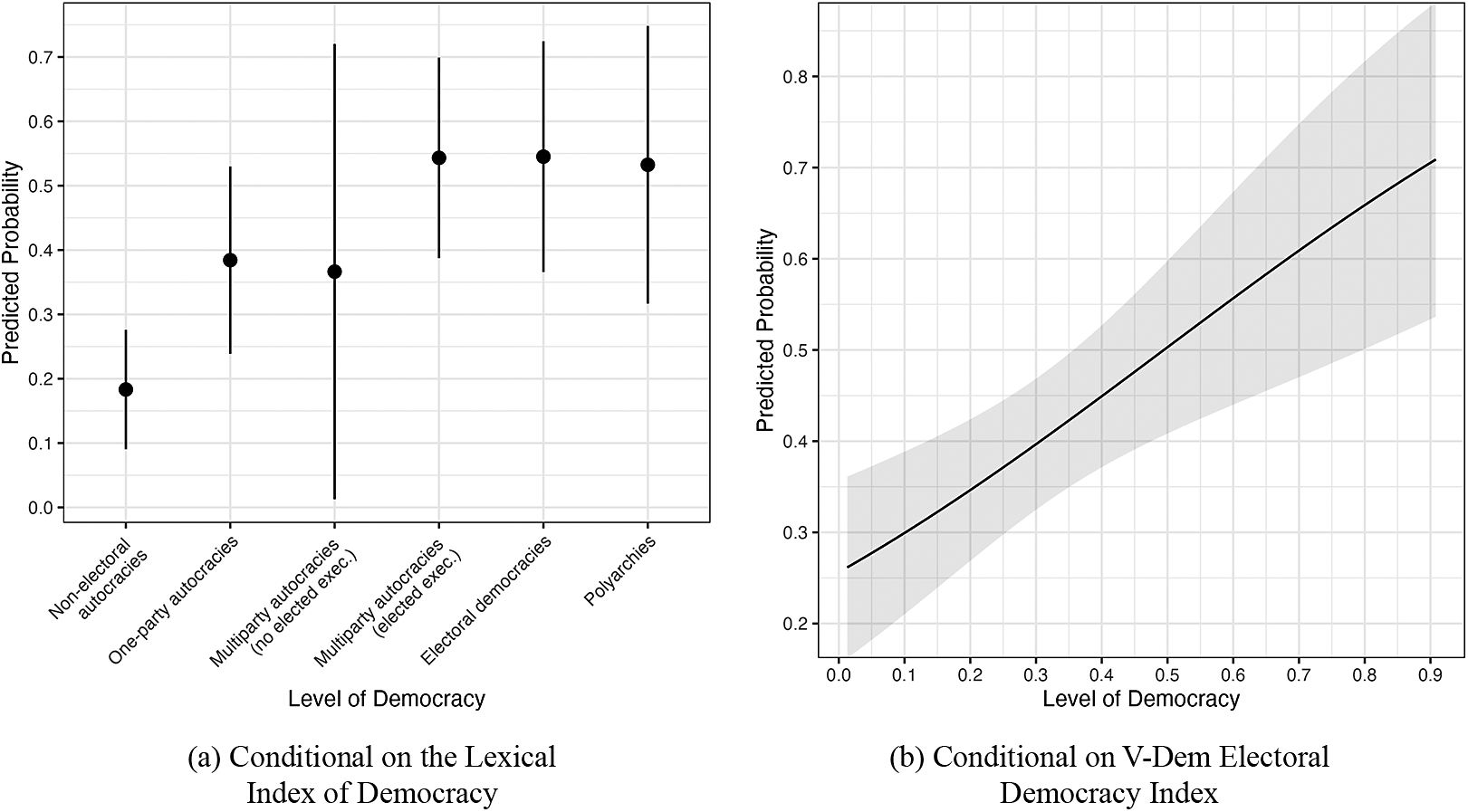
These results provide modest empirical support for H1. They suggest that in contexts characterized by greater political competition and pluralism, such as democratic regimes, there is a heightened propensity for consulting the public in constitutional decision-making processes. This conclusion, moreover, provides some initial support for my theoretical argument that public consultation serves as a strategic tool for political elites to contest power in the constitutional arena.
Next, I discuss the results of two logit models for the subset of democracies (electoral democracies and polyarchies). I test two hypotheses – the first unconditional and the second conditional – related to the role of political dynamics in shaping public consultation within democratic contexts. Hypothesis 2 (H2) posits that in democratic regimes, public consultation in constitution-making is more likely when the process is dominated by a single party or coalition. Hypothesis 3 (H3) adds a condition to this argument by suggesting that in democratic regimes, public consultation is more likely when the process is specifically dominated by a newcomer party or coalition.
In my unconditional model, the coefficient estimate for the control variable is 2.98 $ \left(p=0.05005\right) $
. With a 10% increase in seat share, the log odds of public consultation increase by 0.298 units. This suggests that as the level of control over the process increases by 10% (e.g., from 50% to 60% seat share), the log odds of public consultation increase by approximately 0.298 units, all else being equal. In terms of odds, a 0.1 increase in control corresponds to an increase in the odds of public consultation by exp(0.298)
$ \left(p=0.05005\right) $
. With a 10% increase in seat share, the log odds of public consultation increase by 0.298 units. This suggests that as the level of control over the process increases by 10% (e.g., from 50% to 60% seat share), the log odds of public consultation increase by approximately 0.298 units, all else being equal. In terms of odds, a 0.1 increase in control corresponds to an increase in the odds of public consultation by exp(0.298) $ \approx $
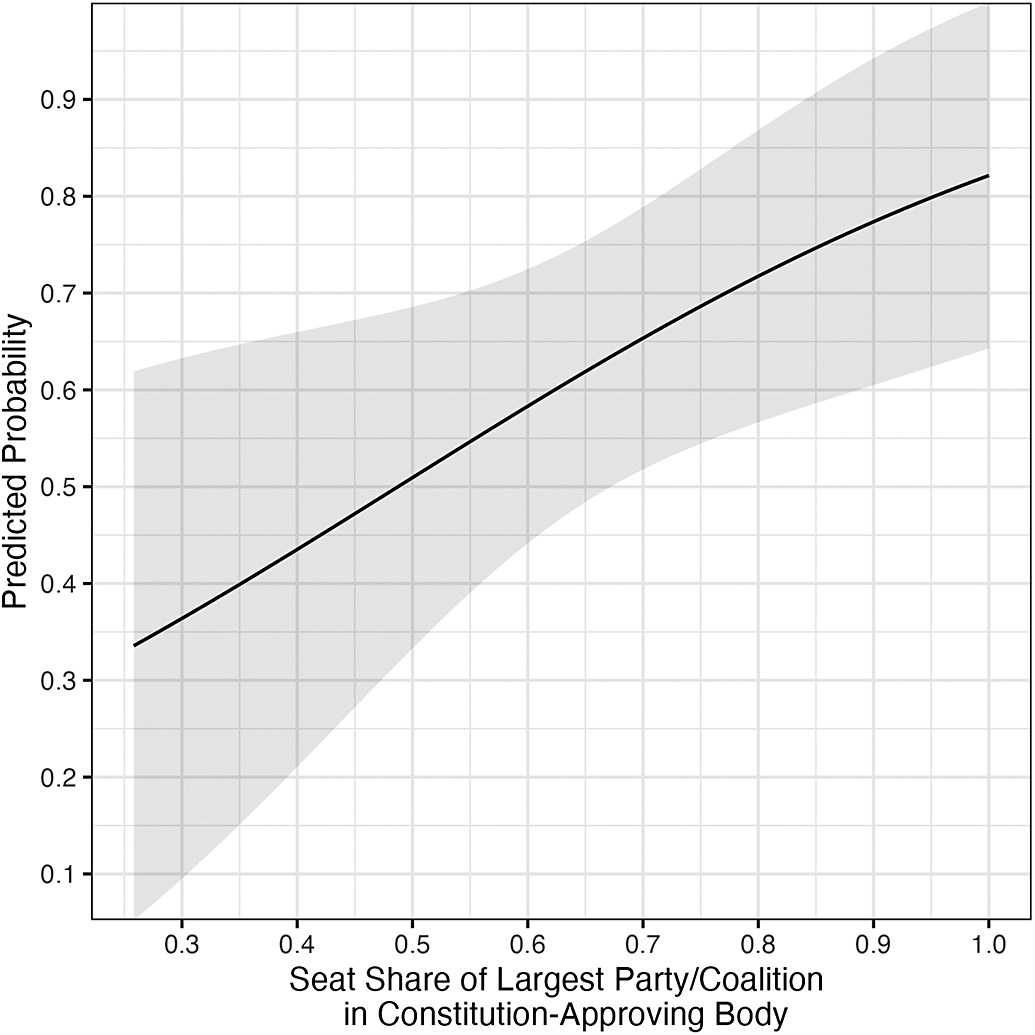
1.35 times. This means that for every 0.1 increase in control over the process, the odds of public consultation occurring are approximately 1.35 times higher, reflecting a moderate but statistically significant association. Figure 4 demonstrates how the predicted probability of public consultation increases as the level of control over the process rises, providing visual evidence of the positive association and support for H2.
$ \approx $
1.35 times. This means that for every 0.1 increase in control over the process, the odds of public consultation occurring are approximately 1.35 times higher, reflecting a moderate but statistically significant association. Figure 4 demonstrates how the predicted probability of public consultation increases as the level of control over the process rises, providing visual evidence of the positive association and support for H2.
Predicted Probability of Public Consultation Across Seat Share of Largest Party/Coalition in Constitution-Approving Body.
In my conditional model, the coefficient estimate for the interaction term between control of the constitution-making process and newcomer status is $ -6.77 $
(
$ -6.77 $
( $ p<0.05 $
). Interpreting this interaction effect in terms of odds is more complex due to the conditional nature of the effect, but the negative coefficient suggests that the effect of control on public consultation within democratic regimes is conditional on the presence of newcomer parties or coalitions – but not in the expected direction.
$ p<0.05 $
). Interpreting this interaction effect in terms of odds is more complex due to the conditional nature of the effect, but the negative coefficient suggests that the effect of control on public consultation within democratic regimes is conditional on the presence of newcomer parties or coalitions – but not in the expected direction.
To make my results more concrete, I present a plot of the predicted probabilities for newcomers and non-newcomers across different levels of control of the constitution-making process. Figure 5 reveals interesting patterns: the predicted probability of newcomers choosing to adopt public consultation remains relatively stable (and high) across the level of control of the process, hovering between 0.7 and 0.75. In contrast, the predicted probability of non-newcomers engaging in public consultation increases significantly as their level of control over the process grows. This probability starts at approximately 0.08 when non-newcomers have minimal control and peaks at around 0.925 when they have full control over the constitution-making process. These results suggest that non-newcomers, or the old guard, behave differently than expected, aligning instead with the hypothesis about newcomers (H3). Newcomers consistently show a higher likelihood of pursuing public consultation. Theoretically speaking, if the goal of newcomers is to upset the constitutional status quo, legitimation may be more important than the predictability of the consultation process. In contrast, traditional political elites may only seek legitimation via public consultation if they anticipate being able to control the outcome.
Predicted Probability of Public Consultation Across Seat Share of Largest Party/Coalition in Constitution-Approving Body by Newcomer Status.
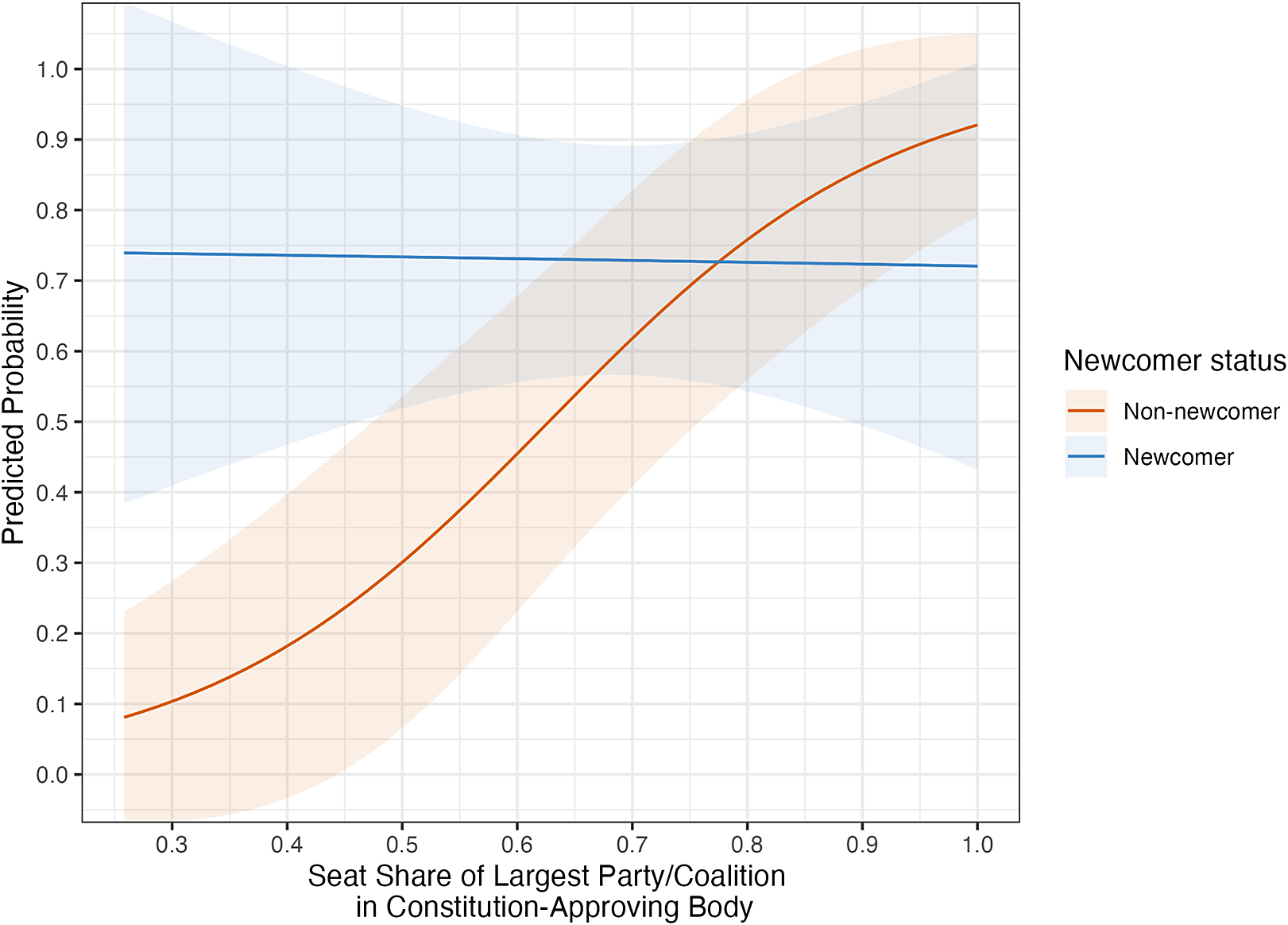
The confidence intervals for the predicted probabilities of newcomers and non-newcomers, however, start to overlap around a seat share of 50%. When both groups form a majority, they behave similarly, but non-newcomers are less inclined to pursue public consultation when they are in the minority. This overlap indicates a degree of uncertainty in the estimated effects of control and newcomer status on public consultation. While the estimated effects may still hold within their respective confidence intervals, the overlap suggests that the differences between the two groups may not be statistically significant beyond this threshold. The large confidence intervals are almost certainly attributable to the small sample size for the subset of democracies (n = 84).
Lastly, I discuss the results of the logit model for my subset of autocracies (non-electoral autocracies, one-party autocracies, multiparty autocracies without elected executive, and multiparty autocracies with elected executive). I test two hypotheses: that public consultation in constitution-making is more likely to occur under autocratic regimes that are more performance-based (H4), and that it is more likely under autocratic regimes with greater party institutionalization (H5).
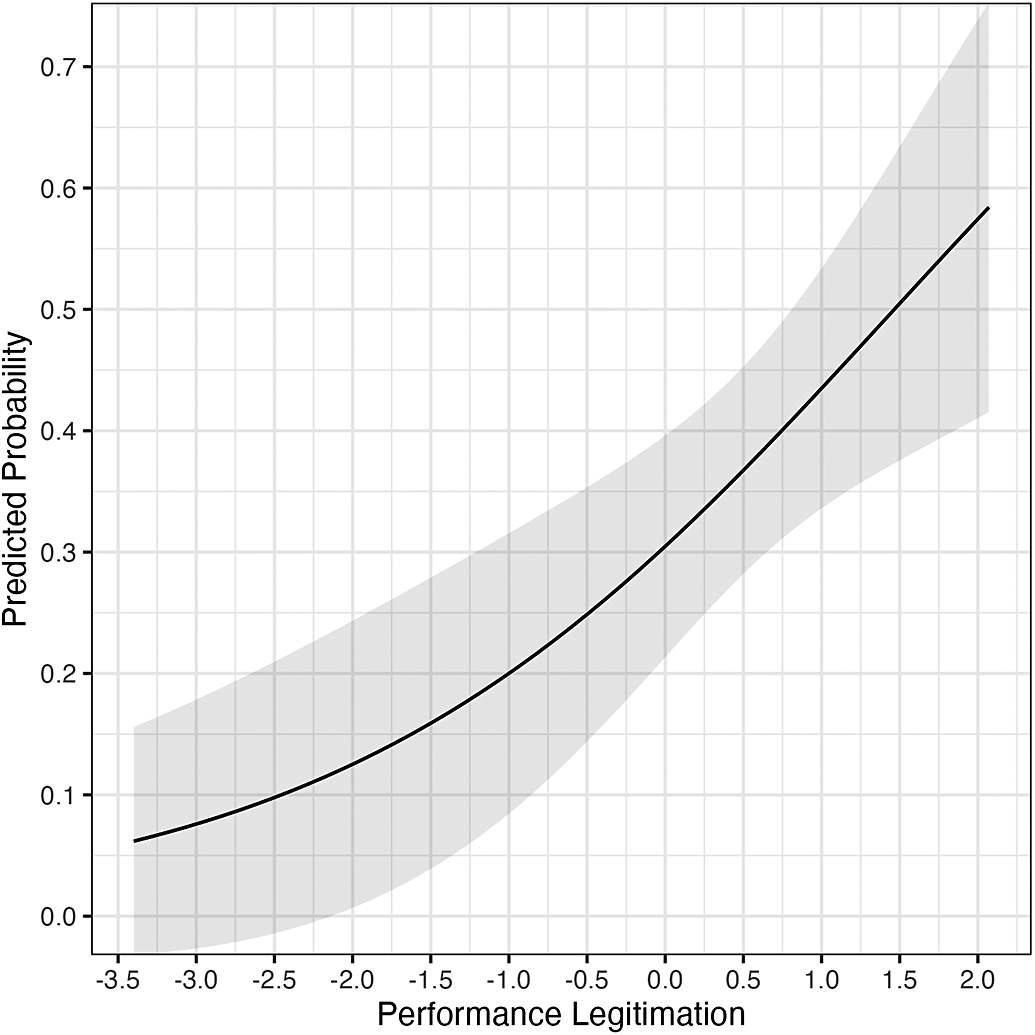
The coefficient estimate for performance legitimation is 0.563 ( $ p<0.01 $
). This indicates that for every one-unit increase in the performance legitimation score of an autocratic regime, the log odds of public consultation occurring increase by 0.563 units, holding all other variables constant. Interpreted in terms of odds, a one-unit increase in performance legitimation corresponds to an increase in the odds of public consultation by exp(0.563)
$ p<0.01 $
). This indicates that for every one-unit increase in the performance legitimation score of an autocratic regime, the log odds of public consultation occurring increase by 0.563 units, holding all other variables constant. Interpreted in terms of odds, a one-unit increase in performance legitimation corresponds to an increase in the odds of public consultation by exp(0.563) $ \approx $
1.75 times.
$ \approx $
1.75 times.
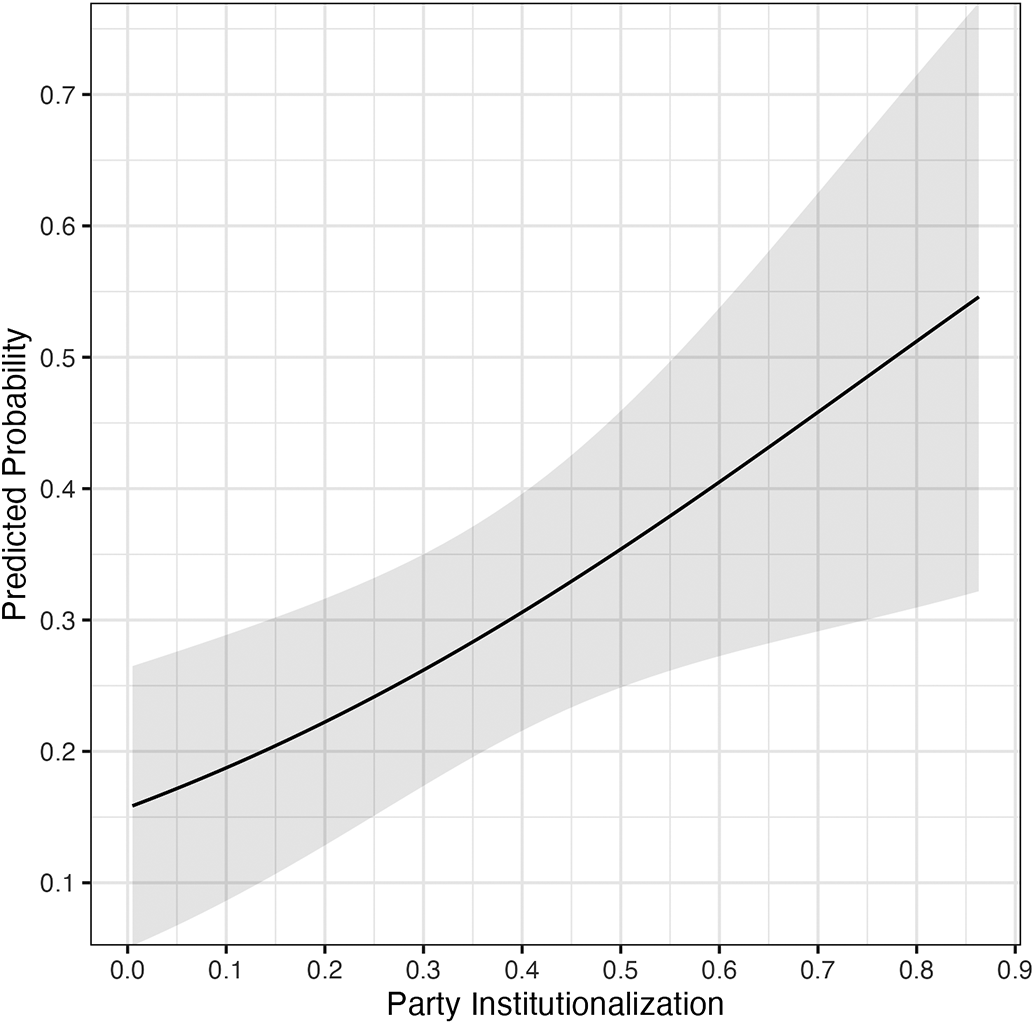
The coefficient estimate for party institutionalization is 2.17 ( $ p<0.05 $
). As the level of party institutionalization increases by 0.1 on the zero-one scale, the log odds of public consultation increase by 0.217 units, all else being equal. In terms of odds, a 0.1 increase in institutionalization corresponds to an increase in the odds of public consultation by exp(0.217)
$ p<0.05 $
). As the level of party institutionalization increases by 0.1 on the zero-one scale, the log odds of public consultation increase by 0.217 units, all else being equal. In terms of odds, a 0.1 increase in institutionalization corresponds to an increase in the odds of public consultation by exp(0.217) $ \approx $
1.24 times.
$ \approx $
1.24 times.
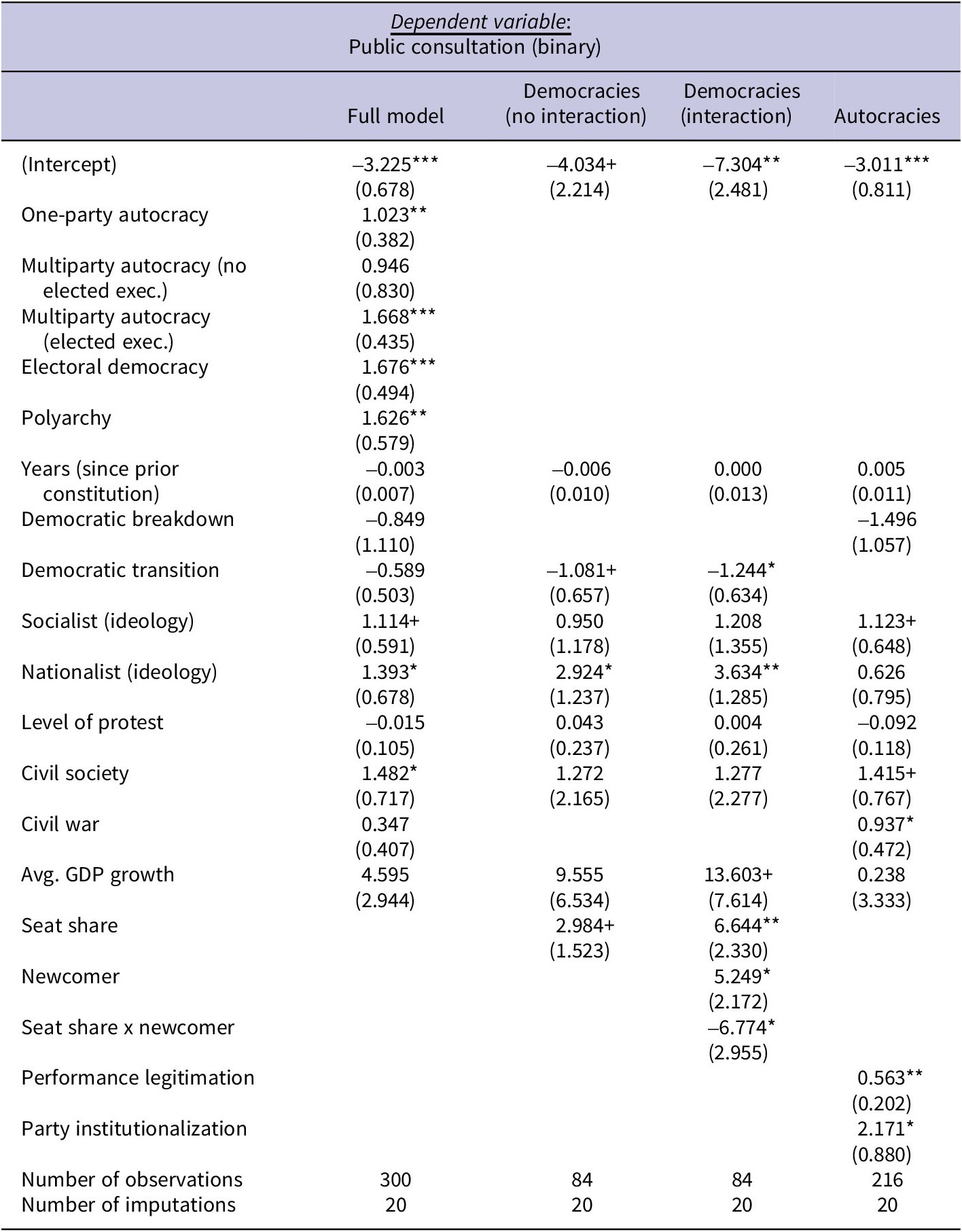
The predicted probability plots in Figure 6 and Figure 7 illustrate these relationships. Both performance legitimation and party institutionalization are positively associated with the likelihood of public consultation in constitution-making within autocratic regimes, providing empirical evidence in support of H4 and H5. Table 3 shows the full set of results for each of my logit models.
Predicted Probability of Public Consultation Across Level of Performance Legitimation.
Predicted Probability of Public Consultation Across Level of Party Institutionalization.
Results of Logistic Regressions
Note: $ +p<0.1 $
, *
$ +p<0.1 $
, * $ p<0.05 $
, **
$ p<0.05 $
, ** $ p<0.01 $
, ***
$ p<0.01 $
, *** $ p<0.001 $
Conclusion
Public consultation has become a fundamental part of modern constitution-making, and it is here to stay. Accordingly, scholars must move beyond a one-size-fits-all approach to public consultation, both normatively and empirically. By prescribing these participatory mechanisms as indispensable benchmarks for constitutional legitimacy (Brandt et al. Reference Brandt2011; Dann et al. Reference Dann2011; Ebrahim, Fayemi, and Loomis Reference Ebrahim, Fayemi and Loomis1999), practitioners may overlook both contextual factors and the strategic calculations of political elites. Furthermore, by simplifying the empirical relationship between public consultation and legitimacy (Hart Reference Hart2003, Reference Hart and Miller2010), scholars assume that political elites involved in constitution-making have an equal interest in producing a constitution that is legitimate. My analysis reveals that the decision to pursue public consultation is driven by a complex interplay of factors, including regime type and the contours of elite political competition.
Public consultation is best understood as a tool for one set of political elites to legitimize their preferred constitutional project in a contest with other elite actors. In democratic contexts, dominant factions with significant influence over the constitution-making process, including newly emerging elites and coalitions, leverage public consultation to validate departures from the existing constitutional framework. Conversely, in autocratic regimes, ruling coalitions – especially those reliant on demonstrating effective governance and those with well-established party structures – adopt public consultation to uphold advantageous power-sharing agreements. In both environments, public consultation arises in response to shifting power dynamics as a means for certain political elites to solidify their authority via constitution-making. These arguments identify the political dynamics shared by democratic and autocratic constitution-making, bridging insights from two largely separate bodies of literature (Elkins, Ginsburg, and Melton Reference Elkins, Ginsburg and Melton2014; Ginsburg and Simpser Reference Ginsburg and Simpser2013a; Horowitz Reference Horowitz2021; Negretto and Wandan Reference Negretto and Wandan2020).
The results of my statistical models support these arguments, using the original data assembled for this project. The PCCD serves as a valuable resource for future research into participatory design procedures in constitution-making. The dataset remains under active construction, currently being expanded to include data on the duration and mechanisms of consultation, as well as data on processes that occurred prior to 1974. The full version of the dataset shall be released for public use in the near future.
In conclusion, the impact on, or the legitimation of, the constitutional text is not the sole measure of the significance of public consultation. My research highlights the political relevance of the normative ideal of participation in constitution-making, particularly for certain elites composing a regime. The public input generated by consultation processes may carry substantial rhetorical weight during negotiations and deliberations, providing leverage against competing elites, rather than the final text serving as definitive evidence that the voice of the people was heard. Therefore, my study underscores the need to examine more closely the relationship between public consultation and elite negotiations in constitution-making.
Acknowledgments
I gratefully acknowledge the helpful comments from Daniel Brinks, Zachary Elkins, Ran Hirschl, Whitney Taylor, Alice Cho Timken, Mishella Romo Rivas, Tatiana Paula da Cruz, Sally Gardner, Roy Gardner, Joseph Liporace, and the anonymous reviewers of this article. A small group of undergraduate interns at the University of Texas at Austin provided crucial research assistance.
Data availability statement
Replication materials for this article are available at: https://doi.org/10.7910/DVN/PVTH3Z
Financial support
None.
Competing interest
The author declares none.
Appendix
Data sources
To construct the PCCD, I consulted a diverse array of primary and secondary sources to ascertain the occurrence of public consultations in constitution-making processes across the globe. I gathered sources in English, Spanish, and French. I am a native speaker of English and speak Spanish fluently. Primary sources included official government documents, particularly reports issued by constitutional commissions responsible for consultation activities. Additionally, I used news articles documenting consultation events stored on the Google News Archive and The New York Times TimesMachine. Secondary sources played a crucial role, including scholarly articles providing detailed analyses of specific cases. Reports from think tanks and NGOs such as the United States Institute of Peace, International IDEA, and the Carter Center were also gathered.
Cross-validation of data
I cross-validated my coding choices using datasets that cover subsets of the data. First, I relied on the “Constitution Writing and Conflict Resolution” dataset from Widner (Reference Widner2004), which covers 195 cases from 1974 to 2002. It is not, however, comprehensive for the period, and it is missing more than two decades of recent cases. There are also some discrepancies due to a broader conception of what events comprised the constitution-making process. For example, Widner (Reference Widner2004) codes Algeria 1976 as having held a public consultation, even though nationwide meetings were organized to discuss the National Charter (an ideological proclamation) prior to the start of the constitution-making process, which lacked public input. Second, I used the dataset created by Negretto and Sánchez-Talanquer (Reference Negretto and Sánchez-Talanquer2021). This dataset, however, excludes mechanisms of public consultation considered “potentially inconsequential…without a clear link to the drafting process” (see Negretto and Sánchez-Talanquer Reference Negretto and Sánchez-Talanquer2021, codebook, 5), introducing subjectivity. Lastly, I compared my coding to the “Database on Constitution-Building Processes in Conflict-Affected States” from IDEA (2022), which builds on Widner (Reference Widner2004). Although useful for recent cases, this dataset only includes thirty-six countries.
Robustness checks
Results of Linear Probability Models
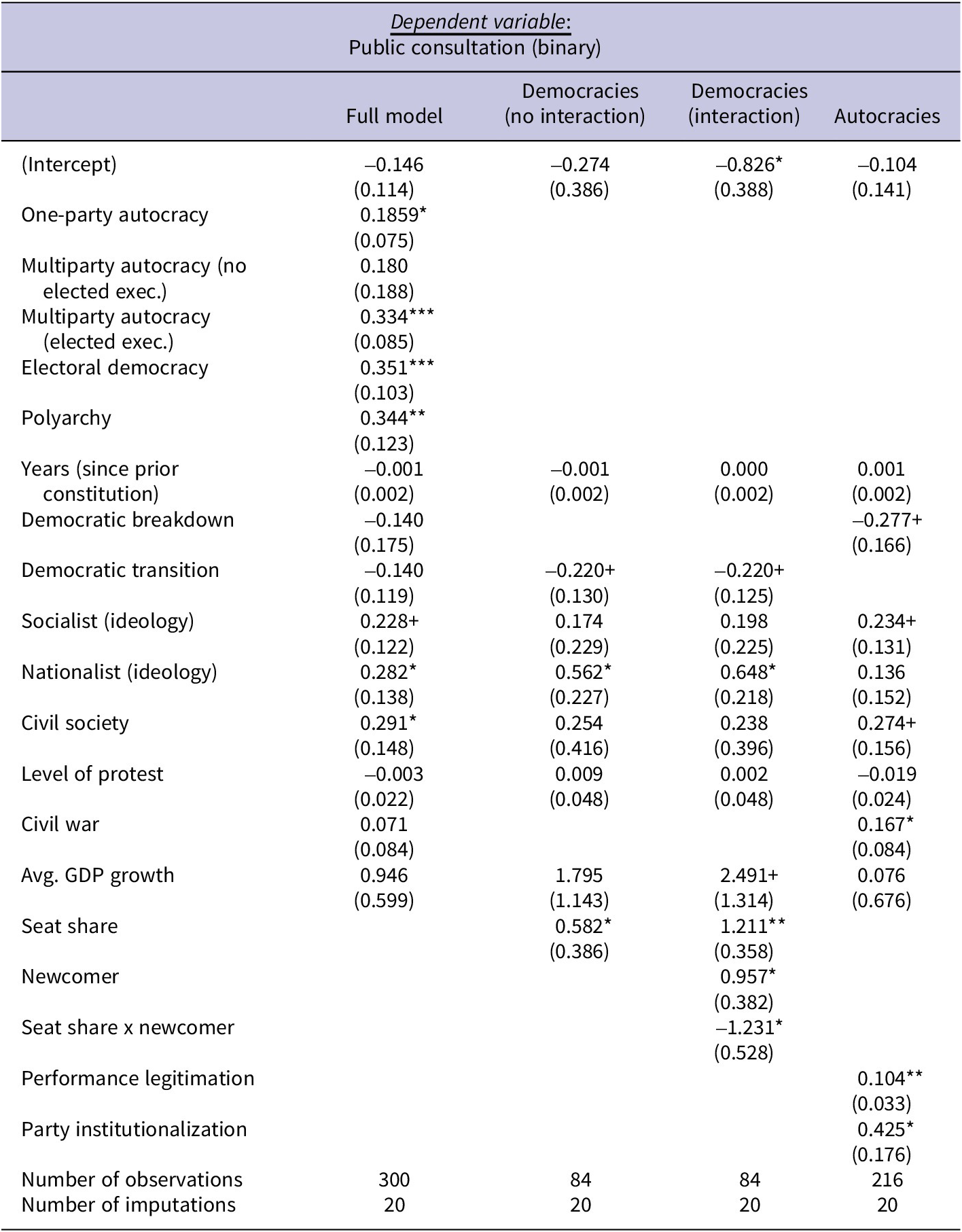
Note: $ +p<0.1 $
, *
$ +p<0.1 $
, * $ p<0.05 $
, **
$ p<0.05 $
, ** $ p<0.01 $
, ***
$ p<0.01 $
, *** $ p<0.001 $


 Open access

