


1. Introduction
Games have long played an integral role in human culture, serving as tools for entertainment, social interaction, and, more recently, educational enhancement. They represent structured forms of play that engage individuals in rules-based scenarios, creating opportunities for skill development, strategic thinking, and cognitive engagement. As society increasingly values technology-driven learning, games have emerged as an essential educational tool, demonstrating value in both physical and digital formats (Reference Vlachopoulos and MakriVlachopoulos & Makri, 2017; Reference AtanasovaAtanasova, 2024). Games hold significant value in socialization and cognitive development, providing an interactive space for players to experiment. Educational games have demonstrated potential in fostering critical thinking, memory retention, and social skills, contributing to the overall cognitive development of individuals. These games often integrate strategies that engage players in rule-based activities, enhancing problem-solving skills and creativity, which are essential for adapting to complex real-world challenges (Reference AtanasovaAtanasova, 2024; Reference NaidooNaidoo, 2023; Roozeboom et al., 2015). Certainly, Indoor games, ranging from board games to digital games, offer a controlled environment that emphasizes cognitive engagement. Research supports the claim that indoor games are effective in promoting active learning, as they limit external distractions and allow players to focus entirely on the game mechanics and objectives. For instance, digital game-based learning (DGBL) within educational environments has gained popularity for its effectiveness in boosting students’ motivation, retention, and participation (Reference Vlachopoulos and MakriVlachopoulos & Makri, 2017; Reference Backlund and HendrixBacklund & Hendrix, 2013). Furthermore, studies demonstrate that indoor games provide a platform for players to develop fine motor skills, enhance spatial reasoning, and engage in strategic thinking (Reference Zhang and ZurloZhang & Zurlo, 2021). Mathematical games, a subset of educational games, add a unique layer of value by engaging players in logic-based challenges. These games are designed to reinforce mathematical concepts, improve analytical skills, and encourage logical reasoning, making them highly beneficial in academic settings (Reference NaidooNaidoo, 2023). They not only cater to educational purposes but also offer a safe space for learners to make mistakes and refine their problem-solving approaches without fear of failure (Reference Vondrová and ŠilhánováVondrová & Šilhánová, 2013). Studies have shown that games, especially those involving multiplayer formats, facilitate collaborative learning and help players develop interpersonal skills. Such interactions are beneficial for social growth and can enhance peer relationships and group cohesion (Reference Zhang and ZurloZhang & Zurlo, 2021). Multiplayer games, whether competitive or cooperative, encourage participants to engage with each other, negotiate strategies, and solve challenges collectively. In educational settings, these collaborative dynamics are crucial, as they foster an inclusive learning environment where students learn to value diverse perspectives and work together to achieve common goals (Reference AtanasovaAtanasova, 2024). Games provide a structured yet flexible environment for exploring complex ideas, experimenting with strategies, and adjusting to the consequences of decisions, all of which are central to design thinking (Reference Zhang and ZurloZhang & Zurlo, 2021). The structure of games, with clear objectives, rules, and feedback mechanisms, aligns with the design thinking process, enabling learners to iterate on ideas, develop prototypes, and refine solutions based on feedback. Additionally, the variety in game types—ranging from strategy games to role-playing simulations—offers learners diverse avenues to engage with content, catering to different learning styles and preferences (Reference MashchenkoMashchenko, 2024).
1.1. Tic-Tac-Toe
Tic-Tac-Toe is a popular pencil and paper game, that is played across the globe. In the classic 2D version, players quickly learn to optimize moves, often leading to repetitive draws (Reference Garg, Songara and MaheshwariGarg et al., 2017). As noted, the 2D structure’s limited win paths encourage predictable gameplay, which can reduce player interest, especially with no strategy beyond maximizing defensive and offensive positions. Ultimate Tic-Tac-Toe, a more intricate variant, divides the board into nine smaller 3x3 grids, enhancing strategy through rules requiring players to play within the smaller board dictated by their opponent’s last move. This configuration introduces new decision layers, which address some predictability of the standard game by increasing the number of possible winning paths and requiring foresight in each move (Reference Baum and DanhofBaum, 1975). However, while it adds complexity, players still operate within a 2D framework.
3D Tic-Tac-Toe, is a variation of the game that has developed over decades in independent efforts (Reference Raphael, Raphael and KingRaphael,Stewart C. et al., 1994). It advances the game further by introducing a 3x3x3 frame, where players can play across multiple planes or layers. This setup allows for a larger number of playing configurations and demands players to think across three spatial dimensions, possibly increasing cognitive engagement. The added depth and spatial variation require dynamic strategy, which led us to develop a game board that facilitates this game.
1.2. Novel board game structure
A 3D game board was designed and developed by the team for the purpose of research. It comprises of two core components: the frame and the play pieces. The frame is a 10x10x10 cm cube structure with 27 hollow cubicles or voids, serving as the spatial foundation for gameplay. The size and shapes of the voids ensures clarity and visibility for players to identify available spaces. Complementing the frame, the play pieces are pliant foam balls that serve as markers designed to claim spaces within the voids. Typically differentiated by color, these pieces help distinguish between players’ moves and are precisely sized to fit securely in the voids, ensuring stability during gameplay as shown in Figure 1. Crafted for both functionality and aesthetics, the play pieces feature vibrant colors to enhance the tactile and visual experience.
Voided cube filled with play pieces (left); 3x3x3 voided cube configuration (right)

1.3. As a fuzzy matrix game
In designing the game board, where players place balls within a voided cube structure, the strategy reflects elements of a fuzzy matrix game, as discussed by (Reference Vahedi, Chabok and VeisiVahedi et al., 2023). This design introduces an added layer of complexity due to the three-dimensional nature of the game, allowing for a variety of moves across six possible sides and within the center of the cube. Players must strategically position their balls in alignment with multiple possible win paths—horizontal, vertical, or diagonal—across different planes. This aligns with the fuzzy sets of strategies concept, where players operate under varying degrees of certainty regarding optimal moves, particularly when attempting to block or complete lines across multiple dimensions (Reference Vahedi, Chabok and VeisiVahedi et al., 2023). Players alternate turns, each trying to maximize their chance of winning by selecting moves that not only advance their position but also limit their opponent’s options. The game board’s void structure, allowing flexibility in moves across all layers, mirrors the fuzzy environment in matrix games where strategy sets are less rigid, and outcomes are not purely deterministic. Moreover, as players assess the game board’s evolving state, they adjust their strategies based on observed patterns, which is akin to type-2 fuzzy sets where the value and impact of decisions change based on ongoing interaction. This adaptation in gameplay emphasizes the influence of fuzzy strategy selection, showcasing how players handle multidimensional ambiguity to achieve victory. Thus, the model provides a practical demonstration of fuzzy matrix game principles, inviting players to navigate complex choices within a structured, yet flexible, game theory.
To qualitatively analyse the aforementioned aspects, the following research questions were answered in the study:
-
RQ 1: How does the multi-dimensional structure of the game influence strategic thinking, rule development, and user engagement (mood, inventiveness, usefulness) in an open-ended play environment?
-
RQ 2: What specific structural affordances of the game enable the emergence of new gameplay variations, and how do they contribute to complexity, adaptability, and cognitive engagement?
Unlike existing 3D Tic-Tac-Toe adaptations, our study introduces a new physical frame structure with multiple affordances, enabling diverse gameplay beyond Tic-Tac-Toe. This design led to the emergence of various games, including puzzle-based and dice-based variants, demonstrating its adaptability. Our key contribution lies in redefining the game’s structural foundation, which enables multi-modal interactions and strategic exploration extending its application beyond its gameplay.
1.4. Application of FBS on the game board
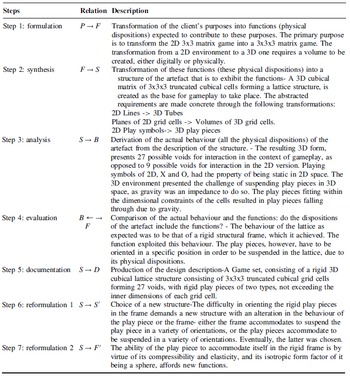
To understand the underlying affordances of the structure designed for the game board, we applied FBS Ontology model (Reference Kannengiesser and GeroKannengiesser, U., & Gero, J. S. 2011; Reference Masoudi, Fadel, Pagano and ElenaMasoudi et al., 2019). Additionally, this helps us analyze how the game’s structure influences player interactions and emergent strategies:
Function, Behavior, and Structure (FBS) analysis for frame and play pieces Key: P, F, B, S, D, F′, S′ (Problem, Function, Behavior, Structure, Design Description, New Function, New Structure)

2. Playing objectives
In terms of gameplay objectives, 2D Tic-Tac-Toe is a game with juxtaposed objectives, in short, when players have opposing goals that are interdependent. Due to its limiting nature, once the optimal strategy is found, the game is rendered futile, despite the competitive nature of its playing objectives. The introduction of the third dimension to the game may afford many novel opportunities for interaction from the perspectives of gameplay and sensory aspects, primarily in visual and tactile modalities. Decoupling the expectation of transforming the existing rules of Tic-Tac-Toe to fit the newly devised structure may free it from the constraints of its predecessor and allow for new games to emerge from the newly possible interactions with this structure, and the functions it can afford.
3. Experiment setup and execution
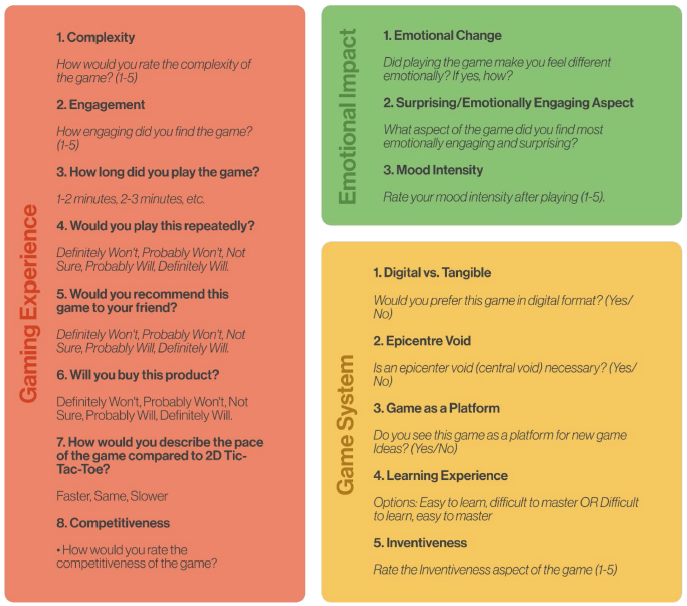
A setup was formed to assess user engagement and strategy development, in a newly designed 3D Tic- Tac-Toe game. The experiment was conducted in two stages with 30 participants divided into 15 teams of two. In the first stage, 15 teams were given only the void space (game cube) and a set of balls. Each team was asked to approach the game as an open-ended exercise to create their own rules and gameplay strategies. This phase included Questionnaire 1, which prompted teams to detail their approach to playing, strategies for winning, and illustrative examples of their gameplay ideas. Importantly, any strategy or hint was not shared with these teams, allowing for unbiased exploration and novel strategy formation. The aim was to understand how players naturally interact with a 3-dimensional structure in a game context, assessing their creativity and approach to gameplay without pre-existing strategic influences. In the second stage, a new set of 15 teams was introduced to the refined game, equipped with a pre-designed set of rules and gameplay strategies developed by the game designers. These participants were made to play rounds based on the structure established by the designers (shown in Fig 4). After gameplay, teams completed Questionnaire 2 (Figure 2), which included questions focused on emotional and cognitive responses. Participants were asked to reflect on their competitiveness, engagement, and cognitive stimulation. This dual-phase experimental setup allowed for comparison between self-developed and structured gameplay strategies, providing insights into natural strategy formation, user engagement of the game format developed. The cognitive factor introduced in this game survey aligns with the findings that interactive design stimulates critical thinking and maintains player interest (Gao et al.,2025). Gameplay time was included to analyze the balance between challenge and accessibility. This aligns with Csikszentmihalyi’s flow theory that that games are successful when they are designed to generate positive affect and facilitating the concept of flow. Flow is a state of concentration, deep enjoyment, and total absorption in an activity (Johnson and Wiles, 2005; Reference NormanNorman, 2004; Reference KhalidKhalid, 2006). Competitiveness was examined as it encourages social dynamics and deepens emotional investment as shown by author ChePa et al., 2023. Player mood was measured to understand the emotional impact of the game, emphasizing its role in mood enhancement and stress reduction (Salazar – Cardona et al., 2023). The study presented in the survey aimed to assess not only the games’ technical and cognitive aspects but also its emotional resonance, supporting its potential as engaging.
Questionnaire 2 designed to evaluate gaming experience, impact, and system dynamics
4. Results and discussion
4.1. Survey results
The survey results for questionnaire 1 which collects the new strategies of the game developed by teams. Out of all the survey responses, some unique strategies recorded are as follows. Team 1 suggested that the starting player is randomly chosen. The game is played by rolling a dice to determine which face of the cube (marked 1–6) to fill. Players alternately roll the dice and place their ball in a void on the face corresponding to the dice roll. If a rolled face is already fully occupied, the player must roll again until an eligible face is chosen. This roll of dice induces probabilistic approach and unpredictable moves, requiring players to adapt their strategies dynamically. The epicenter void is included. Once all 27 voids are filled, the results are evaluated. Winning is determined by the highest number of valid diagonal sets, including face and body diagonals. These diagonal alignments require strategic planning across multiple layers. The emphasis on diagonals adds depth to gameplay and challenges players to anticipate potential outcomes while maximizing their own sets. Team 2 suggested that starting player is selected through a coin toss. The player starting the game must occupy the epicenter as their first move. Players then alternately fill voids on the cube until all spaces are occupied. The winner is decided by the highest number of quadrangles or triangles formed. These shapes can be constructed in any direction across the cube, encouraging spatial awareness and proactive planning for multi-dimensional alignments. This structure emphasizes symmetry and centralized control, creating an initial strategic decision point for shape. Team 3 strategized that the starting player is determined by a coin toss. The game employs two- colored balls, with predefined patterns dictating possible moves. Players alternately push one ball in a single direction per move, with options to either progress their strategy or block the opponent’s moves. The winner is the first player to complete the predefined winning pattern within a set number of moves. Alternatively, the player with the most completed patterns at the end of the allotted moves is declared the winner, rewarding strategic efficiency. Team 4 Players decide the starting turn through Rock, Paper, Scissors. Each player alternately fills voids, aiming to form three balls in a line on any desired face. The epicenter is included in this variation. The game continues until all voids are filled, requiring a mix of offense and defense. The player winning is the one who forms the highest number of valid L-shapes or continuous sets of five balls. These alignments can include diagonal or edge placements, emphasizing multi-directional planning. Team 5 The starting player is selected randomly. Players alternately place two balls per turn in the voids, including the epicenter. The game progresses through balanced placement, with players planning to achieve a uniform face within their moves. The winner is the first player to achieve a full face of the cube with their assigned ball color. This approach mirrors the Rubik’s Cube’s alignment logic of faces, demanding precise placement and long-term planning.
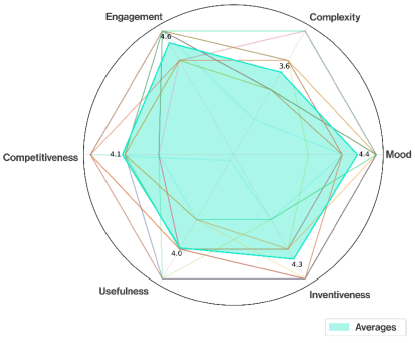
Radar plot depicting the survey results

A master strategy emerged amongst the strategies proposed by the teams, designed to prevent draws and ensure smooth gameplay until the end. This strategy was then introduced to a new group of 30 individuals, organized into 15 teams, who were asked to play the game using this approach and complete Questionnaire 2. The survey results for the 3D Tic-Tac-Toe game in Questionnaire 2 provides valuable insights into user engagement, perceived complexity, competitiveness, mood, usefulness and inventiveness (Figure 3). Among the 30 respondents, a significant majority rated the game highly in terms of engagement, with average scores of 4.6 out of 5, respectively. Participants generally described the game as “easy to learn but difficult to master,” underscoring the cognitive challenge and strategic depth introduced by its 3D structure. Interestingly, 92% of respondents viewed the 3D Tic-Tac-Toe as a potential platform for new game ideas, indicating its scalability and appeal as a flexible gaming framework. The game’s inventive aspect was particularly appreciated, scoring an average of 4.3 out of 5. Many participants found spatial complexity with an average rating of 3.6, keeping track of multiple planes engaging, with comments highlighting the challenge of strategizing in a 3-dimensional space. Additionally, 88% of respondents noted that the game offered a slower pace than traditional 2D Tic-Tac- Toe, adding an element of extended cognitive engagement. In terms of purchase intent, over 80% expressed a conviction to buy, with most recommending the game to friends, reinforcing its appeal and potential marketability. Overall, the survey indicates that the 3D Tic-Tac-Toe game successfully combines entertainment with strategic depth, making it both enjoyable and mentally stimulating for players. The results illustrate the game’s potential for fostering creativity and strategic thinking while also offering a positive emotional experience, with many players expressing interest in replaying the game and exploring further iterations.
4.2. Qualitative analysis
The feedback indicates that the 3D Tic Tac Toe game delivers a highly engaging and cognitively stimulating experience. Participants consistently reported commencing the game in a positive emotional state, such as “excited”, and transitioning to a state of enhanced focus upon completion. The game’s competitive dynamics and strategic complexity were widely commended, with several respondents highlighting the significance of decision-making, where “one move can change the entire game”. The 3D spatial structure and scoring mechanisms were identified as key innovative elements, with the game being described as “easy to learn yet difficult to master”, underscoring its accessibility while maintaining a high skill ceiling. Elevated ratings for engagement, inventiveness, and entertainment value further validate its appeal and creative potential. Suggestions for refinement included considering a digital adaptation, favored by a subset of participants, and resolving divergent views regarding the utility of the epicenter void. Overall, the game-set demonstrates substantial potential as a platform for exploring novel game mechanics.
4.3. Observations during the playing sessions
In the gameplay, contextual observation noted in user interaction, strategic thinking, and responses during play. Observations were based on the recorded video sessions of the participants engaging with the game in both exploratory and structured setups. The observation revealed several key behavioral patterns. In the second set of 15 teams the master strategy developed by the game master was disclosed. The observations in this set were focused on predefined structure of game mechanics and their influence on behavior and cognitive response. Due to the clear understanding of rules, it influenced their play moves. The players demonstrated heightened focus and strategic discussion while selecting the moves. Players were seen often debating the implications of their decisions on potential winning combinations. Many exhibited a mix of proactive and reactive behaviors. Some of the players prioritized completing the set according to the rules, while the others were working simultaneously to block their opponents. The rules fostered multilayered decision making. Players alternated between offensive and defensive strategies, adapting based on opponent’s move respectively. A moment of intense decision making was observed at the epicenter to complete or block the formation of axial sets. Despite the challenges, players generally expressed engagement, lighthearted banter and collaborative problem solving. A key observation was that the players increasingly adapted to think in 3D, in contrast to its 2D precedent, leveraging the cube structure to predict and counter potential moves. The structured game rules amplified the competitiveness as players found the game fair and engaging.
4.4. Emergence of a master strategy
From the experiments conducted, one notable emergence resulting from the affordances of the designed frame structure is the comprehensive game strategy for 3D Tic Tac Toe. The rules and strategy for this game are as follows: As represented in Figure 4, The rules are: Player 1 begins by placing the ball of their chosen colour into any available space on the grid, including the epicentre. Player 2 then follows by placing their ball in an open spot of their choice. All six sides of the cube are open for play, and players can switch between sides, placing their marks wherever they plan, it is not necessary to complete one side before moving to another. The main goal of the game is to create as many ‘three-in-a-row’ conditions as possible, spanning across all six sides of the cube, while simultaneously blocking the opponent’s attempts to do the same. Straight lines on the faces can be horizontal, vertical, or diagonal, but lines formed using the centre spot are only counted along the axes, not body diagonals. The winner is determined by counting the total number of straight lines each player has formed by the end of the game. For instance, one player might form six lines while another forms nine, with the latter being declared the winner. With an emphasis on both strategy and adaptability, 3D Tic Tac Toe encourages players to outwit their opponents while navigating this unique, multi-dimensional playing field. Tic Tac Toe in 3D reimagines the classic 2D game by introducing it into a three-dimensional space, offering a mind-bending and strategic experience within a 3x3x3 cube where every move counts, and the possibilities are virtually endless. The game is designed to play without attaining draw and takes place across six sides of the cube, including the centre.
Master strategy

5. Conclusion
The findings from the study on the game-set reveal significant insights into its potential as both an engaging recreational activity and a versatile game platform. The inherent symmetry of the game’s design along all three axes, combined with the structural affordances of the frame and play pieces, enabled participants to formulate diverse and innovative game rules. This process highlighted the interplay between the Function, Behaviour, and Structure (FBS) of the game-set, which guided the emergence of specific rule clusters. These clusters reflected a natural tendency for interaction and gameplay, driven by the affordances provided by the game’s design. Moreover, the game’s ability to engage users in strategic and spatial thinking across multiple layers positioned it as more than just a recreational experience; it became a tool for cognitive engagement and creativity. The survey results further indicated that the game’s design fosters not only user enjoyment but also adaptability, inspiring suggestions for alternate shapes, increased complexity, and customizable rules to enhance strategic depth of gameplay. A critical finding of this study is the recognition of the game-set as a potential platform for the development of new games. Its demonstrated versatility—attributed to the modularity and adaptability of its form—opens opportunities for future exploration in game design. By leveraging its foundational design principles, the platform can support various gameplay modifications and encourage user-driven innovations, thereby expanding its applications across educational, social, and corporate contexts. In conclusion, the newly designed tangible game-set exemplifies the integration of thoughtful design and user-centric functionality, making it a promising candidate for further development as a dynamic game platform. Its capacity to combine recreational enjoyment with cognitive stimulation highlights its potential to serve as a foundation for emerging new games due to its affordances.
Acknowledgments
We would like to express our sincere thanks to all the users who participated in the study.



 Open access

