




1. Introduction
An interactive electronic system ‘can continuously vary its response and frequently performers are unable to predict how the computer will react’ (Patton Reference Patton2007). This raises the question of how a composer might notate an interactive electroacousticFootnote 1 work with a chaotic system. When developing an interactive electroacoustic composition for instrumentalists, notation can take on varying degrees of importance, ranging from essential to non-existent. Due to the lack of standardised notation, composers have developed a vast catalogue of notational and scoring possibilities such as animated scores, scores in virtual reality and audio-reactive scores among others (Kim-Boyle Reference Kim-Boyle2014; Hope Reference Hope2017; Vickery et al. Reference Vickery, Devenish, James and Hope2017; Vear Reference Vear2019).
Within interactive electroacoustic music, different types of systems have emerged. This paper focuses on the use of chaotic systems. For an electronic system to be described as chaotic, a non-linear feedback loop must be present (Slater Reference Slater1998). A non-linear feedback loop complicates a one-to-one relationship, such that manipulations and interactions with the system cannot be fully predicted. An example of a chaotic system is the no-input mixing board (Mudd Reference Mudd2023; Mudd and Brown Reference Mudd and Brown2023). No-input mixing, or mixer feedback, is a technique that involves patching the outputs of a mixer back into its inputs to form a positive feedback loop.Footnote 2 The no-input mixer, along with other self-sustaining chaotic systems, generate unforeseeable musical outcomes in a semi-autonomous manner. On interacting with no-input mixers, Mudd states that, ‘human and machine agency are not distinct and pre-given, but emerge through their engagement with each other’ (Reference Mudd2023: 4). As a result, performances with chaotic systems like these are largely improvisatory.
Using notation with chaotic systems is a fascinating challenge because it requires balancing unpredictability with the need for performability and communication. The inherent unpredictability and communicability of open graphic notation, therefore, make it an ideal starting point. Graphic notation refers to the use of visual symbols outside the realm of traditional music notation to represent musical ideas. In its more open forms, graphic notation often explores aesthetically pleasing symbols that are presented ‘so as to inspire the free play of the performer’s imagination in unstipulated ways’ (Pryer Reference Pryer and Latham2011). For example, Earle Brown states that his series of open graphic works, Folio (Reference Brown1961), were composed with the intention of making performers more comfortable with improvisation (Cox and Warner Reference Cox and Warner2017). This approach prioritises subjective interpretations and emphasises an embodied engagement with the score over strict adherence to a pre-planned notational system.
The prioritisation of the individual’s subjective experiences and perception of sound when interpreting open graphic scores draws from the philosophy of phenomenology. Smith (Reference Smith and Zalta2018) states that, ‘phenomenology is the study of structures of consciousness as experienced from the first-person point of view. The central structure of an experience is its intentionality, its being directed towards something, as it is an experience of or about some object’. This phenomenological emphasis on the individual emerges naturally when performing from open graphic scores. However, as Casey (Reference Casey2015) has shown, composers can imbue their scores with concepts from phenomenology to encourage an even more phenomenological interpretation, to amplify this emerging characteristic in open graphic scores. Creating open graphic scores with a high aesthetic value, akin to abstract art, in one way to encourage a phenomenological interpretation. The art of the twentieth-century Abstract Expressionists was one of the original inspirations for the New York School (Brown, Feldman, Cage) in creating open graphic scores (Boutwell Reference Boutwell2006). In The Logic of Phenomenology and Abstract Art, Crowther (Reference Crowther and Crowther2020) discusses the role of phenomenology when viewing abstract art. Like open graphic scores, ‘abstract works…can express multiple aspects of contextual spaceFootnote 3 simultaneously. Such works model and…illuminate individual perspectives’ (Ibid: 118). Crowther states our visual system that perceives abstract art is a complex and radically open system because it employs ‘behaviour and perceptual orientation where free choice is involved’ (Ibid: 117). The ‘highly unpredictable elements’ (Ibid: 117) of our complex and open visual system mirrors the interpretation of open graphic scores and the behaviour of chaotic systems. This similarity between open graphic scores and chaotic systems makes them extremely compatible. Therefore, scores incorporating abstract visual stimuli (i.e., open graphic scores) are an ideal notational method to use with chaotic systems.
This paper begins by examining how performers and interactive electronic systems engage in meaningful musical exchanges, followed by an exploration of chaotic systems and their use in experimental music and noise music. Drawing from Merleau-Ponty’s writings on phenomenology and scholarship on phenomenological practices in art will further illustrate how and why phenomenological open graphic notation is an ideal method for use with chaotic systems. Specifically, I will demonstrate the application of three phenomenological concepts in my scores:
-
(1) Emphasis on the lived body.
-
(2) The embodiment of action.
-
(3) The perception of the score as a whole.
Three case studies of my original electroacoustic compositions for live instrumentalists with chaotic systems are used to illustrate the notational theories discussed. Performers’ testimonials serve to demonstrate how they understand these scores from a phenomenological perspective. Two of the three compositions feature a novel chaotic system that I have dubbed Instrumentalist Mixer Feedback Transmutation (IMFT)Footnote 4 (Hildebrand & Roth Reference Hildebrand and Roth2025), while the other work utilises chaotic sampling in the computer software Max/MSP.
2. Interactive electronic systems
2.1. What is an interactive electronic system?
How can we classify musical exchanges between a performer and an interactive system in electroacoustic music? How can notation be used to guide performers when interacting with these systems?
Chadabe (Reference Chadabe2005) proposes three metaphors to describe interactions between a performer and an electronic system:
-
(1) Sailing a boat on a windy day and through stormy seas.
-
(2) The net complexity, or the conversational model.
-
(3) The powerful gesture expander.
Joe Drummond describes Chadabe’s first metaphor as ‘an interactive model in which control of the system is not assured…In this scenario interactions with the system are not always controlled and precise but instead are subject to internal and/or external disturbances’ (Reference Drummond2009: 129). Chadabe’s conversational model describes a musical situation in which ‘no one individual is necessarily in control and the combined outcome is greater than the sum of its parts’, similar to a networked ensemble (Ibid: 129). The third metaphor ‘defines a deterministic rather than interactive system in which input gestures are re-interpreted into complex musical outputs’ (Ibid: 129).
Chadabe’s metaphors are useful for describing interactive systems such as George Lewis’ Voyager (Steinbeck Reference Steinbeck and Steinbeck2022). In its current form, Voyager functions as a computer-based improvisation system. The system uses machine learning to listen to human performers and convert their sounds into MIDI data, tracking some 30 musical parameters for its response on the Disklavier (Ibid). The interaction between human and machine that Lewis strives for is an ‘AACMFootnote 5 -inspired approach to open improvisation, in which the instrumentalists and the software work together in real time to articulate musical form’ (Reference Steinbeck and SteinbeckIbid: 127). Drummond uses the sailing metaphor to describe the ‘randomness and probability’ (Reference Drummond2009: 129) exhibited by interactive systems like Voyager.
However, as interactive systems increase in chaotic behaviour, the distinctions between Chadabe’s metaphors begin to break down. The following section demonstrates how the chaotic feedback system used in David Tudor’s interpretation of John Cage’s Variations II (Reference Cage1961) transcends Chadabe’s metaphors.
2.2. What is an interactive chaotic system?
Interactive chaotic systems respond and react with input from instrumentalists in unpredictable ways. A compelling example of a chaotic interactive system is found in David Tudor’s interpretation of John Cage’s Variations II (Reference Cage1967). The setup used loudspeakers and microphones, contact microphones, and cartridges placed inside the piano to create positive feedback loops (Pritchett Reference Pritchett2004). Tudor stated that he ‘could only hope to influence’ this unpredictable feedback-based setup (Pritchett Reference Pritchett2004: 14). Tudor’s statement parallels Chadabe’s sailing metaphor, which emphasises imprecision of control. However, on Tudor’s recording of Variations II (Cage Reference Cage1967), one can hear how the chaotic system responds to Tudor’s playing (illustrating the conversation metaphor) and greatly expands the piano’s gestures as well with amplification and processing (illustrating the gesture expander metaphor). Therefore, chaotic interactive systems transcend Chadabe’s metaphors. As Clutterbuck et al. (Reference Clutterbuck, Mudd and Sanfilippo2016) observe, ‘nonlinear (sic) and chaotic systems provide a distinct set of resistances and affordances in performance, cleaving a space for reassessing our categories in thinking human-machine interaction’.
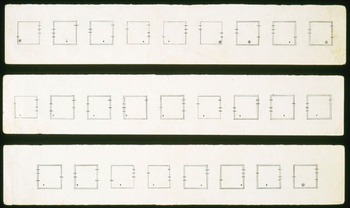
Unlike performances with Voyager, a score is used to guide Tudor’s interactions with the chaotic feedback system. The score for Variations II contains a series of transparent sheets marked with six lines and five dots (Cage Reference Cage1961). Cage instructs performers to superimpose the transparent sheets on one another and draw perpendicular lines from each of the six lines to each of the dots, which are used to determine the pitch/frequency, durations, timbre, amplitude and form of the work (Ibid). For Tudor’s interpretation, he transcribed his version of the score to be able to ‘make all conditions for each event readable at a single glance’ (Pritchett Reference Pritchett2004: 13). In making these transcriptions (what he called ‘nomographs’), Tudor’s nomographs represent a more fixed version of the score, wherein his actions and gestures are, to some extent, predetermined (Figure 1).
David Tudor’s ‘nomographs’ for Variations II. Property of the Getty Research Institute.

Tudor’s performance of Cage’s Variations II presents an example of a graphic score being used in conjunction with a chaotic feedback system. This distinction is significant, as performances involving chaotic systems – particularly in noise music – are frequently characterised by free improvisation.
2.3. Chaotic feedback systems in noise music
Chaotic systems are a common practice in noise music.Footnote 6 As David Novak writes in his study of Japanese noise performance practice,
‘Noisicians (noise musicians) use their electronics to embody the self-destructive imbalances of positive feedback. Personal expression is transformed in conflict with the system…This is not a relationship that creates a balanced sound environment. On the contrary, Noisicians appear to be in the midst of battle with their machines’ (Reference Novak2013: 159).
My electroacoustic practice with chaotic systems seeks to integrate this noise music aesthetic. Tudor’s notion that he ‘could only hope to influence’ (Pritchett Reference Pritchett2004: 14) the chaotic system in Variations II is amplified to the extreme in noise music, when performer’s battle against their chaotic systems. This battle is epitomised in the work of Japanese noise artist Maso Yamazaki, a.k.a. Masonna. For example, on the 1998 album Frequency L.S.D, Masonna used a vocal microphone, an EXPJ Ring Modulator, Colorsound Pedals, a 60s Fuzz Noise Canister, a Spectral Audio Analog Synth, a Sherman Filterbank and a delay effect to create an interactive chaotic feedback system (Masonna 1998). The feedback is modulated by turning pedals on and off, twisting knobs, and – in Masonna’s case – screaming into the system. In performance, noise music is largely improvisatory and rarely uses scores or any type of notation (White Centipede Noise 2024). However, one can still achieve a noise music aesthetic in a notational paradigm through the use of phenomenological open graphic notation.
3. Towards a theory of phenomenological open graphic notation
As previously stated, because interpreting open graphic scores involves free choice and unpredictable elements, it is an ideal method for performing with chaotic interactive systems. Imbuing phenomenological concepts such as the lived body, the embodiment of action and Gestalt theory into open graphic scores allows performers to engage with the notation in a more phenomenological way.
3.1. The lived body
The lived body is central to Merleau-Ponty’s conception of phenomenology (Merleau-Ponty Reference Merleau-Ponty1962). In contrast to the Cartesian view of mind–body duality, Merleau-Ponty posited that the mind and body are one. The body is lived through first-person experience, meaning that ‘all forms of subjectivity may be traced back to the so-called lived body’ (De Sousa Reference De Sousa2018). When interpreting open graphic scores, instrumentalists draw upon their lived bodily subjective experiences to create music. When applied to interactions with chaotic systems and open graphic scores, Merleau-Ponty’s theories on embodiment (Reference Merleau-Ponty1962, Reference Merleau-Ponty1964) suggest that such interactions should be viewed as a form of embodied perception that integrates sensory and motor experience. Embodied perception posits that there is a fundamental link between action and perception (Merleau-Ponty Reference Merleau-Ponty1962). Performing with an open graphic score and a chaotic system can be considered embodied perception with the whole body, as it involves the eyes, ears and the necessary body parts required to play the chosen instrument. These types of embodied interactions have a distinct feel or what Svanæs (Reference Svanæs2013) defines as the feel dimension:
The feel dimension…can be illustrated with examples from everyday technology. When I drive a new car for the first time, the user experience of having taken the car for a drive is the sum of stimuli in a number of sense modalities: visual, auditory, tactile and olfactory. In addition, the drive results in the kinaesthetic experience of actually having driven the car. This is the feel dimension of the user experience: how it feels to drive it. It includes how the car reacts on the steering wheel, brake and gas (Reference Svanæs2013: 16).
Similarly, open graphic scores and chaotic systems have a distinct feel dimension. Both the system and the score’s unpredictable nature invites performers to interact and play with them, which ‘gives rise to a particular “directedness” towards a piece of art’ (Svanæs Reference Svanæs2013:15).
3.2. Embodiment of action
Like abstract art, phenomenological notation is able to embody the ‘experience and an action in itself’ (Rebelo Reference Rebelo2010: 19). To effectively express experience and action, many open graphic scores explore ‘semantic soundness’ or ‘the degree to which the graphical representation makes intuitive sense to the reader’ (Vickery et al. Reference Vickery, Devenish, James and Hope2017: 20). Casey’s statement that a ‘Jackson Pollock painting will usually tend to elicit a busier, more fractured musical response than a Mark Rothko painting’ (Reference Casey2015: 163) illustrates this idea well. Many of Jackson Pollock’s paintings demonstrate his signature action painting techniques where the physical action used to create the work is clear. Using and/or simulating action painting techniques with graphic notation can embody the physical action of the performers’ musical gesture when playing their instrument. In phenomenology, physical action/kinetic movement pertains to the lived experience of motion, emphasising its qualitative dimensions and the ways in which physical movement informs perceptual engagement with the world (Gallagher Reference Gallagher1986). Rather than reducing motion to its mechanical properties, this perspective foregrounds the affective and experiential aspects of movement, examining how it is felt, perceived and meaningfully constituted in human experience (Ibid). The action-based approach to notation is open and ambiguous enough to allow performers to take inspiration from both the score and the sounds produced by the chaotic systems. This is essential because, as previously mentioned, agency emerges through the musical interactions between the performer(s) and the machine to co-create the sound world (Mudd Reference Mudd2023). While a performer could choose to interpret the notation and ignore the output from the chaotic system, having the option to engage and respond to the system’s output is useful as it draws from improvised practices with chaotic systems.
3.3. Interpreting the score as a whole
Casey (Reference Casey2015), in Developing a Phenomenological Approach to Music Notation, examines John Tilbury’s performance of Earle Brown’s December 1952. In performance, Tilbury maps aspects of the graphic score to musical parameters like pitch, duration, articulation, timbre, etc. Casey states that this reading of Brown’s score ‘removes the phenomenal experience that the score, taken as a whole, induces in the viewer’, concluding that, ‘it (the graphic score) is not explicitly a signifier of concepts, actions or objects but a purveyor of affect’ (Reference Casey2015: 201). When perceived as a whole rather than read, open graphic scores can allow performers to further draw on their own phenomenal field (i.e., lived experiences and memories) to relate and respond to the visual stimuli. Perceiving the score as a whole follows Gestalt psychology theory: ‘For the gestaltists, the whole of the experience or the behaviour was always greater than the sum of the individual mental elements or reflexes’ (Baker Reference Baker2012: 575). While both Tilbury’s read approach and Gestalt approach are possible when interpreting open graphic scores like December 1952, the Gestalt approach is unique to open graphic scores. Merleau-Ponty’s statement on matter and form is relevant. ‘Matter is pregnant with form, which is to say that in the final analysis every perception and its horizon is a certain horizon and ultimately in the “world.” We experience perception and its horizon “in action” rather than “posing” them or explicitly knowing them’ (Merleau-Ponty Reference Merleau-Ponty1964: 2). Open graphic notation (as matter) is always imbued with the musical form that emerges from performance. Even though the instrumentalist will likely be unable to distinguish the musical form at first glance (whether that be the form of a section of music or the form of the entire work) it is always present, waiting to be sonified. This suggests that perception is shaped not through explicit analysis but through lived engagement – aligning with the performer’s intuitive response to graphic notation.
Perceiving the score as a whole can be applied to an open graphic score like Earle Brown’s December 1952 where the entire score is visible, or to individual pages or instances of scores. In the latter situation, the abstract graphic notation is perceived as a whole, and this phenomenological experience guides the performer’s realisation of that section of music. A phenomenological interpretation elevates the open graphic score to a level of pure sensorial engagement (Casey Reference Casey2015) that reflects the performer’s interactions with the sound phenomena from the chaotic system. The interpretation of the score as a whole and the interaction with the chaotic system both demonstrate pre-reflective self-consciousness. In phenomenology, pre-reflective self-consciousness refers to an implicit self-awareness that arises before conscious reflection. It suggests that self-consciousness is always present during an experience, even before one explicitly thinks about it (Gallagher and Zahavi Reference Gallagher, Zahavi, Zalta and Nodelman2023). In contrast, reflective self-consciousness occurs after the fact and is not present in the moment of experience. When performing with a chaotic system, a performer does not necessarily have time to reflect on their experiences and interactions with the system. This pre-reflective engagement is heightened when chaotic systems destabilise musical continuity, as is often the case in noise aesthetics. The performer’s lived body, therefore, must continuously engage and respond to the notation and the chaotic system in the moment.
3.4. The phenomenological attitude
To engage with these phenomenological concepts in performance, the performer must adopt a phenomenological attitude. The phenomenological attitude focuses on the subjective experience of phenomena rather than the objective reality of things (Walton Reference Walton2015). By suspending preconceptions about musical interpretation and notation, performers examine the essence and structure of their experiences. To assume the phenomenological attitude, instrumentalists must:
-
(1) Focus on lived experiences.
-
(2) Suspend beliefs.
-
(3) Exercise intentionality in experience.
Focusing on one’s own lived experiences is essential to interpreting phenomenological open graphic notation. This focus closely aligns with Merleau-Ponty’s concept of the lived body, as both are grounded in the performer’s embodied and subjective perception with the score.
When performers suspend their beliefs and assumptions about how to interpret the notation, they enable a more immediate and unmediated encounter with the score. In doing so, performers focus on experiencing the score as it appears to them in their perception rather than as an object to be decoded. This strips the score down to its ‘essence’ as an object to be intentionally experienced.
Here, intentionality in experience means that the performers have a particular directedness towards interpreting the score and performing with the chaotic system. In doing so, the performer assumes an intentional state directed towards the interpretation of the score in relation to the chaotic system (intentional) which has a distinctive conscious feel (phenomenal).
4. Methodology
The following case studies demonstrate the application of three phenomenological concepts to my scores:
-
(1) Emphasis on the lived body.
-
(2) The embodiment of action.
-
(3) The score can be perceived as a whole.
Imbuing open graphic scores with these concepts creates a notation that enables a phenomenological experience that mirrors performing with a chaotic system. Additionally, performer’s testimonials are given to offer insight into their subjective experiences and how they interpreted the scores in conjunction with the chaotic systems. These testimonials reveal how the performers assumed the phenomenological attitude and how they came to interpret and respond to these scores from a phenomenological perspective.
5. Case studies
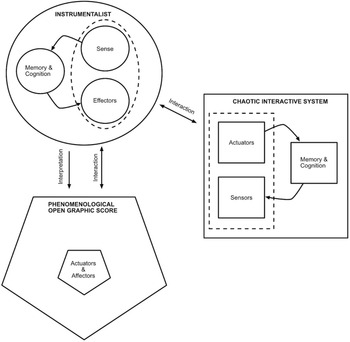
When performing from phenomenological open graphic scores together with a chaotic system, a unique interpretative feedback loop is formed that illustrates the entangledFootnote 7 relationships between the instrumentalist, the score and the chaotic system (Figure 2). This performer interactive system model,Footnote 8 adapted from Drummond (Reference Drummond2009), who in turn adapted it from Bongers (Reference Bongers, Wanderley and Battier2000), incorporates the phenomenological open graphic score, highlighting the multilayered interaction between performer and system. The score contains actuators (which represent the output images) and affectors (which refer to the performer’s subjective experiences). This interpretative feedback loop may be understood as a positive feedback loop, akin to those used in the chaotic feedback systems. The scores featured in the case studies often aim to illustrate this entangled connection by depicting the reciprocal influence and agency of the performer and the chaotic system.
Interpretive feedback loop with the instrumentalist, the chaotic system and the phenomenological open graphic score.

5.1. Instrumentalist Mixer Feedback Transmutation
My compositions generative open graphic score #1 (2023) and noise ritual (2023) route instrumentalists’ microphones into a mixer configured with feedback loops, creating an interactive chaotic system. I refer to this system as IMFT (Hildebrand and Roth Reference Hildebrand and Roth2025). The IMFT system extends the principles of no-input mixing techniques. When routed into the mixer, the instrumentalist’s timbre is distorted, and their musical gestures augment, morph and interact with the behaviour of the mixer feedback (Hildebrand Reference Hildebrand2023b).
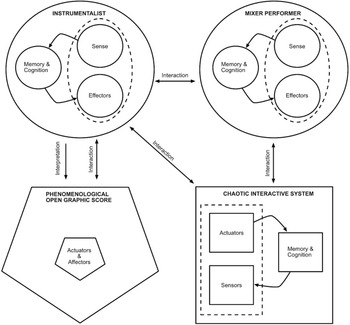
In these works, another performer operates the mixer, adding another level of interaction to the system. Both performers can manipulate the sounds of the feedback and musically influence one another. For example, the mixer performer can alter feedback parameters, which can also be influenced by the instrumentalist’s gestures. This creates a dynamic performance situation where the mixer performer and the instrumentalist can battle against one another, or cooperate. The mixer’s semi-autonomous behaviour creates a trio situation involving the instrumentalist, the mixer performer and the mixer feedback itself. In generative open graphic score #1, the mixer performer is responsible for controlling the graphic score and its changes in real time. Instead of interpreting the score directly, the mixer performer is instructed to react to the sounds of the feedback and the instrumentalist and improvise freely in response. This approach further intensifies the interpretative feedback loop (Figure 3).
Interpretative feedback loop with IMFT.

5.2. Notation and interpretation in generative open graphic score #1
The score for generative open graphic score #1 was created in the software program TouchDesigner.Footnote 9 The TouchDesigner score patch ‘uses instancing to create copies of rectangles, circles, and triangles that can be placed in specific areas on a grid allowing users to endlessly generate new seeds/score pages…The geometric shapes and grids can be hidden, blurred, and abstracted to create a multitude of generative shapes ranging from simple and smooth to complex and jagged’ (Figures 4 and 5; Hildebrand Reference Hildebrand2023b: 20). The primary aim of developing a generative score in TouchDesigner was to create a phenomenological notation that mirrors the instrumentalist’s engagement with the unpredictable and dynamic IMFT system. This score patch facilitated the creation of abstract images imbued with the three phenomenological concepts discussed in Section 4.
Score extract from generative open graphic score #1.

Score extract from generative open graphic score #1.

The notation simulates action painting techniques, endowing the score with a sense of kinaesthetic dynamism that emphasises the action of musical gestures through the performer’s lived body. The instructions for generative open graphic score #1 state that ‘while the solo instrumentalist may interpret the graphic symbols however they see fit, the gestures, sounds, and aesthetic should reflect the noisy, unpredictable nature of the electronics’ (Hildebrand Reference Hildebrand2023a). This creates a notational system where the performer is free to employ a read interpretation, where the score is semiotically decoded, or a Gestalt interpretation where the score is perceived as a whole. As with Tilbury’s approach to December 1952, instrumentalists have taken a read approach to interpretation where there is a one-to-one correspondence between the graphic notation and a musical gesture. For example, a performer interprets three dots as three distinct sounds, with height corresponding to frequency. This is potentially more accessible for performers with little experience interpreting open graphic notation. However, a phenomenological mode of engagement emerges when the performer apprehends the score as a whole, facilitating a pre-reflective self-consciousness that grounds embodied perception and interpretation. In doing so, the performer does not reflect on the notation or sounds of the chaotic system, but rather perceives, experiences and interacts with them in the moment. The absence of textual instructions allows performers to respond more directly and intuitively to the visual stimuli, so they may engage more fully in a direct, phenomenological response, focusing on their immediate perception of the images.
generative open graphic score #1 was most recently performed and recorded by Colin Fisher on soprano and sopranino saxophone. Fisher is an improvising saxophonist who has extensive experience interpreting various types of experimental notation. On interpreting the work Fisher states that:
‘The embodied phenomenological response to Nolan’s work was very unique. Rather than it being tethered to rigid prescriptive parameters, the flow of the score was felt and received in a much different way. As opposed to eliciting a specific response, I felt the freedom to have a particular relationship with images in which a prismatic index of gestures felt available at any given moment in response to what a particular image elicited in this open circulation of impressions and its relation to musical gesture’ (Colin Fisher, personal correspondence, May 2025).
Fisher’s statement illustrates a phenomenological interpretation of generative open graphic score #1. By taking an embodied approach to engagement with the score, Fisher focuses his intentionality and directs it at interpreting the score and playing with the chaotic system. This embodied approach emphasises his lived body/subjective lived experiences. For Fisher, the feel dimension of the score was defined by its freedom and flow which allowed him to respond in a multitude of ways. This freedom reflects the phenomenological attitude where ‘one must acknowledge that there are many ways to experience and describe the multi-dimensional meaning of the world’ (Walton Reference Walton2015). Fisher demonstrates a suspension of belief in that he does not have a preconceived notion of how to interpret the score but instead reacts to the different images with an open ‘index of gestures (that) felt available at any given moment’. Each time a new image appears, it is interpreted in the moment, anew. This also demonstrates how the notation contains latent musical potential that emerges through performance and is always ‘pregnant with form’ (Merleau-Ponty Reference Merleau-Ponty1962) waiting to be discovered.
In performing on the mixer together with Fisher in generative open graphic score #1, I was able to see and hear how he responded to the notation and the IMFT system. In rehearsal, I explained the phenomenological aspects of the score and Fisher immediately understood how to approach interpreting the score. In performance, the unique interpretative feedback loop was manifested in the dynamic interaction between the performers, the score and the IMFT system.
5.3. Notation and interpretation in noise ritual
noise ritual (2023) is a composition for percussionists and the IMFT system. It was first performed by Toronto-based percussion duo Duo Cichorium. The outputs of both percussionists were routed into a single mixer (played by myself), along with two feedback loops.
The score was created by hand with ink and paper, digitised, translated into vector graphics and then arranged into a fixed video score. The changes in the IMFT system are both triggered and manipulated by the mixer performer who follows the score video and responds to the percussionists’ musical gesture. Unlike generative open graphic score #1, the graphic score used in noise ritual has a clear form. The goal of the fixed video score was to see how the IMFT system would work in a predetermined musical form. Composing a predetermined form exercises more intentionality in chaotic systems which are often rooted in improvisation. However, by integrating concepts from phenomenology, scores with predetermined forms can still elicit spontaneous musical performances and phenomenological responses from instrumentalists.
The score uses alchemist, pagan, and wiccan symbols, original graphics, and text prompts that inspire a phenomenological interpretation. The symbols, although not defined in the score, carry an aura of mystic esotericism, evoking a ritualistic or arcane aesthetic. The distinct feel dimension within the symbols used has the ‘capacity to shape the viewer’s qualitative experiences without any necessary conceptual overlay’ (Casey Reference Casey2015:166). Together with the title of the work, the symbols used create an ineffable experience that influences the instrumentalists’ musical decisions. On the feel dimension of interacting with the phenomenological score and IMFT system in noise ritual, Louis Pino of Duo Cichorium states that ‘the impression it gives me is that it goes from primal searching to ritual worshipping which correlates to performance energy. The energy goes from frantic, chaotic, and desperate to calm, processional, and controlled’ (Louis Pino, personal correspondence, May 2025).
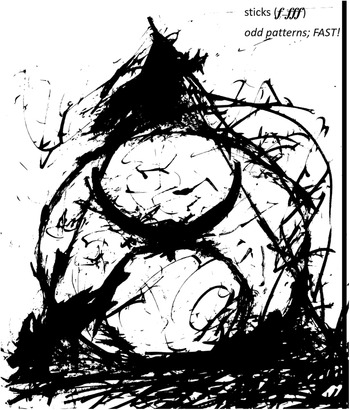
The first section of the score features splattered scribbles (Figure 6) with the text prompts ‘chaotic, angular, and formless’ to describe the desired musical texture. Creating this score by hand allowed me to use action painting techniques to embody the images with kinaesthetic action and movement. These graphics reflect the movement between performer’s lived body and their instruments in that the splattered scribbles can be intuitively interpreted as a whole.
Score extract from noise ritual.

Throughout the beginning of the piece, the chaotic scribbles gradually transform into the alchemist symbol for Magnum Opus (Figure 7). As the shapes become more defined, the performers are instructed to become more structured in their playing. The full formation of the Magnum Opus symbol coincides with a musical climax, where the performers are instructed to play fast odd-pattern groupings. Pino states that this transition from ‘formlessness to form; correlates to time and gesture’ where ‘time and gestures go from shaky and unstable; to rooted and held out’. Here, the performers are instructed to play what they see in an abstract way where the fully formed Magnum Opus symbol illustrates a more defined musical gesture. The performers do not decode the score analytically but apprehend the image as a whole, using it as an intuitive prompt to influence the fast odd-pattern groupings, which guides their actions in performance with the IMFT system. In doing so, the performer focuses on their dynamic experience and perception of the phenomena as opposed to perceiving the score as a static object.
Score extract from noise ritual.

Pino states that ‘In terms of personal experience, the rehearsal process was about figuring out how to engage with the score, and in performance it ends up being mostly about performing/listening. Especially with the no-input mixer, my main goal in performance was to hear when the no-input mixer was responding to me and try to play off of that’. Pino’s reflection illustrates how, even after discovering how to engage with the score, the unpredictable interactions with the IMFT system in performance forced him to suspend his preconceived notions of how to interpret the score. Therefore, the flexibility of the phenomenological notation allowed Pino to react to the volatile interactions with the IMFT system. Simultaneously, the fixed form of the score allows the music to maintain a perceptible structure.
Like Fisher, Pino has extensive experience interpreting experimental and graphic types of notation. The first rehearsals of noise ritual involved discovering how to interact with the score and experimenting with different instrument timbres, whereas later rehearsals focused on how to interact with both the score and the IMFT system. Pino’s phenomenological approach to interpreting the score therefore demonstrates how phenomenological open graphic notation allows for a structured yet flexible means of guiding the interaction together with chaotic systems.
5.4. Chaotic sampling in Raw Data Speed Demons
Raw Data Speed Demons (2025) is a composition for violin and interactive electronics. The electronics employ digital signal processing and chaotic sampling in the computer software program Max/MSP. The chaotic sampling occurs in three specific sections of the work titled ‘Raw Data Speed Demons 1-3’. In these sections, the amplitude of the violin input triggers random, non-linear sample changes in a sampler that stores over one hundred noisy raw data sonification samples. Due to a low amplitude threshold, sample changes occur rapidly. Additionally, the selected raw data samples are re-tuned to match the pitch of the violin input and the violin amplitude also ‘plays’ a virtual drum kit.
To establish a real-time interactive dynamic between performer and system, the violinist is instructed to mimic the sampler’s gestures. For example, the sampler may play a raw data sample that is a single high-pitched repeating attack, which the violinist can mimic. However, attempting to mimic this gesture could trigger a new sample before completion. The violinist then responds to what was previously heard, creating a perceptible dialogue between themselves and the computer. Although the performer must reflect on the sounds of the chaotic sampler in order to mimic them, rather than deeply reflecting on these sounds, the act remains situated in the moment, much like the spontaneous responses of musicians improvising together. While the computer is ‘listening’ to the performer, it is not making decisions like Lewis’ Voyager system for example (Steinbeck Reference Steinbeck and Steinbeck2022). Instead, the computer’s programmed behaviour is performed with a robotic and inhuman confidence which can feed and inform the instrumentalist’s decisions in powerful ways (McNutt Reference McNutt2003: 303).
5.5. Notation and interpretation in Raw Data Speed Demons
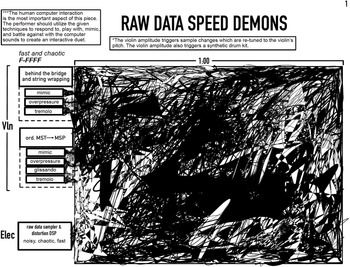
The score for Raw Data Speed Demons uses open graphic notation with text prompts that describe the musical output and indicate the violin techniques to be used. These violin techniques were chosen to correspond to the desired sound world. The score was designed to visually reflect the sonic characteristics of the music with the goal to create a clear, pre-planned form. For example, the first page of the score features chaotic scribbles and tangled monochrome shapes that visually embody the erratic nature of the chaotic sampling and the complex interactions between the violin and the computer (Figure 8).
Score extract from Raw Data Speed Demons.

Unlike the action painting techniques used in the previous works, the technique for creating the graphic notation (on an iPad with a stylus pencil) for Raw Data Speed Demons was more akin to automatic drawing. Automatic drawing is conceptually linked to automatism in physiology, which refers to the unconscious and unknowable bodily functions discussed earlier (TATE 2025). Like action painting, automatic drawing similarly embodies the physicality of the performer’s interaction with the chaotic system. By illustrating the interactions, the notation draws clear connections to the performer’s lived body. Here, the lived body reacts to the sonic sensations from the chaotic sampler as the individual perceives the score.
Raw Data Speed Demons was written for violinist Roan Ma. This was Ma’s first time interpreting a score of this nature. On performing the work, Ma states:
‘The score of Raw Data Speed Demons looks like a piece of artwork, and is interpreted by the violinist almost with synesthesia: what is seen visually must first be interpreted emotionally, and that in turn is then represented with sound. For me, the intensity of darkness in the score represented intensity of sound; darker images called for denser, heavier sounds whereas lighter sections with more blank space represented sparser sound worlds. Although absorbing each page as a whole is what most directly informed my interpretation of the page, I also roughly read each section from left to right, with the horizontal axis indicating time.
There is not enough time during an actual performance or play-through of the piece to make conscious musical decisions. During the busier sections of the piece, the electronic sounds changed at a very rapid rate and I was flooded with a plethora of different sounds all at once. This meant that I typically had to quickly select and mimic one of the electronic sounds that I heard, staying with it for a while before mimicking another sound. This process did not involve much rationalisation or logical thought. Rather…my choice in timing of any specific gesture that I played was done intuitively’ (Roan Ma, personal correspondence, May 2025).
By interpreting the score emotionally, Ma focuses on her intentional relation and subjective experiences with the score and chaotic system and interprets the score phenomenologically. At the same time, she reads the score from left to right which seems to contradict the phenomenological approach of taking in the score as a whole. However, in the ‘Raw Data Speed Demons 1’ (Figure 8), the visual density makes parsing individual gestures virtually impossible. At this level of complexity, the score (or section of the score) is perceived as a whole, rather than isolating specific gestures from the dense visual web of notation. The kinetic movement of ‘Raw Data Speed Demons 1’ embodies the movement that occurs when Ma plays the violin and informs her perceptual engagement with the score and chaotic system. Here, the affective and experiential aspects of movement form meaningfully through Ma’s subjective lived body.
Ma’s statement that ‘there was not enough time…to make conscious musical decisions’ demonstrates the in-the-moment pre-reflective self-consciousness that occurs with the chaotic system. This also shows how the unpredictability of the chaotic system forces Ma to suspend her preconceived notions of how to interpret the score even after discovering how to engage with it. The subjective feel dimension of the score here is illustrated when Ma says ‘during the busier sections of the piece, the electronic sounds changed at a very rapid rate and I was also flooded with a plethora of different sounds all at once’. This describes a feeling of overwhelm at the speed and excess of the raw data samples. Therefore, the inhuman nature of the chaotic sampler forced Ma to suspend her beliefs on how interaction with a machine is meaningfully formed.
Rehearsals consisted of discovering how to simultaneously engage with both the score and chaotic system in a meaningful way. Because this was Ma’s first time performing a piece of this nature, in order to assume a phenomenological attitude, she had to question her belief that notation is an object to be decoded. This transition from rational pre-planning to spontaneous interpretation reflects the shift from a reflective to a pre-reflective mode of engagement, where the performer’s embodied intentionality and lived experience guide their interaction with the score and the chaotic system in real time.
6. Conclusion
The works discussed in this paper – generative open graphic score #1, noise ritual and Raw Data Speed Demons – demonstrate how phenomenological open graphic scores function within chaotic systems in interactive electroacoustic music with live performers. The open graphic scores discussed here resist codified semiotic readings in favour of intuitive, embodied responses. The deployment of action-based visual languages and automatic drawing techniques invites performers to interpret these scores through pre-reflective engagement. This approach aligns closely with Merleau-Ponty’s phenomenology of perception. Testimonies from performers further suggest that such scores elicit distinctive affective and kinaesthetic experiences, reinforcing the view that notation can shape, rather than simply document, the interactive field of performance. Drawing on key phenomenological concepts – namely, the lived body, the embodiment of action and the perception of the score as a whole – this approach situates open graphic notation as a site of encounter where visual, sonic and embodied modalities converge. Imbuing open graphic scores with these concepts allows performers to assume a phenomenological attitude and in turn a more phenomenological interpretation.
Central to this investigation is the notion of an interpretative feedback loop, in which performers dynamically respond to, influence and are influenced by both the score and the emergent behaviours of chaotic electronic systems. This feedback loop mirrors the recursive logic of chaotic processes themselves, particularly in systems like the IMFT, which complicate agency by embedding performers within unstable and co-constitutive sonic networks. Rather than functioning solely as a prescriptive guide, the score becomes an active agent in performance that is pregnant with form, yet indeterminate in outcome.
Moreover, this research contributes to broader discourses surrounding notation, performer agency and machine interactivity in electroacoustic contexts. The inclusion of chaotic feedback circuits foregrounds instability, resistance and surprise as creative affordances. In this setting, phenomenological open graphic notation not only mediates but amplifies these affordances by encouraging multiplicity in interpretation and emphasising the perceptual experience of the performer.
Supplementary material
The supplementary material for this article can be found https://doi.org/10.1017/S1355771825100666.




 Open access

