





Introduction
Invasive mold infections (IMI) cause substantial morbidity and mortality among patients hospitalized with hematologic malignancies and stem cell transplant (SCT) recipients yet also impact other individuals including surgical patients. Reference Pana, Roilides, Warris, Groll and Zaoutis1–Reference Hariri, Genoud and Bruckert6 Environmental controls including high-efficiency particulate air (HEPA)-filtration are important for limiting exposure to airborne mold spores among vulnerable patients in healthcare settings. Reference Marek, Meijer and Tartari7,8 Sampling for airborne fungi has been utilized as a supplement to environmental controls during periods of major construction activity or outbreaks. Reference Marek, Meijer and Tartari7,Reference Kanamori, Rutala, Sickbert-Bennett and Weber9 The utility of such environmental sampling during other times of routine hospital operations, however, is unclear due to several limitations. Thresholds beyond which elevated levels of airborne mold spores increase IMI risk are unknown, Reference Marek, Meijer and Tartari7,8,Reference Morris, Kokki, Anderson and Richardson10 and transient spore bursts may not be captured by periodic testing. Reference Falvey and Streifel11,Reference Rupp, Iwen, Tyner, Marion, Reed and Anderson12 In addition, it is challenging to determine whether individual IMI cases should be attributed to healthcare exposures given the absence of standardized surveillance definitions and uncertain incubation periods. Reference Nicolle, Benet and VanHemes13 Consequently, practices regarding measurement of airborne fungal loads (AFL) and surveillance for IMI vary widely among infection prevention (IP) programs at U.S. hospitals. Reference Gold, Jackson, Glowicz, Mead and Beer14
Since late 2018, our hospital has conducted routine monthly sampling to monitor the viable AFL on units with the most vulnerable patients. Testing was started in preparation for an extended maintenance project on the ventilation system requiring intermittent closures of clinical areas from June 2019 until August 2020. Following that work, regular air sampling was continued due to perceived benefits. Additionally, our IP department has conducted standardized facility-wide surveillance for IMI since before starting routine air sampling. We now report this experience with AFL monitoring and IMI surveillance.
Methods
Study setting
We conducted a retrospective ecological study of AFL in the healthcare environment and IMI cases at a 490-bed tertiary-care pediatric teaching hospital in Texas, USA. The hospital includes eleven units identified as caring for patients at highest risk for IMI: two pediatric intensive care units, one cardiac intensive care unit (CICU) with an adjoining step-down unit, three neonatal intensive care units (NICU), and a hematology/oncology program with four inpatient units including a positive-pressure SCT unit. Ventilation for these units is provided by air-handling units equipped with central HEPA-filtration.
AFL measurement
Regular air sampling for fungal cultures was conducted approximately monthly as detailed in the Supplemental Materials. Average AFL values were calculated by unit and facility-wide for each collection date. Because sampling dates were irregularly spaced, average monthly AFL was estimated by linear interpolation to generate daily AFL values for dates between measurements and then averaging daily values over the calendar month.
IP program responses to AFL findings
The initial framework used for interpreting and managing AFL results considered both total and opportunistic fungal pathogen levels. Each unit was assigned into an action response category based on these values and the thresholds in Table 1.
Action categories for IP management of AFL results during the study period

AFL, airborne fungal load; CFU, colony forming units.
Notes. These categories and thresholds applied specifically to AFL measurements obtained on HEPA-filtered units housing patients at high risk for invasive mold infection. The framework for characterizing the air sampling data described above was initially developed to guide the priority and type of follow-up actions during and specific to the HVAC system maintenance project. The same framework was later employed to guide routine IP responses to continued AFL surveillance in the absence of other established standards.
IMI surveillance
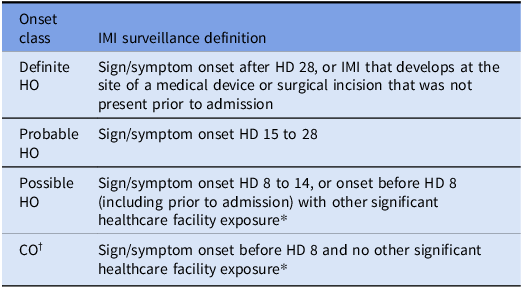
We reviewed IMI surveillance data for January 2018 to December 2023. The IP department conducted facility-wide surveillance for IMI as described in the Supplemental Materials. Cases were classified as proven, probable, or possible IMI based on published criteria. Reference Donnelly, Chen and Kauffman15 After these criteria were updated in 2020, IMI surveillance from earlier years was reviewed for agreement with the revised definitions. Cases were furthermore classified as definite, probable, or possible hospital-onset (HO) or community-onset (CO) based on timing of sign/symptom onset using criteria in Table 2. Infections with Candida species and other yeast-like fungi such as Trichosporon were excluded from surveillance. Endemic mycoses were retained within the surveillance, but all cases of endemic mycoses were classified as CO since reactivation can occur months or years after exposure. Reference Miller and Assi16
Surveillance definitions for IMI onset classification

IMI, invasive mold infection; HO, hospital-onset; CO, community-onset; HD, hospital day
* Other significant healthcare facility exposure was defined as ≥ 1 hospitalization or ≥ 2 outpatient visits during the month prior to sign/symptom onset.
† Endemic mycoses including infections with Histoplasma or Coccidioides were always considered to be CO in keeping with National Healthcare Safety Network guidance, 22 but otherwise the same definitions applied to all mold species.
Statistical analysis
Categorical variables were expressed as counts or percentages, whereas continuous variables were described using means, medians, and percentile ranges. Fisher’s exact test was used to compare proportions, and continuous variables were analyzed using the Mann-Whitney U test. Poisson regression with an offset of ln(10,000s of patient days) was used to analyze the association between monthly AFL and IMI rates, for interrupted time series analyses, and to calculate IMI rate ratios. AFL values were also categorized and the chi-square test for trend was used to assess the association with IMI rates. Poisson regression was conducted using SAS Enterprise Guide version 7.15 (Cary, NC, USA). Other statistical analyses were performed using GraphPad Prism version 10.2.3 (San Diego, CA, USA). A two-sided alpha threshold of 0.05 was used to assess statistical significance.
Human subjects
The Human Research Protection Program at the University of Texas Southwestern Medical Center, which has oversight of research at all facilities within our health system, determined that this project did not meet the definition of human subjects research.
Results
AFL measurements
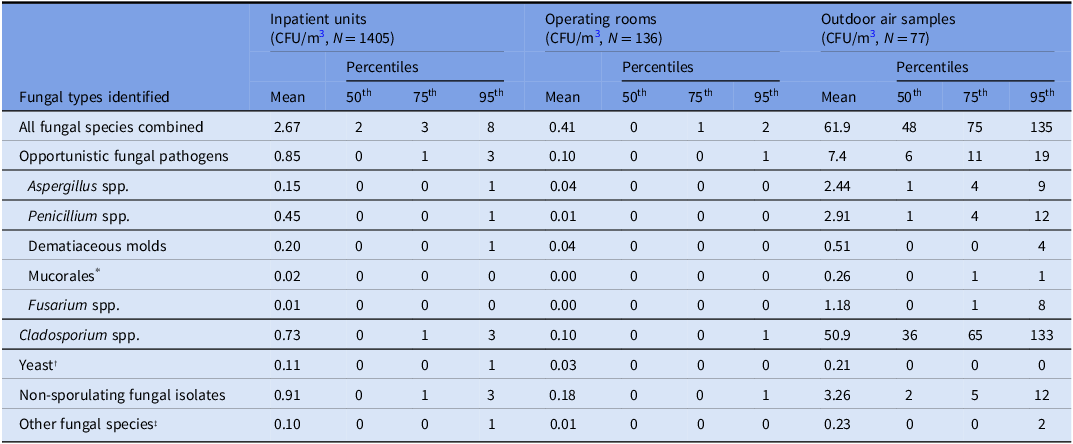
Concentrations of airborne fungi measured in inpatient units, operating rooms, and outdoor air samples are shown in Table 3. The median total AFL for occupied inpatient units (2 CFU/m Reference Lehrnbecher, Schöning and Poyer3 ) was lower than in outdoor air (48 CFU/m Reference Lehrnbecher, Schöning and Poyer3 , P < .0001) but higher than in the operating rooms (0 CFU/m Reference Lehrnbecher, Schöning and Poyer3 , P < .0001). The same pattern was seen for the AFL of opportunistic fungal pathogens. Most colonies of airborne fungi in outdoor samples were Cladosporium spp., which were also common among isolates from inpatient units. The most frequent airborne fungal pathogens identified from inpatient units were Penicillium spp., followed by dematiaceous molds and Aspergillus spp. AFL measurements fluctuated sharply over even short intervals (Figure 1) but seasonal patterns were not evident. Histograms showing complete frequency distributions of AFL measurements are in Supplemental Figure S1. Monthly AFL values for fungal pathogens were only slightly higher during the ventilation system maintenance project than during the remainder of the study period for facility-wide measurements (median 0.79 [IQR 0.53–1.93] vs 0.59 [IQR 0.42–0.91] CFU/m Reference Lehrnbecher, Schöning and Poyer3 , P = .07) and for units caring for hematology/oncology patients (median 0.79 [IQR 0.44–1.09] vs 0.54 [IQR 0.36–0.78] CFU/m Reference Lehrnbecher, Schöning and Poyer3 , P = .11).
Abundances of fungi identified in surveillance air cultures

* For Mucorales, colony counting may underestimate the number of these organisms present in a specimen due to the predilection for rapidly spreading across plates. For comparison, Supplemental Table S3 gives percentages of cultures positive at any level for each category of fungi and confirms that Mucorales isolates were rare in indoor samples.
† Includes yeast, which were not further identified, and yeast-like fungi such as Geotrichum spp.
‡ Other fungal species represent infrequently identified organisms, including some considered opportunistic pathogens and others categorized as non-pathogens as described in Supplemental Materials.
Notes. Data presented are descriptive statistics for all individual surveillance air cultures from the given areas. All inpatient units sampled were equipped with HEPA-filtration.
AFL and IMI by month for (A) facility-wide measurements, (B) hematology/oncology, and (C) cardiac units. Solid lines show AFL of opportunistic fungal pathogens. Bars indicate numbers of probable or proven IMI cases per month that were classified as probable or definite HO (solid black bars), possible HO (diagonal stripes), or community-onset (open white bars). AFL, airborne fungal load; IMI, invasive mold infection; HO, hospital-onset.

IMI case surveillance
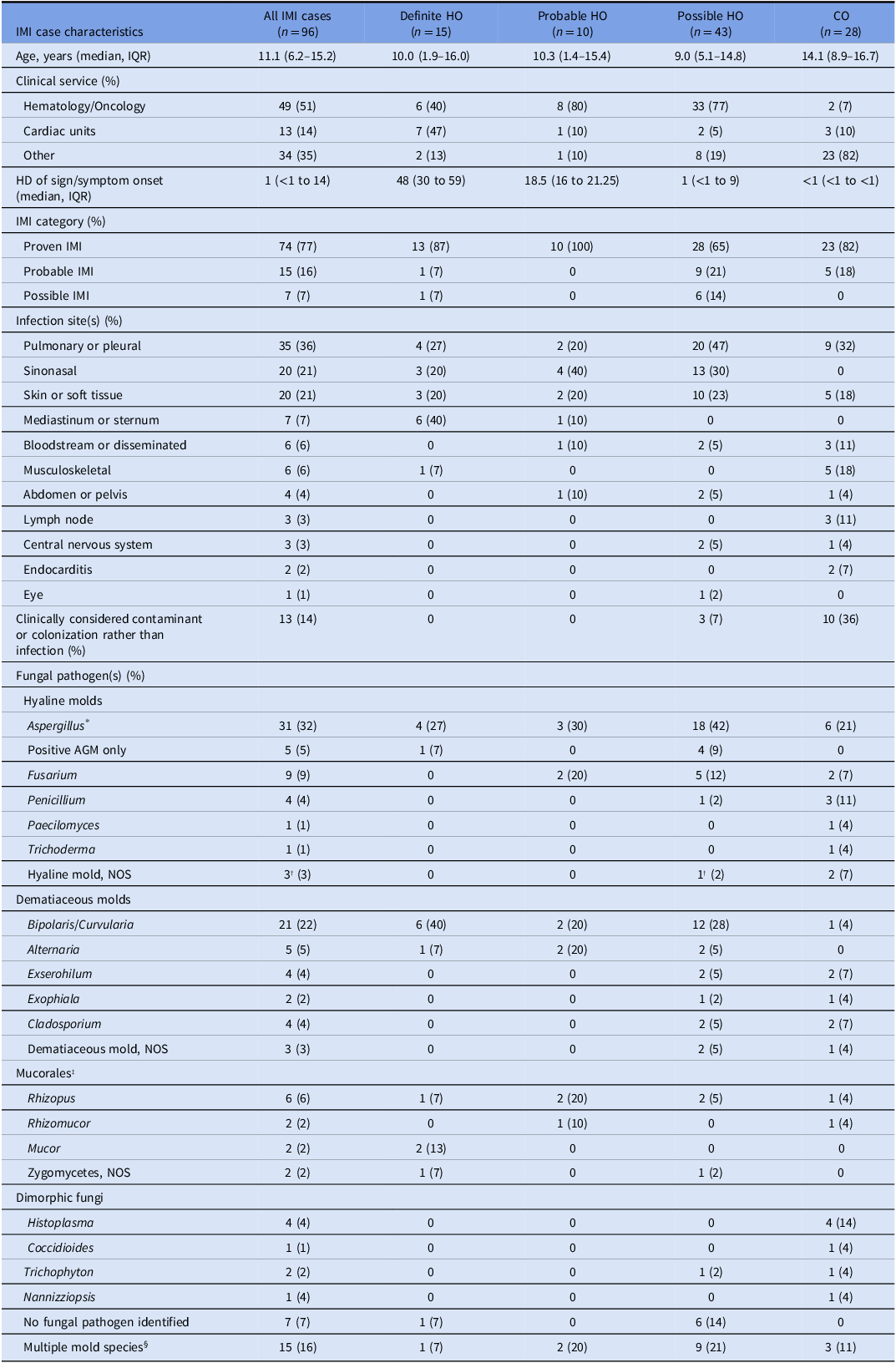
From January 2018 until December 2023, 96 cases of possible, probable, or proven IMI were identified (Table 4) of which 78 occurred during the period of AFL monitoring. Time to sign/symptom onset ranged from before admission to HD (hospital day) 151. Most cases were on the hematology/oncology service (including SCT recipients), but 13 cases occurred in cardiology patients, including 8 infections classified as probable or definite HO. Among cardiology patients, all HO IMI cases occurred in post-surgical or heart transplant patients. IMI cases resulted from a wide range of pathogens, with Aspergillus identified from only 32% of infections (Table 4). Hematology/oncology cases predominately affected the respiratory tract with pulmonary, pleural, or sinonasal infections, whereas those in the cardiac population frequently involved the mediastinum, sternum, or heart (Table S1). Although patients on all other services collectively accounted for 34 IMI cases, most of these infections qualified as CO with very few being probable or definite HO (Table 4). Unlike the hematology/oncology or cardiology cases, a substantial number of these other cases were evaluated by clinicians as likely representing a contaminated culture or fungal colonization rather than invasive infection (Table S1). We therefore focused particularly on the hematology/oncology and cardiology populations during subsequent analyses aimed at understanding healthcare-associated infections.
Characteristics of patients with IMI by onset class

IMI, invasive mold infection; HO, hospital-onset; CO, community-onset; IQR, interquartile range; HD, hospital day; AGM, Aspergillus galactomannan; NOS, not otherwise specified.
* Including cases with positive AGM testing only.
† Including one isolate identified as Penicillium/Paecilomyces.
‡ Including isolates identified only as Zygomycetes, which could represent species other than Mucorales.
§ Isolates from cases with multiple mold species are also listed separately with the individual molds identified.
Monthly average AFL and IMI rates
To examine potential relationships between AFL measurements and healthcare-associated IMI, we limited analyses to cases of proven or probable IMI. Reflecting our surveillance process that relied largely on reports of fungal culture results and histopathology findings, these IMI cases represented 93% of the total infections identified. Overall, there were 51 cases of probable or proven IMI that were considered potentially healthcare-associated (i.e., possible, probable, or definite HO) during the AFL monitoring period. These HO categories were combined for subsequent analyses unless otherwise noted.
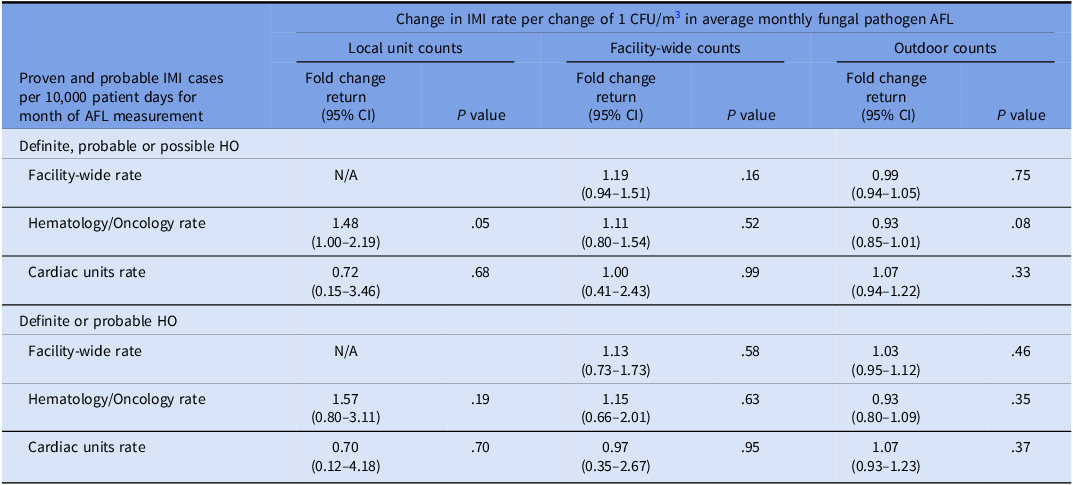
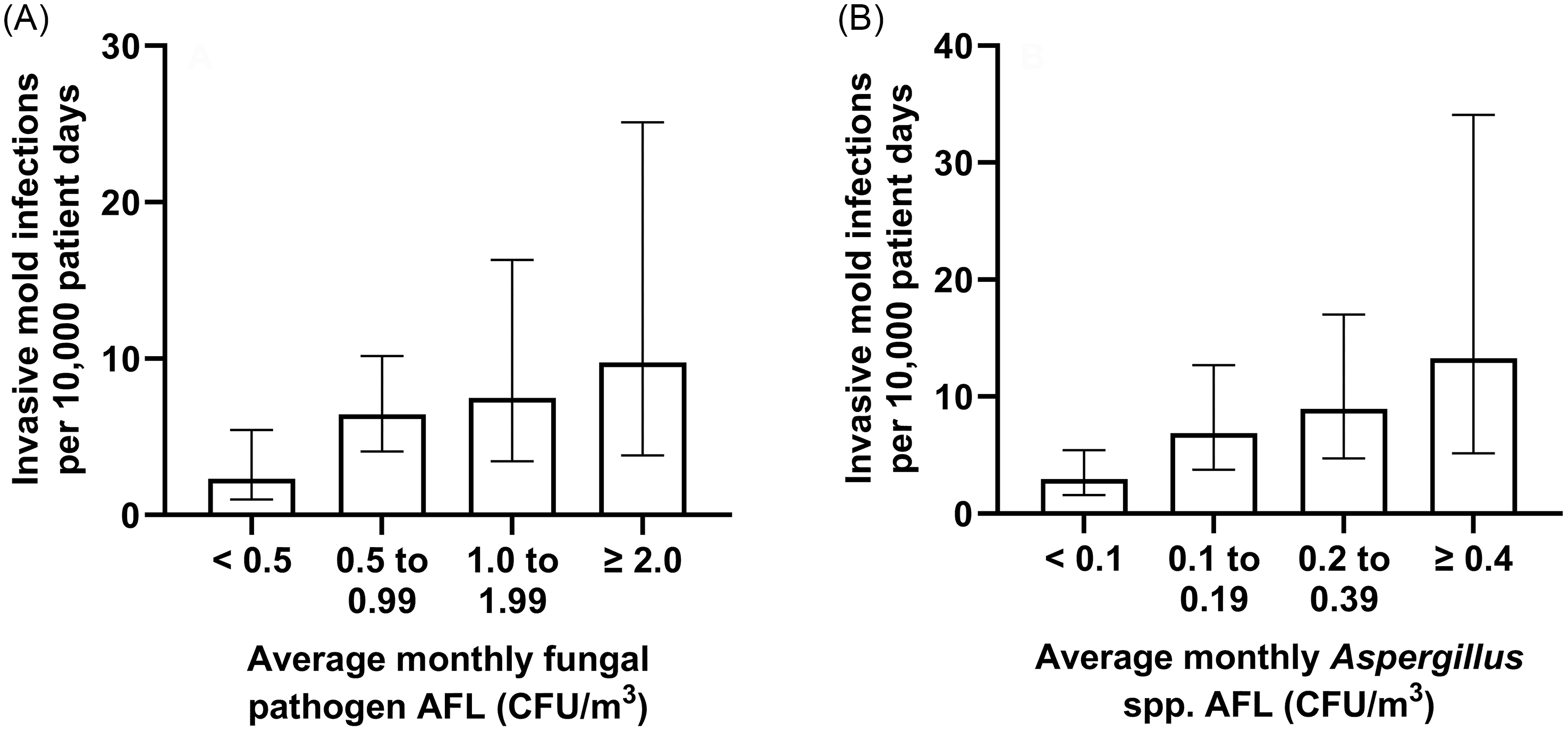
There was not a significant association between the average monthly AFL and the IMI rate when examined at the facility-wide level (Table 5). For hematology/oncology patients, an increase of 1 CFU/m Reference Lehrnbecher, Schöning and Poyer3 in the average monthly AFL for opportunistic fungal pathogens on the units where these patients receive care was associated with a 1.48-fold (95% CI 1.00–2.19, P = .05) increase in the IMI rate. In contrast, there was not a significant change for cardiac patients. The hematology/oncology IMI rate ranged from an average of 2.3 cases per 10,000 patient days (95% CI 1.0–5.4) during months when the local unit pathogen average AFL was less than 0.5 CFU/m Reference Lehrnbecher, Schöning and Poyer3 up to an average of 9.8 cases per 10,000 patient days (95% CI 3.8–25.1) when the average pathogen AFL was 2.0 CFU/m Reference Lehrnbecher, Schöning and Poyer3 or greater (Figure 2A, chi-square test for trend P = .02). As a control for the temporal relationship between AFL and IMI events, we found that there was not a significant association between the hematology/oncology IMI rate for the prior month and the local unit AFL for the following month (1.36-fold change for an increase of 1 CFU/m Reference Lehrnbecher, Schöning and Poyer3 [95% CI 0.89–2.10, P = .16]).
IMI rates and monthly opportunistic fungal pathogen AFL

IMI, invasive mold infection; AFL, airborne fungal load; CFU, colony forming units; HO, hospital onset.
Notes. All rates are calculated based on combined numbers of proven and probable IMI cases. Local air pathogen counts for the hematology/oncology population include those taken on inpatient hematology/oncology floors, stem cell transplant unit, and pediatric intensive care units. Local air pathogen counts for the cardiac population were limited to those taken in the CICU as samples were not collected on the acute care cardiology floor.
Rates of invasive mold infections among hematology/oncology patients during months when the average AFL on units where these patients received care was in the indicated ranges for (A) opportunistic fungal pathogens, and (B) Aspergillus species. Chi-square test for trend for panel A, P = .02; and for panel B, P = .001. Bars indicate average rates and error bars show 95% confidence intervals. AFL, airborne fungal load; CFU, colony forming units.

The types of fungi identified from the air affected the association with IMI (Supplemental Table S2). The local average AFL for Aspergillus species showed a strong association with the hematology/oncology IMI rate (15.9-fold elevation for an increase of 1 CFU/m Reference Lehrnbecher, Schöning and Poyer3 [95% CI 2.8–90.1, P = .002]). Figure 2B shows the increase in this IMI rate with even low levels of average airborne Aspergillus. The AFL for pathogens excluding Aspergillus also appeared to retain a borderline association with the hematology/oncology IMI rate. This association was strengthened when a combined IMI rate was calculated for the month of the AFL measurement plus the following month (1.42-fold elevation per increase of 1 CFU/m Reference Lehrnbecher, Schöning and Poyer3 [95% CI 1.04–1.95, P = .03]). When non-pathogens were included, however, no association was seen between total AFL on local units and the hematology/oncology IMI rate.
Because outdoor air quality might influence AFL on inpatient units and exposure before admission could contribute to later development of IMI, we examined whether IMI rates were associated with AFL measured in outdoor air samples. AFL readings in outdoor air, however, did not positively correlate with indoor values (Figure S2). Consistent with this finding, associations between IMI rates and AFL measured outside the hospital were not similar to those seen for indoor AFL values (Table 5 and Supplemental Table S2).
To examine further the relationship between AFL and IMI rates, we conducted sensitivity analyses limiting the IMI rate to definite or probable HO cases (Table 5). The magnitude of association with AFL on local units was similar for hematology/oncology patients, but confidence intervals were wider reflecting the smaller number of cases.
Discussion
These results provide preliminary evidence for an association between fungal pathogen AFL and the rate of healthcare-associated IMI among pediatric hematology/oncology patients. Our findings contrast with the conclusions of previous investigators Reference Marek, Meijer and Tartari7,Reference Falvey and Streifel11,Reference Rupp, Iwen, Tyner, Marion, Reed and Anderson12 who have questioned the utility of AFL monitoring during routine operations for predicting invasive aspergillosis (IA) among immunocompromised patients at hospitals with good environmental controls including HEPA-filtration. Other studies have reported associations between AFL and IA but have been limited by conflicting results among different units and observation periods Reference Alberti, Bouakline and Ribaud17 or very small numbers of IA cases. Reference Gheith, Ranque and Bannour18 Our use of frequent AFL measurements and systematic IMI surveillance with consistent methodologies over an extended period may have facilitated finding an association.
Several factors may also have contributed to the frequency of IMI events and increased the ability of our study to identify this association. Routine evaluation for fungal infection in patients with prolonged febrile neutropenia at our hospital includes nasal endoscopy even in the absence of sinus symptoms. This practice was previously reported to increase identification of fungal infections Reference Cohn, Pokala and Siegel19 and likely contributed to the high frequency of sinonasal infections among oncology patients. In addition, the cardiac service at our hospital manages a high volume of critically ill patients including a large pediatric heart transplant program. Delayed sternal closure and bedside invasive procedures are often required in this population and may increase risk for IMI.
Although extended maintenance on the ventilation system was the impetus for starting regular environmental monitoring, AFL measurements during the maintenance project were only marginally higher than at other times, and infection rates were not appreciably different (Figure S4). Units were closed and barricaded during the work, with their ventilation systems isolated from the rest of the hospital where AFL measurements were taken. The results of this study therefore reflect the impact of AFL surveillance under conditions of essentially routine hospital operations. Median AFL measurements for indoor sampling were generally low, which may reflect the impact of HEPA-filtration for the inpatient units and operating rooms being monitored.
The absence of established mold concentrations above which IMI risk increases has limited the acceptance of routine AFL monitoring, although thresholds for airborne Aspergillus ranging from less than 0.1 to 5 CFU/m Reference Lehrnbecher, Schöning and Poyer3 have been recommended in areas where patients are at highest risk for IMI and stringent environmental controls are in place. Reference Marek, Meijer and Tartari7,Reference Morris, Kokki, Anderson and Richardson10 Our analyses now show that an increase in the fungal pathogen AFL of 1 CFU/m Reference Lehrnbecher, Schöning and Poyer3 was associated with a 1.48-fold increase in the IMI rate among hematology/oncology patients and that increases in the Aspergillus AFL appeared to have an even larger impact. As discussed in the Supplemental Materials, these data may start to inform the selection of relevant action thresholds for future AFL monitoring in healthcare facilities.
The prolonged turnaround time (TAT) of fungal cultures has also been considered a barrier to using the results of such environmental cultures in routine IP activities. Reference Falvey and Streifel11,Reference Rupp, Iwen, Tyner, Marion, Reed and Anderson12 Our program utilized a commercial culture protocol with an incubation period of just five days, which generally yielded reports within about a week of collection. Although this short incubation may have contributed to some isolates being identified only as non-sporulating mold, the shorter TAT provided more timely and actionable results. In several instances, AFL monitoring led to interventions intended to protect patients or facilitated IP investigations. Areas of the CICU and NICU were closed on two occasions due to unusually high AFL readings for Aspergillus and/or Penicillium. Investigation of the CICU revealed a potential mold source in an adjacent non-clinical space that was undergoing renovations, and antifungal post-exposure prophylaxis was provided to high-risk cardiac patients (i.e., those with heart transplants, open sternal incisions, or supported by ventricular assist devices or extracorporeal membrane oxygenation). After the NICU closure, elevated Penicillium AFL was unexpectedly found again in the new unit to which patients had been moved. This finding triggered close evaluation of equipment that had been moved, which identified an infant incubator with mold on an internal humidifier filter. No infections were linked to either episode, but we cannot know if infections were prevented by our interventions. On another occasion when two healthcare-associated IMI cases were identified in the CICU, unremarkable data from recent surveillance cultures contributed to expanding the scope of investigation promptly to other areas through which the patients had been transported during care.
Our study has several limitations including that it was conducted at a single center. Distributions of AFL measurements and frequencies of different fungal species may vary at institutions in different geographic regions or with different building infrastructure. Another limitation of our study was the absence of AFL measurements on additional units of the hospital where patients are typically at lower risk for IMI or in public spaces such as lobbies and cafeterias. The AFL sampling regimen was designed based on pragmatic needs and constraints of our IP program rather than as a planned research initiative. Because we conducted a retrospective analysis that involved multiple hypothesis testing, all results should be considered exploratory. The associations found between AFL and IMI rates in hematology/oncology patients, however, are particularly plausible because these findings were specific to local measurements on the units treating these vulnerable patients and among whom infections of the respiratory tract were consistent with inhalational exposure. IMI rates analyzed for this study were normalized to monthly patient-days of hospitalization. We were unable to adjust monthly IMI rates for individual patient-level risk factors such as neutropenia, antifungal prophylaxis, or surgical status, but it seems unlikely that these patient-level factors would have varied systematically with the measured AFL. Mold-active antifungal prophylaxis was routinely provided during the study period to patients with acute myelogenous leukemia, selected acute lymphoblastic leukemia (ALL) patients with T-cell ALL, relapsed or refractory B-cell ALL, or chromosomal disorders such as trisomy 21, and to allogeneic SCT patients within 6 months after transplant.
The absence of standardized definitions for healthcare-associated IMI for which the incubation period remains unknown Reference Nicolle, Benet and VanHemes13 contributes to uncertainty about how these events should be classified. We used locally developed HO categories that acknowledged the uncertainty around IMI incubation periods by classifying infections as possible or probable rather than definite HO over broad time spans. These definitions had been developed for surveillance by our IP program prior to undertaking the analyses presented here and were selected in part to avoid overstating the certainty that any particular infection was healthcare-acquired. Our primary analysis of the association between AFL and IMI rates combined data from possible, probable, and definite HO infections, which together were considered as healthcare-associated IMI. This aggregate category included any infections with sign/symptom onset after the first week of hospitalization or with defined healthcare exposures before admission and was thus comparable to definitions selected for prior studies of healthcare-associated IMI. Reference Nicolle, Benet and VanHemes13,Reference Hopkins, Weber and Rubin20,Reference Pokala, Leonard and Cox21
Very few infections within the hematology/oncology population were classified as CO because other significant healthcare exposure during the month before sign/symptom onset typically gave a classification of at least a possible HO. The associations between AFL and IMI for hematology/oncology patients—including possible HO events—suggests that at least a portion of the early hospitalization infections classified as possible HO were likely acquired in the healthcare setting. The alternative potential for some IMI to develop after an extended period of latency or incubation, however, is suggested by the fact that the association between hematology/oncology IMI and the non-Aspergillus pathogen AFL was strengthened by inclusion of IMI data from the month following the AFL measurement. These observations may contribute to future efforts that are needed to standardize criteria for healthcare-associated IMI.
Within the limitations above, our results may provide useful comparison data for other hospitals performing AFL measurements. Further work is needed to extend these observations to other healthcare facilities and more fully define the role that routine AFL surveillance may play in mitigating the risk of IMI among immunocompromised patients.
Supplementary material
To view supplementary material for this article, please visit https://doi.org/10.1017/ice.2025.10264
Acknowledgments
None.
Financial support
None reported.
Competing of interest
B.C. reports that he is an employee of Environmental Health & Engineering, Inc. All other authors report no conflicts of interest relevant to this article.
B.P. and P.J. performed this work while affiliated with Children’s Health System of Texas.




 Open access

