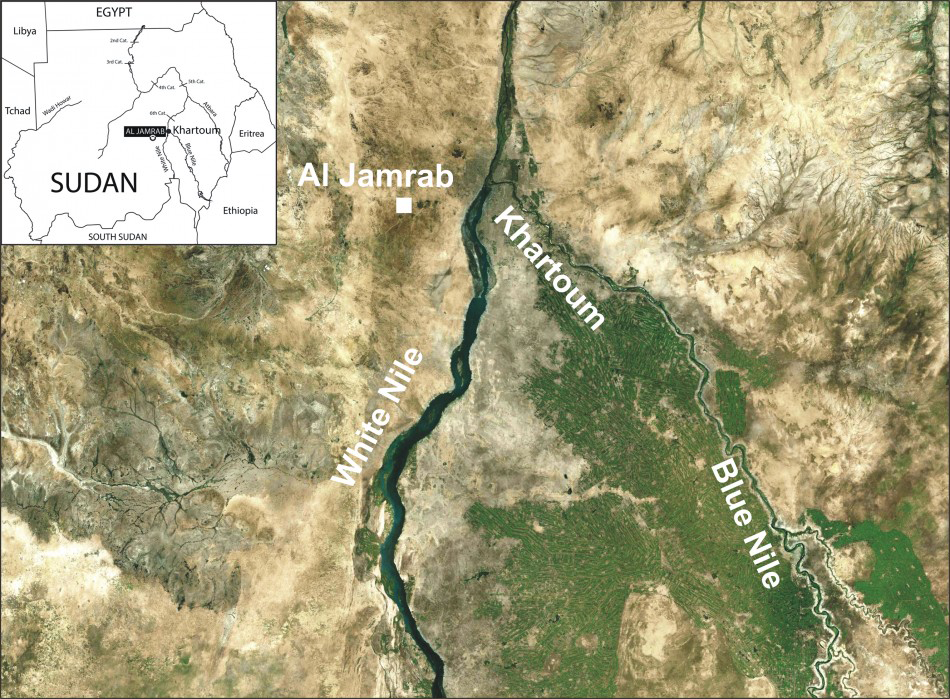


Landsat satellite image indicating the position of Al Jamrab along Wadi Hamra; the insert represents the position of the area within Sudan.

Introduction
Sudan represents a key region for the investigation of important issues related to human evolution, including the dispersal of Homo out of Africa (e.g. Van Peer 1998). Few investigations in this country, however, have focused specifically on the Palaeolithic period (although see McDermott et al. 1996; Van Peer et al. 2003; Rose 2004; Abbate et al. 2010). In central Sudan, the Palaeolithic record is restricted mainly to surface evidence (Salvatori et al. 2014; Carlson 2015), but a preliminary exploration at Al Jamrab has revealed an in situ stratified Middle Palaeolithic site (Figure 1). The site has yielded handaxes associated with single or opposed platform core exploitation technology, as well as rare evidence of Levallois elements.
Research strategy
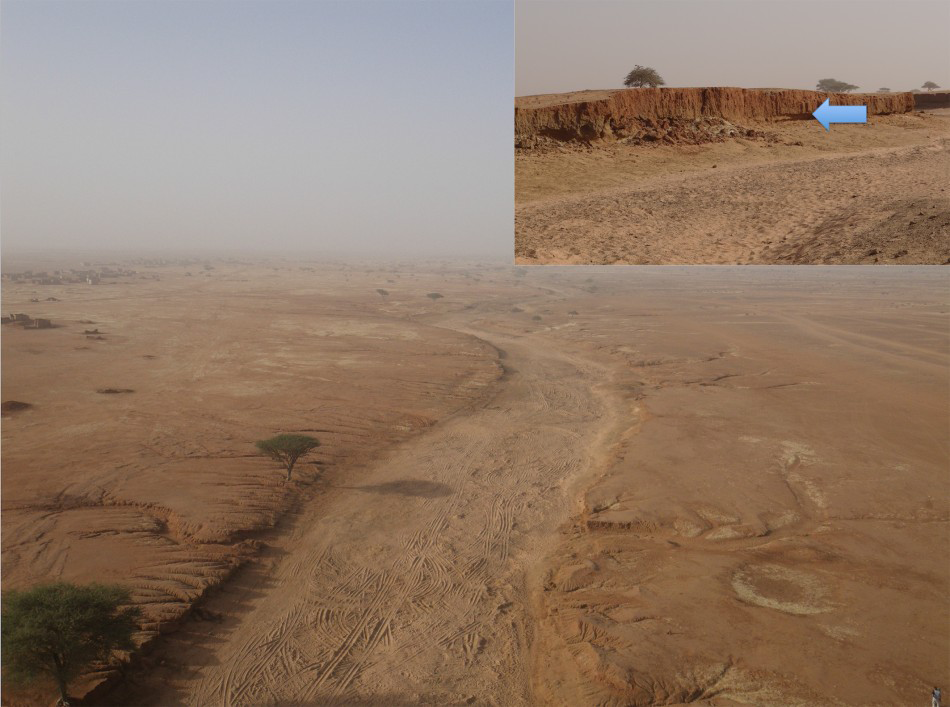
Oblique kite picture of the area along Wadi Hamra (© Yves Guichard) where Palaeolithic materials were found; the insert is a detailed view of the exposed section.

Palaeolithic artefacts embedded in the complex stratified sequence of sediments and interlayered paleosols east of the Jebel Maddaha were identified along the Wadi Hamra in 2012 during a geoarchaeological survey. The site is located near Al Jamrab village. Palaeolithic artefacts dot the exposed surface and are scattered along the wadi bed (Figure 2). During the 2014 and 2015 field seasons, two test trenches and further surface observations were undertaken, including a detailed study of the geological formations outcropping along the wadi. Samples for micromorphological analysis and OSL dating have been collected.
The stratigraphy
The stratigraphic section and bedrock are exposed discontinuously along the wadi cuts, and the sedimentary record suffers from repeated fluvial and occasional runoff erosion that has removed part of the sequence. As a result, the reconstruction of the stratigraphic sequence and the interpretation of formation processes are hampered by the occurrence of frequent discontinuities and the lack of lateral continuity of the sedimentary units.
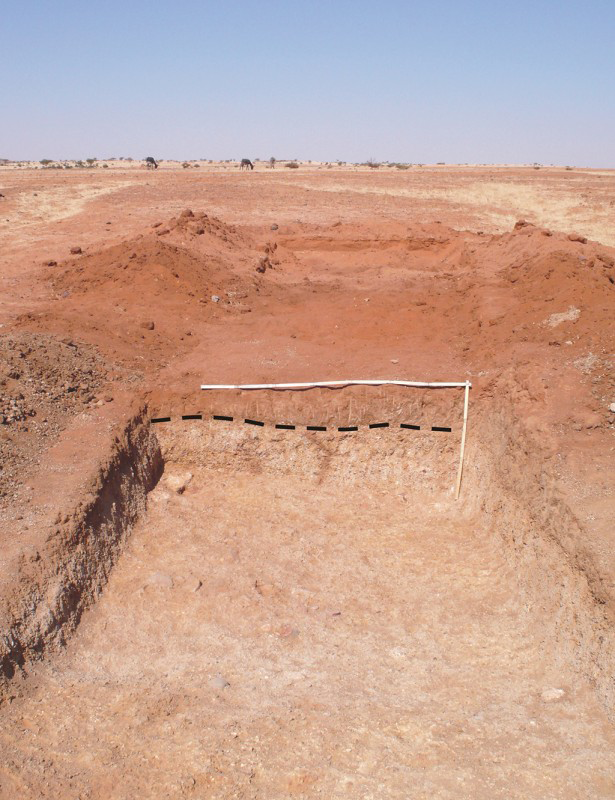
View of one of the excavated trenches; the dashed line on the vertical section marks the erosive transition between the upper sterile layers and the top of the palaeosols developed on fluvial sediments.

The stratigraphic sequence at Al Jamrab consists of a top layer of laminated aeolian sand, overlying a thick (up to 1m) and well-cemented layer of red-and-grey fluvial sand and silt. The following unit consists of a layer of greenish silt and clay displaying evidence of hydromorphism; this unit is truncated at its top and was formed in a low-energy environment (probably by settling in a lake) and possibly corresponds to the Upper Pleistocene lacustrine formation described from the nearby site of Al Khiday (around 15km to the east) by Williams et al. (2015). An erosive boundary separates this unit from the next deeper unit that also contains the Palaeolithic artefacts (Figure 3). It consists of a thick fluvial deposit, displaying an upward fining trend. In its upper part, a strongly developed palaeosol is present, with high concentrations of calcitic cement and iron-and-manganese-rich concretions. This palaeosol contains the Palaeolithic material, and can be interpreted as the topographic surface at the time of the Palaeolithic occupation of the region. This fluvial-palaeosol unit overlies the bedrock that consists of deeply weathered Mesozoic sandstone.
Palaeoenvironmental context and preliminary chronology
Little palaeoenvironmental information is currently available about the character of the landscape at the time of the site’s occupation. Preliminary investigation of thin sections of the palaeosol suggests high rates of weathering, which included clay translocation and the formation of iron-bearing nodules (indicative of a warm and wet pedoclimate). We thus speculate that the Palaeolithic occupation of the area occurred during a warm and wet (i.e. interglacial) phase of the Pleistocene. The same stratigraphic sequence observed at Al Jamrab is exposed (thinner and, in many cases, discontinuously preserved) at Al Khiday, a few kilometres to the east. At Al Khiday, fine-grained greyish to greenish sediments occur and have been interpreted as the result of lake formation by Williams et al. (2015). Many lakes existed in central Sudan in the Middle and Upper Pleistocene, and recent OSL dates suggest the occurrence of lacustrine sedimentation between 70 and 40 Kyr BP at al Khiday (Williams et al. 2015). We tentatively correlate the fine-grained greenish sediments at Al Jamrab with the OSL-dated lake sediments from Al Khiday. Given that these (lake) sediments at Al Jamrab directly overlie the archaeological sediments, we may consider the oldest OSL dates as a terminus ante quem for Palaeolithic occupation at Al Jamrab.
The excavation at Al Jamrab
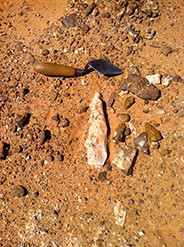
An in situ handaxe embedded in the palaeosol; a calcitic crust covers the tool.

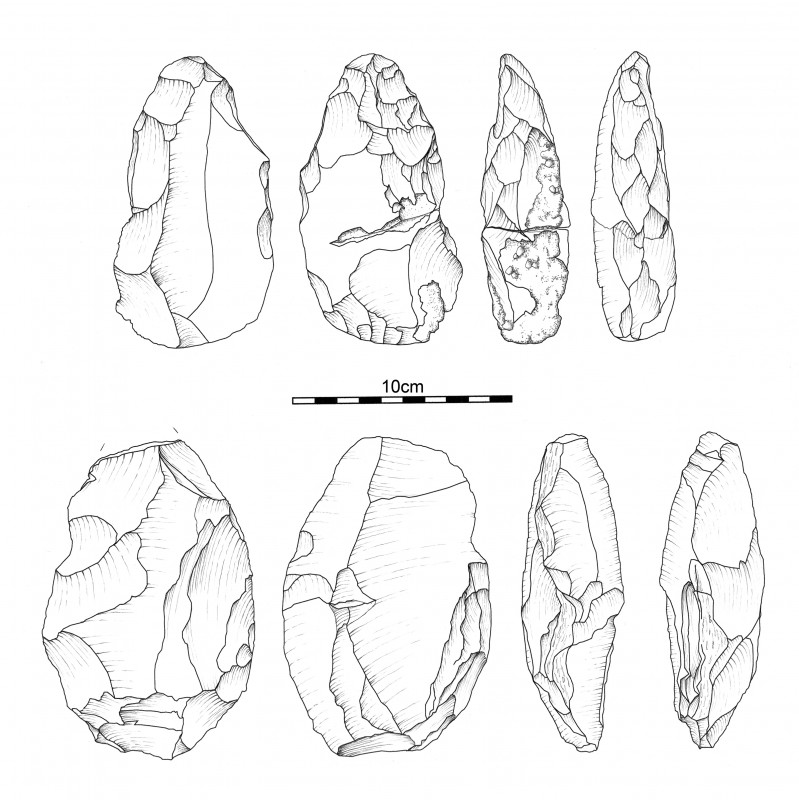
Two trenches (2 × 5m and 2 × 3m) were opened along the Wadi Hamra. The archaeologically sterile upper layers were removed to expose the palaeosol and its artefacts. The lithic assemblage recovered—both lithics found on the surface due to erosion and those found in situ during excavation—includes several handaxes (Figure 4), cores and pieces of débitage. The raw material mainly consists of local sandstone and mudstone. When in situ, the artefacts sometimes display a white carbonatic crust (due to post-sedimentary pedogenetic processes), but generally show sharp edges and lack signs of abrasion due to transportation.
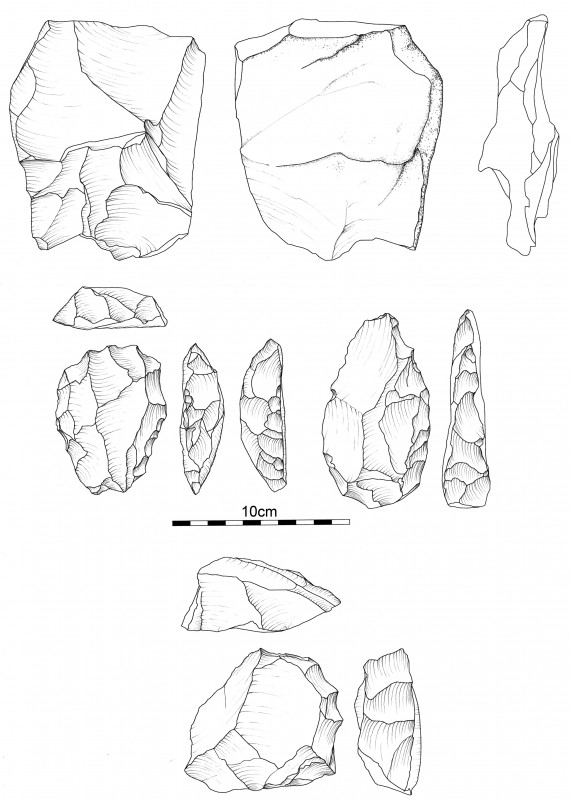
Flakes are mainly from a single platform core, and most display a flat platform. Few flakes can be definitely related to the Levallois technology, and, in general, those with centripetal scars are scarce. A single blade was recovered. Cores are of different types: discoidal, single and opposed platforms. Tools include handaxes, cleavers and scrapers (Figure 5).
Selection of handaxes from site Al Jamrab.

Selection of artefacts from site Al Jamrab: a core and some scrapers.

Preliminary conclusions and broader implications
An OSL single-grain dating campaign by the University of Innsbruck is currently under way. Although absolute dates are pending, the Al Jamrab lithic assemblage can be provisionally attributed to the Middle Palaeolithic/Middle Stone Age based on the typological cross-dating of lithics, with sites of known age that share technological similarities. Handaxe typology and the scarce presence of Levallois elements would broadly suggest a transitional phase between modes two and three technological phases, and thus an Acheulean/Sangoan cultural affiliation.
Given the location of Al Jamrab en route out of Africa, the stratified sedimentary context and the very good preservation condition of the recovered lithics, this site has an archaeological potential seldomly encountered at other Palaeolithic sites of the area. Indeed, central Sudan has been recognised as a key region for further archaeological investigations in order to evaluate the timing and nature of modern human emergence (Rose 2004), and to put the various hypotheses regarding the human dispersal routes out of Africa to the test (e.g. Beyin 2006; Drake et al. 2013).
Acknowledgements
The research on the Palaeolithic archaeology of central Sudan has been carried out within the framework of the Italian Archaeological Mission to central Sudan, directed by D.U. and financed by the Italian Ministry of Foreign Affairs. The Italian Embassy in Khartoum is also acknowledged for its consistent interest in our activities and assistance. The National Corporation for Antiquities and Museums of Khartoum and its director, Abdelrahman Ali Mohammed, are thanked for their continuous support. The excavation at Al Jamrab has been financed by a grant from the Università degli Studi di Milano (Fondi Speciali per le Ricerche Archeologiche—2015), entrusted to A.Z.