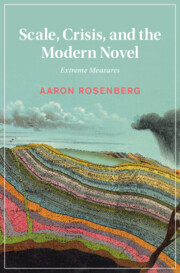


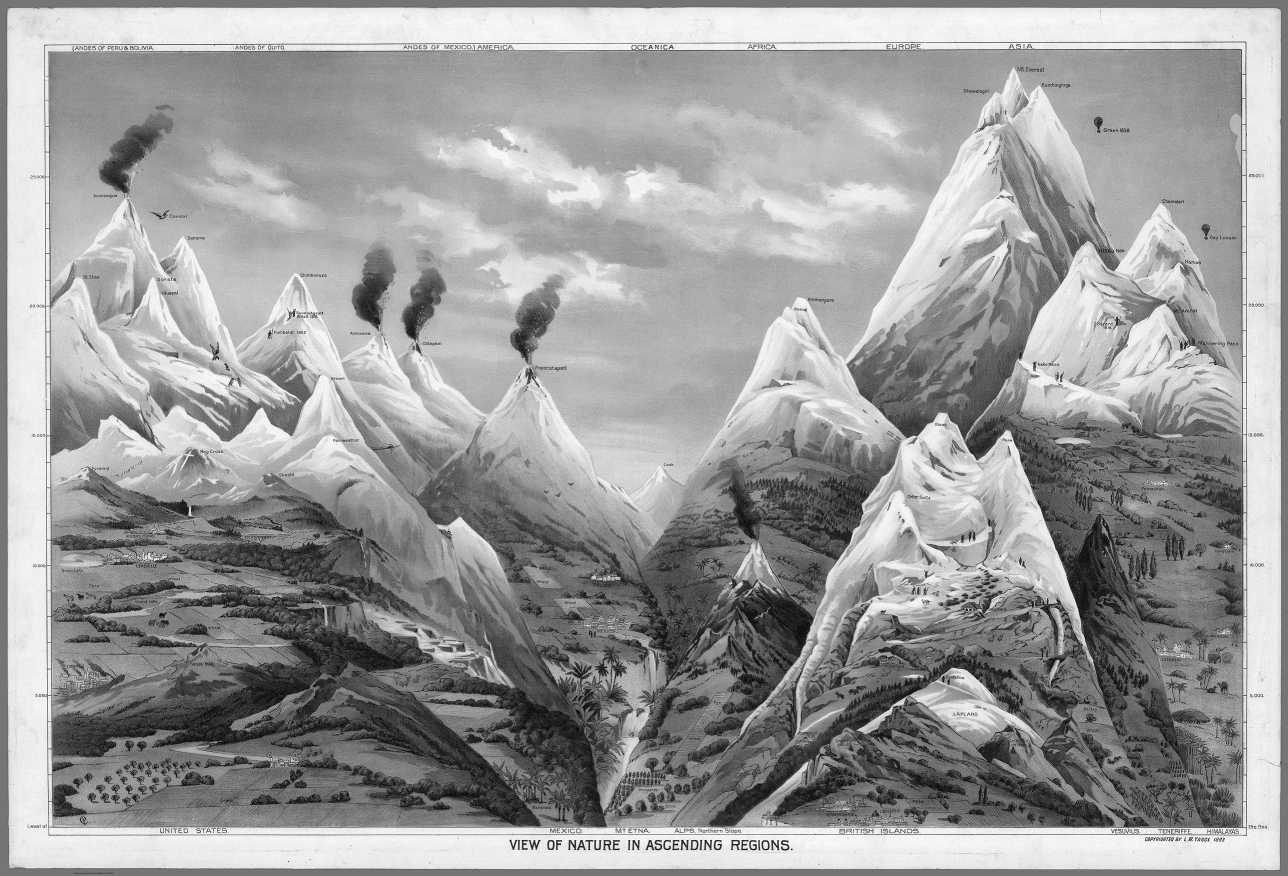
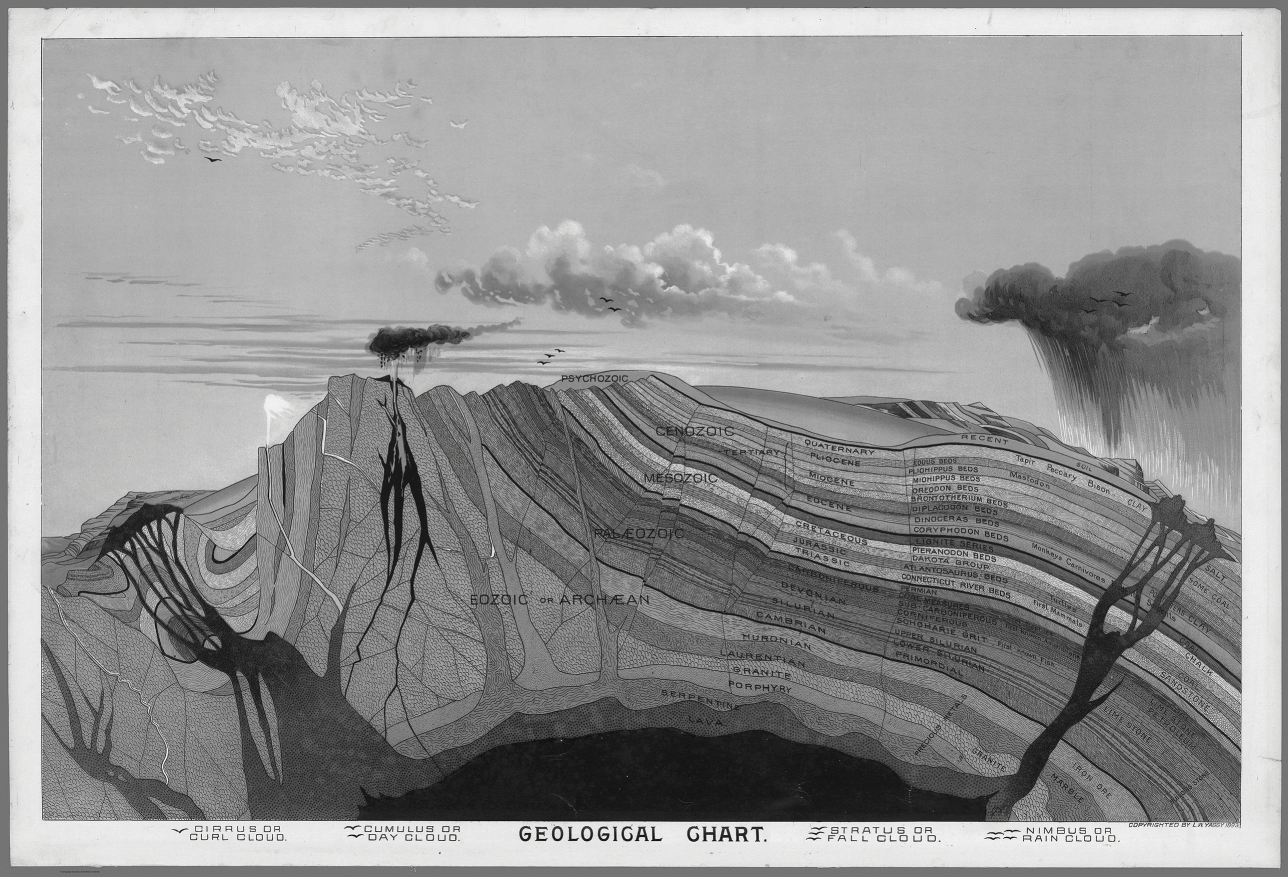
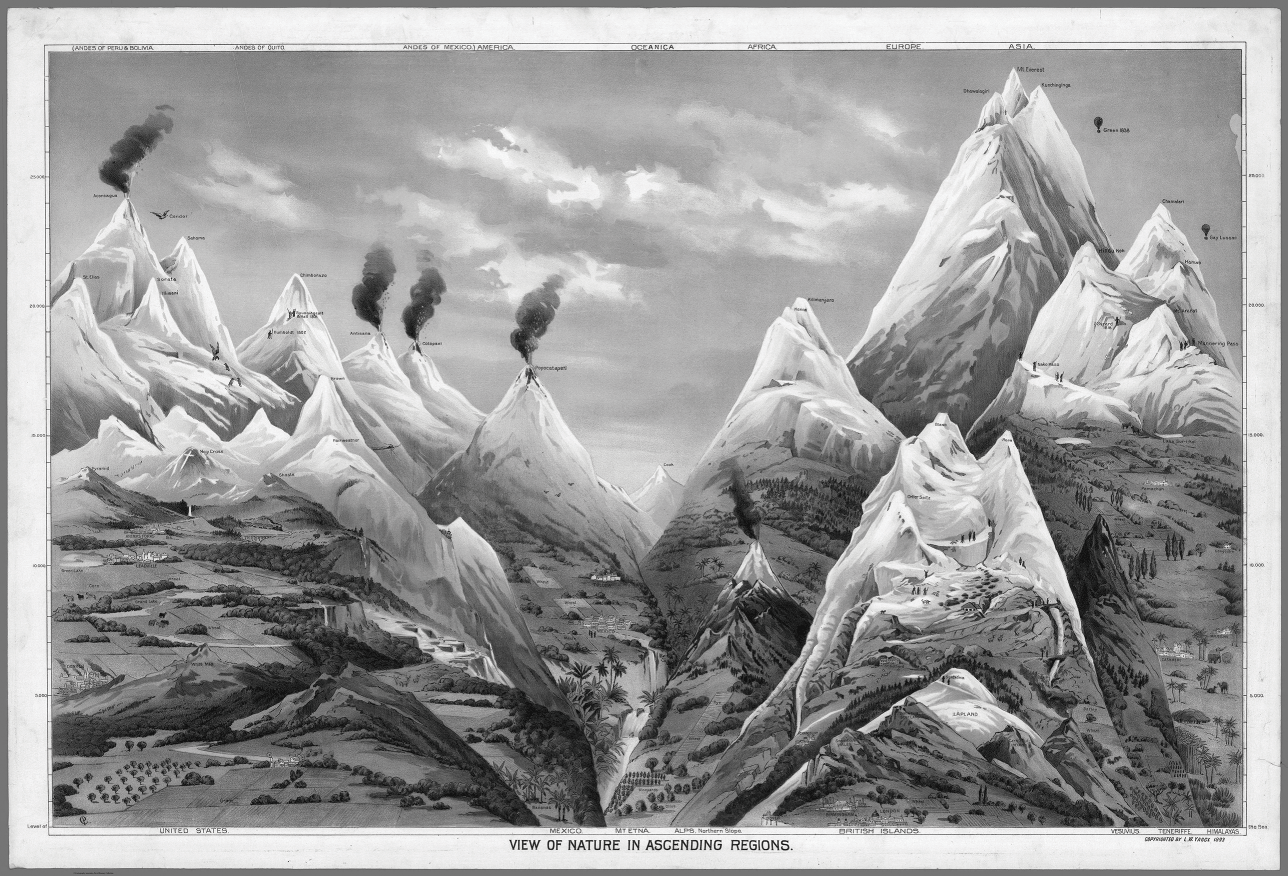
The cover image of this book is a detail taken from Levi Walter Yaggy’s Geological Chart (Figure C.1). It was originally part of a teaching kit, Yaggy’s Geographical Portfolio, a set of ten vividly colored chromolithographic prints housed in a large wooden box that could be unfolded as a display mechanism. Each of the ten charts in Yaggy’s Portfolio presents us with a slice of the planet, a resolving cut that brings it into focus on a specific scale.1 In View of Nature in Ascending Regions (Figure C.2), for example, Yaggy squeezes major landmarks from every continent into a single vista, arranging them by relative height on a scale that ascends from 0 to 30,000 feet. The viewer confronts a massive vertical expanse of mountainous terrain dotted with human construction; it rises from the city of London (at sea level) progressively upward to Mt. Vesuvius and thence to Denver, past Darjeeling and Mexico City and Mt. Kilimanjaro, upward to points marking the highest recorded flights of hot air balloons, and upward still to the towering summit of Mt. Everest. The image’s strange framing techniques and unstable points of view break the principle of vanishing-point perspective, disrupting conventions of visual mimesis. Its extreme compressions of spatial distance flatten topographical detail, collapsing the world into cartoonish two-dimensionality.
Levi Walter Yaggy’s Geological Chart, 1893.

Levi Walter Yaggy’s View of Nature in Ascending Regions, 1893.
Yaggy’s charts generate a sense of spectacular excess by cramming as much data as possible into single frames, an effect that multiplies when the images are presented in montage – as an interactive slideshow. Three charts – “Arctic Zone,” “Tropical Zone,” and “Temperate Zone” – depict the earth’s climate environments. This triptych features fantastic and contrasting scenes of, respectively, igloos and ice floes, polar bears and shooting aurorae; lush jungles teeming with snakes and jaguars, hut villages and wooden canoes; and finally, an Anglo-European pastoral stuffed with factories, corn, cows, and cathedrals. The exotic scenes in the Arctic and Tropical Zones evoke well-worn Western motifs of primitive accumulation and imperial adventure, but when juxtaposed with the encroaching urban sprawl of the Temperate Zone, they begin to look less like Russeauian wildernesses and more like extraction zones – climate change frontiers.2 Arranged as a linked sequence, the centrifugal expansion of a single, carboniferous modernity seems to be devouring the forests and glaciers at its edges, along with flora, fauna, and human communities – homogenizing the planet.
Collectively, the charts in Yaggy’s Geographical Portfolio give us the impression of a whole: the world in a box. But they also encounter, through the medium of the image, the same representational challenges we have examined in the preceding chapters. In their efforts to visualize points of conjuncture between the earth sciences, natural history, and human geography, they face what I have described throughout this book as an antagonism between inhuman scales that are scientifically “realistic” and the aesthetic norms of realist representation, which are bound, ultimately, to the direct sensory experience of a perceiving subject. The image I have chosen for my cover, Geological Chart, grants us additional powers of scalar access by means of another impossible view. Like the other illustrations in Yaggy’s Portfolio, it performs what Donna Haraway calls the “god trick of seeing everything from nowhere,”3 but instead of giving us the usual top-down view of the planet as object, it shifts our perspective by ninety degrees to provide us an above-and-below cross section of the planet’s crust. Under the surface, layers of sediment are separated into distinct stratigraphic bands, each marked in a different color to indicate a unit of geologic time. Each is named, labeled with its characteristic fossil and mineral deposits, and stacked vertically, from oldest to newest. This surreal, half-buried vision evokes fantasies, not of spaceflight, but of time travel. It implies our capacity to slip effortlessly between imponderable eons that have been neatly piled up like the leaves of a book, just waiting to be opened. Visually, Geologic Chart draws upon suggestive analogies of reading and writing that have been central to geologic discourse since the time of its disciplinary formation.4 But the image also echoes a new form of narrative desire that emerged from the popularization of geologic epistemology: the wish to descend by degrees to the very core of a prehistoric, hollowed-out earth, and to return laden with the knowledge and treasures its surface concealed. This wish was, of course, fulfilled vicariously by Jules Verne, using a method that would be repeated and refined by the authors whose works I have examined in this book: to merge inhuman scales with individual experience by repurposing long-established narrative designs; to put popular genres to new uses.
Using a similar strategy, Geologic Chart repurposes the aesthetic tradition of Weltlandshcaft, or “world-landscape,” to visualize a planetary history whose scope is longer than any human epic.5 Colored lines signify spatiotemporal boundaries that divide this history into a series of episodes or chapters, each of which terminates in an “event.” To describe the endings of so many worlds within a planet as “events” is, of course, to admit the cosmicomical paucity of our temporal vocabulary. We call them events because they are sudden: sometimes by human standards (in the case of an asteroid strike that took seconds), and sometimes by planetary standards (in which million-year processes like the rise and fall of sea levels, extreme shifts of global temperature, or the oxygenation of the atmosphere, are comparatively brief). In Geological Chart, buried worlds rise to the surface in certain places, exposing their sequential chronology. In other places, a molten, formless past – deeper than any age – erupts from volcanoes and geysers, spewing ejecta into the atmospheric present where it dissipates into striations, wisps of cirrus, thunderheads.
At first glance, Geologic Chart seems devoid of human presence. But if we pause to examine it more closely, we notice an unfamiliar word printed on the uppermost stratum, at the horizon where land and sky converge: Psychozoic. The “Psychozoic Era” has in various contexts been translated to roughly mean “the age of mind” or “the age of reason,” but in a broad sense it signifies a new planetary age shaped by human consciousness – not, that is, by “animal force” but by “intellectuality.”6 While this term has since fallen out of use, it was once a leading contender for the title of our geologic present, one that was clearly in wide enough circulation to justify its inclusion on Yaggy’s educational chart in 1893. Today we might expect to find the word “Holocene” written in its place, but that term gained only limited traction after its coinage by Paul Gervais around 1860 and would not be adopted internationally until the mid-twentieth century.7 Indeed, during the historical period I have covered in this book, a host of potential alternatives – Anthropozoic, Psychozoic, Anthropogene, Holocene, and Noösphere, to name a few – competed for consensus.
Among these conceptual predecessors to the now-dominant Anthropocene, the Psychozoic is perhaps the most obscure, but also the most suggestive. Its coinage is often attributed to Joseph Le Conte, a professor of geology and cofounder of the Sierra Club, who used it during the late 1870s to designate “the appearance of man as the dominant agent of change.”8 Le Conte, a supremacist in both racial and anthropocentric senses, asserted that the performative act of human self-definition inaugurated a wholly new period of earth history, an age in which man effectuated his own “separation from the all-pervading forces of Nature” by arrogating to himself the will and the power to “modify the whole flora and fauna of the earth.”9 For Le Conte, the Psychozoic represented an era of providential stewardship, a neo-Hegelian future in which humanity’s capacity for planetary bioengineering promised a new stage of global ontogenesis, rather than mass extinction. This melioristic outlook accorded with that of fellow geologist-cum-theologian Antonio Stoppani, who preferred the “Anthropozoic Era” as a name befitting humanity’s divinely inspired ascension to planetary dominance. “The creation of man,” per Stoppani, introduced “a new element into nature, of a force wholly unknown to earlier periods,” an agent whose “power and universality” was equal “to the greater forces of the earth.”10 By announcing man’s centrality within this new and presumably final stage of the earth’s natural history, both Stoppani and Le Conte were, as Peter Hansen observes, fashioning a geologic time that fitted their religious conviction in a preordained, messianic teleology.11
While Stoppani’s account of humanity’s emergence of as a geophysical force was persuasive among his contemporaries, many took a far more pessimistic view of its implications. In The Earth as Modified by Human Action, George Perkins Marsh set out to show that “the action of man upon the organic world” was far from beneficial; that human modifications served to “derange its original balances” and push it toward ecological collapse.12 While Marsh readily agreed with Stoppani’s assertion that there was “scarcely any assignable limit” to humanity’s “present and prospective voluntary controlling power over terrestrial nature,” he insisted that the consequences of wielding that power would be catastrophic, that they would result in “swift and radical” devastations that would “for an almost incalculable time” be “irreparable.”13 Prophetic statements like these recur throughout Marsh’s book. They are particularly apparent when he draws attention to contrasting orders of temporal magnitude, when he sets the infinitesimally brief time of human action against the extreme longue durée of ecological damage. “Within that brief space of time which we call ‘the historical period,’” Marsh exclaims, “man has brought the face of the earth to a desolation almost as complete as that of the moon,” and has wrought wastelands which “are now too far deteriorated to be reclaimable by man, nor can they become again fitted for human use, except through great geological changes, or other mysterious influences or agencies of which we have no present knowledge, and over which we have no prospective control.”14 These spectacular acts of environmental violence have overwhelmed the planet’s slow forces of natural repair.
Even a cursory look at this conceptual history reminds us that we are hardly the first to conceive of the notion that we are living in a new geological age: one we have commenced but cannot control; one we can manipulate but not contain. We are in the midst of a planetary “event” – a sudden epochal shift, a crisis – in medias res. Our belated awareness, not of its expected future arrival but of its long-standing, ongoing presence in our atmosphere and in our culture intensifies the search to identify its beginnings, to define its limits, to circumscribe it with a name. We call it the sixth extinction, the Great Acceleration, the Great Derangement, or else the Anthropocene, Capitalocene, Chthulucene, Plantationocene (or another of the myriad-cene variants). The differences between these terms are by no means arbitrary. Each is a form of address that nominates a competing set of agencies, causes, and effects. Each is a form that carries its own limitations and affordances. Each, as Dana Luciano puts it, enables “not just periodicity but narrativity,” and “relies on conscious plotting and the manipulation of feeling.”15 Names shape the stories we tell, but also the ones we can imagine – they help us to stabilize events, to order them in time, and to plot them in space. This is why, as Haraway reminds us, “it matters which stories tell stories, which concepts think concepts. Mathematically, visually, and narratively, it matters which figures figure figures, which systems systematize systems.”16 Names can initiate a seemingly endless epistemological regress, and if they are badly chosen, they can send us down the wrong path at a moment when there is little room for error, no time for course correction.
On the other hand, in the past decade we have also begun to recognize how the concept of the Anthropocene has, in large part because of its shortcomings and thanks to its contested, provisional status, forced us to rethink many unacknowledged historical framings and narrative structures that were deeply entrenched in and by the work of the disciplines themselves. It has compelled us to question which, if any, of our organizing frames can now aid us in the urgent challenge of having “to think of human agency over multiple and incommensurable scales at once.”17 And, just as importantly, it has forced us to consider which of our methods, techniques, and habits are standing in the way of that crucial task. Dipesh Chakrabarty, among the first to raise and engage seriously with these issues, casts doubt especially on whether the poststructuralist push away from grand narratives and toward an ever-increasing concern with differentiation, particularity, situatedness, contingency – toward anti-universalism – can resist the countervailing force of a totalizing crisis which, in his view, inaugurates “a negative universal history.”18 Ian Baucom, while recognizing the importance of Chakrabarty’s critique, suggests that we should instead embrace a “multitemporal ontology of the present” and develop a non- or multilinear historical method that would reassert embodied experience, recognize the subaltern, and value nonhuman agency as punctual vortices through which to apprehend “this new supra-, ultra-, or extra-historical moment we inhabit” – a time not negatively universal but “composed of multiple scales, orders, and classes of time (abstract, hermeneutic, ontic) and multiple corresponding orientations to the possibility of the (just) future fashioning of those times.”19 Such a method would make a virtue of the manifold, tenuous names for the long now. It would value their undecidability as a quality befitting the unsteady, unstructured feeling of living in “disturbed time.”20 It would treat their hesitations as appropriate to what Lauren Berlant, using a more laconic formulation, called “a situation.”21
If each of the proposed names for the “stretched-out present” tells a different story of the same events, or a different version of a similar kind of story, then the best way of describing them collectively would be, of course, as a genre.22 Throughout this book I have advocated for a renewed attention the scalar affordances of genres – for their capacity to make accessible, through reiterable and evolving patterns, events and phenomena that lie far beyond the reach of the specific, the particular, the individual. I have suggested that they can, in this respect, capture aspects of “the real” whose spatiotemporal values are misaligned with the norms of realist representation.23 To test this hypothesis I have focused on the formal experiments of authors who repurposed romance, melodrama, horror, and epic – genres that had been ostensibly superseded by the rise of realism – and turned them into “vehicles” (recalling the metaphor Hardy proposed in Chapter 2, and Wells deployed in Chapter 1) for conveying readers across the inhuman scales of biology, geology, and astronomy; for exposing empire as an ecologically deleterious and unsustainable system, accelerating toward global collapse (as we saw in Conrad, Chapter 3); and for integrating the constricted temporalities of biographical form with multigenerational histories of climate change (as we saw in Chapter 4, on Woolf).
If such strategies were, as I have suggested, important for rescaling the novel at the turn of the twentieth century, they now seem indispensable in the twenty-first. The scalar affordances of genre fiction have become necessary to our narrative representations of life in the present. This helps to account for the rising prestige, in both public and academic domains, of what Ghosh calls “generic outhouses,” the forms that had been banished from the “mansion in which serious fiction has long been in residence.”24 It also helps to account for why the distinction between serious fiction and genre fiction seems to be collapsing. “Laying claim to the authority of the real,” explains McGurl, is how “literary fiction” (which we might take to mean the highbrow inheritor of both the realist and certain modernist traditions) “maintains its increasingly tenuous superiority of esteem.”25 But it is also “how genre fiction gets taken more and more seriously, as its more flagrantly built worlds come to be understood as making the same claim about a real world that seems increasingly unreal.”26 Unreal by which standards? By those that have been modeled for us, and which we have come to expect, from “serious fiction,” the kind of work which, as Ghosh puts it, “has never been forced to confront the centrality of the improbable,” let alone “the passage of thousands of years” or “how the continents were created.”27 Ghosh concludes that serious fiction can survive only by adapting beyond its formal limitations, only if “new, hybrid forms will emerge and the act of reading itself will change.”28 However, as we have seen in the preceding chapters, this was evident to authors writing more than a century ago, who began the process of hybridizing realist fiction with its generic alternatives in an effort to overcome the same representational problems and to address an earlier phase of the same crisis.

 Open access