

Making sense of party systems has long been central to the study of politics. Scholars have focused on how political competition is configured by analysing social cleavages, the number and polarisation of parties, government turnover and government–opposition relations (Enyedi and Casal Bértoa Reference Enyedi, Casal Bértoa, Carter, Keith, Sindre and Vasilopoulou2023; Siaroff Reference Siaroff2019; Wolinetz Reference Wolinetz, Katz and Crotty2006). Party systems matter for structuring electoral choices, for the formation and maintenance of governments, for policymaking and for democratic legitimacy (Webb Reference Webb2024). Given the significant and sustained changes witnessed in electoral, parliamentary and governmental arenas since the early 2010s, party system research now has heightened relevance.
The ‘Sartorian School’ of party system research (Casal Bértoa and Enyedi Reference Casal Bértoa and Enyedi2016), which explicitly focuses on interactions between parties, is particularly influential, and within that lineage, an approach to party system analysis that focuses on government formation has been developed (e.g. Casal Bértoa and Enyedi Reference Casal Bértoa and Enyedi2021; Mair Reference Mair1997). The utility of this ‘government formation’ approach to party system analysis has been demonstrated in its application to key questions, including party system institutionalisation and party system change. But it also has weaknesses. Its principal weakness is that it does not account for interactions with and between parties that are not in government; it therefore gives a view of the party system that is incomplete. Moreover, its operationalisation depends on ‘change’ concepts (government turnover, novelty, access), so while it can help to identify party system change, it cannot characterise the structure of a party system at a particular point in time. Both features are problematic, given the Sartorian School’s underlying concern with how parties’ interactions constitute a party system.
This study develops and demonstrates an approach to systematically describing party systems that builds on Sartorian concerns with interactions between parties in competition for government, but which aims to mitigate weaknesses of the ‘government formation’ approach. It does this by using coalition preferences, which have not previously been used to systematically analyse the interactions that make up party systems. It argues that coalition preferences are important ‘streams of interaction’ between parties (Sjöblom Reference Sjöblom1968), and it measures the ‘openness’ of the system of coalition preferences. The study demonstrates this approach to party system analysis by applying it to Ireland (1987–2024), a case in which there has been substantial party system change over time. The case study illustrates the utility of the ‘coalition preferences’ approach and allows us to examine its proposed measures in context. This new ‘coalition preference’ approach adds to the tools available for the analysis of party systems, complementing existing approaches.
The article proceeds as follows. Firstly, it describes the influential Sartorian School of party system studies, and the development of its ‘government formation’ approach. Secondly, it reviews research on parties’ coalition preferences and their application to party system research. Thirdly, it describes how coalition preferences at the party level are operationalised in this study, and what measures can be derived from them at the system level. After this, it introduces the case of Ireland since the 1980s, highlighting why it is useful for demonstrating this approach. Next, it presents an analysis of Ireland’s party system from 1987 to 2024, using the measures developed within the ‘coalition preference’ approach. It then discusses what the case study tells us about the coalition formation approach to party system analysis and shows that the approach can be applied to other party systems. The article concludes by highlighting opportunities for future research.
The Sartorian School and the government formation approach to party systems
How parties interact has been central to much research on party systems. A concern with interactions between parties underlies the work of Maurice Duverger (Reference Duverger1954), Jean Blondel (Reference Blondel1968), Stein Rokkan (Reference Rokkan1970), Robert Dahl (Reference Dahl and Dahl1966), Gunnar Sjöblom (Reference Sjöblom1968, ch. 8) and Alan Siaroff (Reference Siaroff2019). Giovanni Sartori (Reference Sartori1976: 43–44; see also Mair Reference Mair1997: 206; Wolinetz Reference Wolinetz, Katz and Crotty2006: 52) made this focus on interactions between parties explicit in his conceptualisation of the party system:
The concept of system is meaningless – for purposes of scientific inquiry – unless (i) the system displays properties that do not belong to a separate consideration of its component elements and (ii) the system results from, and consists of, the patterned interactions of its component parts, thereby implying that such interactions provide the boundaries, or at least the boundedness, of the system …. Parties make for a ‘system’, then, only when they are parts (in the plural); and a party system is precisely the system of interactions resulting from inter-party competition (emphasis in the original).
This perspective was taken up by Peter Mair (Reference Mair1989) and Gordon Smith (Reference Smith1989), and then developed further by Mair (Reference Mair, LeDuc, Niemi and Norris1996, republished in Mair Reference Mair1997), who became its leading exponent. It has been highly influential, giving rise to the ‘Sartorian School’ of party system analysis, which is characterised by an explicit concern with the system of interactions between parties (Casal Bértoa and Enyedi Reference Casal Bértoa and Enyedi2016: 265; see also Bardi and Mair Reference Bardi and Mair2008: 152–153; Enyedi and Casal Bértoa Reference Enyedi, Casal Bértoa, Carter, Keith, Sindre and Vasilopoulou2023: 30, f.34; Mair Reference Mair, Katz and Crotty2006; Webb Reference Webb2024: 5–17).
Mair (Reference Mair, Katz and Crotty2006: 65) built on Sartori’s definition to argue that ‘the structure of competition for control of the executive’ was central to the concept of the party system. As he acknowledged, he was not the first scholar of party systems to focus on this (Mair Reference Mair1997: 206–207, Reference Mair, Karvonen and Kuhnle2001: 39, Reference Mair, Katz and Crotty2006: 65; see also Wolinetz Reference Wolinetz, Katz and Crotty2006: 56). For example, Rokkan (Reference Rokkan1970) was concerned with patterns of government formation; Dahl’s (Reference Dahl and Dahl1966) combinations of competitive, cooperative and coalescent patterns of opposition had a comparable focus; and Smith (Reference Smith1979) maintained a dual focus on the electoral and governmental arenas, and later presented parties of government as the ‘core’ of the system (Smith Reference Smith1989).
In asking ‘how might differential patterns in the competition for government be understood?’ (Mair Reference Mair1997: 206–207), Mair (Reference Mair, LeDuc, Niemi and Norris1996, Reference Mair, Karvonen and Kuhnle2001, Reference Mair, Katz and Crotty2006, Reference Mair, Gloppen and Rakner2007) honed in on patterns of government formation. In this approach, party systems could be ‘closed’ or ‘open’, depending on the regularity and predictability of interparty relations. Closed systems were those with regular patterns of government formation, while open systems were less predictable (e.g. Mair Reference Mair1997: 211). Mair conceptualised openness in terms of three inter-related facets of government formation: the extent of partisan alternation or turnover in government (closed systems have either no turnover or wholesale alternation; open systems are characterised by partial turnover); innovation in the partisan composition of government (open systems are characterised by novel coalition formulas; closed systems by familiar formulas); and the openness of access to office for parties without government experience (in open systems, these parties gain access to government; in closed systems they do not). As well as predictability, closed systems have been associated with accountability and clarity of choice (for voters), while it has been suggested that open systems are more adaptable in changing circumstances (Casal Bértoa and Enyedi Reference Casal Bértoa and Enyedi2016: 266).
Focusing on government formation addressed a number of concerns in the study of party systems: that not all parties are equally important for the party system (Mair Reference Mair, Karvonen and Kuhnle2001: 37; Sartori Reference Sartori1976: 121–125); that cooperation – and not only conflict – is an important aspect of party systems (see also Casal Bértoa and Enyedi Reference Casal Bértoa and Enyedi2021: 9; Smith Reference Smith1989: 349); and, relatedly, that alliances can be taken into account, as they often structure the system (Casal Bértoa and Enyedi Reference Casal Bértoa and Enyedi2021: 8). Mair further argued that focusing on government formation helped to avoid conflating electoral change with systemic change (Mair Reference Mair1997: 215–216).
Mair’s conceptualisation has been widely applied (see Casal Bértoa and Enyedi Reference Casal Bértoa and Enyedi2016: 268 for a review; Casal Bértoa and Mair Reference Casal Bértoa, Mair, Keman and Muller-Rommel2012). Perhaps most significantly, Zsolt Enyedi and Fernando Casal Bértoa (Reference Enyedi, Casal Bértoa, Carter, Keith, Sindre and Vasilopoulou2023: 37) use it as the basis for ‘the closure approach’ to party system institutionalisation. They develop an additive index of party system closure based on Mair’s three components, measured by the partisan composition of government as it relates to alternation, novelty and access (Casal Bértoa and Enyedi Reference Casal Bértoa and Enyedi2021, Reference Casal Bértoa and Enyedi2016).Footnote 1
The ‘government formation’ approach to party systems has limitations, and these limitations are acknowledged by its proponents. The principal shortcoming is one of incomplete information about interactions between parties in competition for government. Competition for government involves not only the government that finally forms but also parties and coalitions that fail to win office. These actors are accounted for only indirectly in this approach (insofar as patterns of government formation are rooted in developments in the wider party system), but are otherwise left out (Casal Bértoa and Enyedi Reference Casal Bértoa and Enyedi2021: 21, 23; Smith Reference Smith1989: 352).
This cross-sectional problem of incomplete information is compounded by government formation being an infrequent event, meaning that the durable ‘systemic’ patterns arising from it are evident only after several government formation opportunities (Mair Reference Mair, Katz and Crotty2006: 67). Furthermore, the openness (closedness) of party systems has been operationalised in this approach using ‘change’ concepts (turnover, novelty, access). So, while it describes important aspects of party system change, it is less well-suited to describing patterns of party interactions at one point in time. And although party system scholars have long emphasised the importance of the stability of patterns over time for them to be considered ‘systemic’ (Mair Reference Mair, Katz and Crotty2006: 67; Sartori Reference Sartori1976: 199; Siaroff Reference Siaroff2019: 74; Webb Reference Webb2024: 5), these snapshots – what Siaroff (Reference Siaroff2019) calls ‘party patterns’ – can nonetheless provide valuable information about the structure of party systems.
In summary, the ‘government formation’ approach to party systems has been at the fore in conceptualising and operationalising party systems. It is founded on two ideas: that party systems consist of patterns of interactions between parties, and that cooperation and conflict related to government formation is a very important aspect of interparty interaction. The challenge that the present study takes up is to develop an approach that can describe party systems in a way that focuses on the interactions of parties as they compete for a place in government – in line with the Sartorian School’s approach – while mitigating limitations of the ‘government formation’ approach. I suggest that using information on parties’ coalition preferences can contribute to achieving this goal.
Coalition preferences and party systems
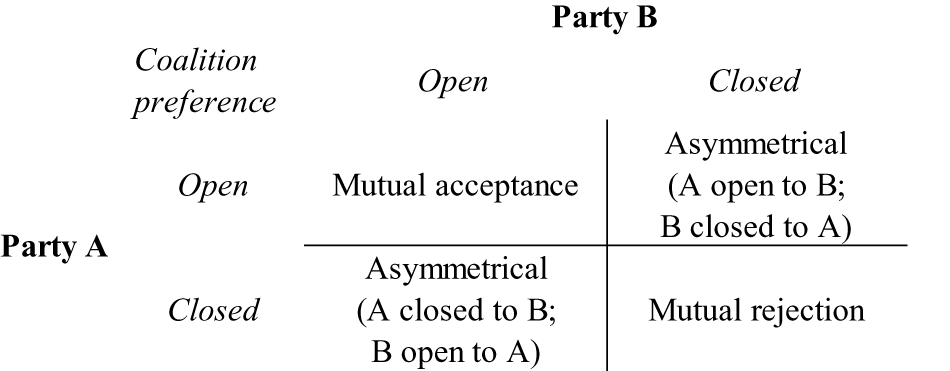
A party’s coalition preference is its position on coalescing with another political actor; that is, whether it is for or against coalescing with them.Footnote 2 Conceptually, a coalition preference can be open (the party is willing to coalesce with the other actor) or closed (the party is not willing to coalesce with the other actor). The relationship between any pair of parties can therefore be characterised by mutual rejection (both closed), mutual acceptance (both open) or it can be asymmetrical, where one party is open to coalition, but the other is not (Figure 1; see also Decker and Best Reference Decker and Best2010).
Coalition Preferences within a Party Dyad (Party A–Party B)

Parties’ coalition preferences (and ‘coalition signals’) have long featured in the study of government formation and interparty cooperation. For William Gamson (Reference Gamson1961: 374, 376), it was a shared ‘coalition strategy’ – an approach to prospective coalitions – that defined actors. Coalition preferences are central to the concepts of ostracism, pariah parties and cordons sanitaires (e.g. Geys et al. Reference Geys, Heyndels and Vermeir2006; Heinze Reference Heinze2018; Jacobs Reference Jacobs2024; Martin and Stevenson Reference Martin and Stevenson2001: 36–37; van Spanje Reference van Spanje2010, Reference van Spanje2018: 6). They can also take the form of positive commitments to govern together (Allern and Aylott Reference Allern and Aylott2009; Golder Reference Golder2006b).
Open coalition preferences can help to put parties in a pivotal bargaining position, while foreclosing coalition options can weaken a party’s bargaining position, turning it into a ‘captive’ partner (Bale and Bergman Reference Bale and Bergman2006). Kaare Strøm et al. (Reference Strøm, Budge and Laver1994: 317) found that the exclusion of certain parties from coalition bargaining was ‘the most striking party constraint’ on coalition formation (see also Mershon Reference Mershon1996: 541). Further empirical analyses showed that coalition preferences help to explain which coalitions form (Debus Reference Debus2008; Druckman and Roberts Reference Druckman and Roberts2007; Martin and Stevenson Reference Martin and Stevenson2001) and that participation in pre-electoral coalitions increased the probability of a coalition forming, the speed at which it formed and its ideological compatibility (Golder Reference Golder2006b; see also Bäck Reference Bäck, Hellström, Lindvall and Teorell2024).
Parties’ coalition preferences also shape voters’ views, including their predictions about which government will form (Bahnsen et al. Reference Bahnsen, Gschwend and Stoetzer2020; Bowler et al. Reference Bowler, McElroy and Müller2022; Jang et al. Reference Jang, Crabtree and Golder2022), their perceptions of parties’ positions (Bahnsen et al. Reference Bahnsen, Gschwend and Stoetzer2020; Falcó-Gimeno and Muñoz Reference Falcó-Gimeno and Muñoz2017; Jang et al. Reference Jang, Crabtree and Golder2022) and their focus on coalitions rather than parties (Gschwend et al. Reference Gschwend, Meffert and Stoetzer2017). Therefore, coalition preferences are an important part of a party’s electoral strategy (Duch et al. Reference Duch, May and Armstrong II2010), and as they structure electoral choices, coalition preferences can shape (de)polarisation between parties and among their supporters. After elections, there is anecdotal evidence that parties sustain electoral losses when they break their promises about coalition formation (Debus Reference Debus2008: 520–521; see also Strøm et al. Reference Strøm, Budge and Laver1994: 310).
There is less empirically grounded knowledge about what shapes parties’ coalition preferences, but ideology is likely to be a key explanation (Jacobs Reference Jacobs2024; see also Golder Reference Golder2006a). This is consistent with the idea that coalition bargaining is more difficult if parties are further apart (Bäck Reference Bäck, Hellström, Lindvall and Teorell2024). Preferences regarding political institutions (e.g. democracy or European Union membership) and differences on legitimate means of achieving political aims (e.g. the use of violence) may be particularly likely to lead to coalition rejections. Other factors that may influence coalition preferences include parties’ histories (including their origins), their previous experiences of working together and their familiarity with each other (Debus Reference Debus2007: 89; Tavits Reference Tavits2008). These positions are underpinned by the preferences of both the electorate and party members, and by personal relations between leaders (Decker and Best Reference Decker and Best2010: 166).
The relevance of coalition preferences to party systems and their importance for interparty relations is widely acknowledged. Steven Wolinetz (Reference Wolinetz, Katz and Crotty2006: 53) identified parties’ ‘willingness to work with each other in government formation and the process of governing’ as key to interparty relations. Mair (Reference Mair1997: 211) noted that ‘the development of a closed structure of competition owes much to the strategies of the established parties’, specifically their avoidance of novel coalitions. And Casal Bértoa and Enyedi (Reference Casal Bértoa and Enyedi2021: 21) stress the role of parties’ approaches to potential coalition partners as a primary explanation for variation in party system institutionalisation. Nonetheless, coalition preferences have not previously been used to operationalise interactions between the parties that make up party systems.
Coalition preferences refer directly to interactions between parties concerning competition for government and can therefore inform the analysis of party systems while allowing us to address some of the main concerns of the Sartorian School. Each pair of parties can have coalition preferences in respect of one another; therefore, coalition preferences represent the reciprocal ‘streams of interaction’ cited by Sjöblom (Reference Sjöblom1968: 174) and later Sartori (Reference Sartori1976: 120). Focusing on coalition preferences emphasises the importance of cooperation between parties, facilitating the identification of units above the party level (i.e. blocs) (Casal Bértoa and Enyedi Reference Casal Bértoa and Enyedi2021: 11–12). And as I demonstrate in the sections that follow, a coalition preference-based approach holds considerable potential for developing quantitative measures of interaction-focused party system parameters, which Enyedi and Casal Bértoa (Reference Enyedi, Casal Bértoa, Carter, Keith, Sindre and Vasilopoulou2023: 38) have identified as a key challenge for the analysis of party systems.
Unlike the government formation approach, an approach centred on coalition preferences includes non-governing parties and, in principle, the universe of possible coalitions. By including information about parties that did not enter government and about alternative government formation possibilities, it provides considerably more information about party interactions than government formation data alone, thus addressing an acknowledged limitation of the government formation approach (Casal Bértoa and Enyedi Reference Casal Bértoa and Enyedi2021: 23). This makes it particularly useful for providing ‘snapshots’ of the system of interactions between parties – that is, for analysing the structure of the system as a whole. Even with a restricted (binary) operationalisation of coalition preferences (which I use below), data on coalition preferences provide richer information than government formation data. Specifically, they tell us not only about pairs of parties that have mutually open preferences (the basis for coalition), but also about asymmetrical coalition preferences. This allows us to tap into the latent potential for coalition formation.
In summary, coalition preferences have not yet been used systematically in the study of party systems. Doing so can satisfy several concerns shared by scholars of party systems, and is consistent with the Sartorian School’s focus on interparty interactions as they relate to competition for government. The next section outlines some choices made in respect of the operationalisation of coalition preferences for the purpose of this analysis, before examining what coalition preferences can tell us about party systems in a hypothetical party system.
Operationalisation: coalition preferences and party system openness
Coalition preferences as coalition rejection
While conceptually a party’s coalition preference in relation to another party may be ‘open’ or ‘closed’, coalition preferences can be operationalised in a variety of ways. Binary operationalisations indicating either the presence of a positive commitment to govern together or the exclusion of a partnership between parties have each been used in research on government formation (e.g. Debus Reference Debus2007, Reference Debus2008; Martin and Stevenson Reference Martin and Stevenson2001: 36–37).Footnote 3 Ordinal and continuous measures of the openness of a party to coalition with another actor are also conceivable. Frank Decker and Volker Best’s (Reference Decker and Best2010) systematic exploration of coalition signals in Germany identifies 15 possible stances on coalition formation, taking into account preferred and alternative coalitions, executive coalitions and support party status, implicit and explicit positive signals, and positive signals with or without prerequisites (see also Golder Reference Golder2006b: 16). Other approaches include expert surveys and measuring the salience of positive coalition signals in the media (Bowler et al. Reference Bowler, McElroy and Müller2022; van Spanje Reference van Spanje2010).
For the purposes of this study – which aims to demonstrate how coalition preferences can shed light on party systems – I operationalise coalition preferences as a binary variable that indicates whether a party explicitly and without qualification rules out entering government with another party; that is, as coalition rejection (Debus Reference Debus2007). This commitment must be explicit (i.e. made publicly) (Golder Reference Golder2006b: 12) and made by an actor that has the authority to speak for the party in respect of its coalition strategy (often its leader). If there is no evidence of this explicit and unconditional rejection of a coalition partnership, then the party is assumed to be open to coalition.
Although the argument in favour of the coalition preference approach to party systems does not rest on this specific operationalisation, I suggest that this binary operationalisation of coalition rejection has four strengths: such rejections are common, consequential and categorical, and they rest on a reliable assumption about party motivations. We know that coalition rejection is common, occurring in many contexts (Golder Reference Golder2006b: 21; Strøm et al. Reference Strøm, Budge and Laver1994). We also know that it is consequential for government formation (Debus Reference Debus2007, Reference Debus2008; Martin and Stevenson Reference Martin and Stevenson2001). Another advantage of this operationalisation is that an unqualified rejection is categorical. This supports reliable measurement, as it leaves less room for subjective interpretation than more fine-grained indicators, such as those that would account for preferred coalitions or conditional coalition preferences. Categorical commitments are also more likely to be binding on the parties concerned, and thus to be consequential. Finally, by stipulating that parties are open to a coalition unless they rule it out, this approach to operationalising coalition preferences rests on the assumption that parties are office-seeking (even if they also pursue other goals). The opposite assumption – that a party has ruled out a coalition unless it expresses a preference in favour of it – is more difficult to sustain.
What can coalition preferences tell us about party systems?
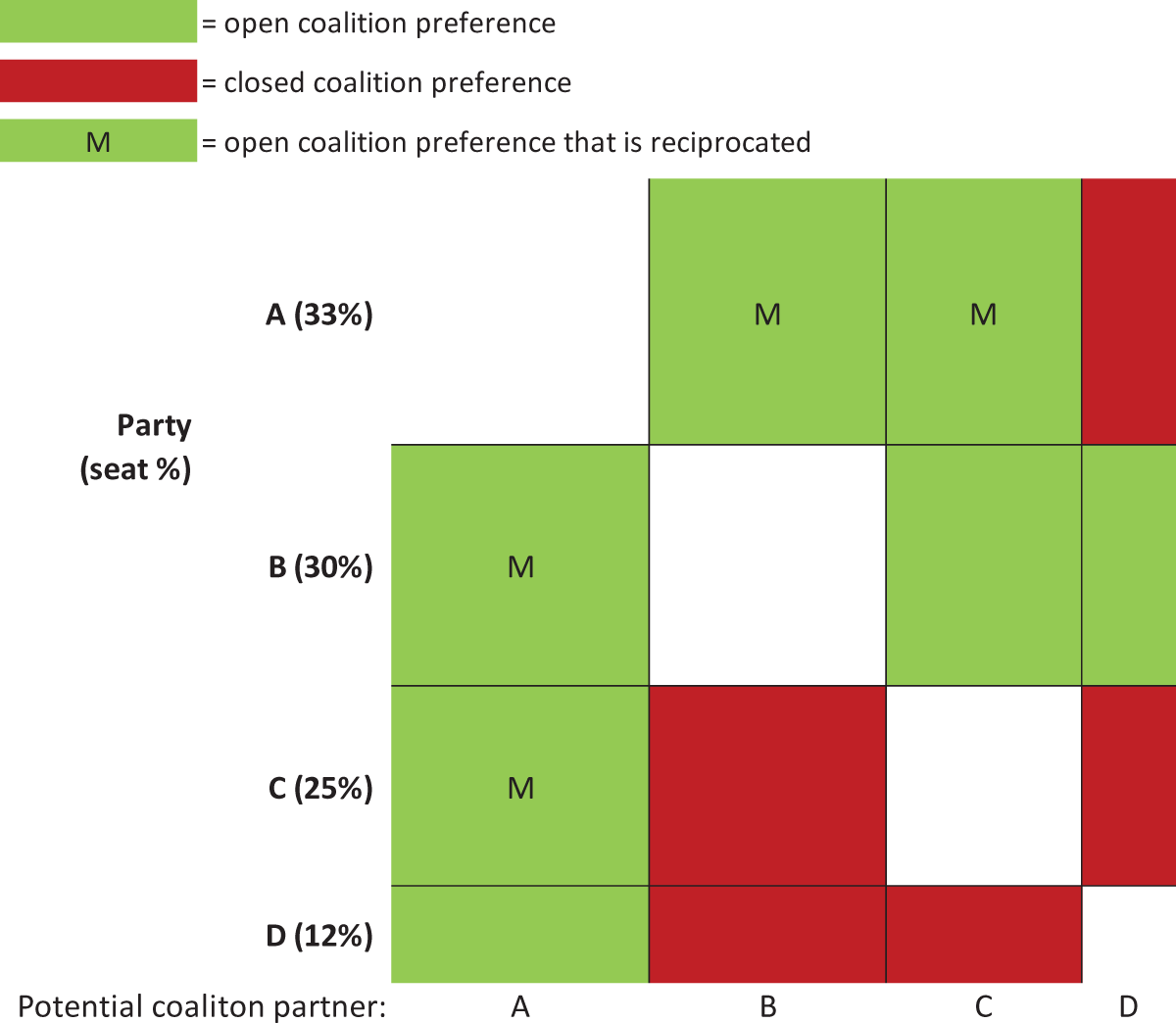
Figure 2 describes a hypothetical party system with four parties – A, B, C and D – that vary in size and that can have open or closed preferences towards one another. In all, the system includes 6 party dyads and 12 coalition preferences. The top row in Figure 2 shows that party A is open to a coalition with parties B and C but not with party D. Party B is open to a coalition with all parties. Party C is open to coalition only with party A, as is party D. The ‘streams of interaction’ between the parties in Figure 2 provide examples of mutual acceptance between parties, denoted by an ‘M’ (A↔B and A↔C), mutual rejection (C↔D) and asymmetrical relationships, where one party is open to coalition with the other, but where this is not reciprocated (A↔D, B↔C, B↔D).
Coalition Preferences in a Four-Party System

From a party system perspective, it is the system of coalition preferences that is of central interest, and specifically how coalition preferences can inform us about the interactions that make up the party system. Using data on coalition preferences, the aggregate openness of the system of coalition preferences can be calculated while taking into account parties’ varying sizes. Open coalition preferences that are reciprocated, such as A↔B and A↔C in Figure 2, are necessary for coalition formation and therefore are particularly significant. The m-openness (mutual openness) of the system captures the extent to which the system is characterised by reciprocally open coalition preferences. It is calculated by dividing the surface area of the cells characterised by mutual non-rejection (marked ‘M’ in Figure 2) by the surface area of all red and green cells (‘nonempty cells’).Footnote 4
 \begin{equation*}M{-}openness = \frac{\sum (surface\, area\, of 'M - open' cells)}{\sum {(surface\, area\, of\, all\, nonempty\, cells)}}\end{equation*}
M-openness values can range from 0 to 1, and the system described by Figure 2 has an m-openness value of 0.5: half of the (weighted) parties are mutually open to coalition with one another.
A second measure identifies the proportion of coalition preferences that are open to other parties regardless of whether these preferences are reciprocated. This is described as the openness of the system. This measures actual m-openness as well as the potential for m-openness. In Figure 2, for example, parties B and C, which have an asymmetrical relationship, are closer to being able to coalesce than parties C and D, which mutually reject one another. The openness of the party system is calculated by dividing the surface area of the cells characterised by open coalition preferences (all the green cells in Figure 2) by the surface area of all red and green cells.
 \begin{equation*}Openness = \frac{{{{\mathop \sum }}{\text{ }}\left( {surface{\text{ }}area{\text{ }}of'open'{\text{ }}cells} \right)}}{{{{\mathop \sum}}{\text{ }}\left( {surface{\text{ }}area{\text{ }}of{\text{ }}all{\text{ }}nonempty{\text{ }}cells} \right)}}\end{equation*}
Here, system openness values also range from 0 to 1, but they will always be equal to or greater than the values for m-openness. The system described by Figure 2 has an openness value of 0.71: 71% of weighted preferences are open.
While quantifying the openness of the party system is of central interest here, this systematic overview of coalition preferences also allows us to make other, secondary observations. Firstly, it allows us to describe some salient system-level characteristics in qualitative terms. For example, in Figure 2, two interaction streams between the parties (i.e. A↔B and A↔C) are open, in the sense that both parties are open to coalition. If we assume that these are the only viable coalitions, this puts party A in a pivotal position. Secondly, it allows us to describe relevant party-level attributes that make up the system: the openness of the party’s coalition strategy (its openness to other parties) and its coalitionability (other parties’ openness to the party). A party’s openness relates to how much of its weighted coalition preference is open. The horizontal rows in Figure 2, for example, tell us that party B’s coalition strategy is completely open, while each of the other parties is, to varying extents, partially closed to coalition with other parties. A party’s coalitionability relates to other parties’ preferences towards that party (the vertical columns in Figure 2). In Figure 2, party A is the most coalitionable, while party D is the least coalitionable. Although they are not our main concern, I refer to these party-level characteristics in the case study, and I return to questions concerning their measurement in the conclusion.
Relying on coalition preferences is associated with at least two potential limitations. One concern relates to the validity of expressed coalition preferences. While the objective data of government formation provide firm evidence of parties coalescing (in the government formation approach), stated coalition preferences are more slippery. They may be strategic rather than sincere, and ultimately they may not be binding. But this limitation should not be overstated, as even when an expressed coalition preference is not sincere, the positions that a party takes are somewhat binding, as parties view breaking promises as being costly (Bäck Reference Bäck, Hellström, Lindvall and Teorell2024: 104, 107; Debus Reference Debus2008: 520–521; Strøm et al. Reference Strøm, Budge and Laver1994: 310; Thomson et al. Reference Thomson, Royed, Naurin, Artés, Costello, Ennser‐Jedenastik, Ferguson, Kostadinova, Moury, Pétry and Praprotnik2017). Another concern relates to the stability of parties’ coalition preferences, since even if coalition preferences are sincere, they may change in a post-election context. This means that pre-election coalition preferences will not always provide a leading indicator of government formation possibilities. I return to these potential limitations in discussing lessons from the case study.
Case selection and data collection
I demonstrate the ‘coalition preference’ approach to party systems by applying it to the case of Ireland (1987–2024).Footnote 5 Ireland is a multiparty system that offers change over time in the configuration of party politics, from an era of closed competition for control of government to a more fragmented, open and unpredictable system (Casal Bértoa Reference Casal Bértoa2023; Weeks Reference Weeks, Coakley, Gallagher, O'Malley and Reidy2024). This change was accompanied by considerable variation in the ‘openness’ of its system of coalition preferences (described further below). Such variation allows us to assess the face validity and broader significance of the measures and to calibrate their interpretation against a varied set of political circumstances.
After its institutionalisation in the 1920s and 1930s, the Irish party system was exceptionally stable and predictable. Fianna Fáil was predominant in the electoral, parliamentary and governmental arenas, although it occasionally alternated in government with Fine Gael-led coalitions; until the 1980s, Ireland had ‘the frozen party system par excellence’ (Mair Reference Mair1997: 15, Reference Mair1987). The Fianna Fáil single-party government that held office from 1987 to 1989 turned out to be the final iteration of this pattern, as the party reluctantly entered a coalition with the Progressive Democrats in 1989 and the Labour Party in 1993. A structural decline in Fianna Fáil’s vote share and the emergence of new parties led to a ‘fundamental shift in Fianna Fáil strategy’ (Mair Reference Mair1997: 16): having been the party that could offer single-party government, it became a party that needed coalition partners (Carty Reference Carty and Carty2022: 34; Mair Reference Mair1987). Government formation became less predictable, with more partial turnover, more novelty in the composition of governments, and more parties gaining access to government for the first time (Little and Farrell Reference Little, Farrell, Farrell and Hardiman2021). For voters, this meant less clarity of choice; it was no longer Fianna Fáil versus the rest.
An acute economic crisis that began in 2008 led to increased party system fragmentation and the emergence of a left-of-centre opposition, principally Sinn Féin (Hutter and Malet Reference Hutter, Malet, Kriesi and Hutter2019). This reshaped the party system as a whole and led Fianna Fáil to support a Fine Gael-led minority government from the outside (2016–2020), after which it entered government with Fine Gael for the first time in 2020 (along with the Greens) and again in 2025 (with some Independents).
The data presented below cover 10 elections, 64 parties-at-elections and 376 coalition preferences. All parties that won at least 2.4% of parliamentary seats are included. This threshold is inductively derived: it allows us to include all parties-at-elections that entered government with the exception of the Progressive Democrats in 2007, which won just 1.2% of seats (2 seats of 166) and then re-entered government before the party’s dissolution a couple of years later. It allows broad coverage of the party system, but increasing fragmentation means that this coverage falls over time (see Figure A1 in the Supplementary Material). With the aim of ensuring like-with-like comparisons over time (i.e. similarly broad coverage at each election), I extend the scope of the analysis to smaller parties for elections where coverage resulting from the application of the 2.4% threshold is less than 90% seat share (i.e. elections from 2011 to 2024). Data on seat share are derived from ParlGov (Döring et al. Reference Döring, Huber and Manow2023) and from Irish media sources for 2024.
For this analysis, I have focused on identifying parties’ coalition preferences as the election approaches. Election campaigns provide opportunities to observe parties’ preferences (Decker and Best Reference Decker and Best2010: 171), and coalition preferences held during this period influence government formation (Martin and Stevenson Reference Martin and Stevenson2001). Given our concern with competition for government, I use seat share rather than vote share for the purpose of calculating openness values. Although I measure coalition preferences immediately before an election, I weight them by party size after the election; the openness values, therefore, reflect the situation immediately after each election.
For information on coalition preferences, I relied on party histories, political memoirs, authoritative accounts of elections (e.g. the How Ireland Voted series; election reports in journals), media coverage (including searches in the Nexis news archive for the six weeks before the election), and Marc Debus’s (Reference Debus2007) data on coalition preferences of Irish parties from 1982 to 2002. The sources used are detailed in Table A2 in the Supplementary Material. This approach to data collection is similar to other studies of coalition preferences that rely on case study information (Debus Reference Debus2007, Reference Debus2008: 525; Martin and Stevenson Reference Martin and Stevenson2001: 40; see also Golder Reference Golder2005). I exclude ‘Others’ (non-party independents and some micro-parties) from the analysis; information about their coalition preferences tends to be scarce, and it does not seem justifiable to make a uniform assumption about the coalition preferences of these heterogeneous actors (i.e. that they were all open or closed to coalition with all other actors).
The case of Ireland, 1987–2024
Figure 3 shows the development of the Irish party system’s m-openness and openness values over time. In the late 1980s, the system was rather closed (m-openness 0.16 in 1987 and 0.15 in 1989; openness 0.24 in 1987 and 0.19 in 1989); these values were consistently higher from 1992 to 2016, albeit with substantial variation between elections, ranging from 0.24 to 0.6 for m-openness, and from 0.33 to 0.63 for openness. In 2020 and 2024, m-openness remained within this range (0.41 in 2020 and 0.6 in 2024), but openness rose to 0.7 and then 0.8. The widening gap between openness and m-openness indicates a rising proportion of open coalition preferences that were not reciprocated. The case study that follows focuses on these three periods characterised by different levels of openness: 1987–1989, 1992–2016 and 2020–2024.
The Development of M-openness and Openness Values in Ireland, 1987–2024

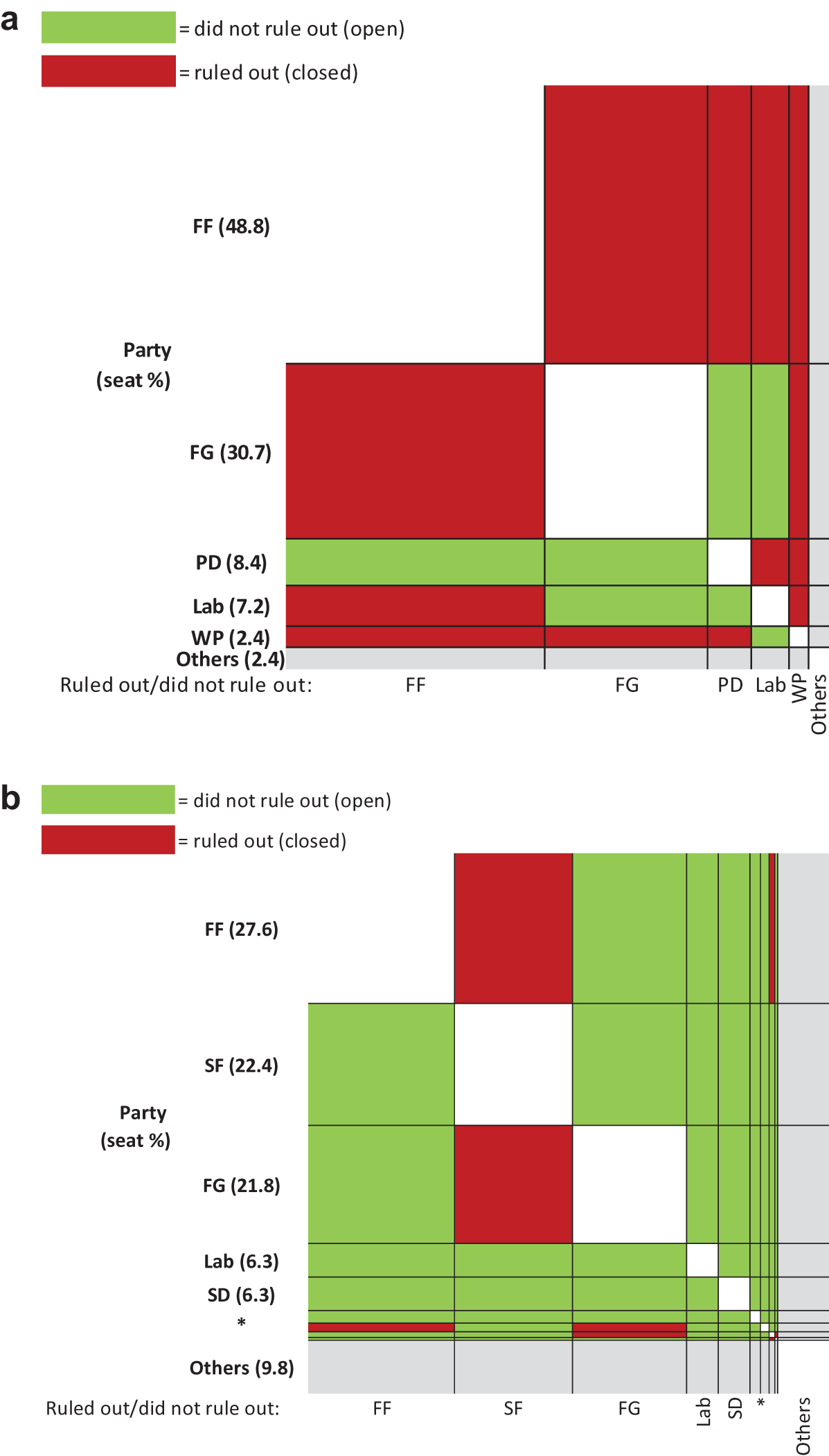
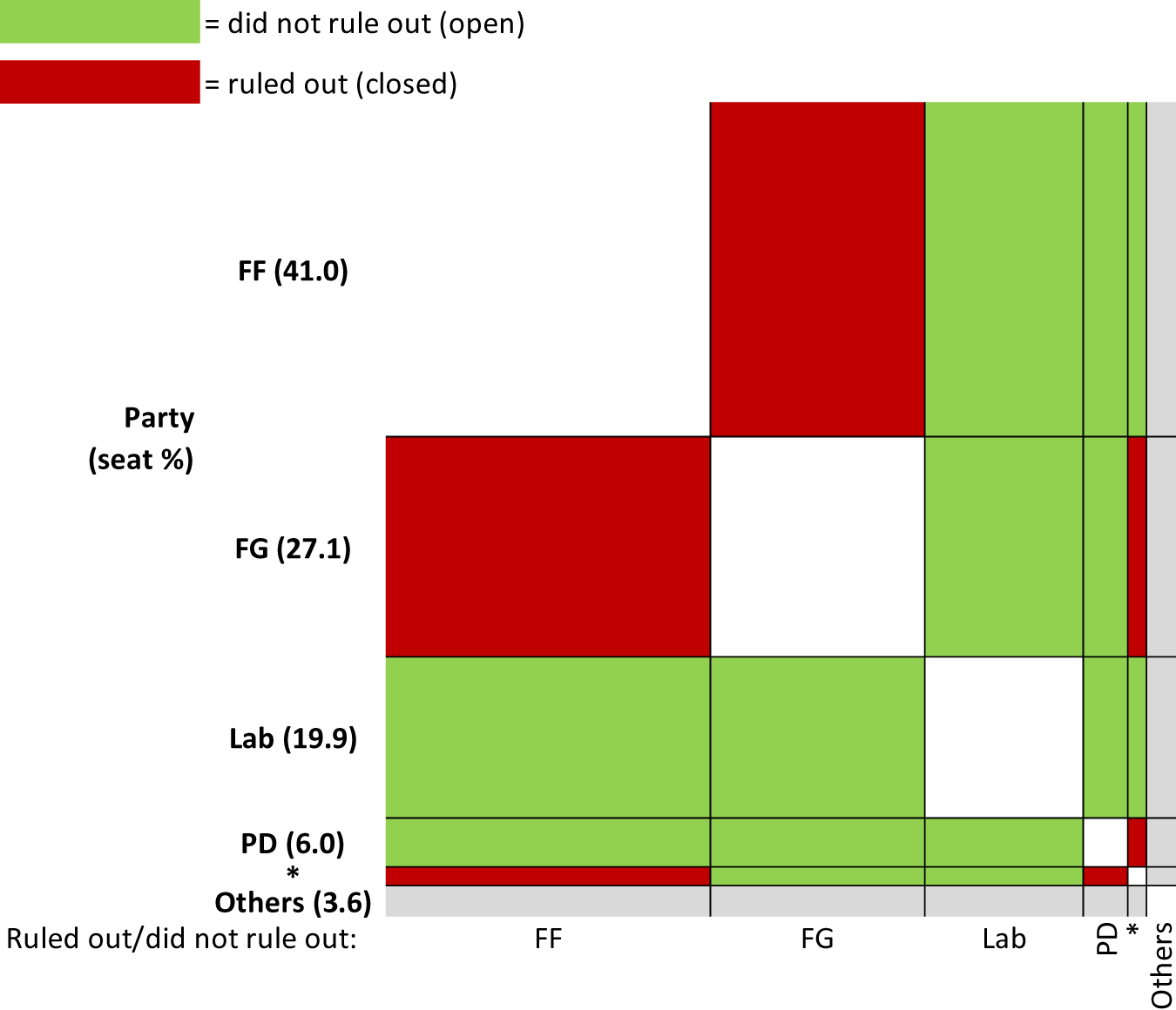
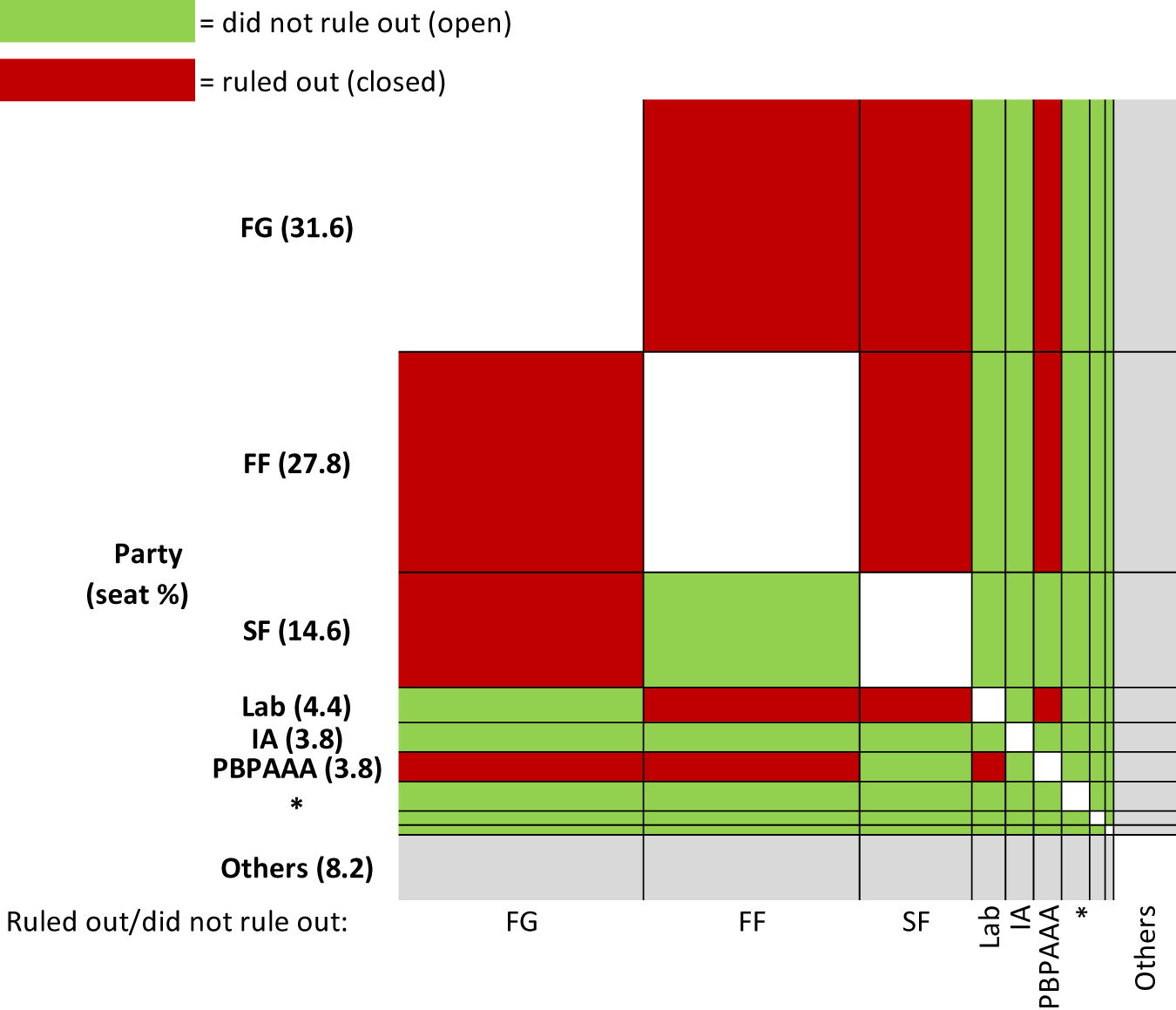
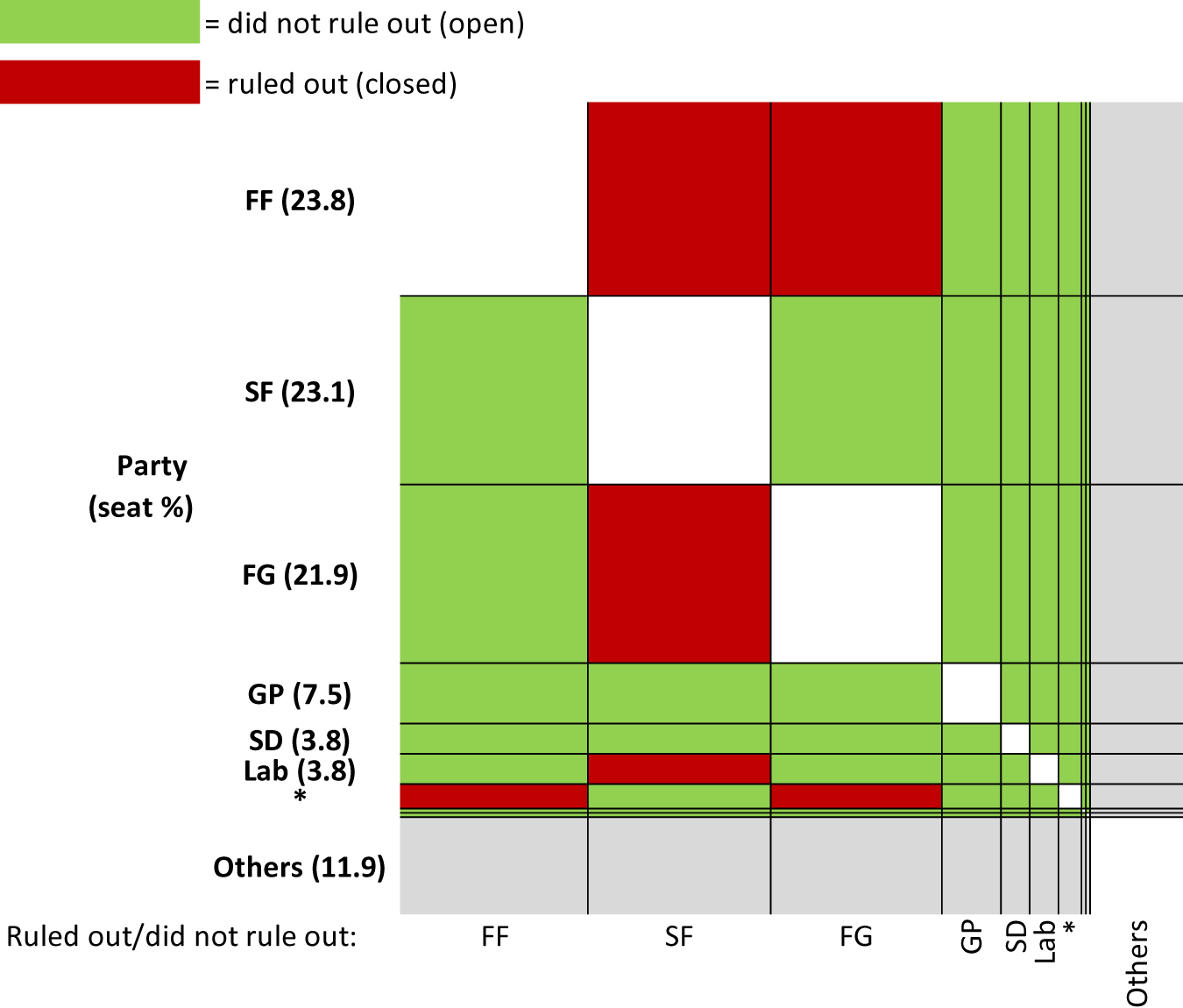
Figure 4a and 4b presents a more detailed picture of the systems of coalition preferences in 1987 and 2024. Changes in the distribution of seats, including the emergence of new parties (e.g. Sinn Féin, the Social Democrats), and changes in parties’ coalition preferences profoundly altered the system in the interim.Footnote 6
(a) Coalition Preferences in Ireland, 1987; and (b) Coalition Preferences in Ireland, 2024

1987–1989: a closed system
In 1987, m-openness was 0.16. That is, only 16% of (weighted) combinations of parties were mutually acceptable. Openness was 0.24, meaning that 24% of parties’ weighted coalition preferences were ‘open’. The most significant set of preferences underlying this rather ‘closed’ system was that of Fianna Fáil, as it won nearly half of the seats, and was still ruling out coalition entirely. The second-largest party, Fine Gael, ruled out coalition with Fianna Fáil, and all parties ruled out coalition with the leftist Workers’ Party. Based on these preferences, Fine Gael–Labour and Fine Gael–Progressive Democrats were the only coalition possibilities. A three-party coalition of Fine Gael, Labour and the Progressive Democrats appeared to be ruled out by the Progressive Democrats’ rejection of Labour, and in any event, those three parties did not come close to winning a majority at the election. In 1989, there were some electoral changes as the smaller parties won more seats at the expense of the two main parties, and the Progressive Democrats became open to a coalition with the Labour Party, but the overall pattern remained the same (see Figure A3 in the Supplementary Material). A key change happened shortly after the 1989 election when, in order to form a government, Fianna Fáil revised its coalition preferences and entered a coalition with the Progressive Democrats.
1992–2016: more open but variable
In the period from 1992 to 2016, Fianna Fáil and Fine Gael continued to have closed coalition preferences in respect of one another; this limited the openness of the system, as together, they held between 58% (2011) and 79% (1997) seat share. However, other factors contributed to the oscillation between mostly open and mostly closed systems of coalition preferences during this period (Figure 3). The most important single preference in this regard was the Labour Party’s approach to Fianna Fáil: Labour was open to Fianna Fáil in 1992 and 2002, but closed to them in 1997, 2007, 2011 and 2016.
1992 saw a new departure in patterns of coalition preferences, with an openness value of 0.63 (m-openness = 0.6) (Figure 5). Having been in coalition with the Progressive Democrats since 1989, Fianna Fáil opened up to the possibility of coalition with small parties, while Labour, despite trenchant criticism of Fianna Fáil, did not rule out any potential partners and won a record seat share. These two parties subsequently formed a coalition. This pattern of competition for government was to become the norm, with Fianna Fáil and Fine Gael each seeking to work with smaller coalition partners. The open coalition strategy adopted by Labour in 1992 was also to become common among smaller parties.
Coalition Preferences in Ireland, 1992

At the end of the ‘Rainbow Coalition’ of Fine Gael, Labour and Democratic Left (1994–1997), Labour rejected the possibility of coalition with Fianna Fáil, while the Progressive Democrats ruled out coalition with Labour, leading to a bipolar choice of potential coalitions: Fianna Fáil and the Progressive Democrats or a renewed Rainbow Coalition. The seat share of the two largest parties (Fianna Fáil and Fine Gael) grew by almost 10%, and Labour’s seats were cut nearly in half. As a result, the system of coalition preferences was again relatively closed (m-openness = 0.23; openness = 0.33), although not as closed as in 1987 or 1989, partly due to Fianna Fáil’s continued openness to coalition with smaller parties (Figure A5 in the Supplementary Material).
2002 (m-openness = 0.54; openness = 0.6) saw the reestablishment of more open coalition preferences by the Progressive Democrats and Labour and the growth of the Greens and Sinn Féin, neither of which ruled out any coalition partners. Nor did larger parties rule out coalition with the smaller parties except Sinn Féin, which nearly all parties rejected. Therefore, the coalition options in 2002 were overlapping Fianna Fáil- or Fine Gael-led coalitions. A similar pattern of overlapping possible coalitions was obtained in 2007, but Labour ruled out a coalition with Fianna Fáil and this, together with the success of the larger parties, which were closed to coalition with one another and with Sinn Féin, depressed openness values (m-openness = 0.24; openness = 0.37) (Figure A7 in the Supplementary Material).
2011 and 2016 saw the electoral consequences of Ireland’s economic crisis, which began in 2008, play out. 2011 (m-openness = 0.4; openness = 0.6) was an exceptionally volatile election in which Fianna Fáil lost the vast majority of its seats and was uncoalitionable to most parties due to its role in the economic crisis. Sinn Féin, which was still rejected as a coalition prospect by all major parties, grew substantially. The uncoalitionability of Fianna Fáil and Sinn Féin (Figure A8 in the Supplementary Material) explains much of the gap that opened up in 2011 between openness and m-openness values (Figure 3, above).
A combination of election results and coalition preferences (Figure 6) led the government formation process to an impasse in 2016 (m-openness = 0.32; openness = 0.41). At the core of the system, Fine Gael and Fianna Fáil still rejected entering government with one another and with Sinn Féin, which became the third-largest party. Sinn Féin on this occasion rejected coalition with Fine Gael, but did not unconditionally rule out coalition with Fianna Fáil; rather, they said that they would coalesce with Fianna Fáil if they (Sinn Féin) were the senior coalition partner. Ten weeks of coalition bargaining produced a coalition government of Fine Gael and the Independent Alliance, supported by Fianna Fáil in a confidence-and-supply arrangement.
Coalition Preferences in Ireland, 2016

After 2020: towards an open system?
In 2020 and 2024, openness was higher than it had ever been, but in several instances, open preferences were not reciprocated, meaning that the gap between openness and m-openness values widened. 2020 (m-openness = 0.41; openness = 0.7) was marked by further fragmentation and a transformation of the system of coalition preferences (Figure 7), as Sinn Féin, adopting an open coalition strategy, became the second-largest party in the lower house of parliament (the Dáil). Fine Gael was open to the possibility of a coalition with Fianna Fáil for the first time, but this openness was not reciprocated. The – now numerous – small parties generally adopted open coalition strategies, while Fianna Fáil, Fine Gael and Labour (collectively holding less than half of the seats) continued to reject Sinn Féin as a coalition partner. Fine Gael’s openness to coalition with Fianna Fáil facilitated the formation of the novel Fianna Fáil–Fine Gael–Green coalition, which this time took 20 weeks to form, in the context of the early stages of the COVID-19 pandemic.
Coalition Preferences in Ireland, 2020

In 2024 (see Figure 4b and O’Malley Reference O’Malley, Gallagher, O’Malley and Reidy2025), the system had an even higher openness value of 0.8, while m-openness (0.604) was marginally higher than it had been in 1992 (0.600). Having governed with Fine Gael since 2020, Fianna Fáil was now open to a coalition with its historic rival. Fianna Fáil and Fine Gael still rejected a coalition with Sinn Féin, but the very few other ‘closed’ coalition preferences in the system related to small parties and so had only a small impact on systemic openness.
Analysis
The openness of the system of coalition preferences changed substantially between the late 1980s and the 1990s. This was driven by several developments, including the largest party (Fianna Fáil) opening up to coalition after 1989, the collective electoral decline of the main parties (Fianna Fáil and Fine Gael), and their opening up to coalition with one another in the 2020s.
The emergence of smaller parties also contributed to increased openness, as they increasingly adopted open coalition strategies. In 1987 and 1989, the Progressive Democrats, Labour and the Workers’ Party all ruled out coalition with various other potential partners, but Labour and the Progressive Democrats became more open to a wider range of partners in the 1990s (as in 1992, for example) and the Workers’ Party was effectively supplanted in the system by its splinter party, Democratic Left, which had a more open strategy. 2002 exemplified this general trend (Figure A5 in the Supplementary Material). On the other hand, Sinn Féin’s growth in the 2010s and 2020s has limited systemic openness values. This is because, although the party itself has tended not to rule out coalition with other parties (2016 being an exception), only smaller parties have accepted it as a potential coalition partner, in part due to its history of supporting political violence.
Openness also varied due to changes in party preferences between elections, especially Labour’s preferences in respect of a coalition with Fianna Fáil. In general, however, the evidence from the Irish case suggests that coalition preferences are quite sticky, rather than being fickle (Figures A2–A11 in the Supplementary Material). Consider the consistently closed stance of Fianna Fáil and Fine Gael towards one another until 2020; the consistently closed preferences of the main parties in respect of Sinn Féin; or the consistently open strategies of some of the smaller parties (e.g. the Greens). This suggests that they are rooted in durable incentives, such as office-seeking motivations and supporters’ preferences.
Increased openness has had implications in the electoral and governmental arenas. For example, increased openness after the 1980s meant that the offer made to the Irish electorate changed. In 1987 and 1989 (and long before), the electorate was presented with a choice of a Fianna Fáil single-party government or a Fine Gael-led coalition. For most of the period from 1992, the offer at election time was of putative overlapping Fianna Fáil- or Fine Gael-led coalitions. Similarly, the opening up of coalition preferences between Fine Gael and Fianna Fáil in 2020 and 2024 meant that by 2024, the electorate was being presented with a choice of overlapping potential coalitions led either by Sinn Féin or by Fianna Fáil and Fine Gael together.
Open coalition preferences in many cases preceded the formation of a coalition. For example, Labour entered government with Fianna Fáil in 1993 after keeping that option open in 1992. In some significant cases, however, such as Fianna Fáil’s change of direction after 1989 or their openness to coalition with Fine Gael after 2020, the party’s expressed preferences only changed out of post-election necessity. Parties have also adapted to changes in their parliamentary strength: Fianna Fáil’s reduced electoral success in the late 1980s and 1990s forced it to open up to coalition, and when it became a smaller party (after the 2011 election), it adapted to this by (eventually) becoming more open to coalition with Fine Gael.
Discussion
What does this case study tell us about the ‘coalition preference’ approach? It illustrates how this approach incorporates information on more parties than the government formation approach and, therefore, is able to take a wider variety of interparty relationships into account: not only between government parties, but also between opposition parties and between government and opposition parties. This underlines that it provides richer information, as the ‘openness’ measure provides information on coalition potential between parties (i.e. asymmetrical relationships involving unreciprocated openness to coalition), and how the two measures (openness and m-openness) can diverge. The case study also suggests that openness between parties, including unreciprocated openness, can be a precursor to coalition.
How do the openness measures developed here compare with ‘government formation’-focused measures? Mair (Reference Mair, LeDuc, Niemi and Norris1996, Reference Mair, Karvonen and Kuhnle2001, Reference Mair, Katz and Crotty2006, Reference Mair, Gloppen and Rakner2007) did not aggregate his three dimensions of party system openness (alternation, novelty and access). However, in developing their ‘closure’ measure of party system institutionalisation, Casal Bértoa and Enyedi (Reference Casal Bértoa and Enyedi2021) operationalised and aggregated them. A visual comparison of these values for Ireland (Figure 8) shows some similarities, in that Casal Bértoa and Enyedi’s raw closure values are lower when patterns of government formation changed after 1989 and from 2020. Where they differ is in the 1990s. This is mainly for a simple reason, noted above: Mair’s approach uses ‘change’ concepts (alternation, novelty access), and so captures change rather than structure.Footnote 7 Thus, the two approaches differ empirically as well as conceptually. However, they may be causally related: it is plausible that open coalition preferences are an important part of the mechanisms that lead to unpredictable systems of government formation, and thus an ‘open’ party system in Mair’s terms.
Comparing Openness Measures with Raw Data for Casal Bértoa and Enyedi’s (Reference Casal Bértoa and Enyedi2021) Measure of ‘Closure’

In operationalising the coalition preference approach, I identified two concerns about relying on coalition preference data to characterise interparty relationships. The first was whether such stated preferences are a valid indicator of party preferences; the second was a related concern about whether such preferences remain stable. The case study of Ireland reinforces the finding in existing research that coalition preferences are consequential: parties tend not to enter a coalition with partners that they have ruled out before an election (see also Debus Reference Debus2008; Martin and Stevenson Reference Martin and Stevenson2001). Although there are important exceptions (e.g. Fianna Fáil coalitions with the Progressive Democrats in 1989 and with Fine Gael in 2020), this suggests that such preferences are at least somewhat binding. They also appear to be rather stable over time, but again, there are exceptions, including important changes in party preferences that have happened out of post-election necessity. As a result, coalition preferences will sometimes ‘lag’ rather than ‘lead’ developments in coalition formation. Overall, however, the case study suggests that coalition preferences are not fickle and that they do shape parties’ actions.
While the coalition preference approach does allow us to quantify change in one important aspect of the system, some challenges related to the interpretation of party system change and stability are not resolved by this approach. Although the focus on coalition preferences allows us to measure a form of systemic change ‘that counts’ – that is, change in a key set of interparty relations – it remains ‘change by the numbers’, in that it produces continuous measures (Mair Reference Mair, Katz and Crotty2006). Key questions remain: How much change counts as change? And for how long must a configuration be stable in order for it to be considered systemic (Casal Bértoa Reference Casal Bértoa2023: 452; Mair Reference Mair, LeDuc, Niemi and Norris1996, Reference Mair, Katz and Crotty2006; Smith Reference Smith1989: 356)? One potential threshold in the openness measures developed here is between systems in which coalition preferences are more closed than open (<0.5, e.g. Ireland in 1987) and systems that are more open than closed (>0.5, e.g. Ireland in 2024).
What the case study of Ireland cannot tell us is whether the coalition preference approach can be applied successfully to other party systems and used to compare them. There seems to be little reason why not, but the most direct evidence for this can be found in its cross-national application. Therefore, I have applied the coalition preference approach to three post-election contexts: Austria in 2024, Czechia in 2025 and the Netherlands in 2025 (Figures A12–A14 in the Supplementary Material). Despite having different levels of party system fragmentation, Austria and the Netherlands show relatively ‘open’ patterns of coalition preferences (openness = 0.83, m-openness = 0.66 in Austria; 0.82 and 0.64 in the Netherlands). In contrast, Czechia’s system was bipolar and rather closed in 2025 (openness and m-openness at 0.33). What each of these contemporary cases has in common – which the Irish case does not offer – is the exclusion of some significant far-right parties by several other parties (and reciprocal rejection in some instances), corroborating the suggestion that it is, in part, ideological differences that underpin coalition rejections. The key difference in the Czech case is, arguably, the extent of the populist and far-right’s success.
One potential weakness in the specific operationalisation of coalition preferences used here – revealed by the Austrian case – is that it does not allow for cases in which there has been no ‘ruling out’ of a coalition, but where a particular interparty partnership is so unlikely that it is not even on the agenda. For example, Austria’s far-right FPÖ did not rule out a coalition with the Greens, but the evidence suggests that it would have done so if this were in question. However, this operationalisation-specific issue does not weaken the case for a coalition preference approach to party systems more generally.
Conclusion
This study has proposed and applied a new approach to the analysis of party systems using data on coalition preferences. It builds on the insights of scholars from the Sartorian School of party system analysis, focusing on relationships between parties and on competition for government. In doing so, it aims to take into account some of the Sartorian School’s other key assumptions, including the importance of cooperation between parties and parties’ unequal systemic importance. It also shares a concern with some of those scholars who aim to develop ways to quantify systems of interaction between parties (Casal Bértoa and Enyedi Reference Casal Bértoa and Enyedi2021).
The ‘coalition preference’ approach does what Mair (Reference Mair, Katz and Crotty2006: 65, also citing Smith, Reference Smith1989) suggested that approaches to party system analysis needed to do: ‘to address [one of] the principal modes of interaction between the parties and the way in which they compete with one another’. In doing so, it provides a more complete picture of the party system and the relationships of which it is comprised than the existing ‘government formation’ approach to party system analysis. However, it is not intended to replace this approach, nor other measures of party systems, such as fragmentation and polarisation. Rather, the coalition preference approach adds to the tools available to scholars who aim to deliver on the promise of the Sartorian School. Party system research has always been characterised by a focus on various arenas and aspects of party systems, and the coalition preference approach provides another analytical layer that we can apply.
The central and primary argument of the study has been that the coalition preference approach is a tool that can help us to understand party systems; within that approach, its operationalisation can be modified. There is no reason why alternative binary distinctions (e.g. positive commitments to coalition), or ordinal or continuous measures of coalition preferences, would not also be compatible with this approach and the measures of openness that it produces, and comparing alternative measures may be instructive. The operationalisation can also be varied by measuring coalition preferences at different time points – including post-election, at the time of government formation.
The coalition preference approach is undoubtedly useful in case or country studies. However, its application should not be limited to case studies. I have shown – albeit in a limited way – the potential for the coalition preference approach to be applied across countries and for cross-national comparisons. Although collecting data on coalition preferences is more demanding than collecting data on government formation, collecting such data on a cross-national basis is far from impossible (Debus Reference Debus2007; Martin and Stevenson Reference Martin and Stevenson2001). And while it may be that coalition preferences are expressed differently across countries (Decker and Best Reference Decker and Best2010: 167), this is an empirical matter to be described and explained, and its implications teased out.
Introducing this approach invites questions about how variation in the openness of the system of coalition preferences can be explained, and about its effects. Explanations of systemic openness would need to refer to attributes of the party system in the electoral arena, including ideology and policy preferences, the fragmentation of party systems, electoral volatility and parties’ past experiences with one another (Tavits Reference Tavits2008). The Irish case certainly suggests that the opening up of the party system coincided with increased fragmentation and that party size strongly influenced parties’ coalition strategies. At the same time, electoral volatility was not sufficient to produce immediate changes in the openness of coalition preferences (at the time of the 2011 general election, for example).
The principal effects of open coalition preferences should relate to coalition bargaining outcomes, including which coalitions form and how quickly. Although we have some evidence on these questions (Bäck Reference Bäck, Hellström, Lindvall and Teorell2024; Debus Reference Debus2008; Golder Reference Golder2006b; Martin and Stevenson Reference Martin and Stevenson2001), openness at the system level may not always lead to quick government formation (Decker and Best Reference Decker and Best2010: 174; see also the case of Ireland in 2020, above). Coalition preferences may also have electoral implications, fuelling (or defusing) polarisation among parties and their supporters. We might also look at how developments in openness presage similar developments in m-openness, and whether and to what extent m-openness is more consequential for government formation than openness.
The focus of this study has been on patterns of interaction at the level of the party system, but drawing on coalition preference data, there is also potential for further analysis at the level of parties – their coalition strategies and their coalitionability – and party dyads. Party-level attributes of openness and coalitionability can be quantified using data on coalition preferences (see the Supplementary Material, pp. A20–A23 for an illustration). This too opens up an agenda relating to their effects and causes, not least explaining why any office-seeking – or policy-seeking – party in a multiparty system would rule out coalition with any other party. As highlighted above, our knowledge of the causes of parties’ coalition preferences remains limited, and there are several potential avenues to follow. Inside parties, the respective roles of the party leadership and the party grassroots in shaping coalition preferences remain an open question, and one that may be best studied through case studies. Finally, the electoral effects of parties breaking with pre-election promises regarding coalition formation might also be investigated to supplement existing anecdotal evidence.
Supplementary material
The supplementary material for this article can be found at https://doi.org/10.1017/gov.2026.10041.
Acknowledgements
I thank Marc Debus for sharing his PhD thesis, which contains valuable data on coalition preferences; Alan Kinsella for inspiring this perspective on coalition preferences; Rory Costello, Christoffer Green-Pedersen, Evelyne Huebscher, Frank Haege, Kévin Saudé and participants in the Department of Politics and Public Administration’s Research Seminar at the University of Limerick and the Political Studies Association of Ireland’s Annual Conference in 2024 for comments on earlier drafts. Thanks to Kévin Saudé for help with managing data in R with the purrr package, Jonathan Arlow for directing me to information on coalition preferences of small left-wing parties in Ireland and Maren Hoppenbrouwers for input on the Dutch general election of 2025.
Disclosure statement
The author reports that there are no competing interests to declare.



 Open access

