

1.1 Close Encounters with Chimpanzees
There may be only two groups of humans who truly understand how chimpanzees look at the world. The first is those who have studied chimpanzees in the wild, trailing along behind them day after day, watching as males manipulate both friends and enemies in their struggle to ascend to alpha status; or looking on in sympathy as a heavily pregnant female, tired after a long day of gathering, calculates which feeding site might pay-off best for the day’s last meal. After perhaps a year of such snooping, an observer might begin to understand what it is like to inhabit the mind of the chimpanzee, to think about the world and other chimpanzees as a chimpanzee does.
The second group is made up of people who have reared a chimpanzee from infancy, treating her as they might have treated their own infant, learning her abilities, desires, and fears as she experiences the joy, loneliness, anxiety, frustration, and confusion of childhood.
The approach followed by the first group has led to incredible scientific discoveries and vivid biographies of individual chimpanzees. That followed by the second group is heavily discouraged nowadays, and thankfully so. It has always (at least, in every case I know of) played out as a heart-wrenching tragedy entailing shattered relationships, forlorn isolation, and premature death. To quote Jane Goodall, “Every primate belongs in an environment that is as close to a wild setting as possible. They are beautiful and intelligent animals, but highly complex with very specific needs.”
Most people belong to neither of these groups, but see chimpanzees in a third context: captivity. Ceding control of your life to a jailer, no matter how benign the jailer, shrinks the spirit and shrivels the intellect. Captive chimpanzees are diminished beings, not the striving, calculating, problem-solving personalities I know from the wild.
Those who have inhabited the chimpanzee world come to know that while chimpanzees truly are intelligent, their intelligence is as unlike ours – but also as like ours – as their anatomy. For some cognitive tasks their intellect and psychology mirror ours almost perfectly; for others it is a fun-house mirror version of the human condition, similar but strangely warped. For still other intellectual tasks their abilities are surprisingly meager. These differences mean that it takes time and effort to inhabit their minds. This volume means to introduce a diverse audience to aspects of chimpanzee behavior and biology they may have neglected. While the rest of this book will focus on chimpanzee research, both in the wild and in captivity, I want to introduce chimpanzee nature to you by profiling a few chimpanzees whose lives were among humans, and I will wrap it up back in the wild, where we will spend most of our time in this volume.
1.2 Nkuumwa
The Uganda Wildlife Education Center (the Entebbe ZooFootnote 1 to some) of July 1997 was half green hope and half dusty depression. The startling transformation that has rendered it the green and shady animal sanctuary it is today had only just begun. Yet, even then you could see signs of what was to come. There were new, spacious nature-mimicking exhibits under construction everywhere you looked. Yet still amid these emerging oases of wildness you could find (in a kiddie pool-sized mud puddle) a lone, tattered, and bloated-looking crocodile whiling away eternity, nothing about the creature reminiscent of the sharp danger and vivid action of the wild animal.
Strolling the zoo’s dusty paths with Debby Cox, one of the driving forces behind the zoo’s current zenith, I wended my way past steel-meshed, concrete-floored monkey cages and topped a hill to catch a glimpse of what I had come there to see, the green, spacious, and spanking-new chimpanzee habitat. This modern enclosure had been built as a home for some of nature’s most appealing castaways. Or – not castaways – but unfortunates, wild beings kidnapped from nature. Here lived chimpanzees who had narrowly escaped the cooking pot – or if not that, the short, miserable life of a shackled pet. Debby proudly showed off the enclosure. It was hilly, clothed in green, alive with healthy vegetation, and situated so that the restraining fences were as little noticed as possible. I circled the compound, listening to the clean-toned, high-decibel hoots of the chimpanzees, watching their faces and mannerisms for some hint of their harrowing past. Sadly, some clearly showed it. Yet, others seemed happy, virtually indistinguishable from wild chimpanzees.
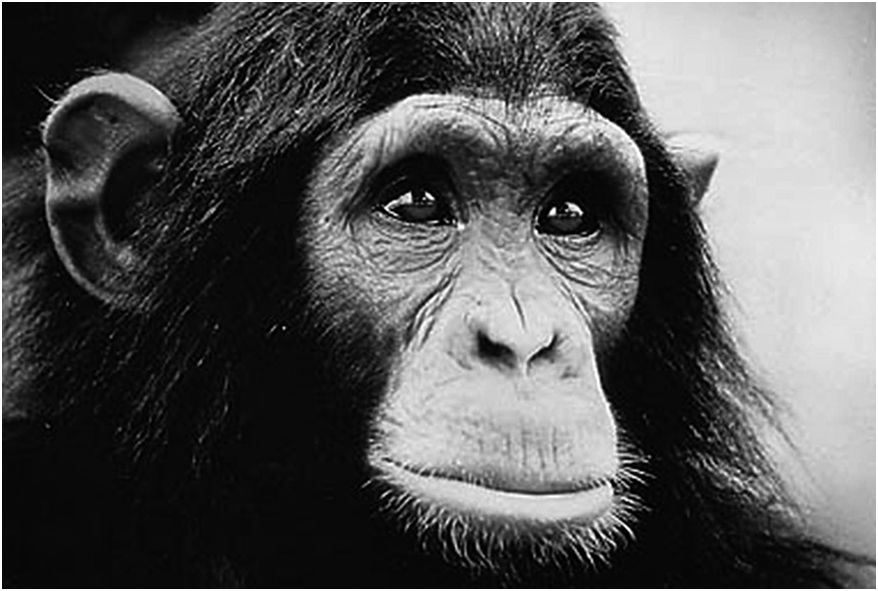
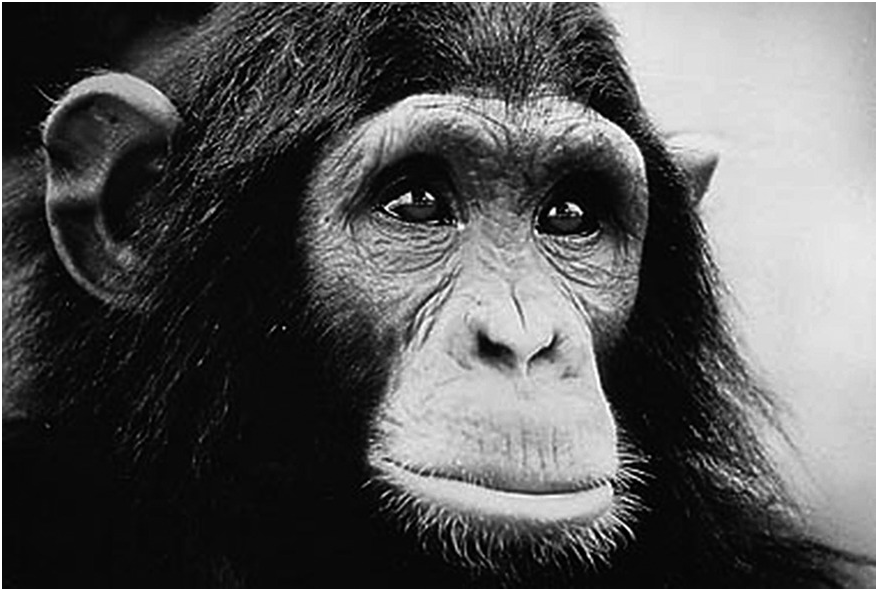
Near the enclosure was a modest structure that held the offices and workspace for the ape caretakers. There I met the zoo’s newest castaway, an infant chimpanzee named Nkuumwa (Figure 1.1). Possibly a year old, perhaps two, the orphan Nkuumwa was too young to live on solid food alone. Chimpanzees mature only slightly faster than humans. If she were in the wild she would still be getting all her nutrition from nursing and would continue to do so for another couple of years. She was here because she was still too small and weak to cope with the nearby raucous chimpanzees who would one day become her companions. Instead, she was being hand-reared by Debby and the zoo staff.
Nkuumwa at four years old.
Nkuumwa had been confiscated five months earlier from a cook at the US Marine House in Kampala, where she had been kept as a sort of mascot, regularly passed from person to person during social events, a circumstance that could have been no more comfortable for her than it would be for a human baby.
If Nkuumwa had a typical experience during her orphaning she would have seen her mother shot and killed, and as horrific as it is to contemplate, it is not at all unlikely that she watched as her mother was butchered by poachers. Then she would have been carried to a roadway, chained, offered for sale, and eventually bought by a passing stranger. Since wild chimpanzees of Nkuumwa’s age are rarely out of their mother arms, her capture would have been the first time she had ever been more than an arm’s length from her mother.
Someone notified the authorities that Nkuumwa was at the Marine House, and it fell to the Entebbe Zoo staff to confiscate her. When zoo personnel first gathered her up she was so covered with lice that her normally black fur appeared white. She was too weak to stand, and when she was examined by medical staff she was found to have pneumonia. At first Nkuumwa refused to eat or drink. Pneumonia is extremely dangerous for chimpanzees, and for infants it is fatal more often than not. Nkuumwa was lucky. After only a brief time in the care of the knowledgeable zoo staff, she rallied. She gained strength, then gained weight, and soon it was apparent she would survive. By the time I met her she looked healthy and well-fed. At a cost. Debby was woken up several times a night to feed Nkuumwa on demand, just as her mother would have done.
Nkuumwa’s luck has continued up to now. She is 21 years old as I write this, living in the Ngamba Island chimpanzee sanctuary in Uganda, a well-adjusted, lively young female, seemingly bearing no scars from her harrowing life-journey.
While Nkuumwa’s story is a disturbing one, I can hardly blame the Marine who bought her and took her home. He was young and infant chimpanzees are heart-breakingly cute; perhaps he did what many of us would have done in his place: He saw an appealing and sad animal he wanted to comfort. This is exactly what so many sympathetic chimp owners in history did.
I recounted Nkuumwa’s biography because it says something about people and chimpanzees that I find telling. For, as I was meeting Nkuumwa, her caretaker asked if I would like to hold her. As a fieldworker I had been fully indoctrinated in the “avoid-contact” code all wild primate researchers follow. I was inculcated to avoid close proximity to a chimpanzee, and touching them on purpose was out of the question. The no-contact rule is an important one. Not only might contact pass on diseases, if chimpanzees interact too intimately with humans the overexposed individuals tend to treat humans just as they might treat another group member. Despite what you may have heard, that does not mean sensitively grooming them and patting them on the head – it often means inclusion in the violent world of chimpanzee physical dominance, a rigid social hierarchy we will discuss in detail in Chapters 24, 25, and 26. So this was a first for me. In all my years of living among chimpanzees I could count on one hand the incidental physical contacts I had had with them.
While it would never have occurred to me to ask to hold Nkuumwa, I made a quick readjustment as her keeper looked at me expectantly. I reached for her and as I did, she held her arms out to be gathered up, exactly as a human infant would. There was something endearing about the way she gripped my shirt and arm so tightly, even though there was no indication she was fearful. I pulled one of her hands away from my shirt and held it between my thumb and finger, examining her surprisingly narrow light brown hand with its long, thick fingers, wrinkled, warm, soft on the outside, but with hard strong sinews and bone underneath. I looked down at her face and she gazed back at me steadily, her eyes darting back and forth between each of mine, something that somehow made her seem unsettlingly like a human baby.
I had received some potent doses of infant chimpanzee cuteness in the past, but holding this tiny, clinging baby in my arms evoked a much more powerful emotion than I had experienced before. It was not just that Nkuumwa was cute; I felt embarrassed that I immediately felt a strong protectiveness and possessiveness toward her, as if I might have trouble handing her back to her keeper. At that instant I felt a brief stab of guilt, a guilt I have felt before when cuddling someone else’s baby, the hollow feeling that somehow my parental feeling toward Nkuumwa was betraying my own children. This feeling was quickly followed by the more objective realization that some important distinction I had always assumed existed between humans and animals had been short-circuited.
1.3 Meshie
While this episode was unusual, I am just one of many to have experienced it. Soon after this incident, I read an article by Claire Martin that told a tragic tale with which I was vaguely familiar, but she told it in a more personal way than anything I had read before (Martin, Reference Martin1994).
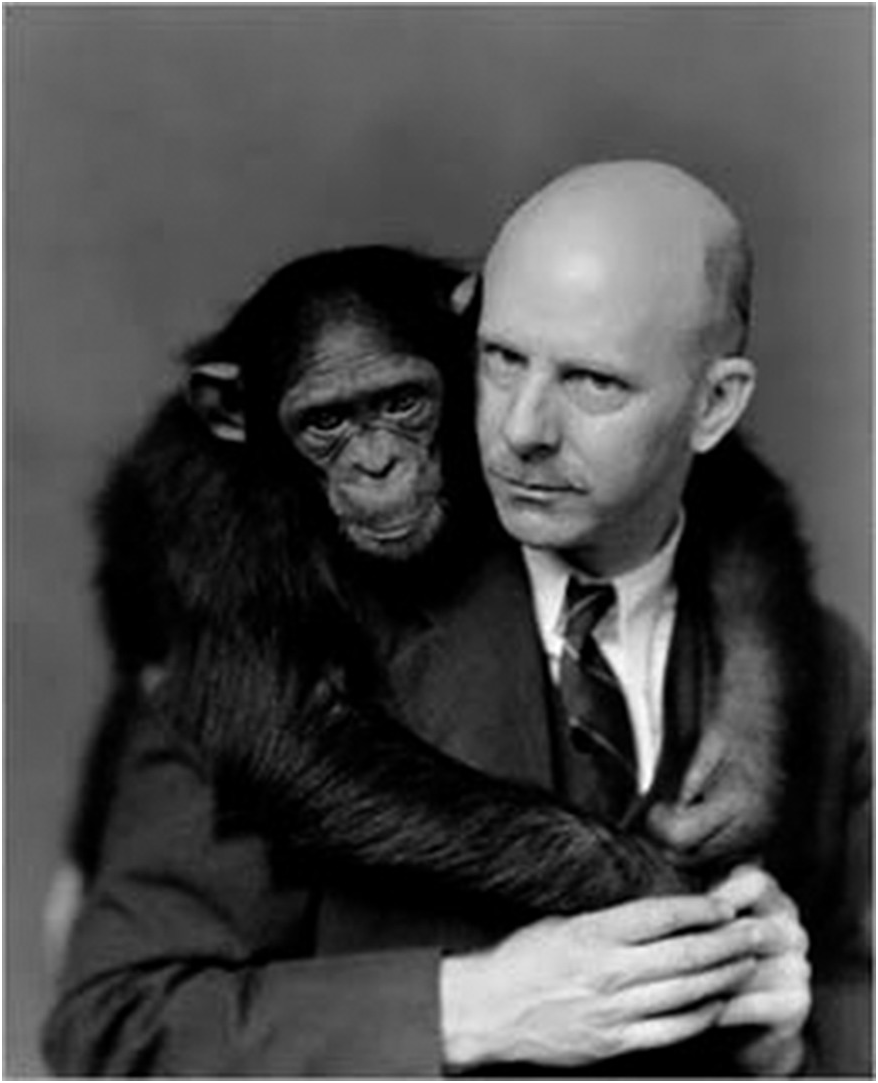
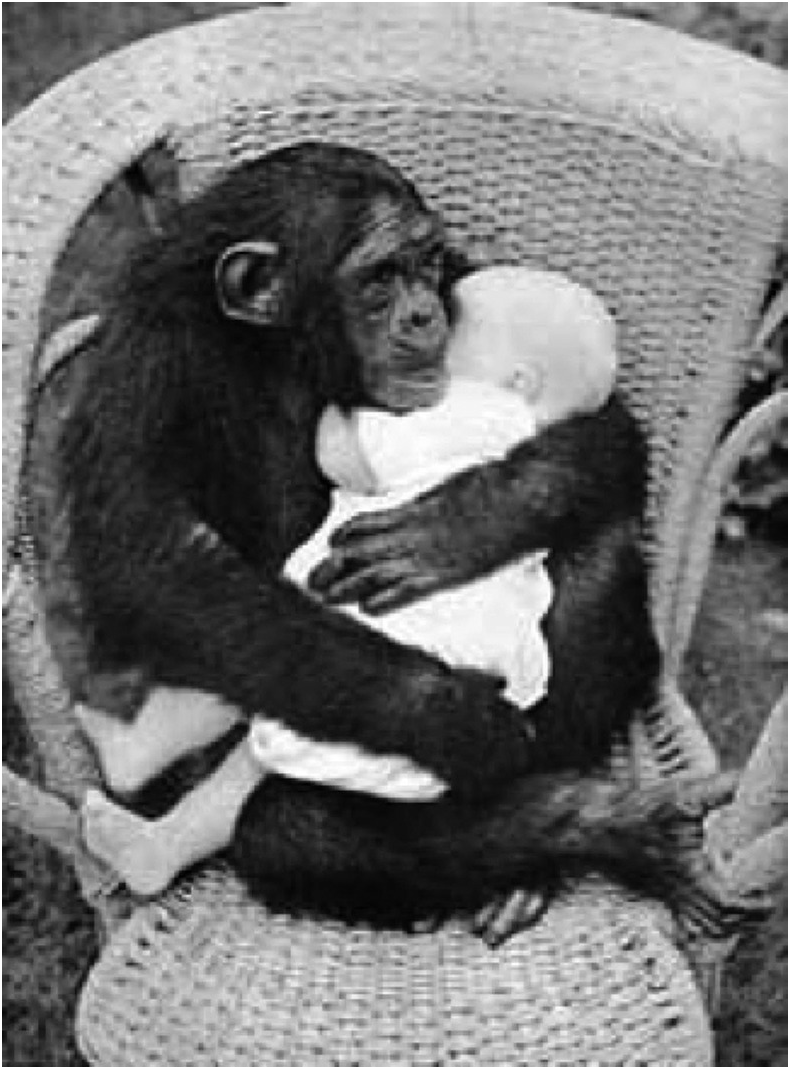
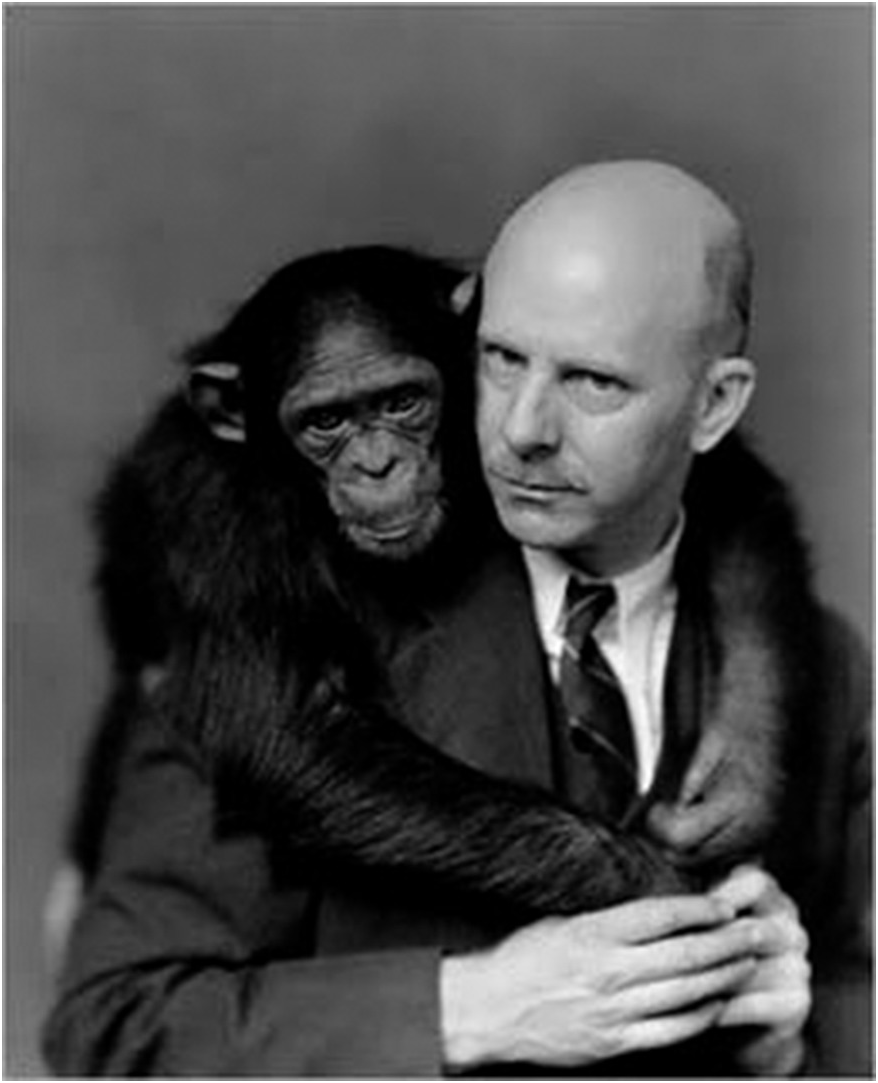
It was the story of a scientist and a chimpanzee – a frail orphan purchased on impulse. It was a story that featured the same species-confusion I had experienced holding Nkuumwa. It was the story of the eminent scientist Harry Raven and his adopted chimpanzee daughter, Meshie (Figures 1.2–1.4).
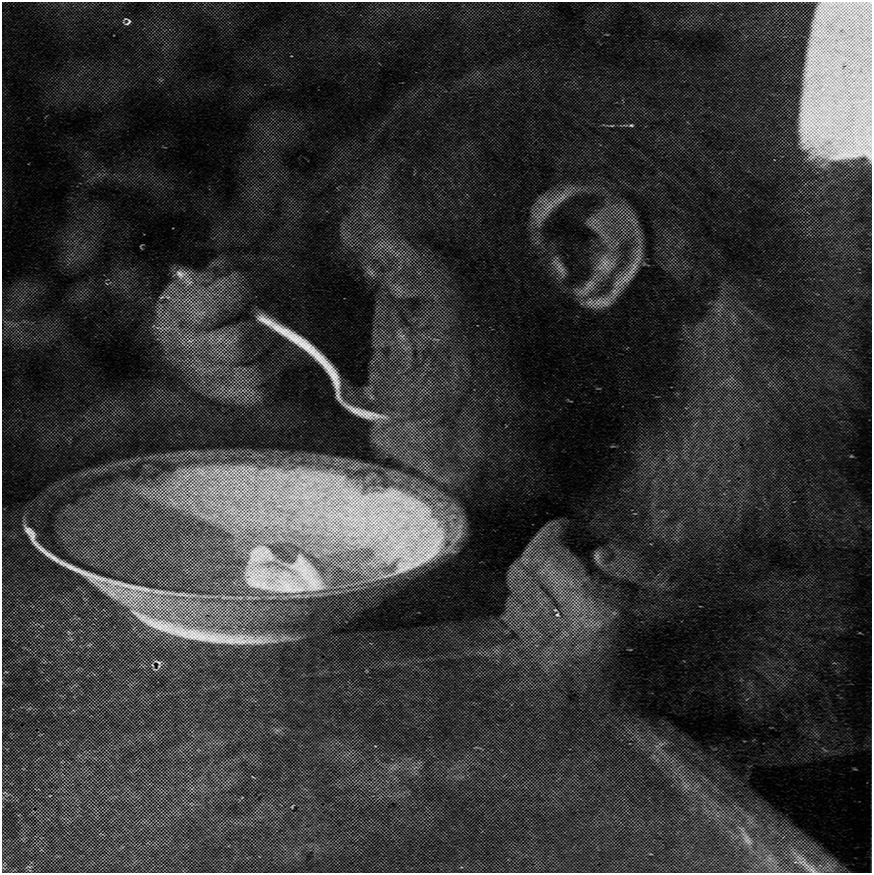
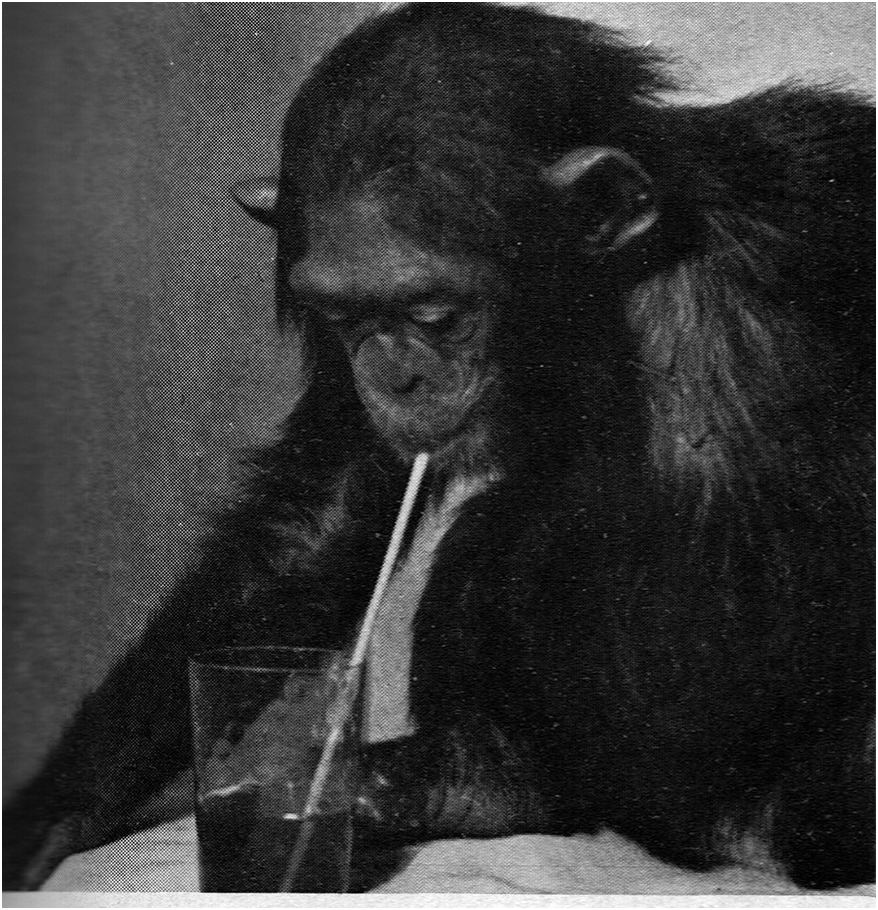
Meshie drinking grape juice, using a straw.
Raven’s is a well-known story (Raven, Reference Raven1932, Reference Raven1933), told in two articles that were sensations at the time among those who were interested in primates, retold many times even before Martin’s retelling. Writer Preston Douglas reported on Raven’s story and was so intrigued by it he turned it into a captivating novel that was widely reviewed and read, Jennie (Preston, Reference Preston1994).
Raven, Douglas, and Martin tell Meshie’s story. Her name was given to her by children in an African village Raven was visiting. “Meshie Mungkut,” Martin wrote, was said to mean “little chimpanzee who fluffs her hair up to look big” (chimpanzee hair stands on end when they are excited or aggressive, a phenomenon known as piloerection).
In 1930 and 1932, while he was curator at the American Museum of Natural History, Harry Raven traveled from his tidy home on Long Island to Cameroon, West Africa on an expedition “collecting” primate specimens for anatomical study; you probably suspect what collecting means – “specimens” are not normally found lying on the forest floor.
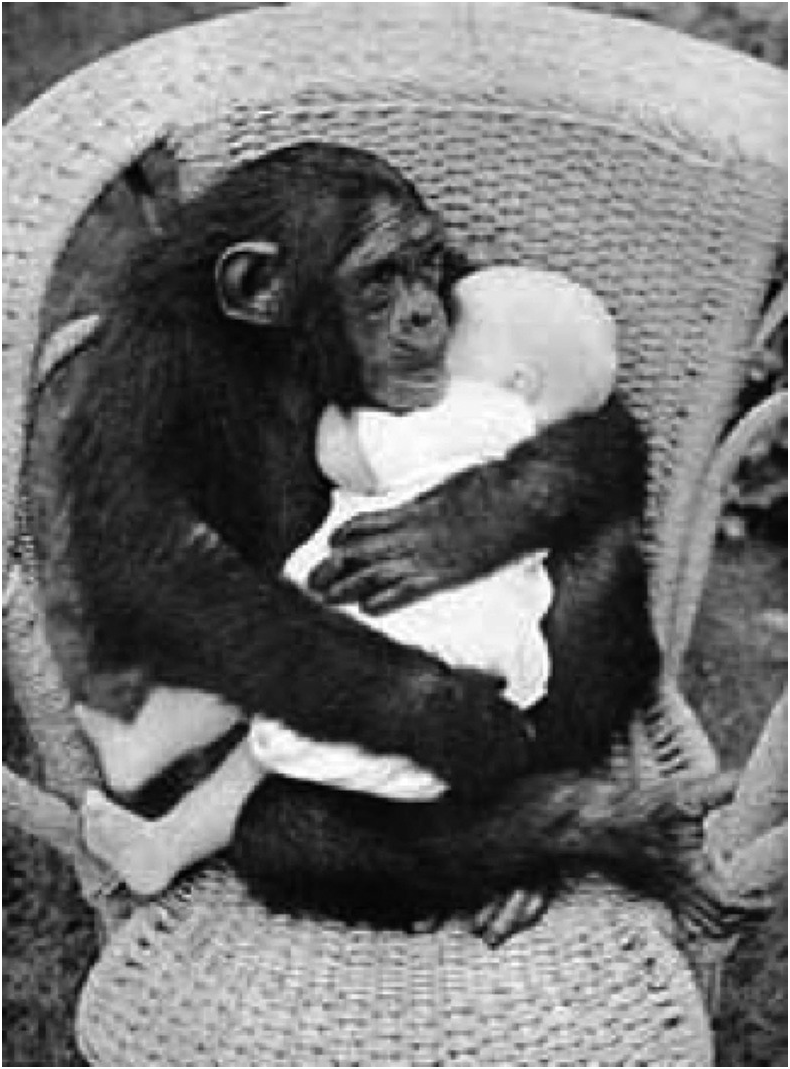
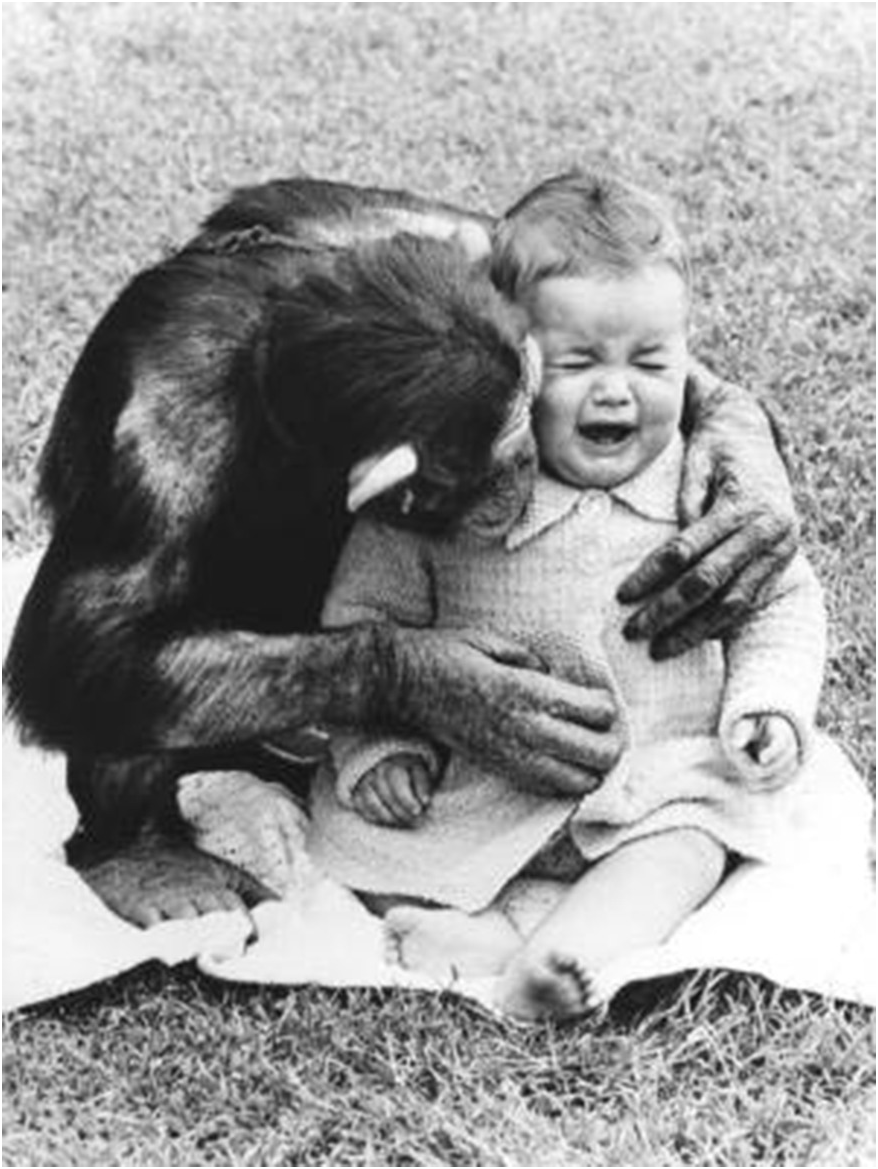
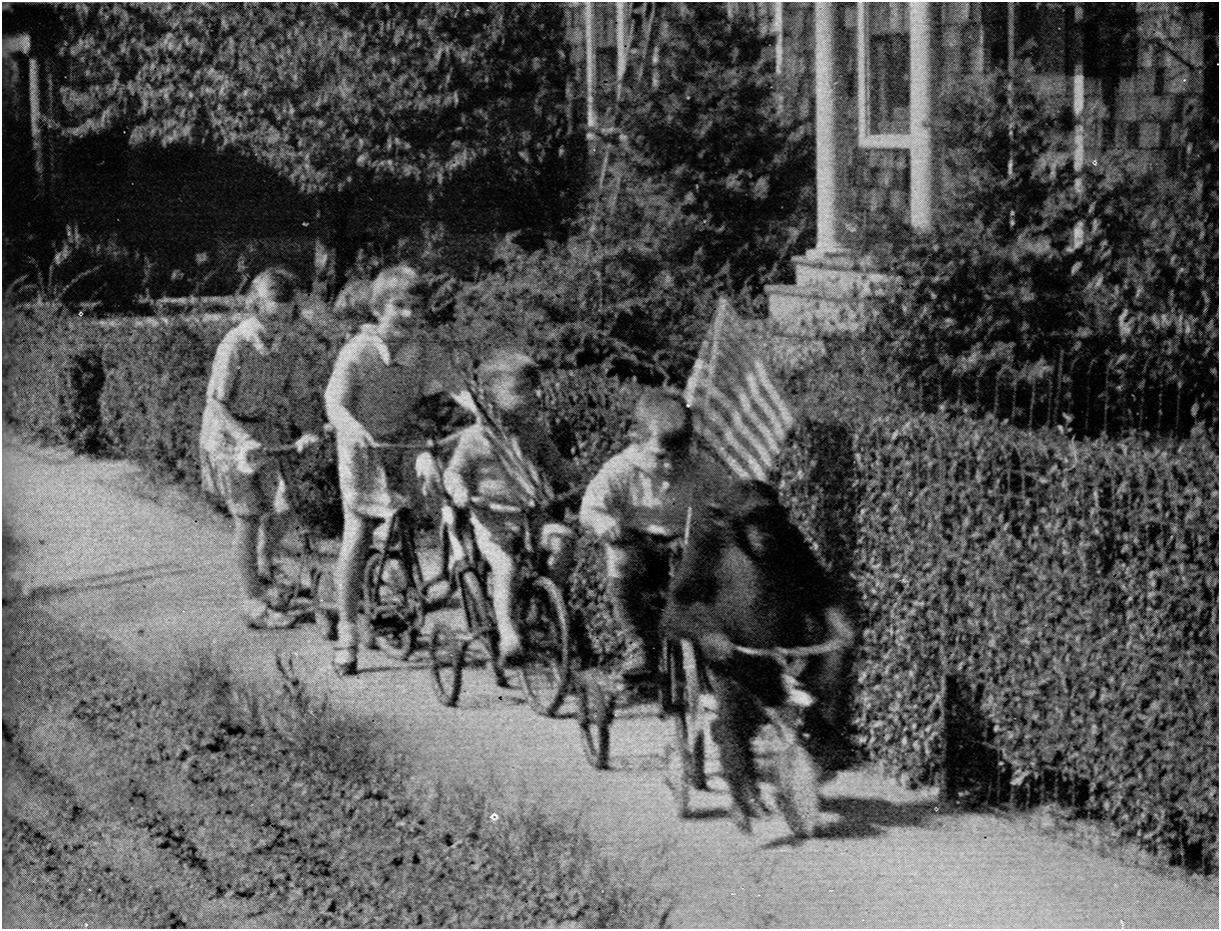
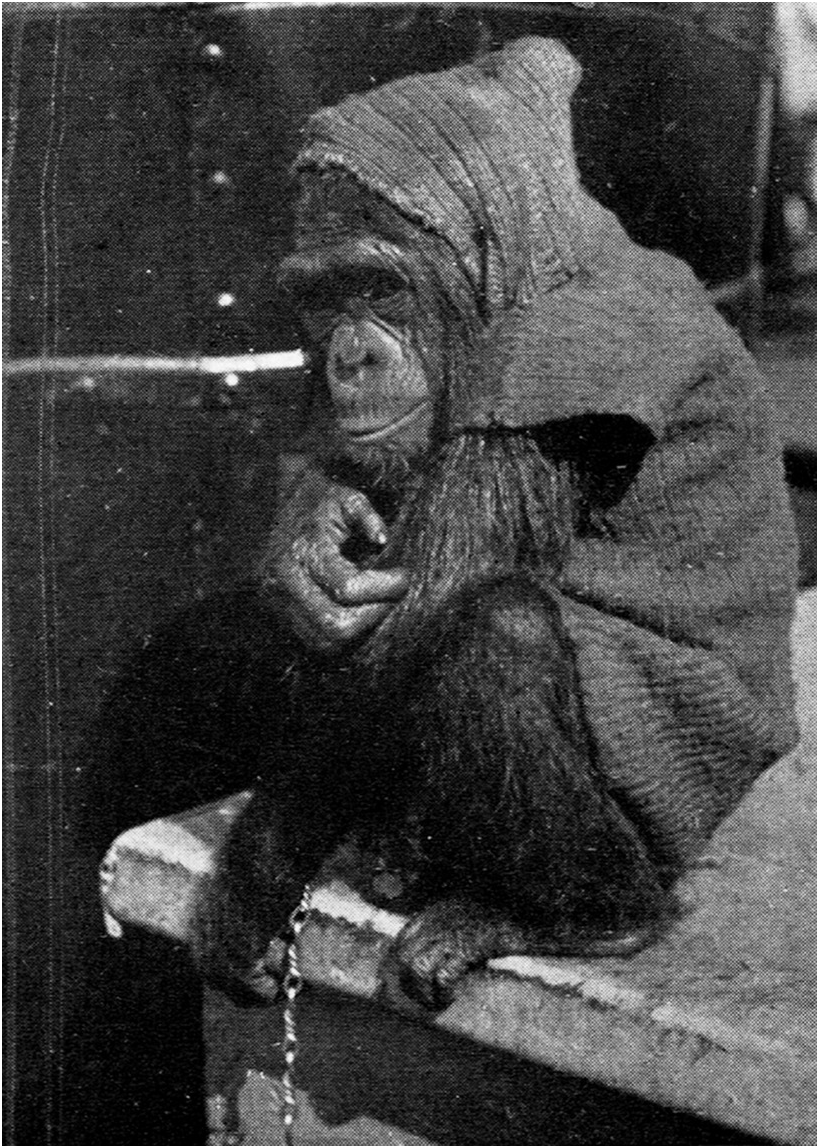
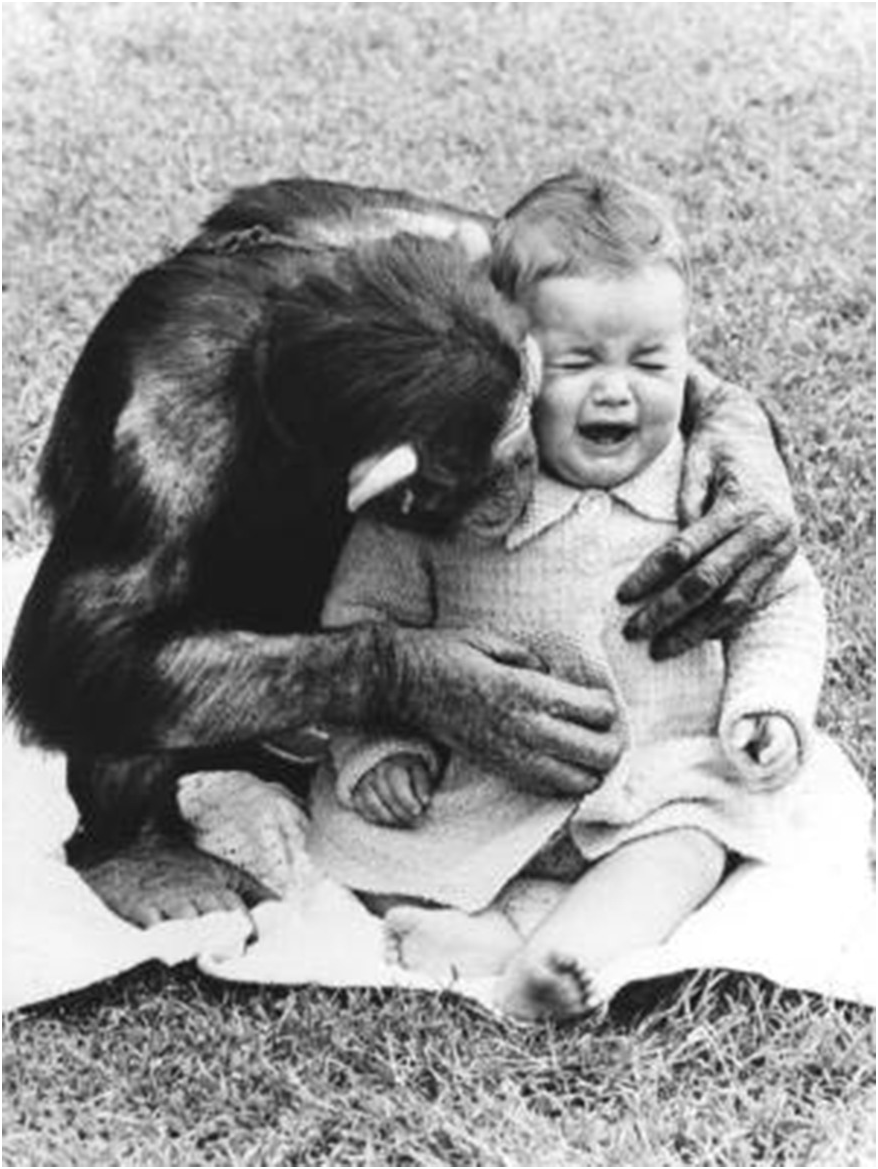
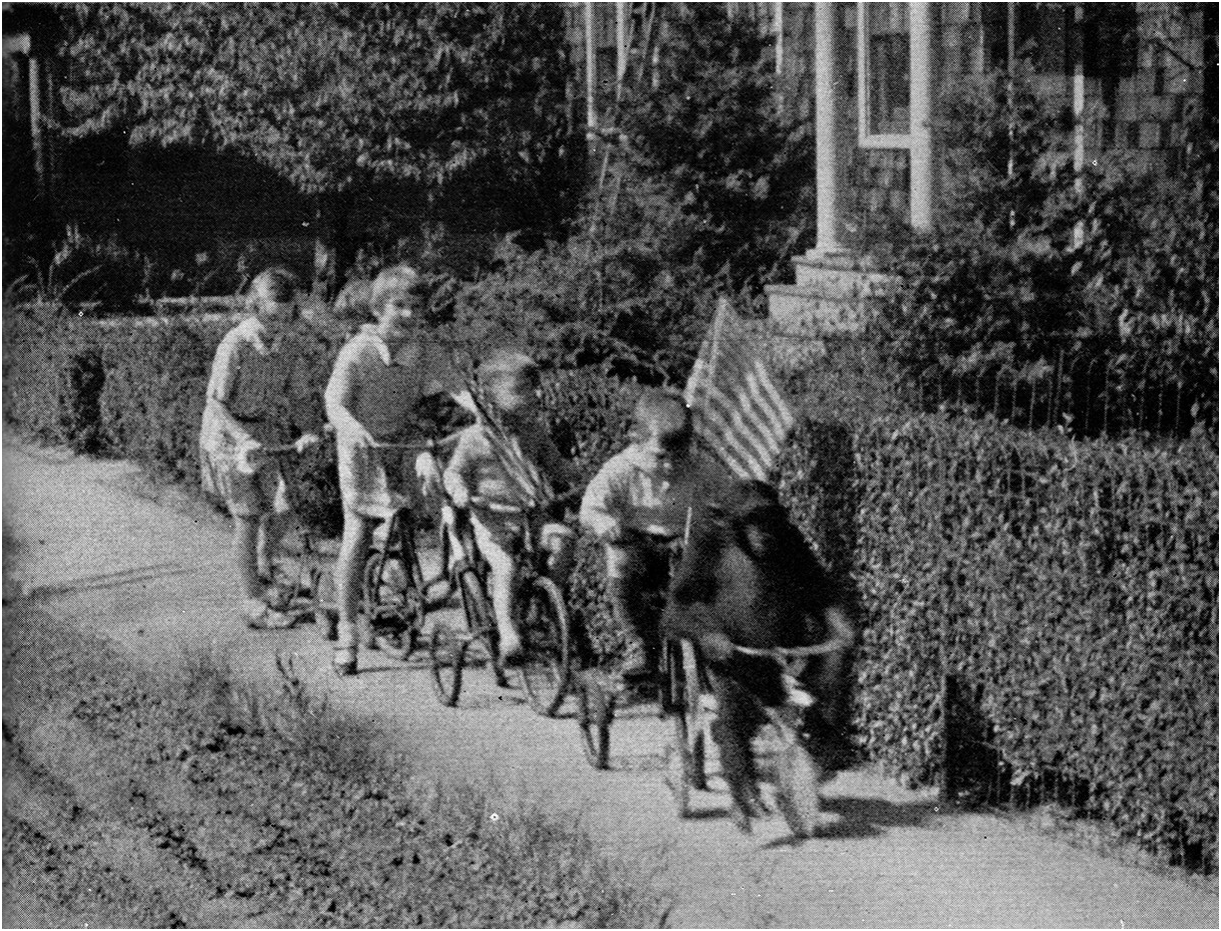
Two men walked into Raven’s camp carrying the tiny Meshie. One of the men had killed her mother with a poison dart, and the two had eaten her. Meshie, seeing Raven, stretched her arms toward him and he could not resist taking her; she held on tight “as if she feared she might fall,” and stroked the hair on his arm. He must have felt the same impulse I felt when holding Nkuumwa, the powerful impulse to protect. Raven bought Meshie and traveled with her around Africa, Meshie sitting next to him in the front seat of his vehicle as he drove. He managed to get her back to the USA. While she slept for a time in a treehouse Raven made for her, making a nest of blankets each night, for the most part she was reared in his home and treated as a sibling to Raven’s other three children (Figure 1.5); afterward this rearing-as-if-human came to be known as cross-fostering. In Raven’s home, Meshie soon learned to eat at the table, pedal a kiddie-car, and eventually to ride her tricycle around with neighborhood children (Figure 1.6).
Meshie comforts a crying Mary.
An older Meshie leads a wheeled parade of local children.
In short, Meshie was allowed about as much freedom as a chimpanzee can be allowed in human society. Perhaps because Raven was a prominent scientist, nobody seemed to question his custom of allowing her the run of his home and of the wider neighborhood beyond.
You have read my own species-confusion story, but in the case of Meshie we have more than mere written descriptions with which to comprehend Meshie’s intimate relationship with her human family. We have home movies. Martin describes one of these films with these powerful words:
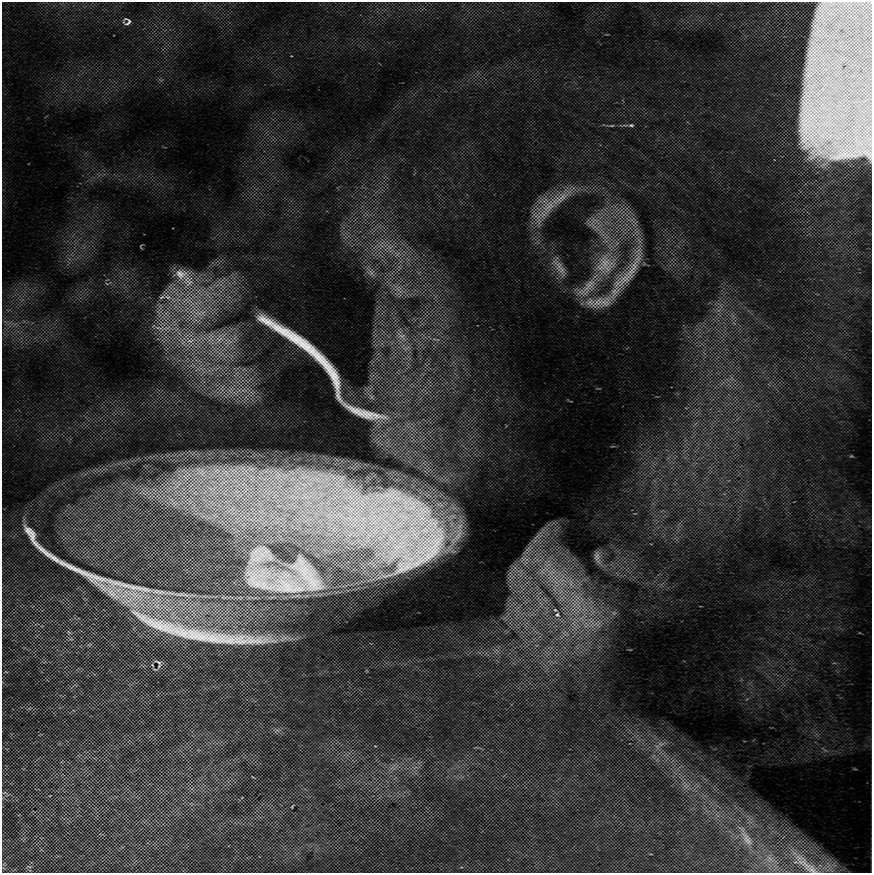
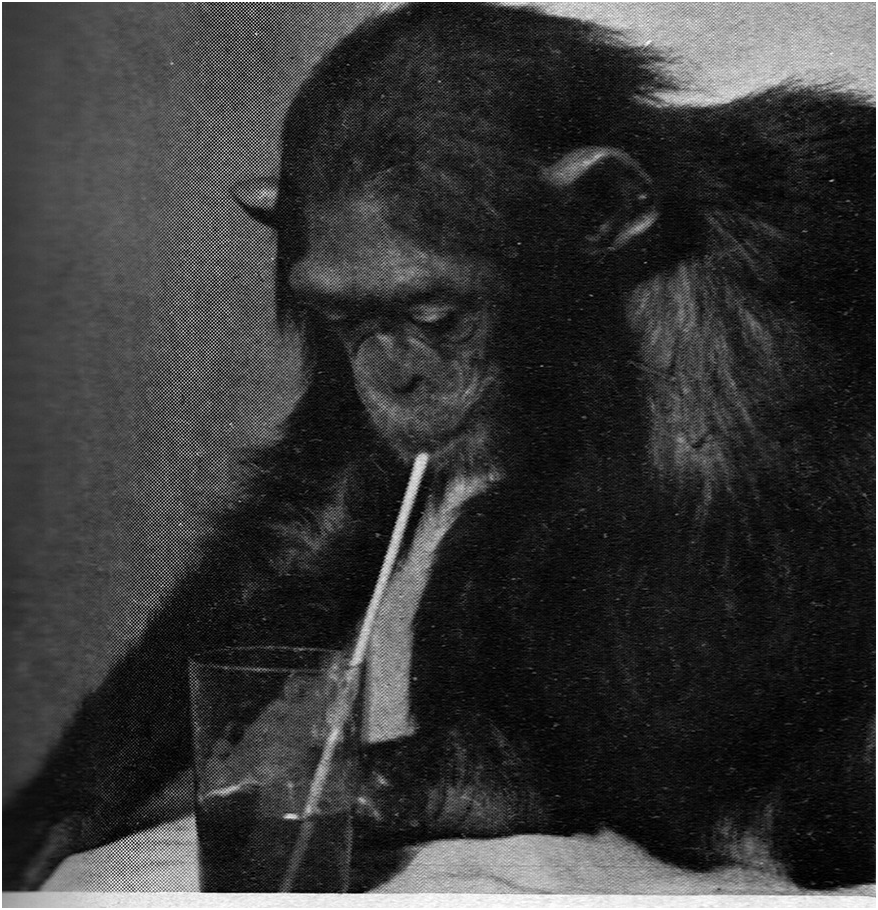
Meshie is about five years old. She is perching on a stool next to the Ravens’ six-month-old baby, Mary, who is in a high chair. With one thick, wrinkled hand, Meshie holds a bowl of what looks like rice cereal. With the other hand, Meshie patiently and deftly spoon-feeds the baby, who is blasé about being fed by a chimpanzee but fascinated by the camera, constantly twisting to stare curiously at the bright lights. The scene cuts to the baby grabbing a sloppy handful of cereal and smearing it on the high chair's tray. Meshie, who was fastidiously neat during her own meals, is visibly appalled. She hops down, fetches a rag and wipes the baby's messy face. Then she cleans up the cereal, scrubbing until she's satisfied that the tray is spotless.
This visual image brought home to Douglas and Martin the similarity of chimpanzee and human minds in a way that nothing else had. In an interview with Martin, Douglas remembered his response to the film: “I thought ‘My God! This is an animal feeding a human! With a spoon! Feeds her with a spoon, very carefully, and then wipes up the mess afterward. This isn't at all like a cat or a dog or a horse; we're talking about an animal so close to being human that a real confusion is going on here.’”
For some time Meshie seemed to slip almost seamlessly into the family, but as she matured she became increasingly willful and uncontrollable. Eventually she became too dangerous to be allowed to roam freely. Raven estimated that as a 46-pound four-year-old she was already as strong as an adult human.
At his wit’s end, Raven sadly realized she had to be restrained somehow. At first, he tied her up with a rope, but she untied the knot. He tried a chain, but before long she learned to break the links or unbuckle the collar. Raven’s frustration at Meshie’s repeated escapes is palpable in his retelling, but so also is a suppressed delight in her skill at untying knots and slipping off collars. Finally, he had a cage custom-built in his basement, a comfortable cage, but still too much like a prison to be a happy thing.
Reading Raven’s Reference Raven1933 article, his love for Meshie (Figure 1.7) bubbles to the surface as he describes the loving persistence and remarkable steadfastness with which he resignedly repaired one after another of Meshie’s devastations. She ripped out electrical wires; she bent gas lines; she toppled paint cans – all this from inside her cage. She escaped to play in the coal bin, tracking black footprints everywhere. Not only did she have incredible strength, she was as nimble as a circus acrobat; once out of her cage, she climbed everything climbable, making recapturing her an exhausting trial. Raven unflinchingly bore it all – the financial costs, the phone calls summoning him home from work early, and the stress of an increasingly chaotic home life that his put-upon wife bore even more heavily than he. His tale begins to sound much like that of any exhausted parent of a wayward son or daughter who is constantly in trouble with the authorities.
1.4 Meshie’s Fate
Ultimately, even with restraints, Meshie proved too dangerous to both herself and to children in the neighborhood to remain in the Raven home, and in the end she suffered the fate of the vast majority of pet chimpanzees: She was sent to a zoo, confined to a sturdy steel cage at the Brookfield Zoo in Chicago. Having sat watching her mother butchered and eaten, she was now torn from her loving adoptive family and doomed to confinement, a circumstance that undoubtedly left her lonely and frightened. Zoo staff saw nothing cute or appealing in Meshie. In her confusion and anger she struck out at her caretakers with shockingly aggressive displays. To zoo staff she was a vicious, violent, dangerous beast, nothing like the loving “child” who had cuddled her baby sister and fed her with a spoon.
Douglas and Martin report that Raven visited her once, some years later. He ignored concerned keepers’ warnings that she would rip him apart and entered Meshie’s cage where the “vicious beast” and her adoptive father had a tender reunion. Sadly, love does not conquer all. Despite Raven’s affection for Meshie, the reunion was short-lived; it was simply impossible for him to take her home.
I wish there were a happy ending to this story, but there is not. Meshie remained in the zoo as an animal on exhibit. In her anger and confusion she never fully integrated with the other chimpanzees and interacted with them little. She did assimilate well enough to mate with a male and ultimately became pregnant. She died giving birth. Motherhood can calm captive primates; having a helpless, appealing baby to fawn over gives their drab lives some meaning; it is the ultimate tragedy of Meshie that she never had this last chance at adult happiness. Raven is said to have grieved Meshie’s death for years.
There is a lesson to Raven’s and Meshie’s tragedy. Their heart-breaking separation is one that ultimately divides all chimpanzees and their civilian caretakers. Chimpanzees cannot be pets. As appealing as they are as infants, they are best reared among other chimpanzees from birth, if they are born in captivity.
Raven’s home movies and narratives from the 1930s are important when placed in context. They are part of the history of discovery of chimpanzee cognitive abilities. They provide a less scientific and more personal addition to a whole procession of astonishing scientific discoveries about – if I can phrase it this way – the humanity of the chimpanzee, much of it played out in those few celluloid seconds of Raven family life. We see tool use. An animal that clearly understands the somewhat fuzzy concept of “neat,” and the seamless (for the moment) splicing of a member of different species into a human family. Rule following. Mental mapping (a mental map is a cognitive representation of a geographic area) of unobserved and distant objects. Empathetic concern for loved ones (Figure 1.5). Is it any wonder that even decades later Mary Raven Hockersmith, the child being fed in the movie, displayed in her home a photograph of herself as an infant, being held by Meshie, her doting and ultimately stolen sibling?
For scientists, Meshie’s story adds texture to publications that appeared around the time of Meshie’s adoption but that largely spoke to a scientific audience (Köhler, Reference Köhler1925; Kellogg & Kellogg, Reference Kellogg and Kellogg1933; Ladygina-Kohts, Reference Ladygina-Kohts1935).
1.5 Vicki
At the risk of lingering overlong on cross-species adoptions, let me relate two more anecdotes that show the adoption of human cultural traditions by Meshie was not unusual. Martin also reported on another human-reared chimpanzee named Vicki; she was a further model for Douglas’s novel Jennie. One of Vicki’s favorite playthings was a pull-toy she towed around her house with great enjoyment. The toy occasionally got hung up on furniture or fixtures, particularly as she raced around the toilet. Surprisingly, when the pull-toy went missing Vicki continued to “play” with it, trailing an imaginary pull-toy behind her as she ran through the house. The nonexistent pull-toy got hung up on the toilet, just as did the real toy, at which point Vicki patiently stopped to untangle it.
Now and then someone wonders whether human-reared chimpanzees might be more intelligent – more human-like – than wild chimpanzees: Distinguished lab primatologist Duane Rumbaugh asked this of me once. This view arises from the idea that life in the wild is less intellectually challenging than life in the lab. I hold a diametrically opposed view. Other than superficial behaviors like using a spoon, the basic “humanity” of chimpanzees is just as startlingly apparent in the wild. In Chapter 18 I will discuss the close correspondence between the chimpanzee mind and the cognitive demands they face in the wild. There, in their natural home, chimpanzees exhibit all their intellectual strengths, and many are similar to those that distinguish humans from other primates: In the forest their excellent memories, superbly tuned sense of geographical space, social subtlety, and intense mother–infant bonds closely match human intelligence. They are like us not because they mimic us, but because they are a close relative, a sister species.
1.6 Kakama
As an example of Vicki- or Meshie-like behavior among wild chimpanzees, Richard Wrangham (Wrangham & Peterson, Reference Wrangham and Peterson1997) tells the story of a boisterous eight-year-old male, Kakama and his sluggish, pregnant mother. Kakama plucked a log, a largish one half his size, from the forest floor and carried it off and on for hours, snuggling with it, juggling it while he lay on his back in a day-nest, placing it carefully beside him when he fed, frolicking with it as if it were a baby. Fate had placed Kakama, an outgoing, playful young male, with a somewhat stodgy, antisocial mother. Could he have been anticipating the birth of a playmate? Wrangham was left wondering. Several months later, just weeks before Kakama’s mother gave birth, two of Wrangham’s assistants saw behavior just like that he had seen. When he abandoned the log the assistant brought it back to camp and stapled to it a label that interpreted what they had seen in a delightfully straightforward manner: “Kakama’s toy baby.” There was no question that Kakama invented his doll without human interference.
1.7 Understand Chimpanzees, Understand Human Evolution
Because we are Sister Species, chimpanzees have important lessons to teach us about nature, and about ourselves. Of all species on the planet, surely this one, and the other human sister species, bonobos (Pan paniscus, also known as pygmy chimpanzees) are the species from which we learn the most and the species for which we should move heaven and earth to save in the wild – for purely selfish reasons if nothing else. We have much more to learn about chimpanzees and bonobos (Chapter 29), especially if you consider this: As I wrote this book, I consulted a large number of experts (see Acknowledgments) and there were a multitude of disagreements, questions about the reliability of this fact or that detail; there were gentle accusations of “speculation” or “overinterpretation.” Maybe so, but the important thing is that only wild chimpanzees can answer the scholarly questions my colleagues raised. My particular interest in chimpanzees is what they can tell us about human evolution. You may be surprised at how human-like chimpanzees are as you read this volume, but you may be even more surprised as you gradually become aware of how many mysteries about human origins we can solve by understanding chimpanzees.