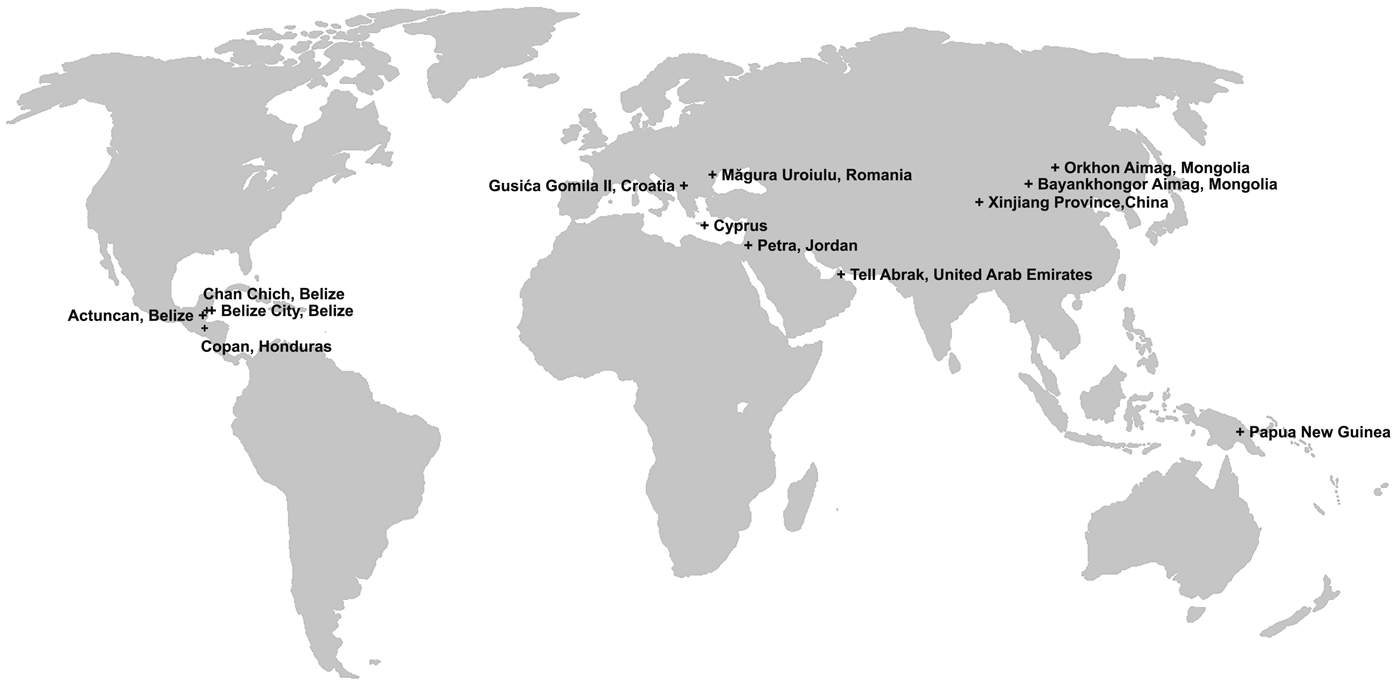


Human remains recovered from archaeological excavations provide a wealth of information about past cultures but also require the greatest care. The recovery, cleaning, and curation of bone present important challenges for archaeological projects. What is the best way to transport fragile materials to labs or to export them? How should they be stored until they can be analyzed, or over the long term? Should they be cleaned? Field labs and storage facilities in remote locations often are only periodically monitored, can have extreme humidity or heat, be infested by insects or animals, lack long-term financial support for collection maintenance, and/or be at risk due to natural disasters like earthquakes or hurricanes. This special theme issue describes techniques that bioarchaeologists have employed to address these problems as they have worked to curate and house skeletal collections from prehistory through the contemporary era in North and Central America, East Asia, Europe, and the Near East (Figure 1) in light of ethical and cultural considerations of modern populations.
Map of study locations referred to in articles in Advances in Archaeological Practice issue 7(1).

WHY CONSIDER CONSERVATION?
Instructions for excavating and studying human remains range from short book sections to in-depth, illustrated manuals (e.g., Bass Reference Bass2005; Brothwell Reference Brothwell1965; Larsen Reference Larsen2015; Martin et al. Reference Martin, Harrod and Pérez2013; Ubelaker Reference Ubelaker1978; also see works by Duday and Guillon Reference Duday, Guillon, Schmitt, Cunha and Pinheiro2006; Duday et al. Reference Duday, Courtaud, Crubezy, Sellier and Tillier1990). The majority emphasize the biological analysis of the bones themselves (e.g., Baker et al. Reference Baker, Dupras and Tocheri2005; Buikstra and Ubelaker Reference Buikstra and Ubelaker1994; Cox and Mays Reference Cox and Mays2000; Schaeffer et al. Reference Schaeffer, Black and Scheuer2008; Steele and Bramblett Reference Steele and Bramblett1988; White and Folkens Reference White and Folkens2005), including those geared toward forensic anthropologists (Adams and Crabtree Reference Adams and Crabtree2011; France Reference France2008, Reference France2016). Bioarchaeologists and osteologists have also engaged with zooarchaeological references to support the mechanics and taphonomy of skeletal analysis (Biesaw Reference Biesaw2013; Lyman Reference Lyman1994). However, although curation is one of the most important aspects of archaeology, long-term treatment of human remains receives limited attention and is often found only in appendices, museum manuals, or conservation guides (but see Cassman et al. Reference Cassman, Odegaard and Powell2008; Cronyn Reference Cronyn1990; Sease Reference Sease1994). Of particular concern to bioarchaeologists and osteologists are the ethics that are inherent components of work with human remains, especially when considering their significance to descendant communities.
The articles offered in this special issue of Advances in Archaeological Practice draw from the work of 15 emerging and established bioarchaeologists and archaeologists whose expertise and experiences span the globe and consider thousands of years of prehistory. Real-world examples of research and conservation of skeletal remains and collections are drawn from a variety of contexts and reflect current scholarship in bioarchaeology. Five “how-to” articles provide technical information and guidance to support archaeologists as they improve bioarchaeological data collection and address conservation challenges. The remaining articles describe real-world problems and outline the solutions employed for the specific archaeological context within sometimes challenging cultural or political milieus. The problems described are, of course, specific to particular environments, but the descriptions, details, and solutions can be applied more broadly. Authors in this issue offer guides for burial excavation in their respective regions with best practices for exposure, lifting, transport, and cleaning; discuss conservation techniques with consideration of the benefit and danger of consolidant or chemical use and the implications for subsequent analyses; describe cleaning and storage techniques of collections found in precarious circumstances; and explore the reality of working in a variety of environments, cultures, and bureaucratic systems.
THEMES IN CONSERVATION
The overarching thematic purpose of this issue is to identify and explore the ways in which a holistic approach to archaeological investigation can mitigate future conservation problems, share the best techniques for work in particularly challenging environments, provide a summary of failures and successes in conservation efforts, and highlight new technologies that may assist in our work.
The articles are linked by shared challenges and can be divided into four primary themes. The first presents new technologies that aid in the process of data collection during excavation and in the field laboratory (Novotny; Osterholtz; Wrobel et al.), while the second addresses how to excavate, document, and conserve human remains in ways that maximize their research potential (Beaubien; Freiwald). The third theme relates to the intricacies of conservation in challenging physical and/or sociopolitical environments (Miller Wolf; Prevedorou and Buikstra; Lee), while the fourth major theme offers approaches to the conservation and excavation of remains with social importance to descendant communities (Plumer-Moodie et al.; Powless and Freiwald).
New Technologies for Research and Documentation of Skeletal Remains
Systematic and consistent documentation of skeletal remains from the field to the laboratory is a long-standing issue that Buikstra and Ubelaker (Reference Buikstra and Ubelaker1994) began to address in a comprehensive volume. The counterpart to this manual, which is now essential in all bioarchaeological work, is the Osteoware program, which is used to catalogue and document collections across the country. Both the software and volume were developed, in part, to address the needs of the 1990 Native American Graves Protection and Repatriation Act (NAGPRA). This volume laid the groundwork for addressing complex issues like commingled remains, metric and nonmetric analysis, and general best practices in the study of skeletal remains, and a new generation of researchers is building on this foundation. Technological advancements have increased the quantity and types of data we can collect but result in new ethical concerns as more requests are made for destructive analyses at the same time that the field has greater accountability to descendant communities.
Osterholtz's (Reference Osterholtz2019) article presents a data-recording system that is specifically geared toward understanding commingled burial assemblages, which challenge researchers in diverse disciplines such as forensic anthropology, archaeology, and museum studies. The FileMaker Pro 15 database, which the author shares with readers, is designed to manage the types of data needed to analyze a representative burial assemblage, such as element identification, age-at-death and sex estimations, dental observations, and documentation of trauma and taphonomy. The resulting demographic information can then address research topics such as marriage and mobility, violence, and funerary patterns. The database was developed and used for NAGPRA-related cultural resource management (CRM) research in the United States and at sites in the United Arab Emirates, Jordan, Cyprus, Romania, and Croatia, which included large assemblages and fast-paced analyses.
Novotny's (Reference Novotny2019) article focuses on photogrammetry, a technology that is in the early stages of use for documenting burials during excavation. Photogrammetry and photo rectification technologies have entered into the discourse of bioarchaeology projects to address problems with poor preservation, complex mortuary practices, difficult field conditions, and time constraints, challenges that bioarchaeologists face around the world. Novotny assesses the financial and implementation costs of using Agisoft PhotoScan Professional software with a Canon PowerShot G15 camera to document Maya burials at two sites in Belize. Her six-step guide documents the basic method, including practice and preparation, lighting and space considerations, equipment choices, and photography techniques. She concludes that photogrammetry was relatively simple to learn but not always easy to implement. Overall, it is a useful addition to a bioarchaeologist's tool kit.
Wrobel and colleagues (Reference Wrobel, Biggs and Hair2019) discuss digital repositories as a means to address the curation and preservation of human remains that also can improve access to collections of skeletal (and other) materials for research. They describe the potential benefits of 3-D models for study of skeletal morphometrics, observations such as trauma and taphonomy, and other lines of research. Digital collections also allow researchers to build 3-D models using computed tomography (CT) scans and laser scanning, as well as photogrammetry, which may offer the most utility to bioarchaeologists due to its lower cost, portability, and convenience. Widely available digital datasets can address problems beyond curation, including small sample sizes and bias stemming from reuse of a limited number of easily accessible collections. Ethical considerations for use of digital images will vary by research location and the stakeholders involved, but digitization ultimately will play a key role in the long-term preservation of bioarchaeological collections.
Best Practices for Excavation and Conservation from Field Experience
Freiwald's (Reference Freiwald2019) article also focuses on techniques for excavating and analyzing complex burials, specifically acknowledging the reality that burials are frequently not excavated or curated by bioarchaeologists. Special strategies for collecting complex taphonomic details critical to reconstructing the burial process, especially when skeletal remains are poorly preserved, are discussed in the context of documenting upright flexed, or seated, burials in the Maya region. Curation of osseous materials in tropical and other challenging environments also merits special consideration, and she presents one set of solutions.
Beaubien's (Reference Beaubien2019) work as a conservator with the Smithsonian Institution has afforded her experience in a variety of conditions, and her article details her expertise in the practice of field and laboratory conservation. Beaubien highlights the alterations that can affect a burial in an archaeological context from the time of exposure to transportation and storage. Beaubien's discussion of stabilizing agents and their effects on bone and its biological and chemical components is timely in the context of this issue. The recommendations offered by Beaubien provide a guideline for conservation and research beyond the field.
Conservation in Challenging Physical and/or Sociopolitical Environments
Some of the articles acknowledge the challenges faced when burials are discovered unexpectedly or result from emergency excavations. It is important not only for projects to consider curation needs as part of the annual budget but also to consider long-term investment in facilities, personnel, and ongoing maintenance. For example, even high-quality storage materials eventually deteriorate and must be replaced 10–15 years after excavations have ended. Leaks develop, plastic lids form cracks, and pests such as rodents appear in what seemed to be pristine and animal-proof storage. A long-term curation plan—in addition to a budget for immediate curation needs such as shelves, bags, and boxes—should be in place to extend far beyond the period of excavation. The examples presented in this issue show that irreparable damage is done to collections if no funding is available to pay for staff, facilities, and associated costs after excavations have ended.
Miller Wolf's (Reference Miller Wolf2019) article describes a decade-long project to curate, document, and rehouse the largest collection of human skeletal remains (n = 1,200) recovered in Mesoamerica to date at Copan, Honduras. She details the complexities involved with curating an archaeological collection in Honduras and similar locations, including bureaucracy, unstable sociopolitics, limited funding, inconsistent and/or lack of field documentation, inadequate storage facilities, infestation of pests, and a tropical environment. Miller Wolf offers guidelines for conservation strategies and recommendations for the field and laboratory at the outset of a project to ensure the safe and ethical handling of human remains over the long term.
Prevedorou and Buikstra (Reference Prevedorou and Buikstra2019) focus on Greek archaeology, where rescue and academic excavations routinely encounter graves and human remains, presenting a challenge to long-term preservation of Greece's cultural patrimony. The authors discuss recent work at the Phaleron cemetery, where Prevedorou and colleagues study its large bioarchaeological assemblage at the Wiener Laboratory of the American School of Classical Studies in Athens. The authors discuss work with skeletal remains and grave goods in the context of broader concerns with conservation issues in Greece related to insufficient time, money, documentation, storage facilities and materials, and the long lag between excavation and analysis of human remains.
Lee's (Reference Lee2019) work in Mongolia and China poses uniquely binary problems with remains from either very dry or very damp environments, including desert oases, cave shelters, and permafrost. She has encountered further issues when it comes to the transportation of remains from the excavation site to the primary laboratory facility. The remains must traverse various environmental zones, and the permafrost mummies start to decay during transport, only to be stored in frigid facilities anew. The diverse environmental conditions affect lab analyses as well, with unheated subzero indoor winter temperatures adversely affecting the researchers and warmer summer temperatures harming the mummified remains. The constant threat of moisture damage to mummified remains is compounded by the methodological and ethical challenge of obtaining bioarchaeological information. Sample collection from mummified as well as skeletal remains requires destruction not only of the burial context during excavations but of the tissues during analysis.
Approaches to the Conservation of Remains of Social Importance to Descendant Communities
Plumer-Moodie and colleagues (Reference Plumer-Moodie, Quiroz, Miller Wolf and Musa2019) describe the emergency recovery and conservation of human remains from a private collection and the inherent difficulties of identifying their source when provenience is lost. The curation of the collection of 70-plus individuals recovered from an attic above a high school in Belize City, Belize, was complex. The authors had to mitigate contamination from bats, the absence of important contextual information, funding shortfalls, and ethical concerns raised by potential ties to descendant communities. The article is a collaboration between bioarchaeologists trained in the United Kingdom and the United States and Belizean historians and presents research from each perspective to begin to unravel the mystery of the St. John's remains.
Powless and Freiwald's (Reference Powless and Freiwald2019) article focuses on the issues common to those working in the United States: NAGPRA and state burial acts and the problems that those laws were meant to address. Powless describes the complexities of the world of CRM in California, where she has worked to navigate the delicate relationship between the fast pace required of CRM firms and the rights of tribes. Moreover, she highlights that CRM (bio)archaeologists are not simply focused on the recovery of material culture but are active participants and liaisons with local communities. Powless offers a set of solutions that will help the CRM community work more effectively with tribes, advocating that going beyond what NAGPRA mandates will better preserve the integrity of data and the archaeological sites themselves. Powless also brings an indigenous perspective to (bio)archaeological research, which is much needed in a profession where only 7% of membership in the American Association of Physical Anthropologists (AAPA) self-identifies as coming from an underrepresented group (Antón et al. Reference Antón, Malhi and Fuentes2018).
It is difficult to pass on best practices in skeletal conservation under NAGPRA in a single publication given the diversity in decisions made by tribes, the various material types, and the nuanced negotiations, sometimes confidential, that are incumbent during individual excavations (Underhill Reference Underhill2006). As such, we recommend further reading on NAGPRA-related topics on regional museum, tribal, state, and national websites and in federal publications, as well as on NAGPRA-like legislation in other regions of the world (e.g., Colwell Reference Colwell2015; Geisen Reference Geisen2013; Kakaliouras Reference Kakaliouras2012).
We recognize that other perspectives are missing from this issue. While some of the authors in this issue may self-identify, at least in part, with multiple underrepresented groups in North American archaeology, this issue lacks those who might speak from an African American perspective. There are significant ethical issues related to historic and colonial cemeteries and attempts to build on or relocate them (LaRoche and Blakey Reference LaRoche and Blakey1997). For example, the needs of multiple descendant communities in Mississippi, whose ancestors were buried on the grounds of the Mississippi State Asylum, have prompted discussion of a new ethical justification for bioarchaeological research (Zuckerman et al. Reference Zuckerman, Kamnikar and Mathena2014). It is also important to consider more nonacademic voices; just over half of the SAA 2015 needs assessment survey respondents reported employment in an academic setting (n = 952) versus CRM (n = 441), government (n = 283), or museums (n = 109), and students, retirees, or other (n = 737; Association Research, Inc. 2016). We also need to consider related fields such as forensic anthropology, which has significant overlap with bioarchaeology but remains only loosely connected in scientific publications, conferences, and collaborations.
CONCLUSION AND FUTURE DIRECTIONS
This issue covers five world areas (North and Central America, East Asia, Europe, and the Near East) with authors from different countries whose identities may shift as they cross borders. For example, an American of Chinese ancestry could elect to mark Asian American on a survey in the United States but be viewed as foreign when doing research in China. Likewise, a Belizean might be considered a minority in the United States but is not a member of an underrepresented group in Belize. A Belizean of indigenous descent might carry a foreign identity with Native American groups in the United States, as might a Guatemalan with Maya ancestry who works in Belize, or a Native American bioarchaeologist with no official affiliation or that of a different tribe. In sum, the interdisciplinary boundaries crossed by the researchers in this issue provide a breadth of perspective that is not limited to his or her own country and include diverse international contexts and large projects with unique conservation demands.
Bioarchaeologists are particularly concerned with the conservation of human skeletal remains because of our relatively new role as primary researchers on archaeological projects. No longer are our reports relegated to appendices or added as an afterthought (see Whittington and Reed's [Reference Whittington and Reed2006] discussion). Rather, we take a holistic approach with theoretical and research driven questions as Buikstra (Reference Buikstra1976) likely originally intended. It is incumbent on researchers to preserve collections and samples for future scholarship, to work in tandem with interested parties, and to publish their data from the collections they excavate (Morell Reference Morell1995). The extra documentation associated with burial excavations has consequences beyond good scientific practice; it shows a respect for the affiliated communities and descendants, promotes good public relations overall, and can play an important part of the repatriation process in North America and elsewhere in the world.
The curation challenges presented in these case studies demonstrate a structural problem that (bio)archaeologists have recognized for decades. If responsibility is not taken for conservation of remains in the long term, or if only temporary post-excavation measures are employed, collections may be left to languish and deteriorate for decades due to lack of storage space, insufficient staff, and inadequate funding. The conservation crisis of orphaned collections, as has been described in US contexts by MacFarland and Vokes (Reference MacFarland and Vokes2016), is a pressing issue that our field must address. Further questions remain as to who is or should be responsible for curation decades after a project ends or where the encumbrance shifts when researchers are no longer active (Childs and Benden Reference Childs and Benden2017). In the United States, this problem is compounded by the sheer scale of materials stored with governmental agencies where repositories are full (Bawaya Reference Bawaya2007).
Deteriorating collections, even after research and publications are complete, represent an ethical dilemma—especially when they consist of human remains—that archaeologists and museum staff are attempting to manage. However, we need to revisit the problem at the level of the discipline to encourage long-term conservation strategies in our research proposals rather than considering conservation when it has reached crisis level on a case-by-case basis (e.g., Bawaya Reference Bawaya2007; Marquardt et al. Reference Marquardt, Montet-White and Scholtz1982). After all, if we cannot properly and respectfully study and care for those who lived within ancient sites we study, have we violated the ethical responsibilities to the people of the past or present?
We also must think beyond scientific ethics to reconsider the reasons collections deteriorate for decades without adequate curatorial attention or research. A tension exists in the field of bioarchaeology between considering the bones and bodies as scientific specimens and treating them as the remains of people who did not have the chance to consent to our examinations. Although we have emphasized the need for long-term plans for collections in this issue, the prospect of reburying “our collections” is usually limited to cemetery relocations, historic individuals, or some projects covered by NAGPRA or other legislation. If we are not studying collections, why are we curating them? If we have existing archaeological assemblages, why do we privilege new excavations over analysis of existing ones as we fund new theses and senior research (e.g., Keene Reference Keene2006; Roberts and Mays Reference Roberts and Mays2011; Voss Reference Voss2012)? The field of bioarchaeology must take the lead on the future direction of the field. We hope this will include a focus on long-term collaboration and support (financial and otherwise) to curate existing human remains and archaeological materials. Increased collaboration with descendant communities is also an important future direction (Boutin et al. Reference Boutin, Long, Dinarte and Thompson2017), both in the United States and abroad, to create future scholarship, education, and outreach that benefits indigenous and descendant populations and the public, as well as the scientific community.
Acknowledgments
We wish to thank the many projects, funding agencies, and researchers that have participated in the support and dissemination of the research presented here, as well as the journal editors, two anonymous reviewers who provided useful feedback, and Nancy Peniche May for assistance with Spanish language translations in this issue. We also wish to thank colleagues who attended our session at the 2017 Society of American Archaeology Annual Meeting. It was their interest and enthusiasm for these papers that encouraged the publication of our collective experiences and recommendations about the study and conservation of human skeletal remains that, we hope, will support our colleagues locally and abroad.
Data Availability Statement
Data used in the article are available in references cited and in the other articles in this special issue.