




Rich and poor may eat differently, but upset stomachs beset all. The second emperor of the Tang dynasty, Taizong 太宗 (598–649 CE), found himself in just such a predicament one day. His belly had swollen, and stool leaked uncontrollably from his body. The palace physicians could not treat the loose stool, which had turned an alarming red and white color.Footnote 1 At a loss, the palace issued a call to all local healers to render assistance. It was answered by an old magistrate, named Zhang Baozang 張寶藏 (fl. 627–649). Zhang was not a healer, but he had suffered from the same condition, and he knew what to do. He recommended that the palace attendants boil milk with long Indian peppers (bibo 蓽撥; piper longum). Prepared and administered, this simple decoction reportedly stopped the emperor’s diarrhea after just a few sips.Footnote 2
This story does not impress contemporary readers with its plausibility. Not only does the combination of milk and pepper seem like an improbable cure for the runs, but the use of milk is at odds with received wisdom about the lactose intolerance of the Han Chinese.Footnote 3 This view has been perhaps summarized most eloquently by H.T. Huang. “The reason the ancient Chinese did not develop dairy farming,” Huang writes, “is that the consumption of substantial amounts of milk could be hazardous to their health.”Footnote 4 Here, Huang rehearses received medical wisdom that has gone unchallenged until recently. Purportedly, in the guts of nearly 90 percent of ethnic Chinese, milk triggers gastric distress: cramping, bloating, and diarrhea. Supposedly, this is because most Chinese lack the gene that produces the lactase enzyme continuously into adulthood—the enzyme responsible for breaking down lactose, that is, the complex carbohydrate in milk.Footnote 5 By Huang’s account, lactose intolerance is irreversible: “it cannot be reversed or ameliorated by adaptation; if an individual is lacking in the lactase-persistence gene, he will lose the ability to produce lactase as an adult no matter how vigorously and for how long he continues to drink milk after weaning.”
The medical-historical view that the Chinese have avoided milk because of lactose intolerance remains the received opinion. Yet a few scholars have cautiously begun to question this received opinion. Like Huang, Françoise Sabban and Andrea Wiley accept the notion that most of the world’s population, including Asians, produces too little lactase to digest lactose. But they warn against conflating lactose intolerance with dairy avoidance. They remind readers that Central Asians and Mongols might lack the genetic adaptation to digest fresh milk, but that they consume high levels of yogurt, cheese, and koumiss nonetheless. As they note, the culturing or curdling of milk reduces its lactose content, rendering it more easily digestible to people without the lactase gene.Footnote 6 In other words, there is a world of difference between fresh milk, on the one hand, and cheese and yogurt, on the other. They suggest that, whereas fresh milk was off limits to the Han Chinese, cultured products were not.
A recent essay by Hilary Smith similarly calls for a critical reevaluation of popular wisdom from a different angle. While Smith agrees that the Chinese lack the lactase-persistence gene and did not consume much dairy historically, she maintains that the present framing of lactose intolerance as a pathological condition represents a recent Euro-American invention, a byproduct of the dietary determinism of the late nineteenth and twentieth centuries. This particular strand of thinking presumes that fresh (cow’s) milk is nature’s most perfect and universally nutritious food. In so doing, it presents the inability to digest fresh milk as an anomalous condition, or as “inborn errors of metabolism”—in other words, a sign of the genetic inferiority of non-European peoples.Footnote 7
Such accounts have complicated popular understandings of dairy in China. This essay proposes to build on them by challenging another dimension of conventional wisdom: namely that Chinese healers were dead set against milk consumption for health reasons. This assumption is not borne out by the Chinese evidence. Let us here return to the story about the Tang emperor. Had it been obvious to healers that healthy people suffer diarrhea from fresh milk, why give the sick emperor this to drink? Nor was the account of Taizong’s cure an anomaly. As early as the eleventh century, medical authors in China rehearsed the story in their instructions for treating diarrhea. Such authors further specified that the milk be procured from a cow, simmered with long peppers until half-evaporated, and ingested on an empty stomach.Footnote 8
Thus elaborated, new versions of the story of Taizong’s cure went on to appear in key medical primers from the Ming dynasty. These repeated inclusions suggest that Chinese physicians took the story seriously enough to include it in their arsenal of remedies. The account of Taizong’s cure thus invites us to examine what Chinese healers thought of milk and whether they cautioned against milk for health reasons. What role did it play in medical therapy? What properties did healers ascribe to it? The story also forces us to both look deeper into the uses of milk in medicine and to reconsider conventional wisdom about the lactose intolerance of the Chinese.
This essay documents the medical understandings of dairy among medieval healers in the time of Taizong, the seventh century CE. Examination of their writings shows that Han Chinese regarded the fresh milk of domesticated animals like cows as bad neither for the gut nor for overall wellbeing. Hardly lactophobes, Chinese healers of Taizong’s time espoused surprisingly positive views of almost all dairy products, considering both fresh and cultured milk products to be good for the gut. Their beliefs about health, in other words, should have encouraged the regular consumption of fresh dairy instead of impeding it.
To make this argument will first require some discussion of the historical setting and the main textual sources for our story. Only then will we be ready to investigate the role of dairy in the medical traditions of the Tang dynasty, as exemplified by a body of work attributed to the celebrated physician Sun Simiao 孫思邈 (581–682). Learned physicians in the Tang dynasty employed the fresh milk of herd animals in their remedies for stomach problems. They in fact recommended that dairy products—including cow’s milk—have a regular place in an ideal diet. Having reconstructed the views of milk in the corpus associated with Sun Simiao, we will then place his remedies and recommendations within a broader tradition of healing. We show that far from being anomalous, Sun’s views of milk were consistent with a long tradition of using dairy to cure digestive ailments.
Setting the stage
In contrast to later periods, dairy products were popular as food in north China between the third through ninth century and may have been more widespread earlier. By most accounts, this owed much to the culinary influences of the steppes and Central Asia, which reached a peak during the Tang.Footnote 9
While culinary uses of dairy fall outside the scope of this essay, it would be worth mentioning that the ancient and medieval Chinese ate dairy as food. Surviving poems, banquet menus, and recipe collections suggest that the elite consumed dairy at least occasionally.Footnote 10 In this regard, it would be useful to offer one example from an influential medieval text.
In the Qimin yaoshu 齊民要術 (Essential techniques for common people), the official and agronomist Jia Sixie 賈思勰 (fl. 533–544) used cow and goat dairy in different ways. For example, he offered instructions on preparing what appears to have been one variant of a sweet pastry. To make it, Jia mixed wheat flour together with honey. If honey was unavailable, he (or members of his household) boiled jujubes to extract a sweet juice. After adding sweeteners, Jia incorporated the rendered fat of goats or cows, or their milk. Jia recommended the use of fresh milk in particular, as it made the pastry “excellent and crispy” (meicui 美脆).Footnote 11
It is worth noting, though, in Tang China, dairy products were not synonymous with just cow’s milk. For therapeutic purposes, the Chinese derived milk from a wide variety of sources, including lactating women.Footnote 12 In addition to cow’s dairy, such writers referred to milk harvested from sheep, water buffalos, yaks, donkeys, horses, pigs, dogs, and camels. They mention that milk was drunk cooked, to be sure, but also taken raw, straight from the cow, or added to various congees and used to refine raw cane sugar juice into jaggery (rutang 乳糖; shitang 石糖).
Besides fluid milk, Chinese healers employed its fermented byproduct, yogurt (lao 酪, rulao 乳酪). In their writings, they also mentioned firmer dairy products, such as curds, and most of all, butter or clotted cream (su 酥/蘇, laosu 酪酥), produced by heating the buttermilk and churning the solids. They even spoke of koumiss, a carbonated and slightly alcoholic fermented mare’s milk (rujiu 乳酒, dongru 潼/湩乳, dongjiu 潼/湩酒). Many of these fermented ingredients also doubled as foods.Footnote 13
Medical texts from roughly the same period as Taizong’s reign touch on all of these varieties of and uses for dairy. Our discussion will focus on two texts from that time, both associated with Sun Simiao: the Essential Formulas Worth a Thousand Pieces of Gold for Emergencies (Beiji qianjin yaofang 備急千金要方) and the Supplemental Formulas Worth a Thousand Pieces of Gold (Qianjin yifang 千金翼方).Footnote 14
Of course, the Sun corpus did not emerge from a vacuum. In many ways, it represents a culmination of centuries of writing about drug formulary. As Chen Yuan-peng 陳元朋 points out, Sun drew his ideas about food therapy from existing material and recycled earlier materials liberally.Footnote 15
Despite this, we maintain that the Sun corpus merits particular attention for several reasons. To begin with, Sun and his followers presented the earliest systematic treatment of dairy products that survives to our time. These two works describe not only the medicinal applications for cow’s milk and other dairy, but also the place of such foodstuffs within the model diet.
Additionally, these works were incomparable in terms of their influence. Later generations of healers venerated Sun, the putative author, as the “King of Medicine,” and they reproduced the formulas and thoughts about dairy in their own collections. For this reason, the ideas associated with Sun about milk not only open a window onto the Tang but also reflect premodern Chinese attitudes towards dairy more generally.
Milk as medicine
Let us turn to what Sun Simiao’s corpus had to say about milk. Does this body of writings support the story about the sickness of Taizong? As we will see, the evidence is equivocal. Although the writings do not exactly corroborate the story, the remedies suggest that the milk-based cure was not out of the realm of possibility, either. Medieval healers regarded milk as a potent medicine for a wide range of conditions, including digestive ailments.
There are certainly points of agreement between the story about Taizong and the surviving corpus associated with Sun Simiao (we will refer to this corpus as Sun for ease of expression).
For a start, it depicts milk as medicine. Dairy products appear often in Sun Simiao’s formulary, assuming various guises. Sometimes, they take the form of drugs as butter, ghee, or yogurt, made from the milk of sheep and cattle. Often, however, dairy products are featured as fluid milk, procured from the common, domesticated animals of the era: dogs (2), donkeys (4), sheep (12), pigs (4), and, most of all, cows (37). Sun apparently preferred the milk of such domesticated animals to human breast milk (13), at least in the context of drug making. Taken together, dairy products represent only a small portion of more than 7,000 formulas in the Sun corpus.
Not only did Sun employ milk in his formulas, but he also administered it in a variety of ways. Many of his cures were applied topically, stirred into ointments applied to the surface of the skin, or prepared as drops deposited to the ears or eyes. Take the solution to insects that infest the ears (baichong 百蟲). Sun instructed his readers to drip the milk of cows or donkeys into the ears of small children to expel these pests.Footnote 16 Milk was not the only dairy product that found its way into a person’s orifice. To cure bad constipation, Sun told the afflicted to pour yogurt made from sheep’s milk and other medicines into the anus to evacuate the bowels.Footnote 17
Most often, however, Sun recommended that the sick ingest fluid milk. In some cases, Sun boiled the milk with other herbals and minerals to prepare pills, or added fresh milk to congee and soupy decoctions. In other cases, Sun proposed to give his patients milk to drink on its own. Sun’s remedy for those overly fond of ale, a guaranteed fix, is perhaps the most memorable: take the milk of a white pig and drink.Footnote 18 He also mixed peach pits, butter, honey, and other ingredients with cow’s milk to fatten up the frail.Footnote 19
The function of milk in these formulas raises an important question. Chinese healers of Sun’s time drew an essential distinction between therapeutic agents, on the one hand, and solvents or media, on the other.Footnote 20 Returning to the opening anecdote about Taizong, it’s worth asking what role Chinese healers saw the milk playing in the cure. Was it a delivery method or an active therapeutic agent? The question is worth posing because as Chen Ming 陳明 has shown, the pepper is prescribed in later Chinese works for diarrhea—a function found in medieval Indian medical works.Footnote 21
Certainly, it would not be odd for milk to be used as a solvent. Many common solvents in Tang medical texts were liquids. These included water, beer, and vinegar.Footnote 22 Indeed, in some cases, milk had such a function in Sun’s formula. Consider a remedy for replenishing depleted kidneys, which makes use of both milk and butter. Based on the formula’s name, the main therapeutic agent was not the milk but rather the Père David’s deer antlers (mijiao 麋角). The milk and butter, however, were used in processing the antlers into pills, perhaps as a binding agent. Healers would cook antler shavings with fourteen cups of fresh cow’s milk and one stick of butter, to which six other ingredients were added.Footnote 23 While this represents a substantial quantity of dairy, we note that the dairy was consumed over a period of three to six months.
But there are signs that Sun saw milk as more than a solvent or binding agent in formula. Consider, for example, one prescription for postpartum symptoms in women. This includes symptoms like shortness of breath, fatigue, and coldness:
Cow’s milk (7 sheng 升;Footnote 24 1400 ml). If you lack cow’s milk, use sheep’s milk.
White honey (1 ½ sheng; 300 ml).
Chinese Angelica, Ginseng, Pubescent Angelica (each 3 liang 兩; 123.9 grams).
Large Jujube (20 pieces).
Cassia and Licorice (each 2 liang, 82.6 grams).
Take the eight ingredients above and mince. All of these medicinal ingredients should be put in the milk and honey and boiled down together to obtain 3 sheng [300 ml]. Remove the dregs and divide into four dosages.Footnote 25
牛乳(七升, 無則用羊乳), 白蜜(一升半), 當歸 人參 獨活(各三兩), 大棗 (二十枚), 甘草 桂心(各二兩), 右八味, 㕮咀, 諸藥以乳蜜中煮取三升, 去滓, 分四服。
The role Sun assigned to milk in this particular formula remains admittedly ambiguous. Was it one of the medicinal ingredients or merely a medium? He does refer to the other ingredients as “medicines” (yao 藥) to be cooked in the honey and milk, which might lead us to conclude that Sun saw the milk as having no therapeutic effects. But other evidence suggests that Sun may have seen the milk as enhancing the remedy’s efficacy. The chapter on xiaoke 消渴—a worrisome condition marked by constant urination and fatigue—indicates that cow’s milk, along with apricot kernel curd, was “good for replenishing.” Not surprisingly, milk features repeatedly in Sun’s remedies for depletion disorders.Footnote 26
This is not the only case where milk appears to have been a therapeutic agent. For instance, Sun recommended serving 1 sheng (200 ml) of warmed cow’s milk combined with the powder of the citraka (Zhiduluo 質多羅) to women with fertility issues (and to people who wanted to be rid of their gray hair).Footnote 27 Significantly, the fertility remedy’s effectiveness was attributed not to the citraka alone, but specifically to its combination with cow’s milk. Other combinations of citraka yielded different results. For example, mixing honey, ghee, and citraka powder treated wind illnesses, whereas mixing warm water and citraka helped with emaciation.Footnote 28
More importantly, regardless of what role the milk played in the actual formula, these formulas undercut the idea that the Chinese were—or are—incapable of digesting much milk. Sun Simiao served up milk not by the teaspoons, but by the cups. As we saw with the formula for treating post-partum symptoms, Sun calls for the equivalent of six cups to be administered over four doses—in other words, one and a half cups at a sitting.
What is more, Sun typically employs fresh rather than fermented dairy products in treating patients. According to biomedical researchers, fresh milk is the worst for people with lactose intolerance. It lacks the cultures and lactic acids found in yogurt or cheese that help break down complex carbohydrates so that they can be absorbed by the intestines.Footnote 29 Similarly, fresh milk has considerably more of the complex carbohydrates than butters or creams, which are, by contrast, composed primarily of fat. Of course, some readers may wonder whether the simmering made a difference. The formula calls for a final product like evaporated milk, a thick milky concentrate. From a public health perspective, the heat makes the milk safer because it kills harmful bacteria, but it does not significantly reduce the lactose content.Footnote 30
All this shows that Sun Simiao used dairy products as general medicine, leaving the question whether Sun employed milk in formulas specifically for digestive woes. In fact, Sun did not supply a formula with milk to sufferers of chronic diarrhea. Instead, he put most dairy products like milk, yogurt, and butter on the list of prohibited foods for people with flux. Dairy products were not alone in this regard. Sun likewise warned against raw, cold, vinegary, salty, and slippery things, as well as pork, chicken, fish, oil, dried foodstuffs, jerky, and fermented sauce.Footnote 31 The existence of such a list argues against the view that Sun saw dairy as uniquely troublesome to incontinent guts.
Although Sun did not recommend milk for chronic diarrhea, he did use dairy products to treat other afflictions of the gut. As one might expect, milk figured in treatments of constipation, something noticed previously by Hilary Smith.Footnote 32 One formula, designed to moisten the innards and resolve constipation, serves as a case in point: mix the juice of the Musk mallow (kuizi zhi 葵子汁; malva verticillate) and fresh cow’s milk in equal parts and drink, and the tardy stool will immediately come out.Footnote 33 This was not the only instance in which dairy products were consumed to resolve constipation: cow’s milk butter (niusu 牛酥), a food with little lactase, could also be mixed with the Musk mallow and taken to similar effect.Footnote 34
While it is tempting to interpret the formula as a sign that Sun Simiao regarded the loosening of the bowels as an inherent property of milk, we should not be hasty in drawing conclusions. Sun did not necessarily treat milk as a laxative in these formulas. The milk here was not enough to induce a bowel movement, but required help from the Musk mallow, a staple in many of Sun’s remedies for constipation: the stems of the Musk mallow pounded into a juice and drunken raw; seeds aged, pulverized, and combined with lard to make pills; boiled with saltpeter; or just processed with white pepper. Given that so many of Sun’s formulas for purging the body involved Musk mallow, it makes sense to conclude that Sun Simiao regarded the Musk mallow more than the milk as the laxative.Footnote 35
More importantly, Sun Simiao saw fresh milk as more than as a purgative; he deployed it as a therapeutic agent for a range of stomach ailments like vomiting, abdominal distension, indigestion, and food aversion. Consider retching or nausea (gan ou 乾嘔). One of Sun’s cures was quite simple and revealed that milk could be potent on its own: “Take a bei 杯 or Chinese cup of sheep’s milk and drink” (qu yangruzhi yin yi bei 取羊乳汁飲一杯).Footnote 36
For cases where the blockage led to phlegm, distention, and swelling, two different kinds of dairy were required: Simmer cow’s milk (2 sheng or 400 ml, e.g., 1.7 cups) and liquid butter, together with ingredients like garlic, dried ginger, and long Indian peppers.Footnote 37 This last mixture catches the eye, bearing more than a passing resemblance to Magistrate Zhang’s fix for chronic diarrhea. Taizong, after all, had purportedly been cured by drinking a mix of long peppers and cow dairy. While it is unclear in the case of Taizong whether the milk was the therapeutic agent or the solvent, in the case of this formula, the role of milk is crystal clear. It wasn’t the main ingredient: that was the garlic (hence the name a garlic decoction). But like the pippali peppers, the milk was one of a dozen therapeutic agents. These ingredients were boiled down with ten other ingredients until it became a powder, then mixed with garlic juice and further boiled down to make a syrup. The patient was then to take that syrup on an empty stomach, washing it down with the beer (the media).
It is Sun’s cures for food aversion that presents the most striking remedy with milk. The remedy was quite simple. Simmer two sheng of the milk of a yellow cow over gentle heat until the milk was half-evaporated. Then mix the concentrate with one sheng (200 ml) of raw milk. Drink this mixture twice a day on an empty stomach.Footnote 38 This formula is particularly noteworthy as milk is the only and thus main therapeutic ingredient.
General overview of milk
Raw, evaporated, sweet, and spicy, milk represented a staple in Sun Simiao’s pharmacopeia, used in formulas that treated everything from gray hairs to retching to food aversion. Yet this raises the following questions: What exactly were the properties of milk that made it so useful for treating stomach problems? And did Sun Simiao think of milk just as medicine? Or did he believe that milk should also have a place in the diet? For answers, we examine Sun Simiao’s pharmacopoeia. As we will see, he celebrated the therapeutic properties of milk and urged readers to make dairy products a regular part of their diet.
Judging from his remarks, Sun regarded dairy not as a monolith, but as several distinct foodstuffs. Take cow’s milk, the most common dairy product in the corpus. Sun writes that it is “sweet in flavor, slightly cooling” (wei gan wei han 味甘微寒). Sheep’s milk, he claims, is also sweet but “slightly warming” (wei wen 微溫). Milk from a woman’s breast and a pig’s teat are neither cooling nor warming, but rather level (ping 平). Besides these forms of fluid dairy, Sun also categorizes mare’s milk (acrid in flavor and warming) and donkey’s milk (sour and cooling, or, alternatively, greatly cooling). Ghee is sweet and level. Interestingly, Sun tends to lump many cultured dairy products in the same general class as cow’s milk. Yogurt is always sweet and sour, and slightly cooling, regardless of whether it is made from sheep’s (warming) or cow’s milk (cooling). Butter likewise receives the same blanket classification: cooling.Footnote 39 Sun’s classifications of the various kinds of milk bear explanation. They map out into a fivefold distinction in Chinese medicine between warming, or cooling, or alternatively, heating (re 熱), chilling (leng 冷), and level.Footnote 40
Sun did not stop with just assigning milk products to different categories but also divided them according to their diverging therapeutic applications. Human milk, he maintained, replenishes the five viscera, causing people to be plump and white, with a pleasant and bright complexion. Cow’s milk further “replenishes those suffering from vacuity or feebleness and stops thirst” (bu xu lei zhi ke 補虛羸止渴). Sheep’s milk restores those suffering from cold and deficiency, “causes a person to be hot internally” (ling ren re zhong 令人熱中); whereas donkey milk did exactly the opposite: it “controls great heat” (zhu dare 主大熱), as well as jaundice. Butter replenishes the lungs, whereas ghee adds years to the lifespan.Footnote 41
More strikingly, Sun claimed that yogurt and butter were good for digestive health. Yogurt “benefits the large intestines” (li dachang 利大腸) regardless of its source: horse, sheep, or cow. Butter made from yellow cows and sheep, similarly, “benefits the small intestines” (利小腸). Yak butter, finally, “benefits bowel movements” (li dabian 利大便).Footnote 42
Naturally, we may wonder what exactly Sun Simiao meant by “beneficial” or “advantageous” (li 利). Here, we should keep in mind that the term had multiple senses. More generally, Sun used the notion of li to convey a sense of healthfulness, of butter and yogurt being good for a particular part of the body. This general sense appears in other entries in the same pharmacopeia, as when Sun claimed that Chinese onions benefit pregnant women (li chanfu 利產婦), or asserted that alfalfa (muxu 苜蓿) is good for the person’s four limbs (li ren siti 利人四體).Footnote 43 At the same time, Sun advertised the virtues of certain dairy products for maintaining regularity, for keeping food and waste properly flowing through the gut. Sun similarly praised a number of leafy vegetables and fibrous grains also as being “good for the intestines and stomach” (li changwei 利腸胃), including Chinese cabbage (songcai 菘菜).Footnote 44
Besides celebrating the virtues of various dairy products, Sun exhorted the elderly to consume cow’s milk often. Towards this end, he enumerated the many advantages of drinking milk. Milk makes a person strong in body, brightens the complexion, and guards against mental decline (obviously, a real concern for the aged). This led him to conclude:
All those who are children must provide cow’s milk [to their parents] as a regular food. Do not let a day go by without it. Always ensure that you have enough milk to satisfy their desire for it. This foodstuff is far better than meat.Footnote 45
故為人子者。須供之以為常食。一日勿闕。常使恣意充足為度也。此物勝肉遠矣。
Not content with saying it once, Sun Simiao repeated the same idea elsewhere, writing, “Only milk, yogurt, honey, and butter should be consumed warm and regularly, as it greatly benefits the aged (wei ru lao su mi chang yi wen er shi zhi, ci da liyi laonian 惟乳酪酥蜜, 常宜溫而食之, 此大利益老年).Footnote 46
Sun’s remarks on dairy products are telling on several counts. Notice here that Sun Simiao spoke not just of yogurt or butter, which he had praised earlier for their digestive benefits, but also fresh cow’s milk. More to the point, the elderly could consume as much cow’s milk as they would like every day. This stunning recommendation did come with the following caveat, however. The elderly should increase their dairy gradually: “Suddenly eating a lot of dairy will cause the belly to swell and lead to bouts of diarrhea, but this will gradually resolve itself” (cu duo shi zhi yi ling ren fuzhang xieli jianjian ziji 卒多食之亦令人腹脹洩痢, 漸漸自巳).Footnote 47 Sun’s calls for easing into dairy were part and parcel of his general concern about the elderly and their diets. The aged had weaker constitutions than people in their prime and struggled with digesting their foods, being prone to sudden attacks of vomiting and diarrhea.Footnote 48 Extreme vigilance, Sun emphasized, must be exercised with all matters of diet.
Milk was not just for the old, however. Sun stressed the virtues of dairy products for people in their prime, “Consumed regularly, milk, yogurt, butter and other dairy products will make a person’s muscles powerful, the gall strong, and the body moist” (ru lao su deng chang shi zhi ling ren you jinli, dan gan jiti runze 乳酪酥等常食之, 令人有筋力, 膽幹肌體潤澤). Such benefits notwithstanding, Sun also warned against adopting too much dairy overnight: “Eating a lot of these things at once will cause the belly to swell and lead to flux” (zu duo shi zhi yi ling lu zhang xieli 卒多食之, 亦令 臚脹泄痢). Still, Sun emphasized that the discomfort was temporary: “Gradually, it will end on its own” (jianjian ziyi 漸漸自已).Footnote 49
Here, it is worth contrasting Sun’s views of milk intolerance with those of Huang. As we saw earlier, Huang had claimed that lactose intolerance is an irreversible condition. Sun did not: to Sun’s mind, the discomfort came down to quantity (too much milk or dairy, too fast) and time (the body would eventually adjust).
There were, of course, other caveats. Sun Simiao also called attention to the need for dietary balance when writing about dairy. Balance here did not just mean moderating the intake of rich foods, but attention to proper—or better still, harmonious—food combinations. Cow’s milk, Sun thought, could not be taken with raw fish; such an imprudent mixture would lead to fishy lumps in the abdomen. Yogurt and vinegar also did not mesh well at mealtime. Consuming both would result in discolored urine and bloody lumps on the abdomen (xiejia 血瘕).Footnote 50 Dairy products were hardly the only foods that Sun Simiao thought required caution. Sun likewise warned against enjoying small-leaf amaranth with soft-shelled turtle, a popular delicacy of the time.Footnote 51
The concern with balance and proper food combinations also turns up in Sun Simiao’s warnings about yogurt. Such warnings emerge in his discussion of “sudden turmoil” (huoluan 霍亂),Footnote 52 a lethal condition marked by sudden bouts of diarrhea and vomiting:
Those who suffer from sudden turmoil all consume minced meat and yogurt and stuff themselves to excess with miscellaneous things without restraint. The illness is what comes from not using blankets at night and not getting adequate rest. Many people lose their lives this way.Footnote 53
凡霍亂, 皆中食膾酪及飽食雜物過度不能自裁, 夜臥失覆不善將息所致, 以此殞命者眾。
The passage requires unpacking. We should not interpret Sun’s remarks as a blanket statement about dairy products, as they pertained specifically to yogurt, not fresh milk. We must also be clear that Sun refrained from naming yogurt as the sole or primary root of sudden turmoil. The problem lay with rich meals: meats topped with yogurt sauces and replete with the many treasures of the land and the fruits of the sea—in other words, extravagances afforded only by the ruling elite, who apparently consumed these things to excess. This is evident from Sun’s critical tone. Such people “stuff” themselves to excess, exercise no restraint, and eat too many different things. The last comment points to Sun’s taste for simplicity (simpler meals tended not to contain poor food combinations). Indeed, if we look more closely at the thrust of the passage, it becomes clear that Sun did not even lay the blame just on bad diets. He also attributed sudden turmoil to sleeping without covers and failing to rest. In other words, sudden turmoil was the consequence of sensual indulgence and careless living.Footnote 54
Taken together, Sun’s writings about diet reveal that he was favorably inclined towards dairy products, particularly fresh cow’s milk. He not only celebrated their tonic qualities but also alluded to their digestive benefits. He also framed cow’s milk as the safest nourishment for the weakened bellies of the elderly. Yet Sun’s embrace of dairy also came with important caveats. Sun recommended against increasing milk consumption too quickly, as well as improper food combinations, and issued stern warnings about over-indulging in rich meals with meat and yogurt. Such caveats, which reflect Sun’s general emphasis on moderation, do little to dampen his overall message: Milk does the body good.
Milk in medieval medicine
So how typical was Sun Simiao, really? The question is worth asking, because Fan Ka Wai, C. Pierce Salguero, and others have argued that Sun was heavily influenced by Buddhist curative traditions that originated from the Indian world. Indeed, Fan has written at length about Sun Simiao’s ideas about ophthalmology: their origins in India and their transmission to China through Buddhist missionaries. Chen Ming notes that milk was commonly used in drug preparation across the Central Asian, Indian, and Iranian worlds.Footnote 55 Furthermore, as both the English and original Chinese name suggest, the peppers (bibo) were native to India. Ancient Indian healers also regarded milk as a potent medicine for digestive woes like diarrhea, as noted above.Footnote 56 While it may be near impossible to trace the ultimate origins of the pepper milk concoction used by Sun Simiao and other Tang healers, we should nevertheless consider whether Sun Simiao’s views about milk were shared by other Chinese healers.
An answer to these questions will require that we broaden our view of Chinese medicine to include a larger corpus of writings between the Han and Tang dynasties. Through these means, we will see that Sun Simiao’s elevation of milk was far from unprecedented. His predecessors also shared his views about the potency of milk products, with some contemporaries even going further in devising new applications for dairy.
While ancient healers evinced awareness of the healing properties of dairy, they did not suggest that their patients actually ingest dairy. Take the following formula, recovered from a tomb dating to the mid-second century BCE. One of its treatments for burns includes a reference to a fresh milk of some kind. “Pulverize sprouted rice and combine with milk, then apply the mixture [to the skin]” (ye niemi, yi ruzhi huo, fu zhi 冶糵米, 以乳汁和, 傅之).Footnote 57 A formula recovered from a first-century CE collection in northwest China likewise confirms a preference for topical rather than oral uses of dairy among early healers. Consider a numbing ointment for bad saddle sores, made with butter, aconite, dried angelica, and Sichuan peppercorns. Apply to the legs and backside, and the mixture will alleviate the pain.Footnote 58
Not all of the milk, however, went on the skin. After the end of the Han dynasty, healers began experimenting with sipping milk—perhaps human breastmilk. One formula, attributed to the late second century healer Zhang Zhongjing 張仲景, is for meat poisoning; it presents a case in point. The formula was basic: incinerate the fecal matter of dogs, mix it with breast milk, and ingest.Footnote 59 Another formula, a more appetizing cure for bad coughs, went a step further, experimenting with the curative powers of butter. The healer instructed his readers to take Chinese honey locust (zaojia 皂莢; gleditsia sinensis) and broil it in butter. Make the resulting mixture into a powder, then use honey to form pellets. Finish by swallowing the pellets with a sweet soup.Footnote 60
While the use of dairy in medicine stretched back to the Han dynasty, the first signs that the fresh milk of cows or sheep was drunk as medicine are comparatively late, dating only about two centuries before the time of Sun Simiao. The Recipes to Keep in Your Back Pocket for Emergencies (Zhouhou beiji fang 肘後備急方), ascribed to Ge Hong 葛洪 (283–343) with contributions from Tao Hongjing 陶弘景 (456–536), supplies the earliest evidence of the practice.Footnote 61 Consider one of the text’s many formulas for foot qi disorder:
Take 3 liang of good sulfur [123.9 grams] and make a powder from it; take five sheng of cow’s milk [1000 ml], first cooking down the two ingredients to your right with 5 sheng of water to obtain 5 sheng of liquid. Then add the sulfur powder into the mixture and simmer down to obtain three sheng [600 ml]. With each dose take 3 ge 合 [61.5 ml]. It is also alright to directly cook the powder in the milk, without the water. If in a rush you find yourself without cow’s milk, you can use sheep’s milk.
好硫黃二兩, 末之, 牛乳五升。右二味, 以水五升, 先煮乳水至五升, 乃內硫黃, 煎取三升, 一服三合。亦可直以乳煎硫黃, 不用水也。卒無牛乳, 羊乳亦善。Footnote 62
Several points bear emphasis. To begin with, there is the matter of location. Unlike Sun Simiao, both Ge and Tao spent their lives in the hot and humid southern Chinese regions, far from the grasslands of the west or the Central Asian steppe. Still, Recipes to Keep in Your Back Pocket anticipates Sun Simiao by enumerating the many ways that milk could be used as medicine: as pastes applied to the surface of the skin, and also as pills, soups, and drops. Recipes to Keep in Your Back Pocket further supplies formulas for a wide variety of dairy products: tangy yogurts and, most of all, concoctions made from butter, some of which doubled as confections. To cure coughs, Recipes to Keep in Your Back Pocket suggests cooking pears in butter and honey.Footnote 63 The text also makes liberal use of the fresh milk of sheep and cattle, deploying it by the cup rather than the teaspoon, and betrays no concerns about the possible side effects of consuming dairy.
Like Sun Simiao, Recipes to Keep in Your Back Pocket regarded animal milk as good for treating certain kinds of belly troubles. Take the remedy for retching or nausea, which may have inspired Sun’s own formula two centuries later. The remedy was simple. Take one cup of sheep’s milk and drink it on an empty stomach.Footnote 64
Similar views are echoed in a range of manuscripts recovered from the Dunhuang caves, the medieval site thousands of miles away in the Northwest. Milk appears in just over a dozen formulas in the collection. Roughly dating between the early Tang and the early Song dynasties (seventh through tenth centuries), these remedies further confirm the picture found in Sun Simiao: namely, that Chinese healers made copious use of milk from an even greater variety of animals than Recipes to Keep in Your Back Pocket: horses, donkeys, and yaks, as well as cows and sheep. The milk may also take many forms: fresh milk, butter, yogurt; ointments, drops, and therapeutic soups.
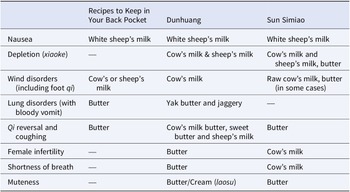
If we compare the formulas from Dunhuang to those collected by Recipes to Keep in Your Back Pocket and Sun Simiao, certain patterns become clear. To be sure, there are a number of formulas found only at Dunhuang: milk-based remedies for ringworms (xuan 癬) and donkey-milk cures to revive the unconscious. Yet most of the formulas from Dunhuang have a familiar ring to them, revealing that the therapeutic applications of dairy products overlapped across time and space. As Table 1 reveals, the various Dunhuang authors prescribed milk products for many of the same ailments as Recipes to Keep in Your Back Pocket and Sun Simiao. These encompassed conditions as different as wind illnesses, to fevers and shortness of breath, to coughs and depletion, to the loss of voice and barrenness in women.Footnote 65 The repetition of ingredients and formulas is suggestive. Such repetition not only discloses that Sun Simiao’s views of milk were far from idiosyncratic but also hint that such views once represented common sense.
Overlapping treatments

Table 1. Long description
The table consists of four columns. The first column lists the medical condition, followed by three columns representing historical sources: Recipes to Keep in Your Back Pocket, Dunhuang, and Sun Simiao.
* Nausea: All three sources recommend White sheep’s milk.
* Depletion (xiaoke): Recipes to Keep in Your Back Pocket has no entry; Dunhuang recommends Cow’s milk and sheep’s milk; Sun Simiao recommends Cow’s milk and sheep’s milk, and butter.
* Wind disorders (including foot qi): Recipes to Keep in Your Back Pocket recommends Cow’s or sheep’s milk; Dunhuang recommends Cow’s milk; Sun Simiao recommends Raw cow’s milk and butter in some cases.
* Lung disorders (with bloody vomit): Recipes to Keep in Your Back Pocket recommends Butter; Dunhuang recommends Yak butter and jaggery; Sun Simiao has no entry.
* Qi reversal and coughing: Recipes to Keep in Your Back Pocket recommends Butter; Dunhuang recommends Cow’s milk butter, sweet butter, and sheep’s milk; Sun Simiao recommends Butter.
* Female infertility: Recipes to Keep in Your Back Pocket has no entry; Dunhuang recommends Butter; Sun Simiao recommends Cow’s milk.
* Shortness of breath: Recipes to Keep in Your Back Pocket has no entry; Dunhuang recommends Butter; Sun Simiao recommends Cow’s milk.
* Muteness: Recipes to Keep in Your Back Pocket has no entry; Dunhuang recommends Butter/Cream (laosu); Sun Simiao recommends Butter.
Our discussion has been limited to medical formulas, but Sun Simiao’s calls to include dairy in the diet were seconded by Meng Shen 孟詵 (621–713), a younger contemporary and purported disciple. In his often-quoted Pharmacopeia of Therapeutic Foods (Shiliao benca o 食療本草), Meng emphasizes the restorative quality of fluid milk. Although cow’s milk should be avoided by those suffering from cold qi, Meng recommends, “It is appropriate for people afflicted by hot winds to take milk” (huan refeng ren yi fu zhi 患熱風人宜服之). This was presumably because the cooling quality of the milk will offset the damage from these elements.Footnote 66 Sheep’s milk possessed still greater virtues in Meng’s eyes, being useful for curing depletion disorders and exhaustion. It increases the store of quintessential qi (jingqi 精氣); when served warm, sheep’s milk also soothes heart pain and cures children of internal winds.Footnote 67
Meng also highlights the benefits of dairy products for the belly, repeating many of the views advanced earlier by Sun Simiao. Meng, for example, insists that butter “benefits the stomach and intestines” (li changwei).Footnote 68 Yet Meng also dreams up new applications for sheep’s milk, which he asserts “replenishes the lung and kidney qi and harmonizes the small intestines” (bu fei shen qi he xiaochang 補肺腎氣, 和小腸).Footnote 69 Here, the reference to harmony (he 和)—a term that was reliably positive in its connotations—is striking. Harmony does not point to milk’s role as a powerful purgative used to expel human waste from the body. Instead, Meng’s turn of phrase implies that milk worked gently within the body, ensuring regularity and thus obviating the need for harsh measures.
Most surprising, however, are Meng’s remarks about milk curds, which point to new ideas of how to use dairy:
Milk curds: slightly cooling. Moisten the five viscera. Advantageous to both urination and bowel movements. Good for the twelve cardinal vessels. They slightly agitate the qi. Curds can be finely minced like beans and mixed with flour, and cooked in soured millet water until the water comes to a full boil more than twenty times [by repeatedly adding water]. These can be used to treat chronic diarrhea with white- and red-colored stool. In cases where small children are affected, consuming milk curds is even more effective.Footnote 70
乳腐微寒。潤五臟, 利大小便, 益十二經脈。微動氣。細切如豆, 面拌, 醋漿水煮二十餘沸, 治赤白痢。小兒患, 服之彌佳。
Certainly, Meng Shen sounded very much like Sun Simiao, as both of them valued dairy products, specifically yogurt and butter, for their ability to keep things flowing through the gut. Yet Meng went farther than Sun when Meng asserts that curdled milk can also cure chronic diarrhea.
The last usage particularly draws the eye. Up until this point, we have only seen healers discourage patients with diarrhea from consuming dairy products. In fact, Meng’s claims come closest to the ideas found in the story about Taizong, both in terms of the kind of ailment (red-and white-colored diarrhea) and the cure (dairy). To be sure, the curds here are not the same as fresh milk. But as we have already seen, Chinese healers were accustomed to treating stomach problems with milk products, which worked as both solvents and therapeutic agents.
Fresh milk was moreover valued for its power to restore harmony to the body’s function. Given this background, it was not such a stretch to propose that certain milk products—namely, curds—ensured general regularity. From there, it was even less unexpected that someone would transfer the properties of milk curds to a closely-related product, fresh cow’s milk. And indeed, milk curds had many of the same properties as cow’s milk. Both were cooling, sweet, and free of poison. Seen from this light, the decision to treat diarrhea with fresh milk made sense. It was the logical next step.
Conclusion
So what do medieval sources tell us about the history of dairy in China? To begin with, they rule out the possibility that the Chinese avoided milk and dairy products for health reasons. Tang and pre-Tang healers, in fact, urged their readers to consume milk both for tonic and therapeutic purposes. They recommended that the old and young eat and drink fresh milk, butter, yogurt, and curds, both to ensure regularity and to harmonize the stomach. They also prescribed milk products for a wide variety of stomach problems, ranging from nausea and vomiting to indigestion and food aversion, to hard stool and chronic diarrhea.
The sources also undercut the notion that Chinese people are incapable of digesting fresh milk in any substantial amount. As our discussion reveals, Chinese healers were attentive to the problems of the leaky gut. They set forth a myriad of remedies for the various conditions of the stomach: vomiting, chronic diarrhea, cramping, and distention. They also paid close attention to troublesome foods, warning their readers against vegetables and grains known to cause gastric distress. Had fresh milk consistently caused diarrhea, learned Chinese healers would have noticed. This is more the case with Sun Simiao, who attended the rich and powerful Tang elite, the men and women presumably with the greatest access to dairy. Yet Sun did not argue for the elimination of milk from the diet or recommend that it be consumed sparingly. On the contrary, he recommended cow’s milk highly. As Sun put it, milk and other dairy products made for happy guts and strong bodies.
So how do we reconcile medieval sources with scientific research? As it turns out, the contradiction may not be as stark as it would initially seem. The science is less clear-cut than Huang and others would have us believe. If we look closely at the medical studies that informed Huang and his predecessors, it becomes clear that most of Huang’s ideas about lactose intolerance drew from research conducted in the 1960s: studies based on small samples and contradicted by other studies, including ones that proposed that Asian rates of lactose intolerance were roughly equivalent to those of people of European descent.Footnote 71 Indeed, the consensus statement put out by the National Institute of Health in 2010 further suggests that Huang and others were on shaky grounds. Based on their review of the literature, the authors of the statement emphasized that the actual prevalence of lactose intolerance remains unknown.Footnote 72
Moreover, biomedical researchers have trouble pinning down the cause of lactose intolerance. Scientists caution us that lactose intolerance is a heterogenous phenomenon rather than a single condition with a readily identifiable cause. Some researchers even question whether lactase deficiency causes lactose intolerance, suggesting that the real culprit (or one of the real culprits) may be the protein specific to Northern European breeds of cattle like the Holstein—not coincidentally, the most popular breed of milch cows in the world. Some new studies conclude that individuals diagnosed with lactose intolerance handle well the fresh milk from cattle breeds native to Asia and Africa.Footnote 73
It is perhaps unsurprising that researchers fail to agree whether the Chinese can tolerate milk. Americans have yet to decide whether drinking milk is good for anyone’s body. Such controversy is perhaps best exemplified by the titles of popular articles on the subject, titles like “Twelve Frightening Facts about Cow’s Milk” or “Health Concerns about Dairy Products.”Footnote 74 Not surprisingly, healthcare providers are divided on whether cow’s milk is suitable for human consumption—raw, pasteurized, or cultured. In recent years, the debate has acquired an alarmist tone, with some critics claiming that cow’s milk contributes to a host of serious illnesses: cardiovascular disease, diabetes, and cancer.Footnote 75
Clearly, the jury remains out on milk. Yet one thing is clear: Chinese healers of the Tang dynasty were no proponents of milk avoidance. As it turns out, some of them were even fans and would have taken a dim view of a dairy-free diet.
Competing interests
The authors declare none.

 Open access

