

The Chancay
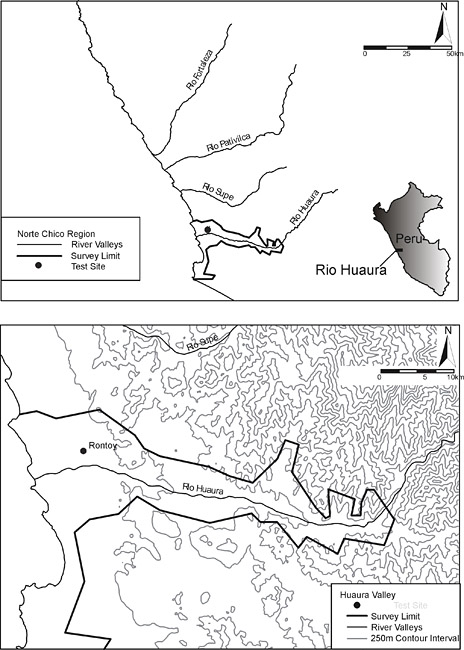
The Chancay are an understudied culture of the north central coast (Norte Chico) of Peru, contemporary with the Inca and active c. AD 1200-1625. In 2007, investigations of Chancay sites were carried out in the Huaura Valley (Figure 1), principally to obtain radiocarbon samples for dating. No detailed chronological framework is available for this area and the objective was to build one, using stratified deposits from test excavations throughout the valley at sites with characteristic Chancay black-on-yellow pottery and adobe tapial walls (poured adobe) in the form of enclosed compounds.
The location of the site of Rontoy in Peru.

During test excavations at four Chancay-type sites, a tomb was uncovered at the site of Rontoy (Figure 1). The tomb was an unexpected discovery as most Chancay burials are within cemeteries and adds important details to our knowledge of the Chancay by shedding light, not only on the methods of internment, but also on the timing of change in the material culture in the Huaura Valley.
Looting in Peru is both widespread and intense. Parts of the site of Rontoy, as well as other Chancay period sites, are often the target of professional looters due to the near perfect preservation of fine textiles, pottery vessels and figurines that are highly desirable on the international black market.
Location and excavation of the tomb
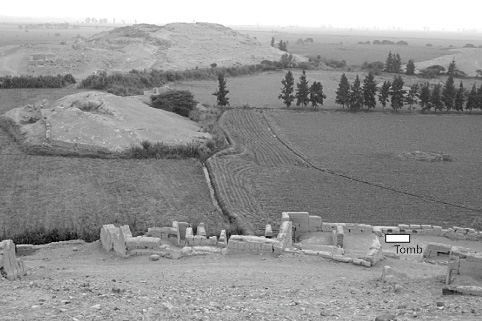
At the site of Rontoy, a 1 x 1m unit was placed in an open area adjacent to three niches within an adobe tapial compound wall (Figure 2). This area was chosen for two reasons: firstly, because there were multiple floors exposed in a nearby looters' trench, making it a good sample for stratigraphic deposits; and secondly, because the function of rooms with niches are not known for the Chancay.
The Huarua Valley, looking south and showing the location of the tomb at the site of Rontoy.

This was the last site in the valley to be tested in the 2007 excavation season. Other excavated units had exposed multiple layers of construction material that included layers of plant material interspersed with rubbish to build up level platforms. The deposits in the final unit to be dug, however, were completely different in terms of its construction sequence. Instead of the purposeful layering of materials, the fill below an initial cap of an adobe floor was composed of large pieces of adobe tapial (poured adobe) wall fragments, large pieces of plastered and smoothed floors, and loosely placed, partially complete artefacts. This mixed deposit continued down for 51cm, at which point Offering 2 was found placed on the top of a wall. Offerings, as part of construction, are not unknown in the Andes and so it was recorded and removed as such.
The excavations continued until the first signs of a textile were encountered, extending across the entire 1 x 1m unit. Small textile bundle offerings have been recorded in construction fill (Reference Brown VegaBrown Vega 2008, Reference Brown Vega2009), but the size and layering of this textile suggested that it was a mummy bundle. Due to the concerns of looting, the 1 x 1m unit was immediately expanded slightly larger than the length and width of the bundle so that it could be removed. For the same reason, the mummy bundle and offerings were removed as quickly (but with as much detail) as possible, so as to not attract attention from local people on their way to and from their fields. The bundle was wrapped in tarpaulins, carried to the vehicle and immediately taken to the laboratory.
The tomb was then covered over until permission and funding to extend the test unit were received. Despite the discreet manner of the excavation, on returning to the site, new looters' holes were found scattered across the platform — luckily missing the tomb by approximately 1m — but unfortunately doing damage to several architectural features.
In the second phase of excavation, the test unit was extended further to expose the entire tomb. The previously excavated area proved to lie in the approximate centre of the tomb. From here, excavations expanded to the north-east and south-west following natural stratigraphy (Reference NelsonNelson & Ruiz Estrada 2008).
Layout of the tomb
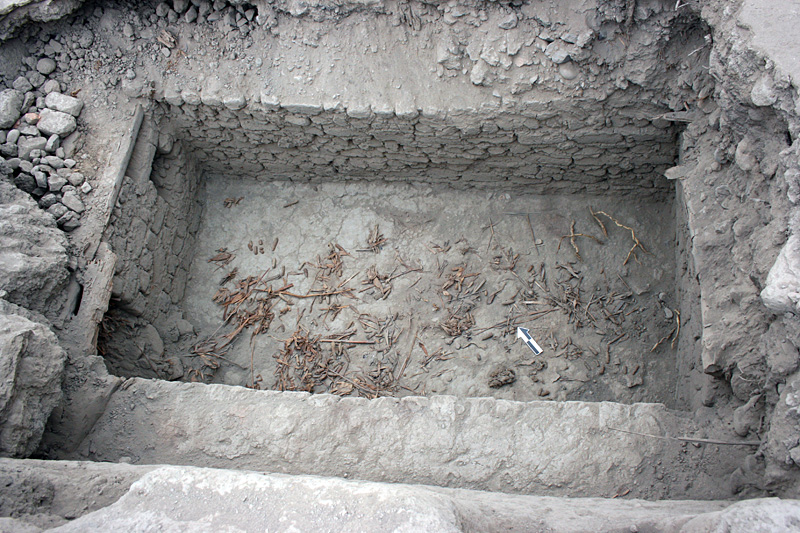
The walls of the tomb (Figure 3) had been constructed within an existing structure. Adobe bricks were laid in alternating rows of headers and stretchers, to a surviving height of approximately 1m. This method of alternating adobe brick construction is common in Chancay architecture (Reference KrzanowskiKrzanowski 1991). One wall is somewhat strange because it was constructed against an existing adobe tapial wall. The tomb is approximately rectangular and at its maximum measures 3.15 x 1.69m. The floor of the tomb was plastered and rests on top of the natural ground surface. A small window and door are located in the north wall, but the area beyond this was not excavated due to the risk of collapsing the thick adobe floor above. The door has a lintel made of a single tree trunk.
The walls of the tomb, its floor scattered with an offering of corn stalks and cobs.

The earliest deposit was a layer of sediment over which a layer of corn stalks was spread across the floor of the tomb and filling the doorway (Figure 3). (Corn stalks are known to be placed as an offering because they were also found stuffed into the small door and window associated with the upper layers of the tomb.)
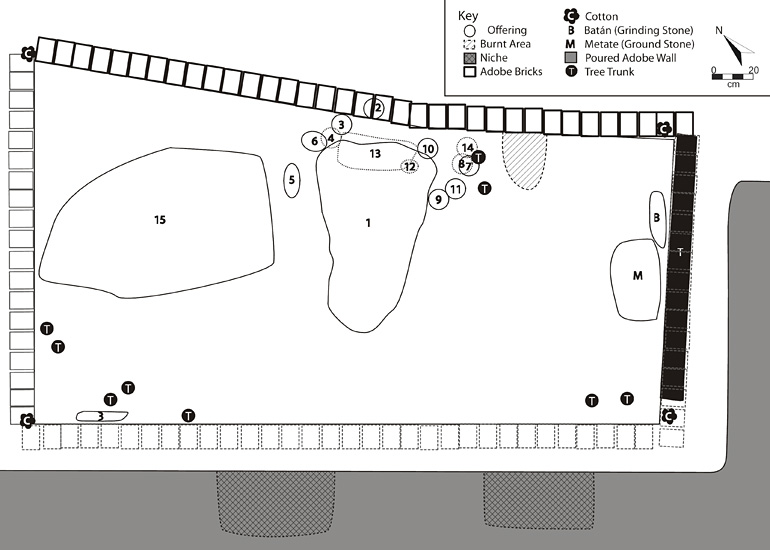
Placed on top of the corn stalks were two batánes (grinding stones) and a large metate (ground stone) (Figure 4). These were set upright, one batán and metate against the south wall and one batán in the north-east corner of the tomb. The corn stalks were covered by a layer of fine sediment 20cm deep and level at the top, containing a few artefacts.
Plan of the excavated the tomb, showing the location of offerings: 1) mummy bundle; 2) textile bundle with cotton yarn, small textiles and a wooden rattle; 3) Chancay-Inca style goblet with food remains (see Figure 5); 4) pottery bowl filled with corncobs; 5) cotton bag of pacae (tree fruit) (see Figure 6); 6) bird-shaped spouted vessel (see Figure 7); 7) Chancay-Inca style goblet filled with several balls of cotton; 8) Chancay-Inca style canteen; 9) undecorated jar with sherd lid containing plant material; 10) Chancay-Inca style pottery bowl with two handles covered with a piece of cotton textile; 11) undecorated jar with sherd lid; 12) small textile bundle; 13) textile pillow; 14) small bowl with food remains; 15) intrusive burial of a male possibly dating to the mid-nineteenth century.

On top of this layer of sediment were the mummy bundle and offerings (or grave goods) (Figure 4). The mummy bundle was placed with the head approximately to the west, close to the west wall and in the approximate centre of the tomb. It was labelled Offering 1 because it was uncertain if it was an offering or the main bundle. Tree trunks were present in the south and west corners of the tomb and two near the mummy bundle. These trunks may once have crossed the top of the tomb and their fall perhaps resulted in the breakage of several of the offerings.
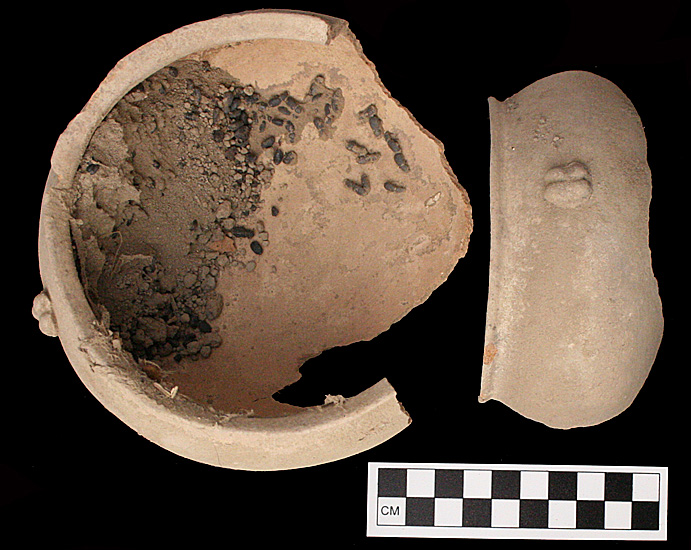
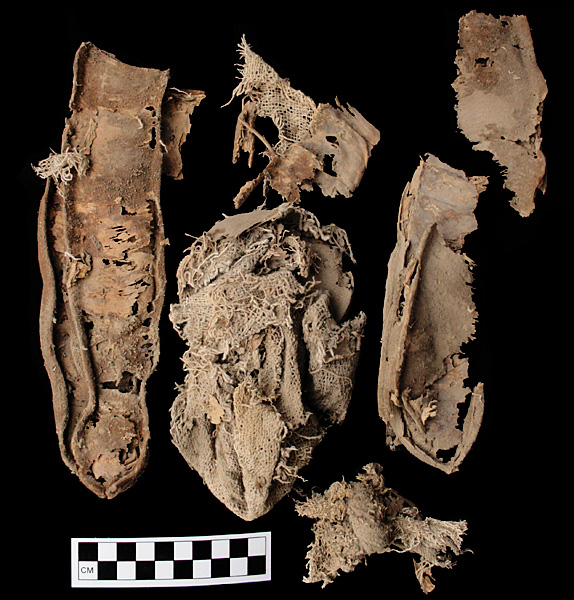
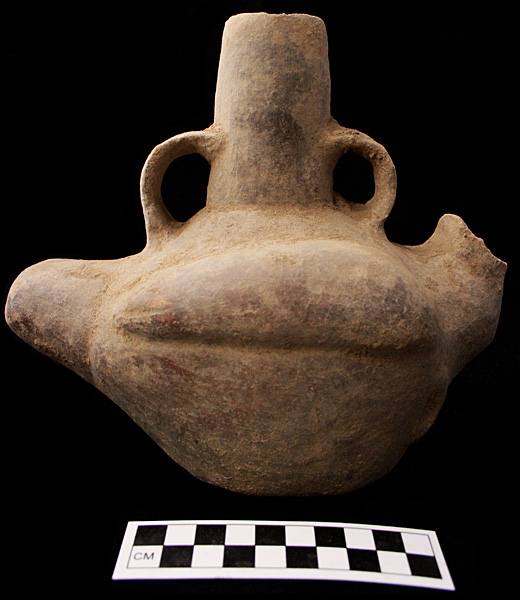
The offerings were not all placed at the same vertical level. Instead, it appears that some items were placed, additional sediment was then added, and then further offerings were placed, creating tiers of offerings surrounding the mummy bundle. For example, Offerings 3 (goblet; Figure 5), 5 (cotton bag; Figure 6) and 6 (spouted vessel; Figure 7) were placed at the same level as the base of the bundle, while Offering 4 (bowl) was placed on a pile of sediment on top of Offerings 3 and 6, so that the top of the spout of Offering 6 was at the same level as the top of the mummy bundle. The vertical and horizontal relationship of these offerings may be telling of social relationships or the sequence of interment activities. The presence of food remains in all of the ceramic vessels, including the bowl pictured in Figure 5, suggests that the purpose of the pottery vessels was to contain food or drink that was itself the offering.
Offering 3, Chancay-Inca style goblet with beetles and small fragments of food remains.

Offering 5, cotton bag filled with pacae (tree fruit).

Offering 6, bird-shaped spouted vessel.

After the tomb was loosely filled to the top of the adobe brick wall, a final offering (Offering 2, cotton bag with rattle) was placed on top of the wall near the head of the mummy. Cotton was also placed on top of the adobe brick walls in each of the four corners. The cotton offerings showed duality in the placement of opposing offerings of dark brown and white cotton. They then continued to fill the hole with large sherds, burnt stone, adobe wall and floor fragments, and sediment until it was finally capped by a thick adobe floor.
Date
The pottery present included a wide variety of forms, but style and function are shared. The pottery style of all of the vessels associated with this tomb falls within the category of what is regionally referred to as the Chancay-Inca style. This style includes unpainted Chancay yellow-to-cream slipped surfaces sometimes with the addition of appliqué in the shape of small frogs, corncobs or beans (Figure 5). Although this style has not been directly related to an Inca occupation or influence in the valley, it does appear to be late in the ceramic chronology of the Chancay culture. The late dates of this type are confirmed by an associated accelerator mass spectrometry (AMS) date for the tomb of 520±25 BP (UGa-03319, wood charcoal, d¹³C = -26.5‰). This date is from a large piece of charcoal that was tucked into the outer layers of textile surrounding the mummy. The date falls within the later half of what has traditionally been argued as the temporal span of the Chancay culture (AD 1200-1450) (Reference MoseleyMoseley 2001).
The Rontoy tomb in context
The tomb resembles several excavated by Reference HorkheimerHorkheimer (1962) and described by Reference CornejoCornejo (1985, Reference Cornejo1991) at the site of Lauri, a major centre in the Chancay Valley. Similarities include vertical layers of offerings, a mummy wrapped in textiles, and concentration of offerings at the head of the individual. The Rontoy tomb is significant for our knowledge of the Chancay culture for a number of reasons. Firstly, few Chancay burials have been excavated, partly due to extensive looting. Documenting this tomb in situ offers the opportunity to examine the types and relationships among grave goods in context, to date textiles and associated goods, and to determine the construction and entire composition of the tomb. Secondly, these data together offer important information concerning the timing of the Chancay-Inca style. Thirdly, this context reveals the importance of food and other organic material as part of the interment ritual. Thus pottery and botanical remains retrieved from looted tombs may have been part of the offering package and not just random inclusions within the fill.
Lastly, the tomb is important for understanding the Chancay culture, shedding light on different types of artefacts and burial practices used during the Late Chancay, a period when both the Chimú and Inca were expanding.
Acknowledgements
This study was supported by Tulane University's Faculty Enhancement Grant 2007 and the National Geographic Society (Grant #8338-07). Special thanks go to both Drs Nathan Craig and Margaret Brown Vega for their contributions to excavations of the tomb and their ongoing interest and support in this project.