

Introduction
Svalbard has in recent years turned into somewhat of a showcase of a changing Arctic, and Longyearbyen at 78° North has become renowned as the town “on the front line of climate change” (Fraser, Reference Fraser2019). Both the media and science feed this narrative, and climate change has become a powerful discourse in the local and state governance of Svalbard. Indeed, temperatures on the archipelago have risen substantially since 1900 (Vikhamar-Schuler, Førland, & Hisdal, Reference Vikhamar-Schuler, Førland and Hisdal2016). These changes occur simultaneously with profound economic restructuring as coal mining is being dismantled and tourism is booming. The associated uncertainties regarding the town’s economic future go hand in hand with a changing social structure as Longyearbyen’s population is becoming more international and increasingly transient. While the environmental consequences of climate change on Svalbard are well-documented, research on the societal impacts and responses to these changes is scarce (Tvinnereim, Angell, Kolstad, Brekke, & Mortensen, Reference Tvinnereim, Angell, Kolstad, Brekke and Mortensen2016). In a recent study, Hovelsrud et al. (Reference Hovelsrud, Kaltenborn and Olsen2020) studied adaptation to multiple changes, including climate change, in Longyearbyen, finding that the complex policy and institutional context of Svalbard affect and limit local actors’ ability to adapt. This study aims to complement our knowledge about the societal impacts of and responses to climate change in Longyearbyen.
It has been established that climate change adaptation takes place on the local level (IPCC, 2007). This article examines perceived societal impacts of climate change in Longyearbyen, and how experienced and projected impacts are dealt with locally. The focus lies on climate change adaptation, including both meanings and practices. Talking to citizens in Longyearbyen throughout my fieldwork in 2019 and 2020 about whether and how they experience climate change, it became evident that impacts on buildings and infrastructure are considered a main concern. In this article, I thus focus on the built environment, which constitutes a critical link connecting humans to their natural surroundings. I draw on interviews and conversations with those involved in one way or another in adaptation of the urban environment in Longyearbyen. The aim is to provide an in-depth empirical description and analysis of locally perceived climate change impacts, as well as local adaptation practices, meanings and challenges. Four interrelated questions guide this article: What are the perceived societal impacts of climate change in Longyearbyen? How is the town being adapted to climate change? Which meanings and understandings of adaptation guide these practices? What are the challenges to adaptation?
Lately, the “anthropology of climate change” has developed into a well-established field of research (e.g. Barnes et al., Reference Barnes, Dove, Lahsen, Mathews, Mcelwee, Mcintosh and Yager2013; Crate & Nuttall, Reference Crate and Nuttall2009; Fiske et al., Reference Fiske, Crate, Crumley, Galvin, Lazrus, Luber and Wilk2014; Hastrup, Reference Hastrup2013), and the Arctic has received considerable scholarly attention in this regard (e.g. Hovelsrud & Smit, Reference Hovelsrud and Smit2010; Krupnik & Jolly, Reference Krupnik and Jolly2002). Simultaneously, there has been a veritable explosion of interdisciplinary research on the “human dimensions” and the “societal impacts” of Arctic climate change (e.g. Ford, Bolton, Shirley, Pearce, Tremblay, & Westlake, Reference Ford, Bolton, Shirley, Pearce, Tremblay and Westlake2012; Stephen, Reference Stephen2018). While in the Norwegian context climate change adaptation has been studied in municipalities, institutions and economic sectors (e.g. Hovelsrud, Dannevig, West, & Amundsen, Reference Hovelsrud, Dannevig, West, Amundsen, Hovelsrud and Smit2010), the anthropological research on climate change in the Arctic typically focuses on small-scale Indigenous societies that are strongly dependent on their local environments for subsistence and at the margins of national economies. Longyearbyen presents quite a different picture: its population has high levels of income and formal education, it is non-Indigenous, transient and international and the town lies at the centre of the economic and political interests of an industrialised, affluent nation. With this article, I thus hope to add knowledge about how an Arctic society far removed from a local, traditional and place-based community in the classical anthropological sense (Sokolíčková, Reference Sokolíčkováforthcoming), and with a greater amount of resident experts, deals with climate change and understands adaptation.
The article begins with a brief introduction to the theoretical framework that has guided the research questions and the analysis. In the second part, I describe from the point of view of my interview partners which climate change impacts they observe in Longyearbyen, with a focus on the built environment. I then move on to analyse how these impacts are dealt with locally, which discourses guide adaptation and where there are challenges to adaptation. I conclude with a discussion of the findings, relating them to adaptation and environmental anthropological literature.
Methodology and research design
This study draws on 14 months of ethnographic fieldwork between 2018 and 2021, with the aim to study how Longyearbyen is impacted by environmental and socio-economic changes, and how inhabitants experience, live with and adapt to these. This article is based on 22 semi-structured, in-depth interviews, for which I used a flexible and evolving interview guide, including questions about perceived climate change impacts on society, related concerns and opportunities, whether and how these can be/are dealt with, about other changes the interviewee saw impacting and about the future of Longyearbyen. Here I draw on a specific sample, namely on interviews with people I identified (primarily through recommendations of previous interview partners) as involved in climate change adaptation in Longyearbyen: urban planners, engineers and administrative staff in the local government Longyearbyen LL (hereafter LL); elsewhere employed engineers, architects and consultants; workers and administrative staff in the building and construction sector; scientists, and local politicians. Twenty-one of the interview participants were Norwegian, which indicates the considerable share of Norwegians in public administration, among politicians, and engineers and consultants in Longyearbyen, where 36% of the population is non-Norwegian (Statistics Norway, 2020a). This specific sample is thus not representative of the population in town, and – as will be argued throughout the article – represents a certain view on adaptation. Most interviews were conducted during working hours at the interviewee’s workspace, a handful were conducted in the afternoon/evening at the interview partner’s home. The interview data are contextualised by informal interviews, participant observations and local media, including social media. The presented findings are based on the categories that emerged using qualitative content analysis (Mayring, Reference Mayring2014).
Theoretical perspectives
A central premise of this study is that climate change has physical and cultural dimensions, acknowledging both its material and discursive realities (Moore, Reference Moore2015). Whilst avoiding “the simplistic environmental determinism of an earlier era”, climate change research must recognise that “environments play a vital role in shaping cultures and providing possibilities and setting constraints on what they are likely to do” (Baer & Singer, Reference Baer and Singer2014, p. 60). The way climate change is approached here is inspired by recent developments and “turns” in anthropology that re-actualise and further develop more traditional environmental approaches in anthropology, such as the spatial and material turn (e.g. Ingold, Reference Ingold2012). What these approaches have in common is what makes them suited for the study of climate change: their concern with the physical world and environments, whilst rejecting the nature-culture dichotomy, and an insistence that humans cannot be seen but as mutually constitutive of these environments. Moving away from post-modern linguistic approaches, they reflect a renewed interest in peoples’ material surroundings as well as interactions and entanglements of the human and the non-human, resulting not only in a focus on environmental issues but also in landscapes, dwellings, buildings and spaces (Stender, Reference Stender2017).
As part of this broader interest in the material and materiality (Ingold, Reference Ingold2012) there is a recent growth in the anthropological interest in infrastructure and the built environment (e.g. Carse, Reference Carse2016; Larkin, Reference Larkin2013; Schweitzer, Povoroznyuk, & Schiesser, Reference Schweitzer, Povoroznyuk and Schieser2017). Human–environment relations are mediated by technology and infrastructure (e.g. Dourish & Bell, Reference Dourish and Bell2007), a problem that has been central to environmental anthropology (Carse, Reference Carse2016). The built environment thus becomes a critical link when studying the societal impacts of climate change. A focus on climate change impacts on the built environment however does not exclude the cultural dimension of climate change. Anthropologists focus on cultural meanings and values related to climate change (Strauss & Orlove, Reference Strauss and Orlove2003) and emphasise that “culture frames the way people perceive, understand, experience, and respond to key elements of the worlds which they live in” (Roncoli et al., Reference Roncoli, Crane, Orlove, Crate and Nuttall2009, p. 87). As pointed out by Hulme (Reference Hulme2009), climate change itself is also a social construct, a cultural idea, which influences the way people think, feel and act in relation to environmental changes.
This cultural dimension is crucial when considering climate change adaptation. Adaptation refers to “the processes by which individuals and groups of people adjust their behavior and organization in response to changes in their environment” (Thornton & Manasfi, Reference Thornton and Manasfi2010, p. 134). The concept is at the same time a powerful policy term and an analytical concept. It has a long history in anthropological theory and is now revisited and applied in the context of climate change (e.g. Barnes et al., Reference Barnes, Dove, Lahsen, Mathews, Mcelwee, Mcintosh and Yager2013; Crate, Reference Crate2008; Fiske et al., Reference Fiske, Crate, Crumley, Galvin, Lazrus, Luber and Wilk2014; Nelson et al., Reference Nelson, West and Finan2009; Oliver-Smith, Reference Oliver-Smith, Kopnina and Shoreman-Ouimet2017; Thornton & Manasfi, Reference Thornton and Manasfi2010). The related concept of vulnerability describes the extent to which a system is susceptible to harm from environmental impacts. It implies that societal climate change impacts are determined by the social, economic and cultural conditions of the affected society (e.g. Ford & Smit, Reference Ford and Smit2004; Turner et al., Reference Turner, Kasperson, Matson, McCarthy, Corell, Christensen and Schiller2003). The concept thus allows to study environmental impacts in specific societal contexts, with a focus on the social factors that shape vulnerability (Oliver-Smith, Reference Oliver-Smith, Kopnina and Shoreman-Ouimet2017), stressing that vulnerability is “produced in and by society” (Ribot, Reference Ribot2014, p. 667).
Anthropologists call for a holistic definition of adaptation, including both material and cultural, objective and subjective aspects of adaptation (Oliver-Smith, Reference Oliver-Smith, Kopnina and Shoreman-Ouimet2017). Importantly, anthropological accounts have established that adaptation is more than a “techno-fix” (Thornton & Manasfi, Reference Thornton and Manasfi2010), as in technological solutions to specific risks. Rather, it is constituted through diverse, intersecting processes, taking place on multiple scales in response to multiple climatic and non-climatic stressors (Thornton & Manasfi, Reference Thornton and Manasfi2010). This concept of adaptation entails a critique of conventional climate-change debates “focused on technologies and the elusive search for large-scale, cookie-cutter solutions, leaving aside the important role that individuals, cultures, and societies play in constructing and living out an adaptation dynamic” (Nelson et al., Reference Nelson, West and Finan2009, p. 272). A holistic concept of adaptation moreover entails to attend to both practices and meanings of adaptation (Oliver-Smith, Reference Oliver-Smith, Kopnina and Shoreman-Ouimet2017). As emphasised by Hulme (Reference Hulme2010), climate change is not merely “‘a problem’ waiting for ‘a solution’. It is an environmental, cultural and political phenomenon which is re-shaping the way we think about ourselves, about our societies and about humanity’s place on earth” (ibid., p. 171). Whether and how individuals and groups respond to climate change thus “depends importantly on what the effects of climate change mean to those affected” (O’Brien & Wolf, Reference O’Brien and Wolf2010, p. 232), and values and worldviews have been found to shape adaptive responses (ibid.). Thornton and Malhi (Reference Thornton and Malhi2016) have identified different major epochal “Anthropocene narratives” which frame adaptive responses. Whereas the “Moral Jeremiad” narrative emphasises the urgency of the planetary crisis, the “March of Progress” narrative naturalises human domination of the planet. The “New Genesis” narrative seeks a vision of “re-enchantment emerging from the Anthropocene in which humans reconnect with Earth systems” (ibid., p. 1), and the “Techno-fix Optimist” narrative views global problems solvable through human ingenuity and technology.
Observed changes and experienced impacts
The main takeaway from the recently published climate report for Svalbard (Hanssen-Bauer et al., Reference Hanssen-Bauer, Førland, Hisdal, Mayer, Sandsø and Sorteberg2019) and the climate profile for Longyearbyen (Norsk Klimaservicesenter, 2019) is that annual air temperature will increase, as will annual precipitation. Thawing of the upper layers of permafrost is expected, as are more frequent events with strong precipitation, and more rain in winter. Increased precipitation and snow and glacier melt will result in more flooding, and river and coastal erosion is predicted. There will be an increase in snow and slush avalanches. A thicker active permafrost layer in combination with more frequent rain events will result in unstable slopes, increasing the risk for landslides and debris flows. The data collected throughout my fieldwork indicate that people observe climatic changes and connect these to a range of environmental changes in an around town already today, observations that to a certain extent reflect the scientific observations. These include warmer temperatures; changing precipitation patterns, which are associated with landslides and avalanches; changes in permafrost, which people relate to coastal erosion and landslides; and less sea-ice in winter.
Vulnerability: The inheritance of the coal mining company town
The societal impacts of climate change in Longyearbyen are defined by the town’s history as a coal mining company town. Firstly, the presence of coal determined the town’s location (Fig. 1). “Longyearbyen is the worst place on the island to have a town, and it is just because of one reason, the coal in the mountain”, an architect told me. The location – in a narrow valley between steep slopes and with a river running through it, confined by a glacier on the one end and by the fjord on the other – creates major challenges for the maintenance and development of the town today, challenges that are enhanced by climate change:
“We live in a scree slope. It’s a bit hard to deal with that, everything is supposed to be a hundred percent secure and then you live in a scree [laughs], it goes without saying that there are some expectations that you cannot fulfill. […] Of course, the steep areas we have here, things [avalanches, landslides, etc.] have always happened there and they will continue to happen and probably a bit more now when there will be more thawing.”
Map over Longyearbyen. Source: https://toposvalbard.npolar.no.
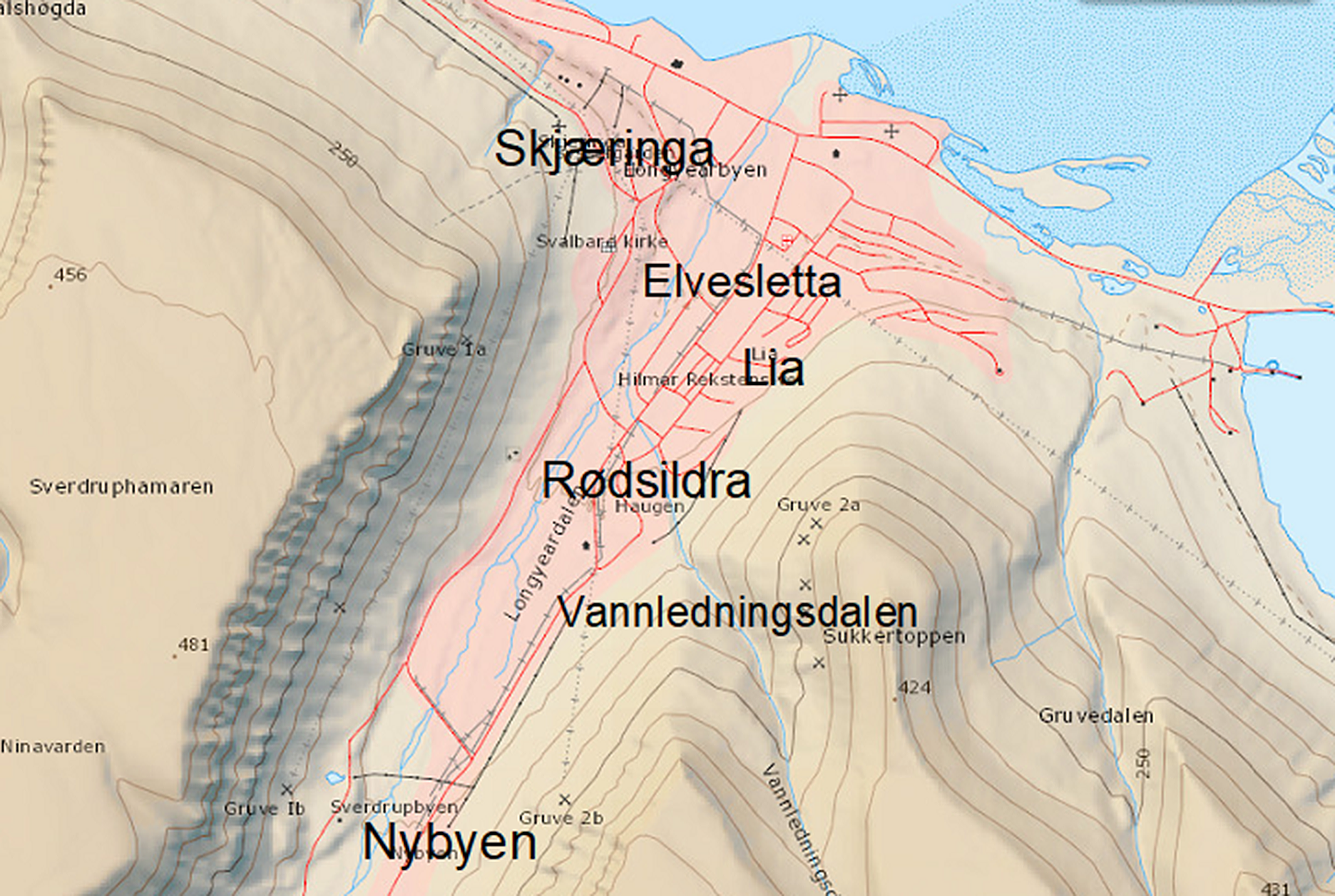
Furthermore, the town developed in response to where the mines opened, and exposure to avalanches and landslides did not define urban development. As a result, several of the existing neighbourhoods are exposed to geo-hazards such as avalanches. A geologist told me: “If you look at where those houses [Lia] are built, they are built on avalanche paths. They would never have been built there today” Another neighbourhood – and also today’s main area of urban development, Elvesletta (literally “riverbed”) – is located upon an embanked riverbed, prone to flooding and erosion, with masses that are less than ideal for construction. Moreover, the former company town is characterised by temporariness: “The town is built on a temporary idea. It was kind of built around the mines and not for developing a long-term society”, an architect explained. This also includes the buildings and infrastructure in town, which often have a short lifespan: “What was built before was not supposed to last for long, it was never intended to last for 30–40 years”, she continued. Many buildings are moreover of poor structural quality. Part of the present housing stock has outlived its intended life span and was never intended for long-term and high-quality living in the first place. Longyearbyen’s built environment is thus susceptible to impacts of climate change, and these vulnerabilities are very much related to its history as a coal mining company town.
Observed physical impacts
The societal impacts of climate change my interview partners identified are tangible and visible impacts on the built environment, and these are the impacts that are considered most pressing. Avalanches came up in almost every interview. Longyearbyen was hit by two major avalanches in December 2015 and February 2017. The first hit ten houses in the neighbourhood Lia and killed a child and an adult. The second destroyed houses in the same neighbourhood. These traumatic events mark a great rupture in the recent history of the town (reference anonymised) and have become a powerful symbol of climate change impacts, playing a decisive role in climate change adaptation. Avalanches threaten infrastructure and buildings in Lia, in Nybyen, and on the other side of the valley, above Skjæringa. In Haugen, the main problem identified is slush avalanches, which threaten a bridge and technical infrastructure. Another concern literally underlying many challenges is the permafrost ground, inherently unstable, always on the move and with a deepening active layer as temperatures rise. This may destabilise existing buildings and structures. The unstable permafrost also impacts the road network, an impact that is reinforced by precipitation. This also raises concerns for the local freshwater reserve, Isdammen, which is dammed up by a road. The unstable ground conditions furthermore create challenges for the airport strip. Outside of town, a related concern is coastal erosion, which has led people to move their cabins away from the coastline, and is damaging the road. Another challenge related to thawing permafrost is that it might release pollution locked in the ground around town. Several interview partners pointed out that many of these challenges exist already under normal conditions, due to seasonal thawing and general movement in the ground, and that a deepening active layer due to climate change only adds to this. Ice patches constitute another challenge, as they pop up unexpectedly and can damage infrastructure and buildings: “the past years a lot of ice patches have appeared, probably because we have these mild periods and then the water gets pressed up”, an engineer explained. Permafrost thaw is furthermore considered a problem in terms of landslides. Moreover, old constructions, including the wooden trestles from the mining industry, declared as cultural heritage, and wooden piles are starting to rot as a result of a warmer and wetter climate.
The built environment in Longyearbyen is thus put under pressure by different, often interrelated, environmental processes. The interview partners are acutely aware of climate change and directly relate experienced challenges and observed impacts to a changing climate. This knowledge and awareness of the situation indicates strong adaptive capacity (Marshall et al., Reference Marshall, Park, Howden, Dows and Jakku2013). Interestingly, these impacts are often described by the interview partners as not concerning them personally, but rather to be a challenge for society. In the words of an urban planner: “They [environmental changes] do not impact me directly, but I see that they affect society as a whole”. The interview partners frequently distinguished between impacts on society (and nature) and impacts on their personal life, which indicates a perceived disconnection between the self and the natural environment and society. This notion has been described by Ingold (Reference Ingold, Dove and Carpenter2008) as a “view of the environment as a globe”, which the detached human views from the outside, representing separation of humanity from nature. The “globe view” is rooted in modernity and implies a view of nature as manageable, which we will see is also reflected in the interview partners’ understandings of adaptation.
Uncertainty and unpredictability
“There is great uncertainty in knowledge that we used to rely on. […] So climate change challenges us quite a lot, because it changes the conditions. When you can’t build on the knowledge you had, then what are you supposed to build your knowledge on? That is what is difficult and that is what we don’t know yet in many cases.”
This quote by a bureaucrat in the technical department of LL illustrates what many of my interview partners emphasised: that in addition to the mere physical impacts, climate change creates uncertainty and unpredictability, which pose major challenges for urban development, planning and construction in Longyearbyen. The avalanche in 2015 came as an extreme shock to the community and marked the beginning of rapid development of security measures against geo-hazards. However, it was the avalanche in 2017 that clearly indicated that the environmental conditions were changing and that previous knowledge in many cases no longer could be trusted. In the words of an engineer from the technical department in LL:
“In 2017, when the second avalanche hits, NVE [the Norwegian Water Resources and Energy Directorate] is in town. So they sit here at Næringsbygget [the premises of LL] and discuss avalanches with LL, there are observers out in the field and they cannot predict the avalanche, because they rely on old assumptions, old parameters, old history. So climate change has been there and changed these premises, and then you can’t see the whole picture, you cannot predict the avalanche and then comes the second avalanche. […] If the avalanche is a direct consequence of climate change or not, that can be discussed, but there is no doubt that climate change alters the suppositions.”
Climate change thus alters the premises of knowledge used to be considered sound. This creates uncertainties and may ultimately result in risks. A local architect expressed that the knowledge base changes at a fast pace: “And just during the time that I have been up here, we have changed the avalanche zones twice. So what is the truth today, and what is the truth in 5, 20, 50 years, that is very hard to predict”.
This confirms that what has been claimed regarding local knowledge elsewhere in the Arctic – namely that unpredictability due to climate change threatens to erode traditional knowledge and skills (e.g. Krupnik & Jolly, Reference Krupnik and Jolly2002) – also applies to Western, science-based knowledge and competencies.
Adaptation measures
The avalanches in 2015 and 2017 marked a decisive turning point in climate change adaptation in Longyearbyen and continue to shape climate change discourses and adaptation. My interview partners narrate that the avalanches “gave climate change a face”. After 2015, climate change adaptation was put higher up on the local and central political agenda for Longyearbyen and the work against geo-hazards was greatly intensified. Climate change became a serious factor to consider in this work and in urban planning, which is increasingly based on climate projections.
Responsibilities in climate change adaptation
The interview partners consider climate change adaptation a public responsibility, to be managed by the local administration and supported by the state. This is related, on the one hand, to LL’s responsibility for the entire infrastructure of town. The big projects, such as the securitisation of the river and avalanche protection measures, are decided upon and carried out by LL, and smaller-scale adaptation measures, for example the implementation of new building regulations, are a political decision. This is not unique for Longyearbyen: in Norwegian climate policies, the municipalities are given great responsibility for adaptation (Ministry of Climate and the Environment, 2012-2013). However, in Longyearbyen, the state also plays a decisive role in adaptation. This is related to ownership: the state owns practically all ground in Longyearbyen, and most housing is owned by the state and larger companies, with only 13% of the housing stock owned by private individuals (Longyearbyen Lokalstyre, 2019). This, in combination with a high population turnover, makes individuals less inclined to feel responsible for climate change adaptation of the built environment. Furthermore, the resources that the local government has at their disposal for hazard security measures stem directly from state transfers. Moreover, the central government recently redefined “which level of climate change” must be used as a “premise for planning” locally, as a planner at LL explained: “It is the government, through their Stortingsmelding [white paper], that decides that we must be precautionary and use RCP8.5 [the highest greenhouse gas emission scenario] as the basis for projections. So that defines our work concretely”.
The state also plays an active role in carrying out the adaptation measures. In the implemented and ongoing projects for securing the town against hazards, the local government is responsible for planning and implementation, while the state assists with expertise through the Norwegian Water Resources and Energy Directorate (NVE) and funds most of the projects. However, the state is sometimes criticised locally for not contributing enough, as an employee in the administration of LL pointed out: “It is a problem that the state does not provide the needed financial means for adaptation”. Also the Local Council has expressed its concern that it is overwhelmed by changes that require action. In 2018, the leader of the Council said to Svalbardposten that it “might seem that one forgets that the Local Council also has large expenses related to natural hazards”, criticising the state for prioritising state-owned infrastructure in climate adaptation (Engås, Reference Engås2018).
Physical adaptation: urban development, construction and security measures
“In 2015, the avalanche, that changed things. After that, they built all these new houses. It had an impact on where things have been built since then and where they will be built in the future”, a participant in a focus group on urban development in Longyearbyen described (LPO arkitekter, 2021). Adapting the town to a changed risk picture has become a main driver behind urban development in Longyearbyen. A planner told me: “Before, the town moved after the mines. Now we move it away from natural dangers”. Since the avalanches, the areal plan has been revised and new risk zones have been defined. The current areal plan includes a transformation of the town, where housing is moved out of the avalanche zones, existing neighbourhoods are densified and new ones developed (Longyearbyen Lokalstyre, 2020). As a result of the new risk zones, in 2019 the work with demolishing 139 housing units within these zones in Lia began. On the other side of the valley, a kindergarten and a road are permanently closed due to risk of avalanches and landslides. Permanent and temporary evacuations, such as the closing of the kindergarten expansion Rødsildra which was built as late as 2019, are implemented as new risk evaluations develop. As the state has made it clear that it would not invest in avalanche protection in Nybyen, also this part of town is being emptied, as the student housing, the art gallery and the crafts centre are relocated to the city centre. The guiding principle behind these developments is to “get people out of the avalanche zones”, in the words of a planner. This is a challenging task: the area for urban development in Longyearbyen is very restricted, both due to topography (limited area to build on) and because the state has made it clear that further growth and infrastructure development are not desired (Norwegian Ministries, 2019, p. 6). Hence, compromises in urban development are made: moving houses out of the avalanche zones seems to be the main priority, and considered worth the risk of constructing on the riverbed (Elvesletta), an area with unstable ground conditions, prone to flooding.
The interview partners explained that also building practices are starting to change in response to a changing climate. In general, constructions in Longyearbyen today need to more strictly follow building codes and regulations than during the town’s company town past. According to several interview partners, construction in Longyearbyen is done more “properly” today, and buildings are intended to be built with higher quality materials and a longer lifespan. This includes building foundations more suited to unstable ground conditions and an increasingly active upper permafrost layer, by digging deeper pile foundations and using steel piles. As an engineer told me: “Much has changed from when I was a student here ten years ago. The attitude towards the depth of piles and foundations, before it was just like ‘drill a six meter hole and it will work anyway’.” Whether this increased focus on higher building standards better suited to thawing permafrost actually results in greater quality and longer lifespan of buildings remains to be seen.
Security measures to protect the town against environmental hazards are considered another main adaptive strategy to deal with climate change in Longyearbyen. The largest projects in this regard are the securitisation of the river Longyearelva and the avalanche protection measures in Lia and Sukkertoppen, as well as the measures to protect against slush flows in Vannledningsdalen. Permanent physical measures include avalanche fences, snow-catching fences and a dyke, as well as erosion prevention along the shores of the river, in addition to different forms of monitoring, by the use of sensors, cameras and field observations, a local avalanche forecast, and a regional public avalanche warning system. Temporary security measures include evacuations and emergency preparedness, as well as regular bulldozing of the snow masses to prevent slush flows in Vannledningsdalen.
Previous research has shown that in order to take action against climate change, people need to feel that climate change is a relevant issue (Aitken, Chapman, & McClure, Reference Aitken, Chapman and McClure2011), and the need to adapt must be recognised (Dannevig & Hovelsrud, Reference Dannevig and Hovelsrud2016). In Longyearbyen, the avalanches of 2015 and 2017 put climate change and adaptation on the local and state political agenda, and the “issue salience” (ibid.) of climate change adaptation is currently significant. The avalanches served as “focusing events” for reactive adaptive strategies, which has been found to be typical in Norwegian municipalities (Amundsen et al., Reference Amundsen, Berglund and Westskog2010). Urban development and planning, changing construction practices and physical securitisation measures are today the main adaptive strategies for dealing with climate change in Longyearbyen. Efforts to deal with avalanches have become a top priority of LL in this regard. Like in other municipalities (Dannevig et al., Reference Dannevig, Hovelsrud and Husabø2013), adaptation competes with other, sometimes considered more pressing, tasks, and issues that were once considered crucial, such as fire security, receive less attention. A local scientist described the situation as follows: “Avalanches have become the main buzzword. Put ‘avalanche’ on any application and it will go through”. In urban development, other risks, for example flooding or unstable ground conditions on Elvesletta, are accepted in order to avoid building in avalanche zones. Furthermore, the extensive security measures against avalanche risks are often viewed critically locally. The demolition of 139 residential units was initiated in the middle of an already hot housing market and contributed to what was locally referred to as a “housing crisis” in Longyearbyen (Røsvik, Reference Røsvik2018). This decision has been criticised by many, who feel that demolishing houses in addition to constructing avalanche fences and a dyke in the same area was invasive and unnecessary. The critique is further fueled by the fact that the demolishing serves increased state control over the housing stock in Longyearbyen, as the new houses that were constructed thereafter are state owned. This fuels local criticism against the security measures and speculations regarding the intentions behind them, even by people well aware of the avalanche risks. A local scientist I interviewed called the demolishing of houses “a sneaky way for the government to gain more control”, an interpretation which might undermine local acceptance of physical security measures and ultimately climate change adaptation.
Adaptation in a “community of experts”: The role of experts and scientific knowledge in adaptation
Longyearbyen can be described as a “community of experts”. Research and education are defined as Longyearbyen’s main economic “legs” in addition to tourism (Ministry of Justice and Public Security, 2015-2016), and the town has become a hub for Arctic climate change research. The research and education sector accounted for almost 15% of the total person-years in Longyearbyen in 2019 (Statistics Norway, 2020b). Local research institutions include The University Centre in Svalbard (UNIS), the Norwegian Polar Institute and the Arctic Safety Center. Moreover, several consulting firms have local offices in town, and LL employs several engineers, planners, etc. in its administration and technical department. The population of Longyearbyen thus consists of numerous “experts” in the sense of holders of Western scientific knowledge about the environment and technical skills for how to deal with it, including how to build and maintain a town within this environment, whereas expert communities normally are not localised but connected through their expertise, in Longyearbyen the experts are residents. My interview partners clearly consider formal, Western scientific knowledge and expertise the key to dealing with the impacts of climate change, a view that is reflected in local and State policy documents regarding the town. Moreover, not only formal knowledge but local formal knowledge is considered key for climate adaptation. It was often emphasised that Svalbard requires specific solutions, and that “fastlandsløsninger”, mainland solutions, mostly do not do the trick.
The local government increasingly draws on this bundled local formal knowledge and expertise for adaptation, after the avalanches there has been increasing collaboration between different actors to deal with environmental challenges, such as the group for developing avalanche security measures. There is collaboration between the local government and UNIS, and good dialogue between members of both institutions, especially regarding permafrost. There is a newly implemented effort aimed at increasing the transfer of knowledge between UNIS and LL, including student projects that can be of direct use for the latter. Still, some interview partners pointed out that there is room for improvement of this collaboration, and that gaps between research and practice persist. Furthermore, the private building and construction sector is not very much integrated in this knowledge exchange, and neither are knowledge holders outside of institutions, such as retired or former employees of the local government or the mining company Store Norske, responsible for running the town before the instalment of the local government.
Not only are there many relevant knowledge holders in Longyearbyen, the knowledge base for climate change adaptation is also at a high standard. There is a growing body of publicly available research and reports about environmental conditions on Svalbard and in Longyearbyen, of which much is produced locally. There is an increase in projects on environmental changes that include local actors such as the local government or the Governor as partners, to ensure local relevance of the research, and that draw on a more diversified and participatory way of knowledge making. Climate projections form a central aspect of the knowledge base for adaptation in Longyearbyen today and are by my interview partners considered crucial for dealing with uncertainties. In the words of a representative of the technical department of LL, climate projections define “the level of climate change that we must use as a premise for planning”. The work with climate projections and how different climate scenarios might result in changing local environmental conditions for Svalbard and Longyearbyen, in particular, was intensified after the avalanche in 2017. They have been central in the development of the local avalanche warning system, in defining new avalanche risk zones, and provide the base for public construction projects. Also architects and construction firms in town are adapting their projects to these projections. An employee in one of Longyearbyen’s larger construction companies told me that climate projections are important “steps towards better control” and crucial for dealing with changing conditions.
This and similar quotes also indicate the importance my interview partners attribute to scientific knowledge and skills, and consequently of experts who encompass these, in dealing with climate change and for “controlling” a changing environment. Decisions are made on the basis of scientific reports and projections, and there is a profound trust in “experts” and scientific knowledge. Adaptation is thus approached in what is considered a rational, evidence-based way. There is a broad localised knowledge base available to inform adaptation, indicating a great capacity for rational, planned, knowledge-based adaptation. As much of this knowledge is produced locally, and many of the experts are locals, in the case of Longyearbyen the dichotomy often referred to in climate change research between “locals” and “scientists” or “experts” becomes blurred.
Understandings of adaptation
Adaptation: Physical, necessary and feasible
“When I refer to Longyearbyen as a window for climate change, I mean that the world needs to understand that these changes, and this transformation, will happen in other places soon. And we need to be able to transform, if not, this society will not make it and be shut down. [Name of author anonymized for peer review]: What do you mean, how would this transformation look like? “If they wouldn’t be willing to invest in the society, by building avalanche protection, then we would have to close down large parts. If they would not be willing to invest in securing the river, then we couldn’t have built any of the buildings that stand there today. And then half of the society would’ve been gone. So if we want to maintain a society, we need to be willing to invest, and transition into something else. Because if not, climate change catches up with you, that’s the way it is.” [Name of author anonymized for peer review]: What do you mean by transition into something else? “That we find a way to make stable foundations.”
This excerpt of a conversation with a representative of the administration of LL is telling for the way that climate change adaptation is talked about and conceptualised by many of my interview partners. When asked about climate change adaptation measures, they mainly spoke about physical measures, in the realm of urban planning, development and construction, as well as the protection against environmental hazards. The impacts that are considered needed to be dealt with are physical impacts of present and projected environmental changes on the built environment. This approach to adaptation is closely related to the impact of the avalanches, and the perceived pressing needed to secure the town against geo-hazards. Climate change adaptation is thus first and foremost understood as something physical: finding technical solutions to physical problems, as expressed in this quote by an engineer in the technical department of LL: “We just drill the piles further down to get them to stand. Yes, things like that, we just have to adapt to the reality we live in. Put on masses from the mainland; make sure we handle the over-water well, stuff like that”.
The quote above also illustrates another trend in the various interviews: that climate change adaptation is considered as necessary. Adaptation is furthermore considered a pressing issue, to be dealt with already today:
“I feel that we have to deal with them [climatic changes] today. The society is kind of not made for the weather we have today, so it has already arrived full force it seems. It is not something we can prepare for fifty years up here. It is pouring outside now, in December. […] And when the buildings are starting to fall down around us… The society is not made for this. So, yes, you kind of have to plan already today.”
The engineer in the technical department of LL who this quote stems from referred to “the society” as the built environment, and went on to explain how much of the infrastructure and houses in town are not suited for a warmer and wetter climate, how they are built in exposed places and built with a short lifespan and with bad quality. He and others expressed that there is a strong need for adaptation if Longyearbyen is to be maintained. Even those doubting human influence on climate change and irritated by the constant focus on climate change in Longyearbyen talked about adaptation as something that is simply necessary. An employee in the construction sector, who minutes before had expressed his doubts about anthropogenic climate change, said to me: “We will have to equip a bit more for extreme weather, all kinds of things, rain, warmer weather, storms…”.
Adaptation to climate change is furthermore considered as feasible. A point the interview partners repeatedly emphasised was that technical solutions to deal with the changes exist, and that infrastructure and housing can be adapted to changing environmental conditions. In the words of an engineer at the technical department of LL: “From an engineering standpoint, most problems can be solved. […] So, the infrastructure itself, it will survive. It is man-made, so we can adapt it”. They also expressed confidence that it will be possible to build and live on Svalbard in the future, as this quote by a planner illustrates:
“We will be able to live here in the future. But there are things that will happen in town, so we will have to do something in the meantime. […] I don’t believe that they [climatic changes] impede life here, then the changes would have to be larger. […] One can still live here, but maybe not build in the slopes.”
The discourse of safety and rhetoric of fear
As can be observed in Local, National and International media, as well as in policy documents and political statements, adaptation measures implemented after the traumatic avalanches in 2015 and 2017 have been accompanied by a discourse of fear and safety. This discourse, also voiced by local politicians and in state policies, expresses the assumption that climate change (i.e. the avalanches), threatening people in the place where they are supposed to be the safest – their homes, triggered fear among the population. Consequently, to make people feel safe (again) has become a top priority in the governance of Longyearbyen. A local politician explained the situation from his perspective:
“This is another consequence of ignoring environmental change, then you have fear in society. You have a local population that is afraid. And then you have a huge challenge. […] If the government does not acknowledge this we will have big consequences. […] And all of a sudden there is something that makes the city unattractive. People seek safety and if you don’t have safety, you don’t have people. And that is a huge consequence of climate change. […] So what I’m saying is that the government needs to take climate change seriously and they need to be able to adapt.”
Here, climate change is portrayed as creating fear among the inhabitants of Longyearbyen, which ultimately is considered as making the city unattractive to live in. There is a particular focus both in the local government and in governance policies related to Svalbard on “bolyst”, the will to live in Longyearbyen, in particular by Norwegian families. As this quote illustrates, safety, installed through security measures against geo-hazards, is by the local government considered a major factor contributing to “bolyst” (Longyearbyen Lokalstyre, 2021, p. 17), and to ensure safety has thus become a matter of utmost political importance. Safety has become a guiding principle in the administration and governance of Longyearbyen, as well as a main premise for planning and urban development, as stated by another representative of the LL administration: “Safety comes first and everything else needs to adapt”. In this discourse, safety legitimises measures that are by many considered as extensive, invasive or even unnecessary, like the demolition of housing in addition to fences and a dyke Lia. These measures are in the official discourse portrayed as necessary to re-install safety, or, in the words of a local politician, to “create safety”: “Here we took it extremely seriously and adopted a high standard to implement and create safety”. To demonstrate power of action, through extensive security measures, demolition of houses, evacuations, etc. is considered key to safeguard the feeling of safety in town. As expressed by a bureaucrat in the technical department in LL: “Generally I would say that people feel safe, because they see that the government acts, they see that measures are taken, they see that the town is moved, they see that we build avalanche protection. But you have to do something. […] It is very important to take measures before something happens, because the consequence of not doing it is fear”. This focus on safety, and accordingly, risk acceptance, is a political decision in Longyearbyen. At a meeting in 2020 of the local council where the security measures in Lia and Vannledningsdalen were discussed, the technical department presented the progress of the project and a plan proposal for further work. After presenting the facts, the sectoral manager turned to the local politicians and said: “Which level of risk is accepted is a political decision. Risk acceptance, that’s up to you to decide”. The political goal of making Longyearbyen a (Norwegian) family community has great influence on the politically defined risk acceptance. My interview partners often pointed out that when the town was built, the demands for safety were completely different than today: “It was a much higher risk to work in a mine […] So they did not think about that there was a high avalanche danger, the risk is much higher at sea or in the mine”, an LL engineer told me. Today, both the local government and inhabitants have a lower risk acceptance, and different demands and expectations regarding safety.
Interestingly, several of my interview partners voiced criticism against this strong focus on safety and the low risk acceptance. A planner expressed her concern that strict precautionary measures sometimes complicate planning and urban development:
“The government has said that we must assume RCP8.5 for projecting. And this creates great challenges in terms of what we must account for. And it will be expensive. I’m not saying that it is wrong, but I see the consequences of this, it is almost so that it is not feasible. Or, it is feasible, but it becomes disproportionately costly. I feel that in all reports they just put buffer upon buffer all the way and in the end it’s almost impossible to implement, and that is challenging. That you’re supposed to be so sure always that in the end it just stops.”
The central political decision to assume the worst-case emission scenario as a basis for projections and planning is described as challenging and costly, and what is implied as being an exaggerated precautionary principle is criticised.
The official discourse surrounding climate change adaptation in Longyearbyen thus draws on the assumption that environmental changes create fear among the population, and that safety can be re-installed through the demonstration of action through implementation of extensive physical security measures. This strong emphasis on safety regarding avalanches, and the consequent strong precautionary measures must be seen as an attempt by local and state authorities to restore trust in their ability to safeguard the town against avalanches, after the avalanches in 2015 and 2017, through acting fast and resolutely. In the field, I often heard criticism against the local authorities and their perceived shortcomings for preventing the avalanche hazards from occurring. A long-term resident criticised LL for “not listening to those of us who knew that there have been avalanches in these slopes before”, and that regular avalanche monitoring came to a halt when LL took on the community services from the coal mining company Store Norske. For context, the parents of the girl that lost her life in the 2015 avalanche sought compensation from LL, the Governor and Store Norske, thus holding them accountable for the accident. In this light, it is understandable that LL is looking to prevent another disaster from happening.
The key to understanding the critique of the strong emphasis on safety and the rhetoric of fear might lie in the emphasis on “creating safety” through demonstrating power of action in the face of climate change. In the field, I often heard the comment that demolishing the houses in addition to constructing avalanche fences and a dyke is invasive and exaggerated, and that the decisions involved were made too hastily. The measures are sometimes perceived rather as a demonstrative act than actually necessary, which stirs criticism. The same applies to the critique stemming from those involved in urban development and construction: the applications of very precautionary measures are sometimes perceived to be too precautionary (“buffer upon buffer”, “That you’re supposed to be so sure always”). Furthermore, there is limited evidence that power of action actually enhances feelings of safety, and that feeling safe contributes to “bolyst” – the will to live in Longyearbyen – but this would have to be investigated further. Another aspect of the critique of these measures is that they are often suspected to serve other interests than solely climate change adaptation. Especially, the demolition of houses is by some interpreted as part of a larger strategy for increased state control over housing in Longyearbyen. The process of demolishing 139 residential units as part of the avalanche securitisation was begun in the middle of the abovementioned housing crisis, and the new houses that were built to compensate for them are on state hands. These speculations fuel mistrust in climate change adaptation actions and narratives of local and state authorities and may ultimately be a hinder for successful adaptation.
Challenges to adaptation
As demonstrated above, the interview partners agree that adaptation is possible, and that the technical solutions to dealing with climate change exist. However, there are several non-technical challenges to adaptation. As an engineer in the technical department of LL pointed out: “Most can be solved technically, but it is the economy it depends on, and the priorities regarding what is important for society”.
Long-term place attachment is often emphasised as crucial for communities’ capacity to deal with environmental changes, as it entails environmental knowledge and skills (Amundsen, Reference Amundsen2015). In Longyearbyen, however, the high turnover of the population results in a lack of memories, observations and stories about past events that could inform current risk assessments and documentations of change and thus represents a main challenge for adaptation. The present turnover rate of the population in Longyearbyen is about 20%. Numbers from the local tax office show that in 2020 over 60% of the population had been living in Longyearbyen for less than five years, and only 6% have been living there for longer than 20 years. A short collective memory might hinder that previous events, such as avalanches or landslides, are taken into account in the development and maintenance of the town.
In this regard, several of my interview partners emphasised institutional discontinuity as a challenge for adaptation. When local democracy was instituted in Longyearbyen in 2002, LL resumed the responsibility for the provision of public services, including infrastructure, housing, and area and community planning, from the coal mining company Store Norske. New people took on the new positions, and there was limited knowledge transfer. A similar challenge is found today, as people typically occupy positions only for a short time. As people go in and out of positions, knowledge gets lost. Interview partners from different sectors explained that it typically takes at least a year before people are acquainted with their job and the specific challenges and topics. One interviewee working in the local government added another nuance, describing the turnover as “scary” in the sense of potentially dangerous:
“On the mainland you often have a solid political memory, people are sitting in the local government for ages, they are passionate about their parish and have their agenda, right, they are there with a purpose. Here we have a big turnover in politics, and that means that we have neither administrative memory nor political memory and the combination of those two is what makes this scary.”
Not only memories about past conditions and events but also formal data that are crucial for climate change adaptation are lost due to turnover, a local geologist emphasised:
“As things get turned over you lose some of that more abstract knowledge. But then there’s also probably datasets that we don’t even know about, that sat on somebody’s computer, that they forgot to dump onto the LL server or something and then they walk off and you lose a couple of winters of some weird snow data and just nobody knows about it.”
My data suggest that this is a challenge in all sectors: administration, research, politics and consultancy, with exception to parts of the construction sector. As place-based knowledge is crucial for successful adaptation (Nelson et al., Reference Nelson, West and Finan2009), high turnover, limited knowledge transfer and institutional discontinuity present challenges for adaptation.
Another challenge to adaptation, which was emphasised in several interviews, is the steep costs involved in adaptation and construction according to the climate projections. Especially, future costs involved with adapting existing infrastructure and buildings to permafrost thaw, which will require new foundations, were highlighted. As a member of the administrative staff of the LL explained, the institution now finds itself in a situation where different environmental pressures require action simultaneously, and the sum of several projects becomes a challenge:
“When we first get a [invoice] down at the river and then a [invoice] up here in the slopes, and then a [invoice] for securing the energy station, and then some millions because we’re demolishing our houses and build new ones… Suddenly all these portions involved with the transformation become so big that a small community cannot carry it. So it is the sum of all these changes that make us struggle.”
It was mentioned by several interview partners that the agency of the local government is limited by the fact that it does not receive an income from taxes, but is directly reliant on yearly state transfers, which in some cases also complicates long-term planning.
Another challenge to adaptation identified by my interview partners is the limited space for urban development in Longyearbyen. Hovelsrud et al. (Reference Hovelsrud, Kaltenborn and Olsen2020) have identified this “adaptation dilemma”, which they relate to a complex institutional and policy context, where “climate change creates hazardous conditions which require the local spatial planners to develop new safe housing areas, but the strict environmental protection limits the action space” (ibid., p. 1). To this I would add that the state has emphasised that further urban growth in Longyearbyen is not desired, which in combination with an environmentally circumscribed town and areas defined as cultural heritage, gives urban planners limited space for urban development, thus having to deal with less-than-ideal environmental conditions.
Social science climate change literature suggests that challenges to adaptation are often of social, economic, cultural or political nature, rather than technical (e.g. Ford et al., Reference Ford, McDowell and Pearce2015). This is also the case in Longyearbyen, where challenges to adaptation – turnover, limited knowledge transfer, institutional discontinuity, steep costs of adaptation and limited space for urban development – are of a non-technical nature.
Discussion
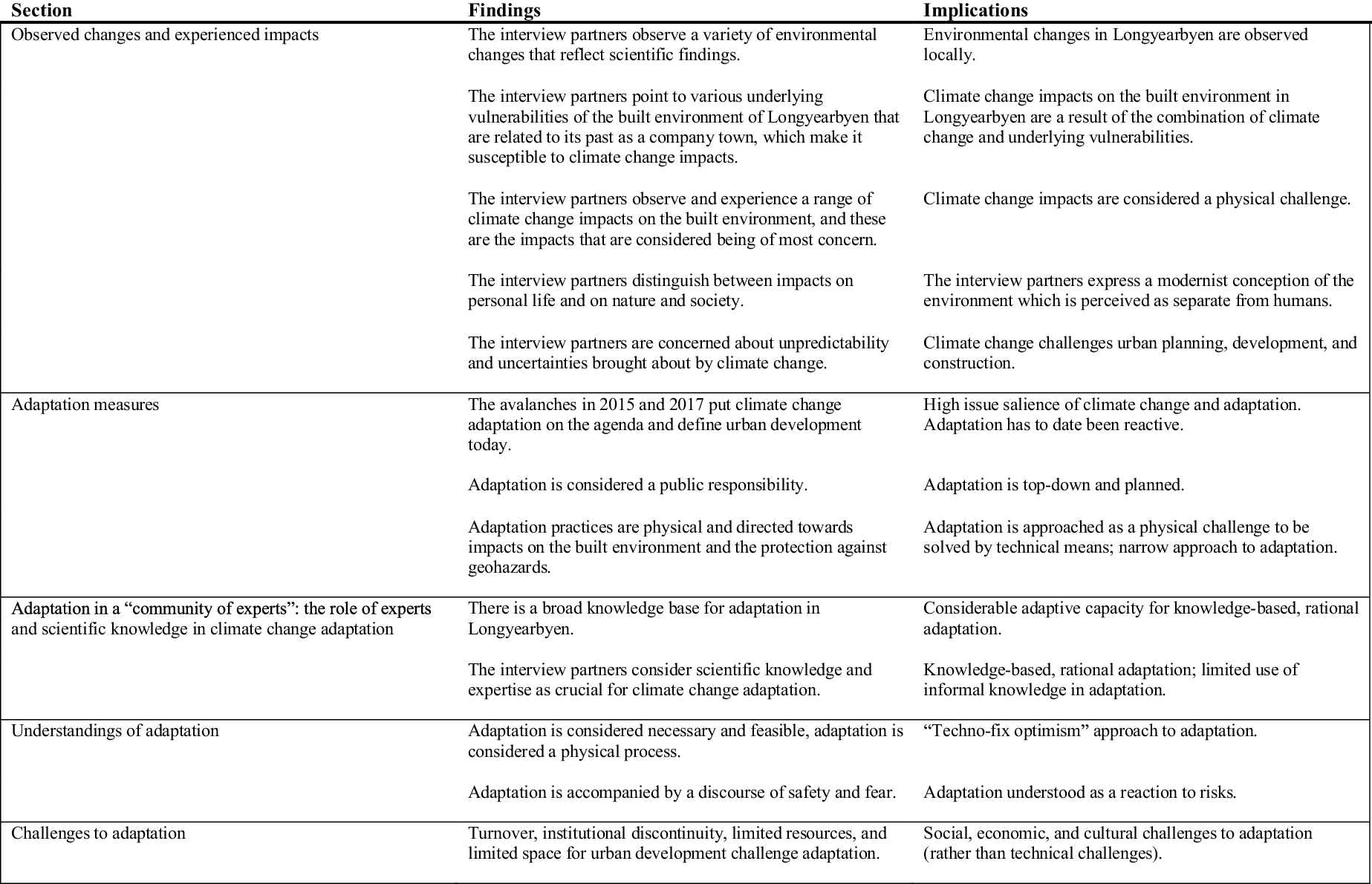
My data (Fig. 2) show that the interview partners observe physical changes in the environment which they relate to climate change, and impacts on the built environment are their main concern. Climate change impacts on the built environment in Longyearbyen have to be seen in relation to underlying vulnerabilities, related to the company town past. Since the avalanches in 2015 and 2017, the awareness and issue salience (Dannevig & Hovelsrud, Reference Dannevig and Hovelsrud2016) of climate change is notable in Longyearbyen and adaptation has been added to the local and state political agenda, which in other contexts has been found to be an important precondition for adaptive capacity (e.g. Marshall et al., Reference Marshall, Park, Howden, Dows and Jakku2013). The avalanches have created awareness about climate change and were “focusing events” (Amundsen et al., Reference Amundsen, Berglund and Westskog2010) for adaptation. What is often portrayed as proactive adaptation measures can thus be said to be rather reactive attempts to adapt a town not constructed with a long lifespan to a challenging location in an increasingly changing environment. These events have a substantial impact on urban planning and development, resulting in a strong focus on physical securitisation measures, as well as the consideration of climate projections and the development of monitoring systems. The latter might indicate that climate change adaptation in Longyearbyen is becoming more proactive (ibid.), and that adaptation to future climate change is becoming a priority in Longyearbyen.
Summary of findings and implications.
Climate change adaptation in Longyearbyen is considered a public responsibility, to be managed by the local government in collaboration with experts and supported by the Norwegian state. Several of my interview partners consider adaptation ultimately a responsibility of the state, and that the ability to adapt the town to a changing climate depends on the state’s willingness to invest in the town in the future. In the words of a planner: “It is the state that decides if we will adapt in the future, if Longyearbyen will exist a hundred years from now”. This assumption also implies a certain disclaimer and reflects a common sentiment in Longyearbyen that “everything” locally is ultimately decided by the state. Adaptation in Longyearbyen thus forms part of Norway’s Arctic policies, and from today’s viewpoint, there are reasons to assume that the (geo)political aim of a Norwegian political presence (Pedersen, Reference Pedersen2017) on Svalbard will ensure the necessary investments for adapting the town to a changing environment at 78° North.
A main aim of this article was to examine current adaptation practices and how adaptation is understood by those involved. Physical impacts on the built environment were seen as the main challenge to deal with locally. The interview partners often distinguished between impacts on the self and impacts on nature and society, which indicates a worldview rooted in a Western, modernist understanding of the human as separated from the environment (Ingold, Reference Ingold, Dove and Carpenter2008). They expressed a “view of the environment as a globe” (ibid.) in which humans can manage and control nature from which they consider themselves as detached. This understanding underlies adaptation concepts and practices in Longyearbyen. Adaptation is about finding technical solutions to physical problems, with a focus on adaptation in urban development and planning, and construction. The focus lies on security measures against natural hazards, with a strong emphasis on avalanches. Adaptation is understood as technological interventions and the bolstering of infrastructure in response to specific risks, whereas research often highlights the role of traditional ecological knowledge and skills as crucial for adaptation (Nakashima, Galloway McLean, Thulstrup, Ramos Castillo, & Rubis, Reference Nakashima, Galloway McLean, Thulstrup, Ramos Castillo and Rubis2012); in Longyearbyen formal, Western scientific knowledge and expertise are considered the key to dealing with the impacts of climate change. Problems are to be solved by technological solutions exerted by experts in the sense of holders of formal knowledge and skills, informed by a broad scientific knowledge base. Adaptation is thus understood and practiced as a “techno-fix” (Thornton & Manasfi, Reference Thornton and Manasfi2010), informed by a Western approach to nature as something that can be dealt with by the means of science and technology. As shown above, adaptation is considered as feasible: The technical solutions exist, it is rather a question of priorities and resources. This can be interpreted along the lines of a “techno-fix optimist” Anthropocene narrative, according to which human ingenuity and technology are the solution to climate change (Thornton & Malhi, Reference Thornton and Malhi2016). This modernist interpretation of the environment implicates a view of nature as “manageable”, and even a changing environment can be dealt with by the means of science and technology, through intervention (Ingold, Reference Ingold, Dove and Carpenter2008). This understanding is heavily dependent on the sample of this research, those responsible for climate change adaptation in Longyearbyen: representatives of the local administration and politicians, engineers, technicians and planners, people from the construction sector. They largely match the category of “hierarchists” identified by Dannevig & Hovelsrud (Reference Dannevig and Hovelsrud2016; see also O‘Riordan & Jordan, Reference O’Riordan and Jordan1999), working in a hierarchical system that provides social control and with a general acceptance of scientific knowledge, requiring predictability, tending to see problems as structured and accepting state intervention as long as it is legitimised. There is thus strong adaptive capacity in Longyearbyen regarding a specific form of adaptation: planned, rational, knowledge-based adaptation in the form of technical solutions to physical problems. As priority is given to scientific knowledge and experts, informal knowledge and skills – which are crucial for adaptation (Nakashima et al., Reference Nakashima, Galloway McLean, Thulstrup, Ramos Castillo and Rubis2012) – are often not considered. Notwithstanding the high turnover, there are individuals that have been living for a long time in Longyearbyen and have an environmental memory spanning back in time, as an architect emphasised: “Gamlekara [long-term residents] sit on a lot of valuable knowledge. If you ask them, they tell you where something has happened in the past, they remember all the past avalanches. […] But no one asks them”. Especially in the context of extreme turnover, adaptation could contribute a lot from integrating local and informal knowledge.
Concluding remarks
Technological measures to prevent physical impacts on the built environment are obviously an integral part of dealing with a changing climate. Without repudiating the importance of such efforts, this focus however runs the risk of downplaying other aspects of adaptation. The “techno-fix” understanding of adaptation and the related practices in Longyearbyen indicate an “adaptation bias” (Thornton & Manasfi, Reference Thornton and Manasfi2010), including “a reliance on bolstering existing infrastructure through ‘techno-fix’ measures and a neglect of more socially transformative adaptation processes” (ibid., p. 149). Current adaptation concepts and practices in Longyearbyen imply a narrow understanding of adaptation and are not addressing the far more challenging task of transforming society as a whole. Although the local government, as well as the state, increasingly promotes the green transition in Longyearbyen, these efforts are more discursive than actually implemented. There are, however, various voices and efforts –both informal and institutionalised –that express a more holistic understanding of adaptation. These include a local sharing and recycling economy, collective clean-ups and indeed the search for a clean energy source to replace coal after the scheduled closure of the local coal mine and the coal-fueled energy plant. These visions point towards a broader approach to adaptation in terms of societal transformation: a vision of Longyearbyen not as a showcase for climate change but for sustainable living in the Arctic. There is a pressing need for social science research to follow Longyearbyen on its envisioned transition into a “green” future.
Conflict of interest
The author declares none.


 Open access

