


1. Introduction
Engineering design tools are essential for engineering design processes. Therefore, engineering design tools, such as Pugh’s Product Design Specifications (PDS) or the Pugh Chart, are often core components of engineering education. These tools incorporate important engineering concepts, however, they often do not engage with ethics, equity, and justice considerations. In this work, we ask the research question “How do we evolve existing engineering design tools to incorporate social justice?” with the goal of collaboratively redesigning the PDS engineering design tool to incorporate design justice considerations. We present our co-design process with Elizabethtown College faculty and Massachusetts Institute of Technology (MIT) researchers, provide a new iteration of PDS, and highlight 5 recommendations to support incorporating social justice considerations in redesigns of engineering design tools.
1.1. Product Design Specifications (PDS)
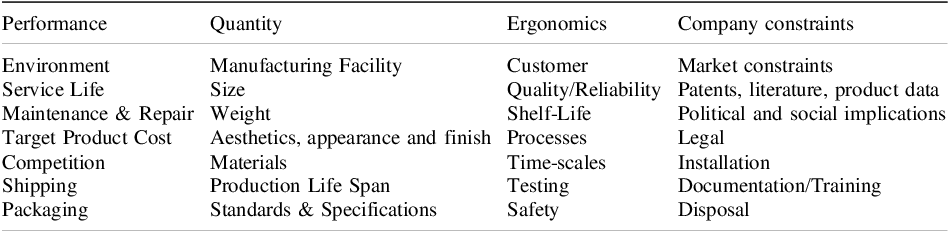
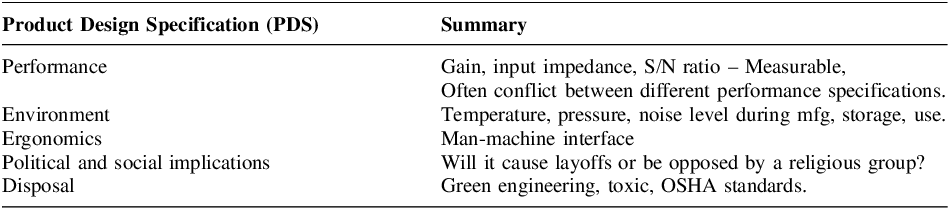
The Product Design Specifications (PDS) tool outlined in Pugh’s book, Total Design, includes 32 categories relevant to design (Reference PughPugh, 1991), detailed in Table 1. Each of these categories also has an associated summary to further clarify what the category covers in the context of design. Several examples of these descriptions are included in Table 2.
The existing summaries were generated in 1991, so they are generally outdated and do not reflect the current landscape of product design. These summaries are hyper specific to certain contexts while also attempting to make generalisations. For instance, the “performance” category mentions “gain, input impedance, S/N ratio” which are specific to signal processing but also includes the general phrase “often conflict between different performance specifications.” Similarly, the category of “ergonomics” simply states “man-machine interface” and does not provide any context or suggestion about what the man-machine interface should be. Finally, the category of “political and social implications” is the only one that explicitly mentions broader societal impact. However, the description simply states “Will it cause layoffs or be opposed by a religious group?” This is a very specific set of questions with a minor range of implications considered. The limitations and general outdatedness of the existing PDS provides motivation for revising this tool for educators and practitioners.
All original PDS categories from Total Design (Reference PughPugh, 1991)

Five example product design specifications and summaries from Total Design (Reference PughPugh, 1991)

1.2. Design justice
Stemming from a larger collective organisation (DJN, 2018), Design justice is a framework that calls for designers to examine how the benefits and burdens of design objects, including technologies, are distributed and how they can be equitably distributed (Reference Costanza-ChockCostanza-Chock, 2018, Reference Costanza-Chock2020). The Design Justice Network grew from the Allied Media Conference in 2014 and is grounded in Black Feminist scholarship from concepts such as the Matrix of Domination (Reference PatriciaPatricia, 2000) and intersectionality (Reference CrenshawCrenshaw, 1989). Design justice also aims to “ensure… meaningful participation in design decisions; and recognition of community-based, Indigenous, and diasporic design traditions, knowledge, and practices” (Reference Costanza-ChockCostanza-Chock, 2018). These goals are realised through a set of design justice principles and questions to help guide designers in empowering communities in design processes and supporting equity- and justice-based design work. In the past few years, design justice has become a more commonly applied framework in engineering design spaces. For example, Das et al. (Reference Das, Roeder, Ostrowski, Yang and VermaDas, Roeder, et al., 2023) and Syal & Kramer (Reference Syal and KramerSyal & Kramer, 2024) have examined how the field of engineering design is engaging with ethics, equity, and justice considerations. Design justice has also become a community focus at the ASME IDETC-CIE conference; first as a workshop focus in 2023, followed by a dedicated session on design justice at the Design Theory and Methodology track in the conference in 2023 and a special session in 2024 (e.g. Reference Maar, Roy and MenoldMaar et al., 2024; Reference Roeder, Das, Saadi, Harrington, Verma, Breazeal, D’Ignazio, Yang and OstrowskiRoeder et al., 2024), demonstrating increasing movement and attention around design justice in the engineering design community. Additionally, a new Special Interest Group (SIG) on the topic of Design Justice and Ethics has recently been launched in the Design Society.
While design justice as a framework is relatively new, there have been several calls in engineering education to support deeper engagement with social justice considerations in engineering design and engineering education (Reference Leydens and LucenaLeydens & Lucena, 2017; Reference RileyRiley, 2008). In the area of engineering design education, scholars have recently investigated how design justice is embedded in design courses (Reference Das, Roeder, Ostrowski, Yang and VermaDas, Ostrowski, et al., 2023), how instructors want to engage with social, policy, and ethical considerations (Reference Saadi, Das, Roeder, Ostrowski, Lee, Santos, Breazeal, D’Ignazio, Yang and VermaSaadi et al., 2023), and how instructors can be empowered to change their courses and communities to engage with design justice (Reference Roeder, Das, Saadi, Harrington, Verma, Breazeal, D’Ignazio, Yang and OstrowskiRoeder et al., 2024). These works have revealed several important considerations when championing change around design justice in engineering design, including obtaining prioritisation and buy-in from instructors and department and institution leaders (Reference Saadi, Das, Roeder, Ostrowski, Lee, Santos, Breazeal, D’Ignazio, Yang and VermaSaadi et al., 2023) and building a community and incorporating people into change initiatives (Reference Roeder, Das, Saadi, Harrington, Verma, Breazeal, D’Ignazio, Yang and OstrowskiRoeder et al., 2024). Additionally, it is critical to consider concrete steps that can be taken to incorporate design justice-based considerations that feel approachable and can collectively help educational communities reach larger-scale visions for chance (Reference Ostrowski, Das, Roeder, Saadi, Harrington, Verma, Breazeal, D’Ignazio and YangOstrowski et al., 2024; Reference Roeder, Das, Saadi, Harrington, Verma, Breazeal, D’Ignazio, Yang and OstrowskiRoeder et al., 2024). The Accreditation Board for Engineering and Technology (ABET) recently underscored the importance of equity and justice in engineering education including it as an accreditation criteria (“d. content that ensures awareness of diversity, equity, and inclusion for professional practice consistent with the institution’s mission”) (ABET, 2024). These previous works underscore the importance of collaboration within departments supported by leadership around design justice change and approaching design justice change from different levels, from curriculum changes to assignment changes.
2. Project context
For this work, the team was composed of two groups- faculty at Elizabethtown College (Etown) in Elizabethtown, PA, USA and design researchers at the Massachusetts Institute of Technology (MIT) in Cambridge, MA, USA. The MIT team had been conducting research regarding the integration of design justice into engineering and design education including conducting a syllabus audit (Reference Das, Roeder, Ostrowski, Yang and VermaDas, Ostrowski, et al., 2023; Reference Ostrowski, Zhang, Das, Breazeal, D’Ignazio and VermaOstrowski et al., 2023b), an instructor survey (Das, Reference Saadi, Das, Roeder, Ostrowski, Lee, Santos, Breazeal, D’Ignazio, Yang and VermaSaadi, et al., 2023), and Design Justice Pedagogy Summit (Reference OstrowskiOstrowski, 2022; Reference Ostrowski, Das, Roeder, Saadi, Harrington, Verma, Breazeal, D’Ignazio and YangOstrowski et al., 2024; Reference Roeder, Das, Saadi, Harrington, Verma, Breazeal, D’Ignazio, Yang and OstrowskiRoeder et al., 2024).
Simultaneously, the faculty at Etown had been interested in adapting their engineering curriculum to be more focused on social impact including direct discussions of ethics, equity, and justice. The Etown engineering instructors use the Pugh Total Design approach throughout their project based curriculum, so they identified the PDS as a tool that could be redesigned to be more socially minded and then re-implemented in the curriculum in the same way as it has been currently. This provided a way of making a major modification to the course without having to find room to add new material. Updating the tool was a priority for the team already, but updating it to be justice-centred satisfied both goals at once. The primary research question of this work was “How do we evolve existing engineering design tools to incorporate social justice?” The MIT and Etown teams worked together to develop a plan for modifying the existing PDS tool to incorporate social justice. This plan involved several phases that will be described in Section 3 below (all approved by MIT’s institutional review board).
3. Iterating on PDS design
Our PDS tool redesign process included 4 rounds of tool iteration (Figure 1). The iterations were informed from various stages of feedback from project collaborators and stakeholders.
PDS redesign process highlighting the various project components aligned with the four iterations

-
Iteration #1: The first iteration of the original PDS tool occurred after a project meeting with the core project team that included two instructors from Etown and two researchers from MIT where the MIT researchers learned about the original PDS tool and how it was used in the Etown curriculum. From this conversation, the MIT researchers, who have specialisation in incorporating design justice in engineering design, created the first iteration of the PDS tool. This involved reviewing each of the PDS summaries, noting general areas that each of the PDS categories could cover, and including some “guiding questions” for how the PDS may address design justice considerations. For example, the PDS summary for “Shipping” was originally “Time sensitive, conventional means” and was modified to “sourcing materials close to where it will be manufactured and distributed” and “carbon footprint.”
-
Iteration #2: After the first iteration by the MIT researchers was generated, the core members on the project team from Etown reviewed the PDS tool (Iteration #1) and gave some initial feedback. Because we wanted to create the new PDS tool in collaboration with the Etown faculty and instructors, we then hosted a workshop to further develop the PDS tool with the Etown faculty and instructors. The workshop was organized by the two Etown faculty members. The workshop was conducted virtually and had 4 main parts: (1) Introductions of Project Team and Workshop Attendees, and Overview of Project; (2) Existing PDS Reflections; (3) PDS Refining + Revising; and (4) Connecting to Other Frameworks. Six Etown faculty and instructors participated in the workshop (including the two Etown faculty on the core project team) facilitated by the 2 MIT researchers.
-
In the first step, “Introductions of the Project Team and Workshop Attendees, and Overview of Project,” we had introductions from the two MIT researchers and the faculty and instructors, including what courses the instructors taught. The MIT researchers then introduced the project and contextualized the focus on societal consideration using terms around ethics, equity, and justice, including equity, accountability, inclusivity, sustainability, human-centered design, and societal and environmental implications. After explaining the context of the project, we then introduced the Miro board that we would be using for the project. We introduced the idea of the “park your thoughts” section that was used as a way to document ideas that people were having that at the moment may not be relevant but we wanted to come back to later. In the Miro board, to get people accustomed to the interface, we had people complete an introduction activity where they used several of the Miro board tools answering the question, “why do you want to embed equity, ethics, and justice considerations in engineering design courses?”
-
In the second step, “Existing PDS Reflections”, we wanted to understand what are the most common specifications in the original PDS that students engage with. Participants indicated this by putting dots on post-its with the PDS on them (Figure 2a). The participants then grouped the PDS post-its that they thought overlapped with one another (Figure 2b). Participants could also propose new PDS they thought were missing from the original PDS. Lastly, participants noted which of these PDS “fit” with design justice considerations by placing colored dots on the now grouped PDS post-its (Figure 2c).
-
In the third step, “PDS Refining + Revising”, small groups of 2-3 selected an existing or newly ideated PDS and then added or revised bullet(s) related to the PDS to incorporate elements of design justice (Figure 3). After revising the PDS to be more design-justice focused, the faculty and instructors then addressed how they would introduce this and/or engage students with this PDS being mindful of design justice in the context of their course (see Figure 3 for example for the “environmental impact” PDS).
-
In the fourth and final step, “Connecting to Other Frameworks”, the participants reflected on how the revised PDS from the third step could be connected with other frameworks. The group picked the KEEN model of 3 C’s (Curiosity, Connections, Creating Value) to consider for this part of the workshop (Reference Kavale, Jackson, Bodnar, Brunhaver, Carberry and ShekharKavale et al., 2023; Reference Neumeyer and SantosNeumeyer & Santos, 2022; Reference Rae and MeltonRae & Melton, 2017). The KEEN model was selected because Etown is part of the Kern Entrepreneurial Engineering Network (KEEN).
Figure 2.Images of the Miro board from the faculty workshop step 2. (a) Common PDS that students engage with (blue dots are instructors and magenta dots are core project members); (b) Grouping of PDS for areas of overlap; and (c) Identification of PDS that align with design justice considerations (blue dots are instructors and magenta dots are core project members)
 Figure 3.
Example of newly ideated PDS, “environmental impact”, new bullet for summary of PDS, and how the new PDS could translate to a course
-
The instructor and faculty workshop provided context around current practices with PDS and how instructors and faculty considered the original PDS categories in relation to design justice considerations. The workshop also provided several examples of PDS, including new PDS generated during the workshop, to be incorporated into the next iteration. Together, with the feedback on Iteration #1 from the faculty and the results from the workshop, Iteration #2 was created further developing new categories on the PDS and refining the summaries and guided questions. For example, from the previous example discussed, “Shipping”, the PDS “Shipping” was merged with “Packaging” to create the “Shipping and Packaging” PDS category with the summary: “How the product is packaged and shipped including how the ecological impact of these stages can be minimized”; and guiding questions: “Can materials be sourced close to the manufacturing and/or distribution locations? What is the carbon footprint of the product? How can the required amount of packaging be optimized to minimize waste and maximize packaging performance?”
-
Iteration #3: After Iteration #2 was completed, the faculty and instructors provided another round of feedback which was used to edit the guiding questions further (Iteration #3).
-
Iteration #4: The final step of the project was to gather student feedback for one additional edit to the tool. From the Iteration #3 feedback, instructors noted that it would be helpful for students to have examples of different products from different fields (e.g. engineering, computer science, etc.) included in the PDS. To gather these examples, we engaged students in a workshop focused on the PDS and creating examples. This was part of a larger session where we also conducted a pilot test of Iteration #3. For the purpose of this paper, we are highlighting the participatory design portion of this workshop where students created PDS examples based on three different product types: a water bottle, a social media application, and an electric vehicle. These examples were selected by the main project team because they represent a variety of different product designs across engineering and computer science (focuses for Etown). In addition to the example generation activity, we also asked students their thoughts about Iteration #3. From this workshop, we incorporated the students’ examples into the PDS tool (Iteration #3), adding examples as another component of the PDS tool. This resulted in our final iteration, Iteration #4. For example, in the “Shipping and Packaging” PDS, students identified PDS such as “Easy to ship”, “medium sized packaging”, “Easy for anyone to open”, “Biodegradable or recyclable box” and “Carbon footprint/eco audit calculation for the bottle.”


4. Introducing the new design justice-inspired PDS
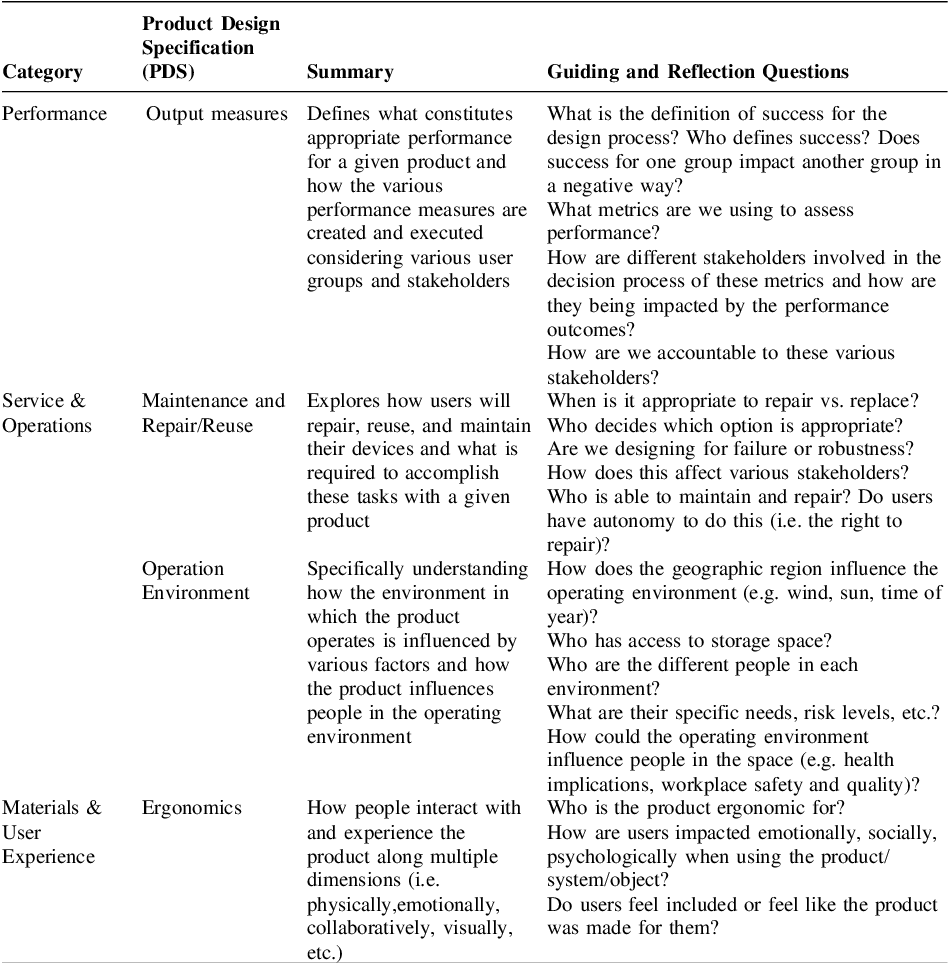
The final version of the updated PDS tools consisted of two versions, each with several categories. The first version included a broader category, the associated PDS categories, a summary, and several guiding and reflection questions for each PDS. Three examples of updated PDS corresponding to some of those found in Table 2 are shown in Table 3. The second version replaced the guiding and reflection questions with examples in the context of three types of products: a water bottle, an electric vehicle, and a social media app. For the water bottle example, the “output measures” PDS consideration include “How much water do different people need to drink? What size of bottle is unwieldy to carry? What body metrics influence these parameters and how might that impact the tradeoff between volume and weight of the bottle?”; and the “ergonomics” PDS consideration prompts “Who is the bottle sized for? Who might have a hard time using it?” For the electric vehicle example, the “customers” PDS questions “will this be an affordable vehicle for a broad range of consumers?”; and the “environmental impact” PDS prompts “How are the materials harvested? How renewable are the materials used? How difficult is it to recycle?” Lastly, for the social media app example, the “liability” PDS emphasizes “keep user info private”, “misinformation control”, and “protect user data.” These provide a glimpse at the examples included in the second version of the PDS. The full final PDS versions can be found on Open Science Framework here.
5. Adapting engineering design tools to be justice-focused
This work informs how engineering tools can be edited to incorporate justice, equity, and ethics. We provide 5 recommendations for evolving engineering design tools to incorporate social justice.

-
Recommendation #1: When updating engineering design tools as the fields evolve, combine this effort with incorporating social justice. Engineering tools that have previously been developed may not provide ways for designers to consider equity and justice in the design process. Historically, engineering as a field has not promoted a sociotechnical approach to design (Reference Leydens and LucenaLeydens & Lucena, 2017). Engineering tools also need to be evolved as the field grows and expands its boundaries. For example, with the rise of generative artificial intelligence (AI) tools, there has been increasing work focused on automation and incorporation of AI in engineering design (e.g. Reference Allison, Cardin, McComb, Ren, Selva, Tucker, Witherell and ZhaoAllison et al., 2022; Reference Kim, Liu, Wang and WangKim et al., 2017; Reference Panchal, Fuge, Liu, Missoum and TuckerPanchal et al., 2019). The evolution of engineering design provides an important catalyst for not only updating engineering design tools to be adaptive to the field’s changes but also updating these tools to make them more socially justice-minded. Our work demonstrates the potential for building upon already existing engineering design tools and how seamlessly social justice considerations can be embedded into these tools.
-
Recommendation #2: Interdisciplinary teams and co-design methods value varied knowledge and expertise in the redesign of engineering tools for social justice. We were able to successfully adapt the PDS design tool for engineering education because of our interdisciplinary team. Our team included members with expertise on justice-based design and instructional design, as well as those with an administrative perspective (the team included one Dean). This interdisciplinary expertise allowed the team to support the project from multiple sides, promoting justice-based changes to the design tool that could be successfully used in an instructional context as well as advance their mission “Educate for Service.” Additionally, the co-design format that we selected for this work, including faculty members and instructors outside of the core project team, supported multiple perspectives, ideas, and respective knowledge to be valued and enacted into the new iterations of the PDS tool.
-
Recommendation #3: Include students in the re-design of engineering tools. In our process, we engaged students as both evaluators of the new tool and co-design of aspects of the tool. We explicitly worked with students to ensure that their voices were heard in the design process, providing expertise to the design process from the student perspective. Students as designers in training are learning these tools and are also aware of directions that they would like the engineering field to evolve. For example, there is expressed student and instructor interest for engineering education to support a more social justice minded focus and social change (ABET, 2021, 2024; Reference GaribayGaribay, 2018). By incorporating student voices into the design process of engineering design tools, we can co-create the future of engineering education and how engineers are educated around societal concerns.
-
Recommendation #4: Support iteration and evaluation with multiple stakeholders in the re-design of engineering tools. In our process, we iterated upon the new design of the PDS tool 4 times with each iteration being informed by a stakeholder. The first iteration of the tool was done by research team members with expertise in design justice. The second and third iterations were informed by faculty members and instructors and the last iteration was informed by students. Iteration and re-design are essential parts of the design process (Reference Dorst and CrossDorst & Cross, 2001; Reference Wynn and ClarksonWynn & Clarkson, 2018; Reference Wynn and EckertWynn & Eckert, 2017; Reference Yassine and BrahaYassine & Braha, 2003). Iterations can be used to “progress [a] design”, “correct problems or implement changes” and “enable coordination within a process” (Reference Wynn and ClarksonWynn & Clarkson, 2018) to support design and development. Iterations were used in our work to support coordination and communication in the PDS re-design process as the PDS tool evolved.
-
Recommendation #5: Engineering tool re-design should be driven from the bottom-up. A critical component of successfully redesigning engineering education to be more socially-justice minded is prioritization and buy-in from departments and institutions (Reference Ostrowski, Zhang, Das, Breazeal, D’Ignazio and VermaOstrowski et al., 2023a; Reference Saadi, Das, Roeder, Ostrowski, Lee, Santos, Breazeal, D’Ignazio, Yang and VermaSaadi et al., 2023). This is also essential for redesigning engineering tools. The motivation for the PDS tool redesign project was from the faculty and instructors who had recognized that the original PDS tool lacked a focus on societal considerations and was not working well for the students and instructors. Because this motivation came from the faculty and instructors, the re-design process was galvanized by the community’s buy-in to and active engagement in the re-design process.
6. Conclusion
Through an iterative co-design process, this PDS tool re-design demonstrates the potential and importance of evolving existing design tools to be more socially-minded and engage with justice and equity. The recommendations included here outline ways for other engineering designers to update their tools to more intentionally integrate these themes into the design process from the start. The recommendations included here outline ways for other engineering designers to update their tools to more intentionally integrate these themes into the design process from the start.
6.1. Future work and next steps
This work is being expanded further in several directions. We have conducted an initial pilot study to assess whether using the new PDS tool results in changes to students’ attentiveness to and depth of engagement with social and ethical components of their work. The PDS tool has also been implemented in some of the Etown design classes and we will be conducting a comparison study to determine whether students’ final reports show any differences in engagement with social and ethical topics for those who used the new tool vs. those who had not. These studies are in progress and we plan to disseminate these results soon as a follow on to this work.
Acknowledgements
We thank the Etown faculty and Dr. Aditi Verma for their feedback, engagement with, and enthusiasm for this work. This work was supported by an MIT Institute for Data, Systems, and Society & Sociotechnical Systems Research Center Combating Systemic Racism Seed Fund Program Grant.



 Open access

