




Introduction
From its modern rediscovery in the Renaissance through to its Victorian heyday, the investigation of natural history (Barber Reference Barber1980) fuelled passionate European exploration of the world during The Age of Enlightenment (Holmes Reference Holmes2008). The result was that, through their description and cataloguing of fauna and flora, naturalists (known then as “natural philosophers”) became active participants and “pioneers” (Evans Reference Evans1993) in documenting and Europeanising (Parrish Reference Parrish2012) an ever-expanding world.
Of the animals encountered by naturalists on the European periphery, some were strikingly, if not alarmingly, novel, whereas others were reassuringly familiar. Regardless of whether animals confirmed or confounded Linnean classification, a well-honed approach employed by naturalists and their artistic affiliates was to produce detailed illustrations of their subjects (Majeski and McDonald Reference Majeski and McDonald2024). Maria Sibylla Merian’s late seventeenth-century studies in Suriname exemplified this intersection of art, observation, and empire (see, for example, her works in the collection in the British Museum, https://www.britishmuseum.org/collection/search?keyword=maria&keyword=merian&agent=Maria%20Sibylla%20Merian&view=grid&sort=object_name__asc&page=1). Merian’s (1647–1717) vivid depictions of insect metamorphosis combined meticulous field study with the visual conventions of colonial natural history (Valiant Reference Valiant1993; Etheridge Reference Etheridge2011), sharing biological diversity from the unfamiliar tropics in a medium familiar to her European readers.
Today, a popular pursuit among those interested in the history of natural history entails examining artistic renderings of animals in historical sources through the lens of the zootaxonomic knowledge that has accumulated since the time of their initial portrayal. For instance, in a single recent issue of the journal Archives of Natural History, papers posited identifications for depictions of a “monkey” in an eighteenth-century painting from India, a series of birds in seventeenth-century drawings from the West Indies, a “sea monster” on a sixteenth-century map of Iceland, and a group of primates in decorative panels in an eighteenth-century painting from Peru (France Reference France2024; Noltie Reference Noltie2024; Pietsch and Marx Reference Pietsch and Marx2024; Urbani and Heymann Reference Urbani and Heymann2024).
In like spirit, the present contribution reassesses what are acknowledged (Bewell Reference Bewell, Bushell, Carlson and Davies2021, p. 31) as being “the first illustrations of insects from Canada,” as shown in the margins of an eighteenth-century map associated with the founding of Halifax in the British colony of Nova Scotia. This so-called “Porcupine Map” has been the subject of interest by cartography historians (Morrison Reference Morrison1987; Dawson Reference Dawson1988; Lennox Reference Lennox2007; Bewell Reference Bewell, Bushell, Carlson and Davies2021) but has not been commented on by natural science historians in their writings about its illustrator, noted entomologist Moses Harris (Weiss Reference Weiss1926; Mays Reference Mays and Cannadine2004; Orr and Hamalainen Reference Orr and Hamalainen2014; Calhoun Reference Calhoun2023a, Reference Calhoun2023b). Nor have writings about Harris as an entomologist considered his first published depictions of insects on the Porcupine Map (Goffe Reference Goffe1951; Wilkinson Reference Wilkinson1968). The purpose of the present paper is to provide the first entomological assessment of Harris’s illustrations and identifications produced at the very start of his illustrious career, while situating them within a review of how they contributed to the use of natural history as a tool of cartographic imperialism.
Moses Harris: entomologist and engraver
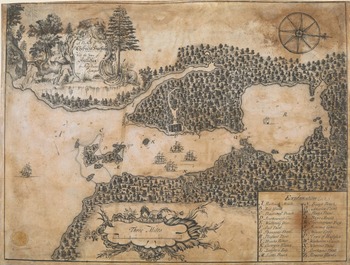
Biographical details about Moses Harris are few (Weiss Reference Weiss1926; Wilkinson Reference Wilkinson1968; Sparling Reference Sparling1980; Mays Reference Mays and Cannadine2004; Bewell Reference Bewell, Bushell, Carlson and Davies2021). He was born in the London, England, borough of Holborn in 1730 and is thought to have learned procedures for collecting and identifying insects from an elderly uncle who was a member of the Society for Aurelians – “Aurelians” being a now-archaic term referring to those who studied butterflies and moths. The Society for Aurelians was the first organised society of scientific entomologists in England, with a membership that included notable collectors and artists who likely would have inspired the young enthusiast. This was at a time when London, along with Paris, was the global centre for collections of insects and ensuing taxonomic studies (Hünniger Reference Hünniger, Cockram and Wells2017). In 1744, Harris became apprenticed to a prominent geographer from whom he would have learned surveying and cartographic skills. These would be called upon when he and, according to the passenger list of the ship Winchelsea, his wife were part of the flotilla of 13 ships that sailed in June 1749 to establish the new colonial capital of Halifax in Nova Scotia (Bewell Reference Bewell, Bushell, Carlson and Davies2021). His profession is listed as a “sawyer,” but this is thought to have been confused with “surveyor” due to conventions of eighteenth-century handwriting. A motivation for travelling to Nova Scotia was no doubt to collect specimens of new insects and thereby to establish his reputation as a natural historian. Throughout the summer and autumn of 1749, Harris corresponded to The Gentleman’s Magazine (publisher: Edward Cave, London, United Kingdom) and to Royal Geographer Thomas Jefferys about his observations and regarding future publication plans. It is unknown as to how much time Harris spent in the colony, although it is generally assumed to have been less than a year. All that is certain is that by 23 October 1749, his “A Plan of Chebucto Harbour with the Town of Hallefax” [sic] (similar to Fig. 1) was published in London by the printer Edward Ryland and sold for six pence per copy. Correspondence and records indicate that, by 1770, Harris was living in Kent and that, upon his death in 1787, he was survived by his wife and a son, John, who would himself go on to have a career as a watercolour painter (Mays Reference Mays and Cannadine2004).
“A Plan of Chebucto Harbour with the Town of Hallefax” [sic]; British Library Archive Maps K.Top.119.73.

Figure 1. Long description
Sepia-toned antique map depicting a coastal region with dense forests, a large natural harbour, and scattering of ships offshore. Decorative cartouches, a compass rose, and a labeled legend appear, with an inset illustration of figures and wildlife.
That Harris was precocious is shown by his bold application to join the Society of Aurelians in 1742 at the age of 12 years, which was denied due to his lack of “sufficient Sagacity” (Mays Reference Mays and Cannadine2004). As an adult, when he was a widely regarded expert of entomology, he seems to have had difficulty in tolerating fools, as witness to his statement in the preface to his 1776 book, An Exposition of English Insects, that “although it is customary for authors to apologise for those who study natural history, he is at a loss to know ‘to whom such apology should be made, as those who object ‘are generally men of small capacity and low wit, having a mean conception of things in general’” (Weiss Reference Weiss1926, p. 563). Nevertheless, Harris appears to have been gentlemanly in not publicly criticising his contemporaries. For example, in recognition of being “one of the most talented insect artists of the period” (Calhoun Reference Calhoun2023a, p. 64), Harris was commissioned to draw, engrave, and colour 150 copperplates for the three volumes of entomologist Dru Drury’s (Cockerell Reference Cockerell1922) Illustrations of Natural History (Drury Reference Drury1770, Reference Drury1773, Reference Drury1782; Calhoun Reference Calhoun2023a, Reference Calhoun2023b). Orr and Hamalainen (Reference Orr and Hamalainen2014, p. 26) comment that due to an “extraordinary act of egotism,” Drury not only failed to acknowledge Harris but even fraudulently claimed all artistic credit, something that was not corrected until the second edition of the work came out in 1837, long after both entomologists were dead. There is also no mention in the public record of what Harris thought about being dragged into an eighteenth-century scandal centring on Drury and two other prominent collectors and natural historians, William Hunter and Emmanuel Mendes da Costa (Hancock and Douglas Reference Hancock and Douglas2009; Calhoun Reference Calhoun2023a). Hunter had lent his specimen (and holotype) of a goliath beetle, Goliathus goliatus (Coleoptera: Scarabaeidae), to da Costa, who commissioned an engraving of the beetle from Harris. While imprisoned after being charged with embezzlement, da Costa sold the engraving to Drury, who included the engraving in Illustrations of Natural History, failing to acknowledge Hunter as the source of the specimen (Hancock and Douglas Reference Hancock and Douglas2009; Calhoun Reference Calhoun2023a).
In 1762 (or 1764), Harris became the secretary of the Society of Aurelians and is credited for discovering two species of Muscina flies (Diptera: Muscidae) in 1778 and 1780 (Harris Reference Harris1780). He published an essay in 1767 proposing that the pattern of veins in wings be used as a new system for classifying Lepidoptera – a convention that persists to the present for many insect taxa – and in 1780 provided the first scientific descriptions of several Odonata species (Orr and Hamalainen Reference Orr and Hamalainen2014). He was also the first English entomologist to study and suggest solutions to manage the deleterious actions of the museum beetle, Anthrenus museorum Linnaeus (Coleoptera: Dermestidae). But above all, it is in the beautiful and accurate illustrations of insects, to such a degree of detail that they were, for the first time in certain cases, identifiable to the species level, where Harris’s reputation was unrivalled and for which he is remembered in natural history circles. These engravings were included in his celebrated books: The Aurelian: or, Natural History of English Insects; Namely, Moths and Butterflies (Harris Reference Harris1766a), The English Lepidoptera, or, The Aurelian’s Pocket Companion (Harris Reference Harris1775), and An Exposition of English Insects (Harris Reference Harris1780).
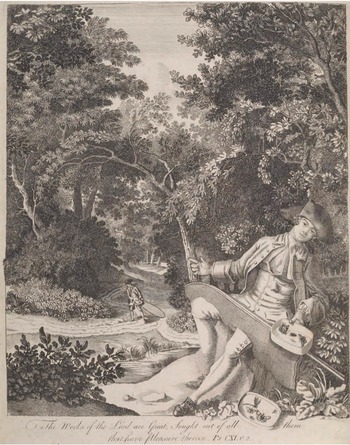
The frontispiece of The Aurelian, or, Natural History of English Insects depicts a charming scene (Fig. 2). In the plate, Harris has drawn an endearing self-portrait (his tiny signature occurs in the bottom right) in which he is sitting beside a stream in a sylvan glade with a collecting net across his knees and a collection box in his left hand and another at his feet, inside of which are a variety of insects. His right hand points to a smaller version of himself collecting the insects on the other side of the stream.
Frontispiece self-portrait of Moses Harris from his 1766 book, The Aurelian, or, Natural History of English Insects; Namely, Moths and Butterflies (Harris Reference Harris1766a).

Figure 2. Long description
A black-and-white engraved pastoral scene: a well-dressed 18th-century man reclines under a tree in a wooded landscape. In the background, a winding path crosses a stream where another figure walks, surrounded by dense foliage and tall trees.
Harris’s fame as an accomplished artist was such that an exposition of his drawings of insects was held at the Royal Academy (London) in 1785 (Weiss Reference Weiss1926). Today, his illustrations, no less remarkable for the passage of time from when they were drawn, can be accessed in online copies of the original books and through their inclusion in several publications (Orr and Hamalainen Reference Orr and Hamalainen2014; Calhoun Reference Calhoun2023a, Reference Calhoun2023b). One immediately appreciates upon studying Harris’s works the ease with which he shifts between “scientific illustrator” and “nature artist.” Entomologists with a zeal for morphology and taxonomy can greatly admire the precision and scientific accuracy of illustrations that beautifully depict highly detailed colours, wing venation, spines and spurs on legs, and other diagnostic characters. Other paintings and drawings have less definite morphological depictions of insects but are no less striking. Clearly a love of art and nature, not just of entomological science, inspired many of Harris’s illustrations.
Harris thought deeply about the use and theory of colour in illustrations. Within artistic circles, he is remembered for his pioneering work in colour theory (Schmid Reference Schmid1948). Inspired by Isaac Newton’s referral to prismatic refractions, Harris invented the first organised colour wheel wherein the principal colours of red, yellow, and blue can be used to generate more than 600 additional colours. This was published in The Natural System of Colours (Harris Reference Harris1766b), with reprintings in 1811 and again in 1963.
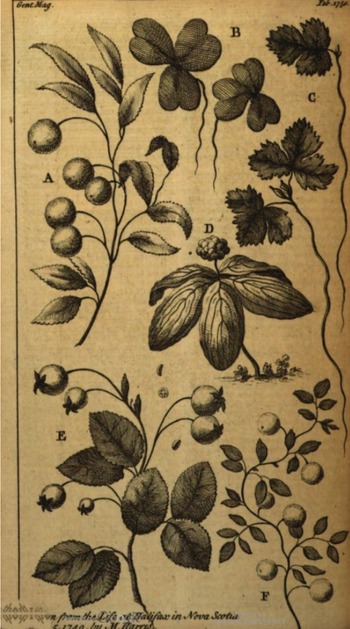
But all these meritorious aspects of Harris’s distinguished career occur well after his initial voyage as a teenager to the British colony of Nova Scotia. His surveying there would lead to the publication of several maps, one of which included inserts of his detailed drawings of animals. In the case of insects, these are their first portrayal by a European naturalist visiting what would become Canada. In between what must have been a busy schedule of surveying to produce the plans and maps, Harris found time to indulge his naturalist interests in collecting and illustrating local fauna and flora. His depictions of plants that were published in The Gentleman’s Magazine, London, in February 1750 (Fig. 3), with the inscription stating that they were drawn by him from life at Halifax on 15 July 1749, may also be the first illustration of botanical specimens from this region by a naturalist.
Nova Scotia plants; engraving published in The Gentleman’s Magazine (London, February 1750). Reprint made available by the HathiTrust.
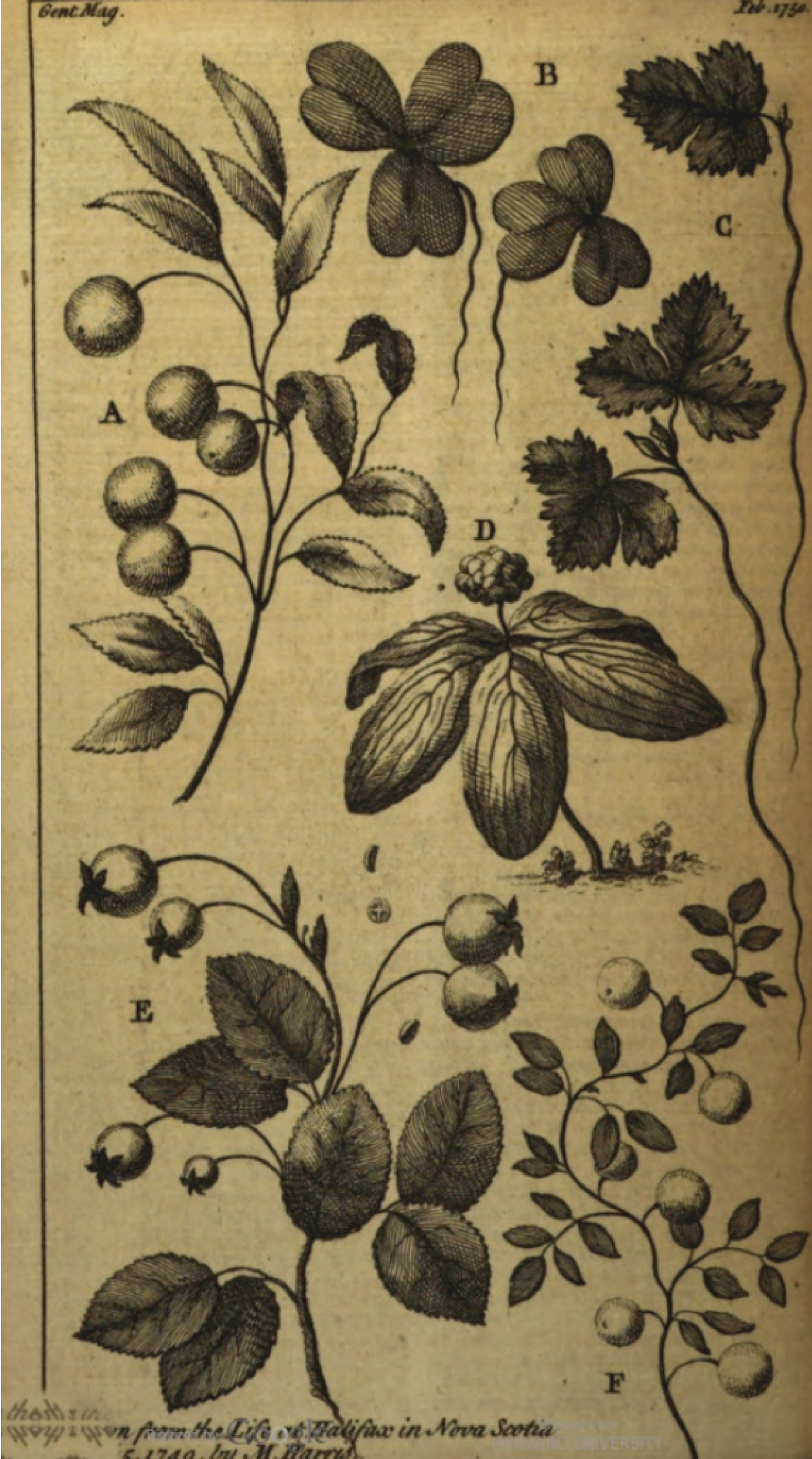
Figure 3. Long description
A sepia-toned engraving of several native plants illustrated in the classical style of botanical illustration. The paper is heavily aged and is sepia in colour.
The Porcupine Map
Description of the map
Halifax was established in June 1749 as a military centre. Its purpose as the so-called “Warden of the North” was to protect British interests along the North American Seaboard and to therefore serve as a counterpoint to the Fortress of Louisbourg, Île Royale (now Cape Breton, Nova Scotia), which did the same for French interests along the Saint Lawrence River. Young Moses Harris’s work as a surveyor, cartographer, landscape artist, and wildlife illustrator appeared on three derivative maps produced in 1749 and 1750.
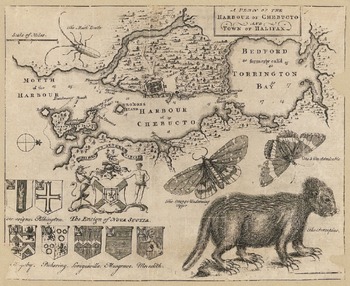
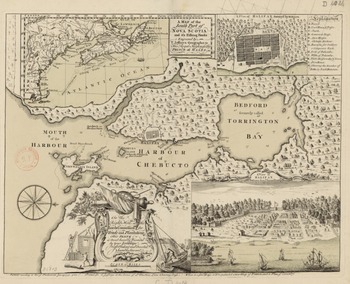
His cartographic work consisted of generating a scaled tracing of the outline of Chebucto Harbour and the inner Bedford Basin. The identical outlines of the shoreline appear on three maps: the first exists only in manuscript form; the second, “A Plan of the Harbour of Chebucto and Town of Halifax” (Fig. 4), was engraved and published in February 1750 in The Gentleman’s Magazine; and the third, an engraved composite map (Fig. 5), was produced in London by Royal Geographer Thomas Jefferys from elements of Harris’s work, published on 25 January 1750, and made available for sale to the public for a shilling per copy.
Moses Harris’s “A Plan of the Harbour of Chebucto and Town of Halifax,” engraving published in The Gentleman’s Magazine (London, February 1750). Map available via Library and Archives of the Government of Canada (4133846).

Figure 4. Long description
A sepia-toned antique map of Halifax/Chebucto Harbour with labeled bays, forests, and settlements. Includes compass rose, coat of arms, ships, three large insects, and a Titular porcupine that does not strongly resemble a porcupine.
An eighteenth-century map by Royal Cartographer Thomas Jefferys “A Map of the South Part of Nova Scotia and it’s [sic] Fishing Banks” builds on the initial map drawn by Moses Harris. Map available from the Bibliothèque nationale de France (GED-4024).

Figure 5. Long description
A sepia-toned antique map of Halifax Harbour. An inset illustration of an orderly looking settlement is included, and a second inset image shows the proximity of Halifax to Boston. Trees are thinned out and no animals appear.
The preliminary manuscript map (Dawson Reference Dawson1988) shows a reduced version of Harris’s plan for the layout of Halifax that was separately published in London by Edward Ryland in October 1749 and again in The Gentleman’s Magazine later that month (Fig. 1). The 5 × 7 grid of 35 surveyed lots is surrounded by a wooden palisade to protect the fledgling settlement from feared attacks by Indigenous Mi’kmaq, whose presence in the area is denoted by a tiny and solitary wigwam. More prominence is given to five sailing vessels from England in the harbour. The settlement is surrounded by a dense mixed forest that completely fills the land around both harbour and basin. Harris included small illustrations of three animals on this map. The scale cartouche is capped by a heraldic dragon with mouth agape and forked tongue displayed. The title cartouche depicts a section of the area forest from out of which a bear is shown emerging and what looks like a lion – presumably a lynx – is about to pounce. None of these decorative animals is convincingly drawn. This preliminary map served as the foundation for the Porcupine Map, which was published the following summer.
The Porcupine Map presents a different impression (Sparling Reference Sparling1980; Dawson Reference Dawson1988) of Halifax and its environs (Fig. 4). The town plan is enlarged relative to the surrounding topography and now emphasises its fortifications. The extent of forests around the harbour and inner basin has been substantially reduced. Gone is the dragon, to be replaced by the coats of arms of seven of the created baronets of Nova Scotia. All presence of Indigenous peoples is removed; likewise, British ships no longer sail the harbour. New embellishments included – most notably and that for which the map is known – a prominent drawing of a mammal that is labelled “The Porcupine.” Situated above this on the map, in the area formally occupied by forest, are two carefully rendered illustrations of local Lepidoptera, identified in their accompanying labels as “The White Admirable” and “The Orange Underwing Tyger.” The bear and lynx–lion in the former title cartouche are replaced by a detailed illustration of another insect, labelled “The Musk Beetle.”
The subsequent Jefferys–Harris composite map (Fig. 5; Sparling Reference Sparling1980; Dawson Reference Dawson1988), which was meant to be the “official” promotional map of the settlement, increases the extent of the forests from the Porcupine Map but seriously thins out the number of trees. All of Harris’s animals have been removed, replaced by a larger insert of his town plan, a new bird’s eye view of the town from Harris that is identified as being drawn from a top-masthead of a ship, an insert of a map of the Atlantic coast amended from a survey of a French geographer that shows how close the new town of Halifax is to Boston, Massachusetts (then a British colony, now United States of America). The title cartouche, with illustrations, presumably by Harris, depicts carpenters constructing a building and fishermen pulling up a net.
Historiography review
A handful of scholars have commented upon Harris’s maps and embellishing illustrations. All these publications have been in the cartographical or historical literature and therefore may not be widely known within natural history circles.
The first four numbered illustrations presented sequentially in the accompanying catalogue to a travelling exhibition of eighteenth- and nineteenth-century European art from Nova Scotia (Sparling Reference Sparling1980) are by Harris. Due to murders and scalping of settlers by the Mi’kmaq in the surrounding area as Halifax was being established, Sparling (Reference Sparling1980) is certain that Harris’s botanical and entomological explorations would have been restricted to the natural world that existed within the confines of the palisade. Noting that the fauna on the Porcupine Map outweigh the importance of the townsite itself, Sparling (Reference Sparling1980, p. 10) concludes that Harris “fits neatly into [the] tradition of recording the new flora and fauna, and the compulsive classification and ordering which inspired it.” Founded in 1731, The Gentleman’s Magazine, with its publication of Harris’s map and illustrations in addition to reprints of letters and poems from settlers, was the best source of publicity for the fledgling colony of Nova Scotia. In this, Harris played an important colonising role in that, by suppressing the reality of the dense forest from his original manuscript map by transforming it into the open parkland on his Porcupine Map, he emphasised “the civilizing hand of European man, not untamed nature” (Sparling Reference Sparling1980).
It is doubtful that Harris ever saw a porcupine (Erethizontidae) in person. His illustration, which resembles a chipmunk (Sciuridae) as much as it does a porcupine, is copied – Morrison (Reference Morrison1987) uses the word “borrowed” – from Henry Ellis’s 1748 book, A Voyage to Hudson’s Bay by the Dobbs Galley and California (London; Ellis Reference Ellis1748, p. 48), excerpts of which had been borrowed and published in The Gentleman’s Magazine. Coincident to the publication of the Porcupine Map and Harris’s illustration of Nova Scotia plants in the February 1750 issue of the magazine, mention is made that interested parties could examine the collected plants and “the real butterflies brought from new Halifax” at the mapmaker’s print shop located at the corner of St. Martin’s Lane in the Strand (London). The reason why only seven coats of arms of Nova Scotia baronets were drawn by Harris on the map (Fig. 4), when there were 242 others, was explained in the magazine four years later. Those shown on the map pertain to English families. Morrison (Reference Morrison1987, p. 18) comments that “the Scots were evidently still viewed with some suspicion so soon after the battle of Culloden” – a 1746 conflict that marked the defeat of the rebel Jacobites by British forces.
For Dawson (Reference Dawson1988, p. 112), the vessels in the harbour and basin on Harris’s manuscript map (Fig. 1) “represent both the new settlement’s link with the outside world, and the naval defence on which it and the rest of Nova Scotia depended.” The original portrayal by Harris of a diminutive town plan of Halifax surrounded by impenetrable forest conveys a sense of isolation. It is therefore not surprising, Dawson (Reference Dawson1988) remarks, that Harris would later minimise this sense – perhaps upon instructions received from his superiors – in subsequent versions of the map that were available to the public. This further taming of the wilderness occurred through Harris’s replacement of much of the forest with depictions of nonthreatening wildlife in the Porcupine Map (Fig. 4). Dawson (Reference Dawson1988) also suggested that Harris’s illustrations of animals provided another benefit in that they highlighted the growth of factual knowledge that accompanied colonisation, as brought about through a European ordering of the New World. Further structured organising took place in the final composite map, wherein Harris’s drawings of local natural history were abandoned in favour of his plan and top-masthead view of the new town, in addition to a regional map showing how close Halifax was to the well-known gentility of civilised and well-established Boston (Fig. 5). In terms of inspiring confidence in the new colonial enterprise among government officials and the public, Harris’s illustrations of animals on the Porcupine Map (Fig. 4), no matter how realistically and familiarly rendered, could simply not compete with his drawings of humans engaged in construction and fishing, as are shown in Fig. 5. Regarding the species identifications themselves on the Porcupine Map, Dawson (Reference Dawson1988, p. 115) writes:
The insects are notable for the accuracy with which they are portrayed. The “Musk Beetle,” despite its unfamiliar name, is clearly a longhorn beetle which, living under tree bark, would have been quite familiar to the settlers as they cleared the town site and cut wood for houses and defences. The “Orange Underwing Tyger” is the name of an English moth, undoubtedly known to Harris and similar in appearance to the moth depicted here, which is native to Nova Scotia. The ‘White Admirable’ butterfly, now known in both countries as the White Admiral, is immediately recognizable. The identification and depiction of these species suggests a serious interest in informing people in England about the wildlife to be found in the new colony.
The field of “critical cartography” is based on recognition that, as well as being precise representations of physical space, maps can be tools in the exercise of ideology and authority. For Lennox (Reference Lennox2007, p. 389), there is no better location to examine the geographic imaginings of Britain’s imperial goals than in the founding of the military town of Halifax: “Cleared of the surrounding dense forests and threatening Natives, Halifax appeared on maps as an ideally situated colony, heavily fortified against a seemingly non-existent enemy.” Lennox is somewhat dismissive of Harris’s dilettante role in such cartographic imperialism, referring to him as a “Halifax settler contributing to popular magazines” (Lennox Reference Lennox2007, p. 403), whose work “might have benefited from, but did not impinge upon” (Lennox Reference Lennox2007, p. 404) the work of the official surveyors and mapmakers. He notes that the official surveyor was the military engineer John Brewse and that it was Brewse’s August 1749 plan for fortifying Halifax that Harris copied without credit. As to whether Harris may have been part of the official survey crew is not made clear. Concerning the Porcupine Map itself, Lennox (Reference Lennox2007, p. 407) iterates comments made by others that its purpose was “to render Halifax familiar to a British audience by employing common names and symbols, presenting a tame landscape, and offering a view of interesting wildlife.” Such endeavours assembled by unofficially commissioned professionals were tolerated by Britain’s Board of Trade and Plantations, which recognised their value in catering “to the public’s curiosity, aesthetic tastes, and imperial outlook” (Lennox Reference Lennox2007, p. 410). Regardless of whether Harris completed the drawings for his own artistic or scientific purposes, his portrayed insects might have played a role in contributing towards fostering support for the expensive colonial endeavour of establishing Halifax. Choosing to illustrate a bird or a plant (e.g., Fig. 3) as map embellishments may have been more favourably received, but Harris is best remembered for his contributions to the field of entomology. His choice to illustrate insects would have been dually practical: insects would have represented the taxon he knew best, and they would have been readily observable within the palisade.
Bewell (Reference Bewell, Bushell, Carlson and Davies2021) continues the critical cartographic discussion of the Porcupine Map, with its integration of natural history and geography as part of the colonisation of what would become Canada. He emphasises the accuracy of Harris’s animals as being a stark departure from the allegorical symbolism of the industrious and colony-building, anthropomorphised beavers shown on Moll’s (Reference Moll1715) “A New and Exact Map of the Dominion of the King of Great Britain on ye Continent of North America”. Harris’s map therefore functions as a curiosity cabinet in which, due to space constraints, different and interesting animals are displayed in close juxtaposition. Bewell (Reference Bewell, Bushell, Carlson and Davies2021) believes the Porcupine Map to also be significant in that it was one of the last examples in which indigenous animals appeared on maps. Thereafter, as more and more species were being ‘discovered’ in Europe’s various colonies, more space was needed for their scientific descriptions than could be afforded in the margins of maps. Harris’s Porcupine Map occurred at a time when natural history was in its last days of being primarily a visual discipline. Natural history combined with cartography to form an imperial alliance through “reinforcing the idea that empire was validated as much by the knowledge as by the new possibilities for trade and commerce” (Bewell Reference Bewell, Bushell, Carlson and Davies2021, p. 36).
Modern interpretation of the depicted insects
As laudable as Harris’s accomplishments were as an entomologist and artist, he was neither infallible in his taxonomic ascriptions nor above reproach in crediting the source material upon which some of his drawings were based. Orr and Hamalainen (Reference Orr and Hamalainen2014) show that Harris misidentified a species of dragonfly and copied previously published images of other odonates, using the well-known ploy of sneakily reversing the images, rather than drawing them from his own collected specimens as was claimed. As zoologists, we were therefore interested in whether such a minor mistake or peccadillo might have occurred in his early Canadian work. Only Dawson (Reference Dawson1988, p. 115) has commented upon the accuracy of Harris’s species identifications depicted on the Porcupine Map (Fig. 4). We appreciate that the Porcupine Map was mainly intended to serve as an imperialistic recruitment tool targeting the public. We therefore would not expect its illustrations to reflect a level of precision typical of present-day scholarly work, but one might expect map illustrations to accurately reflect the appearance and biogeography of species depicted.
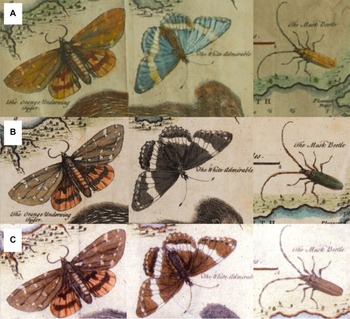
The Porcupine Map was produced using copperplate engraving, an intaglio technique whereby image and text are etched onto a copper plate. Black ink is applied to the etching, the excess is wiped away, and the image is transferred to paper using a printing press. Colour would have been added by hand after, typically using watercolour or gouache paints (Woodward Reference Woodward2007). Although the use of colour would have been common in atlases, The Gentleman’s Magazine, a periodical with a sizeable monthly printing estimated at 2000–15 000 copies (Bryant Reference Bryant1975), would have published this map in monochrome. Due to the variability in colour observed across versions, and without the ability to know whether colouration was under the Harris’s artistic or scientific direction, our interpretation of these images is based largely on the monochrome version of this map. We do, however, briefly comment on the variability of coloured maps found within the archival material and include examples that illustrate the variety found across different versions of the map.
The White Admirable
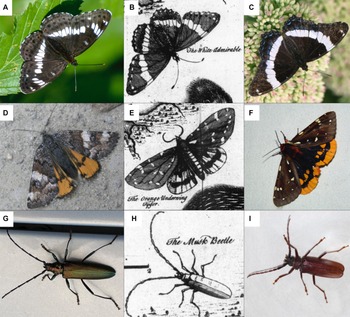
Labelled as “The White Admirable,” Harris depicts what is likely a white admiral butterfly, Limenitis spp. (Fig. 6B). Genus Limenitis Fabricius (Lepidoptera: Nymphalidae) contains more than 20 species, with many species sharing an appearance that is superficially similar to the Eurasian white admiral, Limenitis camilla Linnaeus (Fig. 6A; Mullen Reference Mullen2006). A widespread species across the Palearctic, L. camilla would have been familiar to Harris. The American white admiral, Limenitis arthemis (Drury) (Fig. 6A) is common throughout Nova Scotia and much of North America and was later described by Harris’s contemporary and collaborator Dru Drury in 1775. Larvae of American white admirals feed on a variety of host plants, namely trees and shrubs within the Salicaceae family (e.g., willows and poplars; Mullen Reference Mullen2006). We are uncertain of the official first record of L. arthemis in Nova Scotia or Canada, but Belt (Reference Belt1864), in what is the earliest list of butterflies in Halifax that we are aware of, notes that this species is “not uncommon, but scattered,” with distribution in “Hudson’s Bay, Canada, United States.” Harris’s Porcupine Map might be the first documentation of the white admiral in Nova Scotia, albeit an informal one.
A matrix of photos of the European species named by Harris (left column), the illustrations by Harris (middle column), and potential North American identifications (right column). Individual panels include the following insects known today and how they were shown on the Porcupine Map: A, Eurasian white admiral, Limenitis camilla (frank103 2022); B, “White Admirable” (Porcupine Map); C, American white admiral, Limenitis arthemis arthemis (pei-ott 2024); D, orange underwing, Archiearis parthenias (oleg_kosterin 2021); E, “Orange Underwing Tyger” (Porcupine Map); F, St. Lawrence tiger moth, Arctia parthenos (imbeaul 2019); G, musk beetle, Aromia moschata (enricotomschke 2020); H, “Musk Beetle” (Porcupine Map); and I, brown prionid, Orthosoma brunneum (douglashooper 2021). All iNaturalist photos included here are licensed under Creative Commons Attribution agreements.

Figure 6. Long description
A matrix image of insects. The first row shows a black and white butterfly, the second row shows a brown moth with orange underwings, and the third row shows a longhorned beetle. This compares actual insects to the engravings from the porcupine map.
In two printed versions of the Porcupine Map, the white admirable/admiral illustrated by Harris has dark wings with a white postmedian band on both wings, which is characteristic of L. arthemis (Fig. 7). In another version of the map, white bands are presented on light blue-coloured wings. Although wings of L. arthemis astyanax are iridescent blue, this subspecies does not exist in Nova Scotia, being found south of New England and the southern Great Lake boundary (United States of America; Brock and Kaufman Reference Brock and Kaufman2003). The light-blue wings of the white admirable/admiral in the alternate version of the Porcupine Map exist nowhere. The marginal and apical wing areas of L. arthemis typically have a row of white or iridescent blue spots (Brock and Kaufman Reference Brock and Kaufman2003), and Harris illustrated these on the Porcupine Map (Fig. 4).
A matrix depicting the variation in colour used in different hand-coloured versions of the Porcupine Map originally published in The Gentleman’s Magazine (London, February 1750). Insects are cropped from versions of the map, made available courtesy of: A, the McGill University Library via www.archive.org (https://archive.org/details/McGillLibrary-rbsc-maps_G3422_H3_1750_H3-17130); B, the Library of the Nova Scotia Legislature (https://nslegislature.ca/about/photo-galleries/portraits-and-artifacts/porcupine-map); C, the collection of Dalhousie Art Gallery – Gift of Dr. F. Forrest Musgrave, Dalhousie University Class of 1929, 1971.

Figure 7. Long description
A 3x3 matrix of insects. This shows the variability in colour amongst the different coloured versions of the Porcupine map. Each row represents a different map. Each column represents a different insect.
The Orange Underwing Tyger
Labelled the “Orange Underwing Tyger,” Harris may be depicting the St. Lawrence tiger moth, Arctia parthenos (Lepidoptera: Erebidae) (Fig. 6F), which wouldn’t be described until 1850 (Agassiz and Cabot Reference Agassiz and Cabot1850) by Thaddeus William Harris (no apparent relation to Moses Harris). This moth has a wide distribution in boreal North America, being found in all Canadian provinces and territories and in several American states (GBIF 2025). Larvae of this species feed on alders (Betulaceae), willows (Salicaceae), birches (Betulaceae), and other host plants and require two years to reach adulthood. Like other tiger moths, this species has distinctive aposematic colouration but bears only some resemblance to the orange underwing, Archiearis parthenias Linnaeus (Lepidoptera: Geometridae), found across Eurasia (Fig. 6D).
As was the case with L. arthemis, the accuracy of the A. parthenos colouration pattern depends on the version of the Porcupine Map examined (Fig. 6). Brown forewings with pale yellow or cream spots and hindwings that are black over most of the basal half with orange–yellow and black bands in the outer half (Hall et al. Reference Hall, Sullivan, Petranka, Feldman, George and Niznik2025) are accurately depicted in two versions of the map, but in another version, the hind wings are inaccurately illustrated, being yellow–brown with crimson banding.
As with L. arthemis, Harris’s 1750 depiction of A. parthenos on his Porcupine Map (Figs. 4 and 6E) may be the earliest informal scientific record of the St. Lawrence tiger moth. The earliest formal list of Nova Scotia Lepidoptera including moths appears to be Bethune (Reference Bethune1870), in which for Platarctia (Arctia) parthenos, it is noted, “it is by no means common about Halifax, but a few specimens may be obtained during the summer at lamp-light – J.M.J.” (Bethune Reference Bethune1870).
The Musk Beetle
The third species included on the map is a long-horned beetle (Coleoptera: Cerambycidae) labelled “The Musk Beetle.” Musk beetle is the common name for Aromia moschata Linnaeus (Coleoptera: Cerambycidae), a Palearctic species that does not occur in North America (Fig. 6G). Harris therefore could not have observed this beetle in Nova Scotia. Why is the musk beetle erroneously labelled as such on the Porcupine Map (Figs. 4 and 6H)? Was this error simply an unwitting misidentification or incorrect guess that A. moschata occurs in Nova Scotia? Or was this a case of artistic licence, whereby, for the purposes of a map in a monthly digest intended to attract the public to the New World, Harris was lackadaisical concerning species biogeography in his decision to show a familiar English species instead of long-horned beetles he observed in and around Halifax?
Again, depending on the version of the Porcupine Map studied, the colour of the beetle differs, hamstringing our ability to deduce the species of beetle Harris may have encountered near Halifax and represented on his map. In one case, the elytra (wing cases) on the beetle’s abdomen are green–black and striated, and the thorax, head, antennae, and appendages are orange–brown in colour (Fig. 7). The green–black beetle is not a true depiction of the European beetle nor of any native cerambycids known from the Halifax area. In the alternate version of the Porcupine Map, the body of the beetle is a yellow–orange colour throughout, with black–grey antennae and appendages. In a third copy of the map, the beetle is coloured a chestnut brown – which is somewhat reminiscent of the brown prionid, Orthosoma brunneum Forster (Coleoptera: Cerambycidae), a large species whose genus name derives from the parallel lines that run longitudinally down the beetle’s elytra. The beetle in the drawing has a highly cylindrical silhouette (Figs. 4 and 6H), prominent parallel lines on the wings, and the presence of large mandibles – a dimorphic trait found only in males. The size of O. brunnea, 19–50 mm, is similar to that of the musk beetle (∼40 mm). Today, 99 species of long-horned beetles have been recorded within the province of Nova Scotia (Majka and Ogden Reference Majka and Ogden2010), although many of these were introduced from other localities and would not have been present when the map was created.
Conclusions
Any criticisms about the perceived or indeed possible shortcomings concerning Moses Harris’s entomological undertakings should be tempered not only by considerations of his own youthful age at this early stage in his career but also of the very zeitgeist in which he and his mid-eighteenth-century contemporaries operated. Publication of detailed accounts about the insect fauna of North America did not occur until decades after Harris’s visit to Nova Scotia. These include, for example, Forster’s (Reference Forster1771) A Catalogue of the Animals of North America and Smith’s (Reference Smith1797) The Natural History of the Rarer Lepidopterous Insects of Georgia. So too, publication of the classic foundational handbooks of entomology taxonomy and systemic natural history, such as Fabricius’s (Reference Fabricius1775) Systema Entomologiae, Olivier’s (Reference Olivier1789) Entomologie, Ou Histoire Naturelle des Insects, and William Kirby and William Spence’s (Reference Kirby and Spence1818) An Introduction to Entomology or Elements of the Natural History of the Insects, also occurred decades later (Hünniger Reference Hünniger, Cockram and Wells2017).
It is important to recognise that entomology at this fledgling stage in its development faced two important challenges. The first, which Hünniger (Reference Hünniger, Cockram and Wells2017) referred to as “the multitude of the miniscule,” pertained to the study of insects being “ridiculed” in consequence of the lay perception regarding “most insects as detestable and vile.” This led Kirby and Spence (Hünniger Reference Hünniger, Cockram and Wells2017) to lament that, due to “the diminutive size of its objects, that an entomologist is synonymous with everything futile and childish.” The second challenge was what Ogilvie (Reference Ogilvie, Blair and von Greyerz2020) terms “the maxima in minimis mindset” – “the idea that nature, or nature’s God, shows the greatest power in the smallest things.” Such commingled perceptions of nature and divine workmanship, a characteristic feature of the early study of the natural history of Canada (Berger Reference Berger1983), “was not just a byway in the history of natural history; it contributed to the formation of entomology as a discipline toward the end of the eighteenth-century” (Ogilvie Reference Ogilvie, Blair and von Greyerz2020, p. 172). This is shown, for example, in the argument made by Drury (in the 1770 volume illustrated by Harris, noted above; Drury Reference Drury1770) to vindicate entomology in the face of public ridicule, that insects “proclaim the wisdom, goodness, and omnipotence of their great Creator” (Hunniger Reference Hünniger, Cockram and Wells2017, p. 179). Remarkably, such thinking persisted even four decades after Harris’s death, including in what Ogilvie (Reference Ogilvie, Blair and von Greyerz2020, p. 179) calls “the most important textbook of entomology in nineteenth-century Britain”, wherein the claim is made that entomology “illustrates the great truths of Religion, and proves that the doctrines of the Word of God, instead of being contradicted, are triumphantly confirmed by his Works” (Kirby and Spence in Ogilvie Reference Ogilvie, Blair and von Greyerz2020, p. 180). That any solid proto-scientific information could emerge from the fog of such times is a testament to the careful observational skills and illustrative prowess of Harris and his entomologist colleagues.
Harris’s contribution to the corpus of natural history of British North America (Stearns Reference Stearns1970; Elman Reference Elman1977; Berger Reference Berger1983) was admittedly minor. Of more interest is how well, at the start of a career in which he would achieve justifiable fame, his very first published work stands up in terms of both its taxonomic veracity and artistic verisimilitude.
The insect illustrations on the Porcupine Map certainly add to the map’s allure and make it a more eye-catching piece for a publication like The Gentleman’s Magazine. In one version of the map (Fig. 4), the white admiral (‘admirable’) and orange underwing “tyger” are accurately illustrated, and their depiction on this map may be the first informal records of L. arthemis and A. parthenos in Nova Scotia. On the other hand, given Harris’s expertise as an entomologist and the absence in Nova Scotia of cerambycids closely matching the beetle depicted on the Porcupine Map, the addition of the musk beetle illustration is puzzling. Harris could be forgiven for this decision, but the erroneous inclusion of the musk beetle in the Porcupine Map is nevertheless surprising for an individual as dedicated to the discipline of entomology as Harris.
There are several possible explanations for these errors. We allude to some of these above but more discretely list them here. Although we lack direct evidence for any of these hypotheses, some explanations appear more plausible than others:
-
1. Name labels could have been added by someone else who was less familiar with insects than Harris was. In the eighteenth century, once the engraved copperplates used to print the map were sold, practical control would have remained with the holder. Cartouches, imprint lines, and even updated geographic details were routinely modified by subsequent owners of the copperplates (Verner Reference Verner1974).
-
2. Perhaps Harris did not carefully compare specimens in Nova Scotia with type specimens from collections in his native England, leading him to assume that the insects he observed around Halifax were geographic variants of European species. Butterflies in particular are prone to polyphenism and colour-pattern “races” or “forms” that sometimes are treated as subspecies (Brakefield Reference Brakefield1996; Braby et al. Reference Braby, Eastwood and Murray2012). Harris probably would have been familiar with this kind of variation across Europe.
-
3. Harris may have recognised that the insects he observed in Nova Scotia and illustrated on his map were undescribed species not found in Europe. However, for the purposes of a nontechnical promotional map, he may have exercised artistic licence by assigning them familiar common names of related European species.
Regardless of the true reasons of mislabelled insects on the map, Harris’s foray into natural history reflects the imperial context in which it was produced. The Porcupine Map, like other maps of the time, was not merely an instrument of navigation or scientific curiosity; it was a tool of empire, aiming to impose the norms of British culture, society, and dominance onto an unfamiliar landscape. By incorporating insect illustrations into the map, Harris participated in a tradition of cataloguing nature that both celebrated biodiversity (through detailed illustration) and subtly asserted dominion over it (imposition of common British names). This perceived tension between scientific precision and imperial ambition in Harris’s work is emblematic of the broader entanglements between natural history and colonial expansion, an intersection rich for study, scrutiny, and interpretation.
Acknowledgements
The authors thank Patrice Bouchard, Chris Schmidt, Jon Sweeney, and Reginald Webster for their consultation on Lepidoptera and Coleoptera depicted on the Porcupine Map. They also thank Stephen Heard, subject editor Laura Timms, technical editor Monique Keiran, and an anonymous reviewer for their constructive comments on earlier versions of this manuscript.
Competing interests
The authors declare they do not have any competing interests.

 Open access

