




The acquisition of oral language skills, particularly vocabulary, is critical in learning during the preschool years and predicts later reading development (e.g., Burgess et al., Reference Burgess, Hecht and Lonigan2002; Sabol et al., Reference Sabol, Sommer, Chase-Lansdale and Brooks-Gunn2021; Sénéchal, Reference Sénéchal2006; Suggate et al., Reference Suggate, Schaughency, McAnally and Reese2018). According to the ecological systems theory (Bronfenbrenner, Reference Bronfenbrenner1979), both proximal factors (e.g., home literacy environment [HLE]) and distal factors (e.g., family’s socioeconomic status [SES], contextual characteristics, and cultural differences) have an impact on children’s development. In support of this, several studies have highlighted the role of early family factors (e.g., SES, HLE) in children’s language and literacy skills (e.g., Hoff, Reference Hoff2003; Liu et al., Reference Liu, Wang, Xu, Li, Malatesha Joshi, Li and Zhang2023; Manolitsis et al., Reference Manolitsis, Georgiou, Stephenson and Parrila2009; Noble et al., Reference Noble, Norman and Farah2005, Reference Noble, McCandliss and Farah2007; Rowe & Goldin-Meadow, Reference Rowe and Goldin-Meadow2009).
Although several studies have documented the relation between family factors and children’s language and literacy skills, these studies have been predominantly conducted in Western countries representing relatively affluent societies (e.g., Burgess et al., Reference Burgess, Hecht and Lonigan2002; Georgiou et al., Reference Georgiou, Inoue and Parrila2021; Hamilton et al., Reference Hamilton, Hayiou-Thomas, Hulme and Snowling2016; Hoff, Reference Hoff2003; Manolitsis et al., Reference Manolitsis, Georgiou, Stephenson and Parrila2009, Reference Manolitsis, Georgiou and Parrila2011; Rowe & Goldin-Meadow, Reference Rowe and Goldin-Meadow2009; Sénéchal & LeFevre, Reference Sénéchal and LeFevre2002; Silinskas et al., Reference Silinskas, Sénéchal, Torppa and Lerkkanen2020; Stephenson et al., Reference Stephenson, Parrila, Georgiou and Kirby2008). Studies from non-Western countries such as China are still lacking (see Lau & McBride-Chang, Reference Lau and McBride-Chang2005; Li & Li, Reference Li and Li2022; Liu et al., Reference Liu, Georgiou and Manolitsis2018; Zhang et al., Reference Zhang, Inoue, Shu and Georgiou2020, for a few exceptions), and the few studies on this topic have recruited participants from metropolitan cities that made them look more similar to the participants from Western countries. One of China’s most prominent characteristics of regional development is the inequality between urban and rural areas (Cai & Wu, Reference Cai and Wu2019; Wu & Rao, Reference Wu and Rao2017). The urban–rural income disparity has increased the gap in children’s access to educational resources, which has further influenced their academic achievement (e.g., Sicular et al., Reference Sicular, Ximing, Gustafsson and Shi2007). However, whether the broader contextual settings can moderate the relation between family factors and children’s language acquisition remains largely unknown (Nag et al., Reference Nag, Vagh, Dulay and Snowling2019). Therefore, to fill in this research gap, this study aimed to explore the role of various family factors in children’s vocabulary knowledge in both urban and rural areas of China and to compare the relation between these factors and vocabulary across the two settings. Our study is expected to contribute to the literature by generating insights into the intersections of family factors and broader contextual settings in the Chinese context.
Among the various family factors that play an important role in children’s language and literacy skills, family’s SES has attracted most attention (e.g., Ecalle et al., Reference Ecalle, Thierry, Labat and Magnan2024; Hoff, Reference Hoff2003; Noble et al., Reference Noble, Norman and Farah2005, Reference Noble, McCandliss and Farah2007; Reynolds et al., Reference Reynolds, Andersen, Behrman, Singh, Stein, Benny, Crookston, Cueto, Dearden, Georgiadis, Krutikova and Fernald2017; Rowe & Goldin-Meadow, Reference Rowe and Goldin-Meadow2009; see also Letourneau et al., Reference Letourneau, Duffett-Leger, Levac, Watson and Young-Morris2013; Li et al., Reference Li, Peng, Ma, Ding and Zhao2023, for meta-analyses). There has been an increased interest in understanding the processes underlying the role of family’s SES in children’s language skills such as vocabulary knowledge (e.g., Marjanovič-Umek et al., Reference Marjanovič-Umek, Fekonja-Peklaj, Sočan and Tašner2015; Niklas & Schneider, Reference Niklas and Schneider2013; Raviv et al., Reference Raviv, Kessenich and Morrison2004). According to the Family Investment Model (FIM; Conger & Donnellan, Reference Conger and Donnellan2007), distal factors such as family’s SES can influence children’s academic achievement through proximal processes (e.g., family investment) that are associated with children’s development. Family investment may take many forms, but most commonly refers to the provision of learning materials at home and to parental engagement in literacy activities (Conger & Donnellan, Reference Conger and Donnellan2007; Marjanovič-Umek et al., Reference Marjanovič-Umek, Fekonja-Peklaj, Sočan and Tašner2015). Higher SES enables parents to provide more literacy resources for their children, which then allows for better quality home literacy interactions that lead to better children’s vocabulary knowledge.
Research on children’s language skills has provided support for the FIM (Jiang et al., Reference Jiang, Lau and Tan2024; Marjanovič-Umek et al., Reference Marjanovič-Umek, Fekonja-Peklaj, Sočan and Tašner2015; Niklas & Schneider, Reference Niklas and Schneider2013; Raviv et al., Reference Raviv, Kessenich and Morrison2004). For example, Marjanovič-Umek et al. (Reference Marjanovič-Umek, Fekonja-Peklaj, Sočan and Tašner2015) found that parents’ knowledge of children’s books (used as a proxy of print exposure) and engagement in literacy activities mediated the effects of parental education and household possessions on the vocabulary knowledge of toddlers in Slovenia. Another study with German preschoolers showed that the HLE acted as a mediator between family’s SES and vocabulary knowledge (Niklas & Schneider, Reference Niklas and Schneider2013).
Only recently, researchers have begun to explore the generalizability of the FIM in non-Western countries. Preliminary findings of studies conducted in Chile (Lohndorf et al., Reference Lohndorf, Vermeer, Cárcamo and Mesman2018; Mendive et al., Reference Mendive, Mascareño Lara, Aldoney, Pérez and Pezoa2020), the Philippines (Dulay et al., Reference Dulay, Cheung and McBride2018), and Ghana (Wolf & McCoy, Reference Wolf and McCoy2019) were largely consistent with those of Western studies and suggested that the HLE, including stimulating linguistic activities and household learning materials, was the most important mediator of the relation between family’s SES and vocabulary.
However, the availability of print resources and home literacy activities might also be influenced by parental beliefs (PBs) such as views regarding their children’s education. Research has demonstrated the mediating role of HLE in the relationship between PBs and children’s developmental outcomes (e.g., Davis-Kean, Reference Davis-Kean2005; Vasilyeva et al., Reference Vasilyeva, Dearing, Ivanova, Shen and Kardanova2018). However, a limited number of studies have examined how PBs and family’s SES jointly influence children’s language abilities. This is important because parents’ general views about child’s education and development (e.g., the views on the importance of developing language and literacy skills before school entry) are considered to exert effects on children’s language skills that are independent of the effects of family’s SES (Liu et al., Reference Liu, Georgiou and Manolitsis2018; Vasilyeva et al., Reference Vasilyeva, Dearing, Ivanova, Shen and Kardanova2018). Therefore, in the current study, we attempted to examine the mediating role of home literacy activities and print resources in the relationship between family’s SES, PBs, and children’s vocabulary knowledge within the FIM framework.
Confucian concepts have long been seen as the main component of the Chinese cultural civilisation, which affects people from various aspects, including the way Chinese parents are involved in their children’s learning. Affected by the Confucian heritage culture, Chinese parents usually have higher academic standards and educational expectations for their children and tend to pay more attention to children’s academic achievement than parents in Western countries (e.g., Dandy & Nettelbeck, Reference Dandy and Nettelbeck2002; Ng et al., Reference Ng, Pomerantz and Deng2014). Some parents strive to provide the best for their children’s development, regardless of the constraints imposed by their financial condition (Kuan, Reference Kuan2015). Given this unique cultural context, the possible role of PBs in language abilities deserves to be further studied across a wide range of socioeconomic contexts in China. PBs and expectations typically refer to parents’ perceptions and beliefs about the value of engaging in their children’s language and literacy activities, and their expectations about children’s academic achievement.
To the best of our knowledge, only two studies have simultaneously explored the role of family’s SES and PBs in shaping the HLE (Liu et al., Reference Liu, Georgiou and Manolitsis2018; Zhang et al., Reference Zhang, Inoue, Shu and Georgiou2020). Working with a group of kindergarten children from Xi’an, Liu et al. (Reference Liu, Georgiou and Manolitsis2018) found that family’s SES mainly affected literacy resources (e.g., number of children’s books at home), whereas parents’ expectations affected both the literacy activities (e.g., the frequency of reading a story to their child) and resources at home; both SES and parents’ beliefs and expectations predicted children’s vocabulary knowledge and word reading through the effects of literacy resources at home. In turn, working with a group of kindergarten children from Jining, Zhang et al. (Reference Zhang, Inoue, Shu and Georgiou2020) found that parents’ expectations of children’s academic achievement had an indirect effect on children’s word reading and reading comprehension, and this effect was mediated by the literacy resources at home. These findings support the important role of PBs in the language and literacy abilities of Chinese children. Given that both studies were conducted in metropolitan cities in China, more research is needed from less affluent communities.
The relationship between family factors and children’s language skills in rural areas has been explored in a relatively piecemeal way (Gao et al., Reference Gao, Zhang, Nie, Liu, Wang and Shi2021; Kuhn et al., Reference Kuhn, Liu, Wang and Luo2021; Ma et al., Reference Ma, Jonsson, Feng, Weisberg, Shao, Yao, Zhang, Dill, Guo, Zhang, Friesen and Rozelle2021). The findings of these studies indicate that parental involvement in reading and learning materials at home was associated with language skills among children before the age of 3 (Kuhn et al., Reference Kuhn, Liu, Wang and Luo2021; Ma et al., Reference Ma, Jonsson, Feng, Weisberg, Shao, Yao, Zhang, Dill, Guo, Zhang, Friesen and Rozelle2021) or with reading performance among students in the primary school (Gao et al., Reference Gao, Zhang, Nie, Liu, Wang and Shi2021). Evidence from preschoolers is missing. Furthermore, these studies have focussed on describing the differences in the HLE between rural and urban areas and on comparing children’s language skills between the richer and poorer home environment groups. The extent to which the FIM also applies to the Chinese culture, particularly in rural contexts, remains unknown.
As mentioned earlier, one of the most prominent characteristics of regional development in China is the inequality between urban and rural areas (Cai & Wu, Reference Cai and Wu2019; Wu & Rao, Reference Wu and Rao2017; Zhang & Kanbur, Reference Zhang and Kanbur2005). Considering the diverse economic development across China, an interesting question to explore is whether the relation between family factors and children’s language development varies under different contextual settings. Research on this issue is limited (e.g., Bann et al., Reference Bann, Wallander, Do, Thorsten, Pasha, Biasini, Bellad, Goudar, Chomba, McClure and Carlo2016; Li & Qiu, Reference Li and Qiu2018). A study with Chinese adolescents reported that urban students’ academic performance was more affected by their family’ s SES than that of rural students (Li & Qiu, Reference Li and Qiu2018). Another study on early interventions showed that children from families with limited resources displayed more remarkable cognitive improvement in response to family-based early interventions than those from relatively well-resourced families, which suggests that family’s environment and family-based interventions may have a more significant impact on children with relatively fewer resources (Bann et al., Reference Bann, Wallander, Do, Thorsten, Pasha, Biasini, Bellad, Goudar, Chomba, McClure and Carlo2016). It should also be noted that Bann et al.’s (Reference Bann, Wallander, Do, Thorsten, Pasha, Biasini, Bellad, Goudar, Chomba, McClure and Carlo2016) study was conducted with participants from three developing countries (India, Pakistan, and Zambia) with different cultures, and it is quite possible that cultural differences may also explain partly their results. Thus, by examining regional differences within a fairly unified cultural context (i.e., Chinese culture), we controlled for potential confounding effects of cultural differences while examining the relationship between family factors and language acquisition of preschoolers in urban and rural areas.
The present study
The purpose of the present study was to examine the urban–rural disparities in the family environment and the relationship between family factors and children’s vocabulary knowledge in Chinese. Based on the premises of the FIM framework and the findings of previous studies (Dulay et al., Reference Dulay, Cheung and McBride2018; Jiang et al., Reference Jiang, Lau and Tan2024; Liu et al., Reference Liu, Georgiou and Manolitsis2018; Vasilyeva et al., Reference Vasilyeva, Dearing, Ivanova, Shen and Kardanova2018; Zhang et al., Reference Zhang, Inoue, Shu and Georgiou2020), we expected that (a) family’s SES and PBs would predict home literacy activities, access to print resources (AP), and children’s vocabulary knowledge; (b) home literacy activities and AP would mediate the effect of family’s SES and PBs on children’s vocabulary knowledge; and (c) the role of family factors in children’s vocabulary knowledge would be stronger in the rural than in the urban group.
Method
Participants
Our sample consisted of 366 children (178 boys, 188 girls; M age = 4.88 years; SD = 0.33; range: 4.25–5.92 years) who were in their second year of kindergarten (K2). To recruit our participants, we first contacted the preschool teachers through the local educational department. After the preschool teachers agreed to participate, we randomly selected children from each of the participating classes and we sent home a letter of information about our study and a consent form. First, we recruited 109 children (51 boys, 58 girls; M age = 4.85; SD = .30) from two urban preschools in Handan, Hebei Province. Second, we recruited 257 children (127 boys, 130 girls; M age = 4.89; SD = .33) from rural sites. More specifically, to better reflect the characteristics of children from rural areas in China, we recruited children from various regions, including mountains and interior counties. One hundred and thirty-eight children were recruited from 16 preschools located in Zhijin County, Guizhou province, and 119 children from two preschools in Daming County, Hebei province. Both counties are nationally designated as poverty-stricken counties. The unequal number of preschools in the two counties was due to the geographical characteristics and objective conditions of these locations, such as differences in the size of the preschools.
According to statistics from the Open Government Affairs of each area and the National Bureau of Statistics of China (2022), the per capita disposable income of residents in the two counties (i.e., Zhijin and Daming) was less than half of the national average level (CNY 36,883 per year), whereas that of the urban group (i.e., Handan) (CNY 39,687 per year) was higher than the national average level. Thus, they were combined into one group to represent the rural areas of China. All children had no known intellectual or perceptual difficulties. Ethics approval for the present study was obtained from the Institutional Review Board (IRB) of Beijing Normal University State Key Laboratory of Cognitive Neuroscience and Learning (201912170079 and 201912170080). Parental consent was also obtained prior to testing any children.
Measures
The family environment questionnaire was developed by selecting some critical indicators from previous studies (Shu et al., Reference Shu, Li, Anderson, Ku, Yue, Li, Gaffney and Packard2002; Su et al., Reference Su, Peyre, Song, McBride, Tardif, Li, Zhang, Liang, Zhang, Ramus and Shu2017) and the scoring criteria were adjusted after taking into account the actual conditions in rural areas. Thirteen items (see Table 1) were selected to reflect four aspects of the family environment (family’s SES, home literacy activities, AP, and PBs). Similar questions have been used in previous studies in Chinese to reflect different aspects of the HLE (e.g., Deng et al., Reference Deng, Silinskas, Wei and Georgiou2015; Liu et al., Reference Liu, Georgiou and Manolitsis2018; Wang & Liu, Reference Wang and Liu2021; Zhang et al., Reference Zhang, Inoue, Shu and Georgiou2020). Cronbach’s alpha reliability for each family factor in our sample ranged from .81 to .89.
Group comparisons of the family factors and vocabulary score

Note.
a FDR correction was used to adjust for multiple comparisons among these tests.
*** p < 0.001,
** p < 0.01,
* p < 0.05. SES = socioeconomic status; PB = parental beliefs; HLA = home literacy activities; AP = access to print resources.
Family’s SES
Family’s SES was assessed with parental income and parental educational level. Average monthly household income was measured on a 6-point Likert scale (i.e., 1 = less than 1,000, 2 = between 1,000 and 2,999, 3 = between 3,000 and 4,999, 4 = between 5,000 and 6,999, 5 = between 7,000 and 9,999, 6 = more than 10,000 Chinese yuan [CNY] per month). Parents’ educational level was measured on a 10-point Likert scale (i.e., 1 = none, 2 = grade 3 or below, 3 = grade 4–6, 4 = junior high school, 5 = technical secondary school, 6 = senior high school, 7 = junior college, 8 = university, 9 = postgraduate studies, 10 = doctoral degree). Cronbach’s alpha reliability for SES in our sample was .89.
Home literacy activities
Parents or primary caregivers were asked to answer the following questions on a 3-point Likert scale (1 = never, 2 = sometimes, 3 = every day): (a) frequency of reading a story to their child, (b) frequency of teaching their children to sing children’s songs, (c) frequency of shared book reading accompanied by parents, and (d) frequency of teaching their children to recognise or write Chinese characters. Cronbach’s alpha reliability for the home literacy activities in our sample was .84.
Access to print resources
AP was measured with questions about the number of children’s and adults’ books at home. Each question had an 11-point scale (1 = between 0 and 10, 2 = between 11 and 20, 3 = between 21 and 30, 4 = between 31 and 40, 5 = between 41 and 50, 6 = between 51 and 60, 7 = between 61 and 70, 8 = between 71 and 80, 9 = between 81 and 90, 10 = between 91 and 100, and 11 = more than 100). Cronbach’s alpha reliability for AP in our sample was .88.
Parental beliefs
Parents were asked about their beliefs regarding the importance of their child’s education and literacy experiences. Three questions about PBs were asked using a 5-point Likert scale for responses (1 = not important to 5 = very important). We asked parents to indicate their thoughts about (a) the importance of their child receiving a preschool education, (b) the importance of their child receiving a university education, and (c) the importance of reading together with their child. Cronbach’s alpha reliability for PBs in our sample was .81.
Vocabulary knowledge
The vocabulary task was designed based on our previous work (Liu et al., Reference Liu, Hao, Li and Shu2011; Leng et al., Reference Leng, Su, Li, Yang, Xing, Zhang and Shu2024). With the assistance of experts, 90 concrete nouns mastered by children aged 3–6 years were first selected, covering various categories such as animals, plants, food, and daily necessities. After conducting pilot testing in children from kindergartens similar to those in our study in urban and rural areas, the materials were further adapted (e.g., replacing words with too high or too low difficulty and removing words that are less accessible in rural areas). Children were visually presented with the pictures and were asked to name the pictures; there were no imposed time limits or discontinuation rules. A child’s score in this task was the total number correct (max = 90). Cronbach’s alpha reliability in our sample was .95. The task has also been found to correlate strongly with the Word Definition task (r = .70; Song et al., Reference Song, Su, Kang, Liu, Zhang, McBride-Chang, Tardif, Li, Liang, Zhang and Shu2015).
Procedure
Children were tested individually in a quiet room at their kindergarten by trained undergraduate students majoring in education or psychology. The teachers sent our questionnaire to the parents of the participating children roughly the same time period as the children’s testing and collected the completed questionnaires. The first author picked up the questionnaires from the teachers.
Statistical analysis
We first calculated descriptive statistics on the family factors and on children’s vocabulary in the rural and urban groups. The mean differences between the two groups were subsequently compared using independent samples t tests. Partial correlation analyses (controlling for age and gender) were also conducted to explore the relationship between family factors and children’s vocabulary.
Next, structural equation modelling (SEM) was performed to examine the contributions of the family factors to children’s vocabulary. SEM with latent constructs was constructed for the rural and urban groups using a robust maximum likelihood (MLR) estimator. Missing data were managed using full information maximum likelihood (FIML) estimation. The model fit was assessed using chi-square values (χ2), the comparative fit index (CFI), the Tucker–Lewis index (TLI), and the root mean square error of approximation (RMSEA). A nonsignificant chi-square value, CFI and TLI values higher than .95, and an RMSEA value lower than .08 indicate a good model fit (Kline, Reference Kline2015).
Following the SEM analysis, we performed multigroup analysis to investigate the potential moderating role of setting, that is, whether the paths in the model were significantly different between the rural and urban groups. An unconstrained model was first estimated to test the configural invariance; this was followed by establishing a model that examined the metric invariance, which is the minimum requirement for comparing structural paths (Byrne et al., Reference Byrne, Shavelson and Muthén1989). After that, the invariance of the path coefficients was examined with a scaled χ2 difference test (Satorra & Bentler, Reference Satorra and Bentler2010). If constraining each path yielded a significant change in the model fit, then the specific predictor was considered to contribute differently in the two groups. In addition, the statistical significance of the group differences in both indirect and total effects was also tested (Ryu, Reference Ryu2015). All analyses were conducted using the lavaan package in R (Ihaka & Gentleman, Reference Ihaka and Gentleman1996; R Core Team, 2023; Rosseel, Reference Rosseel2012).
Finally, we calculated the indirect effects in the metric invariance model to examine if the effects of family’s SES and parents’ beliefs on children’s vocabulary were mediated by AP and home literacy activities. Monte Carlo confidence intervals (CIs) of indirect effects were calculated using the monteCarloMed function in the semTools package (Jorgensen et al., Reference Jorgensen, Pornprasertmanit, Schoemann and Rosseel2018). If the CIs do not include zero, there is a 95% probability that the effects are significant (Preacher & Selig, Reference Preacher and Selig2012).
Results
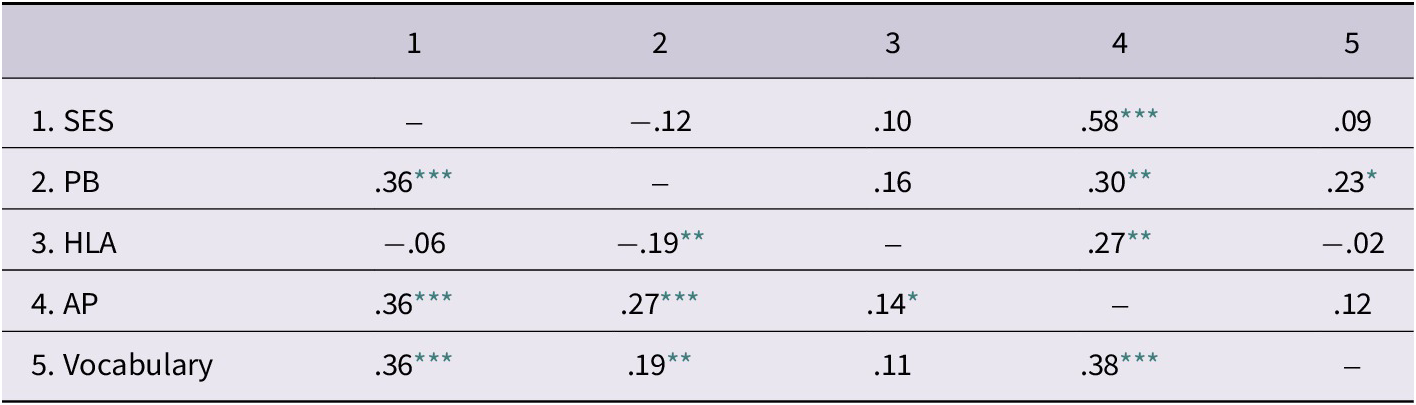
Table 1 shows the descriptive statistics for each variable separately for the rural and urban groups. Generally, the family environment of the urban group was significantly richer than that of the rural group. Additionally, vocabulary knowledge was significantly higher in the urban group than in the rural group. The partial correlations between the family factors and vocabulary knowledge in the two groups are presented in Table 2. Family’s SES and AP correlated significantly with vocabulary (r = .36 for family’s SES and .38 for AP), and PBs also correlated significantly (but weakly) with vocabulary (r = .19) in the rural group. In contrast, only PBs correlated significantly (but weakly) with vocabulary (r = .23) in the urban group.
Partial correlations between family factors and vocabulary in the rural/urban group

Note. The results for the urban sample (n = 109) are shown above the diagonal. The results for the rural sample (n = 257) are shown below the diagonal. The composite scores of SES, access to print resources, parental beliefs, and home literacy activities were calculated as the mean z score of each of the relevant items.
*** p <.001,
** p <.01,
* p <.05.
SES = socioeconomic status; PB = parental belief; HLA = home literacy activity; AP = access to print resources.
Results of SEM analyses
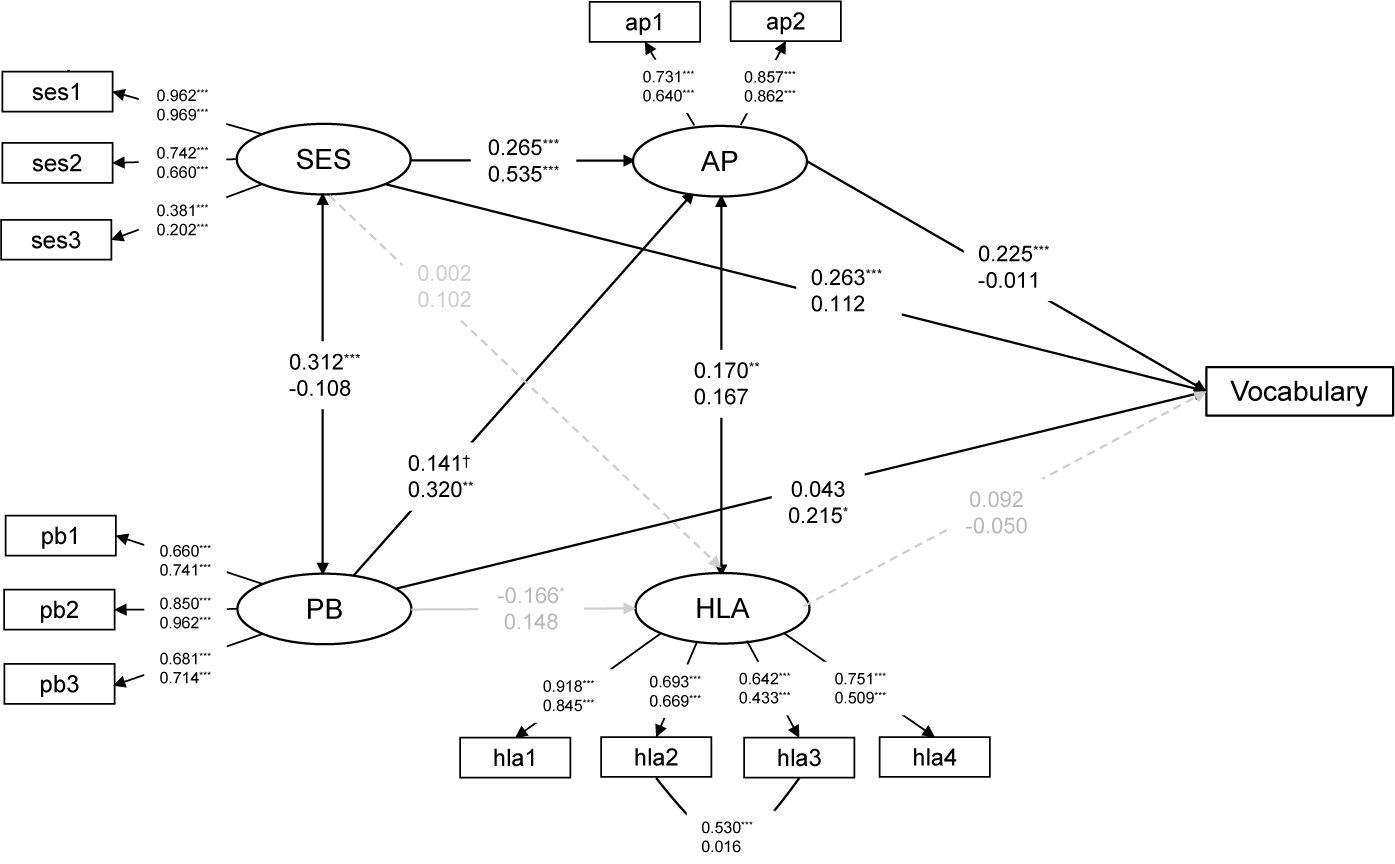
SEMs were constructed for the rural and urban groups to investigate the associations of family factors with children’s vocabulary (see Figure 1). The results showed that the baseline model fit the data relatively well in both groups: χ2urban (75) = 100.79, p < .001, CFI = .95, TLI = .92, RMSEA = .05; χ2rural (75) = 139.06, p < .001, CFI = .95, TLI = .93, RMSEA = .06. The model accounted for 30.3% and 23.0% of the variance in children’s vocabulary in the urban and rural groups, respectively. Following the tests for configural invariance (χ2 [150] = 241.24, p < .001, CFI = .94, TLI = .92, RMSEA = .06), we proceeded with the metric invariance model, in which all factor loadings and correlations were constrained to be equal in the urban and rural groups. The fit of the model was good (χ2 [158] = 244.11, p < .001, CFI = .95, TLI = .93, RMSEA = .06). In addition, a nonsignificant change in model fit (Δχ2 = 7.49, Δdf = 8, p =.490) suggested that the same measurement model fit across the two settings. Therefore, in what follows, we report the path coefficients in the metric invariance model, with age and gender being controlled (see Figure 1). The direct paths from family’s SES (βrural = .263, p < .001) and AP (βrural = .225, p < .001) to vocabulary were significant in the rural group. In contrast, only the direct path from PBs to vocabulary was significant in the urban group (βurban = .215, p = .037). The effect of home literacy activities on vocabulary was small and nonsignificant in both groups (βrural = .092, p = .141 and βurban = -.050, p = .516).
Results of SEM analyses for the rural/urban group.
Note. ***p <.001, **p <.01, *p <.05, †p <.10. Parameter estimates were given separately for the rural/urban group, with standardised coefficients for rural children at the top and urban children at the bottom. SES = socioeconomic status; PB = parental belief; HLA = home literacy activity; AP = access to print resources.

Moreover, a mediating role of AP in the relationship between family’s SES and vocabulary was found in the rural group (β = .060, B = 0.796, 95% CI [0.l48, 1.271], p =.001), with 18.4% of the variance explained by AP. In terms of the relation among family factors, significant effects of SES (βrural = .265, p < .001; βurban = .535, p <.001) and PBs (βrural = .141, p = .072; βurban = .320, p = .003) on AP were found in both groups, while the effect of PBs (βrural = -.166, p = .030; βurban = .148, p = .250) on home literacy activities was significant only in the rural group.
Results of invariance tests
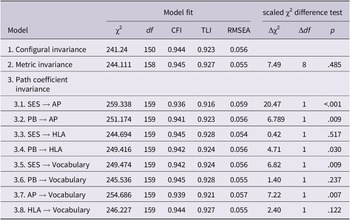
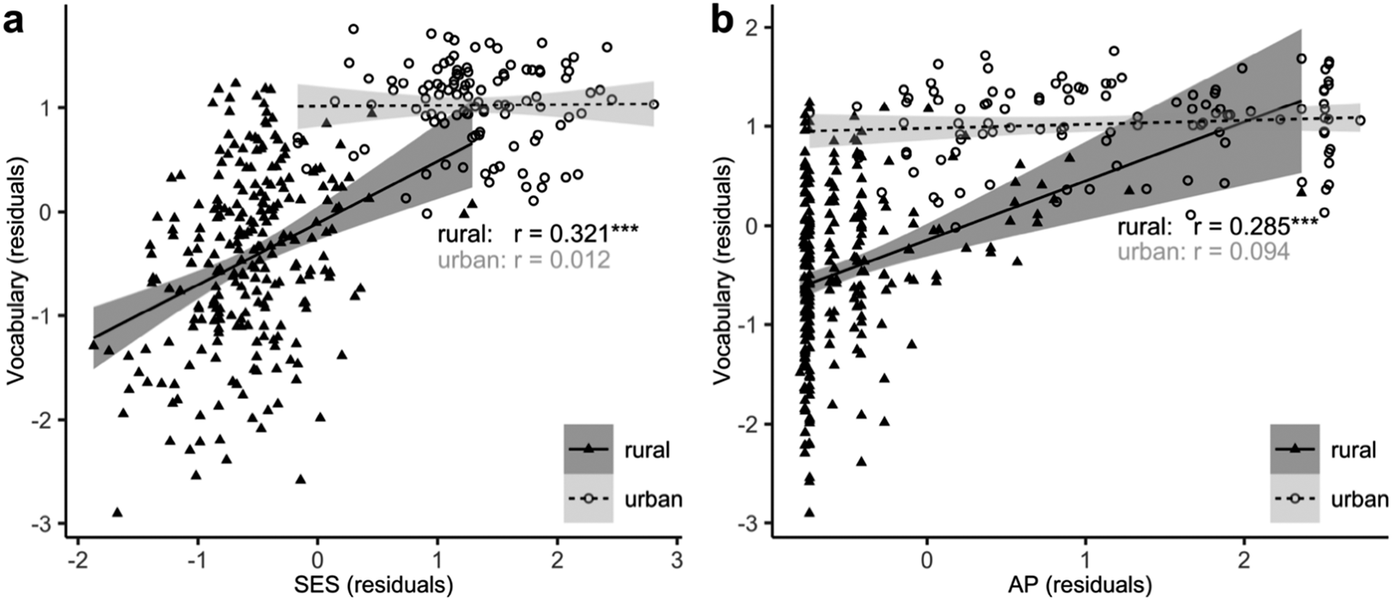
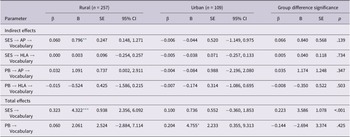
Following the tests for configural and metric invariance, each of the direct paths was constrained to be equal in a stepwise manner between the two groups (see Table 3). There were significant changes in the model fit when the regression coefficients of AP or family’s SES to children’s vocabulary were constrained to be equal (Δχ2 = 7.22, Δdf = 1, p = .007 for AP; Δχ2 = 6.82, Δdf = 1, p = .009 for family’s SES), indicating that the effects of AP and family’s SES on vocabulary were stronger in the rural group than in the urban group (see Figure 2). PBs also showed different patterns between the two groups, but the difference was nonsignificant (Δχ2 = 1.40, Δdf = 1, p = .240). None of the home literacy activities aspects showed a difference between the two groups (Δχ2 = 2.40, Δdf = 1, p = .120). In terms of the relation among family factors, the effect of PBs on home literacy activities was stronger in the rural group (Δχ2 = 4.71, Δdf = 1, p = .030), while the effects of family’s SES and PBs on AP were stronger in the urban group (Δχ2 = 20.47, Δdf = 1, p < .001 for family’s SES on AP; Δχ2 = 6.79, Δdf = 1, p = .009 for PBs on AP). Group differences in the indirect effects of family’s SES and PBs on vocabulary were not significant between the two groups (see Table 4).
Summary of the model fit indices from multigroup invariance tests

Note. ***p < 0.001, **p < 0.01, *p < 0.05. CFI, comparative fit index; RMSEA, root-mean-square-error approximation. SES = socioeconomic status; PB = parental belief; HLA = home literacy activity; AP = access to print resources.
Partial correlations between (a) SES. (b) access to print resources, and vocabulary in the rural/urban group.
Note. ***p <.001, **p <.01, *p <.05. The composite scores of SES and access to print resources were calculated as the mean z score of each of the relevant items. SES, socioeconomic status; AP, access to print resources.

Group comparison of indirect effects of SES and PB on vocabulary

Note.
*** p < 0.001,
** p < 0.01,
* p < 0.05.
SES = socioeconomic status; PB = parental belief; HLA = home literacy activity; AP = access to print resources; CI = confidence interval. Indirect effects with confidence intervals that do not include zero are significant at the 0.05 level.
Discussion
This study examined the relation between family factors (i.e., family’s SES, PBs, home literacy activities, and AP) and children’s vocabulary knowledge in a sample of preschool children recruited from urban and rural areas in China. The results showed that children in the rural group had poorer vocabulary knowledge and more disadvantaged family environments than children in the urban group. Family’s SES and PBs were significantly associated with the provision of learning materials among families from both urban and rural areas. The mediating role of AP was observed in the rural group. Most importantly, the multigroup analysis showed that the effects of family’s SES and AP on children’s vocabulary knowledge were stronger in the rural group than in the urban group.
The relationship between family factors and children’s vocabulary knowledge
In line with previous findings (e.g., Fernald et al., Reference Fernald, Weber, Galasso and Ratsifandrihamanana2011; Noble et al., Reference Noble, McCandliss and Farah2007; Rowe & Goldin-Meadow, Reference Rowe and Goldin-Meadow2009; Zhang et al., Reference Zhang, Inoue, Shu and Georgiou2020), we found that family’s SES was positively associated with children’s vocabulary in rural areas of China. Lack of financial and social resources may make parents in rural areas unable to provide adequate educational opportunities to their children, which ultimately influences their children’s language development. Moreover, the significant association between PBs and children’s vocabulary in the urban group suggests that interventions aiming at raising parental awareness of the importance of education may have benefits in improving children’s early language skills. However, the effect of PBs on children’s vocabulary was not significant in the rural group. This may be due to the fact that PBs were correlated with SES (r = .36, p < .001) in the rural group, and the effects of PBs on vocabulary may have been dissipated through the effects of family’s SES.
In addition, our findings showed that family’s SES and PBs significantly predicted AP both in the urban and rural groups. Moreover, a mediating role of AP between family’s SES and vocabulary was found in the rural group. These findings provide evidence that family’s SES and PBs are key factors driving parental investment in HLE and supporting children’s language development (Liu et al., Reference Liu, Georgiou and Manolitsis2018; see also Davis-Kean et al., Reference Davis-Kean, Tighe and Waters2021, for a review). Parents with high levels of education and income tend to provide more literacy experiences for their children’s language development (Coddington et al., Reference Coddington, Mistry and Bailey2014; Conger & Donnellan, Reference Conger and Donnellan2007; Vasilyeva et al., Reference Vasilyeva, Dearing, Ivanova, Shen and Kardanova2018; Zhang et al., Reference Zhang, Inoue, Shu and Georgiou2020). Abundant print resources at home offer opportunities for parent–child interactions at home (Shu et al., Reference Shu, Li, Anderson, Ku, Yue, Li, Gaffney and Packard2002), thus promoting children’s language and literacy skills (Dulay et al., Reference Dulay, Cheung and McBride2018; Wolf & McCoy, Reference Wolf and McCoy2019; Zhang et al., Reference Zhang, Inoue, Shu and Georgiou2020). The current study extended this relation to rural areas in China concerning the vocabulary knowledge of preschool children. Compared to improving family’s SES, the accessibility and provision of print materials may be a more feasible and beneficial strategy for facilitating children’s vocabulary development, at least for those from rural areas.
Our findings showed that PBs related to both vocabulary knowledge and AP, particularly in the urban group. This result is consistent with the framework proposed by the FIM (Conger & Donnellan, Reference Conger and Donnellan2007), that is, the availability of print resources and home literacy activities might be influenced by PBs such as views regarding children’s education (Davis-Kean, Reference Davis-Kean2005; Vasilyeva et al., Reference Vasilyeva, Dearing, Ivanova, Shen and Kardanova2018). However, our findings also showed that PBs negatively correlated with the home literacy activities in the rural group. An explanation for this finding may be that parents who value their children’s development may work outside the home, therefore lacking the time to engage with them in different home literacy activities (see Dou et al., Reference Dou, Li, Shi, Duan, Tan, Zhao, Wang and Zhang2023; Ma et al., Reference Ma, Deng and Zhou2018). However, it is also possible that parents from rural areas chose other home learning activities and not the ones that we assessed in our questionnaire. Clearly, more research is needed to validate these explanations, for example, by examining the role of HLE and PBs in left-behind children (i.e., children whose parents are migrant workers and they are raised mostly by grandparents).
Finally, despite the established association between home literacy activities and children’s reading (Hamilton et al., Reference Hamilton, Hayiou-Thomas, Hulme and Snowling2016; Inoue et al., Reference Inoue, Georgiou, Parrila and Kirby2018; Manolitsis et al., Reference Manolitsis, Georgiou and Parrila2011; Sénéchal & LeFevre, Reference Sénéchal and LeFevre2002) and the mediating role of the home literacy activities in the relation between family’s SES and vocabulary knowledge (Coddington et al., Reference Coddington, Mistry and Bailey2014; Dulay et al., Reference Dulay, Cheung and McBride2018; Lohndorf et al., Reference Lohndorf, Vermeer, Cárcamo and Mesman2018; Marjanovič-Umek et al., Reference Marjanovič-Umek, Fekonja-Peklaj, Sočan and Tašner2015; Vasilyeva et al., Reference Vasilyeva, Dearing, Ivanova, Shen and Kardanova2018), we did not find a significant effect of the home literacy activities on children’s vocabulary in either the urban or rural group. On the one hand, this may be due to the fact that most parents and children in our rural sample lived in very disadvantaged conditions. Parents in rural areas often have limited reading skills themselves, thus making it challenging to engage in literacy activities with their children. This may have attenuated the relationship between literacy-related activities and children’s language skills. The lack of association between the home literacy activities and children’s vocabulary knowledge is in line with the findings of previous studies in developing countries (e.g., Philippines: Dulay et al., Reference Dulay, Cheung and McBride2018; China: Strasser & Lissi, Reference Strasser and Lissi2009; Wolf & McCoy, Reference Wolf and McCoy2019). On the other hand, the results may highlight the importance of differentiating between home reading behaviours and reading materials when we investigate HLEs. These two factors are separate, though related constructs, and the materials in the home are a moderately strong predictor of early reading in low-income settings (e.g., Chansa-Kabali et al., Reference Chansa-Kabali, Serpell and Lyytinen2014; Zuilkowski et al., Reference Zuilkowski, McCoy, Jonason and Dowd2019). It is possible that for children who have few books beyond their school textbooks, the presence of print resources at home reflects positive household attitudes about the value of reading, and as a result, AP becomes a significant predictor of language skills in these contexts. Our finding also showed that home literacy activities correlated significantly with AP, and when we removed AP from the model, home literacy activities was indeed a significant predictor of vocabulary. As for families in urban areas, however, the key to the link between home literacy activities and oral language development may be quality rather than frequency (see Mol et al., Reference Mol, Bus, De Jong and Smeets2008, for a meta-analysis).
Implications and future research
This study has several important implications. First, our findings make important theoretical and practical contributions by testing the relations between family factors and Chinese children’s vocabulary within the FIM framework. Our results indicate that these family factors matter for children’s vocabulary in the urban and rural contexts of China. However, they may not apply equally to different settings within a given country. Had we included participants from only urban settings, our results would suggest that cultural differences between Western countries and China do not really play an important role in the specific measures. The inclusion of the rural sample in our study is the one that generated interesting differences from the findings of previous studies in Western countries. The distal factor of wealth inequality within the unified cultural context (i.e., Chinese culture), which is considered a contextual moderator, can affect not only the families but also the correlation between home attributes and language and literacy outcomes (Nag et al., Reference Nag, Vagh, Dulay, Snowling, Donolato and Melby-Lervåg2024). Our study provides preliminary and direct evidence for this argument.
Second, our findings have implications for efforts in further interventions that aim to improve early language development, especially for socioeconomically disadvantaged children in China. Given the significant urban–rural disparities, the Chinese government has prioritised poverty eradication in recent years and has made great efforts to interrupt the intergenerational transmission of poverty and achieve education equality. However, some initiatives, such as advancing a new educational agenda at the national or school level, may not be easy and will take a long time to fully realise. In such a situation, family education appears to be a necessary complement. Our findings of the predictive effects of family’s SES and parental educational beliefs on the HLE and children’s early language development were particularly instructive. Given the difficulty of raising parental education achievement and income level, it is promising and feasible to promote children’s early language development in rural areas by encouraging parents to attach importance to education (Loughlin-Presnal & Bierman, Reference Loughlin-Presnal and Bierman2017), providing rich print resources and literacy activities with high qualities.
Limitations
Some limitations of this study should be reported. First, considering the test time and labour costs, we only recruited preschools in urban and rural areas in Guizhou and Hebei provinces. Thus, future studies should replicate our findings by using a larger and more representative sample. Second, we only assessed children’s vocabulary knowledge using a single measure. A future study should replicate these findings using multiple measures of vocabulary knowledge, possibly covering wider aspects of vocabulary knowledge. Third, given that the study was concurrent rather than longitudinal, any associations between family factors and children’s vocabulary found in the study do not imply causation. Finally, home literacy activities was assessed with a self-report questionnaire and not with direct observations. Some researchers have argued that this is subject to social desirability bias (e.g., Inoue et al., Reference Inoue, Manolitsis, de Jong, Landerl, Parrila and Georgiou2020; Manolitsis et al., Reference Manolitsis, Georgiou and Parrila2011) and may attenuate their correlations with outcome measures.
Conclusion
To conclude, the findings of the present study build on those of previous studies conducted mostly in Western countries (e.g., Georgiou et al., Reference Georgiou, Inoue and Parrila2021; Hamilton et al., Reference Hamilton, Hayiou-Thomas, Hulme and Snowling2016; Inoue et al., Reference Inoue, Georgiou, Parrila and Kirby2018, Reference Inoue, Manolitsis, de Jong, Landerl, Parrila and Georgiou2020; Manolitsis et al., Reference Manolitsis, Georgiou, Stephenson and Parrila2009; Sénéchal, Reference Sénéchal2006) and enhance our understanding of the relations between early family factors and children’s vocabulary knowledge. Our findings support the important role family’s SES and PBs play in children’s vocabulary knowledge through AP, particularly in rural areas. This further suggests that the findings of previous studies that related with home literacy activities conducted in metropolitan cities in China (e.g., Lau & McBride-Chang, Reference Lau and McBride-Chang2005; Liu et al., Reference Liu, Georgiou and Manolitsis2018; Su et al., Reference Su, Peyre, Song, McBride, Tardif, Li, Zhang, Liang, Zhang, Ramus and Shu2017; Zhang et al., Reference Zhang, Inoue, Shu and Georgiou2020), which largely replicated those of studies conducted in Western countries, may not necessarily apply to all parts of China.
Data availability statement
The data that support the findings of this study are available from the corresponding authors upon reasonable request. The data are not publicly available due to privacy or ethical restrictions.
Acknowledgement
The authors thank all the children, families, preschools, local teachers, and research assistants who took part in this study. The authors also acknowledge the support of the China Development Research Foundation.
Author contribution
XL and HS: conceptualisation. GG, TI, and HL: methodology. XL and XZ: formal analysis and investigation. XL and MS: writing – original draft preparation. XL, GG, TI, MS, HS, and XZ: writing – review and editing. HS: funding acquisition. HS and AX: supervision. All authors contributed to the article and approved the submitted version.
Competing interest
The authors report no competing interests in this work.
Ethics approval
Ethics approval for this study was obtained from the Institutional Review Board (IRB) of Beijing Normal University State Key Laboratory of Cognitive Neuroscience and Learning (201912170079, 201912170080).
Funding
This study was supported by the Natural Science Foundation of China (31671126), by the Research Funds of China Development Research Foundation, by the Research Funds of National High end Think-Tank of Beijing Normal University, and by the Yiyang Education Research Institute (SEI-QXZ-2019-01).


 Open access

