

‘… beyond the limits of academic research is a whole range of lost experiences: the smokiness of house interiors in the winter, mingling with the smell of incense and at different times in the year, of lily blossoms, in turn competing with the pungent smells of human waste. The experience of night when the city was hardly ever fully dark, but lay faintly visible in shades of silver-grey from the light of the stars in a clear sky, but never silent, for night was the time of barking dogs, sometimes those on the city fringes developing an unearthly dialogue with the jackals and hyenas of the desert … Although archaeology can only deal with the material debris of life, we should not forget that the places we study were once lived in by real people.’
Kemp Reference Kemp2012, 195
In this excerpt, Barry Kemp imagines some of the sensory events likely experienced by the inhabitants of the ancient Egyptian city Amarna in the late second millennium bce. His impassioned description makes assumptions about what sensorial aspects of the environment would have been most salient to the ancient inhabitants of Amarna or, more accurately, to us were we to be transported in space and time. The colourful and vibrant writing is chillingly descriptive, offering a plausible snapshot of the city at night. Kemp suggests, however, that these considerations are ‘beyond the limits of academic research’. The senses, however, have figured prominently in various academic disciplines for at least the last four decades. From Corbin’s (Reference Corbin1986) exploration of olfaction in eighteenth- and nineteenth-century France to Howes’s (Reference Howes1991) edited volume challenging sensory universals, anthropologists have long recognized that the senses are central to the human experience, shaping both the values we attribute to sensory encounters and, in turn, how we organize our lives (Kimmerer Reference Kimmerer2013).
More specifically, a growing body of archaeological work likewise has engaged meaningfully with the senses, offering rich and insightful studies across a range of time periods and contexts. This scholarship remains dispersed, however, with few reflections on the broader conceptual and methodological stakes of sensory inquiry (Skeates & Day Reference Skeates and Day2019). As a result, with the repetition of a narrow set of foundational citations, key questions about how and why we study the senses remain underexplored. This article thus aims to contribute a cohesive and reflexive dialogue—one that not only clarifies the terrain but also invites further experimentation. Because archaeologists study the lives of ancient peoples, let us begin by asking how we might navigate the difficulties of accessing a sensorial past.
Imagining is always a step in the research process. According to Aristotle, imagination differs from both perception and thought as it is little concerned with the truthfulness of the projected image or idea (De anima III, 427b15). Unlike opinions or judgements (hupolepsis), upon which beliefs are socially integrated, imagination is unrestricted, allowing for the unfamiliar, unusual, or never-before-seen to become possible. Seemingly at odds with this interpretation, Ingold (Reference Ingold2000, 418–19) distinguishes between ‘intelligence’ and ‘imagination’. Intelligence, he states, refers to our capacity to solve abstract puzzles, like equations and logic problems. Imagination also addresses problems, but situates them within the messy, relational and embodied context of lived experience. Rather than asking how to solve a problem, imagination asks what the problem is and why it matters. In fact, Ingold proposes that intelligence is itself a product of the imagination, an abstract construction that divorces knowledge from being.
Imagination, however, as both Aristotle and Ingold imply, is less about ‘Truth’ and more about exploring potentiality or possibility. Aristotle distinguishes imagination from perception and rational thought because it is not bound by social strictures, the physical world, or human ideologies. Ingold (Reference Ingold2000) revises this idea, moving imagination from the abstract mind into relational, lived experience. Imagination reshapes the very systems in which it operates, while also being bound within their limits. After all, nothing that we invent can be more than what we can imagine, and vice versa. Taken together, I would suggest that imagination is a mode of speculative inquiry wherein we can imagine how things might have been—or could be—to clarify what we do not yet know. Imagination thus manifests everywhere from everyday problem-solving to the fantastic. Imagination is not held in contrast to knowledge but is the very space from which knowledge is created.
Imagination is not a departure from reality but a method of engaging in its gaps. Whether grounded in material contexts or played out in fictional worlds, imagined speculation can help us to wrestle with the limits of evidence when exploring the richness of human experience. Kemp, for example, uses his imagination in this excerpt to recreate a possible moment from the past. But perhaps we can go further by building upon such imaginative moments to support rigorous research on ancient experience. While we can acknowledge that sensory experience was central to many ancient contexts, these data are not always directly accessible, as Kemp states. Archaeologists can consider the sensorial nature of ancient traces and spaces, however, as embedded within ‘the material debris of life’ (Kemp Reference Kemp2012, 195). This entanglement is often theorized through the concept of ‘affordances’, focusing on what materials enable in context and the relationships that emerge through their use (Gibson Reference Gibson1979; e.g. Eve & Gillings Reference Eve, Gillings, Landeschi and Betts2023). Still, it is essential that our attention to the material does not overshadow the imaginative and affective dimensions of sensory practice—the very qualities that animate our interpretations of the past.
Put another way: consider the feel of a rubber-gripped hammer as opposed to a worn, wooden shaft. The physical sensation is quite different, but beyond the tactile, a host of social and cultural questions emerge. Who has access to these different hammers? What labour, materials and shared knowledge went into their manufacture? How does kinship, wealth, age, and/or gender play into the creation, use and discard of these hammers? These questions evoke imagined responses exploring which hammer is more desirable, not only in terms of functionality but their feel, appearance, smell, or weight. The answers to such questions are embedded in broader organizational systems or industries like economic networks, craft traditions and cultural norms. Supplementary sources such as visual depictions of hammers, metaphors involving hammering, and literary references to tools could help further illuminate the sensorial considerations that inform hammer selection and associated meanings. Though not all questions might have answers, the act of imagining—namely, reflecting on the feel of two different handles—creates the space for considering how affective and/or social values are embedded in material itself.
Wondering about the sensorial nature of ancient traces invites direct engagement with the senses and the values ascribed to them. This approach does not position imagination against research; rather, it treats them as complementary, each informing and challenging the other. As Kemp has done, we begin by imagining the interactions of people, objects and places. From these imaginings, we then generate questions that will explore the experiential networks that shape what it is to be in the world. The senses are fundamental to human experience because our engagement with the world is mediated by perception, and perception is never neutral. It is always shaped by cultural, social and biological forces which influence how we live and what we value. Thus, by first imagining how something might have been, by asking sensorial questions, we open the possibility of accessing a sensory past, not as fantasy, but as a carefully constructed and affectively grounded mode of inquiry.
In the following discussion, I first begin by defining what I mean by ‘the senses’, while discussing the extent to which they are culturally constructed. Next, I explain the importance of studying the senses in the past because neglecting them risks flattening our interpretations of how people live(d). In the final section, I draw heavily from early phenomenological philosophy to propose an effective practice for studying ancient sensory experience as embedded in material remains. The article then concludes with a case study on ancient Egyptian head cones, where I employ the theories and methods discussed throughout to demonstrate how my approach can enrich archaeological interpretation.
What are ‘the senses’?
The senses occupy a unique space between biology and culture. On the one hand, sensory experience originates in biological processes; on the other, it is shaped and valued through cultural norms. Sensing eludes an exact definition, being both an apparatus of the body and a system of shared meaning. The senses embody this duality by encompassing not only how we perceive, but what we become conditioned to notice, prioritize and interpret.
In archaeology, ‘constraints along gender, racialized, and class lines … become embedded in the sensate through “material activities”’ (Howes Reference Howes2022; cf. Coupaye Reference Coupaye2018). In translation, this quote means that social and cultural hierarchies are embedded not only in objects and iconography, but in the way our bodies engage with materials. Cultural norms inform the values and expectations encompassing such engagements, and thus sensory engagement is never neutral. When describing ‘a sense’ such as smell, therefore, the term refers to more than the intake of odour molecules through the nose. Rather, ‘a sense’ is a culturally established valuation system attributed to acts of perception.
While the phrase ‘the senses’ is a convenient shorthand to reference the modes of perception recognized within a culture, not all groups categorize sensory experience in the same way, or even with a single term. For example, the ancient Egyptians do not seem to have had a word for ‘the senses’, though there is evidence that perceptual experiences were grouped by function: they originated in the body and communicated information to the heart (Nyord Reference Nyord2009a).
While the five-sense system, famously codified by Aristotle (De anima II, 7–11), may appear to be universal, the values attributed to sensory experiences rarely translate well across contexts (Meskell & Joyce Reference Meskell and Joyce2003). This mistranslation is the result of how the material world can never be fully separated from our perception of it, nor the language used to describe it. Rather we exist as ‘a mind with a body’ (Merleau-Ponty Reference Merleau-Ponty2004, 56), wholly dependent on our bodies to engage with the world. A distrust of the body’s sensing capabilities dates to at least the fourth century bce when Plato postulated that a reality exists beyond what we are capable of sensing and is only accessible through reason (Republic VII). Echoes of this view feature prominently in the writings of European philosophers from the Enlightenment of the seventeenth century. In Meditations I, for example, Descartes questions how one can distinguish waking life from a dream, a dilemma famously considered in the Matrix film franchise. If the senses can deceive us, then only rational thought can judge reality accurately (Meditations I.5; 6.15). This logic/perception binary underpins philosophical dichotomies like mind/body, truth/falsehood or reason/emotion that pervade essentialist research, limiting our ability to perceive human difference (Harris & Cipolla Reference Harris and Cipolla2017; Pink Reference Pink2015).
In actuality, the world is greyer than the picture painted by the duality that opposes reason with sensation and the mind as separate from the body. The ‘interface theory of perception’ suggests that our senses do not show us the world as it is. In fact, they evolved specifically not to. According to Hoffman et al. (Reference Hoffman, Singh and Prakash2015), perception functions like a desktop interface: just as icons help us to navigate the digital world but do not represent a machine’s inner processes, so too does our ability to perceive help us navigate the physical world. Our senses filter perception in order to prioritize survival over ‘truth’ (however one wishes to define that nebulous term).
‘Sensory experience’ thus references a range of experiences whose value, form and function are culturally dependent and biologically bounded. The physiological mechanisms of sensory experiences, while largely shared across human bodies, do not tell the full story. Rather, senses and sensing are culturally defined, and these categories are not necessarily tied to the physical mechanism of the body.
A comparison with feminist theory helps clarify this distinction. Just as early feminist writers demonstrated that gender need not map onto biological dimorphism, sensory values need not be rooted in biological processes. Gender, for example, can be based on social roles, relationships, or power structures rather than anatomy (Budin & Turfa Reference Budin and Turfa2016; Butler Reference Butler2006; Ghisleni et al. Reference Ghisleni, Jordan and Fioccoprile2016). Similarly, the senses are embedded in the affordances of daily life, structuring experiences, organizing spaces and signalling meaning. Their valuation is cultural, and their impact is often political.
Why study the senses?
Dividing the ‘mind’ (or self) from the ‘body’ reinforces a false dichotomy long critiqued by scholars across disciplines (Finnestad Reference Finnestad1986; Hamilakis Reference Hamilakis2013, 10, 113; Kus Reference Kus, Gardin and Peebles1992, 175). Rather, the sensing body can serve as the critical juncture where contrived ideological binaries like nature/nurture, mind/body, or reason/emotion are shown to be inseparable aspects of lived experience. Though often distinguished in practice, the mind-body is not a passive site inscribed with value, but the ‘political, social, and cultural object par excellence’ (Meskell Reference Meskell2000, 177).
Studying the sensory capabilities and experiences undertaken through and with the body allows the researcher to examine the cross-roads where personal agency and social structure intersect. After all, the sensing body actively constructs society, while both informing and being guided by social norms and material conditions (Hamilakis Reference Hamilakis2013; Joyce Reference Joyce2005). The senses, being learned strategies for interacting with the world, inevitably shape how people organize their lives and engage with materials. Our interpretations of the material traces left behind by these engagements are then filtered through our own sensory values systems, which are themselves culturally shaped (Routledge Reference Routledge2023). Without reflecting on how the senses are valued within a society before beginning an analysis, researchers may apperceive when working with their data—their perception of significance being curated by the sensory value-system(s) in which they are embedded.
Additionally, a sensory approach need not be limited to research that centres the senses. Rather, it offers a powerful framework for articulating the relationship between micro- and macro-level phenomena, connecting the individual to broader political, economic and ideological structures (e.g. Lehner Reference Lehner and Sigl2022). Many publications over the years have examined this in-between space by employing frameworks such as Bourdieu’s habitus (Dietler & Herbich Reference Dietler, Herbich and Stark1998), decorum (Baines Reference Baines1990; Reference Baines, Candelora, Ben-Marzouk and Cooney2023), agency (Robb Reference Robb and Robb1999; Wobst Reference Wobst, Dobres and Robb2000, contra Hodder Reference Hodder, Dobres and Robb2000), or materiality (Beaudry et al. Reference Beaudry, Cook, Mrozowski, McGuire and Paynter1991; Ingold Reference Ingold2007; Knapp & Van Dommelen Reference Knapp, Van Dommelen, Van Dommelen and Knapp2010). Sensory archaeologies extend this effort by demonstrating how perception through the body unifies the material with the social and ideological.
Archaeologists, rightly, are confident in their ability to wrestle with the complexity of material culture and the diverse structures and relationships embedded in object contexts. Each approach developed offers unique insight into the multi-vocal past. Sensory archaeology does not disrupt this project; rather it expands it. By foregrounding perception, sensory studies directly confront the multivalent nature of ancient experience. It encourages us to revisit foundational concepts like agency, habitus, or structure with renewed attention to multi-temporality, affect and pluralist knowledge systems.
As Hamilakis (Reference Hamilakis2017, 172) argues, ‘Multiplicity and heterogeneity emerge as key features of assemblages’, features which include the ‘affective/sensorial, the mnemonic/temporal, and the political’. Hamilakis urges readers to move beyond purely descriptive or interpretive methods and instead embrace ‘experimentation’ and the ‘creative mingling’ of ideas. This includes, I would add, acts of imagining as a means of accessing the sensory, affective and political dimensions of the past and their reverberations into the present. Answering Hamilakis’s call for direct consideration of the sensory, affective and political dimensions of assemblages requires more than new methods. We must ask new questions—ones that place perception, value and embodied experience at the centre of archaeological inquiry from the outset.
How can we study the senses in the past?
When considering how to study sensory experience in the distant past, it is important to embrace rather than seek to overcome the fact that there is no singular method. Many edited volumes published over the last decade attest to this reality, including Fahlander and Kjellström (Reference Fahlander and Kjellström2010), Day (Reference Day2013), Pellini et al. (Reference Pellini, Zarankin and Salerno2015), Betts (Reference Betts2017), Skeates and Day (Reference Skeates and Day2019), Schellenberg and Krüger (Reference Schellenberg and Krüger2019), and Jordan, Mura and Hamilton (Reference Jordan, Mura and Hamilton2025). From the acoustics of rock art (Allen et al. Reference Allen, O’Regan, Fletcher, Noganosh and Day2013) to the olfactory affordances of architecture (Mongelluzzo Reference Mongelluzzo and Day2013), there is no shortage of creative ways for studying senses in the past. Sensory archaeology does not have a single methodology to follow, nor does it necessarily require the invention of new methods. Rather, standard approaches like the examinations of ceramic assemblages, architecture, iconography, ethnoarchaeological studies, etc. are all ripe for sensory analysis. While the chosen method will be shaped by the nature of evidence at hand, it is the interpretive framework, the imagined questions, that must shift to centre perception, affect and embodiment as embedded in material remains.
Early advocates for the centrality of sensory experience in the organization of society, such as Kus (Reference Kus, Gardin and Peebles1992), emphasized how symbols, their material manifestations and associated ‘routines of the state’ could reveal the ‘constitution and control of sensuous human activity in different sociohistorical contexts’ (Kus Reference Kus, Gardin and Peebles1992, 176). By studying the remains left behind by ‘indigenous intellectual specialists’, that is, those embedded within a culture, it is possible to track how tangible experience is mapped onto ideological norms (Kus Reference Kus, Gardin and Peebles1992, 176). Thus, this methodological lens unites the individual with the collective, the fleeting with the structural, by demonstrating how certain practices or processes become established and/or maintained.
Hamilakis (Reference Hamilakis2013, 115–16) calls this melding of the internal world of the individual and the external world a ‘trans-corporeal flow’. Whether described as flow (Hamilakis) or co-constitutive (Kus), both ideas effectively break down our standard dichotomies, like mind/body, subject/object, internal/external, by fronting the inescapable fact that sensory life is inherently embedded in our networks of meaning and power.
To articulate more precisely this messy entanglement of the in-betweenness of the senses, between the individual and the structural, between the biological and the cultural, I employ ‘sensory memes’. The Oxford English Dictionary defines meme as ‘a cultural element or behavioural trait whose transmission and consequent persistence in a population, although occurring by non-genetic means (esp. imitation), is considered as analogous to the inheritance of a gene’.Footnote 1 The term was originally coined by Richard Dawkins in The Selfish Gene (Reference Dawkins1976), who drew inspiration from the Greek word mimēma meaning ‘that which is imitated’ in an effort to reference the concept and function of a ‘gene’. Dawkins defines a meme as the smallest meaningful element of culture, which propagates itself through repetition.
A sensory meme is a sensorially rooted behaviour, value, or pattern that becomes collectively intelligible through repetition, and can regularly be found to function as a foundation for societal organizational practices. Both the trans-corporeal flow and the sensory meme disallow the separation between an experience itself and how we perceive and value that experience before, during and after its occurrence. While Hamilakis’s trans-corporeal flow emphasizes the dynamic sensory entanglements of bodies, spaces and/or Things—in the Heideggerian sense of relational gatherings—the sensory meme redirects attention to the recurring cultural patterning of how sensory experiences are valued, reproduced and shared. Framed as a culturally legible trend, sensory memes offer archaeologists a framework for identifying how sensory experiences become codified across materials, spaces and practices.
Sensory memes can be tracked by studying their embeddedness in material culture and are traceable through patterns of use, form, representation and discourse. For example, in the contemporary United States, commercial marketing firms routinely code certain scents with gender—e.g. musk as masculine; floral as feminine—establishing a sensory meme that we might label SMELL:GENDER (Kapadia et al. Reference Kapadia, Meyers, Jain and Modi2023; Muscarella et al. Reference Muscarella, Arantes and Knocsol2011). To study this sensory meme archaeologically, one could compare representations of fragrance in visual, written and chemical examples, such as perfume advertisements, marketing language and the chemical composition of fragrance products. These data sets could be further contextualized within broader discourses around scent, for example, in vernacular language or as representations in visual media. Thus, such sensory memes become cemented through repetition and normalization. While modern marketing strategies give clear examples of how scent is coded, the ancient world preserves subtler, but equally structured, patterns.
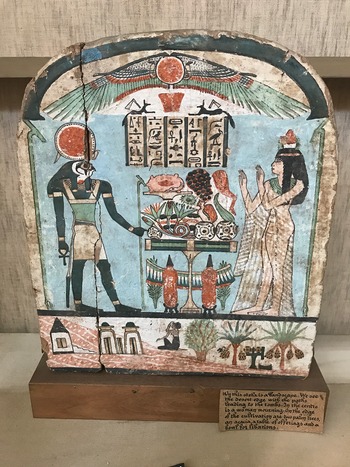
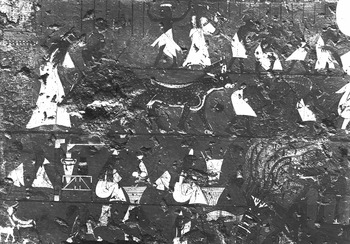
Ancient Egyptian head cones serve as a compelling example of how sensory memes recur across text, image and material, linking sense with shared cultural values. Depicted two-dimensionally in tomb art and attested archaeologically, this perfumed headpiece adorned both the living and the dead, beginning in the New Kingdom (c. 1550 bce). The cone’s form recurs in other related media: as a visual echo of the primordial mound from which Atum created all life (Lehner Reference Lehner2008, 166–7; Wilkinson Reference Wilkinson2003, 205; Fig. 1) or as unguent lumps in dishes (Fig. 2). This repetition illustrates how thoroughly the cone was embedded within a larger, shared sensory network.
Stela of Djedamuniu(es)ankh, 22nd Dynasty, Egyptian Museum. Bottom register depicts mourner seated before two tombs with mounded superstructures reminiscent of unguent set into dishes. (Image courtesy of Jordan Galczynski.)

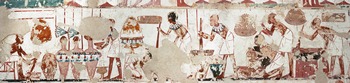
Unguent production scene from TT175 19th Dynasty. (© Uni-Dia-Verlag.)

As explored further in the case study below, the cone was not simply an object, but a material expression of the sensory meme that intertwined scent with health (both physical and ideological) and divinity. The intake of sweet-smelling air was a common trope used to signal divinely sanctioned life. This metonym appears in tomb scenes where the deceased is offered a bouquet of fragrant flowers. For example, in an offering scene from the tomb of Djeserkareseneb (TT38), the deceased is offered a ‘bouquet of Amun’ so that it might ‘exhale breath to [the deceased’s] nostril daily’ (Davies Reference Davies1963, pl. 3). This link between scent and vitality is reinforced with a visual and textual pun: the ancient Egyptian word for ‘bouquet’, ankh, is the phonetic equivalent of the word for ‘life’, encapsulating the connection between fragrance and the divine breath of life.
The repetition of the cone’s form, coupled with an emphasis in ancient Egyptian funerary literature linking pleasant fragrance with divinely sanctioned life, illustrates how sensory memes become codified through repetition across symbolic, material and textual registers. This interplay between scent, life and divinity—manifested here in wordplay, iconography and ritual—demonstrates how sensory values were culturally encoded and circulated. Investigating how the senses were valued in a society can help to uncover the cultural conditioning of sensory experience. These values, when repeated and shared, form sensory memes that shape how individuals engage with the world and help structure social and ritual practices.
To identify sensory memes archaeologically, the researcher must examine how the senses (or a sense) were valued in the past. The senses are the method by which living beings engage with the world, and the judgements we place on those experiences are defined through comparison with the memory of our other experiences, namely our cultural contexts. It is for this reason that sensory systems can vary so drastically between cultures. The judgements we place on our experiences, or, rather, the values we attribute to them, create, maintain and/or reproduce our cultures. This model leaves space for changes to take place within a cultural context due to the consequences of remembering and forgetting, which can be manipulated through changes in material culture (Mills Reference Mills, Mills and Walker2008; Wobst Reference Wobst, Dobres and Robb2000).
Similar to perception, objects are never neutral; they have ascribed values assigned by their makers and users. These values provoke positive or negative reactions based on our culturally conditioned judgements (Merleau-Ponty Reference Merleau-Ponty2004, 63). The judgements we apply to these reactions, whether physiological, emotional, or something in between, operate on affective scales rather than binaries—right to wrong, safe to dangerous, pleasurable to painful, etc. Though our feelings might be grounded in biology, the meanings we assign to sensory experiences are culturally contingent (Classen Reference Classen1993; Howes Reference Howes2022; cf. Ingold Reference Ingold2015; Reference Ingold, Rajala and Mills2017).
As Kemp (Reference Kemp1991, 2) writes, it is our cultural milieu which determines how we establish value judgements: ‘all avenues of perception are present in each one of us, but the use we make of them, and the value that we give to them, vary according to our culture’. Similar to how scholars such as Butler (Reference Butler1988) and Joyce (Reference Joyce2005) have discussed the body as a material display of performance, value ontogenetically is the material embodiment of action. Value is not fixed but is constantly ‘reborn’ as it becomes conditioned by, within and through materials and processes.
Sensory value also directly influences how we build relationships, whether with other people, things or spaces. Assessing the value of a sensory experience thus may require assessing how particular materials stimulate perception and how those effects might shape organizational practices. For example, placing a higher ideological value on an imported fragrance such as myrrh or mastic as opposed to a local fragrance such as papyrus or blue water-lily would require establishing a network to support, while also restrict, access to these highly desirable imports. In fact, one critical aspect of value is its role in negotiating a resolution between accessibility and desirability (van Wijngaarden Reference van Wijngaarden1999, citing Simmel Reference Simmel1907). Thus, this approach can offer insight into the motivation between not only the creation and use of materials, but the organizational processes that surround their acquisition, manufacture, dissemination and discard.
When the emic context is explicit enough to make a sensory hierarchy traceable, it is possible to enumerate singular senses in ancient contexts (Skeates & Day Reference Skeates and Day2019, 7–9). Murphy (Reference Murphy and Day2013), for example, argues that the scent of perfume at the palace in Mycenaean Pylos, a place renowned for its perfume production, reinforced a social hierarchy. Material, written and iconographic evidence accord perfume a high status through restricted access, effectively creating an olfactory landscape that reinforced elite status by limiting accessibility. In this example, scent and its ability to signal status is based on a shared belief. It is the intangible nature of scent that makes such social divisions difficult to challenge, embedding ideology in the very experience of daily life. As Mann (Reference Mann2012, 23 citing Bloch Reference Bloch1974) writes, ‘You can’t argue with a song’—or, in this case, a smell. In Murphy’s argument, perfume is the physical manifestation of a culturally legible sensory value and so it is possible to identify how its value(s) was encoded, experienced and maintained through shared practice and material forms. In short, identifying sensory memes requires tracing recurring sensory values by attending to the sensory affordances embedded in material culture. To recognize sensory memes in archaeological remains, we must reconsider how material culture participates in lived experience. In the next section, I turn to phenomenology as a framework for conceptualizing the networks within which sensory affordances shape and are shaped by ongoing action.
Phenomenology: a new look at an old take
Phenomenology has had a significant presence in archaeology as a framework for discussing ancient ways of being. Phenomenology’s complicated history makes it impossible to define singularly (Harris & Cipolla Reference Harris and Cipolla2017). Most commonly, however, phenomenology has entered archaeological discourse through Tilley’s A Phenomenology of Landscape (Reference Tilley1994). There, Tilley defines phenomenology as the study of the relationship between ‘being’ and ‘being-in-the-world’. This connection is mediated with the body, whether through sensory experience, movement, judgement, or memory (Tilley Reference Tilley1994, 12).
Tilley’s work has been foundational, but also seriously critiqued, largely due to the projection of his modern experiences onto his interpretation of landscapes once inhabited by ancient peoples (Bradley Reference Bradley2000, 42–3; Brück Reference Brück1998; Reference Brück2005; Hamilakis Reference Hamilakis2013). Tilley has responded to these criticisms, but the discussion continues (Tilley Reference Tilley2012). Scholars like Tringham and Danis (Reference Tringham, Danis, Skeates and Day2019, 52) emphasize that researchers must reflect critically on their own biases, with sensory archaeologies needing to be particularly honest. It may be impossible to know today exactly how aspects of a landscape were valued in the past, but attending critically to our own experiences might prompt new questions and methods to explore. Despite a contested legacy, phenomenology has inspired innovative approaches in landscape and spatial studies (Gillam Reference Gillam and Geisen2020; Rahmstorf & Stratford Reference Rahmstorf and Stratford2019), literary analysis (Nyord Reference Nyord2009a,Reference Nyord, Nyord and Kjølbyb; Reference Nyord, Grossman, Polis and Winand2012; Reference Nyord, Díaz-Vera and Caballero2013), experiential reconstructions (Pellini Reference Pellini, Pellini, Zarankin and Salerno2015; Tringham Reference Tringham, Gero and Conkey1991), and studies of materiality (Coole & Frost Reference Coole and Frost2010; McGregor Reference McGregor2019).
While these works are all uniquely valuable, where I find phenomenology particularly intriguing is in its philosophical roots. An early purpose of phenomenological studies was to understand the nature of existence by observing our relationship with the world in which we dwell. In Being and Time ([Reference Heidegger1927] Reference Heidegger1962), Heidegger argues that the material world is composed of equipment, which exists not as isolated objects, but as things integrated into action. When we become absorbed in activity, like the reading of this article on a screen or on paper, we relate to the equipment in use as ready-to-hand—the mouse for scrolling, the pen for note-taking, the computer for reading all disappear as discrete objects and instead exist as part of the ongoing task of reading. It is only when something breaks or is removed from its context that the equipment then emerges as ‘Things’, as objects present-at-hand (Heidegger [Reference Heidegger1927] Reference Heidegger1962, 16:103).
This way of viewing action has major implications for archaeological interpretation. There is never anything such as an equipment, because equipment is always part of a larger network (Heidegger [Reference Heidegger1927] Reference Heidegger1962, 15:97). Materials (or equipment) are relational in that they exist at the melding of action, intention, sensing and meaning. This relational network aligns with Ingold’s (Reference Ingold2015, 108) description of social life as interwoven lines devoid of objects. Ingold’s ‘atmosphere’ wherein one finds the ‘interpenetration’ of structure, line and relationships, seems to incorporate both Heidegger’s ready-to-hand mode, as well as Hamilakis’s trans-corporeal flow. Each philosophy seeks to tackle the conundrum of existing simultaneously as both ready-to-hand and present-at-hand.
Being-in-the-world and the relationships established therein are dictated by our ready-to-hand experiences which are defined by our bodies’ sensing capabilities and our contextual understanding of them. If we conceptualize scent and the capacity to smell as equipment, it becomes an essential aspect of dwelling in the world (Ingold Reference Ingold2015, 18). Smelling is not just physiological, but participatory. Fragrance is ready-to-hand, until it fails—an unexpected whiff of garbage, the absence of cooking smells in a kitchen—at which point it enters full awareness as a Thing. Merleau-Ponty (Reference Merleau-Ponty2004, 39) captures this idea when he writes that the world of perception ‘allows us to rediscover the world in which we live, yet which we are always prone to forget’. Sensory experience is more felt than noticed until we make the effort to reflect upon it directly. This dynamic between background processes and mindful awareness when centred in archaeological research promises to help demonstrate the importance of seeing material traces not as static objects but as equipment entangled in on-going action and relational networks.
By foregrounding the distinction between discrete objects and equipment, between the ready-to-hand and present-at-hand modes, phenomenology enables the archaeologist to explore how people dwelled in sensory-rich worlds. Heidegger’s goal with phenomenology was to reveal the ‘transcendental conditions’ that structure everyday being ([Reference Heidegger1927] Reference Heidegger1962, 5:38; cf. Harris & Cipolla Reference Harris and Cipolla2017). Through the application of this system of understanding to the past, archaeologists can do this too by being better able to question how scents, textures, sounds and the like actively participated in the structuring of ancient ontologies.
The senses contribute actively to how lives are organized, constructed and perceived. Thus, if we recognize that the sensorial is inherent in the material, it becomes possible to consider the trans-corporal nature of the senses as contextualized within various experiences in the past (e.g. ritual, trade, literary tropes) by first imagining how something was experienced and then tracking patterns of sensory values. We should seek not to identify a variety of discrete categories of sensory value, however, but rather shared meanings observable across specific contexts, i.e. sensory memes. The approach discussed here does not look at what materials are, but what they do. The ancient Egyptian head cone, for example, is not just a lump of perfumed fat. It is a Thing, in the Heideggerian sense—equipment that draws together breath, ritual, health, divine presence, aesthetic preference and vitality. It does not symbolize a sensory meme; it enacts it. It is not only symbolic, but functional, affective and atmospheric. With phenomenology, we can trace how materials are more than the sum of their parts—participating in the construction of social life through the senses.
If we aim to identify ancient Egyptian sensory memes, however, it is equally important to consider how the ancient Egyptians themselves conceptualized sensory experience. Language is one way of tracing this logic, particularly when it comes to slippage between visual and olfactory perception.
Ancient Egyptian texts frequently conflate seeing with smelling, showing a sensorial entanglement that challenges modern conceptual categories. Take, for example, this excerpt from a medical text in which milk is judged to be spoiled by its smell: ‘To recognize (mꜣꜣ) bad milk: you should find (mꜣꜣ) its smell like the stink of fish’ (Ghalioungui Reference Ghalioungui1987, §788). Though translated here as ‘to recognize’ and ‘to find’, the ancient Egyptian verb mꜣꜣ primarily means ‘to see’. In another example, this time from a Nineteenth Dynasty ritual text, the gods are recognized by those on the land by their smell: ‘They [the people] see you [the god Amun] when they smell your odor (mꜣꜣ⸗sn tw ḫnm⸗sn sty⸗k) for you will appear upon your land’ (Moret Reference Moret1902; Price Reference Price2018). A similar use of scent is used to identify the nearness of a love in Nineteenth Dynasty love poetry wherein the closeness of one’s desire is defined by one’s ability to smell them. In this context, another pun is used: the word sn meaning both ‘to smell’ and ‘to kiss’ (Price Reference Price2022).
The connection between smelling and seeing is relatively well established in the ancient Egyptian written record, thus linking the visual and tangible with the ephemeral and intangible. In these examples, smell triggers awareness, sparks recognition and signals presence. These sensory aspects were integral to how the ancient Egyptians navigated and interpreted their world.
The rhetorical melding of vision, smell and knowing bolster the argument that sensory experience is not only multivalent, but materially mediated—capable of being ‘seen’ in traces. It also offers the researcher a framework from which to understand how the ancient Egyptians designed and viewed visual media, not as static representations, but as equipment—participants in networks of overlapping experiences both ephemeral and tangible, complex and multisensorial.
The following case study on ancient Egyptian head cones takes up this approach. These cones are not singular artifacts or fixed symbols, but a sensory node—part of a dynamic network of meaning that materialized how scent organized experience, encoded value and shaped ancient Egyptian ways of being-in-the-world.
Archaeology with the senses: ancient Egyptian head cones
The ancient Egyptian head cone offers an effective illustration of the theories and methods so far discussed. Rather than examining this object as a discrete occurrence or static symbol (i.e. a ‘Thing’ present-at-hand), I argue for its recognition as equipment participating in a sensorially mediated, ontological network. By examining this material class as a sensory stimulant, I maintain its status in the readiness-to-hand mode. Namely, I investigate its ability to release aroma and the effects therein on human agency (i.e. its olfactory affordances).
Unguent head cones have long been assumed in Egyptological publications to be just that—cones of fat mixed with scented materials to form a type of perfume. These cones appear on the heads of individuals depicted in tomb art from the New Kingdom (c. 1550–1050 bce) onward and it is possible to date tomb scenes based on their length and width. Often depicted either with a differently coloured top and/or set within a floral fillet, the general assumption has been that these are scent cones.
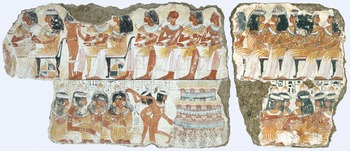
My argument that the head cones were scented is built upon their formal similarity with the mounds of perfumed unguent depicted in other contexts. We can compare the scene of unguent production from TT175 (Fig. 2) with the banqueters sporting head cones from TT90 (Fig. 3). The centre of the register of the scene from TT175 features a massive mound of unguent sitting in a footed vessel atop a knee-high stand. The unguent itself is two-toned with what appears to be an oily substance dripping down the sides. The banqueters, in Figure 3, wear similar two-toned mounds on their heads. Note how not only is the form similar, but so too are the colours (cf. Davies Reference Davies1925, pl. VII). Other examples of unguent mounds are depicted in figural ostraca (Backhouse Reference Backhouse2020, 93–6), coffins, stela lunettes, papyri and tomb scenes (Padgham Reference Padgham2012). Due to the formal consistency of unguent mounds, either as headwear or as offerings or decoration, in addition to the consistent appearance of unguent as a luxury and/or ideologically charged material, I would expect that this material and its visual form was recognizable as a coded symbol with strong olfactory notes.
Banqueters with head cones from TT90 Nebamun, BM EA 37984, 18th Dynasty, showing yellowed linens possibly from melted unguent head cones. (Image released under a Creative Commons Attribution-NonCommercial-ShareAlike 4.0 (CC BY-NC-SA 4.0) License. © The Trustees of the British Museum.)

Beyond two-dimensional representations, scented unguents are archaeologically attested. Calcite vessels from the tomb of Tutankhamun contained greasy contents that, according to the archaeologist Howard Carter, retained a faint lemon scent (Reeves & Reeves Reference Reeves and Reeves1995). Additionally, the cosmetics buried with Kha and Merit in the western necropolis at Deir el Medina (Sousa Reference Sousa and Sousa2019) retained their aroma, which I was privileged to experience myself during my visit to the Museo Egizio di Torino in 2018. The strength of the aroma struck me like a physical blow upon the opening of Sala 07 Vetrine 08 for the first time in the living memory of the staff working at the museum. The sickeningly sweet aroma that blasted forth was surprisingly fragrant.Footnote 2 This lived sensory engagement with the past testifies to the potency of ancient aromas and the atmospheric force scent can carry across millennia.
Interpretations of the head cones vary. Some scholars have argued for symbolic readings. Bruyère (Reference Bruyère1926) was the first to suggest that the tomb depictions of the cones were not representing material objects but instead were symbolic of the rebirth of the deceased. Cherpion (Reference Cherpion1994, 87) agreed with Bruyère arguing that the cones were likely symbolic metaphors, not only for the concept of rebirth but also for fragrance, highlighting a pun with the word sty, which means both ‘scent’ and ‘to beget’. Manniche (Reference Manniche2003, 84), building on Cherpion’s interpretation, added that the cone visibly represented the invisible. Although linen would not have been easily dyed by oils, the fat-based scent, as it melted, could have made people’s clothing shiny or greasy. The yellow colour of some garments seen in a variety of tomb representations perhaps expresses this phenomenon two-dimensionally (Fig. 3). Contrastingly, Padgham (Reference Padgham2012), doubting the olfactory component of the cones, offered a quantitative study that concluded the cones represent the deceased’s ba, a part of the ancient Egyptian ‘soul’.
Simpson (Reference Simpson2003, 306) countered the symbolic interpretations by suggesting that the cones were representations of true material objects made from lumps of animal fat or wax infused with scent and worn on the wigs of both male and female Egyptians as a moisturizer and perfume. Morant (Reference Morant2010, 107) added that the unguent cone’s scent would have produced an atmosphere representative of the deceased’s second life intertwining the symbolic with the material interpretations.
What unites these studies is their tendency to present the cones as discrete objects tied to singular meanings (e.g. cone = ba). These conclusions present the cones more as Things present-at-hand. These approaches, however, obscure the cones’ embeddedness within the wider network of sensory and social experience. The cone should not be thought of as a static symbol or discrete object, but as equipment—a node in a dispersed sensory network that includes everything from flowers, garments, music and drink to divine and mundane relationships, ideological power, sweat, grief and movement (Galczynski & Price Reference Galczynski, Price and Gouy2023).
This networked view of the head cone—as equipment expressive of complex sensorial and social dynamics—recommends reconsidering how we interpret visual displays. TT175 is a clear expression of visually depicted, sensory logic. TT175 is a tiny, New Kingdom tomb of an unknown owner, measuring 1 × 1.6 m (Manniche Reference Manniche1988). On the north wall, depicted just below two registers of sweetly fragranced partygoers, exists the most complete display of the preparation of unguent from ancient Egypt ever depicted (Fig. 2).
This register that displays the production of unguent is set below a scene similar to that depicted in Figure 3, wherein partygoers are well bedecked in scented goods. The placement of these scenes implies a connection between the two, highlighting the role material fragrances play in both images. The unguent cones present on the banqueters’ heads function as a crucial, yet partial aspect of the overall depiction, and the formal similarity between the large vessel holding an unguent mound in the production scene and the shape of the cones atop the banqueters’ heads drives the connection home. Other fragranced equipment such as garlands, floral fillets, and jars adorned with flowers add to the atmosphere. The cone does not function singularly as a static object, but facilitates the creation of a lived and scent-rich experience. To discover why so much effort is being put into depicting the invisibility of olfactory affordances visibly, we must expand our inquiry beyond the immediate depiction. Though possible routes of investigation might include reviewing other aspects of the depiction, its location in the tomb, the contexts in which the image might have been viewed or by whom, I choose to begin by reviewing the networked role of scent in elite ritual.
The centrality of olfaction to elite display, vividly represented in TT175, recurs across similar contexts. TT90 (Fig. 3), for example, likewise displays banqueters festooned in scent—floral fillets and collars, anointing oils offered by the servers, blue water-lilies and mandrakes held to noses. Even the wine jars stacked in the centre of the lower register are draped with floral garlands. The cone again plays an important role in the construction of this atmosphere, but is only one of many olfactory cues. Similar scenes of indulgent luxury are featured on the so called ‘scènes de gynécées’, depicted on figural ostraca (Backhouse Reference Backhouse2020) and other ritual tomb scenes (Price Reference Price2022). It may not necessarily be the specific scents that are important here, but rather the experience. These details, taken together, suggest these images not only record luxury, but materialize (and visibly record) the experience of indulgence itself.
Textual sources add weight to this suggestion. Contemporary feast lists and excerpts discussing festival preparations recorded on stone and ceramic fragments, i.e. ostraca, from Deir el Medina mention the gathering of scented oils and unguents for jubilant gatherings, alongside standard goods like food and drink, indicating their importance to celebration (O. DeM 293; O. DeM 127; O. DeM 551). Other texts, such as the so-called Harper’s songs, which often accompany tomb scenes depicting banquets, confirm the use of scented materials as a form of indulgence celebrating life’s joys:
Make holiday greatly, two times! Put ointment and incense you gathered at your side, and garlands of lotus and mandrake to your chest. The one who [sits] at your side is the woman who is in your heart. Do not let your heart be angry on account of anything that has happened. Set song in front of your face, do not recall evil, the abomination of god. Recall to yourself joys. (Tomb of In-her-khau: McDowell Reference McDowell1999, fig. 20)
Desirable fragrances, like incense and fine ointments, were crucial elements in the celebration of life.
Even outside restricted elite use, scented goods were integral to marking special occasions and affirming social ties through gifting and exchange among friends and families. Scented oils including nḥḥ, tj-šps, ḳnnj, bꜣḳ and snṯr, for example, were gifted to a woman for a special occasion (O. Cairo CG 25677 and 25678). This exchange is echoed in royal art as well, like in Ankhesenamun’s presentation of an elaborately bedecked unguent cone to King Tutankhamun on the little golden shrine (Cairo JE 61481). Backhouse writes of this exchange (Reference Backhouse2020, 96), ‘The inclusion of the cone in both domestic decorative schemes and funeral scenes suggests it had a meaning beyond adornment. It appears to be linked to the receipt of offerings and gifts’. These practices are not merely symbolic but reflect an embodied sensory economy in which scent was materially exchanged, affectively charged and socially meaningful. Unguent cones, whether worn, depicted, or described, function as a node within this larger network of fragrant relations—ones that celebrated life through sensory indulgence, marking intimacy between individuals and cultivating elite identity.
Scent was not exclusively used in celebrations. It also functioned as a marker of social difference between the desirable and the undesirable. One example comes from the New Kingdom text ‘The Teachings of Dua-Kheti’. In the narrative, a father, Dua-Kheti, seeks to convince his son to become a scribe by criticizing the work of other professions. When speaking of a coppersmith, for example, he warns, ‘He stinks more than fish eggs’ (Hoch Reference Hoch1991, 90). This insult wielded by Dua Kheti reveals how aroma can be weaponized to enforce social hierarchies through the assumption of shared norms. The father’s statement implies: we all know fish eggs smell bad, and smelling bad is bad, so don’t be a coppersmith because then you’ll smell bad. Several assumptions go into the building of this argument: (1) that everyone agrees fish eggs smell bad; (2) that smelling bad is a universally accepted standard by which to judge people and professions; and (3) that coppersmiths all smell like fish eggs. None of these three points are objective truths. Rather, they are culturally constructed beliefs that must be accepted for the insult to hold weight. And, like most social norms, their power lies in repetition; once repeated enough times, the assumptions begin to feel ‘natural’.
This is the real strength of sensory prejudice. Because the senses are processed through the body, the values we ascribe to those experiences often feel like universal truths rather than constructed beliefs. In this way, scent is not only a display of luxury and elite ideology, but can work as a tool for enforcing social stratification.
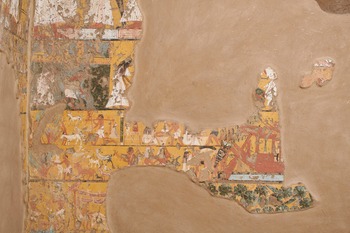
From this discussion, one might assume that the head cone would be restricted to ritual or upper-class contexts. Yet, in a striking departure from artistic decorum, a market scene from TT217 preserves at least three well-dressed women with elegant coiffures bartering bread, fish and onions while wearing head cones (Figs. 4 & 5) (TT217: Davies Reference Davies1927, pl. XXX). These women wear layered linen dresses, floral beaded collars, fillets and large earrings, all similar to the women from the banquet scene in TT90 (Fig. 3). The contexts, however, are quite different. Surrounded by half-clad men of various ages and statures carrying out manual tasks such as herding animals, carrying baskets and harvesting plants, the women here who wear cones (at least as far as the preservation allows) seem to be participating in jobs involving particularly smelly materials. In the bottom register, a women wearing a cone reaches up toward a large bundle of onions held up by a portly man framed by two children—recognizable by their nudity. The older child towards the back of the onion bundle holds an intricate, multi-tiered floral bouquet. Above this register two other women wearing cones sit on low stools before baskets exchanging round bread loaves and fish for containers of other goods with men standing before them (note that their heads are only preserved in Figure 4).
East wall, north side, from the transverse chamber of the tomb of Ipuy (TT217) 19th Dynasty. Centre of lower register shows two women wearing head cones who are seated before baskets and are offering up their wares for exchange. (Image released under a Creative Commons license CC0 by the Museo Egizio di Torino.)

Current state of preservation of the east wall, north side of the Transverse Chamber of the Tomb of Ipuy (TT217) 19th Dynasty. Note the women in the lower registers wearing head cones. (Photograph: Matjaz Kačičnik. Image courtesy of the TT217 Project, directed by Kathrin Gabler, in the framework of the IFAO mission d’étude et de conservation Deir el-Médina.)

A moment of democratized indulgence or a marker of social difference? The presence of cones in this scene certainly draws out the question of how olfactory affordances and their visual proxies operate across social registers. While the cones may continue to point to joyful indulgence, their use here may also speak to their role in odour management. In this case, the same fragranced object that marks elite indulgence and divinely sanctioned breath now appears in a seemingly mundane marketplace full of strong-smelling goods and animals. Its presence here suggests that olfactory affordances could be mobilized to reinforce social and/or spatial boundaries through the suppression of some aromas with the addition of more desirable ones. The women wearing these cones wear fine costumes so perhaps their display, which includes the cones, marks them as distinct from those around them. It is important to remember, however, that this depiction of ‘mundane’ life is still located within an elite tomb and may reference an idealized tableau rather than a reality.
The suggestion that the cones worked to suppress simply undesirable odours is certainly not the only way to read this scene. The suppression of negative scents is a crucial aspect of the mummification ritual, for example, and so, the desire to do so might be broadly relevant across funerary and/or mortuary contexts (Assmann Reference Assmann2005, 126–7; Price Reference Price2022). If fish, onions, or even bread carried undesirable or dangerous olfactory implications (which must be demonstrated, not assumed), then the presence of the cones and floral bouquet here could be sensory counteragents, akin to the ritual ‘killing’ of dangerous forms like horned vipers and hippopotami by showing them pierced with knives, separated into parts, or missing limbs (Miniaci Reference Miniaci, Betrò, Friedrich and Michel2024; Ritner Reference Ritner and May2012; Russo Reference Russo2010; Stanton Reference Stanton2014). This design choice then employs the head cones prophylactically, warding off both physical odour and symbolic pollution.
We are tasked with remembering, however, that due to the overlapping nature of ontological networks, our interpretations are rarely mutually exclusive and more often than not are co-constitutive. The scent cone works as equipment employed in the celebration of life, the setting of social and/or spatial boundaries, and in the creation of a protective atmosphere. This is not an either/or situation, but a both/and.
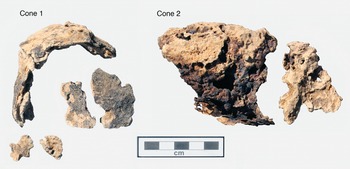
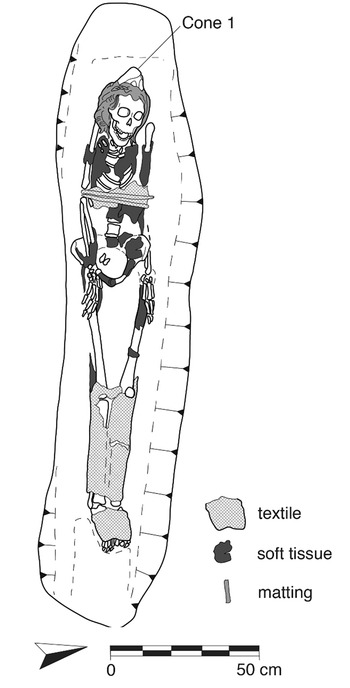
It was not until 2019 that nearly complete material examples of these cones were widely published. Two examples were uncovered in two separate burials at Amarna (Kemp Reference Kemp2010; Stevens et al. Reference Stevens, Rogge, Bos and Dabbs2019; Figs. 6 & 7). Cone 1 belonged to ‘Individual 150’, who was 20–29 years old at the time of death. She was buried with a hollow cone of a ‘pale, brittle, waxy substance (object 39920)’ on the top of her head (Kemp Reference Kemp2010, 3; Fig. 7). The interior of the cone showed impressions of ‘short, randomly clustered lines that crisscross’, suggesting the cone’s centre may have been made from organic matter. The cone was a ‘creamy brown with dark stains, mainly on the outside’ and had a ‘silky feel’ (Stevens et al. Reference Stevens, Rogge, Bos and Dabbs2019, 1520–21).
Remains of head cones excavated at Amarna, Egypt. Cone 1 was found in 2010 in the South Tombs Cemetery, buried with Individual 150, a 20–29-year-old female. Cone 2 was found in 2015 in the North Tombs Cemetery. It was buried with individual 1032, a 15–20-year-old. (Image courtesy of the Amarna Project.)

Burial of Individual 150 interred at the South Tombs Cemetery at Amarna, Egypt. Excavated in 2010. (Illustration: Mary Shepperson. Image courtesy of the Amarna Project.)

Cone 2 was in much worse condition, having been found in a disturbed burial. This deceased individual was 15–20 years old. Diffuse reflectance infrared Fourier Transform Spectroscopy identified both cones as made from biological wax, likely beeswax, and there was no waxy residue noted on the hair of the deceased (Stevens et al. Reference Stevens, Rogge, Bos and Dabbs2019, 1517). Both burials were from ‘non-elite’ graves, of which there are approximately 700 at the site.
Though unclear, more of these cones may have been excavated. Jolanda Bos wrote of the 2011–12 season at the South Tombs Cemetery at Amarna, stating ‘On many skulls remains of possible fat cones were discovered again this season, either in the form of loose fragments of cones or where individuals had either a discoloration of the hair, tissue, or bone which may have been the result of the melting of these possible cones’ (Kemp Reference Kemp2013, 20). That Bos says ‘again’ in this description suggests that this revelation was not the first of its kind.
The discovery of these cones in burials at Amarna suggests that they were more than symbolic motifs only depicted in visual media. They could in fact be tangible objects worn on bodies—certainly in death, but perhaps in life, too. Though their presence in non-elite graves complicates the suggestion that unguent cones were markers of elite luxury and divine favour, it does not disprove that their form alone could communicate the presence of a complex network built around the value of scent. In the same way that flowers lying atop jars signal their invisible contents, so too would I suggest that these cones could materialize fragrance and its associated values (Price Reference Price, Candelora, Ben-Marzouk and Cooney2023).
These cones exemplify how the ancient Egyptians were able to blur the lines between visual, material, written and sensory registers. Neither abstract symbols nor utilitarian objects, the cones were participants in an embodied sensory economy—worn, exchanged, remembered. Their discovery archaeologically invites us to consider how something as intangible and ephemeral as scent was rendered durable and meaningful across social strata as a veritable ready-to-hand manifestation. Taken together, this case study illustrates how scent functioned as equipment—integral to how the ancient Egyptians navigated, perceived and made sense of their world.
Conclusion
I began this article with a quote from Kemp, and I repeat part of it here again to conclude: ‘Although archaeology can only deal with the material debris of life, we should not forget that the places we study were once lived in by real people’ (Kemp Reference Kemp2012, 195). While many of the sensory aspects of ancient life may be beyond us, much remains accessible. The senses are culturally constructed, being restricted by but not dependent upon our physiology. Therefore, through the intentional and honest incorporation of the imagination into our research process, it is possible to identify the sensory values embedded within the materiality of the past. Because material culture is both a product and driver of sensory experiences, archaeologists can identify how the senses are valued and, thus, how the senses shape social interactions and societal processes.
The case study demonstrates how approaching material remains as the embodiment of sensory values is an effective approach to navigating the difficulties of accessing a sensorial past. Researchers can investigate the senses and their ancient values as they manifest in material culture, not as objects in an object–subject dichotomy, but as equipment involved in ongoing action or experience. The ancient Egyptian head cone is not only a visual motif or a burial item, but an integral component of ancient Egyptian sensory life. Their use in elite and non-elite contexts underscores scent’s capacity to influence experience across social strata. Just as scent often is only noticed when it fails to meet expectation, so too does the cone only become manifest as a Thing when its context or function is disrupted. This case study shows not only how scent was represented, but how it made a world.
In framing materials in Heidegger’s readiness-to-hand mode and Hamilakis’s trans-corporeality, we can track how sensory values are less abstract ideals and more culturally embedded, material forces. These values persist across media and contexts, forming what I call sensory memes: shared patterns of embodied perception that recur across space, time and context.
For anyone who has ever licked a pot sherd to see if it is actually a rock, the senses have long been central to archaeological work. I approach the study of sensory experience in the past by examining the interplay of the values of scent in the material traces of ancient Egypt. The senses can be studied in the readiness-to-hand mode through textual and two- and three- dimensional examples to understand their participation in the relentless activity of the past.
It is important, however, to recognize that a single sensing mechanism never functions in isolation. The senses, being implicit and often unconscious, are constantly working alongside one another to create holistic experiences. To the researcher, these spaces often appear complex or even chaotic, where both too much and not enough information is present. By beginning singularly and seeking to uncover shared sensory memes across contexts, piece by piece the messiness of multivalency might be tracked and organized into a coherent picture of the past.

 Open access

