




Introduction
It was late in December when Gabriel Fauré was ‘just completing’ his Trois Préludes. Knowing he would not be done by the end of the month, he wrote to his publisher politely asking to ‘add ten days onto 1909’.Footnote 1 These were the last works he could claim to provide by the end of 1909, when, according to his contract, he was to have supplied a total of 30 works. In addition, he was to complete his opera Pénélope, for which he signed a separate contract (and composed over the course of six summers, 1907–1912). He had, in fact, sent 24 works, some of which were reworked from earlier compositions.Footnote 2 The rest of the preludes known as opus 103 (numbers 4–9) were submitted a year later: together, they filled the quota.
This article will explore the first three preludes, which form a separate unit within the entire opus, as a flow of self-borrowing. This is most evident through the pervasiveness of the shared arpeggiated gesture which seals ‘Ô mort, poussière d’étoiles’ (La chanson d’Ève [Op. 95]), completed around the same time as the preludes. However, the article uncovers a wider web of self-references which evokes, aside from Ève, three other of Fauré’s vocal-work heroes. In the three-prelude unit, echoes of Mélisande and Pénélope’s chanson de toile converge with Prométhée’s flame into a cyclic reference. The article thus continues earlier discussion of allusion, homogeneity and self-borrowing in Fauré’s works, often discerned in works written in close proximity.Footnote 3 However, this exploration targets these issues in context of Fauré’s self-proclaimed struggle while writing the trois preludes of Op. 103, where he combatted a combination of dry inspiration and time constraints. Due to their untraditional traits, the article suggests rethinking the three preludes as a unit of nocturne-préludes. Additionally, self-quotation of both the deliberate and unconscious kind is suggested as method to overcome compositional impasse in face of a tight deadline.
Fauré’s Piano Oeuvre in Context
In his 1922 review of Fauré’s life achievements, Alfred Cortot defined Fauré’s nine preludes as a série, distinguishing between the first three and last six.Footnote 4 Preludes 4–9 were at that point still published separately – only in 1923 were they bound together with the first three as Neuf préludes.Footnote 5 Given Fauré’s contract deadline, the impetus for writing three preludes, and then another six, seems rather prosaic. Fauré himself had probably not originally planned the opus as containing nine pieces, and his publisher must have originally expected more as well: Jean-Michel Nectoux points out that early editions of the nine preludes included the subtitle à suivre and suggests the enlargement of the project was abandoned when Fauré moved to Durand in 1913.Footnote 6 Gustave Samazeuilh expected the same in his 1911 review of the six preludes when describing them as those ‘which seal, for now, the series begun last year’.Footnote 7 As I will later detail, it is possible Fauré had not even committed to a series of preludes when he began their composition; Caballero points out Fauré’s general avoidance of titles and suggests he might even have preferred the most neutral, such as pièce.Footnote 8
Works from around 1906 and onwards fall into what many scholars identify as Fauré’s late style, corresponding to his assuming directorship of the Paris Conservatoire.Footnote 9 Norman Suckling claimed the nine preludes look forward to the type of works one would expect Fauré’s pupils/successors to write and suggested that the preludes contain his most pure and ‘strongest’ music – comparable to the relation between Chopin’s preludes and the rest of his work.Footnote 10 The composer Aaron Copland went so far as to place Fauré’s sixth prelude side-by-side with the ‘most wonderful’ of Bach’s Well Tempered Clavier.Footnote 11 Robert Orledge laments that the piano music from this period is ‘relatively little known, especially the nine Preludes, perhaps because there is a certain gravity, an almost angry feeling to much of it’.Footnote 12 Émile Vuillermoz wondered ‘why pianists pretend to be ignorant of this collection and never program one or two of these preludes together with those of Chopin or Debussy’, as it includes ‘not a single sign of weakness’, but rather a freedom of construction and disconcerting youthfulness.Footnote 13 Cortot found each prelude to be individually coloured, without damaging ‘the striking unity of the whole’.Footnote 14
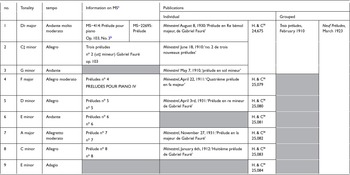
A substantial portion of Fauré’s solo piano works date from around this period: the nocturnes 9–11, barcarolles 7–11, and nine preludes were all composed between 1906 and 1914. The preludes occupy a single opus, however, and were written within a year. Marguerite Long assigned the entire opus to a category she called ‘music of reason’, together with the 1895 Thème et variations Op. 73 and various fugues.Footnote 15 Nectoux considered the opus as made up of three sonic categories, nocturnal, virtuosic, and polyphonic.Footnote 16 The opus may also be divided into three groups, each containing three units abiding by tempo order of moderately slow–fast–slow, and modal order of major–minor–minor.Footnote 17 The tonalities, however, do not bind into a coherent pattern upheld by the tripartite division, as they mostly do, for example, in La chanson d’Ève,Footnote 18 and neither do the dates or location of composition correspond. The first three were part of the 1 January contract, written in Paris within roughly a month, nos. 4–7 were written during the summer months roughly a month apart, and the last two were completed during the last weeks of 1910, back in Paris. The six preludes were received together by Heugel as a group on 11 January 1911, a full year after the first three were deposited and published individually; the Ménestrel aux abonnées piano series also ran them in the odd order of numbers 3, 2, 4, 8, (1911–1912). Only nearly 30 years later, and after they had been published together as Neuf préludes were nos. 1, 5, and 7 published within the series (1930–31), nos. 6 and 9 never were (see Table 1).
Prelude groupings

a I have consulted scanned manuscripts for preludes 1-2 and 4-8 only. Preludes manuscripts housed at BnF are MS414 and MS22695 (first prelude); 17767 (second prelude). Preludes 4-8 manuscripts are housed at the Morgan Library and Museum, Dept. of Music Manuscripts and Books, F2655.P924.
b It appears that both first and third preludes bear the designation “no. 3” on their manuscript. See note 37, below.
The French keyboard prelude of the nineteenth century had been stamped with the example of Chopin’s set of preludes, Op. 28 (1835–39), written as a homage to Bach’s Well Tempered Clavier (BWV 846–893). Charles-Valentin Alkan’s 1847 set of preludes continued this tradition (it too included individual titles but concluded with a twenty-fifth prelude returning to C major (Op. 31)). In 1897 Isidor Phillip edited Études d’octaves: d’après Bach, Clementi, Cramer, Chopin to which Fauré contributed his only other piano prelude – a 16-bar long prelude in C major. More relevant to Op. 103, however, is Roger-Ducasse’s Six préludes written 1908, and Debussy’s first book of preludes, written between December 1909 and February 1910. Both followed Alkan’s example by attaching a title to each prelude, even if Debussy’s were printed at the end of the piece. Unlike Fauré, Debussy worked quickly and easily and abided by Bach’s legacy of a set of 12 preludes, joined in 1912 by a second set of 12 more.
Contrary to the preludes written in close succession, Fauré’s nocturnes span nearly 40 years of composition and several opus numbers, from Op. 33 (nocturnes 1–3) to 119 (nocturne 13).Footnote 19 Departing from the salon idiom explored in the 1880s nocturnes, the 1890s nocturnes grow in breadth of both form and tone, and by the twentieth century they verge on the experimental.Footnote 20 Nocturnes 9 and 10, written in 1908, for example, are possibly closer to a prelude idiom, and also darker than the earlier ones; likewise, the preludes written in 1909–10 traverse the borders between prelude and nocturne. The tenth nocturne, specifically, was worked under similar circumstances to the three preludes. Writing in September 1908 from Lausanne, Fauré mentions how much harder this summer work is compared to previous years, and that he must take time off working on Pénélope to create a sketch for the tenth nocturne which, if not finished in a day, he will finish at the beginning of the school year.Footnote 21 This, apparently, was his plan a year later with the preludes.
Vladimir Jankélévitch indirectly pointed to this blurred nocturne-prélude Fauré had forged when he classified the first prelude as a ‘“nachtstück”, a piece of the deep night’,Footnote 22 and I extend this appraisal to the third prelude as well. The second prelude, however, even if ending in a nocturnal mode, is mostly cast in the unlikely 5/4 time-signature in sextuplet punctuation. This may fit into the nocturnal if we enlarge its conception to include the likes of insomnia; this connects to Bryce Morrison’s description of the fierce climax of the tenth nocturne which ‘belongs in the world of nightmares’.Footnote 23 Both are capped by a calm coda.
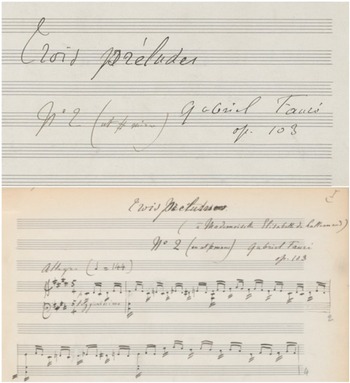
Another angle on the preludes’ nocturnal arc comes from the manuscript, where we find Fauré in his rush to copy his preludes and send them out to Heugel, making two corrections: For the second, frenzied, prelude, the title ‘Trois Nocturnes’ can be read beneath ‘Trois préludes’ (see Figure 1). Similarly, on its title page, a tell-tale n, for nocturne, has been changed into a p as well (by lengthening the n’s left leg; see Figure 1, top). Is this evidence that Fauré originally meant to write three nocturnes (continuing the set of ten already writtenFootnote 24), but pivoted to the less binding categorization of preludes after the second was written? Although a decisive answer cannot be established, the penwork suggests the combination of indecisiveness and hurriedness, and leads the discussion to the presence of a deadline.
Fauré, Trois Préludes, Op. 103, no. 2. Title page (top) and first page of score (bottom). Bibliothèque nationale de France, département Musique, MS 17767.

Unlike the next six preludes, the trois préludes were sculpted entirely at the eleventh hour, which resulted in the design of themes dense with yesterday’s drafts of unrelated works. This would not be the only instance of such a cross-over: Rumph mentions the echo of La chanson de pêcheur in the Op. 33 no. 1 Nocturne in E-flat minor, that is the borrowing of a freshly written mélodie theme into an unrelated piano work.Footnote 25 Caballero more broadly defines such borrowing as an ‘echo both understandable and spontaneous’ when pointing out the presence of the particularly disguised love theme from Pénélope in the eleventh barcarolle, written in its immediate wake.Footnote 26 For the 1909 preludes, however, I propose an intricate web of connections with the larger vocal compositions of the time, primarily, La chanson d’Ève, but also the first two acts of Pénélope. All in all, these preludes not only highlight Fauré’s idiosyncratic form of nocturne-prelude but also reveal the mining of older works and connections to other portions of Fauré’s oeuvre, especially those written with pressing deadlines.
Fauré’s tenure as head of the Paris Conservatoire replaced the arguably tedious work at the Madeleine organ with the equally time-consuming administrative duties of directorship and curriculum reformer. Most of Fauré’s composition efforts were delegated to the summer months, which in 1908–1910 Fauré spent mostly in Lausanne and Lugano. The deadline may have been unusually looming in December 1909, however. Writing from Lugano in July 1909, Fauré is aware of ‘owing’ Heugel five works (at that point sketches for Chanson d’Ève), which, perhaps based on his experience with the tenth nocturne, he imagines will be relatively easily completed in Paris during November and December; he takes two days off to provide Heugel with ‘fodder’ explaining he will work better on Pénélope when he feels he has advanced with his contractual duties.Footnote 27 As proof that some of the workload had to do with being Conservatoire director, later that summer Fauré mentions that correspondence with the Conservatoire has mercifully slowed down.Footnote 28 In his 1909 summer letters from then on he was happy with his progress, finding the rest and vacation conducive to composition; he was, however, wrong in his calculation that he owed only five works, or that composing music from Paris in December would go easily.
In her discussion of La chanson d’Ève (Op. 95), Katherine Bergeron links the work’s new aesthetic with Fauré’s modernizing reforms at the Conservatoire.Footnote 29 In the context of Op. 103 I suggest the administration–creation balance had tipped in a manner which influenced Fauré’s inspirational fluidity. Moreover, while there is evidence of Fauré’s brush against deadlines for the Requiem and Prométhée, for example,Footnote 30 Fauré’s letters describing work on the preludes give the impression that it was not only plagued by time constraints but was also both uninspired and frustrating – a task to fulfil a contract. Marguerite Long mentions that Fauré was pressed for time and preoccupied with his finances when he took up the continuation of his preludes;Footnote 31 in letters to his wife Fauré himself dryly reported, twice, on the amount made per prelude.Footnote 32 When writing to her about the sixth prelude, with only a few bars missing, Fauré also wondered if piano music is the most difficult medium of all. He was, in this prelude, ‘making every effort. The only trouble is, the effort can’t go any more quickly’.Footnote 33 The inability to expedite the creative process, or ‘effort’, had been a much greater concern a few months earlier, while writing preludes 1–3, however. As he confided to Mme. Hasselmans, in a letter dated to December 1909: ‘I’m struggling with a prelude … but it doesn’t tell me much … I’m afraid my miserable imagination is worn out’.Footnote 34
The difference in tone between the description of the sixth prelude as an effort, and one of the first three, as a struggle, is fundamental to this study.Footnote 35 When Fauré’s described the sixth prelude’s composition as an effort, there was no foreseeable deadline, yet Fauré still could not expedite the process much. At this time, Fauré’s approach was perhaps becoming more corporeal/tactile, due to his hearing loss; he complained about this in relation to the preludes written in August specifically.Footnote 36 In contrast, though, when he described one of the first three preludes’ composition as a struggle, it was the deadline that was close at hand. We may, of course, interpret Fauré’s statement in more ways than at face value. The sentiment expressed remains, however, of a strained creative process more forceful in December 1909 than June 1910.Footnote 37
When analyzing the three-prelude unit in this context, several observations arise. The presence of a dense and arpeggiated pattern-gesture that concludes La chanson d’Ève, written in parallel or within days of the three preludes, suggests it had morphed into a thematic earworm. This is joined by self-borrowings of themes, metrical cells, and tonalities related to Mélisande, Prométhée, and Pénélope. The pressing deadlines in which parts of these stage works were created adds another dimension to the homogeneity explored, thus providing a fresh angle on the rich and allusive web Fauré crafted in his elegant late style for the three nocturne-preludes of Op. 103.
Self-Borrowing, Compositional Impasse, and Ô mort
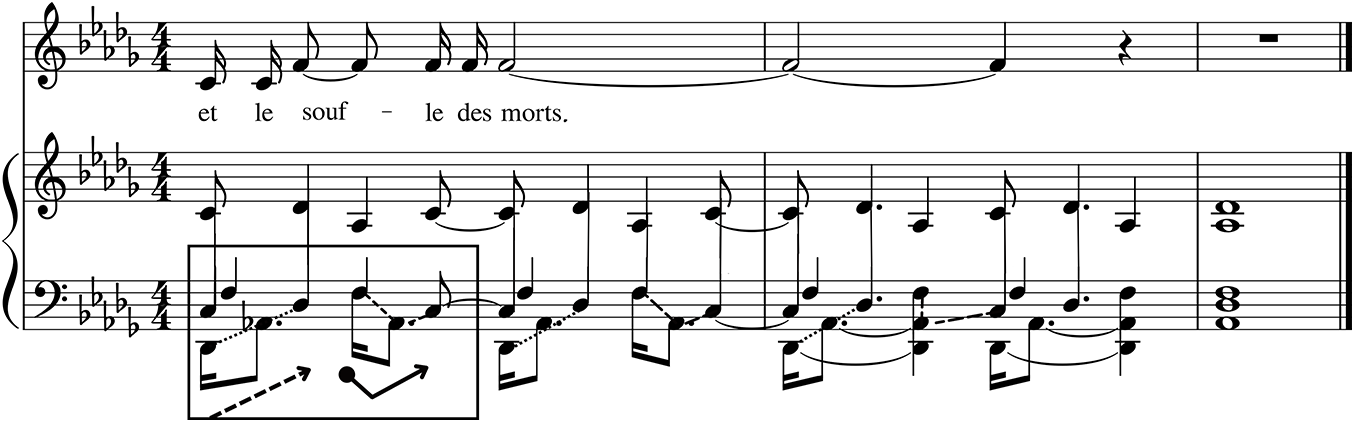
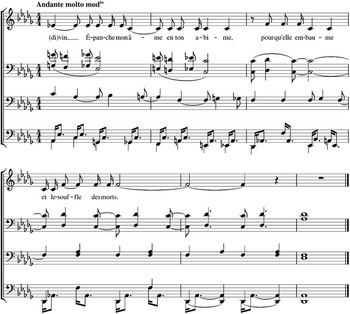
As opening for my analysis, I present the concluding bars of La Chanson d’Ève, No. X: ‘Ô mort, poussière d’étoiles’. As I hope to demonstrate, the rise-and-fall gesture introduced to accompany Ève’s looming death, the souffle des morts (breath of the dead), is a three-part ripple contained by an arpeggiated I7– $\text{I}^{\binom{6}{4}}$ motion. It holds the three preludes together – most notably in their endings, and effectively creates a suite of nocturne-preludes. To establish this connection I shall first chronicle instances of compositional impasse and deadlines in Fauré’s stage work oeuvre, mostly related to female protagonists, and self-borrowings found there. I will then turn to more fully unlock and monitor the Ô mort gesture through the preludes (see Figure 2 and 3).
Fauré, La chanson d’Ève, X: ‘Ô mort, poussière d’étoiles’ ending gesture.

Fauré, La chanson d’Ève, X: ‘Ô mort, poussière d’étoiles’ ending bars as parallel processes.

One of the most pressing deadlines of Fauré’s career might be that in which Pelléas et Mélisande was brought to life: merely two months from commission to premiere, 5 May to 12 July 1898. Quite unable to meet the deadline, Fauré handed the orchestration of the drafts over to his former pupil, Charles Koechlin. Fauré expressed this strain as follows: ‘I know nothing about anything anymore. I only know that I will have to grind away hard for Mélisande when I get back. I hardly have a month and a half to write all that music. True, some of it is already in my thick head!’Footnote 38
The intense stress of composition during this period may have had a part in the most pronounced of Fauré’s self-borrowing: the double insertion of the Sicilienne,Footnote 39 published first as Op. 78, into Mélisande’s incidental music, which was then reworked into an orchestral suite (Op. 80).Footnote 40 It even seems to have been the first of the drafts handed over to Koechlin, ‘used as a starting point’ for the entire score.Footnote 41 It surely was a challenging summer: Regarding a minor flute competition piece, Op. 79, Fauré complained to Saint-Saëns in July 1898 that nothing had ever given him as much trouble.Footnote 42 This demonstrates how Fauré experienced composing works with a looming deadline as a battle, struggle or pain before Op. 103; he also repeatedly used self-borrowing as a means to shorten processes. Fauré mentions the trouble with the flute piece (Op. 79) near the ‘grinding away’ at Mélisande (Op. 78 and 80) in 1898, and the struggle with ‘a prelude’ in 1909.
The presence of a deadline may either serve as an incentive to complete a commission or bury it: a cutoff date clearly exacerbates the tension involved. It may heighten the sense of a struggle with the music being composed and impose a strain on the creative impulse and process. This is not to say, of course, that working without a deadline is not a struggle, such as what Fauré described later in 1911 as ‘the wrestle with Pénélope’s unravelling cloth’.Footnote 43 Yet setting these past deadlines chronologically, the Requiem, flute compositions, and the themes and characters of Pelléas et Mélisande and Prométhée were, by association, on Fauré’s mind in 1909, when a contractual deadline was again tormenting him, now with the added stress brought on by being head of the Conservatoire. This is significant to the discussion of the preludes because the reorchestration of the Mélisande orchestral suite based on Op. 80 with the insertion of the Sicilienne, the last two instalments of Chanson d’Ève, the work on certain parts of Pénélope and the three first preludes of Op. 103, are all found in Fauré’s 1909 output (and its ten ‘leap days’).
Even more precisely, Fauré was putting the final touches on the last of Charles van Lerberghe’s poems included in his song cycle La chanson d’Ève, right around the same time as the preludes were begun.Footnote 44 Ending the cycle of Ève’s life, which started, counter to the Biblical narrative, on the first morning of creation (‘C’est le premier matin du monde’), the text of the last poem is Ève’s death wish: birth is light, but at this point Ève is no more than a trembling flame, a speck of sun. The nocturnal atmosphere of the sealing song, Ève’s self-Requiem, if you will, is bound to the text. Death is stardust that shines in the darkness, and Ève wishes to be absorbed into the dark earth. If only through the shared time of compositions, the last of van Lerberghe’s lines included in Fauré’s cycle are related to Trois preludes.

For the last nine bars of this text, Fauré introduces a syncopated pattern in the pianist’s right hand; in the left, a dotted rising interval, which gradually descends towards the tonic. Perhaps illustrating the ‘flaming wine of heavenly fragrance’, in preparation for the oxymoronic ‘breath of the dead’ which ends the song once Ève’s soul is ‘poured’, both right- and left-hand motion is wavy and descending. I present these ending bars, now divided into voices, to bring out the different layers Fauré created to express the Symbolist nuances of the text: these suggest that a departing soul is flickering (flamme), airborne (fragrance/breath), and liquid (épanche). Apparent are the bottom line of rise and fall, middle line of oscillating third, and upper line of oscillating third-second. The contour is brought to its close following the word morts and for the purpose of this analysis I label it the Ô mort gesture (in contrast to ‘Ô mort’, the song title.) It is self-borrowed, in variation, into the three preludes.
The Ô mort Gesture through Trois préludes
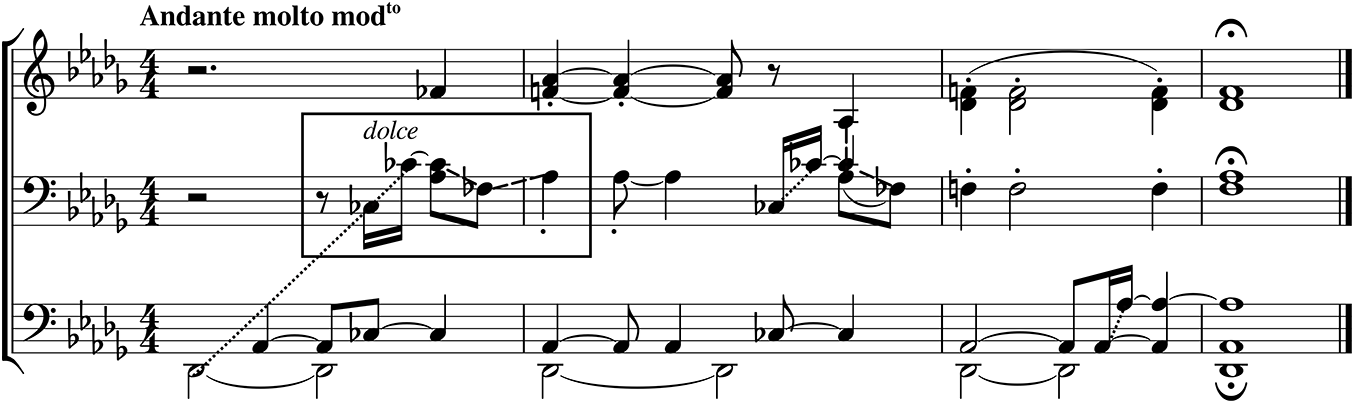
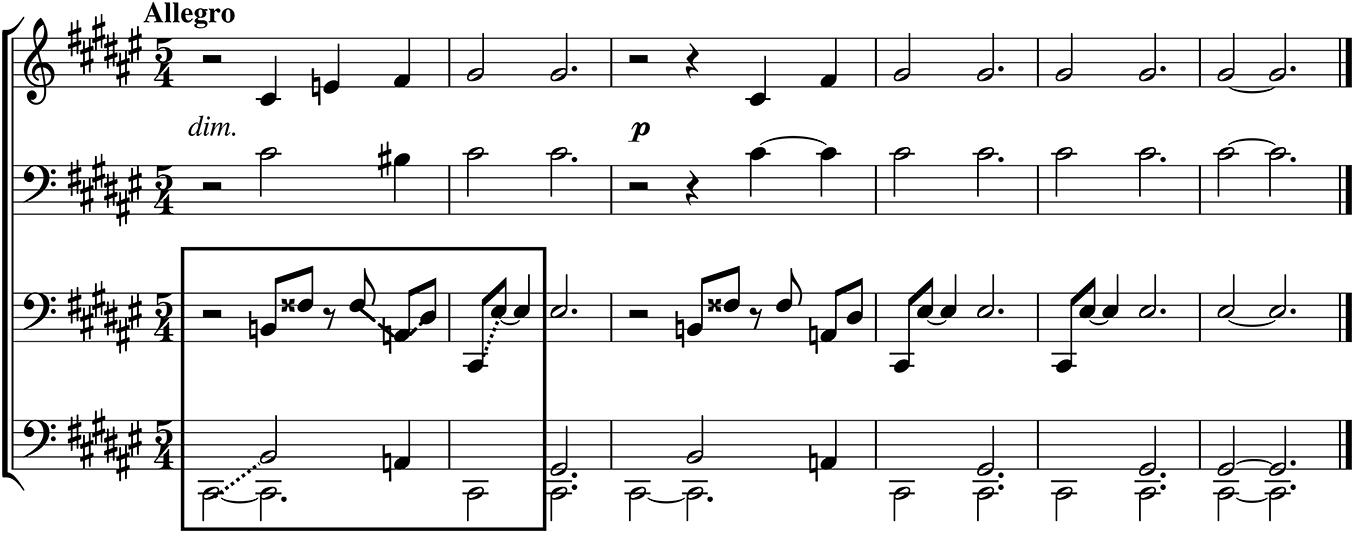
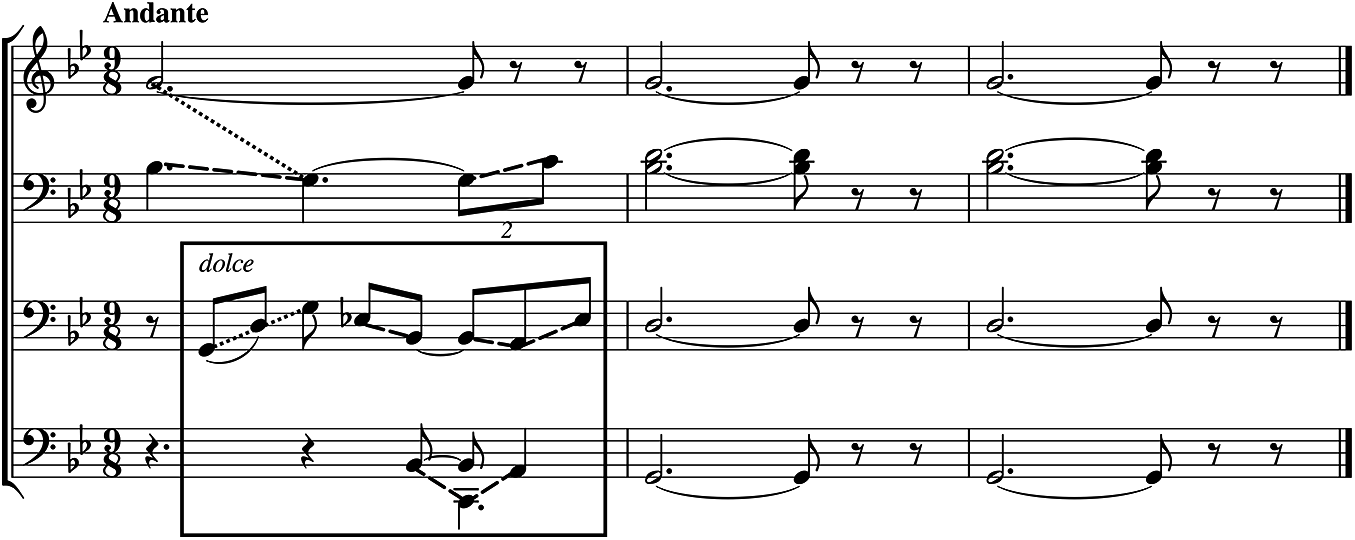
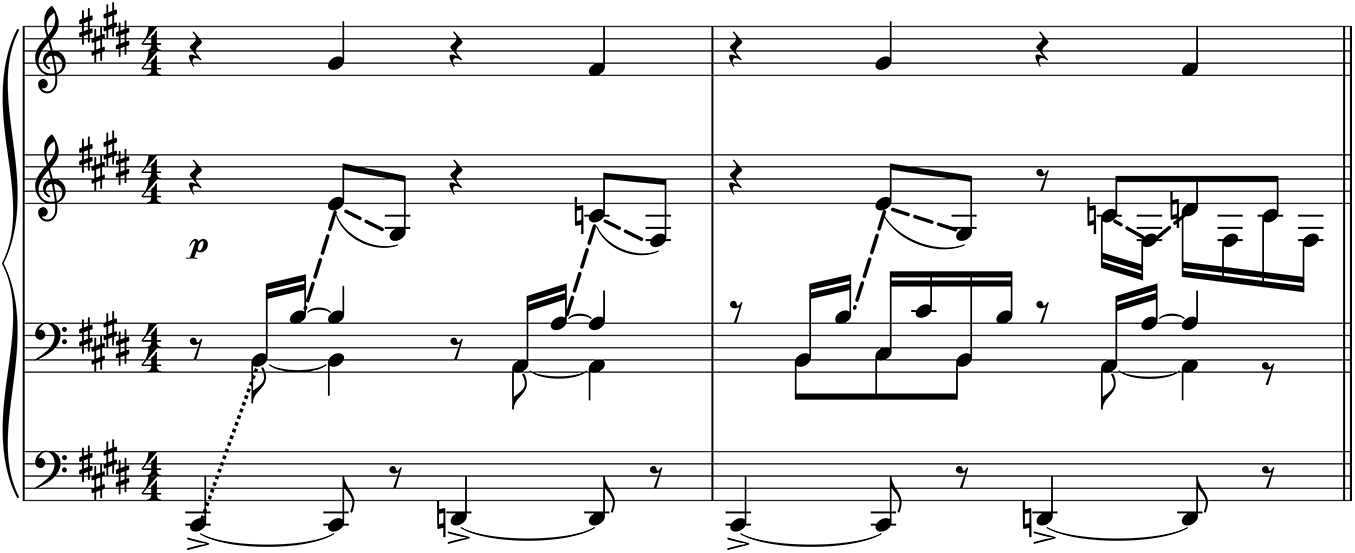
Figures 2 and 3 demonstrate that Ô mort is sealed with the gesture of an arpeggiated motion created through the convergence of the oscillation and a leap which Fauré used to portray the ‘breath of the dead’. The linear effect of the large intervallic leap connected to a down–up motion is carried in variation through the three preludes, and most distinctly discerned in their endings. I’ve rephrased the voicing here to bring out the gesture: see Figures 4–6.
The figure may also be found within the main themes of the first and third preludes, in which, like in Fauré’s early nocturnes, an ABA form is discernible.Footnote 45 In this respect, the three preludes are themselves an ABA construct. However, the individual form of each is more sophisticated as well, and the thematic development includes fusing the two main themes. In the first prelude, parts A and B even share enharmonic relations (D-flat major–C-sharp minor), and part B cadences with a theme A nucleus, after which part A makes its formal return. The coda, presented in Figure 4, is the enharmonic-tonic, rhythmically augmented nucleus on which theme B is based. Moreover, both themes of the first prelude themes display the gesture inherent to Ô mort’s arpeggiated profile. The envelope theme A may even be understood as not only enharmonic but also as the directional inversion (see Figures 7–8). This is to strengthen the understanding that the preludes are highly interrelated and thematically bound.
Fauré, Trois Préludes, Op. 103, no. 1, closing bars.

Fauré, Trois Préludes, Op. 103, no. 2, closing bars.

Fauré, Trois Préludes, Op. 103, no. 3, closing bars.

Fauré, Trois Préludes, Op. 103, no. 1, theme A, opening bars, as directional inversion of theme B.

Fauré, Trois Préludes, Op. 103, no. 1, theme B, opening bars.

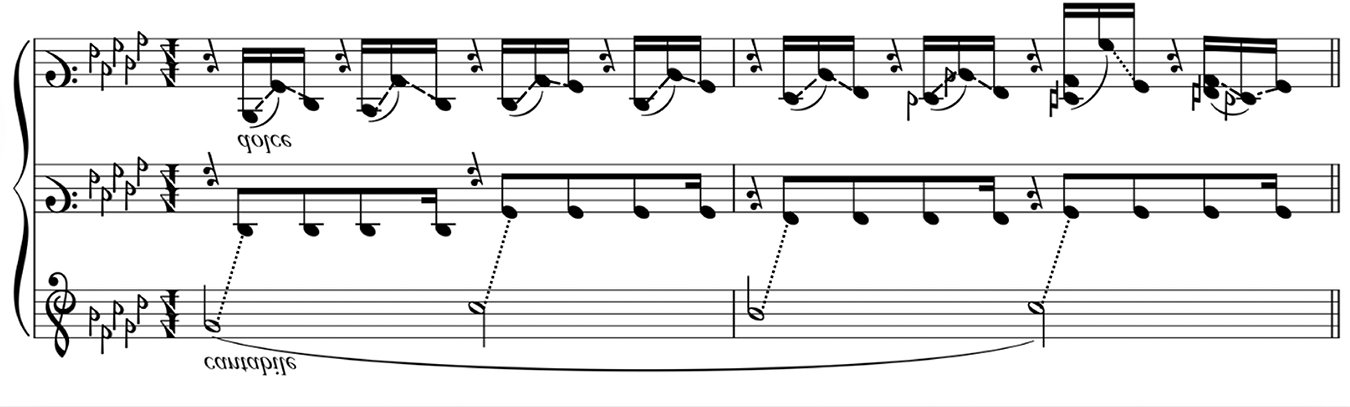
When discussing Fauré’s nocturnes, Roger-Ducasse commented on the importance of the bass, or harmonic filling and texture, in opposition to performers’ tendency to place primary importance on the soprano line, ‘the song’.Footnote 46 This is an observation relevant to theme A, as it includes two expression marks, cantabile for the soprano and dolce for the offbeat, compound rhythm accompaniment, with its 3–2–3 pulse to every half bar (see Figure 7 for expression marks and Figure 9 for rhythm). This connects to both Van Lerberghe/Fauré’s Ève and Fauré’s various spinners, who sing – metaphorically and literally, a chanson de toile/chanson d’histoire: in this medieval genre, a (noble) young lady, often spinning, waits for her noble love.Footnote 47 Ève has no mortal man in Van Lerberghe’s narrative–and in ‘Ô mort’ she is addressing her song to death over the accompaniment of sextuplet-like rhythm; Mélisande spins in one scene, and in another sings of three princesses waiting for a prince, and Pénélope’s singing spinners are critical of her for waiting, while also occupied with their own love fevers. These female intertextualities are joined by the evolution of Mélisande’s spinning theme through Prométhée’s flame, which I will return to discuss after exploring the preludes’ more analytical relations, starting with the second prelude’s unique rhythmic profile and its own web of extra-musical allusions.
Fauré, Trois Préludes, Op. 103, no. 1. The offbeat, compound rhythm accompaniment of theme A, with a recurring 3–2–3 pulse to every half bar.

The second prelude’s texture is so dense that, sandwiched as it is between the nocturnal first and third preludes, Orledge labels it a ‘study’.Footnote 48 Nectoux characterizes it as a virtuosic piece ‘in the spirit of an etude’, written ‘for the study of legato’.Footnote 49 Others, perhaps more in line with the actual performance experience rather than Fauré’s leggerissimo instruction, see it quite differently: Morrison even calls it ‘Saint Vitus’s dance’.Footnote 50 Written in compound 5/4 time, the chords punctuating the flow of sextuplets imply a subdivision of duple and then triple, i.e., units of three septuplets in groups of 4+6 within every bar (see Figure 10).
Fauré, Trois Préludes, Op. 103, no. 2, opening bars.

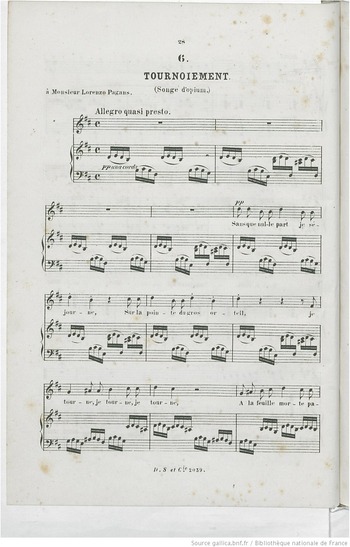
While others commented on the highly articulated texture as alluding outside Fauré’s oeuvre,Footnote 51 I wish to focus on the effect created by the combined melodic-metric properties, which I trace to internal references: Fauré’s own depictions of spindles and flame (Mélisande–Prométhée–Pénélope). However, I also mention Koechlin’s suggestion that the prelude is homage to Saint-Saëns’ Tournoiement: Songe d’opium (Twirling: Opium Dream) from Mélodies persanes (Op. 26 No. 6, 1870).Footnote 52
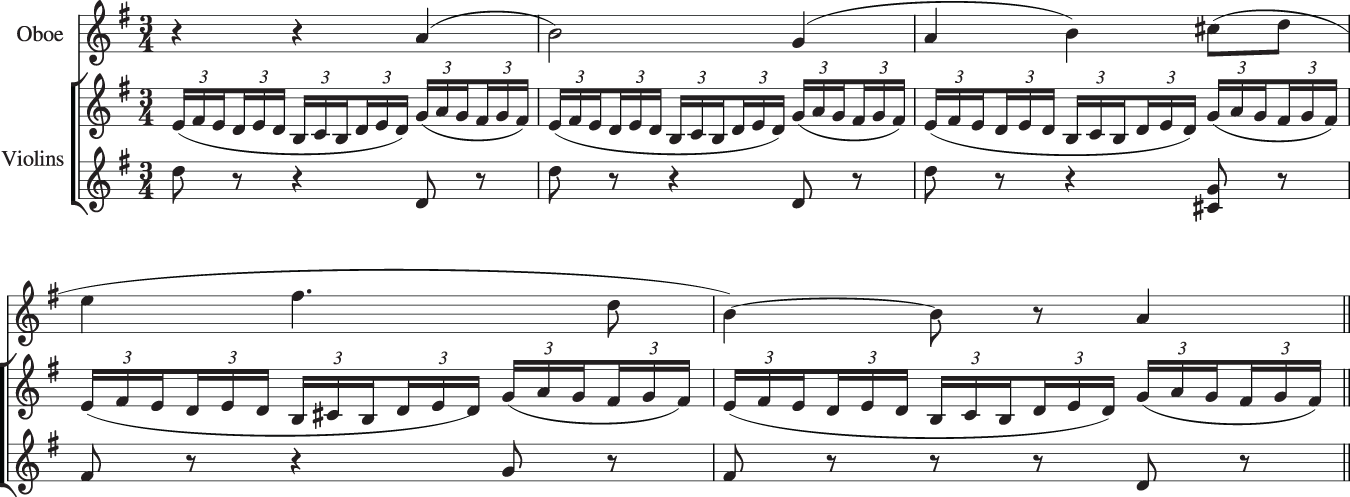
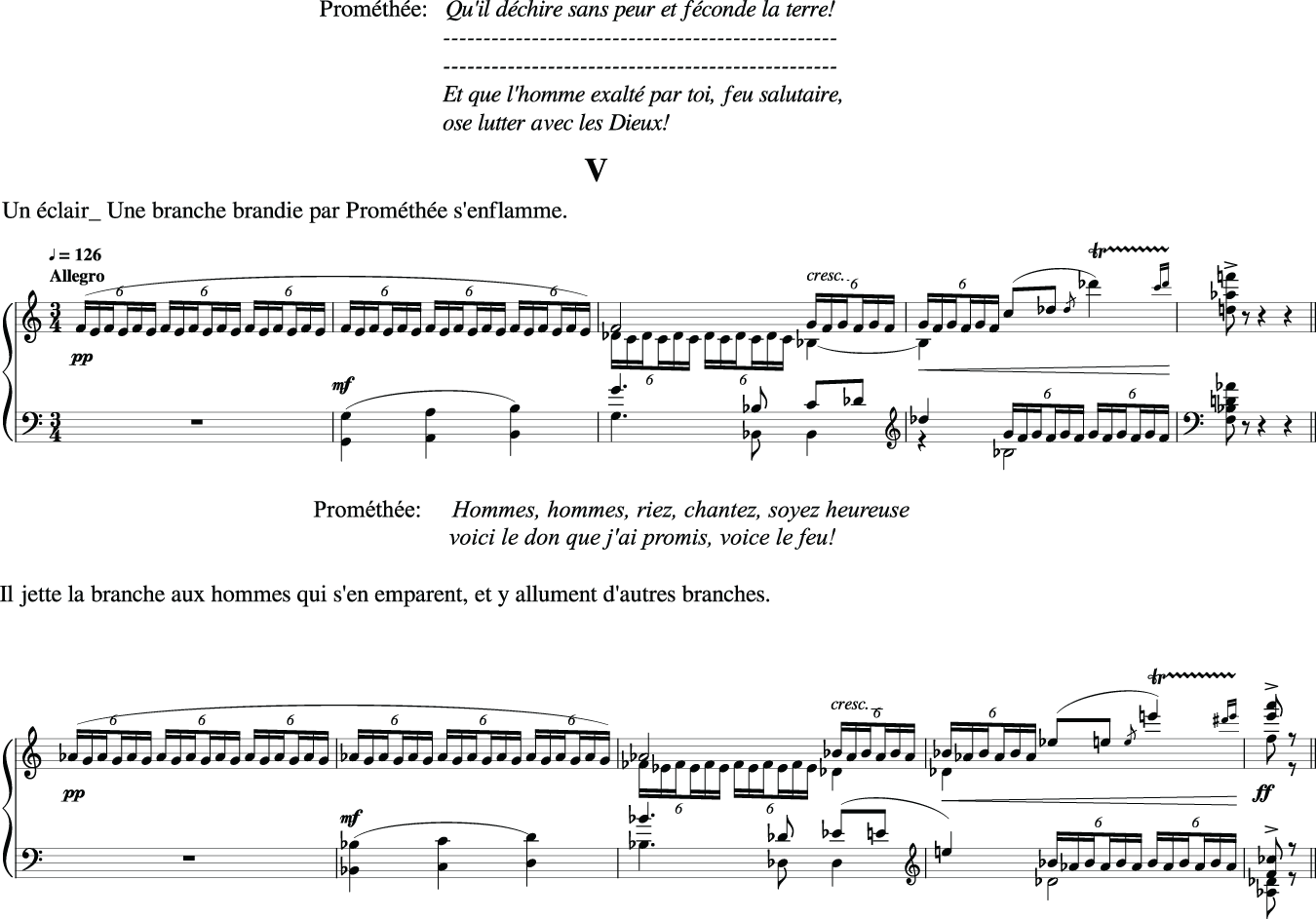
The chœur de fileuses from Pénélope Act 1, Scene 1 (Figure 11) is another of Fauré’s self-borrowings of 1909/10, quoting the figure from Mélisande’s Fileuse, spinning song (see Figure 12).Footnote 53 The plain sextuplet used to portray Mélisande’s spinning wheel is utilized also for the fire theme in Prométhée (Act 1, Scene 5, Figure 13): this connection is neatly bridged by the fact that Pénélope’s spinning servants mention the fire of love (Act 1, Scene 5, Figure 14b.) Fauré’s Mélisande–Prométhée–Pénélope sextuplet instances do not share their tonality, tempo, or time signature with Op. 103’s prelude No. 2, but include a triple subdivision and pickup bar. In Fileuse, this depicts the twirling movement as the background to the oboe’s cantilena;Footnote 54 the strings directly represent the spinning wheel or spindle while the oboe may represent the thoughts and dreams of the fair spinner. The movement starts on an upbeat major shade, and the bass drops in every first and third beat, perhaps mimicking the spinner’s hand or foot movements.
Pénélope, Act 1, Scene 1: ‘Chœur de fileuses’, bars 1–2, 5–7.

Fauré, Pelléas et Mélisande: Fileuse, spinning theme, opening bars in strings and oboe.

Fire theme in Prométhée, Act 1, Scene 5.

Fauré, Pénélope, Act 1, Scene 5. A: ‘A kiss, Melantho’: the switch from spinning to the fire of love B: scene ending. ‘Love burns with its fevers’. Choir of pretenders and maids.

Pénélope’s maids’ spinning is a bit more elaborated than Mélisande’s, containing a combination of tuplets and semiquavers to a beat, or a triple/duple tension, and its parallel oboe part is contracted to merely a repeat of A¨–B¨. This may connect to the complex reality hidden by Pénélope, who unravels her work at night. Yet the effect remains a direct portrayal of the motion of a spindle (including the stress placed on first and third beats), the oboe’s song part reduced to more of a hum (as this is an opera, there is a vocal part as well). By adding into the discussion Fauré’s representation of the moment lightning hits Prométhée’s branch and fire is distributed to the mortals, it appears Fauré utilized sextuplets to represent a force – be it the manual, circular motion, or the flickering of the flame, and by Pénélope it holds the metaphorical combination of both—a spinner burning with emotions/desire, as may be discerned when following the sextuplet motif through Act 1 (Figures 13 and 14a–b).
In Pénélope, the spinning figure opens the opera. Directly continuing the overture, which dissolves into the first act without its own cadence, the curtain rises to reveal Pénélope’s servant girls spinning at dawn.Footnote 55 Fauré described the girls’ spinning as a soft action mingled with dreaming, the atmosphere more important than their words; Nectoux comments on the continuous movement and extreme tonal instability as deliberately creating an atmosphere of vagueness and inconsistency.Footnote 56 The spinning maids choir is interrupted by the audible laughter of the suitors offstage. This interruption begins a conversation, led by the servant girl Melantho who claims that in Pénélope’s place she would marry one of the suitors.Footnote 57 The spinning figure returns at the end of Scene 5, when Eurymaque requests a kiss, and again following the memorable nine choral bars where maids and pretenders sing of how ‘love burns with its fevers/The trembling coral of our (their) lips,/And our (their) beating breasts!’ (Figures 14a–b).Footnote 58
Prelude 2 fits in as an abstracted version of these forces. The spinning/flickering allusion is not only expressed in odd compound (five beats in a bar, each subdivided into two unequal groups of three sextuplet groupings) but is also expressed at a metronome mark of 144, a speed which makes it both an unlikely portrayal of a manual spinner or the song of a pining lover, and closer to that of Pénélope’s maids and pretenders’ feverish state, even if marked leggerissimo.
My argument is strengthened by Koechlin’s comparison. Somewhat like Morrison’s association with dance madness, in his Fauré study Koechlin labelled the second prelude a ‘feverish whirling of dervishes’, suggesting it as a paraphrase of Saint-Saëns’ Tournoiement: Songe d’opium (Twirling: Opium Dream; Figure 15). Transforming six of the poems in Armand Renaud’s Nuits persanes (1870) into the song cycle Mélodies persanes (Op. 26, 1870), Saint-Saëns’ last choice is tournoiement, the first in the section songes d’opium. Saint-Saëns invokes spinning (tournoiement) and inebriation (songe d’opium) through his metric and tonal design to create a finale of ‘Persian’ fantasy.Footnote 59 This is enhanced by the reference to the moment of death and various expressions of light/darkness made by Renaud’s text, which is strikingly similar in subject matter to Van Lerberghe’s ‘Ô mort’.Footnote 60
Saint-Saëns Tournoiement: Songe d’opium (Op. 26).

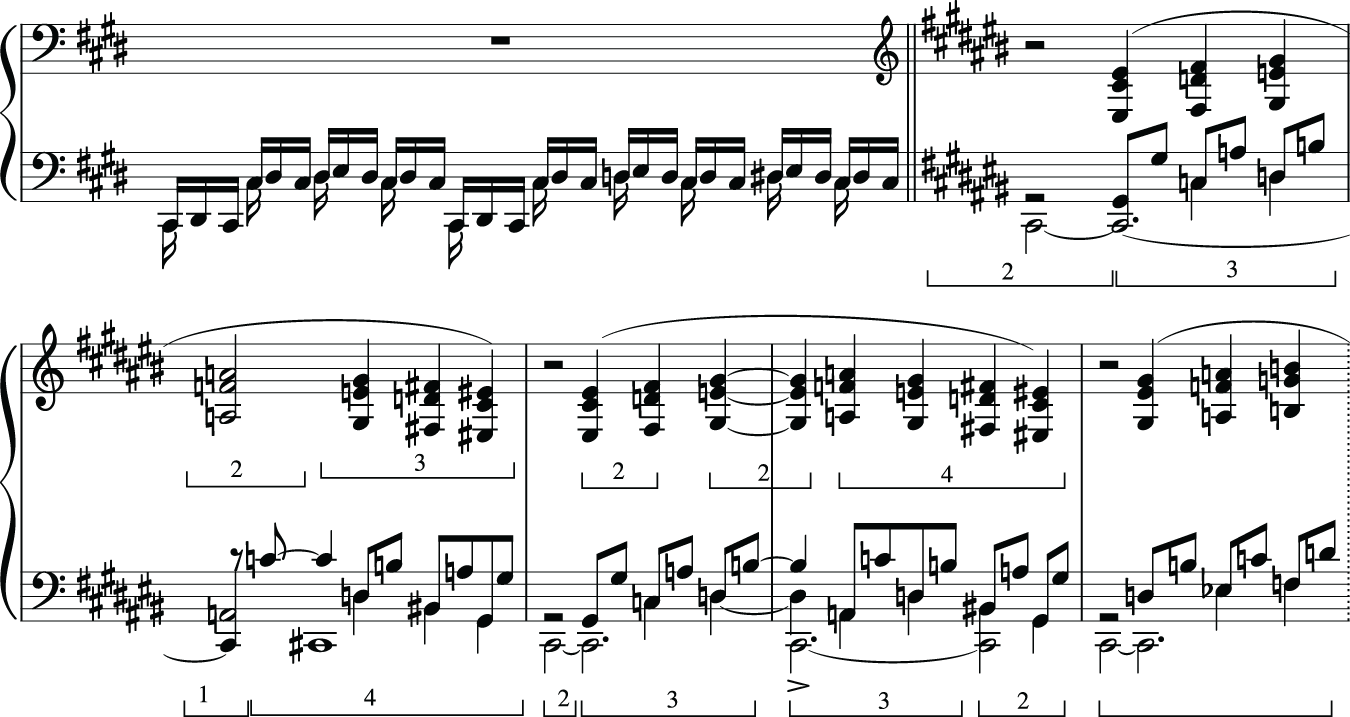
The second prelude is divided into two unequal parts. The first includes 24 bars grouped in ten three-sextuplet figures, in a recurring 4+6 pulse, which ends with a short two-bar unit reduced to the range of one tone (c#–d#), like a spinning top – or spindle – about to drop. This ‘drop’ begins the second part of the prelude, consisting of 14 bars labelled dolce, shifted tonally to C-sharp major, and following a ‘cadence’ on a low, lone C#, now pedal point. While Koechlin writes of these bars as a ‘concluding … sort of ecstasy, with the evocation of some fairy palace’,Footnote 61 they may be equally interpreted as exhaustion – a stupor – if we follow the notion of drunkenness, or the approach of death if we look ahead; Ô mort is reintroduced with some elaboration in the enharmonic equivalent of C-sharp major for the last bars. In this position it functions as a bridge which ushers in the last of this three-prelude unit (Figure 16).
Fauré, Trois Préludes, Op. 103, no. 2. Ô mort in the rhythmically shifting grouping in the final bars, 30–35.

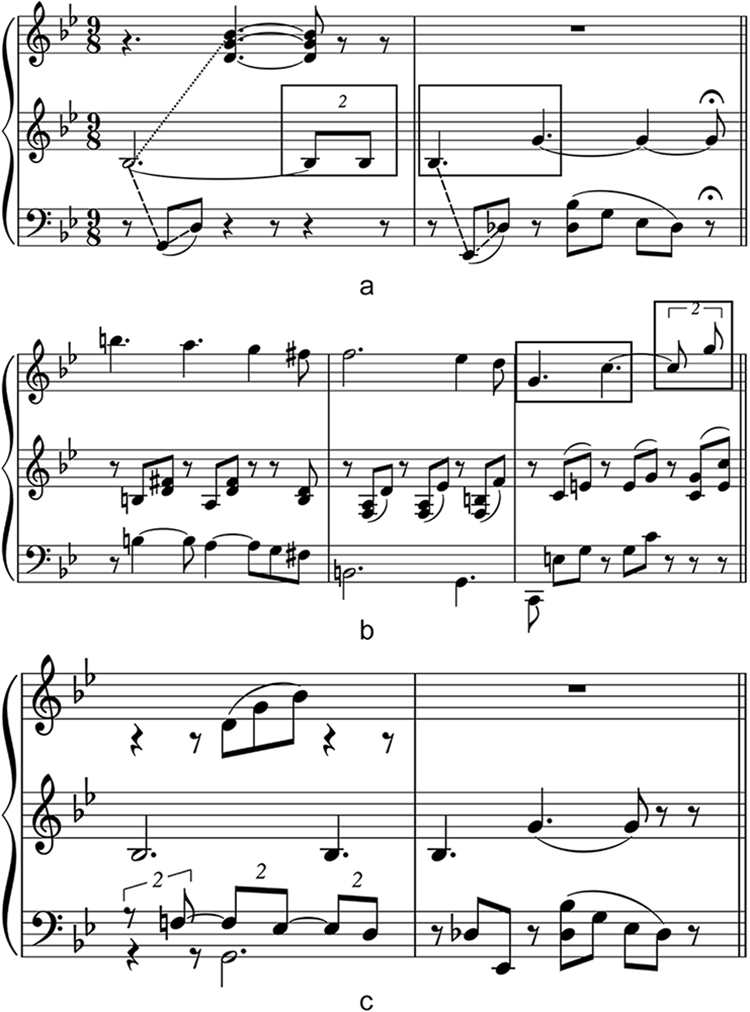
The first two preludes explore the enharmonic D-flat/C-sharp sharp tonalities: prelude No. 1 (D-flat major–C-sharp minor–D-flat major), prelude No. 2 (C-sharp minor–C-sharp major). In this respect, they form a pair, a continuation of one another, palindromic in terms of mode, which nest within the nocturnal frame of the three preludes. Set in G minor, the third prelude is situated a tritone away from the D-flat/C-sharp of the first two, creating a tonal ‘mean’ between them. It also displays compound rhythmic attributes in nearly every bar, in a pattern of 3/8 + 3/8 + 2 duplets, which echoes the 3 vs. 2 tensions worked out in the first and second preludes (the internal pulse of 3–2–3 for the first and the compound and then simple 5/4 rhythm of the second). The prelude seems to be still preoccupied with a vague Ô mort variation in the main theme, rephrased within the tonal areas of G minor and E-flat minor. The secondary theme is more of a transitory element, and it echoes the first; since the thematic development, mostly sequential, fuses the themes together, a single pervading idea seems to guide the prelude overall (see Figure 17a).
Fauré, O mort allusions in third prelude. The G minor presentation is later rephrased in E♭ for middle section, and returns to G minor for the prelude's resolution.

In his study of ambiguities in Fauré’s late piano works, Ken Johansen included an analysis of the third prelude, pointing to Fauré’s occupation with B¨ pitch classes. As Johansen sees it, ‘the third prelude seems to be searching for its tonal direction … The groping quality of the harmony in this prelude, the process of trial and error in the harmonization of the melodic B¨, can really be considered the “subject” of the piece’.Footnote 62 Johansen traces the ‘groping quality’ to development via tonal rephrasing; I add that Fauré’s development in the prelude is done through fusing thematic materials. Figure 17 demonstrates how the secondary theme of the third prelude echoes the primary theme, which itself echoes a thin version of Ô mort, more fully expressed at the closing bar of the prelude. In other words, while the third prelude is almost twice the length of each of the first two preludes, it seems to be speaking the same gestural language. But to fully extract the affinity between the three preludes, additional points of reference need to be introduced. I present them within an enlarged focus of Fauré’s self-borrowings from Ève, Mélisande, and Pénélope, the ladies of Fauré’s deadlines.
Trois Préludes’ as Web of Self-Reference
‘Ô mort’, the last poem of the Chanson d’Ève cycle, is written in D-flat major, just like prelude No. 1. Following Jankélévitch’s suggestion regarding the difference between the flat and sharp spelling of enharmonic tonalities as a hermeneutic distinction between shielding and exposing, dusk vs. dawn, La chanson d’Ève’s arching narrative is congruous with the first day of creation ending at dusk.Footnote 63 Jankélévitch also described the scale of D-flat major as that which Fauré reserved for his most precious and mysterious secrets, as in the case of ‘Ô mort’, where Ève wishes her death with equanimity.Footnote 64 By recalling Fauré’s overall berceuse language in his Requiem and the shift from minor to major for its last section, In paradisum, the first prelude explores Ève’s upcoming death. Prelude one begins in this hermeneutic realm, in the dusk, nocturnal D♭. Syncopated on the middle rhythmic layer, as shown above, it includes the suggestion of song over a backdrop of flickering/liquid quality, the stardust (poussière d’étoiles) Ève likens to death. The first prelude thus is linked with Fauré’s Ève nearing her eternal sleep, or burial. The inner sextuplet looks forward to the second prelude.
In my analysis of the second prelude, its unique non-nocturnal profile was linked with Mélisande, Pénélope, and Prométhée’s flame through the sextuplet. The relationship continues in tonality. The character of Pénélope, according to Fauré, ‘is in’ G minor,Footnote 65 as is the prelude to Pénélope and third prelude.Footnote 66 Following Pénélope’s opera prelude, G minor dissolves into the chorus of spinners in B-flat/D-flat (Act 1, Scene 1, Figure 12) within the context of the futile toil with the toile. In opus 103, conversely, the G minor prelude flows from the D-flat enharmonics of the first two preludes. In Fauré’s late style in general, G minor is just as related to D-flat major, B-flat minor, or B major as it is to E-flat tonalities.Footnote 67 Thus the arrival at G minor for Prelude No. 3 is representative of Fauré’s harmonic syntax, just as the third prelude’s secondary tonal centre is E-flat minor rather than D.
G minor, furthermore, as we know from Fauré’s own comment about Pénélope as he was writing it, is ‘a solemn, spacious, expressive key’ especially suited for the representation of indignation and anger.Footnote 68 G minor could be regarded as a link to the character of Pénélope, expressing the anguish of her position. The link between Pénélope thematics and the third prelude is further strengthened by the rare rhythmic pattern shared by the prelude (multiple bars) and the Act 1, Scene 5 choir (bar 8) – a bar of 9/8 ending in a duple unit and rising fifth/sixth (compare Figures 6, 14b and 17).
The first prelude, then, shares gesture and tonality with Ève (D-flat), the third with Penelope (G minor), and the second, through the spinning motion explored earlier, links both Mélisande and Pénélope. Focusing on the offspring of Mélisande’s spinning song, Prométhée’s fire bridges the development of Mélisande’s fileuse into Pénélope synopsis’ sexual undertones. What was conceived for Mélisande as a naive spinning song, a traditional chanson de toile expressed using regular sextuplets, evolves through Pénélope’s story into a more condensed and complex figure, combining triple and duple, age and youth, mourning and sensuality. The tension contained in this symbolic space is shared by the second and third preludes through tonality and rhythmic profiles.
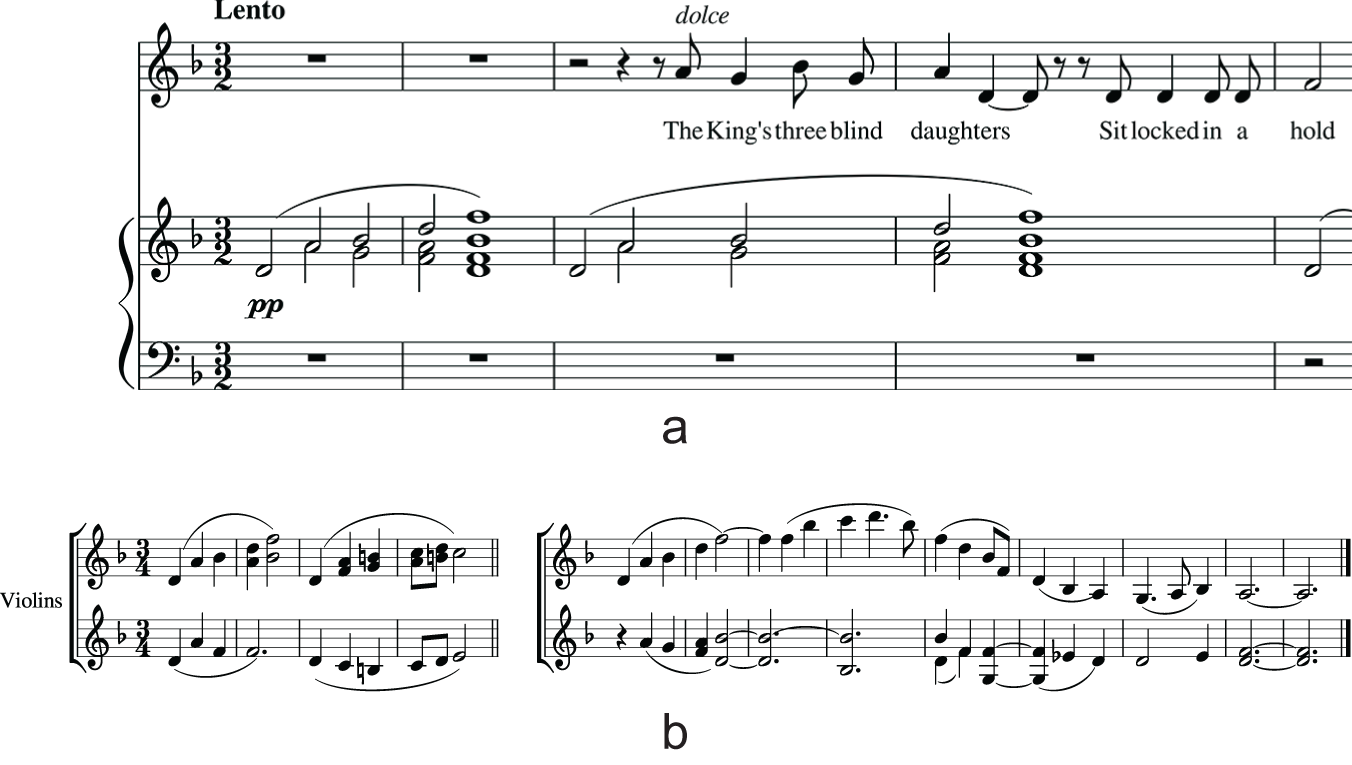
The link between Mélisande and Pénélope becomes even more interesting when considering the repeated and direct quotation from Mélisande in Ève’s narrative. Fauré’s self-borrowing of the opening to Mélisande’s song, or The King’s Three Blind Daughters Footnote 69 (see Figure 18a) has been discussed by Rumph but is crucial here.Footnote 70 In the original English performance version of Pelléas et Mélisande it is part of Mélisande’s hopeless story of the princesses locked with their lanterns in a tower, waiting for a prince. This prefigures Mélisande’s own untimely death: the theme reappears to represent her deathbed (in both incidental music and orchestral suite) by serving as the opening and closing theme of ‘La mort de Mélisande’ (Figure 18b). This theme is reused in La chanson d’Ève, composed up to ten years later, where it serves as a leitmotiv for light in its symbolist sense: the journey from dawn/birth to dusk/death. It opens the cycle to represent the first light on earth (‘Paradis’, I), reappears to describe God (=light, how God radiates, ‘Comme Dieu rayonne’, IV), and again to describe Ève’s dusk (‘Crépuscule’, IXFootnote 71) – but not her death, which has not yet arrived at the end of the cycle.
Fauré, Melisande’s song (1898) and ‘La mort de Mélisande’ in Pelléas et Mélisande Suite, Op. 80, IV: (a) Opening to Melisande’s song (b) The theme’s appearances in Pelléas et Mélisande Suite, Op. 80, IV. ‘La mort de Mélisande’, bars 9–10, and bars 54–end.

While discussing this thematic migration from Mélisande to Ève, Jankélévitch notes that the two women are of ‘the same suprasensible femininity’;Footnote 72 by directly quoting Mélisande in Ève, Fauré communicates as much himself. In their roles as weavers and royals, Mélisande and Pénélope also share character attributes. From the perspective of the three preludes, both Ève and Pénélope of December 1909 echo the 1898 Mélisande–both in character and the work’s tight deadline. The three heroines are thus musical sisters to a certain extent, thrust together by the force of association pressing Op. 103 into the world, located somewhere between Ève’s deathbed and Pénélope’s choir. This duality is further disclosed by the manuscript for what we know as the first prelude, in Fauré’s hand, signed and dated 1910, labelled ‘No. 3’ (see Table 1 and note 42.) This could be no more than further evidence of Fauré’s haste, yet it may also guide future research in determining which of the three preludes Fauré complained about in his letter to Mme. Hasselmans, and which of them was written first.
If we choose to attach each prelude to a feminine character, the first could represent Ève, the second, Mélisande, and the third Pénélope. Narratologically speaking, Ève’s voice begins the unit at the end of her song cycle, as a speck of sun on the brink of her death; Mélisande is thrust in through ‘La mort de Mélisande’ thematic association, spinning or flickering like a forbidden flame in the second prelude, evoking Pénélope, and her spinners, who conclude the cycle implying an optimistic outcome. The boundaries of each prelude are, of course, more porous, and less distinctly related to an associated character, yet a complex web of gestural and associative elements holds everything together.
Conclusions
How does one write a piece of music on demand with the feeling that inspiration has run dry? This question is posed in a positive way, searching for compositional mechanisms successfully implemented. It does not assume that works created under commission or within pressure of a deadline are devoid of inspiration, but rather that the two scenarios may confound, as is the case with Fauré’s Trois preludes. While Fauré’s several discarded projects may provide different perspectives on this question, the current exploration highlights an aspect of Fauré’s creative mechanics, through analysis of a unit brought to fruition under these circumstances. The way out of Fauré’s own proclaimed compositional impasse, as expressed in an undated letter to Mme. Hasselmans regarding one of the first preludes, appears to have included self-borrowing on several levels, exploring fresh and old materials, weaving together their gestures and extra-musical contexts. I do not suggest the preoccupation with Ève’s Ô mort gesture in the preludes was conscious, and I acknowledge it is not necessarily aurally detectable. It is imaginable, however, that Fauré was conscious of the overt thematic borrowings between Mélisande, Prométhée, Pénélope and Ève, and the extramusical content may therefore be viewed as guiding the preludes to a certain extent.
The above may allow a positive perspective of the interaction between deadlines and inspiration which creates homogeneity. Reference to the composer’s own oeuvre is a theme often explored in musicological research, including research on Fauré; less explored are inspirational weights. My analysis of the three preludes began with Fauré’s self-proclaimed struggle and uncovered how borrowing his own gestures and themes guided him through the situation. It also brought to the fore how keyboard music may be shaped by external programmatic elements from unrelated works. Based on the written evidence of Fauré’s difficulty completing a December 1909 prelude and placing the works of this period side by side, a thematic density is uncovered. With a tight deadline, the creative flow may be especially prone to associative strings or patterns of melody and gesture, the spheres of recent compositions, and the traces of older works. The preludes seem to indicate that the composer’s working memory was weighted by Ève’s text and the gesture with which it was musicalized. This created, in effect, a standalone unit within the final opus, a hybrid, and unique, form: Op. 103’s opening unit is not only of a nocturne-prelude kind but also borders on a cyclic suite connecting several other works through allusion.
This self-referential story of a composer struggling with a deadline, singing a chanson de toile to his evasive muse, ends happily ever after. Fauré’s deadline and dry inspiration were both, like Ève’s soul, pliable. The Trois préludes were dispatched to Heugel, gesturally tied yet separate from what were to become, over the course of the year, the remaining preludes of Op. 103. Caught in compositional toil between his heroine’s toiles and étoiles, Fauré ended victorious like a Ulysses.
Efrat Urbach is a fellow at the Polonsky Academy for Advanced Study in the Humanities and Social Sciences at The Van Leer Jerusalem Institute. Her doctoral thesis (2025, Bar-Ilan University) explores Gabriel Fauré’s liturgical oeuvre.





 Open access

