


1. Introduction
Interdisciplinary development teams use targeted creativity formats to generate innovative solutions to complex problems in interdisciplinary workshops (Reference Lubart and Thornhill-MillerLubart & Thornhill-Miller, 2019). The underlying creative process is described in current models as an iterative cycle of analysis, idea generation and evaluation (Reference Amabile and PrattAmabile & Pratt, 2016). Such formats, referred to as “idea factories” in the Integrated Design Engineering (IDE) context of Otto von Guericke University Magdeburg, serve as catalysts for innovation in product development (PD). The process of idea generation is described in the literature as consisting of three to five phases (Reference WallasWallas, 2014), (Reference Howard, Culley and DekoninckHoward et al., 2008). Reference Howard, Culley and DekoninckHoward et al. (2008) divide the creative process into the phases of analysis, generation, and evaluation. Creative workshops (“idea factories” in the following) are based on the creative process and are designed to guide the creative process in a targeted manner. Through structured moderation and the use of idea generation methods (hereinafter referred to as “creativity techniques”), they promote the breaking of conventional thought patterns (Reference KelleyKelley, 2006) and accelerate the search for solutions. However, idea factories require careful planning and implementation to be successful. But this is seldom the case (Reference Brem and BremBrem & Brem, 2013), as small development teams and small and medium-sized enterprises (SME) often cannot muster the necessary resources. However, the established framework of IDE (Reference VajnaVajna, 2022b) currently lacks a sequential structure for IDE idea factories that:
-
• shows the sequencingFootnote 1 of an idea factory,
-
• identifies phase-specific creativity techniques,
-
• offers practical implementation tips for resource-constrained contexts,
-
• and systematically addresses divergent and convergent thinking.
This gap is particularly relevant for teaching in student projects in the IDE Master’s program, small development teams and SME, which want to increase their innovative strength and develop new products, and that need to build innovation capabilities despite limited resources (Reference Ghezzi and CavalloGhezzi & Cavallo, 2020). Existing approaches often remain theoretical (Reference Kirjavainen and Hölttä-OttoKirjavainen & Hölttä-Otto, 2021) or hidden behind paywalls, while practical models neglect the requirements of IDE.
Against this background, this contribution develops a sequenced structure for IDE idea factories based on IDE relevant literature and project practice. The objective is to create a sound, low-threshold, and sequenced planning basis for small development teams and for SME, thereby laying the foundation for the integration of cognition-enhancing tools into the IDE idea factory sequencing. This will enhance the applicability of the creative process in a more goal-oriented manner. Thus, this contribution is intended to lay the foundation for subsequent work on which tools to integrate into the IDE idea process to increase divergent and convergent thinking. This contribution does not claim to provide a comprehensive analysis of the literature on creative processes in engineering design (therefore see (Reference Howard, Culley and DekoninckHoward et al., 2007)) but rather to undertake a sequencing based on the literature relevant to the IDE. This contribution aims to answer the key-question “What are the specific challenges of the idea factories in IDE projects?” to overcome those and create a sequencing of idea factories.
2. Current sequencing of idea factories in -relevant literature
This section examines and presents the literature relevant to the IDE that has been identified in relation to the sequencing of idea factories to derive implications for practice in the course of the work.
2.1. Idea factories according to Horton
According to Reference HortonHorton (2019a), an idea factory is a moderated workshop for generating ideas, typically with 10-20 participants over one to two days. Its goal is task-oriented idea creation using creativity techniques. Although the structure varies depending on the context, it usually follows a sequenced process (Reference HortonHorton, 2019b). The structure of an idea factory can vary depending on the framework conditions, but it usually consists of several sequences: After an introduction to goals and expectations (Reference RuncoRunco, 1999), there is an idea generation phase with unrestricted brainstorming (Reference OsbornOsborn, 1953), in which participants are encouraged to generate as many ideas as possible without being constrained by critical thoughts, followed by the selection and further development of ideas (Reference Parnes and McVicker HuntParnes, 1967) and finally presentation and feedback.
Reference HortonHorton (2014) describes a more specific systematic approach to developing creative potential through the structured application of five specific sequences in his idea generation model.
-
1. Acclimatise: This preparatory phase aims to psychologically prepare participants for idea generation by creating a relaxed and trusting environment that promotes creative thinking.
-
2. Prime (immersion): In this phase, the task is examined intensively to anchor it firmly in the participants’ consciousness. This is often done by collecting keywords or discussing key aspects.
-
3. Stimulate: The central production phase uses perspective shifts and various creativity techniques to generate innovative ideas and break through conventional thinking patterns.
-
4. Combine: Here, existing raw ideas are combined with each other to develop more comprehensive solutions through the synthesis of new approaches.
-
5. Enhance: Finally, the ideas that have been generated are optimised and further developed, often in conjunction with the combination phase, to achieve the most creative and practicable solutions.
This model shows parallels to established creative processes (e.g., Reference WallasWallas, 2014) but surpasses them in terms of its operational controllability. A clear attribution of creativity techniques to the sequences would accelerate their application, but this is sometimes only done to a limited extent. The systematic sequence, from initial psychological attunement to step-by-step idea development and targeted optimisation, can increase creative output.
2.2. Idea factories according to Geschka
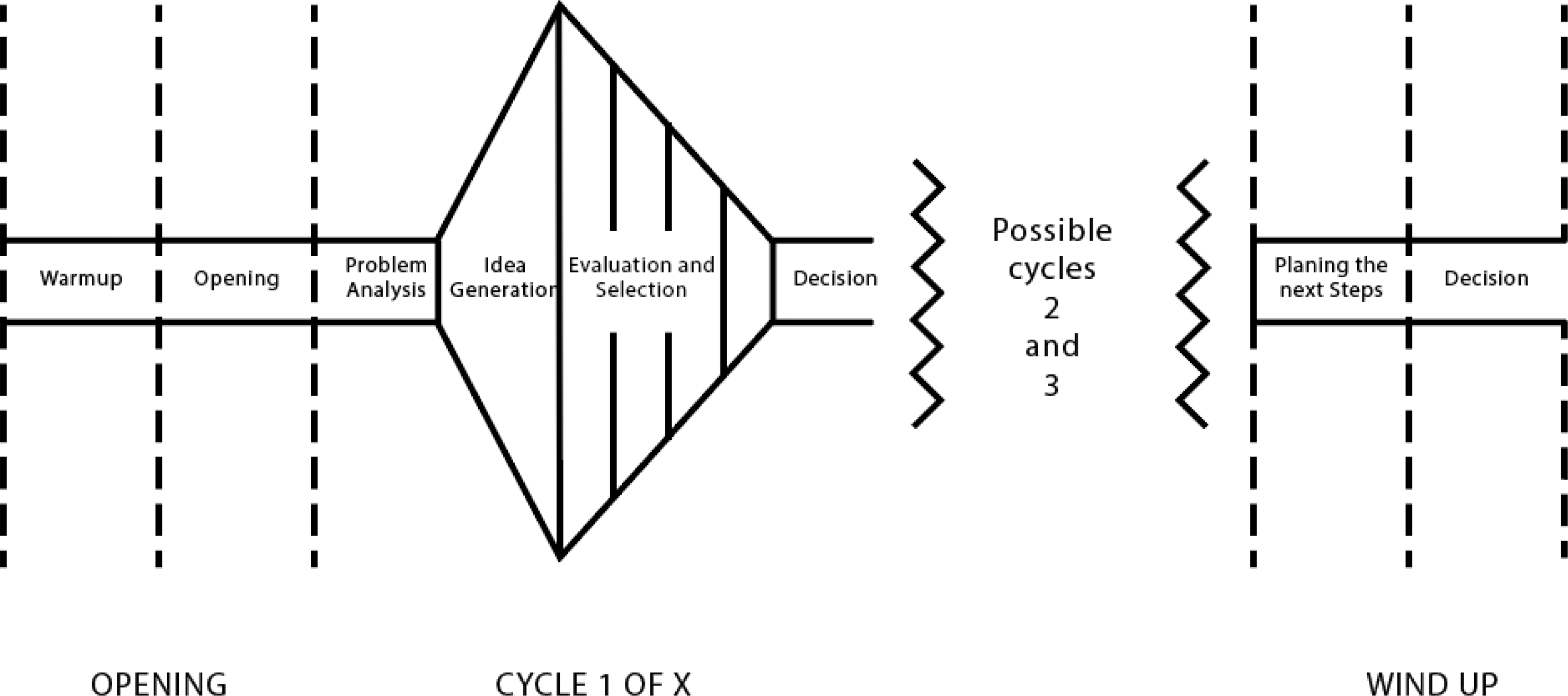
The work of Reference GeschkaGeschka (1986) offers valuable insights of promoting creative thinking through structured idea factories. These, as described by Geschka, are designed to solve complex problems within a structured framework and contribute to product innovation by applying multiple creativity techniques (Reference Geschka, Zirm, Albers and GassmannGeschka & Zirm, 2011). Geschka emphasises that successful innovation is not only based on structured planning processes, but also on unleashing the creative potential of those involved. Geschka proposes the following structure for an idea factory (Figure 1):
-
• The preparation is handled by the moderator: Before the idea factory, the specific objectives are clearly defined and suitable participants are selected. These should represent a heterogeneous group to bring in different skills and perspectives. The terms of reference are also specified and, if necessary, relevant information or data is collected to create a solid basis for discussion.
-
• Implementation: The idea factory follows a cyclical process that is organised in four stages:
-
a) Analysis and formulation of the problem: The idea factory starts with a presentation and analysis of the problem, where questions of understanding are clarified and the core problem is defined together.
-
b) Generation of alternative ideas: A variety of ideas are developed with the help of specific creativity techniques, such as brainstorming or brainwriting, to develop the creative potential of the group.
-
c) Evaluation of the ideas: The ideas generated are then evaluated. Simple voting procedures, such as the awarding of points or rankings, help to separate out the most promising approaches.
-
d) Decision: Based on the evaluation, a decision is made as to which ideas are to be pursued further to ensure strategic feasibility. Decision-makers are often involved here to ensure sustainable implementation.
-
• Several problem-solving cycles can be run through, with the decision from each phase serving as the starting point for the next.
-
-
• Conclusion and follow-up: Once the cycles have been completed, the results are consolidated and concrete action plans are drawn up. Responsibilities are defined and resources allocated to enable the ideas to be implemented.
-
• Reflection and feedback: At the end of the idea factory, there is a reflection round in which the participants evaluate the process, record their findings and identify potential improvements for future sessions. This phase also provides an opportunity for management to acknowledge the commitment of the participants and emphasise the relevance to the corporate strategy.
Structure of idea factory based on Geschka (Reference GeschkaGeschka, 1986)

Overall, Geschka’s approach ensures that idea factories not only produce innovative solutions in the short term but also strengthen a company’s culture of innovation in the long term. A combination of structured preparation, targeted implementation and careful follow-up creates an effective framework for promoting creativity and innovation. Geschka emphasises that the effectiveness of idea factories depends heavily on the competence of the participants and enriching facilitation to effectively lead the group. Despite potential risks, such as insufficient expertise or excessive enthusiasm, idea factories with appropriate moderation and support offer a cost-effective approach to fostering innovation. (Reference GeschkaGeschka, 1986)
2.3. Take away
Horton and Geschka’s approaches provide valuable insights for designing idea factories, especially in the context of limited capacities and for less specialised users. Both approaches emphasise the relevance of a structured but flexible approach that can be adapted to the specific requirements of a project. In a time-limited context, it is crucial that the idea factory processes are clearly defined to ensure effective use of the available time. A clear goal at the beginning of the process helps participants stay focused and work effectively, even if they have limited experience with creative processes. The use of several simple creativity techniques and evaluation methods for ideas (e.g. scoring systems or simple rankings) enables even inexperienced participants to actively contribute to the solution. Simple methods that can be learned quickly thus promote efficiency and make the idea factory accessible to all participants.
3. Idea factories in IDE practice
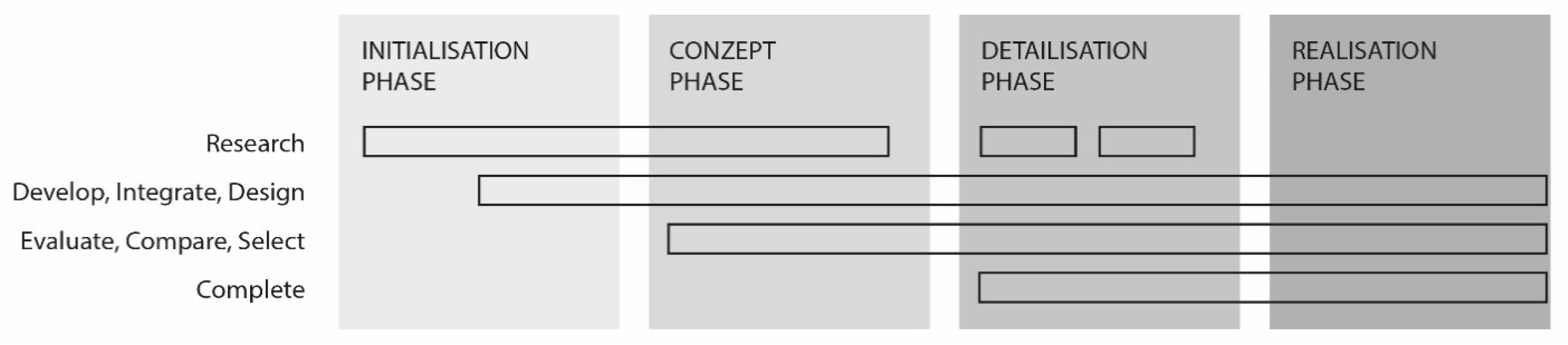
In IDE, idea factories are generally used specifically in the concept phase, the second of four phases of the exemplary product development process model as seen in Figure 2. They are used to create ideas and develop solutions based on the basic understanding of the problem from the initialisation phase. However, the exact integration of idea factories also depends on the specific project, the project goals and the needs of the development team.
Reduced representation of the phases of the IDE process model and localisation of the idea factory (based on (Reference Vajna and VajnaVajna, 2022a), (Reference Neutschel, Wiesner, Schabacker, Vajna, Krzywinski, Linke and WölfelNeutschel et al., 2016), (Reference NeutschelNeutschel, 2017))

The content of the lecture by Reference HortonHorton (2019a) is hereby used and interwoven with the project context. When conducting the idea factory, a scheme is usually followed that includes a warm-up, a massive generation of ideas and a selection of ideas. Although the process mirrors the process described by Reference HortonHorton (2014), it does not claim to be complete.
3.1. As-is analysis of idea factories in IDE
For this contribution we conducted a comparative analysis of the latest six IDE project reports (summer semester of 2022 to summer semester of 2023) to identify recurring challenges (Reference Schabacker, Kokoschko and StarkeSchabacker, Kokoschko, & Starke, 2023). The following disruptive factors can be identified in IDE idea factories that significantly hinder the success of the idea creation. Unclear or poorly defined objectives often lead to confusion and an inefficient use of the creative resources of the participants. A lack of clarification and an inadequate briefing on the rules of conduct in the idea factory can have a negative impact on participants’ behaviour and disrupt the process. In addition, the lack of clear moderation rules, as described by Reference GanswindtGanswindt (2014) can lead to misunderstandings and a disorganised process. Without an experienced moderator to guide and overcome any difficulties that arise, the process can occasionally come to a standstill and the participants’ commitment is reduced. In the IDE context, students who have taken a course in idea engineering often become moderators of the idea factories, as they are experts among the students (from here on called “student experts”). But without a facilitation plan from the IDE process, for the student experts, idea factories often get lost in unstructured discussions and set timeframes are exceeded or goals are not achieved. Also, the knowledge of the student experts differs greatly based on the individuals. An unfavourable atmosphere can severely impair the generation of ideas, as participants are less inclined to think creatively or express their thoughts in a tense environment. On an organisational level, inadequate planning of the idea factory poses a significant problem. Pre-selected creativity techniques, based solely on familiarity rather than the essential context to be considered, lead to a lack of focus and structure.
These disruptive factors can be attributed to the lack of trained facilitators and the absence in the teaching of the IDE framework. This factor can be addressed by placing creativity techniques in a sequenced process. Additionally, participants’ knowledge of the rules and process of idea factories is also limited in places, which results in a double burden for the moderator. As the participants are largely defined by the composition of the project team, the participants are determined in advance, which leads to the difficulty that social dynamics are transferred.
The biggest challenge for IDE-specific idea factories is that, in contrast to the approaches introduced in Section 2, they are significantly more limited in terms of time. Here, due to the workload from studies and any necessary part-time activities, the results must be produced within 4 – 8 hours (this is the average duration of an IDE idea factory). The number of participants also usually strongly fluctuates between projects between five and ten members. In addition, task-specific work packages and research are already completed in the preceding project work, creating a knowledge imbalance between participants. These frequent sources of disruption not only hinder the optimisation of idea factories but often lead to lower quality results and significantly reduce the benefits for the stakeholders involved.
3.2. Challenges and potentials from the IDE projects
By answering the key question from Section 1, implications for improvements to the sequencing of an idea factory are drawn and possible solutions are introduced.
Discrepancy between intended and unintended effects of a structuring framework
Providing a framework by structuring and timing various steps may lead to ideas not emerging from participants in the given timeframe – however, it also may be precisely this structured framework that leads to more ideas being developed by the group. Furthermore, due to the potential abundance of ideas generated, some ideas may not be implemented or regarded at all.
This is where Geschka’s approach is introduced: integrating several cycles – shorter sprints, offering the possibility to include “active” incubation phases and considering curricular and part-time activities.
Group dynamics and social influences
Social dynamics like group thinking or other biases could arise (Reference Fillingim, Shapiro and FuFillingim et al., 2023), possibly contributing to the phenomenon of design fixation, a conscious or unconscious fixation on certain ideas or thought patterns (Reference Crilly and CardosoCrilly & Cardoso, 2017). Especially in student group settings, those effects might not be completely counteracted in some cases. Raising awareness of such hurdles and their consideration in the process design can help to skilfully turn these hurdles into advantages (Reference Yamashita, Zorn, Schabacker, Kokoschko and GerickeYamashita et al., 2025).
One approach to this is the preparation of a moderation plan – by sequencing idea factories and the exemplary assignment of creativity techniques – and training the moderators regarding aspects such as design fixation and other social dynamics, as well as the use of checklists and feedback loops to enable continuous learning and adaptation.
Systematic approach to moderation
There is often no systematic approach to the moderation and implementation of idea factories. This, as well as the individual framework conditions and requirements of teams, leads to variations in terms of duration, number of participants, creativity techniques used and evaluation methods. These variations are mainly due to the different knowledge and individual preparation of the moderators. The topic of the implementation, moderation and application of idea factories is not taught holistically in either lectures or seminars, which can lead to considerable differences in implementation between groups and semesters. In addition to the points mentioned above, this leads to the application of ad-hoc approaches without considering the contextual framework conditions of the project, the task and the resources.
One solution is a curricular approach to create a uniform knowledge base. In addition, a phase of introduction to an idea factory can be helpful to address its process and rules. Consideration can also be given to setting up a mentoring program in which experienced facilitators mentor newcomers and are involved in the development of best practices – this in turn must also be structured rigidly to avoid repeating the as-is loop of the current IDE idea factories.
Self-taught preparation and implementation of moderation plans
In addition to the lack of knowledge, the lack of a structured moderation plan represents a further challenge to the moderators. This structure seems necessary to fully exploit the potential of idea factories. The preparation and implementation of such a moderation plan requires – besides the knowledge to create one in the first place – an increased effort, which in turn could lead to the moderators turning to alternative, less productive options.
One solution is a clearly understandable sequencing of the idea factory and the resulting structure with exemplary assignment of creativity techniques to support a simple and accelerated application of idea factories. Subsequently, the development of a digital planning tool can be considered that provides an interactive and user-friendly platform to create and adapt plans.
Evaluation of ideas
Finally, the evaluation of the ideas developed is often neglected and limited to a few participants who use methods such as network analysis, matrices or scale systems. Observations show that the evaluation often isn’t even part of the idea factory to begin with and will be outsourced to the moderators.
One approach to ensuring the success and quality of the ideas generated is a comprehensive, structured evaluation in front of a broader committee – ideally all participants of the idea factory. This important step should therefore also be included and represent a significant portion of the idea factory. It seems sensible to develop standardised evaluation metrics that include all participants, possibly supported by digital voting tools, to collect and evaluate comprehensive feedback. One approach could be to split off the evaluation into a second day to incubate all ideas properly before evaluating them.
3.3. Measures for long-term IDE practice
The measures to overcome the challenges outlined above will optimise the creative process to ensure high-quality ideas. Following those suggestions, idea factories can be designed in such a way that they can be used effectively by a wide range of users. To further improve the usability of idea factories for untrained users, an easily understandable and well-prepared presentation will be helpful. The following measures can be derived from the solutions listed above:
To increase the effectiveness of idea factories within the IDE, an accessible, straightforward and sequenced structure of idea factories should be integrated into the lectures. Clearly defining each sequence and mapping proven yet simple creativity techniques will make it easier for students and practitioners to apply the techniques in projects. A conscious approach to social dynamic phenomena such as group thinking and design fixation also is essential. Moderation techniques and the creation of an open communication culture should be part of a curricular solution.
Another measure could be the development of specific handouts based on the process model for SME (Reference Schabacker, Kokoschko, Starke, Frehse and IhlSchabacker, Kokoschko, Starke, et al., 2023) and interdisciplinary teams that enable the use of creativity techniques without extensive resources. For example, easy-to-implement techniques such as brainwriting or mind mapping can be proposed here, which require only minimal preparation and knowledge. However, a universal approach cannot be transferred to every application, which is why, as mentioned above, it is advisable to create a framework for sequencing idea factories, which can ideally be adapted to specific criteria to be established (e.g. team size, available time, level of knowledge of the participants, priority – reduction of ideas, priority – diversity of ideas, technical resources). Furthermore, a missing incubation phase should be counteracted by deliberately including such a phase where possible.
By implementing such measures, idea factories can be designed in a way that they are effective for untrained users as well by optimizing the creative process and ensuring the quality and practical applicability of the results.
In summary, an easy-to-generate facilitation plan based on sequencing idea factories into specific phases and assigning creativity techniques to each phase, more comprehensive education, and clearer evaluation guidelines are critical to the success of idea factories. By implementing these measures, both execution and results can be significantly improved. Consequently, the structure of innovation lies in the underlying and organised context in which creativity takes place. To specifically address these challenges, concrete implications for practice are discussed below.
4. Sequenced idea factory approach for IDE
To specifically address the challenges and potentials outlined in Section 3, concrete implications for practice will be discussed in this section. Thus, we derive a sequencing of idea factories for practice in the IDE and go into an exemplary assignment of creativity techniques to the sequences in the running text. Especially this assignment of the creativity techniques to certain sequences is what makes this approach accelerating the application of idea factories. Figure 3 shows the proposed rough structure of an idea factory.
Sequencing of the idea factory

4.1. Run-up and preparation
In the run-up to the idea factory, research is carried out on project-specific task packages to work towards the problem in a targeted manner. Ideally, both the participants and the moderator will be involved in specifying the tasks. Furthermore, the moderator can develop examples for the practical implementation of creativity techniques in addition to the moderation plan. This must be followed by the preparation of the briefing material and task definition in a clear, unambiguous written form to ensure the quality reliability of the results. By this point, the moderation plan including the selection of creativity and evaluation techniques should be finalised by considering the time constraints and the number of participants and moderators.
It is also important to clarify which facilities, working aids and materials are available in advance. Consideration should be given to what measures are taken if groups need to be formed (e.g. by splitting up the total number of participants for a creativity technique). The moderation plan should also include solutions (e.g. games or brakes) for any dynamic requirements that may arise, such as “participant inertia” or tiredness.
4.2. Implementation procedure for the idea factory
Warm-up and briefing
At first, the agenda and sequencing of the idea factory is explained to all participants in an initial briefing. In this step, the ideation task is also clearly defined and described by the moderators. The previously conducted research and work packages mean that no detailed discussion is necessary.
The presentation of the topic, the process, the methods and the objectives have been accomplished by now. This is followed by an introduction of the participants, if necessary (in IDE, the project members usually already know each other), a relaxation exercise and a small game – icebreakers to create a positive and creative atmosphere.
Idea generation
The core of the idea factory is the generation of ideas. Various creativity techniques (including, but not limited to brainstorming, brainwriting, mind mapping or six thinking hats) are used in succession to collect as many ideas as possible. Depending on the objective and therefore the focus of the idea factory, a divergent thinking into the design space should be targeted here, followed by convergent thinking, as seen in the Double diamond model (Design Council, 2005). The creativity techniques must be chosen accordingly to complement each other in their design space exploration capabilities. It can be helpful to include “active” incubation phases via meditation-based exercises (cf. (Reference Kokoschko, Schabacker and WiesnerKokoschko et al., 2025)). It is also conceivable to divide the idea factory into several cycles of divergent thinking regarding the objective of the idea factory, meaning that the next idea factory would take place within the following three days. However, it would also be conceivable to simply incorporate a long break without content overlap to the project (e.g. lunch or cake break). This way, the planned break could also double as an active incubation phase.
After the expansion of the design space through creative techniques that primarily target divergent thinking, a sub-sequence of emergent idea refinement is also conceivable and, depending on the context, should be aimed for to “play” with the ideas that arise. This is followed by a convergent thinking process to initiate reducing the diversity of ideas in a meaningful design space. The moderator should be aware that a floating transition to the following sequence can take place during this sequence. This transition depends, among other things, on the choice of creativity technique.
Idea evaluation & selection
The ideas generated are successively clustered, expanded, evaluated, prioritised and selected. Selection criteria could include feasibility, degree of innovation or customer benefit. For example, expansion questions such as “What components does the idea consist of?” can be used to further develop ideas. Additional sketches and drawings to elaborate on ideas might also be very helpful in this step. This selection is carried out using simple point evaluations, Likert scales or utility value analyses which can also be followed by further development in the idea factory. Here, a loop to the previous step is possible. Following this sequence, it is also conceivable to include an incubation phase at this point and aim for another cycle within the next day regarding Geschka’s approach.
Presentation & feedback
The results are presented and discussed. Ideally, this takes the form of a presentation to explain the final ideas again before going into further detail. At this point, suggestions and ideas can still be introduced to be implemented efficiently. Constructive criticism helps to further improve ideas and concepts during the idea factory as well as the moderation and the approach of the participants in the practical approach.
Conclusion & summary
The last step of the idea factory concludes it by giving a comprehensive summary of the results and a definition of the next steps, work packages and the next project objectives.
4.3. Follow-up
The results are summarised before the next meeting following the idea factory. This step is comparable to that of presentation & feedback. At this point, however, the reflection should primarily take place from the perspective of the moderator to give them a voice in the context.
The evaluation of the idea factory also plays an important role for updating the project team’s shared mental model and bringing every team member on the same page. This seems particularly important given the interdisciplinary and international nature of the IDE teams.
5. Conclusion and outlook
The sequencing of an idea factory, i.e. the systematic organisation of the creative process into clearly defined sequences, can serve several purposes that increase both the effectiveness and efficiency of idea generation in product development projects.
First, it structures the entire idea generation process, helping participants to orient themselves through clear goals and tasks within each sequence. This organisation can increase efficiency and systematically guide creative output.
Second, by designing different sequences, multiple ways of thinking, like divergent thinking in early phases for idea generation and convergent thinking in later phases for idea evaluation and selection, are encouraged. This can help to enable more comprehensive and versatile problem solving.
A sequenced approach also enables the targeted allocation of resources, such as time, human skills and technical means, to each specific sequence. This can maximise the effectiveness of the resources used and prevent valuable resources from being wasted. Each sequence could target the strengths of specific expertise from interdisciplinary teams, allowing synergies between different areas of expertise to be exploited. This can increase the width and depth of ideas generated.
Clearly defined sequencing allows evaluations to be carried out in a more targeted manner. This enables a systematic evaluation and selection of ideas based on objective criteria, which can improve the quality of the final results.
Well-designed sequencing can also enable adaptability by providing room for iterative loops in which certain sequences can be revisited as needed to further develop or refine the ideas.
Sequencing could ensure that ideas are not only innovative, but also implementable and sustainable, as targeted mindsets can be addressed on a sequence-specific basis. This becomes particularly important in the later sequences, when ideas are tested for feasibility. With a clearly defined process and visible progress at each stage, participants can be motivated and engaged as they can see the relevance of their contributions and the incremental progress.
Additionally, the sequencing mentioned above and the implementation into lectures reduce moderator workload by reducing the individual research the moderators had to go through up until now, including the complete organisation of an idea factory and researching appropriate ideation methods. They also enable moderators to actively look for social dynamics during the idea factory instead of being overwhelmed when confronted with them. Lastly, adding a baseline level handout makes sure all interdisciplinary participants are on the same level of understanding when conducting the idea factory, reducing the need to explain each sequence of the workshop and making sure every participant knows what follows each sequence.
In summary, sequencing an idea factory serves as a framework to create a systematic, coordinated and targeted creative process that maximises the quality and feasibility of the ideas developed while fostering collaboration and engagement among all stakeholders. This framework proposes an active incubation phase (e.g., meditation-based exercises) to deliberately enhance cognitive illumination, moving beyond passive waiting to proactively deepen idea refinement. This and the consideration of social dynamics like groupthink and design fixation through phase-specific moderation techniques, will lead to the consideration as a human-centred creativity approach. All in all, the contribution is innovating for the IDE, which has not yet had a structured approach and targeted integration of idea factories.
Based on this contribution, criteria are to be established which serve to select creativity techniques and assign them to the presented approach of sequencing the idea factory. In this contribution, only an exemplary classification was made to reflect current practice in the IDE. This should be further elaborated and specified.
This is done with the long-term goal of implementing the developed approaches in the form of a digital tool that helps to create moderation plans and select creativity techniques through suggestions based on criteria to be defined by the user. Research could also focus on the effectiveness of these tools in real business contexts to further test and maximise their benefits. Especially for innovative SME as well as small development teams, as they often do not have the necessary resources (Reference Kokoschko, Schabacker, Wohak and BeyerKokoschko et al., 2023), (Reference Kokoschko, Augustin, Schabacker, Chakrabarti, Poovaiah, Bokil and KantKokoschko et al., 2021), (Reference Tellez Nitzling, Kokoschko and SchabackerTellez Nitzling et al., 2023, pp. 7–8) this approach can become beneficial.


 Open access

