




Introduction
To minimise risks in crop protection, mineral rock dusts rich in amorphous silica, SiO2, are increasingly recognised as a valuable alternative to conventional synthetic pesticides (Faraone et al. Reference Faraone, Evans, LeBlanc and Hillier2020; Faraone and Hillier Reference Faraone and Hillier2020; Zeni et al. Reference Zeni, Baliota, Benelli, Canale and Athanassiou2021; Athanassiou et al. Reference Athanassiou, Rumbos, Agrafioti and Sakka2025). These naturally derived products, applied as foliar sprays or substrate amendments, provide a tool for managing and controlling pests and plant pathogens (Batistič et al. Reference Batistič, Bohinc, Novljan, Indihar, Košir and Šilc2025). Notably, their low impact on human health and the environment has contributed to the growing popularity of products such as diatomaceous earth within agriculture for effective pest management (Vincent et al. Reference Vincent, Hallman, Panneton and Fleurat-Lessard2003; Laing et al. Reference Laing, Gatarayiha and Adandonon2006; Debnath et al. Reference Debnath, Das, Patra, Mitra and Goswami2012; Sabbour Reference Sabbour2012).
Rock dust, a major component of the Earth’s crust, provides silicon that benefits plants by enhancing stress tolerance (Epstein Reference Epstein2009; Reynolds et al. Reference Reynolds, Keeping and Meyer2009, Reference Reynolds, Padula, Zeng and Gurr2016). Silicon application as a preharvest treatment is a valuable part of integrated pest and disease management, offering residue-free protection and compatibility with biological control (Gurr and Kvedaras Reference Gurr and Kvedaras2009; Gatarayiha et al. Reference Gatarayiha, Laing and Miller2010). Absorbed as monosilicic acid, Si(OH)4, silicon is transported and deposited in plant epidermal cell walls (Sangster et al. Reference Sangster, Hodson, Tubb, Datnoff, Snyder and Korndorfer2001; Calatayud et al. Reference Calatayud, Njuguna and Juma2016; Faraone et al. Reference Faraone, Evans, LeBlanc and Hillier2020). This deposition creates a mechanical barrier, increasing resistance to folivores (Massey and Hartley Reference Massey and Hartley2009; Faraone et al. Reference Faraone, MacPherson and Hillier2018) and plant cell feeders (Moraes et al. Reference Moraes, Goussain, Carvalho and Costa2005) at the herbivore trophic level (Gomes et al. Reference Gomes, Moraes, Santos and Goussain2005; Ma and Yamaji Reference Ma and Yamaji2006; Kvedaras and Keeping Reference Kvedaras and Keeping2007). Silicon also contributes to physiological resistance by promoting the production of defence chemicals, such as tannic and phenolic compounds (Bernays et al. Reference Bernays, Cooper Driver and Bilgener1989; Close and McArthur Reference Close and McArthur2002).
The effective concentration of silica for pest control in crops varies according to the crop, silica source, formulation, application, and target pest (Laane Reference Laane2018). Silica in the form of potassium silicate, K2O3Si, applied at 0.4% v/v as a foliar application, is effective in managing two-spotted spider mites, Tetranychus urticae Koch (Acariformes: Tetranychidae), in strawberries (Rosaceae) (Ismail et al. Reference Ismail, Abdallah and Aboghalia2024). Similarly, silicon amendment in the form of calcium silicate, Ca2SiO4, at 0.16 and 0.32 g silica per kilogram of soil enhanced rice plant (Poaceae) resistance to the rice leaf folder, Cnaphalocrocis medinalis (Guenée) (Lepidoptera: Crambidae) (Han et al. Reference Han, Lei, Wen and Hou2015).
The granite dust examined in the present study was produced by Heritage Memorials Ltd. (Windsor, Nova Scotia, Canada). Trace element analysis of the dust (Faraone et al. Reference Faraone, Evans, LeBlanc and Hillier2020) indicated a high content of silicon dioxide, SiO2 (62.33 ± 0.98 wt% % abundance), among other oxides. The detected levels of silicon are lower than those in diatomaceous earth (80–93%; Shah and Khan Reference Shah and Khan2014), which is made of almost pure silicon dioxide. The silica content and the chemical composition of the granite dust suggest a similar effect and mode of action reported for other silica dust products, and it exerts repellent, insecticidal, and antiovipositional activities against lepidopteran species (Faraone et al. Reference Faraone, MacPherson and Hillier2018, Reference Faraone, Evans, LeBlanc and Hillier2020; Faraone and Hillier Reference Faraone and Hillier2020). The exact mode of action of granite dust against herbivores remains under investigation. However, studies indicate that silica accumulation and polymerisation in plant tissues could play a significant role in plant protection (Gomes et al. Reference Gomes, Moraes, Santos and Goussain2005). This may involve the formation of a physical barrier that increases resistance to pest attacks (Alhousari and Greger Reference Alhousari and Greger2018; Faraone et al. Reference Faraone, Evans, LeBlanc and Hillier2020).
In this context, we assessed the suitability of granite dust application as a tool in integrated pest management by evaluating (1) the ability of the granite dust to control cell-piercing herbivores and (2) the potential differences in product applications, such as root application (as substrate amendment) or leaf surface (foliar) application. To evaluate the properties of our silica-based product, we chose the two-spotted spider mite, T. urticae Koch, a generalist pest known for its broad host range and varying acceptance based on plant chemistry (Grbić et al. Reference Grbić, Van Leeuwen, Clark, Rombauts, Rouzé and Grbić2011). For our host plant, we selected tissue-cultured grapevine plants, Vitis spp. (Vitaceae), which although not a primary host of T. urticae (van den Boom et al. Reference Van den Boom, Van Beek and Dicke2003) are susceptible to significant damage from the mites, including reduced chlorophyll and photosynthetic activity (Sivritepe et al. Reference Sivritepe, Kumral, Erturk, Yerlikaya and Kumral2009). Grapevines are also vulnerable to other mite pests, such as the grape erineum mite, Colomerus vitis (Pagenstecher) (Acariformes: Eriophyoidea: Eriophyidae) (Malagnini et al. Reference Malagnini, de Lillo, Saldarelli, Beber, Duso and Raiola2016), and the grape leaf rust mite, Calepitrimerus vitis (Nalepa) (Eriophyidae) (Jensen et al. Reference Jensen, Lowery and DeLury2017). Grape vines are often subjected to heavy applications of synthetic pesticides that disrupt natural enemy populations (Prischmann et al. Reference Prischmann, James and Snyder2005) and promote pesticide resistance (Van Leeuwen et al. Reference Van Leeuwen, Vontas, Tsagkarakou, Dermauw and Tirry2010). Mineral rock products therefore present a potentially safer and more effective alternative for managing these pests (Vincent et al. Reference Vincent, Lowery and Parent2018; Singh and Acevedo Reference Singh and Acevedo2023).
Materials and methods
Plants
Plant material was prepared from in vitro shoot cultures of the grapevine cultivar, Osceola Muscat (Vitales: Vitaceae), a hybrid-cross of four species, Vitis vinifera Linnaeus, Vitis rupestris Scheele, Vitis riparia Michaux, and Vitis labrusca Linnaeus. Shoots were multiplied by a monthly subculture of nodal sections over three months. The culture medium used contained one-half Murashige and Skoog (MS) basal medium (2.2 g/L from stock; Caisson Labs, Smithfield, Utah, United States of America) with macro and micro elements and organics (Murashige and Skoog Reference Murashige and Skoog1962), 20 g/L sucrose, and 5.8 g/L agar. The pH was adjusted to 5.8 with 1 N NaOH. All shoots were cultured in 25-mL glass vials with Magenta two-way clear caps (Sigma-Aldrich, St. Louis, Missouri, United States of America), under cool white, fluorescent lighting (∼40 umole/m2/second), a 16:8–hour light:dark photoperiod, and 21–25 °C temperature. During the culture period, shoots typically elongated to longer than 5 cm, with extensive adventitious rooting. Shoots were propagated by cutting two to three node sections and transferring them to fresh medium of the same composition. At outplanting, plants were removed from the culture vessels with roots intact, and shoot microcuttings were inserted into one-inch (2.5-cm) cells (Halifax Seed Company, Halifax, Nova Scotia, Canada) containing a peat–perlite substrate (PRO-MIX® BX, Premier Tech, Rivière-du-Loup, Quebec, Canada). During this process, shoots were repeatedly misted with reverse osmosis water. Cells with shoots were placed inside enclosed perforated plastic containers during a three-week acclimatisation period. Containers were kept on benches in a climate-controlled phytotron growth room (Conviron, Model E15, 1.7 m2; Conviron Canada, Winnipeg, Manitoba, Canada) supplemented with high-pressure sodium lamps under a 16:8–hour light:dark photoperiod and a set temperature of 21–23 °C. Container lids were gradually removed after two weeks. Plants were then transferred to four-inch (10-cm) pots with peat–perlite substrate at the start of the trials.
Mite colony
In this study, we use two-spotted spider mites as a representative cell-piercing plant-feeder pest because it is a globally distributed generalist herbivore. In addition, this model species is easy to obtain and maintain in the lab environment. Our T. urticae colony, initially sourced from Vineland Research & Innovation Centre (Vineland Station, Ontario, Canada) and maintained at Acadia University (Wolfville, Nova Scotia) since 2017, was reared on tomato, Solanum lycopersicum, variety “Moneymaker” (Solanaceae), foliage. Mites were housed in 6-L plastic boxes (37 cm long × 24 cm wide × 14 cm high) lined with moistened paper towel and kept in a growth chamber (22 ± 2 °C, 16:8–hour light:dark photoperiod, 65 ± 5% relative humidity). Tomato foliage was replaced every 2–3 days. To acclimate mites to the experimental host, groups of 50 adult mites were transferred to plastic boxes with grapevine leaves for 48–72 hours before experimentation, under the same environmental conditions. Adult female mites were used in the leaf choice and survival bioassays.
Treatments
A rock dust powder blend (granite dusts, 20- to 60-μm average particle size) was sourced from Heritage Memorials Ltd. (Windsor, Nova Scotia), which produces the dust as a by-product of the stone-cutting process used to produce memorials and other stone products.
Grapevine plants were assigned to four treatments: control, rock dust substrate, rock dust foliar, and rock dust substrate + foliar. Substrate application (rock dust substrate treatment) involved mixing 10% w/w rock dust into the peat–perlite growing medium. The foliar application (rock dust foliar treatment) was a 10% w/v rock dust solution in CO2–acidified reverse osmosis water (pH 4.5), applied by handsprayer to the point of runoff. At the onset of treatment, plants were transplanted into four-inch (10-cm) pots containing the designated substrate (with or without 10% v/v rock dust). Foliar treatments commenced, with plants sprayed to run-off, using plastic shields to protect the substrate. Control plants received CO2–acidified reverse osmosis water. Four foliar applications occurred over four weeks, and leaf sampling for leaf choice and survival trials began after the fourth application. No fertiliser was used during the treatment and sampling periods.
Leaf choice and survival bioassays
To evaluate the impact of the treatments, we employed two-choice leaf-disc bioassays, adapting experimental series previously established by Faraone et al. (Reference Faraone, Evans, LeBlanc and Hillier2020) to distinguish between the repulsiveness and repellency effects of the rock dust on two-spotted spider mites. In the repulsiveness assay, we tested how effectively the dust causes the mites to move away after they have made contact with or approached a treated surface. In the repellency assay, we tested how effectively the dust prevents the mites from approaching the treated area in the first place. These bioassays were structured as a randomised complete block design, with each bioassay consisting of five control and five treatment replicates, each containing 10 adult female mites per Petri dish. We conducted eight independent bioassays, resulting in a total sample size of 400 mites (N = 40).
Leaf discs, 1.5 cm in diameter, were excised from both treated and control grapevine leaves using a cork borer. These discs were then carefully transferred, abaxial surface down, into 5-cm-diameter plastic Petri dishes lined with moistened Whatman no. 1 filter paper (VWR International, Mississauga, Ontario, Canada). Each Petri dish contained one control and one treated leaf disc, positioned adjacently about 1 cm apart.
For the repulsiveness bioassay, 10 two-spotted spider mites were gently placed onto the control leaf disc using a fine paintbrush. Conversely, for the repellency bioassay, the mites were placed onto the treated leaf disc. Petri dishes were then sealed with Parafilm® (Uline, Milton, Ontario). Six pairs of control-treatment Petri dishes were grouped within a plastic box (17 cm × 11 cm × 6 cm) lined with moistened paper towel, with five such boxes used per trial and eight trials conducted in total. To assess repellency and repulsiveness, the number of mites present on each control and treated leaf disc was determined after 24 hours using a dissecting microscope. In addition, the number of dead mites was recorded by gently probing each mite with a fine brush to induce movement. Mites that did not move were recorded as dead.
For the no-choice experiments, we used a leaf-disc setup analogous to that used for the repellency and repulsiveness assays. The no-choice bioassays were structured as a randomised complete block design, with each bioassay consisting of five replicates for both controls and the three rock dust treatments, and each replicate containing 10 mites per Petri dish. We conducted six independent bioassays, resulting in a total sample size of 300 mites (N = 30). Leaf discs, 1.5 cm in diameter, were excised from both treated and control grapevine leaves using a cork borer (VWR International). The discs were then transferred, abaxial surface down, into 5-cm-diameter plastic Petri dishes lined with moistened Whatman no. 1 filter paper (VWR International). Each Petri dish contained a single leaf disc that was either a control or a treatment disc. Ten adult female two-spotted spider mites were gently placed onto the leaf disc, and the Petri dishes were subsequently closed and sealed with Parafilm® (Uline). Petri dishes representing the control and three treatments were grouped within a plastic box (17cm × 11 cm × 6 cm) lined with a moistened paper towel, with five such boxes used per trial and six trials conducted in total. Mortality was assessed under a dissecting microscope (AmScope SM-1BSX-64S; Amscope, Irvine, California, United States of America) by gently probing each mite with a fine brush at 24 and 48 hours after inoculation. Whether the mites on leaf discs were alive or dead was also recorded.
Statistical analysis
Statistical analyses were performed using RStudio, version 01.1453 (RStudio Team 2018). For data that did not follow a normal distribution, we used nonparametric tests, specifically the Kruskal–Wallis test. Next, we analysed mortality data from the no-choice leaf choice and survival experiments using a linear mixed-effects model (lmer). To determine the best model fit, we compared the linear mixed-effects model using an F-test (sum of squares) with the Kenward–Roger approximation (Halekoh and Højsgaard Reference Halekoh and Højsgaard2014). Following this, we performed a post hoc least-squares means analysis, corrected for multiple testing using the Tukey method (emmeans package), to identify significant differences between groups. This model was structured with repeated measures, including time as a fixed effect and the Petri dish arena as a random block effect. Finally, for the two-choice leaf choice and survival experiments (repulsiveness and repellency), results were analysed using the Wilcoxon signed-rank test, with a significance level (α) of 0.05. Differences were considered significant at P ≤ 0.05.
Results
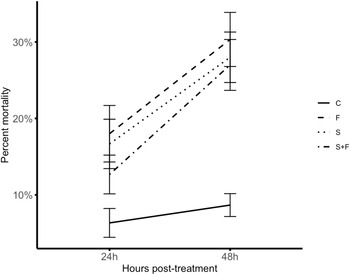
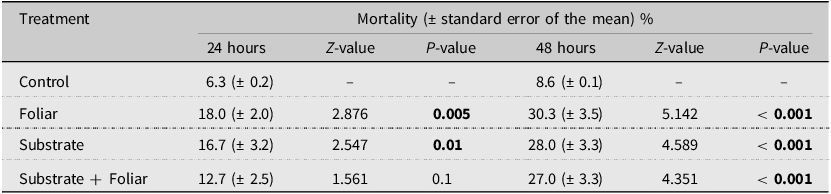
Rock dust application, whether foliar, substrate, or a combination of both, exhibited both acaricidal and repellent effects against T. urticae. In no-choice experiments, all rock dust treatments significantly increased mite mortality compared to the control (F 3,230 = 12.7, P < 0.0001) and over time (F 1,230 = 22.8, P < 0.0001; Fig. 1). Notably, although the combined foliar and substrate application did not induce significant mortality 24 hours after introduction, both individual foliar and substrate applications showed strong acaricidal activity (Table 1). By 48 hours, all three treatments resulted in significant mortality of 27–30%.
Percentage mortality (± standard error of the mean) at different time points in grapevine, Vitis spp., leaf disk no-choice experiments with two-spotted spider mites, Tetranychus urticae. Rock dust treatments (F, foliar application at 10% w/v; S, substrate application at 10% w/w; S+F, combined substrate + foliar application) are compared to the control (C).
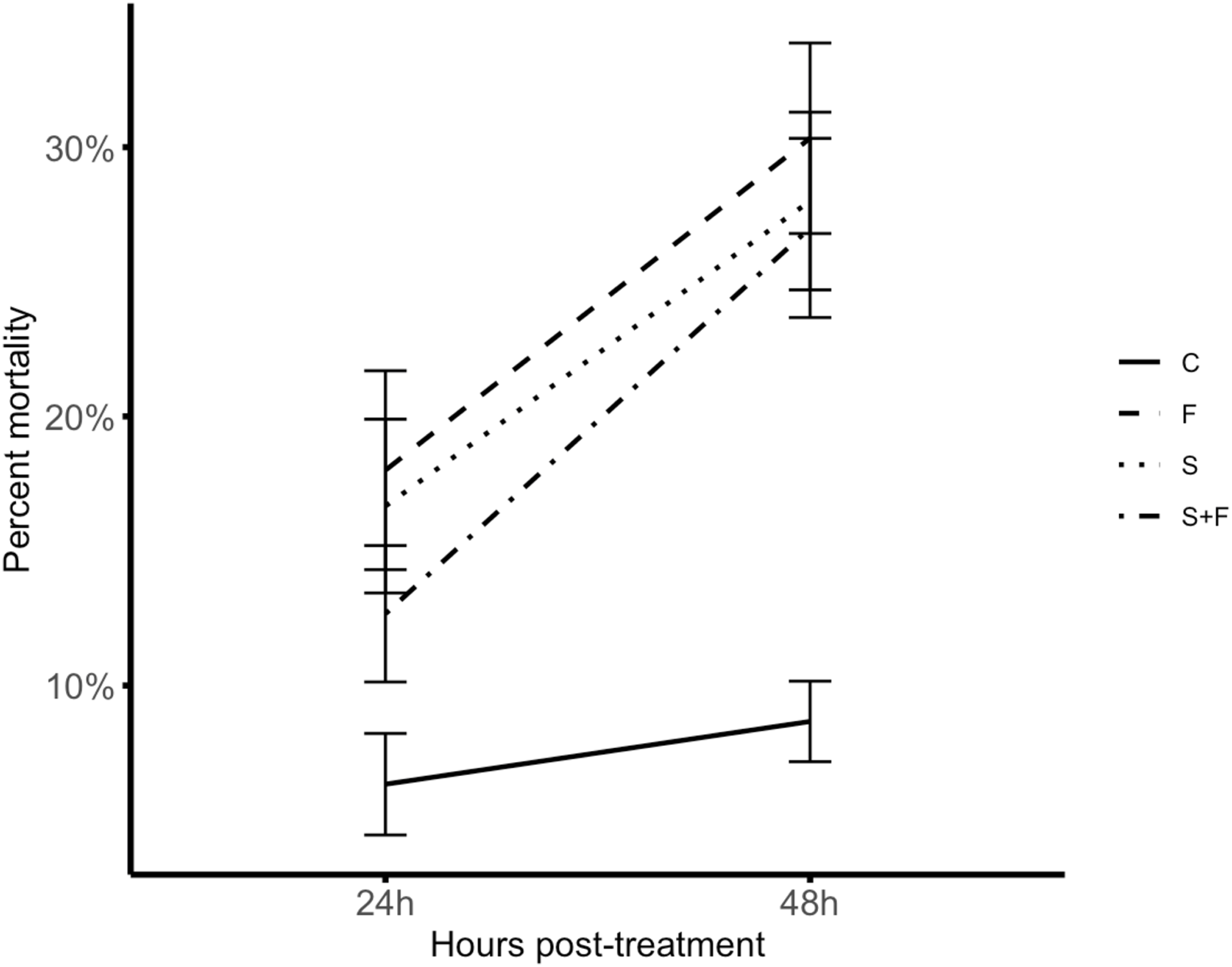
Mean percentage mortality (± standard error of the mean) of two-spotted spider mites, Tetranychus urticae, at different time points and different treatments in no-choice bioassays. Granite rock dust was applied to grapevine, Vitis spp., leaf discs as a foliar treatment (“foliar”) at 10% w/v, added to the plant substrate (“substrate”) at 10% w/w, or applied using a combination of both methods (“substrate + foliar”). Mites were placed on the leaf disc, and mortality was recorded after 24 hours and 48 hours.
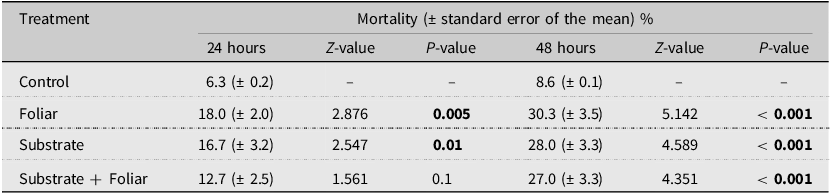
Bold values indicate statistically significant differences between the treatments and the control.
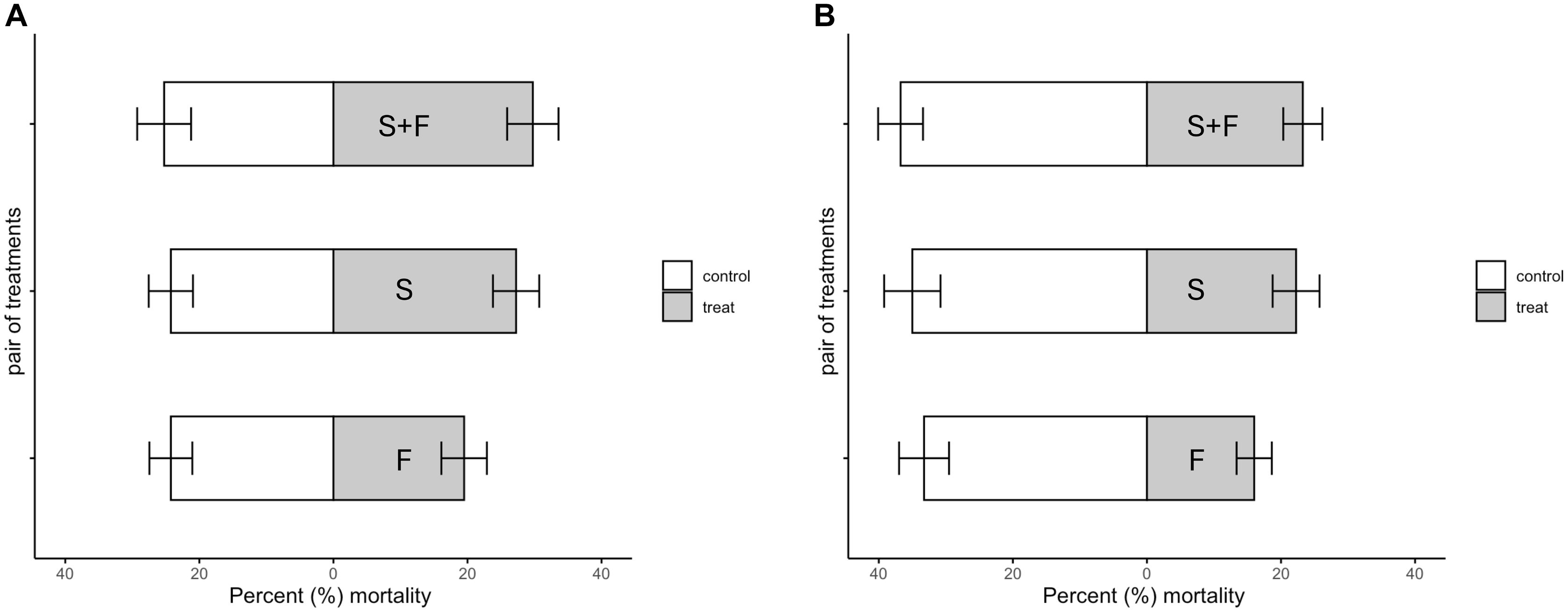
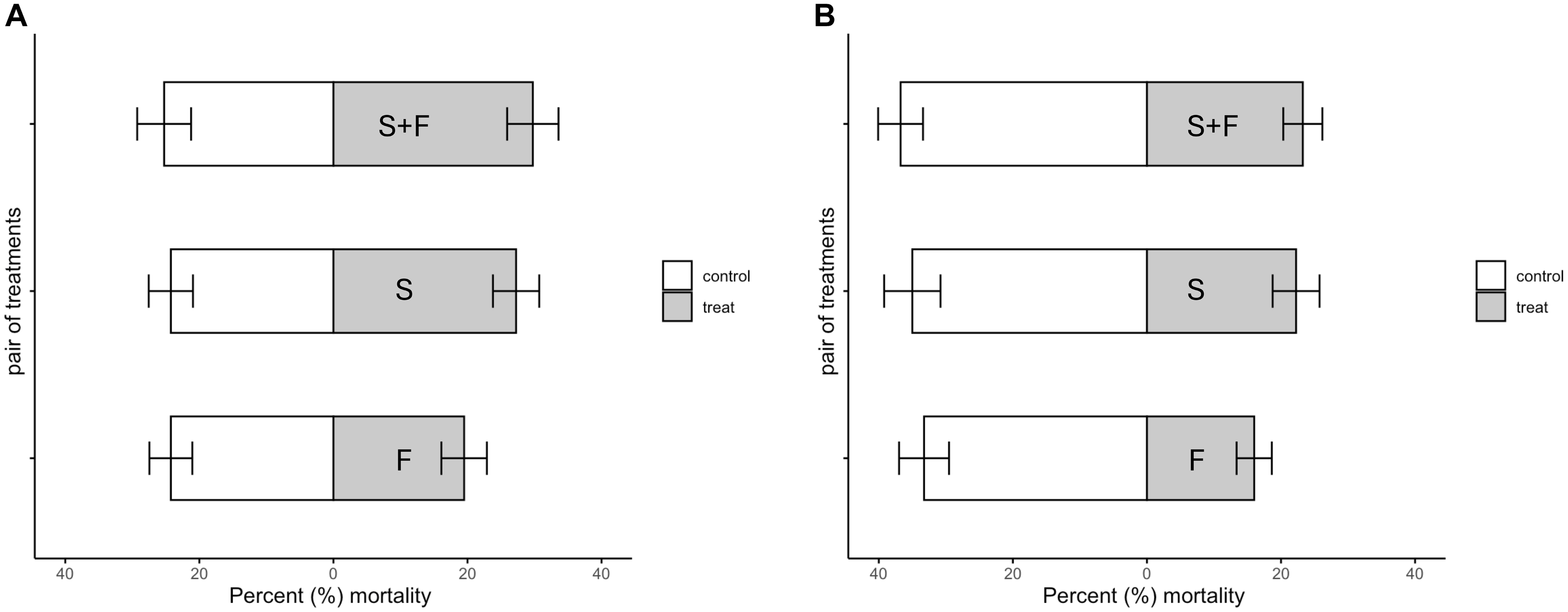
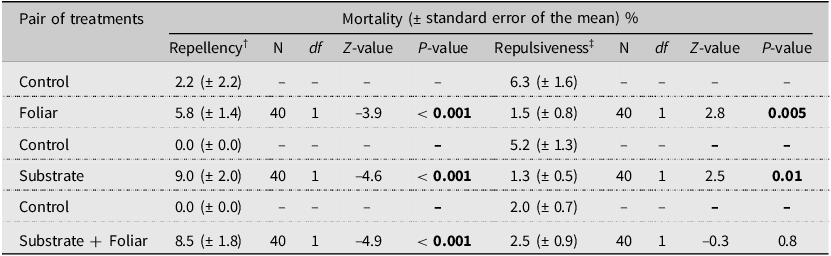
In the repulsiveness experiments, the rock dust significantly inhibited T. urticae movement from control leaf disc to treated discs (Fig. 2A). After 24 hours, significantly more mites were found on the control discs than on the treated discs for the foliar (N = 40, Z = 3.5, df = 1, P < 0.001), substrate (N = 40, Z = 2.2, df = 1, P = 0.02), and substrate + foliar (N = 40, Z = 3.1, df = 1, P = 0.002) treatments. Mortality was significantly higher on the control discs for foliar (N = 40, Z = 2.8, df = 1, P = 0.005) and substrate (N = 40, Z = 2.5, df = 1, P = 0.01) treatments (Table 2), potentially due to dying mites returning to the control after exposure. The substrate + foliar treatment did not significantly increase mortality compared to the control.
Percentage of surviving two-spotted spider mites, Tetranychus urticae (± standard error of the mean) in grapevine, Vitis spp., leaf disk two-choice experiments: A, repulsiveness (mites initially located on the control leaf) and B, repellency (mites initially located on the treatment leaf) experiments. Asterisks indicate significant differences between rock dust treatments compared to the control (S+F, substrate + foliar application; S, substrate application at 10% w/w; F, foliar application at 10% w/v) after 24 hours (*P < 0.0001; Wilcoxon signed-rank test).
Mean percentage mortality (± standard error of the mean) of two-spotted spider mites, Tetranychus urticae, in two-choice bioassays at 24 hours (Wilcoxon signed-rank test). Rock dust was applied to grapevine, Vitis spp., leaf discs as a foliar treatment (“foliar”) at 10% w/v, added to the plant substrate (“substrate”) at 10% w/w, or applied using a combination of both methods (“substrate + foliar”). In the repellency assay, mites were initially placed on the treatment leaf disc; in the repulsiveness assay, mites were initially placed on the control leaf disc. Mortality was recorded after 24 hours.
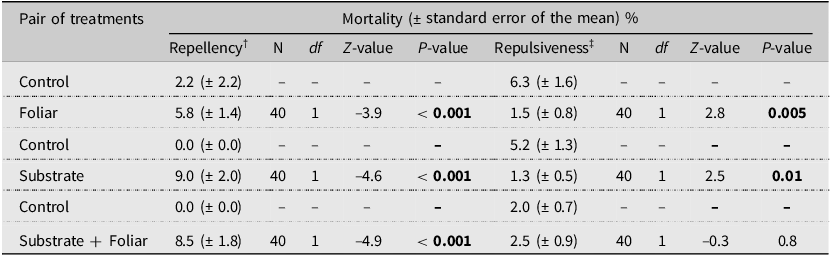
Bold values indicate statistically significant differences in means from the control.
† Mites initially located on the treatment leaf.
‡ Mites initially located on the control leaf.
In contrast, the repellency bioassays, where mites were introduced onto the treated disc, showed that some of the mites located initially on the treated disc moved between discs leading to no significant differences in mite distribution between treatments and the control after 24 hours (foliar: N = 40, χ = 1.7, df = 1, P = 0.2; substrate: N = 40, χ = 0.4, df = 1, P = 0.5; substrate + foliar: N = 40, χ = 1.0, df = 1, P = 0.3; Fig. 2B). This might indicate a degree of repellency across all treatments. Mortality was significantly increased by all treatments (Table 2), suggesting that rock dust affects mites through contact or indirect effects related to feeding on treated plant material, or through a combination of both contact or indirect effects.
Discussion
We evaluated the repellent, repulsive, and acaricidal effects of granite dust on T. urticae through foliar and substrate applications in grapevines. Consistent with our earlier research on tomato and squash (Cucurbitaceae) plants (Faraone et al. Reference Faraone, Evans, LeBlanc and Hillier2020; Faraone and Hillier Reference Faraone and Hillier2020), we observed that granite dust interacted with mites in diverse ways, depending on the application method (substrate, foliar, or both).
This study reinforces the understanding that silicon supplementation can directly and indirectly influence herbivores, bolstering plant defences against pests (Faraone et al. Reference Faraone, Evans, LeBlanc and Hillier2020; Faraone and Hillier Reference Faraone and Hillier2020; Bathoova et al. Reference Bathoova, Svubova, Gimes, Kostolani, Slovakova and Martinka2025). We demonstrated that foliar application of granite dust induced a preference for untreated leaves (repulsiveness effect) or movement towards control leaves (repellency effect; Fig. 2). The fine coat of dust may have acted as a physical barrier to the mites’ ability to reach the leaf epidermis with their chelicerae. Furthermore, significant acaricidal properties were observed, resulting in mortality rates of 9–10% in two-choice experiments and 27–30% in no-choice experiments (Table 1; Fig. 1). These acaricidal properties align with those reported for other silica-rich dusts that induce pest desiccation through contact (Cook et al. Reference Cook, Wakefield and Bryning2008).
Granite dust, when applied as a combination of substrate and foliar treatments in no-choice experiments, caused mortality after 48 hours, mirroring the efficacy of single substrate or foliar applications (Table 1; Fig. 1). Repulsiveness experiments demonstrated that granite dust reduced mite settling on treated leaves, indicating a reduction in host acceptability (Table 2). This is consistent with findings that silicon-based products, such as potassium silicate, can suppress T. urticae infestations when used as substrate amendments (Gatarayiha et al. Reference Gatarayiha, Laing and Miller2010).
The lack of significant mortality differences between control and substrate + foliar-treated leaves in repulsiveness experiments (Table 2) may stem from a stronger repellent effect of the substrate + foliar treatment, leading mites to avoid treated leaves and minimising exposure (Fig. 2A). Interestingly, survival was lower in the control compared to the substrate and the foliar treatments (Table 2; Fig. 2A). Substrate amendments with granite dust can reinforce plant cell walls, particularly in grapevines (Ma Reference Ma2004). Faraone et al. (Reference Faraone, Evans, LeBlanc and Hillier2020) demonstrated that granite dust, especially as a foliar treatment, induces structural leaf changes, including increased lignification, and observed that increased silica deposition in plant tissues also occurs. This reinforcement could impair mite feeding by damaging mouthparts (Moraes et al. Reference Moraes, Goussain, Carvalho and Costa2005), affecting their feeding abilities after exposure.
The granite dust exhibited a high silica content and other oxides (chemical composition proprietary to Heritage Memorials Ltd.), correlating with silicon’s established role in pest control, as documented in Faraone et al. (Reference Faraone, Evans, LeBlanc and Hillier2020). This aligns with the efficacy of other silicon-based products, such as diatomaceous earth, in plant protection against pests and environmental stressors (Ma Reference Ma2004; Moraes et al. Reference Moraes, Goussain, Basagli, Carvalho, Ecole and Sampaio2004, Reference Moraes, Goussain, Carvalho and Costa2005; Epstein Reference Epstein2009; Reynolds et al. Reference Reynolds, Keeping and Meyer2009). Numerous studies have investigated silicon’s potential as a nutrient that provides plant defence against herbivores and pathogens (Bowen et al. Reference Bowen, Menzies, Ehret, Samuels and Glass1992; Menzies et al. Reference Menzies, Bowen, Ehret and Glass1992; Blaich and Grundhöfer Reference Blaich and Grundhöfer1998; Guével et al. Reference Guével, Menzies and Bélanger2007; Massey and Hartley Reference Massey and Hartley2009; Vivancos et al. Reference Vivancos, Labbé, Menzies and Bélanger2015; Yang et al. Reference Yang, Han, Li, Li, Ali and Hou2017a, Reference Yang, Han, Li, Wen and Hou2017b). Silicon’s impact on various pest types, including folivores, phloem-feeders, cell-piercers, and xylem-feeders, is well recognised. This effect is attributed to both the mechanical properties of leaves (Yang et al. Reference Yang, Han, Li, Li, Ali and Hou2017a) and to indirect chemical defences that are mediated by soluble silicon (Keeping and Kvedaras Reference Keeping and Kvedaras2008; Reynolds et al. Reference Reynolds, Keeping and Meyer2009, Reference Reynolds, Padula, Zeng and Gurr2016; Ye et al. Reference Ye, Song, Long, Wang, Baerson and Pan2013). Notably, V. vinifera vines can absorb silicon from substrate amendments, leading to enhanced resistance to pests (Blaich and Grundhöfer Reference Blaich and Grundhöfer1996; Reynolds et al. Reference Reynolds, Veto, Sholberg, Wardle and Haag1996).
Our lab results suggest that granite dust may be used to control two-spotted spider mites on grapevines, thereby positioning it as a promising pest management strategy for both vineyards and grapevine propagation. To further develop this tool, we recommend future research that elucidates the mechanisms behind granite dust’s repellent and acaricidal actions. Studying granite dust’s actions on other crops and pest species is also warranted. The present study provides further evidence that granite dust can modify pest behaviour and act as an acaricide, strengthening the case for high-silica mineral products in integrated pest management.
Acknowledgements
The authors thank Heritage Memorials Ltd. (Windsor, Nova Scotia) for providing the granite dust material, and Vineland Research & Innovation Centre (Vineland Station, Ontario) for providing the two-spotted spider mite colony. This research project was funded by the Natural Sciences and Engineering Research Council (NSERC; CRDPJ-500477-16 to N.K.H.). The authors thank the two anonymous reviewers for their constructive feedback and assistance in improving the manuscript.
Competing interests
The authors declare that they have no competing interest.
Author contributions
N.F., R.B., and N.K.H. conceived and designed the research; N.F. and R.B. conducted the experiments; N.F. analysed data; and N.F., R.B., and N.K.H. wrote the manuscript. All authors read and approved the manuscript.

 Open access

